A Daily History of Holes, Dots, Lines, Science, History, Math, Physics, Art, the Unintentional Absurd, Architecture, Maps, Data Visualization, Blank and Missing Things, and so on. |1.6 million words, 7500 images, 4.9 million hits| Press & appearances in The Times, Le Figaro, Mensa, The Economist, The Guardian, Discovery News, Slate, Le Monde, Sci American Blogs, Le Pont, and many other places… 5000+ total posts since 2008.

  • On Great and Anonymous Works: Doe, Roe, John Q. Public, Average Joe, Joe Schmoe, and Darwin, Newton, & Co.

    JF Ptak Science Books  

    There was a brief point in Charles Darwin’s publishing life when the old (then young) man got stiffed.   Darwin’s magisterial contribution to Narrative of the Surveying Voyages of her Majesty’s Ships Adventure and Beagle between the years 1S26 and 1836…, (published in 1839) appeared in the third volume,  (by far and away the most important volume), and was issued without his name on the title page, which as it turns out was okay by the standards of the day.  The real oddness turns up in  the publisher’s ads that appeared in the later issues of those volumes in late 1839 for what would be a separately-issued volume of Darwin’s contribution (Journal of Researches into the Geology…), where there was no mention of the author’s name. (Captain Robert Fitz-Roy,  the man whose name adorned those early volumes, was the Captain of the Beagle and a man of high accomplishment and some pioneering meteorological ideas.)  
    Anonymouspaine

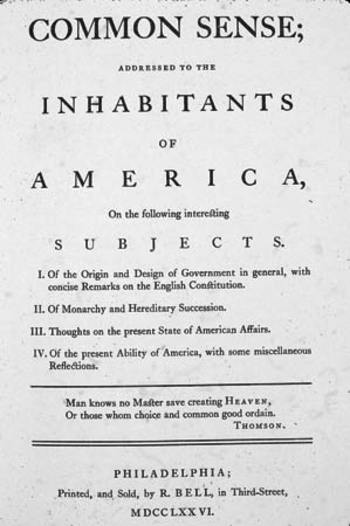
    The history of world literature ancient and modern abounds in silenced or self-silenced authors—there is even a four volume encyclopedia to help you identify the unidentified. . Political and religious work are also particularly heavily laden with unattributed or disguised efforts—the U.S. Constitution and the Federalist Papers are of course both anonymous (and of necessity), as was the most beautiful work of Voltaire.  The Declaration of Independence, on the other hand, and also of necessity, was not.  What is that  they say?  Anonymity is the best defense against the tyranny of the majority”?  It still feels a little Orwellian to see the unattributed source in the newspaper or read an anonymous editorial.   On the other hand Thomas Paine’s On Common Sense may not have made it into print if its author had been required to identify himself. 

    Art is perhaps the longest-lived area of anonymous work, the signed canvas being a relatively recent invention.  There are thousands of years of unknown hands and eyes represented in millions of works, but really we only get solid confirmation of the intellectual origin of a work through the invention of the ornament of the signature, and this just within the last 500 years.  And even after this defacement begins to appear there is still a relatively stout history of semi-anonymous works coming from painting studios doing work “in the manner of ____”.  Of course there were other considerations at play here, what with guilds and patrons and all—the artist was one person in a lengthy bureaucratic trail of aesthetic production.
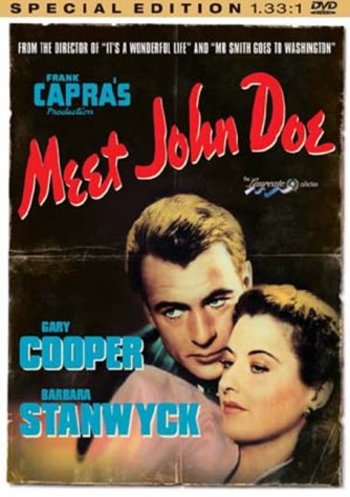
    Anonymouscooper Anonymous seems to come more into play in our present culture via the need for a place holder—when tallying and accounting the death of unknown people, for example, the name “John Doe” or “Jane Roe” is used (in the U.S.) to take up the forever empty space calling for The Departed’s name. (Our most famous “Jane Roe” is Norma McVorvey of Roe v. Wade; I think the Gary Cooper film (“Meet John Doe”) still ranks the highest for the male equivalent.)  Something has to go there in that empty space, and so it does–the placeholder name. (The practice of using such names is actually pretty old, and is practiced worldwide. See HERE  for an entertaining look at multi-cross-cultural “John Doe” equivalents.)

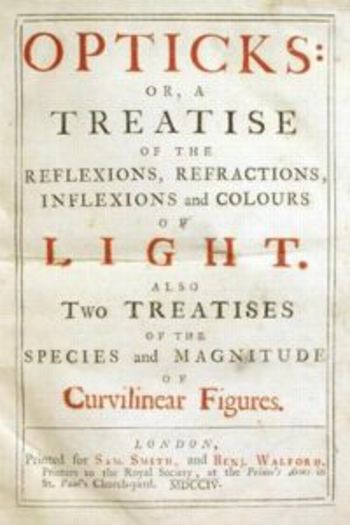
    And now that I’ve had some time to think about non-Darwin examples from the sciences, I’m a little stumped.  Robert Boyle is a good example, what with more than a dozen of his works (at least according to John Fulton’s bibliography) were published without his name carrying the title page-but these were the philosophical and political works of a scientist, and not scientific.  Same too for Pascal, who wrote his Pensees undercover—and again, not scientific but by a scientist.  Isaac Newton published his Annoymousopticks_2 Opticks without his name on the title and in fact only used his initials in the preface as his personal identifiers. 
    That leads us to a final example of Thomas Malthus, who really did publish the first printing of his massively important Essay on Population without his name—it would make an appearance soon after, though, in the second edition of this contentious work making the first edition of this great near-scientific work one of the most influential anonymously published  books of the last 250 years.   

    An unusual example of “anonymous” was Copernicus, the ultimate anonymous author of a scientific work because he intended not to publish i fearing reprisals for his challenging and revolutionary work. He waited until he was basically nearly dead to have his effort put into print, and so overcame his anonymity issue in print to adopt a biological anonymity enjoyed by the dead, his body loosened from the grip of his name so far as reprisals went.  He was free from fear of all anxiety and moral espionage at this point, and he did see the work brought to public display. with his name very boldly displayed on the title page. 
  • Human Maps of Cyborg Parts, Wounds, and Blood

    JF Ptak Science Books

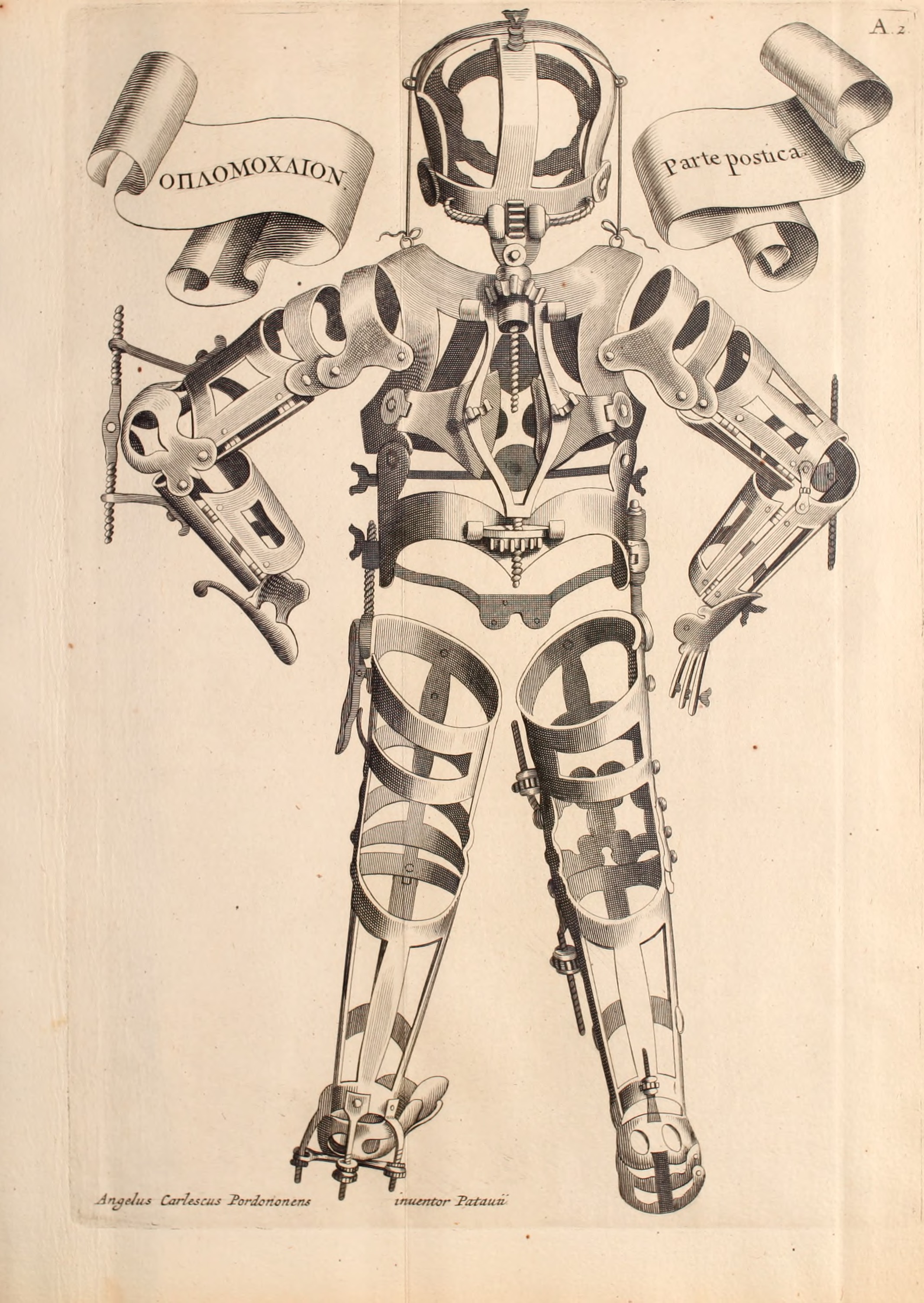
    A Map of Man’s Ability to Replace Himself, 1610-1723

    FabriciThis woodcut of applications and applicators to injured humans, lacking the human, waiting for the human, the missing human, was made by Hieronymous Fabrizzi (or Jerome Fabricius, 1537-1619), and found in his Opera Chirurgica… printed in 1723.  Even though this is a pretty straight-forward image, it strikes me as a little odd, a little off,  looking a bit like inhuman trappings, the entrapments of a human waiting to be built, an artificial skin with artificial bones.  It was much less than that, and in its way, much more—it was a statement of the advances of medicine in the 16th century, a map of the ability of man to replace himself; a map of the artificial man. Perhaps the image of our own artificial man, showing our ability to replace organs, bone, skin, limbs, etc.may come to look to the people of the near future the same way that we here in the present look back on Fabricius’ image. 

    [Image source: Wikimedia Commons]


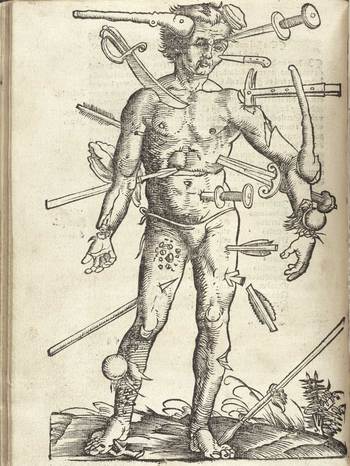
    A Map of Getting Wounded

    This map of the wounded man was a very popular, much reproduced

    Gersdorff_p21v_3image, seeing publication in many works since it first appeared in
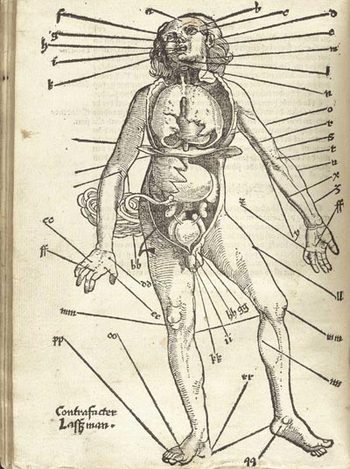
    Johannes de Ketham’s Fasciculus Medicinae,  printed in the year Columbus set sail for India.  It was a battle map, really—a battle for the human body, showing the effects of what happened to that body when someone tried to erase its existence.  The image is graphic, realistic and fairly gruesome, and highly useful.  It was accompanied by instructions on how to deal with all of the trauma, and to save the man thus that he could fight again. 

    This woodcut, as the next, appeared in Hans von Gersdorff. Feldtbüch  der Wundartzney (printed in Strassburg, by  H. Schotten, in 1528).


    A Map of Letting the Blood out of the Human Body

    Gersdorffx400jpg_other_2Well, it really wasn’t like that, not how I mean by a snippy modernist viewpoint looking back on medical history with no contextual appreciation.  Bloodletting was an approach to healthfulness, as blood was seen as one of the four major elements (or “humours”) of the human body that needed to be kept in balance.  This was accomplished via the application of leeches or by the more common (and quicker) practice of venesection, or opening a vein to allow the blood to come out. (Let’s reference Steve Reich’s magnificent “Bruise Blood” creation of 1966 at this point—I don’t think that I’ll ever have a better chance to drop a reference to this piece of revolutionary music in regards to venesection again.)  Thus this map was map for the practitioner of bloodletting—the physicians, and more probably the barbers and other assistants who would inherit this lesser procedure from the more-busy doctors.  In the history of maps of anatomy and the general practice of mapping the human condition, this woodcut x-ray of the best places to drain human blood would not survive close to the age of modernity, disappearing almost entirely by the 18th century, and becoming much more scarce well before that.
  • Comparative Naval Strength in an Infographic, 1905

    JF Ptak Science Books   Quick Post  (Quantitative Display of Information Series)

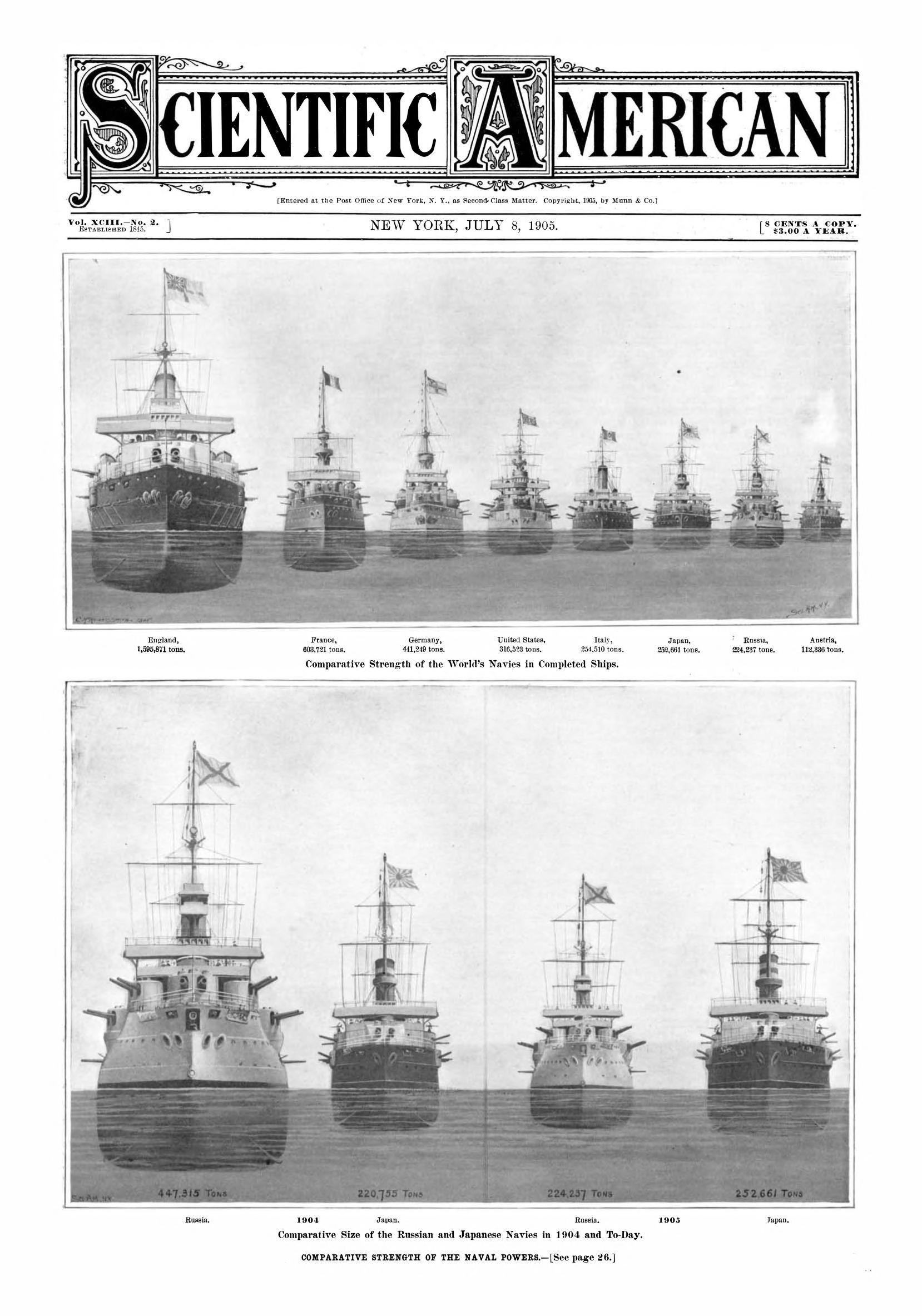
    Here’s another in a long series of Quick Posts on the artistic display of data: this one shows comparative naval strengths just after the turn of the century around the time of the First Moroccan Crisis, and appears in the 5 July 1905 issue of the Scientific American, home to a great number of these examples of popular numerical presentation.  Rule Britannia:
    Sci Am 1905 comparative naval strength

  • Examples of the First Use of Words by George Orwell Found in the OED

    JF Ptak Science Books  Quick Post   [Part of the series on Naming Things.]

    While looking for something else in the Oxford English Dictionary I looked up the instances of the works of “George Orwell” being used as illustrative/descriptive examples for a word and found 484 usages and 9 first-time-use references. That’s a lot for a modern writer in the OED–Shakespeare on the other hand has 15,986 listings and 1,591 first uses, the orders of magnitude fully expected; coming to another massive wordsmith in Gibbon,  we see the numbers skewed deeply down to 1,741 and 32. Anyway, Orwell/Blair shows well in comparison to The Rise and Fall, which to me is impressive.  Here are his 9:

    Doublethink: The mental capacity to accept as equally valid two entirely contrary opinions or beliefs.

    • 1949   ‘G. Orwell’ Nineteen Eighty-four i. iii. 37.   His mind slid away into the labyrinthine world of doublethink. To know and not to know, to be conscious of complete truthfulness while telling carefully constructed lies, to hold simultaneously two opinions which cancelled out, knowing them to be contradictory and believing in both of them, to use logic against logic, to repudiate morality while laying claim to it, to believe that democracy was impossible and that the Party was the guardian of democracy.

    ·Posted by :

    ·in:

  • Mail Call, War’s End, 1918

    JF Ptak Science Books   Quick Post

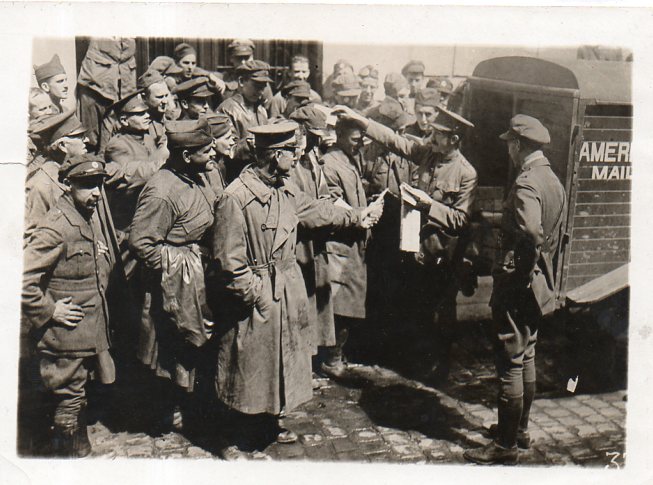
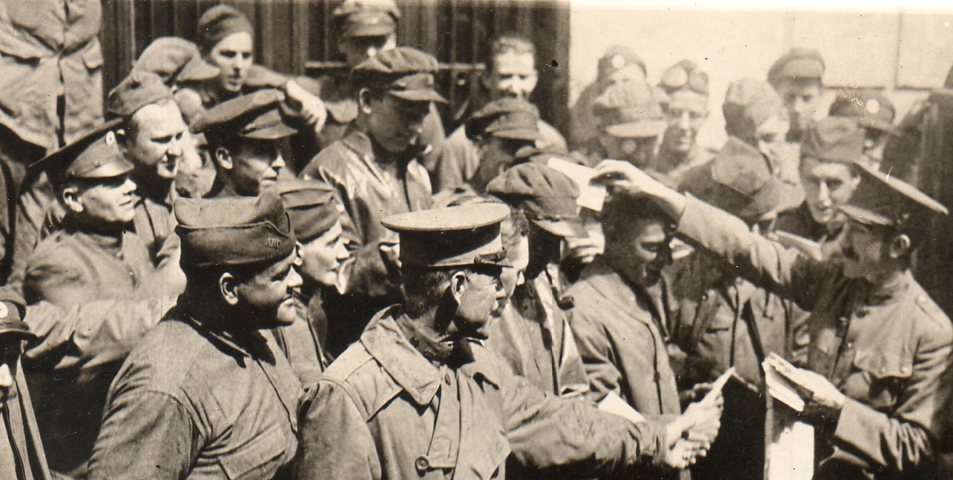
    Yes, this was undoubtedly a posed shot to some degree, but these U.S. soldiers were still very serious about getting their mail. This is a new photo service image made by a pool of photographers whose work was passed by a censor before being distributed1.  The photo was made in the closing weeks of the War in 1918.  On the back of the photo is stamped:  “What a letter from home means in France/Group of American Red Cross chauffeurs in Paris at mail distribution at their garage”, and “Bureau Publicity Lake Div. American Red Cross, for release October 2”.


    WWI Photo Mail167


    WWI Photo Mail168

    ·Posted by :

    ·in:

  • A World Going on, Underground: Tugger Boys, Trench Blasters, George Orwell, & Tom Waits

    JF Ptak Science Books   [An earlier post from 2008, expanded]

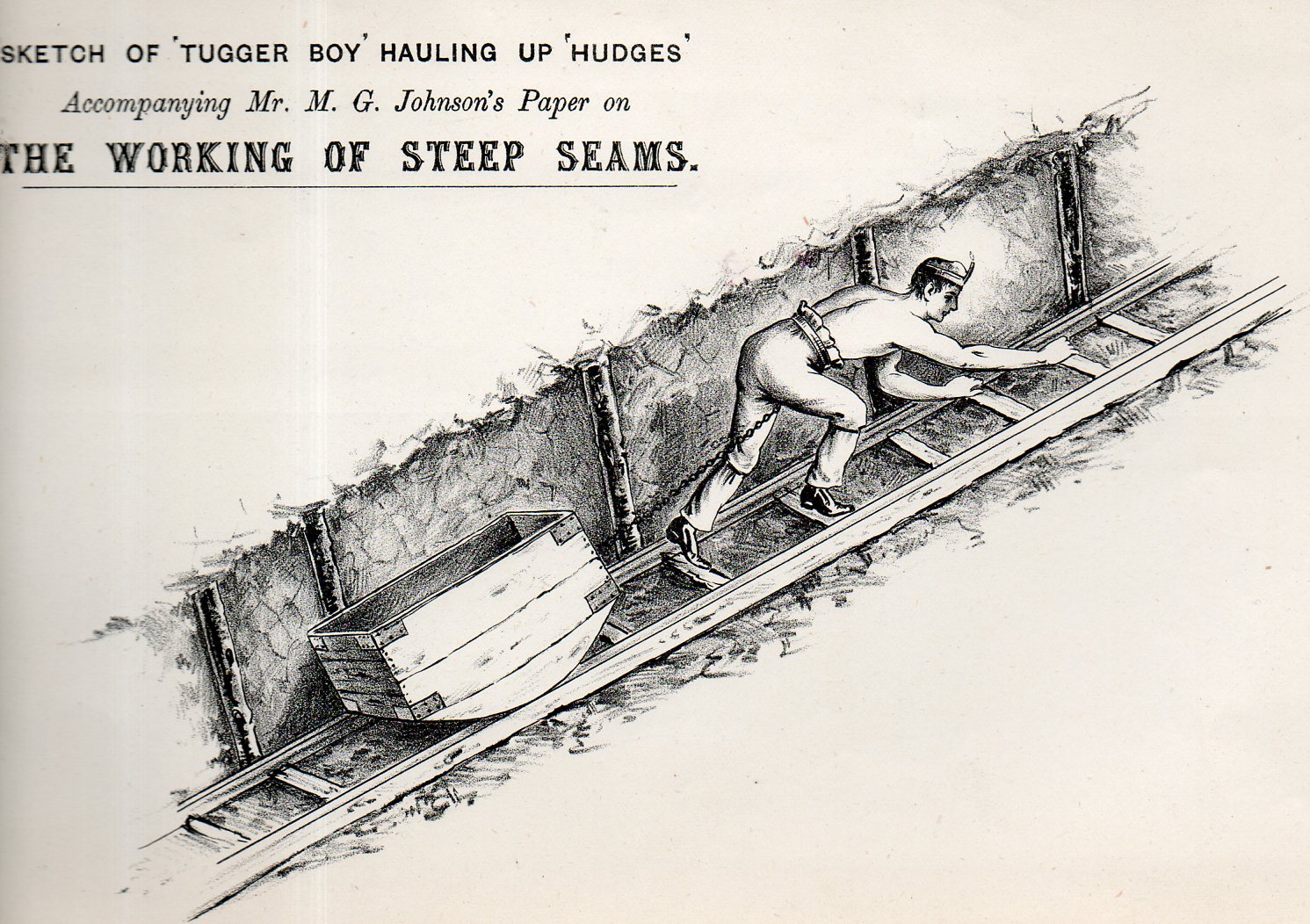
    Underground working steep102


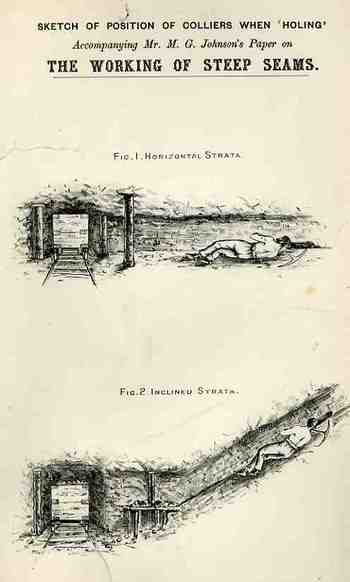
    Looking at these two images of the shirtless miner laying down and working on his side in the semi-dark way underground in what looks to be a tunnel about twice the width of his shoulders makes you wonder about how in the name of great bog could people have done this, day in and day out.  The fact that the appearance of these images were both essential and mundane further tells us—as we sit here in a comfortable chair in the print’s future—that this is, simply, what people did, and what they had to do.

    Blogjuly_17_work334

    This was “holing”, as in working in a hole, and served to illustrate a point in Mr. M.G. Johnson’s paper “The Working of Steep Seams”, which I think appeared in a West Australian mining journal around 1900.  It seems that the miner in the picture would spend his day chunking coal from a hard vein, laying down, scrapping (I think) away at the coal in a too-tight tunnel.  Did he do this for hours?  Days?  Weeks?  I guess the bad answer is that he did this as long as the coal could be followed, though I suspect that the miners must’ve traded out positions to prevent any one man from doing this sort of extremely difficult work for too long, sharing the responsibility of The Bad Job.  (Also, it looks as though that the major tunnel in which the coal car is located may be 4 or 5 shoulders high—certainly not tall enough to walk in, which means that this guy could’ve crab-walked to this position for a half mile or more, just to get to work.  The tenacity of this worker to do his work and collect his pay to feed his family was just incredible. 

    The first image really doesn’t need much commentary, though calling the worker a “tugger boy” pulling up a “hudge” was probably a bit of sardonic camaraderie–except that the doing of the job would distance you from its folksy name.

    • “Tugger boy (Brist). One who draws small tubs or sleds underground by means of a tugger. Called Tugger-work. (Gresley), 1883. 

    The depiction of what seems to be a mature man in the image might be a piece of propaganda. In any event,  the Tugger Boy carries his own flame on the top of his headgear, and the chain that attaches him to the heavy coal bucket runs from his waste down the front of his body and through his legs.  

    George Orwell wrote perhaps one of the most brilliant descriptions of the mining environment in his superb The Road to Wigan Pier. (It is well worth reading all of Orwell’s books at this point—his insights almost never looked so fresh.)

    He  describes the crab-walk from the elevator to the place of work, telling how difficult and exhausting the process was of just getting to the place where you would then begin your difficult workday.  Of the miners he says at one point:  “Watching coal-miners at work, you realize momentarily what different universes people inhabit. Down there where coal is dug is a sort of world apart which one can quite easily go through life without ever hearing about. Probably majority of people would even prefer not to hear about it. Yet it is the absolutely necessary counterpart of our world above.” 

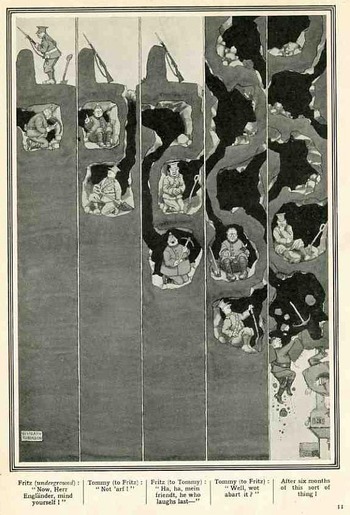
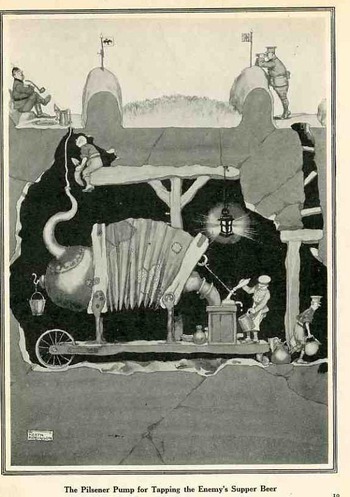
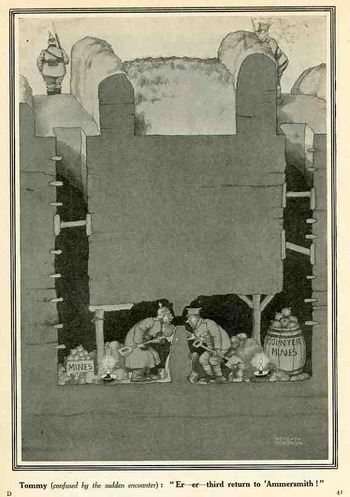
    The next series of images come from the pen of W. Heath Robinson (1872-1944) who was a lovely, quirky, charming, skewed, dark, stiff-bouncing and creative illustrator capable of considerable whimsy (light and complex) and deep skepticism.  The images I’ve selected are from one of his three WWI books, Hunlikely, published in 1916 (Some “Frightful” War Pictures (1915), and Flypapers (1919), were the other two) and depict scenes from the intra-trench tunnel wars, which were battles fought in the midst (or, actually, beneath) other battles.  This was a savage, grueling, post-adjectival affair—exceedingly dangerous, difficult, awful.  And it happened a lot during the war, given the experience of stalemates between vast armies sunk into mole city trenches, with no one going anywhere for long periods because there was nothing in between the two impervious lines but a death vacuum. 

    Blogjuly_18_mining_robinson338

    So one of the solutions was to try and tunnel underneath the opposing army’s defenses, fill the far end with high explosives, and blow them up.  The other side was doing it too, and in the middle of it all was the incorporation of newer/better listening devices to detect forces rummaging around underneath your position dozens of feet into the ground.  It was a bad business. (One of the other means of breaching the trench lines was aerial combat, but bombers carrying tons of HE were still yet to be invented; poison gas was another.  Most of the time the armies would just meet in the middle  in wide plains of nothingness in a sea of hot, expanding metal,  where to this day in many of those places nothing can live).

    Robinson’s illustrations are odd, and oddly funny, the dark humor coming at the expense of both sides of the conflict, piercing each.   

    Blogjuly_18_tunnel_2_robinson340

    This all puts me in mind of Tom Waits’ concrete-toothed “There’s A world Going On Underground” song from the Swordfishtrombones album: 

    Rattle big black bones in the danger zone
    There’s a rumblin’ groan down below
    There’s a big dark town, it’s a place I’ve found
    There’s a world going on underground
                
    They’re alive, they’re awake
    While the rest of the world is asleep
    Below the mine shaft roads, it will all unfold
    There’s a world going on underground
                
    All the roots hang down, swing from town to town
    They are marching around down under your boots
    All the trucks unload beyond the gopher holes
    There’s a world going on underground

    Blogjuly_18_tunnel_3_2_robinson341

  • Rising to a Higher State of Misery–Are You Outread by Victor Frankenstein’s Creation?

    JF Ptak Science Books   [An earlier Post from 2014, expanded]

    “Did I request thee, Maker, from my clay
    To mould Me man? Did I solicit thee
    From darkness to promote me?”–John Milton, Paradise Lost (X.743–5)

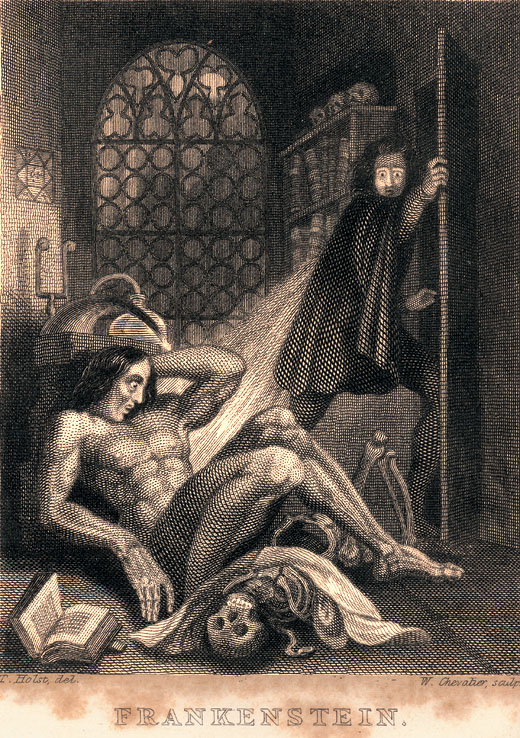
    Frankenstein_2_The animated human created by Victor Frankenstein in 20-year-old Mary Shelley’s anonymously published Frankenstein, or the Modern Prometheus (1818) was a far more intelligent being than portrayed in the many movies and stage productions that made the novel famous. “Frankenstein” usually refers to Dr. Victor, not the creation, who refers to himself as the  possible “Adam” of his maker’s labors (and then later as Victor’s “Fallen Angel” following his murderous and nearly-uncontrollable rage), while elsewhere in the book he is called “it”, as well as “being”, “creature”, “daemon”, “Fiend, “monster”, “vile insect” and “wretch”,  among other adjectival variants. 

    [Illustration at left by Theodor von Holst for the 1831 edition of Shelley’s book.]

    He has been “Frankenstein” as much as he has been the “monster”, and portrayed so in so many films and other adaptations that there is a virtual dictionary of the actors who have played the role. So many, in fact, that there are near duplicates of the actors’ names (as with for example “Gwynn” and “Gwynne”, and “Sarazin” and “Sarandon”). Actors have changed in the role but the iconic makeup first worn by Karloff remained the same after Karloff signed off from the role, though in a twist he returned to play Victor in a later movie. In another variation “Frankenstein” remarks that Dracula is his “master” (I think this is in Abbott and Costello Meet Frankenstein), and in a Hollywoodish irony Lugosi the master tries his hand in one film to portray Frankenstein himself. There are very few instances where Victor’s creation is portrayed sympathetically, at least before the 1980s. Generally he has been slow-witted, slow-footed, unintelligent and unremarkable, with little reasoning power and almost no verbal skills, none of which have anything to do with Shelley’s character. The adaptations seem to just appropriate the horror aspects of the novel, detach them, and sink them solely into the Boris Karloff character, which seems to have sold a lot of popcorn.

    “Remember that I am thy creature; I ought to be thy Adam, but I am rather the fallen angel, whom thou drivest from joy for no misdeed. Everywhere I see bliss, from which I alone am irrevocably excluded. I was benevolent and good; misery made me a fiend. Make me happy, and I shall again be virtuous.”

    Mostly the creation in Shelley’s text is referred to as a “monster”–the word being used 35 times, mostly in reference to Victor’s animated man.

    It is difficult to refer to the creation as a “monster” once you get to know him a little—he is exceptionally smart, teaching himself to read, and then reading difficult and complex works with deep understanding, which is hardly something that is expected from what Boris Karloff gave to us.

    This man is deeply conflicted, and in chapter 13 he says:

    “Was I, then, a monster, a blot upon the earth, from which all men fled and whom all men disowned?”

    “I cannot describe to you the agony that these reflections inflicted upon me; I tried to dispel them, but sorrow only increased with knowledge. Oh, that I had forever remained in my native wood, nor known nor felt beyond the sensations of hunger, thirst, and heat!”

    And then, in a couple of pages in chapter 15, we are given a great insight into this man, as he is about to understand these agonies via a discovery of three books in a portmanteau. These included The Sorrows of Werter by Goethe, a section of Plutarch, and John Milton’s Paradise Lost. The reading appears to elevate his state of understanding and of his misery, particularly with the Goethe.


  • The Mega Mother of all Gas Tanks (1907)

    JF Ptak Science Books   Quick Post  [Series on the Artistic Display of Data]

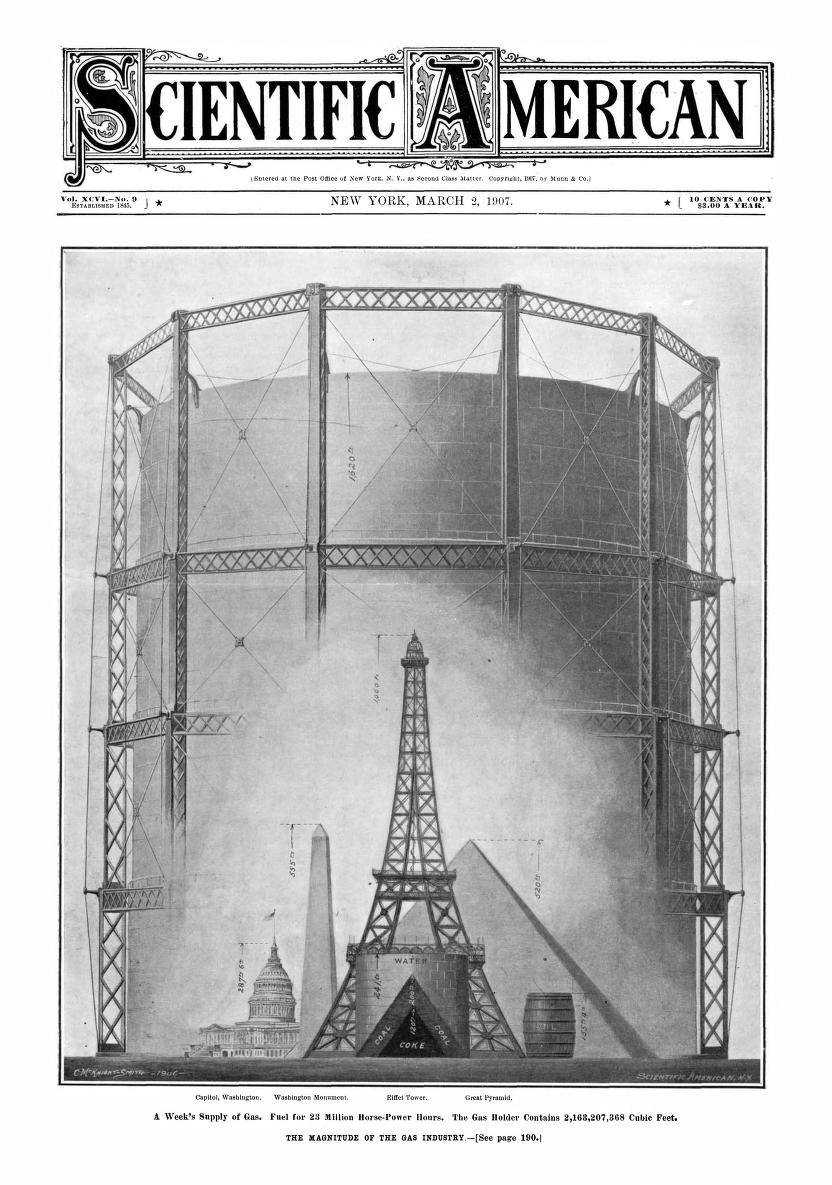
    This striking  comparative visual display of data appears on the front cover of Scientific American for 2 March, 1907, and relates the weekly consumption of gas in the U.S. in an enormous imaginary storage facility measured against several iconic structures.  (I think it would’ve been interesting to have an inset showing the yearly consumption…)  People would not doubt immediately forget the actual numbers of consumption, though they’d be hard-pressed to forget the comparative imagery of the number. 

    Sci AM 1907 Gas Consumption in the Skyline“A comparison of the yearly production of gas is unwieldy, owing to the lack- of objects with which to compare.

    The Eiffel Tower would look lost compared with a gasometer 4,556 feet -high, so we have taken a week’s supply,
    which amounts to 2,163,207,368 cubic feet. This enormous bulk is shown in our engraving stored in a huge gasometer
    1,620 feet high and 1,350 feet in diameter. The water is contained in a tank 241 feet high and 268 feet in diameter.
    The raw materials are also of a bulky nature. The coal
    would form a cone 268 feet across at the base and 200 feet high.
    The coke also forms a cone 120 feet
    high and 160 feet across the base. The oil would fill a barrel 155 feet high and
    122 feet in diameter.”–Scientific American, 2 March 1907

  • Some Good Military Cross Sections from “Popular Mechanics”, 1943

    JF Ptak Science Books  Quick Post

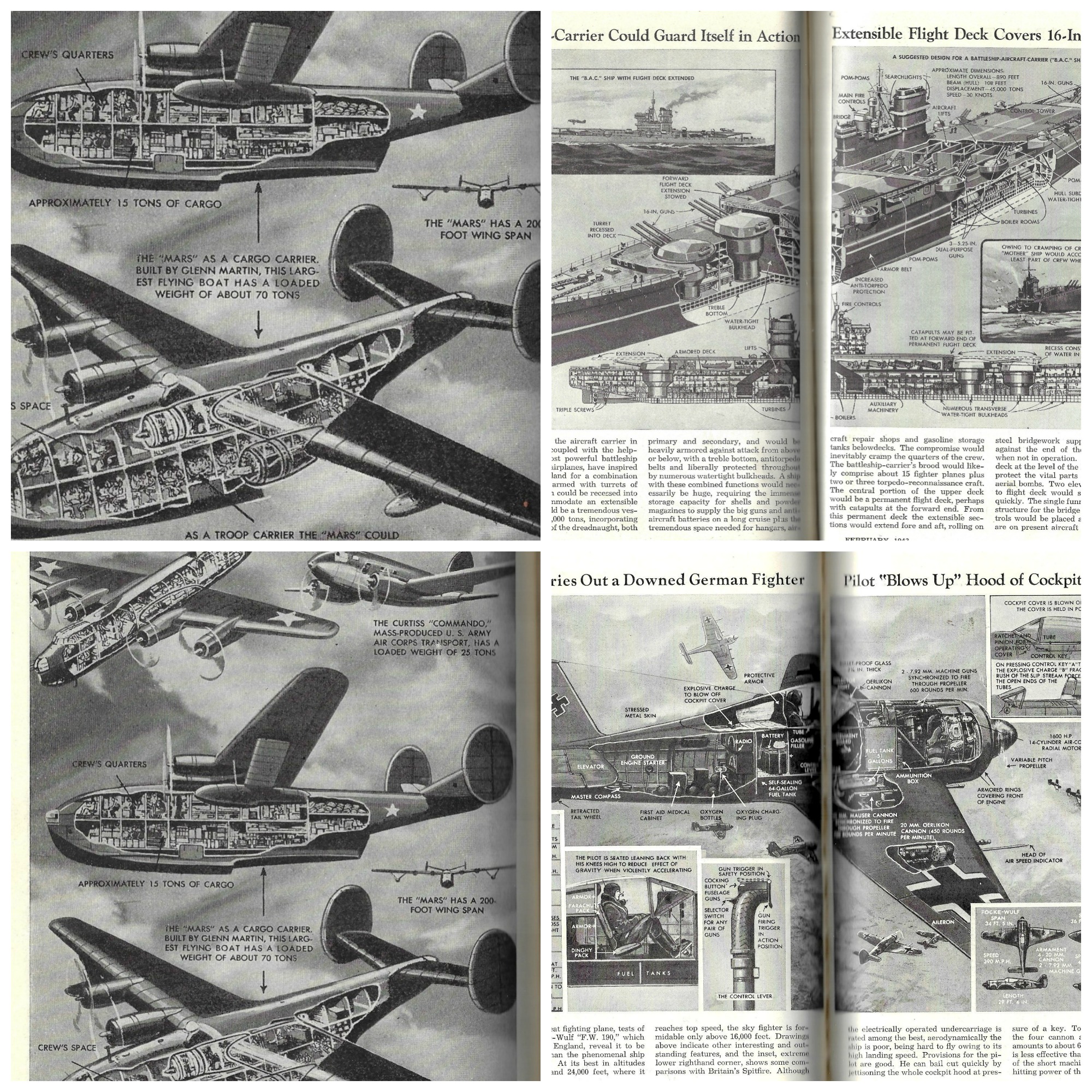
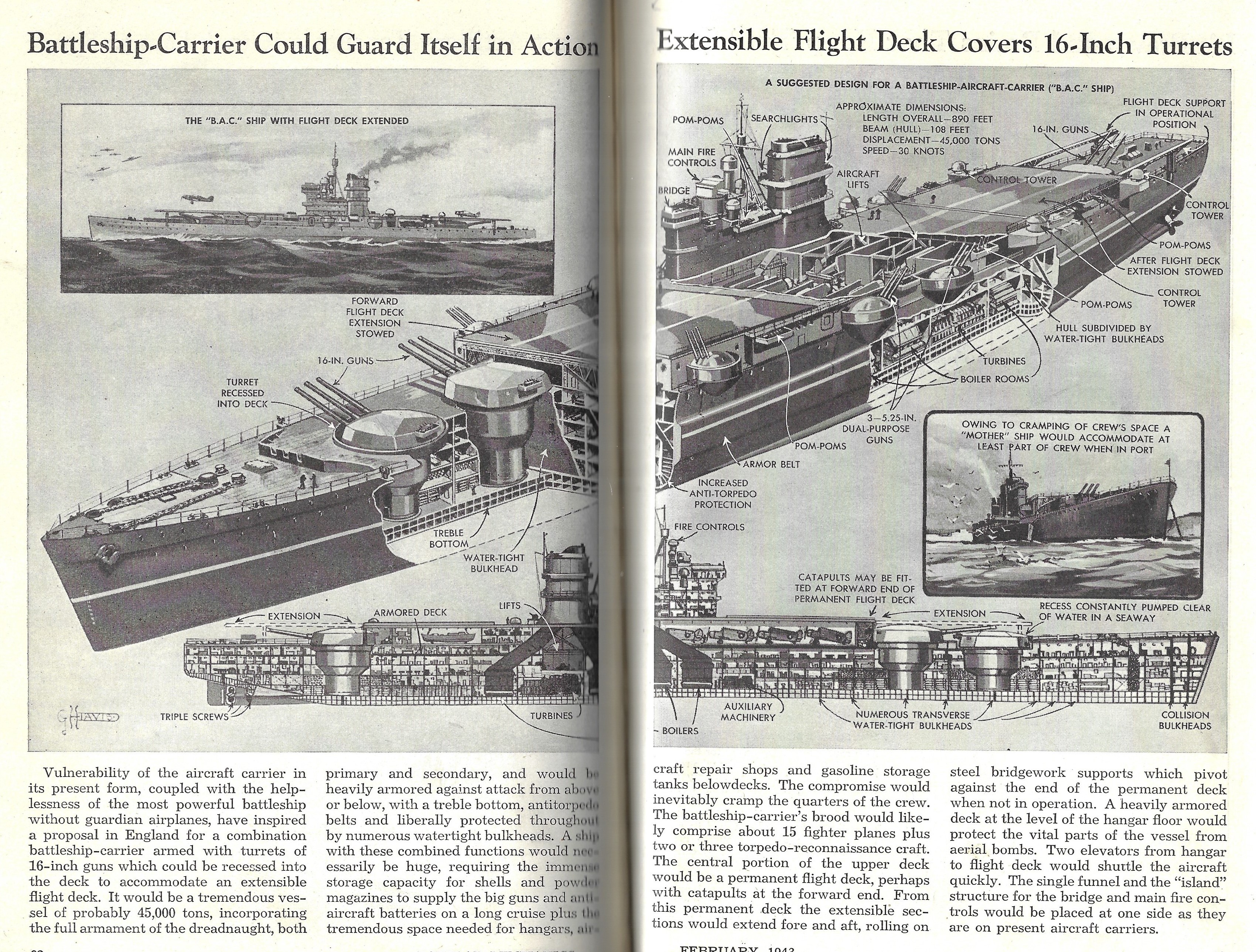
    Here are three fine cutaways from my favorite cutaway artist, George Davis. (He has appeared many times on this blog–just have a peek by entering his name in the Google search for the blog and you’ll have a number of hits.) These three appeared in a volume of Popular Mechanics for the first half of 1943 and feature comparisons for the cargo aircraft “Mars” (from Glenn Martin), a review of a captured F.W.-190, and a think-piece on a possible cruiser-carrier. 

    Pop Mech 1943 cross section collage

    Aha. Here’s an interesting dream of a supership dreamed by some Brit engineering dreamers in 1943–a cruiser-carrier, or Battleship-Aircraft-Carrier (“B.A.C.” as the article says). This was a monster with nine 16″ guns and a host of other armament and defences, plus a flight deck accommodating 15 fighter plans. Although this was an older idea it seems to have picked up steam following the Battle of Midway. 
    Pop Mech 1943 FW 190 Aviation


    ·Posted by :

    ·in:

  • The First Imagery of Einstein with “E=mc^2” Appears in…a Comic Book?

    JF Ptak Science Books  Post 2782

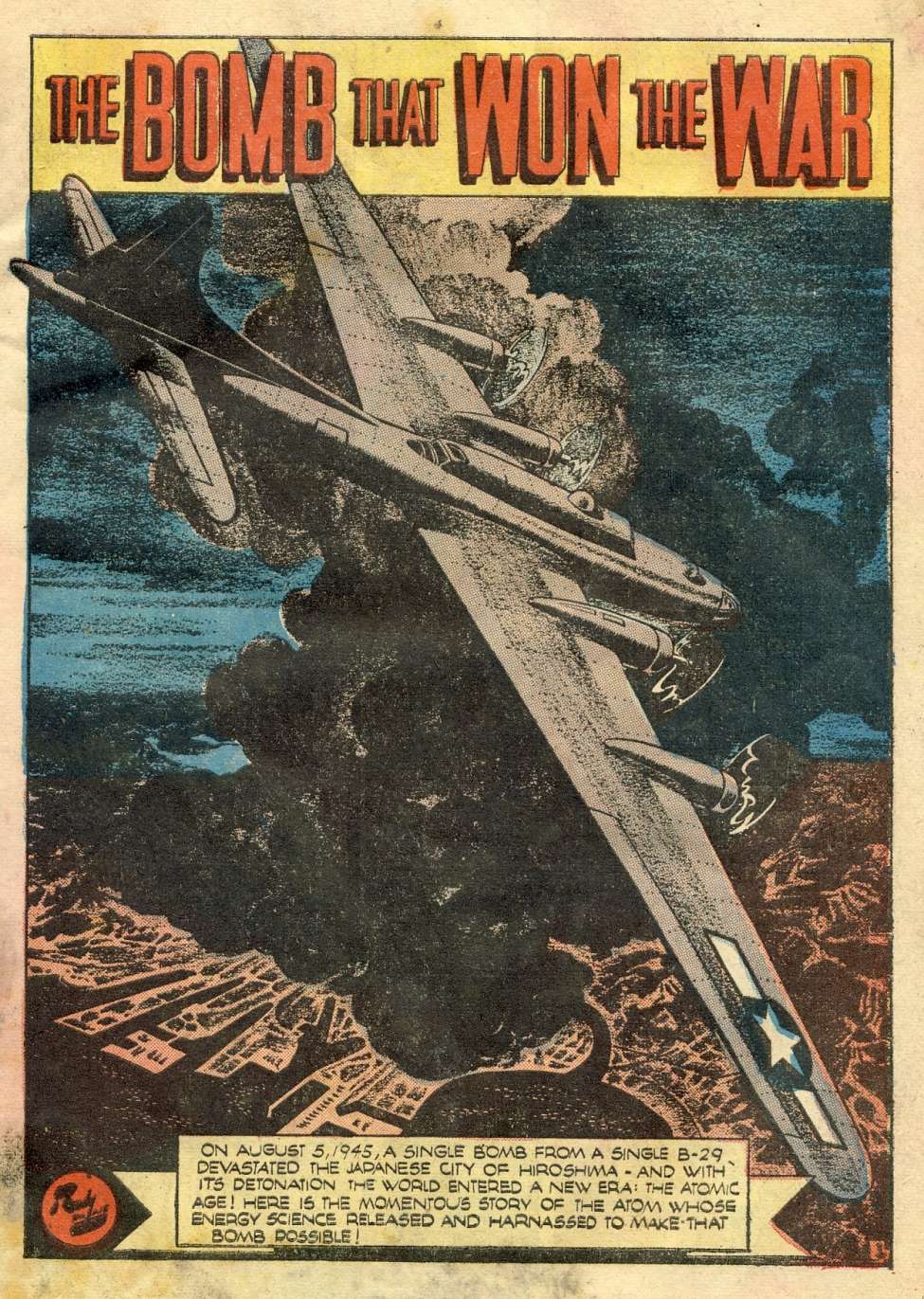
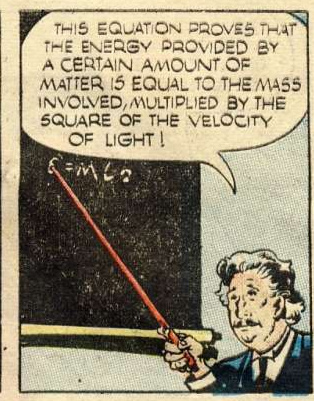
    Comic book hiroshima 1946After years of interest in the development of the atomic bomb and the half+-century of physics and chemistry that went into it, the question was put to me as to when the bomb’s use at Hiroshima and Nagasaki first appeared in a comic book. (It was potentially interesting to see how long it took  to see the effects of the bomb depicted to the very popular youth culture.) That led to an unexpectedly long and not very satisfying search for what turned out to be not a trivial answer. I’m not telling that story here now because the middle parts of the search are still a little unsorted–there was however another curious and provoking bit that popped up in the latest installment of the question,  found in what I think is the issue of this “first” comic book appearance of the use of the atomic bomb.

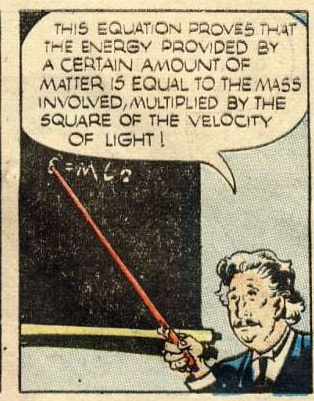
    Tucked inside this comic was an odd though not terribly wrong description of some of the background physics to the bomb. Amidst some fawning (?) and for no obvious reason highly caricatured images of physicists there appeared a crudely-rendered Einstein, and in his second panel, with his second blackboard, we see the The Equation, or almost so, appearing perhaps as   “E=mc2” or “E=mc2” [sic]. What seems to me to be the fact of the matter is that the equation that every schoolchild knows was not a very famous face to the great idea for nearly half a century, and nearly 25 years after Einstein received his Nobel (though that was not for relativity), because it just doesn’t show up. Long story short with a new subset, it seems to me that the very first time that Einstein publishes using this equation is not until the first issue of Science Illustrated,  in his article “E=mc2 the Most Urgent Problem of Our Time”, in April 1946.

    [Image sources above and below: Science Comics, vol 1/1, January 1946, from the wonderful website Comic Books Plus http://comicbookplus.com/?dlid=15937.  Also it is worth noting that the Enola Gay isn’t drawn very well, with extraneous stuff on the fuselage, and is also flying the wrong direction over Hiroshima and is too low…that’s all done for the sake of art, but, still, it ain’t right.]

    E=MC2 comic book 1946

    It didn’t seem possible that it took so long for the equation to be published under Einstein’s name, but it appears that this is the case. The theory appears with much else in Einstein’s miracle year of 1905 (where it was written as a sentence and not as a formula), and there are numerous other representation of the idea of mass-energy equivalence, but so far as Einstein writing it in its most recognizable notation, publishing it under his name, it looks like the first appearance comes years later.

    The equation seems not quite right here in the comic book, and of course it is a comic book characterization of Einstein who is writing it and not Einstein himself, so it seems that this is a curiosity and little else…except when you wonder where the comic book writer/inkman/artist was exposed to the equation so that he might include it in the story?  This must be a shadow of something else, obviously, though not a shadow thrown directly by Einstein. (Another twist came in July 1946 when Time magazine used an image of Einstein and a mushroom cloud on their cover, with E=mc2 written onto the mushrooming cloud. This is “close” but then again, not really–also it appears after the publication of our comic book and Science Illustrated.)

    Just a year earlier there was an appearance of “E=mc2 in Henry DeWolf Smyth’s Atomic Energy for Military Purposes: The Official Report on the Development of the Atomic Bomb Under the Auspices of the United States Government, 1940-1945, right there on page 2, in the introduction. (It was published months earlier in several formats by the U.S. government, though the Princeton 1945 edition reached more readers.)

    This part of the story also has to wait to be told because I haven’t quite got the timeline down for the E=mc2 equation exactly as it appears and not written/published by Einstein, the earliest example that I have found thus far is 1929 (below). Today’s entry on this matter is more thinking-out-loud than anything else. 

    I guess the bigger question is: does it matter that E=mc2 doesn’t appear until much later, or that Einstein didn’t use it much?  Probably not. Other equations–like m=E/c2 and E0=m–were used in lecture and in other papers. It is simply curious to me why the equation has such a misty history given its supra-iconic status. 

    • I’m a little hesitant about posting this on the equation because it seems that the answer is obvious, which makes my question seem a little kooky–so far though the answer seems not trivial. 

    Notes:

    The first appearance in print in general of the equation is a much knottier question, with the “usual suspects” of possibilities exhausted without a satisfactory answer.  I must commend Eric Sacharow (an independent scholar in Milford, Connecticut) for instantaneously suggesting several possibilities during a phone call, all of which were very good and very close to the mark, but not quite there–thus far the best of the possibilities offered.

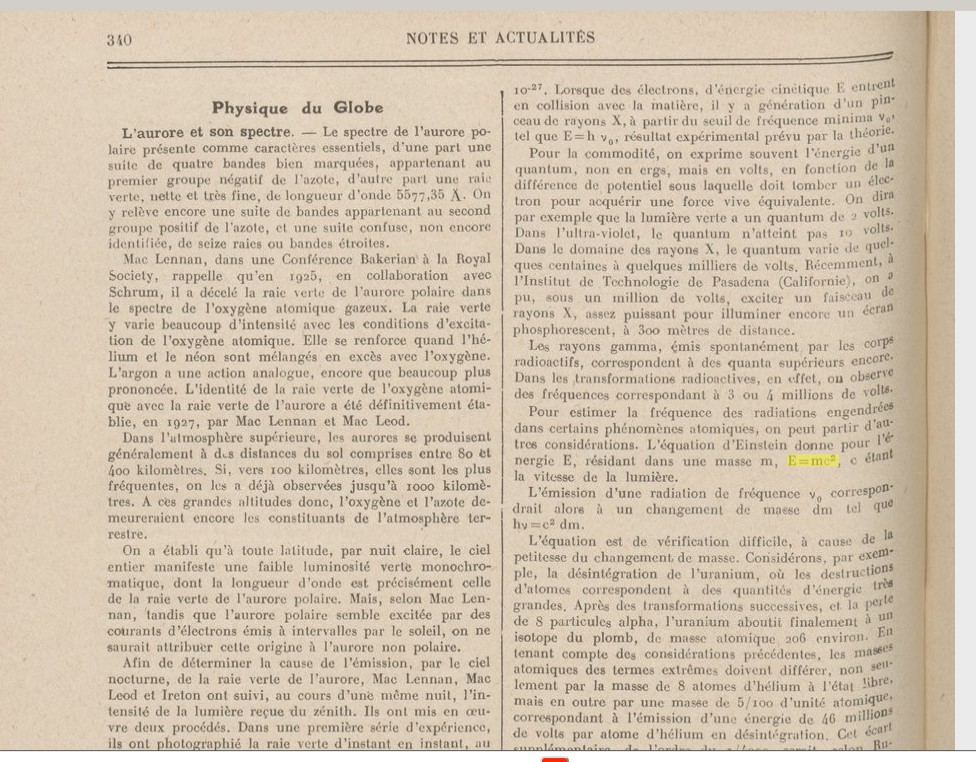
    Here’s an early appearance of E=mc2, in Revue Scientifique (Rose), 1929, in a review of physics for the previous weeks, a condensed review, signed only “S.V.”:

    E=mc2 1929 Revue

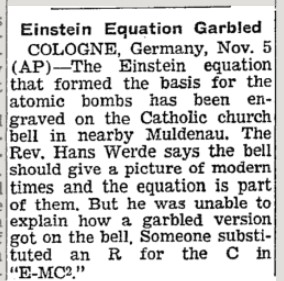
    And in this note from the New York Times (1950, sorry no further data yet) reporting on a “garbled” notation of E=mc2 that sounds as though it was engraved on a church bell as E=mr2 itself garbles the equation as “E-mc2“:

                                     E=MC 1950 NYT

    ·Posted by :

    ·in:

    —
  • A Moment of Levity at the Almost-End of WWI (October, 1918)

    JF Ptak Science Books   Quick Post

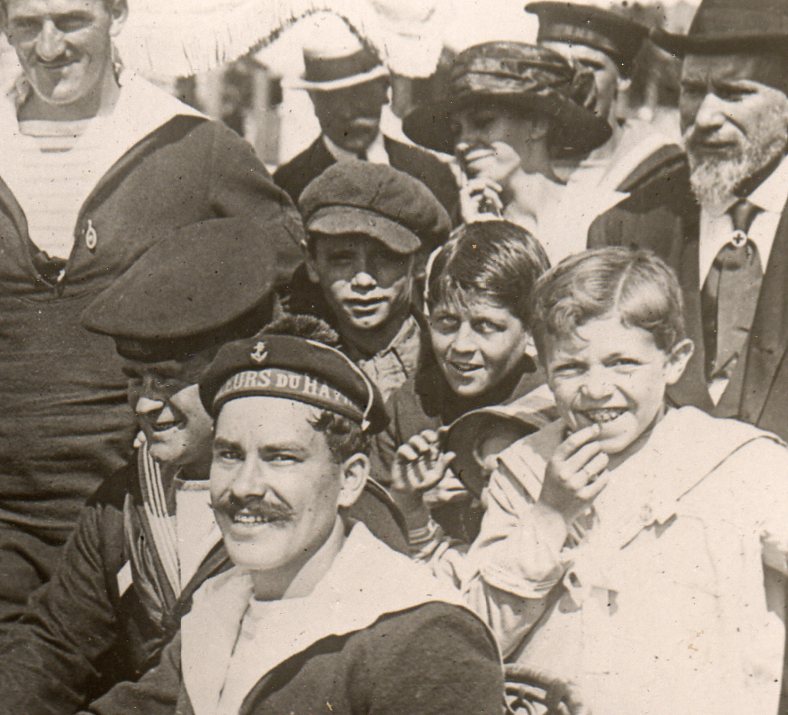
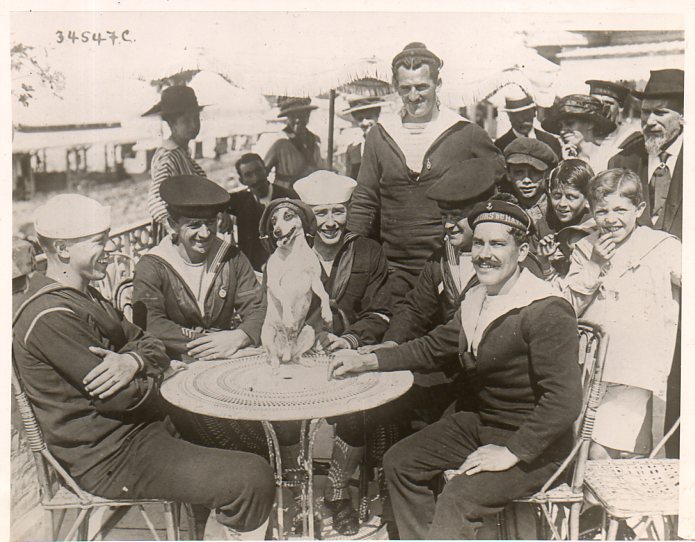
    In a moment of levity at the end of WWI, these sailors from America, Great Britain, and France got together for a bit, and turned their little doggie mascot into a small attraction of sorts, entertaining themselves and the small curious crowd surrounding them.  The photograph was made anonymously by the Western Newspaper Union and is stamped “British Official Photograph”, and published on 10 October 1918, a month before the end of the war which at this point seemed to be not so imminent.

    WWI--Doggie photo detail026
    Which is a delightful detail from the full scale image:

    WWI--Doggie photo025

    ·Posted by :

    ·in:

Recent Posts

Archives

Categories