A Daily History of Holes, Dots, Lines, Science, History, Math, Physics, Art, the Unintentional Absurd, Architecture, Maps, Data Visualization, Blank and Missing Things, and so on. |1.6 million words, 7500 images, 4.9 million hits| Press & appearances in The Times, Le Figaro, Mensa, The Economist, The Guardian, Discovery News, Slate, Le Monde, Sci American Blogs, Le Pont, and many other places… 5000+ total posts since 2008.

  • Pioneering Effort on a Circular-Winged Aircraft (1909)

    JF Ptak Science Books  Quick Post

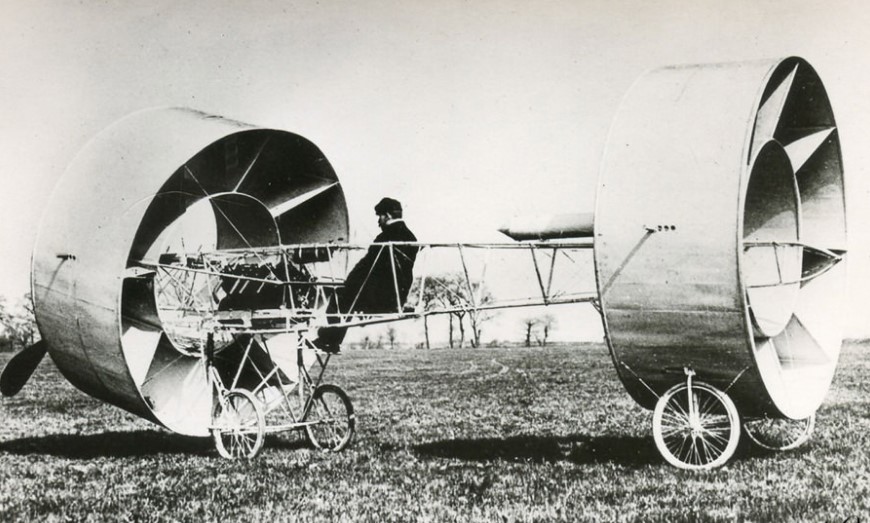
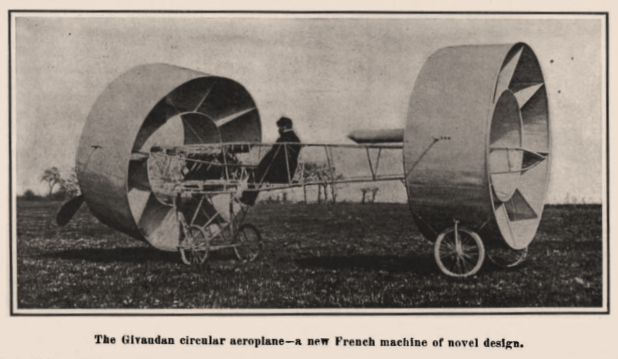
    Claude Auguste Joseph Givaudan’s  handiwork was presented in the June 5, 1909 issue of Scientific American as part of a longer article on the history of human heavier-than-air motorized flight. The image is, well, engrossing.  It is both pretty and then not so much in a double-ended sausagey kind of way, wanting to look the role of a new age aircraft but winding up looking clunky and breakable and heavily unflyable. The “Vermorel” was a step towards flight, but a step in the not-right direction, though it does seem to be among the first circular wing planes attempted. Sometimes you don’t know something is wrong until you know it, and then the information can be useful in the History of Wrong Things. Givaudin (1872-1945) was an excellent candidate for this sort of pioneering work, having an expertise in chemical engineering and machine work in general, working across many fields, not the least of which was making motorized bicycles (motorcycles) at the turn of the century. He just didn’t have the proper insight for flying, evidently, though people would return to his circular wing numerous times over the decades.

    Sci Am 1909 Givaud aircraft

    The barrels fore and aft were fitted with wings that were supposed to catch the wind produced by the 7.8′ propeller (which is barely visible up front) and lift the plane into the air. The (air)craft had no rudders and was going to depend on the movable front barrel for control, but at first glance nothing seems to have come of it except for showing others what was not successful. But it seems that there was something that developed: Givaudan seems to have developed among the first (air-cooled) V-8 engines in a plane, which he evidently developed as much as a decade earlier. 

    It also seems that there is no published record of an attempted flight of this aircraft.  He did continue in his aeronautical/aviation work, and was heavily involved with the development of the machine and the science for forty+ years until his death n 1945 (in October, long enough to see the end of WWII).

    Here’s another version of this image, this one clearer and sharper, from a French photographic postcard of the time. The engine is more distinct here:

    Givaudan _2_

    [Image source: http://www.cpa-bastille91.com/histoire-de-laviation-en-1909-le-givaudan/]

  • “Pick Me Up and Pop Me In, I May Kill a Hun One Day” (1918)

    JF Ptak Science Books  Quick Post

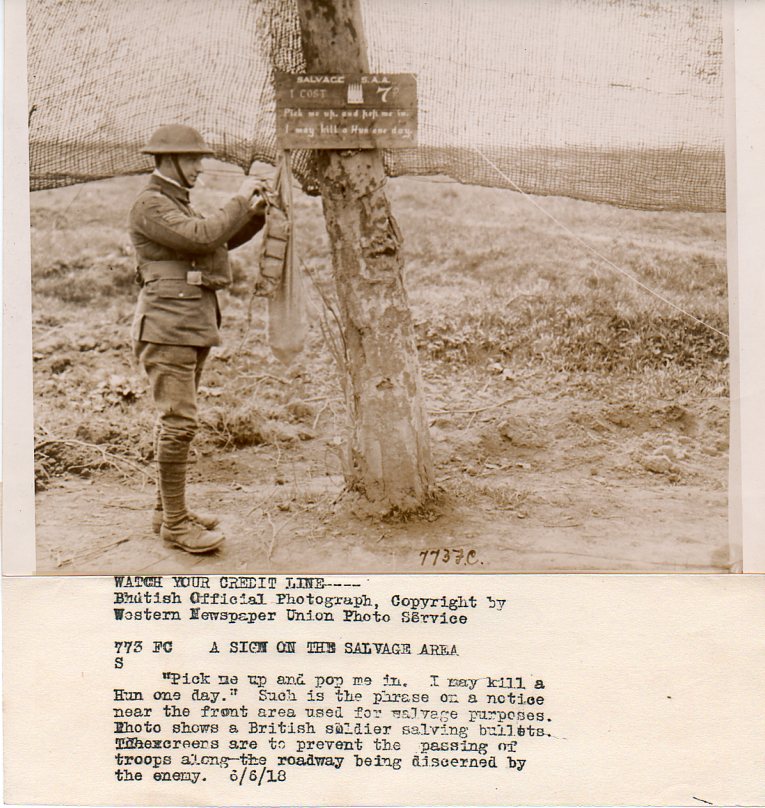
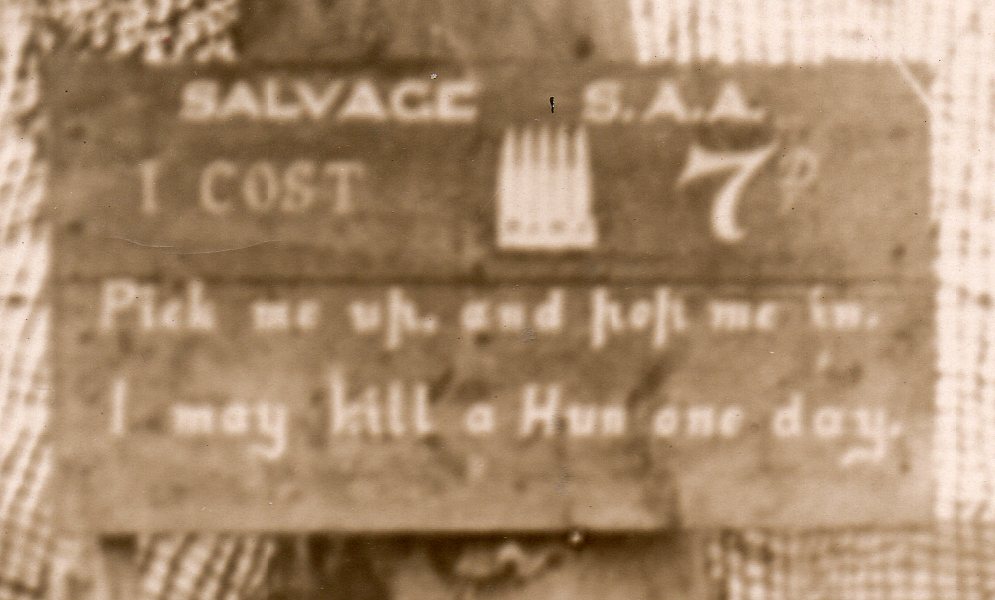
    A little went a long way, sometimes, in collecting the ends and bits of a campaign or a retiring column or from the attics and basements of village houses, or in scrapyards or dustbins or abandoned yards and buildings. Scrap has sometimes contributed greatly to major war efforts; and sometimes it has contributed just a few hundred rounds of ammunition, gathered from the sick or dying or forces on the move, that have told the tale of change in battle.  When you can only carry so much in a campaign where shooting can be an endless process, you can by definition never really carry enough ammunition when you’re already carrying enough of everything else.

    WWI--salvage719 
    WWI--salvageb720

    WWI--salvagec721

    ·Posted by :

    ·in:

  • Fantasia of the Air–Cops, Booze, Marriage, and a Monkey. (1890)

    JF Ptak Science Books  Post 2776

    Well, not quite a fantasia, but more like a “fanciful/fantastical/imaginary” collection of  “flying objects” (“objets volants de fantaisie”), a whimsical look at the very near future (or so) of airship flight in 1890. This future seems to make room for everyone in the air, and celebrated by a collection of worldwide nationalities on the ground. There really isn’t a title for it,  and the print is indexed according to the posters/signs adorning the floating businesses and municipal pleasantries.  According to the excellent French library  site “Galica” the print is catalogued as “Sanatoir aérien du docteur Farceur, bureau volant de mariage, police aérienne [objets volants de fantaisie]”, which is entirely unpoetic and slightly galling given the subject matter, and merely describes some of the objects in the print. The only part of the title that hints at the delightful subject matter is the “police aerienne”, which would in spite of its clumsiness at least raise an eyebrow of just about any overworked research mole:

    Sanatoir_aérien_du_docteur_Farceur_[...]_btv1b53024091c (1)

    [Image source: Galica https://gallica.bnf.fr/ark:/12148/btv1b53024091c/f1.item]

    What vision of the future of aviation doesn’t include two flying doggies and a monkey? This one does. At top right we have part of the title, a marquee for a floating sanitarium run by “Dr. Farceur”, which is probably some very light wordplay implicating a medical jester. There’s the police station, marriage chapel, a hook-up joint (sounding better as a “ballon de rendez-vous”), and a bar/cafe/restaurant. The law is there directing traffic and making an arrest; there are two ships, one a warship with a skull-and-bones and the other probably not; there’s a pamphleteer literally dropping his suggestions, some ladies with attaches, and a long-shoe Flaneur. Belting it all together is some sort of chorus line, though these ladies aren’t attached to any flying thing save for the wings on their backs. All in all, this is a fine and pleasing work, full of action, and probably not so impressed with the actual future of human flight.  

  • Android Artists (1785 and 1903)

    JF Ptak Science Books  Post 2777

    Jacquet-Droz 1903This is a very short post on a much more involved issue, but for right now I just want to scribble out this note in the sand.

    While looking for the Wright Brothers not-appearing in the Scientific American in 1903 and 1904 and 1905 and 1906 and 1907 I found in the May 3, 1903 issue  “The Jacquet-Droz Androids”. It was seeing the word “androids” that was so unusual–usually when you see references to the great machines built by Pierre and Henri-Louis  Jacquet-Dros1 you nearly always seem the inventions as “automatons2” or “automata”. This time, it was “android”. 

    “Android3” as it turns out is pretty old as a word, though I do not know how common its usage was, though just weighing that against decades of reading it seems to my experience not to pop up very much at all before WWI.  

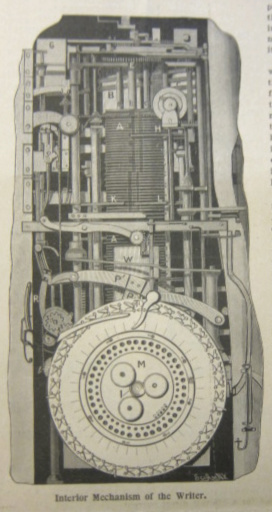
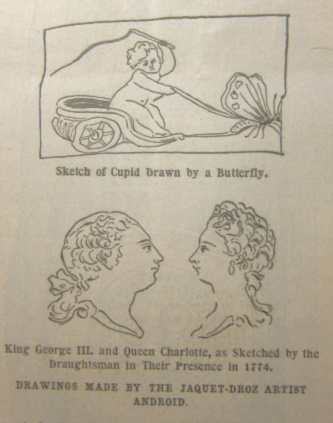
    This gets us to the truncated history part. The Jacquet-Droz machines were built during a relatively short period, 1768-1774 or so. One of the machines was called “The Draughtsman”, which had the capacity to render at least several different drawings. This would make them among the earliest machines to ever produce art. The “android”–which was about half-life size and quite human-like–sits at a small desk and renders its creations, looking like a mechanical artist. In fact the machine had a very sophisticated cam-based memory, which to some extent meant that the machine was “programmed”, and so becomes the first (?) computer-generated artworks4. 

    What distinguishes this article in Scientific American further is that it reproduces the artwork of “The Draughtsman”.  The question here then is when are these android drawings first reproduced? There were many exhibitions of the Jacquet-Droz creations over the years, and the popular portrayal so far as I can recall has been the machine itself and then a small reveal of the mechanism. Were the drawings reproduced in the 18th century? Right now, I just don’t know. I did do a search under “Jacquet-Droz” in Gallica over thousands of publications and at first blush there (1) seems to be not many hits and (2) none that I have seen have any illustrations. Also even though the machines of Jacuet-Droz and, say, Maillardet’s writing/drawing machine (le Jeune artiste”) were popular in the late 18th and early 19th c, they seem to not have been so afterwards. One source says that Maillardet falls completely off the RADAR in 1833 and resurfaces only in 1928.  

    Jacquet-Droz _2_

    This all makes for an intriguing question. Right now though all I can really say is that the end-date for the range of possible first-publication dates for Jacquet-Droz is 1903.

    Notes:

    1.  “Constructed between 1768 and 1774 by Pierre Jaquet-Droz, his son Henri-Louis (1752-1791), and Jean-Frédéric Leschot (1746-1824), the automata include The Writer (made of 6000 pieces), The Musician (2500 pieces), and The Draughtsman (2000 pieces). Pierre Jaquet-Droz (French: [ʒakɛ dʁo]; 1721–1790) was a watchmaker of the late eighteenth century. He lived in Paris, London, and Geneva, where he designed and built animated dolls, or automata, to help his firm sell watches and mechanical birds.”–Wikipedia

    2.  From the Oxford English Dictionary: “Automatons. A moving device having a concealed mechanism, so it appears to operate spontaneously. Frequently (and in earliest use) in figurative and similative contexts. Now chiefly hist.Originally denoting various functional instruments including clocks, watches, etc., as well as moving mechanical devices made in imitation of human beings; later (from the early 19th cent.) usually restricted to figures simulating the action of living beings and widely regarded as toys or curiosities, as clockwork statues or animals, images striking the hours on timepieces, etc.”

    • 1616   W. Cornwallis Essayes Certaine Paradoxes sig. G3   The soule doth quicken and giue life to the body, the body like an Automaton, doth moue and carry it selfe and the soule.
    • 1660   H. More Explan. Grand Myst. Godliness ii. iii. 37   God will not let the great Automaton of the Universe be so imperfect.
    • 1742   J. T. Desaguliers tr. M. Vaucauson (title)    An Account of the Mechanism of an Automaton or Image Playing on the German Flute.
    • 1784   P. Thicknesse Speaking Figure 5   That an Automaton can be made to move the Chessmen properly, as a sagacious player,..is..utterly impossible.
    • 1790   J. Imison School of Arts (ed. 2) 284   Those automata..do by little interstices, or strokes, measure out long portions of time.
    • 1815   Scott Guy Mannering I. xx. 315   Sprawling out his leg, and bending his back like an automaton.
    • 1821   New Monthly Mag. 1 443   Archytas’ flying dove..is another of the ancient automata… It was made of wood

    3.  Citations of “android” in the Oxford English Dictionary:

    • 1728   E. Chambers Cycl. (at cited word),   Albertus Magnus, is recorded as having made an Androides.
    • 1819   Pantologia (new ed.) (at cited word),   M. de Kempelen..constructed an androides capable of playing at chess.
    • 1847   J. Craig New Universal Dict.   Android
    • 1951   C. D. Simak Time & Again (1956) i. 1   Human gossip as well as android and robot gossip.
    • 1958   Spectator 19 Sept. 379/1   Today SF must be more than a blood-and-sex day~dream spattered with words like androids (robots made of flesh and bone).

    4.  Another long history is that of computer generated art. Suffice to say here that the very earliest period of this genre begins probably with Ben Laposky’s “Oscillons” in 1952 where he manipulated electronic waves in an oscilloscope to produce interesting and complex figures. 

  • Books as War Booty, 1918

    JF Ptak Science Books   Quick Post

    In the vast caches of loot taken during the course of war I suspect books have ranked somewhere in the middle of stolen stuff–no doubt some fine libraries have disappeared, though I can’t offhand say how many fine libraries emerged from the slaughterhouse.  This photograph–a wartime news photo service image–is one of the few that I have seen depicting the capture of stolen books. 

    WWI photos--looted books111

    ·Posted by :

    ·in:

  • “The Aeronautical World”–a Great Advertisement from 1903.

    JF Ptak Science Books  Quick Post

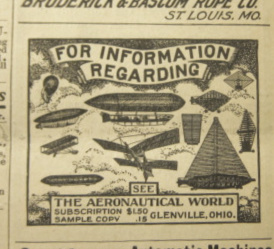
    Aviation aeronautical world 1903

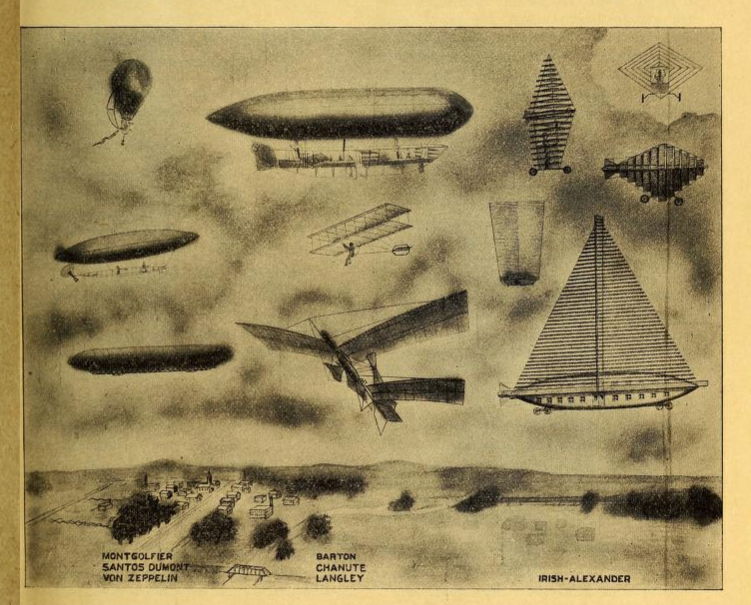
    Here’s a clearer picture, which is from the front cover of the magazine, and which identifies the fliers–as you can see the middle flyer that looks like a Wright plane was Octave Chanute, and which was moved over to the left in a new design to accommodate the title of the journal in the ad. Chanute was really very helpful to the Wrights and gave them support at nearly all times during their experiments…but I think it was his interest in them early on that was most beneficial, as the Wrights were just starting out and Chanute was a recognized world-wide authority who actually traveled to Dayton to meet them.  Anyway, that’s his flyer, though not Chanute himself, who I’m pretty sure never flew one of his own inventions–the Wrights on the other hand insisted upon that, saying it was of the most supreme importance for understanding motion in the air and controlling the aircraft. As the Wrights realized at the outset, it wasn’t getting into the air that was the problem–it was staying there. And in order to stay there you had to be able to move the aircraft, and so move different parts of the aircraft. Everything else flowed from that. 

    It was in volume 1 issue 7 that Chanute was quoted saying that the Wrights “flew like a vulture” which was a high compliment, given the ability of vultures, and that with them “soaring flight was almost an accomplished fact”. (p. 147). See Internet Archives for the magazine: https://archive.org/details/aeronauti111118021903glen/page/148

    Aviation aeronautical world _2_ close up

    ·Posted by :

    ·in:

  • What is the World’s Most-traveled Book?

    JF Ptak Science Books    Post 2778

    What is the world’s most traveled book? This question came to mind after I received an order for a book that had been sent to me from Florida after it arrived there from London, sending it off to someone in Baltimore. Does it go back to London after that and continue its travels?

    Is the Most Traveled Book (MTB) a category of book, or a single title, or a single copy of that title? Is it thousands of people moving the book, or is it just the single book making the trip? If it was just a title, then the number of miles packed on Stephen King books traveling back and forth to the beach or wherever by millions of people over several decades would probably outweigh the travel of all of Homer on a galactic scale. My preference is for the single copy scenario. Also: I’d like this to be a published book rather than not, simply because the boundaries get a bit too misty for me.

    Dr strangelove code bookThe closer we come to the present time, the easier it would have been for a book and a person who might have been traveling with the book, to travel. It increases the chance for people to travel with a book, and with the invention of the middle class, it would encompass more people the chance to come in contact with books and travel with or send them. And of course it is the mode of transportation and the creation of parcel post that would add orders of magnitudes of miles to category—for example you could receive a book from London and send it out to Tokyo where it might be sent to Wellington all in two weeks. In 1822, raking in that sort of mileage would have been nearly impossible for almost all circumstances. No doubt books were carried to Botany Bay from London and then back again, perhaps over and over as the property of the ship’s surgeon or some such, but that would be years worth of travel.

    Maybe it was books carried by people who were professional travelers or at least traveled a lot, like Napoleon or Alexander going to “work”.

    Is it a travel book, like Herodotus, Sterne, Twain, Stark, (or even Kerouac who had the words right in the title?), Xenophon…Cervantes?

    Perhaps it was literature—no doubt Shakespeare, Dante, Sophocles, Euripedes, and Aeschylus have been hauled about for pleasure. What about professional books? I doubt that copies of Newton, Galileo, Copernicus, and so on have traveled very much on their own (though the ideas contained in them are probably among the best-traveled of that sort), but I suspect that anatomies (Vesalius, Gray) have some miles in them. There are no doubt other reference books like that that could have traveled save for their size (like Audubon, which could have been useful in the field but which would have needed their own caravan). There are unliekly titles that have made their way around the world (like Darwin’s Lyell making the long trip on the Beagle), but that book ended its travels when Darwin got home.

    And what about military strategy books like Lao Tsu, Sun Tzu, Clausewitz, Thucydides? If in the field their owners could have lugged them far and wide, passing them along after enforced/sudden “retirement” or when their usefulness ran out.

    What might establish the peripheries of this question are books that keep intact a belief system, or way of life, a secret-or-not codification of a state of well-being? A Bible? Alcoholics Anonymous? Probably that is the first place to visit, the religious book, though offhand it seems that the travel of this sort of book wouldn’t transcend one owner. The Bible and company are enormously popular books and have been printed no doubt in terms of billions of copies, so they have a much better chance of being the leader of the category by sheer numerical possibility. On the other hand some of them were tremendously popular but relatively short-lived, like the “Little Red Book”, which was carried by most Chinese for decades, though I doubt that the work as an inherited object was inter-generational.

    Maybe the best traveled book simply comes down to one that belongs to an aircraft pilot of 40 years’ experience who has been flying with a single title because that is what they had with them on their very first flight, and has become a good luck token. Perhaps it is a King book, or Robert Pirsig; and maybe it is The Cat in the Hat which was an intended gift for a child, the pilot keeping the original as a charm for a successful first flight, and giving away another copy of the book, and so it has made thousands of flights. Maybe the book is never actually read—its just an icon.

    Or perhaps it is an instruction booklet on the reading of nuclear codes and attack plans that has been basically airborne since 1960. This is far less romantic than a Dr. Seuss book, but more, well, “practical”.

    And maybe the most traveled book is less-traveled than the most-traveled map?
  • Power and Technology of the Year 2000 (from 1927)

    JF Ptak Science Books   Post 2779

    Lubke IRCRAFT BOMBING

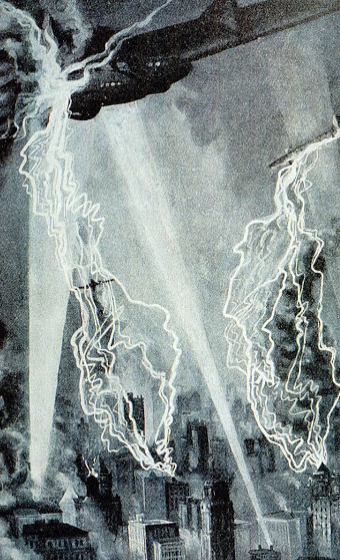
    I found another unexpected source for the initiation of nuclear energy—this one coming in Anton Lubke’s  1927 book, Technik und Mensch im Jahre 2000. The book is thick (372pp) and well-illustrated,  and has what seems to be a  mostly/somewhat progressive look into the future judging what I can cobble together….or from what I can tell, it was at least not terribly negative, though I haven’t been able to determine if the writer gets political, or not. Given the times Lubke (b. 1890) can’t but help to wonder what warfare might look like, and supplies us with one set of possibilities involving vast aircraft (pictured at left) attacking cities with poison gas and electricity. The idea of urban bombing was still pretty new in 1927, as was the idea of attacking cities that weren’t necessarily military targets. Both of the weapons used by Lubke’s aircraft seem as though they would be devastating, and indiscriminate. (Politicians would pull away from the idea of attacking civilian areas and sign treaties to that effect—that all went away with the invasion of China by Japan, and the attack upon cities by Nazi forces in WWII–the Allies followed suit almost immediately thereafter.) Lubke’s image (which appears in the section titled “Der Zukunftskrieg und die Technik”) must have seemed terrifying to his readers of 1927, though they are at least spared the image of the effects on the population in the imagery of the attack. (The Illustrated London News doesn’t hold back from its readers in an issue from 12 November 1932, which shares an exceptionally graphic artist’s interpretation of a poison gas attack on London, right on the front cover.) 

    This is only 16 years removed from what seems to be the first aerial bombing attack of a civilian population on 1 November 1911, when  Lt. Giulio Cavotti dropped the first bomb from a plane on oasis-encamped Libyan troops at Tripoli.  Of course things rapidly in the few years following that, so that by the end of WWI people got a good taste of what it meant to controlling pieces of property without actually occupying them, raining chaos and destruction from above.  20+ years later, in the early 1930’s bombing became more sophisticated, including a new arsenal of poison gas weapons.  The threat from this weapon was agonizing and palpable–the results of gas attacks upon armed combatants in WWI and  the gassing of civilians in the 1920’s and early 1930’s  made a hard strike into the social fabric, an enormous gaping new hole to be filled in the heart of fear.

    There were a number of interwar aerial bombings that took place that kept the issue of mass destruction alive and well.  For example,  Britain used its air arm  very convincingly in Iraq, bombing many places including Bagdhad  in 1923; the Spanish bombed civilians into submission in Morocco, near Tetuan, in 1925, and the French crippled and destroyed  their opponents–both military and civilian, it made no difference–in Damascus, Syria, also in 1925.

    Fiction also harnessed the possibilities of air war, not the least of which included Armageddon-like scenarios for the semi-End of Days through the use of poison gas and “atomic” weapons.  For example, deadly gas used in Anderson Graham’s The Collapse of Homo Sapiens (1923) and Neil Bell’s Valiant Clay (where the poison gas kills 1.5 billion) and Dalton’s Black Death (1934), while Reginald Glossop’s The Orphan of Space (1926) created an alien atomic spaceship which delivered holocaustal death to Soviets and Chinese and Communists in general.  There were many more stories like this, not the least of which were the non-fiction strategy works, like Giulio Douhet, author of Dominion of the Skies (1921), legitimizer of the “strategic” bombing of civilian populations (in spite of the Hague Conference of 1907*), and  JFC Fuller’s The Reformation of War (1923) which emphsized the new importance of air war and power and which also allocated the use of gas, justifying that morality  because it could cause less harm than a conventional attack.

    Back to Lubke: it seems an interesting book, and from what I can see in a very light review there is space devoted to different energy sources than those of 1927: he wrote on solar, wind, tidal, and nuclear (“Atomzertrümmerung”) energy. He also addressed some sort of perpetual motion-something, electrical farming (“Düngung durch Elektrokultur”), and trips to the Moon with the “Mondrakete” (though this adventure into space was already being a well-established part of images of the future in the 1920’s).

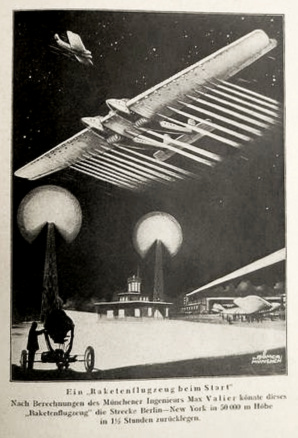
    Lubke aircraftThere’s also this terrific image of a vast rocket plane, the description of which mentions Max Valier, the rocket pioneer, Oberth-popularizer, and founder in 1927 of the (German) Society for Space Travel.  An aircraft/space vehicle like this it is noted could make the Berlin-NYC flight in about 1.5 hours. (Valier was also the first to lose his life in a failed experiment using liquid oxygen, establishing him in a very unfortunate category of “firsts”, becoming probably the first person to lose their lives in rocket flight; this is a similar category to Thomas Selfridge, who became the first person killed in an airplane crash, a 1908 test flight for the army with the pilot Orville Wright.)

    There’s not that much else I can drag out of the Lubke book given my references, though I have just ordered a copy. I’ll get back to this when I’ve had a better look at it. 

    [Image at left from bookseller Versandantiquariat Hans-Jürgen Lange, here:

    https://www.booklooker.de/B%C3%BCcher/Anton-L%C3%BCbke+Technik-und-Mensch-im-Jahre-2000-Erstausg/id/A028NHxY01ZZi]

  • The Early Airplane in Popular Culture: Sheet Music (1897-1911)

    JF Ptak Science Books  Post 2780

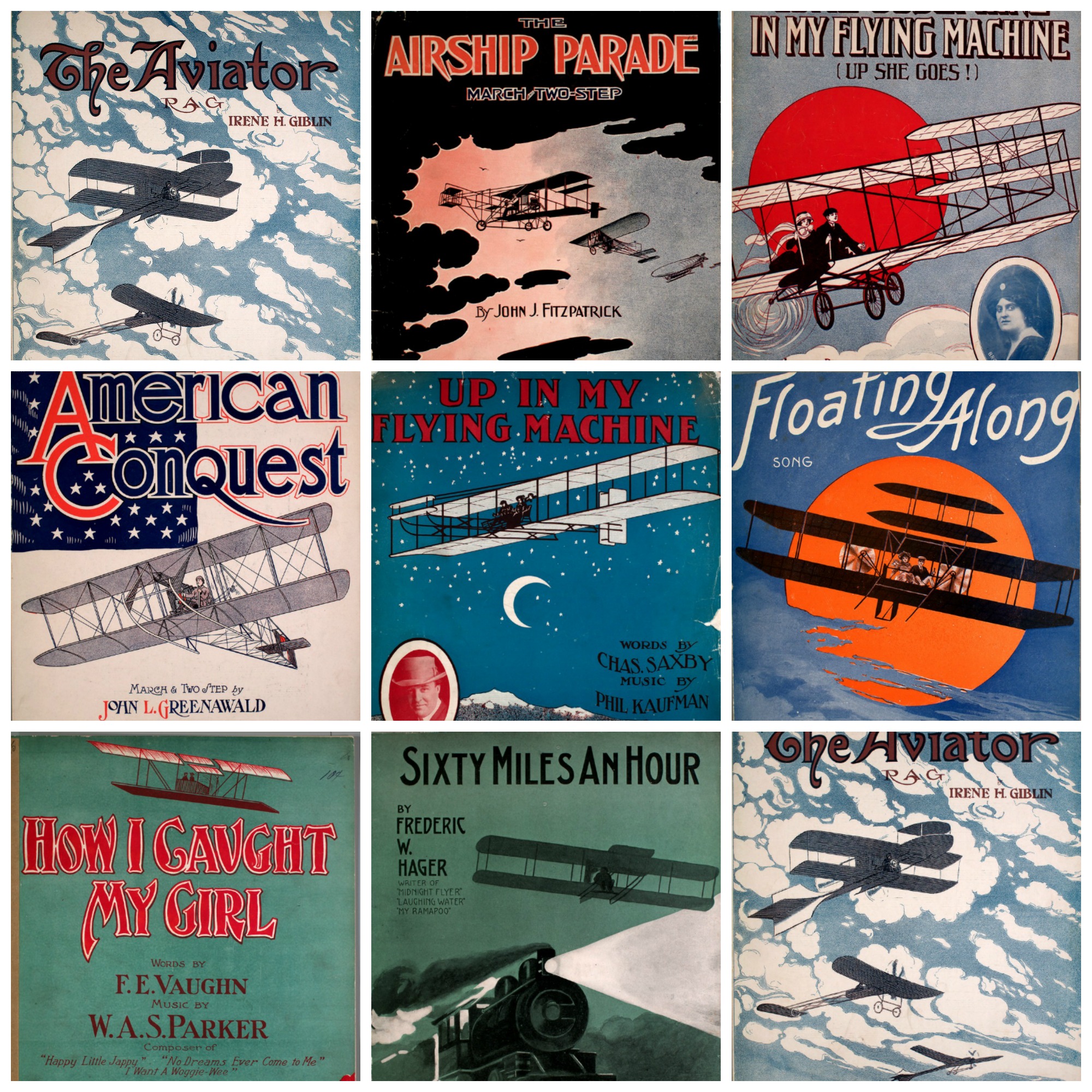
    I’m posting these following sheet music covers because of their lovely airplane covers. They are located at the wonderful (and highly available and useful) Lester Levy Sheet Music Collection at Johns Hopkins University.  

    Aircraft sheet music collage

    Aeroplane floating along

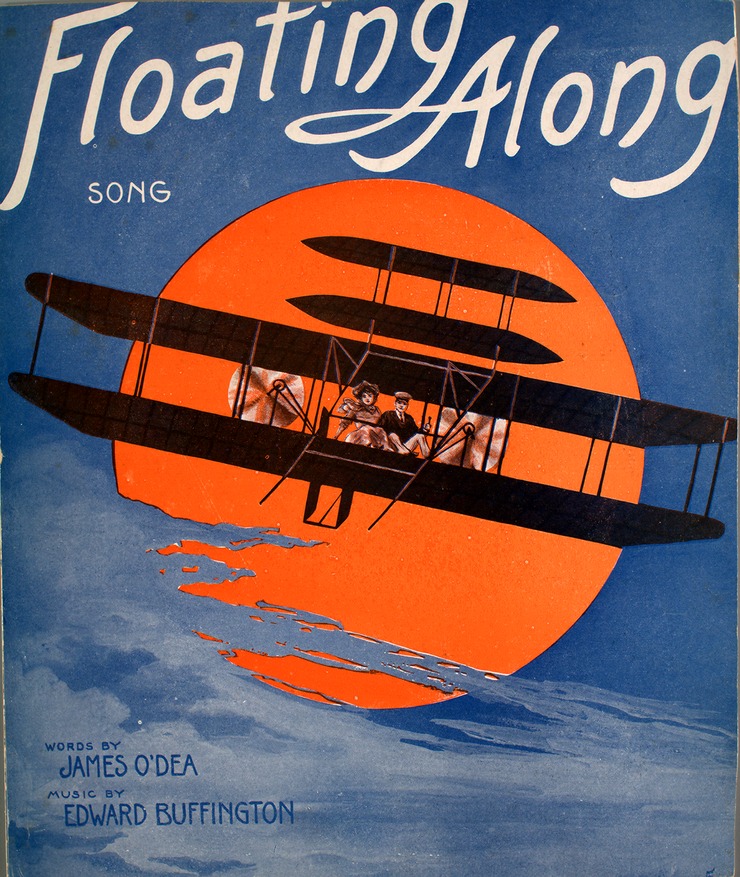
    “I Could Live in An Airplane”, by James O’Dea, with music by Edward Buffington, 1909. [Image source: http://levysheetmusic.mse.jhu.edu/catalog/levy:060.048]


    Aeroplanes levy sixty

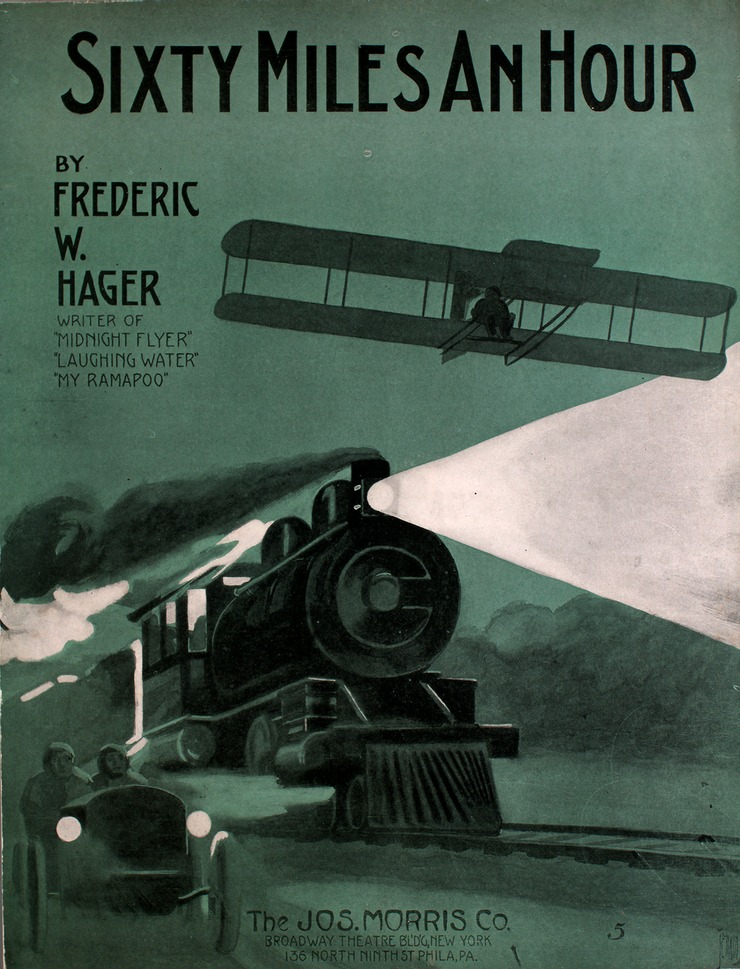
    “Sixty Miles an Hour. March and Two-Step’,  Frederick W. Hager, 1910.  [Image source: http://levysheetmusic.mse.jhu.edu/catalog/levy:059.065]

    ·Posted by :

    ·in:

  • Aircraft Cross Sections, WWII

    JF Ptak Science Books   Post 2781

    Aircraft Cross section Collage

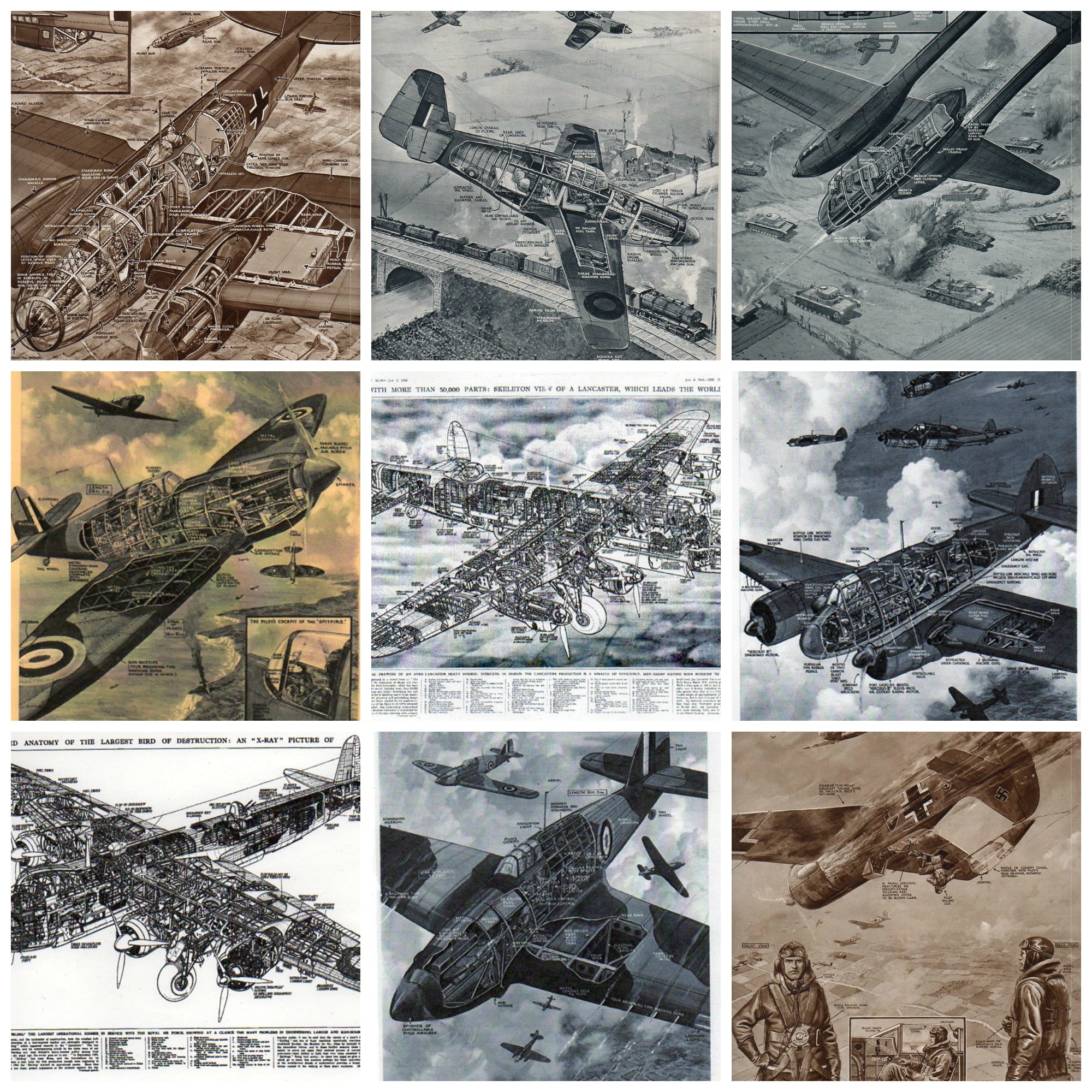
    I’m sharing some of the collection here of the published work of George.H. Davis (1881-1963), the prolific and vastly accomplished artist for The Illustrated London News. His work with that magazine for the forty or so years that I am familiar with is superb, and his great strengths can be found in rendering technical cross sections and infographics.  He had a great sense of design and a very fine hand, and so far as I can tell he displayed an excellent control of his subject, thousands and thousands of times (2,500 times, according to Mr. Davis).

    Here are some fabulous examples of technological cross sections of WWII aircraft by Davis–the drawings are just superb, and you can easily get lost in them, following the geography of engineering detail from one logical place to the next.

    Blohm u. Voss BV141 

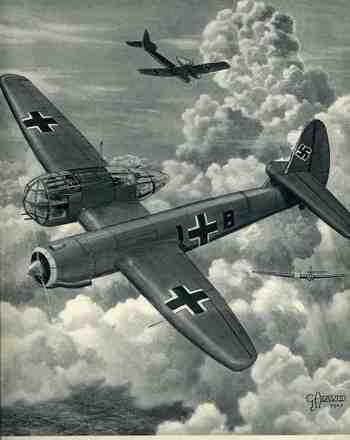
    Aircraft cross section BV 141Surprise!  My first cross section isn’t one–I just couldn’t resist posting it, though. This aircraft is the Blohm u. Voss “BV 141″a very unusual-looking aircraft as it appeared in The Illustrated London News for 23 May 1942–it gives an excellent view of what the editors called “a lop-sided freak”.  Perhaps the editors of the ILN wanted to educate its readers on the plane since it was supposed to be widely employed on the Russian Front, though it looks like only 38 were ever built (and none survive today). Actually, the plane, designed by Dr. Richard Vogt (1894-1979),  was a high-flying three-seater  surveillance aircraft capable of 220 mph at 17,000 feet, powered by a single 1000 hp Bramo Fafnir 9-cylinder radial engine.  The idea for the design was to give the pilot and co-pilot a very wide field of view–and by this, I’m guessing that the field of view most affected and aided by this would be straight down. The rear gunner also had an enormous field of view. 

    As it turns out Vogt survived the war and spent his Golden Years in the U.S., seven of them (1960-1966) with Boeing to evaluate hydrofoils and vertical liftoff systems:  he had built other odd planes during his career, and carried them with them into near-retirement, making this sort of design his metier.

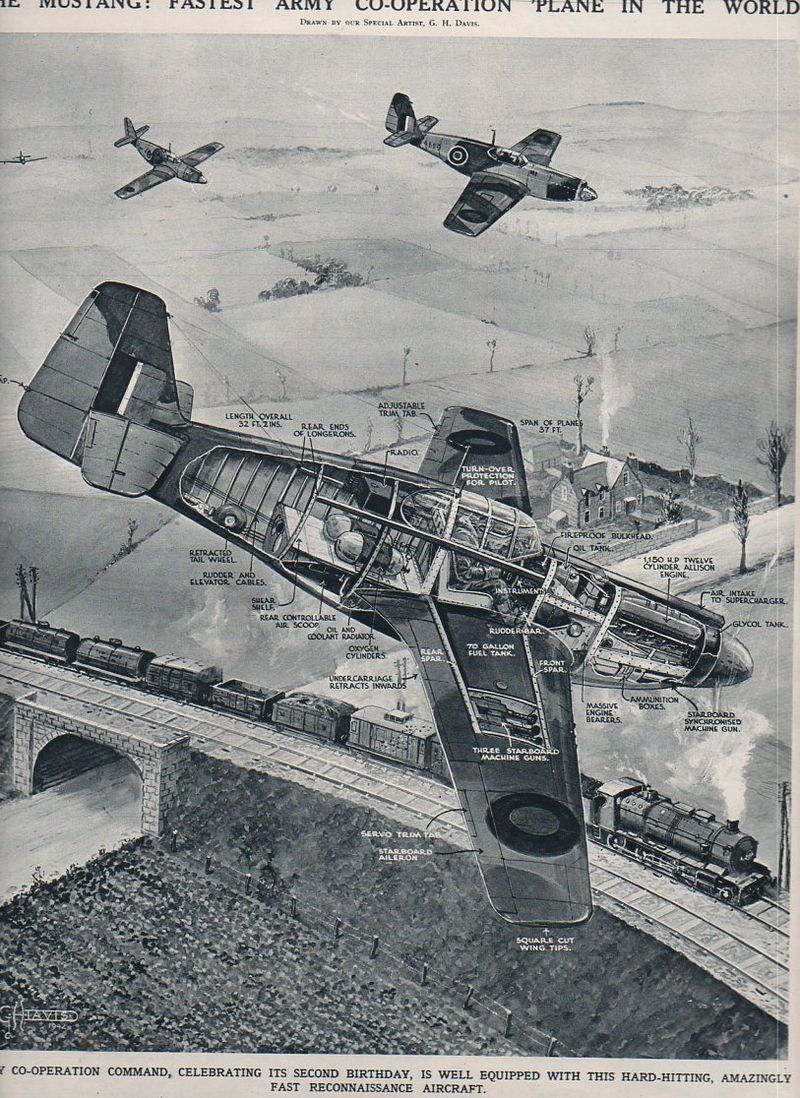
    “The Mustang–Fastest Army Co-operation in the World“, appearing in The Illustrated London News for 12 December 1942.  

    Aircraft cross section Mustang
     

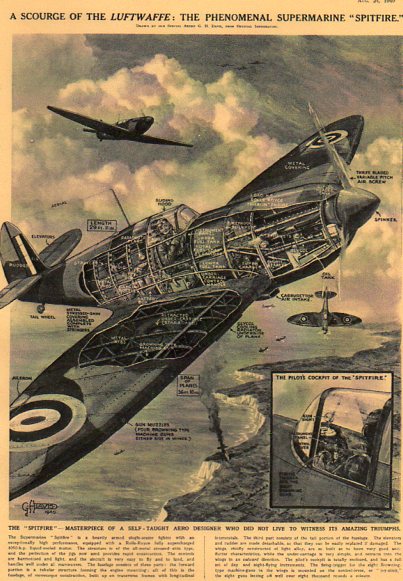
     The Spitfire (perhaps the most beautiful-sounding aircraft of WWII):

    Aircraft cross section Spitfire


    ·Posted by :

    ·in:

    —
  • Giant Bottles in the Skyline, Part 8 (1909)

    JF Ptak Science Books  Quick Post

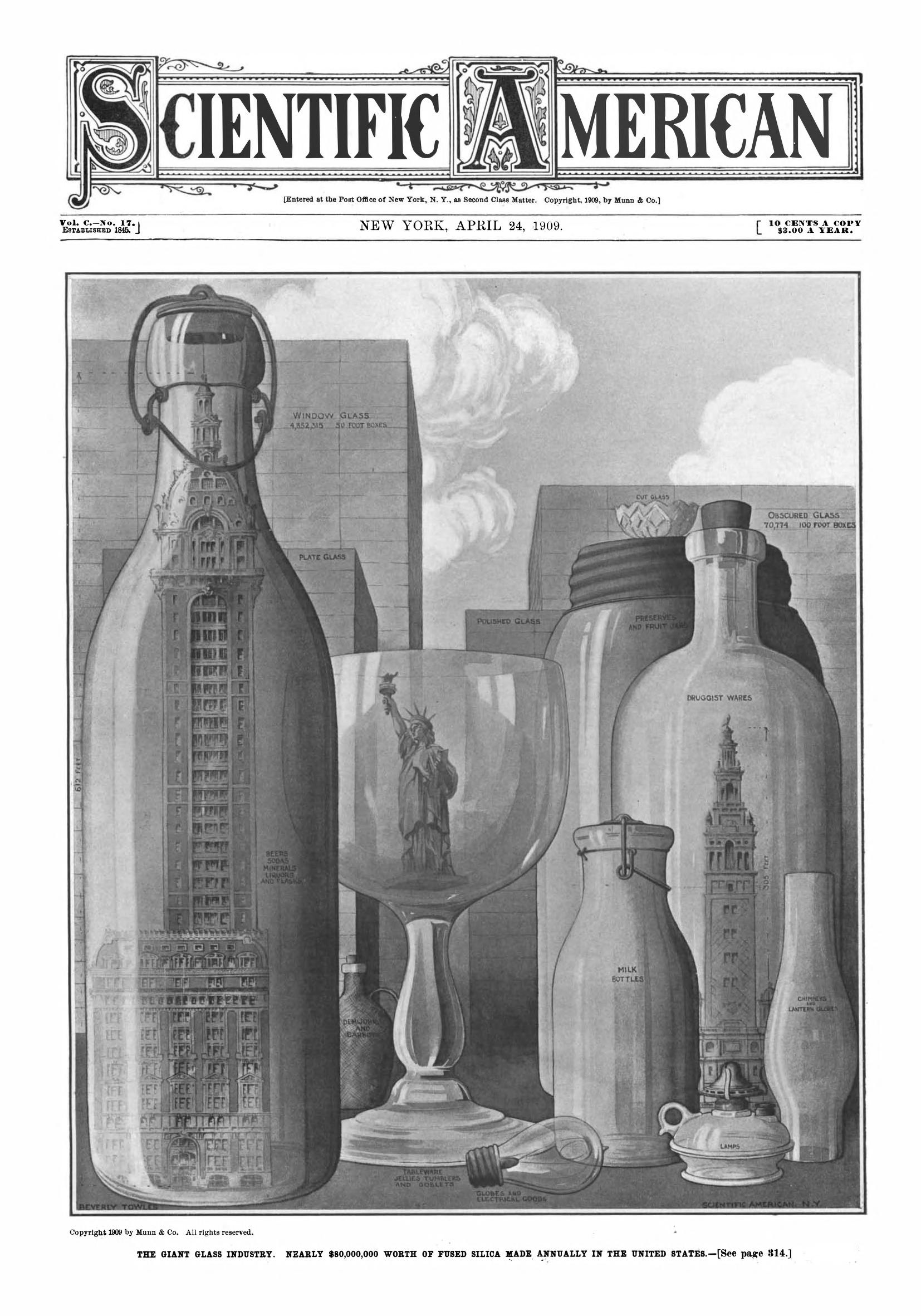
    This I believe is the eighth installment of a series of posts on articles using infographics comparing objects to buildings and skylines. Ships are often seen this way–comparing the newest/largest to some well-known building in, usually, the NYC skyline. There are variations: for example, nail and salt production are depicted as enormous single objects showing that if you combined all nails made in the U.S. into one 100′ diameter nail, it would be as big as the Singer Building, or some such. The current example is the first I’ve found where the gigantic production item encloses the building against which it is being compared, showing the  size of famous structures relative to all of the glass of a particular sort had they been manufactured and produced as one single unit. This makes for a striking non-sequitur object, and gets the intended point across of how large the various glass manufacturing industries are

    Sci Am 1909 stuff in skyline

Recent Posts

Archives

Categories