A Daily History of Holes, Dots, Lines, Science, History, Math, Physics, Art, the Unintentional Absurd, Architecture, Maps, Data Visualization, Blank and Missing Things, and so on. |1.6 million words, 7500 images, 4.9 million hits| Press & appearances in The Times, Le Figaro, Mensa, The Economist, The Guardian, Discovery News, Slate, Le Monde, Sci American Blogs, Le Pont, and many other places… 5000+ total posts since 2008.

  • A Stupendously-Dense Giant Atom Non-Bomb Threatens the Earth (1943)

    JF Ptak Science Books   Quick Post   (Another entry in the neglected “Strange Things in the Sky” category.) 
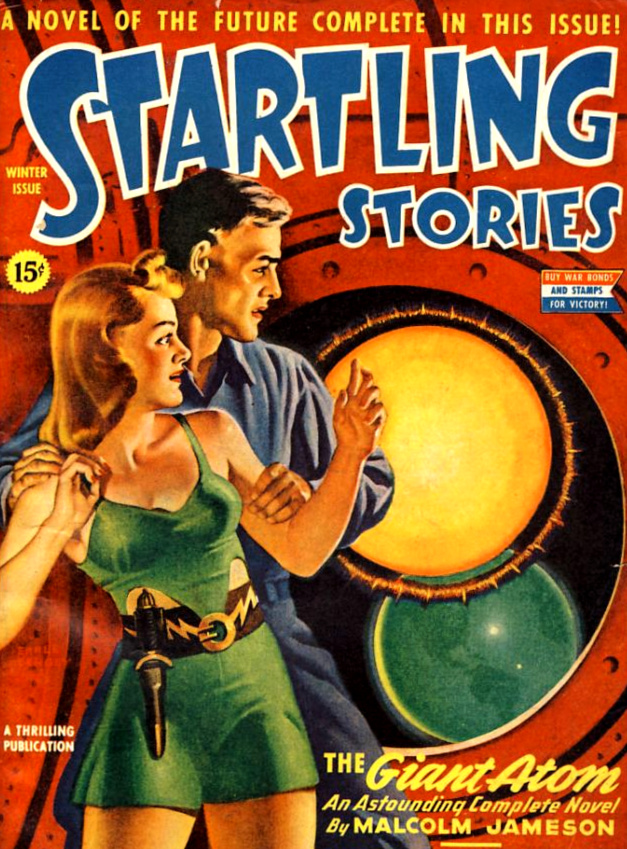
    Giant atomThe story “The Giant Atom” in Startling Stories was pretty striking to me, as it was published in December 19431 and (I thought) was illustrated with what looked like the first milliseconds of a nuclear explosion, except the reality of that event was still more than half a year away. There are a number of prescient atomic bomb stories written in the 50 years or so preceding the real one, and I thought that this one might be an odd, back-door entry to the little sub-genre. So before I got into the story I checked out the author, Malcolm Jameson, and found that the story was re-issued later as “The Atomic Bomb”, which ignited curiosity enough to at least start to read it to see if this was indeed an “atom bomb” story written in 1943.

    Possible evidence to the contrary, it seems as though this turgidly-written story was indeed about a gigantic blob-like atom. I can’t get to the details because the prose covered stuff up like a syrupy metal brick:  “Anything that is as small as four or five feet in diameter and weighs five or ten thousand tons is pretty dense, general.” 


    • Um. Yes.  It works out that this 5′ sphere would weigh about 3,000 average-sized cars, or 1/4 of the weight of the 887′ USS Missouri, something like 11,000 pounds/litre, or 11 pounds (4,983 grams) cm3 .  Osium, the densest metal, weighs in at 22 grams cm3.  That’s quite something. For another perspective, I believe a neutron star would weigh about 4×10⁷ pounds. 
    • Another way of looking at this, since the idea of the 4,000-lb bomb is introduced here, is via ordnance. The first 1000 plane bombing mission by the RAF occurred May 30, 1942 over Cologne, where the total amount of ordnance dropped equaled about one-third of the weight of the sphere. Cologne received 34,711 tons of ordnance from all Allied bombing missions during the war, about three times the weight of the sphere, doing vast damage and killing 20,000 civilians, or about 1.7 tons of ordnance per death.  So. The atom was heavy.

    The atom seems to have started out small and grew, though even at the beginning “a large formation of bombers dropping 4,000-pound bombs” had no effect on it. (Note: this was at just about the time when the Brits announced the introduction of a 4,000-pounder into its arsenal–about the largest bomb at the time.) 

    “Only Steve Bennion, Inventive Genius, and His Lovely Assistant, Kitty Pennell, Stand Between the Earth and Destruction When a Flaming Monster Threatens to Devour and Destroy Civilization!” it says, somewhere, of the “flaming monster” atom. How disappointing. 

    There’s too much going on in this work in too many (128!) pages, and I can’t be sure from a five minute browse that I know what the real story is.  It does seem as though some sort of giant atom comes to Earth and threatens the planet, somehow, and seems to grow quite a bit from the 4- or 5-foot diameter sphere to something much larger later on. There is some talk of “New Eden” and space ships and lifting the atom into the cargo bay of the space ship “New Hope”. As I said I thought that since this story would be re-titled (re-written?) as “The Atomic Bomb” that it had something to do with the bomb, though it seems not to, except for somehow weaponizing a cyclotron. Anyway I can’t go any further here because the story just isn’t interesting enough, though the cover art opens up some interesting twists of interpretation.  

    Notes:

    1.  Startling Stories, December 1943 [vol. 10, no. 2 “Winter Issue”] [New York and Chicago: Better Publications, Inc.] 

    Text source: https://gutenberg.ca/ebooks/jamesonm-giantatom/jamesonm-giantatom-00-h.html#chap05

    Image source: Parigi Books, where you can purchase the original, at  https://www.parigibooks.com/pages/books/27413/malcolm-jameson/the-giant-atom-in-startling-stories-winter-1944
    ·Posted by :

    ·in:

  • History of Holes: Filling Holes Up

    JF Science Books  Post 2786   (Part of, yes, the History of Holes series)

    Holes and Dots (and anti-Dots) and Circles all have some longish threads running through this blog, though where they are actually running to is unknown at this point–perhaps when they get “there” they’ll recognize it and stop. Today’s installment scopes out the writing property for filling-holes-up, perhaps on the road to a Picture Alphabet of Hole-Filling:  filling holes with seeds, explosives, death, trains, square pegs, cities, music, everything in existence, soldiers, blood, superconducting super colliders, fallout shelters, radioactive waste, books, a shadow, a sunbeam, light in general, and so on.

    Somehow though it seems a larger and more explosive time in describing how holes are made in the first place, but that’ll be for another time. 

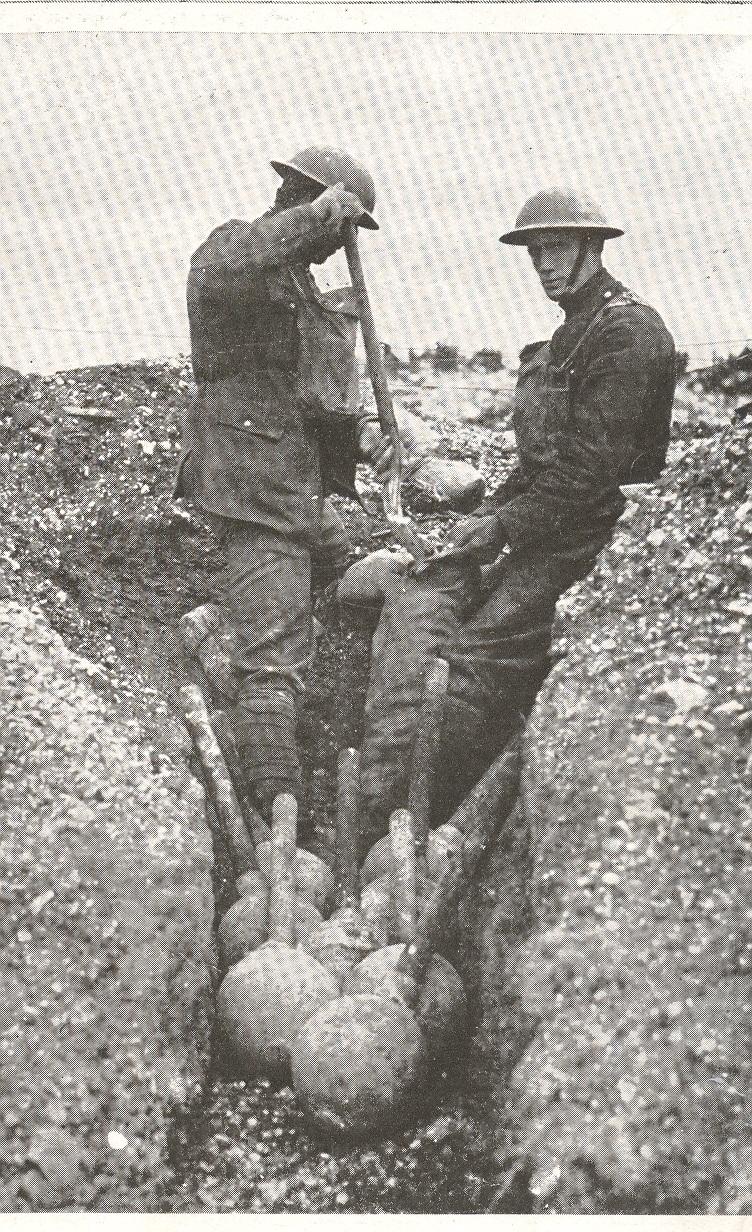
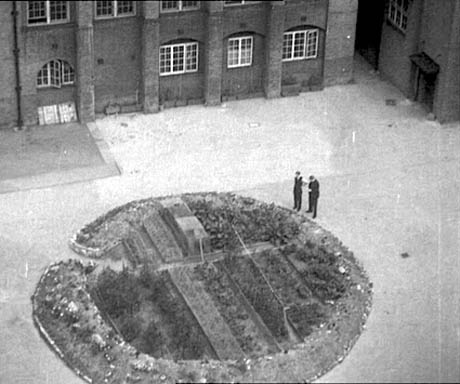
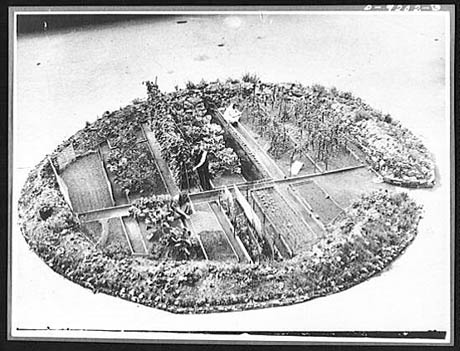
    The first image comes from Ediblegeography and shows a Nazi-caused bomb crater during the Battle of Britain ca. 1940/1 with its new innards. 

    And ditto1 here:

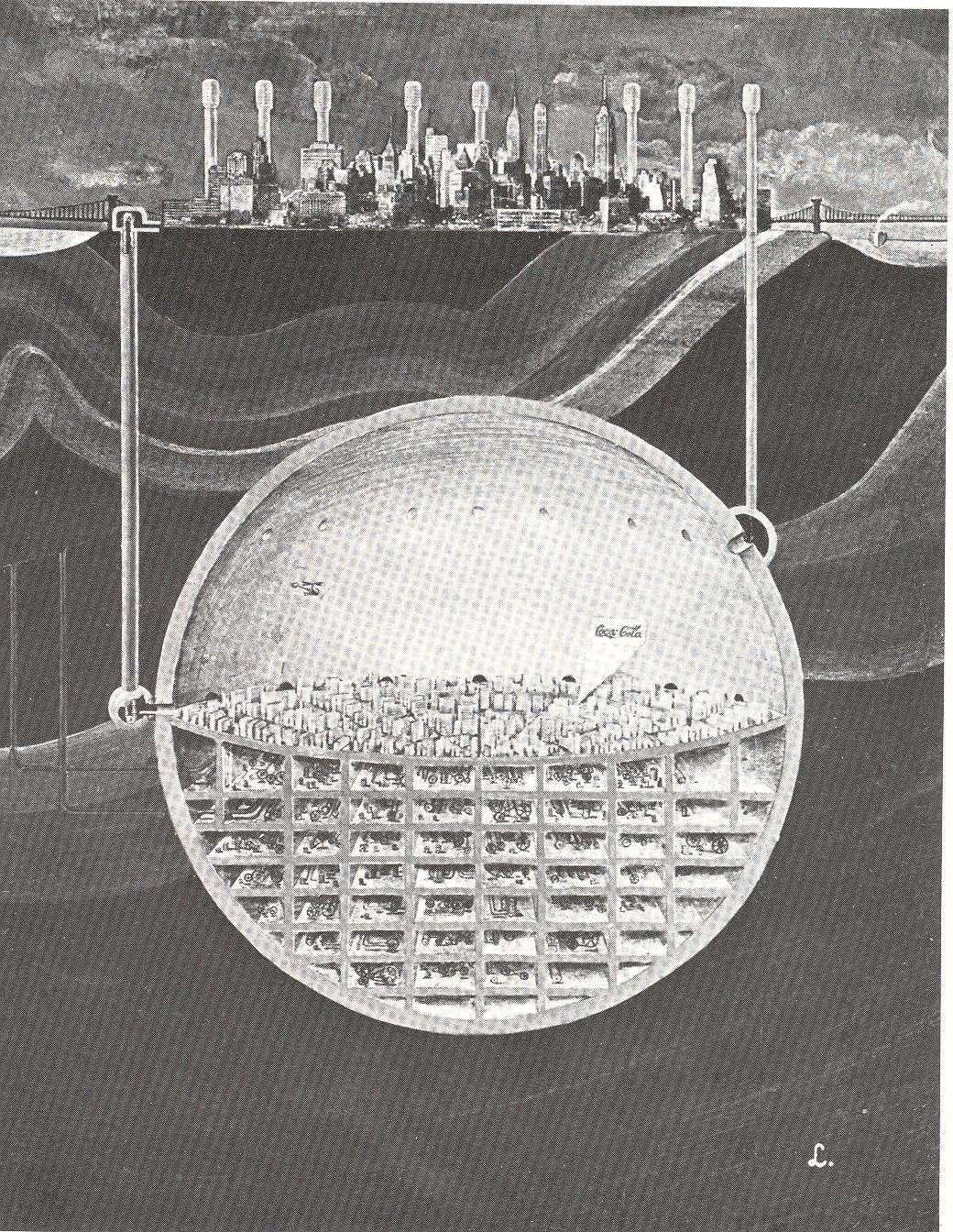
    A very unusual instance of filling holes up is when they are filled with cities.  Underground holes for some reason sang out their siren tunes of underground cities, landing the listening Oscar Newman on the rocks with his singular design.  The 1969 underground city (the image of which can be found in Alison Sky and Michelle Stone’s  Unbuilt America,  McGraw Hill, 1976, page 192–no home should be without this book) shows his fascination and unguarded belief in such an idea, though the whole things reminds me of a dog-buried ball.

    Blog--april 5 atomic city

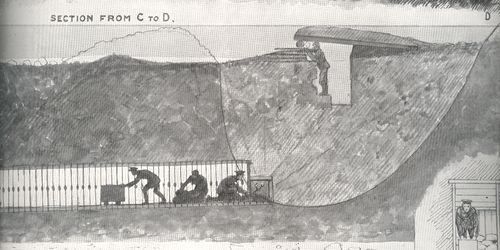
     During WWI  the indomitable sappers would dig long, tenuous tunnels under the field of battle to the enemy’s position, and then fill up the end of their hole with a lot of explosive, and then blow their enemy to kingdom come. This would be the Hole Filled With Death.

    Holes--sapper

    Holes filled with men–if holes can be considered so that are half-a-hole, as in a “trench”, then the period from 1914-1918 saw a 25,000-mile half-hole filled with 50 million men, half of whom would not come out alive, as they had been riddled with holes that got filled up with their blood.   Blog april 29 trench

    recording telegraphs made holes in paper tape so that the messages could be played back in their entirety later on

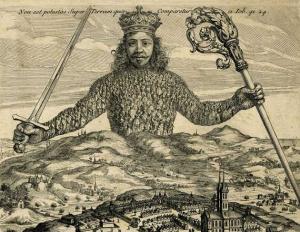
    I suppose too that a case could be made for the Leviathan, the empty holes of the political impresario filled to capacity with its subjects, the popular puppets filling the empty monarch because there is nothing there save for its need to be filled up, filled in the way that Gargantua and Pantagruel were filled.

    Leviathan_135448t
    Another very famous hole was filled with dark, a shadow cast by a stick, a lovely experiment carried out thousands of years ago by Aristarchus of Samos to prove his theory that the Earth was round.

    Not quite on the other hand is the sunbeam allowed to fall on the floor of the cathedral of S. Petronio in  Bologna through a speculuum in the ceiling, creating a solar clock (this being only one of many such examples).

    And I guess too that light entering one end of the telescope or microscope could also be considered a variant of filling-up-a-hole, if we can establish that a tube is a hole.  

    These holes below were filled with music–rather, they made it possible for music to be made through them, that they could actually produce a piano to play whatever music had been “transcribed” in them.

    In any event, this was meant to be a short thinking-out-load pieces on a Pictorial Alphabet of Hole-Filling, and it seems like a nice start.

      Music role making--1871


    Notes:

    1.  Again from Ediblegeography:  “Bomb crater victory garden (sadly long gone) near Westminster Cathedral, image from Pathé Films footage via City Farmer News”.

    ·Posted by :

    ·in:

  • Finding the Center, continued: the Center Sun and the Center of the Universe. 11th Anniversary Post

    JF Ptak Science Books   Post 2787

    In the long history of finding the Center of Things is the subset (or overset) of finding the center of the galaxy (which until the 1920’s was the universe) or of creation. The center changes over the dozens of centuries, not the least of which was the flower of creation blossoming outward from Jerusalem.  

    Astronomy--central sun

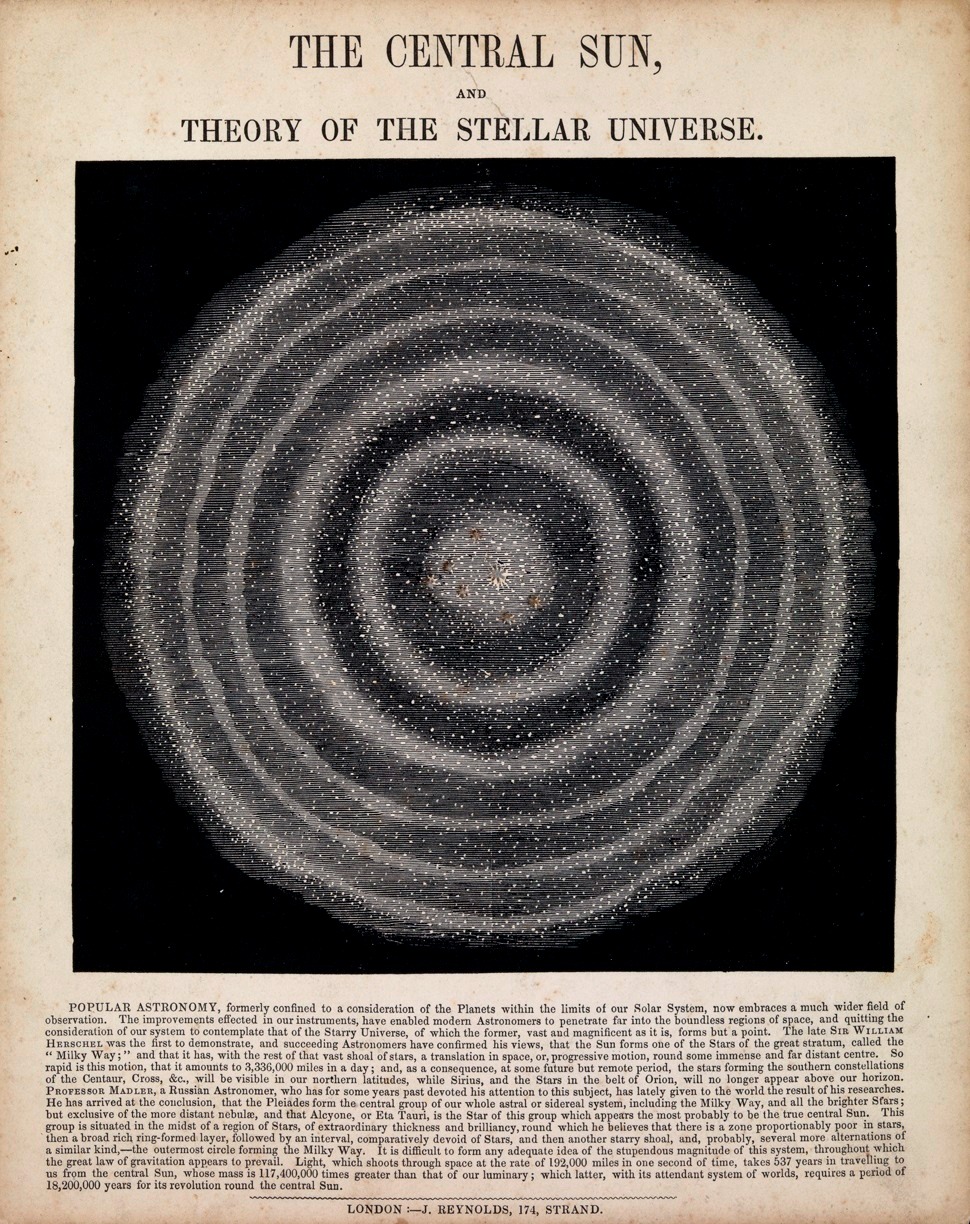
    • Image source:  Greenwich Observatory29x23cm http://collections.rmg.co.uk/collections/objects/263846.html (This is a depiction of the center of the universe, the Central Sun, as hypothesized by William Herschel and  later by Johann Henirich von Maedler (1794-1874), who published his observational results in Die Central Sonne, Doprat, 1846.)  This legend to this image is very legible once expanded. 

    Where is the center?
    Where is the center of the Earth, of religion, of the United States, of the universe, of art, of consciousness, of seriousness, of complexity?
    The center of stuff throughout history has been an almost entirely shifting matrix, a collection of vortices coming from Jupiter’s strongbox–a three dimensional representation of the location of their shifting centers over time would make an interesting Fibonacci-like display, I think.\The question may seem meaningless at first, but people have long asked it of nearly everything within their experience, trying to find the center of their world and universe, of their selves, of their religion, of their country, of politics, of art and music, and on through the Encyclopedia of Things that Could Have a Center.

    Take for example the questions of where the center of the Earth, or solar system, or galaxy, or universe might be?  There have been answers to these question more often than not over time, though the answers have been shifting.  The center of the Earth has certainly stayed more-or-less constant over thousands of years, though the stuff in the center has been swarming with change, from being hollow, to being filled with magma, to being a solid magnetic core, to being occupied by Mole Men, to housing the seat of the Inferno, or to be simply located on the surface of the sphere at Jerusalem (as the old T-maps have shown for hundreds of years), and on and on.  Working backwards, the center of the universe has drastically changed over time–for thousands of years, it was assumed that the Earth was the center of all things, until it wasn’t (that beginning mostly with Copernicus, and then challenged with Galileo’s use of the telescope and his discovery of an order of magnitude more stars, etc.).  And then William Herschel beautifully represented the shape of the galaxy in 1782, placing our solar system in a far from central location.  The center of the universe’s fate changed along with that of the Earth, incredibly so beginning with the Big Bang and then with the possibilities of their being a universe without boundaries.  And then of course there’s multiple universe theories, and worm holes, and the space time continuum, which complicates things even further, making the discussion of a “center” pretty much nonsensical.

    Simpler things can be as complicated–where is the center of the United States?  If we measure the center for the lower 48 states, it will be different than if we included the two far-flung states, or protectorates like Puerto Rico. The geographical center is one thing; another might be where the population center might be–that has made a beautiful map published over time by the U.S. Census Bureau (Department of Commerce), showing the star of the center moving not-so-slowly westward into Ohio over the last 20 censuses or so.  And where is the heart of the country?  Where is the heart of the West?  Better yet, where is the center of the West (or North, or South, or Mid-West)?  To answer where the center of these places might be you’ve got to first locate where those geographical ideas begin and end, which for many is a tricky subject, making it a matter of opinion as to where the center of these places might be.  
                                        
    The center in art had been a findable thing for some time, though more recently people like the Impressionists and Kandinsky have shown that the center might not exist, and it might not exist along with anything that is recognizable as a form of nature, representation and the center falling away completely.  Perhaps this is like finding the center of a decade or year or month, or week or day or second.  The parameters keep getting both smaller and larger, the ability to measure halves of things or the center of a second growing almost incalculably small, small enough to reveal that in this Zeno-paradoxical way, that there is no center because there are no boundaries; getting half-way to something into infinity doesn’t actually get you there.  

    Now, getting back to today’s image: this lovely illustration shows what is supposed to be the center of the galaxy, which at the time also meant the center of the universe.  The model was based on the observations and hypothesis of William Herschel, and then later more firmly put forward by Johann Henirich von Maedler (1794-1874), who published his results in Die Central Sonne, Doprat, 1846. The Central Sun was supposed to be the star Alcyone in the constellation of the Pleiades. Alcyone (or Eta Tauri, “the Central One”), who in legend threw herself into the sea in deep grief after an encounter with the disguised Morpheus; the gods though took pity or exhibited compassion and changed her into a bird, the Kingfisher. The Kingfisher is a bird which lays its eggs around the time of the equinox in December, the gods showing more mercy by introducing a period of non-stormy weather for seven days, and so introducing the (H)alcyone Days of winter. (I just missed being able to post this during that period by about a week.)  The Pleiades, (“the Seven Sisters”), were the seven daughters of Atlas, who (long story fractured) were turned into stars to ease the worry of the father who was busy doing others things, saving them from their instant pursuers once their protector was otherwise engaged. Orion, however, still pursues them across the sky.

    Here’s the concept of the Central Sun, explained for the kids of 1872:

  • The Situation of the Jews in Europe, a 1941 Assessment

    JF Ptak Science Books   Quick Post

    Jew in Nazi Europe 1941Jews in Nazi Europe, February 1933 to November 1941; a study prepared by the Institute of Jewish affairs, submitted to the Inter-American Jewish conference, November 23-24-25, 1941, Baltimore, Md., .Institute of Jewish Affairs.Institute of Jewish Affairs, [New York, 1941]. This 175pp (or so) report made at the end of 1941 was a sort of census about what was happening  to the Jews delegated in geographical sections, at the end of which was an overview summation. The writer(s) were seeing things accurately in terms of overall viciousness towards the Jews, and amongst other conquered peoples, but did not see the full and overwhelming, impossible, extent of the situation and the enormous numbers, not in 1941. (In that year alone, addressing solely the construction of concentration camps, six death/extermination camps were constructed in Poland, including Auschwitz-Birkenau, Treblinka, Belzec , Sobibór, Lublin ( Majdanek ), and Chelmno, with the result of murdering millions.)

    This from the “Conclusion”:

    “How does the general picture of Jewish life in Axis Europe look? The most important elements are the following: 1. Decrease in the number of Jews in Europe At the beginning of 1933» the area now under Axis domination had a population of about 8,500,000 Jews. Since that time, about 600,000 Jews have migrated. Another 400,000 are now homeless refugees, interned in concentration camps, building railways in deserts, waiting vainly in harbors for a ship, rotting on floating prisons, in the heat of the Sahara and in the cold of Siberia…addition, hundreds of thousands of Jews of the Soviet Union have been forced to leave their homes as evacuees and as refugees. The Jewish birth rate has been decreasing steadily during this period, while the death rate has been increasing at an accelerated speed of between five and ten times the normal pace. The population has been further decimated by the death of thousands in concentration camps, at the hands of the Gestapo and in the flames of total war, while many thousands more took their own lives in hopeless despair…”–Jews in Nazi Europe…, final section (unpaginated). 

    The entire document is well worth reading: 

    [Source for page images: https://babel.hathitrust.org/cgi/pt?id=uc1.c070874352;view=2up;seq=1

    [Source for text version: https://babel.hathitrust.org/cgi/ssd?id=mdp.39015002352097;seq=303;num=

    ·Posted by :

    ·in:

    —
  • Ships & Skyscrapers: Ships in the Skyline and a 2000′-Tall Building (1908)

    JF Ptak Science Books  Quick Post

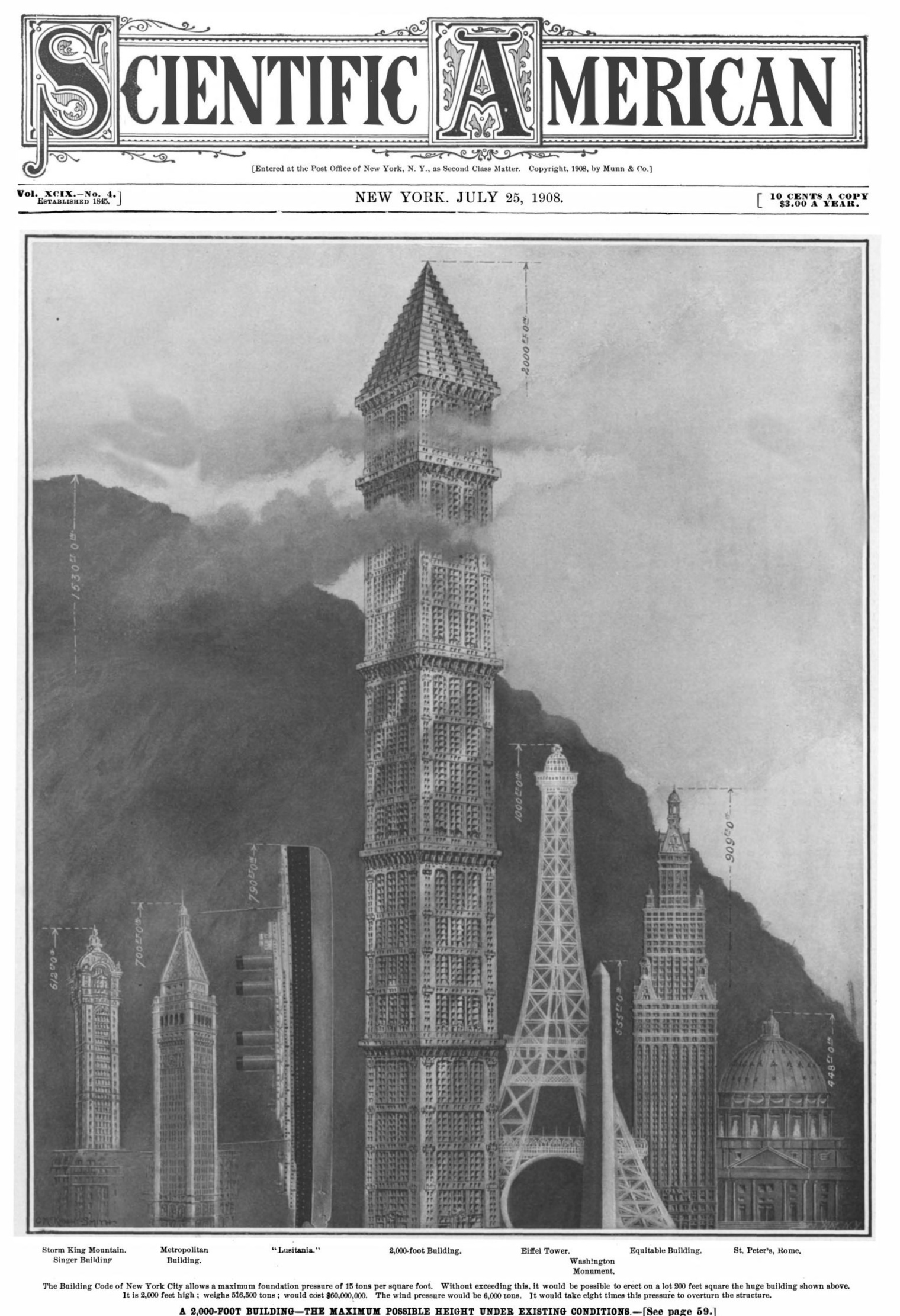
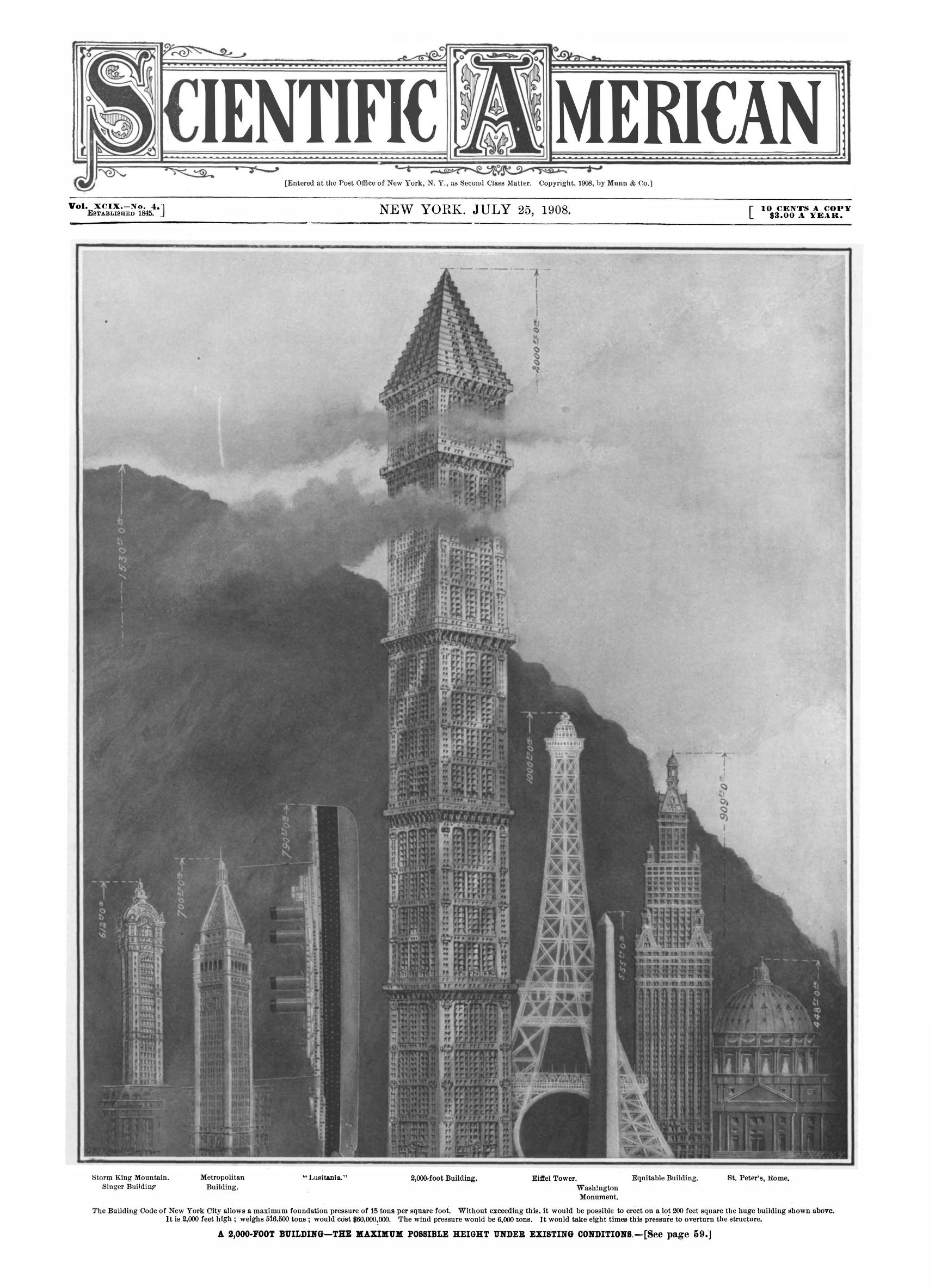
    I’ve lost track of the count of the sub-series on “Ships in the Skyline” in which new buildings etc. are measured against commonly-known objects, including large ocean liners. The enormous ship as measuring stick is interesting, and the appearance of the ship amidst buildings is very attractive in a Dadaist sort of way, as an artistic non sequitur. That said, here’s another example, this from the Scientific American for 25 July 1908,  showing what was estimated to be the maximum height (based on foundation and framing) of the still relatively-new architectural ideal of the skyscraper. 

    I guess I should identify what “new” means–here I’m talking about the third decade of the building, the first of which (for all intents and purposes) could be identified as William Jenney’s Home Insurance Building in Chicago in 1885, which was 10 stories and 138′ high. (There are couple of other earlier and qualified contenders for “first skyscraper”, but for here the Jenney building will work fine.)  There was a boomlet of skyscrapers in Chicago beginning in the 1890’s, and the beginning of the Golden Age/Building Boom around 1900, so by 1908 the building style was well established, though “skyscraper” as a word applied to buildings was only 20 years old. (According to the Oxford English Dictionary, the first use of the word for a building was preceded by its usage for a tall horse (1788), a tall bonnet (1800), a ship’s sail (1801), an exaggerated story (1840), and a  high-hit ball (1842), before it came to rest on a building in 1884 and 1889.)  The secular buildings were not taller than the non-secular ones (like the Rouen and Cologne cathedrals) until the early nineteen-oughts. 

    Anyway, here’s the image with a Beaux-Arts superbuilding: 

    Sci Am 1908 Ships in SKyline  2000 foot bldg

  • Infiltrating Fascist Sympathizer Groups in the U.S. (1943)

    JF Ptak Science Books  Quick Post

    UndercoverJohn Roy Carlson (the pseudonym of Arthur Derounien, 1909-1991) was an investigative journalist and during WWII he went undercover and infiltrated many of the right wing/fascist/”patriot” groups operating in the U.S.  The result of that work as a  well-received book called Undercover, My Four Years in the Nazi Underworld of America1, which was published by Dutton in 1943 and which went through seven printings in its first two months of publication.  It wasn’t yellow journalism, either–it was an expose of Nazi and fascist sympathizers, who–even after Pearl Harbor–supported the ideas of fascism.

    Derounien was a busy man, joining and infiltrating such groups as:

    • National Socialist White People’s Party (formed by George Lincoln Rockwell in a shabby store front on Wilson Blvd in Arlington,Virginia, and renamed the American Nazi Party in 1960);
    • Christian Mobilizers (allied with the Bund, this was a militant arm of the Christian Front which had a more-militant spin-off in the American Unity Party);
    • America First Committee (a mixture of patriotic, isolationist far right-wing and Nazi sympathizers, infamously spearheaded by Lindbergh, the group disappeared on 7 December 1941; 
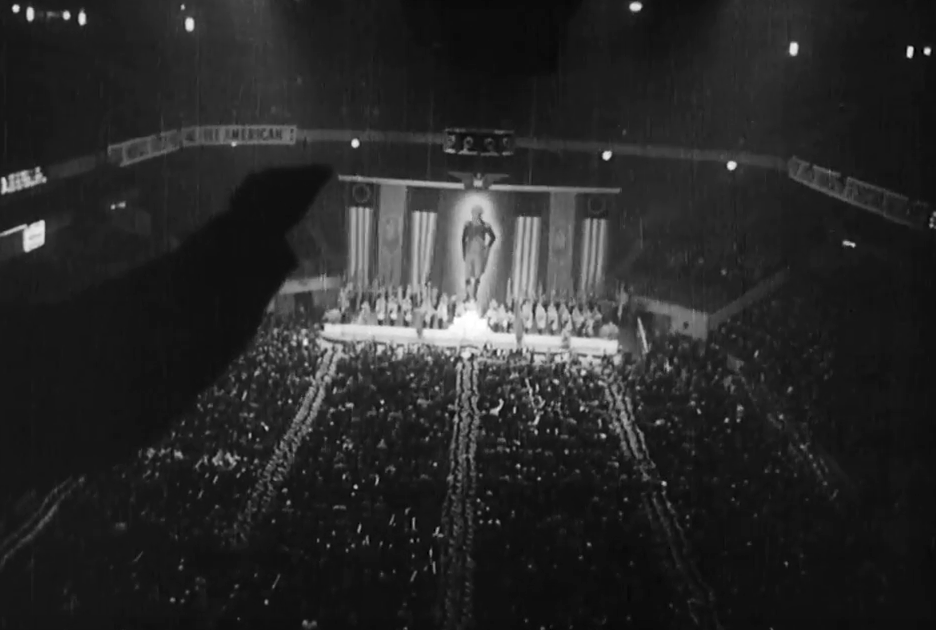
    • German American Bund, (a loud German-patriotic pro-Nazi group which filled Madison Square Garden in 1939 with 20,000 members, sweatily drenched in Hitler rhetoric, an enormous portrait of G. Washington, Brownshirts,  and swastikas: https://www.theatlantic.com/video/index/542499/marshall-curry-nazi-rally-madison-square-garden-1939/);

    plus the Gray Shirts (not to be confused with local boy Pelley’s Silver Shirts, abandoned after his jail sentence for sedition and replaced in the 1950’s with his new religion of UFOs and religious-something called “Soulcraft”), American Nationalist Party, American Women Against Communism, The American Defense Society, Anglo-Saxon Federation of America, National Workers League, Yankee Freemen, Flanders Hall, American Patriots, and others2–it was a very impressive undertaking. 

    Nazi Madison Square[German American Bund at Madison Square Garden, 20 February 1939.  Source: https://youtu.be/WpaYQqzFouw]

    His book had a very wide impact, contributing to some degree in bringing together thirty leaders of such groups to trials for sedition during wartime. Carlson had in the intervening year or so, 1943/4, been subject to many accusations and charges of being an enemy alien himself, or Communist, or something–accusations initiated by many of the groups that he exposed. So it seems that in preparing himself for the trials to come that in anticipation of more libels to come Carlson published this short broadsheet call Under Cover News, which appeared five days before D-Day, June 1, 1944.  In it he asked himself questions that he thought his detractors might ask, and answered them. 

    Note:

    1.  Full text is available here: http://dlib.nyu.edu/undercover/sites/dlib.nyu.edu.undercover/files/under_cover-%20john%20roy%20carlson-1b.pdf

    2. A fuller list of the organizations:
    American National-Socialist Party, German-American Bund, Christian Front, The Ultra-American, Nationalist Party,
    American Nationalist Party, American Women Against Communism, The Gray Shirts , America First Committee,
    No Foreign War Committee, Christian Mobitizers, American Destiny Party, American Brotherhood of Christians
    Congress, The Ethiopian Pacific Movement, Citizens Protective League, Social Justice Distributors Club,
    The American Defense Society, Anglo-Saxon Federation of America, Paul Revere Sentinels, Ra-Con Klub,
    Crusaders for Americanism, Inc.


    ·Posted by :

    ·in:

    — —
  • Life Expectancy–a Useful Collection of Numbers

    JF Ptak Science Books  Quick Post/Reference Post

    I was having an interesting conversation with my friend, Andy Moursund, who asked if we are better off now or 50/60 years ago. That was the basic premise from which MANY qualifications were made, including who “we” are, where that “we” is, what they do, and so on, and then followed by defining “better” in a number of different ways, and then creating relative measures and measurements, and etc. It is a very complicated question–Andy says it is his favorite question for a long car ride with someone, and I like it. Anyway, in checking out one point I needed to consult numbers for human life expectancy, and since it took a little poking around, I thought I’d collect a useful selection of them and share it here. 

    (One definition by Encyclopedia Britannica: https://www.britannica.com/science/life-expectancy)

    Life Expectancy (current) by Country (wikipedia)

    Life Expectancy 1850-2015

    • https://www.infoplease.com/us/mortality/life-expectancy-age-1850-2011

    Life Expectnacy, Worldwide, 1850-2015

    • https://ourworldindata.org/life-expectancy

    Life Expectancy U.S., 1900-2000 (including by race)

    • https://www.seniorliving.org/history/1900-2000-changes-life-expectancy-united-states/

    Life Expectancy at Various Ages, 1800-1920, Great Britain

    Life Expectancy 1950-2050

    • https://en.wikipedia.org/wiki/Life_expectancy

    Actuarial Tables

    Also:

    Net Worth by Age and Percentile Calculator

    • https://dqydj.com/net-worth-by-age-calculator-united-states/

    ·Posted by :

    ·in:

  • Extreme Bird’s-Eye Views of NYC

    JF Ptak Science Books  Quick Post

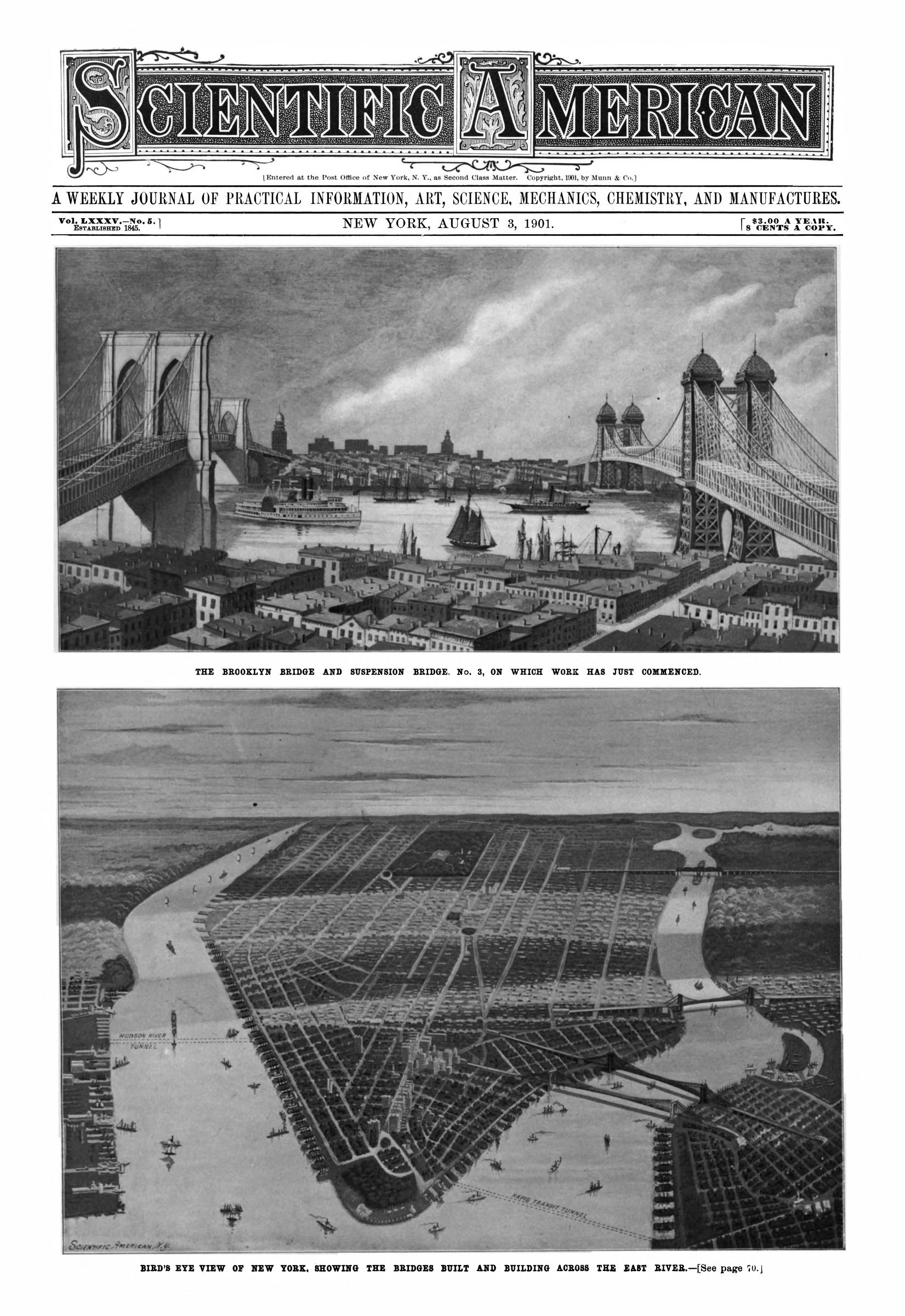
    I found this fine bird’s-eye view in the 8 August 1901 issue of Scientific American (the lower image is what I’m referring to).  It is a low-level oblique that shows about the entirety of Manhattan, from South Ferry to what is probably Harlem, and it seems to be an image that is not often reproduced.  While looking around online for something similar I found a great selection (19 maps, documented and linked) at the terrific (and now on hiatus) Bibliodyssey website. There’s no sense to reproducing all of the hard work that PK (Mr. Bibliodyssey) did in assembling his view selection, so just follow the link to his site and enjoy.

    Well, now that I think of it, I do want to share just one of them here and make a few comments on the thing here because it is just a terrific image:

    Sci Am 1901 Agust Birds Eye View Manhattan

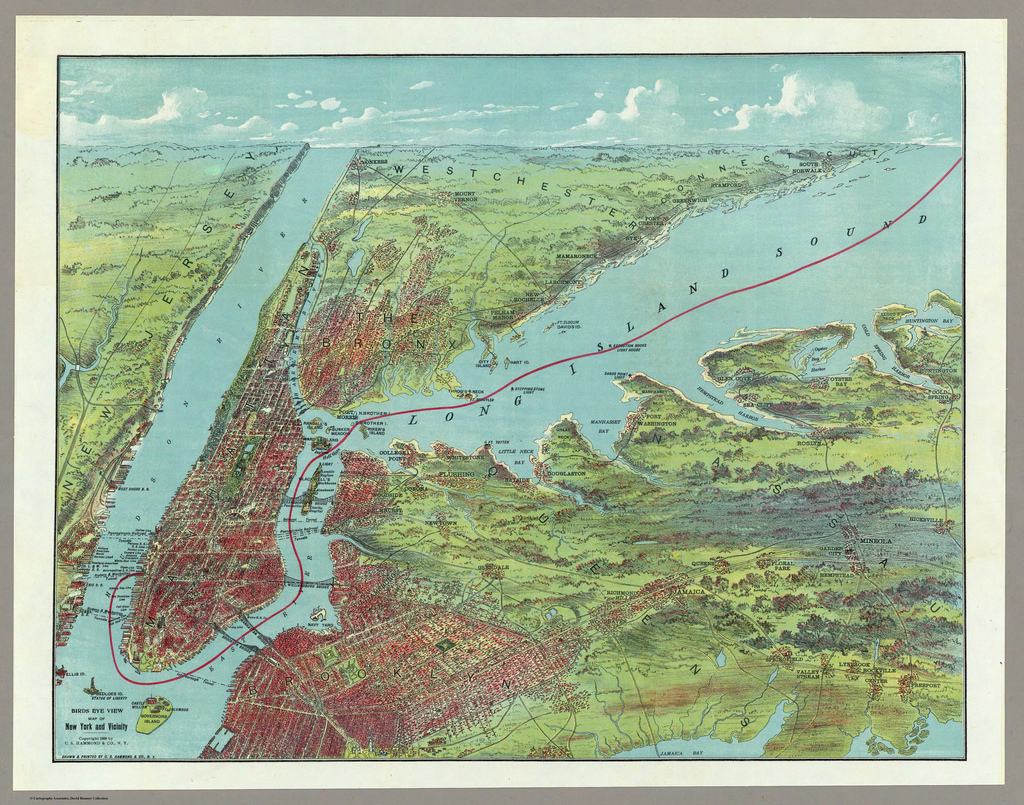
    The Bibliodyssey image:

    Brooklyn Birds Eye 1909

    [Bird’s Eye View Map Of East And North Rivers And Long Island Sound Price 10 Cents – New York C.S. Hammond & Co. Publishers. Scale 1:80,033.]

    [Source: http://bibliodyssey.blogspot.com/2011/09/birds-eye-new-york.html]

    This view reaches from Grand Army Plaza all the way to Yonkers, and it shows that even in 1909 there were some green areas left in Brooklyn in the south towards Jamaica Bay and out east (my mother’s mother was from Brooklyn who as a girl didn’t have to go far from Boro Park to go sledding on an open hill). Also it looks as though the Sci Am image also reaches almost to the Grand Army Plaza, but not much else in Brooklyn.  Anyway, its a beauty. 

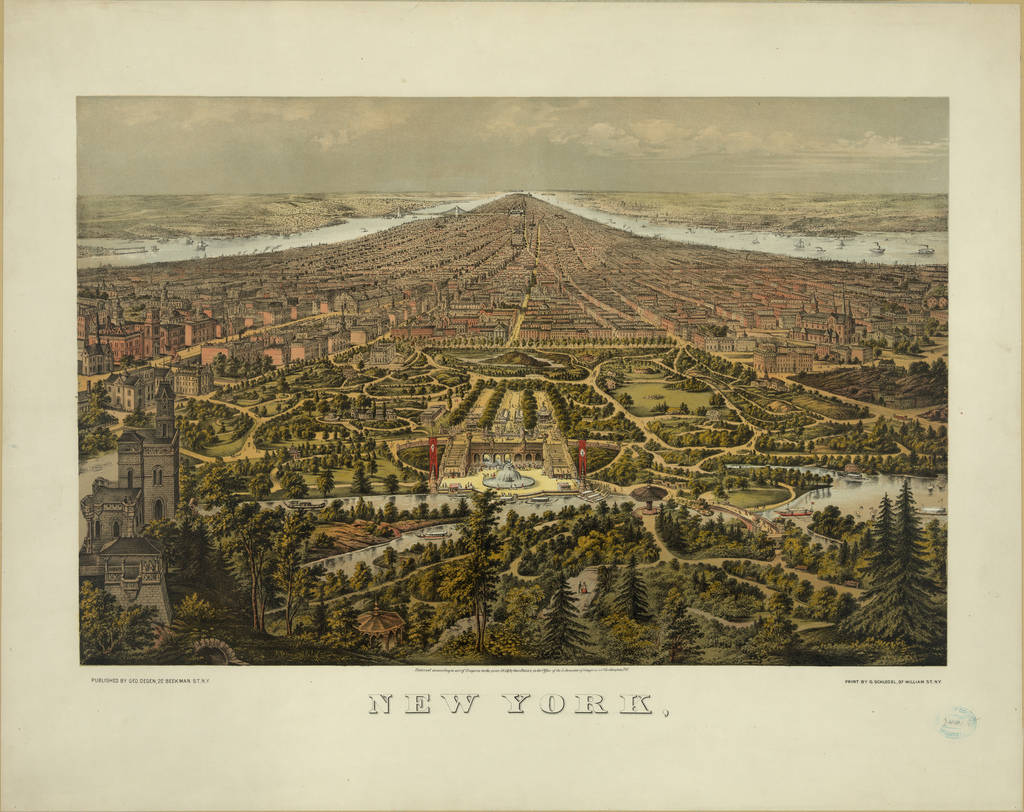
    Okay! One other that I’d like to draw attention to:

    Brooklyn birds eye 1873[Source: http://bibliodyssey.blogspot.com/2011/09/birds-eye-new-york.html]

    This is a “Bird’s-eye view of New York with Central Park in the foreground”, by George Schegel, published by George Degen in 1873.  This is sort of the opposite of the Sci Am image, though the perspective is not quite right and the point of view is much closer to the ground–still, we see all of Manhattan from Central Park south to the Battery and beyond. This view has an odd feel to it, as though you’re looking through the wrong end of a binoculars–still a fantastic piece of work. 

  • The Belgian Collector of Life (1918)

    JF Ptak Science Books  Quick Post

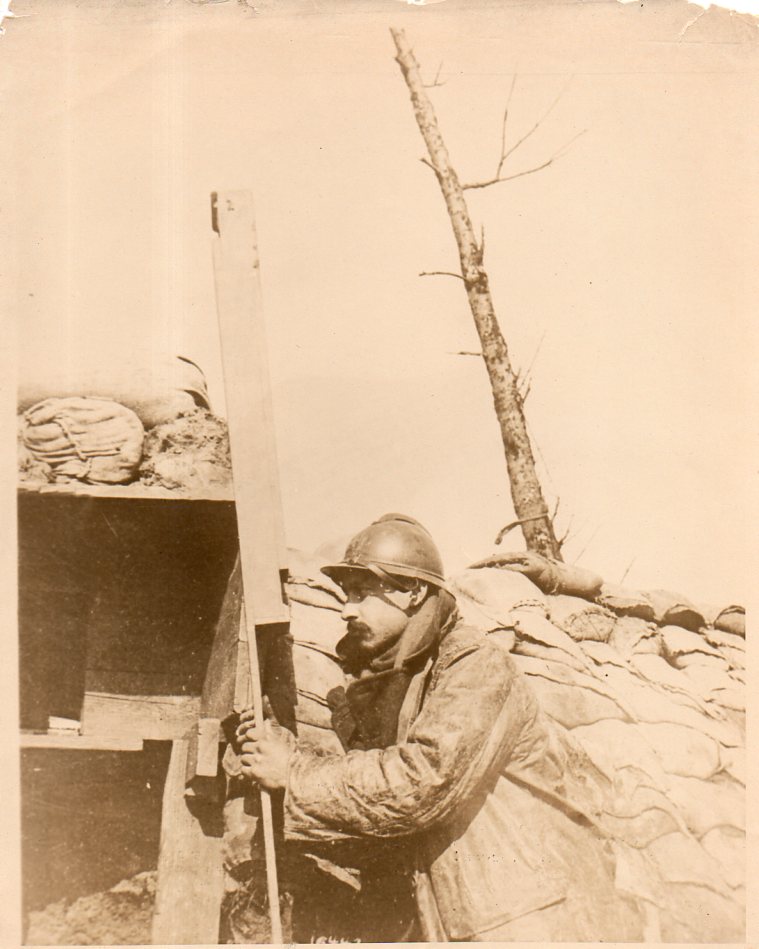
    This is an excellent example of appreciating images in context.  The photograph seemed line an ordinary image of a soldier peering through a periscope on action ahead of his trench, in some miserable battlefield, somewhere in Europe, 1918.  The image is the product of a photographic pool, the photographers working in semi-unison to produce acceptable images to be used in publications illustrating the war.  The images could not be too terribly graphic, and must not relate any useful military intelligence–they would pass through the hands of very active censors whose job it was to slightly inform the reading public and to also keep morale high, a difficult balancing act.

    WWI Sniper198

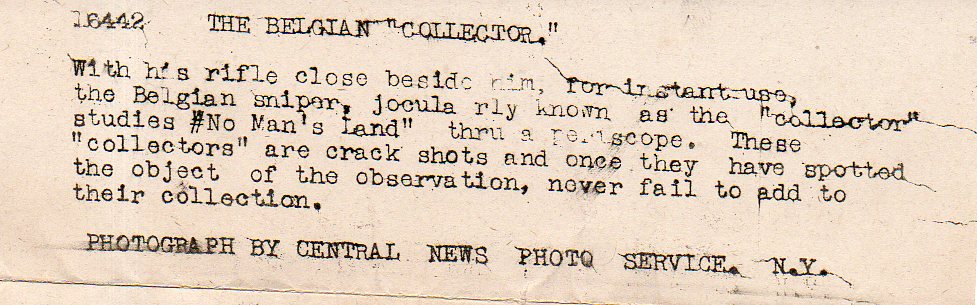
    And so this is what I thought–until I turned the image over–and saw that it was stamped “Photo by Central News Photo Service”, and was accompanied by a typed caption (below), the bit of text that was to be the standardized caption for this photograph when and if it was used by a magazine or newspaper.

    The title is “The Belgian Collector”. 

    I was surprised to read that the Belgian collector was a sharpshooter. He would scan the field looking for any unfortunate enough to spend a moment of thoughtless to leave themselves exposed for one brief moment.  In that moment the exposed soldier could/would die, collected. 

    In a  sense, “collect” like “John Fowles The Collector, only killing them with a rifle.

    But that was his job. And it was war. And if he was on your side, then you’d want him there.  

    “The Collector” title was chilling, and poetical.  

    WWI Sniper det199


    ·Posted by :

    ·in:

  • One of the Earliest Appearances of “Arbeit Macht Frei” (Spring, 1944)

    JF Ptak Science Books   Post 2788

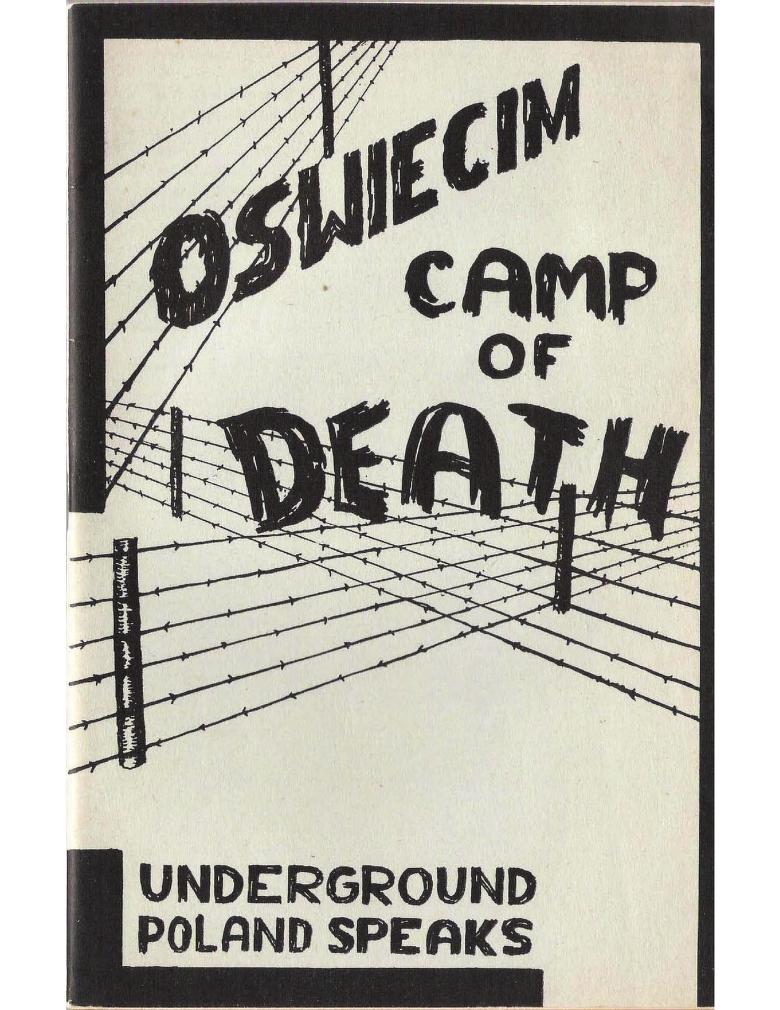
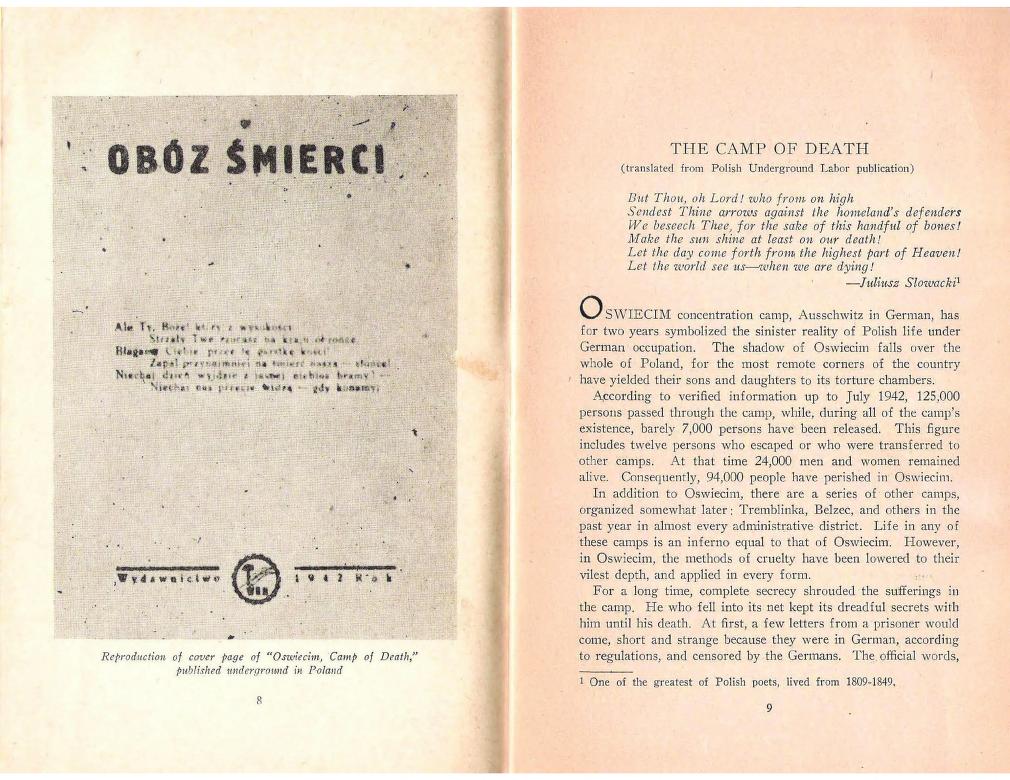
    Auschwitz 1944 English titleI stopped by my old friend the amazing Andy Moursund’s fantastic Flickr site, where in just the first 30 seconds or so I needed to stop and follow Andy’s lead on an astonishing book. The cover1 is stark, and justifiably so as  Oswiecism—Camp of Death. (Underground Report)2 is one of the earliest separately published reports on Auschwitz, published in March, 1944. (Auschwitz, which is the German rendition of the Polish “Oswiecism”, comes into being in May 1940, grows by 140,000 prisoners in March 1941, another 200,000 in 1942, and then many more until the end, when something on the order of 1.1 million people were murdered there, 90% of them being Jewish.)

    See Andy’s site here: https://www.flickr.com/photos/145907841@N08/albums/721577056751817750

    I checked the title on the internet archive, where there is a full-text copy available to read (here:

    https://archive.org/details/OswiecimCampOfDeath/page/n1

    Reading this pamphlet is a very stiffening experience, even if you have a background in reading about the Holocaust.

    I imagine too that this may be one of the earliest appearances in print of the hellish sign at the entrance to the KZ, “Arbeit Macht Frei” (“Work Brings Freedom”).

    We read of it on page 24 of the pamphlet:

    “HERE is a large sign over the camp entrance with the words “Arbeit Macht Frei”, (“Work Brings Freedom”), while from any spot in the camp one can see the huge chimney of the crematory. It is an ugly, brownish red.”

    “A prisoner’s life moves between these two points — the sign and the chimney —from the moment he “loses” his life when he enters the camp until the moment he “regains” it as a bit of ashes coming from the crematory.”

    “Surrounding the camp for an area several miles in width are cultivated fields from which the previous owners have been evicted. Many farm buildings and workshops adjoin the camp and its barracks. Scores of miles beyond the actual camp boundaries are the coal mines. All work, above ground or underground, is done by prisoners. They till fields, build houses, mine coal, load and unload trains. They produce goods of which only a part is for the camp; the major share goes to the German army…”

    Auschwitz 1944 polish version

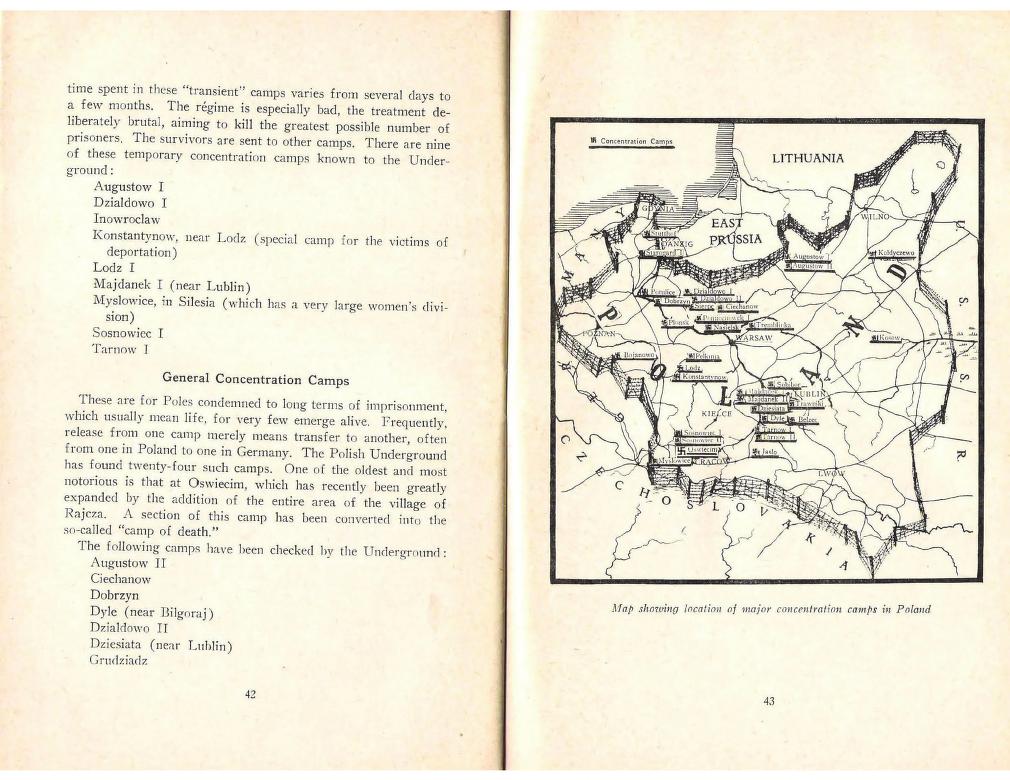
    And of further interest is this map of concentration camps in Poland:

    Auschwitz poland map

    Notes

    1. Cover by Teresa Zarnower (Teresa Żarnowerówna was a Polish avant-garde artist, painter, sculptor, scenographer, and architect). “One of the most important artistic personalities of the Polish constructivist avant-garde in the 1920s…” (Jewish Women’s Association Archive)
    2. Oswiecism—Camp of Death. (Underground Report), Sponsored by NATIONAL C.I.O. War Relief Commission, First Edition: March 1944. Copyright 1944 by Poland Fights New York, N. Y. Sponsored by American Friends of Polish Democracy; Published by Poland Fights, 55 West 42 Street, New York 18, N. Y. Assisted by Polish Information Center

    ·Posted by :

    ·in:

    —
  • Very Early Published Works on the Holocaust (1942)

    JF Ptak Science Books   Quick Post

    After reading my quick post from yesterday (on Oswiecim, Camp of Death, March 1944, a very early work published on the Holocaust) my friend Andy Moursund made several good points on other pieces of very early Holocaust literature (those being books or pamphlets rather than newspaper or journal articles), which I note below with links to their full text. 

    Andy went directly to Jan Karski’s extremely early (1942 and 1944) works–they were potentially momentous, though they missed their true moment, the reasons of which will no doubt be long discussed and debated. Karski (1914-2000) performed an heroic duty reporting on the mass extermination of Jews, ethnic Poles, and other nationalities in Poland in 1942-3, and wrote on the destruction of the Warsaw Ghetto. He was a professor at Georgetown University for a while, and lived on or near MacArthur Blvd–I saw him a couple of times in Georgetown (where my store was for years) back in the mid/late 1980’s but never spoke to him…he had very penetrating eyes in a sharp and angular face, exceptionally striking in a Samuel Beckett sort of way–his Story of a Secret State was well known to our circle, and Karski was very easily recognized, but not necessarily easily approachable. In any event, I regret not speaking with him. 

    The earliest work by Jan Karski is The Mass Extermination of Jews in German Occupied Poland. First official government-documented alert about the Holocaust and genocide of Poles addressed to the wartime allies of the then-United Nations.Government of the Republic of Poland, Ministry of Foreign Affairs MSZ, published in 1942. I should point out that “extermination” used in the description of mass execution of human beings seems to predate the recorded OED first-usage by three years.  (“Extermination, attributive, as  extermination camp n., a concentration camp for the mass murder of human beings, applied esp. to the camps set up by Nazi Germany in the war of 1939–45.1945  [First usage] Atlantic July 55,  “Among the workers a threat of being sent to an extermination camp has its uses.”–OED)


    ·Posted by :

    ·in:

Recent Posts

Archives

Categories