A Daily History of Holes, Dots, Lines, Science, History, Math, Physics, Art, the Unintentional Absurd, Architecture, Maps, Data Visualization, Blank and Missing Things, and so on. |1.6 million words, 7500 images, 4.9 million hits| Press & appearances in The Times, Le Figaro, Mensa, The Economist, The Guardian, Discovery News, Slate, Le Monde, Sci American Blogs, Le Pont, and many other places… 5000+ total posts since 2008.

  • A Not-So-Good Idea for Air Travel (1922)

    JF Ptak Science Books   Quick Post

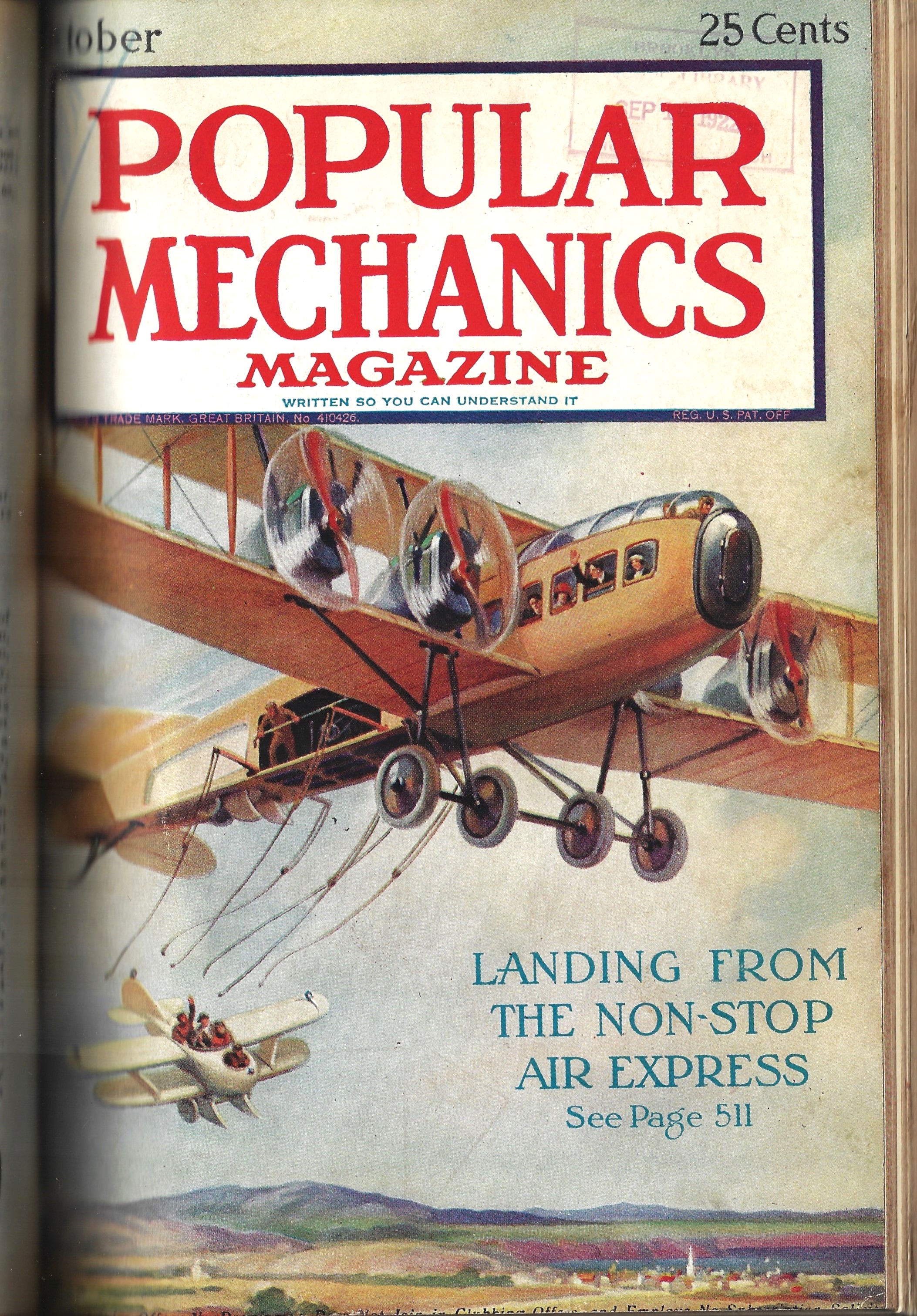
    This October issue of Popular Mechanics 1922 is robust! Here’s another attractive piece of design with loads of character and one central question:  “why?”  The image is that of a giant aeroplane capable of hauling 100 or more souls (not this particular version, though) for long distance uninterrupted flight of 1000 miles–so in order for there to be no in-between landings the aircraft came equipped with a glider aircraft (an altogether different version of the “hang glider”) that was released for the mother ship. As you can see it is a much smaller aircraft and looks to me to be pretty well packed, leading no doubt to questionable utility and much prayer. The thing is, why bother with another aircraft when you can just stop the plane and let people off? This beast was half-stopped in the air anyway by modern standards, probably chugging away at, what, 100mph? (The airspeed record at this time was just a touch over 200mph.) and it wasn’t flying very high (relative to even 1950), so stopping may not have been such a big deal. The airport or air station wouldn’t’ve been an issue either, because the glider would near to land somewhere. Anyway, I just couldn’t figure out this piece of The Possible Future.

    Pop Mech 1922 hang glider

    ·Posted by :

    ·in:

    —
  • Bad Places to Be (1922)

    JF Ptak Science Books  Quick Post  (Part of the series on the History of Holes)

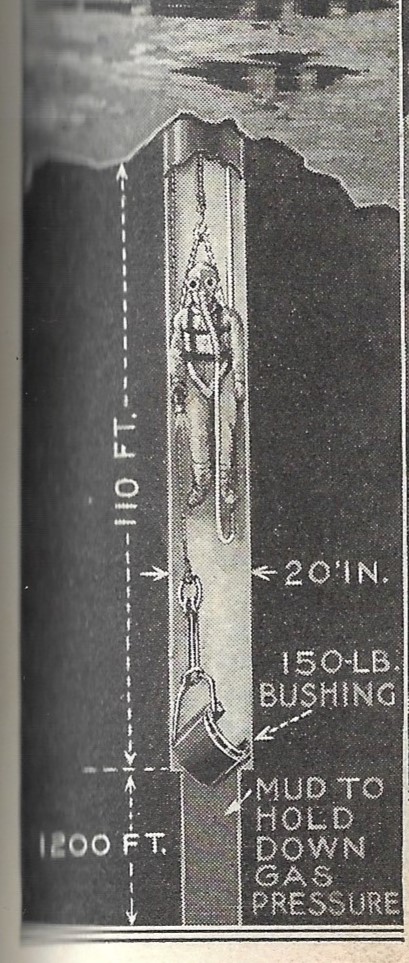
    Pop Mech 1922 bad place well retrieval detailThere could have been many dozens of posts in this sub category–many. There are posts dedicated to B-17 belly gunners, sappers tunneling under trenches, workers struggling away in the enormous and dank and terrifically unhealthy Brooklyn Bridges (not fireproof!) caissons, WWI coffin-like observation cars dangling from a 500′-long cable, and so on. (And as long as I’ve mentioned coffins, there are the illustrations of patent drawings showing people saving themselves from premature burial.) There’s an endless variety of these situations though I’ve only identified a half-dozen or so in this blog of 4500+ posts. 

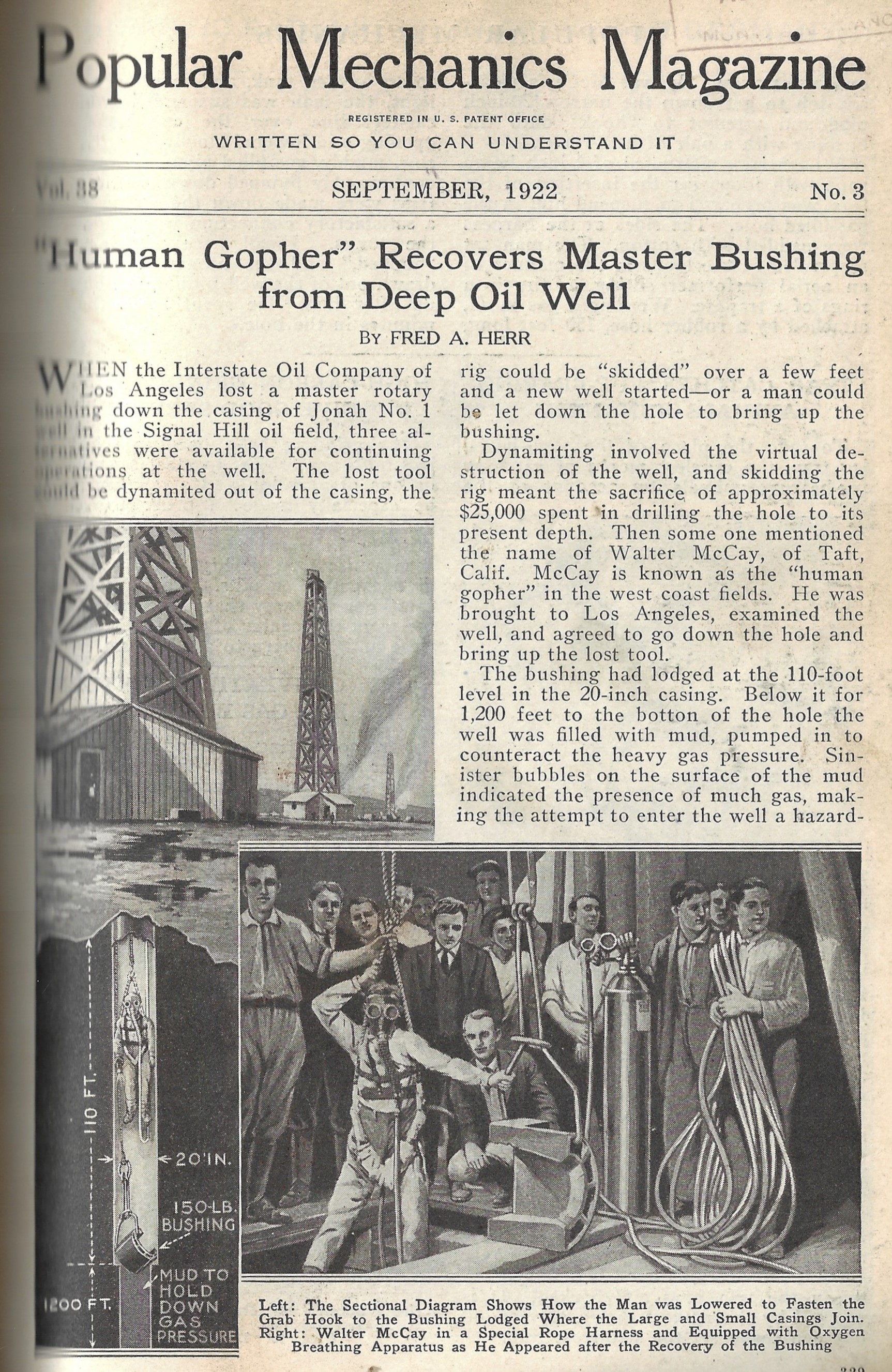
    I never did add a subcategory for this and labeling posts in this way simply got away from me, though it did just return this morning seeing the adventures of the human mole man. This guy would’ve been made of slim steel to do what he did, as just the idea of it gives me some low stomach shivers. He’s wearing half-overalls, a rudimentary mask, and with one flashlight in his right hand he’s lowered 110′ down a well that is just a little wider than his shoulders (20″) to collect a stuck 150-lb bushing. (I just measured 20″ across the width of my shoulders and I can say easily that I would’ve turned into a plug very quickly.)  Down the hole this man went, and emerged victorious, posing at the end of it all with his broken trophy.  It could’ve been worse–the hole could’ve been filled with water, or on fire, or filled with water on fire–but not by much.

    Bad places to be human mole

    [Source: Popular Mechanics, June 1922.]

    ·Posted by :

    ·in:

  • Ngrams: A Surprise with Two Words Unexpectedly Coming Together: “Bible” and “Television”.

    JF Ptak Science Books   Quick Post 

    I’m having a little fun with the Google Ngram viewer–you can too!

    • (https://books.google.com/ngrams/graph?content=&year_start=2000&year_end=2012&corpus=15&smoothing=3&share=&direct_url=) which if you look for the most recent date will default to 2008 and has a limit of 12 variables.

    I’ll just let these graphs speak for themselves. In the first graph I tried to beat “Frankenstein” with something popular but had a hard time, not finding anything (though just over a short period of time) but being very happy overall with the results. In the next graph I was mainly interested to see the difference in the use of “World War II”, “Second World War”, and “World War Two”, and then threw in “Bible” and “television”, and found the surprising “singularity” (well, not really). 


  • “The Western Frontier” and How Old That Name Might Be

    JF Ptak Science Books  (From the series on “Naming Things”)

    I’m returning to this post (from ten years and 4300 posts ago) on the question of “where is the West?” because I thought I had stumbled upon a very early mention of the related idea of “the western frontier”. The phrase popped up in an article on the telegraph systems of the world (in the Journal of the Franklin Institute for 1852) and in the section on the U.S. there is a mention of telegraphs “now extending from the verge of civilization on the western frontier (east of the Rocky Mountains) to the northeast extremity of the United States”. It struck me that–I thought–I really didn’t recall seeing “western frontier” (without a capitalized “W”) all that much in the mid-19th century, let alone discussing it in terms of Colorado. 

    To check out the scarcity of this phrase I checked out the Frederick Jackson Turner piece that started this whole idea of the study of the U.S. frontiers and scanned for the elements, finding “frontier” mentioned 168 times, “west” 107 times, “western” 42 times, but with only four appearances of “western frontier”, and that usually in reference to the slavery issue. The OED was no help on this, unfortunately, and could not establish “western frontier” in the long entry on “frontier”, which has a very old and long usage in English. From there I went over to WorldCat, and checked out the appearance of “western frontier” in the titles of books printed 1800-1860, and found in the dozens of millions of book records that it seemed to occur hundreds of times. However, once getting rid of duplication, and works that had “western” and “frontier” in the title but not together, it looked as though there might only be 10 or 20, but a short look at that set showed the usage in the form I was looking for reaching back into at least the 1820’s.  So, my 1852 reference was way late, but I think I might be able to say that “western frontier” really doesn’t pick up in usage until after Turner’s 1893 piece. 

    Anyway, here’s the rest of that earlier post: 

     
  • Electricity and Telegraphy Before the Electric Telegraph: the (Electric) Shock of Recognition (1825)

    JF Ptak Science Books  Quick Post

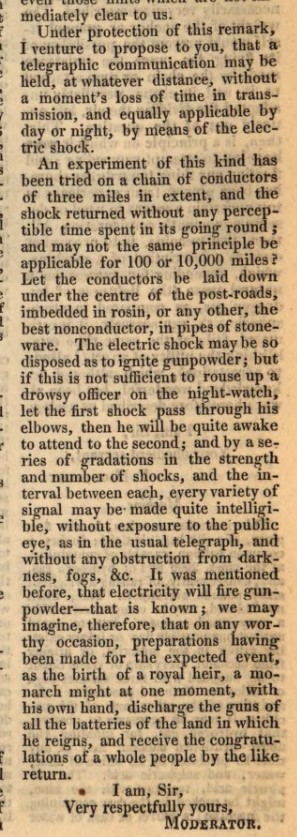
    Electric shockHere’s an interesting twist on electricity and the telegraph, but not quite what you’d expect. The note, written by “Moderator”, appeared in Mechanics’ Magazine for 15 June 1825 (volume iv, p 148). Since this is 1825, the telegraph being referred to here is an “atmospheric telegraph”, or semaphore, the electric telegraph of Morse being another dozen years away and another 5 or 6 before its practical appearance.

    The electricity here was being used in part to alert (where “alert” = “shock”) whoever it was that was snoozily sitting at their post to instantly pay attention to whatever it was being signaled to that point in the semaphore chain:

    “The electric shock may be so disposed as to ignite gunpowder; but if this is not sufficient to rouse up a drowsy officer on the night-watch, let the first shock pass through his elbows, then he will be quite awake
    to attend to the second…”

    I can’t tell if this is being suggested along a A Modest Proposal sympathy, or not. 

    This shock-bit though is preceded by something interesting that I also don’t quite understand, though that is starting to sound like the modern electric telegraph:

    “…and by a series of gradations in the strength and number of shocks, and the interval between each, every variety of signal may be made quite intelligible, without exposure to the public eye…”

    In any event, it is an interesting footnote in the history of communication and those sleeping through it. 


  • Massive Paper Coronary for the Coroner’s Office of NYC, 1915

    JF Ptak Science Books   Quick Post

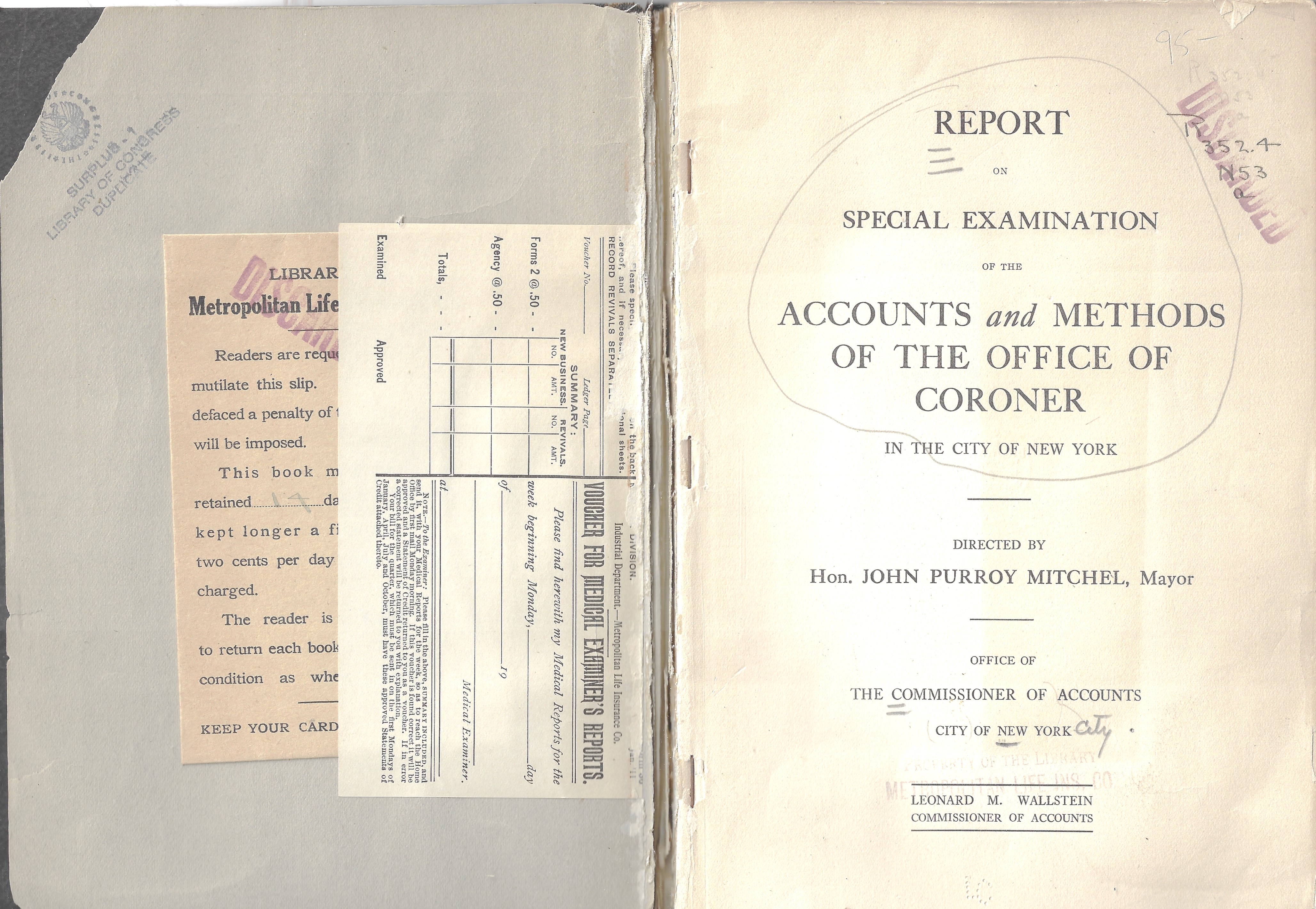
    If you ever had any interest—known and unknown—in reading about very impressive amounts of corruption and its constituents in the coroner’s office for NYC 104 years ago, here’s your chance to satisfy it. I’ve found a scarce report documenting the extraordinary conditions of that agency and also found a copy of it online, and include a link to the report (below).

    You don’t want to be on the other end of this paper—it is scathing, and angry, and well-written and documented. From a quick read of it the office of the coroner of NYC was simply a fantastic mess of incompetent work and very highly competent corruption.

    The report starts at the end, with a summary of findings, and then goes downhill from there:

    • “The elective coroner in New York City represents a combination of power, obscurity and irresponsibility which has resulted in inefficiency and malfeasance in the administration of the office. With constant temptation and easy opportunity for favoritism and even extortion, with utter lack of supervision and control, and without the slightest preparation and training to create in the coroner’s mind a scientific and professional interest in the performance of his duties, the present system could not have been better devised intentionally to render improbable, if not impossible, the honest and efficient performance of the important public function entrusted to his office.

    Of the 65 men who have held the office of coroner since consolidation, not one was thoroughly qualified by training or experience for the adequate performance of his duties….”

    Coroner rept

    There’s a ton of bitter accusation of wrongdoing along with the evidence to back it up. 

    • Here’s the full text via Hathitrust: https://babel.hathitrust.org/cgi/pt?id=mdp.39015055432580;view=2up;seq=4

    ·Posted by :

    ·in:

  • A Fine Engineering Effort: Constructing the Foundation for a New Building Under the Still-in-Use Building to be Replaced (1922)

    JF Ptak Science Books   Quick Post

    Here’s a very interesting engineering and building feat: placing the foundations for a new building to replace an older one while the older one was still (1) standing and (2) in use. The recipient of this effort was the McVickers Building in Chicago, a theater that opened in 1857 and came to it slow end in 1922. It looks like the last bit of currency was squeezed out of this old building, performances being given right to the very end while foundations for the new building were being constructed 24 hours a day. Int he world of cross sections this is a good one, and also pretty unusual. Also in the top left corner we see a photo of a caisson under construction–a shot I don’t see very often in my searches of old stuff.  

    Pop Mech 1922 Cross section theatre caissons

    Source: Popular Mechanics, February, 1922. 

  • A Marching Band Without Instruments, but with an Wireless Master (1922)

    JF Ptak Science Books   Quick Post

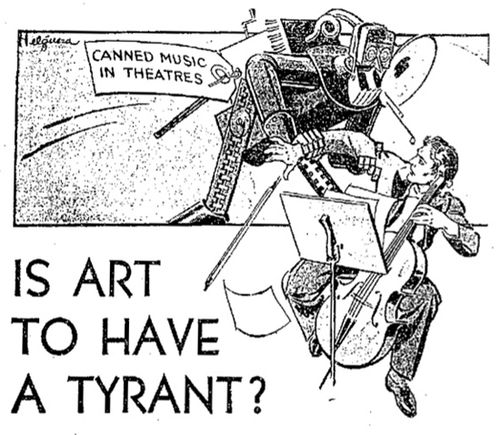
    I’ve written here before about the early incursion of technology into the spheres of human creativity and imagination. Now, some of those bits have stretched the idea a little, but when people (or Our Future Robot Overlords) look back  into the dim dust they may be more prepared to accept some of propositions of these posts as pre-history implications of the future domination of something along the lines of AI or universal intelligence. For example, one of the posts dealt with the replacement of live music in theaters with “robot music” , which was simply “canned”, or recorded music replacing the live players. (See https://historyofideasblog.com/thesciencebookstore/2016/10/robot-songs-of-love-.html for example.) 

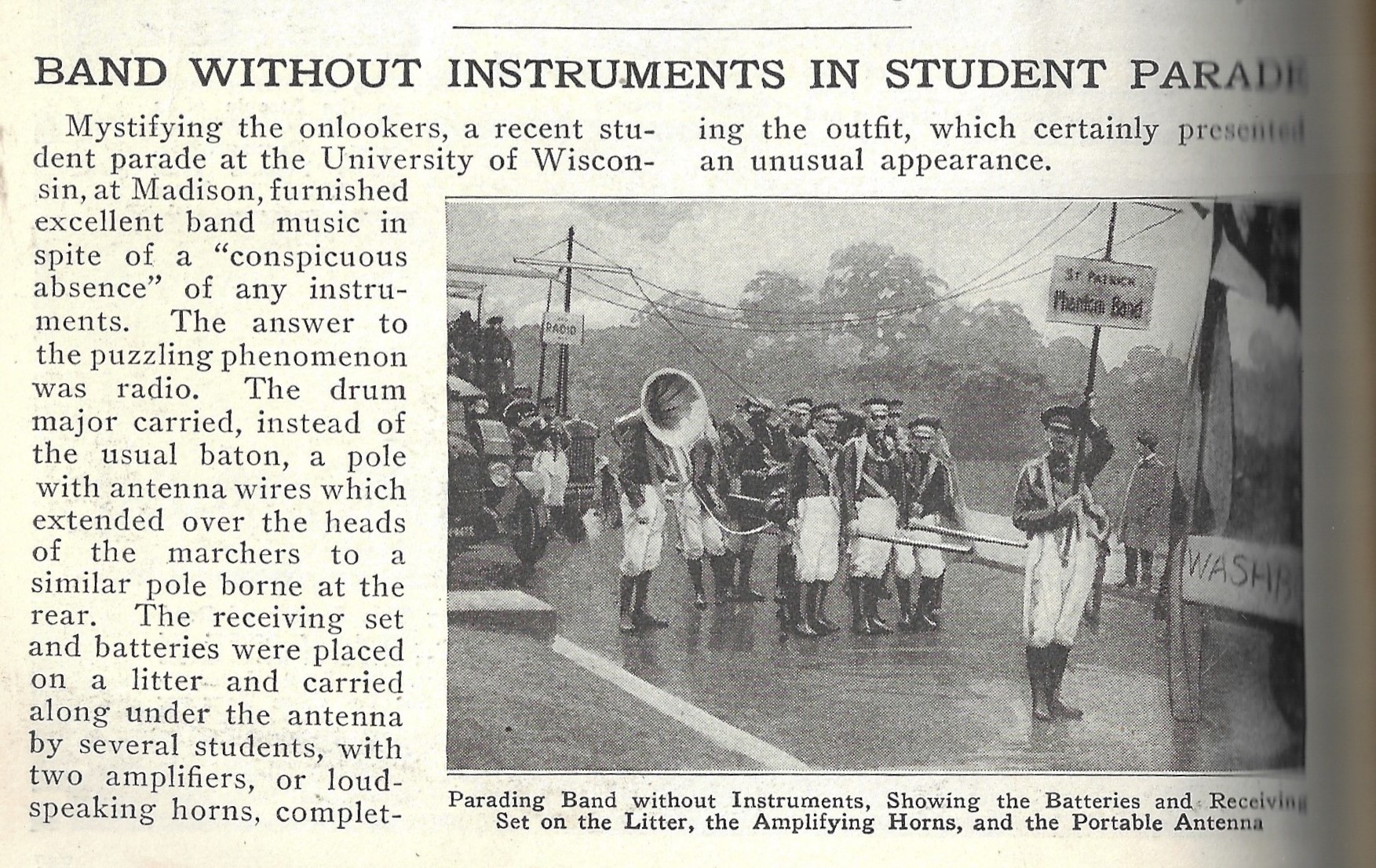
    Along these lines came  another example today, this one from 1922 (just a year after the creation of the word “robot” from Karel Capek’s R.U.R.): the marching band with no instruments. This was the “Phantom Band” depicted in the pages of Popular Mechanics in March 1922 and shows a band identified so, marching with a radio set playing the music rather than the human performers. (If you look closely you can see the drum major is carrying an antenna, and the sousaphonist is actually carrying a loudspeaker, and somewhere in there are folks carrying the battery set, and so on. There’s no clue in this short article why this demonstration was taking place, but it did.  

    Pop Mech 1922 marching band

    And another example of “robotic” music (1929):

    Robot songs of love

    ·Posted by :

    ·in:

  • One of the Earliest Reports of Dogs on the Newly-Invented Telephone (1877-1884)

    JF Ptak Science Books   Quick Post

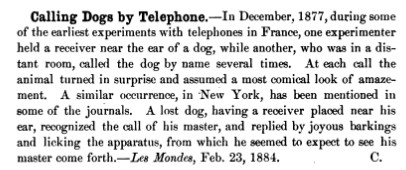
    Okay, so I really don’t have any idea of what might be the earliest use of a telephone with a dog–I mean, who does? However I do have some long experience in looking at very early reports on the development of the telephone and the first time I ever came across a reference mentioning dogs and the phone was today (oh sweet joy!) in the Journal of the Franklin Institute (volume 116, June 1884, p 460). This is nothing really but personal bias and judged on my own experience, but I have to say that I may be right in my guess…though I’m not going to set out and research what a better answer might be in pulling the timeline to make it taught.  In any event, it is an enjoyable report, and at this point the dogs probably reacted like most humans did hearing the telephone for the first time.  

    JFI 1884 Dogs on the phone

    ·Posted by :

    ·in:

  • “I’ve Got a Bridge to Sell You!” First (?) Notice of the Sale of the Brooklyn Bridge? (1867)

    JF Ptak Science Books  Quick Post 

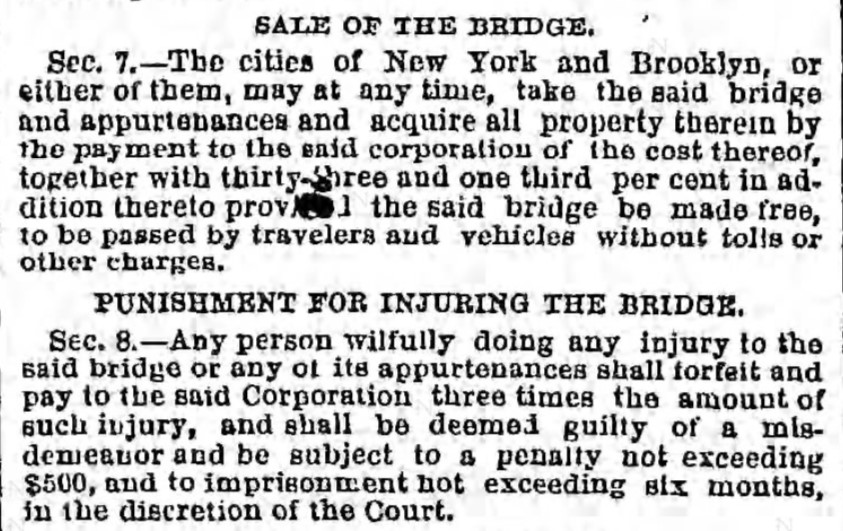
    The butt of an old tag-line for a gullible person convinced of something that could be easily disproved was something along the lines of “…and if you believe THAT I have a bridge to sell you”, that bridge being of course the Brooklyn Bridge. Well, the snippet below from an article in The Brooklyn Eagle (January 25, 1867, page 2) in which the agreements were made to start construction of the bridge (commencing in 1869) also included a section about the sale of the bridge from the corporation building it to NYC or Brooklyn or both. Now this is not what the comedy tag referred to of course as this was real, but it is a little amusing to see such a thing in black-and-white.

    Also its amusing to see below it a notice on “punishment for injuring the bridge”.

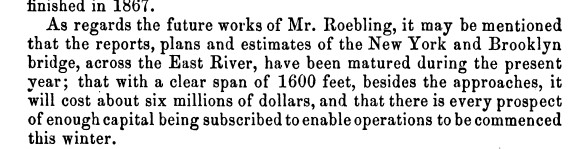
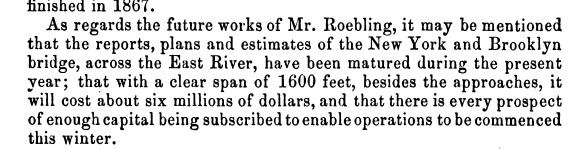
    Lastly in this short post I include an interesting view of the future, found at the end of an appreciation of John Roebling in a volume of the Journal of the Franklin Institute for 1867.  It is a statement on the plans for building the Brooklyn Bridge–at teh time it was still the “New York and Brooklyn Bridge”, and then the “East River Bridge”, though “Brooklyn Bridge” was also used, the official designation of that final name coming in 1915. 


    Brooklyn Bridge sale of

    [Source: Brooklyn Eagle archive at the Brooklyn Public Library, now gloriously online.]

    JFI 1867 Roebling _detail_


    [Source: Journal of the Franklin Institute, volume 84, pg 410.]

  • The First Weather Map Printed in the U.S. (1838)

    JF Ptak Science Books   Post 2794

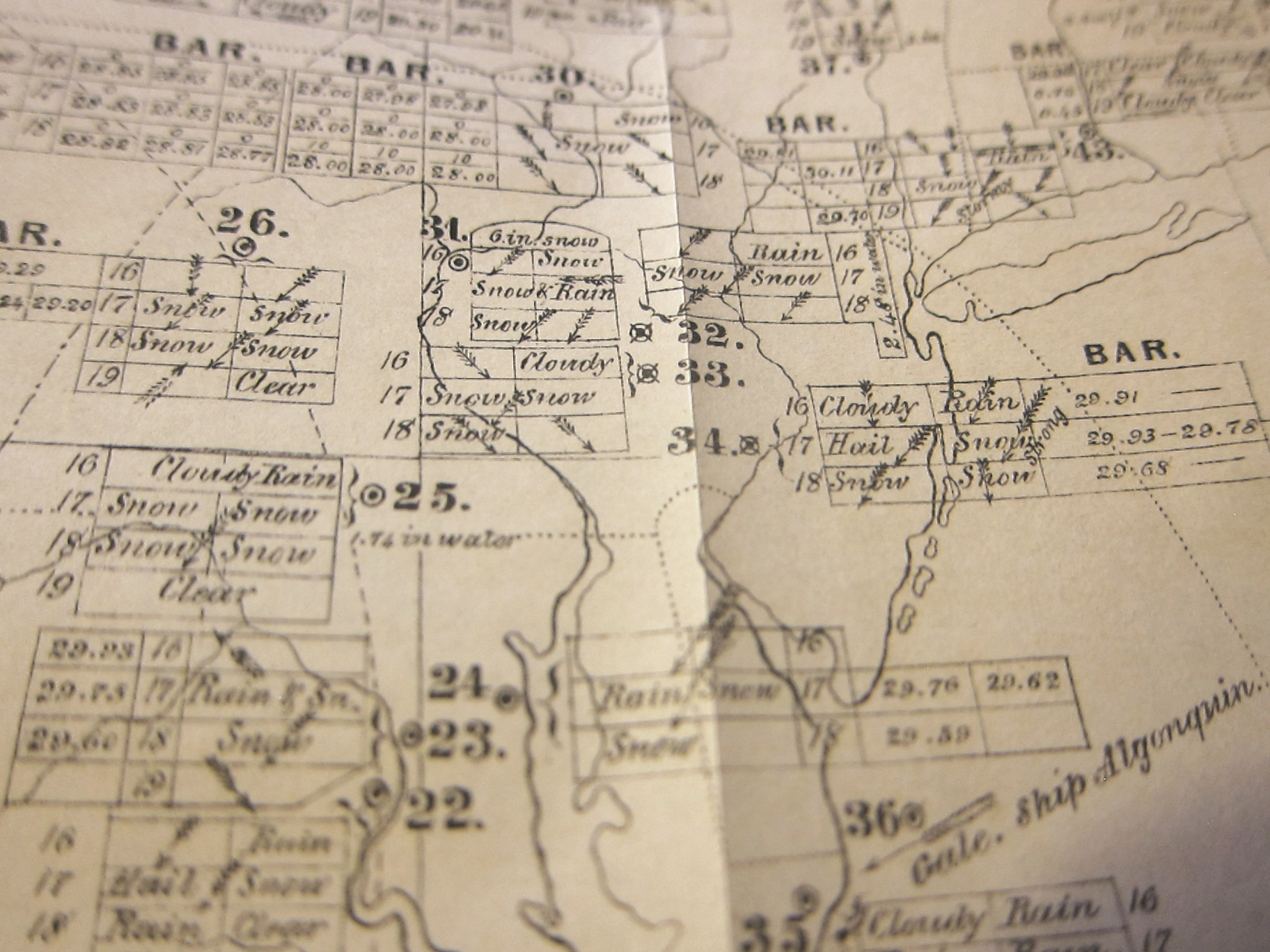
    Here’s another example of a book that I catalogued for the books-for-sale section of this blog that may be of some interest to general readers: the first weather map printed in the U.S. (1838). 

    Espy weather map _2_

Recent Posts

Archives

Categories