A Daily History of Holes, Dots, Lines, Science, History, Math, Physics, Art, the Unintentional Absurd, Architecture, Maps, Data Visualization, Blank and Missing Things, and so on. |1.6 million words, 7500 images, 4.9 million hits| Press & appearances in The Times, Le Figaro, Mensa, The Economist, The Guardian, Discovery News, Slate, Le Monde, Sci American Blogs, Le Pont, and many other places… 5000+ total posts since 2008.

  • On 19th Century Back-of-the-Head Portraits

    JF Ptak Science Books   Post 1125
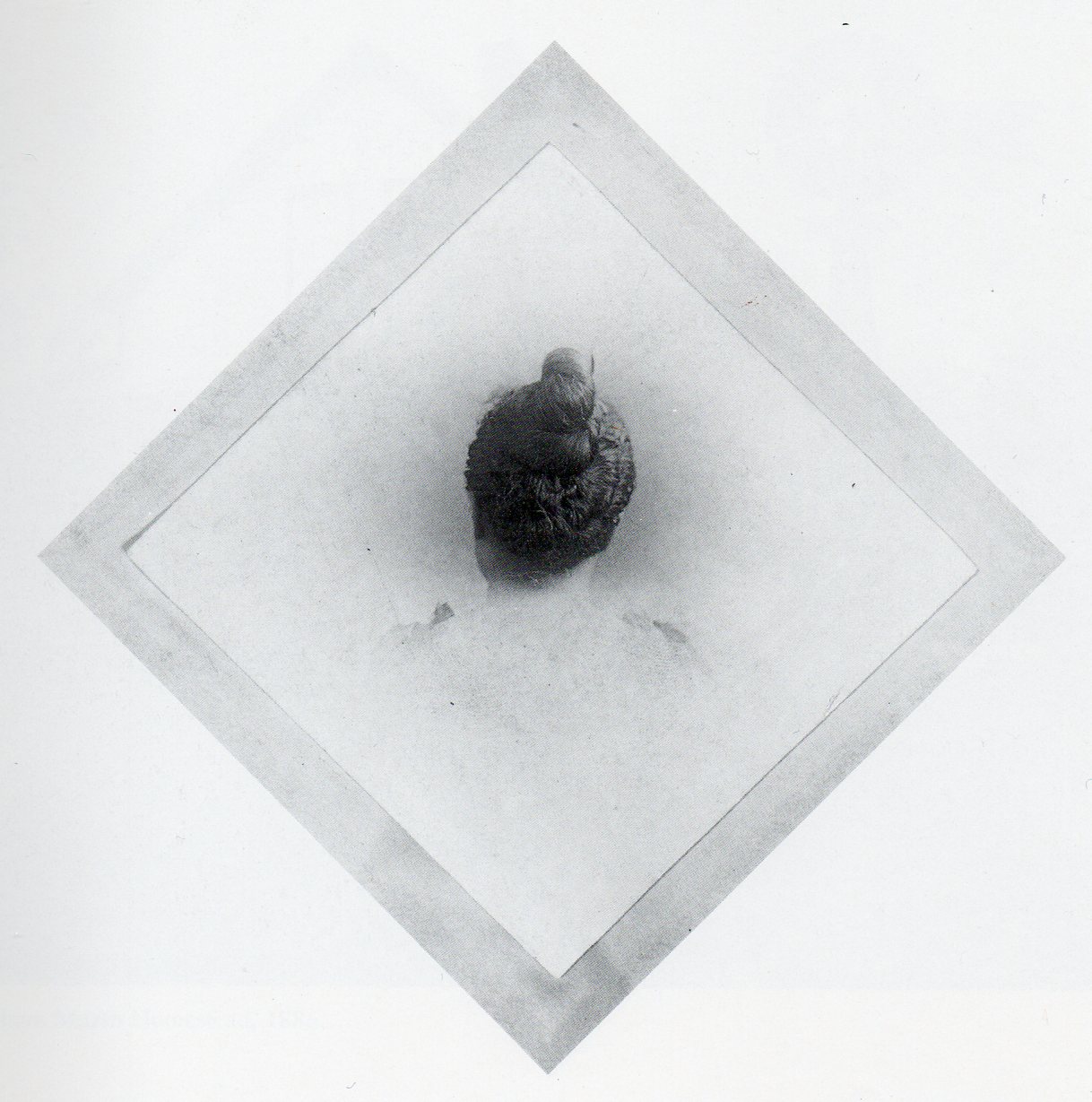
    Back of head back342

    I honestly cannot say when I first started noticing photographs in this odd category–it may have been from police images, early mugshots, that started with (the first) antropometrist  Alphonse Bertillon, showing deformities and cracks and creases and blemishes and tattoos on felons; or in the earlier and  floundered phrenological work of Franz Gall1, who looked pretty much for the same but with more  liberal doses of social philosophy But it is a restricted category, that’s for sure.  Even when you look closely at paintings and engravings it is rare to see even a secondary image of someone’s head squarely, directly form the back. 

    And then came this pair of photographs presented on the endpages of Cathy Luchetti’s Women of the West (Antelope Island Press, 1982)–its a wonderful book about 19th and early20th century women as pioneers int he American West, told mostly in their own words.  It wasn’t until I closed the book that I found this picture (which is odd for me as I’m mostly back-to-front with a new book) and decided on this post.  The photos do tickle some old memories of 19th c back-of-the-head photos featuring extraordinary hair length,  Civil War wounds, spinal and neck injuries, young Hopi girl hairstyles, and that sort of thing–but in this case, I can’t see anything unusual about the back of this woman’s head.  It looks as though it is just the back of her front.  I think that most of the time that we see back-of-the-head it is for something special or unusual in some way (and I won’t even get into 20th/21st century stuff like Valdemort’s surprising hiding spot)–it seems in this case, it is not.  Its just the back.
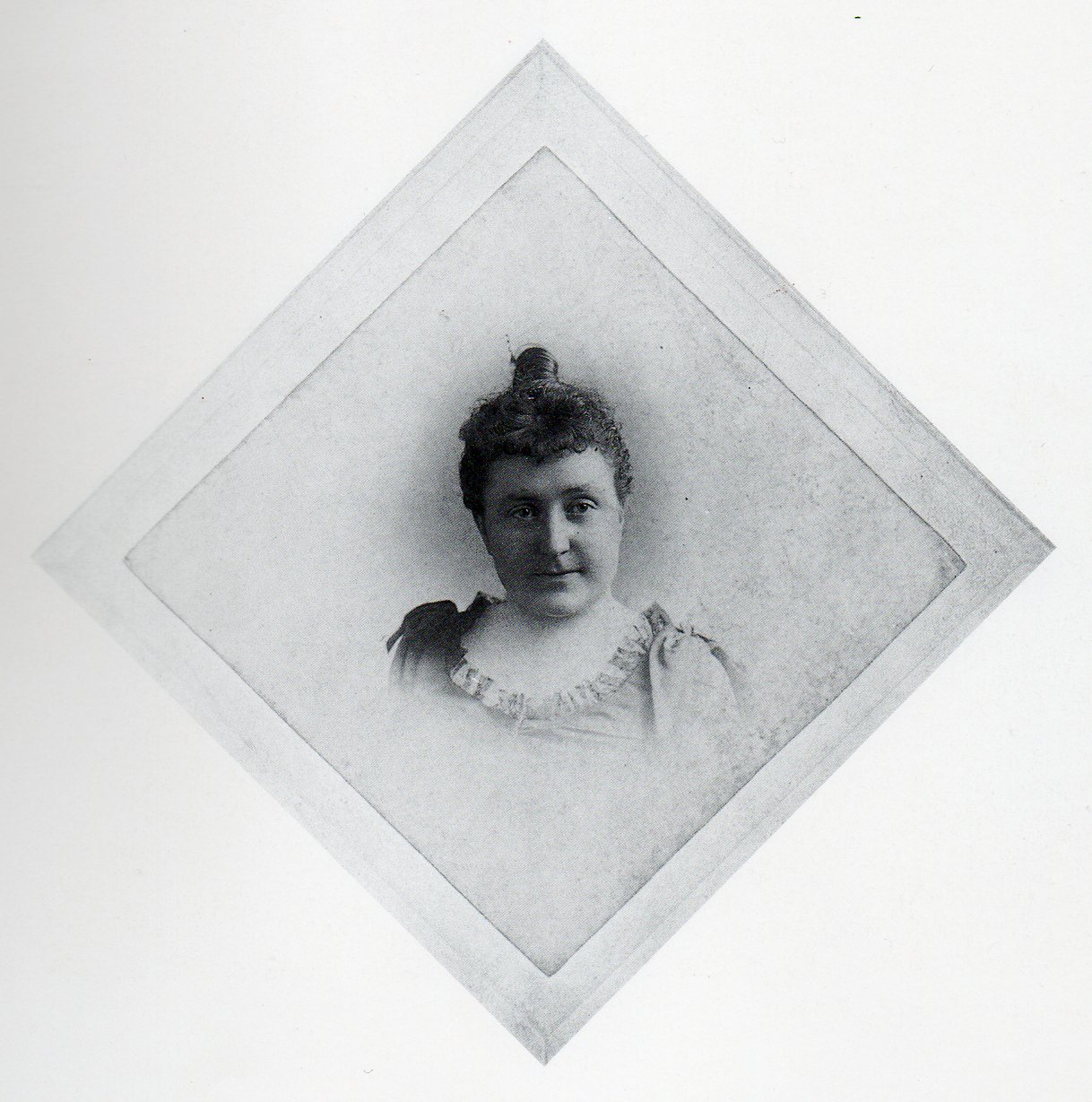
    Back of head front343

    Notes:

    1.  Gall’s book’s title really lays it all out: The Anatomy and Physiology of the Nervous System in General, and of
    the Brain in Particular, with Observations upon the possibility of
    ascertaining the several Intellectual and Moral Dispositions of Man and
    Animal, by the configuration of their Heads,
    published 1819.
  • History of Blank and Missing Things: Telescope Tubes

    JF Ptak Science Books  Post 1127

    One of the greatest missing things in the history of astronomy thankfully never came to be.  When the Hubble space telescope was having its very early problems, Senator Barbara Mikulski (D, MD) suggested and pursued the idea for bringing the Hubble down and end the program rather than repair it–for financial reasons, or something, I dunno.  It was an toweringly bad idea that keep itself alive for too long (and was just so bad that NASA I recall had a hard time getting their head around such a bizarre problem-solving approach to a fixable problem)–Mikulski went on to not think about other things, the Hubble was fixed, resulting in a simply astonishing amount of discoveries and data that could absorb astronomers worldwide for generations. (In another part of the wanting-to-make-things-disappear is House Speaker Dennis Hastert, who wondered why exactly in the days after Katrina if we should rebuild New Orleans.  But that’s another story.)  Hubble is still there; so is Mikulski, who now is the champion of “the people’s telescope” and who chairs the committee responsible for NASA’s funding. 

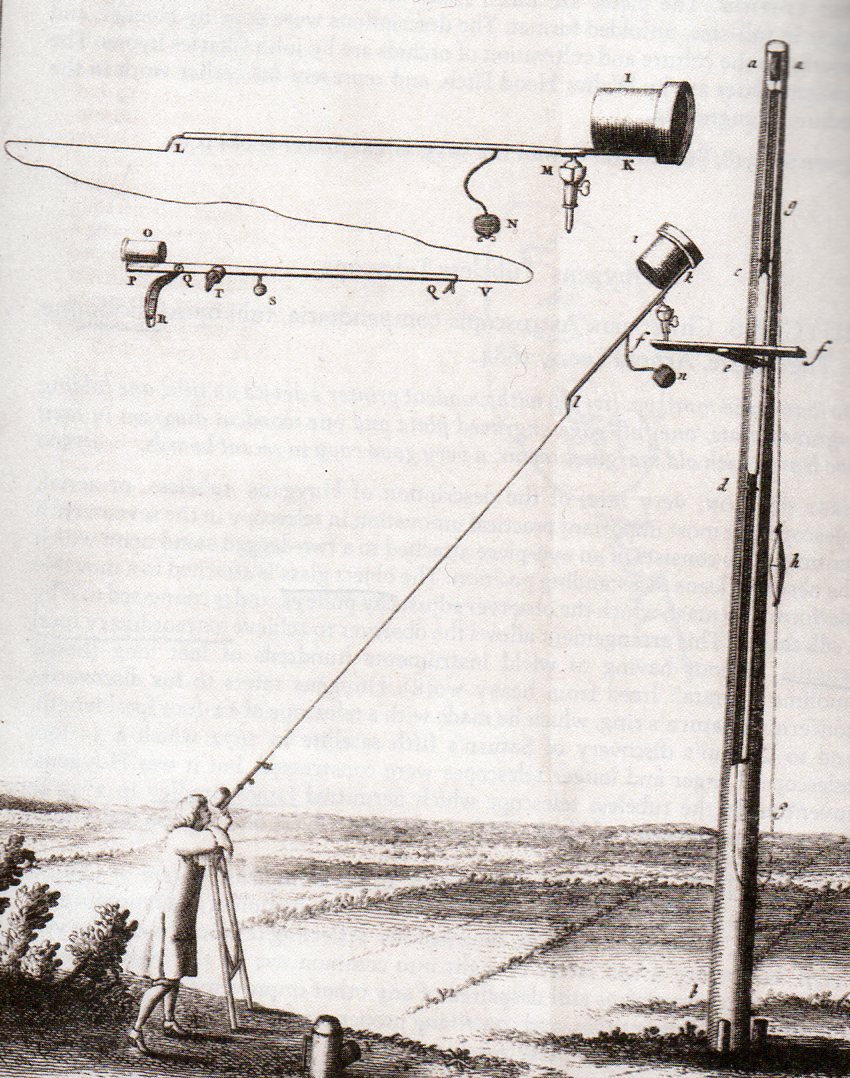
    One of the most powerful blank/missing or empty things in the history of astronomy that did come about may very well be Christiaan Huygen’s telescope1 without a telescope tube. Presented to the Royal Society in 1691, Huygens instrument (also known as an “aerial telescope”) was meant to perform the world’s most powerful optical observational instrument, having a focal length of 122′.  Monster telescopes were not practical at that time given the weight and flexure and movement of what would be a massive multi-hundred-foot-long telescope tube.  And so Huygens came up with the idea of doing away with the cumbersome part of the large telescope.

    Huygens was a very smart man, and one of very few people acknowledged in Newton’s Principia (along with “Dr. Hollis” and Christopher Wren, the three referred to as “the greatest geometers of our time”)), a man who Newton found to be “the most elegant of any mathematical writer of modern time”. He was extraordinarily accomplished, almost so as much as the half-forgotten Robert Hooke…Huygens was by far Hooke’s superior in mathematics, but Hooke was probably more accomplished across a wider variety of fields, which is saying mounds because Huygens did about everything..  In any event, Newton found Huygens to be an extraordinary scientist, even though Huygens didn’t really quite ever get Newton’s universal gravitation–a high elevation, perhaps among the highest, coming from the cranky Newton. 
    Blog--huygens347

    Getting back to the telescope–its missing section was perhaps one of the most important developments in astronomy in the second half of the 17th century.  Its arrangement was very elegant, and simple–the mast held the object glass whose position could be changed with a series of simple pulleys and pulls; the eyepiece was placed on a table, aligned with string and rope.  And that was it.  By the first third of the 18th century, James Bradley was able to construct a telescope of this type with a focal length of 212 feet, and used it to measure the diameter of Venus.

    Technology would soon catch up to the Huygens invention, but not really for another 75 years. 

    Notes.
    See:  “Christian Huygens and the Development of Science in the Seventeenth Century”, by E. N. DA C. ANDRADE, in Nature 162, 472-473 (25 September 1948). 

    1. Astroscopia Compendiaria tubi optici molimine liberata (compound telescopes without a tube), published 1684.

  • Chess in the History of Comfort–the Dreams that Things are Made On/Of

    JF  Ptak Science Books   Post 1128

    “The stuff that dreams are made of….”  Sam Spade, The Maltese Falcon (1941).
    “We are such stuff, As dreams are made on, and our little life
          Is rounded with a sleep.”  Propsero. The Tempest Act 4, scene 1, 148–158
    Chess set
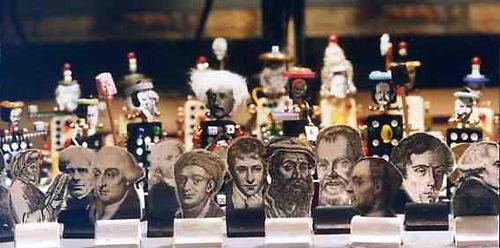
    [This is a chess set that I made of junk and fluff pitting great physicists vs. great mathematicians.]
    I’m wondering when it was that chess became more a part of what dreams were made on rather than of, when it became an attainable comfort for mostly everyone rather than a dreampt of thing, unattainable, the stuff courted by only the wealthy and the ruling class. 

    The game makes its first recorded, written appearance in the West sometime in the 10th century, and had developed as a sort of amanuensis for the upper crust, a theatre of sorts not only for itself but for some of life’s major relations, a platform for the display of relationships, and debates, and all manner of social and personal interactions. 

    Chess certainly remained out of reach for the vast majority of humans for many centuries, it seems, removed from the hands of common folks, long down the list of things that were once considered luxuries which developed into comforts and then into necessities.  I’m not sure when this happens, really, but it seems to come after the introduction of window glazing, fireplace chimneys, stoves, lamps, turned wood furniture, and so on, so on down the list.

    Judging from antiquarian engravings and images of interiors of the houses of working folks, looking around the inside of their houses to see what was becoming relatively common comforts and when, I’m guessing that chess begins to make an appearance as a suitable, affordable comfort for the mass of folks by the early 19th century.   It may well be among the first appearance of an intellectual game for the masses in the history of comfort. 

    ·Posted by :

    ·in:

    —
  • Extruding 3-D Shapes from 2-D Art to Create a Cubist vs. Art Deco Chess Set

    JF Ptak Science Books   Post 1129

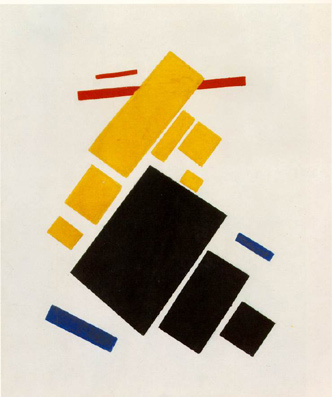
    Is there room in the history of invented art to reconstruct cubist and abstract paintings by imaging the objects that could’ve passed through the canvases to leaves their geometric footprint?  That is to say, if you took the Woolworth Building in NYC and passed it at an oblique angle through a large sheet of paper, and that paper was permeable enough and the building moving slowly enough to simply leave its “footprint” without tearing or deforming the surface of the paper, the resulting image may look a lot like figures in classic works in the history of art.

    Malevich.aeroplane-flying


    That is no revelation, really, as the Black Square or Airplanes Flying of Kasimir Malevich could’ve been made by every fourth item on your desk.  But what is interesting to me would be the reverse of this process, where you take that black square and reverse-engineer it, extruding whatever figure it was that could’ve made the black square into its three dimensional counterpart.
     
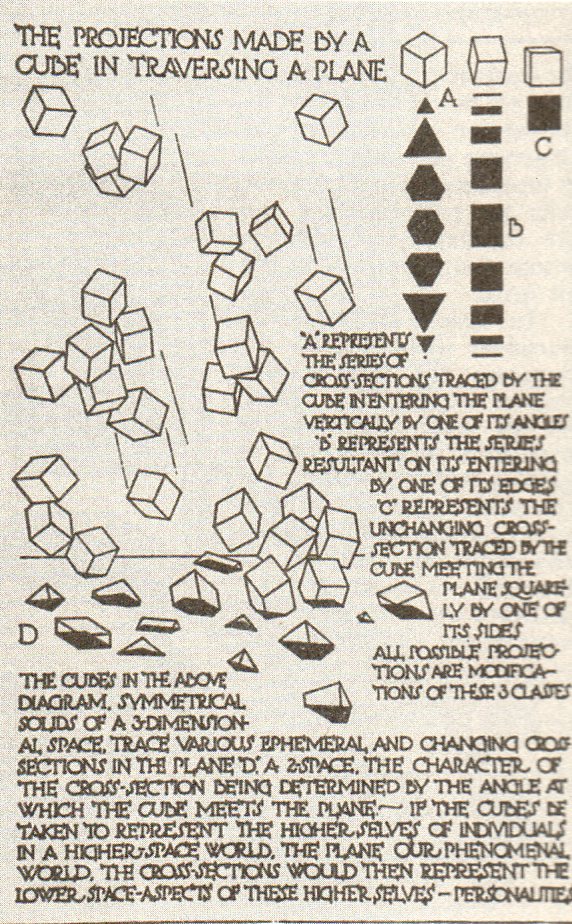
    What comes immediately to mind for me in this regard is Claude Bragdon (1866-1946),  (a New York-based architect with a long set of sleeves for writing in upper dimensional planes of Theosophy and reincarnation and other similarly squishy reaches) who wrote a few interesting books on the fourth dimension and objects and space, writing two of them at a very interesting period of t
    ime for the history of physics and art (1912 and 1913). The books are interesting enough, I guess, and seem to perhaps have had an influence on some influential artists of that time,  but what is of interest here are tow illustrations. 

    Blog--blagden 1348

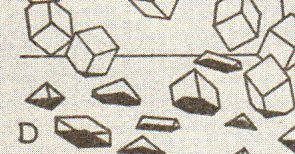
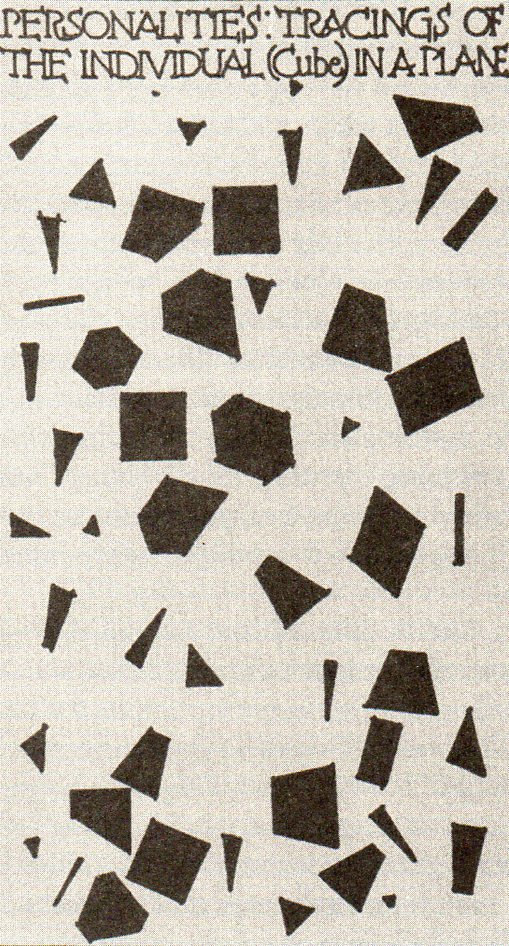
    First is “the Projections made by a Cube in traversing a Plane” from Primer1, showing the impact (at different levels) of a cube falling through a plane.  The second, “Personalities: Tracings of the Individual (Cube) in a Plane” from  Man2, shows the “shadows” of the three-dimensional figures as they lived in their two-dimensional world.  It comes close to the impact of the cubes above, but really only depicts what two-dimensional creatures would see of the three-dimensional beings inhabiting their Bragdonesque world. 

    Blog--blagden 1 det349

    I like  the tracings more as impact points than 2-D renderings of 3-D objects, and in some ways they are very similar. (I have to say that I am surprised that given Bragdon’s expanse of taste and artistic ability that he didn’t arrange these images in an artistic manner–in that sense he entirely missed the boat on adding his own bit to the newly-formed
    Cubist world. He also reminds me of Emily Vanderpoel, who in her own way completely missed the new artform that she was serendipitously creating.)    

    So when I look at something like a Malevich or Mondrian or even (but less so) at a Duchamp (Bride), I find it interesting to manufacture the base of the something that plunged itself cleanly through their canvas, pulling it out again, giving it three dimensions, and incorporating the thing as a piece in a chessboard–the chessboard being the pieces that made the shapes in the canvases resulting in the Art Deco vs. Cubist/Suprematist   Chess Set.   It would be interesting to choose two representative canvases for either style and  see if one (or a couple of ) object(s) could make all of the shapes in the two representative paintings,  populating a chessboard with sameness.

    Blog--blagden 2350

    The bottom line, then, is how different or similar would the extruded three-dimensional figures be that were responsible for this impact in a two-dimensional surface be? 

    (I am reminded too of Duchamp and John Cage sitting down to a game of chess and producing a musical composition via their moves, at  Sightssoundsystems, a festival of art and technology in Toronto, 1968. In this way too an artwork could be made with each move in a game of pieces used to make iconic shapes in the history of art.  “They did not speak. They did not sing, they remained, all of them, silent, almost determinedly silent; but from the empty air they conjured music. Everything was music…” Franz Kafka, Investigations of a Dog.)

    Notes:
       
    1..(Bragdon) A PRIMER OF HIGHER SPACE. (The Fourth Dimension). Rochester: Manas Press, 1913. 8vo, (12), 79pp, including 30 plates.Notes:

    2.. (Bragdon) MAN THE SQUARE. A Higher Space Parable. Rochester: Manas Press, 1912. 12mo, 34pp, 9 illustrations.  

  • Scary Color-Steampunk Photos of Food, 1933

    JF Ptak Science Books   Post 1129

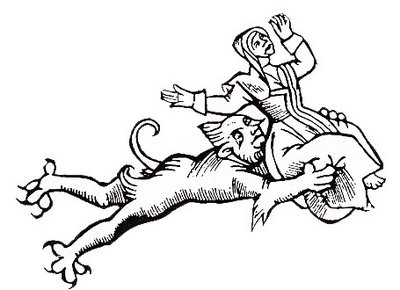
    In the earliest part of the printed history of picturing scary things everything left the printer in black and white.  The colorist added the necessary tinting and fright stuff, though it seems to me that the sheets that made it through to binding in black and white were the most disturbing of them all. Most of the time and for several centuries color was left to the desire of the individual, the purchaser of the book; the green of dragons or the reds of monster men or yellows of serpents were mostly given life by the buyer.  Color printing had to wait more than three hundred years
    Medieval monster after Gutenberg’s Bible–there was some multi-color printing for grammars and the like where words and phrases were printed in multiple colors, requiring numerous passes through the press, but by and large the color printing of artwork was more a 19th century thing more than anything else.         
    My own preference is for black and white images that let the mind fill in the beasts from outside in, allowing the imagination to run with the text and the description of the beast, rather than fast-forwarding to the completed images.  It is these images, the black and whites, which have retained some element of scary or creepy over the years; the colored images don’t make it quite so well. 
                                                   
    Color does makes some unexpected contributions to scariness, and in uncommon places.  For example, this photo
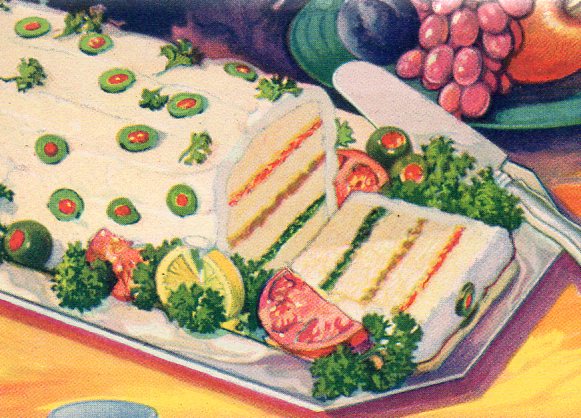
    Blog--color--mea tloaf351 from a 1933 Chicago World’s Fair pamphlet for the exhibitor Durkee Famous Foods fits the ticket perfectly.  It is an image of a sandwich loaf that is made mainly with scrapings of ham and lots of Durkee products, which were things like mayonnaise, oleomargarine, cheese squeezings, tapioca, coconut oil, salad dressings and vegetable shortening.  The color of the object only heightens the creepiness of its contents, all of which was topped by a layering of mayonnaise and cream cheese studded with olives.

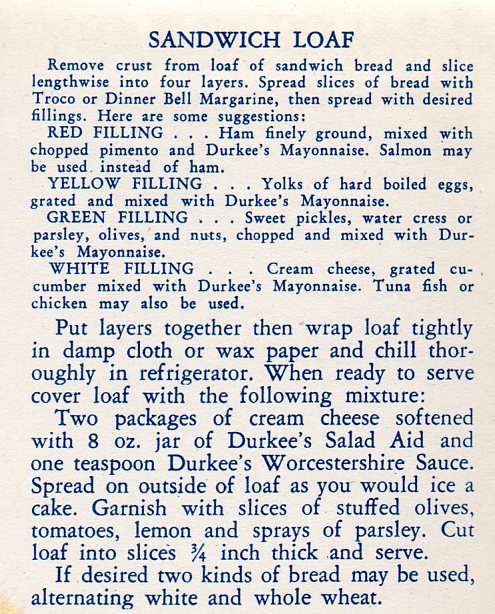
    Admittedly this color photograph comes at the earliest stages of the modern aspect of color photography, and perhaps the engineers were a little too anxious at spreading their food-color, it still just isn’t good. Here’s the recipe: 

    Blog--color--jmeatloaf rec354

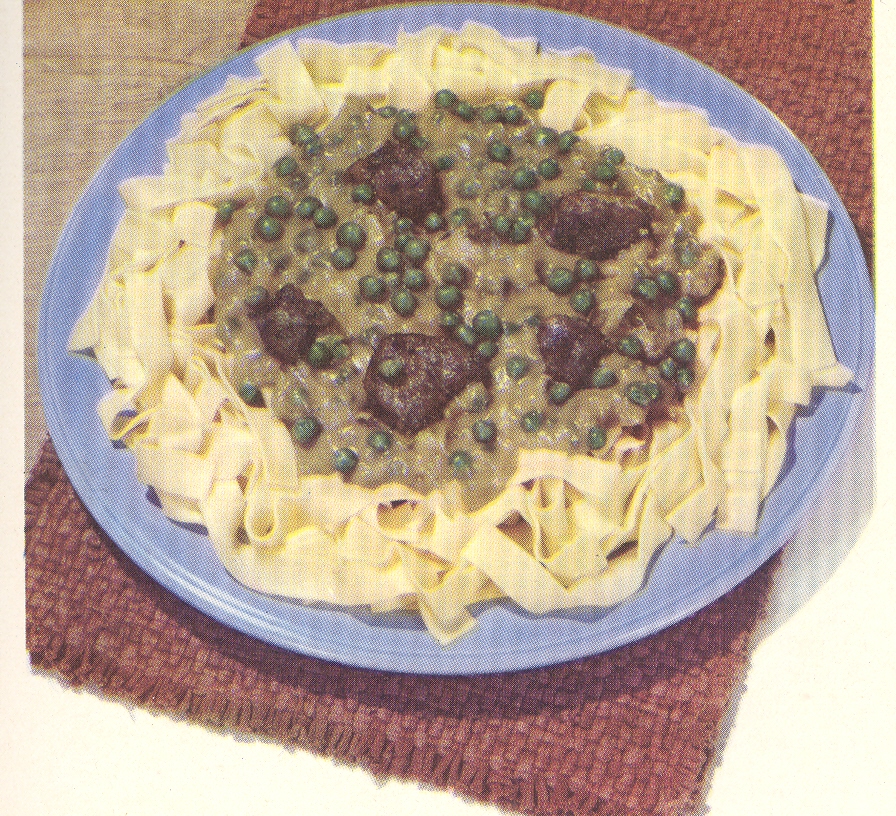
    There’s also this incredible plate (below), having some sort of internal color dialog with itself, though manifested externally–it must not be a pretty conversation.  House of La
    Rosa.  101 Ways to Prepare Macaroni seems
    about as benign and forgettable a title that one could write; that said, once
    opened, this little pamphlet poured its heart out to the Naïve Surreal in us
    all with the unforgettable (and accurate) color images of the promised linguine
    delicacies. 

    ===blog==aug 24=color--sauce green

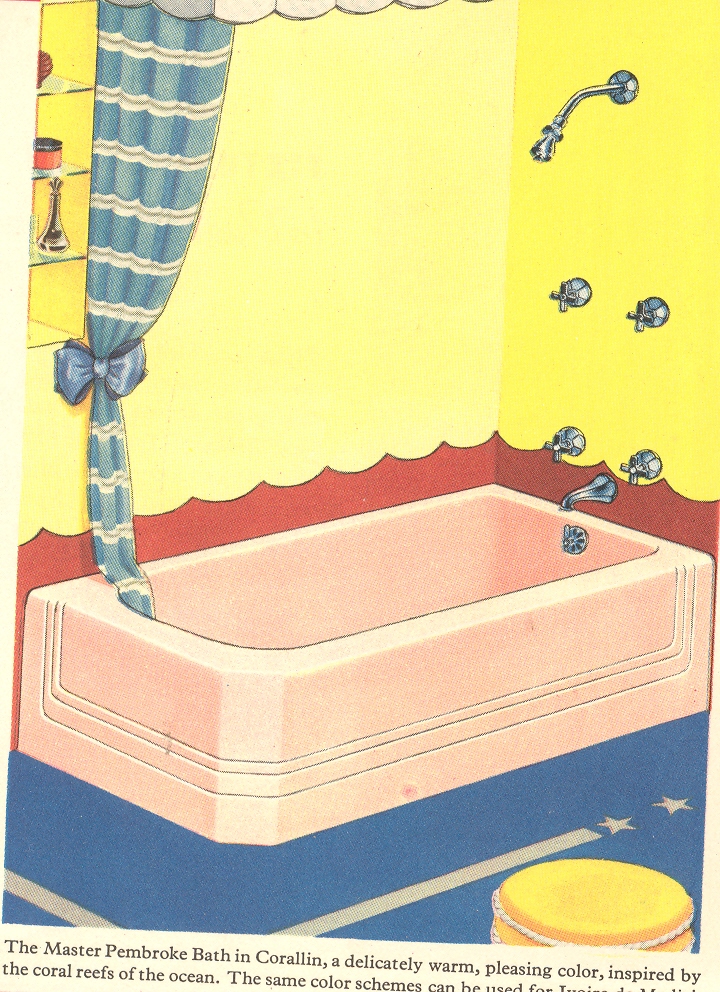
    And of course there are innumerable examples of architectural bits:

    ++00++ 9.23 bathroom3 great

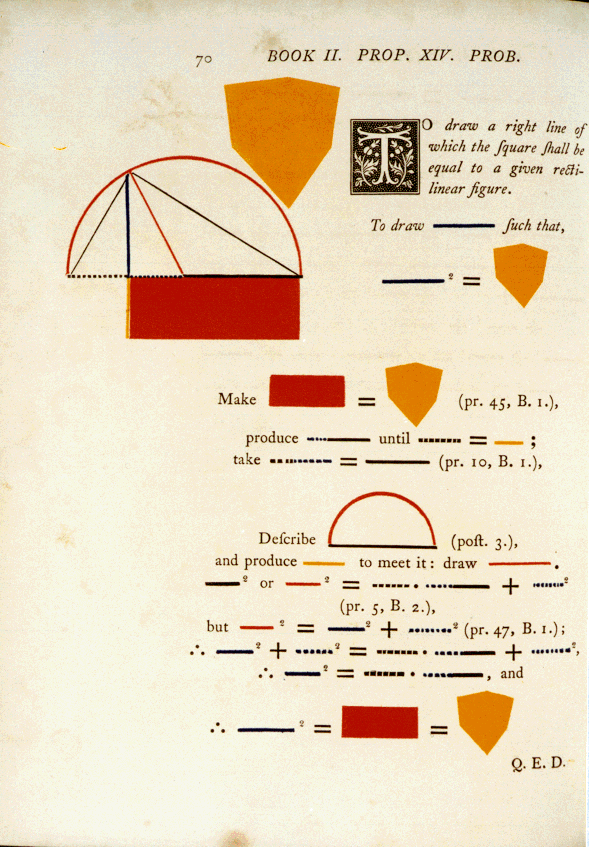
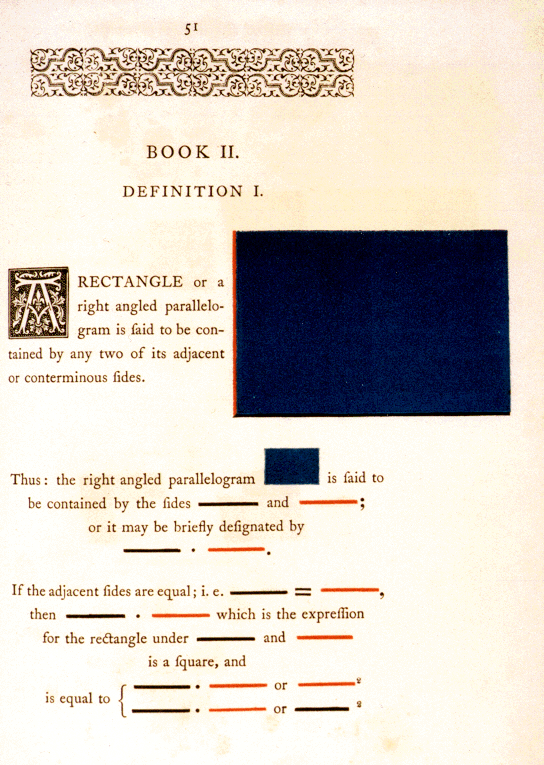
    And even when beautiful, color can be scary, as in the case of the very highly problematic Oliver Byrne, whose work restructuring the explanation of the first six books of Euclid is inversely useful to its great beauty.

    Byrnes II.14

    As unsettling as these color images may be, none come quite so close to being a truly visceral experience as does the Durkee sandwich loaf.  These other color examples are just simply wrong; but the Durkee food product, slathered in oil and leftover, is just so wrong it isn’t even wrong anymore. 


  • Images from Our History of Women Series

    JF Ptak Science Books 

    I was looking for some of these images from this blog’s History of Women series and thought that I’d post them all to one page. Seeing them out of context is odd, but interesting.   Enjoy!


    File0505

    .
    000 women on a leash012
                                                   

    1 april 26 women king+queen 00--shooting strip tease042

  • History of Blank, Missing and Empty Things: Niagra Falls

    JF Ptak Science Books  Post 1130   

    [This is a very short entry in  the series on the History of Blank, Empty and Missing Things]

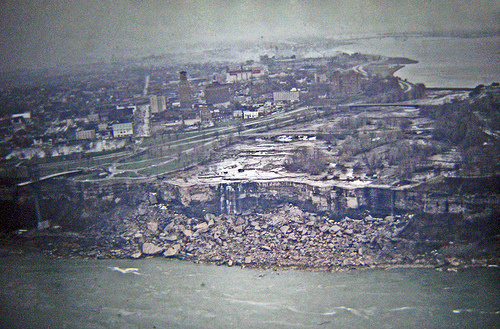
    Perhaps one of the most difficult places in North America to collect thrown coins is at the base of Niagra Falls.  This was all made possible in the summer of 1969 when the water flowing over the falls went missing.  It actually was re-routed via a cofferdam which effectively turned off the falls so that engineers could clear debris and do scientific/geological work.

    Blan missing Niagra Falls
    Nowadays there’s about 100,000 cubic feet per second that flows over the
    falls, fixed at about this level for the amusement of tourists.  At
    night, when viewing is limited, the flow is fixed at about 50,000 cubic
    feet, the water diverted to produce hydroelectric power.   But in the
    summer of 1969, the flow was virtually zero.  

    So, officially, Niagra Falls didn’t go missing–only the water did. 

  • 9/11. Lists of Victims

    List of the Victims of 9/11

    Listing WTC victims, followed by the  plane crews and  passengers of American Airlines Flight 11and United Airlines Flight 175.  This list followed by the Pentagon victims, and then by the passengers and crew of United Airlines Flight 77.  Lastly are the crew and passengers of United Airlines Flight 93. )

    Gordon M. Aamoth, Jr.
    Edelmiro Abad
    Maria Rose Abad

    Andrew Anthony Abate

    (Equivalent of 60 pages follows)

    ·Posted by :

    ·in:

  • The Movies and the Discovery of the Modern Smile

    JF Ptak Science Books  Post 1131

    [A continuation of sorts on an earlier post “Did Teeth Exist in the Renaissance?  Art and the Toothy Smile, 1300-1600”]

    Did more people in the U.S. laugh in 1924 than at any time in American history?

    The mass-consumed smile, the social laugh, the pantomime, the big grin, the sly eye, the devilish smirk, the latent laugh, the absorbed chuckle, the impish grin, were all elements of the human comedy that were difficult to see in the theatrical realm.  When performers were in front (or within, etc) a large audience, many subtleties of humor and comedy inherent in communal story telling that could be conveyed by facial expressions were simply lost.  
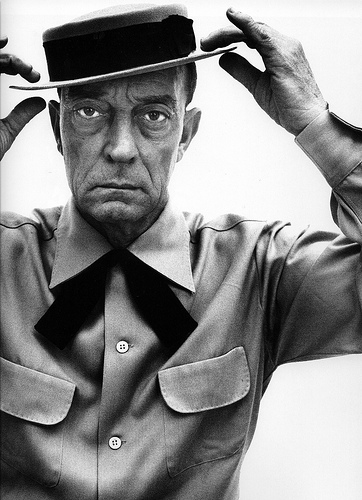
    Keaton
    The culture of the magnified  moment, especially in comedy, I think,  was not discovered until the motion picture was invented.  It was then, and then particularly with the invention of the closeup, that comedians were finally able to display the vast quiet parts of their craft, especially in fine pantomime.  This sort of thing was just not visible in the performers on a vaudeville or burlesque stage.  It was with the motion picture and the close-up that made the facial expressions as keen as and broadly appealing as slapstick, or the good-bad paradigm, or even The Chase.

    Fatty Arbuckle, Chester Conklin, Fred Sterling, Charlie Chaplain, Ben Turpin and especially Buster Keaton (whose facial expressions were exceptionally wide without really ever changing his expression) all came to greater prominence because of the close-up. There were more people from more different social and economic backgrounds  seeing more comedy by more comedians–and seeing more of the comedians–than at any time in human history.  And I guess we can infer that they were laughing more, because the output of comedies (Ben Turpin producing 150+ movies in one year alone, for example) continued to grow.  

    [I think that if you had to identify one single development that would allow the non-comedy to move to the top of the marquee was the invention of the serial–showing a series of episodes, which building one on the other, leading to a longer, intertwined story, developing characters and of course the audience, the returning audience.]

    In the chicken-and-egg scenario, perhaps what moved the laughter forward more so than the close-up was standardization of motion picture practices, especially in the display department.  That allowed movies to be more easily distributed, making for lower prices, more audience, more profit, more movies, more laughter (etc.).

    Standardization is an interesting story, and as much as it seems to take the creative edges off of some things, it adds to it in other ways.  “Standard Operating Procedure”, the codification of law/de jure, defining words in a consistent manner, having the same rails for all trains, establishing consistent screws threads, creating surgical procedures, developing prescription standards, having interchangeable parts for things like guns and cars and gin reapers, having standard weights and measures, and on and on, are all important things that allow us to not have to repeatedly recreate the daily bits and pieces of our lives.  (Even the “little” improvements in this area can have enormous consequences, like, for example, the British Navy standardizing sailing blocks, which went a long way in ensuring ship operation and safety.  Stuff like that seems like just a bit-and-piece, until you look at their long-term effects.

    Anyway, I could very easily be all wrong about this laughter thing, but from where I sit this morning, its an interesting thing to think about.

    ·Posted by :

    ·in:

    — — —
  • Bio-Mathematics in Busby Berkeley Musicals–Image Dump

    JF Ptak Science Books  Post  1133   

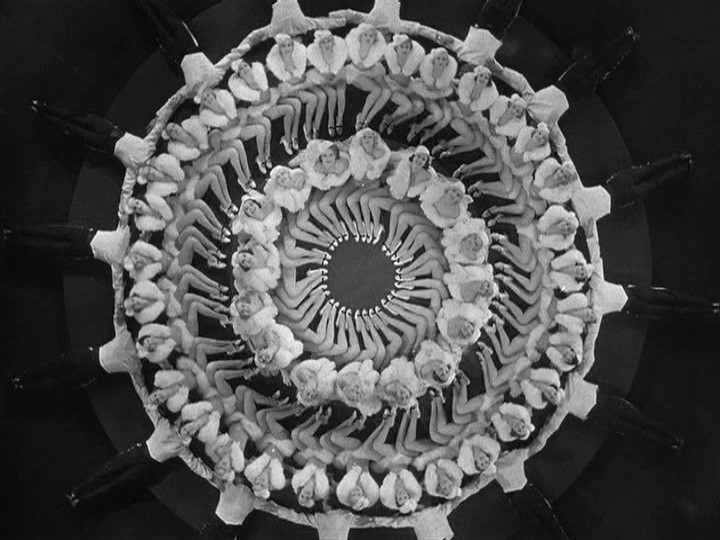
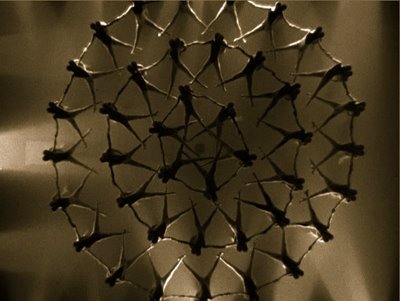
    There’s a certain amount of Leggy Geometry going on in the many films of the great and often-troubled Busby Berkeley.  Berkeley was about 38 when he came into great prominence as a choreographer for movies with music–they were grand and spectacular, intricate dances involving dozens, many times employing overhead shots looking straight down on a full-kaleidoscope productions.  (A kaleidoscope mirrors the great majority of its displayed image; Berkeley mirrored almost nothing, And he didn’t really produce movie musicals per se, I think; those would come later with Fred Astaire and the like, where there were story lines and plots and associated happenings along with the terrific dancing and music. “Plot” was a throw-in with Berkeley, but everything else was just so grand that storyline really didn’t get in the way of entertainment.)  The motion, the offset camera work, the constant motion, almost gives you the sensation of falling into a Phoenix Set.  Between 1931 and the end of WWII, Busby choreographed more than 30 films, many of which are now considered high classics, his very name now associated with fabulous stage productions.

    There’s a big dollop of natural history geometry in his work, as we can see by this selection of still images below. They’re tessellated (if you squint hard and make sure there are no margins) and fractal-like, very organic, very much looking like diagrams outlining the mathematical forms of nature.  And they’re pretty.

    Berkeley 42 nd st 

    Berkeley h

    ·Posted by :

    ·in:

    — —
  • Creating Bad-Hand Female Trouble, 1954–an Imaginary Reconstructed Filmstrip

    JF Ptak Science Books

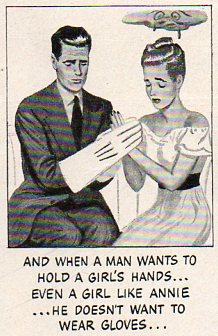
    Girl trouble 7360 Retroist excursions like this into the land of social propriety from not so long ago is a bittersweet thing–its concerns can remind of of how far away from something we seem to be, when in reality that distance in time and space just isn’t very far away at all; it is just slightly different,  renamed and repackaged.  For example, this advertisement from LIFE magazine for Trushay hand softener (1954) delivers pretty much the same message as most similar products today, except for the change in packaging and less obvious message.  The message may seem outdated but I think only in so far as the images and clumsiness of the delivery is concerned.  Products like this have increased by orders of magnitude, the target audiences age seems to have dropped considerably, and most of the time the pursuit of this 1954 end-result stays pretty much the  same. Exercises like this are peculiar, and can show us that the people who we are laughing at may very well be us. 

    The reconstructed ad is below.

Recent Posts

Archives

Categories