A Daily History of Holes, Dots, Lines, Science, History, Math, Physics, Art, the Unintentional Absurd, Architecture, Maps, Data Visualization, Blank and Missing Things, and so on. |1.6 million words, 7500 images, 4.9 million hits| Press & appearances in The Times, Le Figaro, Mensa, The Economist, The Guardian, Discovery News, Slate, Le Monde, Sci American Blogs, Le Pont, and many other places… 5000+ total posts since 2008.

  • Nazi Propaganda–the Big Lie and Germany Surrounded, 1933

    JF Ptak Science Books  1174

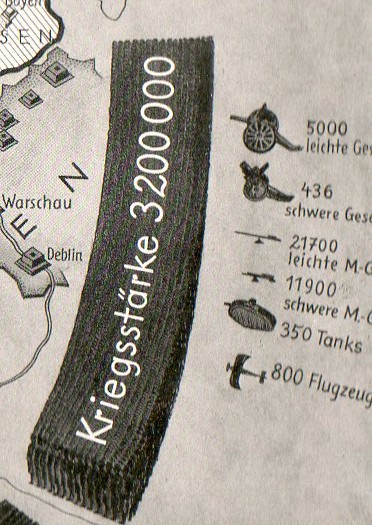
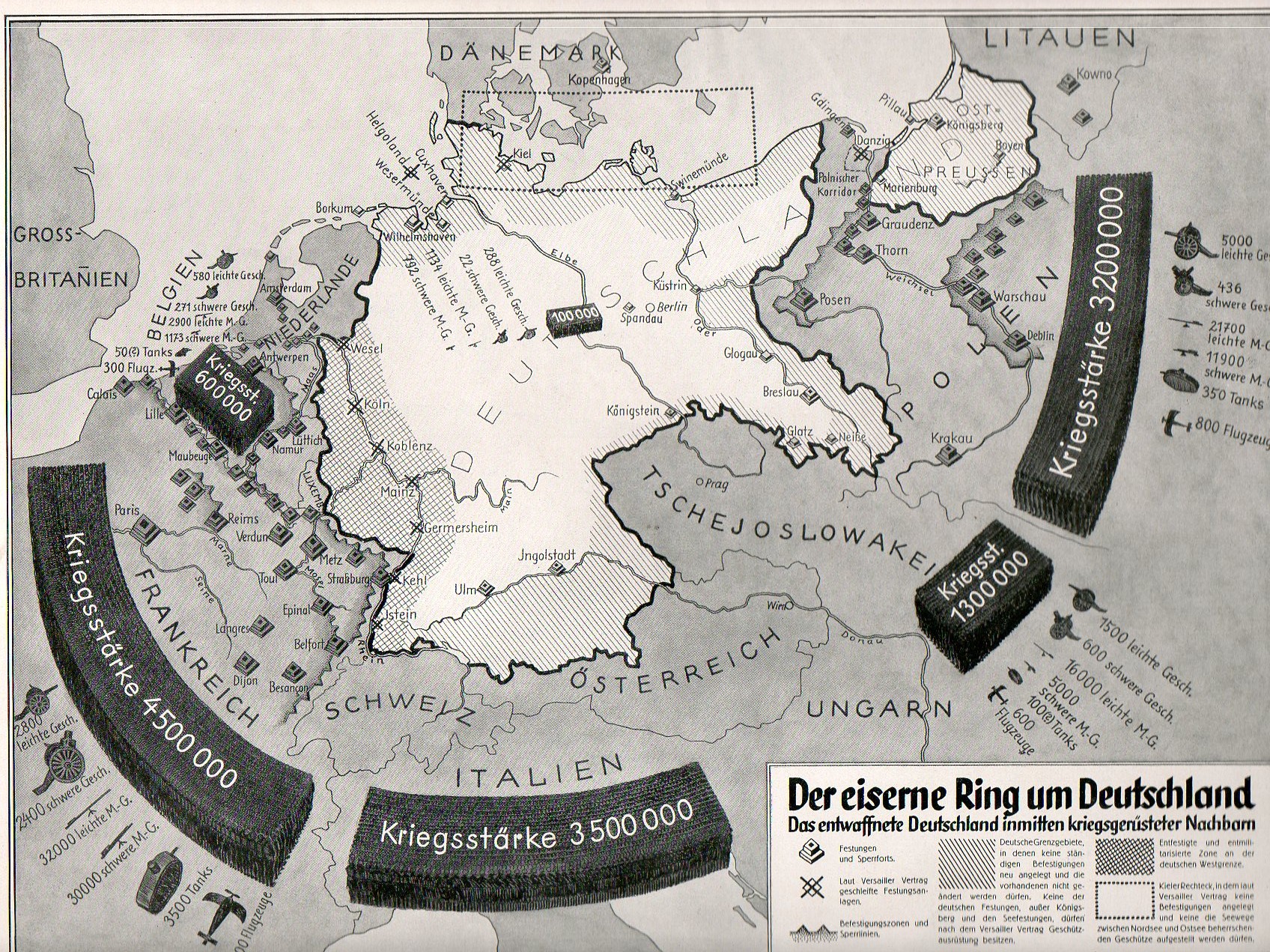
    The newly-elected NSDAP government lost little time in putting forward a case to the German people that the Treaty of Versailles left Germany in a defenceless postion, surrounded by forboding armies and air foprces of its neighbors, the forces of France, Italy, Czecholovakia, Belgium and Poland forging a tight and formidible strangelhold on the weakened Germany.  This image comes from the late November 1933 issue of the Illustrite Zeitung1 (Leipzig), and its relates to the casual and general reader the de-militarized and tenuous situation of the country–its design is effective enough so that the voice of he illustrations is well heard even if no on actually bothered to stop and read its legend–it was all about threat and impending doom, and the words for those emoptions weren’t necessary in this artwork.
    Nazi Prop surrounded538

    Campaigns like this were a first step in the Nazi consolidation of the public spirit, attempting to unify the population under Hitler and the NSDAP by presenting a threat so common that it could not help but to draw everyone into the big tent.  This was a simple message of natural survival, a wide threat to the German state, a threat that was so simple and so devastating and so opaque that there would be virtually no resistence to unifying against it. (J.W. WHeeler-Bennet wrote about this in his superb and still-classic book The Nemesis of Power, the Germany Army in Politics, 1918-1945, published in 1954.)

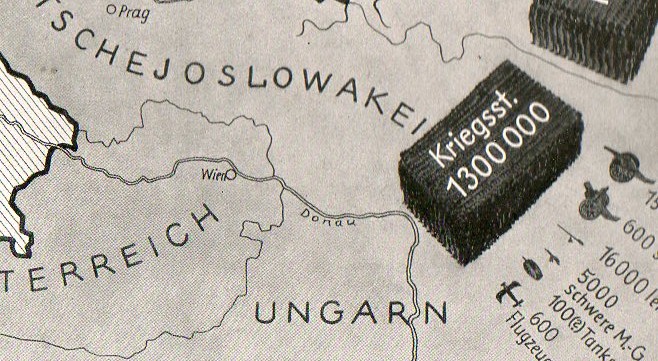
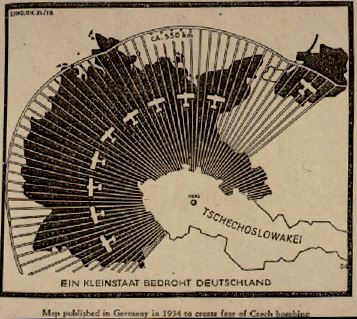
    Here’s another example from about the same time, again showing the devastating effects of imagery–this displays the non-existent threat from Czechoslovakia:
    Blog jan 3 czech air


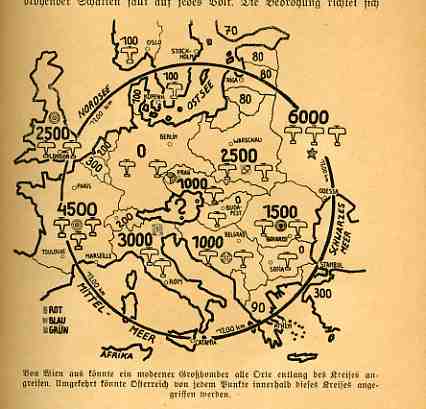
    And another, showing the encircling imagery again:
    https://historyofideasblog.com/a/6a00d83542d51e69e20120a7a04f7a970b-pi

    Getting back to the first image–curiously Great Britain and Russia don’t make the Enelmies Liest here, though in 1933 they certainly loomed as an enemy as much as any other.  (Well, perhaps not neessarily so for the Soivet Union, but close.)

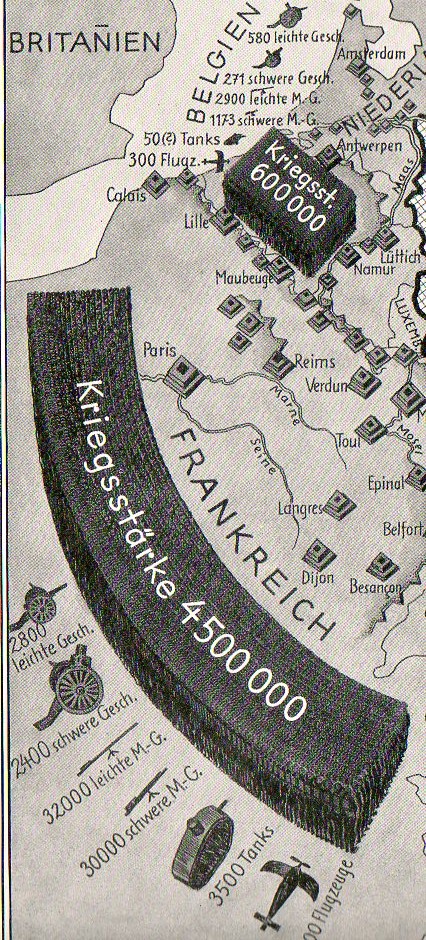
    Someone who actually read the article and looked closer at the full-page ilustration would see the details of t he European threat, like this for France (and Belgium), with bloated figures for WWI-era ordnance and an extremely effectively articiulated represntation of what was seen as the standing army:
    Nazi Prop surrounded france539

    And this for Poland:

    Nazi Prop surrounded poland542

    And of course, Czechoslovakia: Nazi Prop surrounded czech541

    Among other things the signing of the Treaty of Versailles in 1919 limited the German armed forces to less than 100,000; limited the Navy to 15,000; prohibited the manufacture of submarines, armed aircraft, tanks, armored cars, Maxim guns and of course poison gas. There was assignment of guilt, heavy reparations (in what today would translate into something like a half-trillion dollars, without though translating buying power), and much more that was aimed at keeping Germany vanquished if not somewhat pastoral.  Many have seen the Treaty as being the bridge and greatest impetus to WWII, an opportunity lost and squandered by the Allies–maybe so. A year after the end of the incredibly violent and ripping four-year onslaught in which millions were killed and so much destroyed it would’ve been difficult for all parties to the Treaty to have a great forward vision in how to best deal with Germany.

    The Treay did provide a unifying front for Hitler; the Nazi Party using choice aspects of it in hearts-and-minds propagandizing methods like the one above:  the military restrictions were true, but the portrayed threat of attack from Poland and Czechoslovkia and Belgium and Italy and even France were part of the building of the Big Lie.  The “Big Lie” was something that Hitler identified in his 1925 Mein Kampf, and then used in his own terror campaigns–it is a lie so colossal and so impudent, so fantastic, that it is perceived as being true because no one would lie so gigantically.  As  George Orwell put it in his 1948 novel 1984, the Big Lie was “…to tell deliberate lies while genuinely believing in them, to forget any fact that has become inconvenient, and then when it becomes necessary again, to draw it back from oblivion for just so long as it is needed….”  The perception of imminent threat was one of the starting points for the Big Lie; the mechanics and people behind the manufacture of the invasion, of the Treaty of Versailles, of the German economic meltdown, and so on was already laid down in Hitler’s ridciulous book, and much of that lay at the feet of the Jewish people. 

    But first the Nazis needed to address the issue of their entirely weak and vulnerable military position by proposing the threat from much of the rest of Europe, this in order to rail against Versailles and break the German obligations to non-militarism.  The foundations for rebuilding the German war machine started in earnest in 1933; by 1935 most of the restrictions of Versailles had been broken, and Germany (which in 1933/4 had bene secretive about it) had gone public with its new obligations to itself (introducing the Luftwaffe to the rest of the world in March1935).  Reactions from the Allies to generating the new war machine were weak, and Germany rolled right into WWII. 

    Notes:

    1. I’ve written many times here about the Illustrirte Zeitung–it was basically the German equivalent of the Illustrated London News, Paris Match, and LIFE magazine, a better, mid-level weekly magazine that was well-written, very-well illustrated, approachable and affordable to folks of nearly all classes.  It was an expedient way of sending across the government’s message from te beginning of the Nazi ouccpation of German politics.
     

  • Artists in/and their Studios: Bacon, Braque, Kandinsky, and others.

    JF Ptak Science Books   Post 1175

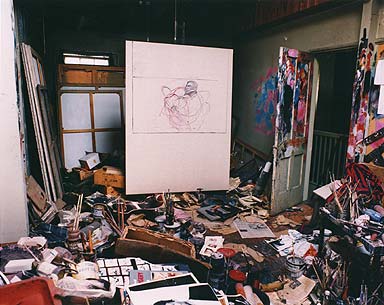
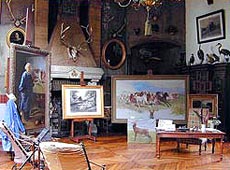
    I.m not sure what sent me scurrying around for images of artist’s studios–iniitally I was looking to see what was on the walls of the artist’s workspaces, but there were so many that it couldn’t be done in my allotted time.  For now I just want to simply post these images of 30 studios and continue later on as a page with more images and  detail on the artists.  For now, I’ve included images of the studios of Bacon, Bonheur, Bonard, Braque, Cezanne, Chagall, Derain, Chase, Friedrich, Kandinsky, Le Corbusier, Mondrian, Remington, Teixidor, Villon, and Vlaminck. (The majority of these images are drawn from Alexander Liberman’s The Artist in his [sic] Studio, 1960; there’s much of interest in that book, including vivid observations and descriptions.)  The other, older, images are depictions of the generalized artist’s workshop and studio.  Enjoy.

    Francis Bacon studio

      Studio--farancis bacon

    Rosa Bonheur studio

    Studio--rosa bonheur
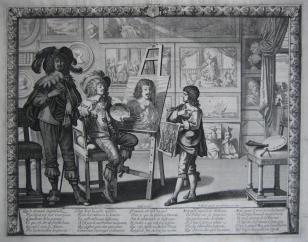
    Abraham Bosse, depiction of  a studio.

    Studio--abraham bosse
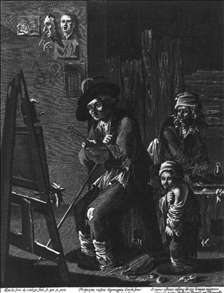
    Both, Andreas (depiction of a poor artist’s studio)

    The Poor Painter in His Studio


    ·Posted by :

    ·in:

    —
  • The Invisible Influence of the Highly Visible? Comets and Meteors in Astrology

    JF Ptak Science Books   Post 1176

    “When beggars die there are no comets seen; The heavens themselves blaze forth the death of princes.” – Shakespeare.

    “Threatening the world with Famine, Plague and War: To Princes, Death! To Kingdoms, many Crosses; To all Estates, inevitable Losses! To Herdsmen, Rot; to Plowmen, hapless Seasons; To Sailors, Storms, To Cities, Civil Treasons!” De cometis by John Gadbury, London, 1665

    It is unusual to me that in the long history of early astrology, some of the greatest elements of the night sky–comets and meteors–are little used, perhaps even unuseful outside of adding flavoring to readings given the time and place of their appearance. They had been seen for milennia–appearing in Gilgamesh and the Book of Revelation for two samples– as prognostic of future events, John of Damascus and Aritotle and Ptolemy and Albumasar all writing about that quality.

    Comets 5564
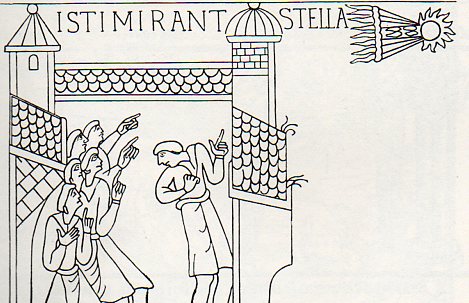
    [The Bayeux Tapestry illustrating the appearance of the comet of 1066, later to be known as Halley’s comet.]

    Comets and meteors didn’t really affect anything in the physical world, and in the astrological one their purpose was to perhaps predict a kingly death or the appearance opf warts on women. They were also seen by people like Aristotle to be atmopsheric events, living out their exsitence in close proximity to the Earth, incapable of having any undue affect on Earthly matters.  Meteors would appear and then disappear, comets were surprises and visible for just short amounts of time; the rest of the night sky remained the same, intact and unaltered after their appearances.  They were not understood, though they were seen by some as raging battles between forces of good and evil, personifications of the struggle between the angels of god and the elements of the devil. Meteors and comets were mysterious, unconquerable, unknowable, suspicious elements, and were evidently not useful to the early astrologers.

    Comets 1560
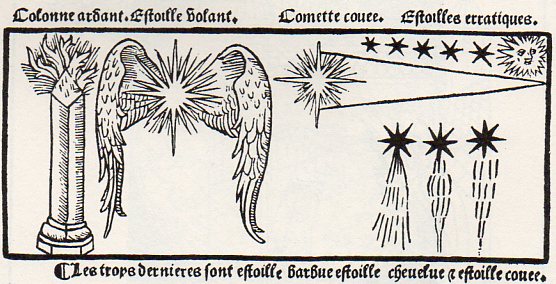
    [Nicolas Le Rouge, Le Grand Kalendrier et Compost des Bergieres, published in 1496 in Troyes. 

    The night sky is a mnemonic device, a place to store memory and a holder of the alphabet of myths and beliefs of all, a culture written large across the sky. Meteors and comets were not predictable, and could add nothing insofar as a consistent bit of storytelling was concerned, though they certainly created their own stories in each observed appearance; they could also add punctuation and exclamation to whatever constellation they appeared in. For example if one appeared in a juncture with Jupiter, a major event for royalty would possibly be foretold.   But as a permanent element to the visualization of the night sky, they had little power even though they seemed to be displays of fantastic energy and power in themselves.

    Comets 2561

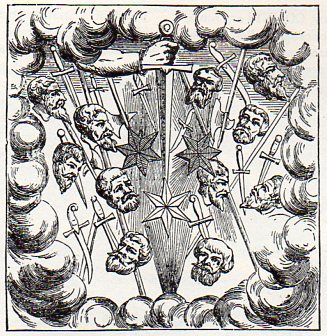
    [Amrose Pare illustrated the comet of 1528 in his Livres de Chirurgie (in a chapter titled “Des Monstres Celestes”), published in Paris in 1597. Even though Pare was a towering figure and great intellect, he still personified the wandering stars with human faces, with hair and beards, accompanied by swords and shields.  There were many other scholars who saw such things in comets and meteors, not the least of which was Maupertuis, who envisioned the tails as clusters of jewels; many others seeing many other things.

    Comets 3562
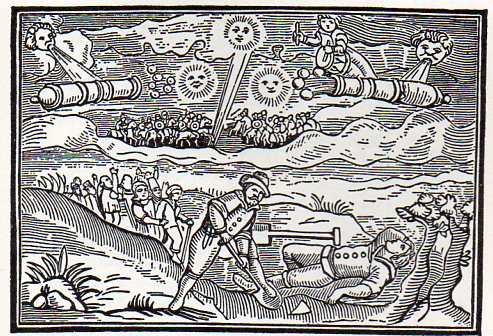
    [For some reason the celestial court, divided by sunlight and flanked by two other sources of light, have ofund it expedient to issue comets from the mouths of Heaven Canon.  I’m not sure what’s going on in the forground with the fellow working his spade next to the triangular blankness.  the man to his right seems to have been overtaken in fear (as have the group of people visible to the left over the shoveler’s shoulder).]

    Comets 4563

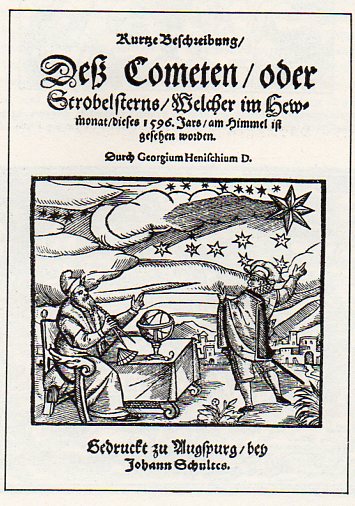
    [Halley’s comet appears again on the title page of this work by the Hungarian George Henischius, a prfoessor of rhetoric, mathematics and medicine at Augsberg.]

  • Science Noir and Steampunk–the Magic Lantern and Major Kong

    JF Ptak Science Books   Post 1177

    I wonder if there is any such thing as Science Noir? There is certainly science fiction noir, and Cyber Noir and associated reaches, but, well, what about a purely Science Noir?  Scary, off-center, distracted, chilling, nightmarish science?  I’m not so sure if this is even a real question, but when I think about arguments made for the cultural and supposed artistic impacts in the creation and direction of some aspects of scientific development, I wonder if it makes any sense at all to think of science in terms of the noirish aspects of culture.

    Emma Alvarez Gibson made the suggestion to me that Science Noir might be a version of Steampunk, and she may well be correct, although the frightening aspects of vast machinery shrouded in noise and smoke and shadow–the very definers of Steampunk and massive Victorian-era machinery–may be itself one version Science Noir.

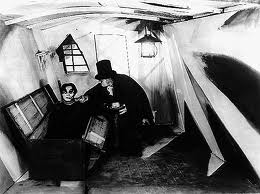
    But what comes first to mind of course is film noir, the edgy use of cinema that came about during the late stages of the Expressionist movement and the early stages of motions pictures.  Expressionism comes just after the first real influx of motion pictures, around 1910 or so, and it seems a little surprising to me that such a huge developmental leap was taken in film so quickly after the first initial mass public success of the film industry.  Perhaps it is incredible that a movie such as The Cabinet of Dr. Calgari–seen as the first adventure into Film Noir and an enormous leap of creativity in film–came so quickly: after all, the first NYT film review appears in 1909, the first movie magazine (Photoplay) appears in 1912, the first animated cartoon (the great Windsor McKay’s Gertie the Dinosaur) in 1914, the same year as the first appearance of the Little tramp.  And then five short years later, almost a decade into the Expressionist movement, comes the Cabinet.         

    Science noir--caligari
    Film Noir was a new experience in motion pictures–it tested reality, coming to the audience in a shadow, fractured, sharp angled crossed line existence, dark, potentially unreal, teasingly chaotic, establishing a waking nightmare.  The mood was questioning, the atmosphere sharp and highly contrasted. It was scary–especially in the case of the deeply creepy Dr. Caligari the deeply disturbing sets continuing to stay as existence in the film even after it is revealed that everything that had happened previously was a dream…except that the dream’s landscape was not relieved. 

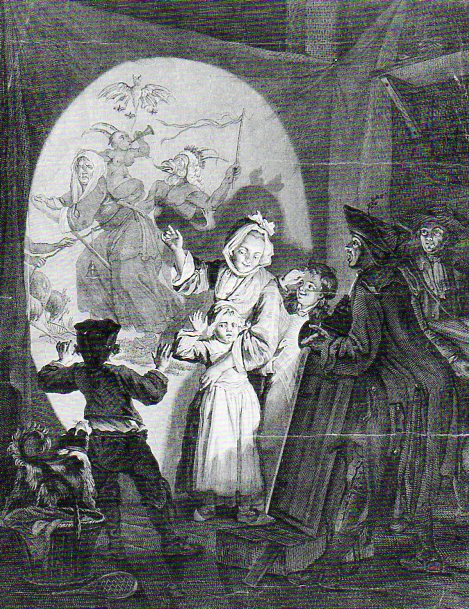
    Perhaps the earliest brush of Film Noir was Science Noir.  The earliest removed images in real time that were seen moving eerily across the probable clay/adobe walls of a camera obscura must have seen fantastic to the first observers.  The earliest projected images from the magic lantern–seen here in the engraving La Lanterne Magique by Jean Orvrier and published around 1770–included many frightening portrayals of witches and demons in addition to their general stable of scientific, technical, literary and travel images. I am quite sure that the earliest viewers of these scenes must have felt as though they were witnessing something extra-ordinary, something beyond simple optical amusements shown on white cloth, something more real than not–particularly since it seems that many people were exposed to these images by traveling magic lantern itinerants more so than scientific lectures. The images of spectres and demons may well have felt to be the things themselves.

      Science noir--magic lantern565

    Perhaps the magic lantern is the first bit of Science Noir, the Steampunk without the steam.  And metal. The noirsh aspects of this science was in projected light and the imagination, leaving the worst effects of the  visual aspects of this fear to the imagination. 

    But I think that Ms. Gibson is correct, and that the most vivid aspects of Science Noir are left to Steampunk, the threat of metallic enormities of power and noise simply overwhelming the viewer.  I suspect though the  greatest science noir of the 20th century would best be seen through the eyes of Stanley Kubrick’s Dr. Strangelove, a masterpiece of black humor layered in incredibly stark, high-contrast black and white scenes, the threat of entire annihilation made to feel somehow ridiculous, humorous and possible, the viewer laughing  as Major Kong rides the nuclear weapon “Hi There” all the way down in Nukepunk cowboy glory through five minutes of an insistent “When Johnny Comes Marching Home” soundtrack. And then, suddenly, the silent, brilliant flash, and the laughing stops, and there’s nothing left but cold heat. 

    I guess that’s my first take on the vision of modern Science Noir. 

    (The except below from Dr. Strangelove is longish, about five minutes,  but it is well worth the buildup.)


    _
    Notes
    The oldest extant magic lantern-like machine comes to us from Christian Huygens from about 1656.  Huygens is a scientist of enormous energy and capacity and genius, and more often forgotten than not nowadays, at least in popular culture

  • Young Communists: Service with a Smile, ca. 1922

    JF Ptak Science Books   Post 1179

    This dapper young man with the sharply snapped salute is a communist, and as he tells you, he’s at your service.  But the Young Communist League (of the United States) in the 1920’s–when this pamphlet was printed–was a semi-underground organization with few members who wanted to serve you and which was also “devoted to the interests of all young people and is dedicated to the revolutionary cause of the working class of our country, the transformation of the United States through mass democratic struggle into a socialist society”. 

    Young communists583

    So the YCL service venture may have been more helpful to someone with Communism in mind than anything else.  It did have a diffident bit of patriotism in the design of the pamphlet’s covers, but they wanted a United States that wasn’t the United States that very many other people wanted.

    Perhaps the October Revolution wasn’t what the people of Russia wanted, either. They certainly wanted their freedom from Tsarist rule, but the revolution orchestrated in the name of freedom was hardly that. Significant American thinkers and writers on the plight of the people in Russia at the end of the 19th century–including George Kennan, author of the still very readable and absorbing Siberia and the Exile System (1891)–pretty much jumped off of the bandwagon by WWI.  I can understand a haphazard interest in the Communist Party and the idea of socialism in the United States in the 1920’s and even the support of the still relatively new Soviet Union, but this was a period in which the member in the cascade of three-letter acronyms of Communist political affiliates and parties had a weak draw.  Interest in them picked up in the United States in the 1930’s, though this was also the period during which the atrocities of the monster Stalin were being discussed.  I’m not sure why this popularity grew in the light of these revelations–I just don’t know the history.  (Even though this was supposed to be Stalin’s quote but wasn’t, it fits quite well: “death of one man is a tragedy, death of a million is a statistic”–as a murderer of millions of people, he was very well versed in statistics of genocidal sadism.) 

    In any event, I simply liked the public face that the YCL engraved for themselves–it looks much like any other face you’d see in any other magazine hawking coats or cigarettes or Dunlop tires.  A face like any other. 
    ______
    Notes
    Kennan wrote in 1923: “The Russian leopard has not changed its spots… The new Bolshevik constitution … leaves all power just where it has been for the last five years–in the hands of a small group of self-appointed bureaucrats which the people can neither remove nor control.”

  • What I Learned from Johnny Cash’s 1949 Report Card

    JF Ptak Science Books   Post 1181

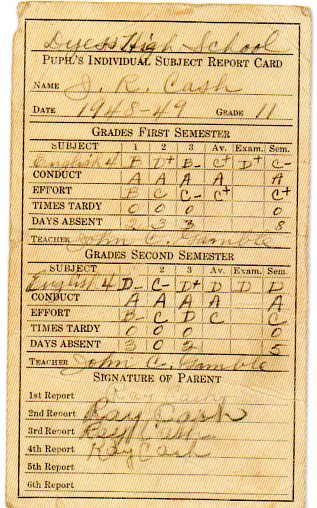
    This great relic of Americana–the report card of Johnny Cash from Dyess High School in 1949 –is the stuff of deep emotion.  It means that John R. Cash walked this (“Pupil’s Individual Subject Report Card”)  English report card home to his parents for review, the 17-year-old wondering about how they might react to his not-great grades in English and “effort”.  Or perhaps he wasn’t worried at all, perhaps he didn’t care.  He missed very few classes, and was never late.  He received straight A’s in conduct from his teacher, John C. Gramble.

    Johnny cash report card584
    [Image source: Cash, by the editors of Rolling Stone Magazine, 2007.]

    So, the young Cash, who had grown up lyrical, with music and words swimming in his head, was unmoved by “English” (which was probably more like “composition” than what we think of it today) and was not interested in trying to overcome his disinterest, overly.  Be that as it may, even though he was a D student, he was respectful of the class and teacher and classmates, always getting A’s in conduct.

    Mr Cash signed the report card each time, and I suspect that he knew exactly what was going on with J.R. in spite of the grades.

    Only six years later, in 1955, Johnny Cash had his first national hit in “Cry Cry Cry”.

    And so where was Dyess High School?

    As it turns out, Johnny Cash lived in a place in his early youth that owed its life to deep government intervention in the lives of its citizens.  The short story is that people–almost entirely farming families–who had lost everything in the Great Depression and the resulting drought were given an advance1 of money to buy a house and land and a chance to start life anew.  Ray Cash, Johnny’s father–born in 1897 in Rison, Arkansas–entered his family on the relief rolls and was one of 500 families selected  to settle a 15,000 timber-cut swath of Arkansas bottom land up in the north-east corner of Arkansas in Mississippi County, basically due north of Memphis Tennessee just this side of the border.
           
    The program brought to bear on this situation was the Federal Emergency Relief Agency (FERA), which was administrated on the national level by Harry Hopkins and in Arkansas by Alabama-born former teamster William R. Dyess.  The farms and farmland was administered through the Rural Rehabilitation program, which under Dyess’ direction in Arkansas started the “Colonization Project No. 1″ in May 1934.

    Ray Cash and family moved into House 266 on its 20 acres in 1936, one of five families selected from Cleveland County, and the same year in which Colonization Project No. 1 was incorporated as Dyess Colony.  In a short period of time construction in the new Colony included  “an administration building (and a )…town center (which)  included a community bank, beauty salon/barbershop, blacksmith shop, café, cannery, cotton gin, feedmill, furniture factory, harness shop, hospital, ice house, library, theater, newspaper (the Colony Herald), post office, printing shop, service station/garage, sorghum mill, and school. Members of the colony often performed community tasks on a cooperative basis, though the farms were worked individually.”2   
    ________
    Notes

    * “Criteria for the all-white community included that applicants be destitute from the economic crisis, come from the lowest poverty level, be of “good moral background,” and that husband and wife each have the physical ability to clear the land and farm their acreage. Each farmer would draw a subsistence advance to buy twenty to forty acres of land and one of the new five-room houses, plus a mule, a cow, groceries, and supplies until the first year’s crop came in. All were expected to pay back the advance. The town would operate as a cooperative in which seed was purchased and crops were sold communally.”Encyclopedia of Arkansas History and Culture.

    2. Encyclopedia of Arkansas History and Culture.

    Dyess had population of 2500 in 1936, now a town of 550 or so.  I cannot see any remnants of the wagon-wheel design of the farm houses that were built there in 1934/5 from Google satellite images.

    An excellent reference for the movement of families into the Mississippi River bottomlands is The final frontiers, 1880-1930: settling the southern bottomlands, by John Solomon Otto.

    And now for this musical video about Dyess:

  • Making Tubes of out Holes–the History of Holes, Extended

    JF Ptak Science Books  Post 1184  [Part of this blog’s History of Holes series.]

    Taking inspiration from Edwin Abbott’s Flatland1 (a superb book  excursion into perception and difficult envisioning in which a two-dimensional world tries to comprehend three-dimensional objects) I’ve decided to extend my History of Holes section with their extruded, cylinderized extension cousin–the tube.  After all, If you take a hole by its edges, shack it out, rough it up, reposition and throw some sides on it you wind up pretty much with a tube, which could be seen as elongated holes with (generally) defined beginings and endings. Sometimes.  This is a natural continuation of my series on dots, which can be regarded as holes, or points, and thus into tubes.  “Spots” on the other hand really doesn’t work into the dot/hole thing, as spots can be irregularly-shaped, and I like the dots/holes to be more rounded than the potentially jagged spot, or blotch.

    When you start thinking of tubes, though, they turn up everyhwere: from gigantic cannon, to impossible flying machines, to telescopes, pneumatic railways and delivery systems, test tubes, subways, pressurized health restorers, television screens, and so on.

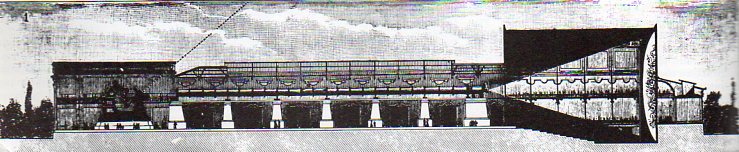
    I’m not sure where this idea came from–perhaps in the post on massive tubeless telescopes (here), reminding me of the most massive tubed telescope, the longest telescope with a tube, belonging to James Bradley, who produced a monster over 200′ long. Connecting the tubeless and tubed telescopes was the image that I had in mind; the hole following naturally from that. Anyway the Bradley  tubed construction–antithetical to the DNA/carbon/membrane nanotubes–were enormous for their time, and as moveable tubes are still very impressive.  Another massive telescope was constructed on speculation for the Paris Exposition of 1900 {the cross section of which is depicted below)–it was 187′ long, spectacularly made and exhiited, and could find not a single buyer.  Positioning the scope of course would’ve been very problemtaic. 

    Tube 1500 ft telescope621
    There are other, more massive and mobile tubes, like, say the smokestacks of the Titanic (which were 24×19 feet, with a fall of 150′ from the top of the smokestack’s sweep to the boilers)–these weren’t mobile in and of themselves, but they did move, if only for a short time (laterally), and then for a very short and cold time (vertically).

    http://www.titanic-titanic.com/pic/funnel_bogie.gif

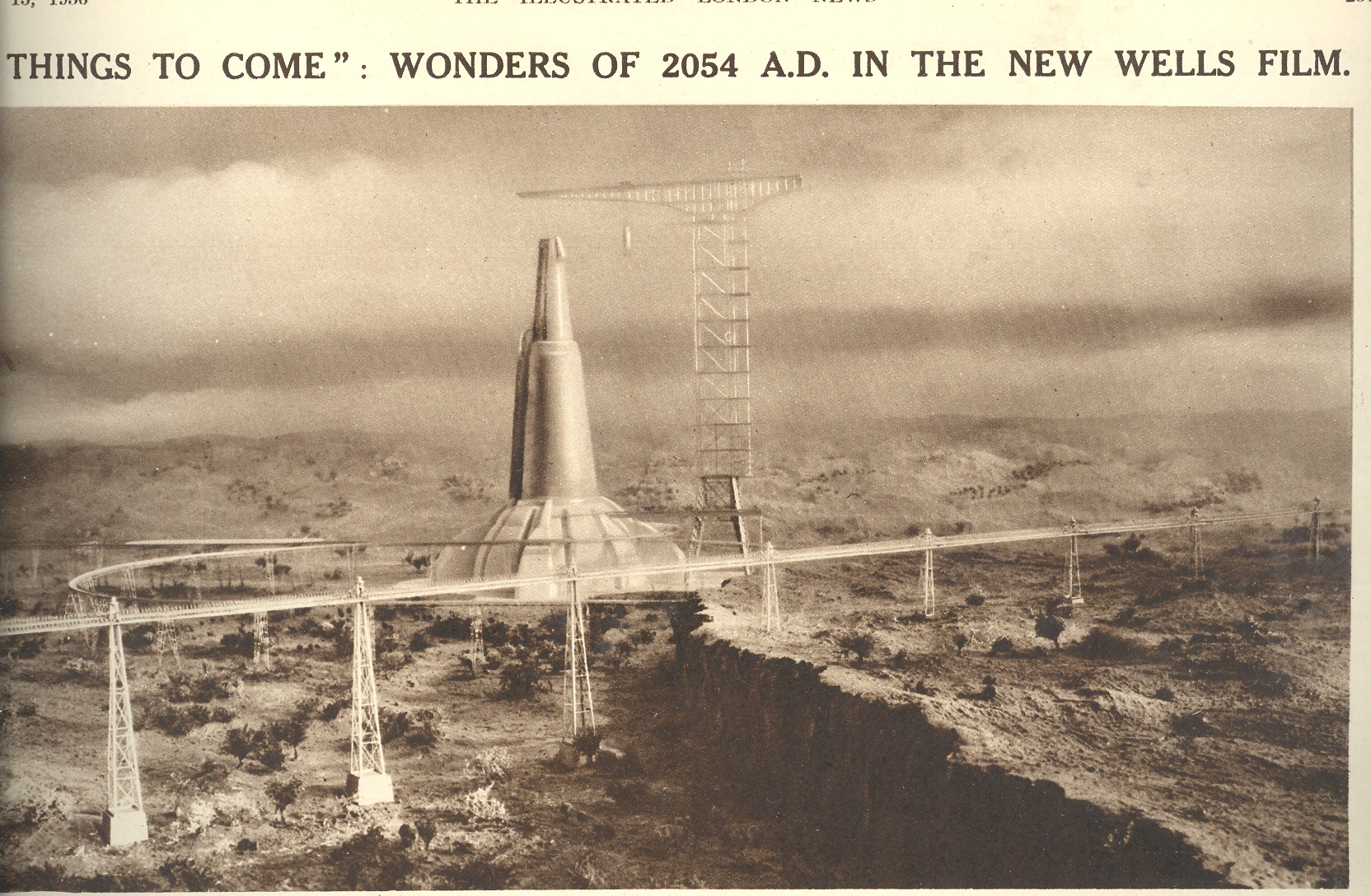
    Massive, monster canons have existed for many years in idealized and theoretical, speculative worlds, like Tom Swift and his Monster Canon.  In the history of early imaginary big gun tubes H.G. Wells’ Babel-like cannon (pictured below in a still from the movie Things to Come (1936), an adaptation his The Shape of Tings to Come (1931)) is fabulous–1500 feet tall, with I figure a  750′ base, it launched a 75′ tall capsule beyond the Earth’s

    Blog jan 6 wells

    gravitational pull with a spectacular explosiveness that would’ve made its occupants into instant jelly.  (Paul Drye points out that one of the biggest sci-fi guns comes to us via Arthur C. Clarke, who had his Lunar inhabitants fashion a gun by drilling into the Moon’s surface until they reached a depth where it would tap and “shoot” molten rock at attacking space ships.  This is more of a hole than a tube, and as such probably ranks it as the biggest hole gun ever constructed, even in science fiction. In the same veinish vein is Robert Heinlein’s railguns, seen in The Moon is a Harsh Mistress.  It has been suggested that E.E. Smith may have concocted gravitational weapons enabling planets and entire galaxies as wepaons, but I’m not sure about this, and they’re definitely not tubes.)

    Just to round out the Solar System cannonry a bit, here’s an example of a gigantic tube coming from the fabulous Frank R. Paul for Stanley D. Bell’s “Martian Guns” found in the January 1932 issue of Wonder Stories.  There’s really no way to determine how big the gun is except to say that it is probably “big”–there’s just nothing to place the thing in perspective, as the figures in the foreground, being Martian, don’t have a specific height.  They could be 6′ tall, or 60′–perhaps they’re only 1/10 of an inch tale, and the projectile they’re firing to the earth is so devastatingly powerful that size doesn’t matter.

    Strange things in sky--martian guns

       Back here on Earth and in the real world,  the Kaiser Wilhelm gun (or “Paris Gun”, the Kaiser Wilhelm Geshutz) was

    http://farm4.static.flickr.com/3169/2951816593_c2d2e5c875_o.jpg


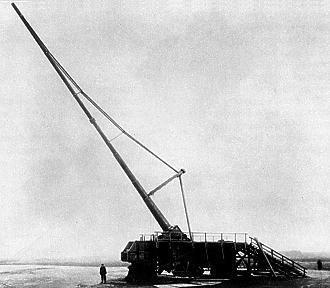
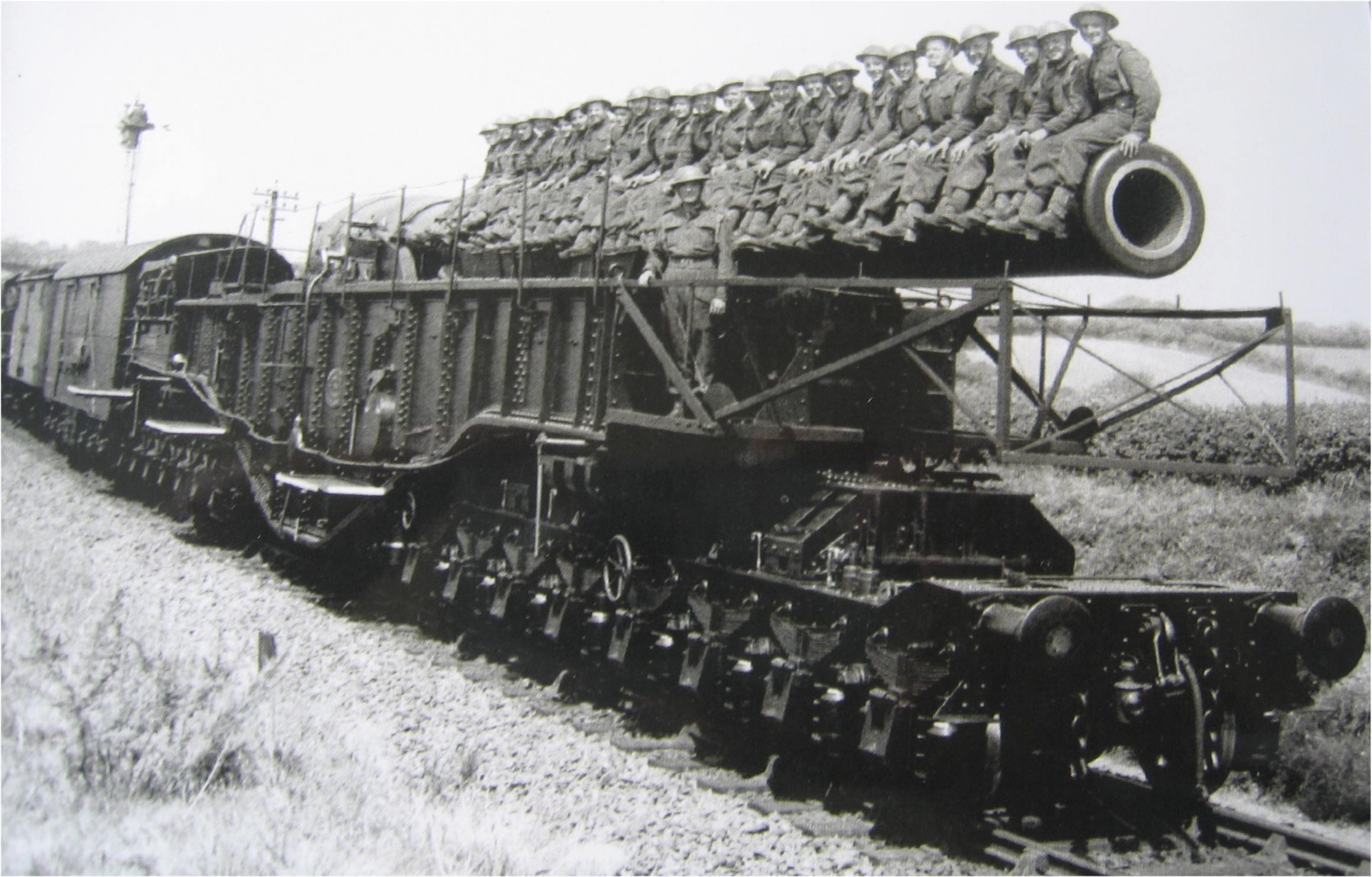
    a long-barreled, light shelled monster: its 92′ long barrel (plus a 20′ extension) launched a 94kg shell about 130 km, reaching a maximum height of 40km (about 25 miles) high. For all of its mass (the gun weighed 256 tons without the railway cars) the shell that it fired didn’t weight much at all….though the shell did reach an extreme height. (Ironically, the gun was built for attacking the deepest of the deep bunkers of the fortresses along the Maginot Line; it was never needed for that, as the Maginot Line was simply left behind in the Nazi assault on France.)  The British Ordnance BL 18 inch howitzer (below) was developedjust as WWI was enidng, but did not enter service until nearly two years after the war ended.

    File:BL 18 inch Howitzer Ashbury Station WWII.jpg

    The Schwerer Gustav was a 1350 ton beast which fired a 14,000 pound shell (!) about 20 miles. A  little later came the Nazi V-3 (the lesser known of the V-weapons), the Vergeltungsewaffe 3, a 130 metre (!) long, 150mm gun built alongthe side of a hill, launching a 140 kg shell. The Iraqi Big Babylon gun was sort of like this one, though never built–it was to have a 500′ barrel and would be supported by a hillside. Then there was the Nuclear Tube: the Atomic Annie (M65) cannon, which was another bruiser, being an enormous 85′ cannon that delivered the worst punch of all cannons, a nuclear warhead.  The weapon was test-fired in 1953 at Frenchman Flat at the Nevada Test Site and delivered a 15kt explosive device to a target seven miles away. There were 20 of these made, but given their diffiult-to-deploy-and-keep-secret status, and the nature of the shells, and the development of more sophisticated weapons, the M65 was obsolete almost as qickly as it was introduced, but was removed from the frontline only in 1963. 

    VWM240mmAtomicAnnie01.jpg

    I guess what people think of first though in regard to tubes in “The Tube” in London, though a more tubey tube was presented here in the pages of the Scientific American for the NewYork City subway:

    Tube nyc623

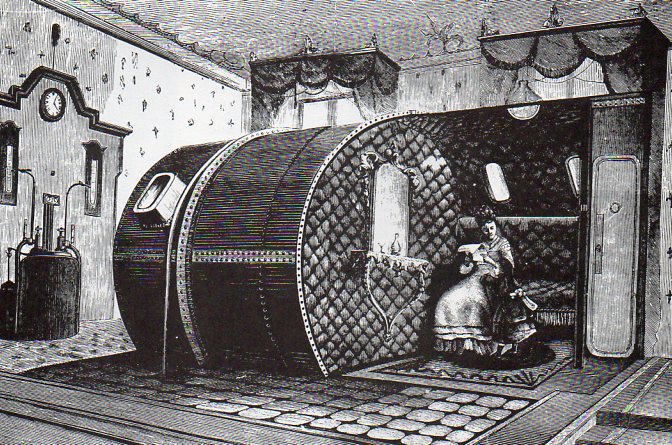
    Here’s yet another strange tube, this a tube-within-a-rectangle, an aerotheraphy device that was supposed to cure people of whatever they needed curing for, just like any other good quack device, though this may well have been the heaviest of them all.  Cushioned, well-appointed, and with a hint of luxury, this burst of fresh air was inteneded to render diseases and other complaints harmless–only for a lot more money than electro-shock or beer cures or massive purgatives or bleedings or copper amulets or whatever else you can come up with.  It does make a nice image, though:

    Tube aerotherapy625

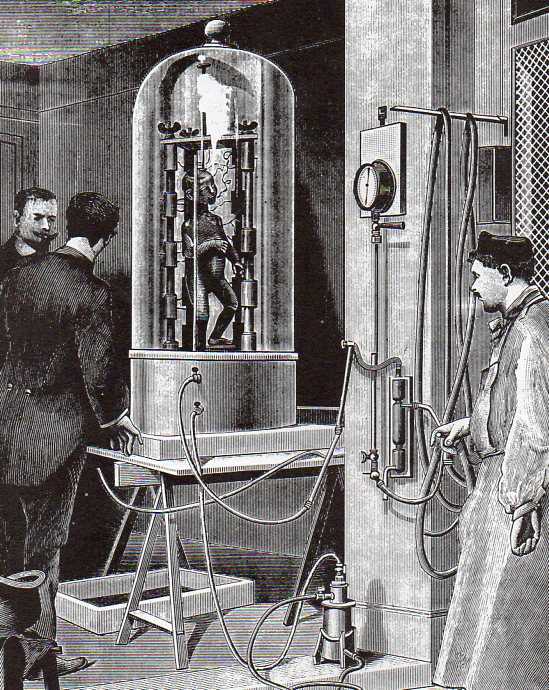
    The tube below may well have been the largest glass tube to hold the body of a dead person–and in this case, a dead child.  It was design for a practice that was evidently not practiced–electroplating the dead.  Someone thought it might make a good practice to deposit a one millimeter coating of copper on the skin of a cadaver, and published their success (and image) in the Scientific American for November, 1891.  The practice didn’t catch on.

    Tube test tube dead622

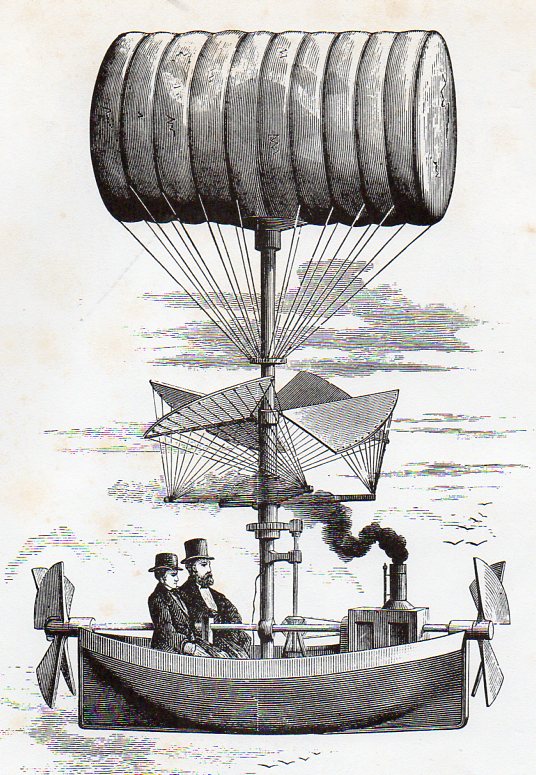
    Then of course there are submerged and flying tubes; submarines have certainly become a long-established part of the technological landscape, and the flying tubes, not. 

    Tube  flying620
    Still, the steam-driven helium-filled flying tube boat looks dignified and lovely, if impracticable.

    There were proposals in the late 19th and early 20th centuries for pneumatic railroads and pneumatic people movers (in one case in the 1930’s, for a plan to move individuals from New York to Philadelphia in chair-like objects in one of these tubes), but for all intents and purposes the closest that these plans came to fulfillment were pneumatic operations like thoe found in R.H. Macy in New York.  It was in the massive department store where you could find miles of pneumatic vacuum tubing that connected department tellers to a main counting office, where little cylinders were filled with cash and receipts and sent along for accounting.  The logical outocme of Macy’s tubular world for Terry Gilliam was seen in the director’s masterpiece dystopic flic, Brazil, where we see a world crowded with gargantuan and suffocating nothinness, filled with bazillions of miles of ductwork whose purpose is a mystery, making for a cold and disturbed world. 

    Brazil screen capture

    End part I of Making Tubes of out Holes–the History of Holes, Extended.

    Notes
    l. Edwin Abbott’s slender Flatland is perhaps one of the best books ever written on perception and dimensions, a beautifully insightful book that was quick and sharp, and in spite of all that was also a best-seller.  Written in 1884 when Abbott was 46 (Abbott would live another 46 years and enjoy the book’s popular reception), it introduces the reader to a two dimensional world with a social structure in which the more sides of your object equals power and esteem.  Thus the lowest class would be a triangle (three sides) while the highest (priestly) class would be mega-polygons whose shape would approach a circle.  Abbott’s magistry comes in explaining to the three-dimensional reader what it was like to be in a two-dimensional world.

  • Mr. Mole, the Stationary Busby Berkeley of Mass Crowd Installation Photographs, 1918

    JF Ptak Science Books Post 1185

    I’ve long enjoyed these massively organized, captured moments of time and effort–large caliber photos of concentrated efforts of tens of thousands of people, all of their motion and utility directed to produce this one moment in time.  Perhaps the greatest practioner of this artform was Arthur S. Mole (1889-1983), the stationary Busby Berkeley of Big Organized Crowd Efforts (BOCE).  (He led an interesting life, coming from Scotland with his family to be part of a Utopian community led by John Alexander Dowie–a faith healing visionary, self-reported precursor to the second coming of Christ, and leader of the Christian Catholic Apostolic Church–at City Zion, Illinois. Dowie was a problematic man not without good and interesting qualities, though his to-the-death prayer duel with a rival visionary is an interesting story to be left for another time.)

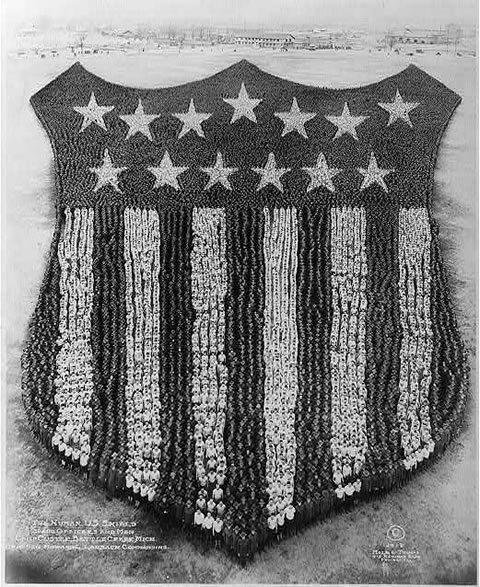
    I’ve always enjoyed this photograph  in particular–it was made from a 70′-tall platform with a 11×14″ view camera using a wide angle and a deep oblique angle, along with 30,000 soldiers from Camp Custer, Michigan.   It was made in 1918 by Mole, along with the evident and very capable choreography of John D. Thomas, who was the Doctor of Persepctive and Motion for the pictures.

    [Note: most of the images below are extremely clickable/zoomable.]

    Arthur-mole-human-us-shield

    Most of the soldiers are used to make the field at the top of the stripes–so near as I can tell (from the resolution image that I had to work with), there are about 300 men in each stripe (except for the outer two), meaning that there between 3,000 to 5,000 in the collected stripes, which puts something like 25,000 troops in the stars and their field. The middle stripe I reckon to be 150′ long; my guesstimate for the star field is 600′ deep and 1250′ wide, making a triangular collection of men 750’x1250′. That takes a little bit of planning to accomplish to ensure that everything is kept in perspective, and which also means that a lot more folks are needed at the top of the constructed image than at the bottom.

    Another excellent example is this photo made of the U.S. Marine Corps emblem using 6,000 marines at Paris Island in 1920.

    http://redtreetimes.files.wordpress.com/2010/05/arthur-mole.jpg

  • Mapping Humans, 1400-1759: Bloodletting, Moles, Bumps and the Stars

    JF Ptak Science Books   Post 1123

    The history of mapping the goods and ills, the past and present and the future on the human body must be about as old as writing, or older.  Ever since you could draw geometric proofs in the sand people have been mapping out the connections (or lack of) the parts of the human body, their relations to one another, the influences of the stars on them, the control of dermatological deformities on the health of the system, the lump and pits and dings on the cranium as an indicator of intelligence and prospects for the future, connecting the lines of electroshock results on facial contortions with the inner musings of the criminal brain, and on and on.  What brings my attention to this though are the overall full-body indexes, the general NYC subway map-like overlays on the entire body, and what they look like out of context. 

    For my purposes here, it really is just the out of context element, the found art, the pre-Absurdist, pre-Dadaist images that they maps create.  Granted the real stuff behind these images are by far more interesting, but I wanted to add these pictures to the blog’s alternative art category before their Duchampian attraction left me. 

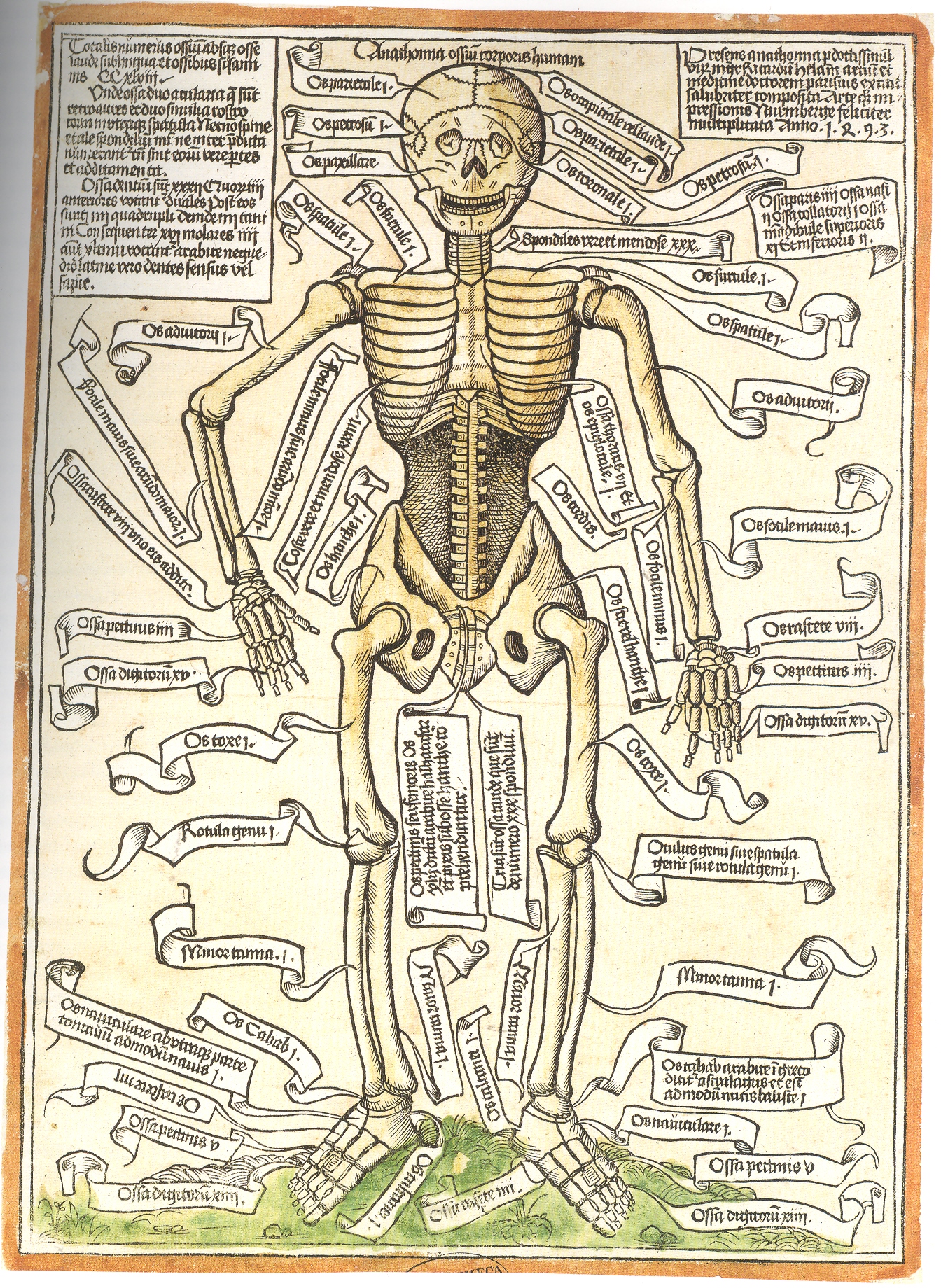
    To start with, for example, in this very breezy survey is the indexing of the very first illustration of a human skeleton. from Anathomia ossium corporis humani, printed the year after Columbus arrived in the Americas–this was the first revelation to the real world of science following a sleepytime of about 8oo years under the very heavy gaze of institutional religions. 

    Blog--may 5 skeleton

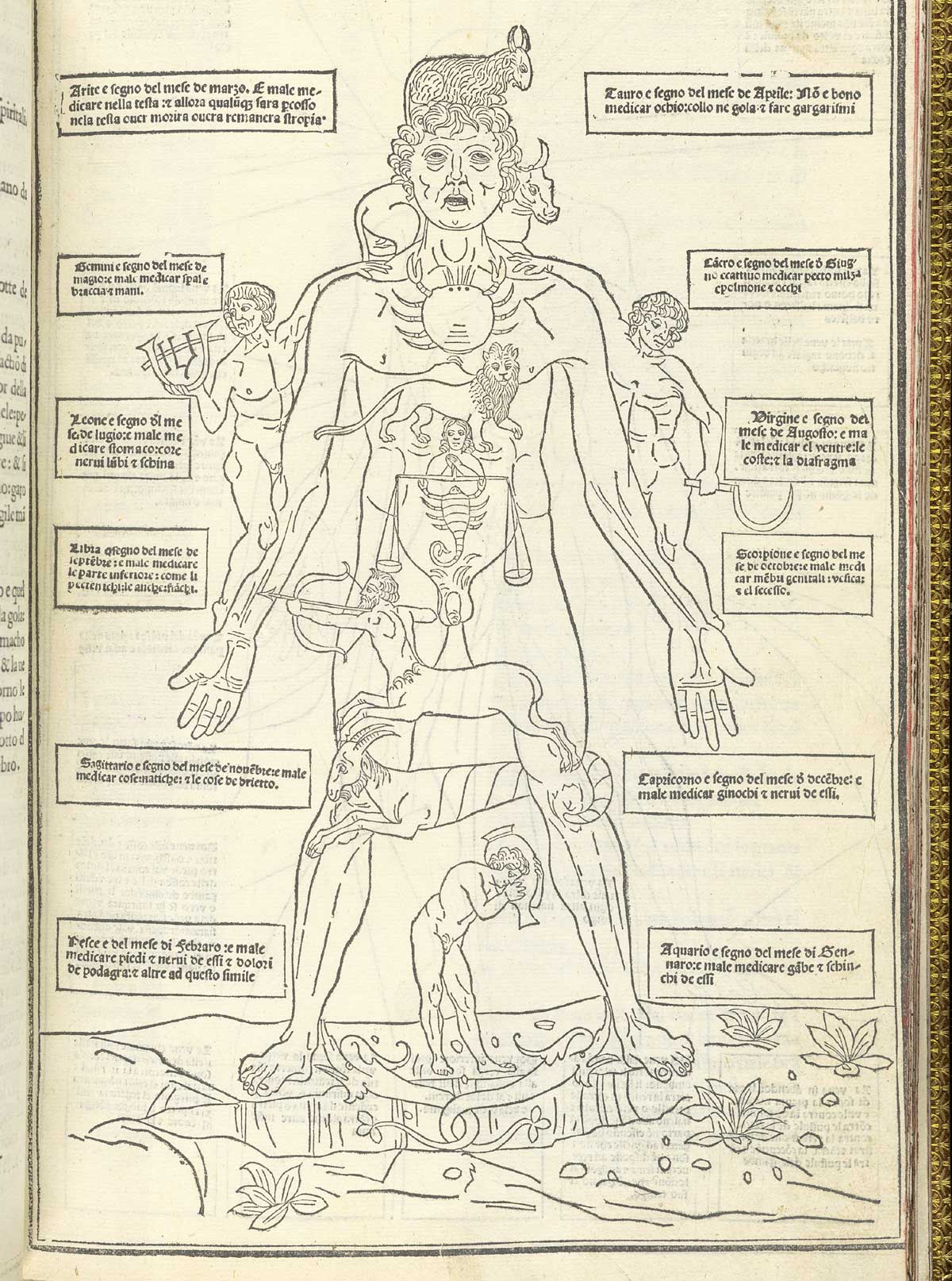
    Human map ketham_p15 In the same year that Columbus set sail for India came the anatomical publication of John de Ketham, with his overall map of astrological influences on the body, followed by a pretty-useful treatise on the treatment of war wounds, as well as the decidedly less-useful map of his locations for the best place to bleed a person of their bad humours. 

    Well, it really wasn’t like that, not how I mean by by snippy modernist viewpoint looking back on medical history with no contextual appreciation.  Bloodletting was an approach to healthfulness, as blood was seen as one of the four major elements (or “humours”) of the human body that needed to be kept in balance.  This was

    Gersdorffx400jpg_other_2accomplished via the application of leeches or by the more common (and quicker) practice of venesection, or opening a vein to allow the blood to come out. (Let’s reference Steve Reich’s magnificent “Bruise Blood” creation of 1966 at this point—I don’t think that I’ll ever have a better chance to drop a reference to this piece of revolutionary music in regards to venesection again.)  Thus this map was map for the practiconers of bloodletting—the physicians, and more probably the barbers and other assistants who would inherit this lesser procedure from the more-busy doctors.  In the history of maps of anatomy and the general practice of mapping the human condition, this woodcut x-ray of the best places to drain human blood would not survive close to the age of modernity, disappearing almost entirely by the 18th century, and becoming much more scarce well before that.
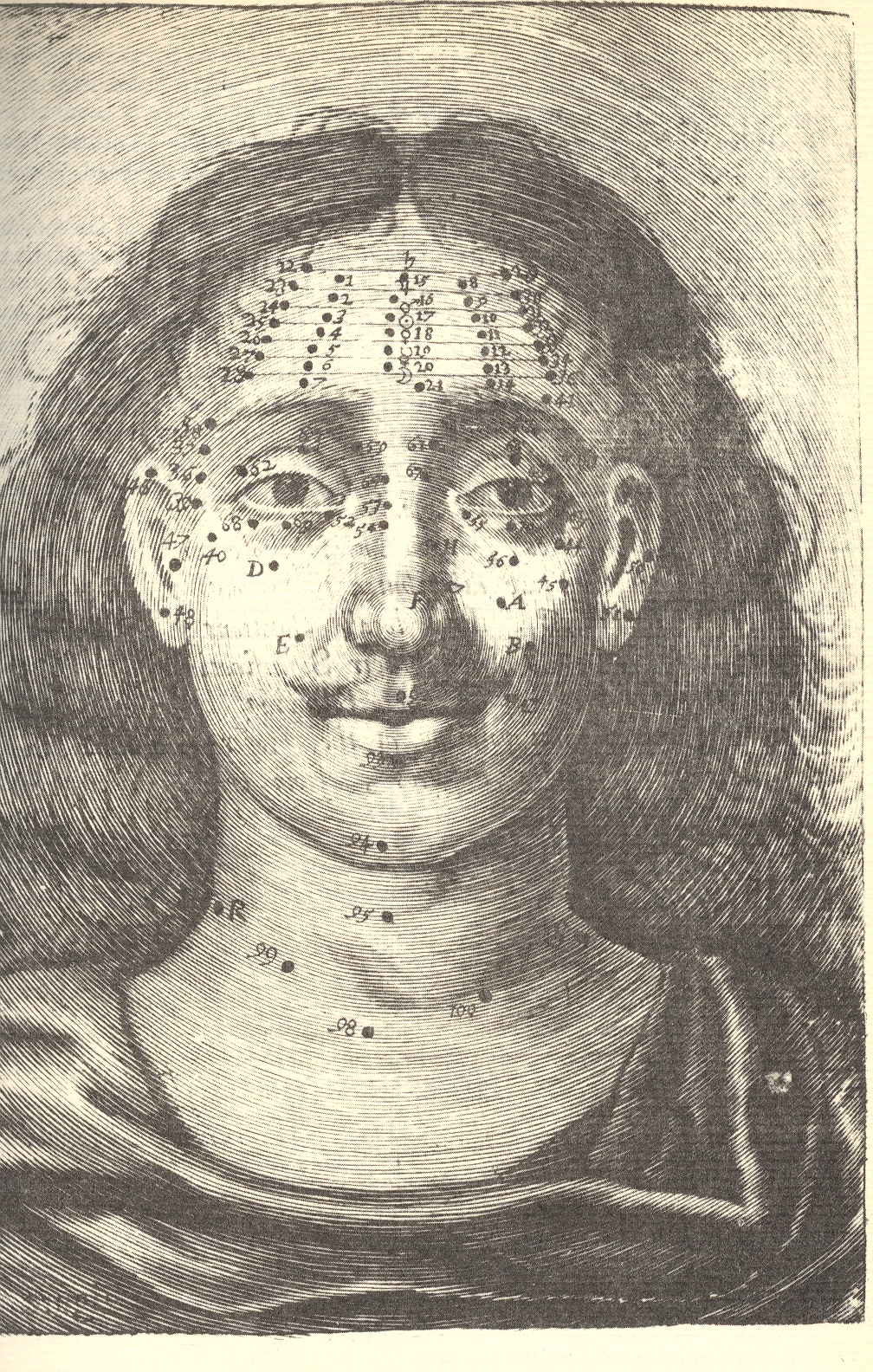
    Moving on to Richard Saunders (who I wrote about more fully here)continued a very ancient tradition into England, deep into modernity, by mapping the divine cosmos of moles and other facial extras for the purposes of health and prophecy:

    Blog--jun 11 circ mole


    Richard Saunders.  Physiognomie and Chiromancie, Metroscopie, the Symmetrical Proportions and Signal Moles of the Body, Fully and Accurately Explained; With Their Natural Predictive Significations Both to Men and Women (published in London, 1671, by Nathaniel Brook).in which he divines the psyche and the future with peoples’ moles. 

    [graphic]

    Visceral Anatomy From Reisch’s “margarita Philosophica,” Johann Schott, 1503

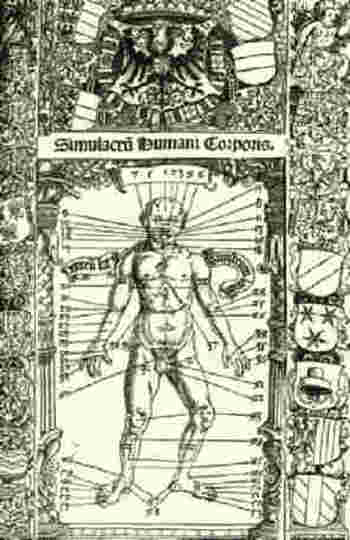
    Blogbloodletting_stoefflerI couldn’t let the above-mentioned  bloodletting image pass without reference to this excellent woodcut for Johann Stoeffler’s  Calendarium Romanum Magnum, printed in Oppenheym by the redoubtable  Jacob Koebel, (24 March) 1518.  It is a glorious display (entitled Simulcarum humani corporis) of seasonal (!) purgative and bloodletting locations on the body, meant to accompany a longish essay by Stoeffler on the practice in general.  The bulk of the book, however, had very little to do with this practice and was actually commissioned as a reform to the Julian calendar, provided with the impetus of the Lateran Council (1512-1517).  The result was a series of forty-one  propositions on the calendar and calendar-related practices, including work on eclipses, the zodiac, the occurrence of leap years, the Alexandrine and Roman calendars, the calculation of the occurrence of Easter, and so on, including the seasonal practices of bloodletting.
    I enjoyed this torso map by Salomon Alberti  in his Historia plerarumque partium humani corporis, in usum tyronum edita. Vitebergae (p1583, 8°; ibid., 1585, 8°; enlarged, ibid., 1601, 8°;(published from 1583 to 1630) for it simplicity.

    The rest of the images I’m going to have to show here as a simple Image Dump, at least for the time being:

  • French Visionary Architect and Creator of Bad Taste: Jean-Jacque Lequeu.

    JF Ptak  Post 1124

    The history of bad taste is like a history of bad food–you need them to tell you what’s good. — Imaginary quote of Hank Hill

    I you look hard at some of the leading styles of architecture and design of the 1880-1920 periods, you will see elements of the work of the great visionary architect, Jean-Jacques Lequeu,  The Rouen-born and Paris-educated Lequeu’s major problem in this is that he was long dead in some forgotten place before any of this very-late recognition occurred.  Too late for accolade, too late to brand his isolation as something other than bizarre (famous people doing the same sorts of things would be “quirky”), and of course too late to get patrons or backers or clients for him to actually be able to build something.  Anything.  He had a brilliant command of fancy and imagination, coupled what extreme senses of design and composition and material, and also how to make something constructed of all of that stuff stand up. And that’s certainly the promise that he showed when he and his more public-centric work were in favor.  But that was back before the Revolution–before the end of the American Revolution.  Things happened, and Lequeu would spend four decades in high obscurity and low solitude.

     He could’ve been just about anyone after this point, after his acceptable brilliance wore off:  instead, he became a government worker/draftsman, lived in a series of small apartments, and finally wound up taking residence in a brothel room, where he created unequaled images of imaginary/inspired architecture. And between his scrambling for a government existence and creating vast Utopian cities and complexes and bizarre anthropomorphic structure, Lequeu might also have invented Bad Taste, being an early version of Charm City’s own John Waters (sorry Mr. Waters, but you know its true). By virtue of his station in life, I think, Lequeu was exposed to many sides of French impolite and exploratory society which he managed to witness, and capture, and portray in a manner vastly uncommon to almost every other artist of his day. 

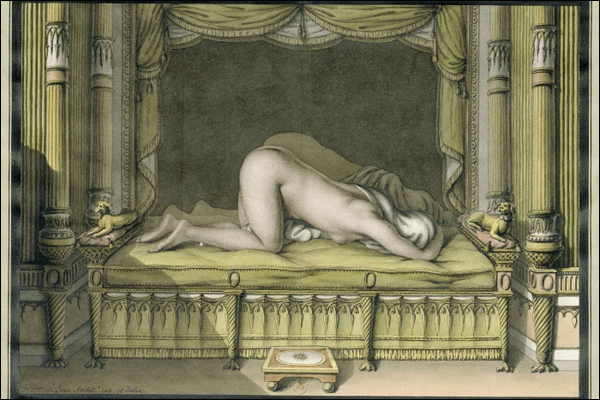
    I did want to concentrate just on Lequeu’s self-portraits here, but I feel compelled to share at least a couple of Lequeu’s fanciful and Columbian adventures into the world of Bad Taste–these are not by any means his great contribution to the history of art, nor do they come anywhere near his great architectural visions, but they are significant  For example, while others (actually, everyone else) was exploring reclining nudes in one refined way or another, Lequeu explored the image from a different angle:

    Lequeu reclining nude
    Not only is the model in an unusual position, and in front of a mirror, but her face and head are completely obscured. A lovely piece of technical gaudiness, this still was not a crowd-pleaser in 1815.  Its not the only thing that Lequeu should be remembered for by any means….but it is something.

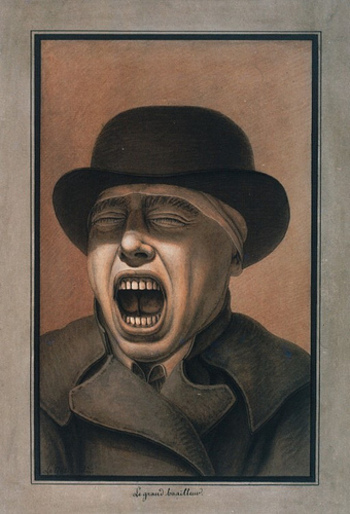
    But on to Lequeu’s fearless self-portraits:

    Lequeu 

    Lequeu 8

    Lequeu portrait 003
    Lequeu portrait 005
    Lequeu portrait 006

    Lequeu portrait 007

    I think that you’ve got to admire the guy for his out-loud living. 

    Notes and examples of Lequeu’s architecture, below:

  • Word Art: the Landscape of the Vocabulary of Kandinsky’s “Concerning the Spiritual in Art”

    JF Ptak Science Books   Post 1126

    Confession: this may represent the coziest I’ll ever be with the written lessons of Kandinsky’s Concerning the Spiritual in Art (1910). It seems to me that anyone who is an artist understands this book; to me, though, as a not-an-artist,  it is  inscrutable–the book winds up looking not much more to me than this Word Cloud. Its a shame for me, really, as this is one of my favorite periods in the history of art, and I enjoy color theory, and I like mixing up sensations and analogies to describe cross-field experiences (like the broad use Kandinsky makes here in describing artistic qualities in terms of music) all of which are strong elements of the book. Its a lovely book, with heavy paper, wide margins, and beautifully designed, but the text is mostly just words, and sometimes a jumbled pile at that. I’ve tried to read it many times over the years, but I keep on failing this book.

    Wordlekandinsky

    ·Posted by :

    ·in:

    —

Recent Posts

Archives

Categories