JF Ptak Science Books Post 315
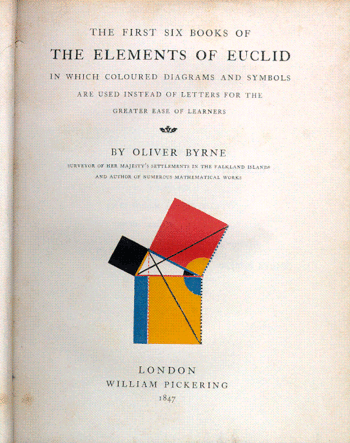
Here’s a bit of a reach, a very-long-distanced connection, between to unrelated items sharing a similar design and operating at the zenith and nadir of color theory. The first work is the great and nearly unusable work by Oliver Byrne on the first six books of Euclid (The First Six Books of Euclid in which coloured diagrams and symbols are used instead of letters for the greater ease of readers…, printed at the Chiswick Press by C. Whittingham for WIlliam Pickering in 1847). The book is, well, unusual and probably not at all useful. Bryne replaced all of the algebraic notation, identifying letters and almost all of the descriptive text with color and color codes, leaving Euclid mysterious, hidden, awkward, impervious, and, yes, beautiful. as a matter of fact this work presages the cubists (and especially Piet Mondrian) by 60 years, and all by accident.

Augustus De Morgan, mathematician and logician, wrote a very highly critical book A Budget of Paradoxes in which he describes hubbub, fakirs, frauds, perpetual motion machines, squaring the circle efforts, millstones and other useless books in the maths, and in here he sniffily dismisses Byrne’s work. At best, to De Morgan, the Byrne book is “curious”. But useless and curious, as I have seen many thousands of times, does not mean that it can’t be attractive and beautiful, and the Byrne book is probably the leading candidate in the Bad & Beautiful category..In Victorian Book Design McLean calls the Byrne book “…one of the oddest and most beautiful books of the whole century…a decided complication of Euclid, but a triumph for Charles Whittingham [the printer]”. (I should point out that the Chiswick press returned to Euclid again in 1893, publishing Gilbert Redgrave’s address on Erhard Ratdolt, who was the first scientific printer in history and also the first publisher of Euclid in 1482. See HERE for the digital record of Redgrave.)
Curiously the Pythagorian theorem illustrated on the title page of Byrne’s book seems at a fast glance to appear on the front cover of Phillip S. Newton’s Color Blindness, Suggested Aids for Correcting 1946. It really isn’t all that close except by fleeting recognition, but close enough to stop me in my tracks, to make me think of where my copy of Byrne was and put them side by side. Curious doubly because in Byrne’s case color is used exclusively in place of numbers and words and is totally and completely dependent upon it. In Newton (who also has the same name as Sir Isaac, author not only of the Principia but also the second-best book of the 18th century, Opticks) we find the confusion of color and plans to correct the color vision, and in a twisty way, on the opposite end of the interests of Byrne.