JF Ptak Science Books Post 1129
Is there room in the history of invented art to reconstruct cubist and abstract paintings by imaging the objects that could’ve passed through the canvases to leaves their geometric footprint? That is to say, if you took the Woolworth Building in NYC and passed it at an oblique angle through a large sheet of paper, and that paper was permeable enough and the building moving slowly enough to simply leave its “footprint” without tearing or deforming the surface of the paper, the resulting image may look a lot like figures in classic works in the history of art.
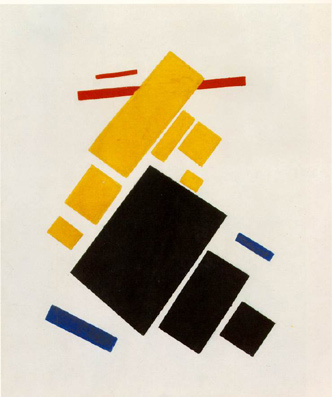
That is no revelation, really, as the Black Square or Airplanes Flying of Kasimir Malevich could’ve been made by every fourth item on your desk. But what is interesting to me would be the reverse of this process, where you take that black square and reverse-engineer it, extruding whatever figure it was that could’ve made the black square into its three dimensional counterpart.
What comes immediately to mind for me in this regard is Claude Bragdon (1866-1946), (a New York-based architect with a long set of sleeves for writing in upper dimensional planes of Theosophy and reincarnation and other similarly squishy reaches) who wrote a few interesting books on the fourth dimension and objects and space, writing two of them at a very interesting period of t
ime for the history of physics and art (1912 and 1913). The books are interesting enough, I guess, and seem to perhaps have had an influence on some influential artists of that time, but what is of interest here are tow illustrations.
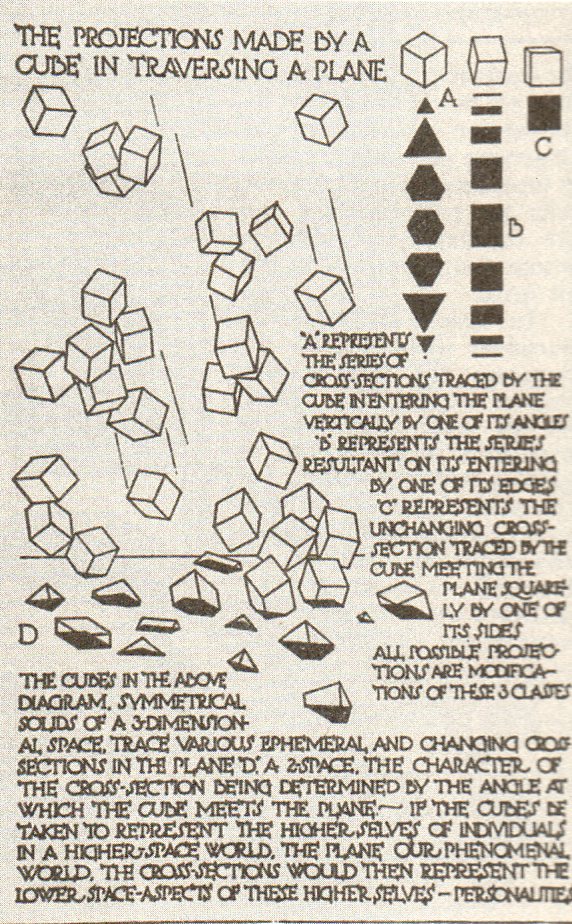
First is “the Projections made by a Cube in traversing a Plane” from Primer1, showing the impact (at different levels) of a cube falling through a plane. The second, “Personalities: Tracings of the Individual (Cube) in a Plane” from Man2, shows the “shadows” of the three-dimensional figures as they lived in their two-dimensional world. It comes close to the impact of the cubes above, but really only depicts what two-dimensional creatures would see of the three-dimensional beings inhabiting their Bragdonesque world.
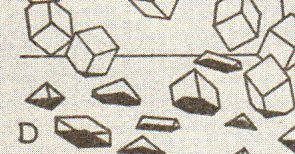
I like the tracings more as impact points than 2-D renderings of 3-D objects, and in some ways they are very similar. (I have to say that I am surprised that given Bragdon’s expanse of taste and artistic ability that he didn’t arrange these images in an artistic manner–in that sense he entirely missed the boat on adding his own bit to the newly-formed
Cubist world. He also reminds me of Emily Vanderpoel, who in her own way completely missed the new artform that she was serendipitously creating.)
So when I look at something like a Malevich or Mondrian or even (but less so) at a Duchamp (Bride), I find it interesting to manufacture the base of the something that plunged itself cleanly through their canvas, pulling it out again, giving it three dimensions, and incorporating the thing as a piece in a chessboard–the chessboard being the pieces that made the shapes in the canvases resulting in the Art Deco vs. Cubist/Suprematist Chess Set. It would be interesting to choose two representative canvases for either style and see if one (or a couple of ) object(s) could make all of the shapes in the two representative paintings, populating a chessboard with sameness.
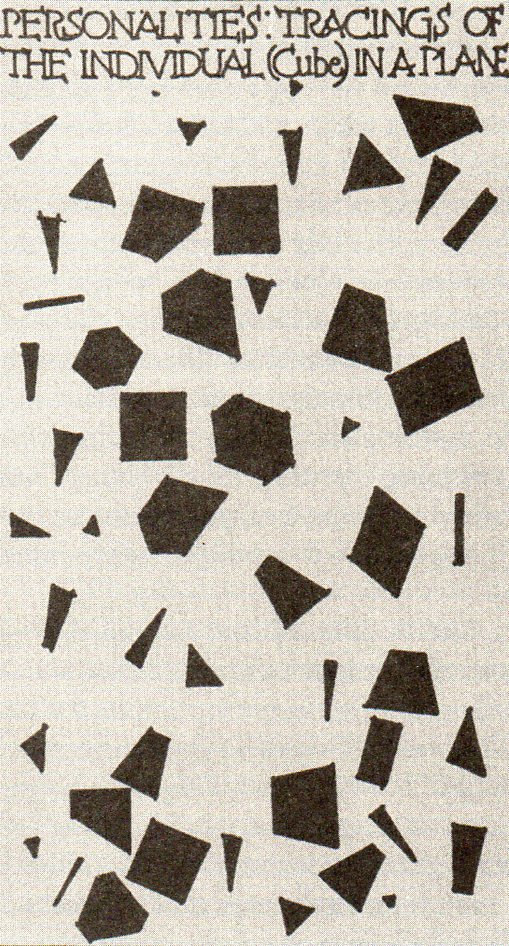
The bottom line, then, is how different or similar would the extruded three-dimensional figures be that were responsible for this impact in a two-dimensional surface be?
(I am reminded too of Duchamp and John Cage sitting down to a game of chess and producing a musical composition via their moves, at Sightssoundsystems, a festival of art and technology in Toronto, 1968. In this way too an artwork could be made with each move in a game of pieces used to make iconic shapes in the history of art. “They did not speak. They did not sing, they remained, all of them, silent, almost determinedly silent; but from the empty air they conjured music. Everything was music…” Franz Kafka, Investigations of a Dog.)
Notes:
1..(Bragdon) A PRIMER OF HIGHER SPACE. (The Fourth Dimension). Rochester: Manas Press, 1913. 8vo, (12), 79pp, including 30 plates.Notes:
2.. (Bragdon) MAN THE SQUARE. A Higher Space Parable. Rochester: Manas Press, 1912. 12mo, 34pp, 9 illustrations.