A Daily History of Holes, Dots, Lines, Science, History, Math, Physics, Art, the Unintentional Absurd, Architecture, Maps, Data Visualization, Blank and Missing Things, and so on. |1.6 million words, 7500 images, 4.9 million hits| Press & appearances in The Times, Le Figaro, Mensa, The Economist, The Guardian, Discovery News, Slate, Le Monde, Sci American Blogs, Le Pont, and many other places… 5000+ total posts since 2008.

  • Magnificent Displays of Quantitative Data by 5-Year-Olds

    JF Ptak Science Books

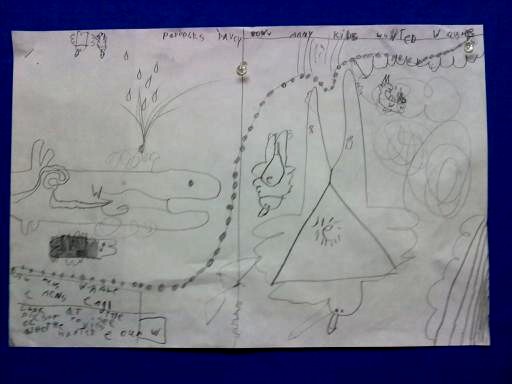
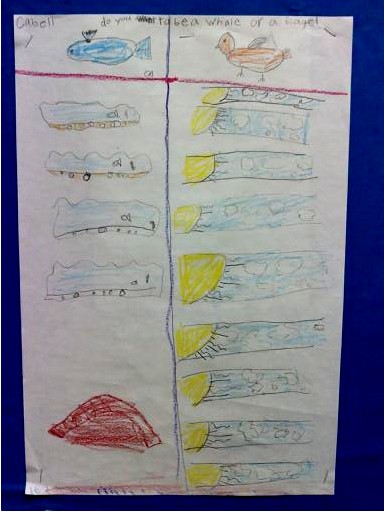
    “Do You Want to be a Whale or a Eagel?”[sic]

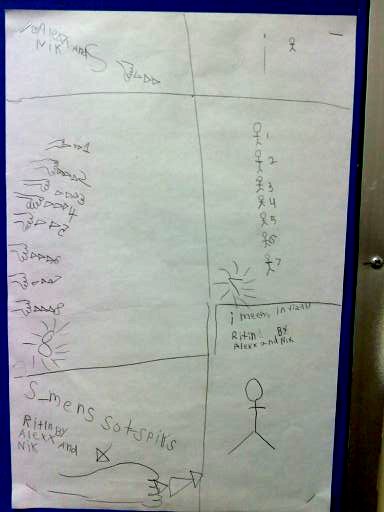
    Walking down the hall of my daughter Tess’ school today I came across these absolutely brilliant displays of information tacked up on bulletin boards.  The kids polled their classmates on whether they would rather be a whale or an eagle.  The designs of the survey results were staggering to me, purely brilliant reasoning and expression.

    The results here are magnificently displayed, elegant and crisp, and of course with a child’s beauty.

    Downsized_0127010808

    Another astonishing work of private clarity–I really do need to interview the statistician to find out the deep depth of what is being presented here. It is just beautiful.

    Downsized_0127010810

    And even though I don’t quite follow this one, there is a LOT of effort in it:  perhaps the kids were asked to raise their hands for a whale and to stand to be an eagle.  Those hands though I have seen drawn in books and manuscripts going back to the 12th century–they have stayed basically the same for 800 years. 

    Downsized_0127010811
    My best wishes and congratulations to these children at Isaac Dickson School, Asheville, North Carolina.

    ·Posted by :

    ·in:

  • SuperBad Ideas: Superhighway Through the Center of Washington D.C., ca. 1925

    JF Ptak Science Books  Post 1346    

    “A Paved United States in Our Day”

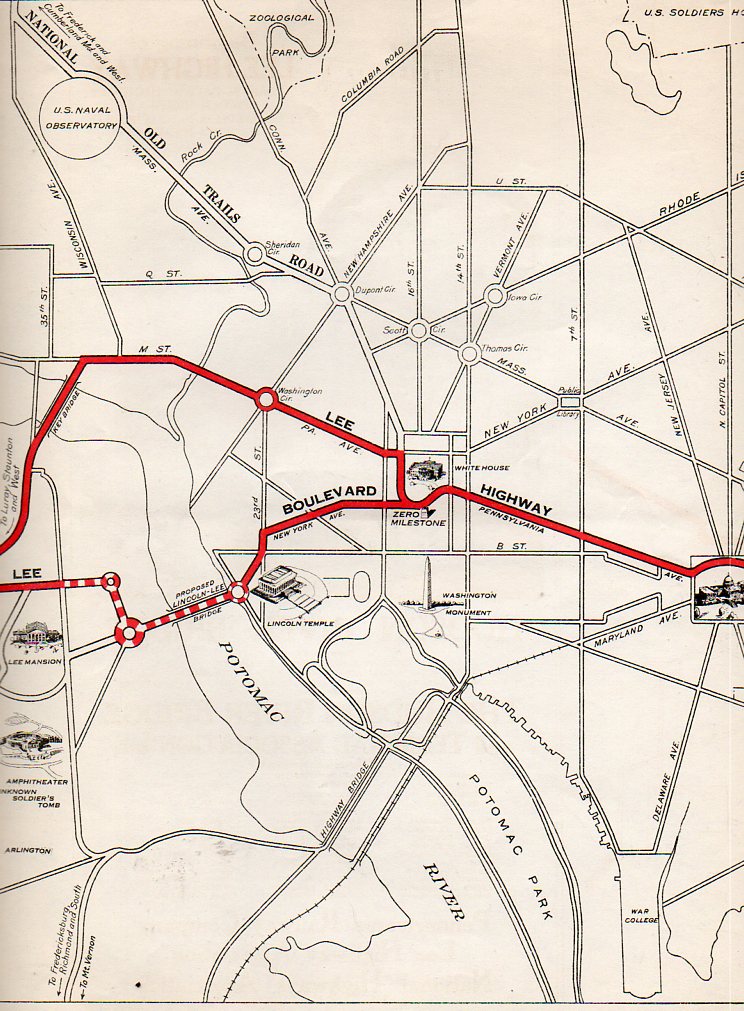
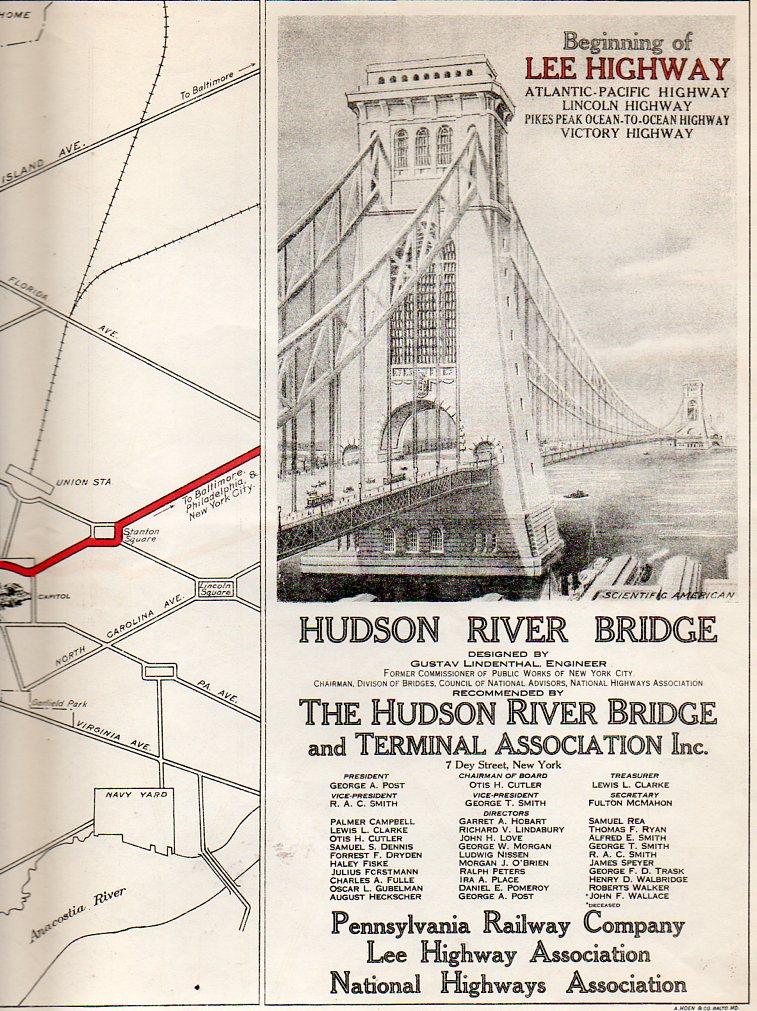
    If the planners of this highway had a crystal ball to see deep into the future–say, 1955–they would have been horrified to see the errors in their ways.  The equivalent of this plan might be something like picking up the Beltway, straightening it out, and running it  through D.C. along 16th street, with massive flyovers for the White House and other associated et ceteras.  This idea was published in an odd source, published by the Pennsylvania Railway Company/Lee Highway Association/National Highway Association auspices and the Hudson River Bridge and Terminal Association in about 1925, or thereabouts, just prior to the construction of the George Washington Bridge in NYC.  

    Lee Highway443 Lee Highway444


    The plan was for a six lane (“six-way”) motorway from New  York to Washington, starting with the Lee Highway (or King’s Highway, Route 1, one of the south’s oldest roads, and part of what was supposed to be a national autotrail connecting New York with San Francisco) and taking that highway across the proposed Arlington Bridge (called Lincoln-Lee here, without irony), up New York Avenue to the ellipse, rounding the White House, going down Pennsylvania Avenue to the Capitol, and then out again to Baltimore and NYC.  Another version called for the highway to go across Key Bridge, dumping everything in Georgetown, hooking right on M Street to Pennsylvania and on out again.  Having lived in D.C.(with my store in Georgetown) for 29 years, I can say without fear of ____  that this would ave been a massively bad idea then and in every decade since then, and probably would have been removed by 1960 just to recognize and correct the sheer, overwhelming badness of its conception. (The original of this map is available for purchase from our blog bookstore.)

    Lee Highway445
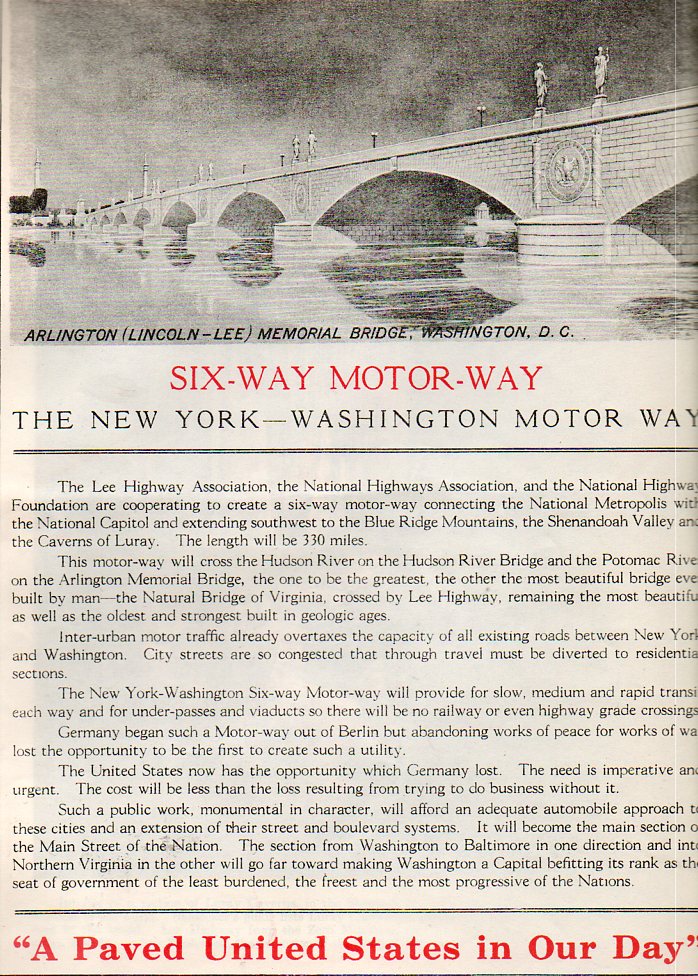
     The Memorial Bridge wound up being pretty close to this design–lacking the statuary, especially–and is quite a beautiful thing, especially when the designs for its rivals were considered.  The bridges in DC are almost all lovely, or at least those built before 1950. 


  • Birds with Stone Wings: Athanasius Kircher, 1664

    JF Ptak Science Books   Post 1347

    The great semi-mystifying polymath Athanasius Kircher (1602-1680) lived for a long time and filled his life with ideas and words,  producing dozens of books during his time on Earth, some of which were never published even though written, some manuscripts lost forever. His was a massive output of extraordinary breadth, most of which was original to him, and a lot of which was original to others and not credited, as was often the case with some scholarship at this time in history.   He wasted little time what I can see, writing on a spectacular range of subjects, enlightening people, confusing people, generating great theories and some bad ideas. 

    The image below comes from his Mundus Subterraenus (“Athanasii Kircheri Mundus subterraneus in XII libros digestus… “), published in 1664, and which was concerned mainly with geology and the theory of the Earth.  Kircher a product of the great Jesuit institution, the Collegio Romano, postulated the structure of the interior of the Earth, the origin of heat, the source of the tides, the composition of light, mechanics, the structure of music, linguistics, astronomy, and of course the existence of the Virgin Mary in amber.  There was also a fair amount of work on one of his side interests that populated a number of his works, alchemy and the search for the organization of materials.

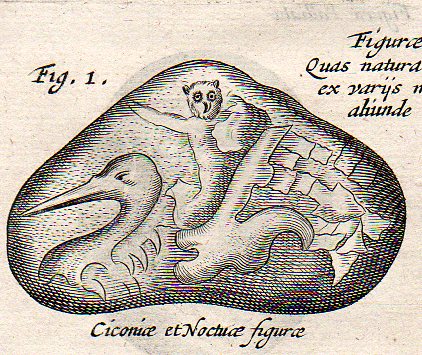
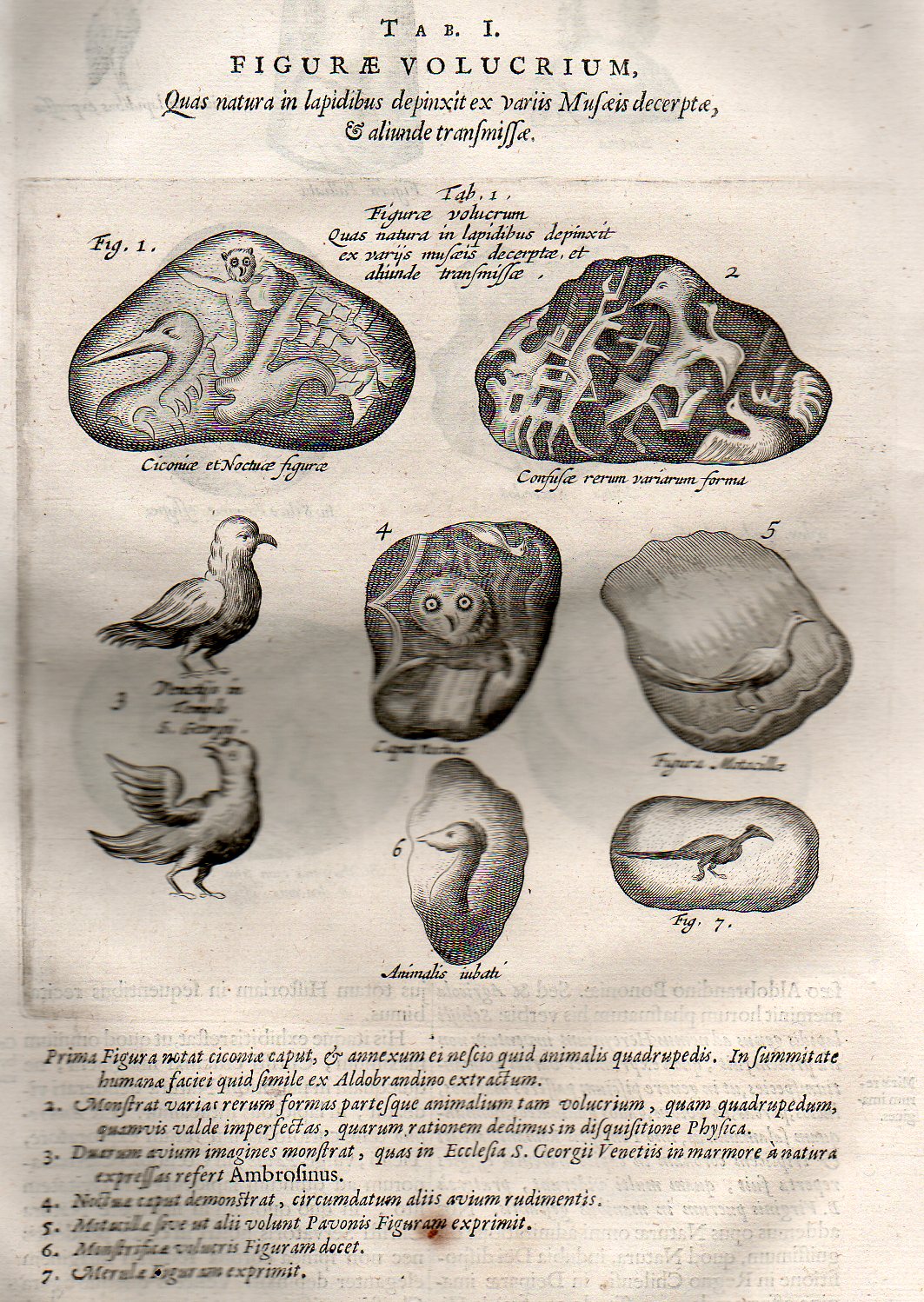
    But what I am looking at today with Kircher is the Mary-in-Amber part, his investigations (and theorizing, and documentation) on naturally-appearing, organic objects found in inorganic material–rocks and minerals–like these birds:

    Kircher  lapidibus birds451

    Which is a detail from  

    Kircher  lapidibus birds449
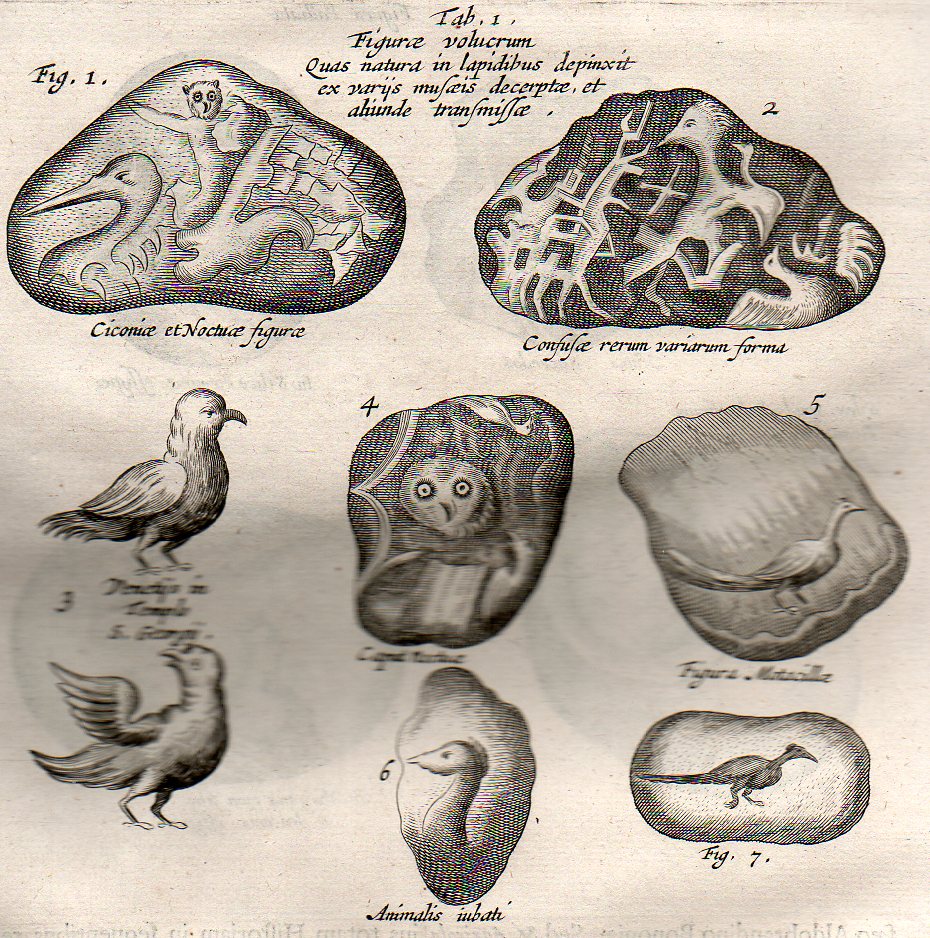
    The engraving (the original of which is available from our blog bookstore), entitled Figure Volucrum, quas Natura in lapidibus depinxit, ex variis Museia decerpt et aliunde transmissa (or “Figures of winged creatures, painted by nature on stones, taken from various museums, and otherwise transmitted.”) shows Kircher’s collection of anthropomorphically based inorganic items.  It is a remarkable exercise to try and place yourself within the context of the scientific world of Kircher’s time, 350 years ago, and try to explain these naturally-occurring phenomena, without even the benefits of the conception of long geologic time, or of expanded time in general. 

    The descriptive text (at the bottom of the engraving) from Kircher on these objects is translated, as follows:

    1.  The first figure represents a head of a Stork, together with some, but I do not know what, quadruped. At the top is something like a human face. Extracted from Aldobrandinot (see PI. XXIII. Fig. 1).
    2.  Shows various forms and parts of animals, winged creatures as well as quadrupeds, although very imperfect, the cause of which we give in the physical examinations (see PI. XXIII. Fig. 2).
    3.  Represents the figures of two birds expressed by nature on marble in the church of St. George’s, at Venice, referred to by Ambrosinua (see Vol. VII. PI. II. Figs. 3, 4).
    4.  Shows the head of an Owl, surrounded by rudiments of other birds (see PI. XXIV. Fig. 2).
    5.  Represents the figure of a Wagtail, or as others prefer, of a Peacock (PI. XXIV. Fig. 3).
    6.  Shows the figure of a monstrous bird (Vol. VII. PI. II. Fig. 4).
    7.  The figure of a Merle (Vol. VII. PI. II. Fig. 5).

    A closer look at the image:

      Kircher  lapidibus birds450


  • Newspapers and Music in Bedlamia, 1850’s.

    JF Ptak Science Books   Post 1348

    Two short tales of attending the needs of the mentally ill in the 19th century:  asylum journals and treatment of mania via music.

    In the world of the treatment of the mentally ill, or of the possibly “deranged”, or the poor confused, or the old and demented, or the depressed of all ages, there have been some uncommon instances of creativity and rehabilitation in the constrained early days of warehousing patients, or inmates.  One example of this was the newspaper/journal called The Opal, which was published–extraordinarily–for ten years (1851-1860, in ten volumes and 3,000 pages) by the inhabitants of the State Lunatic Asylum of the State of New York at Utica.  This illustration–which is so far as I is (unfortunately!) the only image in the journal and is repeated month-to-month–depicts, I guess, the editor of the journal, in a cell, and with a terrified or manic or at least sharp-eyed thousand-yard gaze.  It is an unusual statement by the artist, perhaps, that the stone wall behind the editor’s bars look somewhat like the books bound with raised bands that are on the inside of his cell.  I’m uncertain as to whether this was a message, or whether this picture is just a picture.  But it is certainly odd to draw such a portrait of the editor of The Opal–greasy hair, sunken eyes, mouth ajar, crazy-gaze, and hardly very sympathetic.

    And the title page of the journal:

    Given the time, it is remarkable that such an enterprise occurred and lasted as long as it did.  It must have been an extraordinary aid to the people in Utica, allowed an avenue to express themselves, allow for creativity, allow for some independence of expressive thought  It was put loud and clear in the volume for 1854, on page one, in a bit called “A Message to Our Patrons”: “Forty-eight months [that’s four years since the beginning of the journal] have vibrated their moments on the engagements and extensions of the Opalians. The divine art of printing has conveyed through numerous and constant agencies the heraldry of Asylumian intellect, and in the varied developments of society, our paper hath been insinuated by the gentleness of humanity, and reciprocated in a fourfold state the harbingers of progression in kindness by exchanges, whose opening leaves hath borne refreshment from the wines on the lees of humanity, well refined by the studied graces of purity, sense, discretion and knowledge, to the great comfort of this retirement, hallowed by the superintendence of wisdom and virtue1.”

    The italicized “our paper” appears int he original. 

    And this example of trying to step somewhat beyond the modicum of dispensing agents for settling a “maniac”–a person it seems suffering from a manic stage.  Doctors and attendants tried to treat the patient with an assortment of narcotics, but they didn’t work; very liberal applications of btrandy occurred, which caused some sleepiness, but after two days the man woul dbe getting sleepy, anyway.  And then came the desperate measure (so to speak):  music.  It was certainly nothing new, really, the calming effets o fmusic having been know deep into antiquity.  Why it was not mor eliberally applied in mental institutions, I don’t know.  The case and description are found in the American Journal of Insanity (later the American Journal of Psychiatry) for 185 8:

    “The symptoms indicated, as it seemed, the prompt use of narcotics. Morphine was therefore given in doses gradually increased, till at the end of 48 hours, 3 gr. at a time, with strong laudanum injections, had been administered. This treatment seeming to have little or no effect, was abandoned and other means, such as baths, counter irritants, stimulants, djc &lc, resorted to, with but slight amelioration of the alarming symptoms. The patient had now continued in this state three days and nights, without sleep, and with little or no food. Pulse much of the time 120. Countenance anxious and sunken, presenting every appearance in fact, of approaching final prostration. Of the means above mentioned, the administration of brandy, in often repeated and large doses, seemed to act most favorably and effectually. Under its use the pulse came down to about 100. The patient also became more quiet* and manifested a slight disposition to sleep.

    “At this time, it was suggested by the father, that his son had always manifested a remarkable fondness for music, and that when a child, sleep had often been produced by it. A violin player was accordingly sent for, and the effect of his art tested upon the patient, with the most remarkable and immediate favorable effects. The nervous excitement began to abate at the sound of the fiddle, and in a very short time, the patient was in a sound sleep, from which he awoke in an hour or two much refreshed and nearly rational. By continuing the brandy, and when nervous excitement began to manifest itself, an occasional quietus from the fiddle, this singular state of mental excitement was, in a few days, entirely and permanently subdued.”

    In general, the 1850s were not a good time to be in a mental institution in the United States–or anywhere else for that matter.  There were 3700 people or so institutionalized in America at the time of the two stories (above).  It was really just about at this time that a national effort began to be organized to treat the institutionalized people more as patients than as inmates. 


    ____

    Notes:

    1. “In the diffusion of thought by the arts, its curiosity and character are enhanced by the manner in which it is communicated; and the respectful interchange of sympathy, and of emotions incident to nature that assimilate and affiliate the multiform interests and conditions of the human kind are so promoted by interchanges as to excite a brotherly regard for the correspondences, and a desire to advance their intelligences anew, when apprehended as the instrumentality of reasonable reliances.”

    Also this:

    Asylum Life; Or, The Advantages Of A Disadvantage, from The Opal


    Page 1:

     
    1  

    I have no care for copper or coin,
    I have no fear of any one’s frown;
    I’m fed by the hand that feedeth the best,
    And seldom molested is my sweet rest.

     
    2  

    I have walks to take, and news to read,
    With chit-chat and work the hours to speed;
    Good company, age, as good as the great
    Who have the charge of the “Empire State.”

     
    3  

    When ill, we have nurses; kind they be,
    And doctors too, without extra fee;
    When well, we can leave for homes far and near,
    While the Word of Life may be conned with care.

     
    4  

    Though sad, we may wait till brighter we grow,
    And health and good humor our faces make glow;
    When merry music may lend us her thrall,
    And consoling each other be less sad withall.

     
    5  

    And Love may abide, defended by prayer,
    And our hearts and our hopes be brightened elsewhere;
    We may write to our homes, and see our dear friends,
    And contented and blessed our destiny ends

    ·Posted by :

    ·in:

    — — —
  • Contrary Big Crowds Series–a Chaos of Hats and an Order of Heads with No Hats

    JF Ptak Science Books–Quick Post

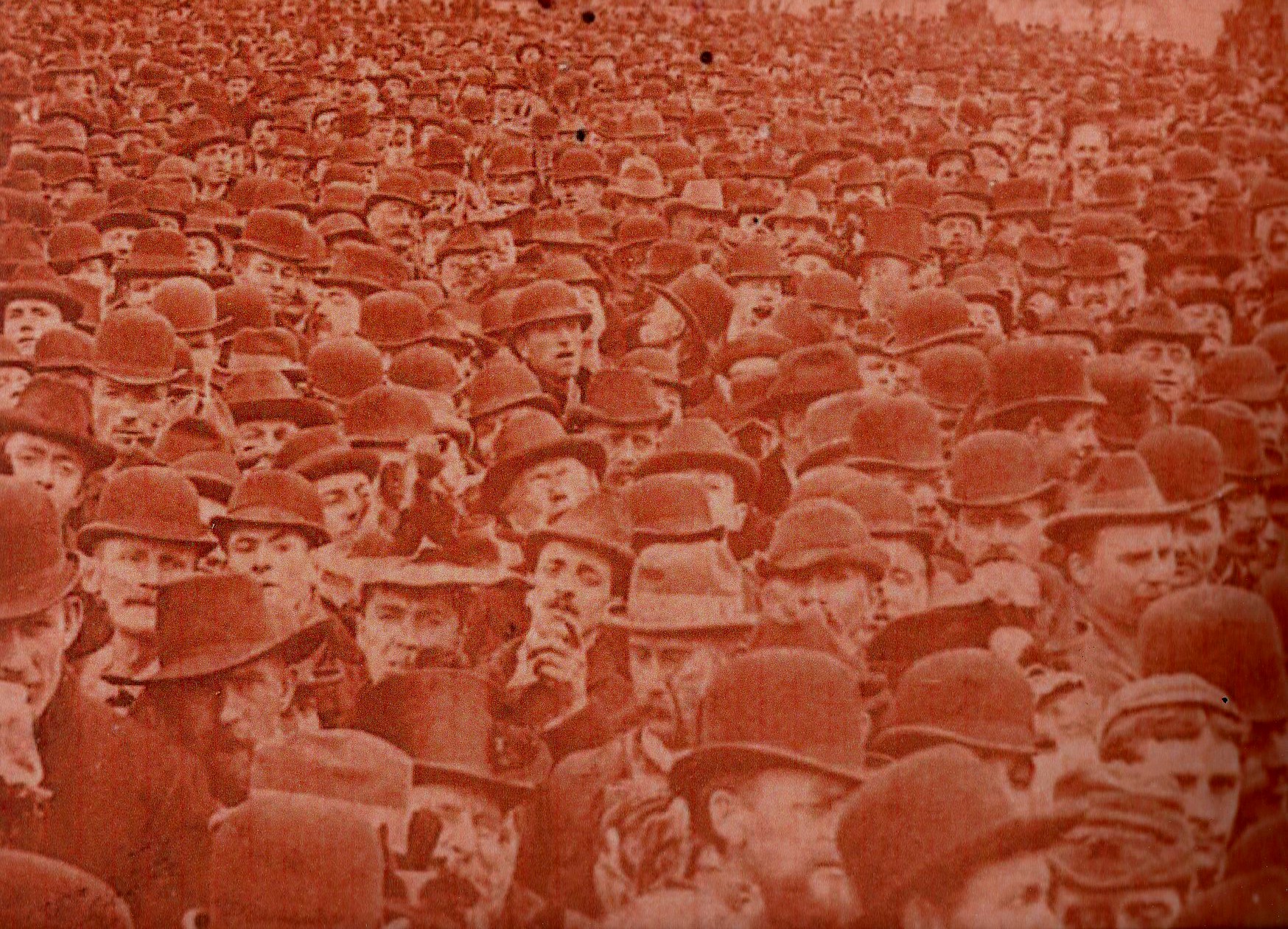
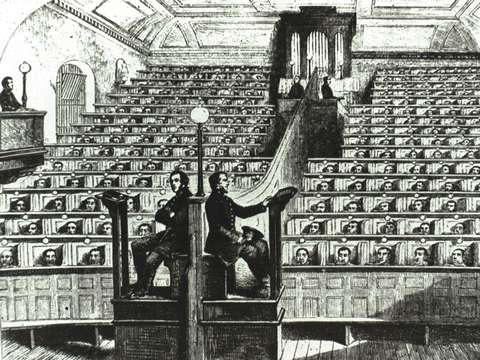
    Coming upon this image of a sea of hats, which in the fine tradition of naming collections of self-similar things-like a gaggle of geese or a murder of crows–a ‘Chaos” of Hats, I needed to find its contrary, and a relatively orderly and ordinary one at that. [I compiled a list of  oddly-named groups in an earlier post here called An Unkindness of Ravens and a Murder of Crows.]

    Hats454

    What better than an Order of Heads?  This image is of a church or social service at Pentonville Prison in 1855.  The penitentiary engraving is real;  but the  truth be told,  the Chaos photo is a manipulated image, about a half of the original of something I made, mainly because I just wanted to see  a very hatty crowd around the man in the middle pointing at the camera. 

    Hats heads

    As it turns out, Pentonville–serving North London loyally since 1816, and still doing so–was the home for a bit of Oscar Wilde and Boy George.  It was also the place where Arthur Koestler began composing his thoughts for his magnificent Darkness at Noon.

  • A Note on the History of Bad Beds (Bedlamia 2): the Utica “Crib” and Putting the Insane to Sleep, 1880.

    JF Ptak Science Books  Post 1349

    Following an earlier post that I made here on the History of Bad Chairs (including a contrivance made by Declaration-signer Dr. Benjamin Rush that immobilized the body, dulled the senses and kept the feet of its mental-patient-occupant in cold water for “treatment”) I’d like to start a short series on bad beds.  This part was excited by another historic psychological/shrinkological tool from the arsenal of doctors who treated the insane: an instrument of torturous treatment called the “Utica crib”. 

    It was a device used, obviously, to constrain the person placed in it–so that they could be controlled during the day if drugged and still not controllable, and to be used at night if the patient wouldn’t stay under their covers.  It looks pretty terrible, a squashed baby bed with a prison door for a top.  It comes as one in a long line of bad beds, including psychiatric hospital”tumbling beds”. centrifugal beds, and of course spiked beds of the inquisition, stretching beds form the same, Aushwitz  “beds”, and on and on, devices of torture made from places of rest.

    Insane supervision453 The Utica Bed of the New York State Lunatic Asylum at Utica–if not actually constructed in Utica it was popularized  there–was put into use at about the same time that the facility was opened in 1843.  According to the numerous reports of New York State asylums directors in Supervision of our Asylums for the Insane1, it was about time (in 1880) that folks in control of the state institutions start to deal with their charges in a medical, treatable, fashion; to try and remedy the effects of mental illness rather than just use the asylums to warehouse societal outcasts.  And it was in this paper that the Utica Crib (and other retraining devices) came under very severe criticism. (The original pamphlet is available at our blog bookstore.)

    Edward C. Spitzka makes the point that the institutional that use devices like the Utica Crib–which was supposed to prevent patients from injuring themselves–actually had far more incidences of  patient injurious than those institutions which–with a similar clientelle–didn’t use them at all.  Spitzka made a very compelling case the the Utica Crib and other devices were archaic remnants of an earlier and darker time in the treatment of cases outside mental health, and they they were far more injurious to patients than not having them at all.  They also, he said, demoralized the staff of the hospital and depressed the medical supervision, making a mockery of treatment. All in all, Spitzka’s insights were accurate and prescient. 

    Notes:

    1.  Report of the Proceedings for Establishing a Board of Commissioners in Lunacy for the State of New York, published by Sherwood & Co., NYC, in 1880.  55pp.


  • Oddly Adjectival Opposites: Color “Plumpness” and Color-in-Black-and-White, 1941

    JF Ptak Science Books  Post 1351 (revisiting the post from 2012 with a few additions).


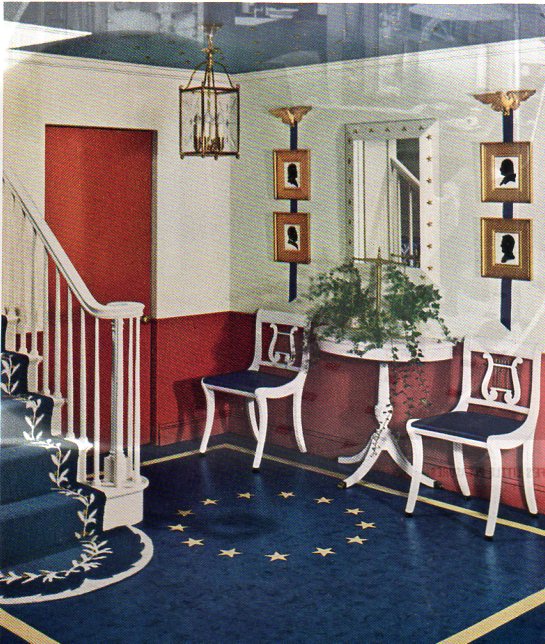
    Color kitchen457


    Anticipated but unexpected color expectations sometimes don’t quite make it through the ordinary vocabulary of color names and descriptors.  Such was the case for me when looking through this Armstrong Linoleum Catalog from 1941–the brightness and color range was remarkable, and, even if the color in the magazine existed only in the complicated color separation technical efforts on its pages, it still stays remarkable for the colors that they may or may not have represented. 

    • The catalogs from which these images are sampled are all available for sale at the blog’s bookstore, here. 

    The colors seem “pluump” (yes, with two “u’s”) to me, like a big man in a little man suit, suggesting a too-ripeness, the colors too much in themselves.

    Color kitchen458 Color kitchen459 Color kitchen460

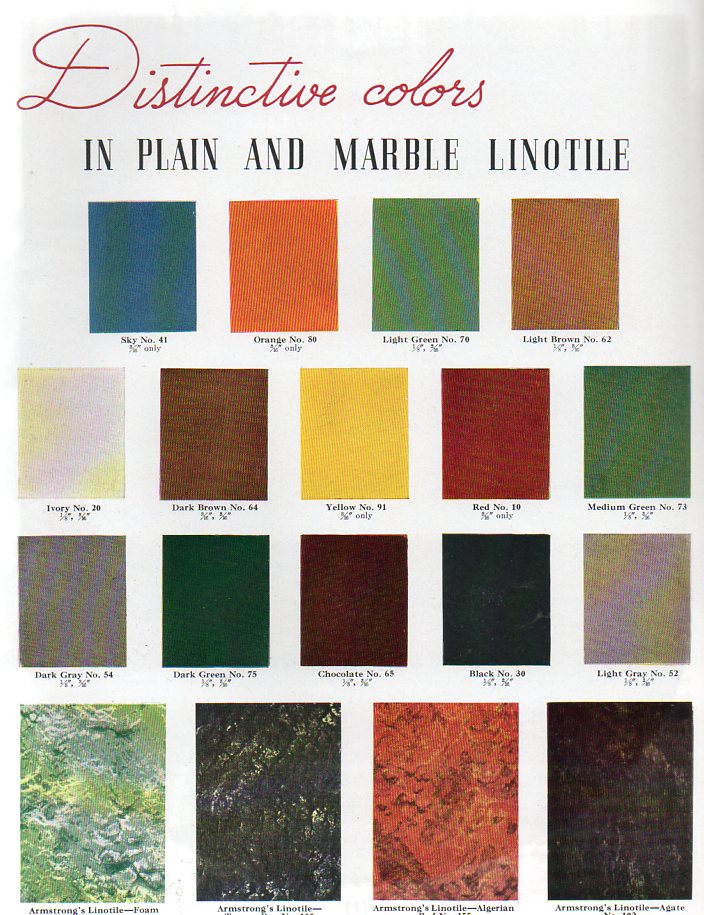
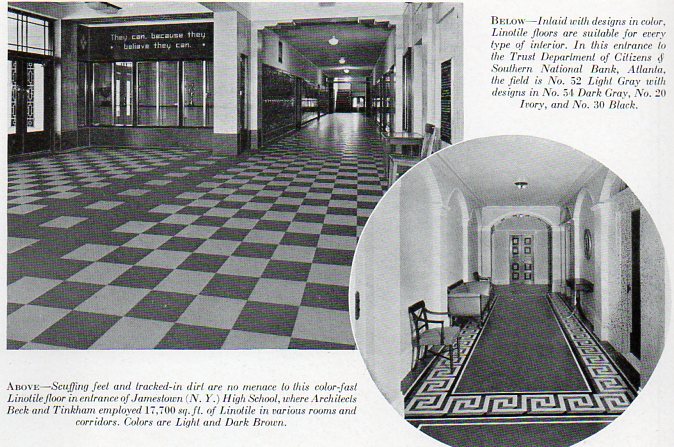
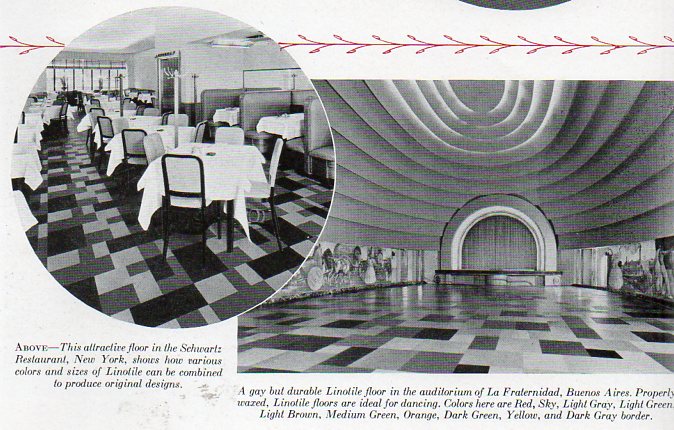
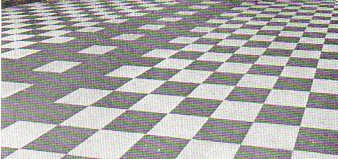
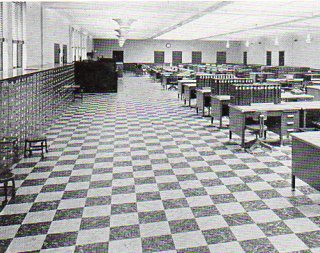
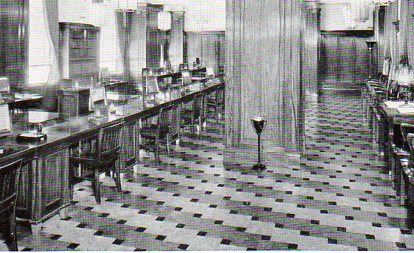
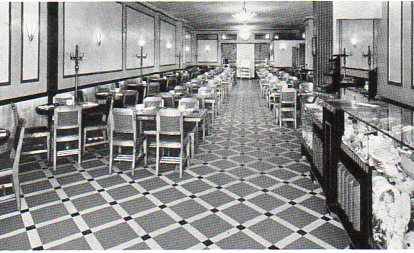
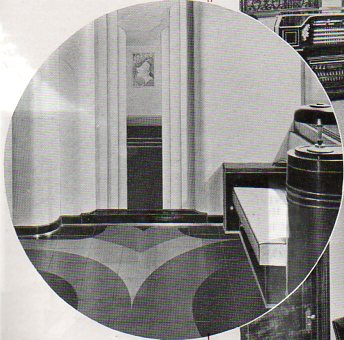
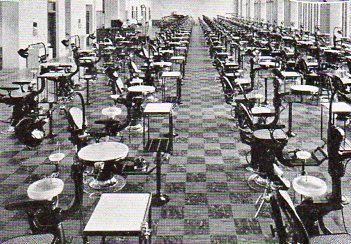
    Color in black and white470 Then, on the other end of anticipation is the Armstrong Distinctive Interior Finishes and the Individuality in Handlaid Floors of Armstrong’s Linotile catalogs of 1935 and 1937 (respectively).  They offer the hope for color but don’t illustrate it, giving their reader a color palette of the possibilities for decoration, but then providing black and white photographs for the imagination.  (I’ve seen other examples of color theory done in black and white–they are not common.)

    Part of the many opportunities for Glorious Color are here at left; examples of their use (in Glorious B+W) are below, illustrating an imagination that was still in black and white in 1935.

    [The last illustration is interesting in itself, being a fading-into-the-horizon image of a lab at a dental school.]

    Color in black and white462

    Color in black and white463
    Color in black and white464

    Color in black and white465
    Color in black and white466

    Color in black and white467

    Color in black and white468
    Color in black and white469

    ·Posted by :

    ·in:

  • An Alphabet of Giants, Part 1.

    JF Ptak Science Books   Post 1250

    “There were giants in the earth in those days; and also after that, when the sons of God came in unto the daughters of men, and they bare children to them, the same became mighty men which were of old, men of renown.” Genesis 6:4-5 (KJV).

    Our dog Blue is a giant Jack Russell Terrier–mix.  He’s a Jack St. Bernard/Jack Russell–a St. Jack–and at 50+ pounds is either a Giant Jack or a mini St. Bernard.  He behaves like the St. Bernard.  One wonders about the mechanics of the thing–similar to Mr. Gulliver in Jonathan Swift’s A Voyage to Brodbingnag (1727), in which the hero (or anti-hero) though he is disgusted by the gigantic women of the place nevertheless seeks and accomplishes some sort of romantic union with the handmaidens of the giant queen.  And this all puts me in the mind of giants–actually, I’d like to put together an Alphabet of Giants, with this being the beginning. And to start at the beginning is Athanasius Kircher–the incredible Kircher, who produced thousands of pages of excellent analysis and cutting-edge technical/physical thinking as well as hundreds of pages of highly imaginative scientificiana–and his generic giant, featured in Mundus Subterraneus in 1646.
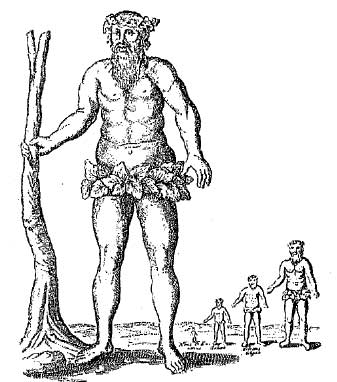
    Giants have certainly been around for a long time, though imaging that imagination is less ocmmmon early on in the history of the illustrated book. 

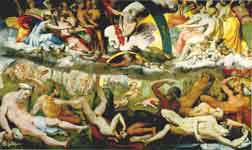
    There’s no lack of giants in ancient mythologies and legends–the Hindu Daitya, Mohamed’s depiction of a 100-foot-tall Adam, the Greek Antaeus (the children of Heaven and Earth, of Uranus and Gaea), the sleepy Encedladus, the Nephialim, and so on.  One of the most glorious of the big people stories is the  beautifully-named Gigantomachy, in which the gods of Olympus engage in an enormous confrontation with Chaos and Aleyoneus. The “good” (though not very) guys win.

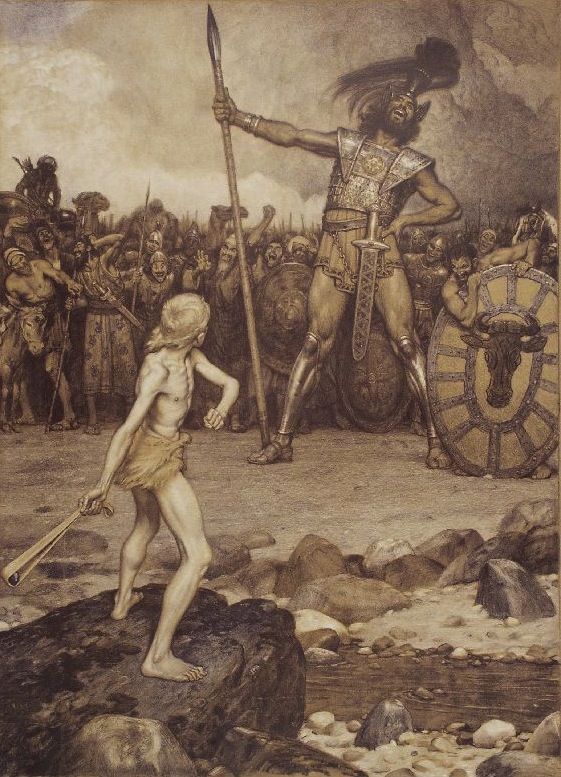
    There’s actually about half-an-alphabet residing just within the Greek Titans (Atlas, Crius, Cronus, Coeus, Gaia, Hyperion, Iapetus, Mnemosyne, Oceanus, Phoebe, Prometheus, Rhea, Theia, Themis, Tethys), but I’d like to expand this if I can. A fuller, more diverse listing of giants and giant-groups follows: Anakim (Jewish mythology, references in the Old Testament), Argus Panoptes (Greek mythology), Bestla (Norse mythology), Cyclopes (Greek mythology), Daityas (Hindu mythology), Epimetheus (Greek mythology), Fachan (Celtic mythology), Gargantua and Pantagruel, Gigantes (Greek mythology), Gog and Magog (Jewish mythology), Goliath (Book of Samuel of the Bible), Hecatonchires (Greek mythology), Iovan Iorgovan (Romanian mythology), John Henry (American folklore), Jotuns (Norse mythology), Kaour (Celtic mythology), Menoetius (Greek mythology), Nimrod (Jewish mythology, OT), Oni (Japanese folklore), St Christopher (Roman Catholic saint),Talos (Greek mythology), Titans (Greek mythology–Atlas, Crius, Cronus, Coeus, Gaia, Hyperion, Iapetus, Mnemosyne, Oceanus, Phoebe, Prometheus, Rhea, Theia, Themis, Tethys), Zipacna (Mayan mythology).

    For the most part I’ve stayed old with these images, except for the 50-Foot Woman, the Giants are generally not from the modern fantasy/sci fi gernre. 

    So, Part 1:


    A. ALICE. John Tenniel’s Alice in Lewis Carroll’s Alice’s Adventures in Wonderland.

    File:Alice par John Tenniel 05.png


    A. Arthur.  King Arthur’s Giant.

    File:Walter Crane King Arthur and the Giant Book I, Canto VIII.jpg

    B.  Beanstalk Giant. Jack and the Beanstalk, John D. Batten 

    File:Page 59 illustration in English Fairy Tales.png


    B. Bunyan, Paul.  By Allen Lewis.

    Frontispiece from Paul Bunyan (woodcut illustration by Allen Lewis)

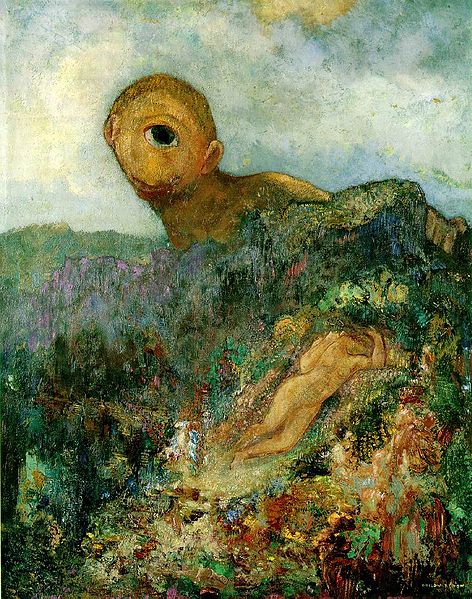
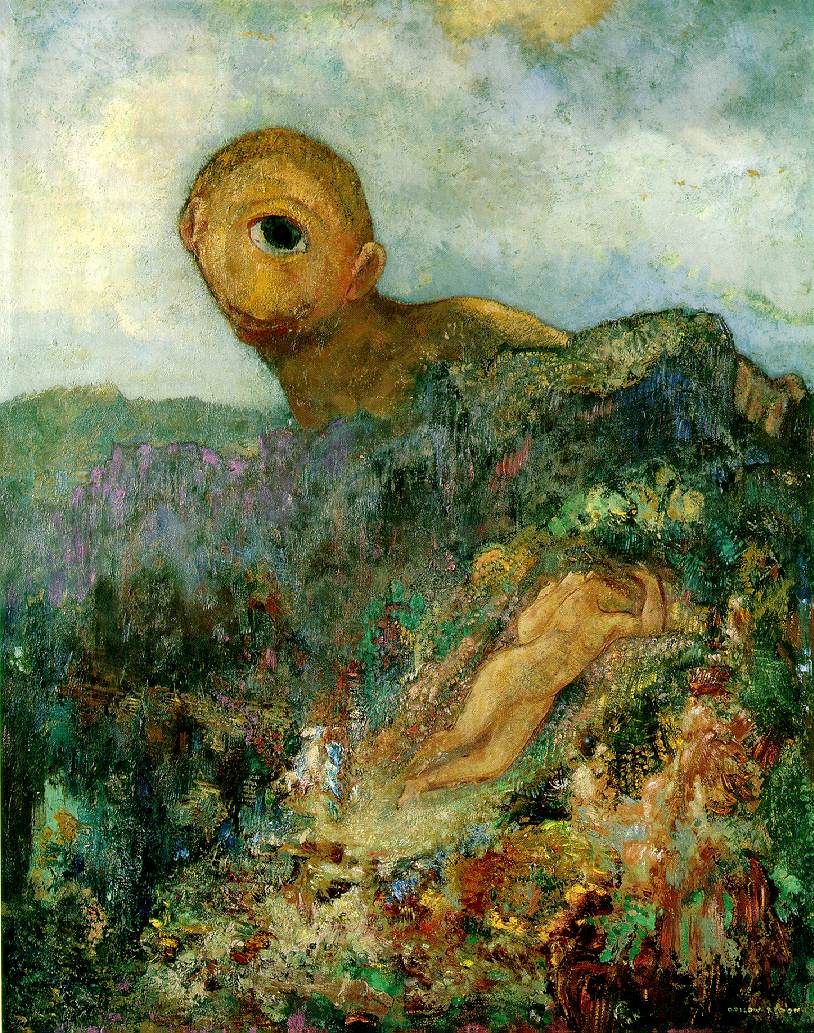
    C. Cyclopes.  By Ordilon Redon.

    .

    File:Redon.cyclops.jpg
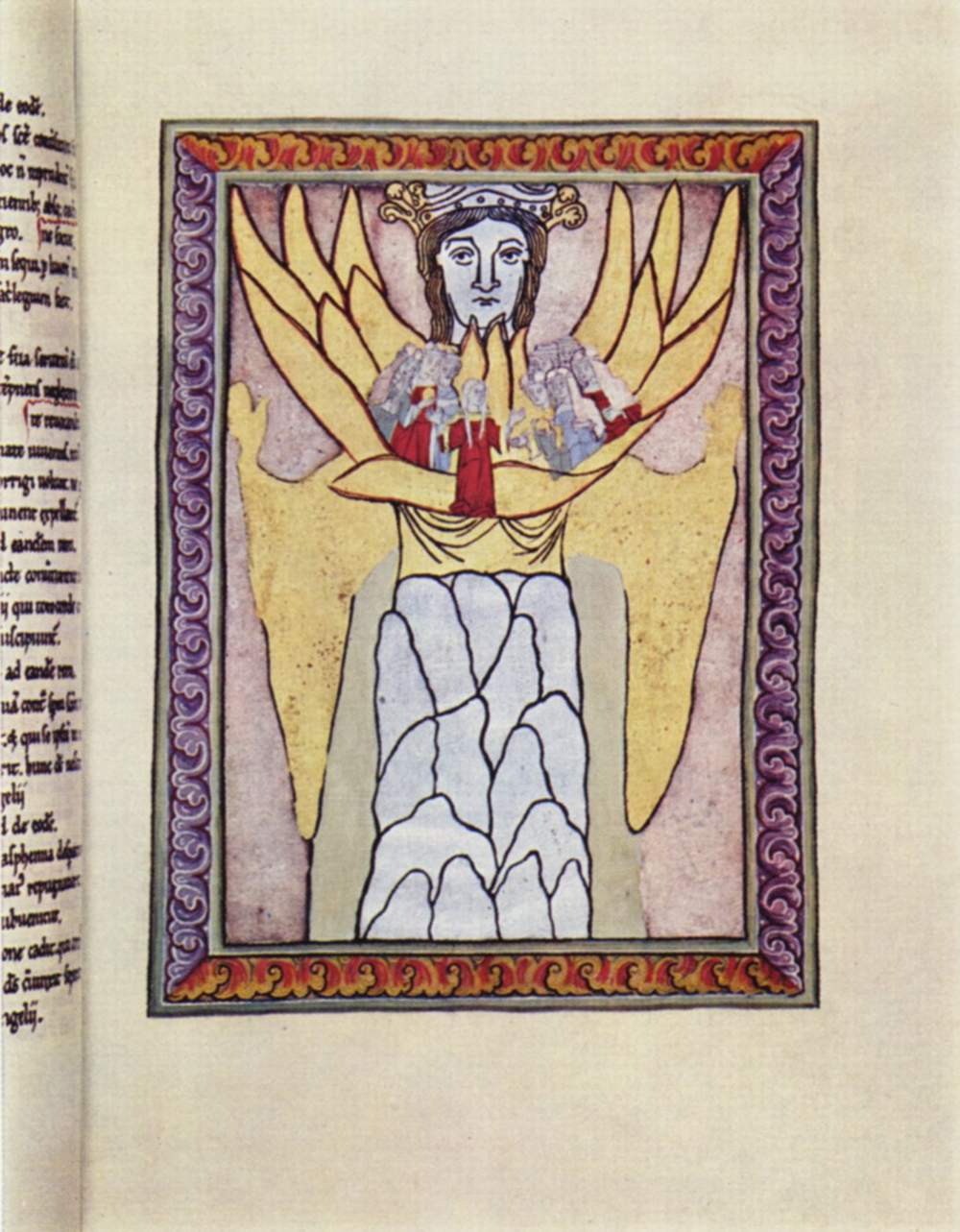
    E. Ecclesia.   “Ecclesia”, or the depiction of Church as the Bride of Christ is a representation of a woman giant, and is seen in  Scivias, by St. Hildegard of Bingen  (1098-1179).

    File:Meister des Hildegardis-Codex 002.jpg

    F. Fatna. The giants Fafner and Fasolt seize Freyja in Arthur Rackham‘s illustration of Richard Wagner‘s Der Ring des Nibelungen

    File:Giants and Freia.jpg


    G. Gargantua
    http://www.gargantua.eu/gargantua.jpg
    G. Gigantomacy.  By Perin del Vagas.

    G. Goliath. Osmar Schindler’s David with Goliath.

    File:Osmar Schindler David und Goliath.jpg

     K.  The Kraken.

    http://bogartswisconsin.com/images/kracken8.jpg

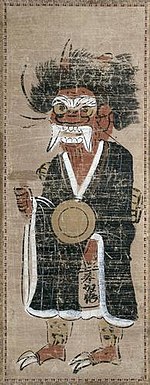
    O. Oni (Japanese folklore.)

    P. Pantegruel.

    http://dramapessoal.files.wordpress.com/2008/01/rabelais-pantegruel-by-francois-desprez-10.jpg?w=460


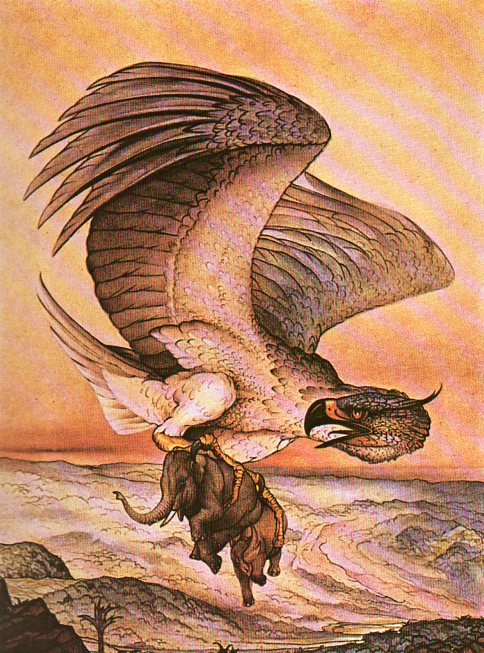
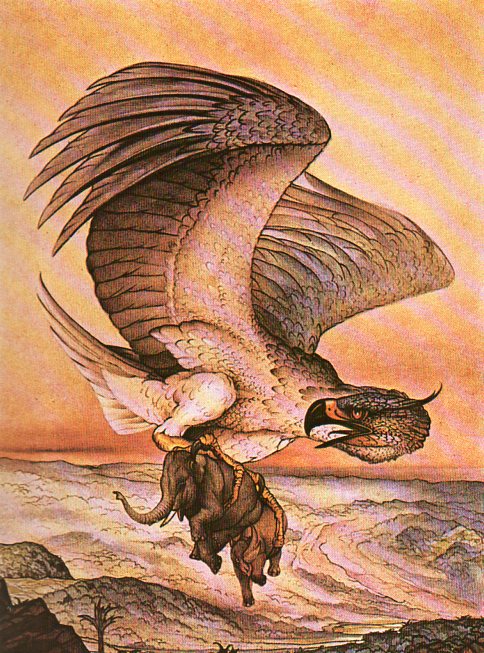
    R.  Rukh.  “The Rukh which fed its young on elephants”, by E.J. Detmold. For The Second Voyage of Sinbad the Sailor from The Arabian Nights, 1924.
    Giant--rokh944

    W. Woman, 50-Foot.

    Women don’t often appear though as giants–at least until modern times.

    Z. Zeus.

    Zeus and three Gigantes, drawing based on the Zeus Pergamon Altar.


  • The Compass of Music

    JF Ptak Science Books  Post 1252

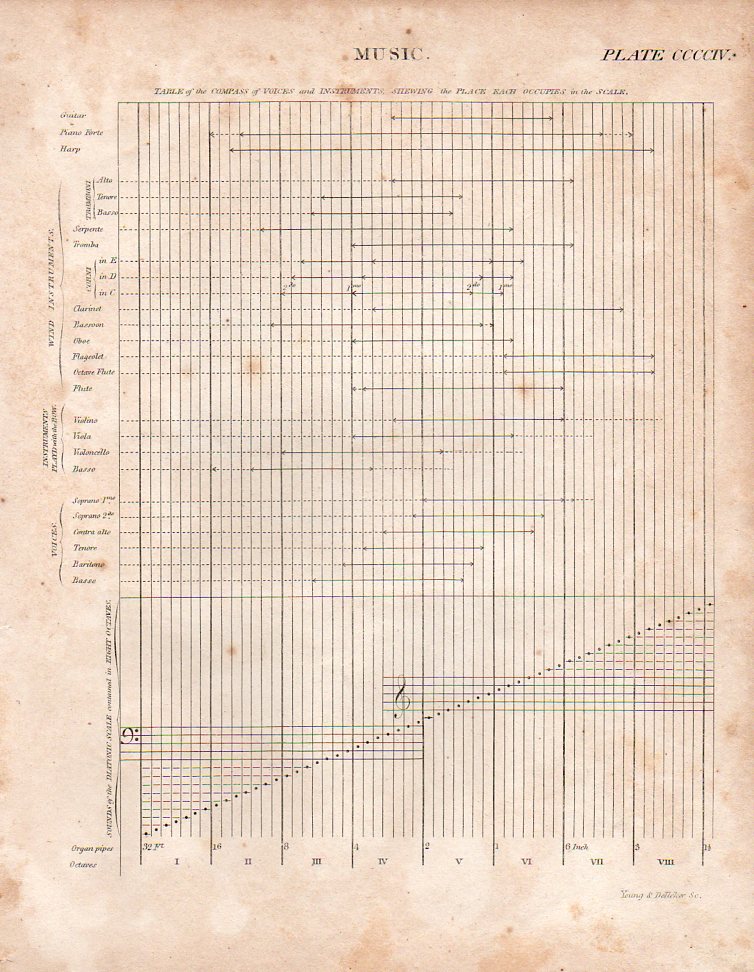
    This engraved plate from Abraham Rees’  Cyclopedia… is the wonderful invention of Alexandre Choron (1771-1834), and appeared (perhaps for the first time in an English press) in London in 1814.  It is a concise and interesting display of the comparisons of the reach of instruments along the eight octaves, and is a very strong example of clear and useful graphical display of quantitative data. 

    Music compass a949
    The full subtitle:  “Table of the Compass of Voices and Instruments, Shewing the Place Each Occupies in the Scale”.  (The original print is also available for purchase through our blog bookstore.)

    From Grove Music Online:

    Choron, Alexandre(-Etienne)

    (b Caen, 21 Oct 1771: d Paris, 29 June 1834). French writer on music, instructor, publisher and composer. While still a boy, he taught himself Hebrew and German and acquired a permanent interest in scientific experiment and a fascination for music theory and the techniques of composition. Although he reached the age of 16 before taking music lessons, he had already attained elementary skill on keyboard and other instruments. He greatly valued a friendship with Grétry which began in his 20th year and which suggests that he moved to Paris after his father’s death.
  • Ships in the Skyline–Artistic Display of Quantitative Data

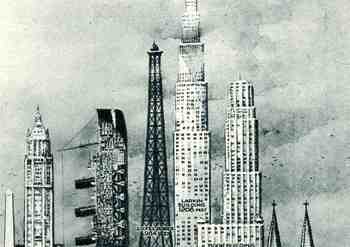
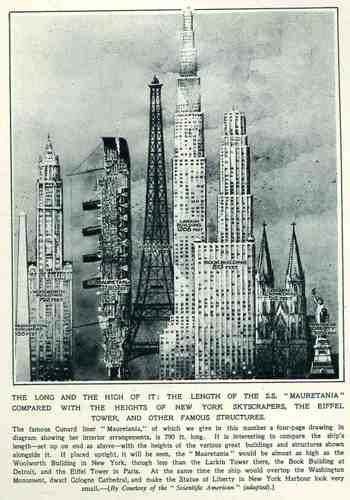
    This wonderful display (appearing in The Illustrated London News for 26 March 1927, page 518) of quantitative data isn’t quite as whimsical as it appears in detail, though I can think of onlyBlog1sept_16_ship_skyline_detail5_2 a few (antiquarian) times that I have seen a ship made part of a cosmopolitan vertical cityscape.  It is a great way of comparing two disparate, out-of-place equals, and certainly can get the idea of the size of something as stand-alone and solitary as a great ship to children (and adults, too) by comparing it to something as obvious as a tall building.,  This time its really just comparing the length of the SS Mauretania with the heights of some famous and notable buildings. (The Mauretania, 1906-1935, was a fabled, luxurious and fast ocean liner of the Cunard line; it was refitted for a resurgent oceanic service at about this time.)   In the larger, expanded second image we see the Mauretania stacked up against (from left to right) the Washington Monument (555′), the Woolworth Building (792′), the Mauretania  (790′), the Eiffel Tower (984′), the Larkin Building (proposed at 1208′), the Book Building (873′), the Koln Cathedral (512′) and the Statue of Liberty (305′).  The Larkin Building (not the F.L. Wright structure of the same name) was a proposed super-tall of 110 floors for 330 W. 42nd Street that was proposed in 1926 and not canceled until 1930, and which would’ve been the tallest building in the world. (For an interesting site on the cancellation of tall buildings, see HERE.)   In any event, this was a big ship–the largest in the world when it was launched as a matter of fact–and the drawing is wonderful.   Upon closer inspection, there is a terrific amount of detail in the cross section of the ship.)     (This original print is available at our blog bookstore.)                                             
    Blog1sept_16_ship_skyline564

  • A Rare First-Hand Account of the Japanese WWII Surrender(s)

    JF Ptak Science Books  Post 1253

    Deglin c det956
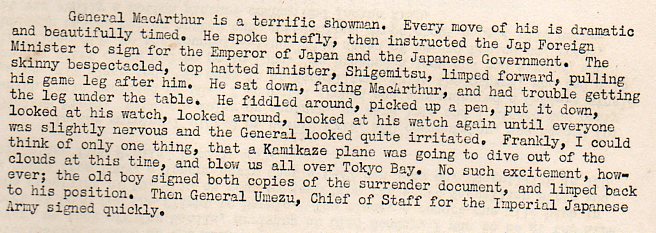
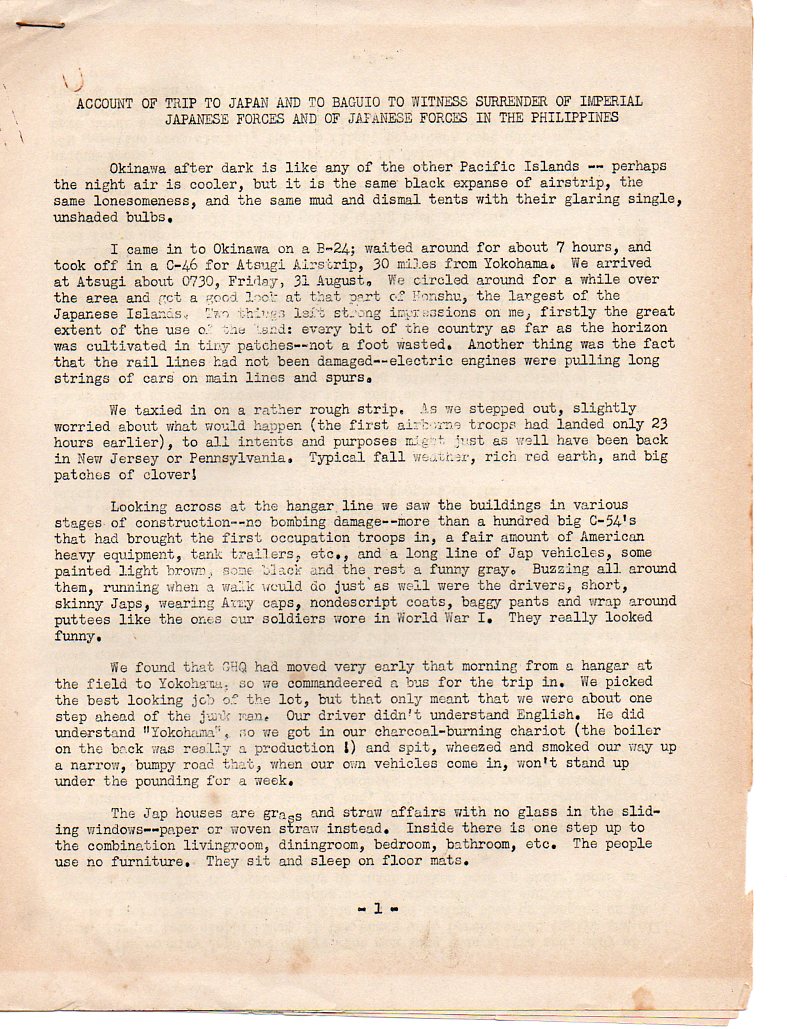
    After serving as public relations director for Madison Square Garden (1935-1942), T.L. Deglin wound up a Lt. Col. in the U.S. Army in a public relations capacity, finding himself a witness on 2 September 1945 to the Japanese surrender on the U.S.S. Missouri and at Baguio (in the Philippines). what follows below is his five-page (1750 word) description of those events.  The report is an offset-printed production, so it did see some sort of distribution, but I can find no mention of it anywhere. 

    My copy came as part of a large group of material (known as “The Pamphlet Collection”) that I purchased of the Library of Congress some years ago–the one cohesive factor to the collection-without-a-purpose was that the material was by and large no located in other libraries.  This may have been because of the great ephemeral nature of some of them, but the pamphlets saw very restricted play in the library circulation game. 

    [Content warning–there’s some very place/time/situation-specific derogatory language here.]

    Deglin a953

    I reproduce the document in full, below.  The original is also for sale at my blog bookstore. 

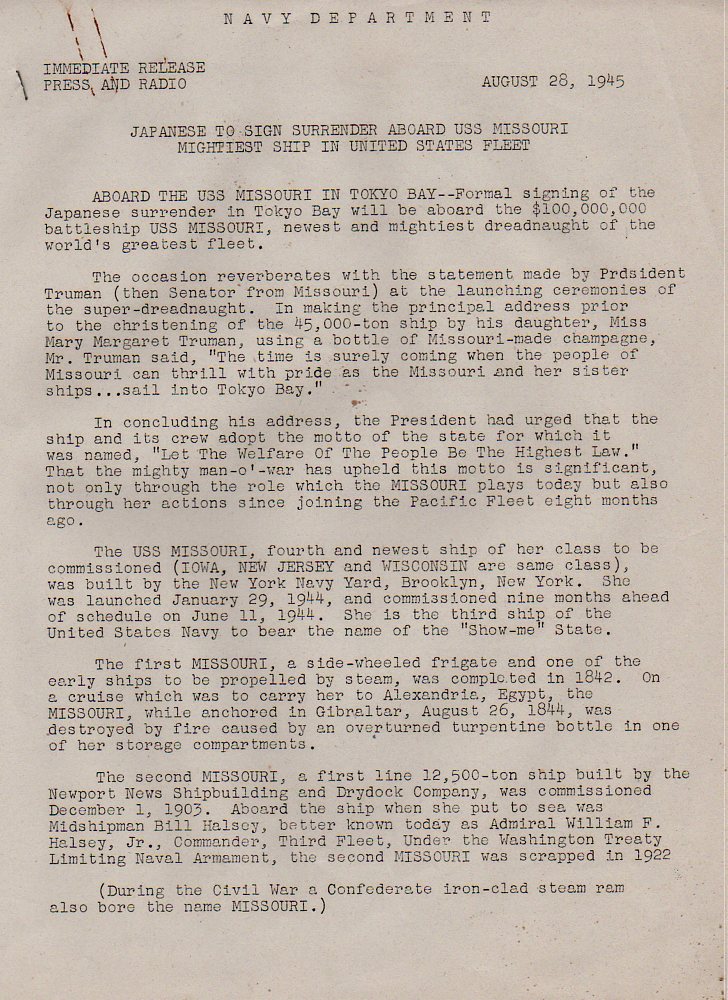
    Additionaly there is this U.S. Navy Department press relsease for announcing the surrender signing agreements, dated 28 August 1945.  This actually comes from the estate of Adm. Grace Murray Hopper via a sale through the Friends of the Arlington Library (Virginia) many years ago. 

    Japan surrender missouri959


    ·Posted by :

    ·in:

    —

Recent Posts

Archives

Categories