A Daily History of Holes, Dots, Lines, Science, History, Math, Physics, Art, the Unintentional Absurd, Architecture, Maps, Data Visualization, Blank and Missing Things, and so on. |1.6 million words, 7500 images, 4.9 million hits| Press & appearances in The Times, Le Figaro, Mensa, The Economist, The Guardian, Discovery News, Slate, Le Monde, Sci American Blogs, Le Pont, and many other places… 5000+ total posts since 2008.

  • The Mysteries of Air Travel (1945)

    JF Ptak Science Books   Quick Post

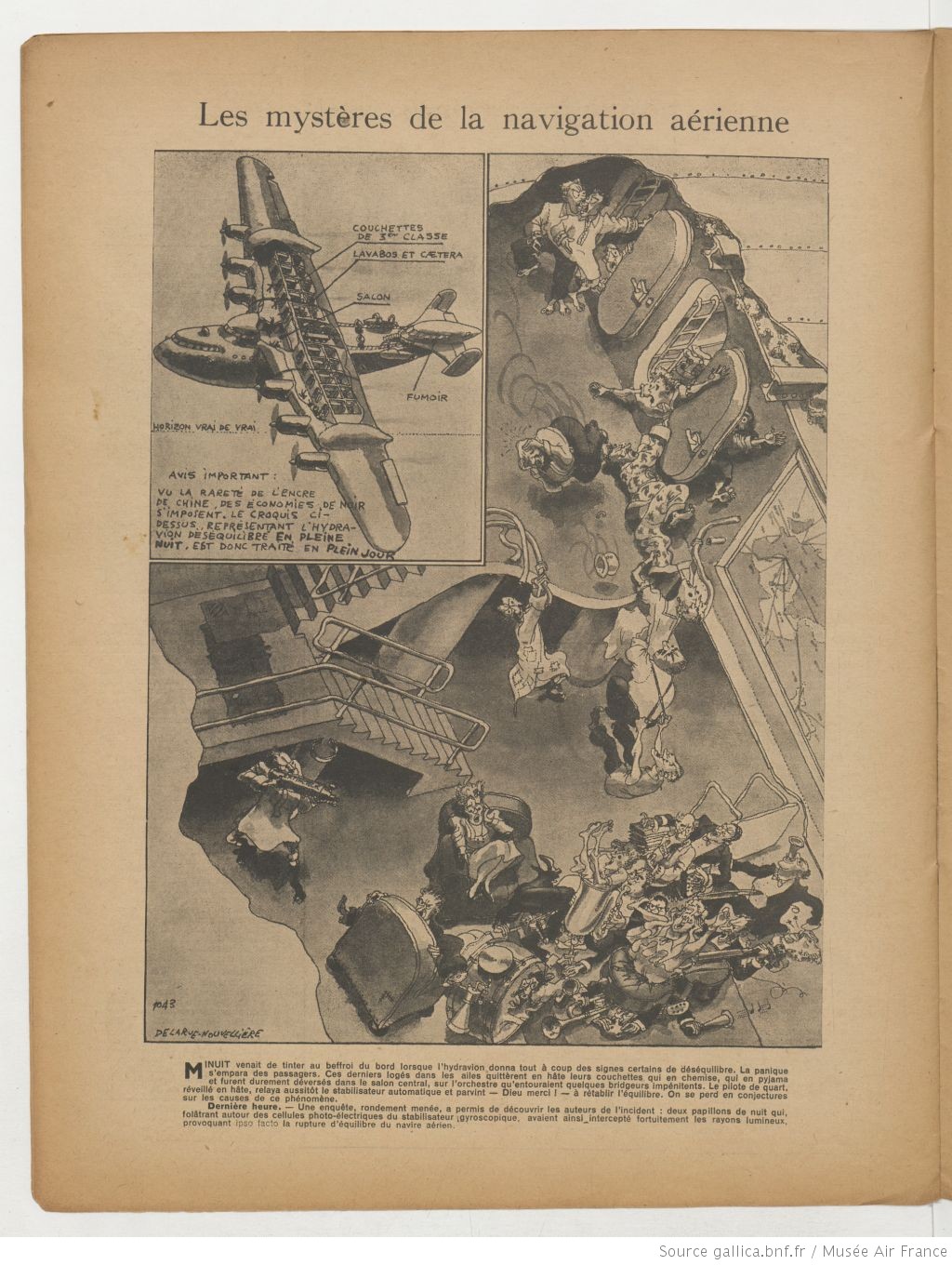
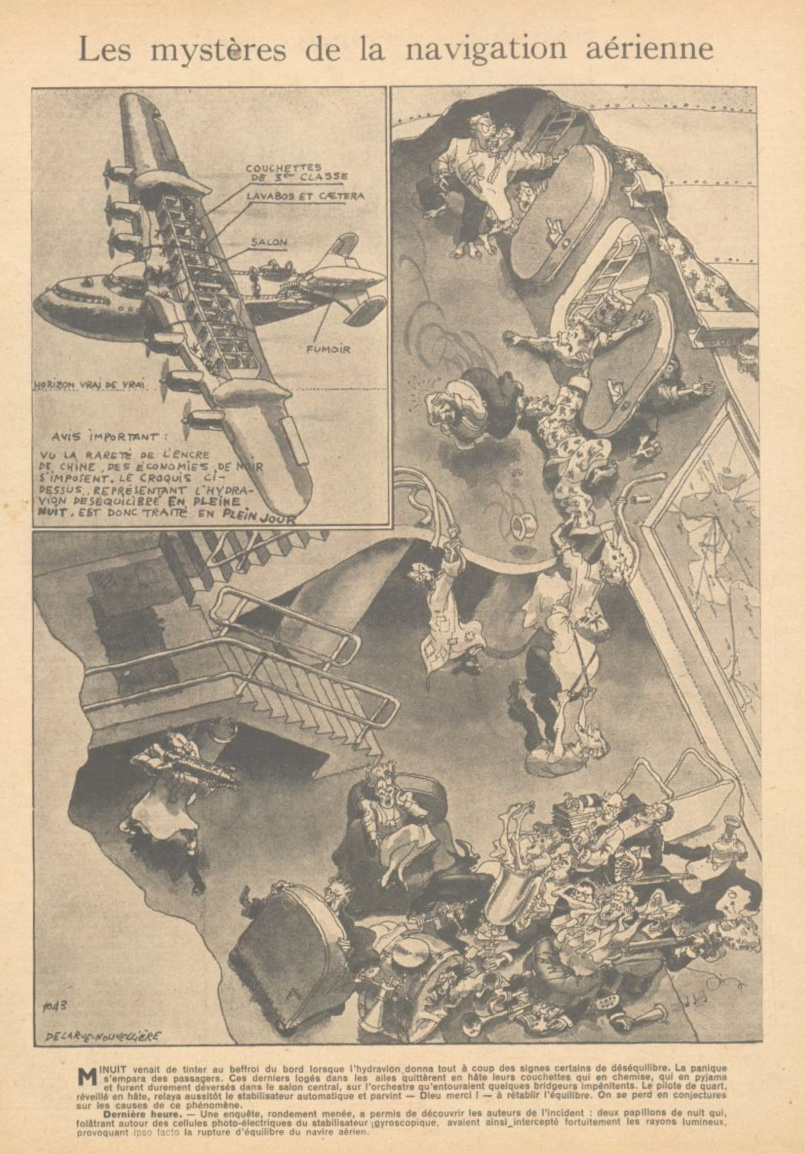
    There’s very little detail of the aircraft in general, though like a lot of free-thinkers the artist has imagined plenty of life being lived in the interior of the plane’s wings, where all of our attention is directed. It seems that the plane has banked to such a degree that it has completely upset the pace of life of its passengers. Many of the travelers have taken a big tumble, and we can see a guy hanging onto another man’s suspenders who in turn is hanging on to a woman clutching a man grabbing a man holding onto a door. Beneath that circus routine is another–we see a small band jostled and imploded into itself (with the clarinetist swallowing his instrument and someone landing in a tuba) while a man in sock garters and a night shirt takes aim at the group with something-or-other.  

    Evidently, the plane’s performance was destabilized by a moth–all was brought back to normal.  

    In any event, I came upon this looking for early published tech reports on the V-1, so there was something that came from this rabbit-hole research:

    Cross section L Air Jan 1945 turbulent flight

    Source: L’Air, revue mensuelle: organe de la Ligue Nationale populaire de l’aviation (France).  January 15, 1945 (via the wonderful Gallica site)


  • Teepees and Petroleum Companies, 1885

    JF Ptak Science Books  Quick Post

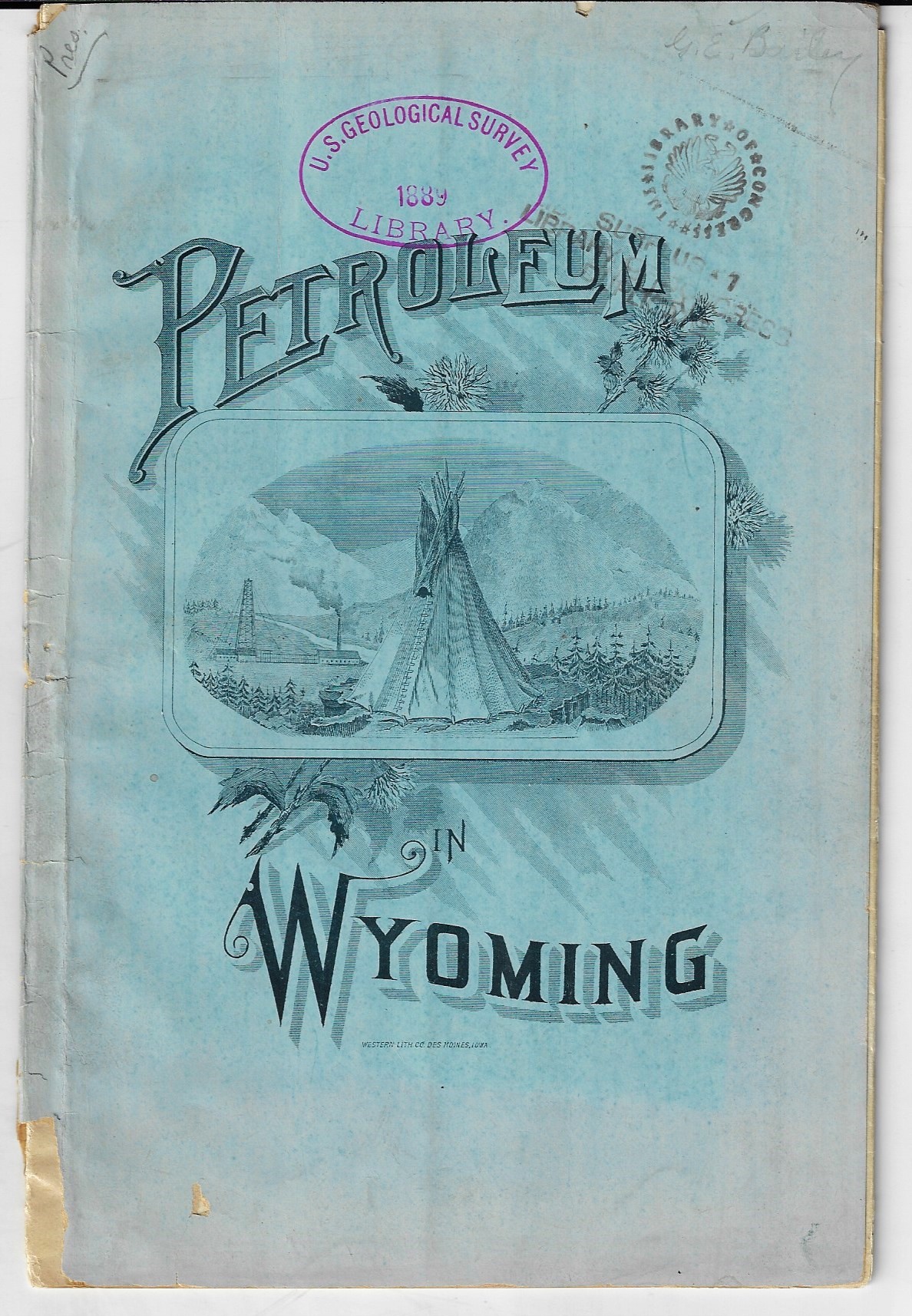
    Wyoming _2_I was working on this 1885 pamphlet1 on petroleum in Wyoming territory, and was stopped by the cover illustration. As you can see, the cover shows a teepee (which would be about right seeing that most of the numerous Indian tribes there in the territory before White incursion were nomadic)—behind it though we see oil derricks, which I am sure was not the case, unless the derricks were on Indian land. In 1880 the (non-Indian) population of Crook County was 239, which “jumped” to 2,300 in 1890, (then to 6k in 1910 where it has stayed about constant since). In 1890 the Indian population in all of Wyoming was 2,063 (or thereabouts, according to the U.S.1890 census special volume Indians Taxed and Indians Not Taxed), and of that figure nearly the entirety of the population–1,861–were on reservations. And according to the census report of the 189,000 reported Indian population in the country 133,000 were on reservations, while another 50,000 were living in Indian Territory which did not in the government’s mind count for being on a reservation, making for something like 5,000 Indians not on reservations or I.T. territory in the entire U.S. and territories. So, picturing the teepee set before a petroleum industry scene was exceedingly and vapidly prosaic.

    WyomingNotes:

    1. Gilbert Ellis Bailey (former State Geologist of Wyoming). Petroleum in Wyoming Territory and special report on the Stockade oil district and the property of the Lakota oil and coal mining company in Crook County, Wyoming. No publisher or place of printing is noted. No date (though it is certainly before statehood in 1890); Stanford guesses 1885.  8.25”x5.75”, 19pp, with a small folding map of the county.  Printed wrappers. Provenance: U.S. Geological Survey Library, gifted to the Library of Congress in 1921. One copy only (Stanford) located by WorldCat.  

  • “The great excellence of this operation was its mechanical roughness and simplicity”–on Moving a Brick House, 1875

    JF Ptak Science Books  Quick Post

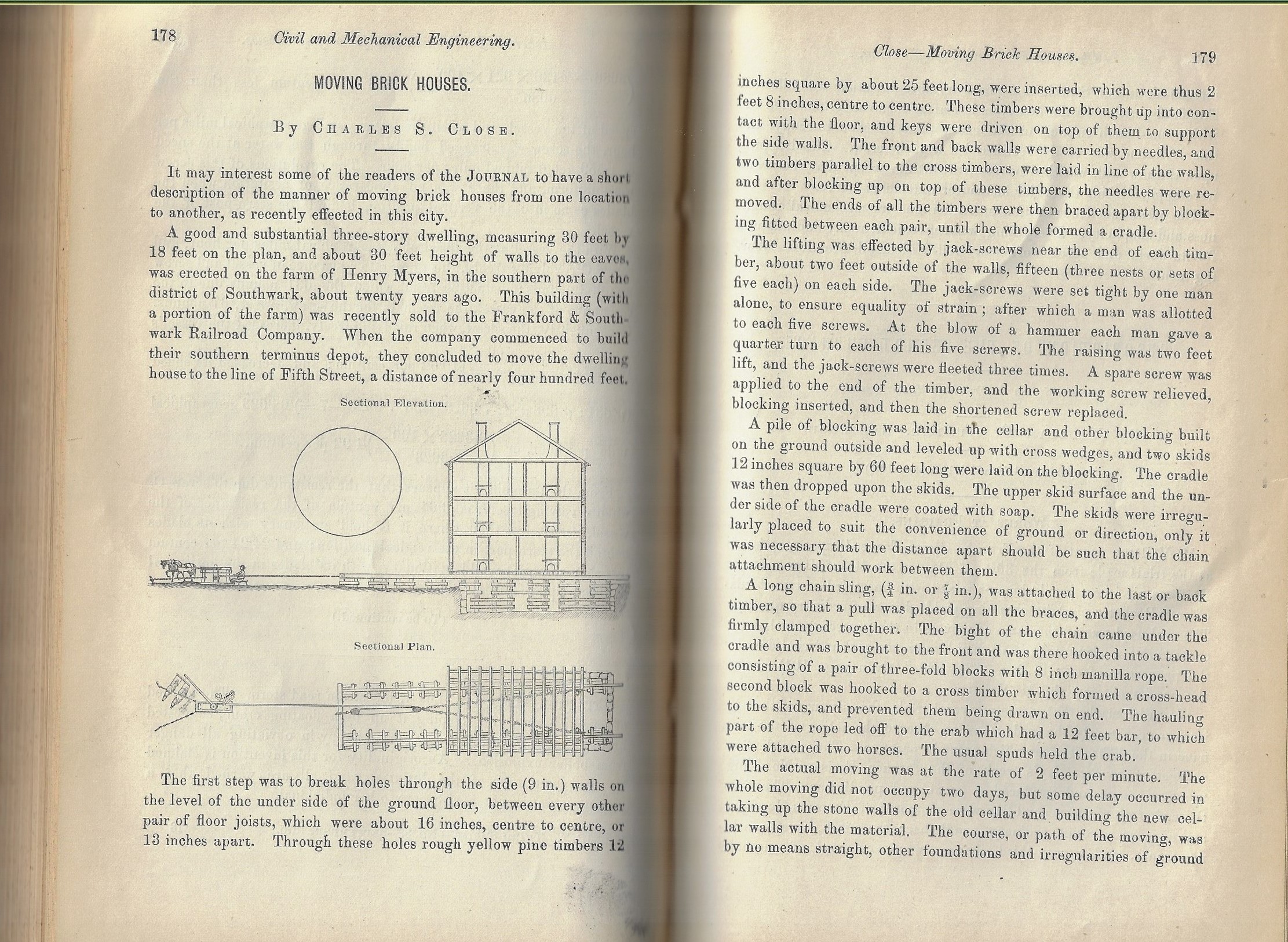
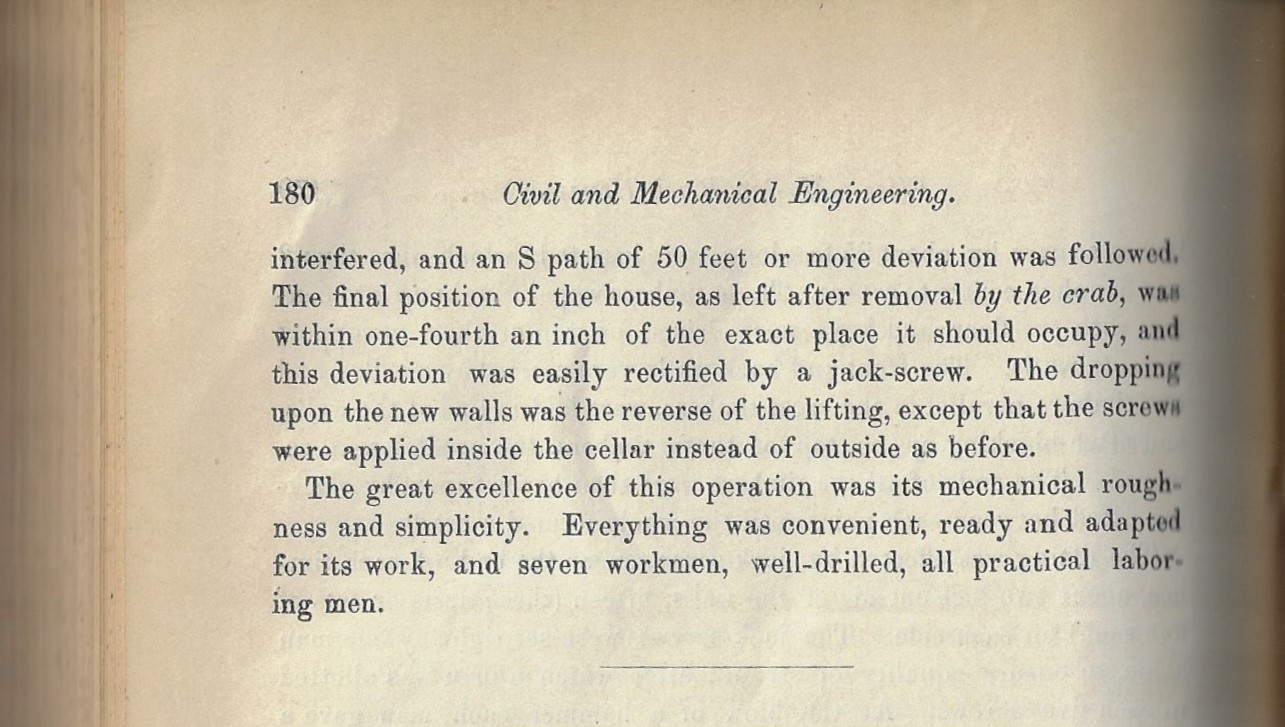
    This is one of the many small articles that appear in major sci/tech/engineering journals in the 19th century that are absolutely so filled with human spirit that it fills your heart with hope for humanity (even if everyone involved has been dead for at least 125 years.  This one is a ravishingly simple three-page report on how to move a (substantial) brick house with a few guys and a horse. The title of this post is taken from the report1, where (I feel) the writer just took a step back from his work and said “holy ____!”, and admired the sheer beauty of the simple and successful approach to a major task. And as it turned out, the house was all of 1/4″ from where it should have been, and that was quickly rectified with a screw jack.

    And about that lifting-of-the-house business–the main part of the job was done by one man and five screws, and as the writer observes with another fantastic-quote moment, “The screw jacks were set by one man alone, to ensure the equality of strain”! I know it is a technical expression, but “ensur(ing) the equality of strain” sounds very applicable to a lot of things, the equivalent of a bean thread base to a veggie stir fry. 

    Here’s the article in case you need to move a brick house:

    JFI 1875 moving house
    JFI 1875 moving houseNotes:

    1. Charles S. Close, “Moving Brick Houses”, in Journal of the Franklin Institute, 1875, vol 70/100, pp 178-180. 


  • Beer Vs. Wine, 1828

    JF Ptak Science Books  Quick Post

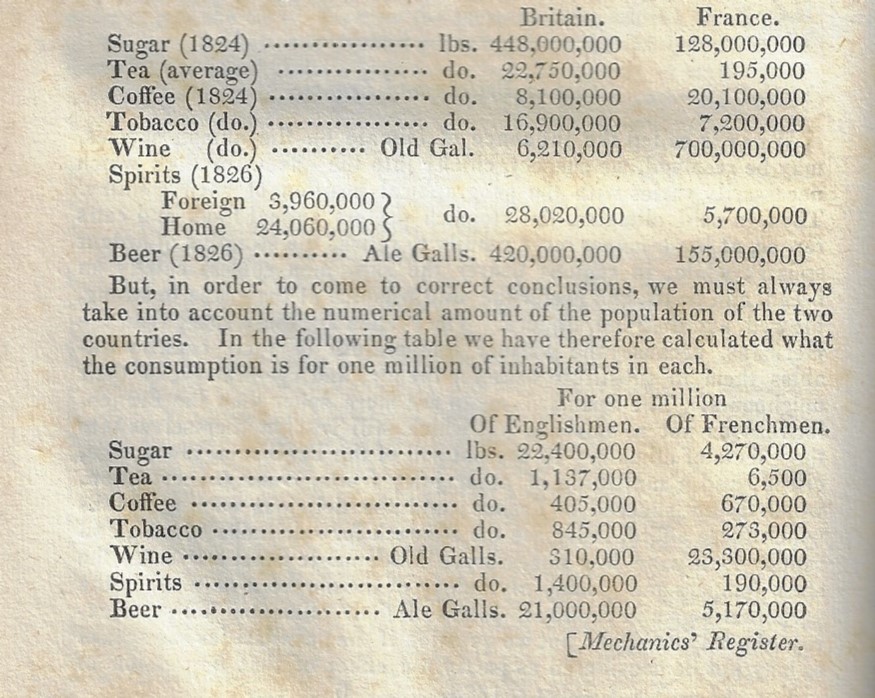
    Here we go: I found this fascinating little table in the article “Diet in England and France” in the Journal of the Franklin Institute for July, 1828. I think that the table displays what seems to be common knowledge about consumption in the two cultures, though it also provides some interesting numbers (“compiled from authentic documents”) to back everything up.  The first section displays gross numbers, while the second breaks it down to consumption in terms of per capita. The Brits drink far less wine than the French, though the French drink even less (by an order of magnitude) of tea than the Brits. 

     JFI 1828 Diet

  • Found Dadaist Image, Lost in the Beauty of Sound on the Sea (1854)

    JF Ptak Science Books  Quick Post

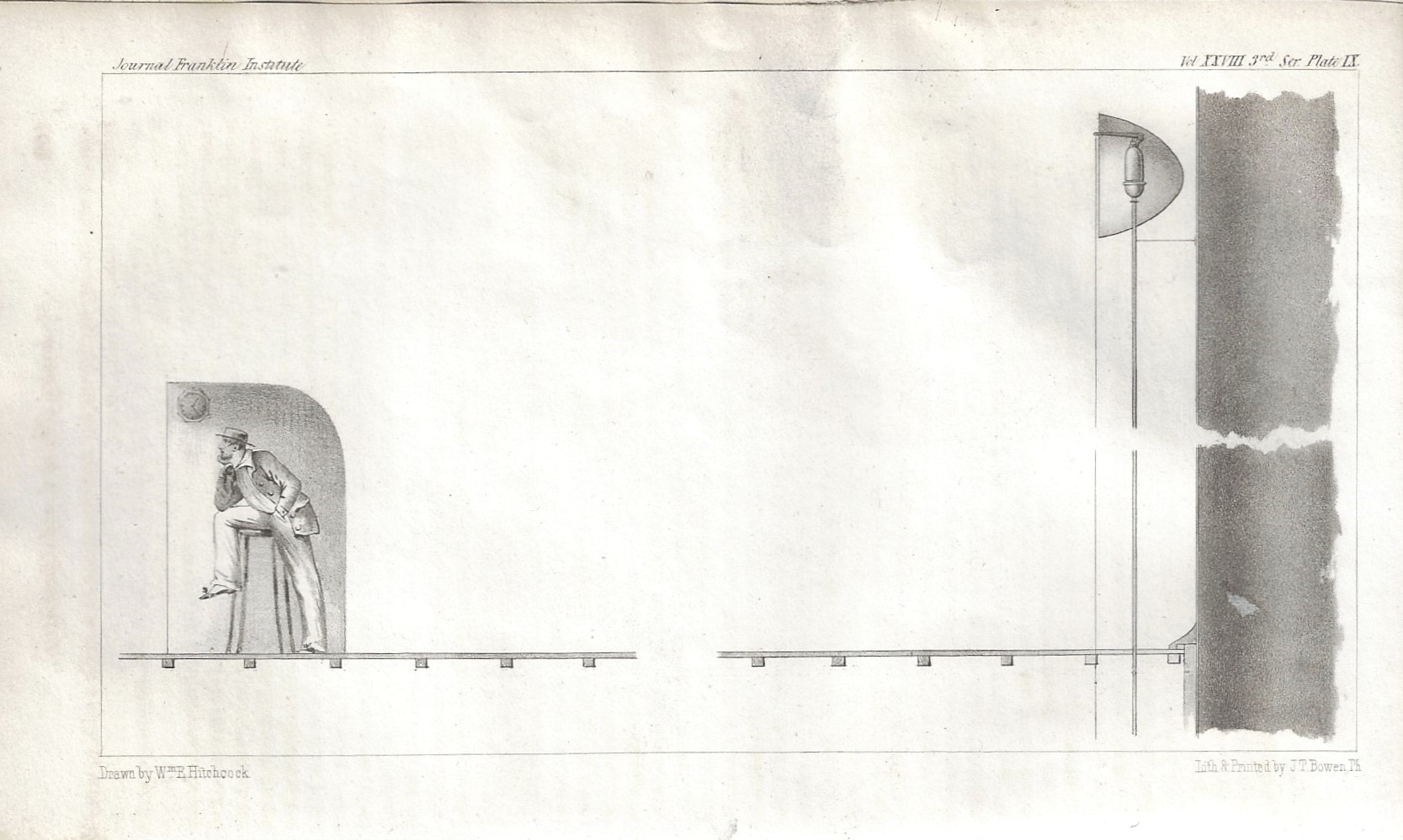
    This fantastic image was found in an 1854 article1 on pre-wireless  ship-to-ship audio communication. The point of the article of course was deadly serious: using a steam-driven whistle not only for signalling to other ships (a la the truncated communication systems between trains on their whistles) but also employing it as a type of RADAR where you may be able to determine what foggy things lay ahead by virtue of their echo, among other things. The article describes the scene below as an effective arrangement for the broadcasting whistle (on the mast or funnel at left) and the “signal-man” in his “pent-house” at left, though I don’t see any instrumentation for the guy. That structure was supposed to shield his hearing from the audio blasts which were to be heard at a distance of five or six miles (and which were to be sounded every few minutes)–the hut seems a little flimsy for that purpose.  In any event, removing the image from its context presents us with something very spare and very creative:

    Found Dadaist audio com ships

    Notes:

    1. John C. Cresson, “Remarks upon the Use of Phonic Signals in Navigation”, pp 397-400, in the Journal of the Franklin Institute, Philadelphia, Vol 28 (third series), volume 58 (overall), July-December 1854.

    ·Posted by :

    ·in:

  • Birds of a Feather: Flying and Perpetual Motion Machines (1848)

    JF Ptak Science Books  Quick Post

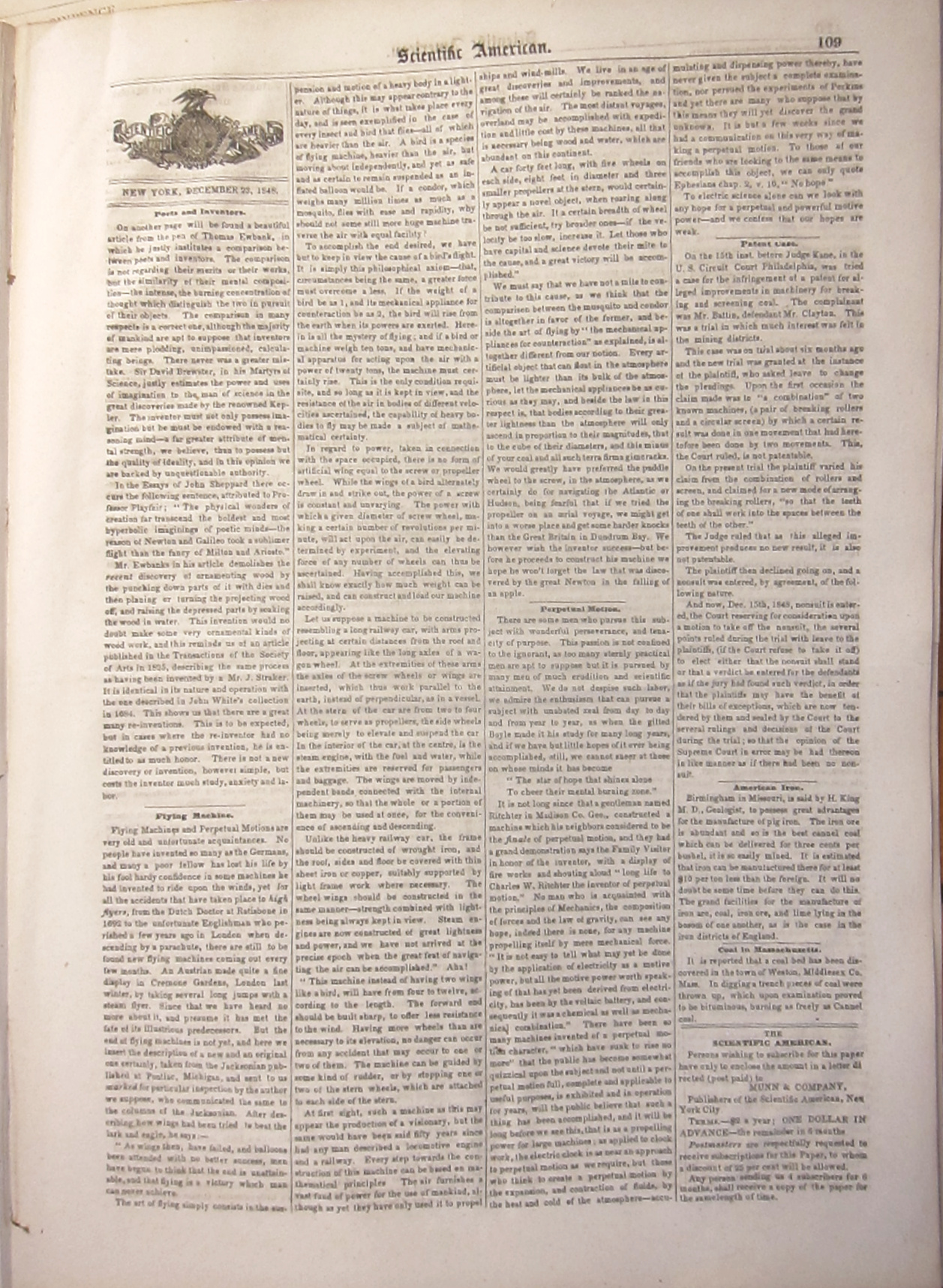
    Sci Am 1848 flying machineHere’s a wonderful and short editorial comment from the Scientific American on the possibilities of human flight, coupled with the observed fruitless pursuit of perpetual motion machines.  There wasn’t much hope expressed in flight, but “the end of flying machines is not yet” and the author shares a vision for one possible flying machine, which was a huge, steam-driven, wrought iron 40′ x 8′ design with between four and twelve wings. No mention is given of its weight. 

    “Flying Machines”, in Scientific American, December 23, 1848, vol 4, #14.

    “Flying Machines and Perpetual Motions are very old and unfortunate acquaintances. No people have invented so many as the Germans, and many a poor fellow has lost his life by his fool hardy confidence in some machines he had invented to ride upon the winds, yet for all the accidents that have taken place to high flyers, from the Dutch Doctor at Ratisbone in 1692 to the unfortunate Englishman who perished a few years ago in London when descending by a parachute, there are still to be found new flying machines coming out every few months.”

    “But the end of flying machines is not yet, and here we insert the description of a new and an original one certainly, taken from the Jacksonian published at Pontiac, Michigan…”

    “As wings then, have failed, and balloons been attended with no better success, men have begun to think that the end is unattainable, and that flying is a victory which man can never achieve. The art of flying simply consists in the suspension and motion of a heavy body in a lighter. Although this may appear contrary to the nature of things, it is what takes place every day, and is seen exemplified in the case of every insect and bird that flies—all of which are heavier than the air.”

    “Let us suppose a machine to be constructed resembling a long railway car, with arms projecting at certain distances from the roof and floor, appearing like the long axles of a wagon wheel. At me extremities or these arms the axles of the screw wheels or wings are inserted, which thus work parallel to the earth, instead of perpendicular, as in a vessel. At the stern of the car are from two to four wheels, to serve as propellers, the side wheels being merely to elevate and suspend the car. In the interior of the car, at the centre, is the steam engine, with the fuel and water, while the extremities are reserved for passengers and baggage. The wings are moved by independent bands connected with the internal machinery, so that the whole or a portion of them may be used at once, for the convenience of ascending and descending.”

    “This machine instead of having two wings like a bird, will have from four to twelve, according to the length. The forward end should be built sharp, to offer less resistance to the wind. Having more wheels than are necessary to its elevation, no danger can occur from any accident that may occur to one or two of them. The machine can be guided by some kind of rudder, or by stopping one or two of the stern wheels, which are attached to each side of the stern. At first sight, such a machine as this may appear the production of a visionary, but the same would have been said fifty years since had any man described a locomotive engine and a railway. Every step towards the construction of this machine can be based on mathematical principles The air furnishes a vast fund of power for the use of mankind, although as yet they have only used it to propel ships and wind-mills. “

    “A car forty feet long, with five wheels on each side, eight feet in diameter and three smaller propellers at the stern, would certainly appear a novel object, when roaring along through the air. If a certain breadth of wheel be not sufficient, try broader ones—if the velocity be too slow, increase it.”

    “We however wish the inventor success—but before he proceeds to construct his machine we hope he won’t forget the law that was discovered by the great Newton in the falling of an apple.”

  • Bombing Dirigibles, from Above (1913)

    JF Ptak Scemce Books   Quick Post

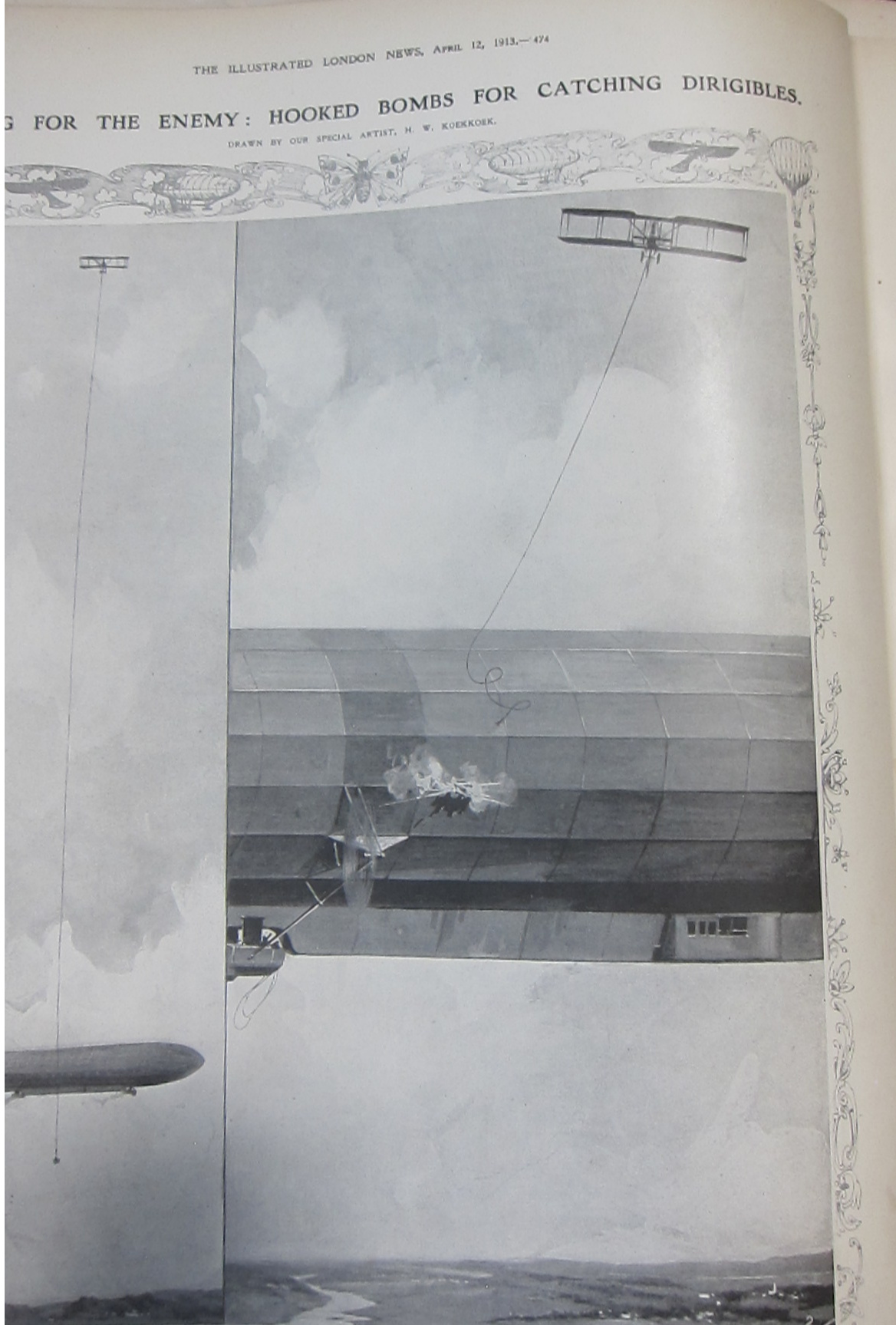
    “Fishing for the Enemy, Hooked Bombs for Catching Dirigibles”, a drawing by H.W. Koekkoek, in the April 12, 1913 issue of the Illustrated London News. Samuel F. Cody (born Cowdery, adjusting the surname of Buffalo Bill/William in his youth) was a Wild West showman at the beginning, and then a showman through his middle years in other fields, and then finally becoming an advanced pioneer in aviation. Cody was the first person to fly in England in 1906 and experimented with different (and successful designs in aircraft) as well as human-lifting kite designs, some of which were employed by the Brits in the Boer War and also used in place of observation balloons under appropriate weather conditions. There is no doubt that Cody was more on the frontier of aviation than on the U.S. Western frontier. Unfortunately Cody would be killed flying one of his experimental aircraft four months after this story appeared.

    Cody went fishing for dirigibles with this invention. The idea was to fly an airplane about 2000’ above a dirigible with a towline of the same length with a grapnle-bomb attacked to the end. The plane would try to hook the dirigible with the grapnel at which point the bomb would detach and detonate.

    ILN 1913 bombing the  dirigible

    ·Posted by :

    ·in:

    —
  • A Trafalgar of the Air–the Battleship Aeroplane, 1907

    JF Ptak Science Books   Quick Post

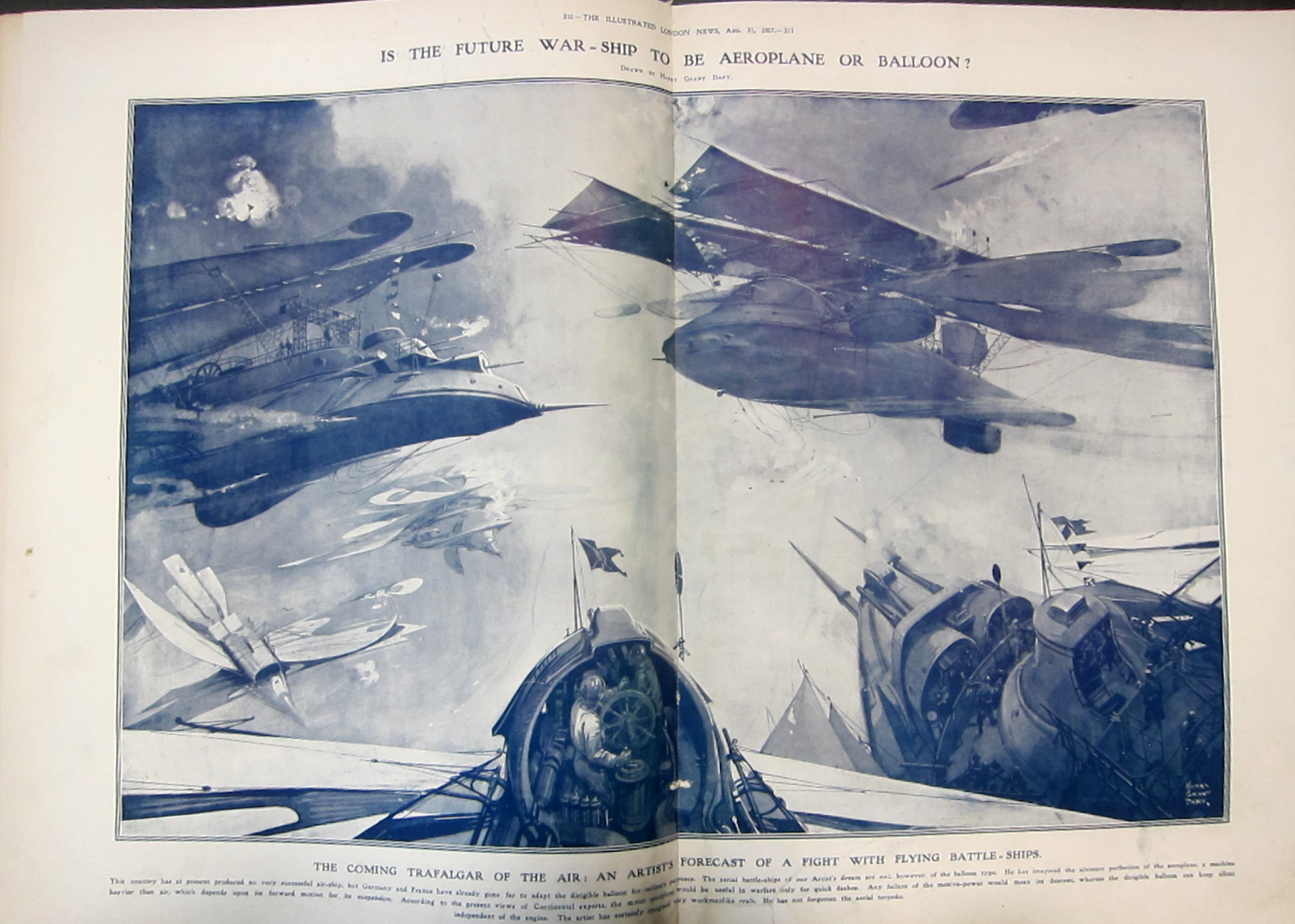
    “Is t he Future War-Ship to be Aeroplane or Balloon?”, is a glorious 2pp (16” x 23”) illustration in the Illustrated London News, published August 31, 1907, and drawn by Harry Grant Dart1 only four years after the Wrights’ powered flight at Kill Devil. It features four images of enormous aircraft as well as two smaller images, none of these seem to be the balloons in question in the title of the artwork, the artist seeming to have come down on the side of the aeroplane. That said, these aircraft are massive—iterating by the figures on deck the plane was close to 50’ tall with wings that must’ve been 100’ wide. Everything seems to be massively heavy, looking more like steam-fired ships (“flying battle-ships”) than anything else…except for their resemblance to birds and dragonflies.  Also of note in the upper right corner is a missile—an “aerial torpedo”—fired at one of the aircraft.ILN Ap 31 1907

    Notes:

    1.  Harry Grant Dart (1869-1938) was a correspondent, artist, and cartoonist who worked for the New York World, Life, and Judge, whose specialties seem to involve techno-future-vision. 


    ·Posted by :

    ·in:

    —
  • The Plurality of Worlds (1912)

    JF Ptak Science Books   Quick Post

    The following is section is from mathematician/logician Augustus DeMorgan’s (1806-1871) classic Budget of Paradoxes second edition of 1912). It is a short expository on the plurality of worlds and life on them beyond the Earth, looking back over the history of the idea from Lucian, Huygens, Swift, Kircher, and others.  DeMorgan’s footnotes are included at bottom (with a few added comments in italics). 

    “INHABITED PLANETS IN FICTION

    There is a class of hypothetical creations which do not belong to my subject, because they are acknowledged to be fictions, as those of Lucian,[177] Rabelais,[178] Swift, Francis Godwin,[179] Voltaire, etc. All who have more positive notions as to either the composition or organization of other worlds, than the reasonable conclusion that our Architect must be quite able to construct millions of other buildings on millions of other plans, ought to rank with the writers just mentioned, in all but self-knowledge. Of every one of their systems I say, as the Irish Bishop said of Gulliver’s book,—I don’t believe half of it. Huyghens had been preceded by Fontenelle,[180] who attracted more attention. Huyghens is very fanciful and very positive; but he gives a true account of his method. “But since there’s no hopes of a Mercury to carry us such a journey, we shall e’en be contented with what’s in our power: we shall suppose ourselves there….” And yet he says, “We have proved that they live in societies, have hands and feet….” Kircher[181] had gone to the stars before him, but would not find any life in them, either animal or vegetable.

    Fontenelle

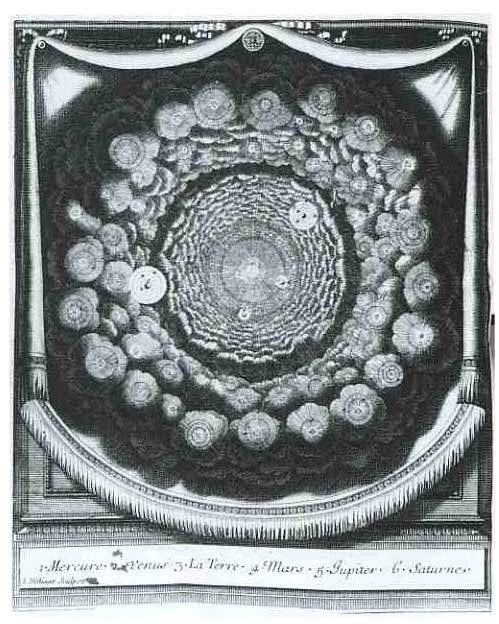
    • [This lovely image belongs to Entretiens sur la Pluralitie de Mondes (Conversations on the Plurality of Worlds), written by the great French philosophe Bernard le Bouvier de Fontenelle in 1686 (just a year before publication of perhaps the greatest work in the history of science, Newton’s Principia Mathematica). The Plurality was a best-seller by the best-selling Fontenelle. An excellent attempt by a rather restricted writer to engage the population-at-large, writing a high-pop book on what was basically the history of astronomy and cosmology of the preceding century. Copernicus was a major feature of his imaginary conversations with a muse as he wandered through a metaphorical garden of questions, with the observations of Galileo and Cassini also very prominently featured.]


  • On Doing and Done: the Differences in describing the Difference Engine of Charles Babbage, 1832.

    JF Ptak Science Books  Post 2792
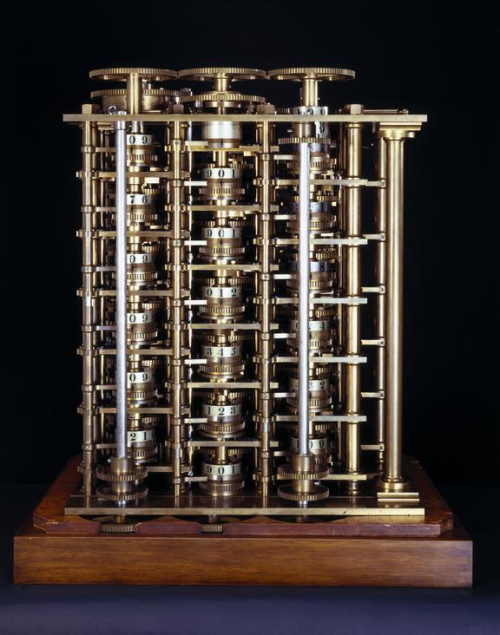
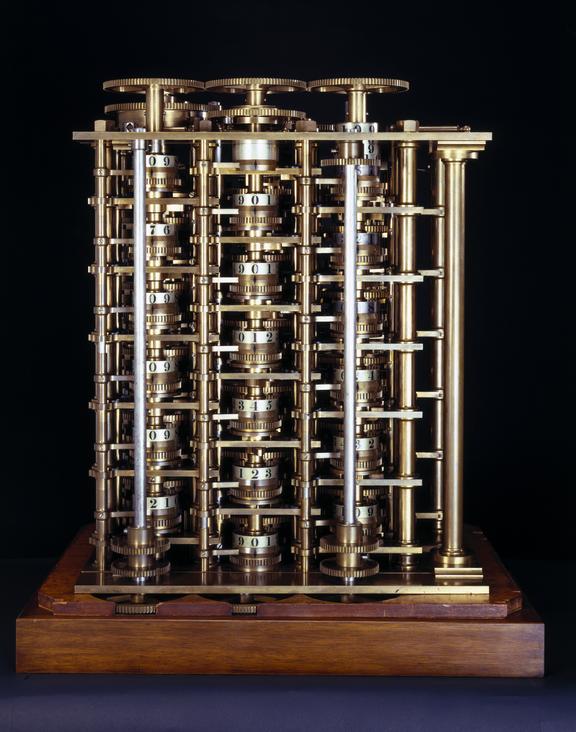
    Babbage difference engineThere’s a big difference being “inventing” and “invented”. You virtually never hear or read of someone declaring “I am inventing thus-and-so” imply that they’re working on something; “I invented the letter number seven” implies that you’ve completed the act of invention and the number seven exists. 

    In cataloging a book for my bookstore I came upon this difference in reference to Charles Babbage and his early calculating machine, and proceeded to make a mountain of a molehill, and then the reverse. 

    The “incident” was sparked by a volume of the Journal of the Franklin Institute1 with the appearance of a very early mention of Babbage having built his Difference Engine  (No. 1) found in a one-paragraph mention in the article “The Results of Machinery”:

    [Image at left of Babbage’s machine in 1832, from the Science Museum http://collection.sciencemuseum.org.uk/objects/co62243/difference-engine-no-1-difference-engine-portion-only]

    “Mr. Babbage…has invented a calculating machine…” referring to the newly (1832) “completed” 1/7th  of the machine. (The Difference Engine No. 0 announcement came June 14, 1822; the Difference Engine No. 1 appeared in this year, 1832, though work was suspended on it in 1833 (with government funding removed);’work soon to begin on Difference Engine No.2 (1846-9), (and with A. Lovelace’s famous “Notes” appearing on the Analytical Engine in 1843.)

    The article is a review/abstract of the book by Charles Knight, The results of machinery : namely, cheap production and increased employment exhibited : being an address to the working-men of the United Kingdom, which appeared in a second edition in London in 1831 (and a fifth in 1832) with a first American appearing in 1831. The Babbage calculating machine bit from the JFI is taken very nearly verbatim from these editions, where in the original the mention of the machine is referred to as “almost perfected”–here in the JFI it shows up as “invented”, which as they say is something quite different, the world of “almost-perfecteds” being much wider broader deeper than that of “the perfecteds”.

    Leaving out the fact that the machine was yet really built is of course a minor thing compared to the overall message of the paper and the book in general, but I just got my scarf wrapped around the axle on it. 

    The full note on Babbage reads:

    “The inventions for saving mental labour, in calculations of arithmetic, have been carried so far, that Mr. Babbage, a gentleman whose name we have twice before mentioned, has invented a calculating machine, which not only does its work of calculation without the possibility of error, but absolutely arranges printing types of figures, in a frame, so that no error can be produced in copying the calculations, before they are printed. We mention this curious machine, to show how far science may go in diminishing mental labour, and ensuring accuracy.”

    This was part and parcel the principle thrust of this article: investigating the application of machinery in a positive way to production and labor and showing its “…effects of saving unprofitable labor”.

    The few paragraphs of background leading to the Babbage reads as follows:

    “The foot-rule of the carpenter not only gives him the standard of a foot measure, which he could not exactly ascertain by any experience or any mental process; but it is also a scale of the proportions of an inch or several inches, to a foot, and of the parts of an inch to an inch. What a quantity of calculations, and of dividing by compasses does this little instrument save the carpenter, besides ensuring a much greater degree of accuracy in all his operations! The common rules of arithmetic, which almost every boy in England now learns, are parts of a great invention for saving mental labour. The higher branches of mathematics, of which science arithmetic is a portion, are also inventions for saving labour, and for doing what could never be done without these inventions.

    There are instruments, and very curious ones, for lessening the labour of all arithmetical calculations; and tables—that is, the results of certain calculations, which are of practical use, are constructed for the same purpose. When you buy a joint of meat, you often see the butcher turn to a little book, before he tells you how much a certain number of pounds and ounces amounts to, at a certain price per pound. This book is his “Ready Reckoner,” and a very useful book it is to him; for it enables him to despatch his customers in half the time that it would otherwise require, and thus to save himself a great deal of labour, and a great deal of inaccuracy.

    The inventions for saving mental labour, in calculations of arithmetic, have been carried so far, that Mr. Babbage, a gentleman whose name we have twice before mentioned, has invented a calculating machine, which not only does its work of calculation without the possibility of error, but absolutely arranges printing types of figures, in a frame, so that no error can be produced in copying the calculations, before they are printed. We mention this curious machine, to show how far science may go in diminishing mental labour, and ensuring accuracy.”

    So in this message of insight and hope I got stuck on one word, which ultimately really doesn’t mean anything. The message was significant and an interesting and insightful way of phrasing the possibilities for the application of more advanced machines in the future, and was much bigger whatever the state of completion of the Babbage machine was.

  • Abraham Lincoln, Inventor (1849)

    JF Ptak Science Books  Quick Post

    Posts to this blog have recently been clustered around volumes of the Journal of the Franklin Institute, as that is what I have been working with quite a bit over on the other side of this site dedicated to online book selling. Bits and pieces have struck me as interesting and curious and worth sharing–I’ve found often that many of these short pieces have received scant attention in the online world. Today’s adventure into the journal led to something that is well-known, but I’m sharing it anyway because it was such a surprise to come upon it “naturally” in the course of looking through one of the JFI volumes.

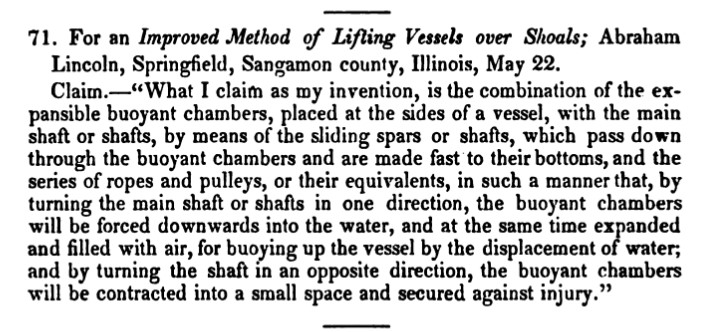
    I knew that Abraham Lincoln was the only U.S. president to receive a patent, and thought that it might show up in these volumes sooner or later, and while looking at the year 1850 I found it: #71 in the review of American Patents for January of that year. In the two open pages of that volume the Lincoln contribution settled in with seven other patents (granted to inventors from New York (2), Ohio (2), Illinois, Pennsylvania, and New Hampshire). Lincoln’s boat-lifter was there with a new method for joining staves, imitating marble, a spring saddle, improvements to scythe nibs, nozzles for ship navigation, and a shank for mineral door knobs. 

    Lincoln Patent

    I expected to find it either in late 1849 or early 1850 (for the patent issued in mid-1849) but it was still a “surprise” to see it there before me. Lincoln published this shortly after leaving his one-term position in the U.S. Congress, returning to Springfield (Illinois) to practice law. (Lincoln was born near Hodgenville, Kentucky, a town of a few hundred people and 200 miles to the southeast of Springfield, which in 1850 was home to about 5,000.)  So, there it is, the not-famous A. Lincoln’s patent for lifting a boat out of the water and over some river shoals. Nice idea.  


    ·Posted by :

    ·in:

Recent Posts

Archives

Categories