A Daily History of Holes, Dots, Lines, Science, History, Math, Physics, Art, the Unintentional Absurd, Architecture, Maps, Data Visualization, Blank and Missing Things, and so on. |1.6 million words, 7500 images, 4.9 million hits| Press & appearances in The Times, Le Figaro, Mensa, The Economist, The Guardian, Discovery News, Slate, Le Monde, Sci American Blogs, Le Pont, and many other places… 5000+ total posts since 2008.

  • Did Galileo Know That He Was Galileo?

    JF Ptak Science Books     Post 1610

    Here’s an interesting lead sentence I found in 3QuarksDaily via Salon:

      “Karl Marx did not know what we know: he did not know that he was Karl Marx.”

    The author suggested that Marx would’ve had a better time in his life had he known what influence he wielded in what he was writing–basically, Karl Marx didn’t know that he was KARL MARX.  It is an interesting–and frightening–idea to think of someone laboring like that laboring (as it were) away in relative obscurity, or at least relative to the monumental influence it would come to have.

    The real question is not how many people might be in this category of not knowing who we know them to be, but if everyone is in this category at one point or another, and how long it took for them to understand the lasting significance of their work.  But for right now I’m interested to know what people think of the following ten science personalities, and to answer (in a simple survey), if they knew the significance of their work.

    The survey is simple and fairly straightforward, and asks questions regarding Copernicus, Harvey, Galileo, Einstein, Maxwell, Newton, Turing, Darwin, Lucretius and John Von Neumann. 

    You’ll have a chance to view the survey results at the end.  Thanks!

    Follow this link to the survey.

     

  • On the Failures and Triumphs of Confederate Digestion: Diarrhea and Urine

    JF Ptak Science Books   Post 1611

    Let’s just say it:  the history of diarrhea is not pretty,  It has been a major killer throughout history (coupled with the sometimes historically-indistinguishable dysentery), wiping out perhaps hundreds of millions of people over human history.  Infectious diarrhea and dysentery is especially suited for crowded, cramped conditions with poor sanitary facilities and bad food, which makes armies a perfect place for those diseases to easily succeed.

    In the American Civil War diarrhea was a leading incapacitor and killing disease, perhaps chief among the diseases that killed more people than did the actual fighting.1  And perhaps no where else did it commit such great tragedy than in the ranks of the Confederate soldiers, who by and large had considerably less than the Union soldiers.  Poor sanitary facilities, bad food badly prepared, close living conditions, weeks/months of stationary encampment during the winter, would all add up to a disaster.  Since the Confederate records of medical treatment are far from complete, we have to look at those of the Union Army to get an idea of what happened with diarrhea–and there, more than 250,000 men were discharged for chronic diarrhea, or roughly 10% of the entire fighting force over the course of the war.  I think it is safe to assume that the Confederate numbers would be at least comparable and probably worse for a fighting force of approximately half that size, though I am unsure of how many of these actually were discharged.  The figures for soldiers suffering from diarrhea who were not killed by it or discharged for it probably ran over a million for both sides.  It would not be easy to overstate the vast impact that diarrhea had on these armies, and particularly for the Confederacy.

    On the side of success we have the story of gunpowder.  Or, rather, the failure in the production of industrial nitrates necessary for the production of gunpowder which was addressed by the Southern citizenry, and particularly the women of the South.  Absent the essential component of potassium nitrate, the Confederate states resolved to produce the stuff locally, in the old fashion. Urine (and water from cesspools, privvies, and so on) would be collected, and then (via one of many methods) would be sprinkled on straw or some other similar organic material (to keep the material moist but not wet); the stew would be covered and sunned and allowed to cook for some months at the end of which time the straw would be washed of the material formed on its top, and then dried.  The resulting salts produced by evaporation would be a form of saltpeter, or potassium nitrate, which provides the necessary O2 for combustion. 

    I know that it was at least considered customary and a rule of engagement for the Union and the Confederate soldiers to not shoot each other while attending nature’s call; I’m not so sure that this would be the case for the guys in the night waste wagons collecting privvy drawers and urine. 

    Just another small, necessarily savage bit in the history of killing. 

    Notes:

    1. The Union armies had from 2,500,000 to 2,750,000 men. Their losses, by the best estimates:

    Battle deaths: 110,070
    Disease, etc.: 250,152
    Total 360,222

            The Confederate strength, known less accurately because of missing records, was from 750,000 to 1,250,000. Its estimated losses:

    Battle deaths: 94,000
    Disease, etc.: 164,000
    Total

    258,000

    ·Posted by :

    ·in:

    —
  • First Use of the Term “Super Computing”

    JF Ptak Science Books   Quick Post

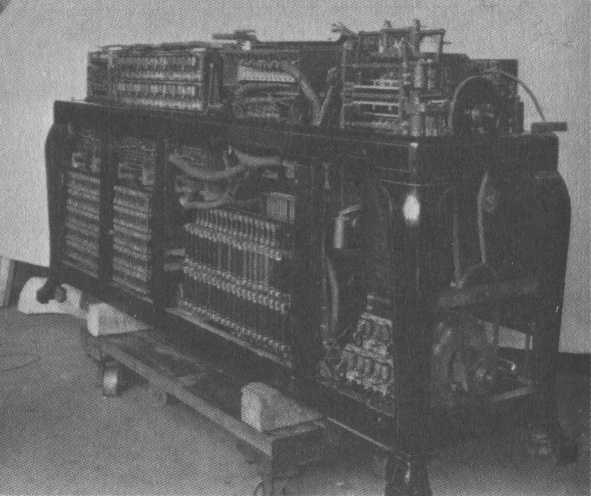
    The Columbia Difference Tabulator – 1931

    The earliest use of the term “super computer” seems to com from the New York World, (“1920” though actually 1929), and was applied  to a unique instrument made by IBM for Columbia University.  The The Columbia Difference Tabulator, completed that year, was nicknamed the “Packard”, after the large, streamlined-but-bulbous American luxury car of enormity.

    http://www.columbia.edu/cu/computinghistory/statlab-clipping.jpg

     And a picture of the great beast, below.

    [Picture source:  Columbia University computer history page,  here. .]


    http://www.columbia.edu/cu/computinghistory/packard-emitter.jpg

    “The new machine “mass-produced the sums of products by the method of progressive digiting and read punch cards at the rate of 150 per minute. It contained ten 10-position counters with provision for shifting totals internally from one counter to another – a capability that anticipated a future function of computers.” [9]. The new machine, variously called the “Columbia Machine”, the “Statistical Calculator”, the “Difference Tabulator”, and (because of its massive size) the “Packard“, was delivered and installed in 1931.”–From the Columbia University site, here.

    Idea source: Eames, Charles; Eames, Ray (1973). A Computer Perspective. Cambridge, Mass: Harvard University Press. p. 95.  More links and references at Columbia University’s computer history page,  here.


    Notes:


  • History of Holes: Making Tiny Holes & the Art of Compiling Statistics (I)

    JF Ptak Science Books     Post 1612

    Part of this blog’s  History of Holes series.  (See, for example: An Episode in the History of Holes: Electricity, Punched Cards and the Computer, 1878, here; History of Holes–Filing Holes Up, here.  And fifteen others. 

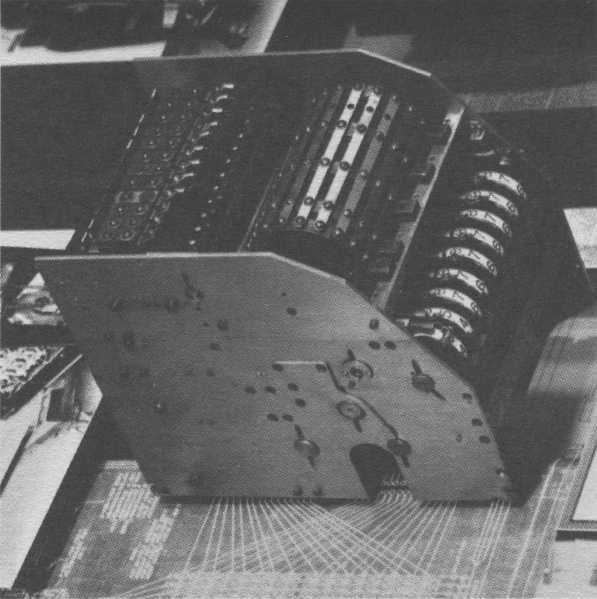
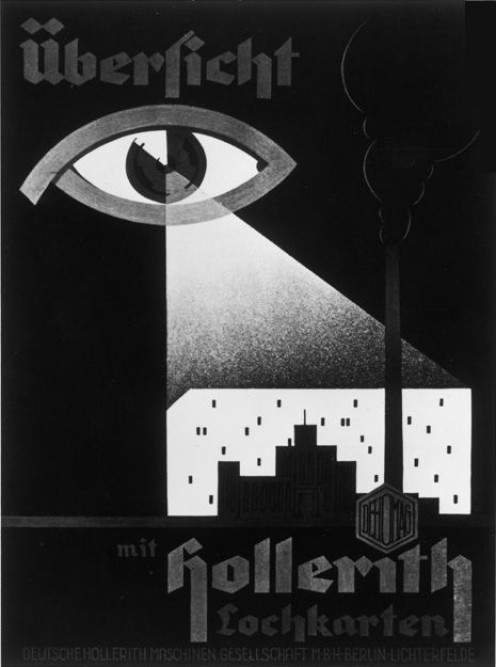
    I was thinking about holes and hole-making in the history of the art form of compiling statistics, and in the process of accumulating a few images of the machines that actually made the holes in tabulating cards, I found an interesting/unfortunate/depressing illustration.  It  belonged to the Deutsche Hollerith Maschinen Gesellschaft (“Dehomag”), which was the German arm of IBM. (Herman Hollerith created his Tabulating Machine Company in 1896; it was consolidated with the International Recording Company and Computing Scale Company of America into Computing Tabulating Recording Corporation (CTR) in 1911, and then, in 1924, changed once again into something with the name that we all recognize , International Business Machine (IBM).)

    Edwin Black’s one-trick pony, IBM and the Holocaust, I’m sure was a consolidation of grand assertions that helped to sell a book.  As a history I find it manipulative, like a person on a mission to say something and uses only what is positive to that end.  On his website, Black states: “IBM and its German subsidiary custom-designed complex solutions, one by one, anticipating the Reich’s needs. They did not merely sell the machines and walk away. Instead, IBM leased these machines for high fees and became the sole source of the billions of punch cards Hitler needed.” If you read between the lines this sounds like standard operating procedure that IBM would’ve followed with anyone; but on the face of it Black creates the case for IBM automating the Holocaust. 

    Keypunch hollerith det
    The poster has a very provocative cache, and taken somewhat out of context it might be viewed as dustjacket artwork for Black’s book.  The all-seeing eye absorbing the information of teh punched card, with the unfortunate, looming, belching smokestack there in the foregoround, reminiscent of the chimneys in the concentration and extermination camps.  But this poster was executed around 1925, well ahead of any of those events–the design by serendipity happens to visually support the author Black’s assertions.  Its just a nasty-looking object.

    Keypunch hollerith

  • A Paris Made to be Destroyed–Sham Paris, 1917/18

    JF Ptak Science Books   Post 1613  (Post 656–expanded) 
    Follow Me on Pinterest


    Now this was a case in which you were given the result and had to find everything else for yourself.  — Sherlock Holmes in A Study in Scarlet

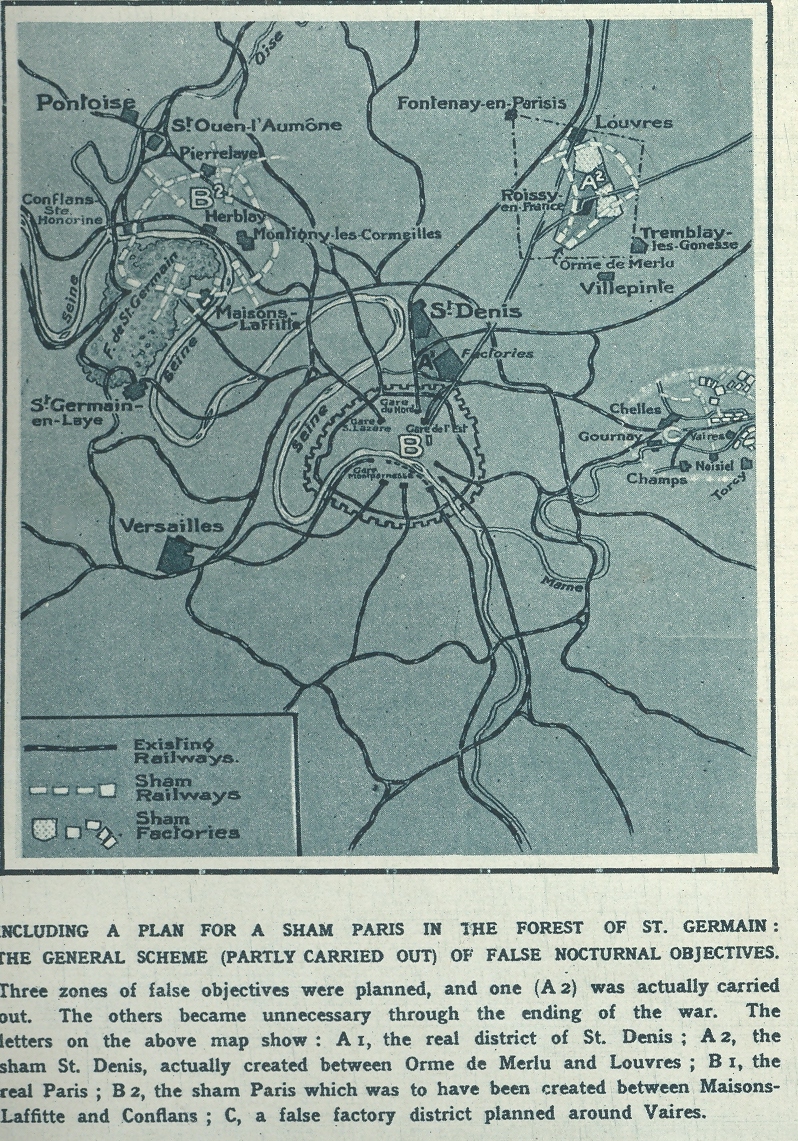
    There is no doubt a history that could be written on shadow cities, cities that were built to resemble other cities, cities constructed to serve as a deterrent or double, cities set to deceive, cities constructed to be experimented upon. Some were built ot be destroyed.  Like Paris–or “Sham Paris”. 

    Paris sham detail sham

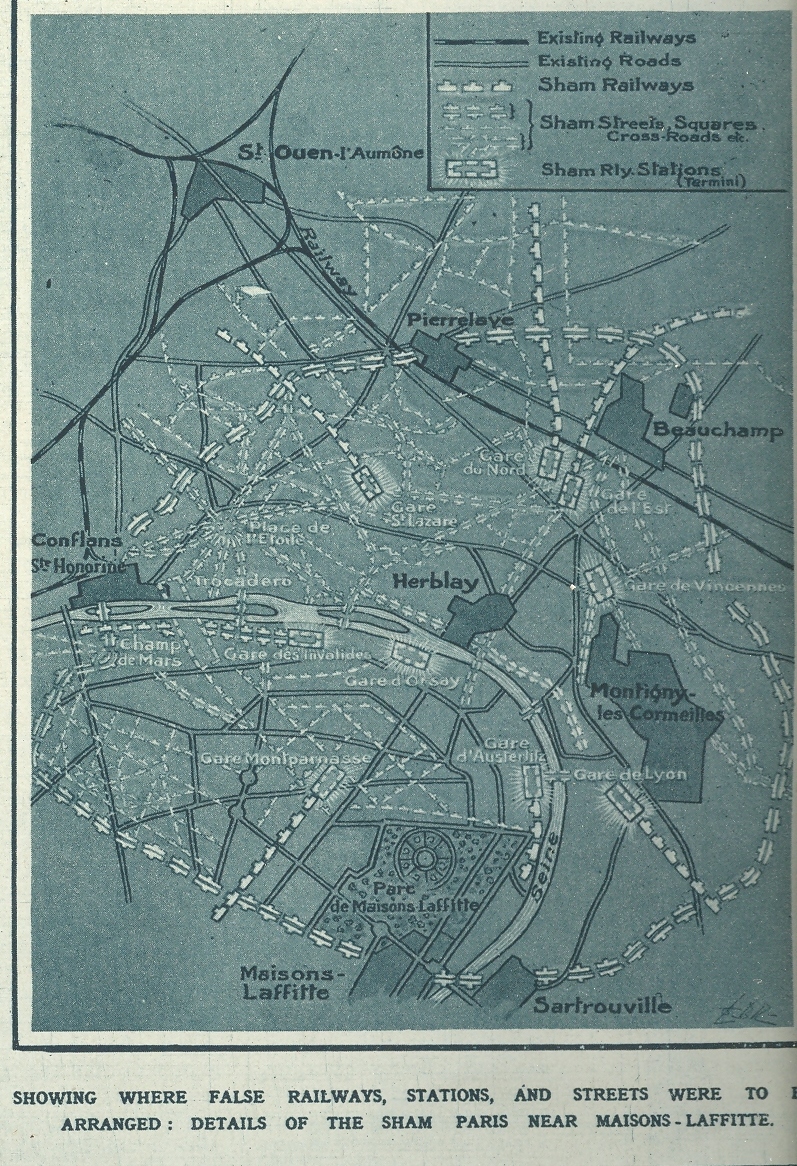
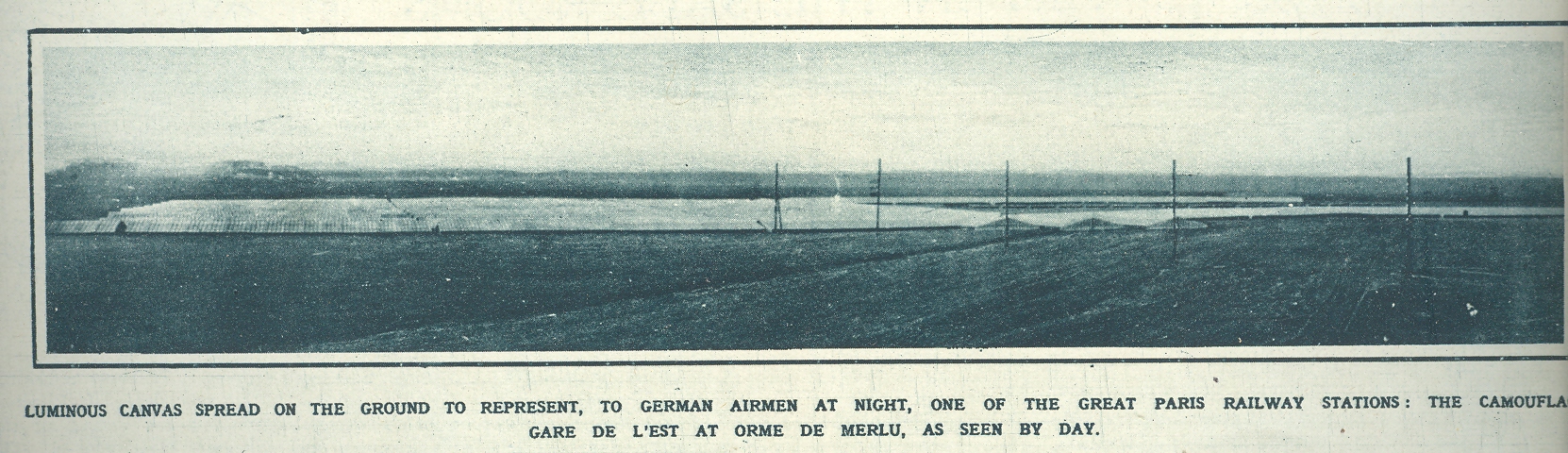
    Augustine cleaved two cities from one, the good and the doomed, in The City of God.   The powers that were in Paris at the end of World War I tried to do exactly that—to create a Sham Paris located on the outskirts of the real city—it was to be doomed, offered with confusing lights and displays that would disorient German aviators into bombing and destroying it rather than the real city. 

     Blo--june 18--paris overview

    Of course these were also the days of pre-RADAR, and of aviators simply holding a bomb by its fins and letting go once a target was in sight, so the possibility of causing this sort of dissonance was at least palpable. The planes held the pilot and a lot of fuel, and not much flight weight was devoted to bombs, so the bombing runs were necessarily quick and comparatively light (by standards of just a decade later).  So the idea of a Sham Paris might’ve, could’ve sort’ve worked, maybe; but not really.  It had a very strong, fatal, feculent (thank you for this word, Mr. Depp) air about it, like that misty doomsday smell that lifted the Maginot Line out of the earth and dumped it in the dim and stinking past. 


    Blo--june 18--paris long2

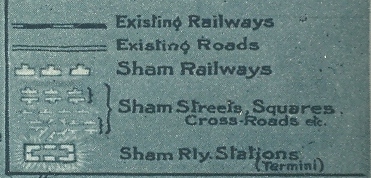
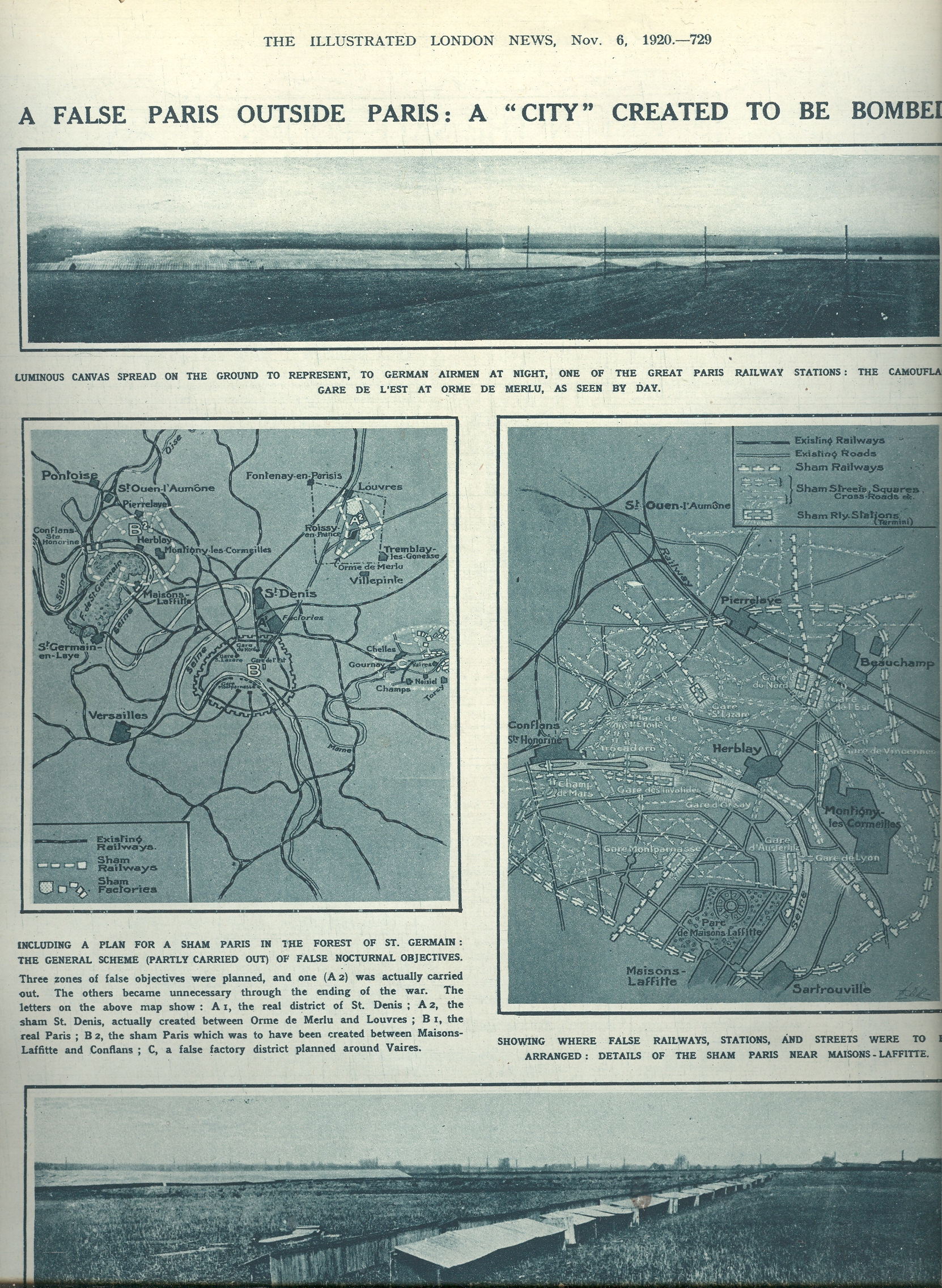
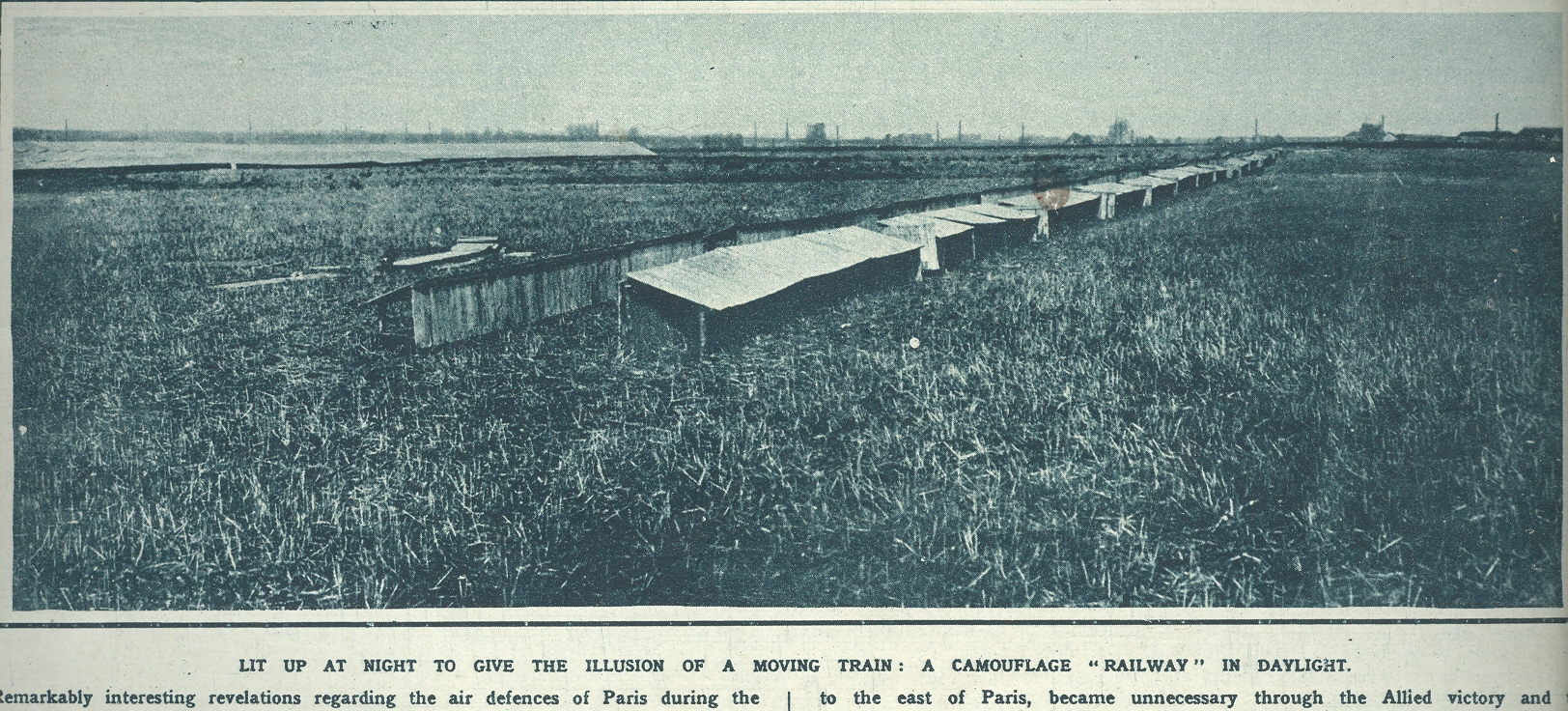
    The story of Sham Paris may have been “broken” in The Illustrated London News of 6 November 1920 in a remarkably titled photo essay, “A False Paris Outside Paris—a ‘City’ Created to be Bombed”.  There were to be sham streets lined with electric lights, sham rail stations, sham industry, open to a sham population waiting to be bombed by real Germans.  It is a perverse city, filled with the waiting-to-be-murdered in a civilian target.  Sham Paris seems to me like a reverse city.  And a reverse city in the manner of the cities created by the guilty Cain and Romulus—these two were murders who created cities; Sham Paris is a city of created murders to save the innocent.

    Paris sham detail
    Sham Paris was only partially constructed before war’s end in November 1918.  

    Paris sham 3

    (All images here are clickable and can be enlarged.)

    Blo--june 18--paris long


    Its important to distinguish Sham Cities from hidden cities, like Project Iceworm (the underground city built in Greenland) or Mt. Weather (the not-so-very-secret secure and safe bunker for the governing class in Bluemont, Virginia) and so on.  Sham Cities were definitely constructed for deception and/or destruction.  The next city we’ll take a look at:  Survival Town, Nevada.

  • Episodes in the History of Fat: Lard, Art Made of Fat, Fat Bullets, Sham & Disappeared Fat

    JF Ptak Science Books  Quick Post

    As it turns out there was–in Real Life–a Fat Bank opened somewhere in our fair land, a fat bank made for people to store their own fat from surgical enhancement procedures that could be used sometime in the future to be used elsewhere in the depositors’ bodies. 

    (I ‘d like to open a bank for pronouns that are used to end sentences.)

    And as it turns out I’ve written a few times on this blog about other Fat Matters, all of which are as truculent-friendly to reality as this Fat Bank thing, but less embarrassing.  Here are most of them:

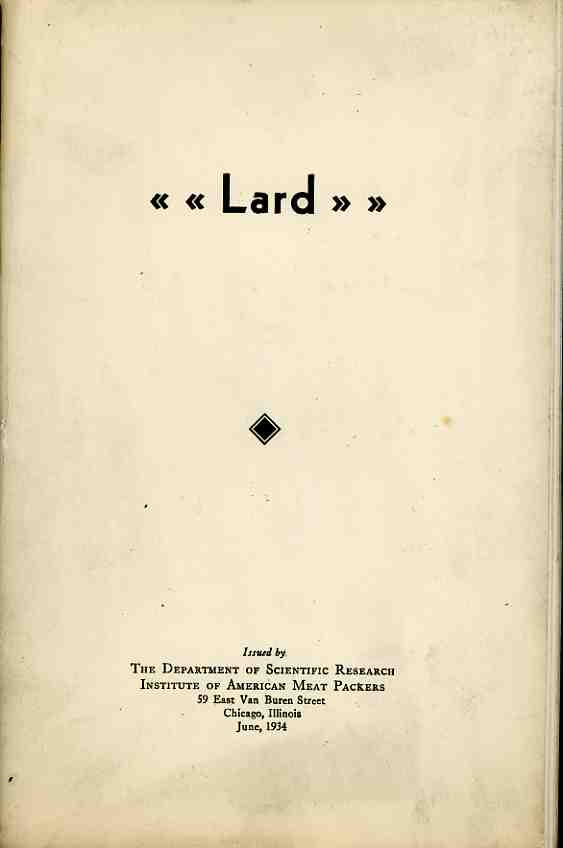
    Fun with Fat  Lard 

    0-blog---Nov 22 lard093


    Fat Redux, Redux:  Fat Bullets, 1945.

    000-ebay--Nov 8 fat025


    ·Posted by :

    ·in:

  • Blank, Empty and Missing Things, #35: Empty Trees

    JF Ptak Science Books   Post 1614

    Blank trees866 sm detail

    Blank trees866

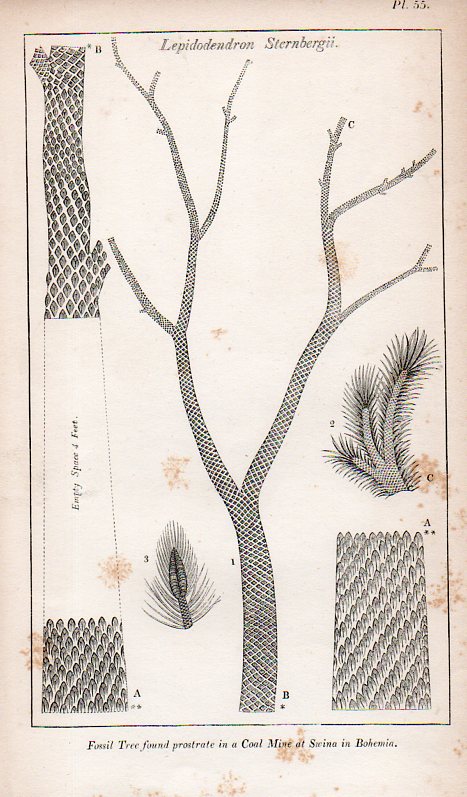
    Continuing a longish thread on Blank, Empty and Missing Things is this very short notice on a beautiful illustration from (Rev.) William Buckland (1784-1756, Reader of Geology at Oxford) in his Geology and mineralogy : considered with reference to natural theology

    Blank trees865

    I think it is a remarkable thing, a beautiful piece of explorative artwork when taken out of context.

    The description of this engraving from volume I, page 466:

    Buckland is well remembered for his analysis of the fossil remains found in Yorkshire’s Kirkdale Cave, which he identified as hyena (and its prey) remains from earlier prehistoric times rather than having been swept from the tropics to England by the waters of the Great Flood.  Of course, Buckland himself held that opinions years earlier, along with many other geologists…as some actually hold today, somehow, in creationist fits of intentional delusion.1

    Notes

  • Fabulist & Fantastic Architecture: Alice in Wonderland to the Library of Immanuel Kant. Sergy Tyukanov.

    JF Ptak Science Books   Quick Post

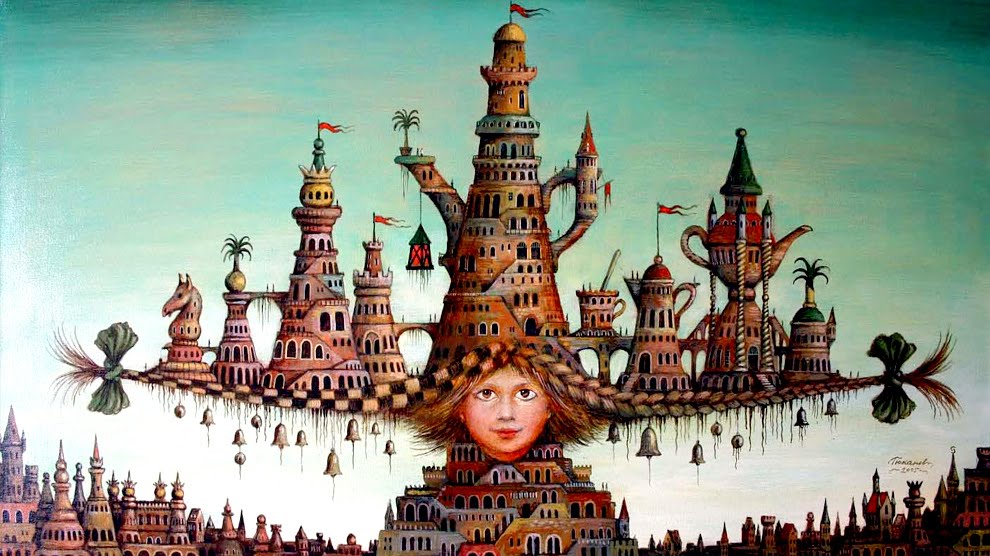
    I just wanted to share in this very quick posting the extraordinary work of the Russian artist Sergy Tyukanov (b.1955), who paints/etches/draws fantastic images calling freely on legendary literature, folktales, history, philosophy, as well as the work of some earlier masters (as in the Bruegels and Bosch, seen in the last two images).  If you follow the link to his website you’ll find that some of these images–which in their nature seem to be telling you that they are enormous works–are actually very small, on the order of one square foot.  Fabulist artists like this, especially those anthropomorphizing their subjects, have always been of great interest to me.  ANd I’ve got to say that Tyukanov’s architecturals remind me very strongly of ideas in the 18th century French visionary architects like Lequeu and Boullee and Ledoux. 

    Sergey Tyukanov (website)


    Alice in Wonderland
    http://www.tyukanov.com/gallery/Etchings/n74.project%20of%20the%20library%20of%20emmanuel%20kant%2013,3x17,8l.jpg
    Library of Immanuel Kant
    http://www.tyukanov.com/gallery/Etchings/n91.moon%2018,5x13,2.jpg
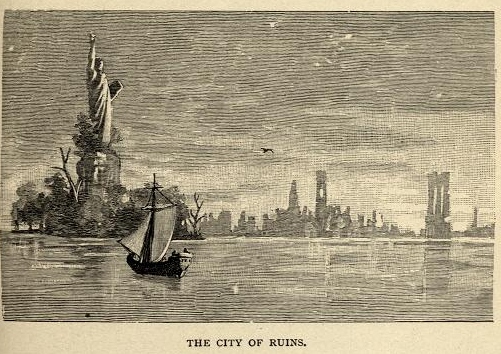
  • More of NYC Destroyed in Explorations of the Future–“The Last American”, 1889

    JF  Ptak Science Books   Post 1615   Part of a series on destroyed New York City that includes New York City: Attacked by Tentacled Flying Saucers, Giant Flying Snakes, Glaciers, and Mining Missile Space Aliens, 1929-1941 and H-Bomb Wipes out Brooklyn, among others.

    NYC in ruins  statue lib
    John Ames Mitchell created quite a world for himself in 1889.  The world he saw in the year 2851 turns out not to support America, or Americans, seeing as how we ran out of luck and envy and possibility and Life.  It is slightly ironic that Mitchell (1844-1918) would write so much about dystopic views of America’s dead culture, as he was the creator and first editor of (the first) Life magazine, a journal dedicated to far less weighty matters (and an early popularizer of populist views of American culture by Dana and Rockwell). 

    NYC in ruinbs  Brooklyn bridge
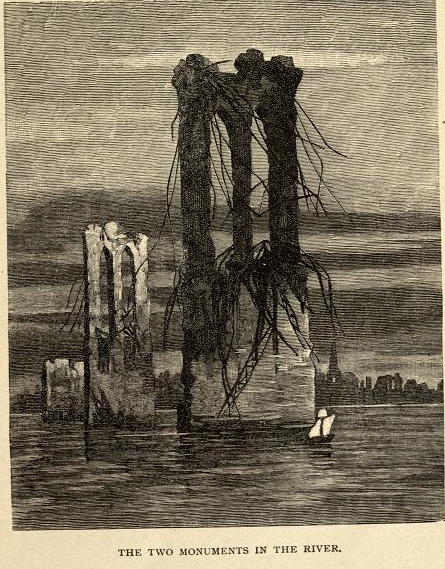
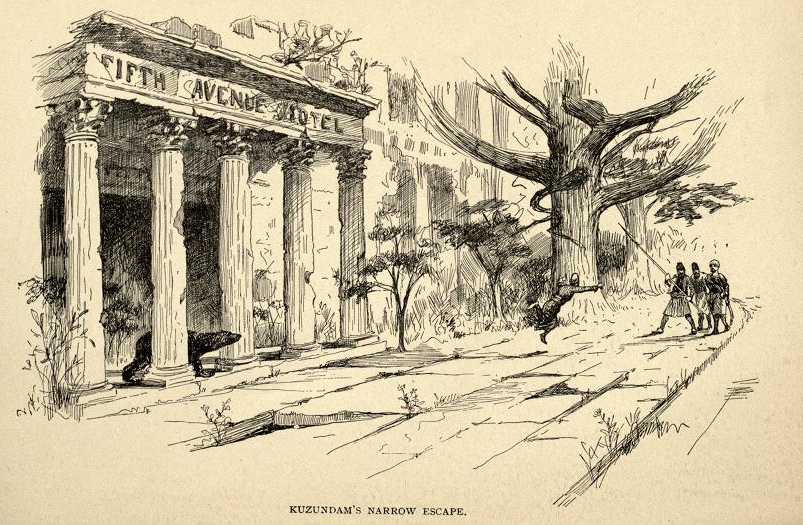
    The Last American (a slight book of 28 pages) is presented as the journal of a Persian explorer (Kahn-li)  a thousand years or so into Mitchell’s future, set off to explore the outer reaches of at-that-time known world, rediscovering the Americas, again.. Kahn-li was intrepid and accomplished:

    “…Curator of the Imperial Museum at Shiraz, and (a)uthor of ”’The Celestial Conquest of Kaly-phorn-ya” and of “Northern Mehrika under the Hy-Bernyan Rulers” The astounding discoveries of Khan-li of Dimph-yoo-chur

     have thrown floods of light  upon the domestic life of the Mehrikan people. 
    "He little realized when he landed upon that sleeping continent what a service he was about to render history,
    or what enthusiasm his discoveries would arouse among Persian archaeologists.
    Every student of antiquity is familiar with their history.
    "
    NYC in ruins  wall st
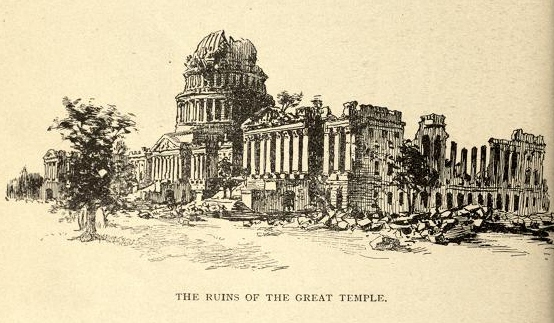
    The images of New York City in ruin, in advanced decline, in an imagined future of slow death, have always
    seemed haunting to me. The images in The Last American are drawn by the author, and in some later editions
    of the work are supplemented by occasional designs and a few extra images. But Mitchell's work is
    pretty impressive. And daunting.

    NYC DC

    Mitchell also has a nice way of showing how his explorers were trying to make sense of the ruins, figuring out what their intended uses were.  For example, the ruins of the Brooklyn Bridge were more a monumental temple, because the distance between the giant structures and the shore were (for them) to great a span for the things to be part of a bridge.  There’s some good, solid, imaginative imaging going on here. 

  • The Game and Play of Chess, a Morality Play: 1474

    JF Ptak Science Books   Post 1616   (Part of the History of Lines series.)

    It turns out that one of the most famous and iconic books on chess is really not about chess at all.  Jacobus de Cessolis, (Jacopo da Cessole, c. 1250 – c. 1322) the author of  The Game and Playe of the Chesse1, found its way into print in the very highly capable hands of William Caxton in 1474 (“Fynysshid the last day of marche the yer of our lord god. a. thousand foure honderd and lxxiiiia”) and into a second edition in (about) 1483. Caxton produced a spectacular, beautiful work on moral and ethical virtue and challenge, using the game of chess as the foundation for metaphor and aliteration of the wide classical literature that it calls upon.2.  The book doesn’t tell you how to play–but it does instruct on how to live.  A great aid to the book’s power are the sixteen strong woodcuts (“repeated to make twenty-four figures”3), which mo doubt were a strong influence on their viewers.

    I have included this entry in this blog’s History of Lines series for the connection between the lines of morality and the lines of he chessboard and the movement of its pieces, which were at last the outward and symbolic basis for the ethical lessons of the work if not used in actuality. 

    Notes:

    1. The book was one of the first books ever printed in English, and was probably the first morality play printe in the language. It was reprinted many times, later under the title of Liber de moribus hominum et officiis nobilium super ludo scacchorum (‘Book of the customs of men and the duties of nobles or the Book of Chess’).

    2. Arthur Hind, An Introduction to the History of Woodcut, 1935.  Volume II, p. 708.

    3. The commentary quoted here is from the facsimile edition of the original work published in London in 1883 by Elliot Stock with notes by William E.A.Axon

    The authors named in this study include “Saint Ambrose (2 references), Anastasius (1), Avicenna (2), Saint Augustine (9), Saint Basil (1), Saint Bernard (2), Boethius (3), Cassiodorus (1), Cato (5), Cicero (6), Claudian (2), “Crete” (1), Diomedes (1), Florus (1), Galen (1), Helinand (4), Hippocrates (4), Homer (1), Saint Jerome (3), John the Monk (1), Josephus (4), Livy (2), Lucan (1), Macrobius (1), Martial (1), Ovid (6), Paulus Diaconus (1), Petrus Alphonsus (2), Plato (4), Quintilian (3), Sallust (1), Seneca (15), Sidrac (1), Solinus (1), Symmachus (1), Theophrastus (1), “Truphes of the Philosophers” (2), Turgeius Pompeius (1), Valerius Maximus (23), Valerian (7), Varro (1), Virgil (2), “Vitas Patrum” (2).”


  • Deceptive Perception: Giant Super Women of Pulpdom and High Art

    JF Ptak Science Books   Post 1617

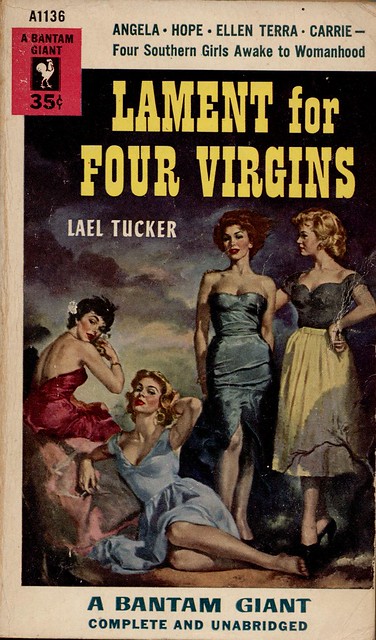
    Sometimes things are just not what they seem to be.  Sometimes they are deceptive and uncommon and somewhat hidden–and sometimes deceptive even to themselves. Sometimes the deception is intentional, and sometimes it is just a mistake, but a deceptive one. In the following cases, the deceptive elements are relating to size–kike the example below, in the cover illustration for the campy (“Southern” with names like those?) troubles of mid-1950’s “girls awakening into womanhood”:

    photo
    If you take a closer look at the reclining figure just abpve the word “giant”, you can see that she is one, unintentionally.  She’s just badly drawn, or something, a victim of foreshortening–we can see that her leg from her knee to her foot is as long as an entire keg of her companions, making this person about eight feet tall.
    On the heels of the eight-foot-tall woman comes one who is far more famous, ultra-famous, really.
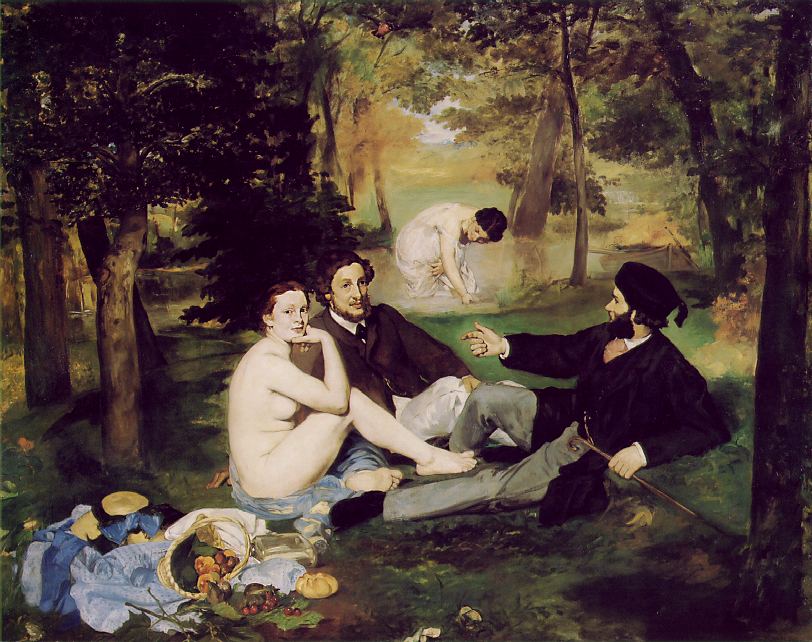
    Le Dejeuner was a scandal when it was exhibited in 1863—Manet painted what he wanted to, unbound by perspective, by color, by composition, and on and on. The folks in the painting were not connected to anything, really, and were unconnected to each other, no one paying any of the others any mind, even when the women were naked.  Nothing seems to be going on—the people are just simply there. 
    Blog--march 7--manet bathers
    This is in itself was a disconnect from previous practices, the vision in painting was about something, and was directed.  Light seems to be coming from a number of different places, and the shadows from the trees reflect this, simultaneously stretched towards and away from the light sources.  The bathing woman in the background, or what used to be background, had she been drawn using proper perspective, would’ve been about nine feet tall.  But what happens here is that there is no foreground or background in this painting, just middle.  It was this collection of abandonments, starting here in the Le Dejeuner in 1863, that ushered in the modern in art. 
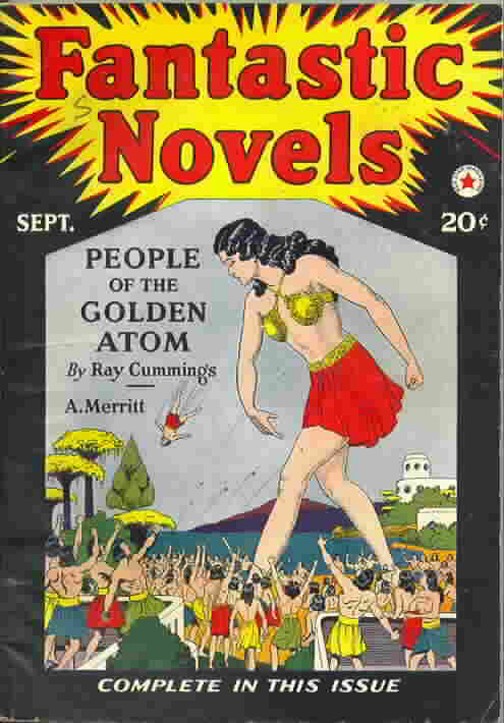
    Then there’s the fifty-foot-tall woman who really isn’t that tall in relation to the people around here. 
    There are times when even things that are made to look extraordinary and plainly, outrageously identifiable as what they are, simply aren’t–and sometimes they’re not even close.  For example, this cover of Fantastic Novels (1921?) seems to tell a straightforward story, but as it turns out the giant is giant but one living within a world in an atom of a gold wedding ring.  (I told a fuller version of the story of thiis here.)  So this giant is a giant but only so in her own world. 
    Man throwing

    Rabelais’ Gargantua and Pantagruel, Hobbes’ Leviathan, the Buddha at Yungang (Shanxi) and Melville’s whale were all pushed to their competitive monsterous edges in the 1950’s, when you were more likely to think of The Bomb and creeping Communism before thinking back to any of these great representations.  And it is also my general impression, having been paging through Life magazine for the 1950’s, that there are some other major, lesser heralds of gigantism, especially if you paid attention only to the advertisements. There were 1950’s colossal characters who were pale imitators of their earlier counterparts–the Amazing Colossal Man and Colossal Woman being two minor mirrors of older ideas–but they hardly contained the colossal ideas that were resident in the earlier creations. (Perhaps part of that is due to having just witnessed the demise of two enoromities in Hitler  Stalin.) But this woman seems to be the largest of the lot–I make her to be about 100 feet tall.  There’s really nothing deceptive about her, except of course that this giant is only a head. 

    Monumental television theatre446

Recent Posts

Archives

Categories