A Daily History of Holes, Dots, Lines, Science, History, Math, Physics, Art, the Unintentional Absurd, Architecture, Maps, Data Visualization, Blank and Missing Things, and so on. |1.6 million words, 7500 images, 4.9 million hits| Press & appearances in The Times, Le Figaro, Mensa, The Economist, The Guardian, Discovery News, Slate, Le Monde, Sci American Blogs, Le Pont, and many other places… 5000+ total posts since 2008.

  • Manuscript Material on the Installation, Operation and Maintenance of the UNIVAC, 1949-1957

    JF Ptak Science Books   Post 1619

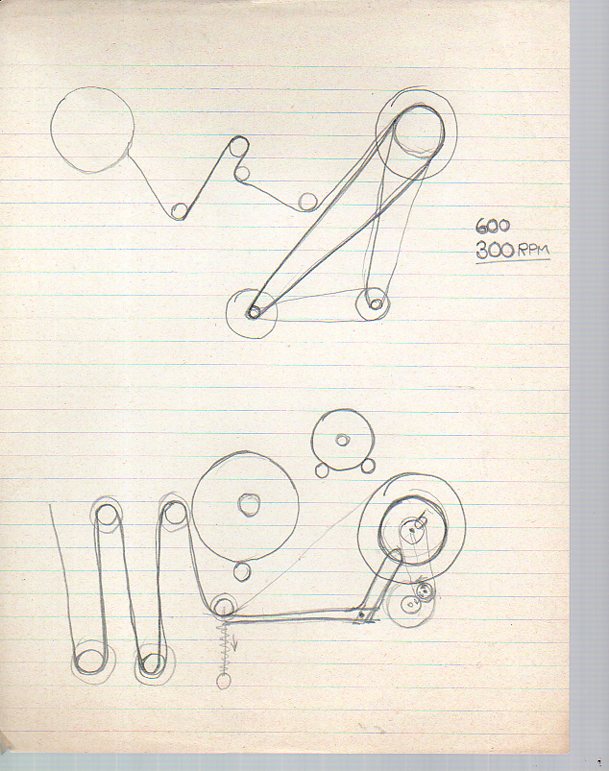
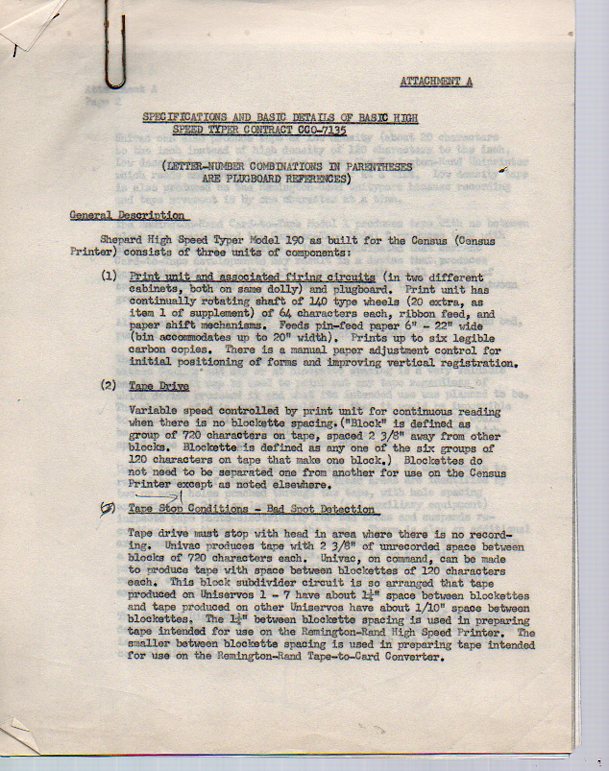
    This is a group of materials from the estate of Ralph Mullendore (see below), an early and integral team member of the electronic computation section of the U.S. Bureau of the Census, who was responsible for the installation and maintenance of the UNIVAC there, at Census.  The papers are on their way to a history of computer science section at the library at North Carolina State University where they will hopefully be enjoyed by any and all who have an interest in the early stages of the maintenance and tinkerings on America’s first commercial computer. It should be remembered that the hands of the man who wrote all of these notes were the same hands that worked on this monumentally important machine, the first of its kind in existence.

    Mullendore a751


    Mullendore f782

    Many mor eimages, below.

    ·Posted by :

    ·in:

  • Pearl Harbor & the Maginot Line: the Sneak Attack of 1932

    JF Ptak Science Books  Post 1619

    See also these posts: The Maginot Line, the World’s Heaviest Bad Idea? and The Invasion of America, 1935

    If the Maginot Line could float, it might have been well represented by the U.S. Navy during the 1930’s (and up to about, say, 7 December 1941).  It was pretty much understood that the previous thinking about battleship power as the mainstay of naval capacity had to be re-accessed following the Japanese attack on Pearl Harbor, and that the aircraft carrier and naval air power were certainly, absolutely, a devastating new weapon and strategic initiative.

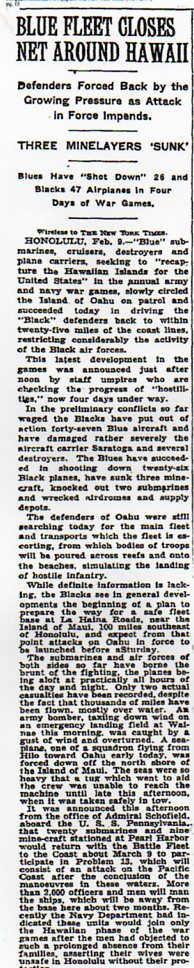
    The power the attack on Pearl by a task force of aircraft carriers had already been demonstrated to the ruling powers of the U.S. Navy and by one of their own, nine years earlier, at 0800 hours on 7 February 1932. 

    During Fleet Problem XIII and Grand Joint Exercise 4 Vice Admiral Harry Yarnell (1875-1959, U.S. Naval Academy Class of 1897), showed the rest of the Navy what the aircraft carrier could do.  In the war game between two naval forces (blue vs. black) Yarnell (commanding blue) chose a different approach in confronting the black team.  Rather than have the battleships duke ti out in horizon-to-horizon shelling, he brought his force of two aircraft carriers (the Lexington and the Saratoga) and four destroyers (all under radio silence) from California to the home base of the black team at Pearl.  Operating beyond the normal shipping lanes and squalls he was able to successfully approach the base without being detected, and launched 157 planes against the ships and the defending aircraft (which was still on the ground).

    Committing imaginary strafing Yarnell’s attacking force decimated the defending aircraft; and in dropping flour-sack bombs the attacking force pulverized the ships docked at Pearl.  It was an extraordinary victory for the blue team, and it should have been a monumental wake-up for all those decision makers involved in running the Navy. 

    In spite of the obvious victory by Yarnell, the exercise was seen as something as a fluke, and the umpires evaluating the manuevers judged the use of the aircraft carrier in a possible attack on Pearl Harbor to be “doubtful”.

    In his review of teh exercise Yarnell clearly stated that the aircraft carrier should become the main arm of the U.S. Navy–it would certainly be so for other navies, including potential enemy navies, thereby putting the U.S. on an unequal footing should this course of action not be followed.  He was certain that he demonstrated that a major change was due in American naval tactics and strategy, and that in order to fight a transoceanic war that six to eight aircraft carriers would be necessary.

    The battleship admirals carried the day, though, saying post facto that their remaining force (and the part out at sea) would have been able to catch up to the retiring aircraft carriers and destroyers and from long range send them sinking, and that the air defense that had been so badly beaten by Yarnell really wasn’t so and that their was actually a strong defending air response.  But probably not.  In any event, the battleship people probably didn’t want to see time and effort and money removed from their own projects, and so the Yarnell results were dismissed,

    Between 1936 and 1940 the U.S. Navy laid keels for twelve ships, including eleven battleships and one aircraft carrier. 

    Yarnell retired in 1939 at age 64, after having been the admiral in command of teh U.S. Asiatic Fleet. 

    When the Japanese attacked on 7 December 1941 they did so using six aircraft carriers (each carry between 54 and 72 planes) for a total of 387 planes (excluding spares and including 48 air patrol Zeroes and six seaplane scouts for reconnaissance).  And that, as they say, was that.

     The funny thing about these results is that the New York Times seems to have been reporting on the progress of the maneuvers throughout their course, over a period of weeks,k which would (if we assume that the commanders and officers in Hawaii were reading the newspapers) tip the hand of a “surprise” attempt, further weakening the case for the battleship folks.  
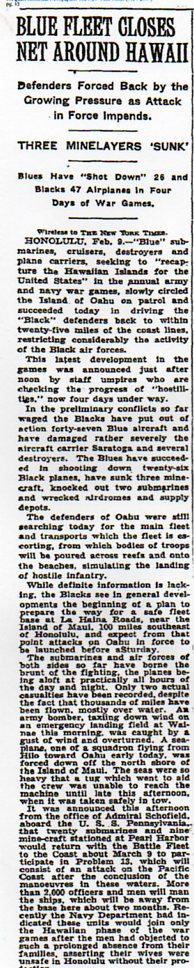
    PD LLC expenses876
    Notes:

    1. “ARMY IS PREPARED TO ‘DEFEND’ HAWAII: Officers Inspect “Black” Defenses From Air — Planes Mass for War Manoeuvres. ATTACK” DUE SATURDAY ” Blue” Forces Under Command of Admiral Leigh Slips Silently Across the Pacific. “New York Times (1923-Current file) [New York, N.Y] 04 Feb 1932: 13. HONOLULU, Feb. 3 — Hawaii’s “Black” army settled down today in its field positions to await the onslaught of the “Blue” force, which is steaming somewhere in the Pacific, en route for its attempted conquest of these islands. Defense arrangements have been completed in every sector and installations have been inspected from the air by a staff of officers and reported satisfactory.

    “BLUE FLEET CLOSES NET AROUND HAWAII: Defenders Forced Back by the Growing Pressure Wireless to THE NEW YORK TIMES.” New York Times (1923-Current file); Feb 10, 1932; ProQuest Historical Newspapers: The New York Times (1851-2007) pg. 15.
    ·Posted by :

    ·in:

  • Curious Cuts: Books in Bosch

    JF Ptak Science Books    Quick Post

    Bosch cure of folly book detail
    Books are a favorite symbol, a venerable icon, a useful tool for developing ideas in Renaissance paintings.  They do sometimes make unusual appearances, this time–and not too unexpectedly–in the work of Hieronymus Bosch.  The painting, Cutting the Stone, (also called The Extraction of the Stone of Madness or better yet The Cure of Folly) was completed by Bosch in 1494 and lives today in the Prado. 

    Bosch cure of folly
    Bosch was at the very least a very curious character, hardly a man of his time–he seems difficult for us to place in the 15th century given the extraordinary range of his deep imagination.  He seems to be more a man of the modern times rather than one of the Renaissance.  I mention that the painting is in the Prado, finding its way there from the collections of Spanish sovereigns, who collected Bosch as a deeply Christian painter who depicted the travesty of sin and moral neglect rather than his own deep fantasy.

    Bosch cure of folly brain
    The scene is described by the inscription above and below it:

    Meester snyt die keye ras
    Myne name Is lubbert Das

    (in English: “Master, cut away the stone
    my name is Lubbert das”).

    The man in the chair, the man undergoing some sort of cranial/brain surgery is an everyman of sorts, a Dutch Everyman Fool named Lubbert (translated to “castrated dachsund”)..  A charlatan medico stands and removes symbols of lunacy and foolishness from his brain, images of flowers standing for the fool’s stone of long folklore.  The medicine man wears an inverted funnel for a hat, a symbol for emptiness, nothingness.  Likewise his purse is stuffed with straw, another iconic display of greed compounded and gaining nothing at all. 

    But what I am attracted to right now in this painting is the woman on the right balancing a book on her head.  It seems to me to be a very rare case of a Renaissance image of  a book displayed in this manner–usually books are simply held and are symbols of learning or wisdom or piety.  In this case, the woman is just part of the general folly which is the concern of the quack surgeon, a closed book (impossibly?) balanced in tribute to the craziness before her, perhaps hoping for the words to seep through the pages and into her own head. 

    There are a number of other images of this operation, which was in its way a standard procedure for the relief of insanity, or depression, or lunacy, or basically of any mental complaint or “error”, which can be found (along with description) on the bioephemera blog, here. 

    For example, there is this scene of mass extraction of the stones of madness by Peter Brueghel (painted ca. 1550)

    Bruegelmadness.jpg

    Its a pretty miserable scene.

    Again, I’m really just after the book in the Bosch. 


  • When the “Standard” Wasn’t So–Flying Upside Down, 1913

    JF Ptak Science Books   Post 1565

    Nearly everything that we have or use or see today was at one point “new”; standard practices, commonly used implements or technologies or ideas were at some point a breakthrough, wholly uncommon, completely non-standard. This thought struck me while breezing through an issue of The Illustrated London News for September, 1913, and seeing the following headline:

    Aeroplane upside down626

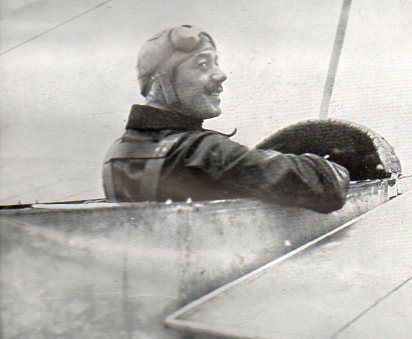
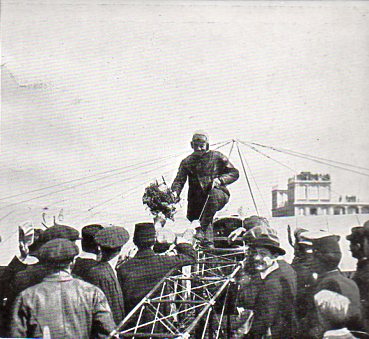
    The Wright Brothers made their powered flight in 1903, and  it is a testament to the difficulty of performing  upside-down flying that it took nearly 10 years to accomplish.  And so it happened, Adolphe Pegoud (1889-1915) accomplishing the feat 21 September 1913–he was greeted everywhere as a pioneer and a hero.  Flying upisde down, looping he loop (the distinction of “first to do this belongs to the Russian Nesterov who performed it in Kiev about a month earlier), doing the tail-slide, performing the vertical S, were all major feats, and all performed by Pegoud during this month of high activity.  But the people who seemed to take the quickest and most particular interest in these “stunts”  were the military folks, who instantly recognized the application of the maneuvers for aerial combat.  And as quickly as they saw that the maneuvers needed to learned for offensive purposes, they recognized that they must be mastered for defensive reasons, as well.  

    Aeroplane upside down625

    Aeroplane upside down624

    Aeroplane upside down623

    New York Times reported on Pegoud so:  (via The Daily Planet at the Smithsonian Air and Space):

    “Pégoud prepared a Blériot monoplane fitted with a Gnome engine and advised half a dozen friends of his plan. They did their utmost to dissuade him, but he invited them to witness the performance, and this morning at the Juvisy aerodrome he climbed into the machine and rose. At the moment of his departure he was by far the calmest person present.

    He rose to a height of 3,000 feet and then turned the nose of the machine earthward. For 200 feet it fell like a stone. It then turned inward till it was flying on its back, after which it rose perpendicularly upward. Then it completed the circle by regaining its normal flying position, having accomplished an apparent impossibility.

    The aviator came again to earth absolutely self-possessed. When he alighted from the machine his first remark was “I wished I had gone another thousand feet up. Then I could have done it twice.”

    The issue of Sciewntific American for (October, 1913)

    1913 Scientific American October 18-Pegoud;Siberian Mam
    Image Source: Pionnaire GE
    Long ago Sir Thomas Browne mused on what it was that the Sirens’ song might have been, trying to imagine and capture a source of vast imagination; it is equally complicated trying to understand how something we take so deeply for granted today was absorb when it was seen for the first time. 
  • The Savage Distress of Women in Science (Fiction); Pulp Covers, 1930-1960

    JF Ptak Science Books   Post 1566

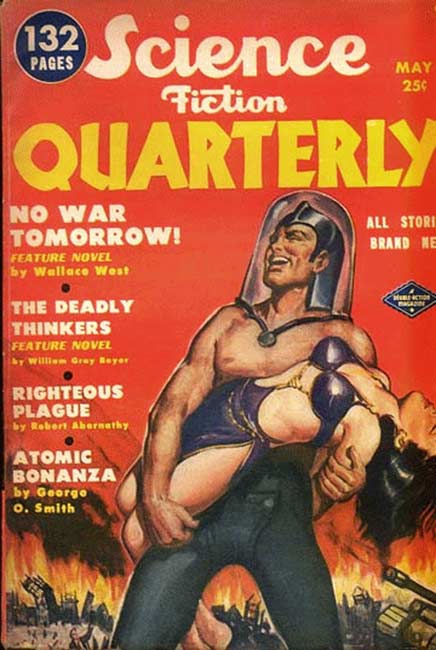
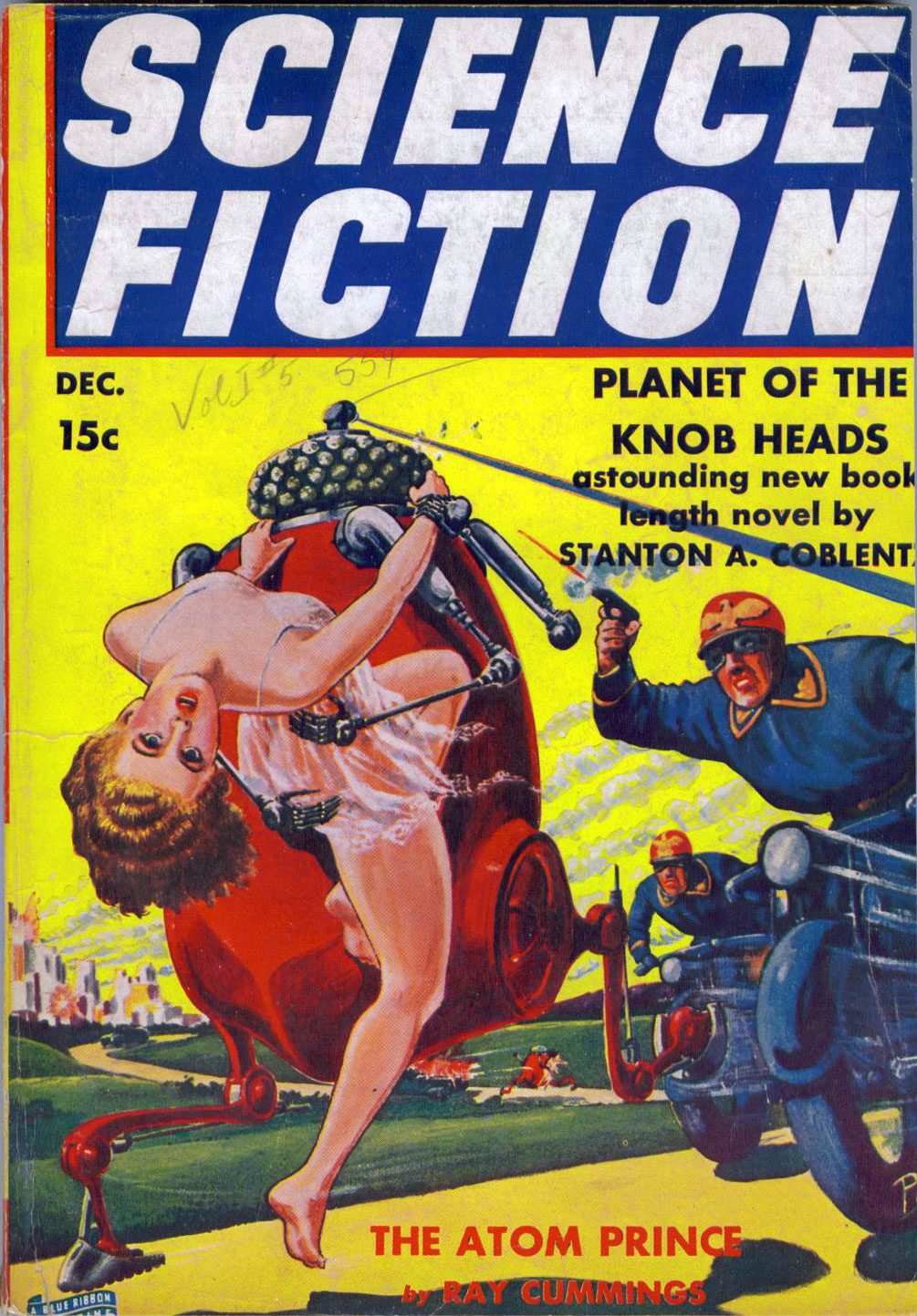
    According to most of these big, spongy pulp magazines, women were made to be rescued, and rescued not only from Enormous Situations, but also from unnameable, unknowable Enormous Things.  I guess they were slightly soft-porny, or at least the cover art was, attracting young readers by promises of  an “easily read” with excitement and voluptuous women in need of saving.  It was yet another turn on the fateful screwing of the tale of the damsel in distress, seen and heard countless times in art and story.  Only in these sci fi mags the damsel showed a lot more skin–it is extraordinary how cleavage attracted so much alien danger/romps.

    http://farm3.static.flickr.com/2671/3835444058_13c02d1279.jpg

    http://3.bp.blogspot.com/-JuUxvfWOlns/Tfx9MIjUoZI/AAAAAAAAKNs/D1M99vnx25M/s1600/sci%2Bfi%2Bcover.jpg

  • The Statue of Liberty as a Billboard, 1888

    JF Ptak Science Books   Post 1567

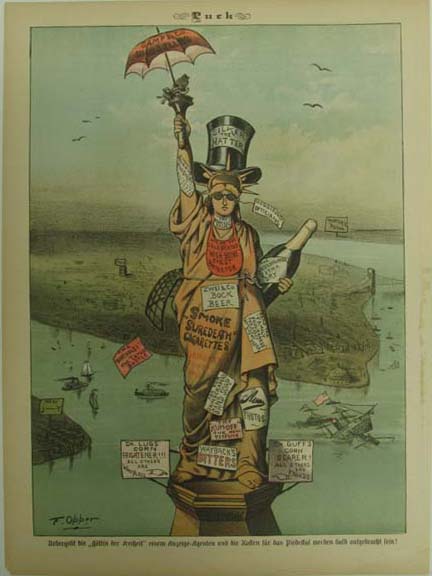
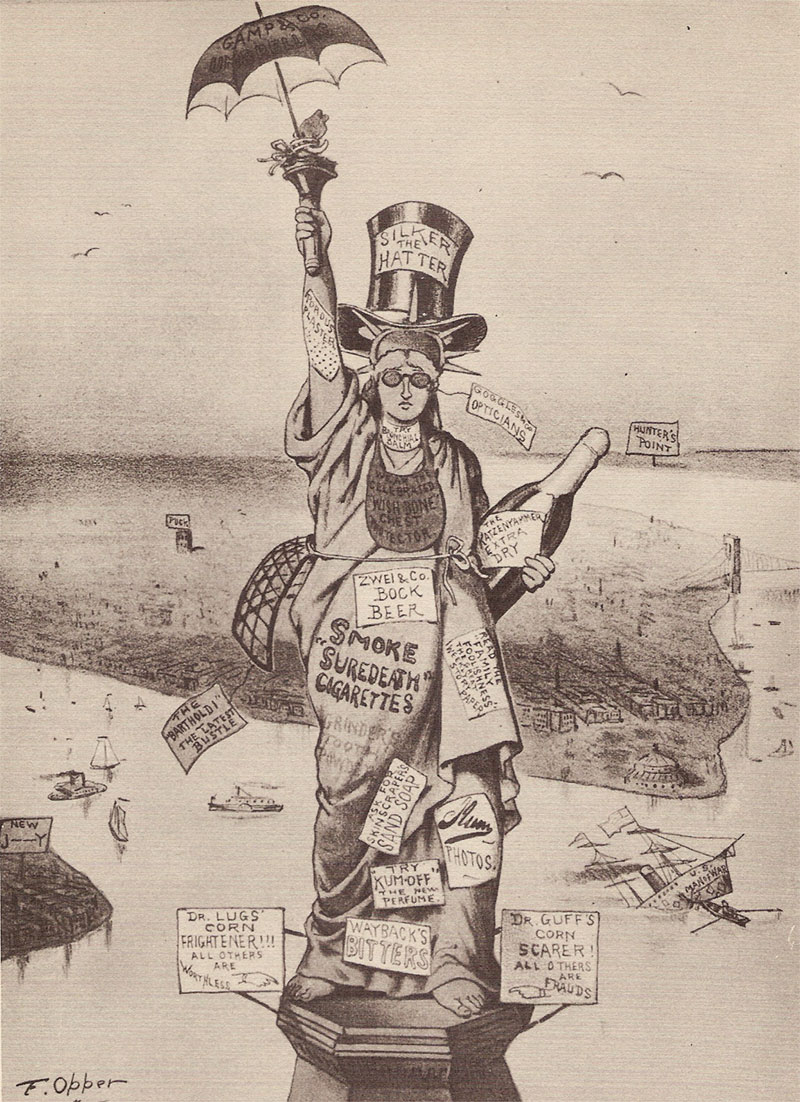
    This image of the near-future Statue of Liberty (“Liberty Enlightening the World”) appeared in the German version of Puck magazine in 1888–since the statue was officially dedicated on 28 October 1886 it didn’t take the cartoonists and social satirists very long at all to get around to using Lady Liberty/Libertas as a backdrop for their message.   And the message here was the creeping advertising age, which was just the shroud of an advancing consumerist society, because there wouldn’t be that many ads if there wasn’t so much material fighting for so many consumers. Advertising was beginning to creeping in everywhere–and here the cartoonist foresaw a near-future in which the Statue of Liberty was a pure advertising vehicle, and as it turns out, most of the stuff advertised there was junk. 

    http://www.printsoldandrare.com/wallstreet/1156ws.jpg

    Here’s another version in glorious black and white

    http://2.bp.blogspot.com/_sGYULzoQCgA/R1DsrSOectI/AAAAAAAABNA/-jpU7nyymuA/s1600-R/1885-puck-magazine-Predicti.jpg

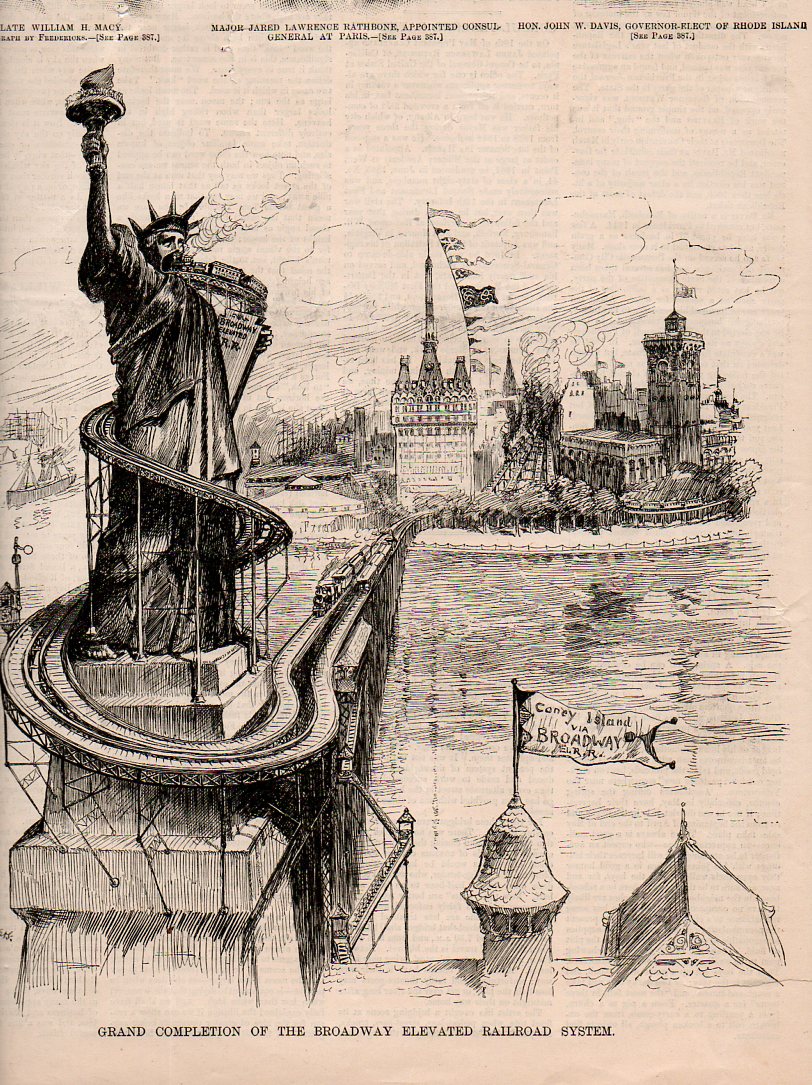
    Another intriguing image of the Statue of Liberty of the future appears below, and described in an earlier post on this blog, here.  Although not being used for advertising, she has become just another part of the landscape, swallowed up by the advancing transportation age. 

    Statue liberty407

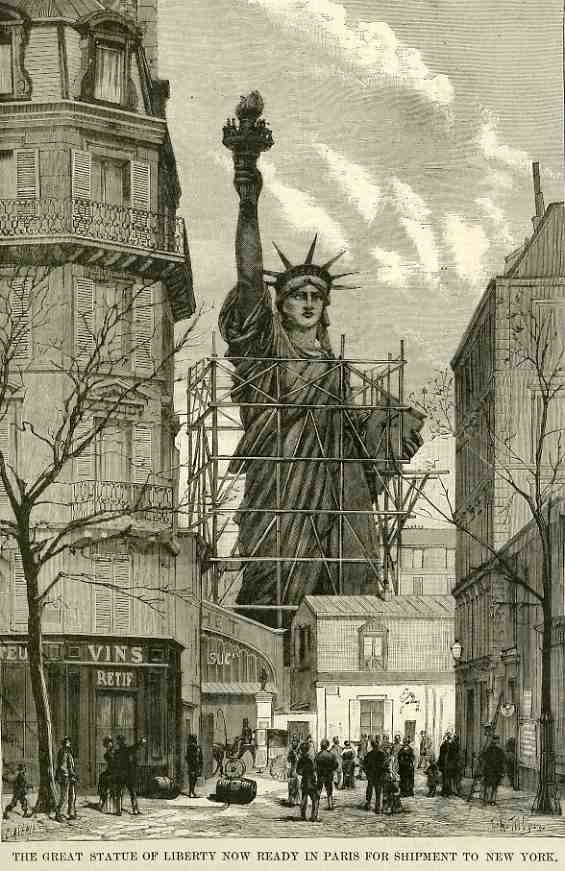
    And although it looks as though Lady Liberty is being packed away as part of a mothball fleet of iconic Americana, this image shows her in France, being constructed (for deconstruction), in 1884. 

    0 blog jan 22 statue409

  • A Store of Memory to a Memory Itself: the First Image of a Bookstore?

    JF Ptak Science Books   Quick Post on the History of Memory

    Bookstore628
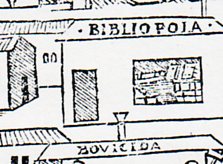
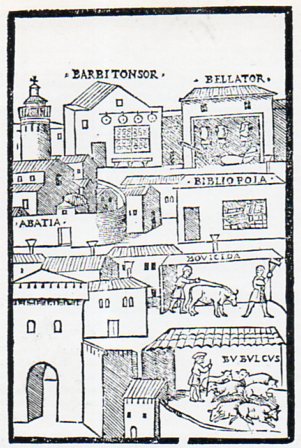
    About a hundred years after the invention of moveable type printing, there appeared–in 1562–this woodcut in Lodovico Dolce’s Dialogo nel quale si ragiona del mondo di accrescere e consertvar la memoria, showing a number of different sorts of high-Renaissance businesses/shops, including one of teh earliest images of a bookstore. 

    This sort of business has survived for 450-odd years, and longer, without momentous change for 95% of that time.  The store of memory is giving place to another memory machine, a digital one that exists mostly in the clouds and electrical aether, growing more accessible by leaps and bounds, become less and less bound to cumbersome end-user machines, growing into what must be a biological interface. 

    It is somewhat ironic that the first-ish appearance of a bookstore takes place in a book on memory/mnemonics  written by a poet. The replacement of the bookstore and of the book itself as the principal storehouse of knowledge is hardly a poetic matter, in spite of what the poet-izers in charge of this restoration might say. 

    Bookstore627

    It will be a maatter of debate regarding what the last bookstore will look like.

    I suppose the larger issue is the future of the history of memory. 

  • The Division of Technology: Different Forms of Social Media Debate, 1893

    JF Ptak Science Books  Quick Post

    Phonograph 1893


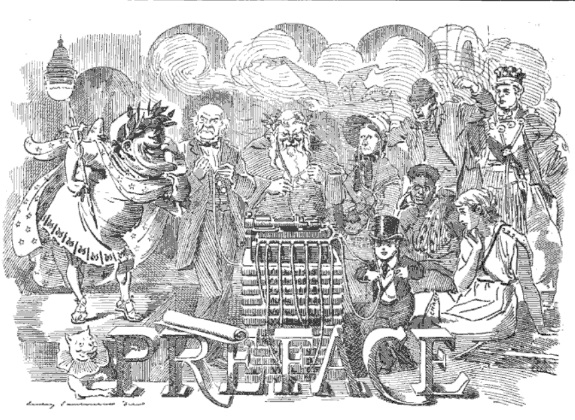
    I found this image flipping through an issue of the London Punch for 8 July 1893.  It shows a group of people gang-listening to a phonograph, with Mr. Punch holding court. The phonograph was already into its third decade (invented by Mr. Edison in 1877 with the patent granted in 1878) and was becoming massively popular, with the prices for the machine and the wax cylinders that powered the interest dramatically falling so that it was within reach of the working middle class.

    The image was used as a header illustration to the opening of the new volume for the second half of the year, and was an introduction to the table of contents for the 300-odd pages that followed, and its legend reads in part:

    “The Penny Phonograph,” pursued Mr. Oracle Punch, “is now prodigiously patronised. For the popular penny you can hear an American band, a Chevalier coster ballad, the ‘Charge of the Light Brigade,’ a comic song by ‘Little Tich,’ or a speech by the Old Man eloquent. No; for the latter I believe they charge twopence. That is fame, my Pantagruelian Premier…”

    You can sense that Mr. Punch is more than a little wincing with his faint praise.  He does take exception to the lightness of the experience, as well as the cost.  He contends in a way that we experience today that the printed media–his own magazine, a “Funograph”– is more complete and the real voice of wisdom: 

    “But in my Funograph—charge the unchangeable Threepence—you can hear the very voice of Wisdom and Wit, of Humanity and Humour, of Eloquence and Essential Truth, of Music and of Mirth!

    And while Mr. Punch might seem to be talking about the phonograph, he is addressing his own Punch: 

    “Sweet lady,” responded the Oracle, with gentle gravity, “there is guidance here for all who will listen; heavenly Charity and diabolic Anarchy, eloquent Statesmanship and adventurous Enterprise, scared Capital and clamorous Labour, fogged Finance and self-assertive Femininity; for the motley and many-voiced Utopia-hunters who fancy they see imminent salvation in Imperial Pomp or Parochial Pump, in Constitutional Clubs or County Councils, in Home Rule, Primrose Leagues, or the Living Wage, in Democracy or in Dynamite, in High Art or Mahatmas, in Science or in Spooks. Take your places, Ladies and Gentlemen! Charity first, if you please, with Father Christmas to her right, leaving room for the little New Year on her left. Listen all, and learn by the various voices of that many-cylindered, marvellous Funographic Machine…

    Advances in the technology of communication have always caused debate–the availability of the printed book was going to make obsolete storytellers and theater, the telegraph would end letter- and book-writing, the telephone would end the telegraph and letter writing and decreased the collective intelligence by shortening the time of thought in communication, the radio would end the telegraph and letter writing and the theater and perhaps books, the television would end radio and etc., vast increases in social media will end privacy and reflective time, and so on.  The advances certainly did doom the form of communication that they trumped, mostly, though what they did to the actual communications part was change it, not end it.   And although Punch wasn’t saying that the phonograph was going to do away with anything at all, he was saying that he felt it inferior.  And for you to buy his magazine.

    The last bit on the ruminations of the impact of social media on privacy and reflection is something that I do believe to be real, and this in spite of all that I know about the history of change in communications; but here I think the medium might have so much “message” that there might not be any at all, given the enormous amount of data units that can be delivered into our consciousness and the limited amount of time for perception (let alone understanding).  And  this is just the beginning, the most primitive stages of vast and pervasive communication.

    And as I write this I wonder if I’m not sounding like a sniffy somebody writing about the impact of the telephone in 1880.

  • Absurd Third–Interesting Absurd, Dadaist Bits Found and Collected

    JF Ptak Science Books    Quick Posts

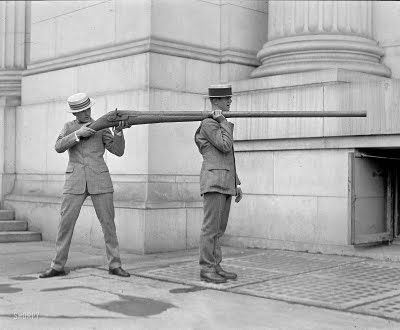
    These are some images that I’ve bumped into and saved for possible use in a post, but they’ve just not fit in anywhere, yet.  Many of these images were found at the fantastic Fantomatik blog.  

    Greg Segal:

    Absurd aug 3greggsegal7

    Fabulous luxury by Martin Parr:

    Absurd aug 3Martin Parr87

    Absurdist aug 3 bangbang8
    Absurdist aug 3 c
    Absurdist aug 3 d

  • A Note on the Future of the Bookstore

    [The question on the future of the bookstore was put to me an hour ago–this is my reaction. It follows a post I made just yesterday on a related topic.]

    I’ve owned a specialty rare/uncommon bookstore for the history of physics and math since 1985.  From 1985-2002 it was a brick-and-mortar location that existed mostly in Georgetown, D.C., with a warehouse in Silver Spring, Maryland. At one point it may well have been among the largest/most complete stores of its kind in the U.S.  Now it is entirely online, and even with that, most of the business is very direct offers to particular institutions. My online store was inaugurated in 1999; by 2000, I noticed that in-town customers were buying things of the store online, and foot traffic in the store began to decline.  By the Spring of 2002, it was very clear that–so far as making sales were concerned–the walk-in store would not make economic sense, tomorrow.  It seemed that the future arrived very quickly.

    So it goes, as Mr. Vonnegut said.  In Georgetown in the mid-1990’s there were perhaps a dozen bookstores; after I left, in 2002, there were four, including a fine new bookshop, a Barnes and Noble, a donation shop, and nationally-regarded antiquarian shop.  The donation shop and the two new bookstores remain, and I think a paperback shop as well.  So far as I can determine, there are no walk-in antiquarian bookshops in Washington D.C.

    The bookstore as devices and stores of memory may become a memory itself.  Or perhaps–like libraries–they will survive with an old name but a new purpose. (And this not in the sense as brand names have survived, like say the Chevy Impala which underneath it all is still an automobile; not so I think for the bookstore.)  But I think they will mostly, entirely, fade away, unless they’re cobbled in with something else of associated value to give them a Dorian Gray-ish future life. Compared to what the bookstore has become since, say, 2000, it enjoyed a relatively unbroken run of success and sameness for the distribution of knowledge and as a potential storehouse of wisdom for some 440 years.  Data distribution is now entirely different, generally bypassing the old method(s) of parsing information out into society. 

    Woodblock books put scribes out of business, moveable type did in the woodblock cutters; books in general were seen as a threat to storytellers and the theater; the telegraph was seen as a curse to letter writing and a bane to prolonged thought, as was the telephone that replaced the telegraph; radio threatened everything and was replaced by television, which taught people what “threat” really looked like.  Then of course there came Pine and email, and the world wide web, and the easy/basically free access to incredible and vast sources of social interaction…and that is only the beginning of the communication “revolution”. 

    Bookstores as stores selling books seems to me to be becoming  a memory in itself–the good or bad of it is not yet the issue. The larger piece of this issue may well be how information is packaged and how it is found, with the subsequent issue of how the stuff is interpreted and analyzed as an end bit, which may well be determined by how it is found or accessed–and that may well be a major cause for concern.

    And so the bookstore might come to pass like the Parisian water carrier.  Even though this might have been the way to get the cleanest, brightest, sweetest, coldest water in all of Paris, it is hard to argue with just being able to go to a fountain or turn on a spigot. 

  • History of Lines–Naive Rivers and Trees, 1670

    JF Ptak Science Books   Quick Post in the History of LInes series.

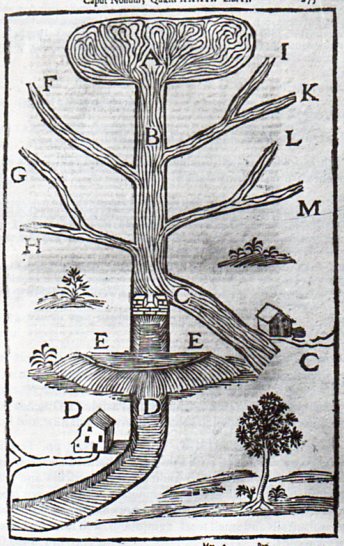
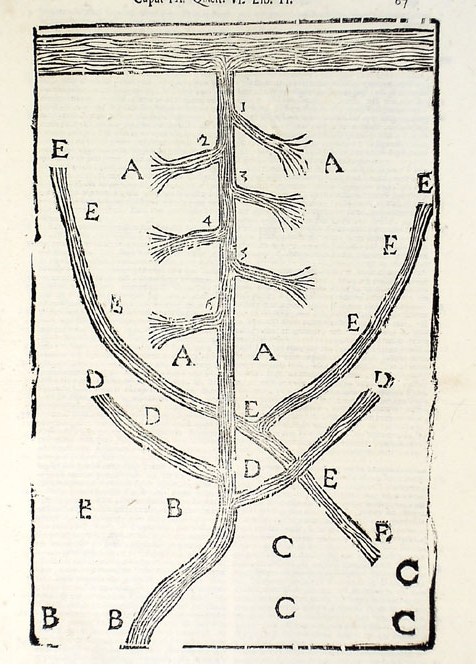
    River629 This lovely river/tree appeared as a woodcut in Franciscus Maria Pecchius’ Tractatus de Aquaeductus, which was printed in 1670-1673.  It actually is nothing of the sort, as it depicts the construction of a dam in a busy river and forms part of a four volume work on the building of aqueducts–ranging from the selection of sites, to financial considerations and of course engineering and materials studies.  Pecchius’ work was the standard of its day, and it also was the cornerstone work on the (Roman) law of such things, presenting a jurisprudence that stretched back a thousand years.

    But the way that the flow of the river is represented makes the image look very much like a tree, in a lovely, naive way.  It might seem a horrible sleight to a work of this importance, but, well, sop it goes–the images, removed from their appropriate context, take on a life of their own…

    River aquaduct 2
    River aquaduct 3

Recent Posts

Archives

Categories