A Daily History of Holes, Dots, Lines, Science, History, Math, Physics, Art, the Unintentional Absurd, Architecture, Maps, Data Visualization, Blank and Missing Things, and so on. |1.6 million words, 7500 images, 4.9 million hits| Press & appearances in The Times, Le Figaro, Mensa, The Economist, The Guardian, Discovery News, Slate, Le Monde, Sci American Blogs, Le Pont, and many other places… 5000+ total posts since 2008.

  • The Height of Flight: London, 2026 Future Vision

    JF Ptak Science Books   Post 1867

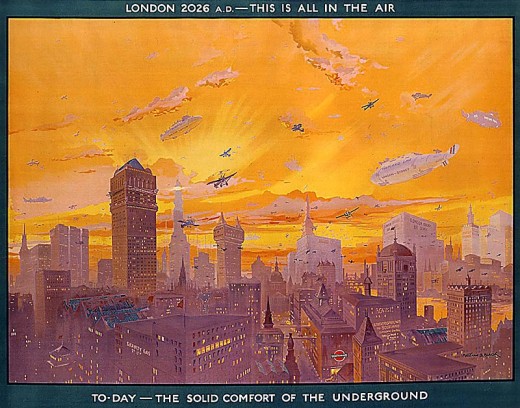
    Montague B. Black (b. 1884), an artist and illustrator, pulled the curtain back from the future back there in 1926 to what he thoiught might be the following scene of London in 2026:

    London-2026-520x408
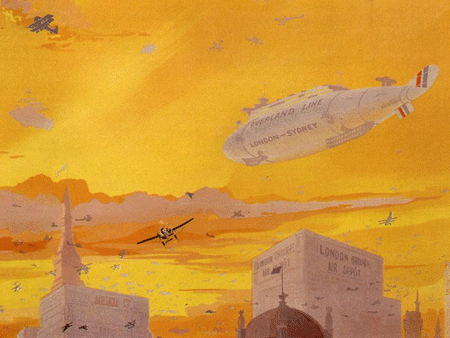
    A detail reveals an interesting airship:

    London 2026  detail
    The airship (of an undetermined power source) has an ad on the side of it reading “Overland Line, London-Sydney”–and by “overland” the artist is not thinking of the old-time “overland” as in prairie schooners and such, but quite literally “over the land”.  We can also see an ad on the side of a building for an “Underground to Scotland, Glasgow 2hrs 45 mins”.  There are also named buildings such as the London Bridge Air Depot and the Airtaxi Ltd.  The skyscrapers really aren’t all that enormous–I see one or two perhaps in the background that might be a hundred stories or so, but the buildings in the foreground are definitely of modest expectation. 

    There are however dozens of flying machines in the sky, though with the exception of the three large airships, a hundred years has not paid too many benefits to the other aircraft. 

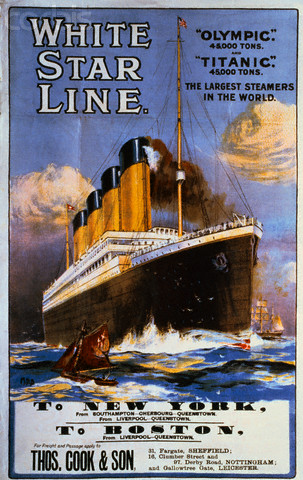
    Black did create an interesting poster for the White Star line, featuring a certain famous luxury liner–of course the man was just like anyone else, and could not see into the future for the Titanic, nor could he imagine slightly accelerated designs for aircraft.  He did manage to portray a transportation system that would be heavily dependent on air travel.  That said, he left plenty of room for speculation on the future of the Underground, as we can see in all of this future-glory that no matter the amount of accomplishments in the sky, trains would still be running underground.  Black got those two things right, at least. 

    London titanic

  • The Awful Problem–the Bomb, August, 1945

    JF Ptak Science Books    Post 1868 [Part of a long series on the History of Atomic and Nuclear Weapons, here.]

    The fate of failed Japan was being decided in the hands of the United States in the middle of July, 1945.  The Imperial Navy and Air Force was basically finished, leaving the sea and sky open for complete domination, and the Imperial Army was still fit to fight, if not well supplied.  That said, there was still the issue of possible invasion, and of fighting on a mountainous battlefield against a dedicated indigenous population  that could still field millions of more fighters if not soldiers.

    As Secretary of War Henry Stimson outlined in his Top Secret memo to President Truman on 2 July 1945, “Proposed Program for Japan”, there was little left to fight:

    Japan has no allies.

    Her navy is nearly destroyed and she is vulnerable to a surface and underwater blockade which can deprive her of sufficient food and supplies for her population.

    She is terribly vulnerable to our concentrated air attack upon her crowded cities, industrial and food resources

    She has against her not only the Anglo-American forces but the rising forces of China and the ominous threat of Russia.

    We have inexhaustible and untouched industrial resources to bring to bear against her diminishing potential. 

    We have great moral superiority through being the victim of her first sneak attack.

    —Source: The Nuclear Files, here.

    Little left, of course, save for the millions of defenders fighting on their own soil for their own soil. Which, in the end, turns out to be almost everything insofar as the use of the atomic bomb is concerned.

    This is of course a very complex and long story on the decision to use the bomb, and I don’t pretend to even begin such a thing here. But what I would like to just point out, that in the middle of all of the discussion, the supreme commander of the allied forces in Europe, General Dwight Eisenhower, was not in favor of using the bomb. Eisenhower was with Stimson when the Secretary of War received the coded telegram giving him the positive results of the atomic test in the Jornada del Muerto, the Trinity test, at Alamogordo, New Mexico. Eisenhower wrote of the experience:

    “The cable was in code, you know the way they do it. “The lamb is born”: or some damn thing like that. So then he (meaning Stimson) told me they were going to drop it on the Japanese. Well, I listened, and I didn’t volunteer anything because, after all, my war was over in Europe and it wasn’t up to me. But I was getting more and more depressed just thinking about it. Then he asked for my opinion, so I told him I was against it on two counts. First, the Japanese were ready to surrender and it wasn’t necessary to hit them with that awful thing. Second, I hated to see our country be the first to use such a weapon. Well … the old gentleman got furious. And I can see how he would. After all, it had been his responsibility to push for all the huge expenditure to develop the bomb, which of course he had a right to do, and was right to do. Still, it was an awful problem1.”–Richard Rhodes, The Making Of The Atomic Bomb (Touchstone Books, 1986), page 688 (though not an expert in this collection of areas when he started, and not an historian of science, Rhodes has written perhaps the definitive history of the Project).  

    It wasn’t entirely clear that the Japanese were ready to surrender at this point as Eisenhower said, not really.  And it also wasn’t necessarily the case that the entrance of the Soviet Union into the war in the Pacific would have resulted in an easier time in fighting on the ground.  And General LeMay–who strategized that he could destroy the Japanese capacity for war from the air by bombing 30-60 cities over the June-August period–had actually carried out his plan, striking 58 cities and nearly destroying half of Tokyo, but still the Japanese fought on.

    But it is interesting that after all of this time, and dozens of millions dead, that Eisenhower would be so circumspect in using the atomic bomb to finally force the hand of the Japanese in resignation. 

    The fact remains though that it still took several days after the dropping of the second atomic bomb on Nagasaki for the Japanese to accept what were essentially the same pre-bomb terms of surrender.

    Notes

    1. I should point out that Stimson’s liability in the decision to build the bomb (if such a thing existed) was relieved when the bomb was tested successfully–its actual employment was beyond the judgment of his actions. (Stimson himself said that he was relieved of the responsibility of having spent “two billions of dollars” on the bomb and that he no longer would have to fear spending years in prison for a failed effort.
  • Thomas Jefferson’s Arithmetic of Black People, 1783

    JF Ptak Science Books   Post 1869

    I was picking my way through Mr. Jefferson’s Notes on the State of Virginia (written in 1783/4), and dipped into Query 14, “Laws”.  Six pages in came the Great Man’s thoughts on being white and being black. He really didn’t have much hope for the black person in the new United States, and in an odd way, I think, did a sort of arithmetic calibration on the black race, giving a few points here and there “for”, and piling up the count “against”, making an overall large negative number for the possibility of the black and white races living together.  [The full text of the work us available, here.]

    In very many cases in his later writing Jefferson re-evaluates this thinking, as seen in this example, writing to Benjamin Banneker in 1791 (‘”No body wishes more than I do to see such proofs as you exhibit, that nature has given to our black brethren, talents equal to those of the other colors of men, and that the appearance of a want of them is owing merely to the degraded condition of their existence”), and in many others (as in the very full example1 of this 1809  letter to Henri Gregoire, shown below).

    Jefferson had already written somewhat earlier in the book about blacks on page 197, where he discusses albinism in black people as part of a natural history chapter dealing with animals:

    To this catalogue of our indigenous animals, I will add a short account of an anomaly of nature, taking place sometimes in the race of negroes brought from Africa, who, though black themselves, have in rare instances, white children, called Albinos…

    This is not promising. This is also the first appearance in the book of the word “negro”. [I wrote a short bit on the history of the fight for the capitalization of the letter “N” in “Negro” here; this was a fight that dragged itself into the first third of the 20th century.]

    I am no Jefferson scholar, not by any means.  Only familiar with the “basics” of Jefferson, and his design and architecture and technical aspects, and somewhat familiar with his writing on the basic morality of slave-holding, I was surprised to find what he had written about constitution of black people here in the Notes. 

    Perhaps I shouldn’t’ve been so, but I was.  Perhaps I wasn’t as familiar with Jefferson during the time of the Revolution as I thought, seeing him as not only a man who changed the product of his time but who was also a product of them, writing in his present on the state of blacks in America that seems to have been seen as a great error in the mind of the Thomas Jefferson who would read these thoughts in the future, and refute (and perhaps repudiate) them.

  • A Note on a History of Lying Down–Sinking Life Preservers and Goiter Chairs

    JF Ptak Science Books    Post 1870

    0--blog---Nov 24--skinny114

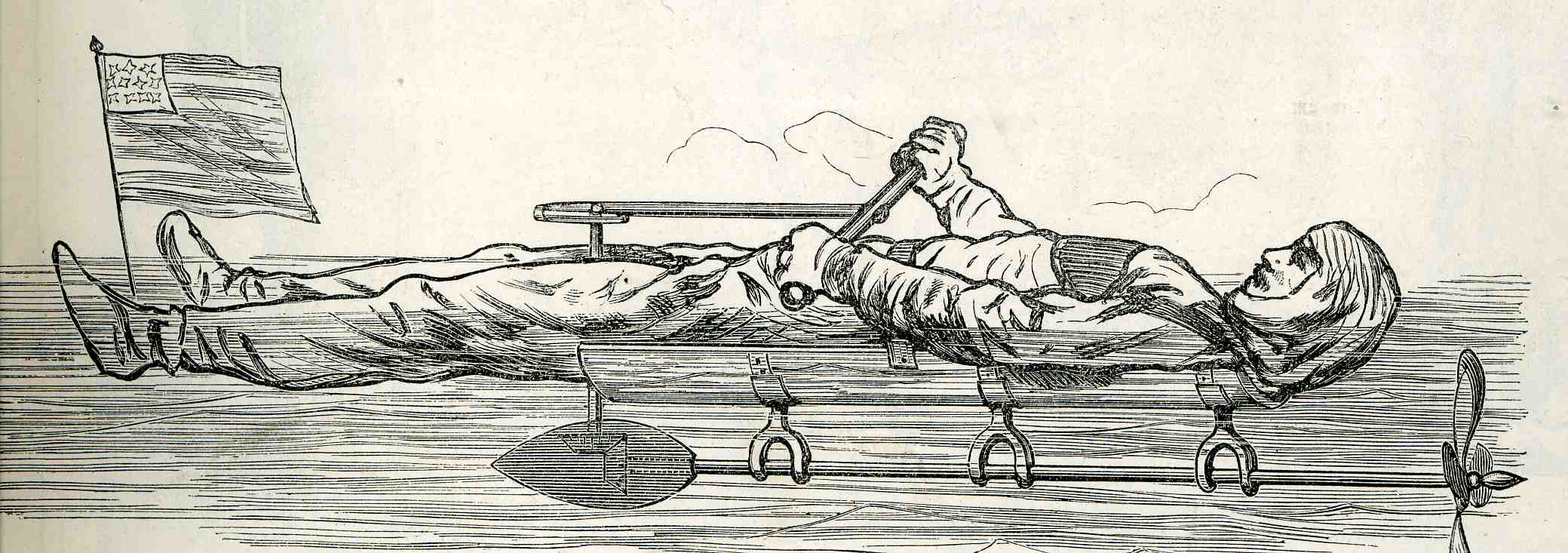
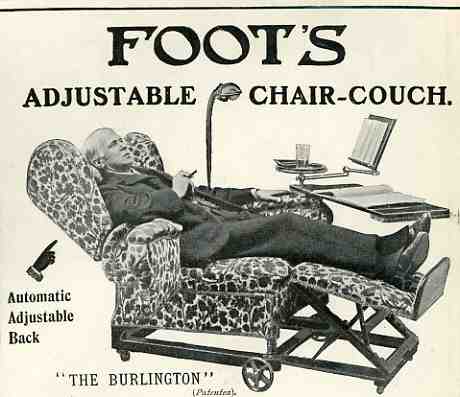
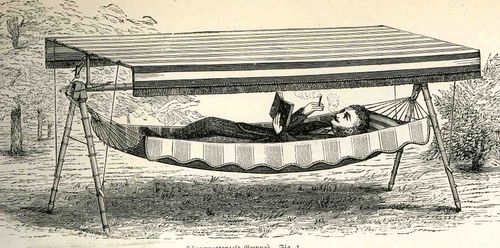
    I don’t have much to comment on in these images, just that they are striking and came to me in short order, and that they are all pretty narrow things.  They could fall easily into a Skinny category, or perhaps better still, they might slide nicely into the prototype for a series of posts on The History of Lying Down.  Or perhaps a combination of the two, or one being a sub-category of the other.  Certainly a history of humans lying down would be fairly massive, but scaling it down to late 19th century images of skinny and lying down might narrow the field a bit. 

    The first, (above),  is from Illustrirte Zeitung (Leipzig), and published in 1878; it depicts an American effort at simplified swimming, though sometimes when you simplify an already-simple thing, the results are fairly complex.  I haven’t much of an idea about how this would make sense, seeing that the body’s strongest muscles are not being used at all; further, judging by the flag, this guy is moving feet-first, and the whole procedure, despite body suit, look as though it would be terrifically cumbersome and bloaty.  And with the geartrain, plus the weight of the driveshaft and propeller, I don’t know how anyone would keep afloat.  Or how someone would keep their neck in that position for any period of time. In the world of Good Ideas, this would be an Anti-Good Idea. 

    0--blog---Nov 24--skinny116

    Foot’s Adjustable Chair Couch, which I found in The Illustrated London News for September 1902, was remarkable for its cushion-y formlessness, accepting the reader to itself like a body with a goiter.  There’s just something terribly wrong with it, reminding me somehow of undeserved and needlessly- rewarded comfort–too much comfort foully a perfectly reasonable invention like The Chair. 

    Next is this skinny, low, light semi-automated shaded hammock; little, narrow, and maybe comfortable to fit a 120-pound person.  This appeared in the Illustrierte Zeitung, again, for 1892.

    0--blog---Nov 24--skinny115

    Another idea, combining a bulky hiding and storage device with a slender and narrow place to lie down is S. Luder’s 1883 patent for a rolling and folding bed in a chest of drawers:


    In any event, this start of a list is simply in jest, an attempt at categorizing a few odd images and find a bit of complementarity where there is none. 

    ·Posted by :

    ·in:

  • History of Blank and Missing Things: Letters

    JF Ptak Science Books   Quick Post  [Partof the series on the History of Blank, Empty and Missing Things]

    This is a good example of one of those “mysteries” which seem hardly so when you find the very straightforward answer.  The appearance of this floating “a”:

    Blank a735
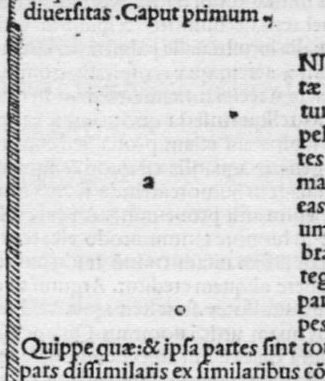
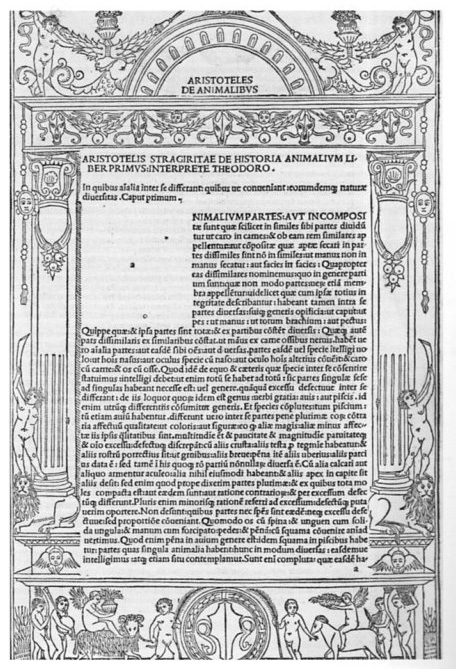
    The non-mystery is a product of a chapter beginning in a beautiful and very early (1476)  printed edition of Aristotle’s De animalibus. At first glance it looks like it might be an attempt at design/spacing, an illustration in a modern Dadaist vein, capturing space and attention while using hardly anything at all, a simple floating letter, an intentional placement of an object in an unusual field. It is that, in a very minor way, but the attention-getting device was used to gather up the focus of only one person.  The little “a”  is simply a place-holder, waiting for the the next stage in production of the book, for the rubricator to come in and decorate the space with a magnificent/articulated/flourishing capital “A”, which was the practice of this time.   

    Blank a734
    The reason why rubricated letters weren’t printed with the rest of the book is that in general the initials (and intricate coloring) were too complex and too colorful to be a product of the press. (The first Gutenberg book appeared in 1456 and although the first printed color appeared in the next year from the press of Fust the practice of multi-color printing with any sort of intricate application would take until the first third or so of the 18th century.) The artist responsible would come in and work on these sheets calling for decorated capitals before the book was bound–the letter “a” was there as a reminder for the work to be done–it also was the only way some of them knew what needed to be painted, as not every rubricator could read (thought they knew the letters of course). 

  • The Ultimate Earthly Holes & the Geocosm of Fr. Kircher

    JF Ptak Science Books   Poat 1871 [Part of a series on The History of Holes.]

    “Water, Fire; Fire, Water; mutually, as it were, cherish one another; and by a certain unanimous consent, conspire to the Conservation of the Geocosm, or Terrestrial World.”–A. Kircher, Mundus Subterraneus, 1665 (quoting a source on the University of Oklahoma library blog, here.)

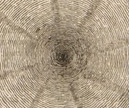
    Kircher hole_edited-1[Detail from the image below.]

    The great Athanasius Kircher (1602-1680)  pride of the Jesuits (and a member of the Collegio Romano, where he also was curator of the natural history collection there) and very forward thinker, was a prolific writer of vast ideas, thought about teh origins and circulation of water (among many other things) in his semi-encyclopedic Mundus Subterraneus (1665).  The Mundus–one of Kircher’s forty books–was one of the most beautiful books produced in the 17th century, and was chock-filled with ingenuity and insight and good thinking that went everywhere, though some of that “everywhere” went nowhere. In any event the man reached very high in an absolutely varied way, writing in the fields of language, optics, astronomy, geology, chemistry, math, magnetism, music, zoology and so on through the alphabet of wonder.

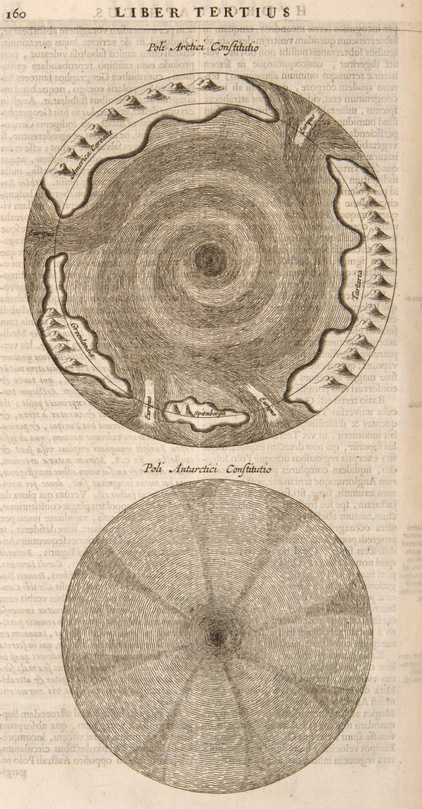
    Kircher hole
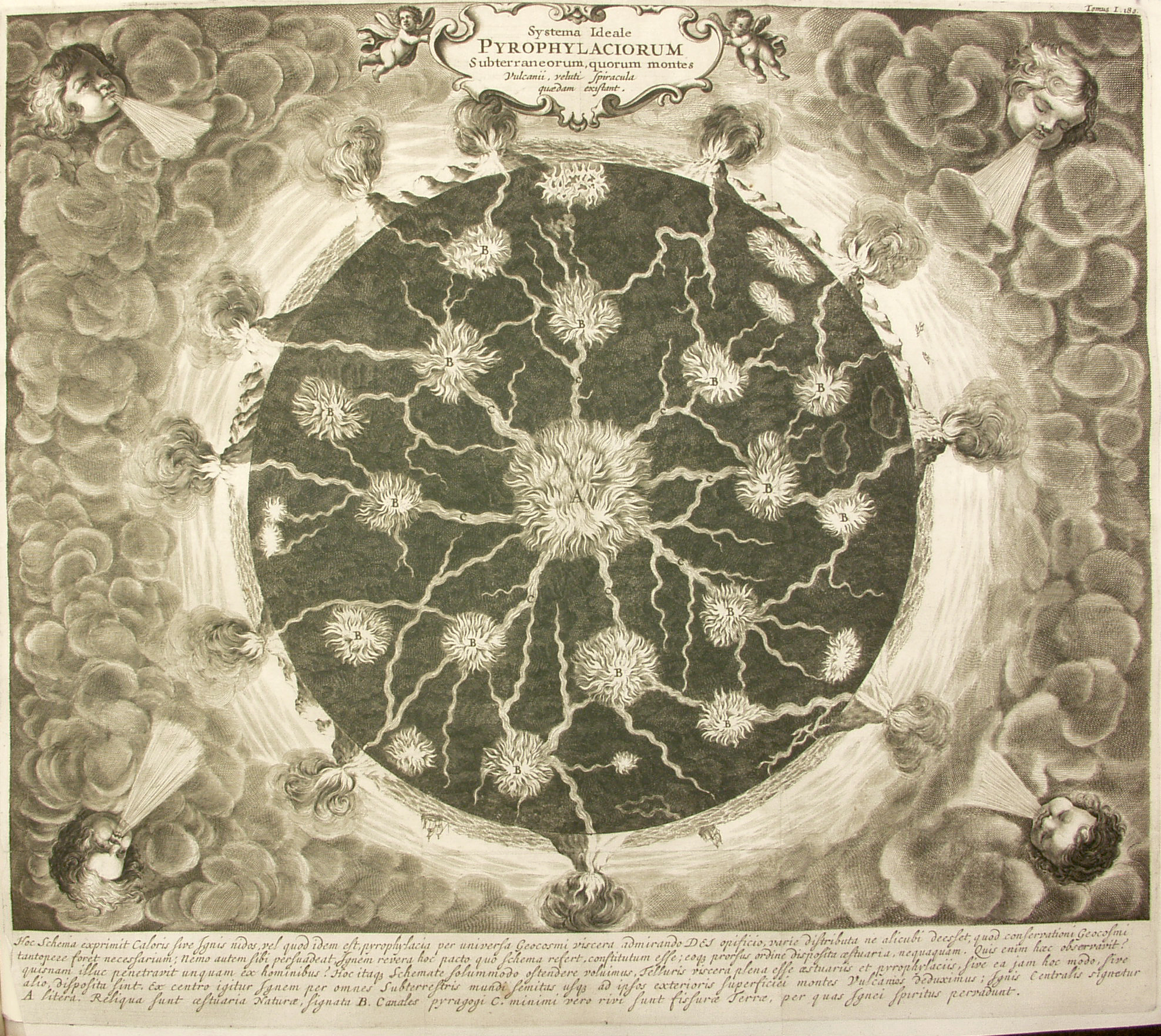
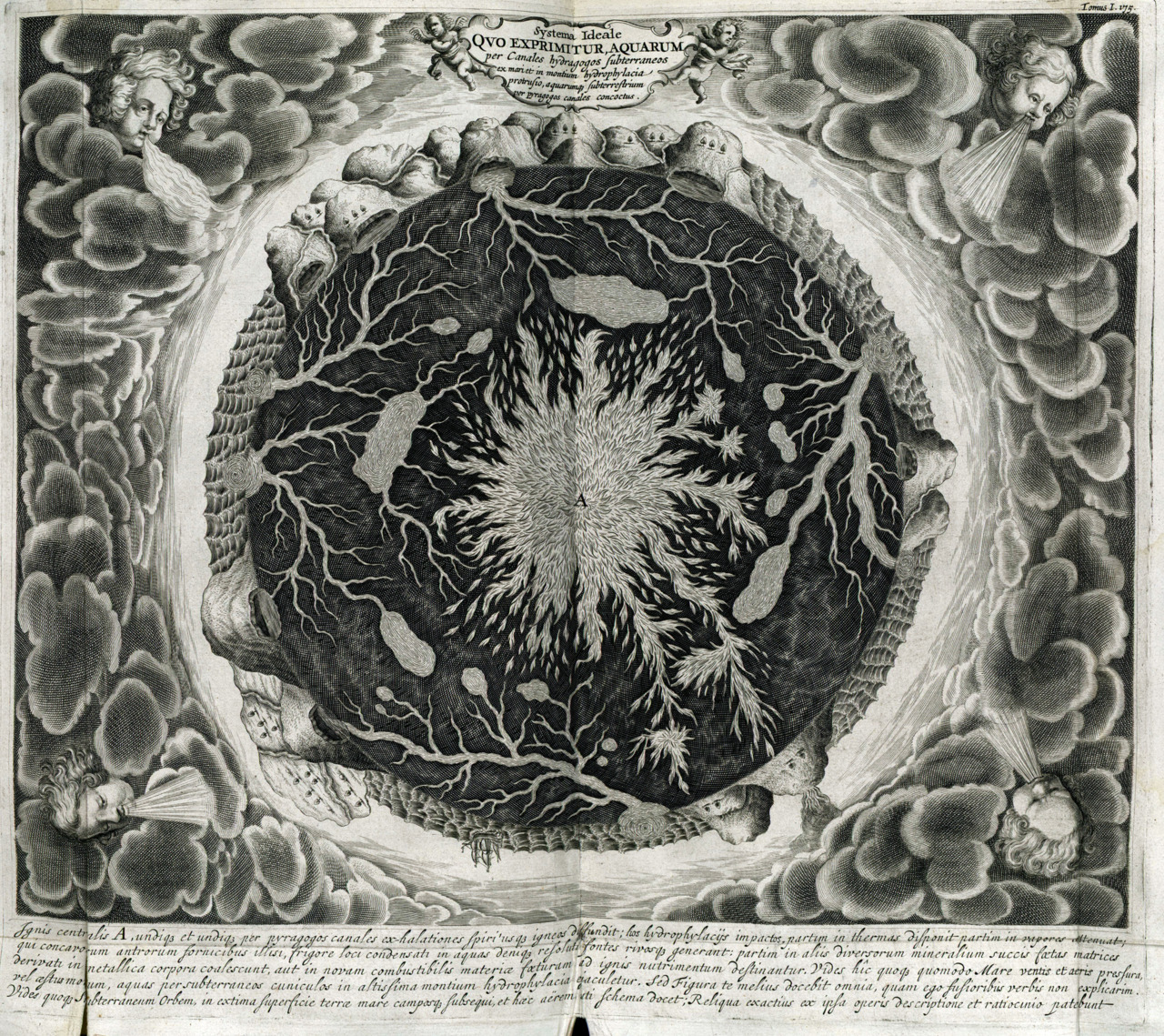
    In this case, Kircher worked on the problem of water–where it came from, where it went, and how the process unfolded, which was part of an overall theory of the physical construction of the Earth.  Kircher’s idea–which relative to other theories of the time was pretty scientific–was that the Earth was a solid mass save for interludes of caves and pockets of water and fire.  The fire (‘pyrophylacia”) represented the origins of earthquakes and volcanoes, and was complemented by a system of underground lakes and rivers (“hydrophylacia”) which was the basis for the movement of all water

    The “holes” part of this post comes in right now, as we see in the engraving that depicts polar portal for water to descend into, great holes (like Spongebob Squarepant’s encounter with the main drain of the oceans) that allowed the water to continue its endless migration.  Water would rise and fall in accordance with the tides, which would act as the power source for raising water to mountainous heights, where it would start its life again, flowing down via creeks and streams into lakes and rivers and then to the ocean where it would ultimately make its way to some severe maelstrom, and down into the Earth to come back up again.  And I think that the primum mobile for this action was the wind produced by the interaction of the fire and water. 

    I’m unsure thus far about the placement of this primal hole. 

    Next:  Descartes Firehole. 

    Below: images of the fire- and water-based subterranean worlds of necessity to Kircher’s geocosm.

    Fire:

    Kirhcer pyro
    Water:

    Kircher water

  • Ancient “Spacecraft”: the Flavor of Moving Very Heavy Things a Long Time Ago

    JF Ptak Science Books    Post 1872

    Obelisk624
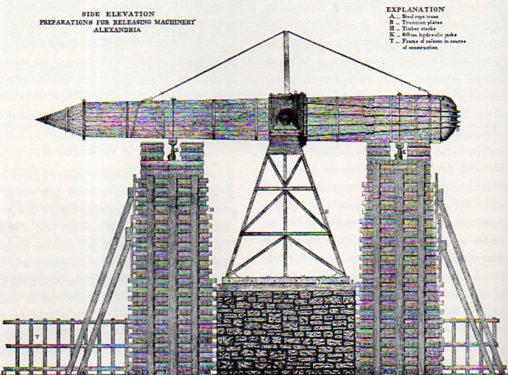
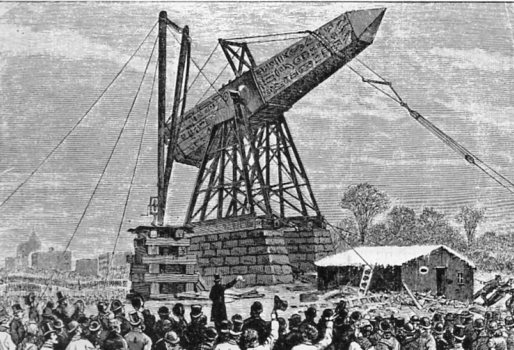
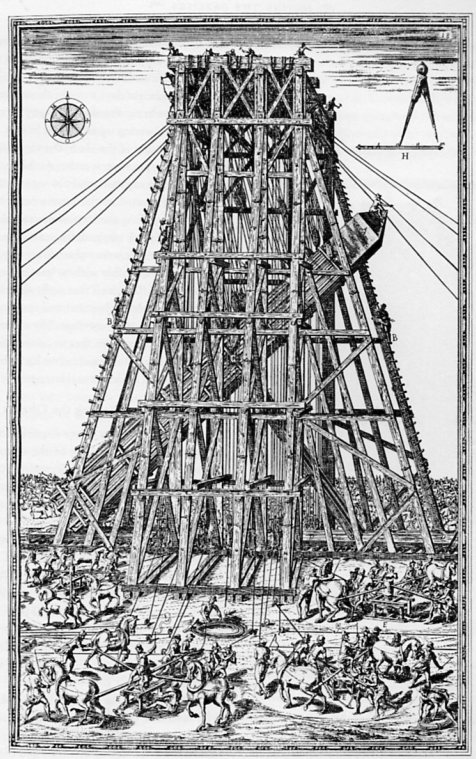
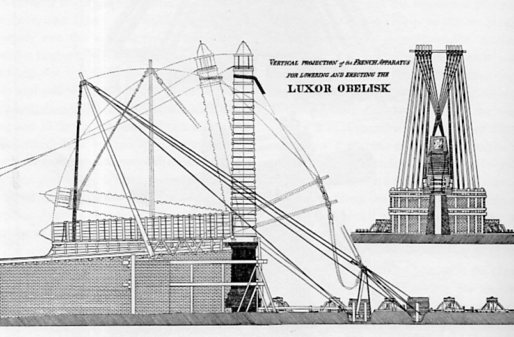
    This of course is not a story of ancient spacecraft, but it is about Very Large Things being manipulated in space in the days of steam and pre-steam engineering. It is hard to escape the “rocketship” interpretation, as some of the images, sculpted slightly out of context and cleansed of any identifying text and viewed with a squint, look as though they might be large booster rockets being readied for flight. They are of course images of some great and famous pieces of engineering–moving massive obelisks, and moving them in the 19th century and before.  And in the case of the Romans, and the original Egyptians, moving them way before our last millennium, moving 200- and 900-ton objects without benefit of very much at all. 

    Obelisk625
    Two of the great examples are the pair of obelisks that the Romans moved from Heliopolis to Alexandria, where they stood for another 2000 years.  Over time there was only one standing, and that one wasn’t doing so well by the end of the 19th century.  The fallen obelsik was taken to London in 1877; the other, the standing obelisk, was given to the United States by the Khedive of Egypt two years later, in 1879.  The man in charge of this second operation was Lt. Commander Henry H. Gorringe, U.S.N., who had the very tricky job of lowering the monolith, bracing it for transport by sea, fitting it out for a ship, and then transporting it to Central Park and raising it again.  He was able to accomplish this feat with the “fragile” 100-ton object in just a year.

    This next image is more classical and probably iconic, at least in the history of science world, and is found in the superb book by Domenico Fontana, Della Transportatione dell’Obelisco Vaticano (published in Rome in 1590 and again in 1604):

    Obelisk627

    Obelisk626They really do have a certain modern taste for interplanetary access, at least to me.  That aside, it is interesting to consider what this vastly heavy movement must’ve looked like to people long ago, when big machines with enormous powertrains (like this 1,200 ton capacity 300′-tall mobile crane)could be hauled into service to do their end in manipulating highly problematic and very heavy things in space.  To think of moving these very heavy objects with steam (or less) was a daunting task, and to see these images showing the progression of movement of these things must have been enormosuly satisfying.

  • Daily Dose of Dr. Odd: Baseball Players at the Sphinx, 1889

    JF Ptak Science Books   Quick Post

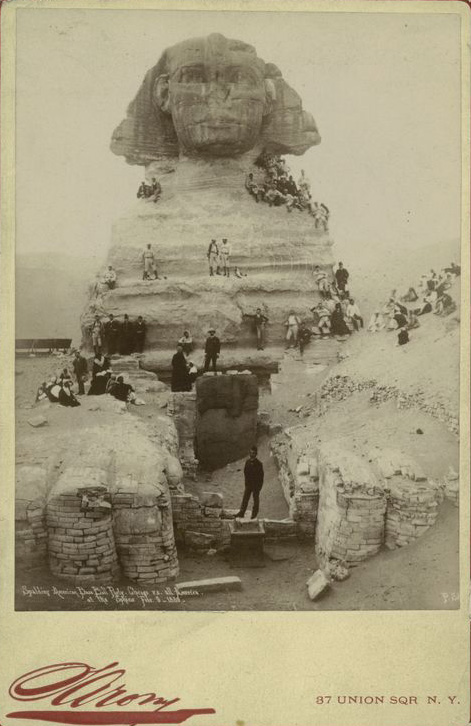
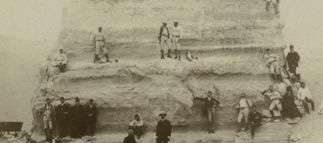
    The Sphinx has hosted all manner of guests in its existence, from circuses to Napoleon’s army using it for target practice, but I’m pretty sure that I’ve never seen an antique image of it with a swarm of baseball players:

    Baseball sphinx
    Source: the New York Public Library Digital Gallery, here.

    Baseball sphinx_edited-1
    The American baseball party at the Sphinx  [Spalding American Base Ball Party; Chicago vs. all America a…] (1889)

    ·Posted by :

    ·in:

  • Daily Dose of Dr. Odd: Sierpinski Triangles & the Empire State Building

    JF Ptak Science Books   Daily Dose series   [Also part of the History of Lines series] 

    So, Nat’rists observe a flea

    hath smaller fleas that on him prey,

    And these have smaller fleas to bite ’em, and so on ad infinitum.

    –Jonathan Swift, 1733 

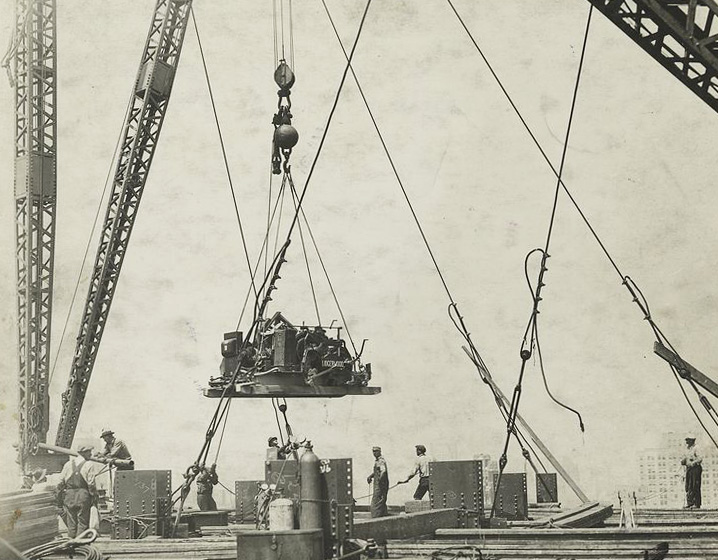
    There are a lot of triangles in this fabulous photo of the construction of the Empire State Building in 1931–a lot. At least fifty–more if you use your imagination or get your pinhole specs out. It is simply an excellent photo in which I’m seeing things of a reducible nature–not in the sense of a Sierpinski triangle/sieve/gasket, obviously–but just a simple exercise along those lines (ha!), experiencing the image by recognizing different sorts of boundaries within it.

    Lines empire state bldg

     [Source: New York Public Library Digital Collections, here.]


  • A Note on the Idea of Seeing Things Backwards

    JF Ptak Science Books   Post 1873

    Backwards--magritte

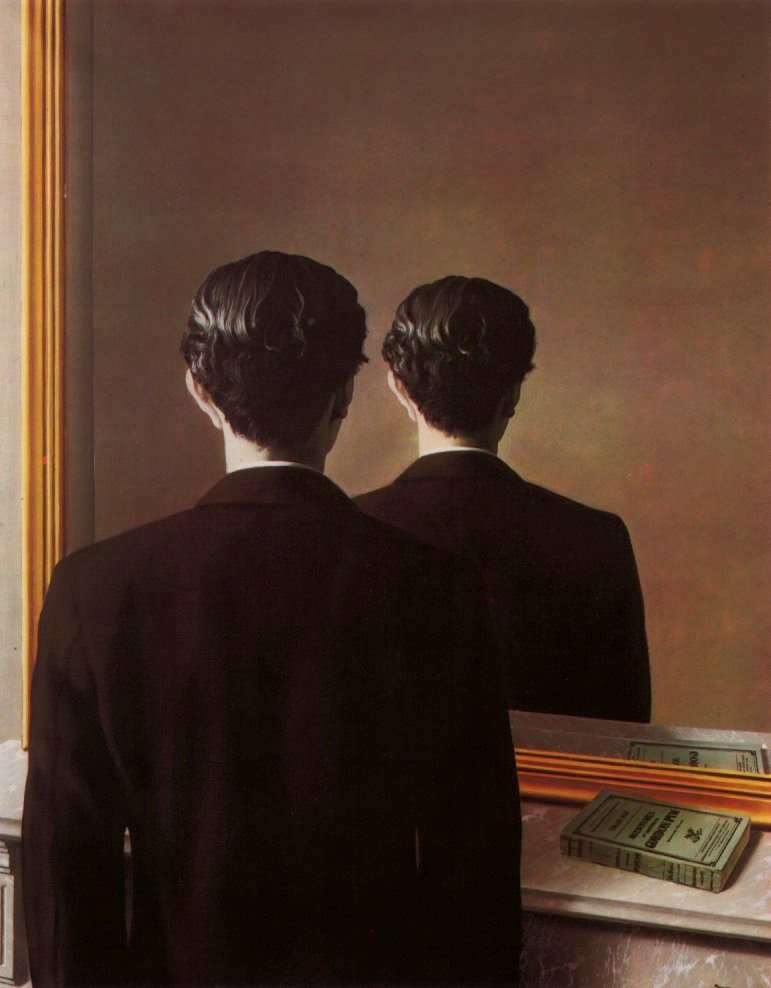
    Leonardo wrote backwards and from right to left, Benjamin Button lived backwards at the hands of Scott Fitzgerald, Rene Magritte’s man in the mirror saw the back of his head, Ignatz the Mouse I am sure saw the back of his head looking around the world with the world’s most powerful telescope, rugby passes are all done backwards, paper images of vue optiques appear backwards, lightning for all intents and purposes starts backwards from the ground up, reverse mathematics are worked from theorems to axioms, the Chicago River (1900) was engineered to flow backwards for the foreseeable future, while the Mississippi River famously flowed backwards for just a bit in the New Madrid earthquake of 1812. 

    Backwards--marey12

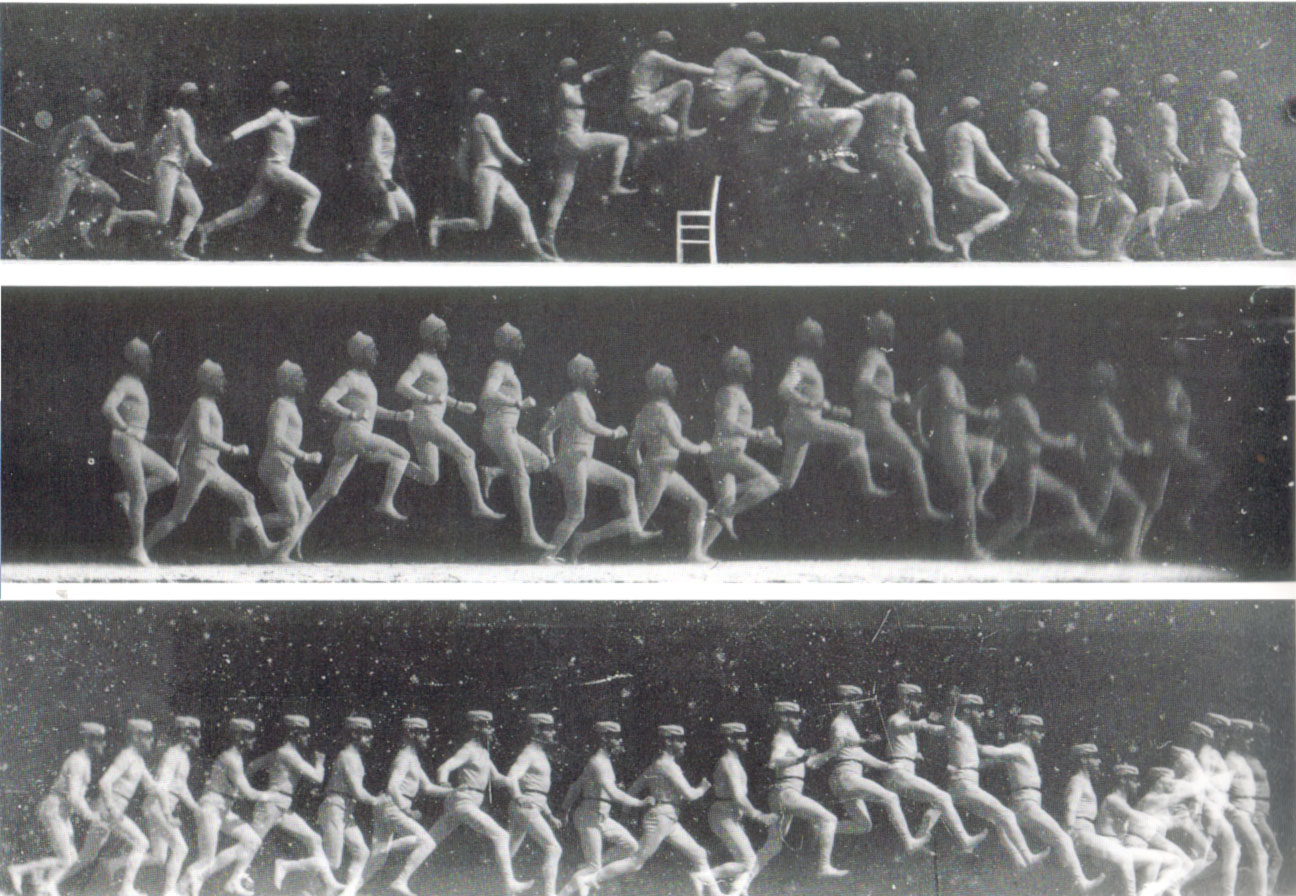
    I can only imagine what audiences must have felt when they saw the first moving pictures played backwards–seeing them played forwards was a novel-enough (and revolutionary) idea, but the simple idea of reversing the direction of the film would have proved to be equally fascinating.  Imagine the first time you witnessed a staged train wreck on film, back there in 18951, and imagine being able to see it played over and over again, until you were filled.  I’m not so sure that there were even any still photographs of a train wreck as it occurred to this point, even with advances in film speed and lens, so seeing the even unfold in front of you at leisure must have been overwhelming.  Now imagine these same folks seeing the event and watching the locomotives reconstitute themselves.  It would have been an extraordinary event.  Even observing the Marey sequences (above) and seeing what actually happens when a person bends over to pick up a pail of water would have revealed almost as much in new detail as when Galileo was in the middle of his earliest observations. 

    In a way the chance of controlling the direction telling of a story and seeing it displayed via moving images, and being able to see them backwards, may well have seemed a form of third-person time travel.  This came on the heals of what is for all intents and purposes the first time travel novel in  H.G. Wells’ (also in) 1895 The Time Machine (appearing earlier as “The Chronic Argonauts,” in 1888)2 and Mark Twain’s 1889 but much earlier than the first motion picture to use the idea of time travel (which was in 1921 and based on Twain’s work).  Being able to show a motion picture, and then stop it at will, and then reverse the order of time to begin everything all over again–visually–must have seemed a magnificent advantage. 

    Notes:

    1.  It is interesting that this very early motion picture , made by the great scientist-brothers Lumiere, l’Arrivee d’un train en gare, was produced in the same year as the Wells book.  Just two years later, the Lumiere Brothers published a catalog of their available movie strips, numbering 338 productions.  In 1898, after six catalogs, there were over a thousand strips.  This is remarkable, especially considering that there wasn’t a cinema industry yet.  The Lumieres are an interesting pair of people (both of whom survived their invention by about a half-century), making perhaps the most important discoveries in the history of cinema, and continued to be interested in other fields throughout their lives.  The cinema-industry part of their work didn’t seem to interest them all that much. 

    The history of moving images is complex and long.  I’m not saying at all that it begins with the Lumieres, or with Edison, as the pre-1900 field is well sprinkled with different and interesting attempts at fooling our eye–Chronophotograposcopes, Counterfivoscopes, Phantasmagorias, Klondikiscopes, Vileocigraphiscope, and so on, are just a few examples of the many attempts at locating the seat of photographic motion in the brain.  There are very early efforts, principally by J.A.F. Plateau (1801-1883) who rediscovered in 1829 the “persistence of vision” effect in which the eye will see a continuous stream of images if presented with a flow of static pictures at 16 frames per second over a one second period, which of course is the basis for the rest of everything that was to come.  There’s much more, but I wanted to at least point out these few important bits. 

    2..  I’m not sure what to  with Mr. Dickens, if he fits in this order with the time traveling Scrooge in A Christmas Carol (1843), or not.  Perhaps he does, and if so, then he precedes Mr. Wells, though the latter’s time traveler is outfitted with a machine and a scientific basis for the belief in it.  At the very least he is worth mentioning in the same moment.

  • Daily Dose of Dr. Odd: a Lovely Bit of Slightly Mysterious Design

    JF Ptak Science Books  Quick Post

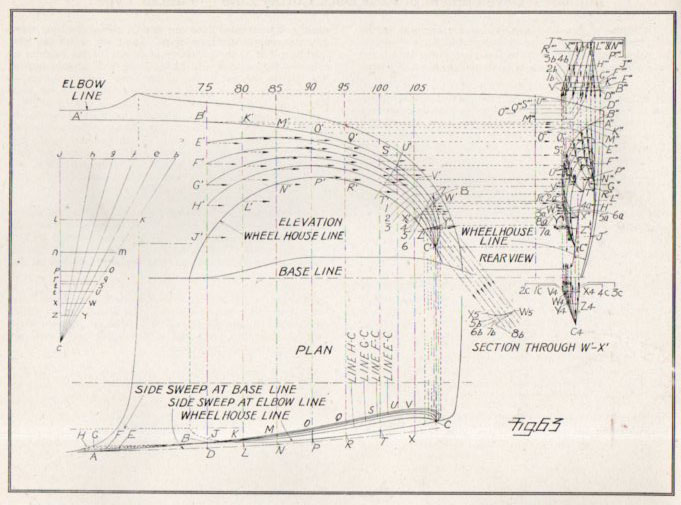
    Care to have a guess on the derivation of these designs? Well, I guess the indicators give this away, but had “elevation wheel house cover” not been printed in the it might have been harder to figure out what this simple and lovely thing is. 

    Design auto528

Recent Posts

Archives

Categories