A Daily History of Holes, Dots, Lines, Science, History, Math, Physics, Art, the Unintentional Absurd, Architecture, Maps, Data Visualization, Blank and Missing Things, and so on. |1.6 million words, 7500 images, 4.9 million hits| Press & appearances in The Times, Le Figaro, Mensa, The Economist, The Guardian, Discovery News, Slate, Le Monde, Sci American Blogs, Le Pont, and many other places… 5000+ total posts since 2008.

  • Blank & Empty Things Series: Self-Referencing Languages and Babel

    JF Ptak Science Books      Part of the History of Blank, Empty and Missing Things.

    Follow Me on Pinterest


    Blog--14 nov--fantastic arch


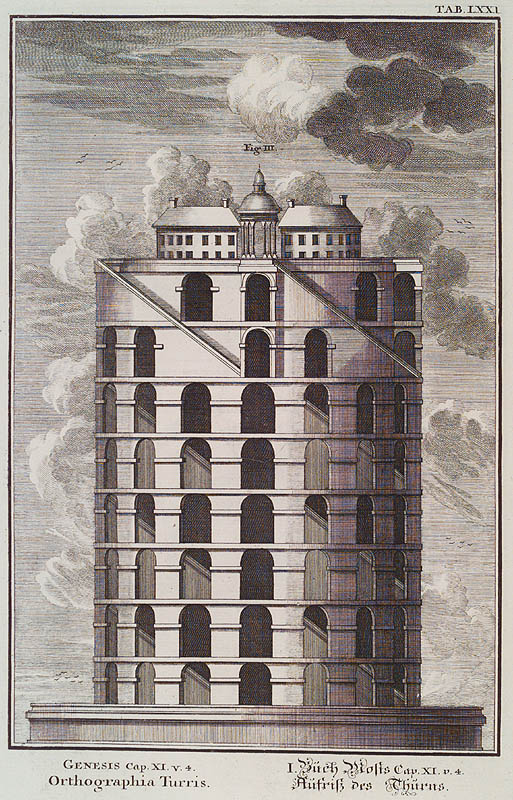
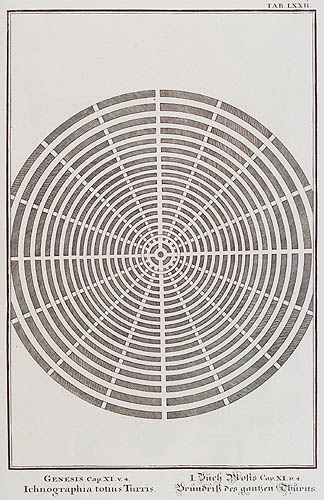
    Returning to Jean-Jacques Scheuchzer’s1 magical, inventive, fact-bending naive-surreal work on universal history based on the Old Testament, I’ve found these two glorious and odd images of the Tower of Babel.  The first (“Genesis Cap.XI.v.4. Orthographia Turris.Mediummetalis”) is terrific, shocking even in its abrupt construction and flat-out stumpiness, because it is one of a very small minority that shows the structure to be canonical, with a little church at top. The enormous stairway is just completely out of proportion to the purpose of the structure, the effort falling into some sort of odd advanced-child category.

    If Italo Calvin’s “Invisible Cities” or (better yet) Jorge Borges’ “The Circular Ruins” were to be illustrated, this image would fit right in.

    The other very unusual bit here, is that Scheuchzer also provides a plan for the city that was to be built around the tower–I’m pretty sure that I haven’t seen references to this before, and the Biblical references to it are no help whatsoever in determining its physical aspects.

    There are probably very few things that could be as blank or as empty as combative, competing, nonsensical and completely self-referential language or communication.  Well, except for Scheuchzer’s very empty town plan locating the tower in an urban setting–a listless place of surrounded circles of nothingness for a place in which everything is said and nothing is understood.  Ground Zero for blank Blog--nov 14--planlanguage.


    Notes:

    Two interesting books that I should mention that address the ideas
    of fantastic/imaginary architecture and decay are C. W. Thomsen, Visionary
    Architecture: From
    Babylon to Virtual Reality,   (Prestel, 1994) ; and  Paul Zucker, Fascination of Decay (Gregg  Press, 1968).

    1.  Kupfer-Bibel, in welcher die Physica sacra, oder geheiligte
    Natur-Wissenschafft derer in heil. Schrifft vorkommenden naturlichen
    sachen, deutlich erklart und bewahrt,
    printed in Augsburg and  Ulm
    by  C.U. Wagner, 1731-1735. Offered in four volumes, illustrated with
    758 plates, it is a magnificent work, if not altogether correct, or
    even near- correct, with an enormously confused pedigree, implying the
    wisdom and text of the Bible (and the old Testament at that) as the
    background for a physical history of the world.
     

  • Questions Answered with Guts, Wax, Bumps and Glory: Fortune Telling Patent Devices

    JF Ptak Science Books   Post 1956
    Follow Me on Pinterest


    [All images via the lovely and easy to maneuver Google Patents here]

    Fortune telling and divination is mostly the subject of the pretty patents (below), a quick penny-ante for the fulfillment of the instant treatment of possibility. reckoning via mechanical means,easing folks out of the necessity to think about What May Come, and also, possibly, relieving some of them of the possibilities of worry should the fortunes agree with their hopes.  And desires. Opposite, for the opposite. 

    This thinking goes back a long way into dark and dusty time, though it becomes interesting (to me, anyway) when it gets wrapped up in Renaissance magic and science. 

    I’m not sure what it reveals except for what people might have wanted to believe in during different periods of time.

    Anyway, the patent drawings are pretty.

    The ways of telling fortunes are broad and numerous and may have been dictated by the stuff that was readily available at hand; a veritable alphabet can be quickly summoned to deal with the most common of the sort:

    Alectromancy (telling the future by relatively brainless modern dinosaur roosters pecking at the ground for stuff);

    Astrology
    (thinking that the motions of stars that are light years away from the
    observer in a vast sea of space and their annotation on an
    infinitesimally small speck of universe dust called “Earth” can somehow
    interact with living organisms that are 1030000 the amount of space that can be affected by the light from the stars that are 1/1,000,000,000 of the age of those stars);


  • Einstein–(A) List of Complete Publications; (B) Most Often Cited Papers, & (C) Contemporary Reviews (D) In the Annalen der Physik

    JF Ptak Science Books   Reference Post

    • Below are three quck reference lists regading publications of Albert Einstein. Section A is a complete list of his works; Section B, a list of hi smost ofte-cited papers; Section C is a collection of some contemporary reviews of papers published 1904-1920; Section D is a listing of Einstein papers in the Annalen der Physik

    A) Quick Complete Publications of Albert Einstein, Listed Chronologically.

    [Titles are in English]

    1901 ANNALEN DER PHYSIK 4(3):513-523
    Conclusions from the capillarity occurrences       

    1902 ANNALEN DER PHYSIK 8(8):798-814
    The thermodynamic theory
    of the potential differences between metals and complete dissociation
    solutions of their salts and a electrical method towards the probing of
    molecular power 
        

    ·Posted by :

    ·in:

  • A Note on the Lunar Cycle, Time, and North American Indians

    JF Ptak Science Books   Post 1957

    For the most part Native Americans of the pre-U.S. had no names for days, no
    division of the week, nor a name for years, though underscoring the observation of the skies and the passing of time was a primary appreciation of a more sophisticated lunar cosmology.
    Simply put, the lunar cycle was one of the major ways in which
    Indians captured spent time. Days, weeks and travel distances were
    in general measured in terms of nights passed, or sleeps (similarly
    the length of the day in terms of the four major daily appearances
    of the sun and moon). The passing of the year was marked in lunar
    cycles, and delineated important, measurable, repeating events in the
    environment important in the life of a tribe. (These events—harvests, plantings,
    snows—would vary from tribe to tribe according to their geographic
    distribution.) 

    ·Posted by :

    ·in:

  • Milestone Papers in the Physical Review Letters, 1958-1969

    Physical Review Letters Milestones  1958-1969

    Data re-ordered and summarized from much lengthier, reviewed and abstracted summaries from:
    Letters from the Past – A PRL Retrospective
    Gene D. Sprouse
    Editor-in-Chief, APS

    1969    High-Energy Inelastic e-p Scattering at 6° and 10°
    E. D. Bloom, D. H. Coward, H. DeStaebler, J. Drees, G. Miller, L. W. Mo, R. E. Taylor, M. Breidenbach, J. I. Friedman, G. C. Hartmann, and H. W. Kendall
    Phys. Rev. Lett. 23, 930 (1969)  NOBEL 1990 

    ·Posted by :

    ·in:

    —
  • Geology of Food Lust, 1948

    JF Ptak Science Books  Quick Post

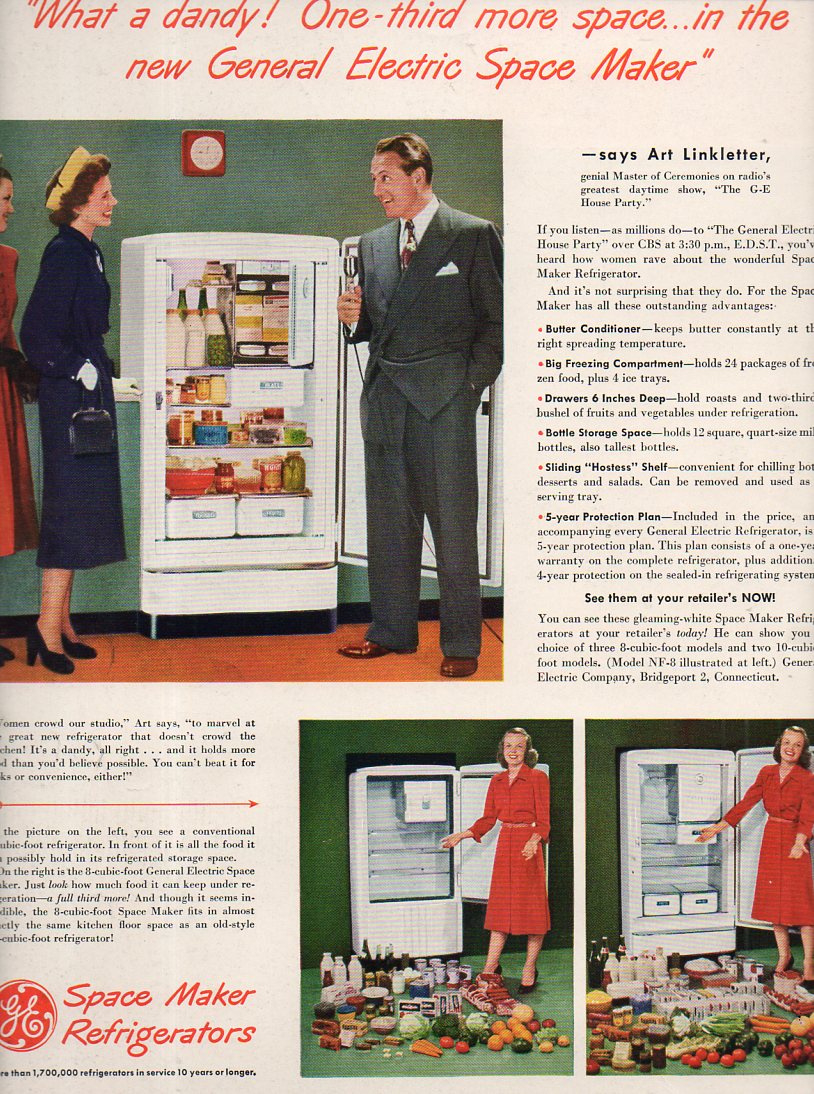
    I wroFood refrig965te earlier in this blog about the geology of meat and want, the last in “States of Perfection: Refrigerated Food & the Archaeology of Meat, 1954” (here).  (“Like Greek statues, orders of architecture, the golden ratio and Vitruvian man, these ads from LIFE Magazine in 1954 measure a sort of highest-attainable-state, though directed at middle class America….”) This is a continuation on that theme, a little, as I found this interesting piece of a refrigerator ad in LIFE magazine for 26 July 1948.  Art Linkletter interviews two women and a refrigerator here, introducing the new G.E. Electric Space Maker, which must’ve used a new motor to make more space available inside the new unit, as it wasn’t much bigger on the outside than the old one.  But seeing the food displayed on the ground in front of the refrigerators shows us what people wanted to have in their house, to eat–and what more of it they could want.  Side-by-side:  normal want, and advanced want. 

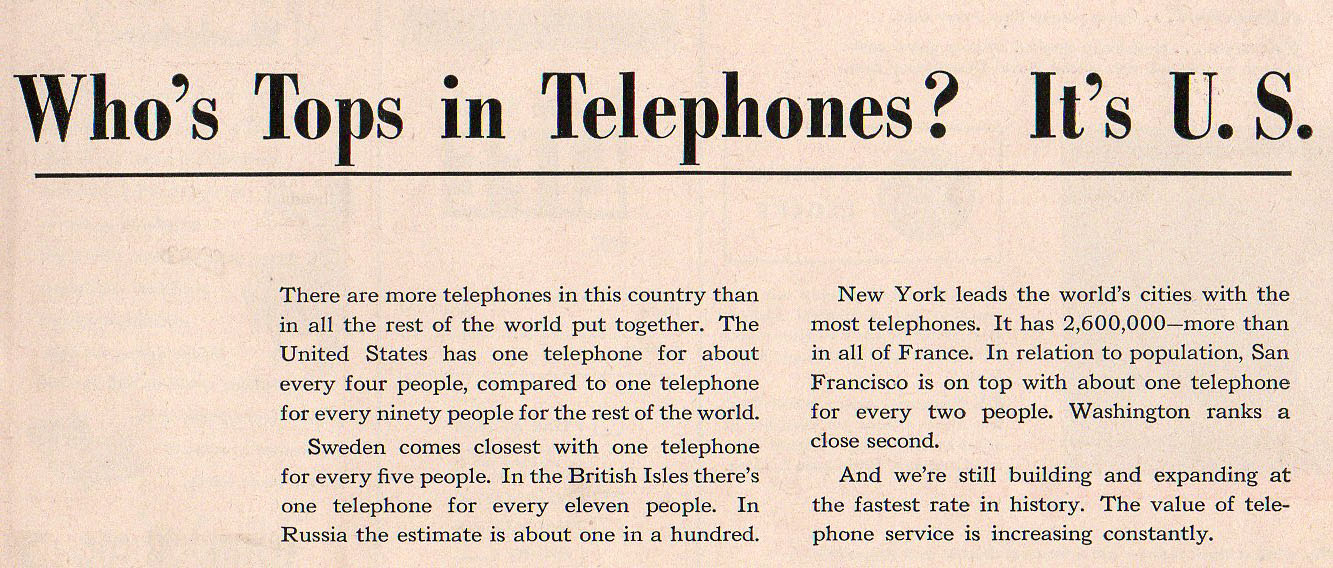
  • Telephone Cowgirl

    JF Ptak Science Books   Quick Post

    Telephone girl969
    Telephone girl970

    For an interesting side-bit on introducing the telephone for popular
    use, see my earlier post, The Magnificent Mundane: an Instructional With
    Prop on How to Use the telephone, 1946, here. 

    ·Posted by :

    ·in:

  • The Next-Most Obscure Reference to the Beginning of American Involvement in Vietnam, 1954?

    JF Ptak Science Books   Post 1957

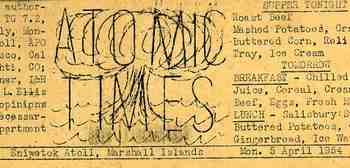
    Five years and 2,200 posts ago, in the young pages of this blog, I wrote a short bit on what might have been the most obscure and removed reference to the American involvement in the Vietnam War, here. It appeared in the 5 April 1954 issue of the Atomic Times, which was a newspaper of sorts produced by the U.S. Army and printed on a mimeographed, single-sheet page, and distributed at
    the tip, or bottom, of a very skinny piece of nearly-circular land far out in
    the Pacific Ocean at Eniwetok Atoll, 5 April
    1954.  The piece of news related to the hoped-for victory of the French Expeditionary Force in the doomed garrison of Dien Bien Phu: “French troops have been
    parachuted into the Indo-Chinese fortress of Dien Bien Phu to join weary defenders in their battle with the Communists. French officials now have a high hope pf a
    French victory, and they say the Communists cannot possibly continue their
    assault unless they receive thousands of reinforcements”. Of course, this was not the case, and the French were badly defeated there, spelling out the beginning of their end in that country and about the earliest beginnings of American involvement in their place. 

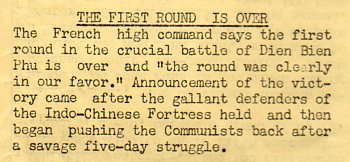
    Then a remarkable thing happened. I was reading in a small cache of mimeographed newsletters called The Parry Island Breeze, which was also produced by the U.S. military (Army engineers?) on Parry Island, which was just down the end of the long arm of slender island from Eniwetok in the Marshal Islands group.  This issue (volume 16, No. 5) was released on 6 April 1954, and it was–like the Atomic Times–a legal sheet printed on two sides.  In the second column, for the day following the Atomic Times notice, we see the following:

    Parry Island 2963
    Again! There was no victory in sight for the French at Dien Bien Phu in April, and only misery and heroism and bitterness and death and division lay ahead in the coming month, and then too in the coming decades.

    In the first week of April ,1954, the French garrison was just about conquered–there would be one more month of agony to endure before the Vietminh would claim full victory.

    Atomic_times_detail_masthead159

    After an eight-week siege, the garrison was defeated. Badly. Brilliantly. The French were
    overrun by the Viet Minh forces on 7 May 1954, effectively ending the First Indochina War and the French presence in Southeast Asia came to the end. And here, probably cranked out by hand in the middle of the Pacific Ocean, on a narrow bit of land separating vast collections of ocean, on long narrow strips of earth from which many nuclear tests were conducted, news reached the soldiers and sailors stationed here about the coming French victory in Vietnam.  Of course not even the French knew at the time that the Vietminh army was tunneling its way through the mountains surrounding the garrison, carrying up large cannons in small bits and pieces up through “impenetrable” jungle mountain slopes to install into those tunnels once they breached the other side of the mountain so that they could fire down onto the French.  All of that was yet to come.  In April, there was a certain bit of hope, but I think in reality it was on fire.

  • When Did “Are” Become “Is”? Beautful Mathematics, 1836

    JF Ptak Science Books  Quick Post
    Follow Me on Pinterest 

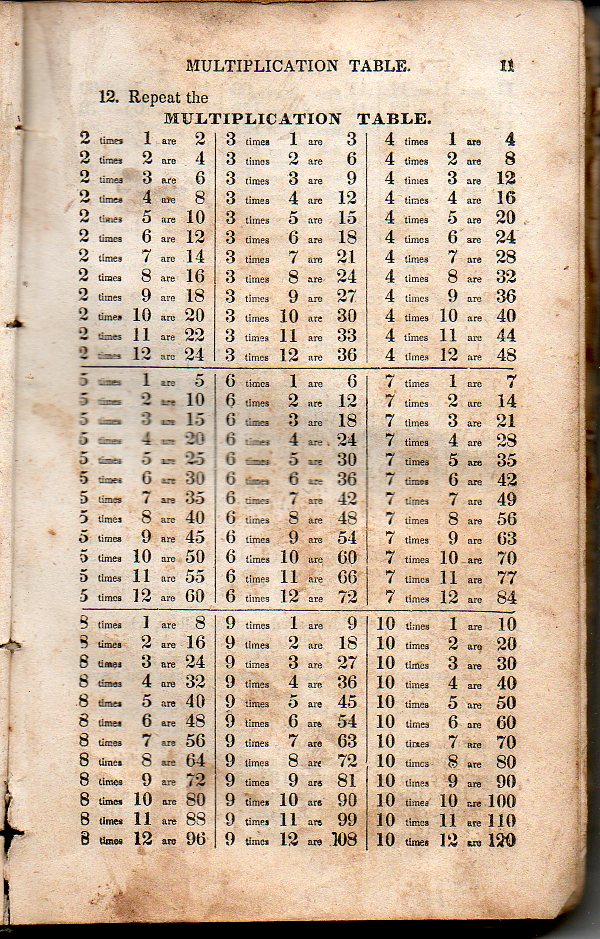
    Multiplication table det
    This beautiful table appeared in Roswell W Smith’s Practical and Mental Arithmetic, on a New Plan, in Which Mental Arithmetic is Combined with the Use of a Slate…, which was a soaringly successful book, this being the 53rd edition (!) and printed in Hartford in 1836.  (Smith was a busy man, writing several other standard and widely distributed works in geography and grammar).

    But what we find here, in one of the many tables in the book, is the surprising “3 times 3 are 9” rather than what we normally hear in the U.S. as “3 times 3 is 9”.  Perhaps what we are saying is “three threes are nine” or “seven threes are twenty-one”, and so perhaps this really should be “are” rather than “is”, except in the case of a number multiplied by one, when we would use “is” (as in “1×3 is 3”, or “one three is three”). This would not be so for “3×1” where we are saying “three ones are three”). 

    We can also disregard both of those words and simply say “equal”. Or is that “equals”?

    Its a small thing, I know, and I was attracted to the beauty and simplicity and assurance of the table–it is simply a finely designed thing.

    Multiplication table971

    ·Posted by :

    ·in:

  • IronPunk Neurology: Brain Nails, Bolts, Screws, and Hammers

    JF Ptak Science Books   Quick Post

    Follow Me on Pinterest


    This is the beginning of a set of patent drawings images of not-so-terribly-antiquarian approaches to neurosurgery. The materials include the nuts and bolts of surgery–literally–as well as head clamps and boring devices.  This will concentrate on the more modern era (1880-1925) so that some of the equipment–as archaic as it may seem–was used within living memory. 

    The boring-end of a trepanning device:

    This is a detail from the full-page patent drawing:

    ·Posted by :

    ·in:

  • Vaginal Opium Suppository & Rectal Exercise Dumbbell Patents (1881 & 1931)

    JF Ptak Science Books Quick Post

    Follow Me on Pinterest


    This is a Quick Post quickly posted, fast-quick, mainly because I’m not so sure what to say about it, other than “wow”.  So, I’m sharing these patents for the sake of sharing, mostly without comment. (Here’s another curious suppository-related post on this blog: Radioactive Suppository Sex Aids & Radium Toothpaste: Shining Lethal Nonsense).

    The first comes from Leonhard Roth, of Brooklyn, who won this patent in 1881:

    And:


    ·Posted by :

    ·in:

    —

Recent Posts

Archives

Categories