A Daily History of Holes, Dots, Lines, Science, History, Math, Physics, Art, the Unintentional Absurd, Architecture, Maps, Data Visualization, Blank and Missing Things, and so on. |1.6 million words, 7500 images, 4.9 million hits| Press & appearances in The Times, Le Figaro, Mensa, The Economist, The Guardian, Discovery News, Slate, Le Monde, Sci American Blogs, Le Pont, and many other places… 5000+ total posts since 2008.

  • On a Census of Senses in Oz-Land: Adventures in the Land of Silence and Light

    JF Ptak Science Books  Post 1980    Follow Me on Pinterest

    With the endless images of the Land of Oz in our minds from the book and movie it is easy for the other lands generated by their creator L. Frank Baum to escape our attention   Oz isn’t the only place that Dorothy traveled to–far from it.  She went very far and wide in the mind of Baum, who was extraordinarily prolific both inside and outside of the Oz series.

    From 1900-1919, Baum (1856-1919) wrote 17 Oz books, as well as another 18 books in the non-Oz realm, plus 17 books in a juvenile series for girls under the pseudonym of Edith Van Dyne, plus six more books under the name of Floyd Akers, plus another seven other books under five other names, plus a pretty wide assortment (200+) of short stories, plus plays. Plus all of the stuff he wrote before 1900.  That’s a LOT of writing in 19 years.

  • On Looking at Things Straight Down

    JF Ptak Science Books    Daily Dose from Dr. Odd

    Follow Me on Pinterest


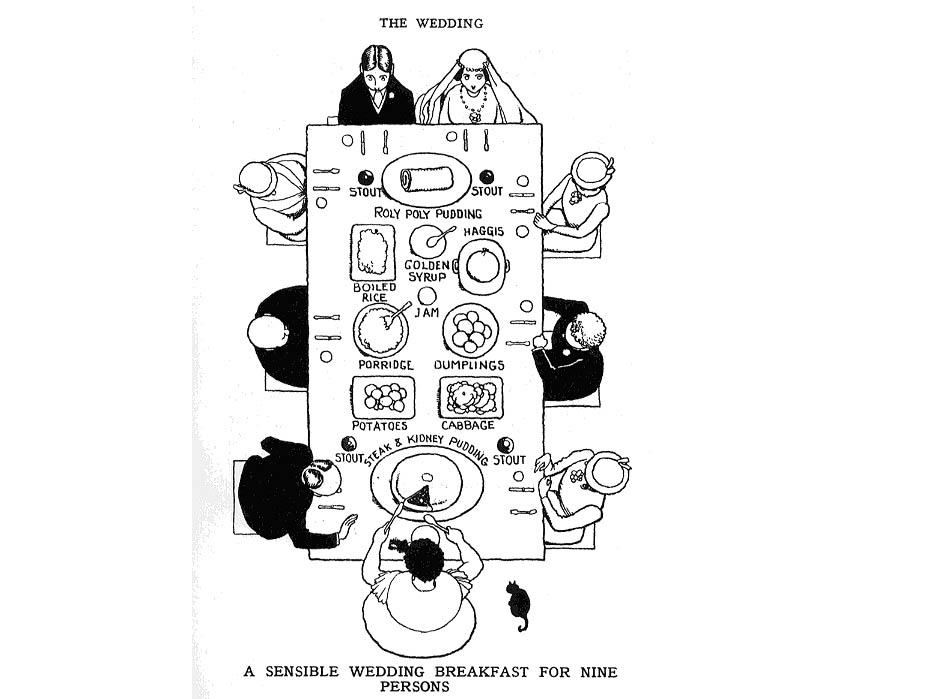
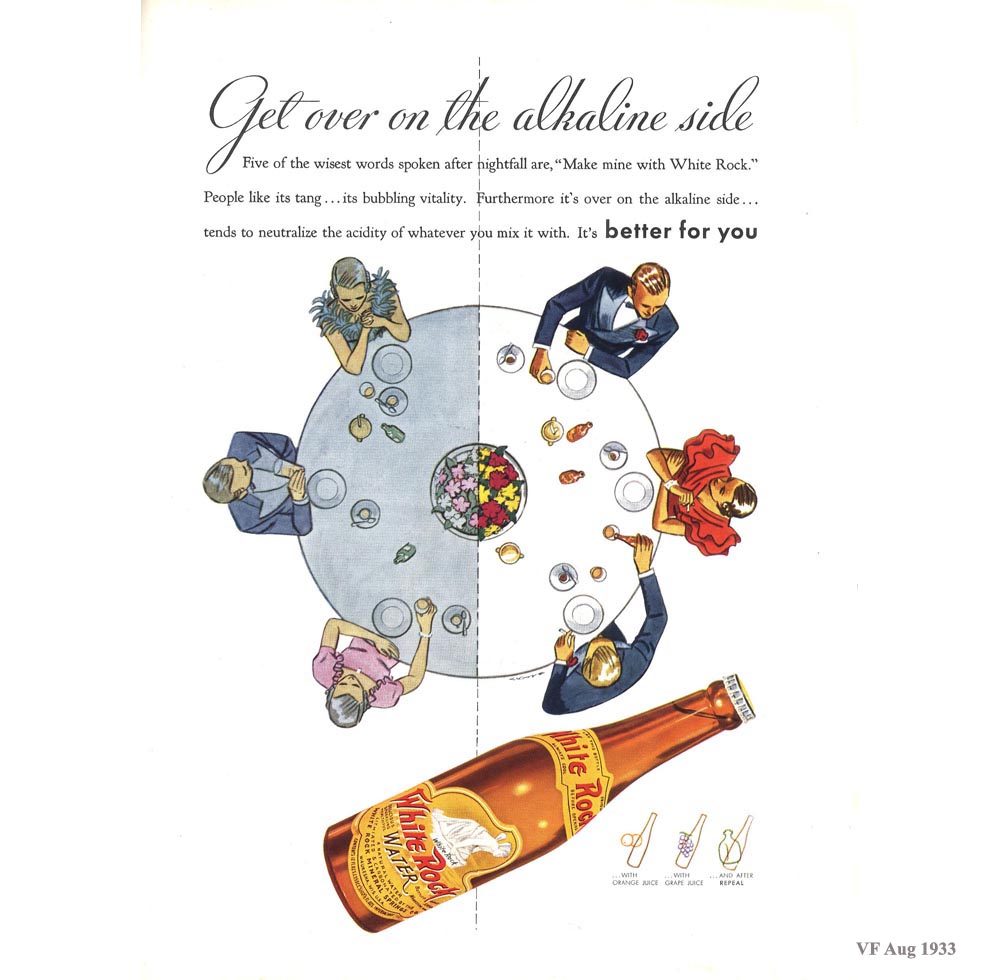
    This Daily Dose from Dr. Odd combines two interesting categories today, “Looking Straight Down” and “Display of Information”, and they involve food. Rather, its the placement of food, and maps of dinner tables, seen from above–directly above–and looking straight down.

    The idea of representing a view straight down, of looking straight down from some height, is a relatively recent occurrence, this view being somewhat rare in the antiquarian world pre-balloon or pre-heavier-than-air flight.  The pre-human-flight reason for its scarcity is understandable, but even after the first Montgolfier ascension in 1787, there’s another 120+ years of scarcity yet to come before these views would start to pop up in common (and uncommon) literature..  Now I’m not talking about cartography, which is basically a straight-down view of the world—what I’m referring to is that same view but not as a map per se, but what you would see if you were dangling out of a plane or balloon. It is an unusual and scarce perspective.

    Maps--Imaginary--Map of a Wedding Table


  • The Extreme Unction of Writing Posture

    JF Ptak Science Books     Daily Dose from Dr. OddFollow Me on Pinterest

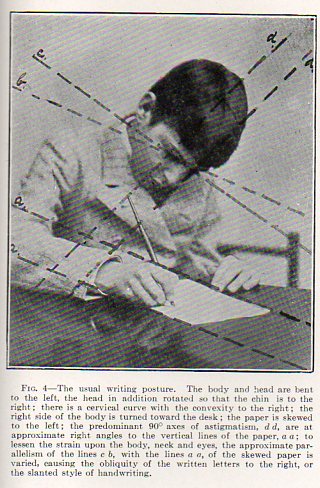
    This semi-wincing image was found in George Gould’s Righthandedness and Lefhandedness (Lippincott, 1908)–it is rather innocent, suggesting a study of penmanship posture; but taken out of context, it is quite something different, something with a bit of threat in it.  In- or out-of-context the author really meant to have the chin buried into the chest as a proper attitude.

    Right handedness098

    ·Posted by :

    ·in:

  • On Educating Women in the Sciences, Nature Magazine, 1871

    JF Ptak Science Books    Quick Post  Follow Me on Pinterest

    Nature099[The decorative gilt-stamped title of the cover of the volumes of my run of the great journal, Nature, 1871]

    In the 23 November 1871 issue of Nature appears “Science for Women”, a sort of unsigned editorial.  It is one in an interesting series of (for the most) part positive revelations about the education of women in the sciences, a step towards, well, not “equality”, but a normalization, a rapprochement,  extending the field of technical education away from the ruling/private school/university class of men towards women. This was happening at a time when there was not only a distinct division between men and women in education but also between the classes. 

    ·Posted by :

    ·in:

  • Beginning an Alphabet of Science Fiction -Punkisms

    JF Ptak Science Books  Post 1981

    “The most ignorant person at a reasonable charge, and with little bodily labor, may write books in philosophy, poetry, law, mathematics, and theology, without the least assistance from genius or study.”  Jonathan Swift, in Gulliver’s Travels (Actually, Travels into Several Remote Nations of the World, in Four Parts. By Lemuel Gulliver, First a Surgeon, and then a Captain of several Ships).  1726.

    I’ve produced the beginning of an alphabet of –Punkisms for variations of robot.machine/computer past and futures, science fiction indicators of possibility. Why should we stop at “Steampunk” when there’s FuturePunk and DeadPunk and such to be had?  So, please find folllowing a few possibilities, and accept them in the playful way in which they are offered–also, the very abbreviated descriptions of the science fiction works desscribed are open to interpretation. And please give this a “pass” for the over-abundance of hyphens.

    A

    ActorPunk: Walter Miller, ‘The Darfsteller’ (1954), human actors are replaced by robots on stage, as compared to being replaced by digital figures online. Some steps have been made with great care over the years by “perfecting” the imaging of women in magazine advertisement—in this way even the models who appear in the ad and are modified find it impossible to live up to the expectations of what their ads depict.

    Anti-technologicalPunk-topia: Samuel Butler, Erewhon, (1872).

    AutomatoPunk:  Kurt Vonnegut, Player Piano (1955), like Brazil and 1984, but with machines.

    B

    BiologoPunk:  Philip K. Dick, ‘Autofac’ (1955), machines find that they can reproduce themselves in a ’50’s iron-bio kind of way. 

    BrainPunk: Miles J. Breuer, ‘Paradise and Iron’ (1930).

    C

    ConsciousnessPunk: Philip K. Dick, Vulcan’s Hammer (1960) and the development of computer consciousness.  Also David Gerrold, When Harlie Was One (1972);
    Frank Herbert, Destination Void (1966); Harlan Ellison, ‘I Have no Mouth and I Must Scream’ (1967);  Robert Heinlein, The Moon is a Harsh Mistress (1966), and many others.

  • What Happened Underground: Mining, Orwell, Trench Bombers, & Waits

    JF Ptak Science Books 


    Underground working steep102

    Blogjuly_17_work334

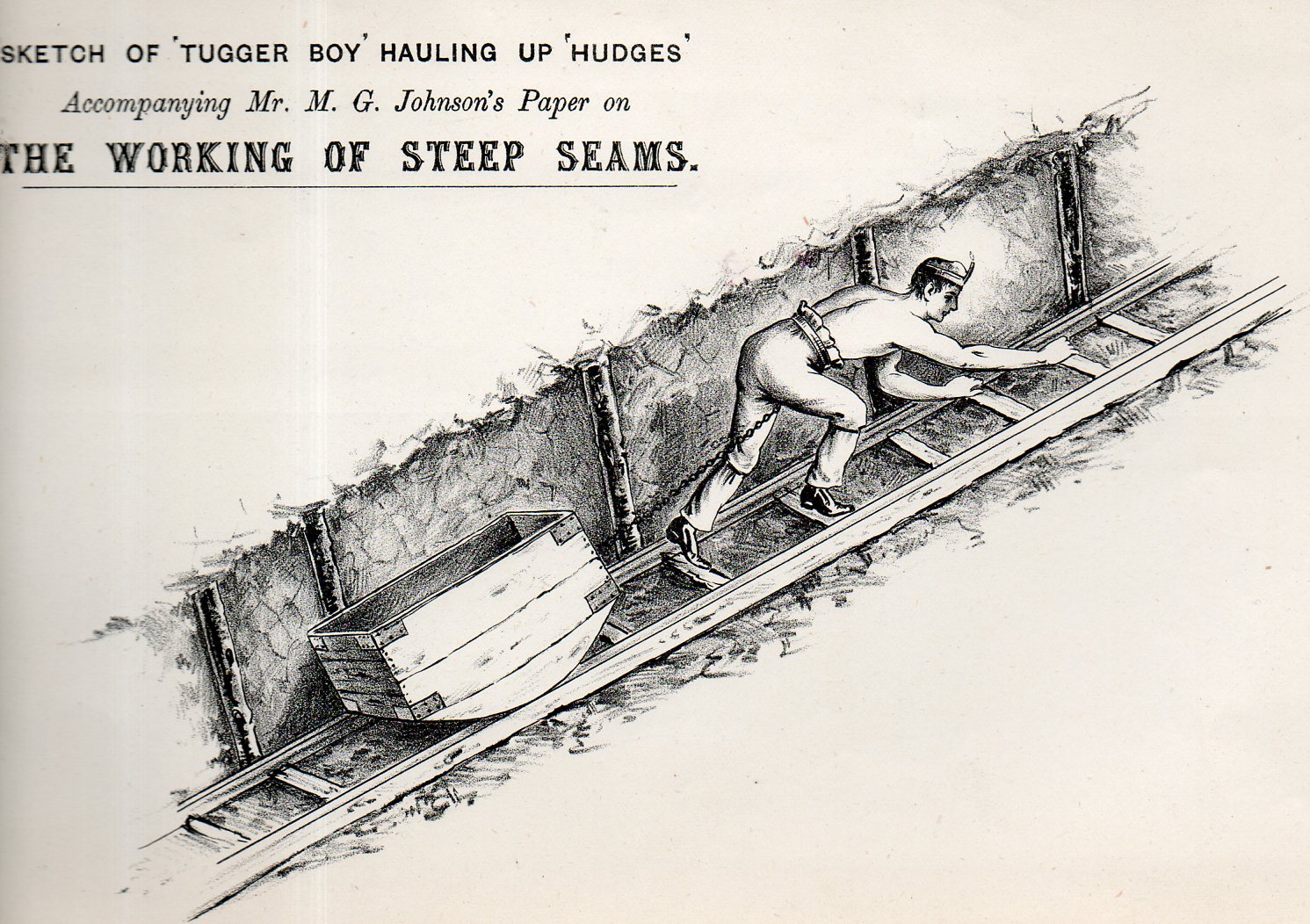
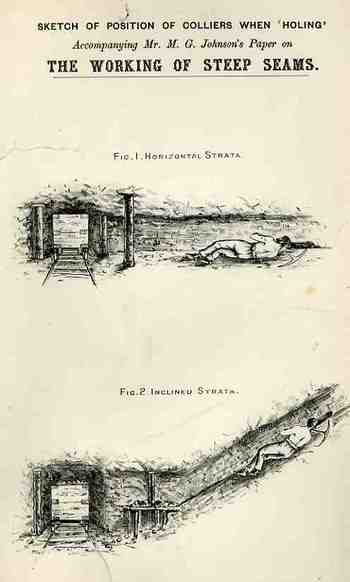
    Looking at these two images of the shirtless miner laying down and working on his side in the semi-dark way underground in what looks to be a tunnel about twice the width of his shoulders makes you wonder about how in the name of great bog could people have done this, day in and day out.  The fact that the appearance of these images were both essential and mundane further tells us—as we sit here in a comfortable chair in the print’s future—that this is, simply, what people did, and what they had to do.

    This was “holing”, as in working in a hole, and served to illustrate a point in Mr. M.G. Johnson’s paper “The Working of Steep Seams”, which I think appeared in a West Australian mining journal around 1900.  So, it seems, the guy, the worker, in the picture would spend his day chunking coal from a hard vein, laying down, scrapping (I think) away at the coal in a too-tight tunnel.  Did he do this for hours?  Days?  Weeks?  I guess the bad answer is that he did this as long as the coal could be followed.   (Also, it looks as though that the major tunnel in which the coal car is located may be 4 or 5 shoulders high—certainly not tall enough to walk in, which means that this guy could’ve crab-walked to this position for a half mile or more, just to get to work.  The tenacity of this worker to do his work and collect his pay to feed his family was just incredible. 

    The first image really doesn’t need much commentary, though calling the worker a “tugger boy” pulling up a “hudge” was probably a bit of sardonic camraderie–except that the doing of the job would distance you from its folksy name. Well, that, or the “tugger boy” really is referring to a boy, as we see in the followlign mining definition: “Tugger boy (Brist). One who draws small tubs or sleds underground by
    means of a tugger. Called Tugger-work. (Gresley), 1883).  The depiction of what seems to be a mature man in the image might be a piece of propaganda. In any event,  the Tugger Boy carries his own flame on the top of his headgear, and the chain that attaches him to the heavy coal bucket runs from his waste down the front of his body and through his legs.  Very hard work needless to say–harder yet done by a child.

    George Orwell wrote perhaps one of the most brilliant descriptions of the mining environment in his superb The Road to Wigan Pier. (It is well worth reading all of Orwell’s books at this point—his insights almost never looked so fresh.)

                                                       
    Blogjuly_18_mining_robinson338

    He  describes the crab-walk from the elevator to the place
    of work, telling how difficult and exhausting the process was of just
    getting to the place where you would then begin your difficult
    workday.  Of the miners he says at one point:  “Watching coal-miners at
    work, you realize momentarily what different universes people inhabit.
    Down there where coal is dug is a sort of world apart which one can
    quite easily go through life without ever hearing about. Probably
    majority of people would even prefer not to hear about it. Yet it is
    the absolutely necessary counterpart of our world above.”  Read more here.

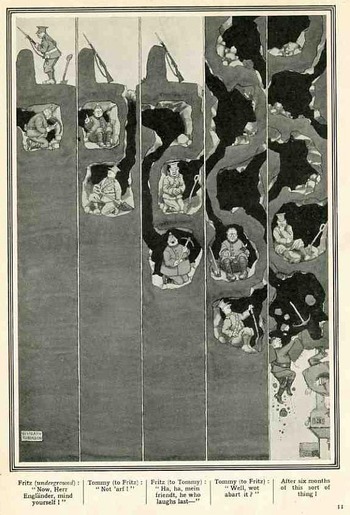
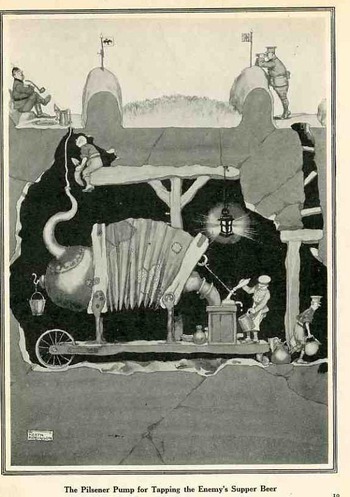
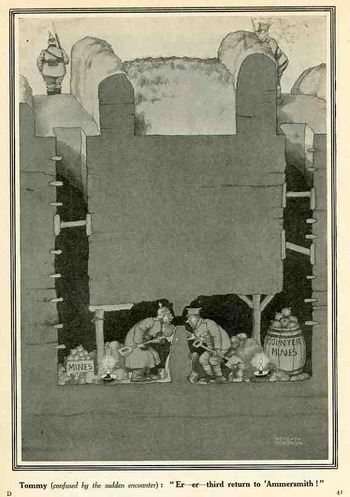
    The next series of images come from the pen of W Heath Robinson
    (1872-1944) who was a lovely, quirky, charming, skewed, dark,
    stiff-bouncing and creative illustrator capable of considerable whimsy
    (light and complex) and deep skepticism.  The images I’ve selected are
    from one of his three WWI books, Hunlikely, published in 1916 (Some “Frightful” War Pictures (1915), and Flypapers (1919),
    were the other two) and depict scenes from the intra-trench tunnel
    wars, which were battles fought in the midst (or, actually, beneath)
    other battles.  This was a savage, grueling, post-adjectival
    affair—exceedingly dangerous, difficult, awful.  And it happened a lot
    during the war, given the experience of stalemates between vast armies
    sunk into mole city trenches, with no one going anywhere for long
    periods because there was nothing in between the two impervious lines
    but a death vacuum.  So one of the solutions was to try and tunnel
    underneath the opposing army’s defenses, fill the far end with high
    explosives, and blow them up.  The other side was doing it too, and in
    the middle of it all was the incorporation of newer/better listening
    devices to detect forces rummaging around underneath your position
    dozens of feet into the ground.  It was a bad business. (One of the
    other means of breaching the trench lines was aerial combat, but
    bombers carrying tons of HE were still yet to be invented; poison gas
    was another.  Most of the time the armies would just meet in the
    middle  in wide plains of nothingness in a sea of hot, expanding metal,  where
    to this day in many of those places nothing can live).

    Blogjuly_18_tunnel_2_robinson340

    Robinson’s illustrations are odd, and oddly funny, the dark humor
    coming at the expense of both sides of the conflict, piercing
    each.   

    This puts me in mind of Tom Waits’ concrete-toothed “There’s A
    World Going On Underground” (1983) song from the Swordfishtrombones album. 

    Rattle big black bones in the danger zone
    There’s a rumblin’ groan down below
    There’s a big dark town, it’s a place I’ve found
    There’s a world going on underground
                
    They’re alive, they’re awake
    While the rest of the world is asleep
    Below the mine shaft roads, it will all unfold
    There’s a world going on underground
                
    All the roots hang down, swing from town to town
    They are marching around down under your boots
    All the trucks unload beyond the gopher holes
    There’s a world going on underground

    Blogjuly_18_tunnel_3_2_robinson341

    ·Posted by :

    ·in:

  • Finding Scientific Method in Uroscopy, 1577

    JF Ptak Science Books   Post 1981

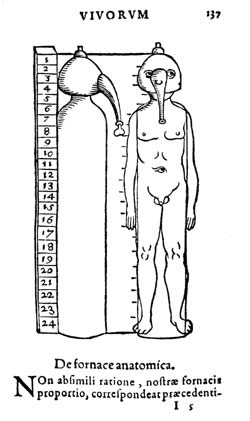
    Paracelsus furnace[Image: the anatomical furnace for the distillation and diagnosis of urine. From: Walter Pagel, Paracelsus: An Introduction to Philosophical Medicine in the Era of the Renaissance, second edition,  Basel/New York 1982, page 193/194. the image also found on line here.]

    While the ancient aspects of the inspection of urine as medical discovery seem distant, it is not so, the practice continuing for thousands of years, deep into the 17th century.  There are some surprises, though, here and there, in the recent history of uroscopy, particularly involving Paracelsus (Philippus Aureolus Theophrastus Bombastus von Hohenheim, 1493-1541), and specifically with his Anatomy, that is, the Dissection of the Living Body or of Distillation of the Urine, printed in 1577. This is one of the many of the works of Paracelsus printed posthumously–in his relatively short but very full life of 84 years, he published four books, but then in the 40 years or so following his death there were at least 14 more works that were published.  (A general overview of the works by and about Paracelsus–who worked in the areas of medico-occult and philosophy, alchemy, astronomy/astrology, theology, magic and more–can be found by piecing your way through the always-useful OCLC/WorldCat, here).

    In the practice of general uroscopy  urine was seen as a window into the health of the body–rather the lack of health.  For centuries urine was simply observed, its color plotted against color wheels.  Paracelsus worked in a different vein, and although this approach seemed as antiquated as possible after hundreds of years of practice, he adopted a proto-scientific approach to his urine inspection.  The idea of urine and his “anatomical furnace”, wherein the urine was distilled in a cylinder the size of the subject for interpretation, was a wide but interesting sidestep in the history of uroscopy, filled with some slight hope and more-than-slight abundance of need in belief. The point though is that Paracelsus went about this scientifically–no longer just an observational inspection: the urine was distilled, and coagulated bits (the “morbid species”) was separated from the urine, and the precipitated items were studied, a “chemical dissection” (according to Walter Pagels in his standard biography of Paracelsus 1982).  The cylinder was graduated in proportion to the subject; there was careful collection and handling of the specimen, and attempts were made to see beyond the standard practice of centuries past.  So there was some hint of scientific method in this work–something that Pagels notes but still labels the work “disappointing, albeit a subtle new brand of uroscopy”.

  • On Holes in and Life on the Sun, 1787

    JF Ptak Science Books    Post 1982   History of Holes series  #44  Follow Me on Pinterest


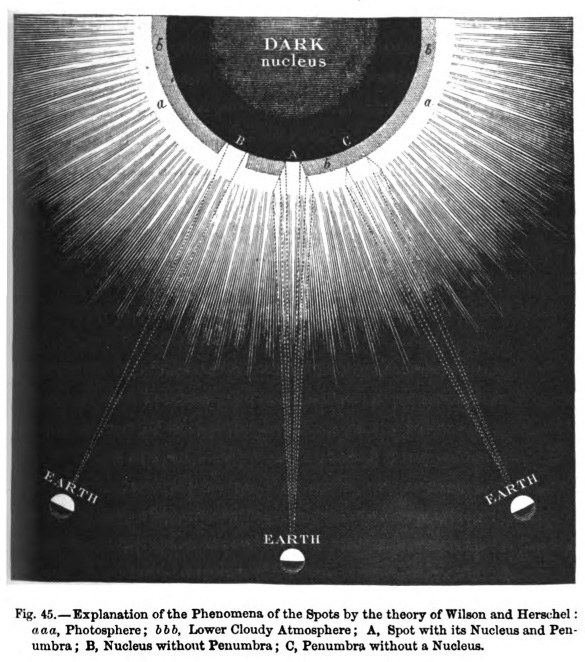
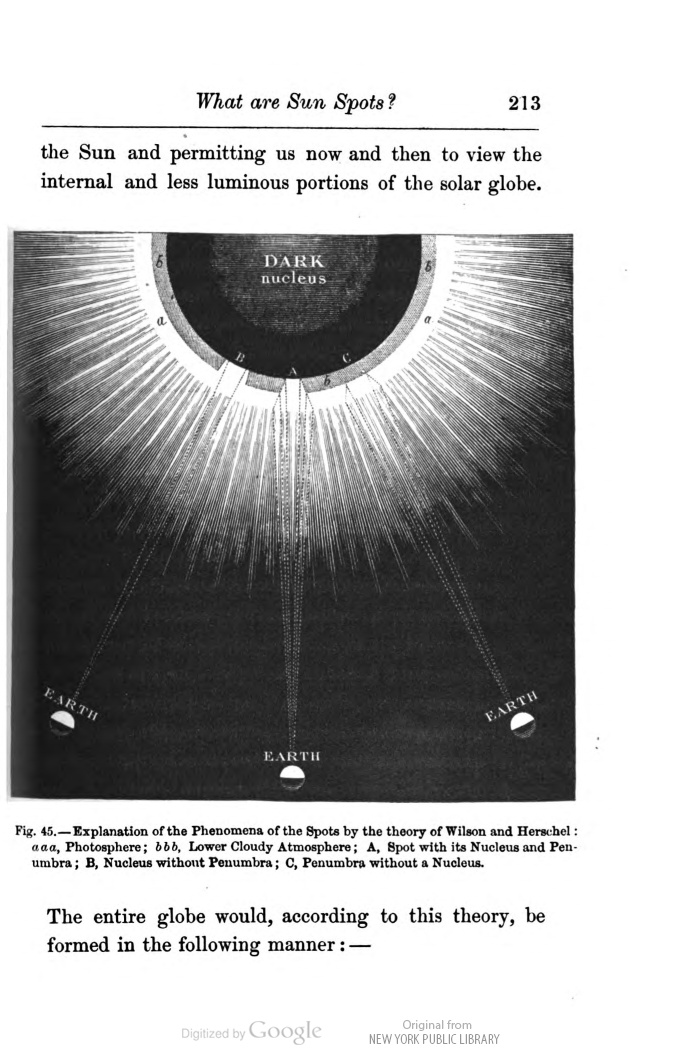
    Sunspot hole
    The composition of the sun remained basically hidden to scientists until relatively recently–certainly it was well into the 20th century before astronomers/astrophysicists got a good idea of what the sun is, exactly.  The perfection of god’s creation and Aristotle’s unchanging nature of the sun must’ve been suspected for a long time given its coronal displays during total eclipse and ancient unaided observation of sunspots (which at least suggested that the sun rotated), but the true nature of the “imperfect” nature of the star wasn’t firmly exhibited until the work of Thomas Harriot and the Fabricus and Galileo and Scheiner–but then there wasn’t that much that could be employed from the data. So too true even with Bunsen and Kirchhoff in their profound invention and discovery in 1859 of the spectrographic analysis of the sun revealing its chemical composition (finding the absorption lines in the spectrum of the sun contained hydrogen,m nicekl, iron, sodium,cacium, and magnesium as starters)–this information was essential in establishing discoveries that would come much later on. (Interesting to note here that the first record of a solar flare is made in this same year by Richard Carrington, and also that this year saw the publication of On the Origin of Species as well as Riemann’s hypothesis and Maxwell’s kinetic theory of gases–a big year in the history of science).

    The interesting hypothesis of sunspots as “holes” in the surface of the sun was made by Alexander Wilson (professor of astronomy at the University of Glasgow) in his paper “Observations on the Solar Spots” on 1 January 1774 and published in the Philosophical Transactions  (volume 64, pp 1-30, and available here).  It was one attempt at an explanation for the mysterious black spots that also opened the door to the possibility of the sun being inhabited.  The spots then would have been conical holes in the sun’s photosphere, with the dark part coming from a glimpse of the interior (and presumably cooler) part of the sun. 

    From the vantage point here in the future this looked like not such a great idea, especially coming only a few years before the (1787) discovery by William Herschel that the sun and the rest of the solar system was in motion relative to the stars and was slowly moving towards a point in the contellation Hercules, which was an enormous scientific breakthrough as well as philosophical-theological chllenge, a cosmological “aha!” moment.  That said, Mr. Herschel also held the view that sun spots were possibly cavities in the surface of the sun, the reasoning for which was very good and at times convincing in the absence of anything better, a pretty good product for its time

    The beautiful image introducing this post was designed about a hundred years after the Wilson paper, and appeared in the prolific Amédée Guillemin’s (1826-1893) The Sun (translated from the original French in 1875), and which is available in full text pdf from The Haiti Trust. Guillemin spends a chapter on sunspots and holes and presents a convicing history of the idea, and that according to Wilson and others the spots were cavities in a liquid globule envelope and revealed the solid mass of the sun “through a cloudy atmosphere with a grey tiny all around” (page 214). 

    The epilogue of Guillemin’s book addresses the issue of life on the sun (“Is the Sun Inhabited?”)  and in his review Guillemin very plainly makes the case that it is “absolutely impossible to support life” on the sun due to the heat–presently. He qualifies his assessment finally by asking “Will it become habitable?”, and responding that it was “very possible” (page 295), but that it would have to take place in a future where the rest of the planets and everything else has gotten colder. 


    ·Posted by :

    ·in:

    —
  • Maps of Extreme Beauty and Detail, 1555

    JF Ptak Science Books   Quick Post  Follow Me on Pinterest

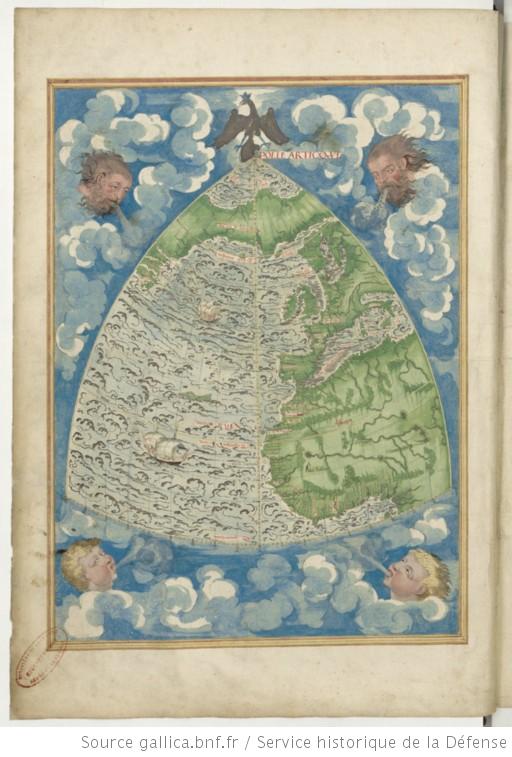
    These fabulous maps appear in the cartographer/privateer/navigator/explorer Guillaume Testu (1509-1572) Cosmographie universelle, selon les navigateurs tant anciens que modernes / par Guillaume Testu, pillotte en la mer du Ponent, de la ville francoyse de Grâce, which was a manuscript atlas composed in 1555 or so, and found online courtesy of the Bibliotheque Nationale (Gallica). It is extraordinarily rich in design, color, and most significantly in detail, much of which was real. 

    The work is 118 pages with 57 plates (almost all of which are maps)–I’ve posted below six world map projections plus a few maps of North America and Central America. And a beautiful wind rose.  The rest are available via the previously-mentioned link. 

    Maps--testu world 1

  • A Mystopian Alphabet of Newspeak Words: Orwell and Unthink

    JF Ptak Science Books  Post 1953

    “It’s a beautiful thing, the destruction of words … what justification is
    there for a word which is simply the opposite of some other word? A
    word contains its opposite in itself. Take “good”, for instance. If you
    have a word like “good”, what need is there for a word like “bad”?
    “Ungood” will do just as well — better, because it’s an exact opposite,
    which the other is not.’”–George Orwell, 1984

    “Orwell and Nabokov wrote nothing like one another and did that to perfection.”–Not H.L. Mencken
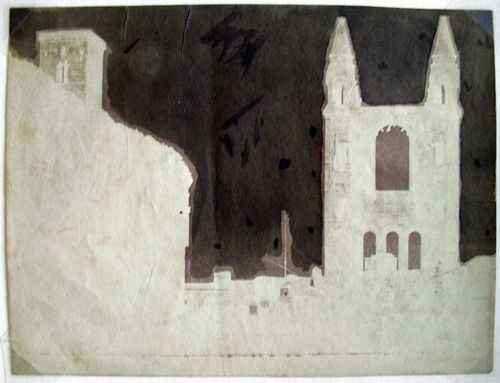
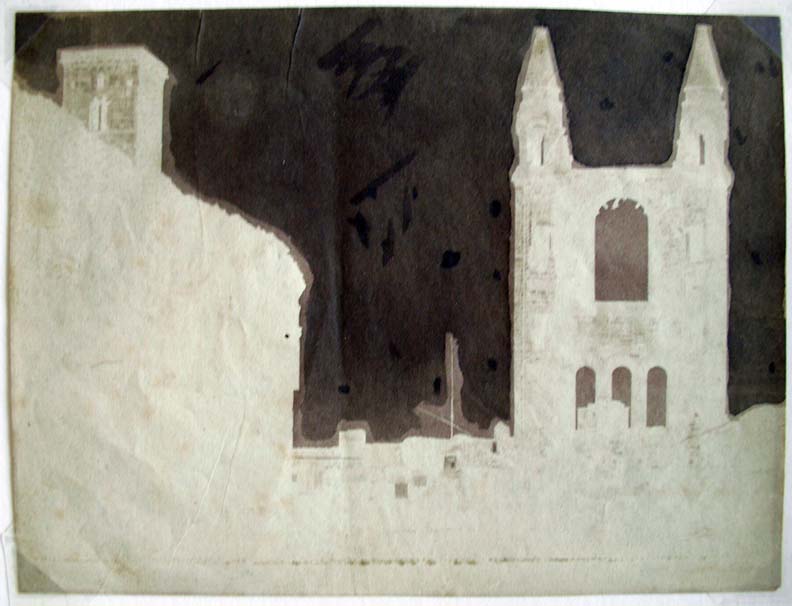
    Hilladamson2[David Octavius Hill (1802-1870) and Robert Adamson (1821-1848), St. Andrews [East Gable End of the Cathedral with Tower of St. Regulus], [1843-1847]. Calotype. Source: Princeton University Library.]

    There is nothing that limits action than the control of the stuff that describes it:  words. Any dictatorship or totalitarian regime can appreciate this thought–many would try to eliminate even the thinking of this thought, let alone limiting the spoken parameters of discussing it. Removing the capacity to respond to what is happening in the world with other human beings by rephrasing the experience through the introduction of new words and the elimination of old ones is an excruciating form of absolute power that can be blatant as well as subtle, though I suspect that accomplishing this word control sotto voce would be the most effective/insidious method. 
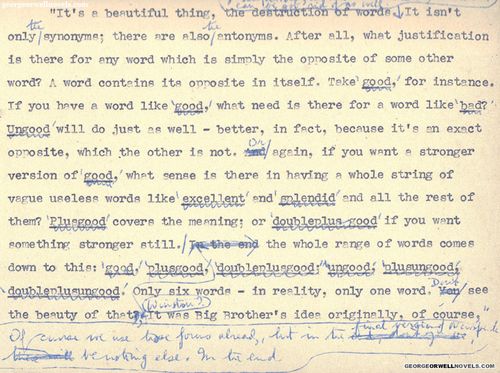
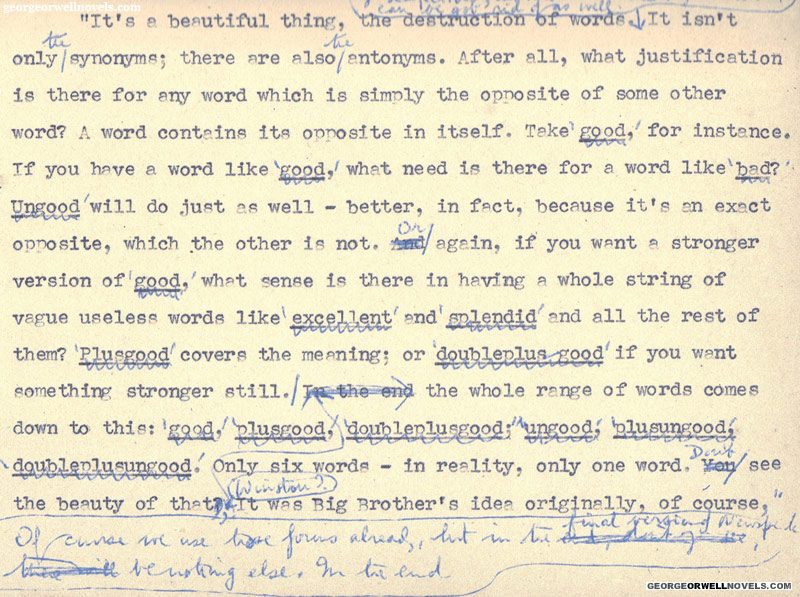
    Orwell 1984 ms[A page of Orwell’s corrected Manuscript of 1984; source: GeorgeOrwellsNovels.com here]

    George Orwell describes a terrifying society of just this sort in his book 1984 (with the complete text available here), which was an adventure into a Mystopia of the near-future (of about the year 2050).  He writes about a society, Oceania, that attempts to makes it members into one conforming biological unit for the sake of control it. One of the methods used to accomplish this is the destruction of words and the creation of other state-controlled words to replace them, a sort of single-channel television for the mind, a device using its own vocabulary which audially impregnates the listener with versions of correct thinking, redefining reality by controlling the ways of interpreting it.

    This is a list of some of the words that Orwell’s society creates–some of course do not stand well on there own, their deviousness appreciated in the context of the story, like the first example, “artsem”, which through constancy has come to numbingly replace the idea of what the word represents.  Others, like ‘good”, are old words with a new meaning, making them new words with a bad (or  not-good) meaning. Or “free” of the old (or Oldspeak”) meaning, where even the word “free” is used only to describe an absence, as in “this sentence describing the use of the word “free” is “free from the old meaning of free”, like you’d want a baby to be free from germs.

    See here for an autobiographical note on Orwell; “A Short History of My Life”, by Orwell in 1945, here.

    Airstrip One:  the new word for “England”, which has been reduced to nothing but a terminal for  the society of 1984, Oceania, is composed of the Americas, part of southern Africa, Australia and New Zealand.

    Artsem: Artificial
    insemination, which is the enforced and nearly the only method of reproduction allowed in the society, another brick in a structure that controls the expression of intimacy between people. Big Brother needs new people for the society to continue, but he doesn’t want there to be any emotional connection between them outside of the prescribed feelings that people are supposed to emulate. Artsem further indoctrinates a no-contact policy between people. There was the possibility of sexual intercourse but only for the production of children when artsem was not applicable–this was called “goodsex”, which was the opposite of “badsex”, which was sexual relations for the joy of it. The orgasm was a hunted thing, to be tracked down and eradicated.

    BB: Big
    Brother. 
    The major domo of Oceania, a hitler/g-d, an extreme presence of control.
    “The story really began in the middle sixties, the period of the
    great purges in which the original leaders of the Revolution were wiped
    out once and for all. By 1970 none of them was left, except Big Brother
    himself. All the rest had by that time been exposed as traitors and
    counter- revolutionaries.”

    Bellyfeel: an unfeeling and enthusiastic acceptance of an idea, following without knowing or knowledge.

    Blackwhite:  “… this word has two mutually contradictory meanings. Applied to an
    opponent, it means the habit of impudently claiming that black is white,
    in contradiction of the plain facts. Applied to a Party member, it
    means a loyal willingness to say that black is white when Party
    discipline demands this. But it means also the ability to believe that black is white, and more, to know that black is white,
    and to forget that one has ever believed the contrary. This demands a
    continuous alteration of the past, made possible by the system of
    thought which really embraces all the rest, and which is known in
    Newspeak as doublethink.”

  • Chess Pieces of Dusty Greats vs. Celebrity Mistakes: Robt Hooke vs. Paris Hilton

    JF Ptak Science Books   Post 1954
    Follow Me on Pinterest

    • QUESTON:  If great but not-popularly-known scientists could be represented as a chess piece, and that chess piece was on a game board opposite Popularly-Known-Celebrities-Not-Known-to-Scientists (and etc.), what piece would the great and dusty Robert Hooke be? And conversely, (on that opposite side), what piece would someone like, say Paris Hilton be?

    See also earlier posts: The History of Dots Part 9: the Cell and Robert Hooke  and Horse Poop and the Stars: Robert Hooke, 1673 (No, it Wasn’t Pegasus) and When a Compliment is Not: Newton and Hooke and the “Shoulders of Giants”

    I wonder about poor old Robert Hooke.  He was such a tremendous thinker, a terrific rush of ideas, with revolutionary insights in many fields; he was a leading architect, a physicist, a microscopist, a chrononaut, a mathematician, an everything. He carried the Royal Society for years, carried on hundreds if not thousands of experiments, and of course was famously on the other side of a bad series of arguments with Isaac Newton.  At the end of his long life, Hooke was afraid of not being remembered, of not having enough money to see
    himself through hi sold age, afraid of others taking credit for his
    work.  He just seemed not to matter, anymore, in the last decade of his
    life (and a period in which he was still doing significant work), and I
    just wonder why he managed to become so semi-invisible.

    13_Portrait_of_Robert_Hooke

    He was so dedicated.  I have an image of him scurrying with a friend, removing the estimable library of a patron and donor to the Society, trundling the books in wheelbarrows across a mile and then-some of bumpy London streets finding a home for these great treasures.  He was an older man at this point, marching these books across parts of the city that he helped to restore after the fire, passed buildings that he helped to build and design, bumping his way through London, a great and famous scientist, saving books by the handful. [An idealized portrait of Hooke, at right.]

    He was a tireless,
    relentless observer and experimenter, who lost little effort in a stranded idea
    and pursued interesting and problematic questions relentlessly.  More than others too he chased his won glory—minor
    but long and insistent—the years of which wore thin on many people in the
    scientific community.  But there were
    many characteristics of the man that made him not quite so lovable and
    endearing—not that Newton was any of those things, as he was not, but if you
    are going to be a secondary luminary to a super nova you’ve got to have
    something else going for you that the other man doesn’t have—sharing, helpful,
    greatly generous—to get you into the long pre-dusty pages of history. Also it would’ve
    helped if Hooke chose his battles with a little more aplomb and ingenuity—the
    war which began in 1672 with Newton went very badly for Hooke and followed him
    to the grave (and far beyond).

    He just didn’t “catch on”, I think–at least he not for the long term.  His brain teemed with ideas, but perhaps by the last decade of his long life, his tireless brain still working on innumerable bits, he just sucked the air out of a room. 

    He also never had his likeness recorded during his lifetime.  And that is saying a lot.  And I still don’t know why.

    Back to chess:  I figure Hooke to be a Knight.  I prefer Knights.  He moved like a Knight.  He importance was “higher” than that of a Knight, but, well, the Knight seems a good fit (and so he seems to get downgraded, in a way, even in this game).  And Paris Hilton?  I think she might be a queen (with a small “q”)–as someone who is ultra-well-known but not for anything in particular except for the quality of being well-known. 

    ·Posted by :

    ·in:

    — —

Recent Posts

Archives

Categories