A Daily History of Holes, Dots, Lines, Science, History, Math, Physics, Art, the Unintentional Absurd, Architecture, Maps, Data Visualization, Blank and Missing Things, and so on. |1.6 million words, 7500 images, 4.9 million hits| Press & appearances in The Times, Le Figaro, Mensa, The Economist, The Guardian, Discovery News, Slate, Le Monde, Sci American Blogs, Le Pont, and many other places… 5000+ total posts since 2008.

  • An Early and Unsatisfying Projection of an Electron, 1920

    JF Ptak Science Books  Quick Post

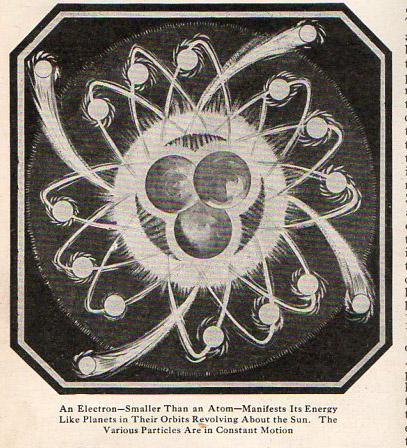
    People have been thinking along the lines of “electrons” for a long time, though the word is of relatively recent origin (1874), coined by the wonderfully-named Johnstone Stoney (1826-1911) after deducing that ther must be some type of electrical bit that vibrates within the atom that would generate light.  J.J. Thomson (1856-1940) stated later in 1897 in his paper “Cathode Rays” that evidence points to the fact that there must exist particles that are less massive than the hydrogen atom–he called these objects “corpuscles” but he was referring to what we now know as “electrons”. The gorgeous “oil drop” experiment of 1910 by R.A.Millikan (1868-1953) determined the charge of the electron, and in the next year–1911–Ernest Rutherford (1871-1937, and one of the 20th century’s greatest Kiwis) proposed the structure of the nuclear atom.  Then the major development of Louis de Broglie’s (1892-1960) particle/wave duality, and so on into our near-present.  But in between the beautiful work of Millikan and Rutherford came this little beast, a very unsatisfyingly-assumed image of an atom and its swirling electrons. The image appeared in the December 1920 issue of Illustrated World and just seems so unfair to the cause of beauty that I thought to share it.   

    Electron059

  • A Telephone Call From TomorrowLand and the Idea of Weighing Antique Surprise

    JF Ptak Science Books   Post 1973  Follow Me on Pinterest


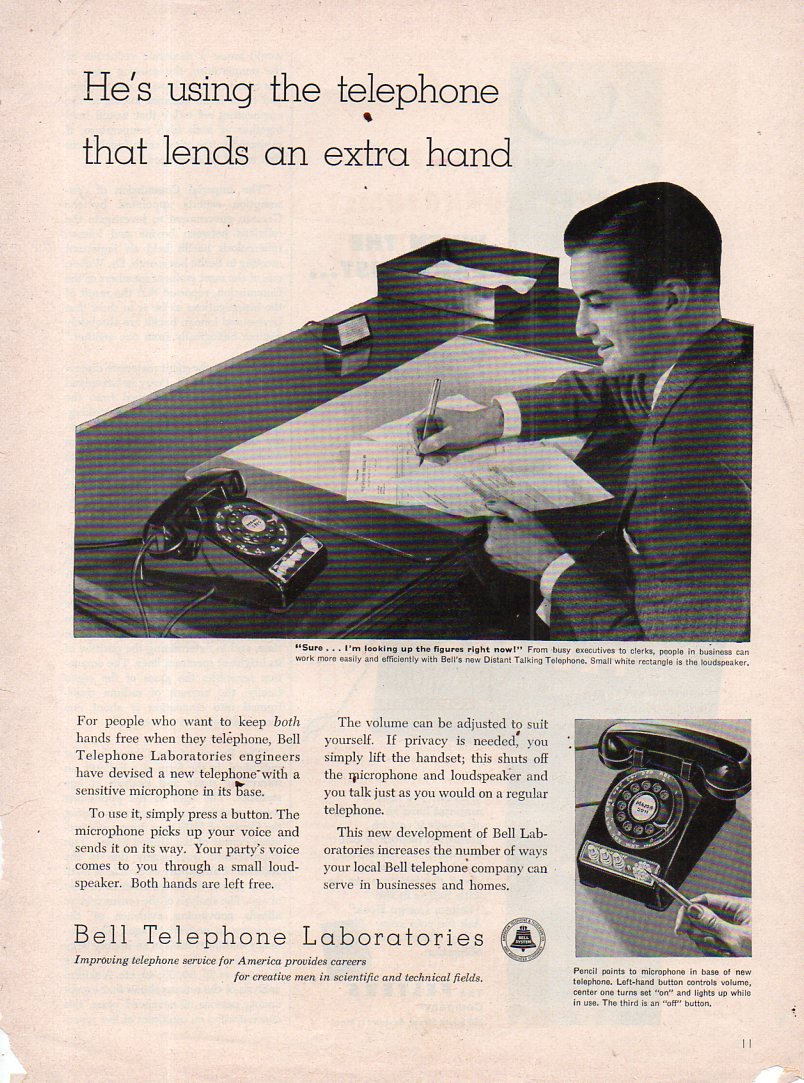
    This ad appeared only 59 years ago–that’s four generations in dog years, two human generations (or one for the more later-in-life crew, which is appealing as I knew a man whose grandfather was born in the 18th century), and 15 generations in managing data and communications. Perhaps more.  It is difficult to imagine the intense surprise that attended this ad showing a practical and popular adaptation of a communications breakthrough. 

    Telephone future064

    The electromagnetic telegraph, which is arguably the first electrically-powered iteration of the internet, was in the works from the 1820’s until it was nailed by Samuel Morse in 1837.  It was 40 years to the development of the Bell telephone (another dramatic example of an invention/technological idea/breakthrough that was “in the wind”, a popular undiagnosed monumental meme, some decades in the making in the hands of Bell anbd Reiss and Meucci and Gray and even Edison). Two more decades (just past the turn of the century) until more-widespread wireless telegraphy, another two decades after that (1920’s) for poular radio, and another two decades after that (post WWII/1950’s) for popular television broadcating. 120 years between the patented invention of the Morse telegraph to 50 million Americans with televisions in 1955. 

    The “telephone” of 2013 is as removed as the telephone of 1955 as the telephone of 1955 was removed from the electromagnetic telegraph–we’re not meeting half-way in the meeting of improbable impossible worlds, of worlds of the future unimagined in the past.  That is what comes to mind when I see this add for the speaking telephone in 1954–the astounding, astonishing, speaking telephone, the phone that allowed you to not have the receiver to the ear, tht allowed you to do free-hand work and communicate at the same time.  It was an ambitious improvement, and as soon as the phone appeared, it became a standard of necessity if that necessity was within budget. 

    It is the weight of surprise that is so abundant looking at pictures like this, giving us the opportunity to imagine the surprise elements of another time. It may well be that the new 1954 user of the speakerphone would have looked at the first telephone systems of 1894 as we look on that 1954 telephone today.  Probably not so, though, probably it was much more imaginable to have forseen the 1954 possibilities in 1894 than for 1954 to have seen in the same amount of time to 2013:  the technological pieces necessary for part of that imagination had not yet been invented, the science ahead of the scifi. 

    The other part of this surprise element is that 1954 is well within living memory, and that this combinaiton of technology and physics and mathematics has grown so incredibly from the speakerphone to the massive changes in 2013–it is as surprising to imagine this as to imagine the same scenario for what ahppened a year before in biology:  it is difficult to grasp the  sweeping changes in that field from the identification of DNA in 1953  and how far those fields have come since. 

    I think that if one could quantify this sort of “surprise” that the greatest amount of “Surprise Integers” (or whatever) ever recorded would have taken place within these past 50 or 60 years. Which makes me wonder–will people 59 years hence see the pictures of our fabulous accomplishments in 2013 as quaint reminders of how much things changed between 2013 and 2072?  Will those “Surprise Integers” be as great for that period of time as the (“our”) preceding period with concomitant revolutions in thought?  My guess is “yes”–its just hard to imagine. 

  • Standard Corpse, Inc. & Deadpunk: Shaving, Cooling, Lifting, Electroplating, and Diapering the Dead

    JF Ptak Science Books   Post 1975   Follow Me on Pinterest

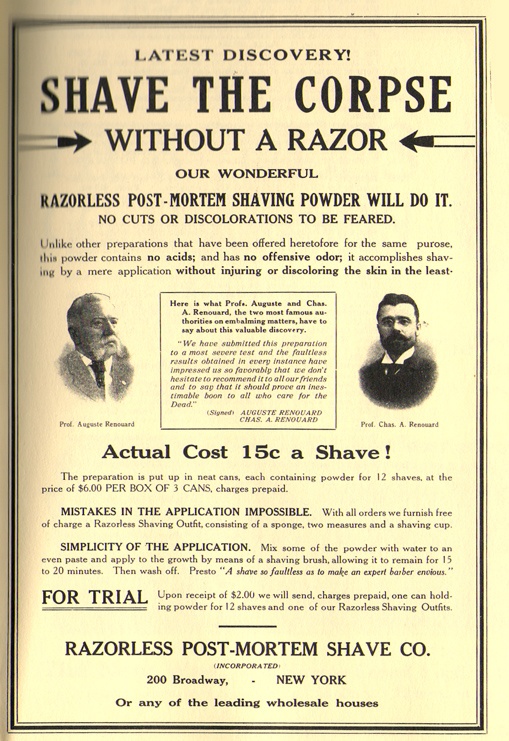
    The idea of creating an economy from a previously dead clientelle–the very after-market dead person–is relatively new. Once a middle class or lower working class with disposable income was created, celebrating the care of the dead was a paying option opened to the millions of families who were not the fastidious and celebratory wealthy.  Once the notion of having other people take care of the dearly departed became a part of the popular ritual of dealing with the dead, an entire new industry was born–spawning other related and associated industries for supplying the dead-care-givers with amenities and notions and necessities of a previously unthunk and unthinkable nature.  For example, the idea of needing to shave a corpse became an issue after it became fashionable to allow several days or more to pass between death and burial.  Beards and hair grow in death, so the people caring for the body and its display now were ordained an issue of economy in nultiple shavings of a corpse.  Now that may or may not have been an issue, but it was certainly presented as a possibility by the incredibly-named “Razorless Post- Mortem Shave Co.”


    Deadpunk shave

    {Many thanks to reader Max W for providing the information for the correct information for the citation of the above image–the magazine is Casket & Sunnyside for January 1912, and there are ample references to it in Charles Addams and Jessica Mitford.] The worry for the consideration of the cost of a shave (15 cents) for a dead person seems quite an inescapable weirdness and luxury. The weirdness of the name of the company nearly obscures it common nature–it isn’t exactly the Acme Corpse Company, but it is close to it, and it addresses just one small bit of minuatiae of deadness in the vast sea of Dead, Inc.

    The sellers of the razorless post-mortem shave equipment didn’t receive a patent for their process–nor did anyone else, for that matter, at least so far as I can determine. 

    Here are some further examples of Dead, Inc/DeadPunk patented death appliances:

    Post-mortem skull examination facilitator:

    Postmortem Underwear for the prevention of dead leakage and deodorization:

  • Daily Dose from Dr. Odd: Outsider Logico-Economics and Free Steel Money

    JF Ptak Science Books  Quick Post   Daily Dose from Dr. Odd series

    Follow Me on Pinterest


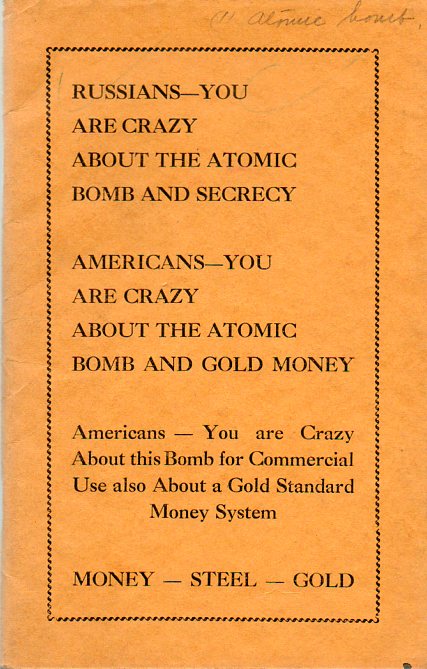
    Dr Odd series069I have rather deep well of sublimely different publications, some of which strain the merits of acceptable thought and the boundaries of logic; and some are filled with their own outsider logic, occasionally acting as a Black Hole of interpretation.  Some of these publications have incredible titles that obscure some good thinking in its pages; sometimes the title is bland or discerning but hide a text that is anything but that and sometimes nonsensical or outre. And sometimes the works have incredible titles with contents to match. Such is the case with Frank Freemont Frazee’s Russians You are Crazy about the Atomic Bomb and Secrecy; Americans, You are Crazy about the Atomic Bomb and Gold Money; Americans you are Crazy about this Bomb for Commercial use also about a Gold Standard Money System.  This work is certianly upper-drawer for publications with difficult titles. 

    And as it turns out, the content does not disappoint, if by “disappoint” we mean “confuse”–I’m still uncertain about what the man was saying in his Fabius, New York publication.  But after much talk of god and Henry Ford and bimetalism and fire and “cost and storage” and Moses and barter and “epitomes and repetition with inflation” and the like, it looks like the author presents a monetary system based on anti-atomic-bomb fear and freedom from major enterprises, along with steel dollars, which “would be a sound valuable dollar, because made of enough rust-proof sttel to be worth a hundred cents internally”.  He terms it “free steel…to be acutally produced competitively new dollars necessarily made of steel”, though by “free” he means “competitively produced and accepted by us and our government as money, freely and without limit”, which really doesn’t have anything to do with “free”.  And so it goes, on and on. 

    ·Posted by :

    ·in:

  • A Sharp Insight on Fascists, Union-Busters & other Armed Vigilantes, 1937

    JF Ptak Science Books  Quick Post 

    Follow Me on Pinterest


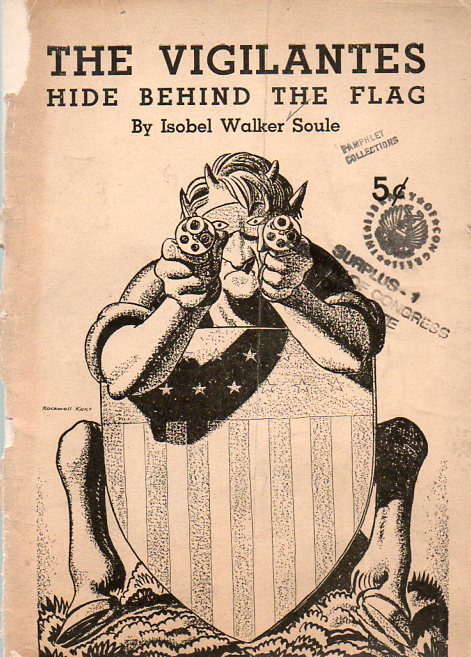
    Vigilante071

    The iconic, prodigiously-talented illustrator, old lefty and great inventive soul Rockwell Kent designed and drew this cover for Isobel Walker Soule’s The Vigilantes Hide Behind the Flag, a slim but powerful little pamphlet published by the National Committee for Defense of Political Prisoners in 1937.  Ms. Soule was a very present social worker and protagonist for the rights of workers–she and Kent would have shared this great passion–and published this work dealing with armed strike breakers (the “vigilantes”) as small targets and Fascists and the like as the larger–those, as well as the groups established by “the economic royalists (who) have given marching orders to their hordes and hope to trap the middle class into the vigilante net they’ve spread”.  

    {Soule could really spike a paragraph:  here’s an example of her addressing former Ashevillean William Dudley Pelley, founder of the lost-soul hate group the Silver Shirts:

    “…He was a YMCA representative with the AEF to Siberia in 1917. Returning to America he wrote for pulp magazines. he became a spiritualist. He had an inspiration and wrote  a story in which he claimed to have died,and spent seven minutes in eternity. On the basis of his fan mail he founded a magazine in North Carolina  with his clair-audient voices from the ether as assistant editors. Out of the magazine he founded the Silver Shirts”.)

    Soule fills up a stubby thirty pages like few others, addressing the very-present issues of thug-backed union-busting and the powerful growth of fascists at home and abroad.

    Vigilante070

  • Imaginary History: 2-D and 3-D Shadows

    JF Ptak Science Books    Post 1975 

    Follow Me on Pinterest


    In preparing an alphabetic sampler atlas of imaginary places (a thing which looks much finer capitalized, so An Alphabetic Sampler Atlas of Imaginary Places), I wondered about the non-existent relationships between these nonexistent places, and thought that this too might make an interesting alphabetization project. So an Alphabetic Sampler of Non-Existent Relationships Between Non-Existent Places came to be, and since it has such an oddly appealing ring to it, with a certain amount of surrealist qualities (really more affectations) it might be appropriate to start with Alfred Jarry, and here with his wonderful creation, Laceland1. and its relationship to Edwin Abbott’s Flatland2.. Their’s could be a war in the relationship of their light–or more exactly, their relationship of shadows.

    I can see across the vast and extremely limited sea that separates these two places a commonality in at least one dimension–and maybe only one, though being light, it is a rather large one. Light plays a big part in Flatland. The slender book Flatland is perhaps one of the best books ever written on perception and dimensions, a beautifully insightful book that was quick and sharp, and in spite of all that was also a best-seller. Written in 1884 when Abbott was 46 (Abbott would live another 46 years and enjoy the book’s popular reception), it introduces the reader to a two dimensional world with a social structure in which the more sides of your object equals power and esteem. Thus a lower class would be a triangle (three sides) while the highest (priestly) class would be mega-polygons, whose shape would then become a circle. On the lowest but complex strata is woman, who is represented as a line, but which is also the most contentious and unpredictable of all of the Flatland shapes. That is, until they all encounter a sphere, and the introduction of the third dimension, where Abbott’s magistry comes in explaining to the three-dimensional reader what it was like to be in a two-dimensional world.

    Jarry’s Laceland–along with Amorphous Island, Fragrant Island, Bran Isle and what is almost the pluralization of my surname, Ptyx–was an island kingdom that was surrounded by shadow and semi dark, but upon approaching it there would appear absolutely brilliant and blinding light the power outmatching that of the sun, glorious and fantastic, the light greater than that of the light of creation. The light is beautifully described by Alberto Manguel and Gianni Guadalupi in their excellent The Dictionary of Imaginary Places (1980):

    “The King of Lace spins this bright light, weaving pictures of madonnas, jewels, peacocks and human figures which intertwine like the dances of the Rhine-maidens. Clear patterns apper against the pitch-black darkness of the surrounding air, like shapes painted on windows by the first, and then disappear again into the shadows” (Page 204)

    Now in Flatland, light is a different sort of thing, coming as it does in only two dimensions, which means that two-dimensional light in a two dimensional world makes for a different sort of shadow, one that is rather flat and uninspired, especially compared to those of Laceland, which must be magnificent. Perhaps the shadow relationship between Laceland and Flatland is one of opposites. Polar opposites. Impossibles.

    This all seems to come together a little when considering that the Dr. Faustroll of the Laceland adventures, is the inventor of “pataphysics”, which is “the science of imaginary solutions”.

    Notes:

    1. Alfred Jarry. Ptyx, Laceland, Amorphous Island, Fragrant Island and Bran Isle, Exploits and Opinions of Dr. Faustroll, pataphysician, 1911.

    2, Edwin Abbott. Flatland: A Romance of Many Dimensions (1884).

    ·Posted by :

    ·in:

    —
  • Comet, Meteors, Aristotle, and Astrological Nothingness

    JF Ptak Science Books   Post 1977 

    Follow Me on Pinterest


    It seems to me that in the history of astrology–or at least for what seems to be most of it, at least through the late antiquarian publishing aspect of it–that comets and meteors were basically not utilized.  Perhaps it was because in that world these entites didn’t really effect anything–perhaps they were simply mysterious, spurious, and incongruent, and not a subject for installation in the astrological night sky.  Comets (from the Greek, kometes,  “long-haired”) and meteors (Greek again, from meteoran, a “thing in the air”) and bolides (exploding meteors, from the Greek bolis, or “missile”), holosiderites, siderolites, aerolites uranolites, and so on, have a long and complex story in the history of astronomy, at least in some ways; perhaps the most influential thinker on comets held thinking at bay and did so for two milennia: Aristotle’s Meteorology made the case that comets were not a planet or associated with planets or even necessarily part of the heavens–rather they were a phenomena of the atmosphere.  So perhaps their use as astronomical/astrological objects was limited by their very Aristotlean obviousness of being near-Earth objects. 

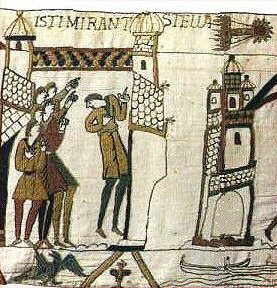
    The Comet of 1066 (later named Halleys’ Comet), as depicted in the Bayeux Tapestry (completed in the 1080’s)

    Comets bayeux

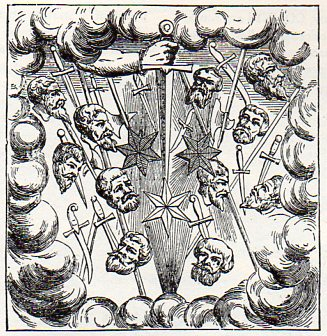
    The fear aspect of comets–the Comet of 1528–was depicted in Ambrose Pares Livres de Chirurgie (1597), and shows what part of the concern was (the coming demise of nations, the death of rules) with the appearance of decapitated heads and a large sword and raining daggers:

    Comet pare

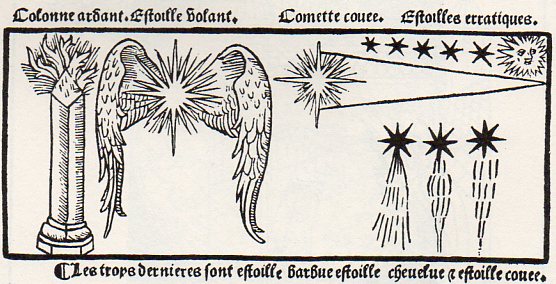
    Comets 1560
    [Nicolas Le Rouge, Le Grand Kalendrier et Compost des Bergieres, published in 1496 in Troyes.

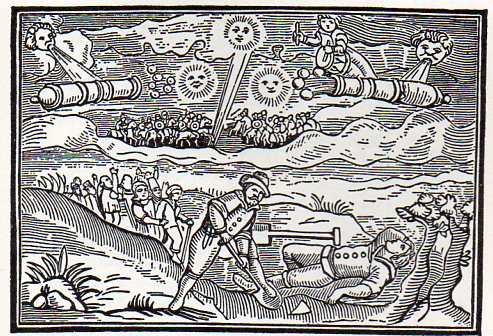
    The night sky is a mnemonic device, a place to store memory and a holder of the alphabet of myths and beliefs of all, a culture written large across the sky. Meteors and comets were not predictable, and could add nothing insofar as a consistent bit of storytelling was concerned, though they certainly created their own stories in each observed appearance; they could also add punctuation and exclamation to whatever constellation they appeared in. For example if one appeared in a juncture with Jupiter, a major event for royalty would possibly be foretold.   But as a permanent element to the visualization of the night sky, they had little power even though they seemed to be displays of fantastic energy and power in themselves.

    Comets 3562
    [For some reason the celestial court, divided by sunlight and flanked by two other sources of light, have ofund it expedient to issue comets from the mouths of Heaven Canon.  I’m not sure what’s going on in the forground with the fellow working his spade next to the triangular blankness.  the man to his right seems to have been overtaken in fear (as have the group of people visible to the left over the shoveler’s shoulder).]

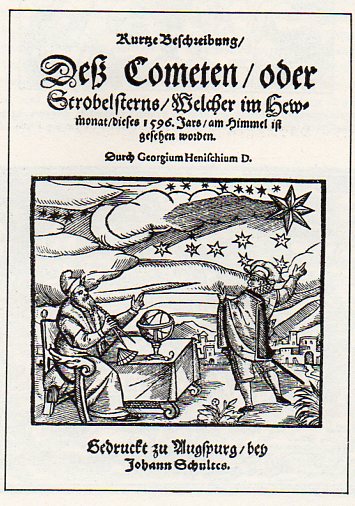
    Comets 4563

    [Halley’s comet appears again on the title page of this work by the Hungarian George Henischius, a professor of rhetoric, mathematics and medicine at Augsberg.]

  • WWII as Advertising Prop, 1943

    JF Ptak Science Books 

    Follow Me on Pinterest

    4-1 prop meat 001
    I was making my way through LIFE magazine for 1943 and was struck by the ratio of the number of advertisements using the war as a backdrop (and American soldiers as convenient props) for sales against the actual space dedicated to war reporting.  Concentrating on just two randomly selected  weekly issues (November 1 and November 15 1943) I was surprised to find  28 ads (most of which were full-page); there was no war reporting in November 1 and just half a story (on the history of the Prussian General staff) in November 15.  Most of the ads were directly war-related, the companies mostly relegated to vast production of war goods, like General Motors, Cadillac and Boeing. The others were less clear, like the ad pictured here for Green Giant peas and corn.  This company was informing the home front that if there were shortages of their product it was because they were selling it to the Army or Navy–others were more adventurous for their spirited attempt at patriotism. I’m not sure that Wembly Ties really needed to include a GI in their ad, nor did I like the use of American soldiers to sell Interwoven socks. 

    ·Posted by :

    ·in:

    —
  • The Machine in the Mind, 1919

    JF Ptak Science Books    Post 1979   Follow Me on Pinterest

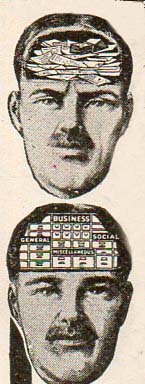
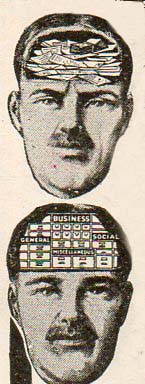
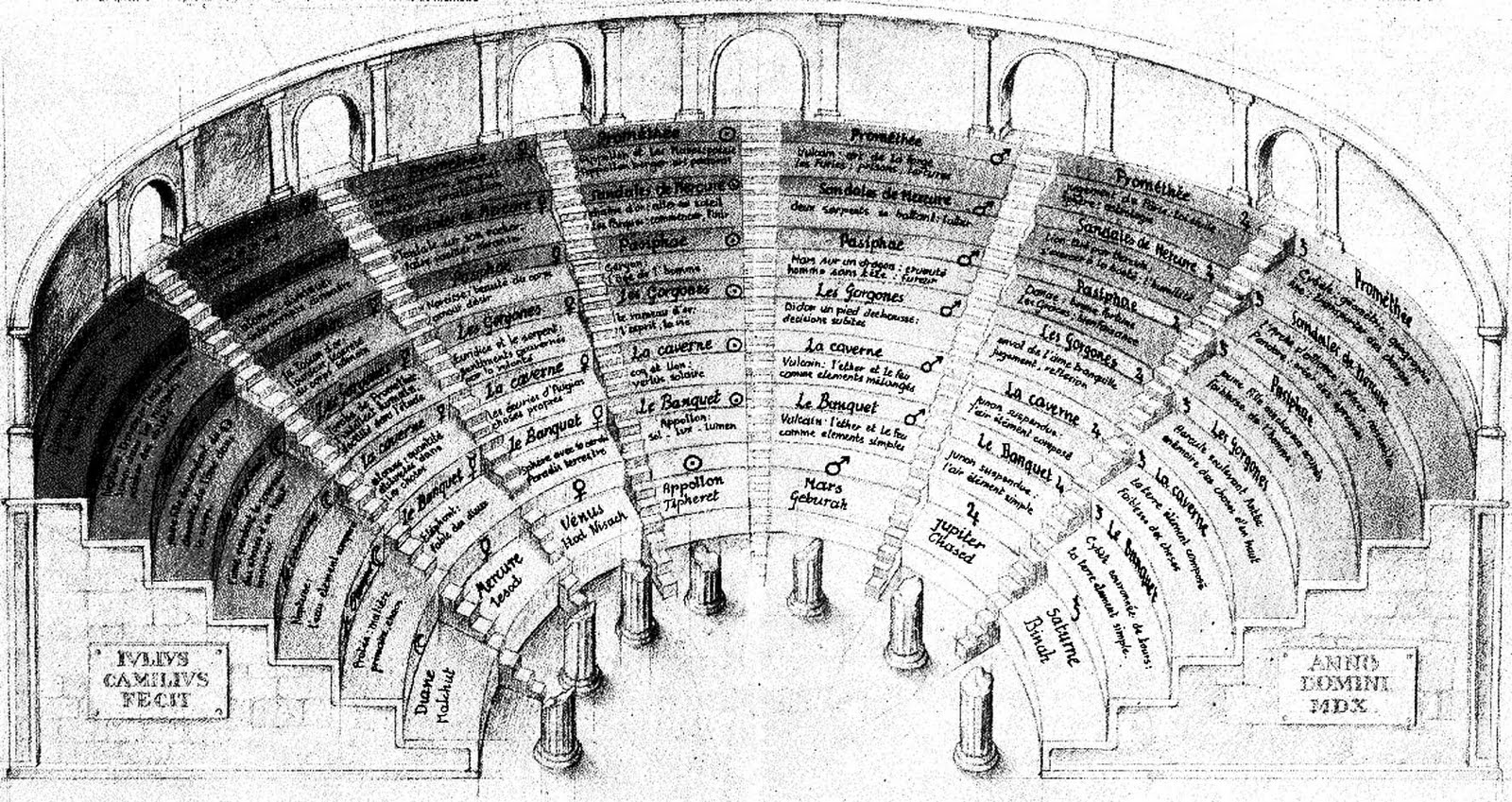
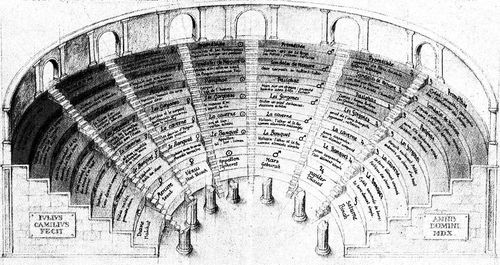
    Computer head089I’m unsure of when the first images appear representing the human mind as a sort of anthropomorphic filing system, utilizing a desk or filing cabinet or (later) a computer. From the early history of human memory-making mnemonic devices and memory palaces there are represnetations of where information in the brain could be stored for rapid access and retrieval, like memories being stored in rows of theater seating, or in the branches of complex trees, or in the buildings of a bird’s eye street map.  But these show where the memory “goes”, and not where this memory set sits in the brain of the individual. 
    Memory palace
    (An example of a memory palace, from Giulio Camillo,  L’idea del Theatro, 1550, from Bourbakisme blog).

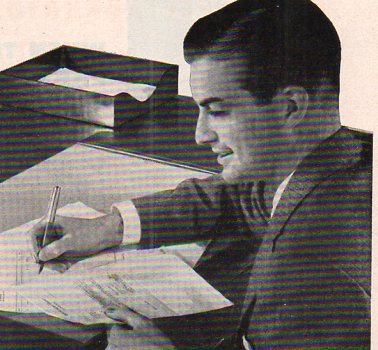
    This came to mind seeing this odd little ad in the magazine Illustrated World for July 1919 seeing these fairly high-creep factor faces endowed with different sorts of cerebral applications. The top man is depicted with a messy desk and a hand-cranked calculator; at bottom we see the organized man, with papers sorted in their labeled places. (As it turns out, the image used for a company selling memory-improvement books).

     Perhaps this image was in a small way a pre-historic insight to brain computer interface (the acquired, direct signal processing of the brain to a computer), in the same way, say, as Hans Berger’s 1924 invention of the electroencephologram, where we can actually see electrical activity of the brain displayed on a piece of paper.  Of course, one image is a simple semi-folly to help hawk a mostly-useless huckerter book on memory improvement, while the other is a bona fide medical breakthrough.  But in similar ways they were insights into looking at the activity of the brain in connection to an external resource.

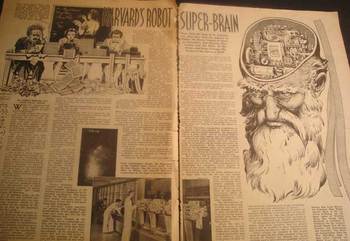
    In 1944 there was something else, something quite different allocated to the Leonardo-like head, something far in advance of the filing system of 1919: the computer.
    Blogharvardbrain
    This may well be the first public, popular, report on the Harvard Automatic Sequence Controlled Calculator (ASCC) (appearing in the American Weekly, 15 October 1944), the first automatic, general-purpose, digital calculator.  Known as the MARK 1, it was the brainchild of Howard Aiken (1900-1973), a graduate student at Harvard, who started it all in 1937 by proposing a series of coordinated Monroe calculators to function as a unified whole  that would cross the threshold of the physically-impossible calculation (though theoretically possible) to the eminently doable.  The project was immeasurably aided by the input of Harvard astronomer Harlow Shapley (who had earlier dealt with the enormously problematic aspects of the scale of the universe) who put Aiken in the hands of IBM at Endicott (NY).  From there the building of the computer came under the supervision of Clair D. Lake, with the engineering and theoretical team of Francis Hamilton, Ben Durfee and Howard Aiken.
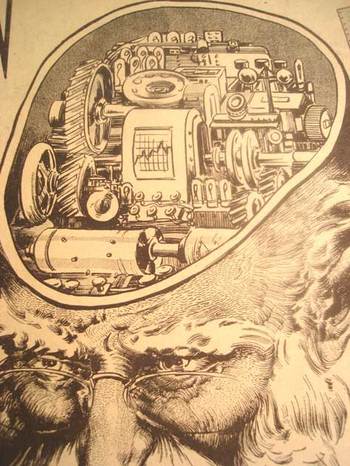
    Blogharvardbraindetail

    The machine was basically completed in 1943 and tested in Endicott for the better part of the year before it was shipped of to Harvard in February 1944, where it was put almost instantly to work on ballistic calculations (like its cousin ENIAC at the Moore School at U Penn), as well as naval engineering and design issues. 

    The author of this article, Gordind Bhari Lal (“noted science analyst”), actually does a pretty decent job describing the machine and its (1940’s) possibilities, noting at the end that “it may even unleash for Man’s Use the long-dreamed-of energy of the atom”.  This part did come true, especially post-war, when the machine was put to fair use by the US Atomic Energy Commission. 

    The part I really don’t understand in this article is comparing the speed and function of the ASCC to two women working on calculators and Albert Einstein, working with a pencil, paper and pipe, none of whom look comfortable or happy.  (Actually the dresses on the women look a little hiked-up to me, just a little too high.)  Lal does make a decent comparative point (of uncertain veracity) about four generations of humans (the three above-mentioned calculators?) doing calculations that the ASCC could do in seconds.  Right or wrong, it gave the crowds in 1944 a real something to think about.
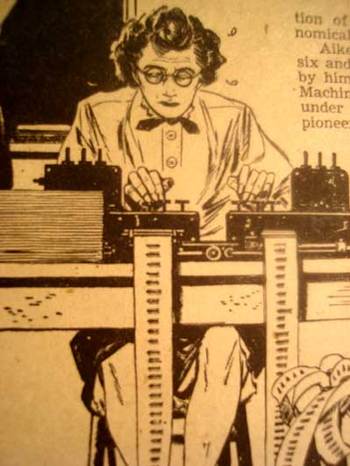
    Blogharvardbraingirl

    And so at the end of this post I believe that the representation of the brain as a mechanical device is relatively new, and I wonder if it isn’t a mostly-20th century creation.   Finding images of SteamPunk humans and robots and such roaming their ways through the literature in the 1920’s-1950’s is fairly easy, but showing the stuff inside the head and representations of how the mechanical brain was functioning seems to be a different matter.
  • Missing the Obvious: WWI and Kriegsoptik

    JF Ptak Science Books   Quick Post    Follow Me on Pinterest

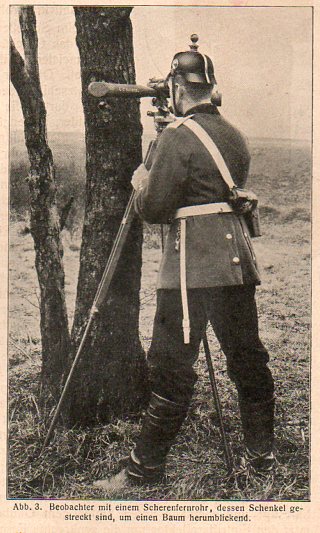
    For some reason this particular defensive utility of the binocular/rangefinder/”scherenfernohr” hadn’t occurred to me before seeing this photograph (in the September 1915 issue of Himmel und Erde).  Of course with the many billions of rounds of ammo that flew across open fields during the war, if it was your job to sight for artillery or what have you it would be better to do that from a trench (as this instrument was also known as a “trench periscope”, as varieties of the binoculars could have vertical tubes) and behind cover, or if in the field to be able to find a defensive position for your work. I hadn’t thought about standing behind a tree with the scope’s optics wide enough to operate beyond the diameter of the trunk–seeing the picture made me think, “of course”. On the other hand, this posture assumes that there’s very little flank to that field…

    Kriegsoptik097

    ·Posted by :

    ·in:

    —

Recent Posts

Archives

Categories