A Daily History of Holes, Dots, Lines, Science, History, Math, Physics, Art, the Unintentional Absurd, Architecture, Maps, Data Visualization, Blank and Missing Things, and so on. |1.6 million words, 7500 images, 4.9 million hits| Press & appearances in The Times, Le Figaro, Mensa, The Economist, The Guardian, Discovery News, Slate, Le Monde, Sci American Blogs, Le Pont, and many other places… 5000+ total posts since 2008.

  • Medical and Public Health Films, 1940’s & 1950’s.

    JF Ptak Science Books   Quick Post

    I bumped into these interesting video time capsules at the fantastic National Library of Medicine site for digital projects.  They are mainly mid-20th century films made for soldiers (on malaria, keeping yourself clean, nutritional behavior in the field in tropical lands, so on) though there are some public service announcements dedicated to the public. 


    view


    The Inside story  “This film outlines the most common emotional illnesses that may be
    suffered by a civilian upon entering a military service and suggests how
    the individual serviceman can deal with them. Anxiety can be caused by
    isolation from family and familiar circumstances, the pressures of
    military training, lack of privacy in barracks life, and worry about
    performing one’s duty. Footage of a sailor in the above situations is
    shown. A navy psychiatrist reassures a troubled seaman, helps him to
    understand what is happening to him, and gives him material to read that
    will guide him in his recovery. The seaman shares his reading material
    and his new self-knowledge with his buddies. They too suffer in
    greater or lesser degree from some of the effects of anxiety. Animation
    is used to illustrate the workings of the unconscious mind.”


    view


    Fight syphilis  “This film outlines the individual’s role in combatting syphilis through
    education, blood tests, prompt medical treatment, and avoidance of
    quacks. Shots includes montage of quack remedies for venereal disease”.

  • The Non-Anatomy of Tears, the “Excrementrious Humiditie of the Brayne”

    JF Ptak Science Books  Post 1969 


    Follow Me on Pinterest

    “Tears are the trails of plenty and of want, both of which are sometimes the same.“–Not from Ambrose Bierce’s Devils Dictionary.
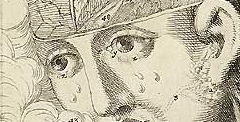
    “Let one rejoice in smiles, the other in tears;
    Let the same labour or pain be the office of both….”-Robert Burton, Anatomy of Melancholy

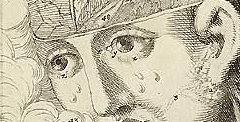
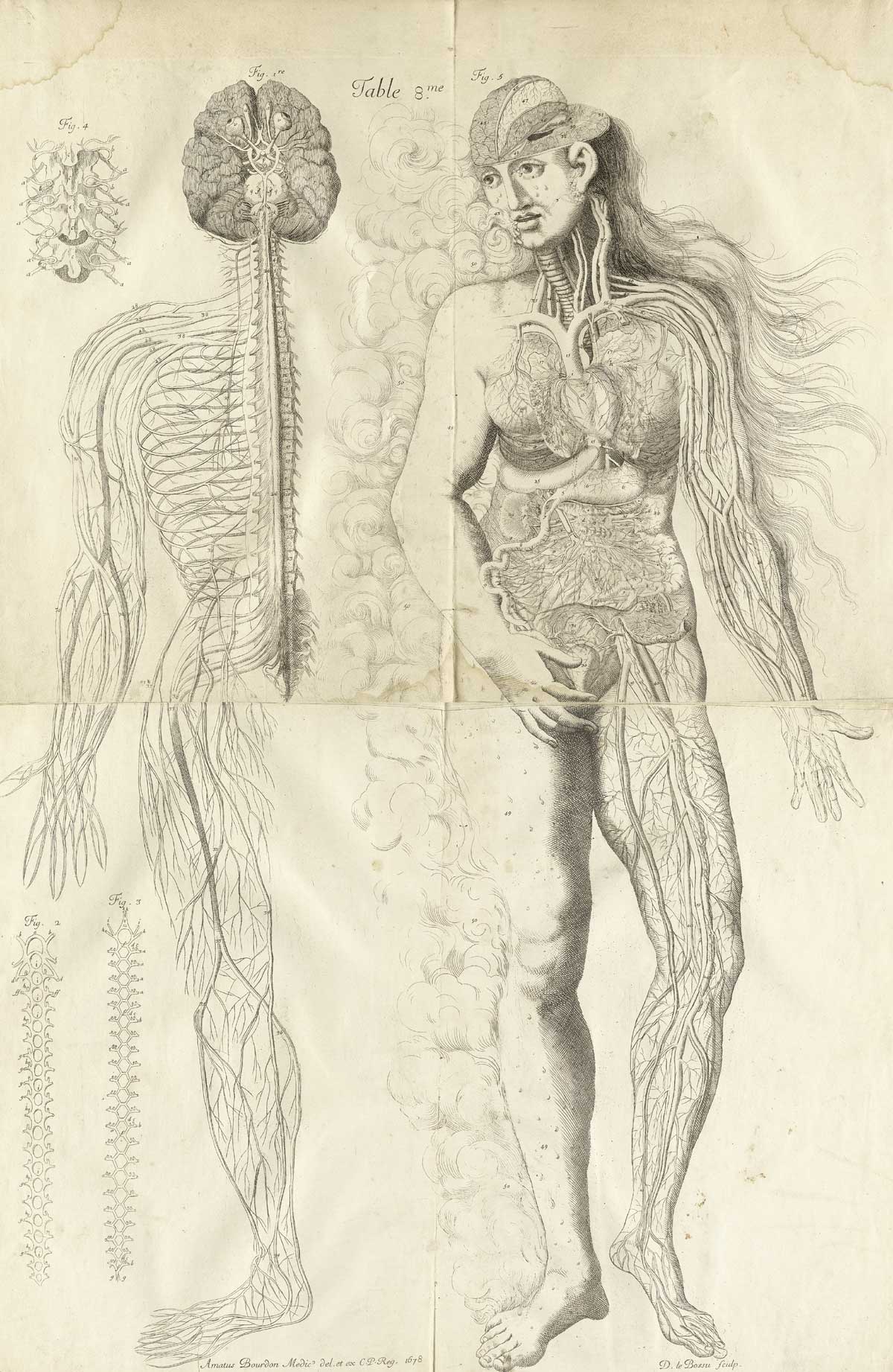
    The image above is a detail from one of the sixteen engraved images found in Ame Bourdon’s fabulous anatomy,  Nouvelles tables anatomiques (printed in Cambray and also in Pair by Laurens d’Houry in 1678). (A good description is found for this work, as well as the rest of the illustrations in their entirety, from the National Library of Medicine, the source for this diversion). 

    I’m not sure why the subject here is crying; and I’m also feeling that I’ve never seen an example of a crying figure in any antiquarian anatomy book before this one.  I remember from another;project that eyelids and tears were of some considerable interest later on, finding no less than 25 books dedicated to the subject printed in the period 1825-1895 or thereabouts.  (That bit of research was undertaken doing some background on a 19th c aboriginal torture of staking a victim to the high desert ground and cutting their eyelids off so that the sun would cause blindness from constant exposure).  And I don’t know when the eyelid is given its first anatomical drawing/consideration, displayed on its own and flattened out for inspection.  And it would be interesting to know when the first extended modern scientific appraisal of tears was made. On the offhand I thought that Burton in his absolutely magnificent and very difficult book, The Anatomy of Melancholy, might have something to say about it, but it doesn’t–as a matter of point, it seems that the word ‘tear/s” appears less than ten times through the whole work, which I find a little surprising. 

    No matter.  I just wanted this to be a quick diversion to consider if Bourdon really did intend to include tears for his model, or if the engraver took a little liberty and added some emotional elements to the image.  It is certainly plausible, as human anatomical specimens had been presented in any number of different poses and posed with different items and in tremendously wide spectrum of emotion expression that crying would be but a small step to take for exhibition. There also seems to be perhaps no connection to any sort of physiology of crying–the subject just looks like someone with tears on their face, unassociated with any sort of muscle movement around the eyes, or glands or ducts or whatever. (Charles Darwin described a usual contraction of the muscles around the eyes when the subject cried, as he published in his Expression of Emotions in Man and Animals (1872)). The tears may just be Baroque ornamentation.

    On the other hand, there may be a tenuous connection in the engraving to the tears and the sectioned brain. It wasn’t too much earlier in the history of crying that it was thought that tears were a cathartic-purgative product of the brain, which is an idea that goes back to Hippocrates and his heirs and which held sway for more than a thousand years. 

    As Tom Lutz writes in his wonder Crying, the Natural & Cultural History of Tears (W.W. Norton, 1999) the English physician Timothy Bright poetically described tears in 1586 as “the excrementious humiditie of the brayne” (page 73), which were the “brai’s thinnest and most liquide exrement”.  The idea of catharsis began to wane by the 17th century, and the four humours were identified more as a belief system than a medical reality, but the idea of the cathartic brain and its release of tears may have hung on to be included in Bordon. 

     But it does seem rare, crying does, in the annals of the history of anatomy–much less so in the history of art books that explore emotions and facial expression (like Chalres Le Brun (1616-1690) in his Méthode pour apprendre à dessiner les passions (1698)). At the end of the day, these tears may well just have been a sly way of the engraver to exercise a little creativity.  
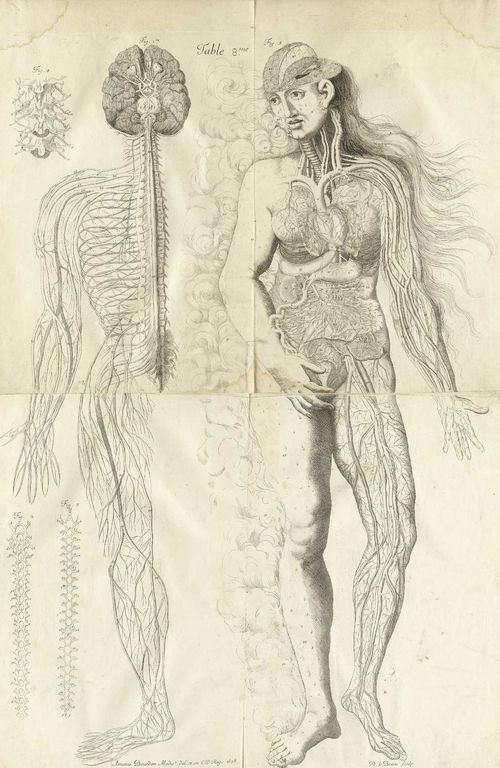
    Bourdon-t08t08a full copy woman

  • The Astronomy of the Great Flood

    JF Ptak Science Books  Quick Post

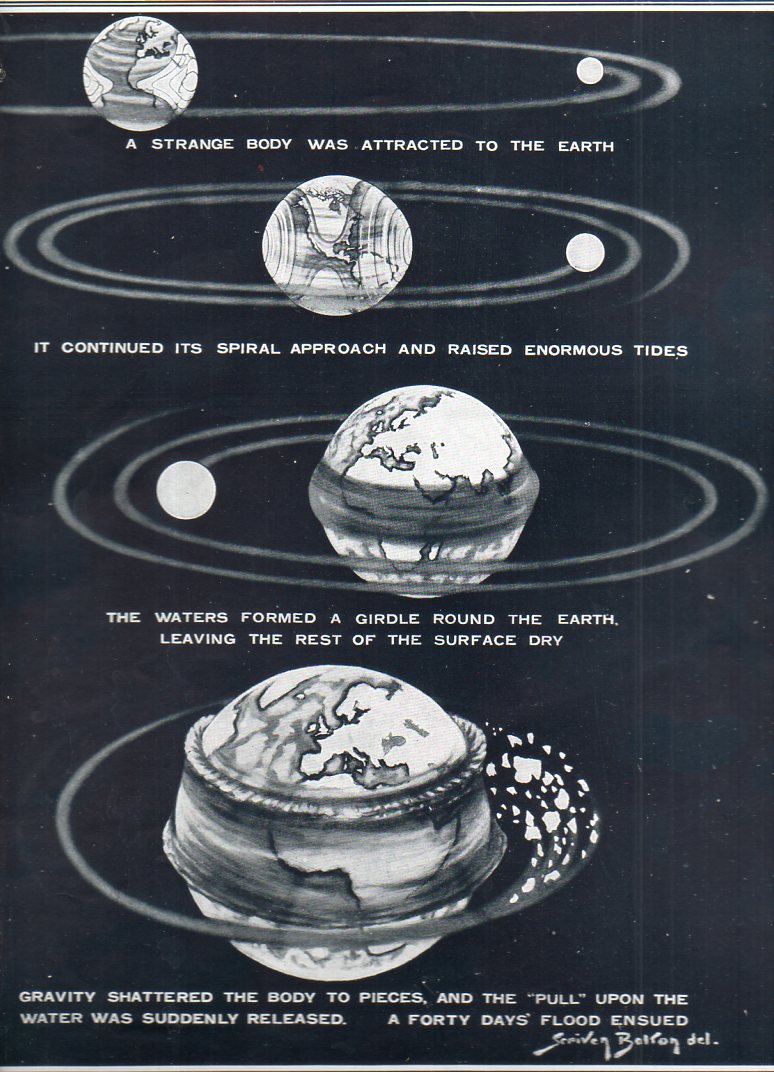
    This lovely if not very convincing argument was produced and directed by “a German engineer, Herr” (Enrst) Horgiger, of Munich.  He attempted to wed belief and mythology and astronomy, providing a worlds-in-collision explanation for the Flood.  From the caption to the drawing I do not know if it is The Flood of Noah, as it occurs in the book of Genesis in the Bible, or the flood of Apollodorus, or Hygenius, or of the Eridu Genesis (some 2000 years or so before Genesis) or the flood of Atrachasis (of about 1650 bce) or the flood of Gilgamesh (of about 1100 bce), or if it is the flood of Emhil, or Zeus, or Allah, or Yahweh, or the other 150+ great floods of mythology categorized by James Frazer in his astounding but unreadable books. But it is a flood, and his reason is that a wandering body in space came into temporary orbit around the Earth with a resulting gravitational soup that caused the waters to rise up after which the flood occurred and the orbiting sphere to break apart.

    The flood 1925057
    As I said, it is a pretty picture, with a nice deep blue background that my scanner won’t capture.

    Source:  The Illustrated London News, 21 January 1925, “A New Theory of the Flood: How it Might Repeat Itself”.

  • How Old are (Some) Scientific Words? Many Not Very.

    JF Ptak Science Books    Quick Post  Follow Me on Pinterest

    Wood-type
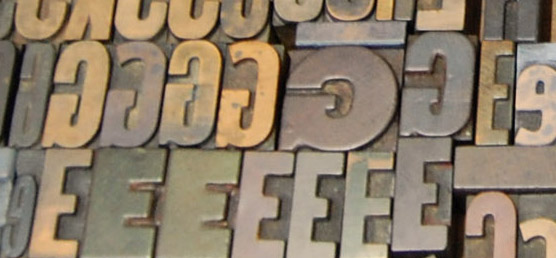
    It is interesting to think about the newness of old things, particularly English words that we have in use every day.  In this case I’m referring to words in the sciences–and not necessarily the words coming in the 20th century following the explosion of modernity beginning in 1895.  It is surprising sometimes to realize the relative newness of some terms, like, for example, “scientist”. The word “science” is very old and very old in English, but the word “scientist” is coined only in 1833. It is surprising to think of the modernity of some of the words when by their constant use they seem as though they must be ancient, but of course are not so.

    Here’s a quick lising of some interesting candidates, everyday words with a not-very-old lineage, their dates taken from first-usages identified by the Oxford English Dictionary:

    Altimeter, 1847; Ampere, 1861; Aphasia, 1867; Bacterium, 1847; Biology, 1802; Cambrian , 1836; Centigrade, 1812; Chlorophyll, 1810; Chromosome, 1890; Claustrophobia, 1879; Cosmology, 1730; Cretacious, 1832; Diatom, 1854; Electron, 1891; Embryology; 1859; Ethnology, 1842; Gastritis, 1806; Gynaecology, 1847; Histology, 1847; Joule, 1882; Jurassic, 1833; Kleptomania, 1830; Morphology, 1830; Ohm, 1861; Palaeobotany, 1872; Palaeography, 1822; Palaeolithic, 1865; Palaeontology, 1838; Petrology, 1811; Pilocene, 1833; Scientist, 1833; Symbiosis, 1877; Synthesis, 1804; Taxonomy, 1828; Triassic , 1841; Voltmeter, 1882; Watt, 1882.

    ·Posted by :

    ·in:

  • Speaking for an Oppressed Minority, 1944: the Japanese in America, WWII

    JF Ptak Science Books   Post 1970

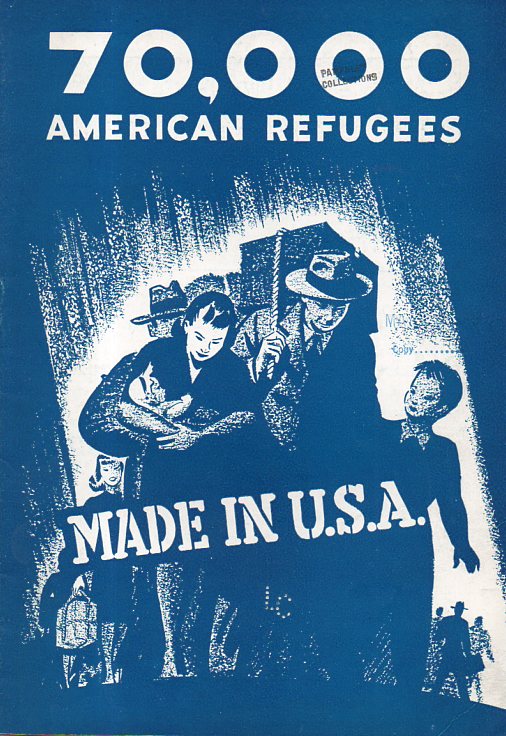
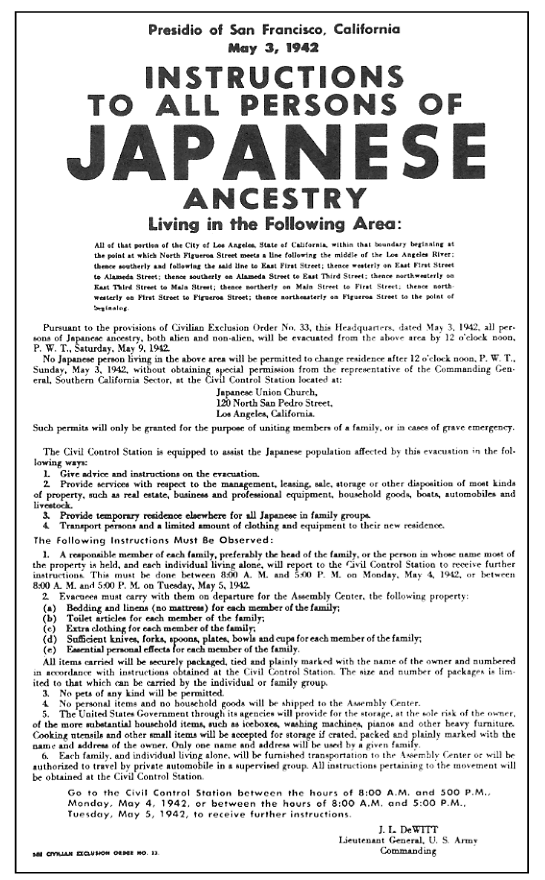
    This pamphlet, 70,000 American Refugees, Made in U.S.A., by Truman  B. Douglass1, was a sympathetic appeal to the deeply grave situation legislated to 140,000 Americans. They were Americans of Japanese descent, many of them U.S. citizen, who by Executive Order 9066  were ordered to stand down from their lives for the sake of national security and be removed to distant and remote internment camps beginning in May 1942, mostly for the duration of the war.  There weren’t that many appeals for the primacy of the rights of these people at this time–the war for the United States was newly begun via the Japanese attack on Pearl Harbor some months before–and the understanding was to protect the security of the country via the segregation and housing of what were seen to be the potential enemies in the existing Japanese-American population.

    Japanese relocation058

    [This pamphlet is available for sale at our blog bookstore, here.]

     Franklin Roosevelt’s  February 1942 Executive Order 9066 (issued 19 February 1942) to imprison more than 100,000 American (70,000 of whom were U.S. citizens, including children) for the duration of the war–it was the legal bombshell that gave the War Department the authority to authorize the removal of the Japanese  to theoretically prevent those people from engaging in sub rosa and fifth column activities asd wartime terrorists fighting for Imperial Japan.

    Given that this pamphlet was in it third edition just a few months past its first appearance in October 1944 says that there was at least some interest in this political/moral anti-Executive Order 90662 position, though how much of that is from a popular groundswell of support it is not possible to say. I imagine that the print runs of this pamphlet were rather small given that there are only ten copies of all three editions in the collections of libraries worldwide.  And since there are many collections that should have this pamphlet but don’t–copies are found in California State University Northridge, California State Irvine, Yale, Wisconsin Historical, Cornell, Berkeley, Davis, Huntington, according to WorldCat–and no copies seem to pop into the rare book market very often at all, I suspect that not many copies were printed per edition, which means that there was a repetitive demand for the pamphlet that exhausted small print runs, which means maybe there were 2000 copies printed…not exactly “groundswell” support for what was an unpopular position).  Third edition, October 1944 (following the first edition of August 1944).Full text available via the California Digital Library, here. (The Library of Congress evidently doesn’t have any copies any more–my copy had been in their collection, and it seems as though the back-up copy is no longer there).

    The story of the removal and control of the American Japanese population is complex and deep and has been addressed in many places in print and online (and even on this blog several times), and it is not my intent to address that issue in this post.  I want to highlight what must have been a largely high-minority and mostly lonely voice of consideration and caution. 

    Notes:

    1.  The printing and publication information for the pamphlet:  “The Citizens Committee for Resettlement, 6501 Wydown Blvd., St. Louis 5, Missouri, 25 cents. May also be ordered separately at cost indicated. Reduced price in quantities. Community Preparation for Resettlement of Japanese Americans, published by The Committee on Resettlement of Japanese Americans, The Federal Council of Churches”.  Truman B. Douglass Grinnell, Iowa, 1901-1969, was instrumental in the forming of the United Church of Christ in 1957.

    2. Transcription courtesy of the History Matters  project:

    Transcript of Executive Order 9066: Resulting in the Relocation of Japanese
    (1942)

    Executive Order No. 9066

    The President

    Executive Order

    Authorizing the Secretary of War to Prescribe Military Areas

    Whereas the successful prosecution of the war requires every possible
    protection against espionage and against sabotage to national-defense material,
    national-defense premises, and national-defense utilities as defined in Section
    4, Act of April 20, 1918, 40 Stat. 533, as amended by the Act of November 30,
    1940, 54 Stat. 1220, and the Act of August 21, 1941, 55 Stat. 655 (U.S.C., Title
    50, Sec. 104);

    Now, therefore, by virtue of the authority vested in me as President of the
    United States, and Commander in Chief of the Army and Navy, I hereby authorize
    and direct the Secretary of War, and the Military Commanders whom he may from
    time to time designate, whenever he or any designated Commander deems such
    action necessary or desirable, to prescribe military areas in such places and of
    such extent as he or the appropriate Military Commander may determine, from
    which any or all persons may be excluded, and with respect to which, the right
    of any person to enter, remain in, or leave shall be subject to whatever
    restrictions the Secretary of War or the appropriate Military Commander may
    impose in his discretion. The Secretary of War is hereby authorized to provide
    for residents of any such area who are excluded therefrom, such transportation,
    food, shelter, and other accommodations as may be necessary, in the judgment of
    the Secretary of War or the said Military Commander, and until other
    arrangements are made, to accomplish the purpose of this order. The designation
    of military areas in any region or locality shall supersede designations of
    prohibited and restricted areas by the Attorney General under the Proclamations
    of December 7 and 8, 1941, and shall supersede the responsibility and authority
    of the Attorney General under the said Proclamations in respect of such
    prohibited and restricted areas.

    I hereby further authorize and direct the Secretary of War and the said
    Military Commanders to take such other steps as he or the appropriate Military
    Commander may deem advisable to enforce compliance with the restrictions
    applicable to each Military area hereinabove authorized to be designated,
    including the use of Federal troops and other Federal Agencies, with authority
    to accept assistance of state and local agencies.

    I hereby further authorize and direct all Executive Departments, independent
    establishments and other Federal Agencies, to assist the Secretary of War or the
    said Military Commanders in carrying out this Executive Order, including the
    furnishing of medical aid, hospitalization, food, clothing, transportation, use
    of land, shelter, and other supplies, equipment, utilities, facilities, and
    services.

    This order shall not be construed as modifying or limiting in any way the
    authority heretofore granted under Executive Order No. 8972, dated December 12,
    1941, nor shall it be construed as limiting or modifying the duty and
    responsibility of the Federal Bureau of Investigation, with respect to the
    investigation of alleged acts of sabotage or the duty and responsibility of the
    Attorney General and the Department of Justice under the Proclamations of
    December 7 and 8, 1941, prescribing regulations for the conduct and control of
    alien enemies, except as such duty and responsibility is superseded by the
    designation of military areas hereunder.

    Franklin D. Roosevelt

    The White House,

    February 19, 1942.


    Photo

    ·Posted by :

    ·in:

  • The Micro-Biological Beauty of the Plans of Catacombs

    JF
    Ptak Science Books     Post 1971

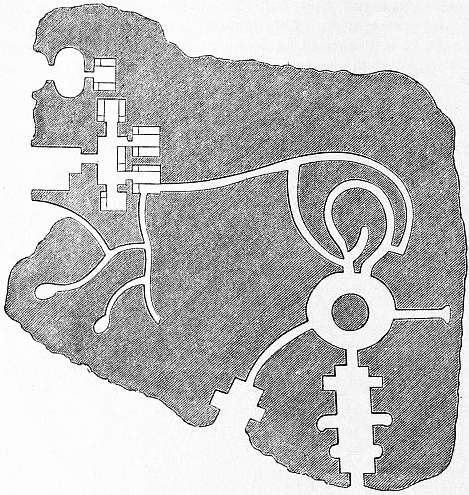
    Cemetery four[Plan of a portion of the principal storey in the Poggio Gajella]

    The plans of underground cities, of catacombs and cemeteries, share a certain biological appeal in their design with the plans of Medieval cities, or at least they seem so to me.  Removed from their context and placed in an undifferentiated environment, the plans look very much like biological structures, and art.  As maps of cities of the dead it is somewhat ironic that their geological chrysalis seem to indicate a biological structure.

    And sometimes the images aren’t so reminiscent of micro-structures as they are macro-structures, as in the case above. If you squint just a little and look at the Poggio Gajella you can visualize a cross section of the upper torso of a body, including an open mouth, with nasal cavity, throat, digestive system, and even intestines and egress routes–a picture of a person in the city of the dead.

    The images below illustrating this ragged point are by Seroux d’Agincourt, (1730-1814), and appear in his  Histoire de l’art par les monuments, depuis sa décadence au IVme siècle jusqu’ à son renouvellement au XVIme (Paris, 1825). The images illustrate the article “catacombs” from  the Encyclopedia Britannica, in the great/standard 11th edition, from Project Gutenberg:

  • The Crucible of Weight and the Overweighted State of 1920 Geology

    JF Ptak Science Books     Daily Dose from Dr. Odd

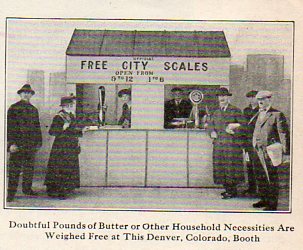
    Scales060
    Grazing the issues for 1920 in the Popular Mechanics-esque popular-techno-magazine, Illustrated World, I found this superb near-Dadaist photograph.  The image is for a free weighing station, where people could come and have their stuff weighed, and weighed for free.  This no doubt came into being to help protect consumers from being under-weighted and over-charged for their weighed goods like butter and whatever, where their good grocer might have had a thumb or more on the scale or even used a crooked/salted scale when selling their goods.  What someone would do at the point of being told that their stuff was overweighed, I don’t know–I mean these are people walking around in the street with things in their pockets or bags….its not exactly “evidence” showing up at the weigh station (staffed by “a woman”) saying that the half-pound blob roll in their hand was sold them as a pound on their word of the purchaser probably wouldn’t stand up in court.  In any event, I like the idea of the story of the world being told from the viewpoint of the person weighing stuff for free, and the people who came to them, and the stuff brought to be weighed.  Maybe there were weighing-in groupies; maybe there were old people who would just kick up a rock or something and take it to the weigh station for a bit of conversation and complaint on the over-weighted state of geology.  Maybe between 12:00 and 1:00 the weighers weighed stuff out-back, sotto voce, for fun.

    If only there was a sign for “no waiting” this photo would be complete.

  • Strychnine for Weak Women, 1920

    JF Ptak Science Books   Quick Post

     
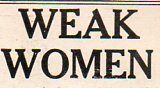
    Weak women061
    Women, weak women, women with iron-poor blood, were sought by the manufacturers of Nuxated Iron, a small-bottled mottled mess that promised to increase vigor and iron levels, mostly through miracle.  It turns out that, according to various early studies, there was a very small amount of iron in the concoction, as well as small amounts of strychnine.  An E.O. Barker, M.D., reported to JAMA in 1923 that a small boy he attended who had taken 32 of these Nuxated Iron tablets died from strychnine poisoning.  There was no benefit from the iron, evidently; I wonder what the long term effects of small dosage ingestion of strychnine led to?  [“Weak Women” ad for Nuxated Iron from Illustrated World, November 1920/]

  • Breaking Bad in Half: a Book to Exhaust and Maim the Reader

    JF Ptak Science Books

    “Sometimes a book is just entirely bad, and sometimes it is entirely nothing. It is impossible for a book to be both very bad and very nothing. Impossible.  Except for this book, whose badness is exceeded only by its nothingness, and vice versa“. –Oscar Wilde

    And so into this black hole of imaged Wildeian description we go, into a very real-ish book.

    I found a novel tonight, bought long ago and long ago mostly lost.  It was written by a doctor who worked in the District Hospital in Lima, Ohio, and written in 1934.  The Lima Hospital was the largest poured concrete structure in the world when it was built in 1915, and stayed so until the Pentagon was completed.  The hospital was established for the criminally insane, had 14″-thick walls, and reinforced steel bars laid into the walls that went “right down to bedrock”. 

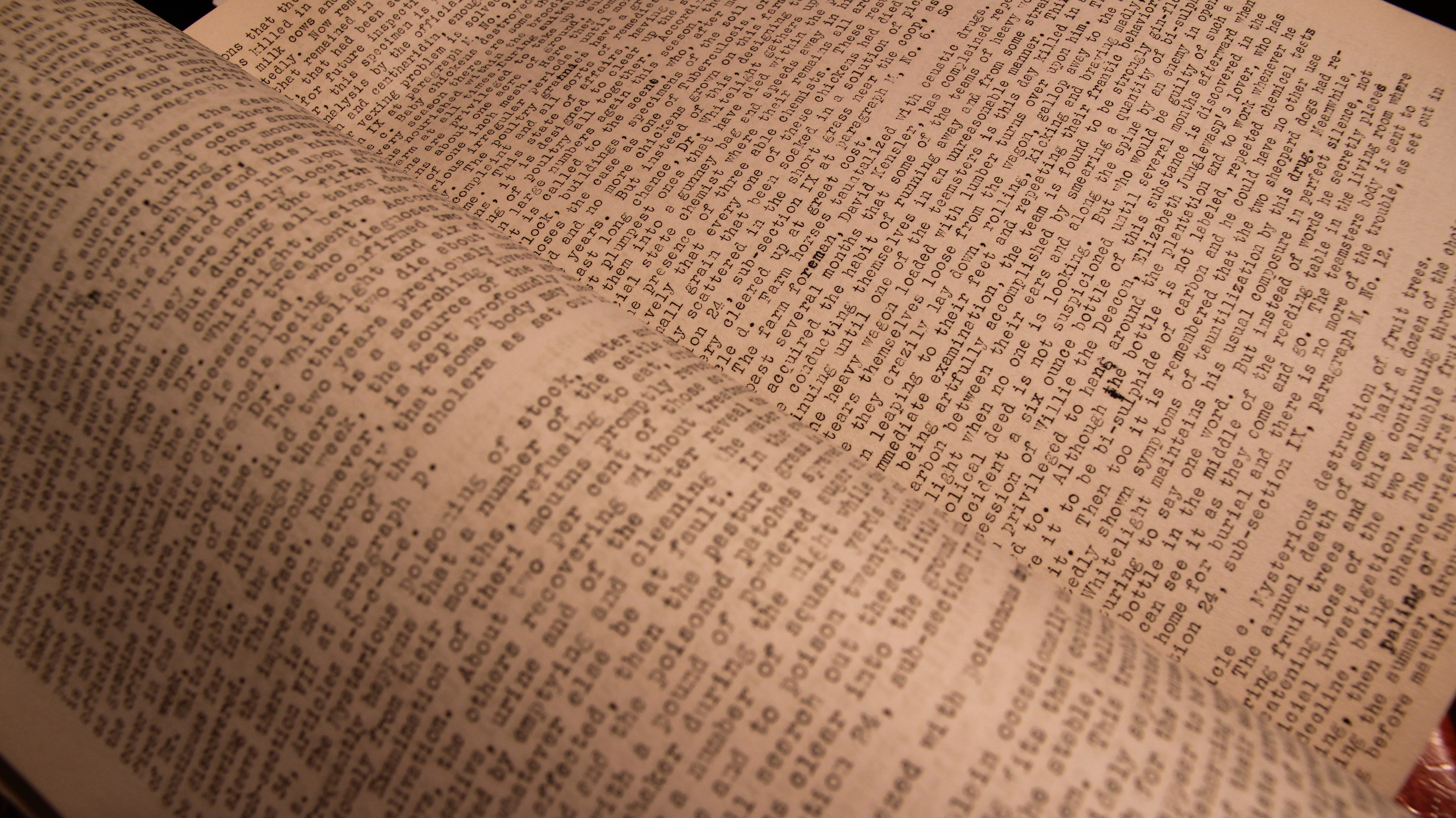
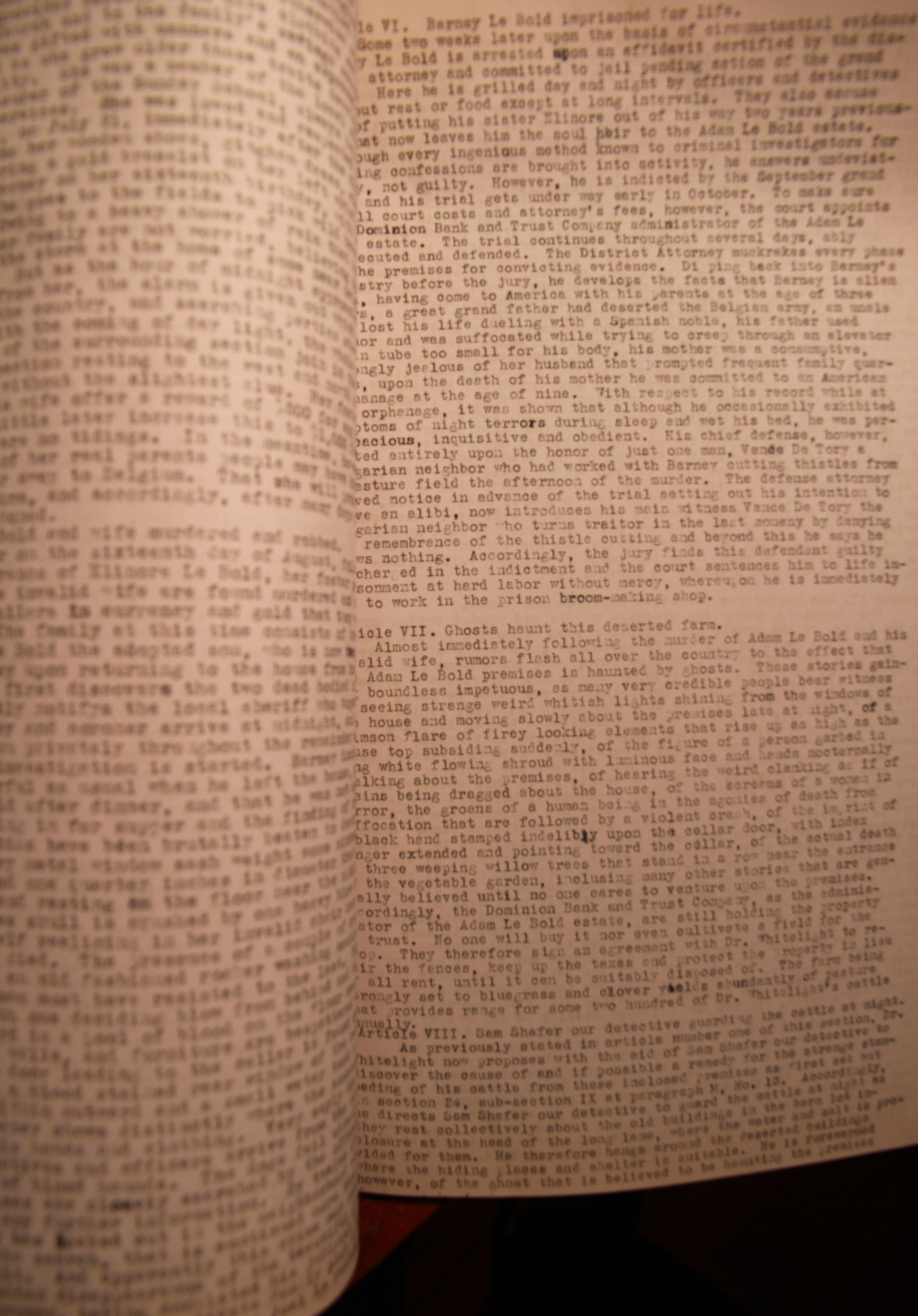
    It was somewhere in there that this doctor wrote something that was really so toweringly bad that it escapes comprehension. I own the carbon copy of the unpublished work, which is typed on 14×8.5″ sheets of paper, front and back, running 94 pages. It is a very crowded affair, with 90 lines of single-space typed lines, making the work about 115,000 words long. 

    There wasn’t enough space evidently for paragraphs, which gives the work a kind of insistent, casket-cramped cruelty.  To read it takes your breath away for its dullness–the book moves so weirdly and at the same time so very slowly that it doesn’t move at all even while moving.

    Manuscript insane one

    A few months ago I found the seven-foot-long scroll of the book’s plan–a work of crowded magnificence of nothing and confusion, being very orderly at the same time.  It went to a friend of mine who created artwork around it, and as it happens made a very noticeable appearance in a very significant yearly show in NYC last week. I was stunned to find that there was actually a text to go with the scroll-outline–it emerged from the warehouse this week, so perhaps this too will find a very celebrated life as art as well. Certainly the book would go nowhere on its own as a book, though it stood a chance at surviving on the grounds of its considerble design weirdness, which is of a complexified beauty.

    Manuscript insane two

    In the meantime, before all of the letters slide themselves off the page from sheer boredom and before the thing is resurrected as a magnificent artistic effort, I’ll share some ianges of the extra-ordinary book of reversed brilliant badness. I’ve also culled a few imaginary descriptions of the book from writers known and not:

    Potboiler scribbler:

    “He couldn’t speak.  He could barely see. Blinded by the flames ignited inside his eyeballs from the novel in his lap.  The words were like molten lead, sucked off the page by his eyes, forming a vacuum in his brain.  It was a bad book”.

    The first-time published novelist’s approach:

    “He couldn’t speak the words of the thoughts in his head, because they and all of his breath were stolen by the magic of the complete badness of the book in his lap”.

    Gertrude Stein:

    “The book was bad and bad, and bad was the book. Even the badness of the bad was bad, a whole new insight into being bad. It was the bad book by which bad books are called bad”.

    Ernset Hemingway:

    “He didn’t read the book so much as he looked through it.  It was easy–there was nothing there. As bad as it was, it could get no worse. So he shot it, and poured a drink”.

     You might wonder what this book is about.  Me too.

  • A Census of “Prefer” in “Bartleby the Scrivener”

    JF Ptak Science Books   Quick Post

    I wonder if Bartleby is more a “structure of words” than was famously said of Molly Bloom?

    The question just came up from Patti about what Bartleby’s classic rejoinder was in Herman Melville’s  (1819–1891) classic noirish “Bartleby, the Scrivener…” (1853)–was it “I would prefer not to” or “I prefer not to”?    

    Instantly I thought the former, but then, well, I wasn’t sure if it wasn’t the later.

    This is one of those instances that shows how magnificent the internet is:  I was able to conduct a quick census of Bartleby’s own spoken variations on this phrase in like ten minutes.  And the results are conclusive but a little complicated.   

    As  pure stand-alone phrases, “I would prefer not to” and “I prefer not” are used three times each.  However, there are variations on this theme, each used only one time by Bartleby:  “I would prefer not”, “I prefer not to”, “I would prefer not to go”, “I would prefer not to make any change”, “I would prefer not to be a little unreasonable”, “I would prefer to be left alone”, “I would prefer not to take a clerkship”, “I would prefer to be doing something else”, “I would prefer not to make any change at all”, and then “I prefer to give no answer” and the fatal “I prefer not to dine”. 

    So.  When comparing the use of “would” in the “not” and “not to” and all of the other extensions on the theme, “would” does come out on top, in general, 12 times to 6. 

    I have no preference for either phrase.

  • The Marcel Duchamp of 18th Century France: Jean-Jacques Lequeu

    JF Ptak Science Books  Follow Me on Pinterest

    Lequeu_portrait


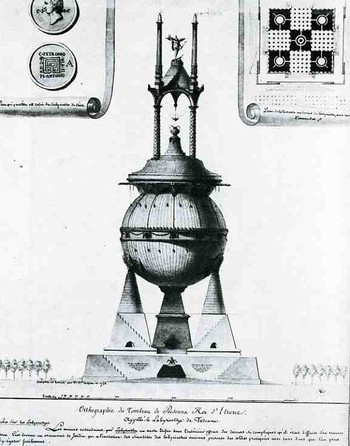
    Jean-Jacques Lequeu (1757-1825), a French architect of fabulously distanced sight, produced this breathtaking image in 1792.  The Tomb of Lars Porsena, King of Etruria (the great Etruscan king, d. ca. 500 BCE ), is just one of hundreds of works by Lequeu, a re-discovered architectural genius who worked during the same era as other visionary architects such as Etienne Boullee (1728-1799), Claude-Nicolas Ledoux (1736-1806), Louis-Jean Desprez (1743-1803), Francois Barbier (1768-1826), Charles Bernard (1765-1818), Francois-Joseph Belanger (1747-1818), and others, though these guys are the most famous.  As a matter of fact, I think, almost all of these architects were re-discovered—Boullee, perhaps the most famous of the lot, was found again not in his buildings but in his visionary drawings that he deposited with the National Library.  But Lequeu—found again in the same way–it seems had to be rescued from an even greater obscurity than the others.  He tried to expose a unity that he saw in the world, some secret sort of unity, that he saw all around him, and which was unseen by everyone else in creation—at least until the 20th century.

    Lequeu started out in a staid and brilliant way, a successful architect in his own right, and student of Scoufflot, designing ancient-inspiration buildings for the super rich.  But along came the Revolution and away went his career—he wound up a surveyor and a cartographer until his retirement in 1815, after which he enters social and historical oblivion, until he finally dies in total obscurity ten years later (or so, the date is unclear).  His post-revolutionary vision was as phenomenal as his success in selling his ideas were dismal.  Well, this is really a cheap shot—his imagination was shockingly large, enormous, his designs fantastic and beautiful, and completely unexpected, and they seemed to grow larger/loftier and more interesting as time wore away at him.

    I think that as Lequeu was cleaved away, cell by cell falling through the floorboards of his single rented room, he reached further into time and deeper into space than almost any architect of that hundred-year period.   I also think that he was very well aware of his genius being seen as pure eccentricity—his dozen or so self portraits are among the most bizarre that I’ve ever seen (before 1900).

    Bloglequewu289

    The odd thing in all of this is that in this brilliance there is still a reluctance to leave the Baroque, and this at a time when just about everyone else—beginning around 1750—was abandoning it.  So much of the work of the other visionaries mentioned earlier freed themselves of the Baroque—not entirely true, not true at all, for the unique creations of Lequeu, who (as in the Tomb of Lars Porsena) included more than a few bits of the practice even in his most incredible works. 

    Somehow Lequeu saw the Lars Porsena tomb as a 650-foot tall (!!) structure, with impossible insight and filigree.  Extraordinary. (In the upper corners of the drawing of the tomb Lequeu included a design for a coin and also the plan of the structure.  The original tomb of Lars Porsena, according to Pliny the elder in his Natural History, XXXVI, 19, 91ff, was a 15 meter high rectangular base with 90 meter sides–completely destroyed in the wars in the first century. 
    Bloglequewu288_2

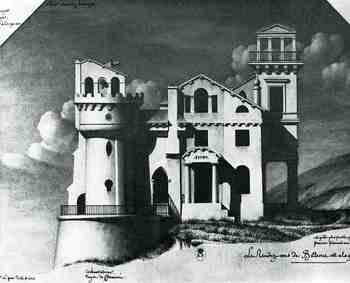
    Perhaps his most sensational creation (and one which was devoid of all Baroque influence, as it turns out) was his Meeting Place at Bellevue.  It is almost impossible to believe that it is am 18th century creation—it is as harmonious (armonia) as it is asymmetrical.  It looks deeply 20th century, and looked as far into the future as it was deeply unknown.


Recent Posts

Archives

Categories