JF
Ptak Science Books Post 1971
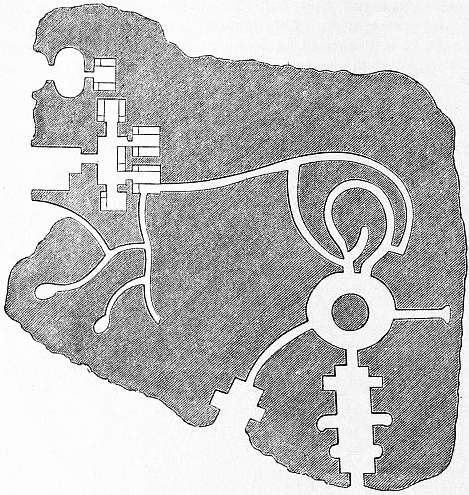 [Plan of a portion of the principal storey in the Poggio Gajella]
The plans of underground cities, of catacombs and cemeteries, share a certain biological appeal in their design with the plans of Medieval cities, or at least they seem so to me. Removed from their context and placed in an undifferentiated environment, the plans look very much like biological structures, and art. As maps of cities of the dead it is somewhat ironic that their geological chrysalis seem to indicate a biological structure.
And sometimes the images aren’t so reminiscent of micro-structures as they are macro-structures, as in the case above. If you squint just a little and look at the Poggio Gajella you can visualize a cross section of the upper torso of a body, including an open mouth, with nasal cavity, throat, digestive system, and even intestines and egress routes–a picture of a person in the city of the dead.
The images below illustrating this ragged point are by Seroux d’Agincourt, (1730-1814), and appear in his Histoire de l’art par les monuments, depuis sa décadence au IVme siècle jusqu’ à son renouvellement au XVIme (Paris, 1825). The images illustrate the article “catacombs” from the Encyclopedia Britannica, in the great/standard 11th edition, from Project Gutenberg: