A Daily History of Holes, Dots, Lines, Science, History, Math, Physics, Art, the Unintentional Absurd, Architecture, Maps, Data Visualization, Blank and Missing Things, and so on. |1.6 million words, 7500 images, 4.9 million hits| Press & appearances in The Times, Le Figaro, Mensa, The Economist, The Guardian, Discovery News, Slate, Le Monde, Sci American Blogs, Le Pont, and many other places… 5000+ total posts since 2008.

  • WIlliam Shockley on the Economics of Atomic Bombing, 1945

    JF Ptak Science Books  Quick Post

    • Background Documents on the Control and Proliferation Issues of the Atomic Bomb
    • Vannevar Bush Group, October 1945-January 1946
    • William Shockley.  The Economics of Atomic Bombing.
    • The original paper is available fo rpurchase at our blog bookstore, here.
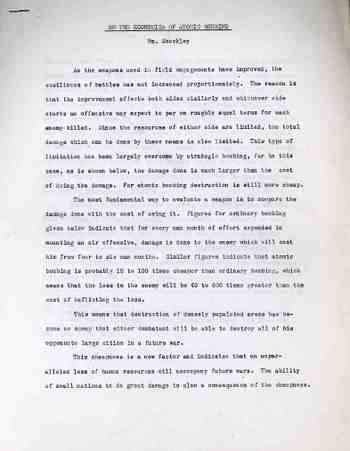
    Blogaug_6shockley_1361 (Click image to enlarge; the other four pages are located in the “Continue Reading” section, below.)
    William Shockley on the Economics of the “Atomic Bomb Art”

    This paper is one a small archive of background and draft papers and proposals by the Vannevar Bush group working on the question of the control of atomic weapons and the formalization of the American position regarding the use and control of atomic weapons, October 1945-February 1946. This archive consists of 38 documents relating to the development of U.S. atomic policy, with  contributions by President Harry Truman, Secretary of State James Byrnes, Dr. Vannevar Bush, (future AEC director) Carroll Wilson, Alger Hiss, I.I. Rabi, William Shockley, Frederick Dunn, Joseph E. Johnson, Leo Pasvolsky, Philip Morrison, Col. Nichols, William McRae, Admiral W.H.P. Blandy, George L. Harrison, and others.

    I have written elsewhere on this site about Vannevar Bush and the coming atomic/nuclear arms problem–as perhaps one of the pre-eminent scientific minds in the Roosevelt/Truman administrations, Bush and others foresaw the development of the atomic arms race in 1943, and by 1945 Bush became a  fundamental thinker and advocate on the problem. The items in this archive are low-formal background papers, drafts of proposals, informal studies, as well as mature statements of thought that would become implemented in the core of U.S. policy regarding the spread and control of atomic weapons. They are generally carbon typescripts and necessarily of extremely limited distribution, generally have no letterheads, occasionally carry the authors’ full names (although sometimes only initials are used).

    A note on William Shockley
    . The brilliant Shockley’s story is difficult and problematic: from the way in which he misused his interaction with the rest of his team at Bell Labs in the discovery of the junction transistor to his sinful racial and eugenic (and dysgenic) public persona later in life–it is a hard and long one to tell, and I’ll not try to do it here.  Suffice to say that I’m very aware of the very long shadows, and I think that other people should at least be aware of them as well, regardless of the staggering importance of “his” (with the wonderful Walter Brattain and John Bardeen) monumental discovery.  

    The William Shockley paper was written towards the end of 1945 and is on five pages and runs about 1500 words.  He begins the paper with a logical statement of the issue of the economics of conventional and atomic bombing, ending with the sentence “For atomic bombing destruction is still more cheap”.  What Shockley is getting to is the overall cost of the amount of destruction caused per square mile, and the conclusion that he draws over these five pages is the destruction caused by the atomic bomb is 1/100th the cost of conventional bombing per square mile destroyed (“atomic bombing is probably 10 to 100 times cheaper than ordinary bombing”).   
    ·Posted by :

    ·in:

  • Suggestions of Magnificence: Bloated and Bumpy SteamPunk Aviation, 1830’s.

    JF Ptak Science Books      Post 2004

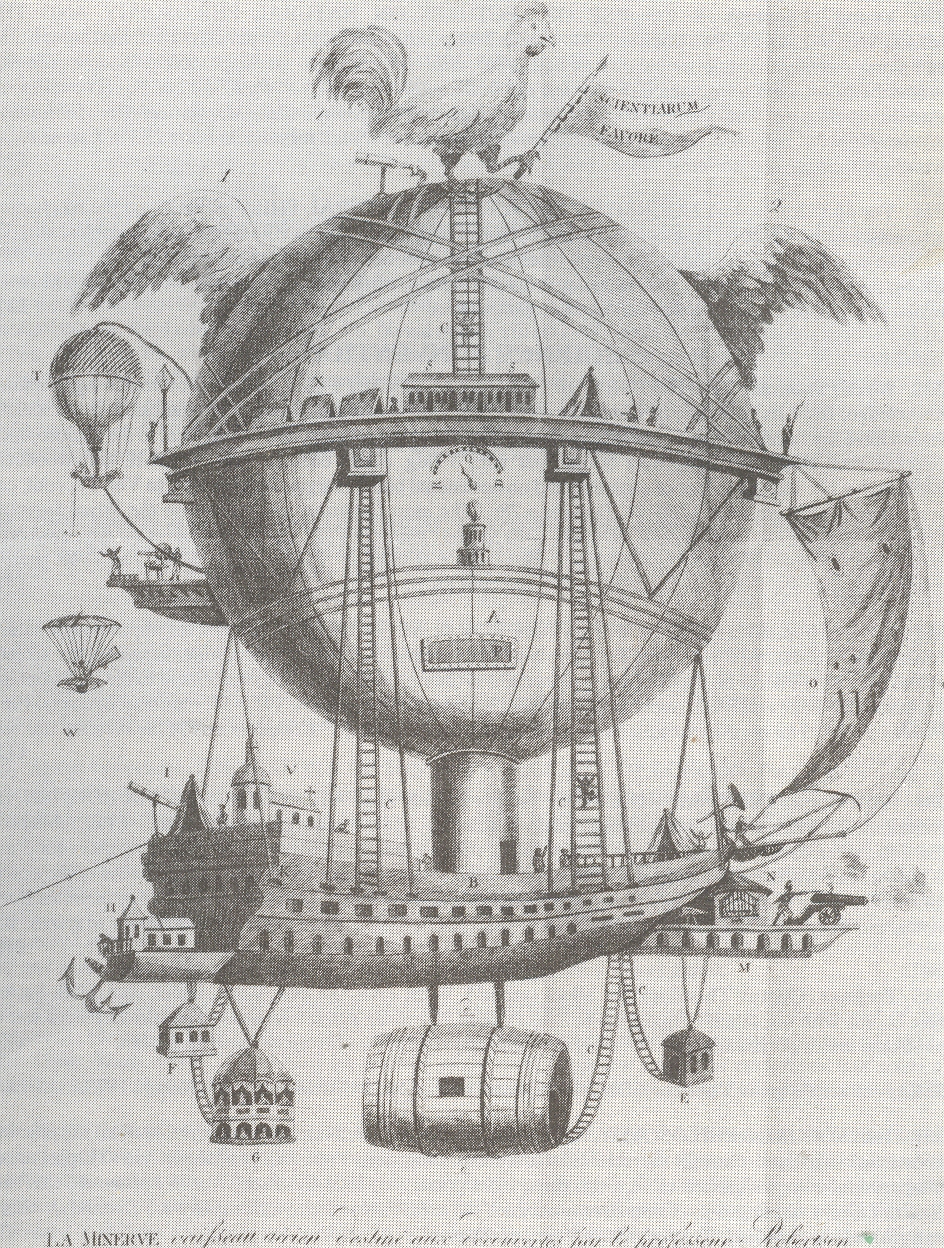
    Question: What is 150’ in diameter, weights 80 tons, carries 60 scientists,
    a cannon, a big rooster, an escape pod for women, and makes transcontinental
    flights? 

    Answer:  nothing.  

    And so: what is ten times bigger, and carries ten times more people? Bigger but still the same nothing–though a more-magnificent nothingness. 

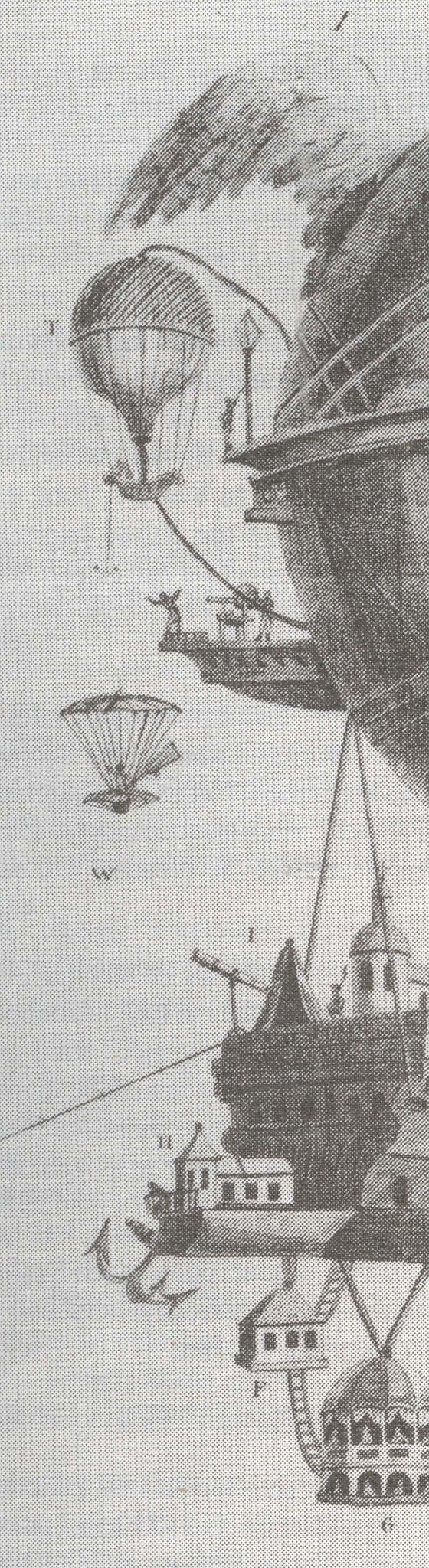
    Blog--May 20--minerveA The first example  did however live in print as the great balloon La Minerve, the  prankish gesture of the Belgian optico-magician,
    physics experimenter/exhibitionist  and
    general experimenter  (and probable
    crumbun)  “Dr. Roberston”, who was
    actually Étienne-Gaspard Robert (1763-1837). 
    Robert did have vast experience with balloons—he was Commandant des
    Aerostiers during the war, serving under General Jourdain in Belgium and Holland
    in 1803/4, providing valuable observations on the enemy troops and movements
    from tethered (and not) balloon observing stations;  he is also regarded by some as the inventor of
    the parachute.  He had a wide interested
    in optics and toys, making a very profitable tour with Brewster mirrors,
    demonstrating all manner of specters and floating bodies and such for a paying
    audience.

    Blog--May 20--minerveB

     He came up with this sci-fi-ish idea
    in the early 19th century, and published his dream broadsided swipe
    at other aeronauts in 1820 under the title of La Minerve, vaisseau aérien, destiné aux découvertes et
    proposé à toutes les Académies de l’Europe par le physicien Robertson. 
    There was nothing about this balloon that
    would’ve worked, and Robertson knew it, intending his pamphlet to be more of
    caricature of existing attempts in flight than as a science fiction
    creation.  (The pamphlet reads a little
    mean-spirited to me regarding the Minerve; other sections, which dealt with
    single-occupant air-transport devices of imaginative construction, seem less
    so.)

    In any event, Roberston provided large creature comforts for his travelers,
    not the least of which was a ship (which seems to be 175 feet long) holding 60
    scientists and providing enough space for long-distance sleeping arrangements,
    laboratories, observation decks, a kitchen, food supplies, water and the
    like.  There is a (large!) cannon in the
    bow of the Minerve, which is also topped by an enormous cock (I figure it to be
    50 feet from tail to beak), a gigantic and heavy symbol for vigilance (at what
    price?) .  There are several small out buildings,
    as well as a smaller balloon that housed the women who accompanied the all-male
    crew on these long distance jaunts.

    There is an enormous anchor where the power source for forward motion should
    be.  Alas!  Roberston has provided no means of thrust,
    trusting the winds to take the massive balloon to-and-fro.

    (“Minerva” is the Roman goddess of poetry, medicine, wisdom, commerce and crafts,
    as well as the goddess of warriors.  She also
    invented music.)  

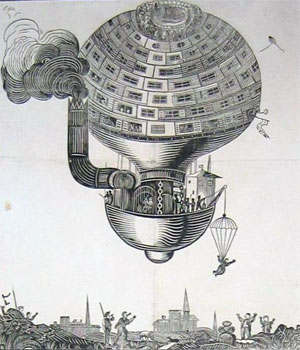
    And the next example of the magnificent nothing, the Great Monster, appeared in 1837.  It was supposed to support 80 houses, steam powered with a large coalhouse and raintanks; it supported gardens and other ammenities, and was to support upwards of 1,000 people–it would be crowded, though, even though the thing was supposed to be 14,000 feet in diameter and 682′ high.  It was huge, tall, and travelled at 100 mph

    Even though the Minerve was a smaller undertaking, its 19th-century Baroque crenulations and insistence upon levels of dangling laddered bits make it a peculiar favorite in spite of the 2.5-mile diameter of the monsterosu Great Monster.Ballon-monstre-1837-f2


  • Word Art: the Geographical Vocabulary of Edwin Abbott’s “Flatland”

    JF Ptak Science Books   Quick Post  

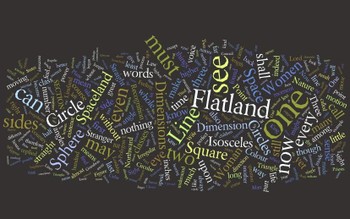
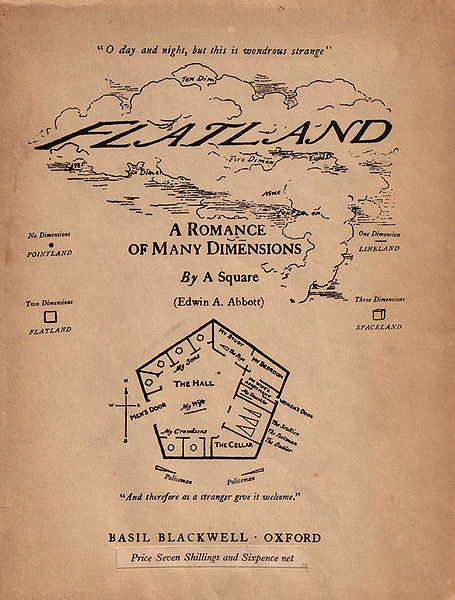
     Edwin Abbott’s slender Flatland, a Romance of Many Dimensions is perhaps one of the best books ever
    written on perception and dimensions, a beautifully insightful book that
    was quick and sharp, and in spite of all that was also a best-seller. 
    Written in 1884 when Abbott was 46 (Abbott would live another 46 years
    and enjoy the book’s popular reception), it introduces the reader to a
    two dimensional world with a social structure in which the more sides of
    your object equals power and esteem.  Thus the lowest class would be a
    triangle (three sides) while the highest (priestly) class would be
    mega-polygons whose shape would approach a circle.  Abbott’s magistry
    comes in explaining to the three-dimensional reader what it was like to
    be in a two-dimensional world.

    Wordleflatland

    Flatland

    ·Posted by :

    ·in:

    — —
  • Mystery of the Sun’s Missing Smile

    JF Ptak Science Books   Post Expanding a Lost Earlier Post (#67)

    Blogsunfacesdetailtwo

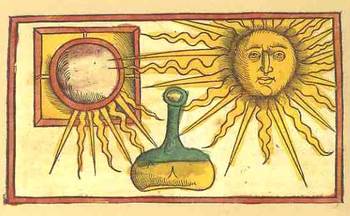
    Where did the smile of the Sun go?  Anthropomorphic images of the Sun
    have appeared in books in the West for several hundred years, and in
    almost every case where the Sun has a face, it is usually
    expressionless, its mouth drawn into a mid-Western farmer/Abe Lincoln
    horizontal, a tightly drawn nothing.  Two thin lips, firmly repulsing
    all emotion.  The face of the Sun was insurmountable, a tabula rasa, showing perhaps that there was nothing there at all inhabiting this
    iconographic image of The Creator to give the poor observer a glimpse
    into the depths of the future.


    Blogsunfacescolor


    Blogsunfaces2048

    This observation  seems to stand for Sun Gods and Goddesses as well, even the ones who are being tugged or pulled or charioted across the vaults of the heavens—the Nordic Sól, Greek  Helios , Roman Sol Invictus, Vedic Surya and of course Elijah ascending to Heaven in a Chariot of Fire, all seem pretty intractable.  But in general images that we see of Sun deities like Apollo, Greece and Rome; Freyr, Norse; Garuda, Hindu; Huitzilopochtli (Uitzilopochtli), Aztec; Inti, Inca; Liza,West African; Lugh, Celtic and Re (Ra) and Isis, and on and on, show a small, set pair of lips, if they have a mouth at all, and this going back beyond the Sumerians (Shamash). 

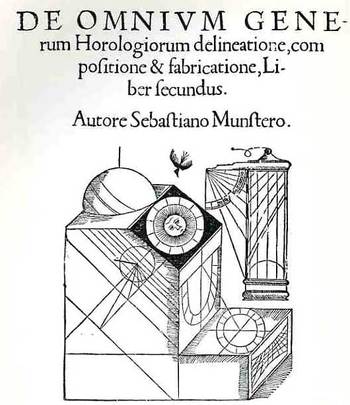
    When the Sun really loses its human personae in the 17th century (the scientific sun and stars beginning much earlier, as in for example Allessandro Piccolomini’s Della Sfera del Mondo, 1552, with simple star maps unadorned by icons and written in the vernacular), it is replaced with starry images which seem to somehow have more emotional authority than the sun images with faces.  Perhaps the sun was meant to have this Delphic, blank-mirroring quality, given its importance as a giver (and taker) of things,
    Blogsunfacedetailone

    and that it was not within human capacity to understand it as an emotive entity, especially during bad times.  But in those times of Good and Bad it wasn’t necessary to see a frown or a smile on an image of the Sun, I guess because of the complaints of redundancy.

    Blogsunfaces047

    No matter, though, as the modern astronomical text took care of the Sun and its missing buckets of smiles in due course—until more modern times, when the Sun is made to have a matching disposition, a result of kinder modern artists. 
    Blogsunfacedetailthree
     

    Now the Moon, well, that’s another matter…

    ·Posted by :

    ·in:

  • Photograph of a Street Abacus Seller, Russia, ca. 1860’s

    JF Ptak Science Books   Quick PostFollow Me on Pinterest

    Carrick abacus seller

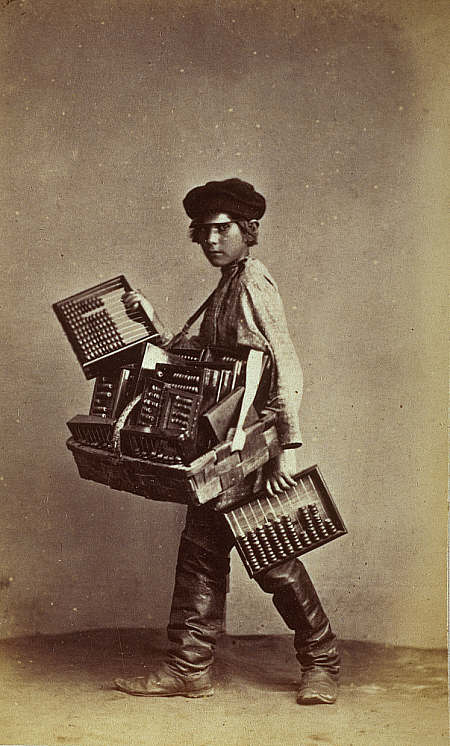
    In my travels in and out of imagery and books, I’ve kept a small space allocated in what is left of my memory palace for images of the working poor and the laboring classes.  Most of the world’s population of course has been and still is composed chiefly of the daily (and not so) laborer, but if you were to measure images that were made of these folks while at work or with the tools of their trade, and compare it to the rest of the images of more-exalted people spending their time doing more-exalted things, I would guess that the images of the working classes would be vastly outweighed by the rest, at least in the ancinet to early-modern times (of say 1925)–that is why it is so very interesting to see third-quarter 19th century photographs of these people.

    This image was made by William Carrick (1827-1878, born in Scotland but who spent his life chiefly in Russia) in the 1860’s, and is found at the National Gallery of Scotland, here.  Carrick made important contributions to the ethnography and the history of photogaphy, documenting the lifestyle and costume of Russian peasants in the country.  It is probable that he made his series cartes de visite images of itinerant trades people as a sort of postcard to the tourist and taveling class–but what happened of course is that he recorded in great detail bits of everyday life that was in general invivible to the main sttream of people who were in the image-making class.  And so Carrick produced images of knife sharpeners, and tool sellers, and milk haulsers, and woodcarvers and hackmen and chimney sweeps and so on, pictures of the people who made the city run.  I was particularly struck by this image of a boy selling abacuses/abaci–Im not sure that I ‘ve seen a photograph/engraving of a street vendor of this sort of instrument, but here one is–a boy in the ‘tween years, wearing boots way too big, with a woven basket full of abacuses/abaci. (The varities here have two ranks of four beads–one for quarter-rubles and the other for quarter kopeks–while the other wires hold ten beads apiece.)

    Maybe the boy isn’t a ‘tween–maybe he’s younger than that. Maybe the boy is a girl.  In any event, the basket looks heavy, and I’m sure the child returned home with a weary back at the end of the day. 

    Other images by Carrick can be found at LuminousLint.com; a short biography of Carrick is available at Oxford Art Online..


    ·Posted by :

    ·in:

    —
  • Justice and the Sign for Equality, ” = “

    JF Ptak Science Books     Post 2006

    
    Equal sign det


    Equal signWith the big discussion taking place at SCOTUS (rather, the same-ish big discussion taking place in two cases) and with the equality sign appearing everywhere, it might be interesting to take a look at when that symbol first came into use. 

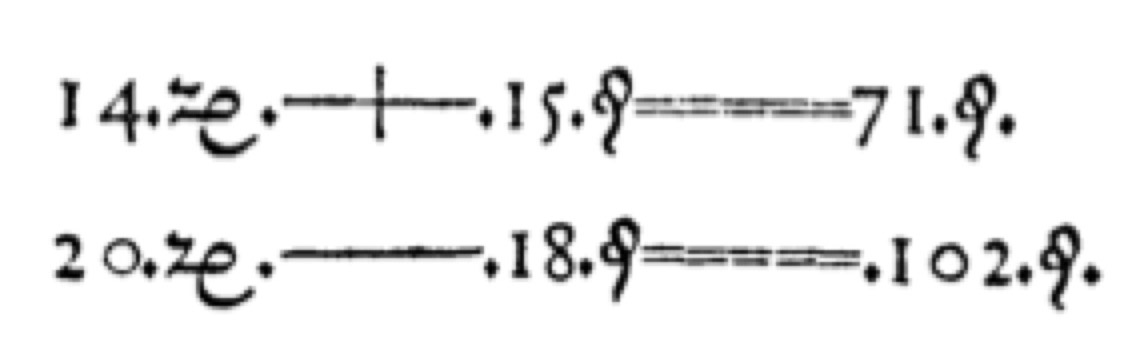
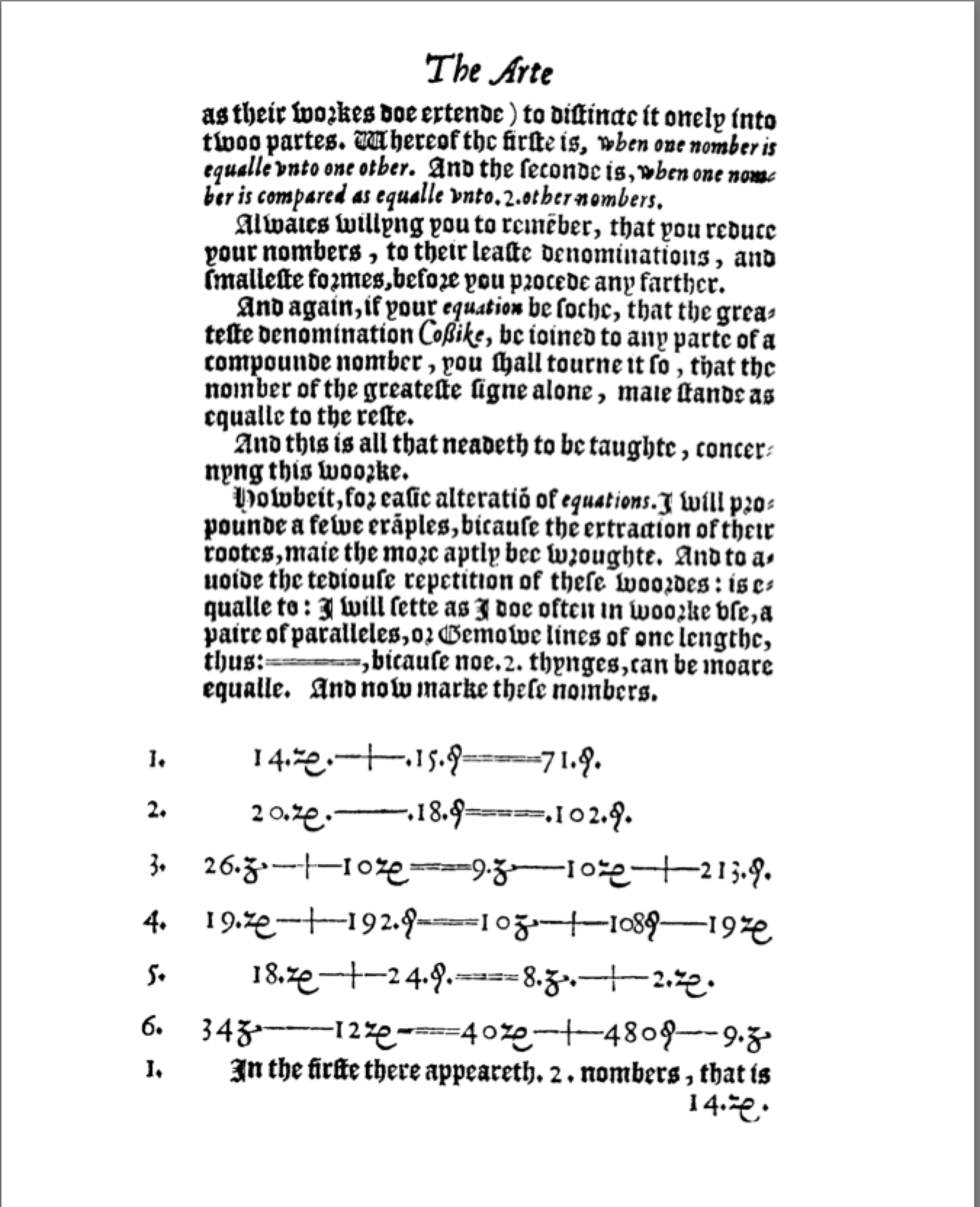
    It turns out that ” = ” makes its first appearance in print with the work of Robert Recorde (a Welsh mathematician and physician, who lived from 1512-1558), in his The Whetstone of Witte, whiche is the seconde parte of Arithmeteke: containing the extraction of rootes; the cossike practise, with the rule of equation; and the workes of Surde Nombers (printed in London in 1557). 

    In clear and concise language (in the fourth paragraph in the text at left) he introduces = = = = = to take the place of repeating the phrase “is equalle to”.

    Howbeit, for easie alteration of equations. I will propounde a fewe
    exanples, bicause the extraction of their rootes, maie the more aptly bee
    wroughte. And to avoide the tediouse repetition of these woordes : is equalle
    to : I will sette as I doe often in woorke use, a pair of paralleles, or Gemowe
    lines of one lengthe, thus: =====, bicause noe .2. thynges, can be moare
    equalle.

    [Page image via the MathMastery Blog, here.]

    The word “equal” comes from the Latin  aequalis, meaning “uniform, identical, or equal,” it also derives from aequus which perhaps more interestingly plays out as “level, even, just”.

    Either would do, for me, so long as the equality sign is put into play as the law of the land, and that this injustice and discrimination is brought to an end. At 456 years of age, = is far younger than the inequality it can replace.

    ·Posted by :

    ·in:

  • AtomPunk: Atomic Hair, Clothes, Swimsuits and Cake

    JF Ptak Science Books    Post 2006

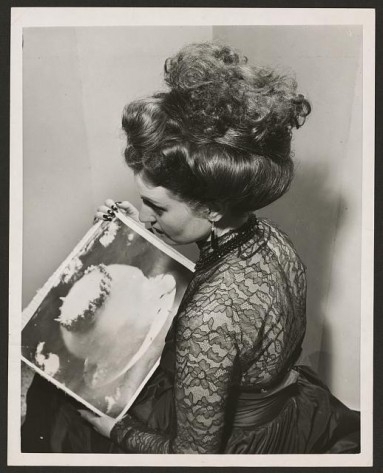
    Perhaps the way you get around the constant fear of Total World Annihilation is to triviliaze the thing that would bring this state of affairs about.  I’m not sure that this has been the case too very often in the history of Potential WorldWide Disasters outside of the great atomic fear of 1950-1990 (and soon to re-emerge, perhaps/probably).  So far as I know there were no V-2 Motels to correspond to the Atomic Motels of the American 1950’s;  nor was there Pestilence Wax, or AIDS Cakes, or Influenza Burgers, or Plague Patter, and so on.  I’m certain that some cases exists outside the atomic realm, but putting the atomic bomb to work on the runaway train that was an advertising antithesis to itself seems to me to be so far beyond anything else that I can think of…well, nothing seems to compete with its ready meanness to the great/monsterous possibilities of itself.  To wind up with a picture of an “a-bomb” on a ball of kid gum seems spectacularly evaporative to what the atomic bomb was.

    I’ve collected some examples of the atomic fear reversal at work:

    Atomic hairdo[via retronaught]


  • The Lonely Gold Windows in Blue Skyscrapers, 1928

    JF Ptak Science Books   Quick Post 

    Skyscraper213
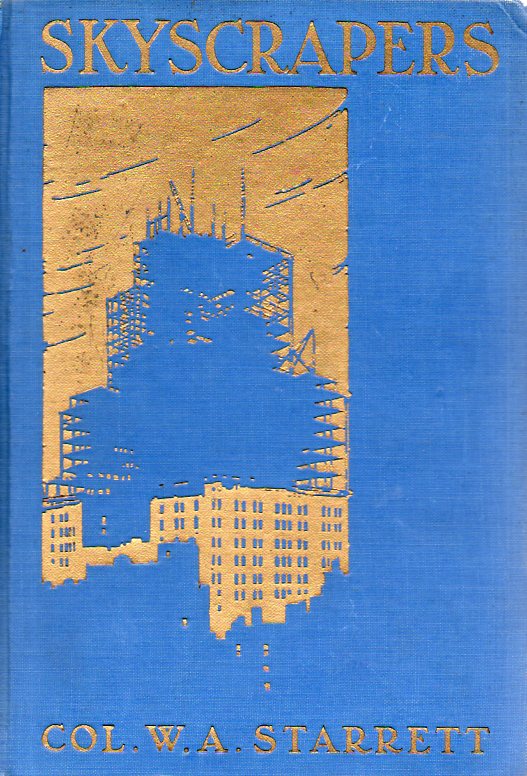
    This lovely cover belongs to W(illiam) A(iken) Starrett’s Skyscrapers and the Men who Build Them, published in 1928.  It is a design cut into the publisher’s blue cloth and highlighted a bit in gilt, and at least to my experience is fairly well singular.  Or at least very unusual.  The “skyscraper” as a building was at least seven decades old (as was the safety brake for the elevators–first referred to as “vertical rail car”– that made these six+ storey buildings  possible back in the early 1860’s) when the Starrett book appeared. Its an interesting achievement, and seems to be filled with a fair amount of history (he does talk about the history of elevators, for example) but mainly concentrates on the new buildings of the 1920’s.  Mostly, though, I liked the book cover. 

    Skyscraper211

    I like the foreground of the more-antique skyscraper in blue, giving way to the recent turn-of-the-century-esque skyscraper in gold, and then the massive under-construction monster in blue in the background–all set against a gold sky.  Its a job well done by the nameless designer.  The design has a Renaissance flavor to it, skyscrapers or not. 

    A review of the book appeared in the Town Planning Review in 1931 and is available in full text  here.
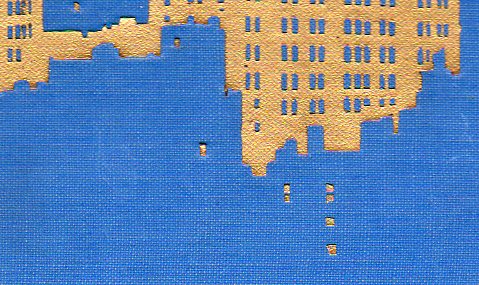
    And a detail of those lovely (2mm) windows at bottom:

    ·Posted by :

    ·in:

  • Crytpo-MAGIC and the Japanese A-Bomb, August 1945

    JF Ptak Science Books   Quick Post

    This is document 63 of 80 from “The Atomic Bomb and the End of World War II, a Collection of Primary Sources”, from the National Secuiry Archive Electronic Briefing Book No 162,  edited by William Burr (2005). (The full source is available here.)  It is here where there is a brief review of supposed Japanese development of an atomic bomb. the information was courtesy of the MAGIC, a cryptonym for the successful effort of the United States Army Signals Intelligence Section (SIS) and the Navy Communication Special Unit to decode intercepted high-level Janapese messages. (A quick appraisal of MAGIC is available here.) Suffice to say for this quick post that the efforts of American cryptographers (with some help from our cousins in the U.K. at Bletchley Park) landed the U.S. the ability to read and render Japanese critical and encoded communications virtually from the very beginning of the war. 

    Read more: http://www.faqs.org/espionage/Nt-Pa/Operation-Magic.html#ixzz2OPnQy4oJ

    ·Posted by :

    ·in:

  • Proust’s Mother’s Hands

    JF Ptak Science Books   Quick Post   


    Follow Me on Pinterest

    “None of us has time to live the true dramas of the life that we are
    destined for. This is what ages us – this and nothing else. The wrinkles
    and creases on our faces are the registration of the great passions,
    vices, insights that called on us; but we, the masters, were not at
    home”.–Walter Benjamin on experiencing M. Proust

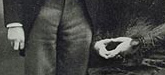
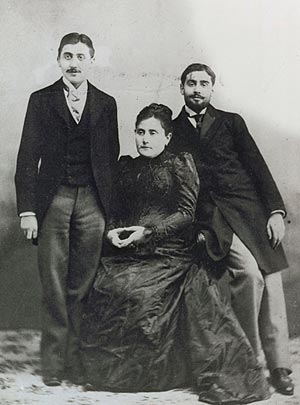
    In sliding my way through found pieces of Proust this morning I bumped quite a bit into aging in general and mothers and the “very painful sense of things” [“une impression fort pénible1“] .  And then in Marcel Proust on Art and Literature 1896-1919 I found Proust quoting Hugo, “I fancy that old age invades us trough the eyes, and that they age too soon who dwell among grey heads”2.  This can go on for quite a while, and it is a little too much before the first coffee.  I did want to post this picture of Jeanne Proust with her two boys because of her hands: not only because their attitude is very very uncommon for late-19th/early-2oth century portraits, but because they see strong and assured, which is I think just what his mother was, not creaking off to the grave covered in moss and age.


    Proust hands

    A detail from:

    Proust

    [Source: the Morgan Library http://www.themorgan.org/exhibitions/exhibition.asp?id=71]

    Notes:

    1.  Mme Proust in a letter to her son Marcel, from Michael Wood, “Proust and his Mother”, in the London Review of Books, http://www.lrb.co.uk/v34/n06/michael-wood/proust-and-his-mother  22 March 2012

    2.  Sylvia Townsend Warner (translator), Marcel Proust on Art and Literature, 1896-1919, Carroll & Graff, 1954, page 105.

    ·Posted by :

    ·in:

  • The Mathematical Garden–Alexander Pope and Found Geometries

    JF Ptak Science Books (Revisiting an earlier post from 2008 with a added details).

    Blogdesirepope

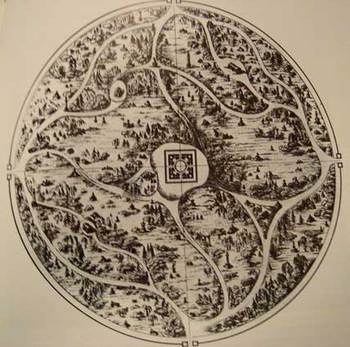
    While sitting at the edge of a stream in a flowing dress and shading herself with a yellow parasol, my wife and  the jewel in the crown, the brilliant Patti Digh, wrote a superb essay on following the paths less marked. (Maybe I’m making up the parasol bit. And the stream. And flowing dress.) I’ve always been a happy observer of found geometries, and her essay heightened my awareness to them, along with the conscious efforts that we may daily make to enforce these lines or follow a new, multi-dimensional geometric path. 

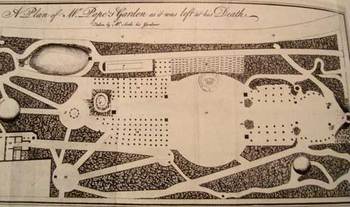
    So when I stumbled across this map of Alexander Pope’s garden and noticed the odd paths  winding their way through it, and  how much in contrast this was to the very sniffy upper  crust English garden of the 18th century, Patti’s essay  lit instantly to mind—and also because in addition to being a geometer of emotion and thought she was in a past life a U VA English Master. 

    Pope’s garden was an irregular path in an irregular garden, that garden being his leased property at Twickenham, where he came to live in 1717, along with his mother and his boyhood nurse, Mary Beach, and his dog Bounce. 

    Pope’s garden was an irregular path in an irregular garden, that garden being his leased property at Twickenham, where he came to live in 1717, along with his mother and his boyhood nurse, Mary Beach, and his dog Bounce.  (Actually that would be a series of dogs as he named them all “Bounce”.)  Pope was a poet and satirist and critic and general taste-maker-the social influence extending even to garden-making, as his was famous even during his lifetime, and not for the reasons that most English gardens were famous.
    Blogdesiregeometrical_4

    His was not the planned regularity of the gentility (and far of course  from the suffocating, critically flawed gardens at places like Versailles,  “Is there anything more shocking than the regularity of a planned  garden?” asks Batty Langley in his New Principles of the Gardening… 1728), and were removed from the “normal”, more articulated garden.  I’ve never really understood the formal garden, especially as it relates  to the ancient analogies of gardens and paradise-the Garden of Eden, Pliny’s Garden of Venus, Lucretius’ Earthly Paradise, seem as though  they might be some sort of paradisical thing (though we won’t address  Bosch’s Garden of Earthly Delights) , but the formal gardens and its  paradise relationship seems odd, what with the removal of nature’s “chaos” and all, unless that was indeed the Master Plan.

    But the mathematical garden was a desirous thing—still is—and none  other than Christopher Wren wrote that it was “naturally more beautiful than any irregular figure” (1750).  There were some critics of the math garden, like Mr. Langley, but most garden  designers wrote and argued in favor of it, coming to the similar  conclusion of John Dennis, in that the Universe, being “regular in all its parts”  would dictate that its beauty be found as regular  in other things too,  “and it  is that exact regularity that [the mathematical garden] owes its admirable beauty” (1704). 
    Pope didn’t seem to address (in print) the garden idea formally except for a few places–  Pope praised ‘the amiable simplicity of unadorned Nature’ in a famous essay, published  in The Guardian in 1713, and then again in his message to Burlinton in 1731.

    Blogdesirepopedetail_3

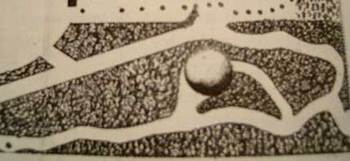
    The plan of Pope’s garden was somewhat irregular, but to me the  most appealing aspect was  the irregularity of the paths that curled and snaked their way through the garden. 
    And particularly,  what about the lower part  of the path along the bottom of J. Serle’s 1725 engraving?  What was that path in Pope’s garden  leading to, or from?  Was there a particularly nice tree there, a  favorite spot, a cool shade, an odd bit of sunshine at sundown?  Or was this  wall-clinging path just the workman’s route? 

    Perhaps these weren’t Pope’s principal desire lines in the garden—in fact, the garden desire lines  weren’t the garden at all— they might’ve been under it.  Pope’s famous grotto at Twickenham  may be better known than his garden-it certainly sounds  much more interesting. Followed his  own desire line, underground, in his famous grotto, which he began to build shortly after arriving at  Twickenham, and which was still under construction at the time of his death. 

    The unseen desire lines of  Alexander Pope seem more fitting to me, more poetic, what with  Pope needing to dig out the earth in order to find what  he was looking for, rather than a more  simple wandering around his fine, rustic garden. 

    Have a look at the materials house in the grotto/cabinet of curiosity here, along with a  commendable plan of the grotto itself.

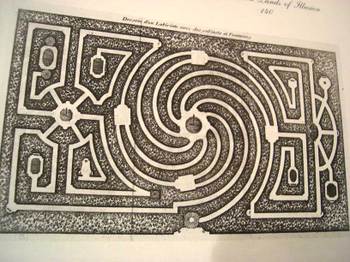
    Blogdesirecircular

Recent Posts

Archives

Categories