JF Ptak Science Books Part of the History of Blank, Empty and Missing Things.

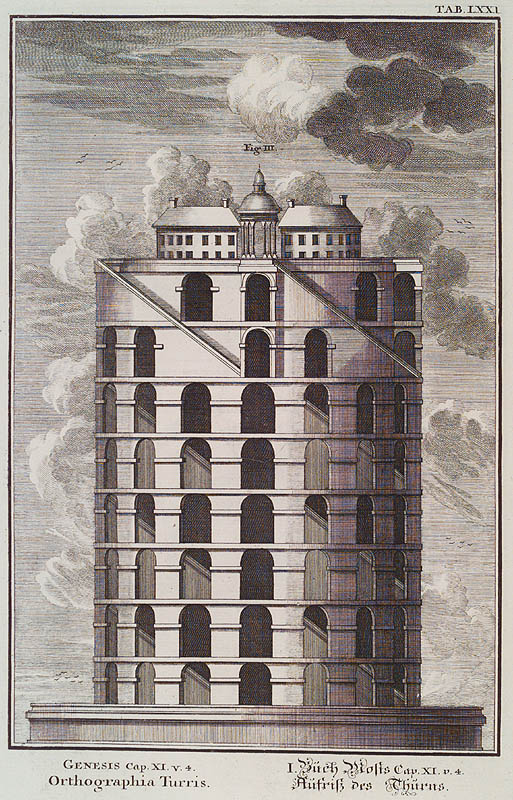
Returning to Jean-Jacques Scheuchzer’s1 magical, inventive, fact-bending naive-surreal work on universal history based on the Old Testament, I’ve found these two glorious and odd images of the Tower of Babel. The first (“Genesis Cap.XI.v.4. Orthographia Turris.Mediummetalis”) is terrific, shocking even in its abrupt construction and flat-out stumpiness, because it is one of a very small minority that shows the structure to be canonical, with a little church at top. The enormous stairway is just completely out of proportion to the purpose of the structure, the effort falling into some sort of odd advanced-child category.
If Italo Calvin’s “Invisible Cities” or (better yet) Jorge Borges’ “The Circular Ruins” were to be illustrated, this image would fit right in.
The other very unusual bit here, is that Scheuchzer also provides a plan for the city that was to be built around the tower–I’m pretty sure that I haven’t seen references to this before, and the Biblical references to it are no help whatsoever in determining its physical aspects.
There are probably very few things that could be as blank or as empty as combative, competing, nonsensical and completely self-referential language or communication. Well, except for Scheuchzer’s very empty town plan locating the tower in an urban setting–a listless place of surrounded circles of nothingness for a place in which everything is said and nothing is understood. Ground Zero for blank 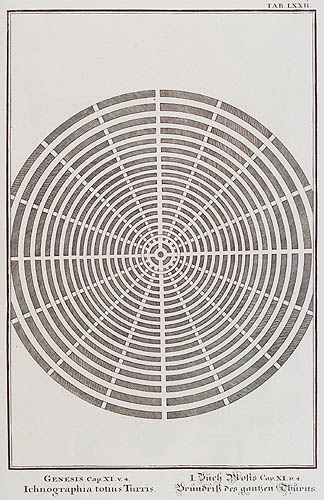 language.
Notes:
Two interesting books that I should mention that address the ideas
of fantastic/imaginary architecture and decay are C. W. Thomsen, Visionary
Architecture: From Babylon to Virtual Reality, (Prestel, 1994) ; and Paul Zucker, Fascination of Decay (Gregg Press, 1968).
1. Kupfer-Bibel, in welcher die Physica sacra, oder geheiligte
Natur-Wissenschafft derer in heil. Schrifft vorkommenden naturlichen
sachen, deutlich erklart und bewahrt, printed in Augsburg and Ulm
by C.U. Wagner, 1731-1735. Offered in four volumes, illustrated with
758 plates, it is a magnificent work, if not altogether correct, or
even near- correct, with an enormously confused pedigree, implying the
wisdom and text of the Bible (and the old Testament at that) as the
background for a physical history of the world.