A Daily History of Holes, Dots, Lines, Science, History, Math, Physics, Art, the Unintentional Absurd, Architecture, Maps, Data Visualization, Blank and Missing Things, and so on. |1.6 million words, 7500 images, 4.9 million hits| Press & appearances in The Times, Le Figaro, Mensa, The Economist, The Guardian, Discovery News, Slate, Le Monde, Sci American Blogs, Le Pont, and many other places… 5000+ total posts since 2008.

  • Dots and Lines in Optical Diversion

    JF Ptak Science Books     Part of the History of Dots series  Post 2007

    Follow Me on Pinterest

    Long is the line in the history of art–far less so the dot. 
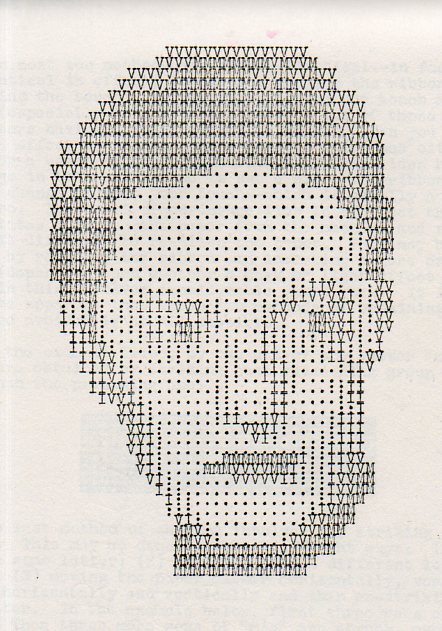
     
    Artyping216

    The line has been part of a long and deep inheritance of rendering a truth, factual, perspectival presence–in general, at least. Certain symbolic and metaphoric elements will sometimes confuse and collapse bits of the image, but the effort for centuries has been to present a balanced nature as close as practicable to its perfection.  That was the strength of the line. 

    The strength of the dot was in doing something not quite the opposite but approaching it. 

    It is interesting to think of the importance of dots in the first revolutionary changes in 500 years in the history of art.  Honestly, there wasn’t anything epochal that happened between the re-discovery of perspective (ca. 1330-1400) and the arrival of Impressionism (and just afterwards of non-representational art) in the 1872/3/4-1915 period.  
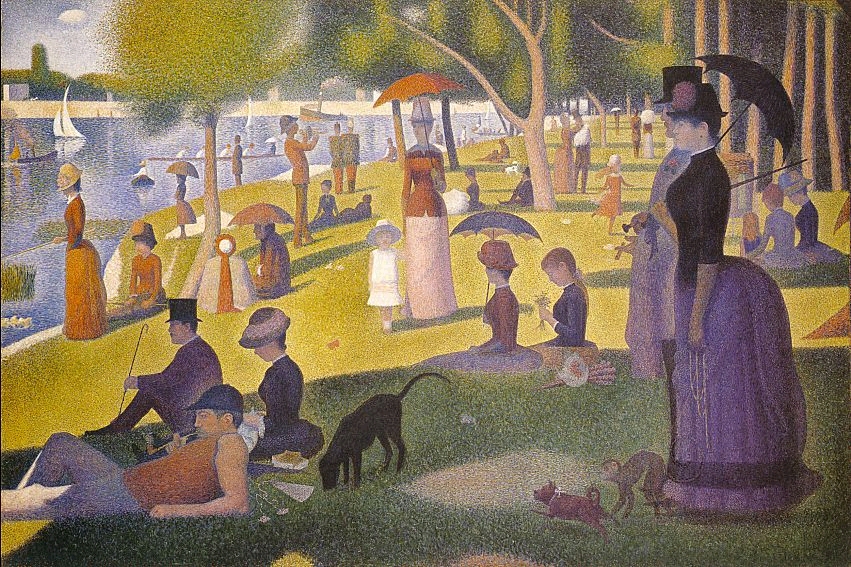
    Suerat Dots aren’t brought to bear formally in the revolutionary movement until the early 1880’s.  Impressionism for all intents and purposes is formed with the Societe Anonyme in 1872 (whose members included Monet, Pissaro, Degas, Sisley, Morisot and eleven others), and perhaps more realistically in 1874 when the Societe exhibited its first salon.  (The first show held at the Nadar Studio in Paris in April 1874; a tiny, one month long affair, compared to mammoth exhibitions like the Universal Exposition in Paris in 1867.) 

    It was Georges Seurat who brought the whole world to the dot experience with his artistic method of Pointilism, in particular with his magnificent Un dimanche après-midi à l’Île de la Grande Jatte, an enormous work given its composition—dots.  The dots replaced the brushstroke, and their placement in relation to their color was an absolutely brilliant innovation, establishing a perfect result for the viewer when examining the work as a whole.  (It may well be that the French chemist an designer Michel Chevreul made this discovery a few decades earlier, noticing the effect and changes in color depending on placement and—in his case, with fabric—color in the dyes for his material.)

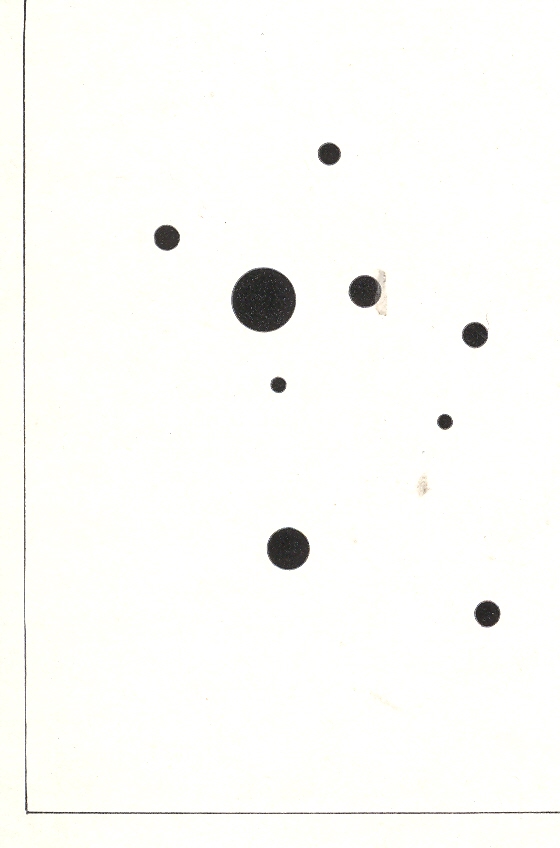
    Wassily Kandinsky (1866-1944), the discoverer of nothingness in art and the introduction of the first BLOG==july 13=kamd non-representational paintings in art history (1913) used his fair share of dots in his exploration of the previously invisible.  One good example is his 9 Points in Ascendance (1918), which is nothing but black dots, an impossible composition just two decades prior to its creation. 
    In the middle of this appeared the half-tone illustration, the great liberator of photographic illustration in popular publication.  Invented in the late 1870’s by Stephen Henry Horgan and used in the Illustrated London News for the first time in 1881, it made the publication of accurate images much feasible and economical.  No longer were readers dependent on the accuracies of artists interpreting photographs or photographed scenes—the photographs themselves were now publishable at little cost and in high quality, vastly increasing the veracity of published reports dependent upon images.  This was revolutionary in its own way, democratizing the sharing of images and icons.


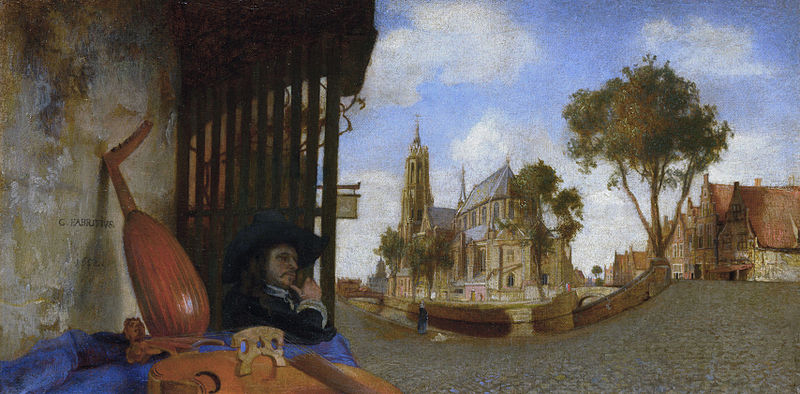
    That said about dots, the line was surely used to transport a bit of reality in art, even before the 18th century–among the earliest appearances being with Hans Holbein in his The Ambassadors of 1533, and a beautiful and very famous use was made by Andrea Pozzo in his illusionistic works at S. Ignazio in Rome in 1685 (and which I mention in an earlier post).  Certainly Carel Fabritius attempted and succeeded in this throughout his career, playing with the substance of perspective, as we can see here in his View in Delft, in 1652:
    Fabritius
    Also the lines of the anamorphic image severely distorted the presentation of reality–if you had the mirror to distort it and if you had the mirror to reconstitute it:
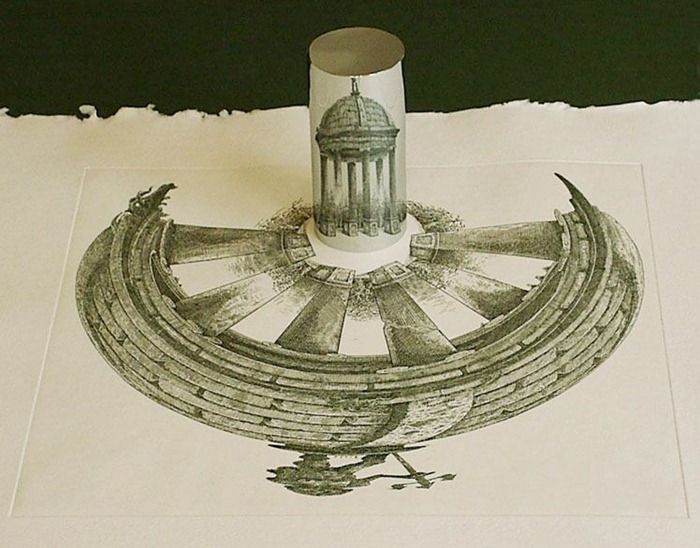
    Anamorphic art
    Source:  Anamorphic Art

    This example is much more recognizable in widely-circulated images of the modern work of  people like Kurt Wenner, who have continued in the tradition of Leonardo’s researches in the difficulties of wide angle distortion:
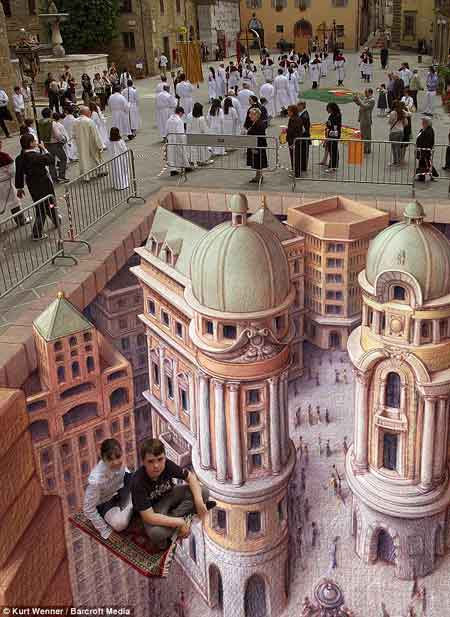
    Anamorphic art b
    Seeing this collection of dots in the construction of human faces I was reminded very strongly of the portraits made on the typewriter by Julius Nelson in his work, Artyping, published and sold for a dollar by the Artyping Bureau of Johnstown, Pennsylvania, in 1939 (and pictured first, above).  Nelson was an instructor in “secretarial science” in Windber High School in Pennsylvania and no doubt put together this pamphlet as something expressive of his artform and as an advertisement for his profession.  This was hardly the first time that anyone used the typewriter artistically, as I can recall some measure of artistic expression in type in Punch magazine as far back as 1869, though portraiture by typewriter does not appear to be a very wide section in the art world between those times. In any event, a portrait that he made here is rather close to those presented on the Modern Metropolis site–the “Dot Portraits”  Nathan Manire.

    Dot portraits

     Modern Art would have the final dispositional comment on the typewriter as an instrument of art, when Claes Oldenburg made his Soft Typewriter in 1963:
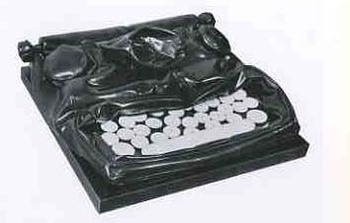
    Blogtypewriter_nwrriter_soft036_2 

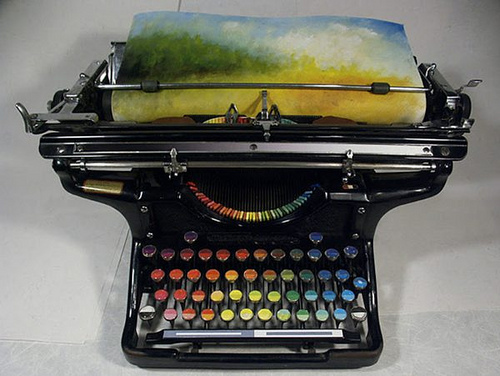
    And then, of course, the magnificent resurrection of the typewriter artform, replacing the spplication of black or red with something a little more complex:
    Typewriter chromatic
    [Source: the chromatic typewriter, by Tyree Callahan, found here  http://www.samanthahahn.com/blog/2012/01/16/chromatic-typewriter/]


  • Atomic- , Solar- and Vacuum-Powered Airport-Laden Dirigibles and Other Wide Ideas of Future Flight

    JF Ptak Science Books  

    Follow Me on Pinterest

    A post (“Nuclear Everything”) over at Dark Roasted Blend that featured a magnificent and stodgy atomic-powered zeppelin pushed me into this short visual note on differentially-powered airships, and then in general about airships with airports on them. (There’s a whole other category for planes-of-tomorrow that were so enormous that they had landing strips on their wings, but that’s another story.)

    And they remind me of things that just aren’t “right”, because these things just weren’t.  I’m not sure why, but I’m drawn into an old story about the legendary Charlie Goodnight, Texas pioneer, one of the creators of the idea of the cattle drive (the Goodnight-Loving Trail), a man who lived an extraordinary and powerful life.  He lived for a long time, too, from 1836 to 1929 (almost to the year of the birth of Larry McMurtry, who told a version of Goodnight’s story so spectacularly well in Lonesome Dove), well into a future so far advanced from the year of his birth that he could scarcely have imagined it.  Anyway, towards the end of his life, in 1916, Goodnight had the idea of making a movie of the Old West that included a “final” Indian buffalo hunt.  I’ve seen the film, and it is a fascinating, heartbreaking, wonderful/awful thing, that somehow might appeal to almost no one.  It certainly didn’t appeal to the folks at the time looking for a cowboy film, because much like Mr. McMurtry’s cowboys, Goodnight’s reality didn’t much resemble the cowboys that the public wanted to see.  In a sense Goodnight lived beyond the history that he so much helped to create, and that his old, passed “present” was something that the people in his future really didn’t want to recognize. Then of course one of the things that made it all seem “not right” to me was seeing a vignette of Goodnight entering into one of the scenes, in  a car, making the whole thing a little spooky.

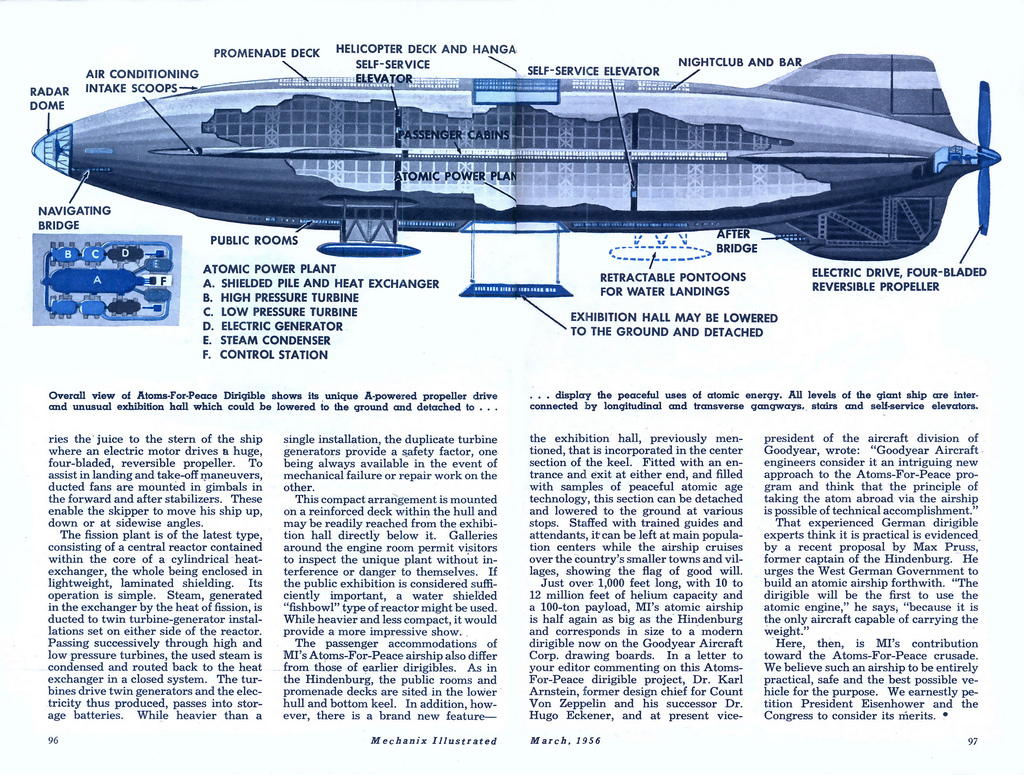
    First up is this mammoth flying advertisement to both peace and war, a nuke-powered dirigible proposed by Eisenhower in 1953 as part of the Atoms-for-Peace push, a move which by this point was already entirely too late.

    Atom everything zep for peace

    For some reason it was seen as a good idea to have a detachable convention hall built for the airship. \

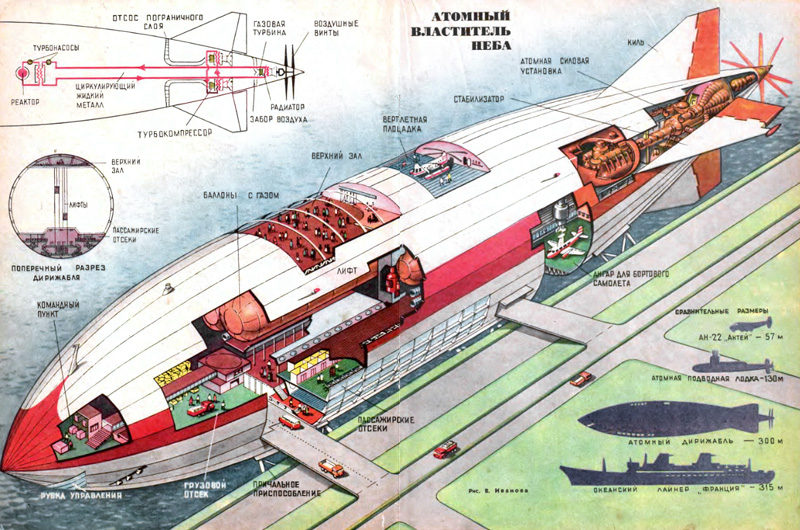
    And of course there is no greater element of a Something-for-Peace anything unless there was a competing idea, as seen in this mammoth Soviet atomic zeppelin, a ship completely absorbed in being bigger than the big thing that it already was:

    Atom everything zep

    At 300 metres this monster had room enough for virtually anything, though it didn’t have the retractable/detachable convention hall–it did however have a small airport. 

    Another dirigible approached the airport-on-board idea, but preferred solar power for its energy source.


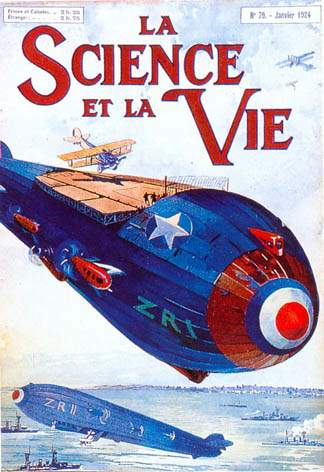
     The magnificent possible, 1924, saw another kind of airborn airport:

    https://historyofideasblog.com/a/6a00d83542d51e69e2012875ea3636970c-pi

    Guido Tallei’s 1932 Diri-Disk was a combination airplane/dirigible, and looked as though it could harbor an expansive airport on its NCC-1701-like wing, but didn’t, alas:

    Konstantin Eduardovich Tsiolkovsky (1857-1835), the Russian/Soviet space pioneer who was nearly without peer (and who somehow survived the bloodlust of Stalin which sucked up and murdered so many of his scientific colleagues),  stepped outside his spaceflight bubble to write about this monster with collapsing sheathing:

    https://historyofideasblog.com/a/6a00d83542d51e69e20128769ed30d970c-pi

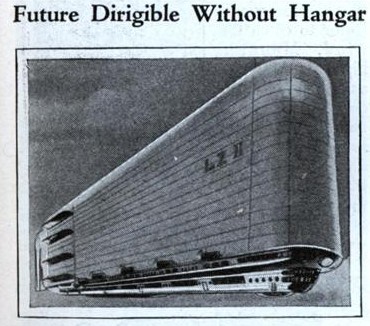
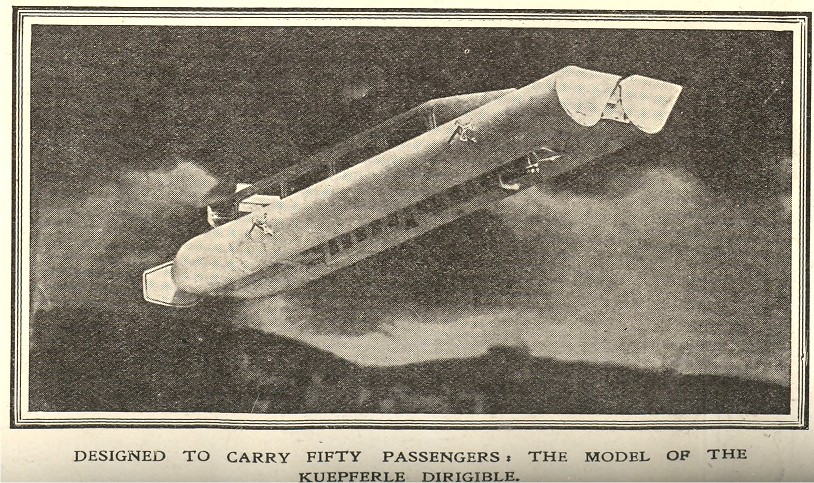
    The Kueperle dirigible, planned in 1909, was nothing if not pretty, and pretty is pretty much what the whole thing consisted of:

    https://historyofideasblog.com/a/6a00d83542d51e69e2012875ea2c87970c-pi

    And lastly, this example of the tracked airship–this must have been a popular notion because I’ve seen perhaps 15 different plans and I don’t spend much time at all reading in this area.  But harnessing the power of the balloon or dirigible or (kite!) whatever to a track system seemed to be a good idea, once upon a time:


  • The U.S. Civil War–Handy Alphabetical List of Battles

    Since we’re nearing the half-way point of the 150th anniversary of the war I thought to put together a handy list of battles–I think I’ve seen one elsewhere but really I cannot recall the locatiion, so I cobbled together a fast-and-simple alpha list to have on hand. 

    Alphabetical Listing of Major Civil War Campaigns, by Battle

    Allatoona Georgia October 5, 1864
    Amelia Springs Virginia April 5, 1865
    Antietam / Sharpsburg Maryland September 16-18, 1862
    Appomattox Station Virginia April 8, 1865
    Appomattox Court House Virginia April 9, 1865
    Aquia Creek Virginia May 29-June 1, 1861
    Arkansas Post / Fort Hindman Arkansas January 9-11, 1863
    Atlanta Georgia July 22, 1864
    Athens Alabama January 26, 1864
    Averasborough / Smiths Ferry / Black River North Carolina March 16, 1865
    Auburn / Catlett’s Station / St. Stephen’s Church Virginia October 13, 1863
    Auburn / Coffee Hill Virginia October 14, 1863

    ·Posted by :

    ·in:

  • Found Art in Oil Well Prospect Mapping, 1935

    JF Ptak Science Books  Quick Post 

    These diagrams of oil well surveys (printed ca. 1935) have a very fine found-art appeal to me–frankly, if hey existed apart from the printed text, I would not have known what they were or represented.  They do remind me quite a bit of labanotation.

    Ebay_sept_23_found_art661


  • Dr. Johnson’s Definition of Letters, A-Z

    JF Ptak Science Books   Quick Post  #426

    I hear Jeremy Brett–as the ultimate Sherlock Holmes–reading this in my head.

    The energy of Dr. Johnson must have been heroic–had to have been.  In addition to all of his other work, he sat down and wrote a dictionary–the first of its kind for the English language: A Dictionary of the English Language, which was printed in 1755.

    Samuel johnson2
    I’ve collected what he had to say about the letters of the alphabet, which is in itself a small and remarkable thing of sweep and brevity.  He sites the “labial” P, the “canine “R”, the unhappy hissing of S, the “note of aspiration” in H, and so on, in a forceful march to recording the language.  His book is a work of high beauty. 

    All of the material below comes from the JohnsonDictionaryOnline site, here.

    ~ A ~

    A, The first letter of the European alphabets, has, in the English language, three different sounds, which may be termed the broad, open, and slender.

    The broad sound resembling that of the German a is found, in many of our monosyllables, as all, wall, malt, falt; in which a is pronounced as au in cause, or aw in law. Many of these words were anciently written with au, as sault, waulk; which happens to be still retained in fault. This
    was probably the ancient sound of the Saxons, since it is almost uniformly preserved in the rustic pronunciation, and the Northern dialects, as maun for man, haund for hand.


  • BioPunk: Human Robots, 1900-1923

    JF Ptak Science Books  Quick Post #425

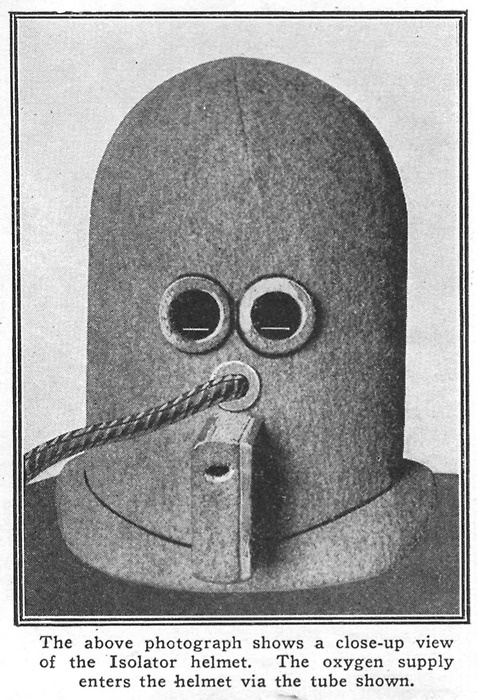
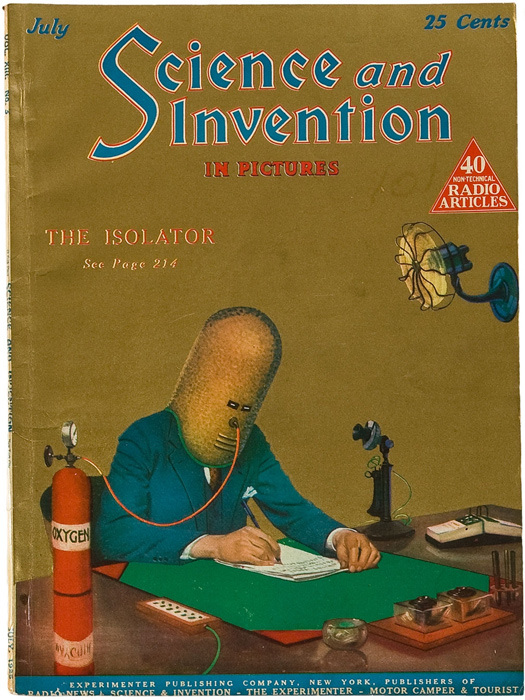
    I found this extraordinary image via collection of Finkiyaya on Pinterest, which is an interesting source for the unusual relating to the uncommon.  There is no attribution, but help came from correspondent Jeffrey Weston, who advised that the helmut belongs to none other than the ferociously active publisher/editor/thinker and creator of the term “science fiction”, Hugo Gernsback.  This was supposed to deliver a more powerful thinking and concentration experience to the user by delivering a flow of O2 , shutting off sound and auditory distraction, and by making the wearer focus their vision through a kind of horizontal pinhole slit. Gernsback I am sure did not use one of these things while working on his dozens of simultaneous projects, but he thought that it might help the rest of us–in today’s world, perhaps all we need to do to achieve this iolsation is turn off the electronics and sit at a clean desk.  In any event, the mask removed a fair amount of the human experience from thinking, and probably focused a LOT of attention on not-hearing and trying to see through those tiny slits. 

    Sub,arine helmet[Source: Pinterest account of Finkiyaya, here]

    [I wonder if Wilhelm Reich read about this as he was fiddling around with his “orgone accumulator” (read: “box”).   Even the crown prince of American Black Comedy, William Burroughs, could not wrestle this Reichian thing outside its impossible cellulosity of weird. As odd as Gernsback’s thing is, Reich’s goes on-beyond-zero with his, thinking that his siting-coffin collects/regulates an etherless ethery thing called orgone which was the seat of many and remarkable things, not the least of which was a controller of cancer and the weather.  It sounds sort of like a water-cycle thing but for a thing that influences thought and consciousness and biological systems as well as our ocean of air–that’s a long pull for a box with a chair in it.]

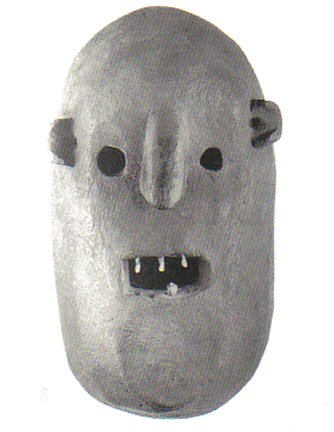
    Now three’s plenty in this helmet to suggest itself to the history of masks, but that is an enormous diversion, because I was really just looking for complements in the mechanical helmet world.  I could not resist though including this magnificent mask made by someone of the Sukuma ethnic group of Tanzania:

    Sukuma_mask_TAA

    It is interesting to note hwo the Isolator mask eprforms up to its name, isoalting human qualities to a high degree, muhc like the Sukuma mask.  There is a real encapsulating experience going on with these helmets and suits, looking far more robotic and alien than anything else. 

    And a last visit to Gernsback:

    BioPunk Isolator
    [Source: LaughingSquid, here.]

    And another (source here):

    Gernsback isolator

    How could any of this possibly go wrong?

  • A Map of the Human Ability to Replace Itself, 1610-1723

    JF Ptak Science Books   Post 2009

    Follow Me on Pinterest


    Blogmissing_man041_3

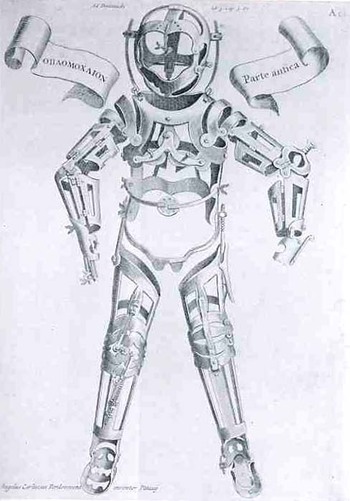
    This woodcut of applications and applicators to injured humans, lacking the human, waiting for the human, the missing human, was made by Hieronymous Fabrizzi (or Jerome Fabricius, 1537-1619), and found in his Opera Chirurgica, printed in 1723.  Even though this is a pretty straight-forward image, it strikes me as a little odd, a little off,  looking a bit like inhuman trappings, the entrapments of a human waiting to be built, an artificial skin with artificial bones.  It was much less than that, and in its way, much more—it was a statement of the advances of medicine in the 16th century, a map of the ability of man to replace himself; a map of the artificial man. Perhaps the image of our own artificial man, showing our ability to replace organs, bone, skin, limbs, etc.may come to look to the people of the near future the same way that we here in the present look back on Fabricius’ mage. 

    A Map of Getting Wounded

    Gersdorff_p21v_3

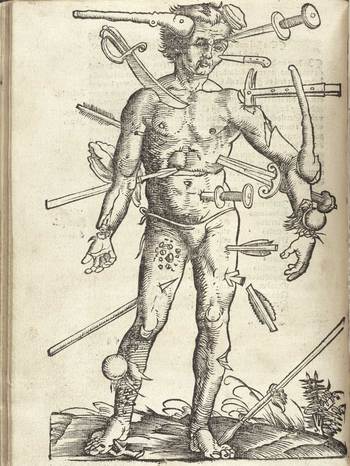
    This map of the wounded man was a very popular, much reproduced image, seeing publication in many works since it first appeared in Johannes de Ketham’s Fasciculus Medicinae,  printed in the year Columbus set sail for India.  It was a battle map, really—a battle for the human body, showing the effects of what happened to that body when someone tried to erase its existence.  The image is graphic, realistic and fairly gruesome, and highly useful.  It was accompanied by instructions on how to deal with all of the trauma, and to save the man thus that he could fight again.  In its way, this might be the earliest issue of M.A.S.H.  This woodcut, as the next, appeared in Hans von Gersdorff. Feldtbüch der Wundartzney (printed in Strassburg, by  H. Schotten, in 1528).

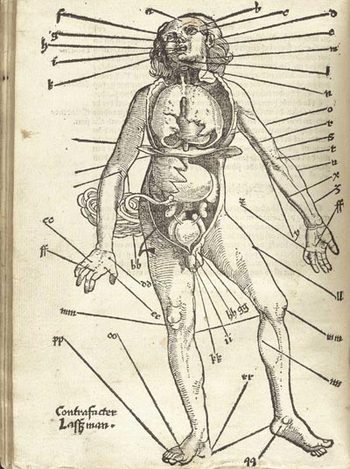
    A Map of Letting the Blood out of the Human Body.

    Gersdorffx400jpg_other_2

    Well, it really wasn’t like that, not how I mean by by snippy modernist viewpoint looking back on medical history with no contextual appreciation.  Bloodletting was an approach to healthfulness, as blood was seen as one of the four major elements (or “humours”) of the human body that needed to be kept in balance.  This was accomplished via the application of leeches or by the more common (and quicker) practice of venesection, or opening a vein to allow the blood to come out. (Let’s reference Steve Reich’s magnificent “Bruise Blood” creation of 1966 at this point—I don’t think that I’ll ever have a better chance to drop a reference to this piece of revolutionary music in regards to venesection again.)  Thus this map was map for the practiconers of bloodletting—the physicians, and more probably the barbers and other assistants who would inherit this lesser procedure from the more-busy doctors.  In the history of maps of anatomy and the general practice of mapping the human condition, this woodcut x-ray of the best places to drain human blood would not survive close to the age of modernity, disappearing almost entirely by the 18th century, and becoming much more scarce well before that.

  • A Found View of Brooklyn and Map of Green-Wood Cemetery, 1846

    JF Ptak Science Books   Quick Post 

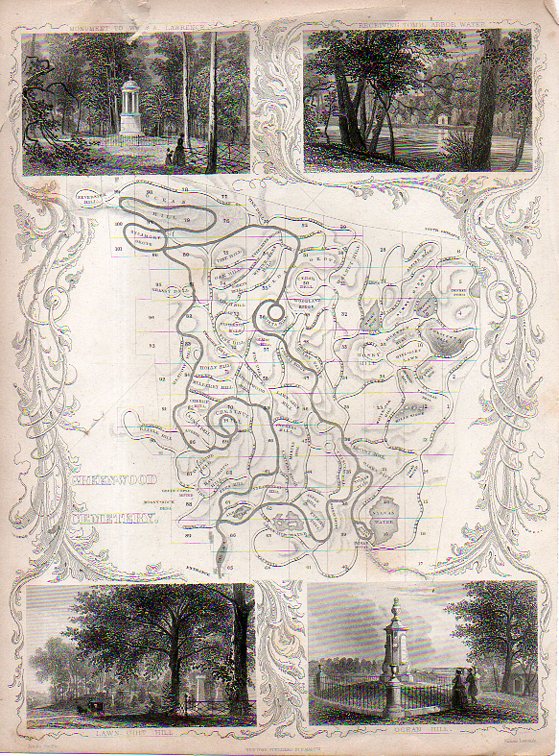
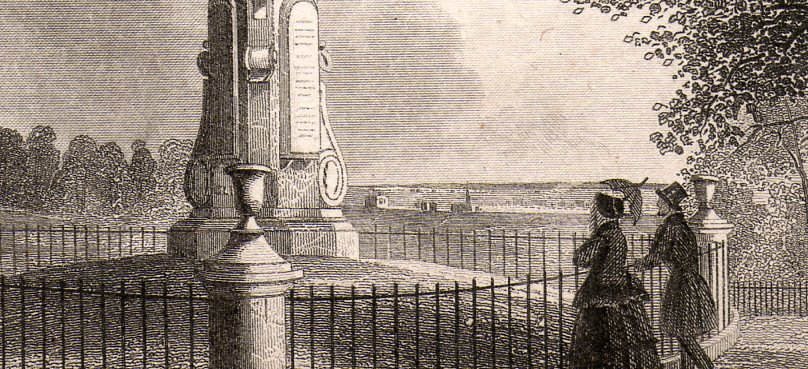
    Green-Wood223This interesting engraving shows a map of the relatively new Green-Wood Cemetery in Brooklyn, U.S.A. It was engraved by James Smillie (1807-1885) and published in 1846, 16 years after opening and addressing a need of the quick-growing burrough whose population grew from 47k in 1840 to 139k in 1850 to 279k in 1860. (Brooklyn would overtake Manhattan in population by 1930, with 2.5 million vs. 1.8 million for Manhattan. More population stats here.)  What interests me most is that small vignette at the bottom right, which shows a quiet scene at the rise in the cemetery called Ocean Hill–what it reveals in the background, though, is an uninterrupted view across Brooklyn and the Hudson River, and on into New Jersey.  Pastoral, Farmlands.  Its a found bit of history, a quiet, privileged view. 

    (The church in the engraving is about 2mm wide in the original.)

    Green-Wood224

    Green-Wood224

  • NarcoPunk: Using Narcotics for Sleep & Enema Treatment of the Insane, 1845

    JF Ptak Science Books   Post 2009

    Follow Me on Pinterest


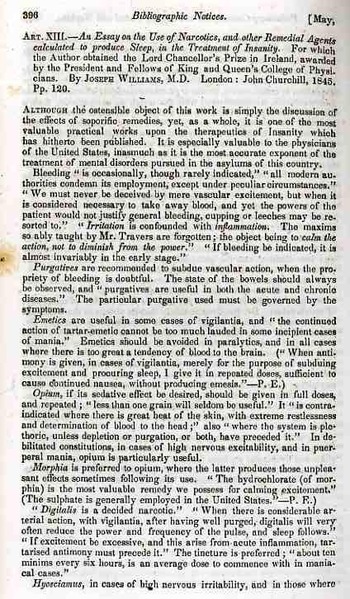
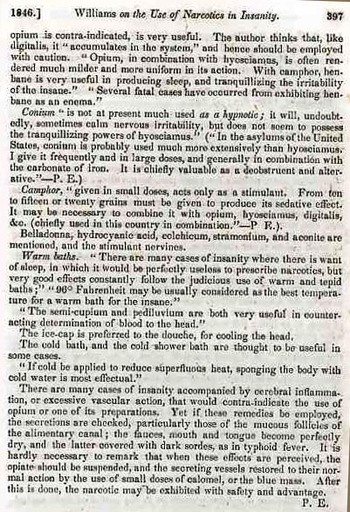
    This book review on the use of narcotics in treating the insane appeared in the New York Journal of Medicine for 1846.  The book, An Essay on the Use of Narcotics, and other remedial Agents calculated to produce Sleep in the Treatment of Insanity…., was by Joseph Williams, M.D., and was published in London in 1845.  The theory behind the sleep treatment was that the basic mechanism of insanity was “cerebral inflammation” or “excessive vascular action” in the brain—inducing deep sleep, evidently, was a good way to combat the over-active/inflammed/blooded-up brain.
    Blogdrugs_crazy254

    The article itself comes at an odd time in the history of the treatment of the insane.  It came almost 40 years after the establishment of  McLean Hospital (first known as the “Asylum for the Insane,” a division of the Massachusetts General Hospital), which opened on Oct. 1, 1818, and was the first hospital dedicated to the treatment of the insane in the U.S.  It came 70 years after the great advances of Benjamin Rush, who elevated the “Mental Patient” from chains on the floor to the status of medical or nervous illness or disease.  The use of narcotics over this period seems to have surged and waned.  In 1879, in an article in the New York Times, the reputation of the Asylum for the Insane on Ward’s Island in NYC was considered—and one of the high points was that it had (largely) discontinued the use of narcotics in treating the patients their. (There were still problems, of course, what with the asylum being overcrowded, housing 1100 in an institution meant to house 700, and where the chores and even nursing positions were staffed by the inmates, who were feed on 32 cents a day.)  As late as 1921, though, Jacob Alter Goldberg notes in his Social Aspects of the Treatment of the Insane, that there was a new, sharp increase in “toxic narcotic” treatments of the insane.  Of course, I guess one could replace “narcotic” with some sort of other misplaced treatment, like shock therapy, or Freudian mélanges, or something.  Each age must necessarily have their entry in the encyclopedia of embarrassments
    Blogdrugs_crazy255 . 

    In this article we find sleep assaulted by the use of the following:  purgatives (“to subdue vascular action when the propriety of bleeding is doubtful’), emetics, opium (to be used “in cases of high nervous excitability and in puerperal mania”), morphia (“the most valuable remedy for calming excitement”), hyosciamus (“to produce sleep, tranquilizing the irritability of the insane”).  It is weird to see that the last sentence in the description of hyosciamus reads “some fatal cases have occurred from exhibiting henbane as an enema”.  Henbane has been in use since ancient times, and is largely understood to be a dangerous/poisonous drug–to administer the thing as an enema leaves little doubt that it would kill people. 

    Still to come in the review is conium (“I have used it frequently and in large doses…it is chiefly valuable as a deobstruent and alternative”, followed by camphor, Belladonna, hydrocyanic acid, colchirum, stramonium aconite, and others.  “Warm baths’ makes an appearance (“90 degrees may be considered to be the best temperature for a warm bath for the insane”), as do cold baths, and the applications of ice caps. 

    I’m not so sure about what to make of it all, the sleep treatment of insanity I mean—after all, Joseph Lister only makes his epochal pronouncements on cleanliness in the operating theatre 15 or so years after this paper, which seems today to be the most rudimentary thing that one could do in treatment in the surgical room, so treating extra blood in the brain through drug-induced sleep doesn’t seem all that far away from the realm of possibility back there in early Victorian England.

    I don’t think I’ll forget the toxic narcotic enema any time soon, though.  Or the word “deobstruent”. 

    ·Posted by :

    ·in:

    —
  • Dance as the Godless Spasm More Dangerous than Hitler (1946)

    JF Ptak Science Books    Daily Dose from Dr. Odd

    Follow Me on Pinterest

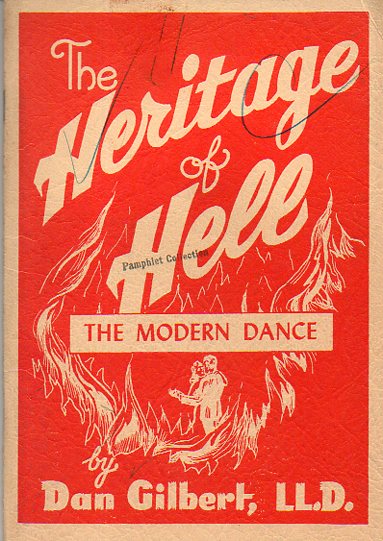
    Hitler was dead in 1946, but dance–the devil’s reach of hellfire and something worse than Hitler, according to the author of this pamphlet–wasn’t.

    Dance Hell222

    The author, Dan Gilbert LL.D., wrote a very _______ summation of modern dance, which was an assault on morals (well, Christian morals) and decency.  He does actually make the case that  dance music (jitterbug, swing, and jazz) was more dangerous than Hitler and was “Hitlerizing” American youth to its utter destruction.  “Jitterbug dens” preached a “faster jitterbuggery” (which was “conceived in the brothel to stimulate lust and vice”) which led youth into the Underworld.  The children of America were being lost to “razzy jazzy spasm bands” which would “strouse uncontrollable sex desire” and “infect youth with the disease of immorality” then to  “produce(s) a state of emotional and nervous derangement, which is scientifically indistinguishable from intoxication induced by stimulants or narcotics”. And on and on.

    These are just a few of the very choice morsels found in Gilbert’s 42-page diatribe, picked out by me rather quickly, plucked from the text with toothpicks–I just didn’t want to spend very much time with this book at all.  That said, I’m sure that there are tastier items than these, salted through a text of salt.

    I don’t know why Gilbert became this deeply interested in dance/death/Hell in the year following the end of WWII–after years of destruction, it seems hard for me to imagine to wake up, look out the window, and see the next assault on the U.S. coming in the form of dance.  He did carry on some about the “jitterbug insanity” of “improvisation”, and how dancers would abandon the appropriate and constrained methods of dance to simply move according to feeling and need.  This was the root of it all–happy feet. 

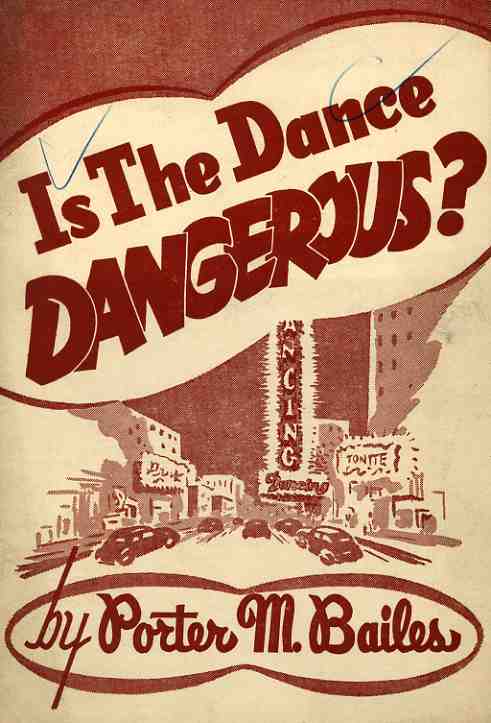
    An earlier post on this blog addressed a direct relative to this pamphlet:

    0 blog jan 20 dance danger391


  • Anti-Gravity & Anti-Aging Centrifuges, 1932

    JF Ptak Science Books  Quick Post

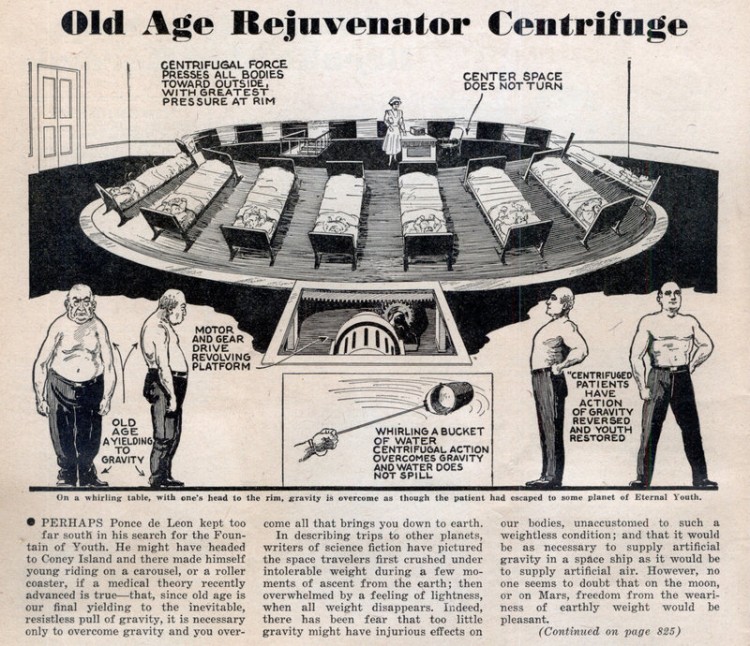
    Old-Age-Rejuvenator-Centrifuge-750x646

    [Source:  the great Modern Mechanix blog, here.]

    Q:  What could possibly go wrong with the idea of settling out mostly-imaginary biological issues than spinning? 

    A:  Well, its not so much as getting something wrong than it is getting nothing right.

    Such is the case with the spinning hyper-centrifugal anti-aging machine, found at the Modern Mechanix site.  Among bad ideas it isn’t so much “bad” as it is “hyper-bad”, though it is not quite so hyper-bad when compared to the mega-hyper-bad-so-bad-it-isn’t-even-bad-but-worse idea for the centrifugal birthing patent that appeared in this blog earlier (here, in the Electro-IronPunk Centrifugal Birth Machine post). 

     The centrifuge had been around for a long time prior to its estrangement and corruption in the anti-aging scheme. James Watt created one (in 1786) as a regulator in his fabulous 1781 parallelogram steering of his double-acting steam engine, and Oliver Evans employed one in his Philadelphia-based mill at about the same time. (Robert Hooke in 1674 had proposed a universal system of cosmic glue using a balanced approach between centrigical force and gravitation as the stuff that held the universe together, only to be bitterly disappointed by the publication of Newton’s Principia nine years later.) Like other bold and advanced ideas corrupted to popular Atomic-Motel misuse, the centrifuge was no exception.

    ·Posted by :

    ·in:

Recent Posts

Archives

Categories