A Daily History of Holes, Dots, Lines, Science, History, Math, Physics, Art, the Unintentional Absurd, Architecture, Maps, Data Visualization, Blank and Missing Things, and so on. |1.6 million words, 7500 images, 4.9 million hits| Press & appearances in The Times, Le Figaro, Mensa, The Economist, The Guardian, Discovery News, Slate, Le Monde, Sci American Blogs, Le Pont, and many other places… 5000+ total posts since 2008.

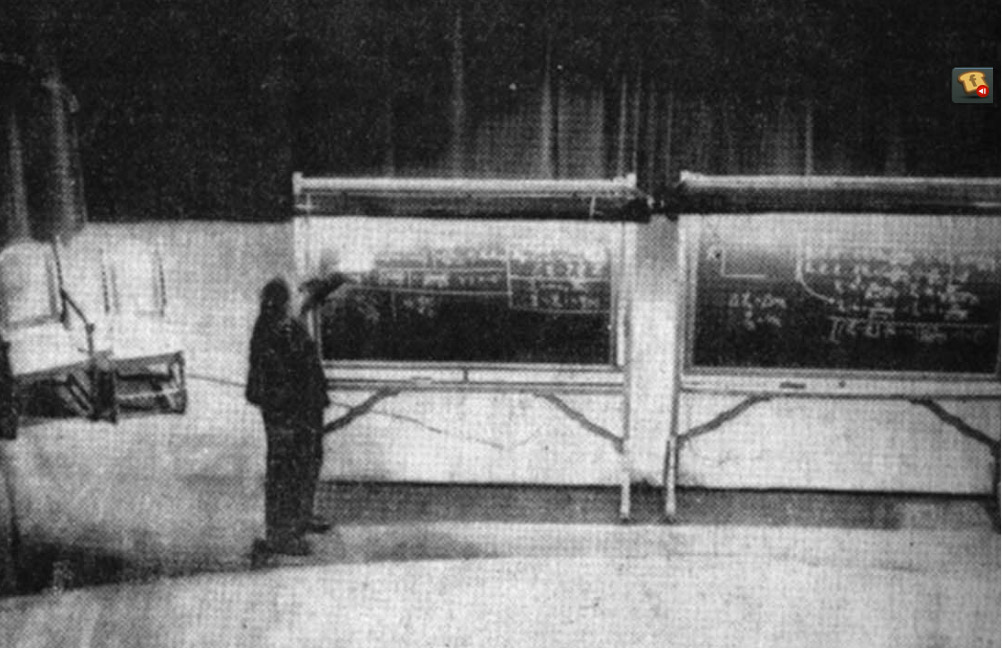
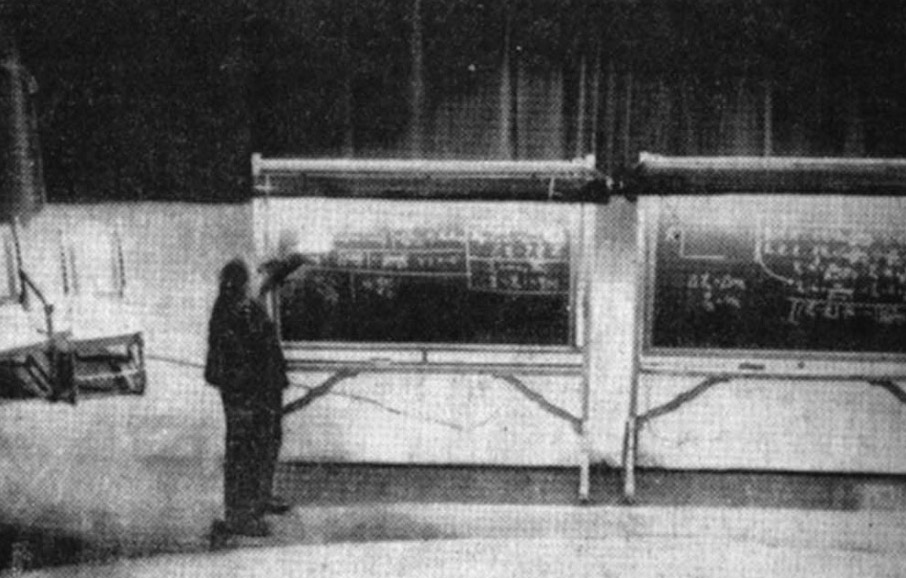
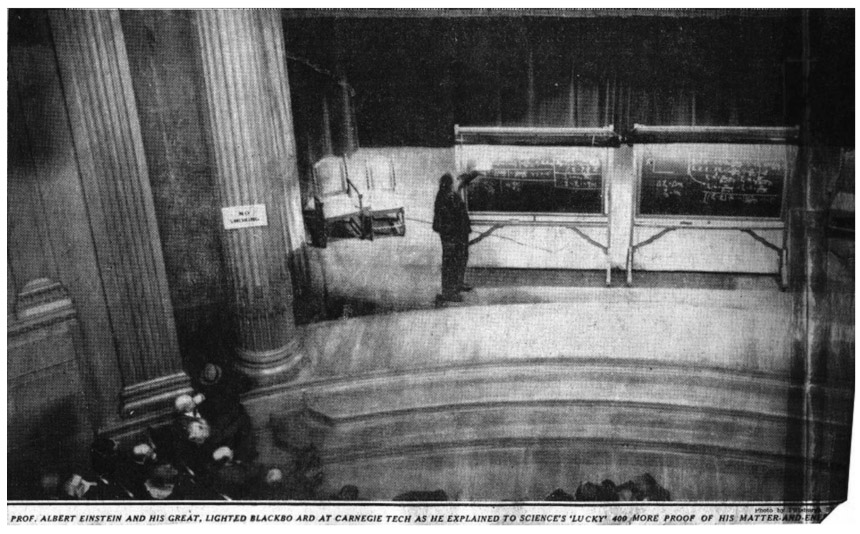
  • The Only Photograph of Einstein’s Derivation of the Mass-Energy Equivalence?

    JF Ptak Science Books  Quick Post

    Einstein e-mc2 detail_edited-1

    [The equation in question is at bottom-left; full explanation here.]

    I came across an article while researching a work by H.P. Robertson–Lectures on Relativity (Princeton 1935)–and it is much more interesting than what I was actually looking for.  It seems that in the history of Einstein working his famous E = mc2 on blackboards around the world that there are no surviving pictures of the man and the chalk and the equation. 

    In their article “Einstein’s 1934 Two-Blackboard Derivation of Energy-Mass Equivalence” (found in the American Journal of Physics, 75 (11), November 2007, pp 978-983) David Topper and Dwight Vincent of the University of Winnipeg sort it out and reproduce a not-sharp (but essential!) halftone newspaper file photo clipping showing Einstein doing just this, using two blackboards for the derivation of the equivalence of mass and energy during a public lecture in Pittsburgh in 1934. 

    Einstein e=mc2 larger
    In their short excellent article they do a fine job of discussing the history of these sorts of images as well as provide a nice description of what’s ont he blackboard.  I urge a reading of the full article found here. 

    ·Posted by :

    ·in:

  • A History of Antiquarian Water: Line Segments

    JF Ptak Science Books   Follow Me on PinterestPost 2022

    Images of rivers and oceans in 16th century maps can be beautifully-rendered objects.  Water can appear as lines thick and languid, curling and wavy, sparse, tentative, adventurous, willing, dashed, timid.  Cold. Mostly cold, and full of loneliness and foreboding.  And sometimes the sea is just a blank–it is more common to see blank skies in engravings and woodcuts before, say, the 1540’s, but the blankness is usually covered by rhumb lines and compass roses and lines of longitude and latitude, compared to the blankness of blank skies, where there is usually nothing to spare us from the blank.

    Today I’d like to have a look at the strong and long lines delineating activity in water as the first part of a short series of posts looking at the design of the representation of water by lines.  Then, when the lines are done, we’ll take a look at dots. 

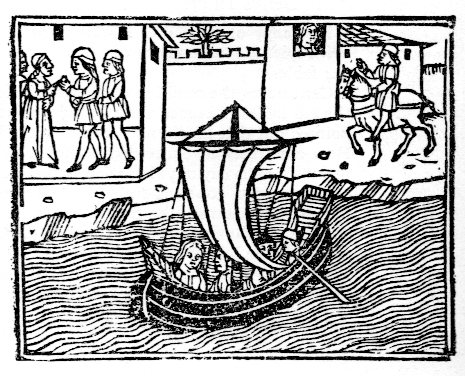
    This example occurs in Masuccio Salernitano’s (Tommaso Guadati, fl. c. 1476) Novellino, published in Venice by Bartholomeo Zanni in 1510, a tall book of a Decameron-ish flavor, with 50 stories told in five sections, mostly of a waning erotic nature.  The lines here are long and very languid. I also like the face in the window. 

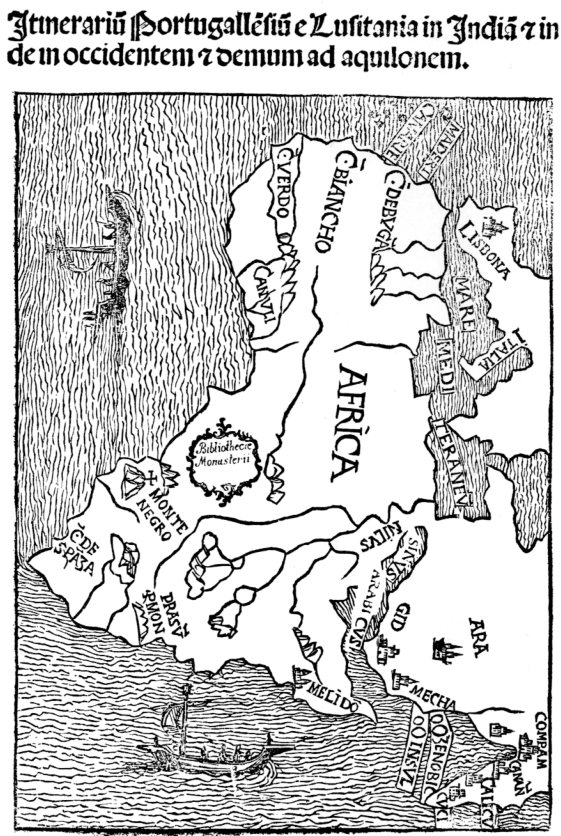
    Water masuccio267This complex of lines illustrates the map of Africa found in Montalboddo Fracan’s Itinerarium Portugallensium, which was about the earliest published collection of Spanish and Portugese travel and exploration relating to the New World.  The work was exceptional and very significant–and very popular, going through fifteen editions in 22 years to 1528. 
    Water africa266

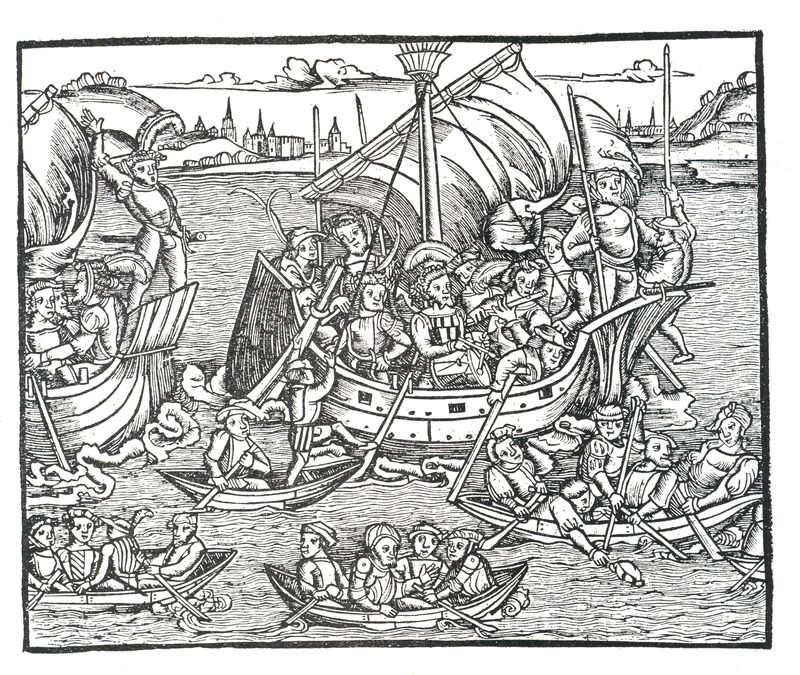
    Titus Livius (59 BCE-17 ACE), better known to the English-speaking world as Livy, was a superior among superiors of Roman historians, writing on the history of his city and country.  His work, Romische Historie…,published in Mainz by Johann Schoeffler 1450 years later in 1514, was one of the most beautifully illustrated books ever produced in that city. This is a considerable statement, as Mainz was the birthplace/hotbed of moveable type printing, being home to Johann Gutenberg and a number of other early presses. 

    Water Livy Punic

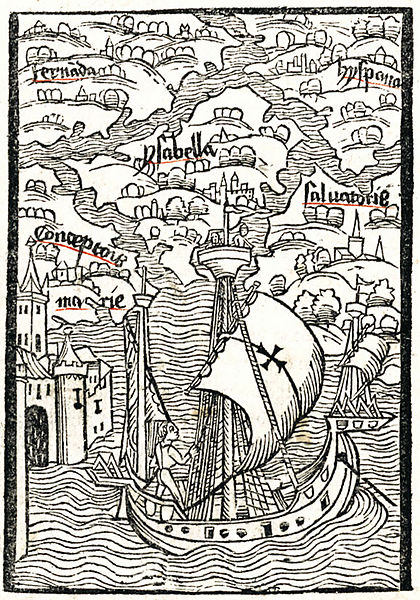
    One of the most famous printed water scenes is from the (numerous) editions of Christopher Columbus’ letter describing his voyage to the New World. It was written (or at least finished)  soon after his arrival in Lisbon 4 May 1493, almost exactly 520 years ago, and quickly found its way into print. This image (depicting Hispaniola and Isabella) was printed in Basel in 1494, and served to illustrate the somewhat hopeful and inflated description of what he found on his new voyage.

    Water Collbus Basel

    [Source: Wiki, here.]

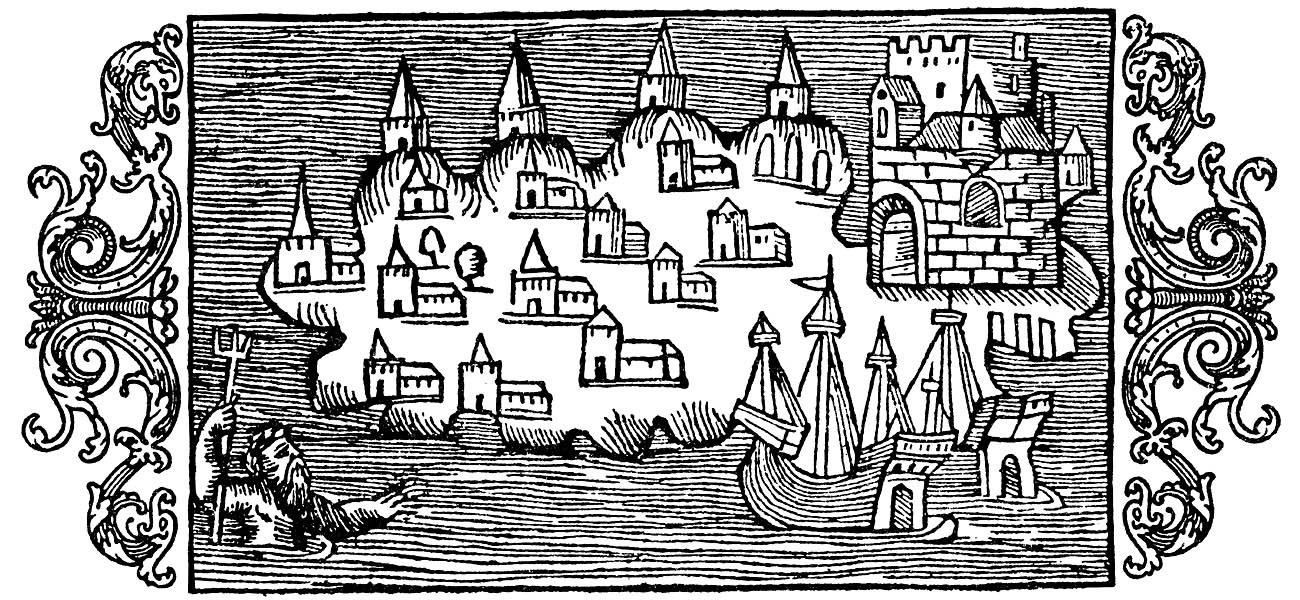
    This image from the mid-16th century is found in the fantastic work on the history of Scandanavia (and etc.) in Olaus Magnus’ Histotria di gentibus septentrionale (“History of the Northern Peoples”, 1555).

    Water Magnus[Image source: http://www.avrosys.nu/prints/index.htm]

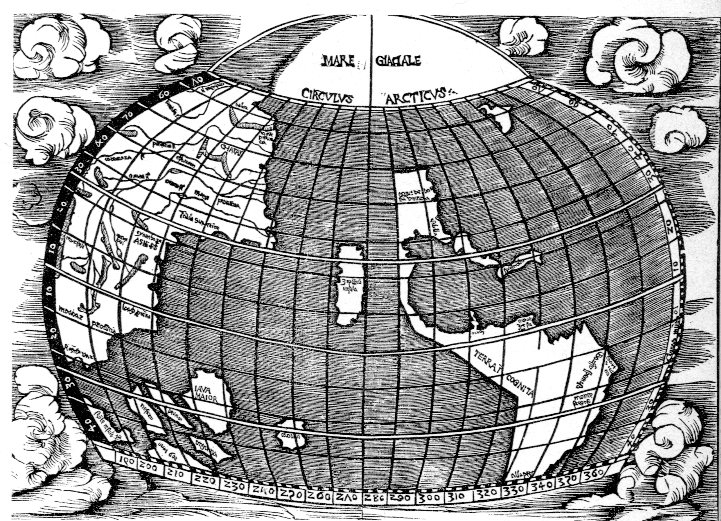
    The seas in the map of the Western Hemisphere in Joannes de Stobnicza’s Introductio in Ptholemei Cosmographium (Cracow, 1512, and widely believed to be copied or at least very heavily inspired by the Martin Waldseemueller’s 1507 map of the world) are very tightly drawn, neatly unifrom, and lovely, as wesee below).  This recitation could go on for quite some time, but this gets the point across on heavy lines.  Next stop: dots. 

    Water strob268

  • Selling U.S. Airpower with Hermann Goering

    JF Ptak Science Books  Quick Post

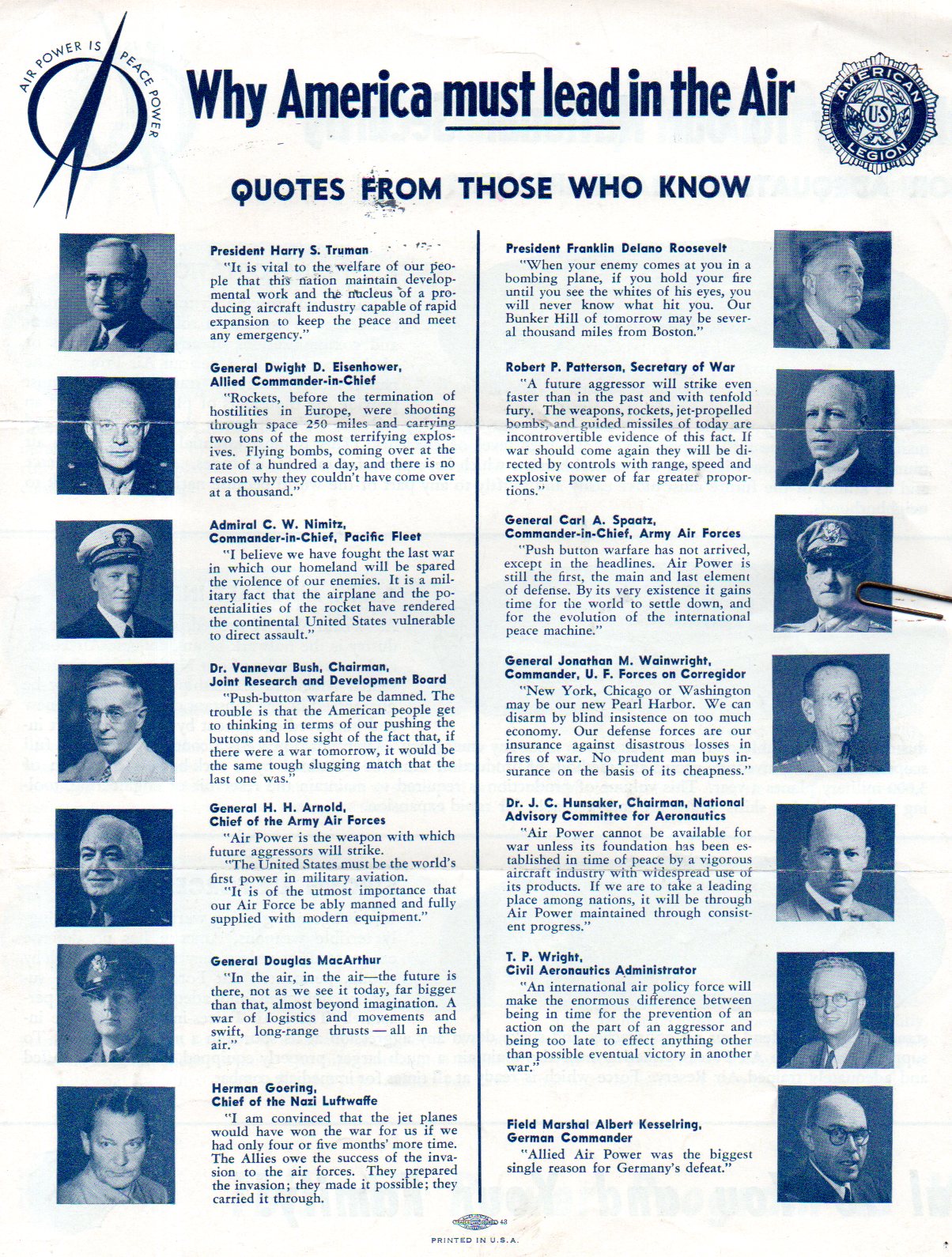
    I know it makes a certain amount of sense to try and sell an idea by using the words of your defeated enemy and how they were defeated by the very thing you’re trying to “sell”.  But, still: at the bottom of the list (The American Legion Program on Adequate Air Power for National Security, 1947) of pictures and opinions of Truman, Eisenhower, Nimitz, Bush, Arnold, and MacArthur, comes Goering.  The soft, badly-placed, I-helped-to-kill-my-air-force Hermann Goering.  It just doesn’t look right–particularly since this is the portrait of him as a skinny Goering, the Goering waiting to be executed, the Goering who lost all of that weight at Nuremberg while on trial before he swallowed a pill and killed himself.  On the other side, in the opposite column, is Roosevelt, Patterson, Spaatz, Wainwright, Hansaker, and Wright–president, secretary of state, commander-in-chief of the USAAF, commander of U.S. forces at Corrigador, chairman of NACA–and then Field Marshall (Generalfeldmarschalls) Albert Kesselring. Kesselring was a major leader, was highly respected, and very successful,  and also sentenced to death at Nuremberg for war crimes (though his sentence was commuted which found him relseased in 1952). 

    This was a good and necessary argument–using Goering and Kesselring, well, was not such a good idea, or at least using their portraits in a line of American heroes to make the point was not a good move.

    Airforce270

  • TV’s Quest for Illuminated Poetry and a Dirac Non-Equation, 1946

    JF Ptak Science Books    Post 2024

    ‘I don’t see how you can work on physics and write poetry at the same time. In science, you want to say something nobody knew before, in words everyone can understand. In poetry, you are bound to say something that everybody knows already, in words that nobody can understand.’–Paul Dirac (1902-1984, Nobel Prize in Physics for 1933 with Erwin Schrödinger, “for the discovery of new productive forms of atomic theory”), quoted in The Book of Universes by John Barrow.

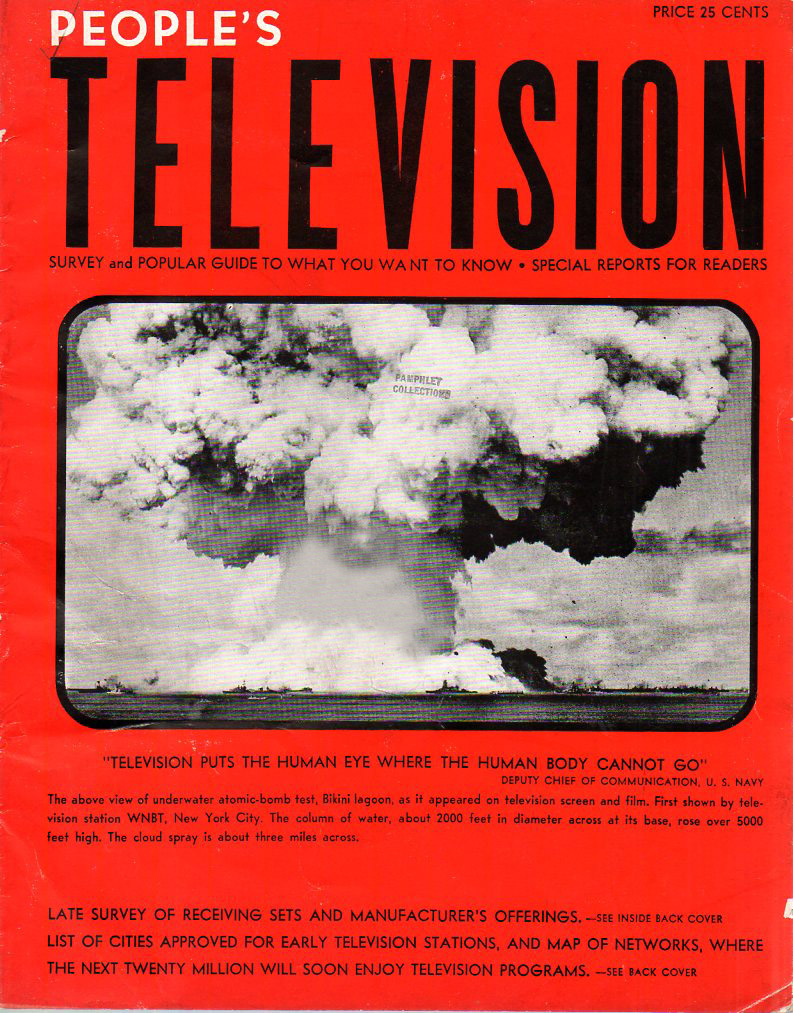
    Television abomb278

    The opening sentence of this pamphlet breathes a lead: “The story of Television, as well as the smashing of the atom, must be explained in a non-technical manner, now that World War II has ended, so that the public may know the facts…”

    I think that I would have preferred this quote to end a little sooner than it does–that way it might have been a little more poetical, a little on the absurd side:

    the story of Television as well

    asd smashing the atom

    must be explained

    in a non-technical manner,

    now that World War II has ended.

    This short pamphlet was produced in 1946, and at the time it was still possible to believe in the great possible poetry that the new medium could produce.  And it certainly did produce something, even in these early days, though I do not think it was poetry.  It did deliver some measure of truth and accountability, though.  It is difficult to imagine seeing the image of one of the earliest post-war atomic tests delivered to the DuMont Teleset in your living room.  I imagine that the societal reaction to seeing these events broadcast may have been like when photography was brought to bear in the news reporting business.  Harper’s Weekly started to run woodcuts of Civil War battles with the imprimatur “from a photograph” rather than something like “drawn at the scene by our correspondent”, readers were immeasurably more responsive to the drawing after a photography because of the undeniable archivitization that goes on when a photograph is made, as the memory of a photograph is for the most part unimpeachable.  This delivered an instantaneous increase in the belief in the reporting.

    It seems as though seeing events such as an atomic explosion from a cozy home encapsulation may have had the same effect. It was a democratization of truth in a way (the title being People’s Television) similar to that which you could experience seeing newsreels in the movie houses–there, everyone paid the same fee, sat where they wanted (for white people, anyway), and were exposed to the same images at the same time. 

    Its character leaned and leaped further away from reality and truth with each passing moment, finally reaching a point in the early part of national broadcasting where reality and entertainment and commercials all blended into one socio-molding opinion-grinding unit.

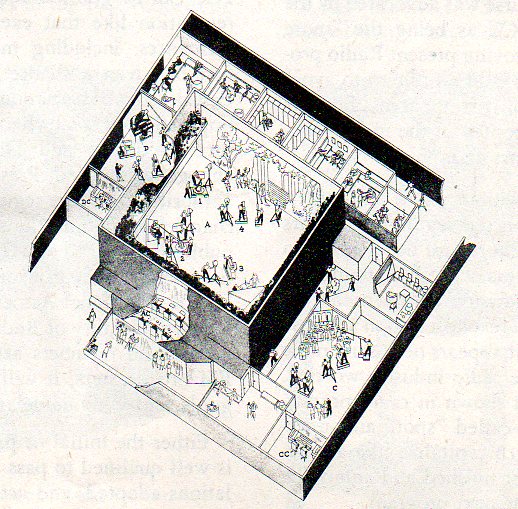
    The dreammaking units responsible for creating the bigness of artificial life were quite modest in 1946, as we can see in the pamphlet’s  wonderful plan of a television studio:


    Television abomb279

    With the description:

    Television abomb280

    The next seven years would toss this pamphlet into the Obsoleteinator; 13 years more would make it seem as though this pamphlet never needed to exist.  The poetry part certainly seems to have disappeared somewhere in these years–not completely and entirely to make poetry in television extinct, but certainly enough to make it an endangered sub-species. 

    ‘Imaginary universes are so much more beautiful than the stupidly constructed ‘real’ one’–G.H. Hardy

  • A Work of High Beauty–an Architecture of Thought, 1944

    JF Ptak Science Books   Quick Post  Follow Me on Pinterest

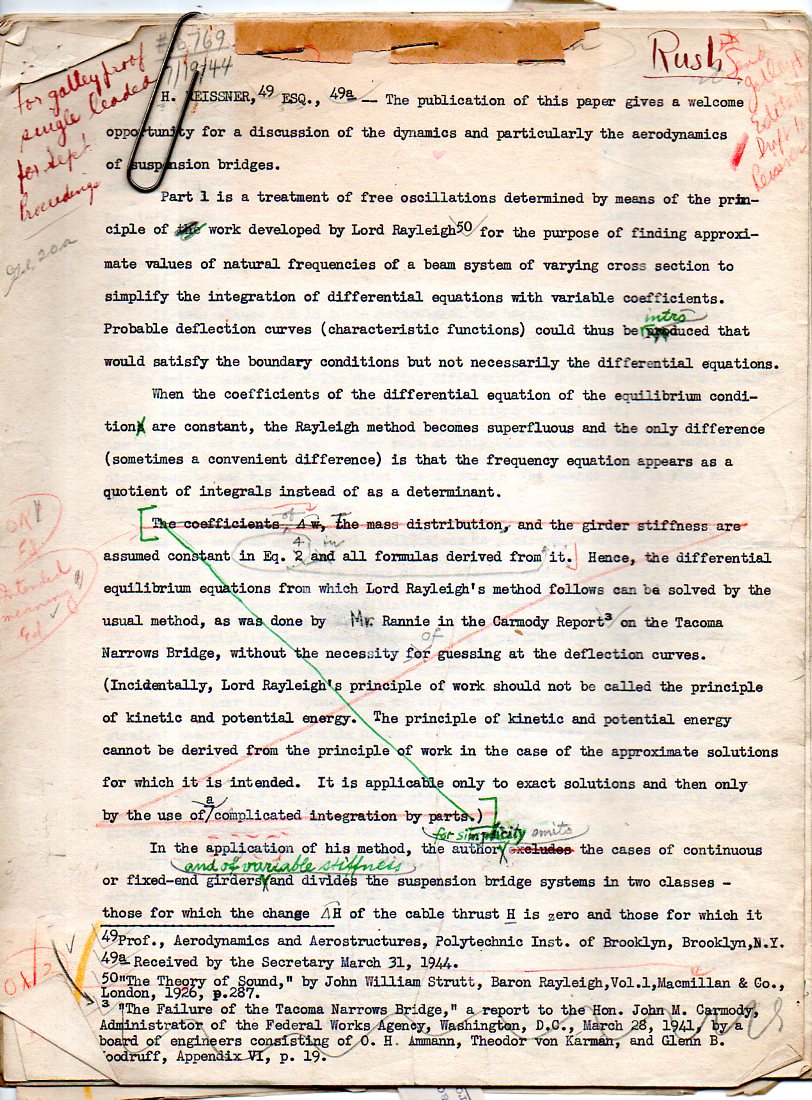
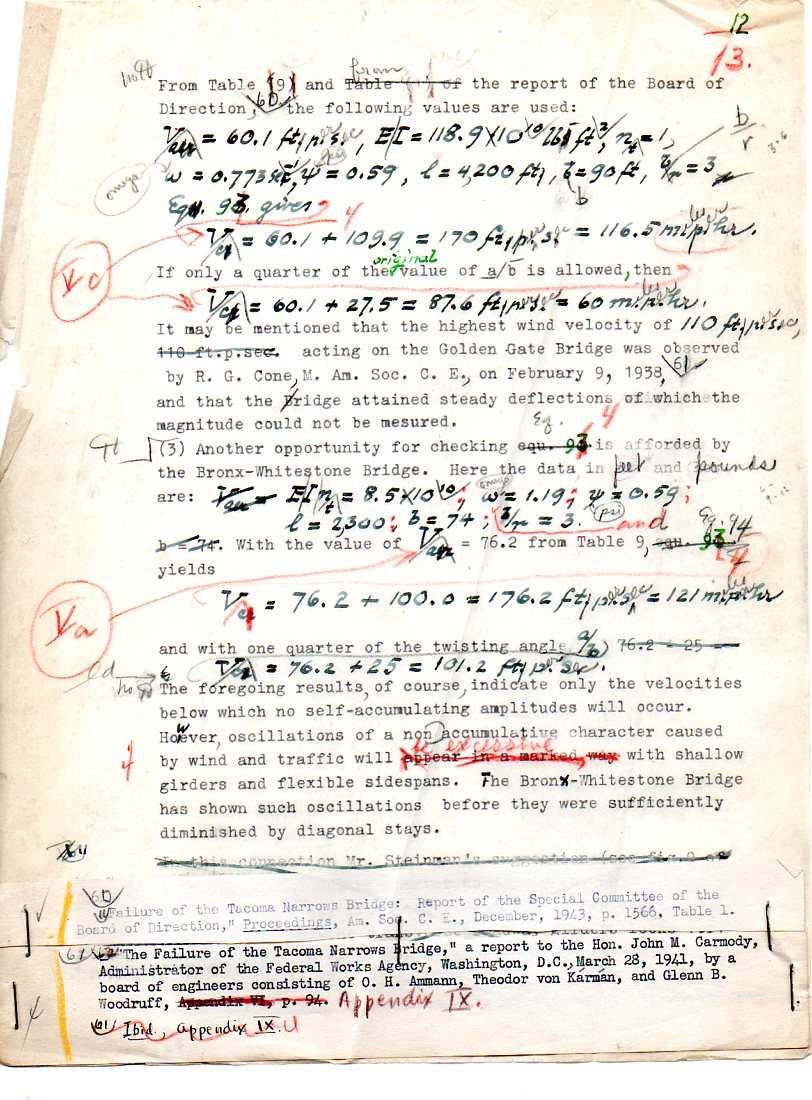
    I don’t often have a chance to purchase manuscripts by significant scientists in their edited state, back from the journal to which they were being submitted.  This is the case with the material below, a paper written by Dr. Hans J. Reissner in 1944. It is a remarkable thing to look at, a precise and elegant archaeology of thinking, a sort of synesthesic display of thinking on different levels.  It is a beautiful thing:

    Reissner draft271
    [Hans J. Reissner (1874-1967) was a leading German pioneer in aeronautics and aeronautical engineering and mathematical physics. He was appointed to the chair vacated by Arnold Sommerfeld at the Technische Hochschul at Aachen, where he established the aerodynamics laboratory and designed the great experimental wind tunnel at Aachen where he was the second director (after T. von Karman). He went on to the University of Berlin where he remained until 1938, when he left Germany for the United States. Reissner held a chair at the Illinois Institute of Technology and in 1944 joined the faculty at Brooklyn Polytechnic Institute.  Van Karman spoke very highly of Reissner and attributed his work in aerodynamics to be as important as those advances made by Prandtl (see von Karman’s Wind and Beyond). Reissner was also celebrated with two anniversary volumes of Applied MAthematiics for his 60th and 75th birthdays (in 1934 and 1949).]
    Reissner draftb277

    ·Posted by :

    ·in:

  • Propaganda Maps: the Big Lie and the Surrounding Threat to Germany, 1927

    JF Ptak Science Books  

    Bloggermany_surrounded328

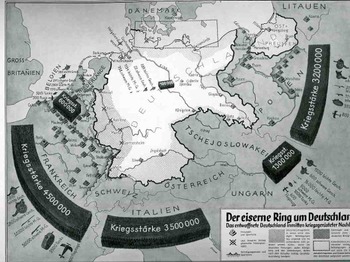
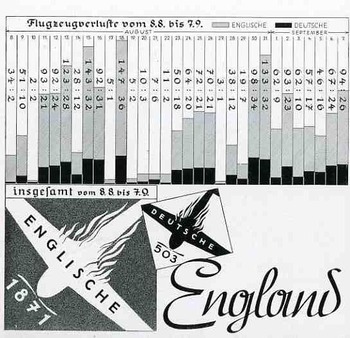
    These two displays come at different ends of the beginning of WWII and, in a way, couldn’t be further away from themselves in the stories they were trying to tell(some truth, some fiction), and were separated in time by  11 years or so.   The first “Der eiserne Ring um Deutschland” (“The Iron Ring and Germany”) shows Germany surrounded by imaginarily aggressive (and aggressively-portrayed) neighbors nine years after the end of WWI.  They both display subsets of the Big Lie superset described by Hitler in 1925 in Mein Kampf (actually, sort of better described by the German term Lügenfabrik, or “lie factory”, used by Goebbels in his descriptions of the British.  The “Big Lie” was basically a lie so big and so preposterous, so outrageous, so impossible, that no one would possibly utter something so insane and dubious, and so therefore the massive untruth is taken as true.) 

    This representation depicts the threat posed to Germany-making an iron ring-by the potentially hostile French, Italians, Belgians, Czechs and  Poles.  It shows the ring composed of a combined army of 13.1 million men versus the standing army of Germany, which in 1928 was given as 100,000, and listing virtually no heavy weapons and no air force whatsoever.. (The interesting bit here is that neither the Soviet Union nor Great Britain is included in these aggressive forces, the Soviets less-so than the English.)   The designer goes so far as to shade in areas of Germany that were under immediate threat, extending from the Donau to the Rhine, to a 50-mile-wide area all around the country, with East Prussia almost entirely consumed.  (Certainly the Treaty of Versailles was a very troubling document closing the end of the war and, it cam be argued, opening the door for the next one.  It took six months to sign the peace treaty following the cessation of hostilities in November 1918, and the troubled negotiations produced a troubled treaty, ripping Germany up and saddling it with unrealistic retributions that began to wither in only four years, with the treaty virtually dissolved by 1935.)

    Blognazi_brit_aircraft325

    It is no wonder when looking at propaganda such as this that Germany was immured with fear of national collapse at the hands of land-hungry neighbors, and that there was a huge need to re-instate the army and a system of “self protection”.    (By 1936, only 8 years later, it was beyond question about what Germany was up to-I can say that after having at least breezed through every page of the Illustrirte Zeitung (Leipzig)  from 1930-1940, that even a very casual reader could’ve tracked, graphically, the interest in military reporting and militarism in the page’s of what would’ve been the German equivalent of LIFE magazine.  By 1935 there was so much glorification of weapons and the Nazi manifesto that it should’ve been a surprise to no one when the Germans moved into their neighboring countries.)  This was by no means the earliest depiction of this rampant sale of fear or fear mongering (a design which has existed for thousands of years and not at all a creation of the present republican administration), but it is a very big and bald one, a somewhat staggering one, a bright shining lie.  (A Bright Shining Lie by John Paul Vann is by the way a great book on American involvement in Vietnam.) 

    The second image, a graph showing the successes of and very limited damage to the German Luftwaffe at the beginning stages of WWII, in August 1940.  This was a bad time for the Allies, this part of the war coined by Winston Churchill in 18 June 1940 in the House of Commons:  “The Battle of France is over. I expect the Battle of Britain is about to begin”. 

    Hitler’s Luftschlacht um England would start by air, where the Brits were far less the equal in military capacity, rather than by a land/sea assault, which would’ve tested the British at their strengths.  This second part of the assault on England was Unternehmen Seelöwe, or “Operation Sea Lion”, which would’ve begun the land assault following the victorious air campaign. 
    The graph shows aircraft losses from 9 July to 8 August, 1940, the German losses in black, and the British in gray.  As you can see, it was a pretty lopsided affair, made even more dramatic by the fictitious number of English planes being destroyed.

    This would all change, of course, with the Germans losing this battle, in a big way, with a resulting decisive victory for the Brits. (Who would of course muscle their way through the war another seven months before the U.S. was attacked and entered the war.) . It would coming to a screeching and collapsing reverse for the Germans by May 1941.  The results of the battle, in terms of aircraft and humans, were,  for England: 1,023 fighters: 376 bombers, 148 coastal command aircraft  for a total of 1,547 aircraft and  544 pilots and aircrew killed.  There were also 27,450 civilians killed and 32,138 wounded.  The Germans lost 873 fighters and 1,014
    bombers for a total of 1,887 aircraft and  2,500 pilots

    I could find no graph of course showing the results of the endgame in the Zeitung.

  • Helping Hitler, 1938

    JF Ptak Science Books  Post 2024

    There are many unhappy episodes during WWII of small groups from the Allied countries which gave comfort and solace and economic and physical support to the Nazis.  The economic aspect gets very complex and pretty deep here in the U.S., with major companies lending assistance even in violation of the Trading with the Enemies Act into 1943, and of course there was the German-American Bund which was relatively full-throated until America got into the war on 8 December 1941, and so on.  There were also occupation Nazi-fueled governments like Vichy, but what I’m interested in for this post are the volunteers who materially contributed to the Nazi war effort, with time, and effort and fighting in uniform. The hard figures for the volunteers and conscripts who fought wth the Waffen-SS during the war totaled some 350,000 men1.–and considering what was happening to the German army post-Barbarossa, that was not an insignificant figure.
     
    British Legion283

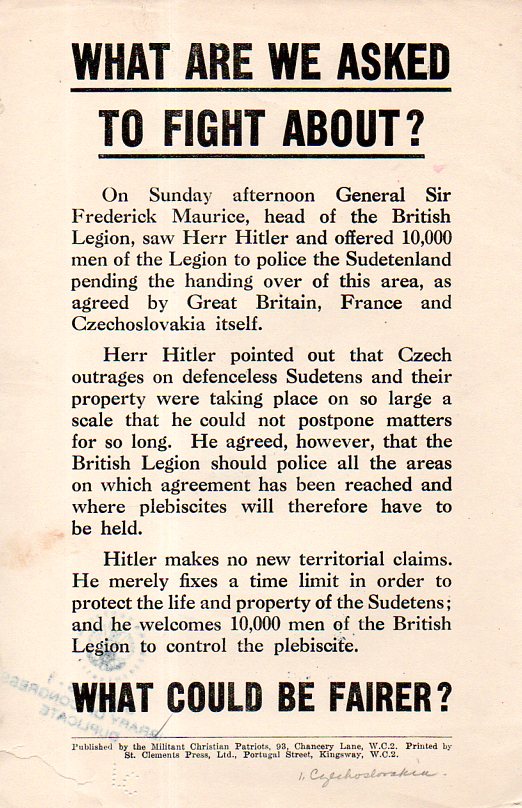
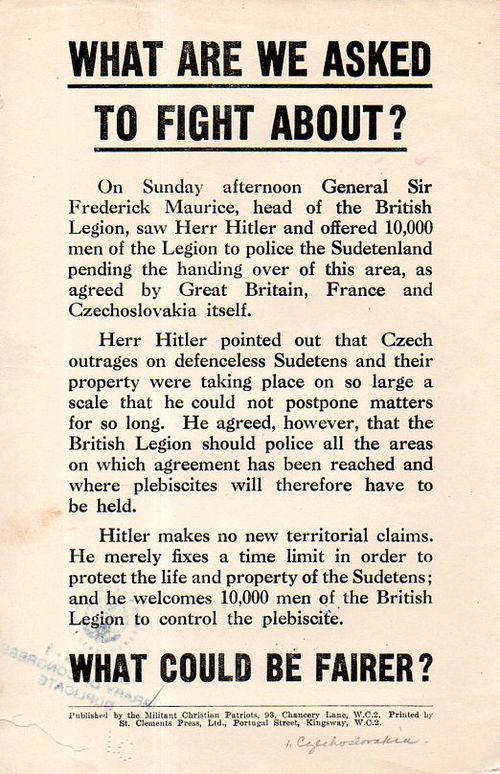
     General Sir Frederick Maurice (1871-1951) , one of the subjects of the leaflet,  had a very long and sine-curve military career, and was an academic of some achievement–he was also along in there was head and founder of the British Legion.  And it was in this capacity and under his auspices that the British Legion offered 10,000 men to help Adolf Hitler and secure a modest success in the transition of control of that country.

    What an enormously disappointing handbill this was to read, coming from the press of a militant right-wing and racist organization in support of Hitler and the Nazis in their swallowing-alive of a living Czechoslovakia. The Militant Christian Patriots2 were the publishers of this handbill–this was a group were formed as part of an earlier organization called The Britons (founded in 1919), both of which were viciously anti-Semitic and severely racist, and were on board with most of the programs of the NSDAP.  (The publishing arm of the Britons, the Britons Publishing Company, for example published 85 editions of the vicious and ridiculous Protocols of the Elders of Zion.) They supported Neville Chamberlain and were happy to keep the U.K. out of any confrontation with Germany.   As we see in this handout, they were eager and able to support Hitler’s invasion and destruction of Czechoslovakia by providing a British volunteer force of more than 1,000 to aid in the Nazi take-over by policing the supposedly audacious and Seudeten-German pillaging Czechs. 

    The story of the Nazis in Czechoslovakia is a complex story, riddled with nothing by treachery-lust on the part of the Nazis, and of course ending very badly for the Czechs, the Germans living out a series of aspects of the Big Lie until it was all over.  The British Legion chose to believe what they needed to believe in order to sustain their own nationalist beliefs. 

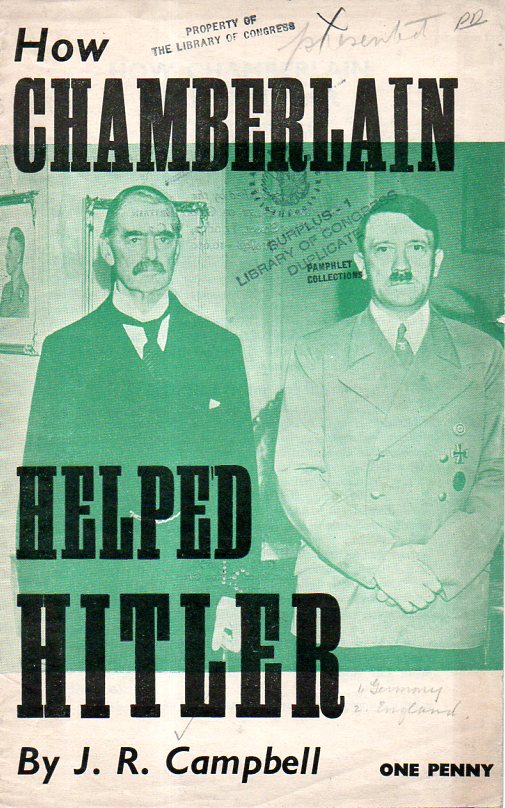
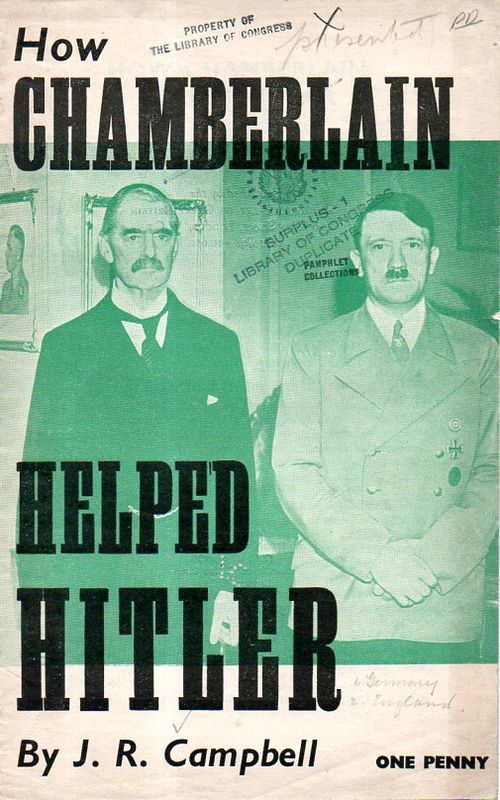
    There were many who found Chamberlain simply wrong in his negotiation with Hitler and where he was guiding the country, not the least of whom was the Communist Party via J.R. Campbell, who expressed a general outrage in this pamphlet (published October 10, 1938), the cover telling the story: 
    Chamberlain284

    Notes:

    1. These included volunteers and conscripts from Albania, 9000; Armenia, 2000; Belgium, 27,000; British Commonwealth,  never more than 100 in the British Free Corps; Bulgaria, 700;  Croatia, 20,000; Denmark: 8,000; Finland, 1,500; France, 9,000; Georgia, 2,000 to 3,000; Hungary: 40,000; India, 3,500; Italy, 15,000; Latvia: 60,000; Netherlands: 25,000; North Caucasus, 1,000 to 2,000; Norway, 6,000; Russian (& Belarusian): 15,000, Russian (Cossack) 20,000, Russian (Turcic),10,000; Romania, 6,000; Serbia, 8,000; Spain: 3,000 in Spanische-Freiwilligen-Kompanie der SS 101 and SS 102; Sweden, 300-500; Switzerland, 800; Ukraine: 20,000.

    2. There’s another example of this publisher described in this blog, here:   https://historyofideasblog.com/thesciencebookstore/2011/01/blank-empty-things-series-the-militant-christian-patriots-hitler-and-saving-britain-from-itself-1938.html
  • War Gas Paper Calculator, 1942

    JF Ptak Science Books   Quick Post

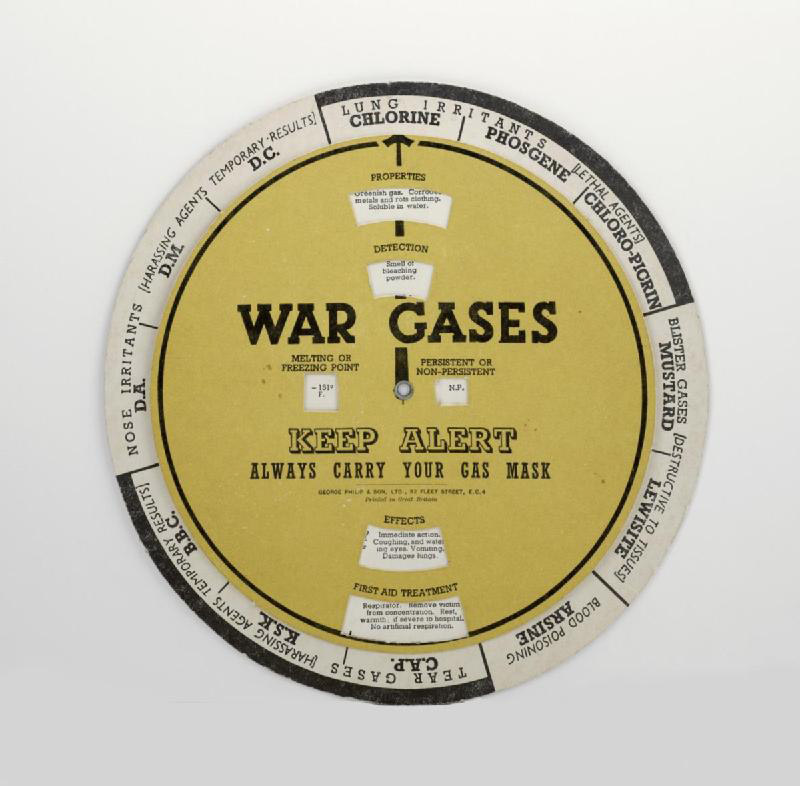
    I found this very interesting paper calculating device (ca. 1940) on the Imperial War Museum site (here):

    War Gases
    I came to the IWM site via the St. Marylebone WWII site and the section on Air Raid Protection because of unearthing this elegant sticker in one of my pamhlets:

    Marylebone285

  • The Bomb God, 1946

    JF Ptak Science Books   Quick Post

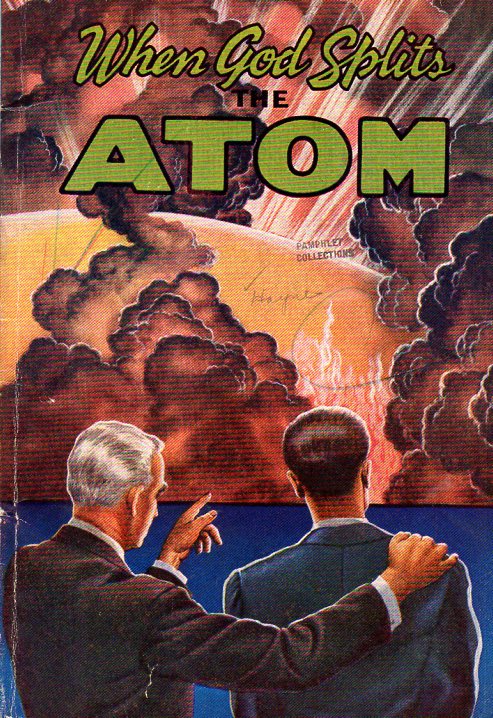
    This wonderful, semi-impossible sulphur-laden pamphlet emerged from the bottom of one of the “Naive Surreal” boxes today in the warehouse:

      God Atom287When God Splits the Atom (1956) offers a not-so-friendly piece of advice:  “its later than you think”.  We are told that God delivered the atom and the atomic bomb and the end of the war and the beginning of the United Nations.  None of that will save us from the burning ring of fire, and the U.N. will fail, and so on, down to the firey pit if there is no repentence and acceptance of the higher power.  The cover pretty much tells the entire story. 

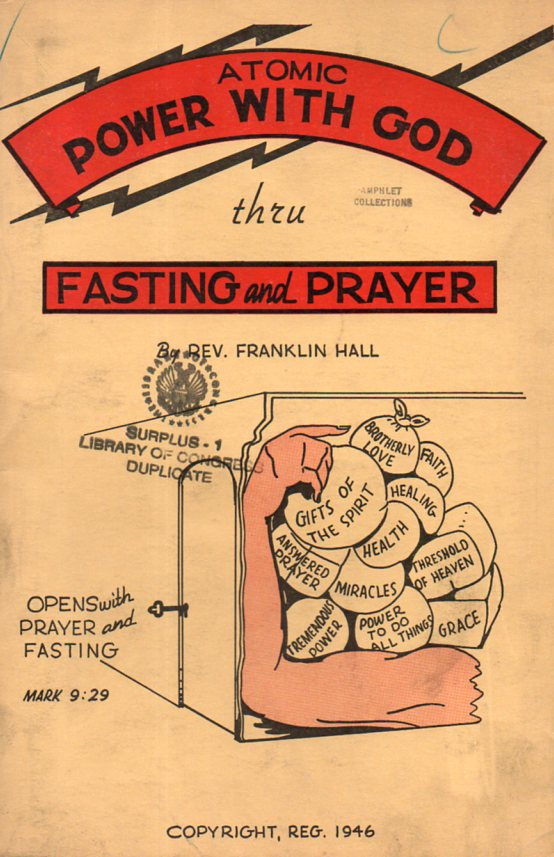
     There are a few other God-and-athe-atomic-bomb posts on this blog, like, well, this one:

    Atomic power with god628(Found here.)

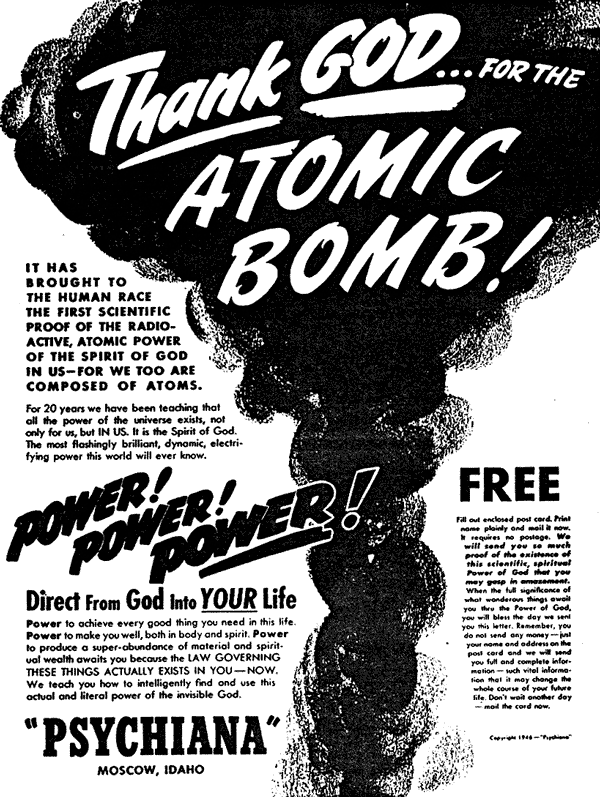
    And this one (from Miss Atomic Bomb: the A-Bomb in Popular Culture–Comics, Cakes and the Will of God):

    Atomic bomb thankgod

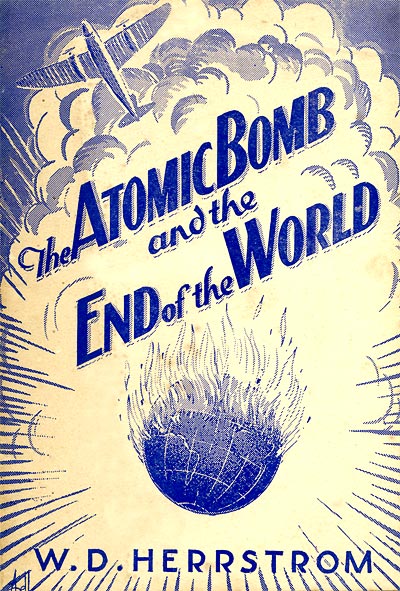
    And of course on the other end of this:

    Atomic_bomb_end_of_world

    And that’s pretty much that.

    The idea and imagery of the atomic bomb was instantly re-purposed and used to identify and sell food and comfort, and was employed for hotel names, cakes, dart games, watches, restaurants, patience games, and so on–God was just one of a series in a long line of a-bomb apps.

  • Found Art: Re-Purposed Book, 1848

    JF Ptak Science Books  Quick Post

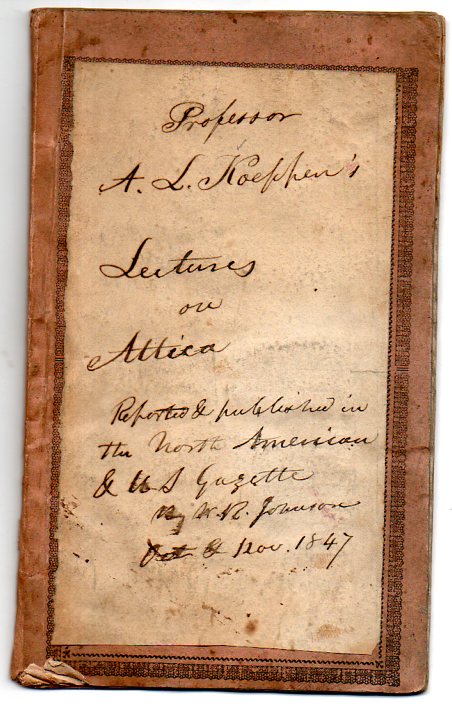
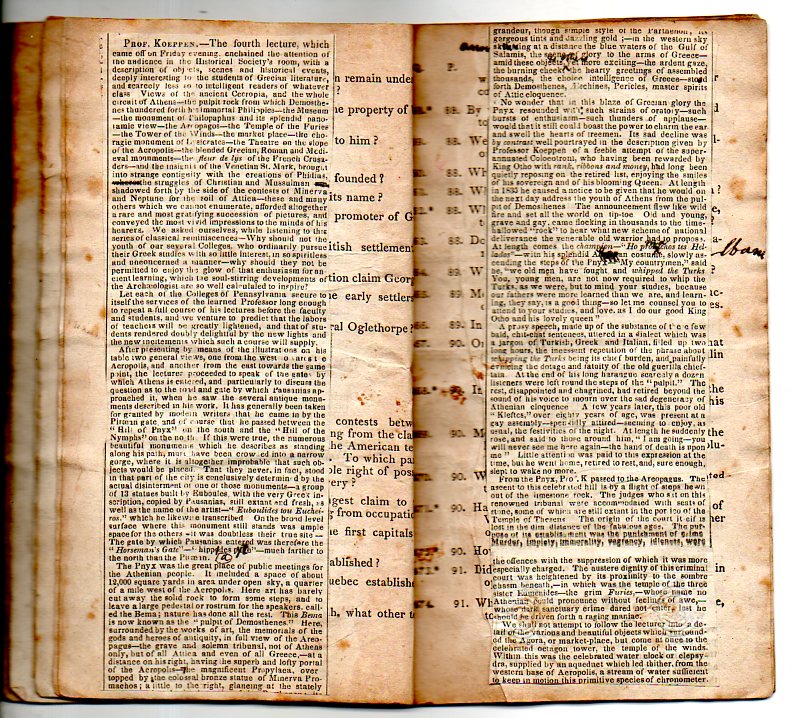
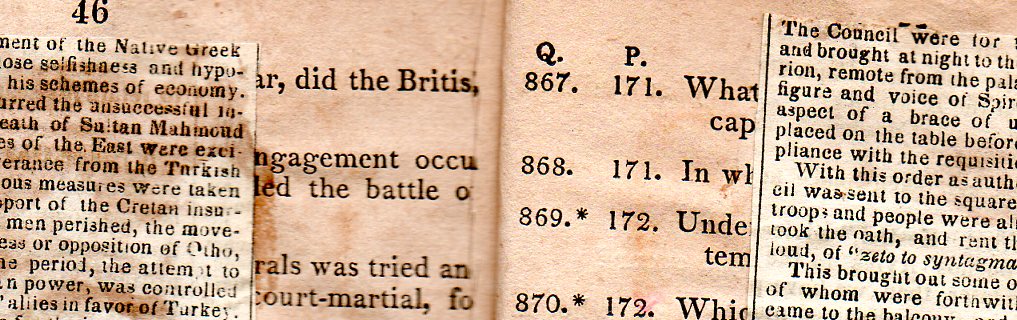
    This beautiful, home-made pamphlet was pieced together in 1847 or thereabouts, bits of an article on Attica by Professor A.L. Koeppen, cut from the North American and U.S. Gazetteer, and then pasted onto and covering the pages and cover of a chapbook. Everything about this little (5″-tall) book is stiff–the flexible paper wrappers of the pamphlet and its pages had been soaked with glue to such a degree that they’re all like boards, but with the feel and sound of paper.  All in all the feel of the book is very satisfying, and very comforting, somehow.

    Found art288
    Found art289
    Found art291

    ·Posted by :

    ·in:

    —
  • The Poetics of STDs and a Mountain of Truth, 1545

    JF Ptak Science Books Post 2023

    000-ebay--Oct 31 venereal disease poetry970
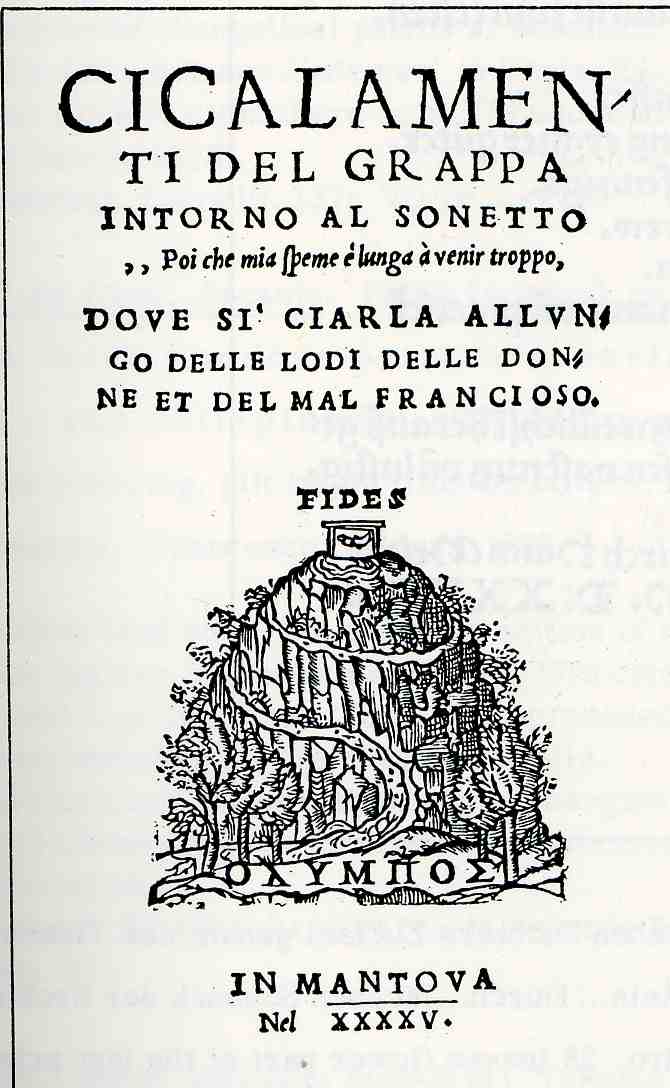
    The progress of man/humankind has, in our dim antiquarian past, been represented in art in stages of ascending a mountain.  The fine arts and sciences have been shown, in their various intellectual pedigrees, at various points on the mountain of the mind, usually with Philosophia sitting supremely at the top (with Astronomia and Mathematica generally not far underneath). This is mind, I came across another sort of progression to the Olympian heights, though it has no people in it, just the mountain, and a curious idea, ascending to faith, or truth. 

    The image is on the title page of a curious, little, early work by the pseudonymous  “Grappa” (well-named for the drink), Cicalamenti de Grapps intorno  al Sonetto…though its real nature is revealed in the subtitle,“dove si’ Cliarala allungo delle lodi delle donne et del mal francioso”, or “where one chats at length about women with The French [venereal] Disease”.  It is also dedicated to a non-existent courtesan who was heralded as being lovely, generous, and deep in the seat of this same disease.  Indeedy! This ribald, blustery, frank, coarse innuendo-laced tract (28 leaves long) was not terribly unusual when it was printed in 1545, celebrating as it does the low- and high-cultural private life of Renaissance Italy.  Doctors, poets, gluttons, cheats and of course lots of beautiful women romp around ostensibly in an attempt to prove the usefulness of their sinful vices, relating it all somehow to the disease-improved poetic capacities of the STD-bestowed Petrarch, master of forlorn and unrequited love poetry and the father of Humanism  (It relates in a way that I can’t explain to Petrarch’s Canzoniere, sonnet #88, mostly written, I think, about a  girl/woman that he fell in love with in church, which is why we can see he needed to invent Humanism. He seems to say that the needs of love are strong, stronger than he could stand, evidently, and that one should flee, renounce it; he seems to for himself, the girl across the pew or across the great open space in the cathedral never weakening to him a bit.  He pines over her, and announces his own amoroso intoppo, or “amorous fumblings”, and would take flight from himself as well. Evidently the people in this work by Grappa do not take his warnings to heart, though they do seem to renounce the “love” part but not the “sex” part. I could be really wrong on this god knows; all I wanted to do was look at the pretty picture on the cover!)

    Stumbling into things like this  makes you remember that the Renaissance wasn’t all stuffy and main-springy; perspective-this and techno-that; they had their fun, too, even in 1545, and put it into print.

    Back to the woodcut on the title page: it features a small, winding route up a mountain, the top of which is sanctified “fide”.  Now considering what these folks were doing in this work I wouldn’t necessarily christen the end of the adventure with this word, particularly if it meant (as it does) the name of the World Chess Federation (FIDE).  Seriously though fide means “faith”, as in bona fide (on good faith, by good authority), as opposed to mal fide (bad faith).  I cannot determine what in the world the structure is on the top of the mountain, or what is in it. 

    ·Posted by :

    ·in:

Recent Posts

Archives

Categories