A Daily History of Holes, Dots, Lines, Science, History, Math, Physics, Art, the Unintentional Absurd, Architecture, Maps, Data Visualization, Blank and Missing Things, and so on. |1.6 million words, 7500 images, 4.9 million hits| Press & appearances in The Times, Le Figaro, Mensa, The Economist, The Guardian, Discovery News, Slate, Le Monde, Sci American Blogs, Le Pont, and many other places… 5000+ total posts since 2008.

  • Bubbles of Cubist and Steampunk Dada Futures from 1812

    JF Ptak Science Books   Post 2105

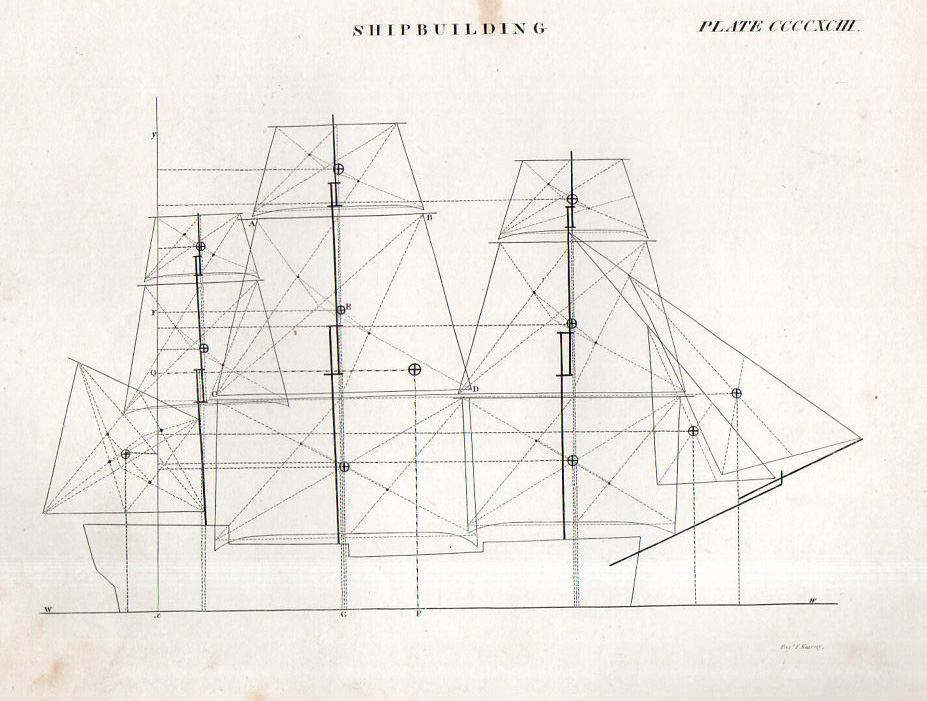
    I think that a pre-proto-neo-antiquarian or whatever Cubist representational form is very clear in the 1812 engraving, which was a relatively simple formulaic presentation of ship/sail construction found in Rhees’ Encyclopedia.  “Clear” of course to someone here in the print’s future, seeing what that form could actually become apart from showing the naval necessaries.  But it always puzzles me how an image like this could appear and someone didn’t take the next step and turn the thing into “art” of some sort.  That would all happen soon enough, the loosening of form and its representation via impressionistic and geometrical ways–Mr. Turner was already 37 years old when this print was published, and on his way (at least intellectually) to his magnificent Romantic career. 
    Cubist653

    Why wasn’t this art in 1812, aside from people not being quite ready for it?  Maybe there is no other “thing” apart from that.  It would take nearly another hundred years before the representational form of say a ship was lessened and stripped away, softened , modified, rubbed, erased, into something that is the object but really isn’t.

    Perhaps what we have here is a peep (like with Durer’s geometric man) into the future at modern art, a dissonance between abstraction and realism.  There is a regeneration of form taking place in this image, but it is only something on its way to creating a more idiomatic engineering representation of naval needs, and not a new art form–that would have to wait for Braque and Gris and Leger and Delauny and Villon and Picabia and Duchamp and the rest.  So this pre-non-Cubist engraving is not a key to a new vocabulary of vision–it is just a drawing of ship’s sails. 

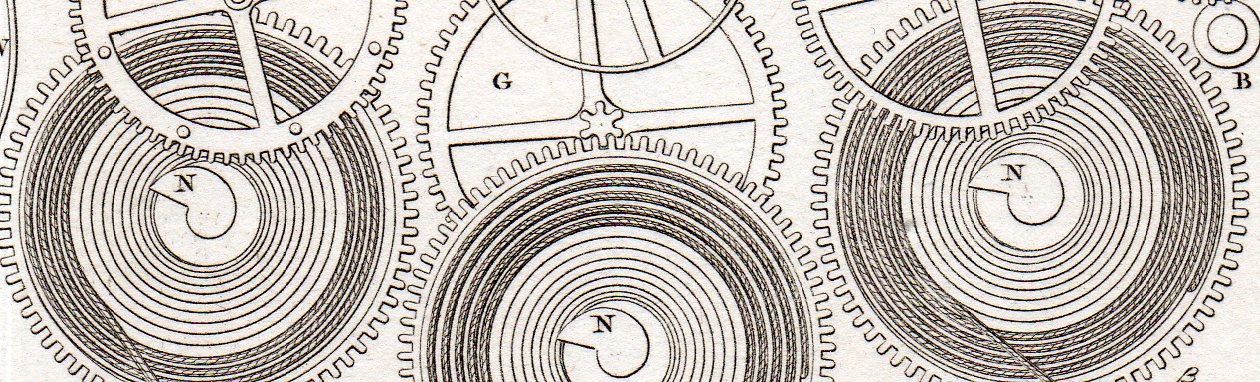
    Here’s another example of pre-modern art peeping out from the pages of this same encyclopedia, this one being a Prehistoric Rayograph, or a proto-non-photographic example of Man Ray, but from 1810 (and which I wrote about here):
    Cubist-Dadaist655

    Which is a detail from:

    Cubist-Dadaist654

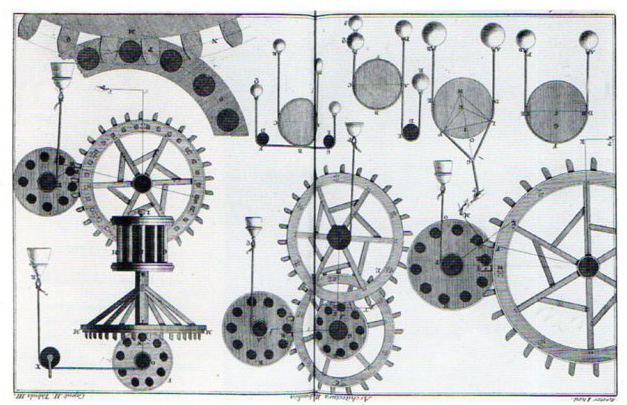
    The engraving below is another fine example of futuristic bubbles, this one a possible example of Steampunk Dada, and appears innocently (and beautifully, and importantly) in Architectura Hydraulica (1740),
    and titled “Demonstration of Friction”.  I’ve simply inverted it and
    removed some of the numerical notation–and then, suddenly, it becomes a
    sort of Steampunk Balloon Machine–a lovely collection of small
    balloons lifting large wheels and cogs, assembling some sort of
    something in mid-air, demonstrating very little friction, of lightness
    and airiness.
    Belidor upside down

    Seems to me that if you look hard enough that these examples are, well, kind of everywhere.  They just aren’t yet what they could’ve been.

    Notes:

    Here’s another example:  Geology of Images: Finding Pre-biotic, Neo-Dadaist Images in Antique Astronomy Prints (here)
  • Tiny Electoral Art, 1920

    JF Ptak Science Books   Quick Post

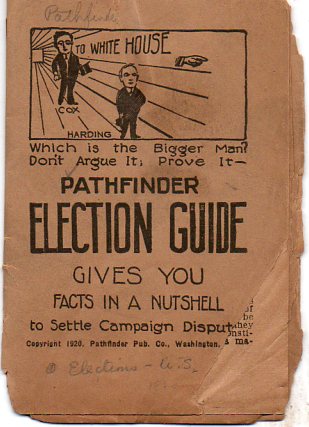
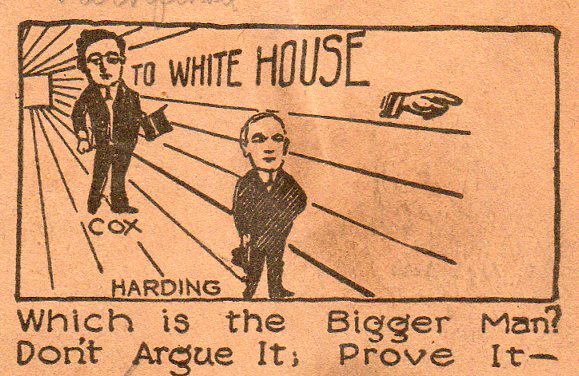
    I admit to a weakness for early 20th century American political found art in barely-existent pamphlets.  And so this fine example:

    Harding714

    This is the top quarter of a tiny (3″) pamphlet on the presidential election of 1920, a small bit of political ephemera found in exactly one library worldwide.  It provides a little coverage for the James Cox (a Democrat from Ohio whose running mate was FDR and who found the still-very-existent Cox Communications) and Warren Harding (another Ohioan newspaper magnate but a Republican).  Harding was the compromise candidate in a field showing La Follette, Hoover, Coolidge, and Leonard Wood (among others) who became the party’s choice on the eight ballot.  Cox was the Democrat favorite, but it didn’t help much, as Harding went on to a tremendous victory with 60% of the vote (and a 404-127 electoral college landslide).  Harding had a number of problems in his presidency, including his 1923 death, an administration pockmarked by scandal, but punctuated by some forward-paced and interesting movements in finance and social issues.  My feeling is that he doesn’t deserve the 40’s that he pulls in POTUS rankings, but Teapot Dome (and etc) are remembered still for him more than anything else.

    None of this helped Cox, who managed to lose the solid south, causing Tennessee to be the first of the eleven original Confederate states since Reconstruction to vote Republican. 

    Harding713


  • The Society for the Friendless, 1921

    JF Ptak Science Books

     The Charities Bureau of Kansas City published this handbook in 1921 for the annual fund raising season: The Hand Book for the Campaign
    is a concise account of the principal helping-hand organizations, many
    of which have (from our seat here in the future) quite extraordinary
    names.  

    0-blog---Nov 21 social agencies090

    We find “The Rest Cottage” (“maintained as a refuge and
    rehabilitation sot for homeless and unfortunate women and girls and
    their destitute children”), the “Receiving Home for Children”, “The
    Home for Infants”, “The Orphan Home for Girls”, “The Child Welfare
    Club”, “The Children’s Hotel”, “The Whatsoever Circle”, “The Home for
    Aged Women and the Destitute”, “The Presbyterian Home and School for Crippled Children”, “The Helping Hand Association for the Blind”, “The Girls Hotel”, “the Childrens Bureau”, “The Finding Society”, “The Home for Aged Women of the Mexican Christian Institute”, “The Hopkins receiving Home”  and of course “The Society for the Friendless” (providing aid to the “man who comes from prison”, from Lansing, Leavenworth and St. Joesph.  Actually the members of this society would receive the newly released convict as well as visit them in prison; the society reached over 13,000 men (and “girls in Industrial Schools”) between 1919 and 1921. 

    Riis4

    There were dozens of these agencies that were providing help and relief to the needy in the Kansas City area in the pre-Federal-help days.  It is very interesting to see these charities divided along lines of need, rather than have them gathered together under a giant umbrella like, oh, the Department of Health and Human Services or some such agency.  Or just the Department of “Human Service”(?) on the state level of many states.  It seems more appropriate to actually specify the nature of relief rather than hide it away under a giant Orwellian blanketing cover of general services–it would be okay to be reminded that there are needs for abandoned children and destitute girls.  Perhaps it would make us all a little more aware of who needs what in this rich and capable society. It just seems to me that codifying the extreme of social need into more amorphous units like we have done in the last 50 years or so smooths the edges that people like Thomas Nast and Jacob Riis* and Charles Dickens and Virginia Woodhull and Dorothea Lange and Dorthy Day** managed to sharpen.  Sharp edges are good.
    Dorothy day

    * Jacob Riis was perhaps the first documentary photographer of the American “underclass”, putting an indisputable photographic face on the living and working conditions of the laboring poor.  A photograph of these conditions was irreproachable–it was something you could absolutely trust, mree so than an “artist’s representation”; like seeing a photograph from the surface of the Moon.
    ** Dorothy Day, (above), perhaps the least-known of these names, was a tremendous figure in the civil and workers rights movement and the founder of the Catholic Worker. 


  • James Clerk Maxwell, on Himself (“a profession was not necessary to a useful life”)

    JF Ptak Science Books  Quick Post

    Around 1870 James Clerk Maxwell–one of the great minds in the history of modern physics–responded to a request by Francis Galton to fill out  a questionnaire for Galton’s work on the characteristics of people-of-genius, and published as English Men of Science, their Nature and Nurture (1874).

    This is a set of Maxwell’s responses about himself, as well as his mother and father: 

    ·Posted by :

    ·in:

  • Finding the One Percent of 1916.

    JF Ptak Science Books  Quick Post

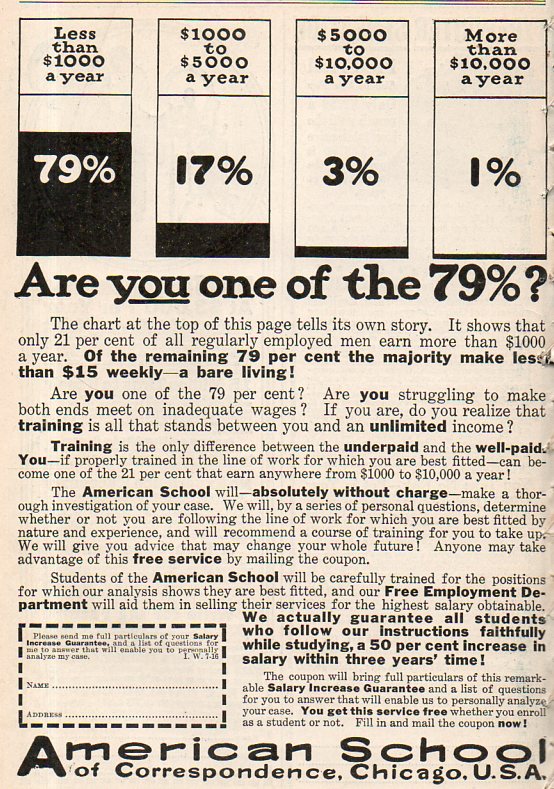
    Where was the One Percent of 1916? Luckily, I found it at the end of this simple bar graph for The American Correspondence School advertisement in Illustrated World for January 1916, right at the end of the other 99% WWI was about at the half-way point, America still wasn’t in the war, and there was little attention paid in the magazine to that fantastically bad Thing happening overseas.  In any event, the ad tried to attract the 79% of the population making $1000/year or less through not-described correspondence school means, and at the same time flagging the top one-percent earners in the U.S. as though making $10,000+ per year. 

    1 percent715
    This doesn’t seem much like a high figure, except that the average person was making about $650/year, and the average house cost about ten times that amount.  Today’s 1% income/year folks take in about $400,000 (or about 25 times the average yearly salary of the  99%, and three times the cost of the average house).  And according to the Bureau of Labor Statistics, that $10k/year is equal in buying power to about $212,000 yearly in 2013, so that odd-looking ten grand figure might be about right, even if it was probably all quickly made up in some composing room in Chicago 97 years ago. 

    If you were to look at this figure through comparative baseball eyes, it is particularly astonishing, given that in this decade or so there have been 65 players with $100,000,000 contracts, which makes for many dozens of players with 10 million/year salaries.  But these are different times, and the baseball players of 1916 (the year of the first super market opening) were paid hardly anything at all relative to the income of the team owners, though baseball as a business at this point represented almost nothing of what it would become. 

    I don’t mean to pick on baseball–it’s just that it is the beginning of the World Series and the game is on my mind.  And it doesn’t work so well to pick out the one percenters in, say, physics, where Albert Einstein–who had a terrific year in 1916–was probably being paid in the 3% club region in spite of his rather exalted fractional 1% status. 

    In any even I was surprised to see “1%” appear in this graphic.

  • A Skelton Key of Blank Physicists, 1946

    JF Ptak Science Books   Quick Post

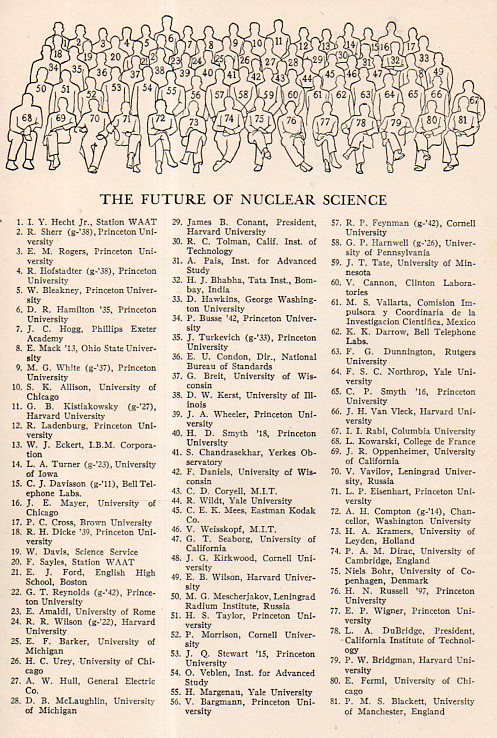
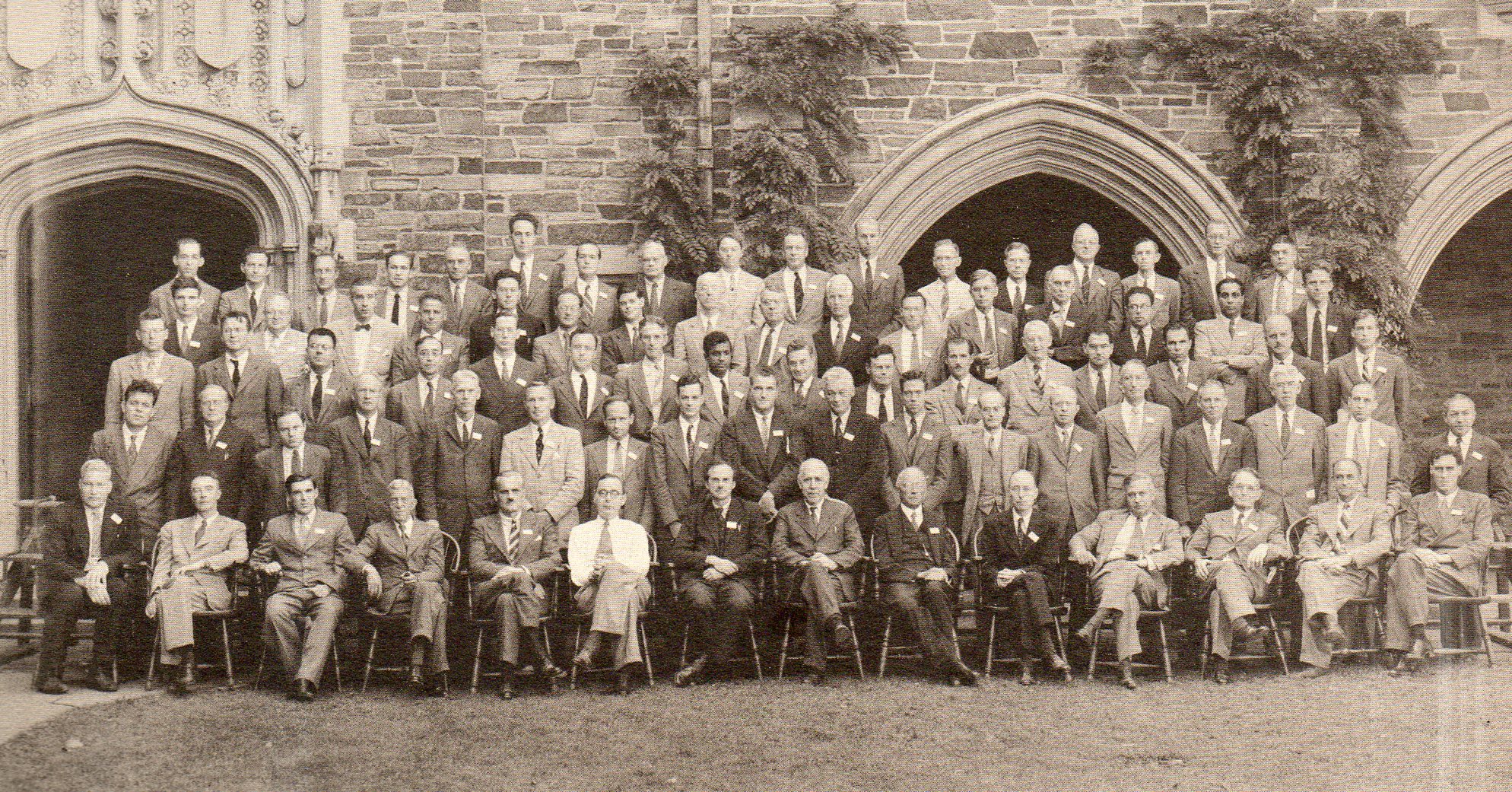
    The Future of Nuclear Science, Princeton University Bicentennial Series, Series I Conference I (1946), with a forward by the director of the conference, E.P Wigner, is mostly just a short (36-page) introduction to the conference, though it does contain a very nice and not commonly seen photograph of the conference’s participants. Of particular interest is the accompanying ghost/outline guide to identifying the group, which seems to take on its own life when viewed out-of-context.

    Skeleton 716
    It is a considerably heavyweight group of physicists–among them are Hofstadter, S.K. Alison, Kistiakowsky, Ladenburg, W.J. Eckert, L.A. Turner, R.H. Dicke, E. Amaldi, Urey, Conant, Tolman, Pais, Turkevich, Condon, Wheeler, Smyth, Chandrasekhar, Weisskopf, Seaborg, Wilson, Morrison, Veblen, Bargmann, Feynman, Van Vleck, Rabi, Eisenhart, Compton, Kramers, Dirac, DuBridge, Bridgman, Fermi, Blackett, and others.  It is a wonderful photograph:

    Skeleton det718
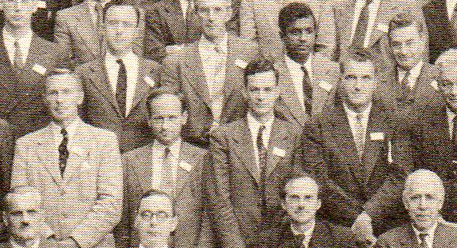
    Here’s a relatively-random detail featuring (bottom left -to-right) Compton, Kramers, Dirac, Bohr, plus (middle left-to-right) Margenau, Bargmann, Feynman, Harnwell, Tate, and (third row) Wheeler, Smyth, and Chandrasekhar.  This was an extraordinary group. 

    Skeleton det a718

    Full text via Hathi Trust via Cornell University.


  • Welcome to October: Make Your Own Baseball Paper Computer (1961)

    JF Ptak Science Books Quick Post

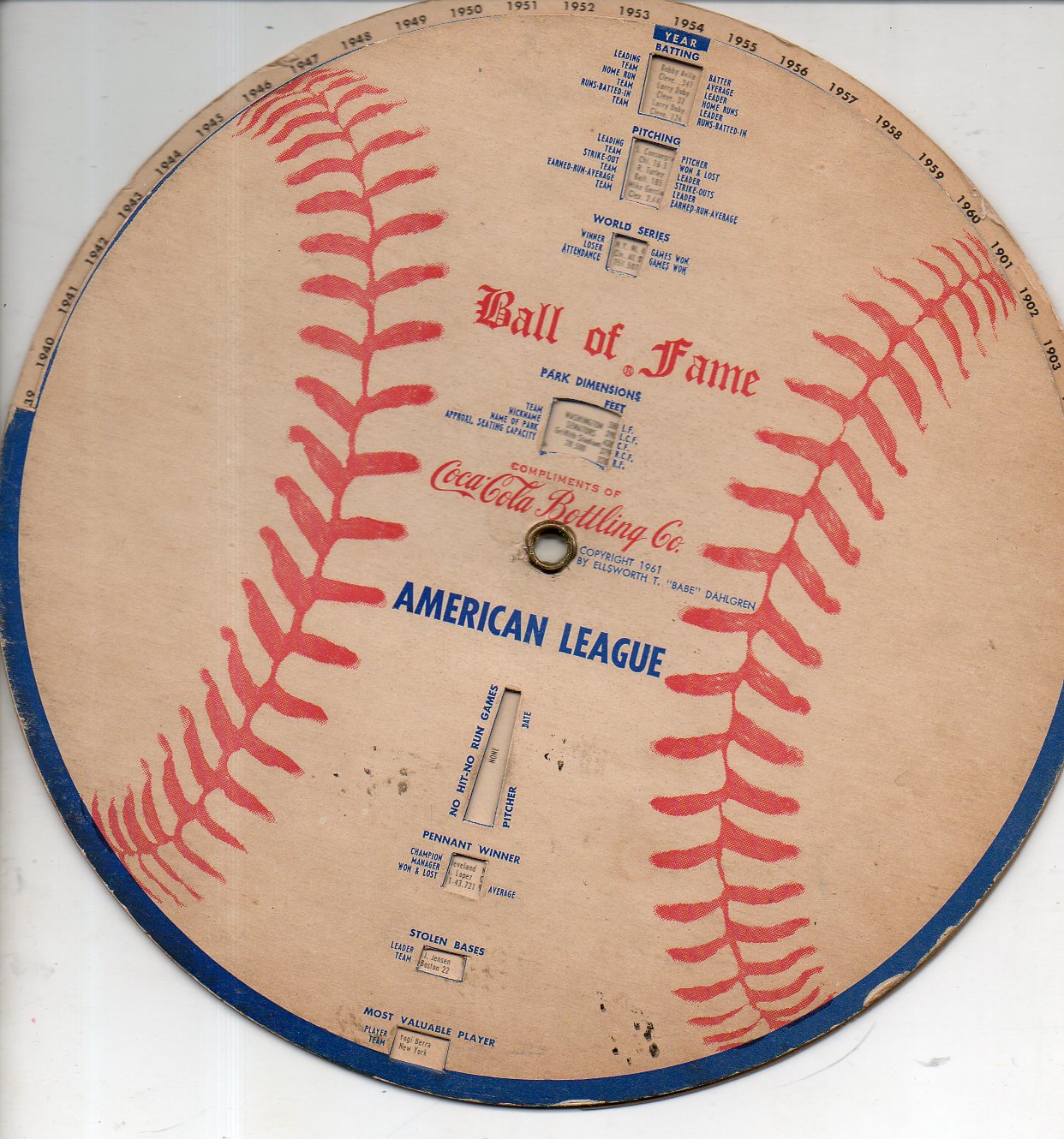
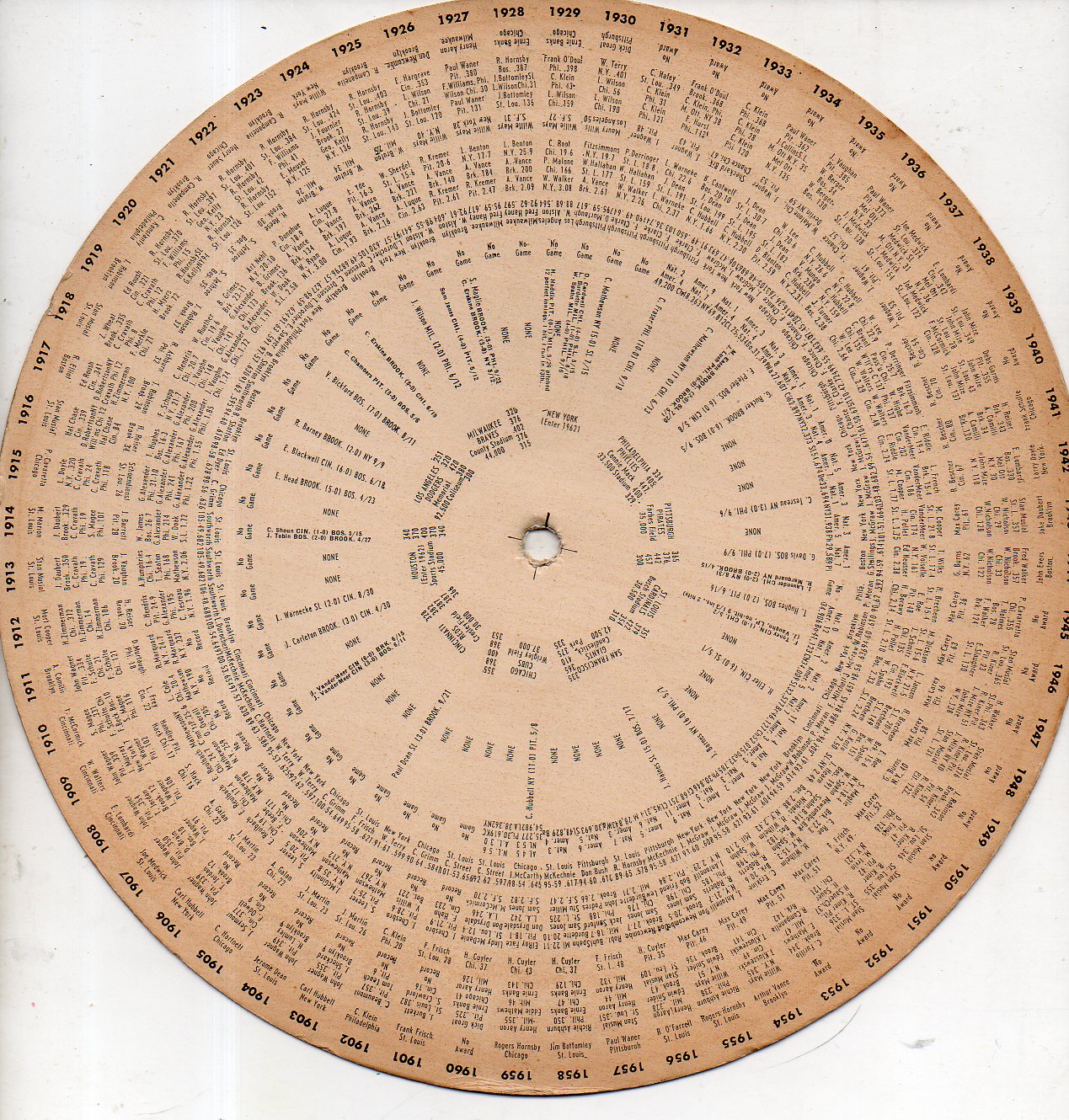
    I’ve accumulated 50 or so paper computer/calculators of various shapes and sizes and descriptions, ranging from calculating the mileage for a 1959 Rambler, the ground speed for a B-25, radiation dosimetry, one-handed bridge, nuclear weapon yields, political history quizzes, and many others–including this “Ball of Fame” baseball historical paper volvelle. 

    Ball of fame719
    I’ve seen this online a bit, but I’ve not seen the guts/data of the thing, so I decided to take mine apart and scan it so that the baseball folks among the readers of this blog can make their own. I’ve scanned at 200 dpi so there’s plenty of detail–just print out the four sections, grab your exacto knife, and you’re in business. 

    Ball of fame721

    The computer has an awful lot of detail, the most interesting to me being located at top-center, for “Park Dimensions”–in that quarter-inch square window we see info for the team, nickname, name of park, seating capacity, and the distances to the five points of the fences. Terrific!  The rest of the info, fpr the years 1901-1960:

    • Batting (showing leading batter, team, average, home run leader, leading team for home runs, rbi leader and rbi team leader).
    • Pitching (showing leading pitcher, w/l record, team, KO leader, team strike outs, ERA pitching and team leaders.
    • Pennant winner: (showing the winning team, manager, W-L, and winning percentages.
    • Stolen bases: leader and team leader.
    • And, lastly, MVP. 

    There are bits and pieces that wouldn’t fit the scanner, but they’re replaceable. 

    Have fun!

  • A Note on Luther and Copernicus

    JF Ptak Science Books  Post 2106

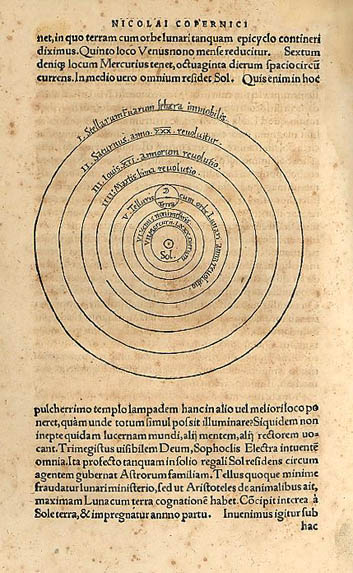
    Like many religious leaders and clerics, Martin Luther in 1539 took a dim and critical view of Copernicus and his new and substantiated theory of planetary motion and placement–he was also among the earliest important criticisms of the work, unable to provide any harmony between the new ideas and the overwhelming authority of the Bible. How did Luther come to say these things about a work that wasn’t published until 1543 (as De revolutionibus orbium coelestium  or On the Revolutions of the Heavenly Spheres)?  As it turns out Copernicus’ book was largely finished a decade or so before it was finally published, being constantly revised and amended and corrected, with parts of the work presented for review and comment to such people as Pope Clement VII (who came to believe in the book and who volunteered to pay for its printing but dying before this could be set into place). 

    Copernicus de revo
    The work was discussed for ten years before publication, with part of the theory finding its way into a small but select circulation in Copernicus’ 40-page summary of his major work, Commentariolus1,  which would have been passed hand-to hand and which itself would not see publication for another 400 years (as the De Revolutionbus was the mature version of what the Commentariolus summarized)–though few copies existed, people did lecture on the work, which is probably where Pope Clement came into contact with its ideas. So it is entirely plausible for Luther to have come into contact with these ideas before publication.

    Luther stated:

    “There is talk of a new astrologer who wants to
    prove that the earth moves and goes around instead of the
    sky, the sun, the moon, just as if somebody were moving in a
    carriage or ship might hold that he was sitting still and at
    rest while the earth and the trees walked and moved. But that
    is how things are nowadays: when a man wishes to be clever he
    must needs invent something special, and the way he does it
    must needs be the best! The fool wants to turn the whole art
    of astronomy upside-down. However, as Holy Scripture tells
    us, so did Joshua bid the sun to stand still and not the
    earth.” And there was more.2

    Even still Luther never did issue  a retraction for his statement, and
    the Catholic Church designated the book to its list of prohibited books,
    in spite of a vetting element that took place prior to publication–it should also be noted that the
    book was also respectfully dedicated to Pope Paul III, leader of the Catholic Church, which was somewhat ambivalent to the work for several decades.

    ·Posted by :

    ·in:

  • A Few Circular Ships (Some Submerged and Semi-Sugmerged) 1868-1880

    JF Ptak Science Books      Post 2017

    I’ve noticed a few interesting articles on the circular ship from mid-late 19th century; I don’t really have much to say about them except that I appreciate their structure and, well, beauty, and so I’m just sharing them here. 

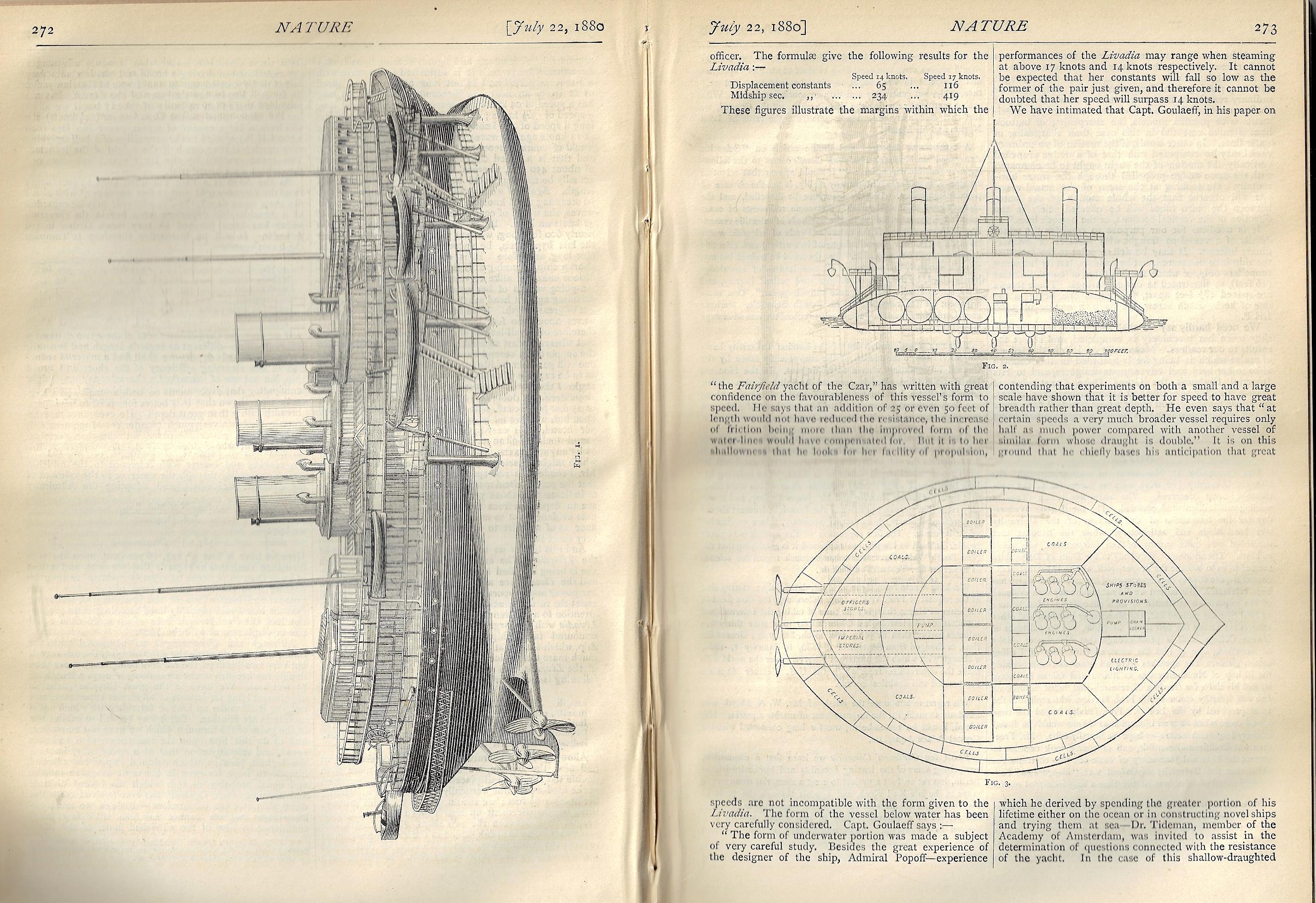
    First is “The Russian Imperial Yacht, ‘Livadia’”, which is an article in Nature, July 22, 1880, appearing on pp 270-274, with several large illustrations, including an elevation and a plan of the ship.  

    Nature 1880 Lividia

    “The Livadia was an imperial yacht of the House of Romanov built in 1879–1880…intended for service on the Black Sea…a radically novel ship conceived by Vice Admiral Andrey Popov, designed by naval architect Erast Gulyaev and built by John Elder & Co. of Govan on Clyde. The Livadia continued Popov’s line of circular shipsalthough this time Popov sacrificed geometrical perfection for seagoing capabilities. She had a beam of 153 ft (47 m) against overall length of only 259 ft (79 m). An extreme example of tumblehome architecture, she sported a conventionally shaped superstructure mounted on a wide, flat-bottomed, turbot-shaped submerged hull or pontoon. The Livadia turned out a surprisingly maneuverable and stable ship with a respectable maximum speed of 15.7 knots and her efficiency was comparable to conventional ships. Her performance at sea trials surprised most naval architects and was attributed to the favorable placement of the propellers.”–Wikipedia

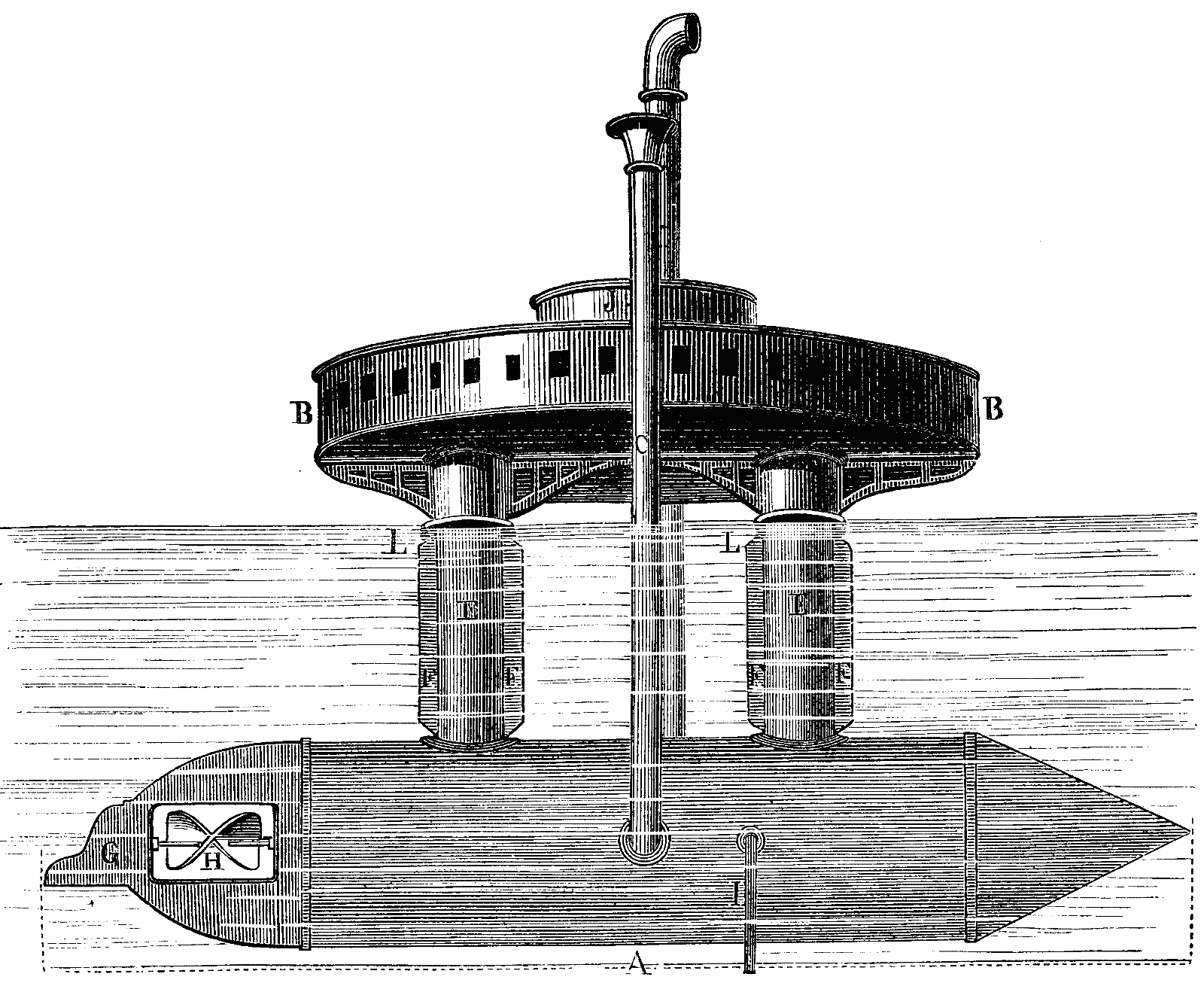
    Next is this fantastic set of drawings for a proposed circular semi-submerged ship, the work of Donato Topmmasi of Paris, and which appeared February 24, 1877, in the Scientific American, page 115.

    Submerged ships tommasi a


    ·Posted by :

    ·in:

  • The 15 Billion Year Old Monkey and “Gasoline Alley”

    JF Ptak Science Books  Post 2118   Part of the series A History of Blank, Empty and Missing Things  Follow Me on Pinterest

    Concevons qu’on ait dressé un million
    de singes à frapper au hasard sur les touches d’une machine à écrire …
    [translation: Let us imagine a million monkeys typing haphazardly on
    typewriters …”
    1


    Gasoline alley723[
    Gasoline Alley, 1931]

    There are some ideas that leave me with a powerful sense of nothing.

    To me, “nothing” can be very important–especially in writing and speaking and action, doing or saying nothing has been the important and the correct thing to do.  “Nothing” isn’t necessarily an ending, and, just a period or a coma, can just be a placeholder for something that is developing.  There can be long nothings and short one, forever- and micro-nothings, and nothing that is nothing for almost nothing.  Nothing can be implied, insinuated, broadcast and defined, though self-defined extended nothingnesses (like John Cage’s 4’33”) is a tricky thing to make happen with success. 

    The ideas that leave me with a sense of nothing are interesting things.  And there are a lot of them. When I can remember them they are in my nothing file, waiting for nothing–or something–to happen.

    This is the sense I had when I was trying to explain randomness to my 10-year-old daughter and her 11-year-old cousin, sitting out in a park, looking at stuff.  Somehow I reached into the past and pulled up the infinite monkey theorem, and tried to make that interesting, but just couldn’t do it. Maybe it was the difficulty of super-large numbers, or the fascinating but incomprehensible thought-threats of Borges and his infinite library, but I was left with nothing.

    It is Borges who writes a lovely piece on the history of producing everything from nothing, appearing in his “The Total Library” in 1939 (and then again in “The Library of Babel” in 19412), reviewing machines and such of spectacular randomization that could produce the whole of what we recognize as what we know. 

    Emile Borel wrote on it in 1913, finding the possibility of one million monkeys pounding away at one million typewriters.  In his wonderful work, The Math Book3, Cliff Pickover looks at 250 big ideas in the history of mathematics and gives each of them one page only for presentation and explanation.  He approaches the infinite monkey theorem by looking at one monkey wailing away at one typewriter, striking the keys, and analyzing how long it might take for the one monkey to produce one line from one book.  The line is “In the beginning…” at the beginning of one great nothingness, from the Old Testament, a 56-object sentence (including punctuation and spaces) and, Pickover reasons, that if there is a 93-character keyboard,then this monkey will have a 1/9356 possibility times 10100 of getting it right, and that if it worked for 24 hours a day striking one key every second then it will have used all of the time in the present universe–the Big Bang Monkey.

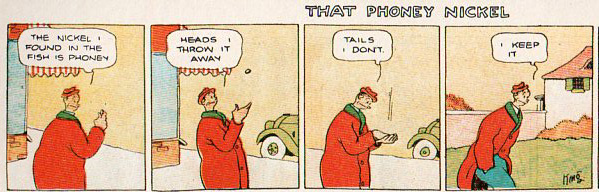
    All I got back were big stares, and a big sense of nothing in my gut.  It reminded me of the cartoon featured above, a toss-off sub-cartoon in a panel of the Gasoline Alley series.  Did he actually look at the coin?  Did he just decide to keep it?  And why keep a phoney nickel? And who counterfeits nickels, even during the Depression?  What is the outcome of the panels–just some guy walking down the street with a nickel in his pocket.  Something may have happened, but it was a lot of nothing. 

    I know that I should have a bigger sense of what Felix Edouard Justin Emile Borel and Jorge Francisco Isidoro Luis Borges were writing about and in many ways I do, but in the end I know that I am left with nothing.  But I have it in my pocket.  

    Notes

    1. Émile Borel (1913). “Mécanique Statistique et Irréversibilité”. Statistical mechanics and irreversibility) J. Phys. 5e série 3: 189–196.

    2.  Jorge Borges,  “La biblioteca total” (The Total Library), Sur No. 59, August 1939. Translated by Eliot Weinberger, in Selected Non-Fictions (Penguin: 1999)

    3.  Clifford Pickover, The Math Book, (2009), Sterling, page 328.

  • DIY Pocket Baseball Game, 1876

    JF Ptak Science Books   Quick Post  Follow Me on Pinterest

    Following up on a post from yesterday on a make-it-yourself baseball history calcul-computer is this glorious spinning arrow pocket game board from 1876.  An enthusiast could easily cut and paste their way to their very own baseball game for lost moments on the train or in line at the Piggly Wiggly.  Enjoy.


    ·Posted by :

    ·in:

    —

Recent Posts

Archives

Categories