JF Ptak Science Books Post 2106
Like many religious leaders and clerics, Martin Luther in 1539 took a dim and critical view of Copernicus and his new and substantiated theory of planetary motion and placement–he was also among the earliest important criticisms of the work, unable to provide any harmony between the new ideas and the overwhelming authority of the Bible. How did Luther come to say these things about a work that wasn’t published until 1543 (as De revolutionibus orbium coelestium or On the Revolutions of the Heavenly Spheres)? As it turns out Copernicus’ book was largely finished a decade or so before it was finally published, being constantly revised and amended and corrected, with parts of the work presented for review and comment to such people as Pope Clement VII (who came to believe in the book and who volunteered to pay for its printing but dying before this could be set into place).
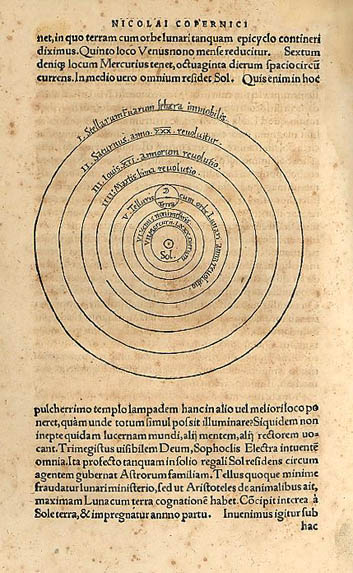
The work was discussed for ten years before publication, with part of the theory finding its way into a small but select circulation in Copernicus’ 40-page summary of his major work, Commentariolus1, which would have been passed hand-to hand and which itself would not see publication for another 400 years (as the De Revolutionbus was the mature version of what the Commentariolus summarized)–though few copies existed, people did lecture on the work, which is probably where Pope Clement came into contact with its ideas. So it is entirely plausible for Luther to have come into contact with these ideas before publication.
Luther stated:
“There is talk of a new astrologer who wants to
prove that the earth moves and goes around instead of the
sky, the sun, the moon, just as if somebody were moving in a
carriage or ship might hold that he was sitting still and at
rest while the earth and the trees walked and moved. But that
is how things are nowadays: when a man wishes to be clever he
must needs invent something special, and the way he does it
must needs be the best! The fool wants to turn the whole art
of astronomy upside-down. However, as Holy Scripture tells
us, so did Joshua bid the sun to stand still and not the
earth.” And there was more.2
Even still Luther never did issue a retraction for his statement, and
the Catholic Church designated the book to its list of prohibited books,
in spite of a vetting element that took place prior to publication–it should also be noted that the
book was also respectfully dedicated to Pope Paul III, leader of the Catholic Church, which was somewhat ambivalent to the work for several decades.