A Daily History of Holes, Dots, Lines, Science, History, Math, Physics, Art, the Unintentional Absurd, Architecture, Maps, Data Visualization, Blank and Missing Things, and so on. |1.6 million words, 7500 images, 4.9 million hits| Press & appearances in The Times, Le Figaro, Mensa, The Economist, The Guardian, Discovery News, Slate, Le Monde, Sci American Blogs, Le Pont, and many other places… 5000+ total posts since 2008.

  • An Early Appraisal of Life at the Extreme Edges of Earth: the Oceans (1861)

    JF Ptak Science Books  Quick Post

    I just came upon an interesting article on the discovery and possibility of life at extremes on Earth. It was printed in 1861 in Journal of the Franklin Institute and addresses the existence of life at extreme depths of the oceans. The author, George C. Wallich (1815-1899) wrote in his well-reasoned paper1 that the extreme water pressure in the deep would limit the extent of life to about 400 or 500 fathoms (2400-3000′), and that “…life, whether animal or vegetable, must be extinct”. In similar language, the naturalist Edward G. Forbes wrote2 in 1859: “As we descend deeper and deeper in this region, its inhabitants become more and more modified, and fewer and fewer, indicating our approach towards an abyss where life is either extinguished, or exhibits but a few sparks to mark its lingering presence.“

    Earlier still we find this interesting statement and call to experimentation by Robert Hooke3: “Animals and Vegetables cannot be rationally supposed to live and grow under so great a Pressure, so great a Cold, and at so great a Distance from the Air, as many Parts at the Bottom of very deep Seas are liable and subject to…We have had instances enough of the Fallaciousness of such immature and hasty Conclusions…” These testimonies go back much further, at least to the time of the great classifier, Aristotle, though the possibilities of experimentation at these points were virtually non-existent.

    It would be shown just three years later by the father and son naturalists Michael and Georg Ossian Sars that life in Norwegian fjords was found at depths of 3,000 meters, and more life found deeper still (5,000 meters) in the findings of the Challenger Expedition in 1872. Discoveries of life at deep thermal vents in 1977 extended the life-bearing depths further still; currently, as of 2017 at least, rich life has been found at the bottom of the Mariana Trench, at depths of 10,600 meters.

    This was the beginning of the period of discovery of life at the extreme deep edges of Earth.

    Notes:

    1. “On the Nature of the Deep-Sea Bed, and the Presence of Animal Life at Vast depths in the Ocean”, pp 237-241, 321-325.

    2. E.G, Forbes. The Natural History of the European Seas, London, 1859.

    3. William Derham. Philosophical Experiments and Observations of the late Dr. Robert Hooke and other Eminent Virtuosos in his Time, London, 1726, p. 314. 


  • Russian Trench Cross-Sections, 1917

    JF Ptak Science Books  Quick Post

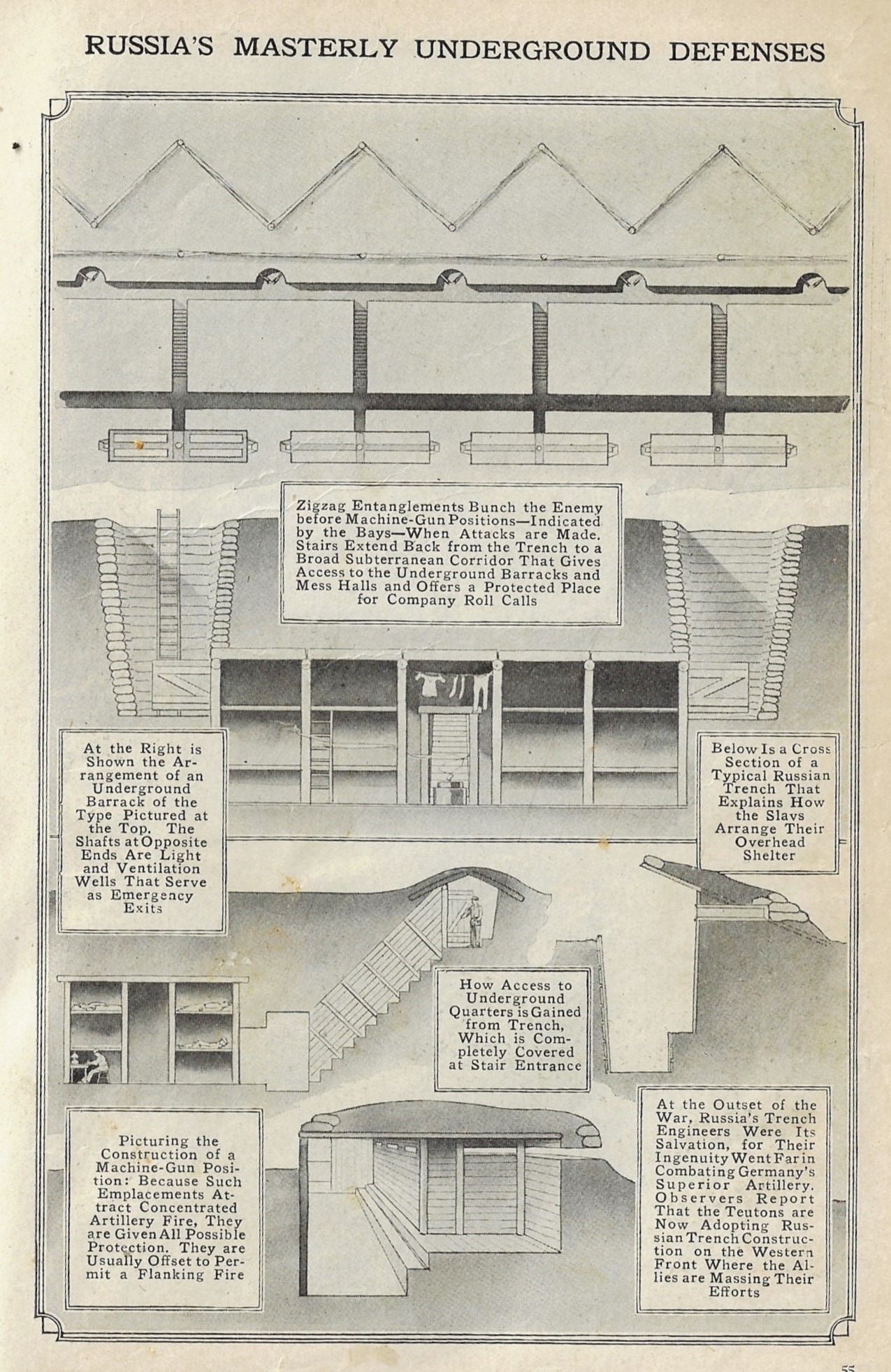
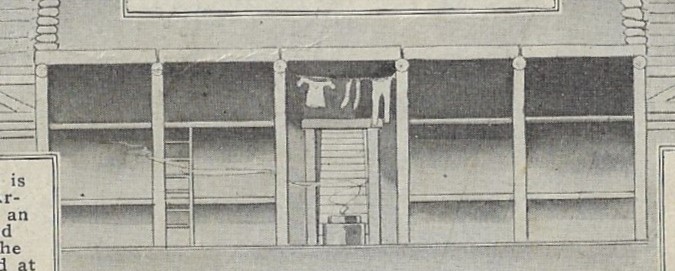
    I’ve made a number of posts to this blog on trenches/trench life (findable by entering the search term in the google box at right) and I believe that I’ve not made one regarding Russian trenches, until today. This image (“Russia’s Masterly Underground Defenses”) appears in a news-of-the-world section of Popular Mechanics for July, 1917, and includes a number of very smart smaller cross sections of division of the works. The whole of it is headed by a plan of the works, followed by  several smaller works, including the central image which shows the great depth at which the sleep chambers are set. (I also enjoy the bit of free will by the illustrator to include some tiny laundry drying out in the barracks.) Its a lovely work of an uncommon visual.

    Pop Mech 1917 Russian trenches
    Pop Mech 1917 Russian trenches

    ·Posted by :

    ·in:

    —
  • An Attempted Glorification of the Hexadecimal (1863)

    JF Ptak Science Books  Post 2812

    I found a very unusual paper1 in the Journal of the Franklin Institute for 1863 promoting moving from base-10 to base -16…for almost everything. It was written by John Nystrom2, an engineer who practiced across several fields and wrote textbooks about more. (Including in this very volume, where he contributes two other papers.) The paper in mind is a very early entry in the history of the application of the hexadecimal system. Nystrom’s plan included converting to a hex arithmetical system, and then expanded the idea to the calendar, musical notation, geography, time—an overall shift in metrology. His idea did not extend to calculators, and his name does not seem to be referenced by any of the modern compsci folks (with the major exception of Donald Knuth3). Probably base-16 was not employed in programming until, I guess, around the early 1960’s. All that said, this is still a remarkable paper. Also: the paper is illustrated with a beautiful color-highlighted folding plate of divider-like instruments that translated hex to denary.

    The Nystrom ideas did not take hold, and it seems that he was a bit cranky about the idea of its not being accepted, perhaps because it was left to the hands of people who just couldn’t see its value. He ends his book of 1862 with the following few observations:  “If the Arabic notation employed in our present decimal arithmetic had been suggested to Moses when he wrote the ten commandments on Mount Sinai he would surely have made similar remarks as that made on the tonal system that such curious looking characters could not be understood by his people….My manuscript on the tonal system has been sent to a great many places for publication. The Franklin Institute thought it would have a very serious effect on the number of subscribers of their journal. The Smithsonian Institute would not publish it because they had so much of the same kind before. The US Coast Survey stated they would publish it if recommended by a member of Congress. And lately the Society of Philadelphia has rejected it perhaps on the remarks herein replied to but Mr D recommended its publication.”–John William Nystrom, Project of a New System of Arithmetic, Weight, Measure and Coins: Proposed ...(1862)  

    As for me, I just don’t understand what he was driving for, or at.  

    Notes

    1. John Nystrom, “A New System of Arithmetic and Metrology, called the Tonal System”, pp 263-275, 337-348, 402-407 (concluded), and illustrated, including a folding plate. In Journal of the Franklin Institute, third series vol 46 overall vol 76, July-December 1863, 432pp.

    2. “John Williams Nystrom (Swedish: Johan Vilhelm Nyström) (1825–1885) was a Swedish born, American civil engineer, inventor, and author. He served as an assistant Secretary and Chief Engineer of the United States Navy during the American Civil War. Nystrom received many patents for inventions such as a marine steam engine, a refrigerator, and calculating machines…Nystrom is most notable for his proposal to switch from decimal to hexadecimal as defined in his 1862 publication titled . In 1859, Nystrom proposed a hexadecimal (base 16) system of notation, arithmetic, and metrology called the Tonal system. In addition to new weights and measures, his proposal included a new calendar with sixteen months, a new system of coinage, and a hexadecimal clock with sixteen hours in a day.”–Wikipedia

    3.  “…a prominent Swedish-American civil engineer named John W. Nystrom decided to carry Charles XII’s plans [radix-8 arithmetic] a step further, by devising a complete system of numeration, weights, and measures based on radix-16 arithmetic. He wrote, “I am not afraid, or do not hesitate, to advocate a binary system of arithmetic and metrology. I know I have nature on my side; if I do not succeed to impress upon you its utility and great importance to mankind, it will reflect that much less credit upon our generation, upon our scientific men and philosophers.” Nystrom devised special means for pronouncing hexadecimal numbers; for example, (C0160)16 was to be read “vybong, bysanton.” His entire system was called the Tonal System, and it is described in J. Franklin Inst. 46 (1863), 263–275, 337–348, 402–407. A similar system, but using radix 8, was worked out by Alfred B. Taylor [Proc. Amer. Pharmaceutical Assoc. 8 (1859), 115–216; Proc. Amer. Philosophical Soc. 24 (1887), 296–366].–Donald Knuth, The Art of Computer Programming section 4.1 (which is in volume 2). 

    A last note on the Nystrom calculator: “In an article of Scientific American the device was hailed as the most important one ever brought before the public. Despite all of the accolades however, it was never widely accepted, and no more than 100 devices were ever produced. This may have been because the cost (there were $10, $15, and $20 models, a huge sum in 1850s), or because the instrument was never well advertised or marketed. –history-computer.com
     

  • The Ineffable Beauty of Gutters (1867)

    JF Ptak Science Books  Quick Post

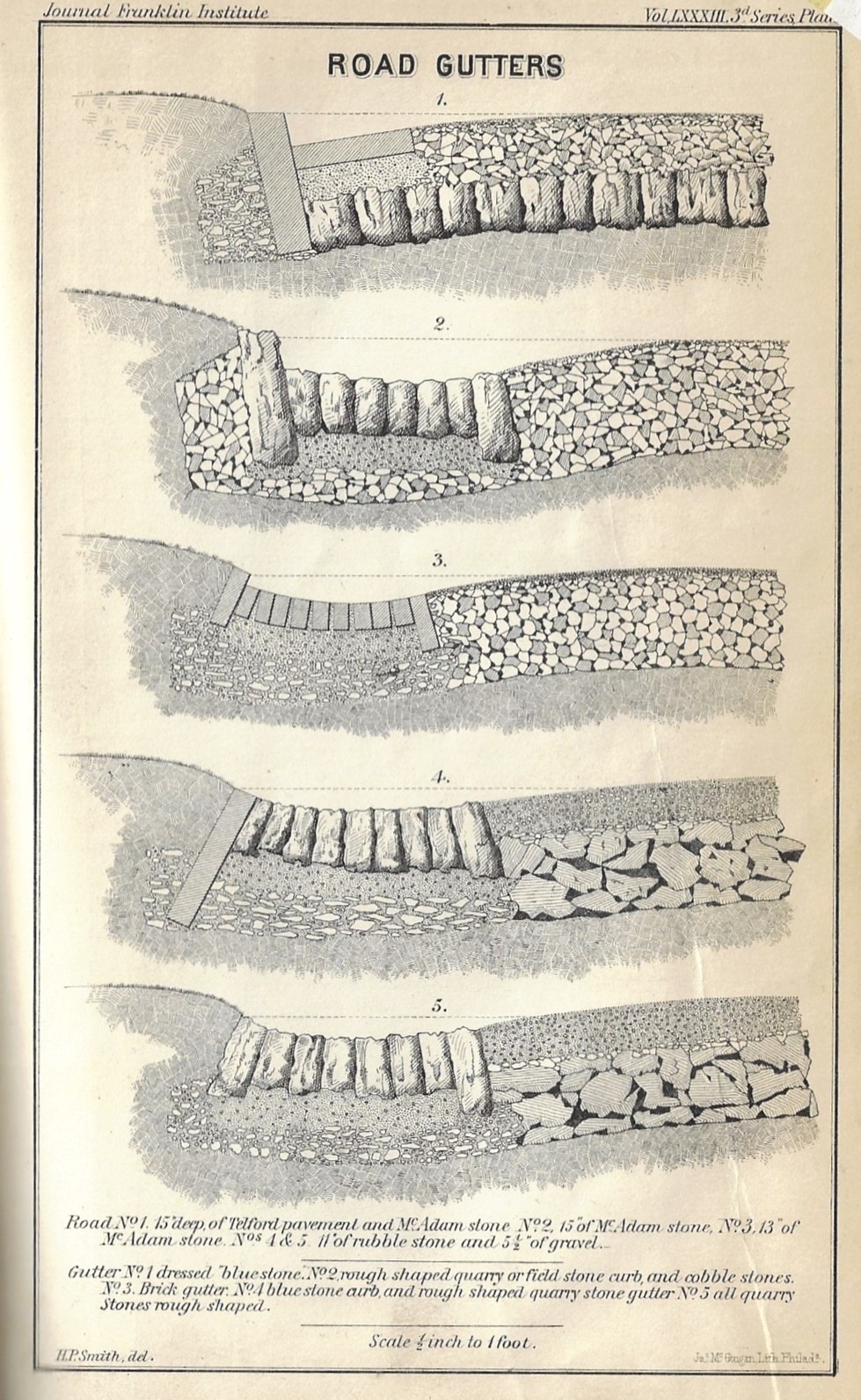
    This is really an ultra-quick post, as I just wanted to share this delightful and lovely image of profiles of different sorts of gutters.  I do recall seeing images like this on occasion, here and there, over the last few decades, though I think that they were either about Roman construction or cross-sections of streets in Paris and London.  In any event, these profiles are from a paper written by supervising engineer of the construction of New York City’s Central Park, and they are a delight to look at. 

    JFI 1867 road gutters

  • A Bad Place to Be in 1868

    JF Ptak Science Books  Quick Post 

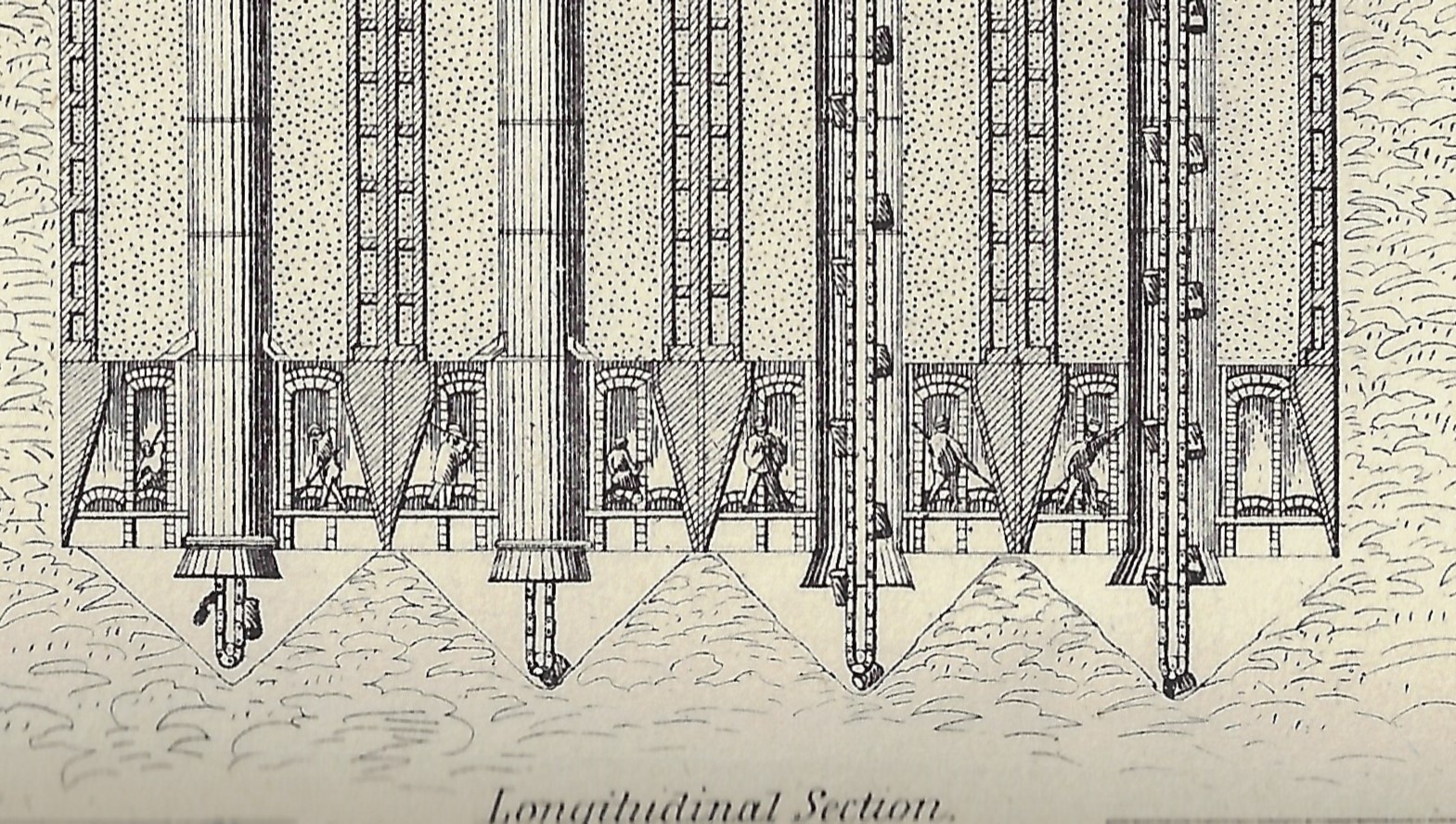
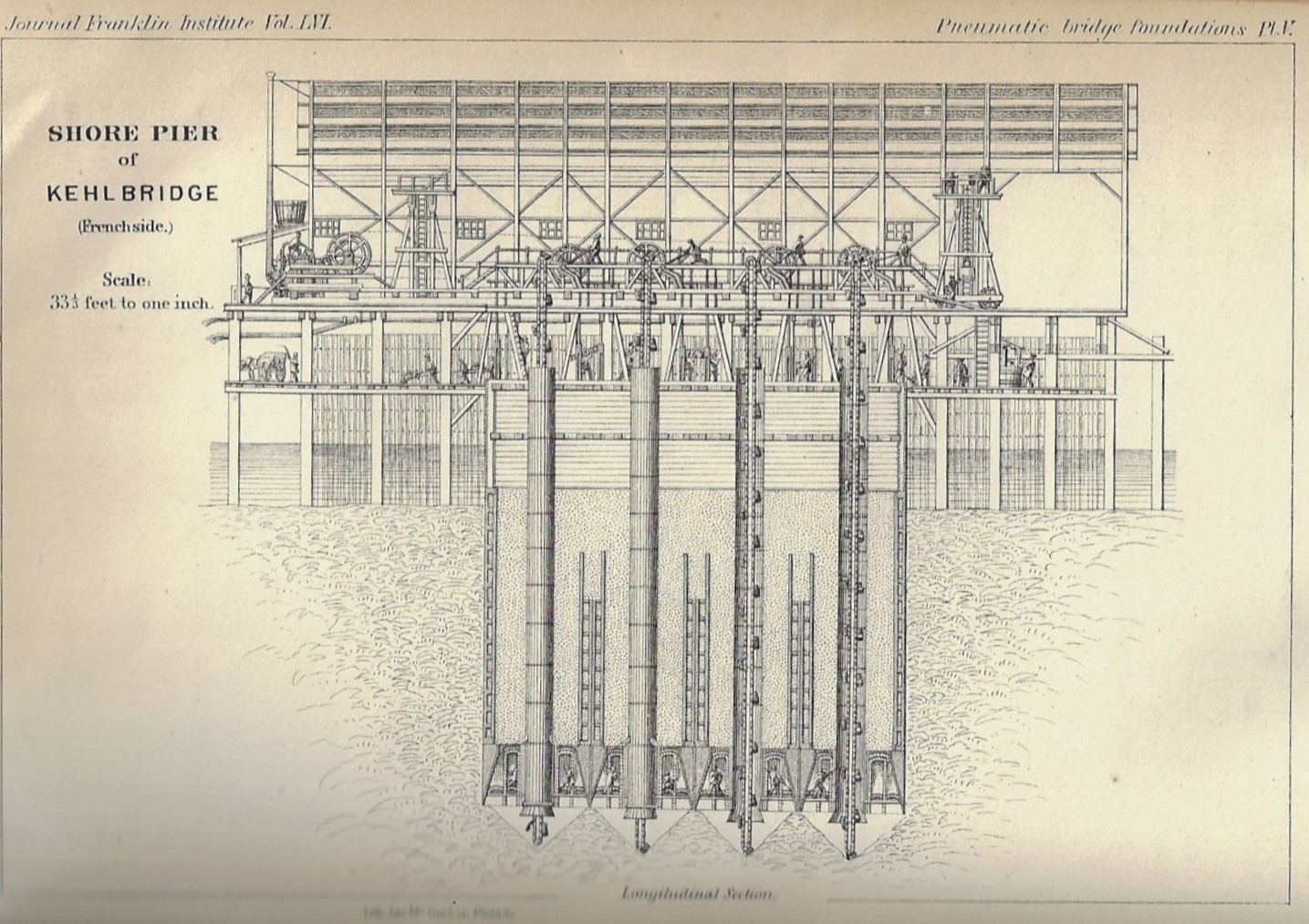
    There have been a number of posts to this blog on “Bad Places to Be”–that is, very unpleasant surrounds in which someone was working, or found themselves to be. For example, sappers digging under opposing sapper’s tunnels to place explosive charges under trenchworks, or being in a tiny observation gondola let on a cable suspended from a dirigible, or digging a tunnel, or being a U-Boat crew member in late 1943, and so on. And then there’s the impossible scenario of being the man with the job of crawling through the burnt and enormous timbers of the Brooklyn ‘Bridge’s east caisson, crawling though tiny spaces to chisel out damaged sections of the gigantic woodworks upon which tons of rock were placed, and doing this in mostly the dark and underwater.  Really, quite incredible. But then again it was a terrifically difficult and dangerous job to be a workman anywhere in those caissons–the environment was dank, dark, fetid, muddy, slippery, hot, and on top of it all, crowded. And so to today’s issue: the building of the pier for Kehl Bridge, found in the July 1868 issue of Journal of the Franklin Institute. It was quite a massive undertaking, and of course my eye is drawn immediately to the bottom of the image, where the men with the most impossible jobs labored. Here’s the detail:

    JFI 1868 caisson _3_ detail

    Which is a section of this image:

    JFI 1868 caisson _2_

    I feel an instant chill looking closely at images like this…

    ·Posted by :

    ·in:

  • On Building Mr. Babbage’s Engines (1878)

    JF Ptak Science Books  Quick Post

    Here’s a very interesting report from an 1878 issue of Nature (volume 18 pp 460) considering the construction and its consequences of the yet-built Babbage computer (analytical machine). Charles Babbage died in Marylebone in 1871 and bequeathed his working archive to his youngest son Henry (1824-1918)  who expected to carry his father’s work into the future. This is one attempt to construct a working machine from the Babbage plans. I’ve reproduced most of the Nature article below, with a few inconsequential edits. Enjoy. 

    REPORTS Report of the Committee, consisting of Prof. Cayley, Dr. Farr, Mr. J. W. L. Glaisher, Dr. Pole, Prof. Fuller, Prof. A. B. W. Kennedy, Prof. Clifford, and Mr. C. W. Merrifield, appointed to consider the Advisability and to estimate the Expense of constructing Mr. Babbage’s Analytical Machine, and of printing Tables by its means. Drawn up by Mr. Merrifield. We desire in the first place to record our obligations to General Henry Babbage for the frank and liberal manner in which he has assisted the Committee, not only by placing at their disposal all the information within his reach, but by exhibiting and explaining to them, at no small loss of time and sacrifice of personal convenience, the machinery and papers left by his father, the late Mr. Babbage. Without the valuable aid thus kindly rendered to them by General Babbage it would have been simply impossible for the Committee to have come to any definite conclusions, or to present any useful report.

    We refer to the chapter in Mr. Babbage’s “Passages from the Life of a Philosopher,”and to General Menabrea’s paper, translated and annotated by Lady Lovelace, in the third volume of “Taylor’s Scientific Memoirs,”for a general description of the analytical engine.

    The Report then, in Section I., contains an account of the general principles of calculating engines, and proceeds:

    Section II. Special Characteristics of Mr. Babbage’s Analytical Engine.

    ·Posted by :

    ·in:

  • A Guide to German Trenches and Aircraft, 1915

    JF Ptak Science Books   Quick Post

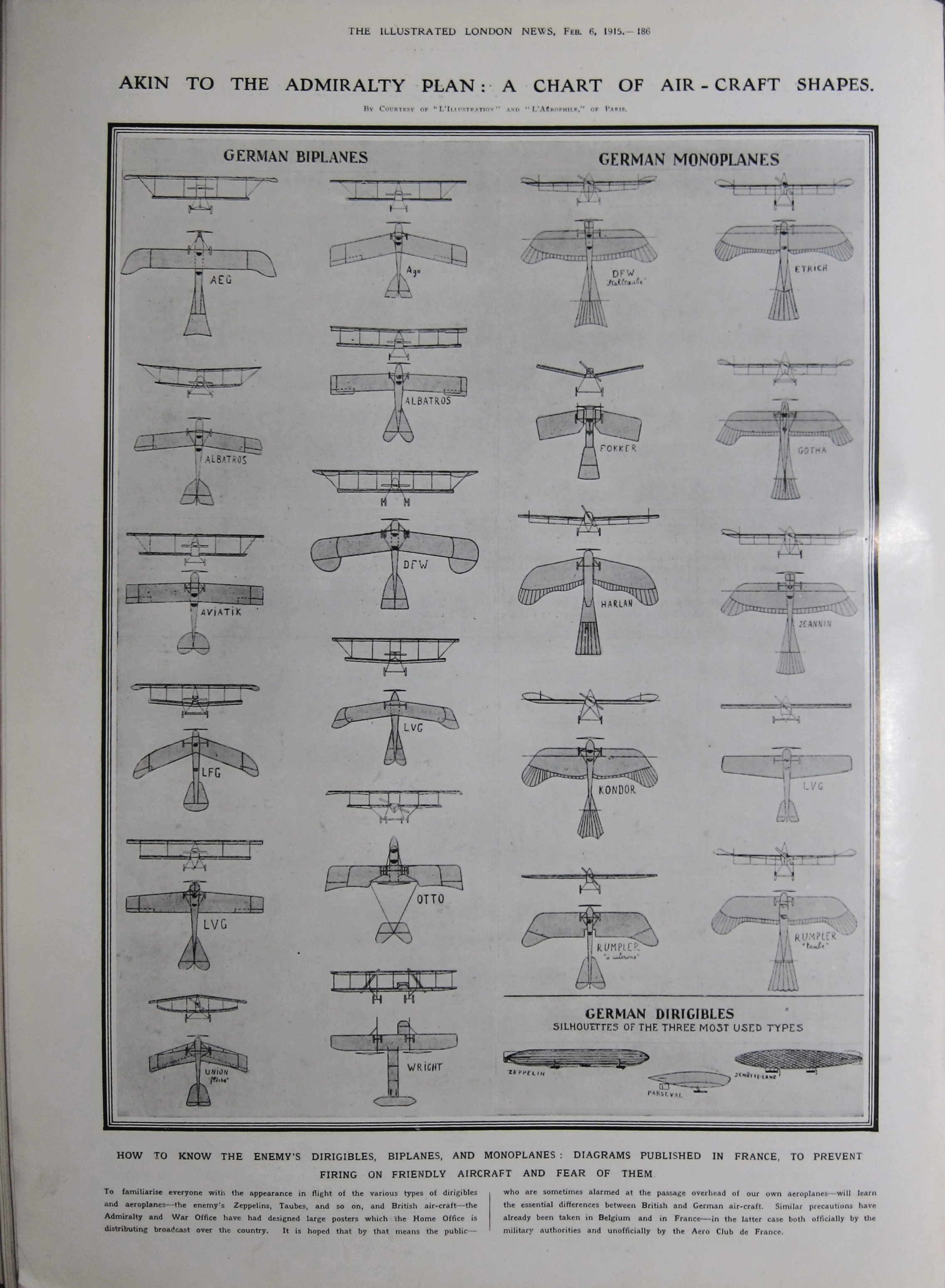
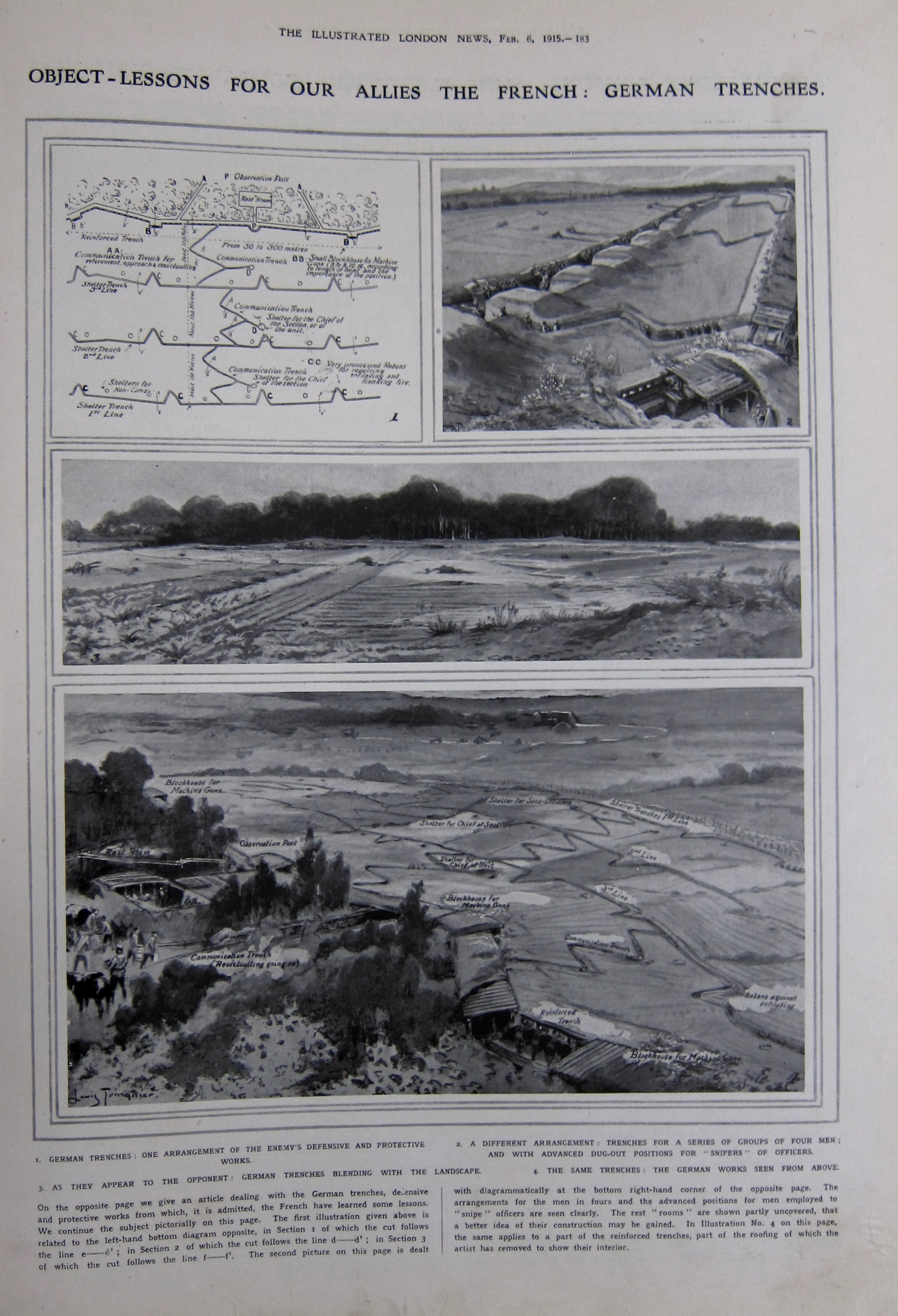
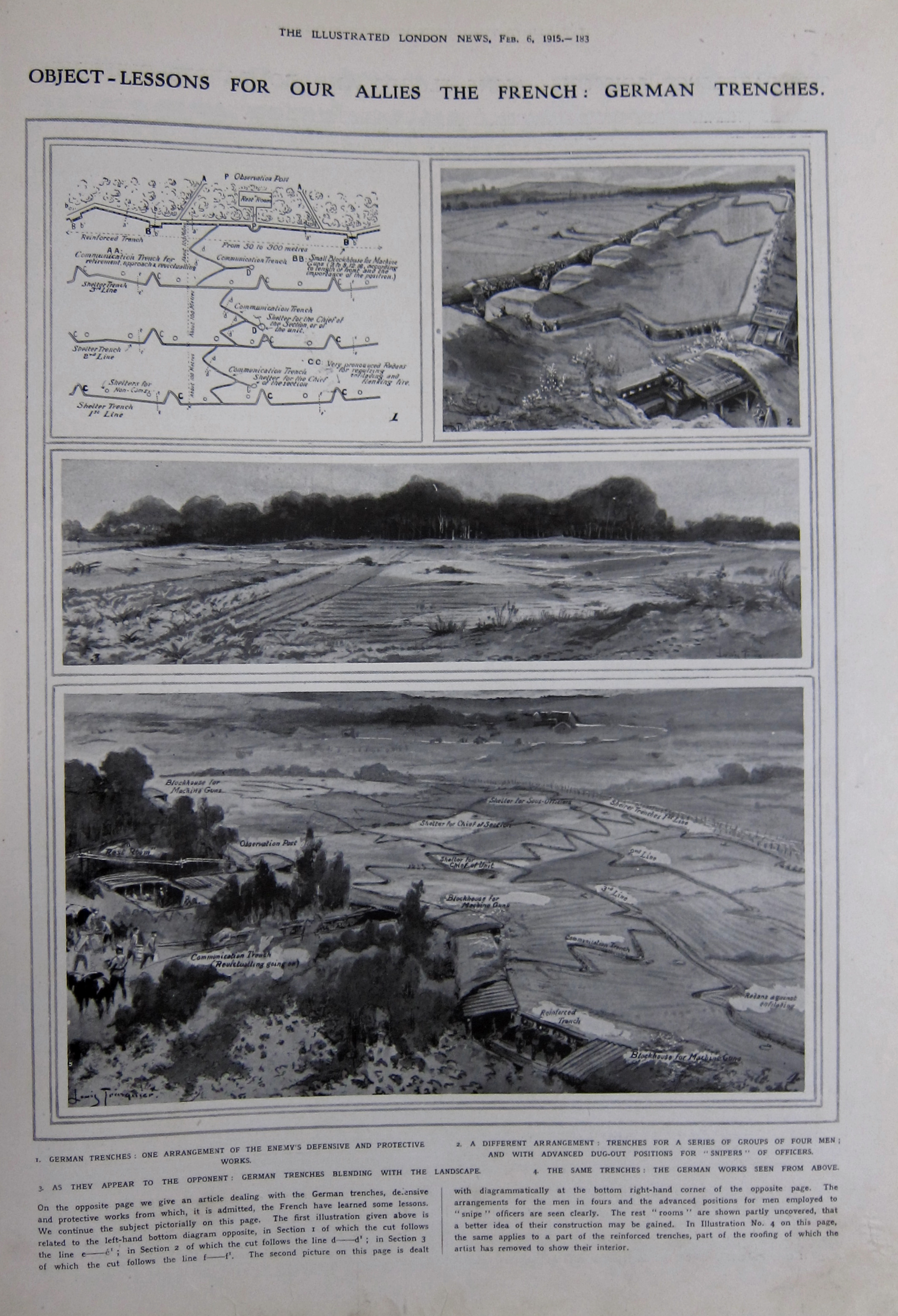
    WWI was into its sixth (of fifty-one) months of war when these helpful graphics appeared in the pages of the Illustrated London News on Feb 6, 1915.  Distinguishing trenches was interesting though not very essential, and certainly not as potentially useful to the broad population as the sheet identifying German aircraft. This image is a version of a poster that was distributed far and wide in Great Britain and France teaching ordinary citizens the differences between airplanes of friend and foe. There were a large number of designs of aircraft,especially so when you threw the British and French planes into the mix. It certainly would’ve been a bit involved at first to make these distinctions, though if your survival depended on perhaps knowing the differences in all of these aircraft then no doubt the learning curve would flatten out. It is also remarkable that all of these developments in aviation come just a dozen years after the Wright brothers first made their powered flight at Kill Devil Hills.  

    • Both images are clickable and greatly expandable.

    WWI German aircraft 1915

    WWI German trenches


    ·Posted by :

    ·in:

    —
  • Measuring Things With Large Gangs of Trains (1900 and 1906): Motive Power of Ocean Liners AND What a Year’s Worth of Mail Delivery Looks Like.

    JF Ptak Science Books  Quick Post  Series on the Depiction of Quantitative Data

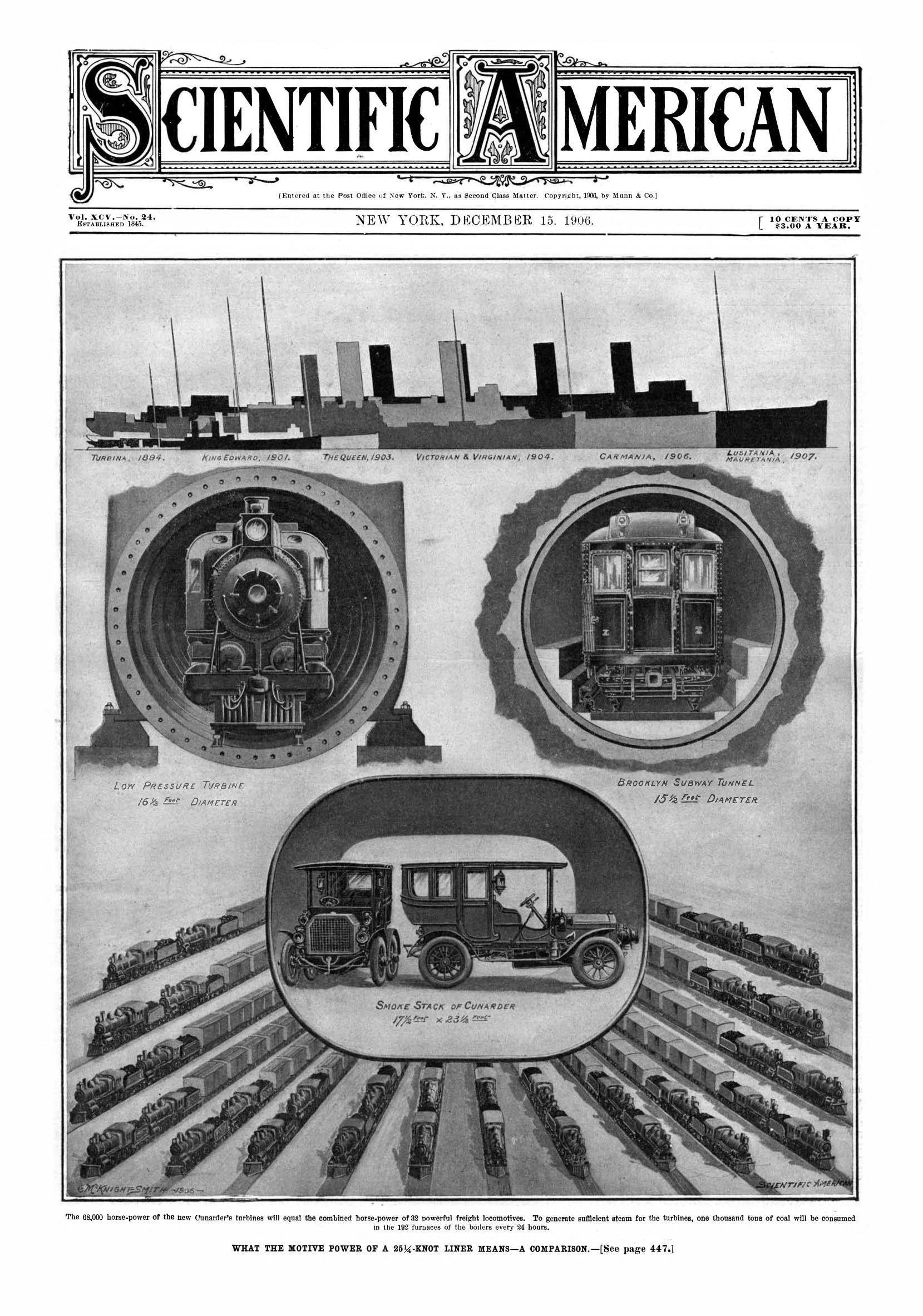
    There are a number of entries on this blog on graphical representations using popular and familiar objects to measure some other mostly-unknown object or idea against. For example, the amount of dirt excavated for the Panama canal was measured and depicted in one article in terms of how many Great Pyramids it would fill; the dept of oceans was measured in terms of Eiffel Towers, and the heights of buildings measured with ocean liners. Trinity Church has been used quite a few times, as has the Woolworth and Empire State buildings. In today’s example there are two examples of measuring things in terms of large groups of trains. The first is a visualization of data depicting the energy generated by the power plant of an ocean liner, found in the pages of the great Scientific American for December 15, 1906; the second uses a vast line of trains to depict the amount of mail delivered in the U.S. over the course of one year.  Enjoy!

    Sci AM 1906 what motive power of cunarder means

  • Great and Complex Bicycle Illustrations, 1885

    JF Ptak Science Books  Quick Post

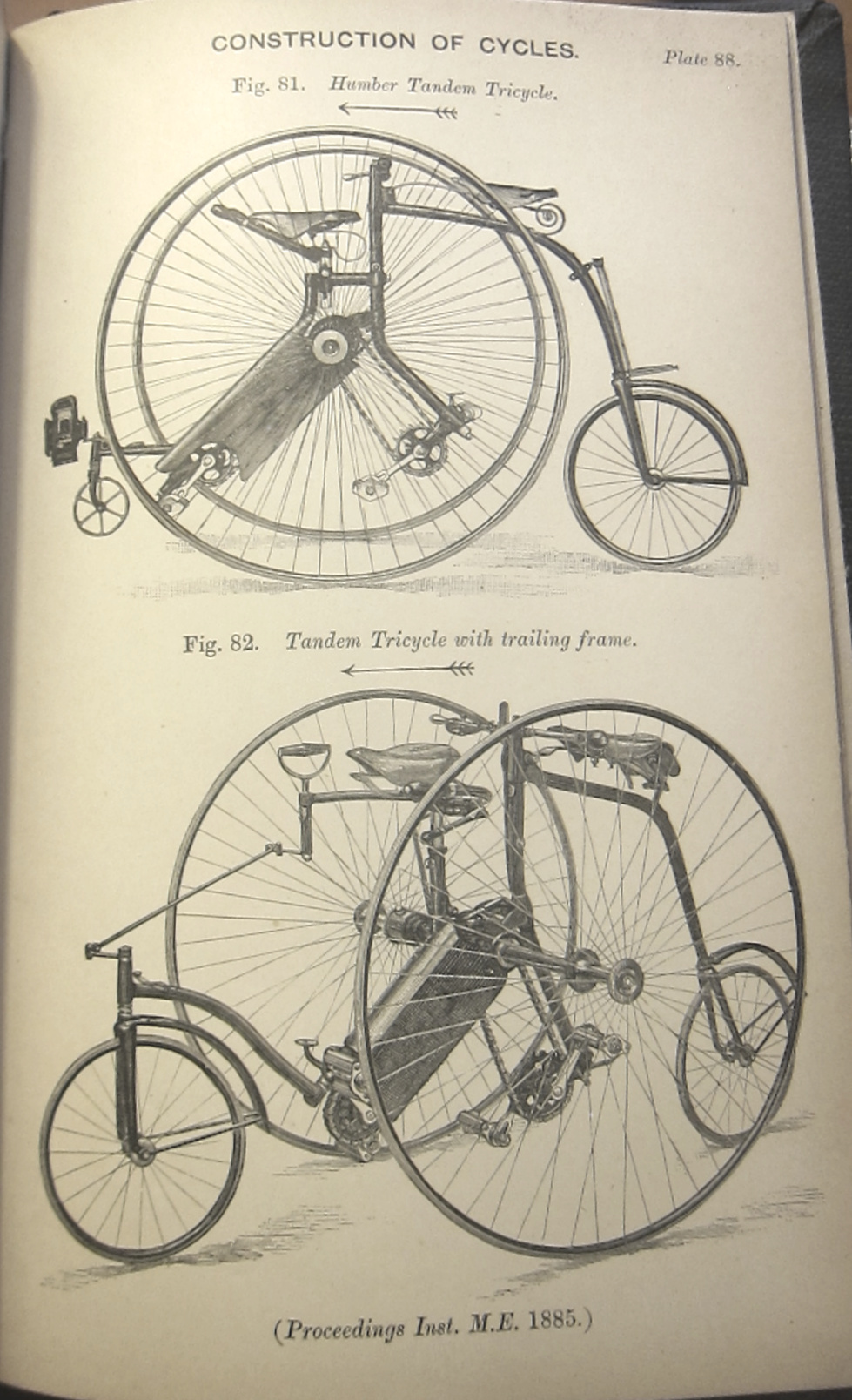
    This post comes from the blog bookstore part of this site, and is just a quick note to surface the unusual and scarce images. The article in question is “On the Construction of Modern Cycles” by Robert Ed. Phillips and appears in the Institution of Mechanical Engineers, Proceedings, and was published by the Institution in October 1885. The paper appears in the issue of pp 461-552 occupying pp 467-521, much of which is occupied by 39 fantastically well-illustrated engraved plates (numbered 62-100). The illustrations are beautifully detailed and feature all manner of technical aspects of bicycles. (Two years hence, in 1887, Phillips would published a lovely book, The Pleasures, Objects, and Advantages of Cycling (London, by Simpkins.)Bicycles 1885 _1_


    ·Posted by :

    ·in:

  • Groundwork for a Post on Cities in the Sky

    JF Ptak Science Books  Developing Post

    “Othello: And O you mortal engines whose rude throats/Th’immortal Jove’s dread clamors counterfeit…” – Line 352

    I’m carving out this space on the blog for a collecting post on the relatively old idea of floating cities/cities in the sky. I was going to try to limit this occasional search and bumped-into-it collective to our sky–Earth’s sky–as opposed to skies elsewhere, or space station-like structures, or orbiting colonies around Mars, or some such, but those examples seem so far to be richer than the terrestrial types, so I’m including them, for now. The story on these things seems to go back at least to the 18th century with the Laputa of Daniel Defoe–but since this is a learning post all of this stuff is subject to change, and there well may be a rich history of floating cities that is pre-Swift. For now I’m simply going to assemble what I find and post it here, and then shape it into something beyond a chronological listing as I go along. (Also for the time being we’ll leave Celestial Kingdoms and Heaven out of this discussion.)

    1726

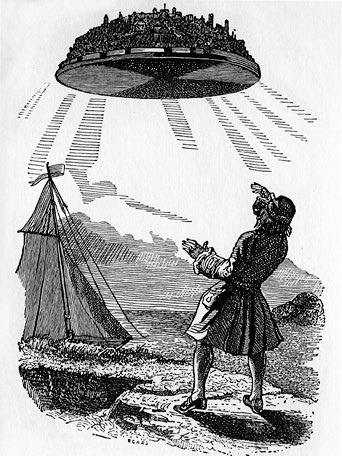
    A fine early example is found in Laputa, the floating island of Jonathan Swift (1667-1745) from his Gulliver’s travels (1726) which is a very strange, advanced, retrogressed, attractive, and repellent place.  It is about 4.5 miles in diameter, and is populated with scientists/scribes/mathematicians and the like, and their wives, with the balance of the population being servants who are the ones who seem to push the mal-contented society going in a semi-positive direction.  The scientists are head-the-the-clouds who cannot make practical contributions in spite of their scientific acumen. They in fact have a hard time getting from place to place, and are accompanied by servants who whack them in the head with a bag full of beans or peas or something to get them to pay attention to what it is in front of them. The wives are interested in travel, to go down to the ground for a vacation from their gravity–defying fortress, but few of them get permission to do so because once off Laputa no one seems to want to return.  Well, there’s also the issue of Laputa (or, “the whore” in Spanish) being lowered to crush enemies beneath it, but that’s another story. 

    City floating laputahttps://en.wikipedia.org/wiki/Laputa#/media/File:Laputa_-_Grandville.jpg
    1912

    L. Frank Baum—the creator of the Oz series—teamed up again with Oz-illustrator John R. Neill to produce Sky Island: Being the Further Adventures of Trot and Cap’n Bill after Their Visit to the Sea Fairies in 1912. Its a kids’ fantasy novel that does introduce a literal island-in-the-sky—unfortunately it is not illustrated, so far as I can find. It is also far sweeter than anything else that I’ve found so far in the massive-floating genre.

    1922

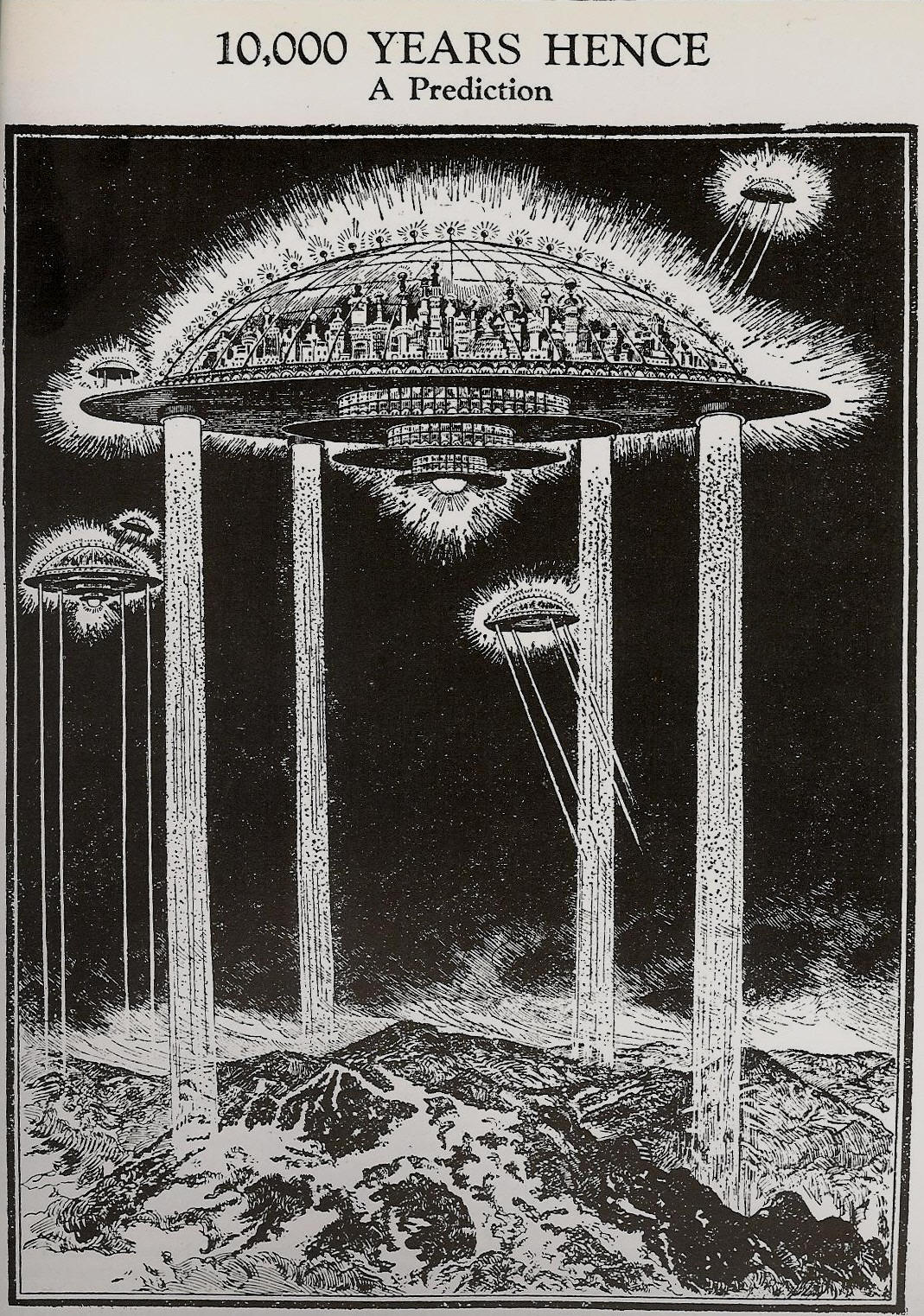
    Hugo Gernsback (1884-1967) was an inventor and also one of the founders of “science fiction” and a big name in 20th century speculative fiction. In this article he presents the possibilities of what the future might hold for somebody or something in 10,000 years, one of which were NYC-sized floating cities. He does make a very good point when thinking about the future, and from his vantage point in 1922 looked back at what the world was like during Napoleonic times in 1822, stating how impossible it was for those folks to foresee what the world of 1922 was like. If such advances were possible in 100 years, what would the next 100 bring? 1000? 10,000?  He makes an excellent point, and one contribution he made to seeing the impossible was this idea of floating anti-grav cities. This would’ve been more interesting if he stated more “why” than “how”, but so it goes.  

    City--floaing gernsback

    • “Our illustration depicts one of the future cities of about the size of New York floating high up in the air, several miles above the earth. The question of sustaining such a large body in a rarefied atmosphere will prove to be of little difficulty to our future electrical engineers. Just as we construct leviathans of the sea today, some of them weighing as much as 50,000 tons, we will construct entire cities weighing billions of tons, which cities will be held in space not by gas balloons, propellers, or the like antiquated machinery, but by means of gravity-annulling devices.”–Science and Innovation, vol 9 #10, February 1922. 
  • Great Images Found in “Popular Mechanics”, 1942

    JF Ptak Science Books  Quick Post/Annual Image Series

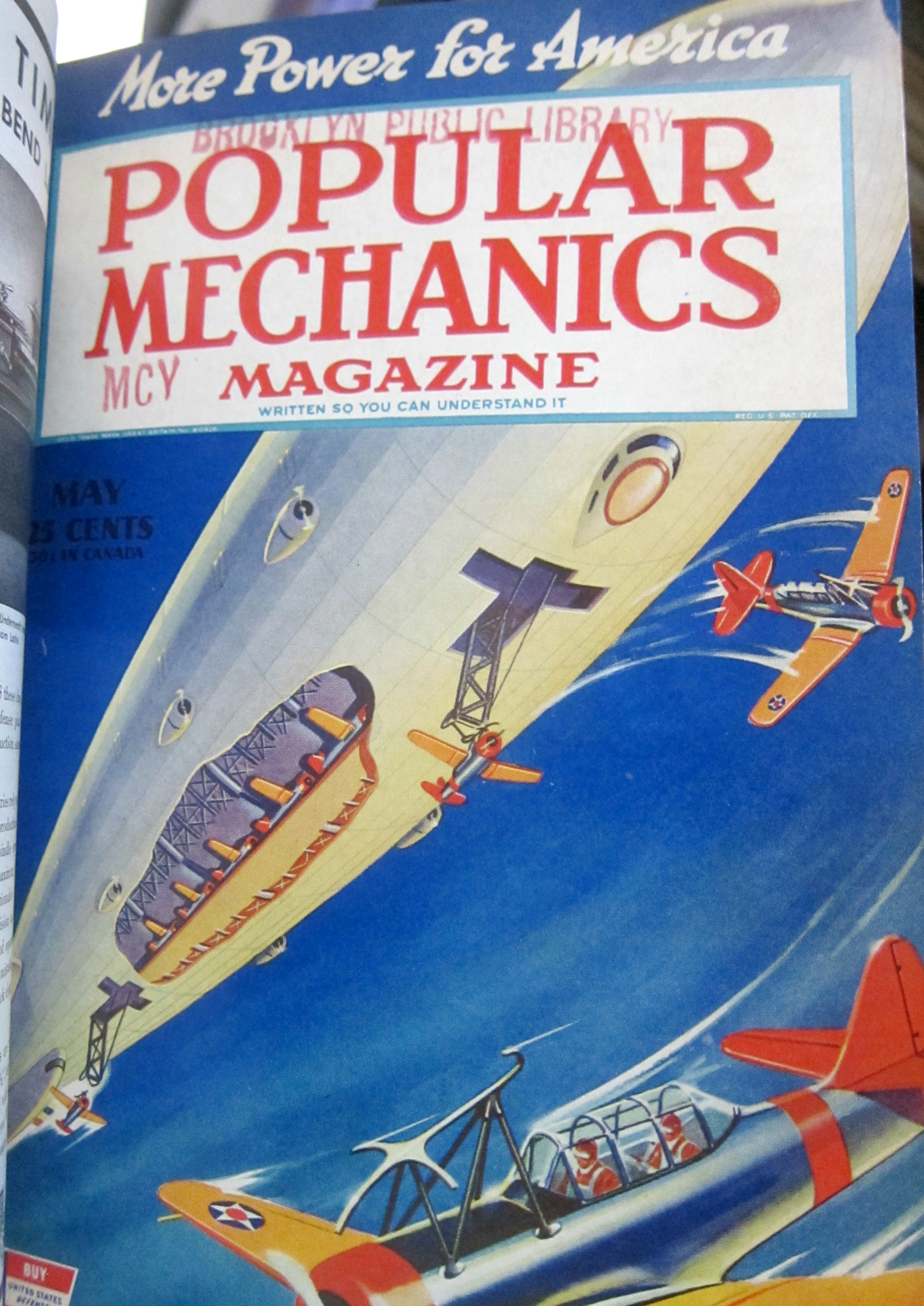
    I’ve posted many times on interesting  images that I’ve found in many different journals, my favorite and most commonly used sources being Scientific American (1845-1920), Journal of the Franklin Institute (1828-1960), Popular Mechanics (1920-1950), Science and Invention (1920-1940), Popular Science (1880-1920), and that sort, though I prefer those listed as I have them here and they’re a delight to browse…you learn something every time you open the volume. While saving and naming a scanned image just now, dropping it into place according to publication/year, it occurred to me that I could create a simple series of posts on selected images per given year by journal/magazine. This would give the images some context (or at least more so than as stand-alones) and it would also be very easy to do since the work is already done. 

    The first of the series will be for Popular Mechanics, January-June, 1942. The volume is heavily war-related, and offhand I’d say the general impression is that most of that is defensive (coastal defense, air raid wardens, gas masks) than offensive (attack plans, fighter planes, warships, etc.).  Here’s a sample:

    Pop Mech 1942 invasion scenario

Recent Posts

Archives

Categories