A Daily History of Holes, Dots, Lines, Science, History, Math, Physics, Art, the Unintentional Absurd, Architecture, Maps, Data Visualization, Blank and Missing Things, and so on. |1.6 million words, 7500 images, 4.9 million hits| Press & appearances in The Times, Le Figaro, Mensa, The Economist, The Guardian, Discovery News, Slate, Le Monde, Sci American Blogs, Le Pont, and many other places… 5000+ total posts since 2008.

  • History of Fear: Money and Failure in 1933

    JF Ptak Science Books  Post 2317                                                            History of Fear series

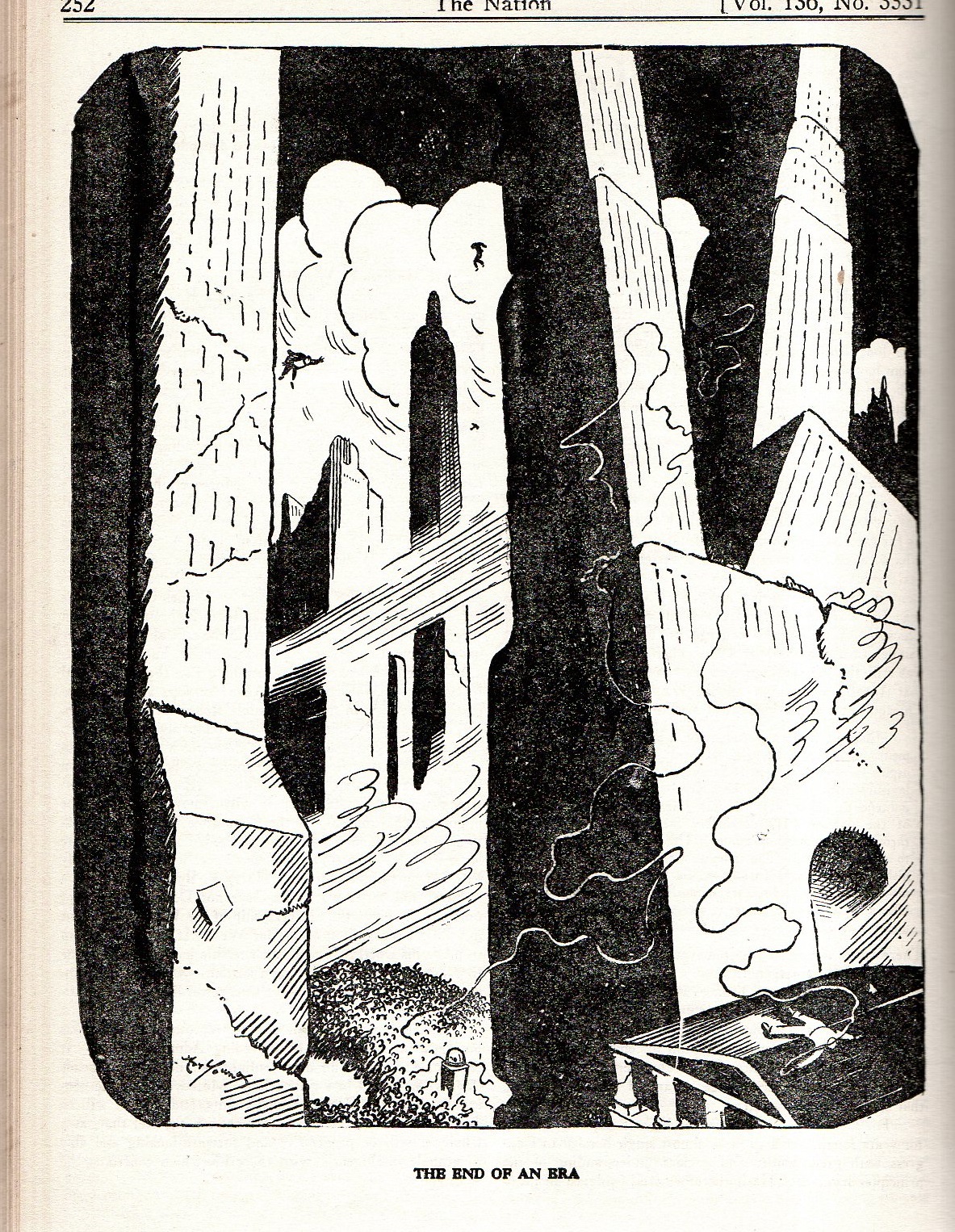
    What this toughly bleak political art is referencing was the gloom and doom of the corruption of the economy, with fortunes and family savings lost, of despondencies, of mass failure. It appeared in The Nation for the issue of March 8, 1933, the first issue printed in the newly inaugurated Roosevelt presidency, four days after the famous inaugural “The only thing we have to fear is fear itself” speech. [See here for text of the speech as well as audio.]
    Nation jumpers317

    So in the first 1100 days or so of the Depression, there was plenty of fear to fear, not the least of which was booming unemployment. The average rate of unemployment for this period went from 3.2% in 1929 to:1930: 8.9%;1931: 16.3%; 1932: 24.1%; 1933: 24.9%; 1934: 21.7%; 1935: 20.1%; 1936: 16.9%; 1937: 14.3%; 1938: 19.0%; 1939: 17.2%.

    There was also the general malaise and partial breakdown of the production of the country as a whole, as measured by the U.S. Gross Domestic Product, which (in current dollars) looked like a retracting landscape, with the pre-crash 1929 figures being $103.6 billion, followed by 1931 at $76.5, 1932 at $58.7, 1933 ($56.4), 1934 ($66 billion and the beginning of the Roosevelt era and through 1937 a period of fantastic recovery and growth); 1935 at $73.3, 1936 at $83.8, 1937 at $91.9,1938 at $86.1, 1939 at $92.1, 1940 at $101 (which was the year that mobilization began in earnest, with huge/record spikes in production); 1941 at $126.7, 1943 at $198.6, 1944 at $219.8, 1945 at $223.

    (And just because I have the figures at hand, the amounts of government spending during the Hoover years were 1929: $9.4 billion; 1930: $10; 1931: $9.9;1932: $8.7; then under Roosevelt in 1933: $8.7 billion: 1934: $10.5; 1935: $10.9; 1936: $13.1;1937: $12.8; 1938: $13.8;1939: $14.8, followed by the war years and buildup, which in itself was explosive growth 1940: $15.0 billion;1941: $26.5;1942: $62.7;1943: $94.8;1944: $105.3; and 1945: $93.  The average government spending as a percentage of GDP under Roosevelt increased to 15% in the 1933-1939 period from 11% under Hoover; during the mobilization the average expanded to about 35%. )

    So, the social commentary by the artist was really a slapping announcement to all readers that the crash of 1929 was still crashing, that the economy was still failing, and that things were getting worse.  Welcome to Washington, Mr. Roosevelt.  
    ·Posted by :

    ·in:

    —
  • Red Radio–Found & Manipulated Tech Art

    JF Ptak Science Books   Quick Post

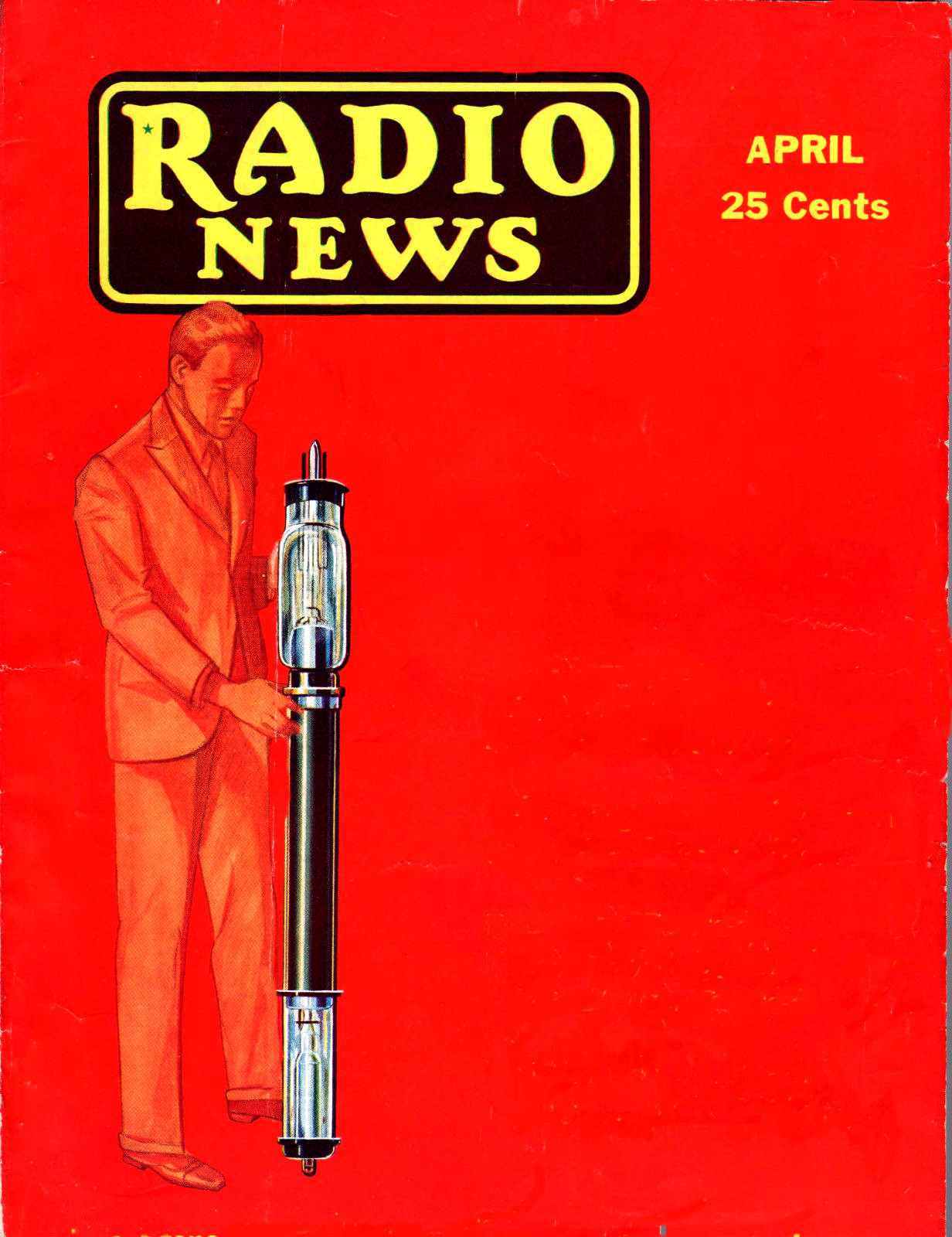
    I just like the cover art for Radio News. For at least the decade that I know about this journal published with very heavily red covers.  This one, for April 1931, was really red and also had some unusual design going on–especially after the cover text was removed. That fellow is standing there with the giant tube that helped the venerable KDKA (Pittsburgh, one of a few contenders for the title of “first commercial radio station” in the U.S.) reach millions of people, with a very powerful 400 kW signal–it basically made the station a local-national. (As it turns out the highest power ever authorized for AM radio was 500 kW to WLW (Cincinnati) in 1934, but which was modified down to 50 KW.)

      Radio News Red[The only manipulation was removing the text from the bottom right that displayed the issue’s contents–everything else is in situ.]

  • A Peek into the Future of Modernist Painting–1863

    JF Ptak Science Books   Quick Post   [Part of the History of the Future series.]

    I’ve written on this blog on a number of occasions about the coming of The Modern, about the coming of many modernisms that came to life in the extraordinary period of 1885-1925 (which could even be shaved perhaps to 1895-1920 and further if you’re a stickler), when nearly all things “modern” in nearly all fields came to be.  Sometimes though one can see a hint of the future, even though it might not necessarily be recognized at the time.

    Punch modern231_edited-1
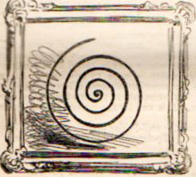
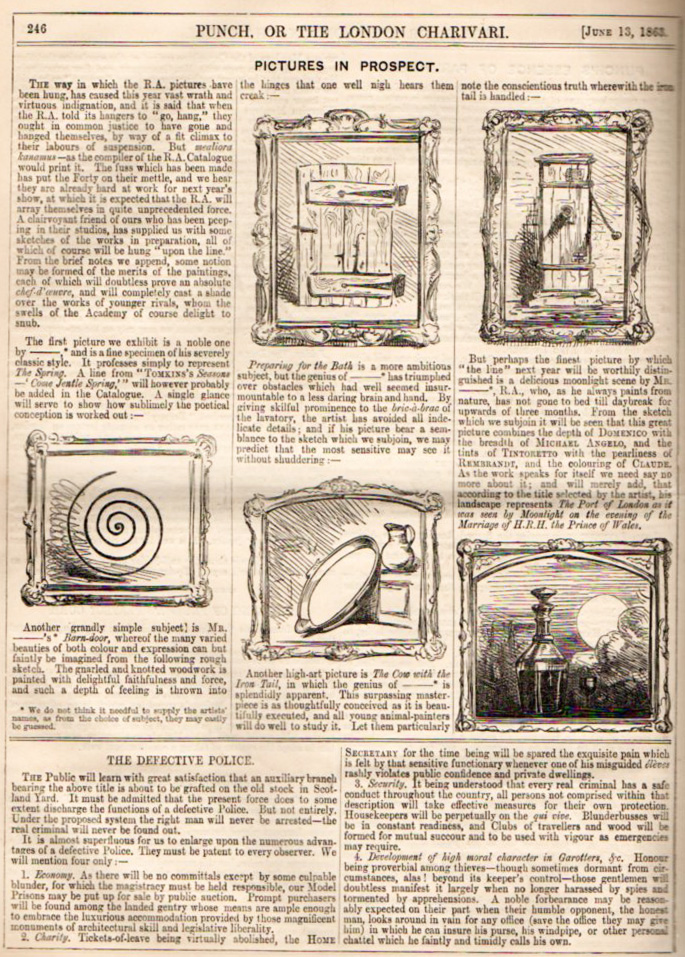
    Such is the whisper of the future in this humorous, somewhat mocking piece on art in the 13 June 1863 issue of Punch, or the London Charivari.  Overall its pretty funny in a 19th century fashion, but what I am taken with most of course is the first piece, the framed non-representational artwork, a taste of the future that wouldn’t arrive for another 50 years with Wassily Kandinsky.  But here it is, or here is something, presented as art, in 1863, and with no discernible, naturalistic subject matter. 

    Punch modern231
    Even in satire, seeing such a picture give some pause–if for no other reason, that even here in the early stretch of Abstract Expressionism, that such an image would appear in a very popular journal and have (a) no impact  and (b) not an ounce of staying power. 

    ·Posted by :

    ·in:

  • A Sad Bit on Positivist Criminology, 1893 (And on Women & Tattoos)

    JF Ptak Science Books  Post 2262

    Lombroso

    In an interesting article in Popular Science Monthly (volume 44, December 1893) Helen Zimmern reviews the work and vision of positivist-criminologist Cesare Lombroso’s Criminal Woman.  Lombroso was a believer in certain bits of investigation and experimentation that he took as science. He examined the physical characteristics of criminals and made aggressive assumptions on how the shared statistics of visual clues could elucidate the character of a person.  He measured all sorts of things in prisoners–head shape, skull capacity, all manner of other body part measurement,s hearing ability, strengths,m weaknesses. color determination, acuity, agility, sagacity of facial features, and on and on, and was fairly well satisfied that he had unlocked a code of criminality determined by mostly visual interpretation–in effect, a naked-eye DNA.  It was certainly in keeping with the time and the belief in New Statistics.  Most of it was bunk, dangerous, and useless.  

    IT was all taken as a science of sorts at the time, and Ms. Zimmern reviewed the Lombroso work as a scientific, evidentiary document.  Mostly the conclusion are sad and wilting.

    Here’s a bit from the review, followed by a couple of links to other works in English by Lambroso.  

    “…on tattooing in women, the tendency to tattoo being, according to Lombroso, an infallible indication of criminal tendencies.”–Cesare Lombroso, “Criminal Woman” review, page 221. 


    ·Posted by :

    ·in:

  • Bill of Mortality, London, December 1665

    JF Ptak Science Books   Quick Post

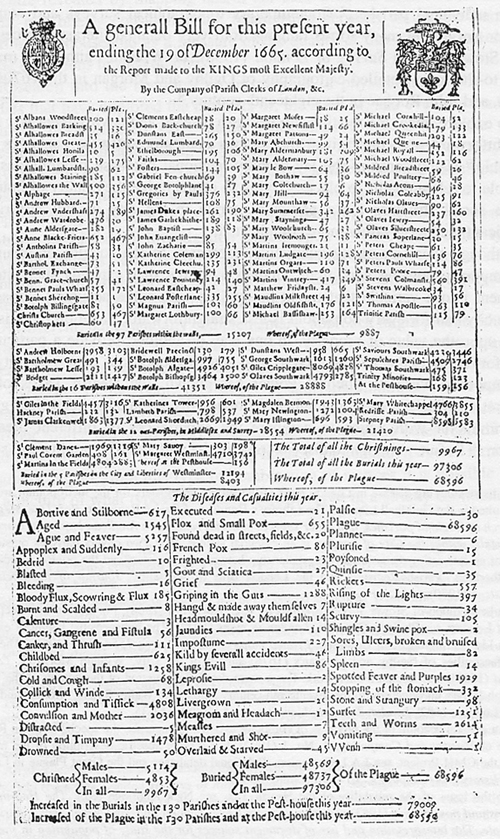
    Six days before Christmas in 1665, the city of London and environs had suffered through more than a year of the Bubonic plague:  the Great Plague of London, killer of 100,000+ people to that point. It was in this preceding week that the annual report of deaths in the city of London were reported in this very grim bill of mortality:

    Bill_of_Mortality

    [Image source:  Wikicommons]

    ·Posted by :

    ·in:

  • A Note on When Literally is Figuratively

    JF Ptak Science Books   Post 2263

    [My thanks to Patti Digh for finding the article that started this small exploration.]

    In the new world of words that is Webster’s dictionary, we find “literally” meaning something less that it has never meant since the beginning of Webster’s in 1828. Evidently the new definition is made to accommodate the slanging/slangy use of this fine word in magazines and television, and especially not-good television. 

    I don’t see the need for screwing this word up, particularly when it comes to mean something completely different, just to pacify a current and goofy usage. Not having see the new Websters, I quote Dana Coleman, from Salon Magazine online, in the article that may be titled “According to the dictionary, “literally” now also means “figuratively”)” on the new definitions of “literally”: “In the first definition of the word,“in a literal sense or matter; actually. Its second definition is, “in effect; virtually.”

    “Virtually” is not “literally”, which is very weird, because Webster’s is messing around with something that defines the ‘is-ness” of language, a word that tells us precisely that something that is supposed to be something actually is that something, though now they tell us that “is” = “maybe”.  

    It is just a bad practice. Literally (old sense). I doubt that the OED will follow in these footsteps, unless Webster’s changes the meaning of “follow” to include things that don’t follow.  

    ·Posted by :

    ·in:

  • A Cemetery for Craters

    JF Ptak Science Books  Post 2364                                                           History of Holes series

    [Thanks to Jonathan Harvey for surfacing this image earlier today.]

    Cemetery for Craters.  That is what came to mind reading an article on WWI and the Hooge Crater Cemetery

    Craters are holes usually filled with dead people, a cemetery powering its way through the air looking for a place to land.  You can assume that many of the shells fired dfuring WWI were indeed flying cemeteries which landed and exploded, making their crater and creating a cemetery in it. 

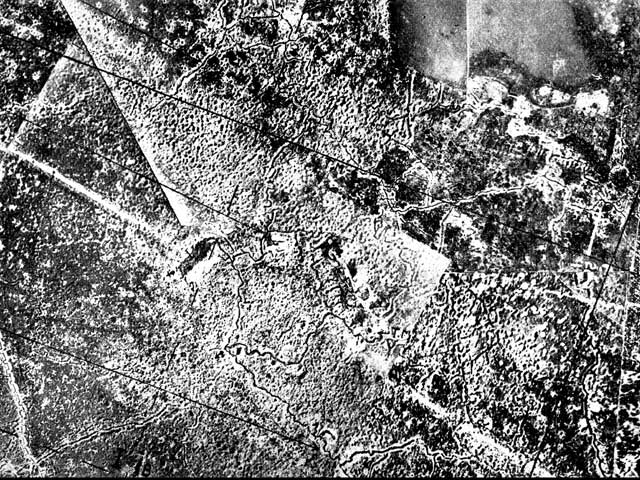
    This is what the town of Hooge looked like after the vicious fighting that took place there in the  Battle(s) of Ypres: 

    Crater hooge aerial

    [Source: Australians on the Western Front]

    The Hooge Crater Cemetery is actually a cemetery in Hooge, Belgium, which was a salient in the massive ultra-battle of Ypres, which was just about a war in itself, along with other gigantic battles such as Verdun and the Somme. And Gallipoli.  And Brusilov. And another two dozens battles in which 100,000+ were killed.  Ypres was actually three major battles which were fought in 1914, 1915 and 1917; the Hooge Crater was made by a giant mine placed by the British in the German lines on 30 July 1915.  Since the geography of Hooge was fairly flat, and since the mine made such a huge crater with massive uplifts, it became a significant part of the battlefield itself–it was captured and lost and re-captured numerous times over a three year period, the last time in September 1918, right before the end of the war.  

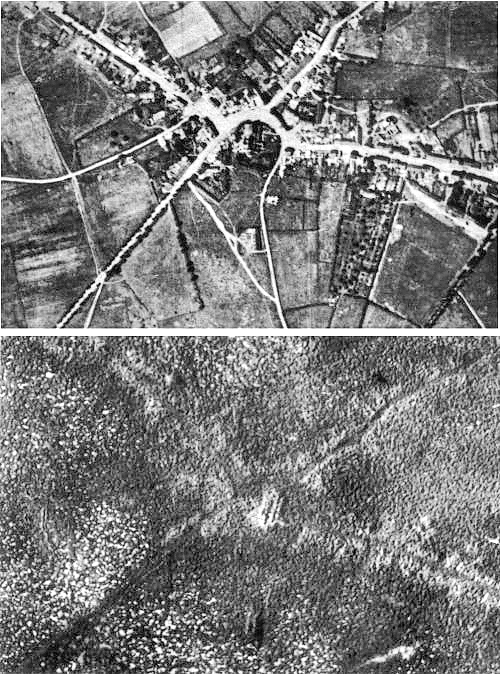
    I didn’t find a before/after aerial for Hooge, but I did for the village of Passchendaele, which turned into another cemetery of craters, especially after the vicious fighting that took place there in the Third Battle of Ypres in 1917.  Nothing but holes: 

    Crater passchendaele_aerial_view

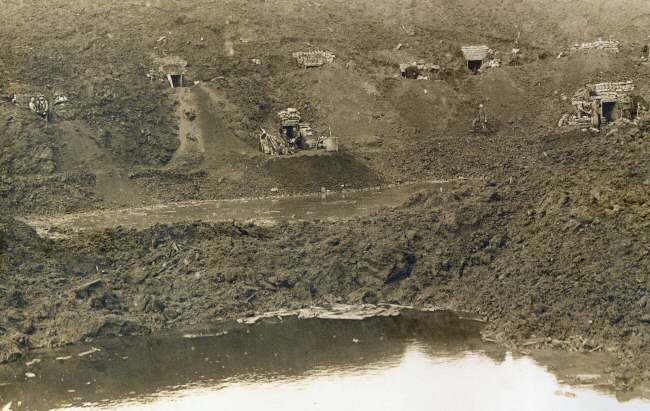
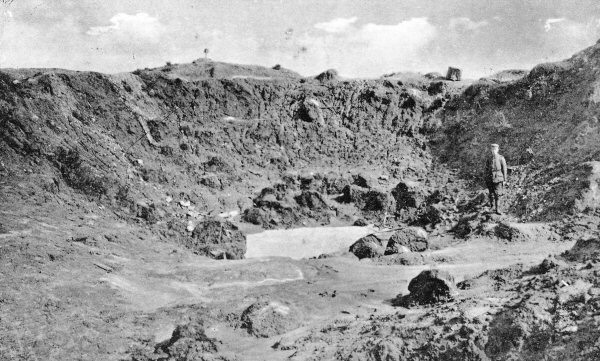
    The Hooge Crater was made by an explosive at the end of a 200′ tunnel dug by the175th Tunnelling Company of the Royal Engineers under No Man’s Land to find itself under the German entrenchments–when the charges placed at the end of the tunnel were exploded, it created a crater 20′ deep and 150′ across.  

     This is what it looked like from a crater’s-eye-view, with dugouts being made its walls:

    Crater hooge dugouts

    [Source: World War I Battlefields:  Hooge, here.]

    And another:

    Hooge_crater_1915[Source: World War I Battlefields:  Hooge, here.]

    I recollect that there were hundreds of millions of artillery rounds fired during WWI, most I think above 75mm (I cannot find this source offhand)–in any event the total number of crater creators was somewhere in the vicinity of the world’s population, something on that order.  A lot. 

    And the very odd thing is that there were enough holes made to perhaps bury every other person on the planet.  

    ·Posted by :

    ·in:

    —
  • Subtlety and the Lack of It in Advertising

    JF Ptak Science Books  Quick Post

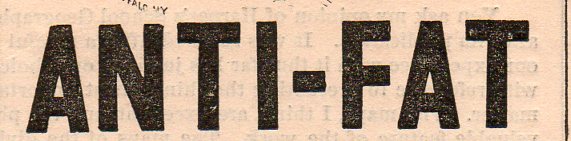
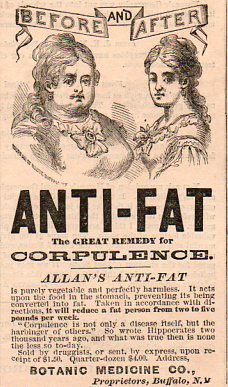
    Anti fat159

    In my bsuiness and leisure I get more than the common share of exposure to old magazines and images, musty old-book-smelling-cologne old books, basically every day. And in whatever memory shelters I have in my brain that aren’t already closed up and away to the seashore, there is one that is waaay down the hall, and it gets excited when unusual early advertising pops up.  I’ve noticed that at least in the mid/late-19th century that ads for personal improvement items were not shy about their claims and what they did and who it was for and what it would do, and it made me wonder about when the idea of subtlety sneaks into the arena of sales.  I have no data, just a collection of images, but it does seems as though the idea of the undersell comes into being in the U.K. at least in the second decade 20th century–and I say this because I’d notice how unusual it was to see an advertisement where it was not immediately apparent what the ad was selling.  Dunlop tires was one such example.  

    Anti fat158

    In any event, opening this volume of Harper’s Weekly to the June 1, 1878 issue, the ANTI-FAT ad struck me immediately as something in the Most Robust Presentation of an Idea in Advertisement category.  It gets right to the mostly-imaginary point, quotes Hippocrates as their medical authority, and that’s that.  


    ·Posted by :

    ·in:

  • How Do You Measure the Distribution of a New Idea in 1878?

    JF Ptak Science Books     Post 2263

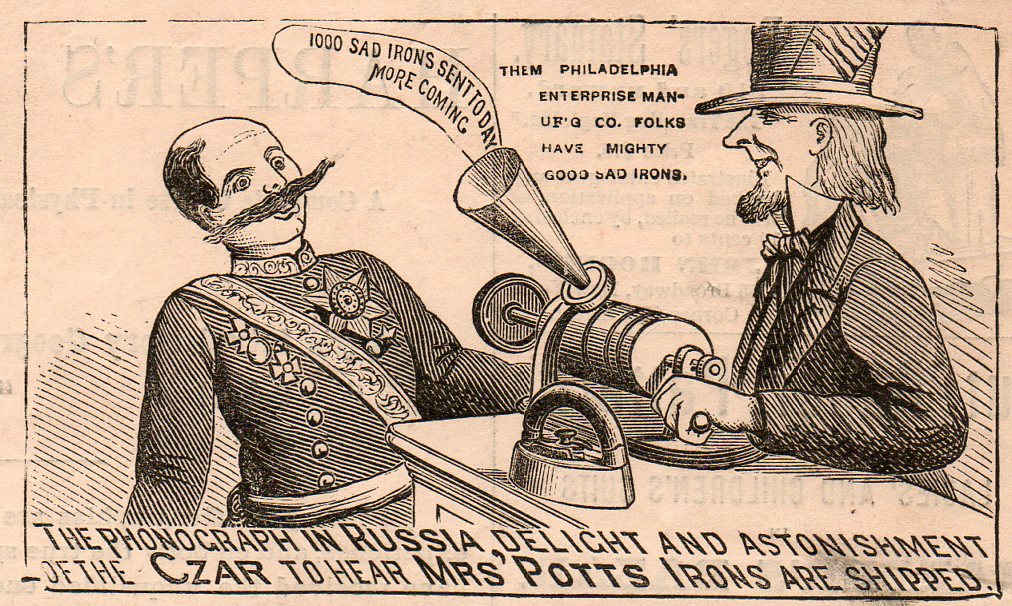
    Iron160

    Edison’s name was not a popular item in the average American home before his invention of the phonograph.  It was actually some months later, after the initial announcement in 1877, that Edison became justifiably famous. (The phonograph seems to have been up-and-running by August of 1877, though Edison did not apply for the patent until December of that year, the patent itself being granted in January 1878.) It is difficult today to place the amazement and astonishment that greeted the invention–there was nothing like it, before, ever–except for writing, of course, and then the recording telegraph.  It was a sensational piece of power, being able to record and save sound–and then play it back again.  It was the first time in human history that the auditory sense world could be audibly preserved.

    The thing about the earliest phonographs was that the recording were made on tin foil, which meant that the cylinder had a limited lifespan. The use of wax on the cylinder took a few years to come (Edison having moved on to other more interesting ideas like the light bulb rather than mess around with tweeking the phonograph) and following the initial public sensation with the invention in 1878/9 there was not another big rush towards it until the mid-1880’s with the much more durable wax cylinder.  This version not only was more stable and had a far greater shelf life, it was also much easier to use (i.e. record and play), and it was in the late 1880’s that the ideas for the use of the thing really took off.  

    I noticed this ad for Mrs. Potts’ “Sad Iron” at the top of the page for something that I wrote the blog-post previous to this one. It is an odd thing, Uncle Sam presenting the Czar with a recording of Mrs. Potts’ irons being shipped his way. (This was a clothing iron, shaped sort of like a boat, made of iron, and fired up on some heat source–Mrs. Potts’ big improvement was to have a detachable handle on the thing.) 

    The ad is dated June 1, 1878, which makes it quite an early use of the great new invention, still in the same year as when the thing was patented.  And here it is, a wonder of the age, used to sell irons.  

    I wonder about how quickly other great inventions succumbed to trivial notice like this…or perhaps this is more a sign of the instrument’s acceptance into popular culture, and it is actually a measure of the distribution of a great new idea that is so even and complete that six months later the thing is so well known as to be trivial?  Or perhaps this is a peek at a more-modern phenomenon for capturing teh attention of a buying public by using a word that is hyper-popular and in the news and a main point of discussion, like “Atomic Cafe” or “Radium Cakes”?  

    I don’t know–just wondering out loud.  

    ·Posted by :

    ·in:

  • What 1.5 Billion Pounds Bought the Military in 1938: Finding a Gem Inside a Great Graphic

    JF Ptak Science Books    Post 916 (from 2010, expanded)

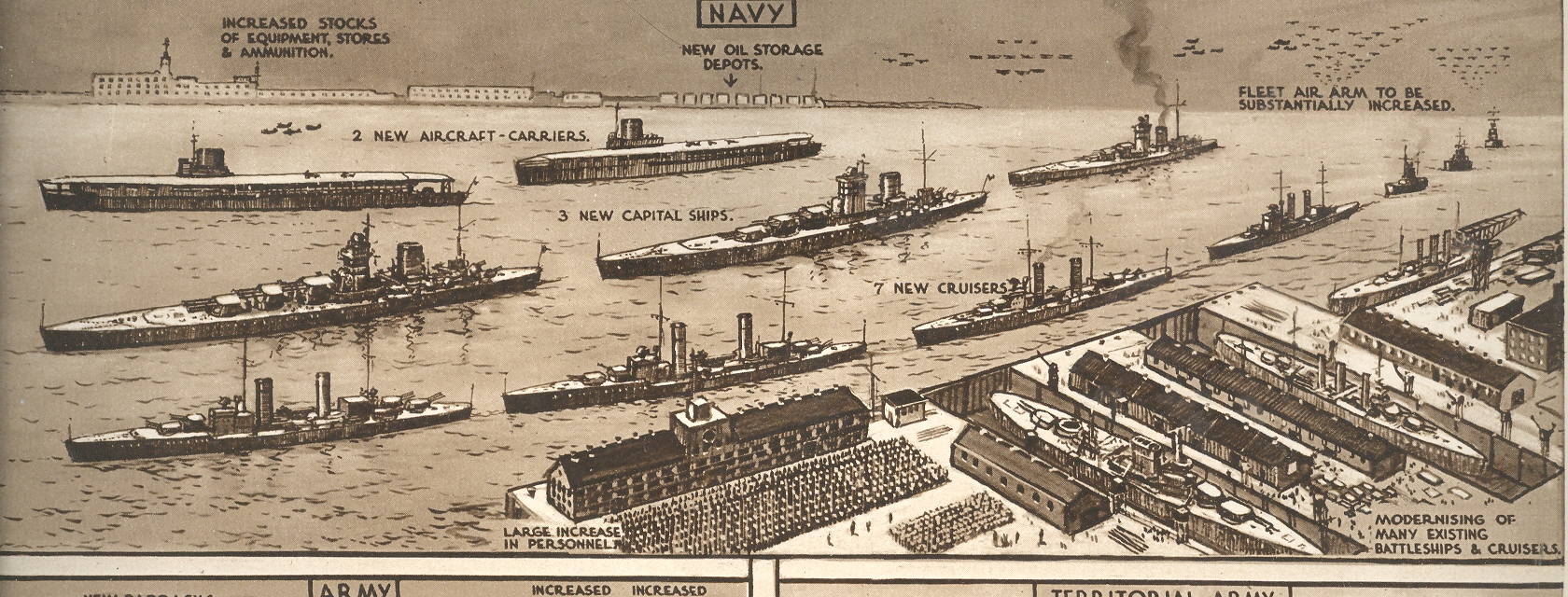
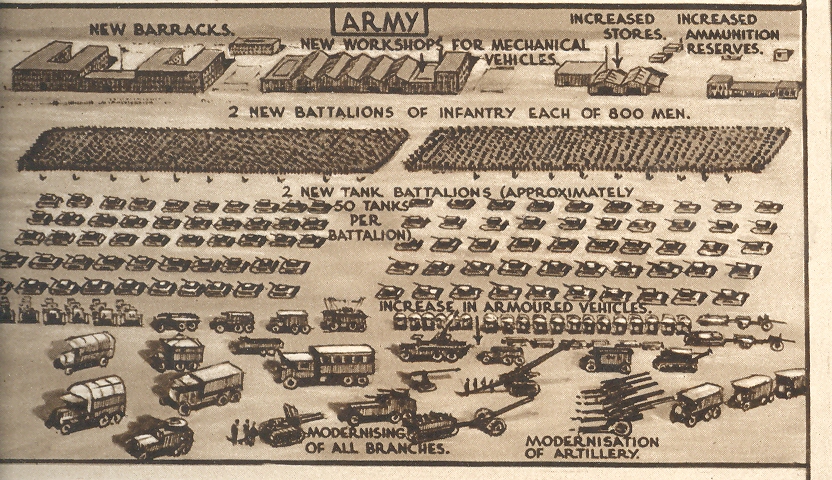
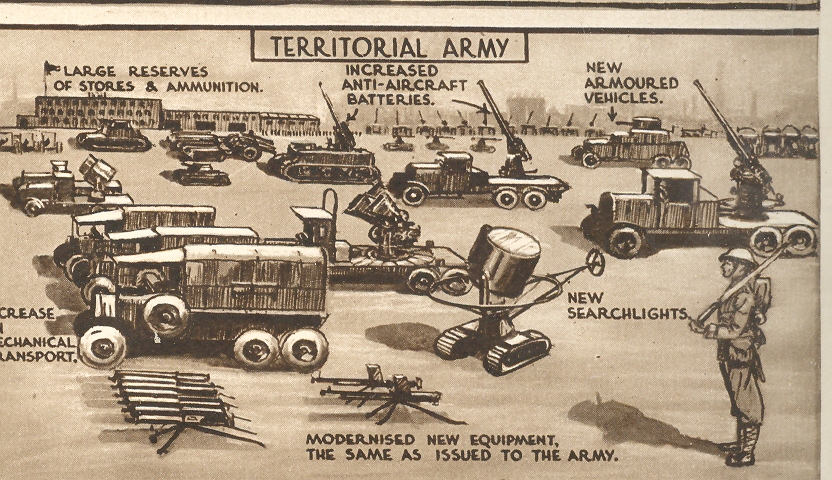
    The Illustrated London News for 27 February 1937 hosted a brilliantly designed graphic illustrating the ways in  which the British War department could/should spend 1.5 billion pounds (or about $100 billion in 2009 dollars, sort of) over a five-year period as the price of keeping the peace.  Of course they wouldn’t make it but a quarter of that distance as Austria fell to Czechoslovakia which fell to Poland and the end.  The full-page pictorial effort is to the right:

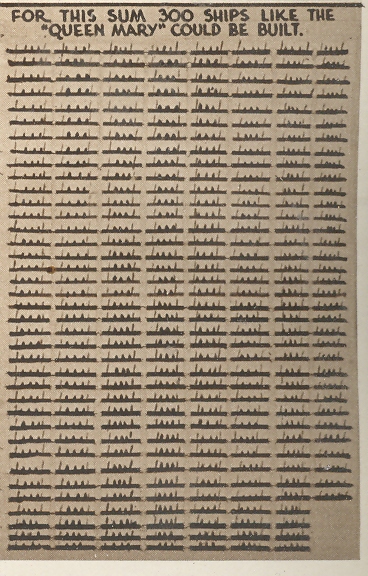
    Nestled in the corner of this page–at about 2×1 inches–is this lovely little graphic, showing that 1.5 bil could purchase 300 Queen Marys, which this delightful little design showed to great effect, and a hidden gem inside of a gem. First is a detail of this detail,

    Blog jan 22 Brit Mil bot right det 

    Followed by the full smidgen of the overall page of comparisons and analogies:

    Blog jan 22 Brit Mil bot right

    Then there’s the semi-standard presentation of what the Navy could purchase:

    Blog jan 22 Brit Mil top

    And then the Army:

    Blog jan 22 Brit Mil middle l

    And of course the Territorial Army:

    Blog jan 22 Brit Mil middle r 

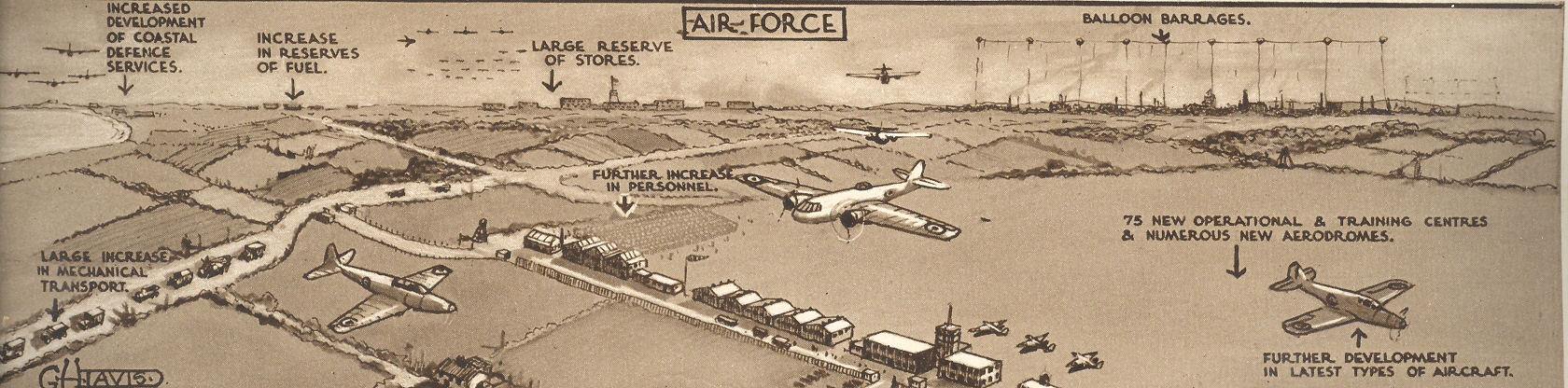
    And the Air Force (which if you look closely includes a balloon barrage  facility at upper right):

    Blog jan 22 Brit Mil middle bot

    By far the most interesting to me is the hidden gemoid of Queen Marys, all produced by the fabulous G.H. Davies, who did many hundreds of such images and sectional cutaways and plans and technical drawings for the ILN over a 25-year period.  M.r Davies may well be my favorite technical artist of this period.

  • A Very Early Nighttime View from a Balloon (1838)

    JF Ptak Science Books  Post 2264

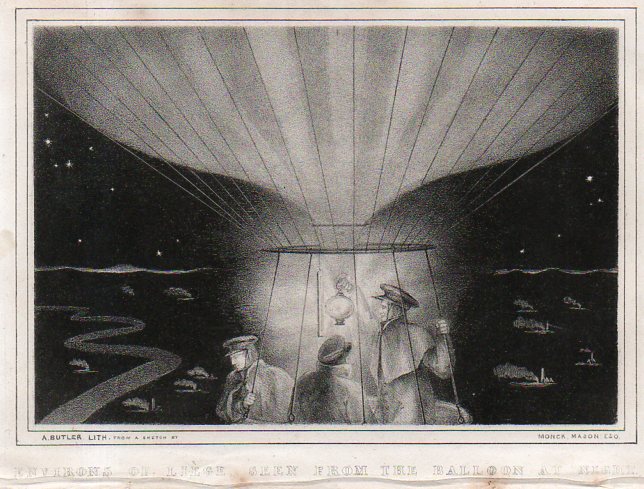
    Balloon night161

    “WHEN man reaches the Pole and when he has learnt how to fly he will almost have exhausted the list of his aspirations. The fascination of both exploits is endless. So far the art of flying has not been a success…”–English Illustrated Magazine, volume 18, no. 169, October 1897.  

    And so starts the chapter, “The First Long Voyage in a Balloon”, which in a remarkably boring way relates the story of the flight of Monck Mason, Charles Green, and Robert Hollond.  It is also a little bizarre because this was two years into the discovery of x-rays which revealed unseen worlds far more vast than the North Pole.  Plus there was George Cantor’s papers on transfinite numbers in ’95, and then Minkowski’s geometry of numbers and Becquerel’s radioactivity and the Zeeman effect and the opening of the Yerkes Observatory  in ’96.  There was a LOT going on in ’95-’97 to show how much we didn’t know and so how much more could be achieved, so it is a mystery why the writer thought that Human Endeavor was done.  

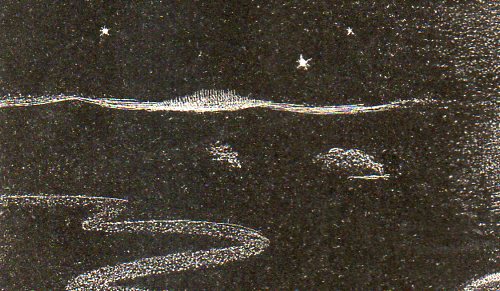
    But back to Monck: in 1836 his was indeed the longest voyage achieved by any human in flight, covering some 500 miles. An account of the voyage was written by Monck in 1838:  Aeronautica; Or, Sketches Illustrative of the Theory and Practice of Aerostation: Comprising an Enlarged Account of the Late Aerial Expedition to Germany, with the illustrations published at Indiana here.  I’m calling this out because I have a lovely lithograph, a night-time image of the three balloonists, that is most unsuaul I think because it seems to me to be a very early night-time oblique image of the Earth seen from above.  

    Balloon night162[A detail of the landscape from above]

    The artwork is by one of the ballooists, Monck Mason, who as it turns out in addition to this great voyage took another, this time making it across the Atlantic in an incredible three days. Well, that was the report of it, anyway–the article was a hoax, written by Edgar Allen Poe, and based somewhat on the real adventures of Mason.  The story appeared April 13, 1844 in the New York Sun, and attracted a lot of attention, lasting as a hoax for a few days.  The story was “retracted” on the 15th, withg the following announcement: “BALLOON – The mails from the South last Saturday night not having brought a confirmation of the arrival of the Balloon from England, the particulars of which from our correspondent we detailed in our Extra, we are inclined to believe that the intelligence is erroneous. The description of the Balloon and the voyage was written with a minuteness and scientific ability calculated to obtain credit everywhere, and was read with great pleasure and satisfaction. We by no means think such a project impossible.”–(source, Wiki, Balloon Hoax.)

    ·Posted by :

    ·in:

Recent Posts

Archives

Categories