A Daily History of Holes, Dots, Lines, Science, History, Math, Physics, Art, the Unintentional Absurd, Architecture, Maps, Data Visualization, Blank and Missing Things, and so on. |1.6 million words, 7500 images, 4.9 million hits| Press & appearances in The Times, Le Figaro, Mensa, The Economist, The Guardian, Discovery News, Slate, Le Monde, Sci American Blogs, Le Pont, and many other places… 5000+ total posts since 2008.

  • Kingdoms of Dust and Street Dirt, and What People Breathed in 1878

    JF Ptak Science Books  Post 2307

    Here’s an extraordinary find, a bump in the grazing field in the Scientific American Supplement for January 19, 1878. The article is about dust–but not the cosmic dust that some folks say is what is being seen in the Big Bang (and not a background radiation signature), nor is it like the dust equation nor the dust of Einstein’s great dust paper of 1905.  It is more like a lower-level plague dust as we see in Arthur Rothstein’s iconic dust bowl photograph made in parched Oklahoma in 1936.  It is about the residue of industry and commerce that did’t get carried of by the mysterious carry-off winds associated with the high and higher chimneys of Victorian London and other industrialized cities, and the leftover bits of the operation of daily cosmopolitan life involving say horses and trains.  It is an article about the significant particulate  matter of dust, which we know today is a high-percentage contributor to air pollution, not to mention the low-level “atmosphere” of the kicked-up business that people would breathe in every day.

    And, evidently, this dust was very heavy-metal rich in composition, which is not so good.  

    The article is “Street Dust”, and the author, Henry G. DeBrunner (who would become professor of chemistry at the Pittsburgh College of Pharmacy), decided to take a look at the dust of Pittsburgh and compare it to reports of the dust of major European cities.  He notes that Paris and London and other cities consist of 35% of “metallic iron, given by the shoes of horses to the stones, besides from 30 to 40% of good glue from the hoofs”.  Now that seems an extraordinary figure, and surprising too in many ways that it came from horse shoes. 

    Dust mask296

     [Source: an advertisment from Scientific American, volume 79, 7 January 1893, back wrapper.

    DeBrunner conducted a study at Thirtieth and Smallman Streets (Pug) and found out that 30% of the sample of dust (“a deep black color”) consisted of silic acid, 26% of “fixed carbon”, ferric oxide at 12%, sulphuric acid at about 1%, gluten 1%, Metallic iron 8.55%.  The details of how all of this was extracted can be seen below, where the entire article is reproduced. There were other samples, and it is interesting to note that in one sample near horse tracks contained 32% heavy metal and lots of glue. 

    The entire article, January 19, 1878, Scientific American Supplement, No. 107:

  • The Kingdom of Fingers

    JF Ptak Science Books  Quick Post

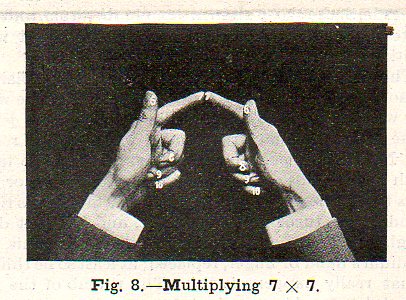
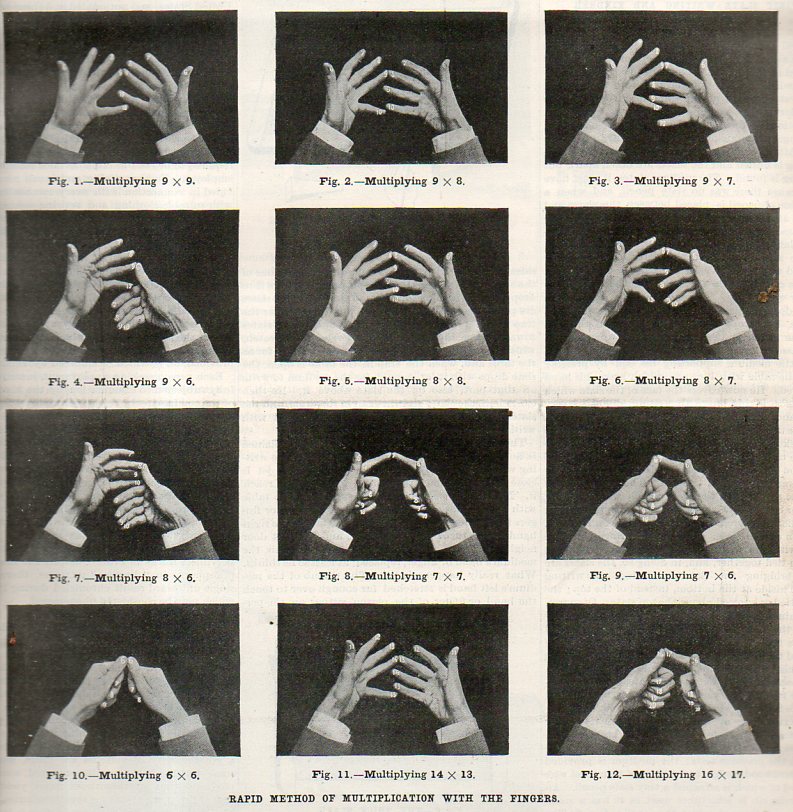
    “The Fingers as an Aid in Multiplication” is another wonderful find coming from a general browse in the great Scientific American (October 22, 1898, page 265). It is an interesting article, using the fingers so that the multiplication tables didn’t have to be memorized by kids–I think that they absolutely should be–but the images taken out of context can also be regarded in some sense for this blog’s “Found Absurdist” series.  (We are told that the system was devised by “a Polish mathematician”, Procopovitch–he is repeatedly referred to as “the Polish mathematician”.)

    • See “Digital “Computers 1450-1750: Memory and Calculating on the Fingers and Hands”, a post on this blog from 2008, here.

    Hand calculating300

    A detail from:

    Hand calculating299


  • The Accidental Absurdist: the Conformator, 1878

    JF Ptak Science Books  Post 2308

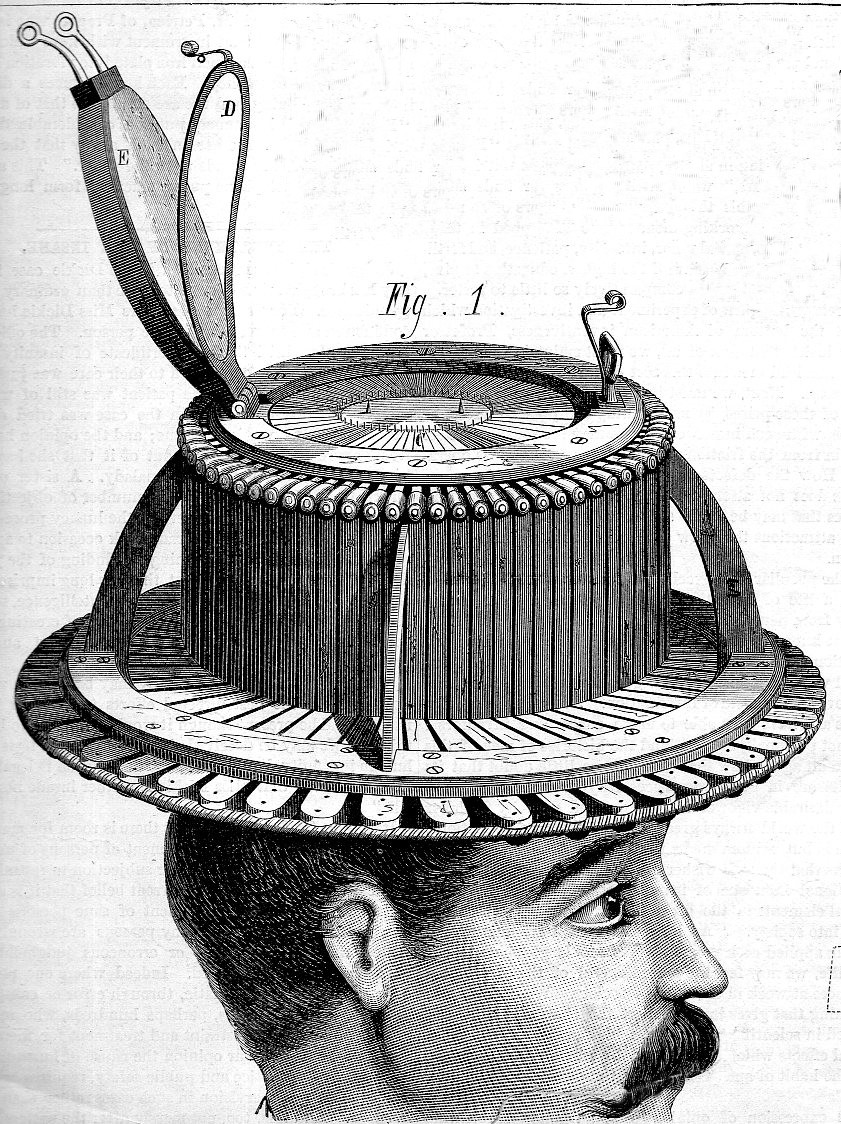
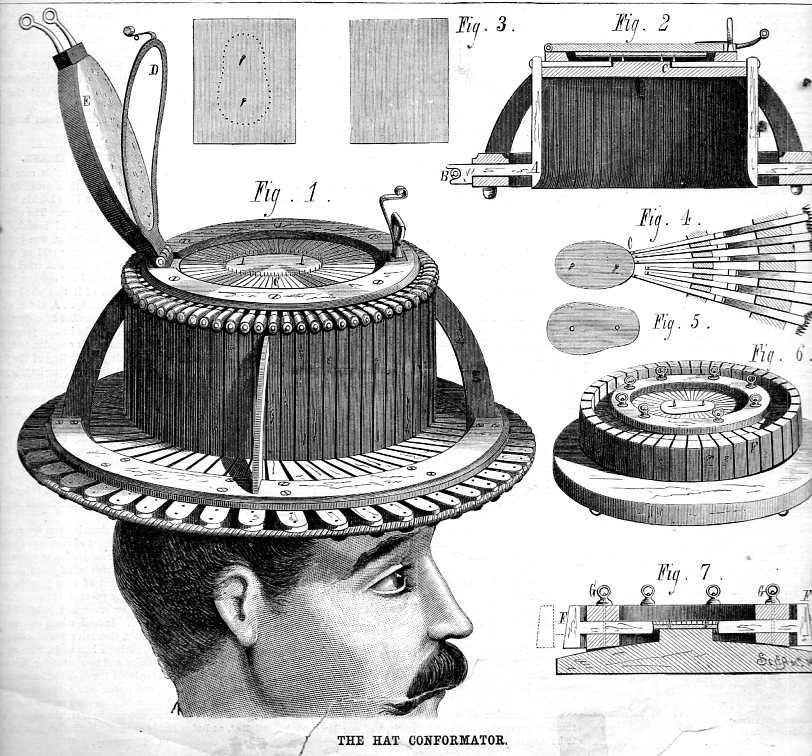
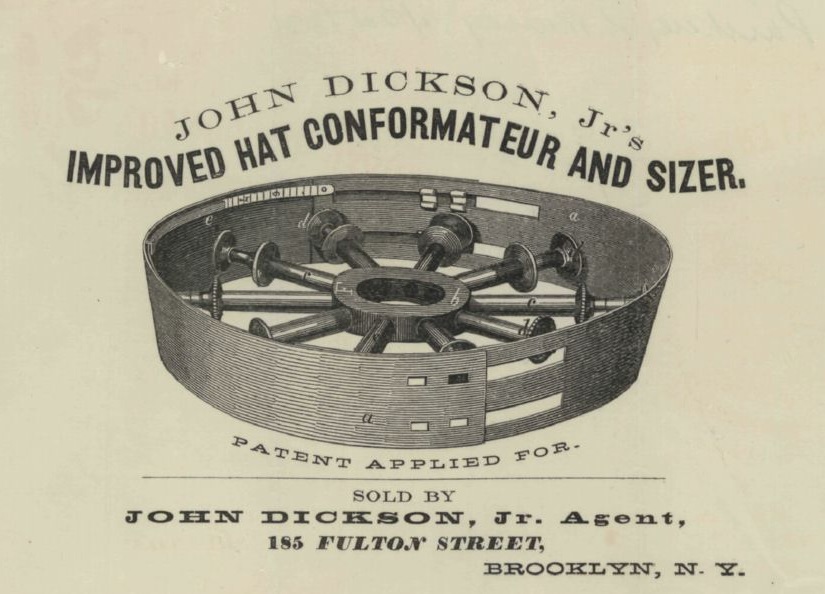
    Here’s another classic of ingenuity mixed with out-of-context accidental absurdist visualisations: the classic (I think) “hat conformator” from the Scientific American in 1878.  


    Hat conformator detail cleaned

    Which is a detail from:

    Hat conformator301

    [Source: Scientific American, March 9, 1878.]

    The $100 instrument (a wide sum in 1878, equal today in buy power to several thousand dollars) was an instrument of use not only to hat makers but to the anthropological and medical professions as well–head shape and its influence on behavior still being a concern to some, the conformator found some occasional use in relating meaning to shape.  That sort of effort would continue for some decades to come.  

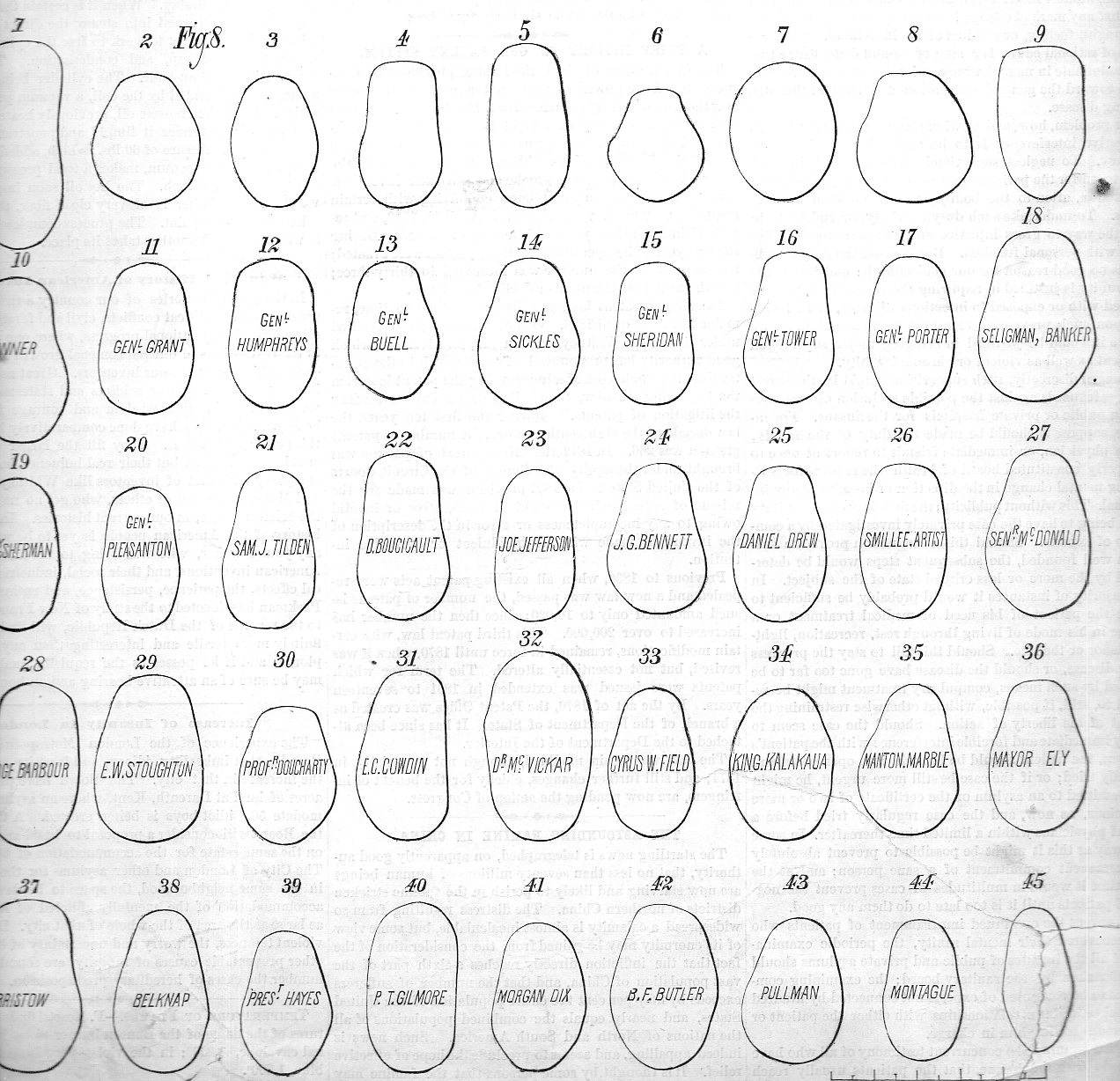
    As a classic illustration the fron page showing the conformator is generally shown when shared online or written about in paper, but I don’t think I’ve ever noticed the posting of the head shapes themselves coming a few pages later. The short chart features the axial view of some famous 1870’s heads–I would say more about this if there was anything useful to say, but really I think there isn’t so I won’t. 

      Hat conformator head shapes303

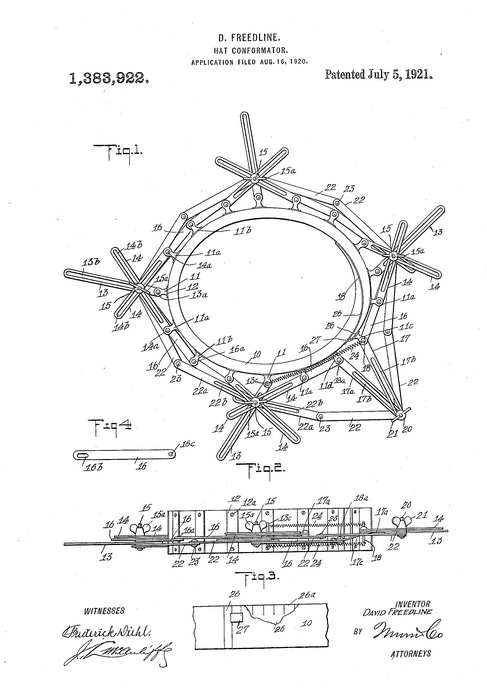
    The 1878 conformator is not unique in the history of head measurement for hats, evidently: “My invention relates to a device to be placed about the head and adjustable to conform to the anatomy thereof”, so states the very wordy originator of another patent device for a “hat-conformator” in 1921–no doubt there are a number of different ways of taking head measurements for a custom-made hat, but I think none are prettier than the 1878 version.

    Hat conformator twoAnd another–no doubt from a field of conformator richness: 

    Hat conformator


    ·Posted by :

    ·in:

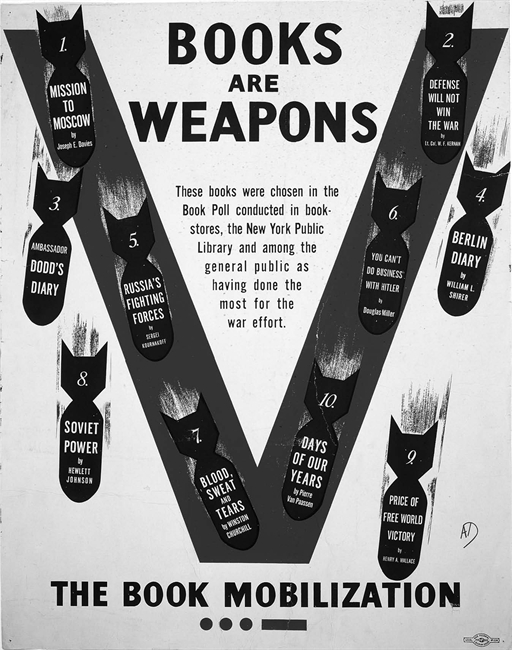
  • Books are Weapons in the War of Ideas

    JF Ptak Science Books  Post 3210  

    “Dort, wo man Bücher verbrennt, verbrennt man am Ende auch Menschen” (“Where they burn books, they will in the end also burn people”).–Almansor, Heinrich Heine. 

    Books are weapons309


    Independent and provocative ideas are usually the first things to be attacked by totalitarian regimes, and the Nazis not only did that in spirit but in action, and unfortunately part of a long and very bleak history of killing ideas and books. 

     Books have been destroyed for as long as they have been made, for reasons as varied as those for their writing:  the motivations for biblio-devastation are ever-reaching.  Perhaps the most astounding and appalling of them all resides in the fetid memory and fouled grave of the Chinese emperor Shi Huang Ti (third century BCE), who in his 49 years of life liquidated nearly every book in China, psychotically determined to make himself the most-remembered person in history by eliminating history itself.  Not to be outdone by books, he eliminated authors as well.  And scholars.

    Authors not only have been killed for their works, some have followed them directly into the flames.  Michael Servetus, who has a complicated history and who was found wanting in his relationship with church orthodoxy on many levels, met his end on a pyre with his books.  One of those books, a medical text, challenged the (religious) orthodoxy of the brain being the seat of all power and wisdom of the body, stating that it was the heart that pumped the blood and not the head, providing another chink in the armor of theological doctrine.  Pissed as the reigning Christians were with this belief, this book probably was not the thing that most annoyed them, but it also didn’t help his case, either.  But no matter, he and his books were burned together to ashes for reasonable and logical thought.  There were many others before and after this.

    The great example in the history of burning books in the West is probably Florentine Savonarola’s “Bonfire of the Vanities”, which saw th eworks of Ovid, Propertius, Dante, Bocaccio and many other classics condemned to flame

    The Nazis were interested in not being interested except for the burning of pacifist lit, degenerate art-inspired literature and art books, anything by Jewish people in any field whatsoever (including the sciences, and hence the creation of the “Jewish physics” of Albert Einstein, any works that denigrated the German people or history or anything that could possibly address action against the German state…and on and on. The infamous book burnings took place mostly on May 10, 1933 and again on June 21, functioning under the umbrella of the Main Office for Press and Propaganda of the German Student Union which asserted the great incendiary “Action against the Un-German Spirit”, though of course the orders and instructions for such a miserably fetid melange came from further up the National Socialist food chain. Some of the writers included in the burning and forbidden edicts included Victor Hugo, André Gide, Romain Rolland, Henri Barbusse,  Ernest Hemingway, Upton Sinclair, Theodore Dreiser, Jack London, John Dos Passos, Helen Keller, Joseph Conrad, D.H. Lawrence, H.G. Wells and Aldous Huxley,  James Joyce, Fyodor Dostoyevsky, Maxim Gorki,Isaac Babel, Vladimir Lenin, Vladimir Nabokov, Leo Tolstoy, Leon Trotsky, Vladimir Mayakovsky, and Ilya Ehrenburg.

    It was a pretty inclusive list, and brought the idea of a German intelligensia to wobbly and shattered knees, a prosaic and sickly-sweet German temporalism not so much unlike the music Hitler enjoyed and the very basic things that he painted.

    The response to these actions worldwide was curt and devastating, as is easily imagined, and provided simple platforms for other areas of anti-Nazi hearts and minds offensives.

    The very striking and simple image above was something I just found in the April 24, 1943 issue of The Nation—not much more needed to be said. (The Nation had since 1932 been very vocally anti-Hitler, with issue after issue featuring articles from the earliest periods of Hitler’s Germany detesting what actions the man was taking in that country, as well as gritty and effect political cartoons featuring blood and rats and the like.)

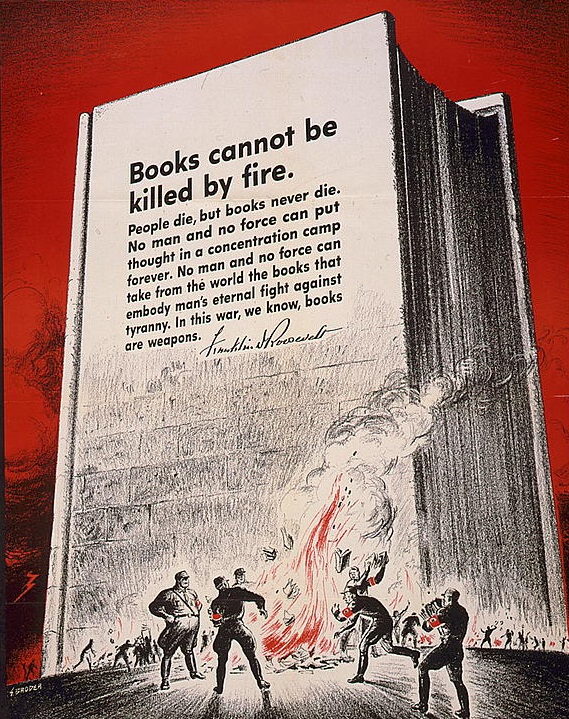
    There were other variations on this theme, like the one below, being made into a poster and using a quote from Franklin Roosevelt, and set in stark contrast to the Nazi book burnings:
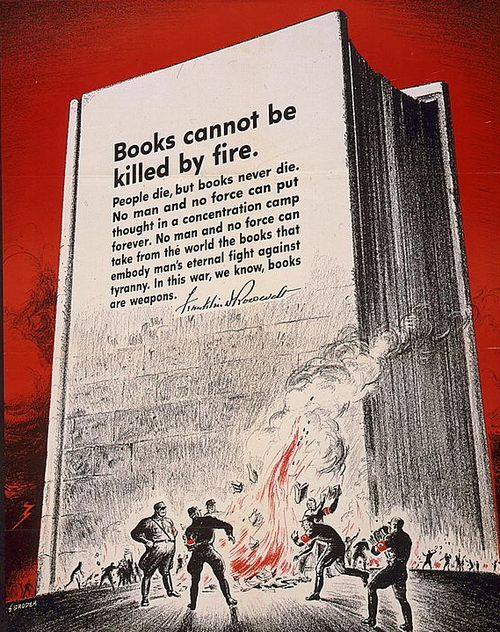
    Books are weapons 2

    [Books are weapons…poster, 1940-1945, via the Library of Congress]

    And another version, suggesting what sorts of books could be used in this war:
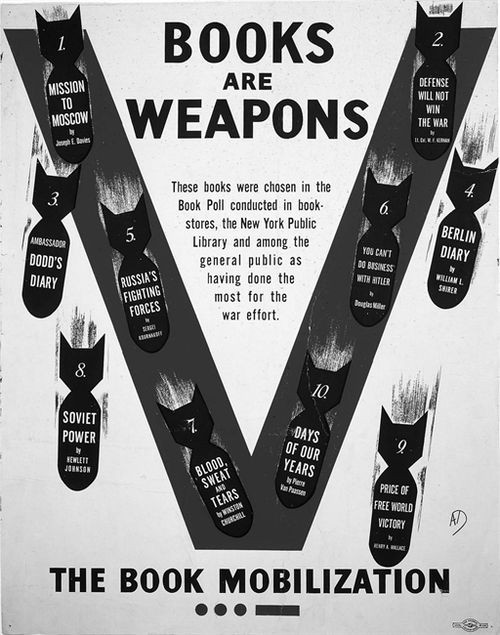
    Books are weapons 3

    Goebbels proclaimed that the flames of the books burning in Berlin were an expression of the German people–that the flames illuminated “the end of an old era and light of the new”.  An anti-Phoenix. 

    [Source: jonathanevincent blog, here.]

  • Human-Powered Flight of an Antique Nature, 1893

    JF Ptak Science Books  Quick Post

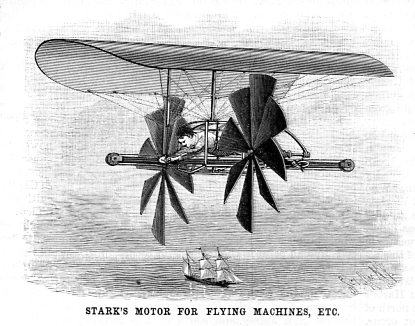
    “A Light and Simple Motor” is the title for this short article in Scientific American (February 11, 1893).  It is the work of Theodore A. Stark of Ottawa, Illinois, for the use on flying machines–it is a odd contraption that is suspended from an “aeroplane” (in this case the word is used to describe only the wing of the flying machine and not the flying machine itself), functioning like a push/pull device by arms and legs, powering the two large propellers that was supposed to keep the aircraft moving and aloft.  This has a curious feel of greater age to it, being only ten years before the powered Wright flight. 

    Ulra light motor flying machine304

    And the detail:

    Ulra light motor flying machine detail305

    ·Posted by :

    ·in:

  • On Einstein Not Being in the Popular Press Before the Great Eclipse of 1919

    JF Ptak Science Books  Post 2311

    Between the Eighth Avenue Line and Julius Einstein in the New York Times Index for April-September 1919, there is nothing.  No Albert. No Albert Einstein.  At least in the newspapers followed by the Index.  

    Abraham Pais mentions in his wonderful intellectual biography of Einstein Subtle is the Lord that there was no mention of Einstein in this index until after the famous 1919 measurements confirming his theory–this to huge popular acclaim. (This was a months-long series of work on the light rays passing through the gravitational field of the Sun, the Einsteinian theory of gravitation fitting the results rather than the Newtonian, thus determining the soundness of E’s theory of relativity.) The paper1 announcing that was read in the Royal Society in November 1919, and then published in the first issue of the Philosophical Transactions in January 1920…and other places.  But the reports started appearing in the press before that, the scientific reports lagging just a little.  

    I never checked it out until I stumbled upon a 1920 issue of Popular Astronomy, with a January 1 issue reporting on the great expedition.  

    Anyway, its true.  The popular mentions of Einstein just aren’t there.  After the reports from Dyson/Eddington though Einstein begins his journey as a household name, blown out of the relative general obscurity of popular acknowledgment (in spite of his gargantuan year of 1905 and the other great papers of 1907, 1911, 1915, and 1916). 

    Notes, with the Times index following:

    1.  F.W. Dyson, A.S. Eddington, C. Davidson, “A Determination of the Deflection of Light by the Sun’s Gravitational Field, from Observations Made at the Total Eclipse of May 29, 1919”, in The Philosophical Transactions of the Royal Society of London. Volume 220, pp. 291-333 (January 1920).

    New York Times Index, Oct-Dec 1920


    ·Posted by :

    ·in:

  • Immigration Map 1903–a Great Display of Data

    JF Ptak Science Books  Post 2113

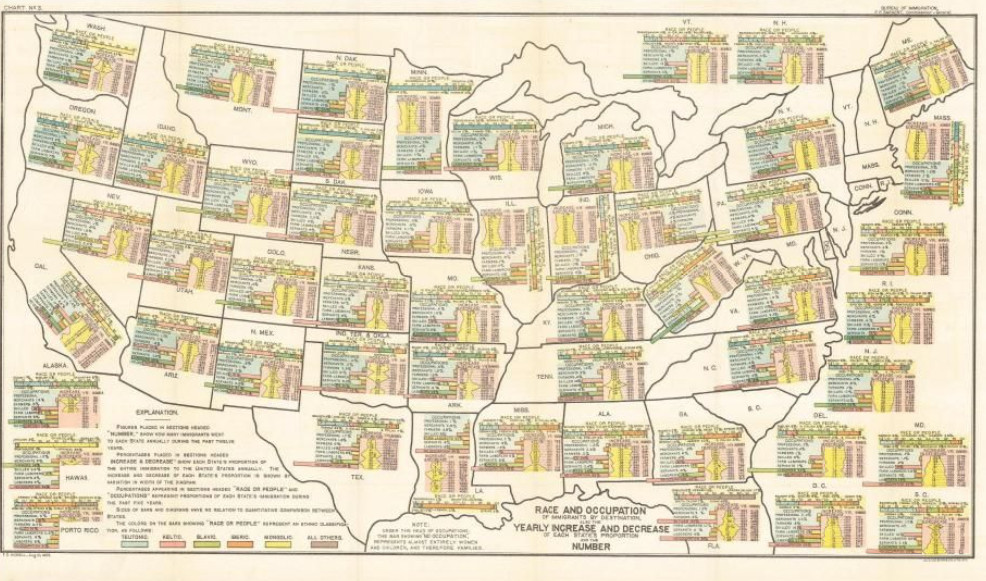
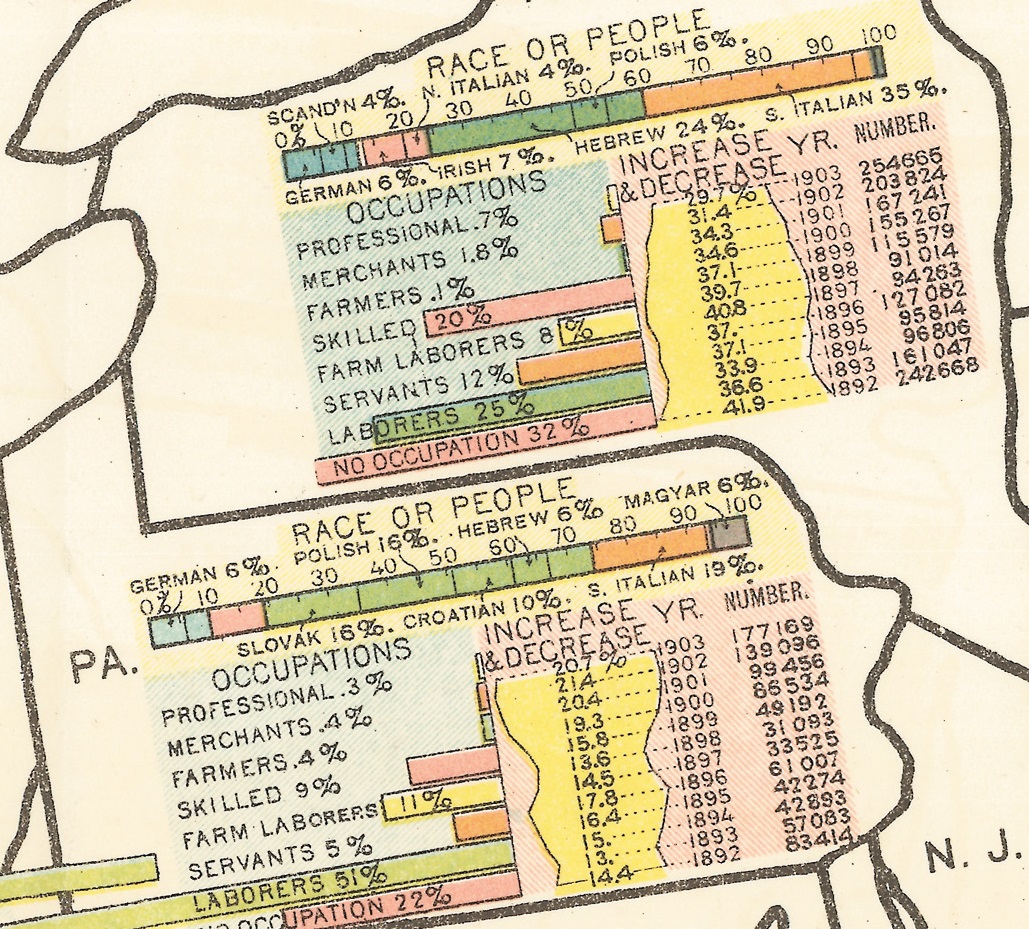
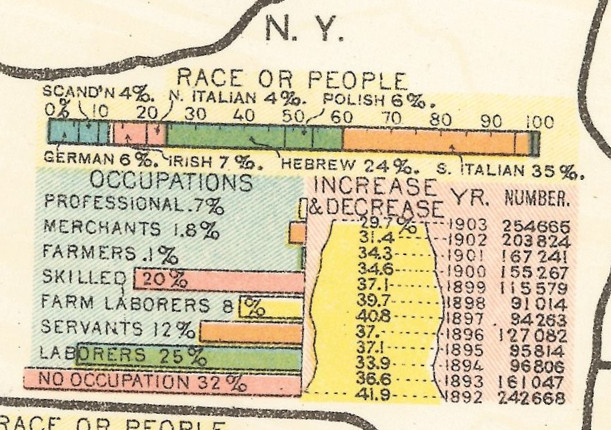
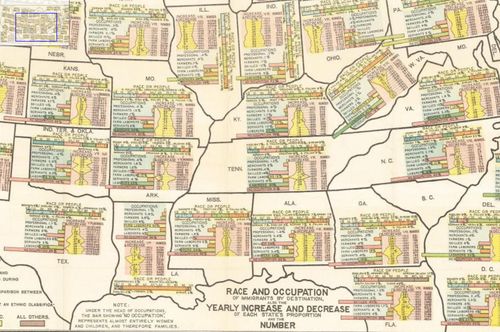
    This map is an interesting early attempt to embed complex statistical information into map form. It shows us the countries of origin of new immigrants to each state and the occupations of the adult male immigrants (with women and children being statistically both invisible and weighty, as they were classified simply as “no occupation”).  New York state saw a huge influx of immigrants–the leading numbers in the country–with more than 150,000 on average every year from 1892-1903,  Most of the South received little interest from immigrants, with Mississippi and North Carolina receiving in the double digits of immigrants, Virginia and Alabama getting in the mid three-figures, and Georgia and Tennessee settling in on average in the single digits.  Florida, on the other hand, is a very different case, receiving in the mid four-figures and also leading the country in the percentage of skilled immigrants (with 42%).  It is interesting to note that Alaska from 1894-1896 received no (legal) immigrants, then having 1 in 1897.  

    In any event it is a fascinating chart to have a browse with.

    Aliem map full

    [A full, zoomable version can be found at Michigan State University library, here.]

    “Race and Occupation of immigrants by destination. Also the yearly increase and decrease of each state’s proportion and the number.” Citation:  Race and Occupation of immigrants by destination. Also the yearly increase and decrease of each state’s proportion and the number. Made in 1903 to accompany the Annual Report of the Commission-General of Immigration for the Fiscal Year ended June 30, 1903 by Frank P. Sargent, Commissioner-General of Immigration and published in Washington in 1903 by the Government Printing Office.

    Immigration NY+PA good

    And New York, closer:

    Alien NY detail


    Alien map middle US

  • Invade Europe Now! (And Nazis in New York)

    JF Ptak Science Books     Post 2313

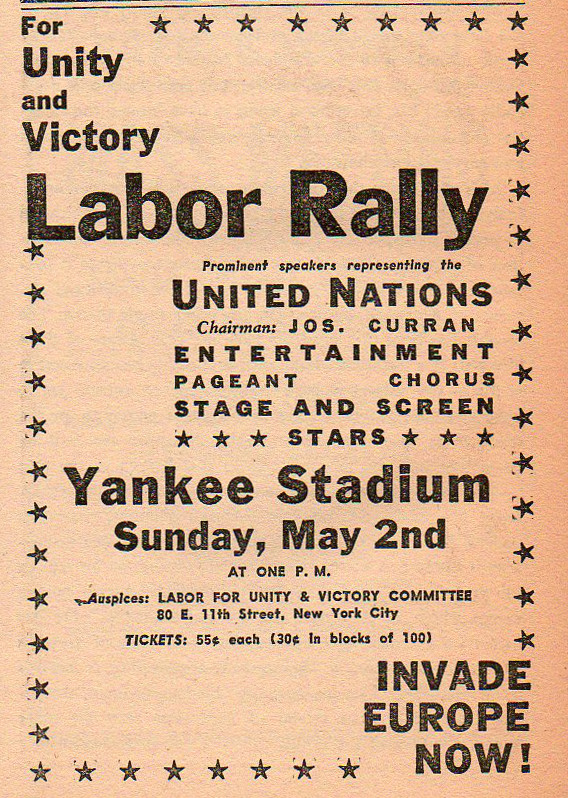
    I found this ad in the April 24, 1943 issue of The Nation, a great magazine already in its 70th year of publication.  I can’t say that I’ve seen a mention of the European invasion like this before, in an ad–certainly everyone was thinking of it, and the issue of where the invasion would take place had been decided (over Mr. Churchill’s desire for the thing to take place in southern Italy), but to see it in a advert like this was surprising.  (It turns out the Paul Robson sang at the event, urging the crowd of 54,000 to fight Fascism “abroad andf at home” (see http://www.bayarearobeson.org/Chronology_3.htm#May%202,%201943)). 

    NATION invade europe now313


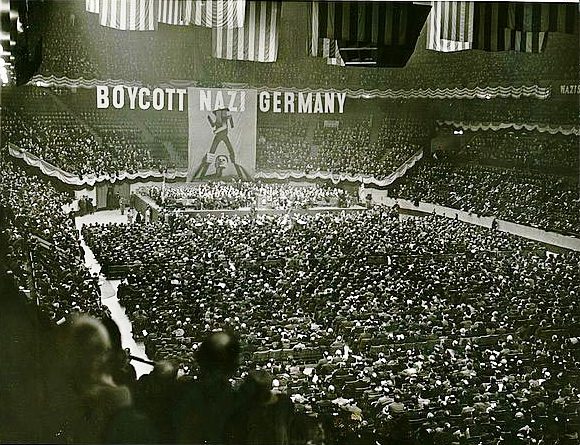
    In searching for images of this event I found something for Madison Square Garden, featuring a packed house for an anti-Nazi even in 1937.  MSG played no particular overt political favorite in the game of renting the facility (free speech and all that), because a year later there was a large meeting of the German American Bund that took places there, with reportedly 20,000 in attendance.  There’s a very unsettling video that I found for this event:

    [Source: http://youtu.be/KPGT7EaCiIY]

    They listened to a lot, not the least of which was the Bund’s leader, Fritz Kuhn, a naturalized American from Germany with a troubled relationship with the Nazi Party, and also with sticky fingers. What brought him to his knees was Fiorello La Gaurdia going after him and with Thomas Dewey prosecuting him for embezzling $14k from the groups general funds to pay for his happy times.  He went to prison in ’43, deported in ’45, and was dead in Germany in ’51.  

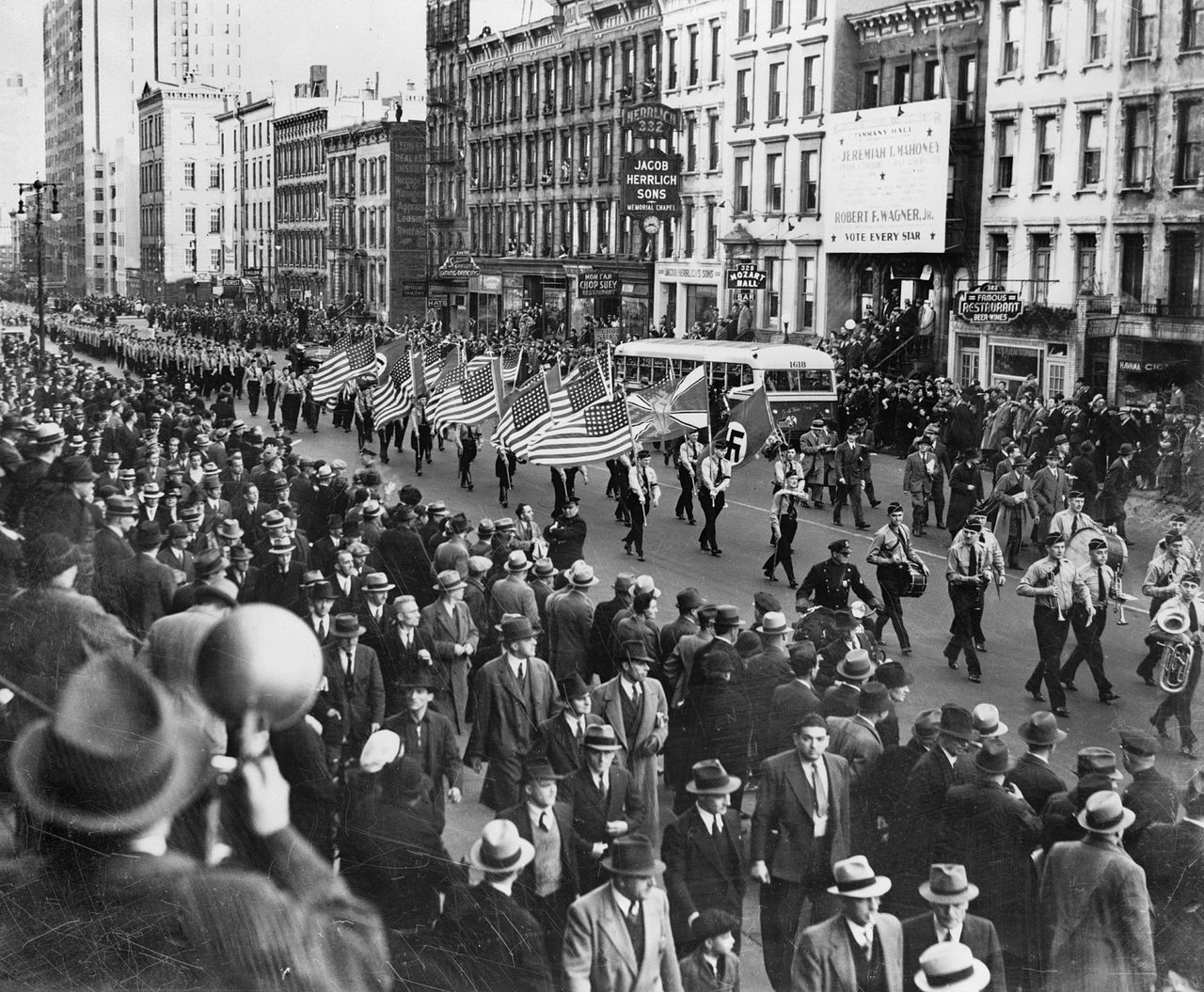
    The Bund paraded down 5th Avenue, too, in October 1939, right after the beginning of the war. From the looks of it the Nazis didn’t come close to even a small fraction of the curious and concerned onlookers.  

    German_American_Bund_NYWTS

    [Source–Wiki images, here]

    For many pro-Nazi groups–including Charles Lindbergh and the America Firsters–the bullshit parade didn’t end until Pearl Harbor, when the U.S. went to war with Germany, and at which point the Hitler admirers had a huge change of heart. Or at least became very quiet and still.

    Here’s an earlier anti-Nazi meeting, which seems to me to have had a much bigger crowd:

    Anti-Nazi rally

    I have my doubts about the 20k mentioned for the 1938 meeting–from what I can tell there were a lot of dark sections and empty chairs…

    ·Posted by :

    ·in:

    —
  • What We Spent on Stuff, 1942

    JF Ptak Science Books     Post 2314

      NATION Graph how we poent our money315

    [Source: The Nation, May 1, 1943.]

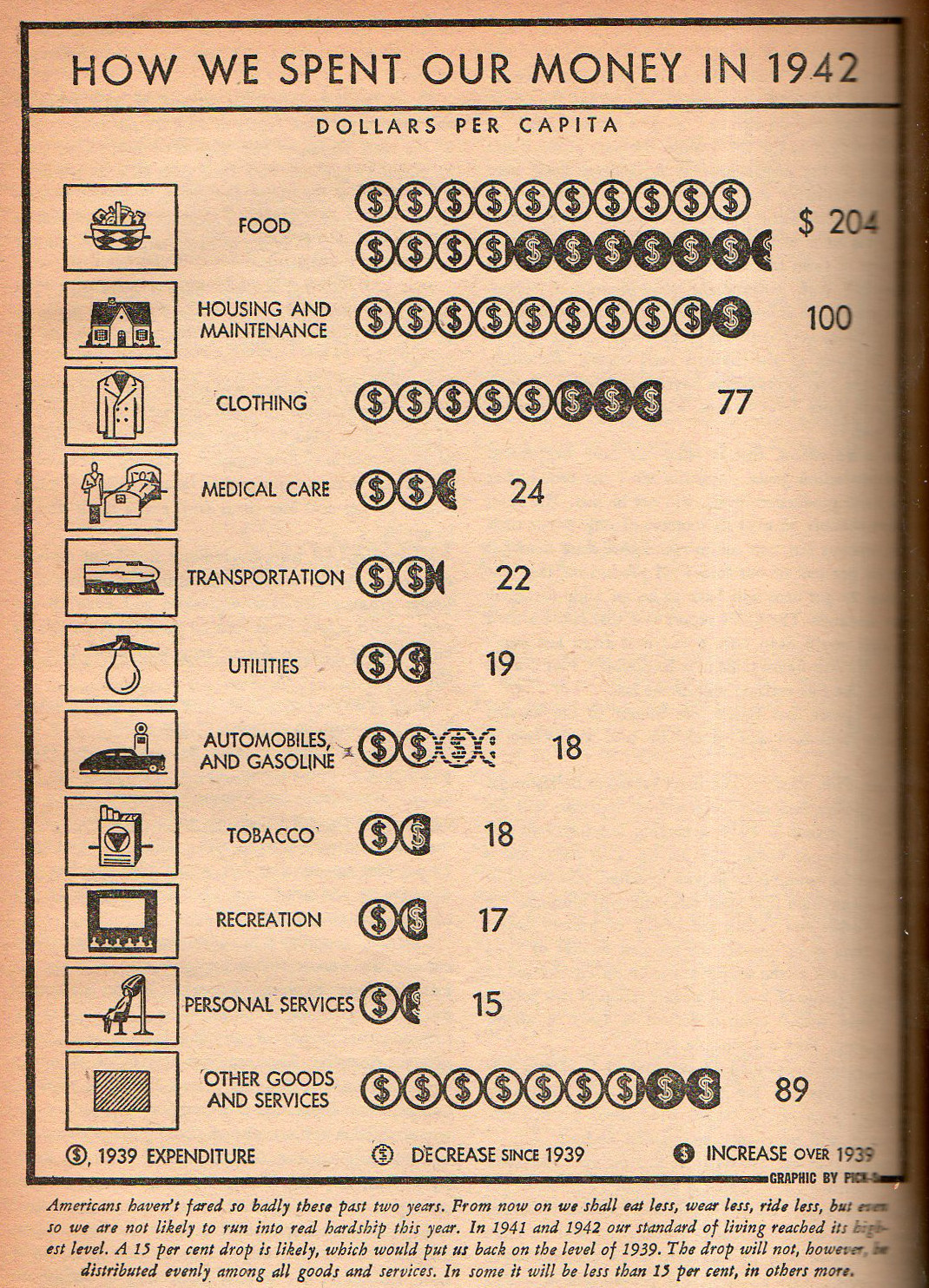
    Average 1942 salary of $2,500 = $34,00; Average hourly salary of 30 cents/hour = $4.12; Average cost of house, $8,000 (which is also about three times the average yearly salary) = $109,000 ; Bread, 9 cents = $1.24; Milk, 62 cents = $8.52 First class stamp, 3 cents = 41 cents.  (Disappointingly I’ve seen some pretty wide discrepancies in these figures, not the least of which is housing, where I’ve seen upper-end estimates of $8,500 for a house…)

    Just for the record, according to the Bureau of Labor Statistics, the fair exchange for a one 1942 dollar would be about $13.75 2014 dollars. *These figures too are bumppy–I’ve chosen to use The figures above are disappointing because they’re figured per capita, which is a little difficult to work with, especially when trying to compare the data to family-computed figures with the numbers I have on hand.  In any event $204 is about 8% of the average income, which is less than the percentage a family will spend on food per year nowadays, which seems to be in the 20+% neighborhood.

    On the other hand, Gallup reports widely different numbers for that time, namely $15/week or $60/month of $720 a year, per family, which is about 30% of an annual income, which seems more in keeping with expectations.  Adjusted for inflation, that figure is about $200/week in 2012, which is about 25% more than the average family spends today:

    Food expsnse percentages[Source: Gallup, here.]

    The shocking thing from this little adventure is seeing the 8% figure at $50/week, and 25% (!) at the <$100 level.  

  • “The Nation” and the Scottsboro Case, Alabama, 1933

    JF Ptak Science Books   Post 2315

    I’m here again with The Nation, a marvel of social reporting and interpretation.  I was recently able to have 40 years of it come my way, and I have the luxury of sitting down with the odd volume and breezing through it–though it isn’t much of a breeze.  It is shocking to me how much of what they cover is absolutely new and fresh to me, especially since I thought I knew something about the decades that I’m pushing through right now (1919-1945).  

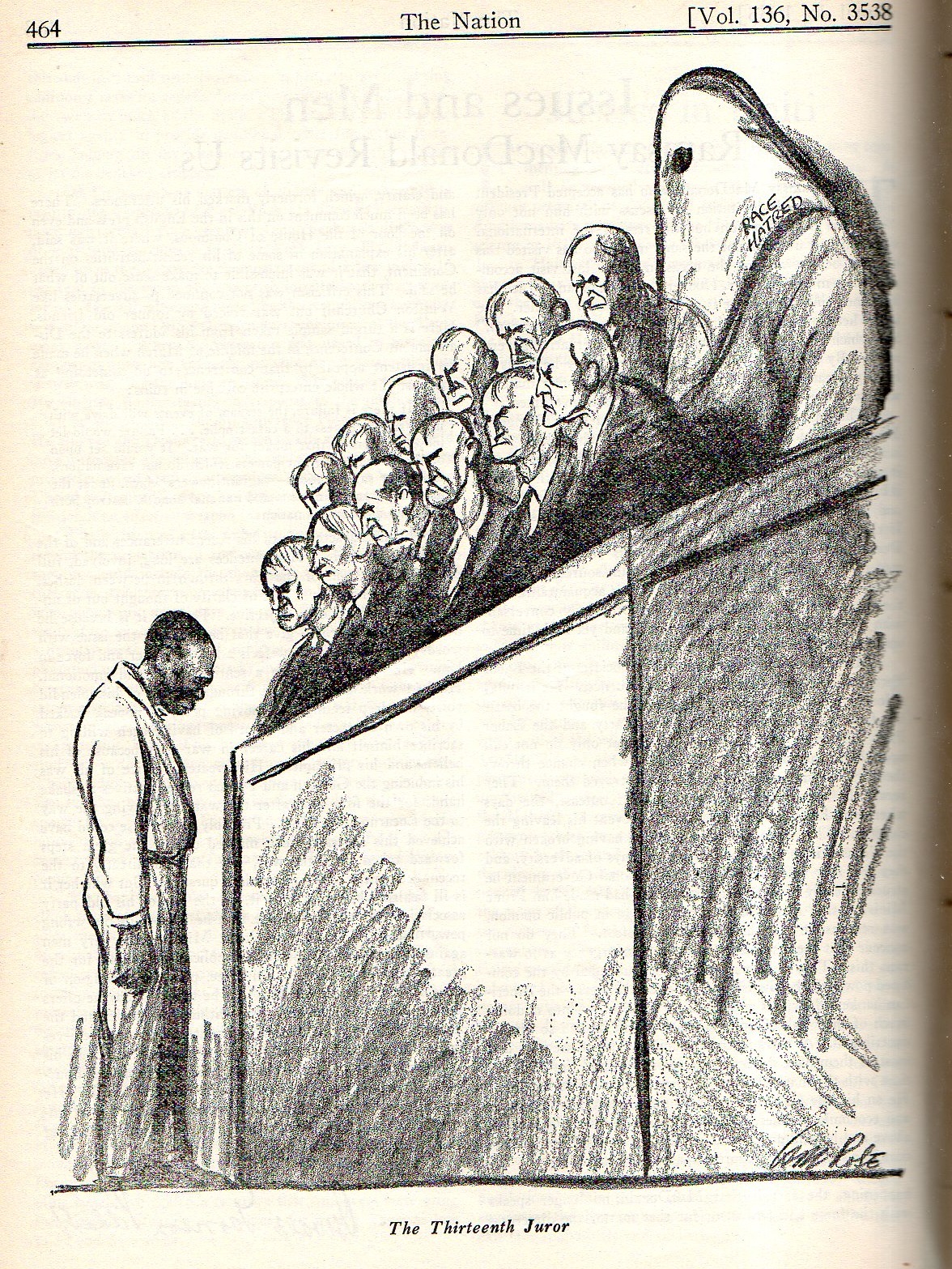
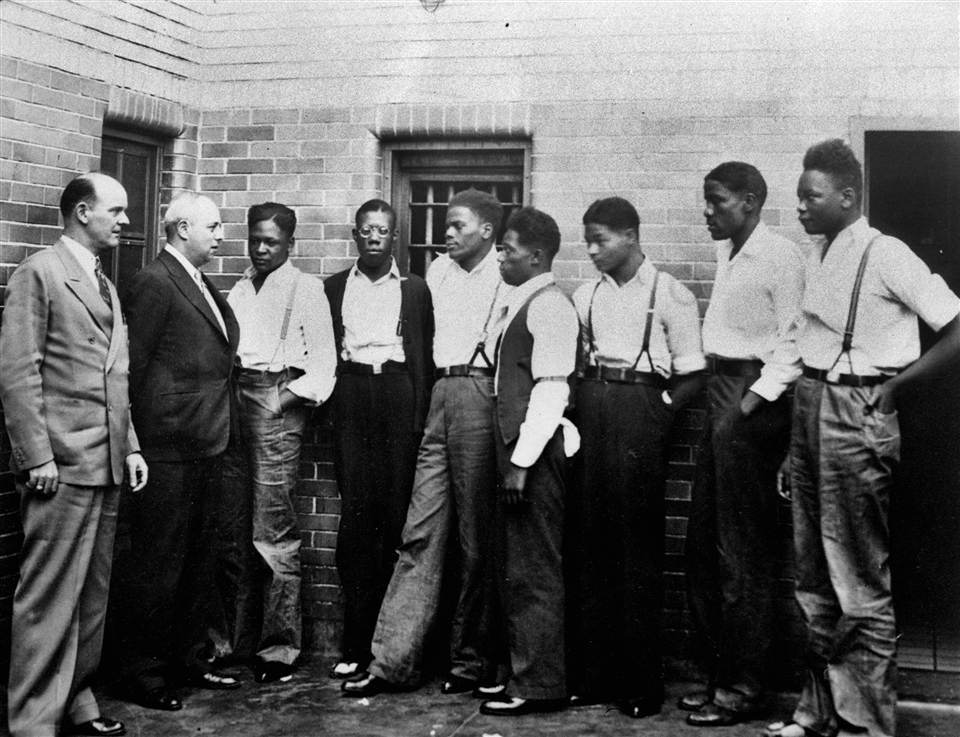
    Nation  lynching316I opened tonight almost immediately to this commentary on the Scottsboro Boys case–and it doesn’t take much to figure out what is going on, even if you never heard of it before,  This illustrate an article on Haywood Patterson, one of the nine African American teenagers who were accused of raping two white women in the state of Alabama in May 1931 and the legal morass and bitter institutional racism that he and the rest of the accused had been dragged through. It is a complicated set of cases –but the fact that there were trials and that there was some sort of legal sensibility to the matter was in itself noteworthy, because the case was highly inflammatory, enraging parts of the population who wanted immediate justice-and-punishment. 

    That didn’t happen in public, but it could be argued that is what was attempted by the Alabama criminal justice system–a judicial lynching.  The cases of these men went back and forth for a number of years, the men being convicted, and then sentenced to death by electrocution, and then appealing, and finding parts of the judgment overturned,  and then starting again, finishing again, overturning again, and other complications.  

    The cases made their way through to 1935 with sentencing in 1937, at which point the death penalties were overturned, but replaced by long prison sentences. 

    Haywood Patterson escaped the electric chair, but was sentenced to 75 years for a crime for which there was no evidence.  He wound up escaping in 1948, and wrote a book about his case (The Scottsboro Boy) in 1950; soon afterwards he was in a bar where he had an argument with a man and knifed him to death; Patterson was subsequently arrested and convicted of manslaughter, and would die of cancer in prison in 1952.  

    Mr. Patterson was evidently the first Afircan American in the history of such cases in the state of Alabama to not be executed for the crime. 

    [Image source:  “The South Speaks”, by John Henry Hammond, Jr., in The Nation, April 26, 1933, opposite page 465.]

    Lead Belly’s Scottsbor Boys”: 


    Scottsboro photo

    [Source:  NBC News.  http://www.nbcnews.com/news/other/alabama-pardons-scottsboro-boys-after-82-years-f2D11634806]

    “In this May 1, 1935 file photo, attorney Samuel Leibowitz, second left, meets with seven of the Scottsboro defendants at the jail in Scottsboro, Ala. just after he asked the governor to pardon the nine youths held in the case. From left are Deputy Sheriff Charles McComb, Leibowitz, and defendants, Roy Wright, Olen Montgomery, Ozie Powell, Willie Robertson, Eugene Williams, Charlie Weems, and Andy Wright. The black youths were charged with an attack on two white women on March 25, 1931.”–Source as above.

    [Source: Emory University, here http://www.youtube.com/watch?v=TmsYLmqx3wg]

  • An Extraordinary POW Postcard 1918

    JF Ptak Science Books   Post 2316

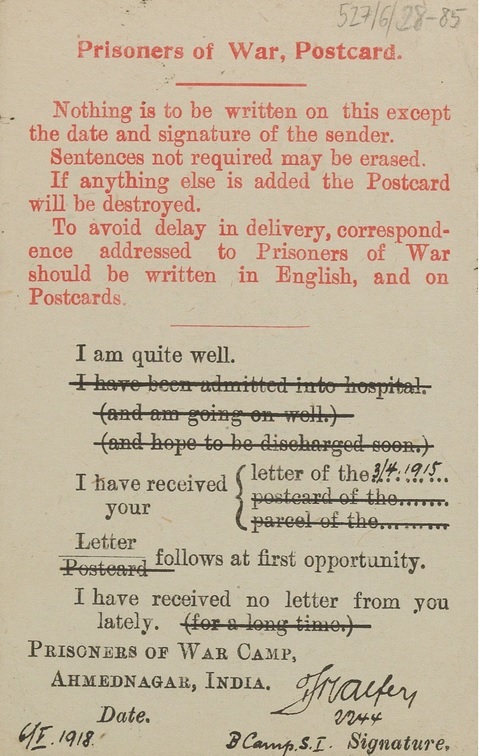
    There is a small collection of WWII propaganda here, mostly Allied-based surrender leaflets and battlefront newspapers. One that I am trying to identify is something simply called “Volksstimme” (“voice of the people”) a very home-made-looking production published in 1944 and which has the feel of being Soviet-produced for German soldiers but which is also extremely anti-Semitic.  As an offshoot of looking for “Volksstimme-ery” things (“Volksstimme” not being a very small handle for a very wide search) I came across a website for the German National Library’s World War I collection, and in one section it displayed this extraordinary postcard:

    WWI POW Postcard

    The German POWs (here based in India) were allowed very limited contact with anyone who had somehow found and written to them.  The instructions were explicit and took up almost as much space on the postcard as the allowed response.  And the response was limited to the POW being well or in hospital, or the status of letters received or not.  It was all attested by an administrative signature, and signed and dated.  And that was it.  

    But, it was at least something.

    “Ahmednagar, a city and fort in India, was the site of one of Great Britain’s prisoner of war camps during World War I. This camp held both prisoners of war and German and Austrian civilians from 1914 and 1918. In contrast, German officers were first sent to Tabora and later usually conveyed to a transitional camp inEgypt or India. The biggest camp was located in Ahmednagar, India, and could accommodate more than 2,000 German prisoners. According to reports from the Red Cross, there were few reasons for complaint. The food was plentiful and housing was acceptable. There were even tennis courts,soccer fields, and billiard tables for the amusement of officers…”–Source

    “Postcard from a British prisoner-of-war camp in India to Gustav Wahl, the Director of the Deutsche Bücherei in Leipzig, 1918”–German National Library, First World War Collection

    [Source: here (http://erster-weltkrieg.dnb.de/WKI/Content/EN/Topics/Kriegsalltag/alltag-kriegsgefangenschaft-en.html)]

Recent Posts

Archives

Categories