A Daily History of Holes, Dots, Lines, Science, History, Math, Physics, Art, the Unintentional Absurd, Architecture, Maps, Data Visualization, Blank and Missing Things, and so on. |1.6 million words, 7500 images, 4.9 million hits| Press & appearances in The Times, Le Figaro, Mensa, The Economist, The Guardian, Discovery News, Slate, Le Monde, Sci American Blogs, Le Pont, and many other places… 5000+ total posts since 2008.

  • Something No Skyscraper Could be Without: an Elevator (1893)

    JF Ptak Science Books  Quick Post

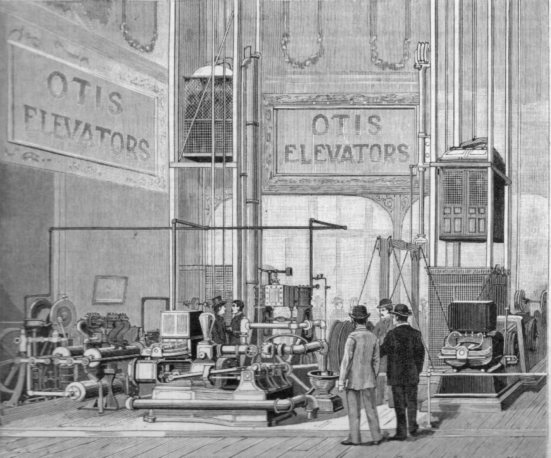
    The front page and very present image (running the full height of the magazine) of the Scientific American for the October 28, 1893 issue presents the Otis elevator on exhibit at the Columbian Exposition of 1893.  Otis was one of a dozen manufacturers showing their wares–it was also evidently the largest and most sensational display, with their demonstration (electric) elevator constructed in the center of the Manufactures and Liberal Arts Hall and rising 185′ from the ground.  At the time the nation’s tallest skyscraper was the New York World buildiing, recently finished in 1890 and 349′ high.  The tallest buildings of the previous decade weren’t close to this, and weren’t as tall as the Columbian Otis elevator, so the thrill of the folks who took the ride to the top of this great indoor structure must have been palpable.  

    And of course tall buildings wouldn’t be anything without an elevator; and elevators would be nothing without a great, reliable, and safe (Westinghouse) braking system.  

    Otis elevator 226


    And this, an accompanying image:
    Otis elevator 227

  • A Beautiful Turbine, 1893

    JF Ptak Science Books    Quick Post

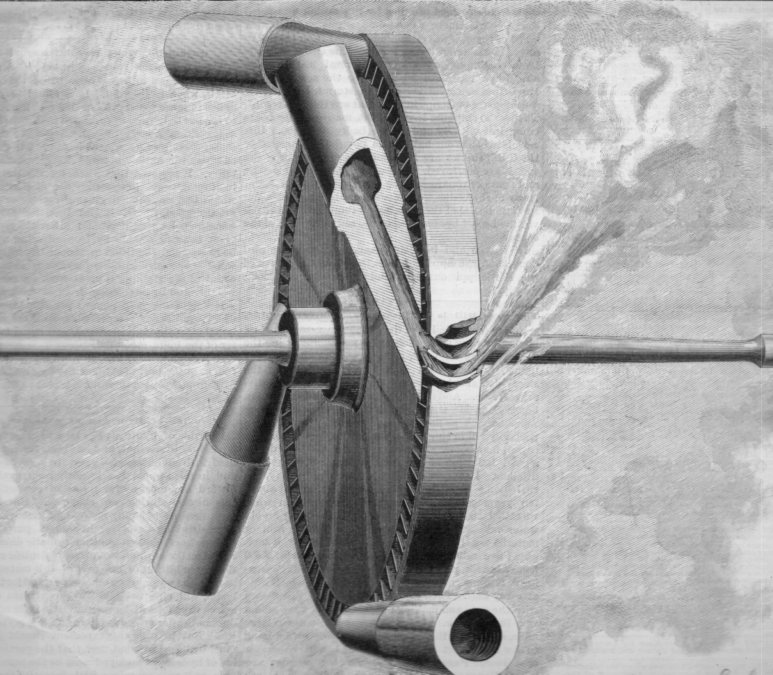
    Dr. Laval’s steam turbine is quite a lovely thing, presented here on the front page of the Scientific American (October 1, 1893), a glorious and beauitiful achievement capable of 20,000 revolutions/minute and developing 20 hp.  

    Revolving steam driven wheel228

    ·Posted by :

    ·in:

  • The Magnificent Comptometer, 1893

    JF Ptak Science Books Quick Post

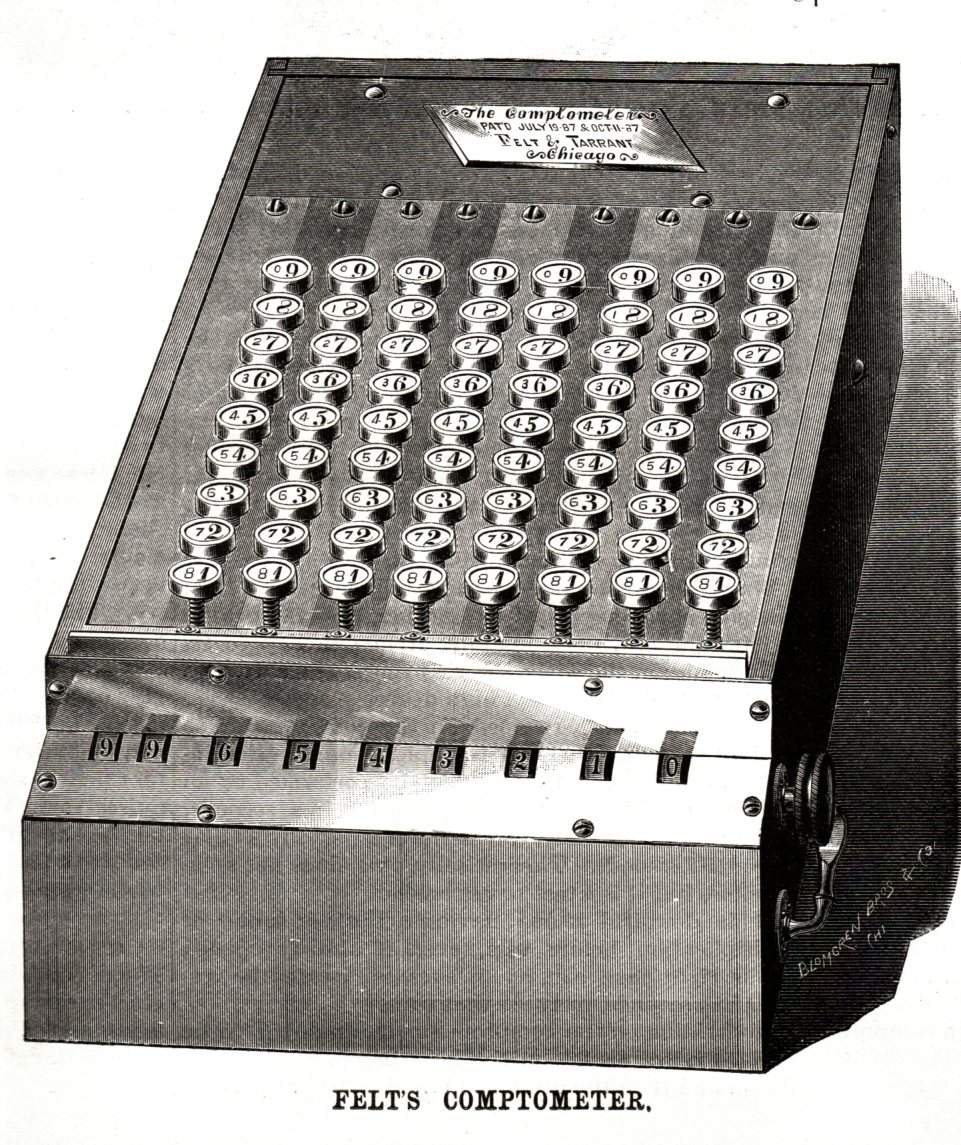
    This magnificent image was–is–The Comptometer, a key-driven calculating machine made by Felt & Tarrant Manufacturing Company, a glorious instrument, encased in coppery metal, and just larger than a large shoebox.  It was invented by Dorr E. Felt (1862-1930) in 1889, and in order to put his idea into production went into business with the Chicago businessman and entrepreneur Robert Tarrant, and the two made an enormously successful go of the whole operation, the machine being easy to carry, and easy to use, and saved a huge amount of time in calculating mounds of long figures.  

    The image (and ad, below) both appeared in the November 11, 1893 issue of the Scientific American.  

    Comptometer b230


    Comptometer229

  • An Appeal to the Conscience of the Civilized World–Anti-Lynching 1920

    JF Ptak Science Books   Post 2288

    Appeal213

    This truly is an appeal “to the world” for there to be an understanding about what was happening to African Americans in the United States in 1920–and this appeal wasn’t about unequal access to education or jobs or Jim Crow laws or any of the social assaults made on those people; it was more basic than that. It was a statement of how thousands of African Americans were being lynched, and murdered, and burned.  The appeal was extremely basic–to let it be known that these horrors were being committed against a class of people with little capacity to defend itself legally. 

    It is a roll call of terror, listing “barbarous” practices against “colored Americans”, citing 84  persons “murdered or ‘lynched’ . 

    Warning: Graphic material below

    ·Posted by :

    ·in:

  • An Appeal to the Conscience of the Civilized World–Anti-Lynching 1920, FULL TEXT

    JF Ptak Science Books   Post 2288b

    I’ve recevied several requests for the full text of this document, which is now found below.


    Appeal213

    This truly is an appeal “to the world” for there to be an understanding about what was happening to African Americans in the United States in 1920–and this appeal wasn’t about unequal access to education or jobs or Jim Crow laws or any of the social assaults made on those people; it was more basic than that. It was a statement of how thousands of African Americans were being lynched, and murdered, and burned.  The appeal was extremely basic–to let it be known that these horrors were being committed against a class of people with little capacity to defend itself legally. 

    It is a roll call of terror, listing “barbarous” practices against “colored Americans”, citing 84  persons “murdered or ‘lynched’ . 

    Warning: Graphic material below


    ·Posted by :

    ·in:

  • Bitter Insurance for Cold Un-found Gold, 1898

    JF Ptak Science Books   Quick Post

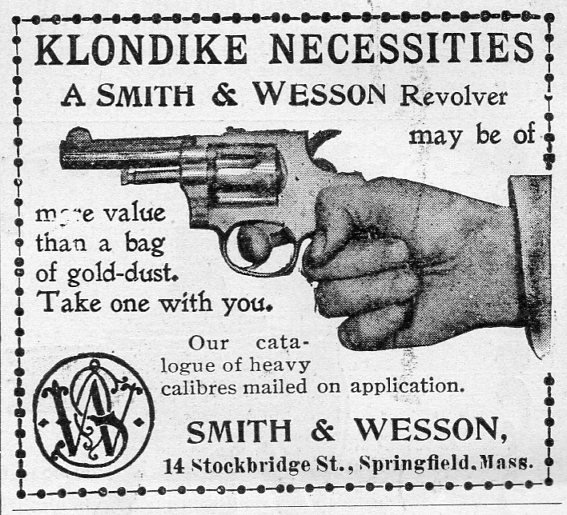
    Apologies for the quality of this reproduction, but the original is quite small, about an inch square, an wasn’t meant for a marquee display.  The idea, though, is a large one, and probably an uncomfortable one at that for the thousands of people who were considering a march to the relatively-newly-found goldfields in the Klondike region of the Canadian northwest territory. The gold was discovered in the summer of ’96, and there were soon dozens of thousands of hopefuls crowded narrow pathways through prospector-choked passes over snow-covered mountains to the gold fields.  Of the 100,000+ prospectors that tempted fate over the next few years, only about 4% actually struck gold. That made for 96% of the gold-seekers with the dangerous and expensive ‘seeking” part accomplished but without any gold to shpw for it.  Gold fever or not, revenge or not, unresponded sweat equity or not, many were no doubt tempted to find their gold in someone else’s pockets.  And so the insurance policy filled by Misters Smith & Wesson.  

    And even though quite a small ad on a big page, it packed some punch.  

    Klondike245

    Found in the ad pages of the Scientific American, September 24, 1898.

    ·Posted by :

    ·in:

  • The Molecular World in Not-Quite 3-D

    JF Ptak Science Books  Quick Post

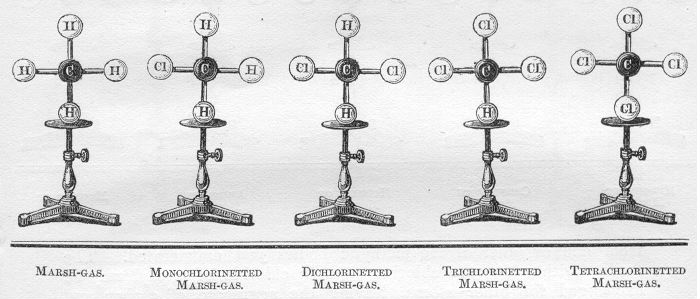
    Hofmann models046


    Hofmann models


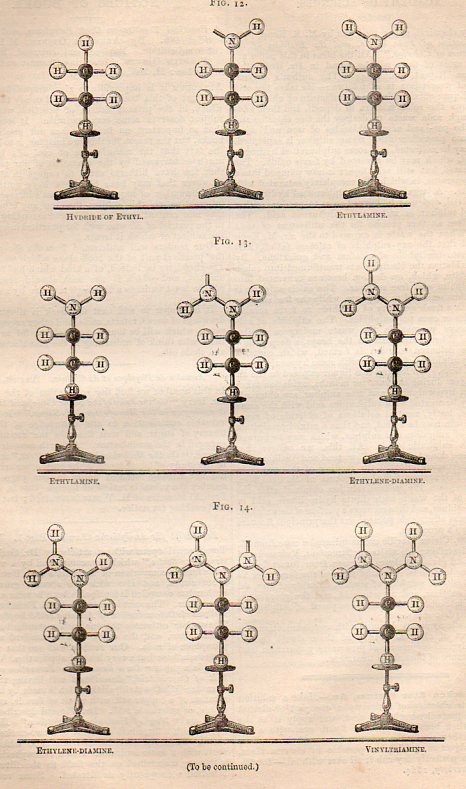
    August Hofmann (a German organic chemist of high calibre, 1818-1892)  made this presentation1 to the Royal Institution in 1865, and it is one in which hand-made three-dimensional models of molecules2 are used for one of the first times for public demonstration.  (He actually made parts of it in different lectures, that is, but I have not yet been able to compare the two.)  The models aren’t quite three-dimensional, as Hofmann arranged them so that they would have at least 3-D molecules though their arrangement in space was veyry much liek they would appear on a piece of paper.  (This might be a bit off, and the molecules were all the same size, but the colors he employed to represent molecules are still being used: black/carbon, yellow/sulphur, white/hydrogen, blue/nitrogen, red/oxygen, green/chlorine.  

    Notes:

    1. HOFMANN, August Wilhelm. “On the Combining Power of Atoms”, in three parts, all in The Chemical News, October 5, 1865, pp 166-169; October 13, 1865, pp 175-179; and in October 20, 1865, pp 187-190.

    2.  The idea of molecules goes back 2000  years, to Empedocles, Leucippus, Democritus, and Epicurus. It should be noted I guess that the modern idea of the world (mostly?) owes itself to an 1873 article in Nature by James Clerk Maxwell.  He titled the paper, well, “Molecules”, and this is how he defined his terms: “An atom is a body which cannot be cut in two; a molecule is the smallest possible portion of a particular substance.”

  • An Harmonic Analyzer, 1916

    JF Ptak Science Books    Post 2290

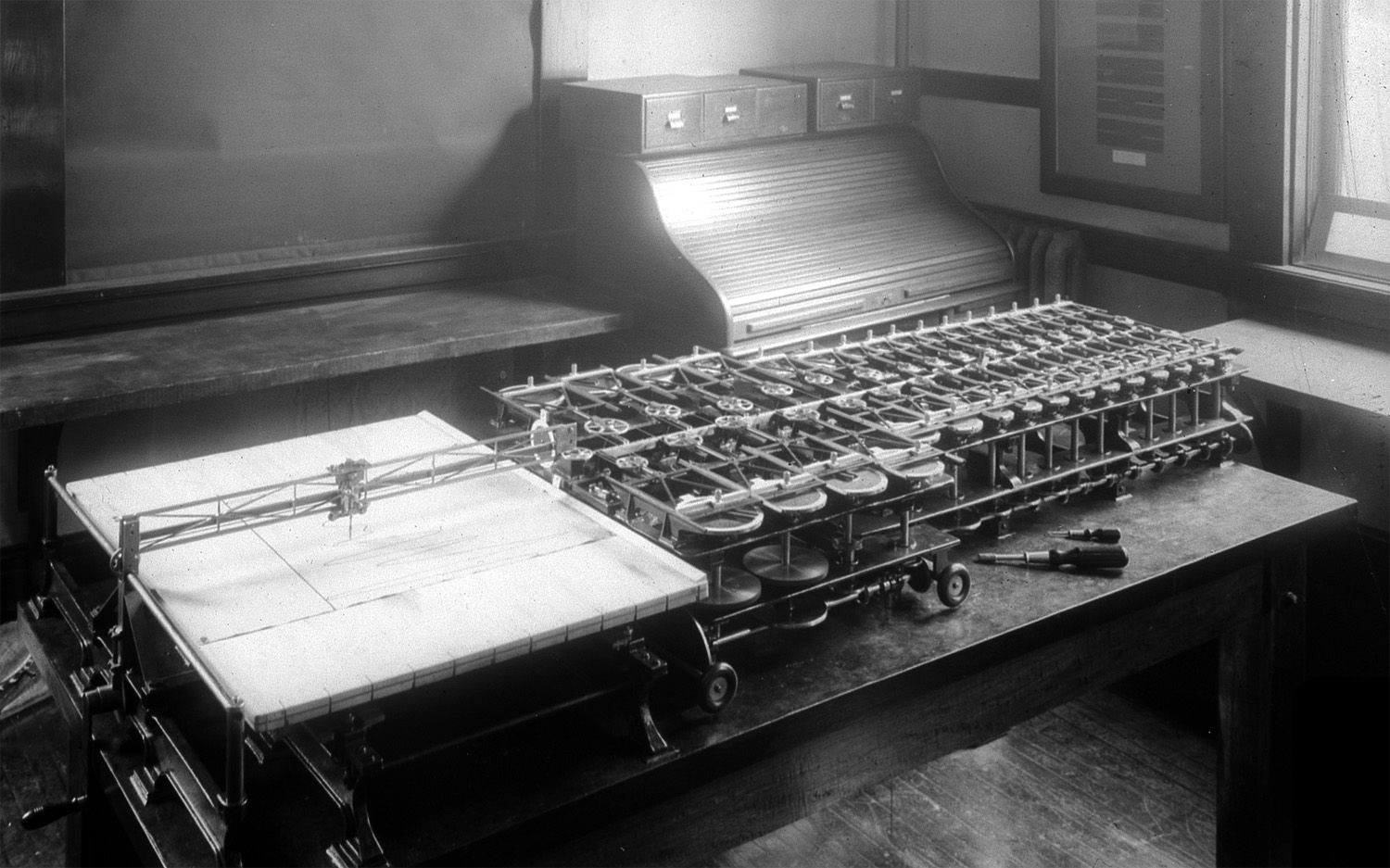
    It isn’t really an onomatopoeia, but the harmonic synthesizer at least feels like itself in the mouth as the two words are spoken. try it: h a r m o n i c   s y n t h e s i z e r.  The name does feel as though it touches the boundaries of most of the mouth, and that is basically what this analog computer does, analyzes sound, and record it in lovely waves (the plotter on the left in the photo).   http://www.phys.cwru.edu/ccpi/Harmonic_synthesizer.html

    32_component_synthesizer

    It is also a beautiful machine. The one above is by Dayton Miller of Case Western Reserve, and it is described in a 1916 publication from the Journal of the Franklin Institute. 

    “As described on the Case Western Reserve University website, “Lord Kelvin’s harmonic synthesizer is basically Henrici’s harmonic analyzer in reverse. Originally designed as a tide predictor in 1873, the system can combine numerous component waves—in some devices, up to 64 separate components—into a single curve. It is based on the earlier pin-and-slot device, which produces simple harmonic motion with the turn of a crank.”

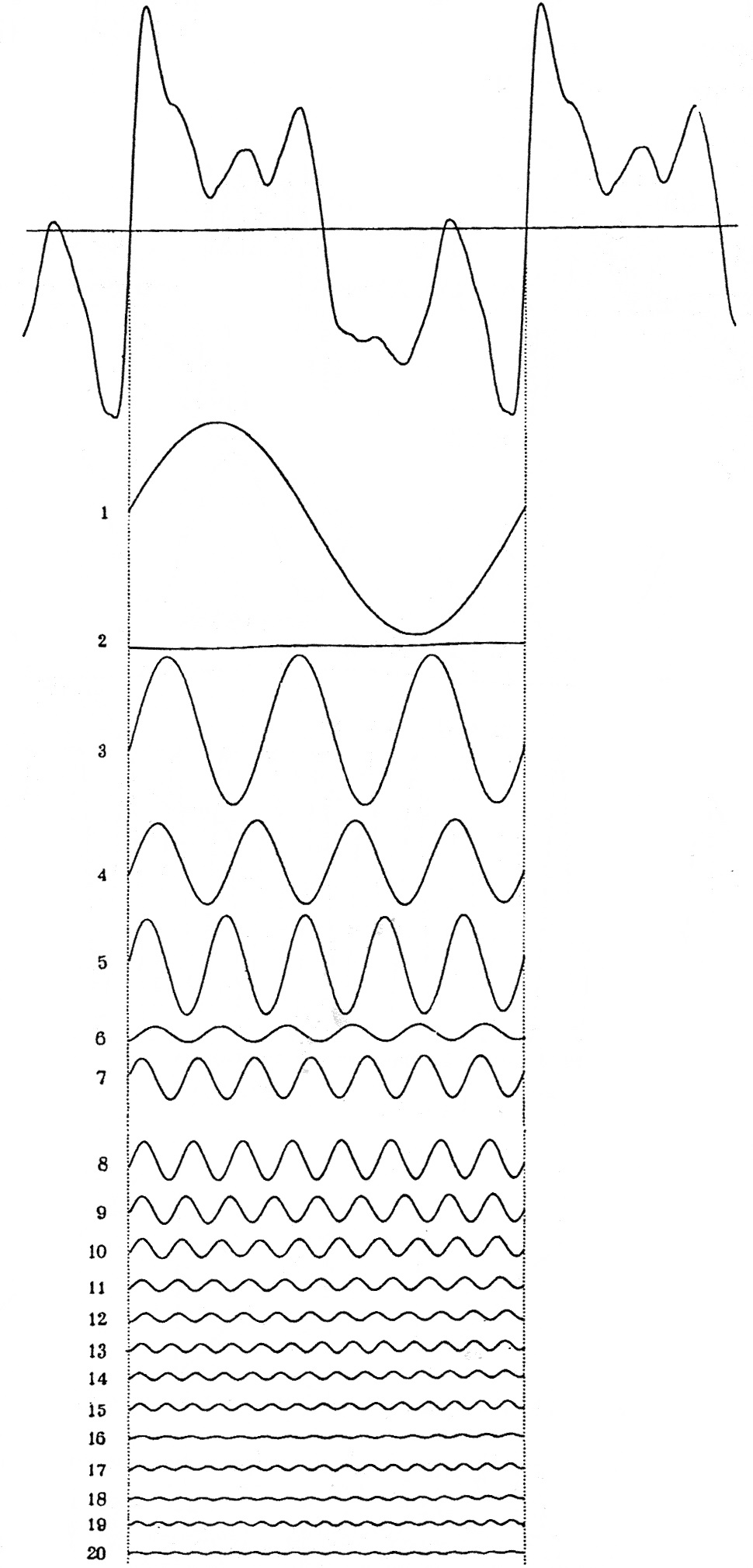
    And one of the results as it appeared on page 73 of the Journal of the Franklin Institute,  a curve representing the sound wave from a clarinet and twenty of its harmonic components: 

    32--big--Harmonic_synthesizer_diagram

    “The version used by Dayton Miller was designed and built in the laboratory and instrument shop of the Physics Dept. of the Case School of Applied Sciences. It consisted of 32 rotating pin-and-slot devices (see diagram below), each of which produced simple harmonic motion with a specified amplitude and phase; these 32 elements controlled the motion of a single cable that traced out the combined wave with a stylus and sliding drafting table. It was used by Dayton Miller to check the results produced by the harmonic analyzer against the original phonodeik curve…” http://www.phys.cwru.edu/ccpi/Harmonic_synthesizer.html

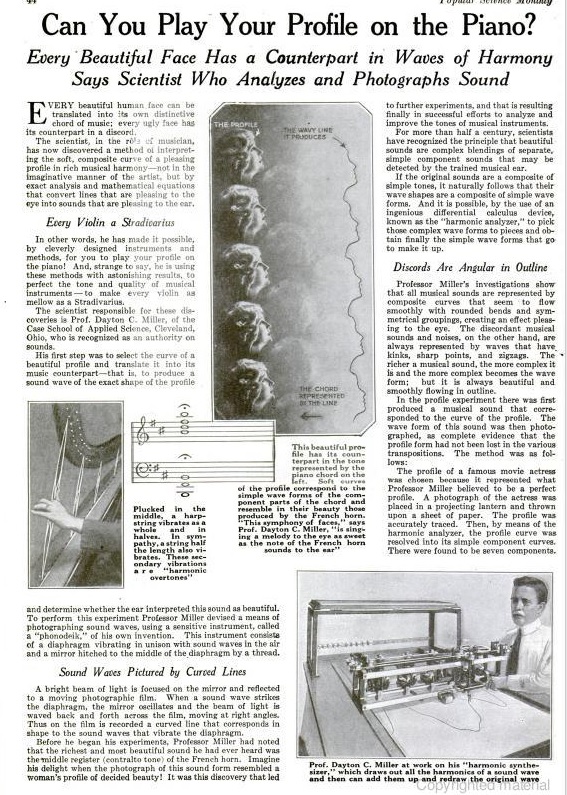
    And from the magazine Popular Science for Augusat, 1921, we find the following article:

    Dayton harmonic

    [Source:  Google Books]


    ·Posted by :

    ·in:

  • Near-Dark, No Windows, Filled with Explosives, and Breathing Cordite. 1894

    JF Ptak Science Books   Quick Post

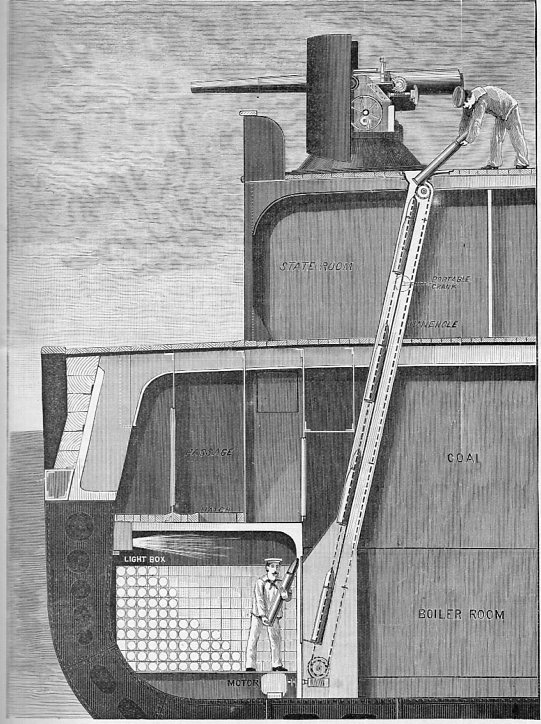
    This is an elementary but still highly useful cross-section illustration, showing the semi-automatic loading system for a U.S. Navy  rapid fire gun as it appeared in Scientific American for September 17, 1894.   I wonder if the sailor sending up the (six inch?) shells in near -dark (except for the “light box”) was breathing in any of the cordite from above?  The weapon was probably the revolutionary six-inch Dashiell rapid firing breech loading gun, which in trials scored 5 aimed hits at a 900-yard target in 55 seconds.  Fast and accurate for 1894.  

    Auto-loading gun244

    ·Posted by :

    ·in:

    —
  • Early Published RADAR Image of NYC, 1946.

    JF Ptak Science Books   Quick Post

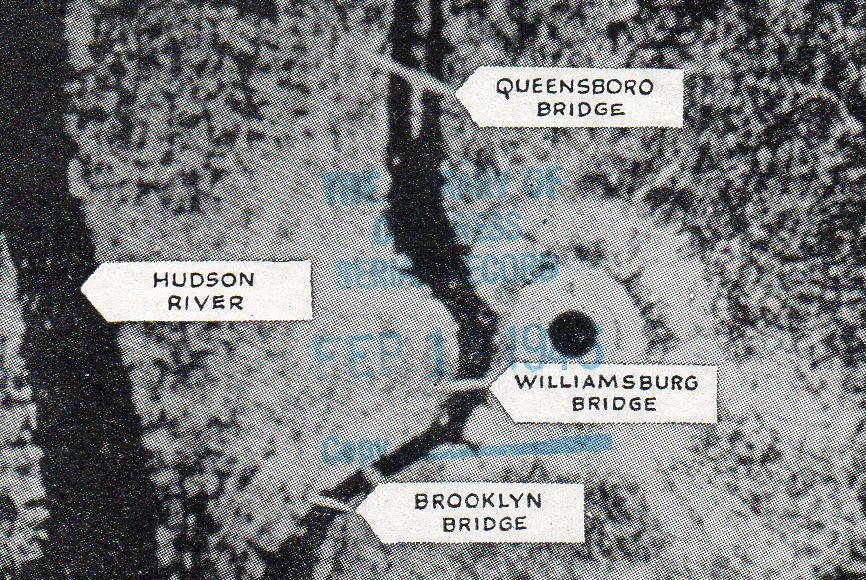
    Radar247

    The history of RADAR (RAdio Deection And Ranging, and something I’ve always written in caps) is absolutely not what I’m thinking about now–that is a long story with lots of twists and turns, complicated, complex–and it ranges depending upon location as for the most part RADAR (from the 1930’s anyway) was developed in secret, kept as a military secret.  And that’s because it was a very important development, with the victor of the Battle of the Beams being the possible victor, period.  

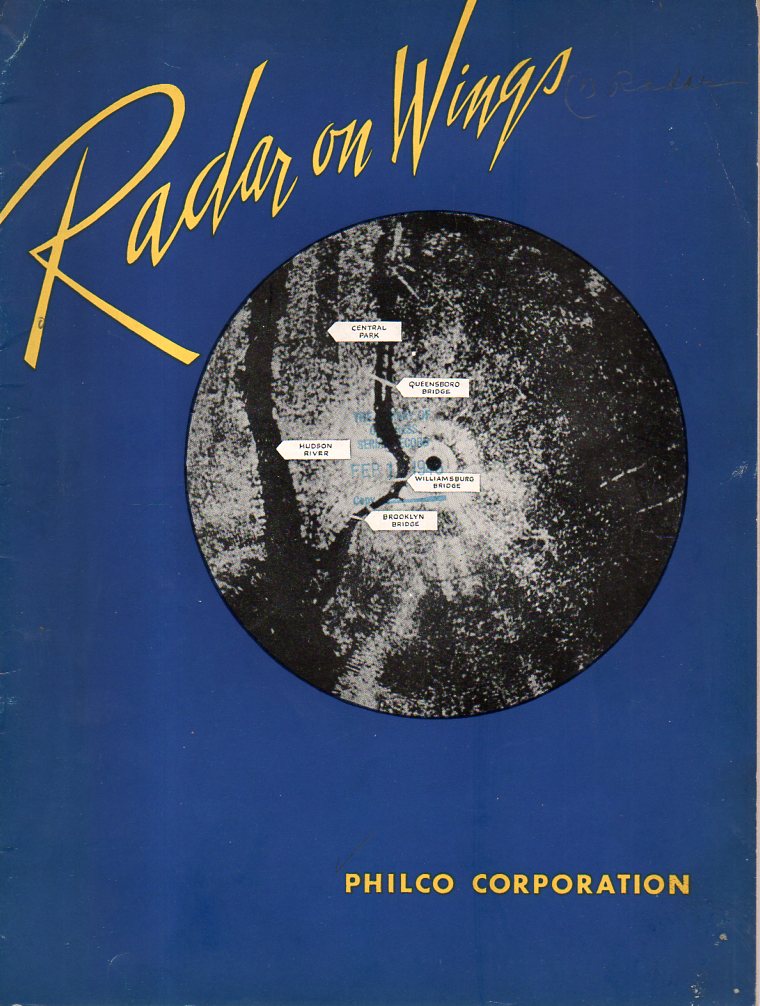
    The image is a detail from the pamphlet below (the covers printed in what looks like U.S.N. blue), made aboard a B-17 at 15,000 feet, and is one of the earliest popular treatments of the vital story of RADAR during WWII.

    Radar246

    The pamphlet was printed by PHILCO Corporation, (and dated January 4, 1946), and has an inserted leaflet stating that this “makes public for the first time the salient facts about the Corporation’s development and production of airborne radar equipment for the United States Army and Navy”.  

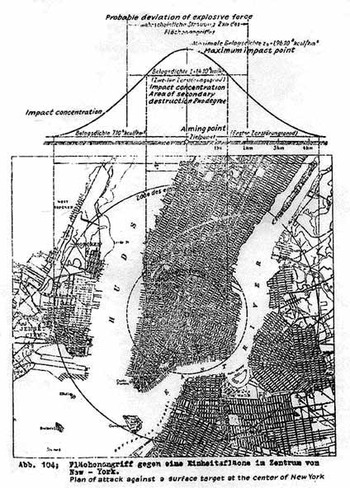
    The image also comes a little too-close-to-home, reminding me of the Eugen Sanger transcontinental bomber, and the image of NYC in the crosshair, 1943:

    Manhattan_bombed_4


    The image is from an earlier posts here, “Bombing Manhattan, 1943…”

  • Welcome to 1893

    JF Ptak Science Books  Quick Post

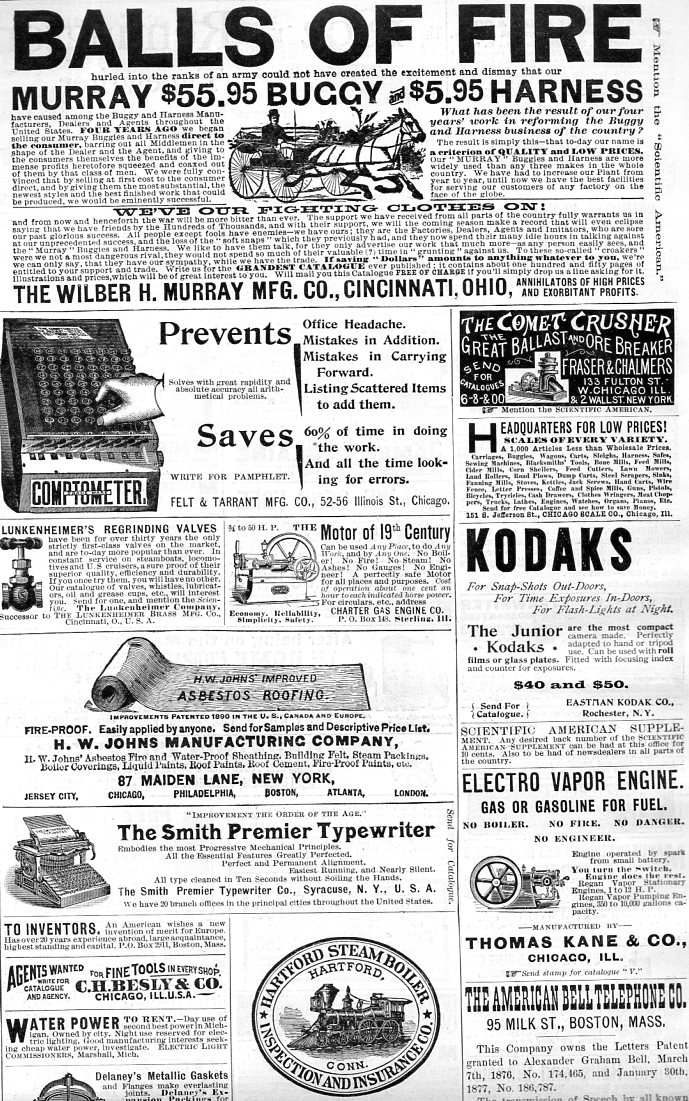
    This back page of the Scientific American for December 7, 1893, has it all:  buggies of such speed that the army would want them; the great Comptometer (“prevents office headache” and I am sure it did so); the Comet Crusher Great Ballast and Ore Breaker; the Charter Gas Motor Company offering The motor of the 19th century; asbestos rolled roofing tarp; $50 Kodak cameras (equal to about $1200 in 2014 buying power according to the Bureau of Labor Statistics), and so on.  I can just about smell the sweet sweet oil that made everything function…

    Sci american ads 1893250

Recent Posts

Archives

Categories