A Daily History of Holes, Dots, Lines, Science, History, Math, Physics, Art, the Unintentional Absurd, Architecture, Maps, Data Visualization, Blank and Missing Things, and so on. |1.6 million words, 7500 images, 4.9 million hits| Press & appearances in The Times, Le Figaro, Mensa, The Economist, The Guardian, Discovery News, Slate, Le Monde, Sci American Blogs, Le Pont, and many other places… 5000+ total posts since 2008.

  • America’s First Race Riot, 1935

    JF Ptak Scence Books  Post 1255–expanded

    “The Harlem riot of 1935, now the subject of a comprehensive report, demonstrated that ‘the Negro is not merely the man who shouldn’t be forgotten; he is the man who cannot safely be ignored’.” Alain Locke,  Survey Graphic, 1936.*


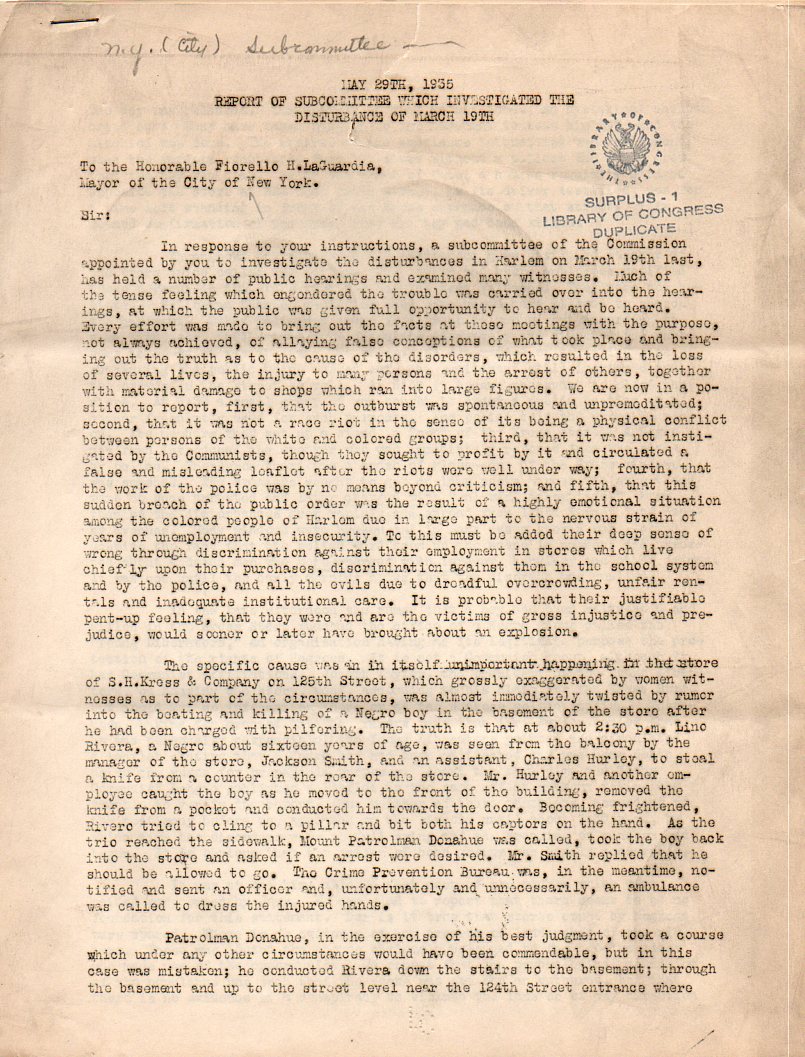
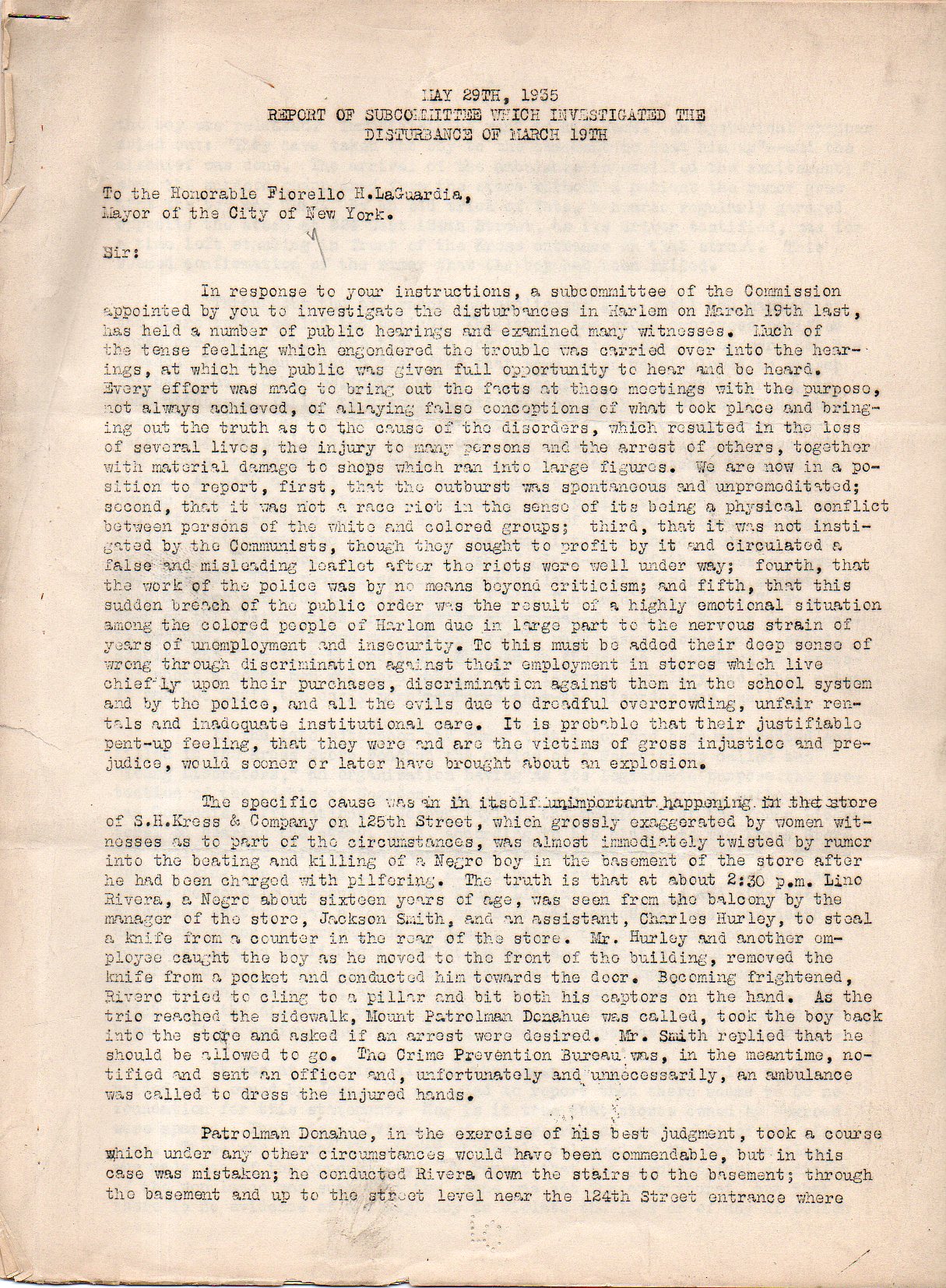
    This is a report to Mayor Fiorello LaGuardia (mayor of NYC from 1934-1945, a liberal Republican who was exactly what was needed in the city at exactly the right time) on what has come to be recognized as America’s first race riot.1 The damage was widespread, with hundreds of people injured, three killed, and $2 million 1935 dollars lost in during the Harlem event.   The action started at the S.H. Kress dime store on 256 W. 125th St. (just across from the Apollo Theater)   in Harlem, where a 16-year-old boy named Lino (described int his report as a “young Negro” though he was Puerto Rican) was detained by authorities in the store for shoplifting.  He was taken to the store’s basement and released to the backstreet unharmed, but a rumor spread violently and quickly that a young child had been taken to the basement of the store and beaten (or killed) for stealing a piece of candy.  Complications arose when the police arrived and when civic leaders’ questions went unanswered.  An odd and unfortunate twist of faith placed a hearse in front of the store during this build-up (from the business across the street from the store), inspiring outrage and “proof:” that the boy had been killed.2
    Race riot259

    In addition to the missing boy, the hearse, the police, and bad communications, were handbills distributed in the neighborhood printed by the Young Communist League and the black semi-militant Young Liberators, all helping to fan the flames of the crowds by the Kress store, which had swelled to several thousand people after just two hours–the riot came soon thereafter.

    The Report of Subcommittee Which Investigated the Disturbances of March 19th3 (and issued before August 15, 1935), was chaired by Arthur Garfield Hayes,analyzed the event in a surprisingly sympathetic way, recognizing that there was no organized response to the event, and finding that the response was understood to be a reaction to the long history of abuse of African Americans and poor governmental/police relations–and this all in eight quick pages.   LaGuardia said “We cannot be expected to correct in a day the mistakes and omissions of the past fifty years. But we are going places and carrying out a definite program. While the critics have been throwing stones, I have been laying bricks.”  It was surprising top me that the report was bi-racial, and that there was some real attempt to understand the problem and “do” something about it, rather than just chalk the whole thing up as something that could be simply solved with pure force.  [The original report is available for purchase from our blog bookstore.]

    As Locke wrote (below) the Riot of 1935 was the end of the Harlem Renaissance, and that a new era had begun.  For his part, LaGuardia at least opened a way to communicate about how to address the causes of such vast and repellent circumstances that eventually turned into the riot.

    Notes:

    * Locke continues: “Eleven brief years ago Harlem was full of the thrill and ferment of sudden progress and prosperity; and Survey Graphic sounded the tocsin of the emergence of a “new Negro” and the onset of a “Negro renaissance.” Today, with that same Harlem prostrate in the grip of the depression and throes of social unrest, we confront the sobering facts of a serious relapse and premature setback; indeed, find it hard to believe that the rosy enthusiasms and hopes of 1925 were more than bright illusions or a cruelly deceptive mirage. Yet after all there was a renaissance, with its poetic spurt of cultural and spiritual advance, vital with significant but uneven accomplishments; what we face in Harlem today is the first scene of the next act—the prosy ordeal of the reformation with its stubborn tasks of economic reconstruction and social and civic reform…” 

    1. Sociologist Allen D. Grimshaw called the Harlem Riot of 1935 “the first manifestation of a ‘modern’ form of racial rioting,” citing three criteria: “violence directed almost entirely against property”;  “the absence of clashes between racial groups”, and “struggles between the lower-class Negro population and the police forces”. “Harlem Renaissance”. Online Newshour Forum. PBS. February 20, 1998. http://www.pbs.org/newshour/forum/february98/harlem5.html.

    Another commission set to investigate the riot was headed by E. Franklin Frazier which produced a report, “The Negro in Harlem: A Report on Social and Economic Conditions Responsible for the Outbreak of March 19, 1935,” which found that the riot was not a controlled event and had happened spontaneously as a result of prolonged “injustices of discrimination in employment, the aggressions of the police, and the racial segregation”.

    2. Locke continues his observation on the Riot: “Curtain-raiser to the reformation was the Harlem riot of March 19 and 20, 1935; variously diagnosed as a depression spasm, a Ghetto mutiny, a radical plot and dress rehearsal of proletarian revolution. Whichever it was, like a revealing flash of lightning it etched on the public mind another Harlem than the bright surface Harlem of the night clubs, cabaret tours and arty magazines, a Harlem that the social worker knew all along but had not been able to dramatize—a Harlem, too, that the radical press and street-corner orator had been pointing out but in all too incredible exaggerations and none too convincing shouts.”

    3.  The commission was headed by Arthur Garfield Hayes and Charles H. Roberts, and was a bi-racial affair. “IMMEDIATELY after the March riot, Mayor La Guardia appointed a representative bi-racial Commission of Investigation, headed by an esteemed Negro citizen, Dr. Charles H. Roberts. After 21 public and 4 closed hearings conducted with strategic liberality by Arthur Garfield Hays…”

    4. Recommendations from the report:

    Increased hospital and health clinic facilities to combat disproportionate disease in the densely populated Negro areas.

    Recommended reorganization of Harlem hospitals and wider admission of Negro physicians to staff appointments, internee’ posts and educational facilities at all other municipal hospitals.

    New health center for Central Harlem District similar to East Harlem Center and a Negro supervisory health officer [the latter already agreed to by Commissioner Rice].

    Additional school buildings and extra educational facilities for vocational guidance, visiting teachers, and playgrounds. [The comparative absence of racial discrimination in the school system is one of the bright features of the report.]

    Housing legislation and additional low cost housing projects in line with recommendations of the report. Additional PWA and federal grants must be sought for such projects.

    Relaxing of the present tension in public opinion about the policy and attitude of the police in Harlem. The report recommends a Citizens’ Public Safety Committee not only to cooperate with the Police Commissioner as an advisory body but as a board of complaint in cases of suspected police brutality or reputed violations of citizens’ rights.
    ·Posted by :

    ·in:

  • City of Wind, 1893

    JF Ptak Science Books   Quick Post

    “And I will look down and see my murmuring bones and the deep water like wind, like a roof of wind, and after a long time they cannot distinguish even bones upon the lonely and inviolate sand.” —William Faulkner, The Sound and the Fury

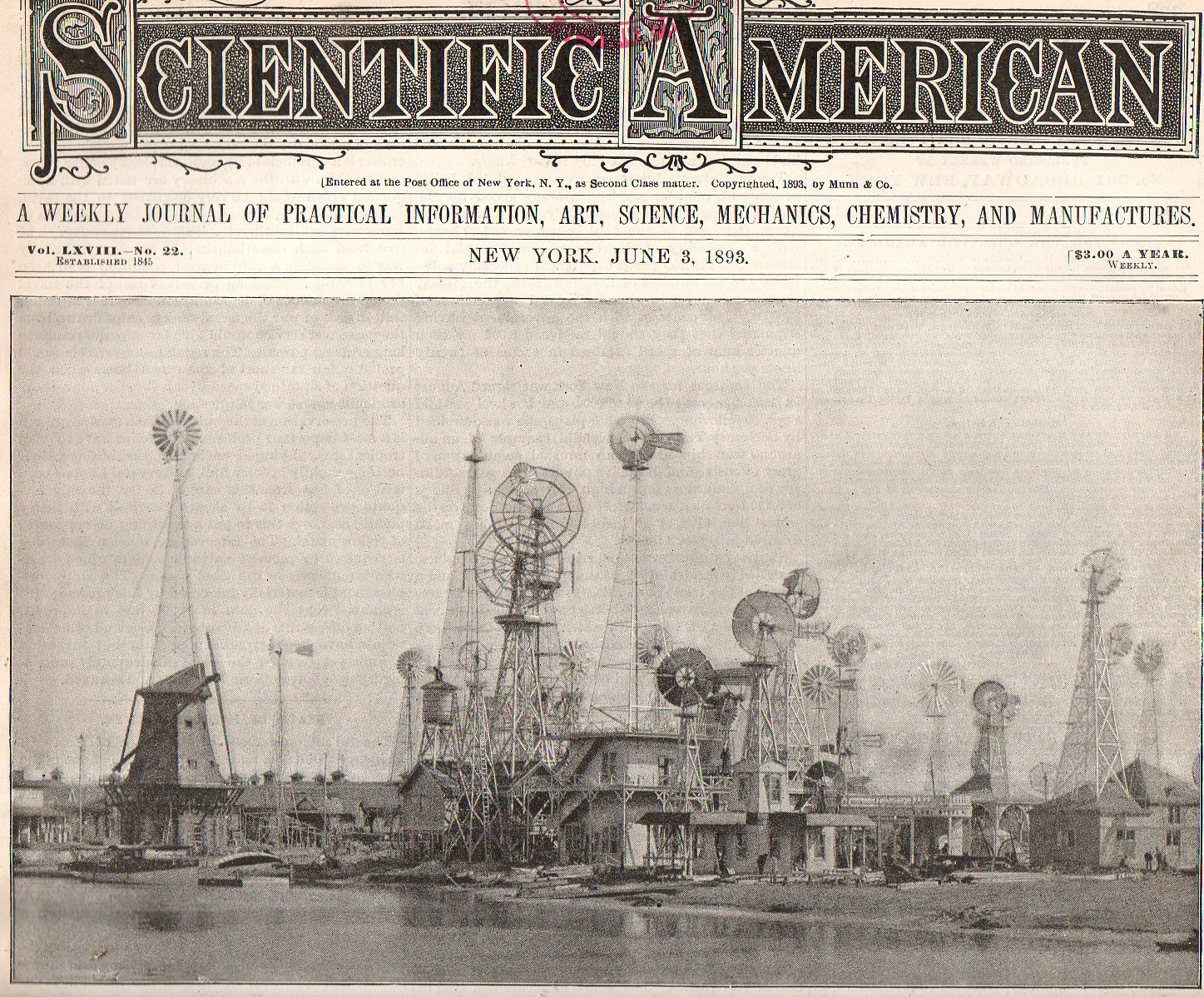
    There’s no one that writes about weather (and most everything else) than Mr. Faulkner.  And it was he who came to mind when I found this image leafing through a heavy monster volume of Scientific American.

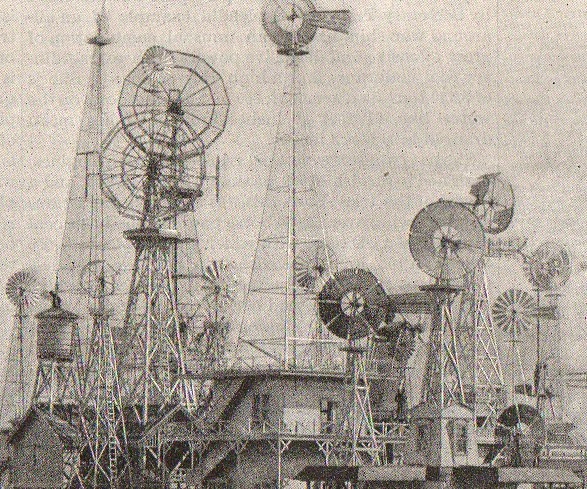
    This is what arose in the Windy City, a forest of cut down trees reconstructed and put together again, with metal and wooden bits to catch the wind, a bunch of them built together by their different makers, all on display at the grand Columbian Exposition of 1893.  They’re not as pretty as trees, but they’re not belching smoke from coal, either, which is something that we can take a lesson away. 

    Windmill detail

    [This is a detail from the front page of the Scientific American, June 3, 1893, from my collection of that great magazine.]

    Windmills260

    ·Posted by :

    ·in:

  • Found Poetry in the Universal Knowledge of Huygen’s Great “Cosmotheoros”, 1698

    JF Ptak Science Books   Post 2291

    It seems to me that as a representative of extraterrestrial imagination not being illustrated its hard to beat the case of the beautiful and polymathic Christiaan Huygens.  Huygens (1629-1695) worked across many fields, including astronomy, biology, math and physics, and was extraordinarily productive, making numerous contributions in the physical and theoretical areas, as well as being a prolific author and correspondent. 

    Towards the end of his relatively short life (he died at age 66, completing work enough for a number of very gifted and exacting people) Huygens embarked down the science fiction road in pre-science fiction days, writing wonderful and provocative outre ideas within what was his general/.universal statement of knowledge of all things , a wonderful book entitled Cosmotheoros, The Celestial World Discover’d: or, Conjectures Concerning the Inhabitants, Plants and Productions of the Worlds in the Planets. (The book had a difficult coming-into-being, Huygens completing it at the end of his life, though he would see only one page of printed before he died on 1695, outliving his elderly father by a bit, an accomplished diplomat who died at age 91 in 1687. His request/bequest to his older brother Constantijn—named for his father—was for him to see the book through to publication. Unfortunately, the diarist/painter/gossip brother lived only two more years, and at his death the book was still not printed. The job finally fell to the direction of Burchard de Volder (1643-1709), a Leiden prof of math and physic who established the physics lab there and who was also the teacher of the “father of physiology”, Herman Boerhaaver (a man of considerable taste, seeing his beautiful and tidy manor house at Oegstgeest, nearby Leiden). Happily de Volder saw the book into publication in 1698 (and survived it by 11 years). The book appeared in Latin and was in the same year (anonymously!) translated into English, followed by a Dutch translation in 1699, French in 1702, German in 1703, and Russian in 1717—in other words, a well-received an popular work.

    See the introduction to the work and the digital version here at the University of Utrecht: http://www.staff.science.uu.nl/~gent0113/huygens/huygens_ct_en.htm

    Huygens looked at everything in his world in this book, and many things outside of it: here he establishes the possibilities of life being lived on worlds other than that of Earth. He develops a detailed fabric for these new heavens, so much so that he can also establish samenesses for the ETs and humans, stating here his belief in the eternal/cosmological abilities of mathematics and music:

    “It’s the same with Musick as with Geometry, it’s every where immutably the same, and always will be so. For all Harmony consists in Concord, and Concord is all the World over fixt according to the same invariable measure and proportion. So that in all Nations the difference and distance of Notes is the same, whether they be in a continued gradual progression, or the voice makes skips over one to the next. Nay very credible Authors report, that there’s a sort of Bird in America, that can plainly sing in order six musical Notes: whence it follows that the Laws of Musick are unchangeably fix’d by Nature, and therefore the same Reason holds valid for their Musick, as we even now proposed for their Geometry”–page 86

    Huygens holds close to the immutable nature and close association of music and mathematics,m which would be the same here and everywhere (everywhere else, the ET communities, being referred to here as “other Nations”). 

    “For why, supposing other Nations and Creatures, endued with Reason and Sense as well as we, should not they reap the Pleasures arising from these Senses as well as we too? I don’t know what effect this Argument, from the immutable nature of these   Arts, may have upon the Minds of others; I think it no inconsiderable or contemptible one, but of as great Strength as that which I made use of above to prove that the Planetarians had the sense of Seeing.” page 86/7

    Huygens is so sure of this that he is willing to take a bet with long odds that not only do ETs enjoy the possibilities of music but that they have also created instruments:

    “But if they take delight in Harmony, ’tis twenty to one but that they have invented musical Instruments. For, if nothing else, they could scarce help lighting upon some or other by chance; the sound of a tight String, the noise of the Winds, or the whistling of Reeds, might have given them the hint. From these small beginnings they perhaps, as well as we, have advanced by degrees to the use of the Lute, Harp, Flute, and many string’d Instruments. But altho the Tones are certain and determinate, yet we find among different Nations a quite different manner and rule for Singing; as formerly among the Dorians, Phrygians, and Lydians, and in our time among the French, Italians, and Persians” page 87

    Huygens then continues to make a beautiful distinction between the musics of Earthling and ETs, in that it may not sound anything like any music we have on Earth, but–since the laws that govern math and music are the same, everywhere–it still might be “very good”.  And not only that, the alien music might be better than our’s:

    “In like manner it may so happen, that the Musick of the Inhabitants of the Planets may widely differ  from all these, and yet be very good. But why we should look upon their Musick to be worse than ours, there’s no reason can be given; neither can we well presume that they want the use of half-notes and quarter-notes, seeing the invention of half-notes is so obvious, and the use of ’em so agreeable to nature. Nay, to go a step farther, what if they should excel us in the Theory and practick part of Musick, and outdo us in Consorts of vocal and instrumental Musick, so artificially compos’d, that they shew their Skill by the mixtures of Discords and Concords?”–page 88 

    And so on.  But why I wonder with all of the great images painted for us in his text is there no venturing into a visual artform?  There’s enough information in the Huygens work to allow for a map, but then there are none, not even something along the images of de Bergerac, who was perhaps among the greatest visionary of techno-anthropormorphic human flight.  Before he was the object of Edmund Rostand’s 1897 play, de Bergerac was a massively creative author, producing, among other things, the book Histoire des Etats et Empires de la Lune (History of the States and Empires of the Moon, published posthumously in 1657), followed by Histoire des Etats et Empires du Soleil (History of the States and Empires of the Sun, again, published further and deeper into his life’s surrender, 1662), both eventually collected as L’Autre Monde (Other Worlds).  Bergerac introduces us, the humble reader, to one of the most important concepts in the history of literature–namely that we humans were not only not alone in the universe, but that we were not even the dominant culture, and indeed we were actually hated by some of the other more advanced species.

    The foundations for structuring a visual habitat for the ideas of Huygens are abundant, as you can see easily in the table of contents (which is like an annotated table of contents for a modern book)–the signs for a road map are there, mostly–there’s just no road, but there are plenty of suggestions for one.

    In general though the chapter titles are fantastic, and invite themselves to their own found-poetry—by simply listing and centering them, a person with a good sense for pause and continuity could read these out loud and make them sound like a considered piece of poetry.


    The Chapter heads, in order (!):

    Some have already talk’d of the Inhabitants of the Planets, but went no fartherThe Objections of ignorant Cavillers prevented
    This Enquiry not overcurious
    Conjectures not useless, because not certain
    These Studies useful to Religion
    Copernicus’s System explain’d
    Arguments for the truth of it
    The Proportion of the Magnitude of the Planets, in respect of one another, and the Sun
    The Lamell more convenient than Micrometers
    The Earth justly liken’d to the Planets, and the Planets to it
    Arguments from their Similitude of no small weight
    The Planets are solid, and not without Gravity
    Have Animals and Plants
    Not to be imagin’d too unlike ours
    Planets have Water
    But not just like ours
    Plants grow and are nourish’d there as they are here
    The same true of their Animals
    Great variety of Animals in this Earth
    And no less in the Planets
    The same in Plants
    Vices of Men no hindrance to their being the Glory of the Planet they inhabit
    Reason not different from what ’tis here
    They have Senses
    Sight
    Hearing
    A Medium to convey Sound to the Ear
    Touch
    Smell and Tast
    Their Senses not very different from ours
    They have Pleasure arising from the Senses
    All the Planets have Fire
    The bigness of their Creatures not rightly guest at by the bigness of the Planets
    In the Planets are many sorts of rational Creatures as well as here
    Men chiefly differ from Beasts in the study of Nature
    They have Astronomy
    And all its subservient Arts
    Geometry and Arithmetick
    And Writing
    And Opticks
    These Sciences not contrary to Nature
    They have Hands
    And Feet
    That they are upright
    It follows not therefore that they have the same shape with us
    A rational Soul may inhabit another Shape than ours
    The Planetarians not less than we
    They live in Society
    They enjoy the pleasures of Society
       They have Houses to secure ’em from Weather
    They have Navigation, and all Arts subservient
    As Geometry
    They have Musick
    The Advantages we reap from Herbs and Animals
    And from Metals
    From the discoveries of our Age
    The Planets have, tho not these same, yet as useful Inventions 
    Book 2
    Kircher’s Journey in Ecstacy examin’d
    The System of the Planets in Mercury
    In VenusIn Mars
     Jupiter and Saturn the most eminent of the Planets both for bigness and attendants
    The proportion of the Diameter of Jupiter, and of the Orbs of his Satellites, to the Orbit of the Moon round the Earth
    The periods of Jupiter’s Moons
    And Saturn’s
    This proportion true according to all modern Observations
    The apparent magnitude of the Sun in Jupiter, and a way of finding what light they there enjoy
    And in Saturn
    Always the same length
    They see the fixt Stars just as we do
    The appearances of the Ring in Saturn
    Very little to be said of the Moon
    The Guards of Jupiter and Saturn are of the same nature with our Moon
    The Moon hath Mountains
    But no Sea, nor Rivers, nor Clouds, nor Air and Water
    The Astronomy of the Inhabitants of the Moon
    This may be applied to the Moons about Jupiter and Saturn
    The immense distance between the Sun and Planets illustrated
    No ground for Conjecture in the Sun
    The Faculty in the Sun not easily seen
    By reason of its Heat no Inhabitants like ours can live in the Sun
    The fix’d Stars so many Suns
    They are not all in the same Sphere
    The Stars have Planets about them like our Sun
    A way of making a probable guess at the distance of the Stars
    Every Sun has a vortex round it, very different from those of Cartes 


  • The Sky Above & Mud Below Department, 1890

    JF Ptak Science Books   Quick Post

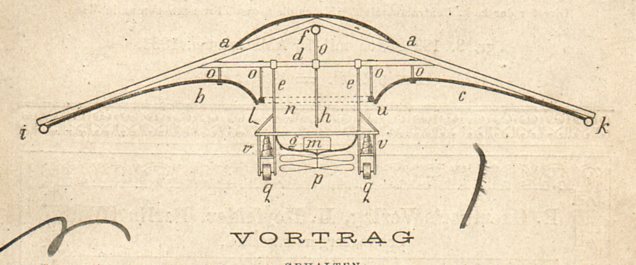
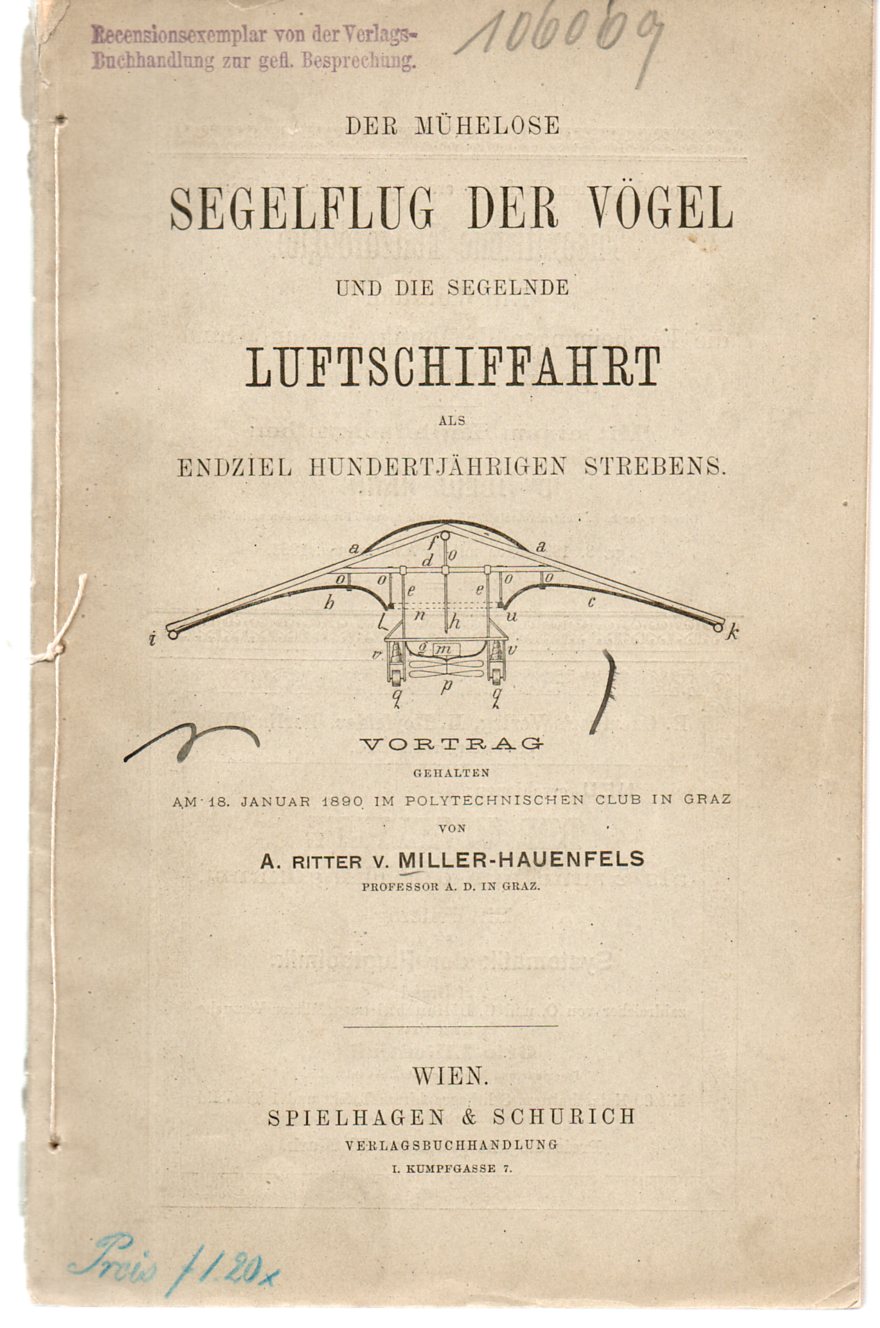
    This lovely design occurs on a pamphlet written by Albert Ritter v. Miller-Hauenfels (1818-1897),  Der mühelose Segelflug der Vögel und die segelnde Luftschiffahrt als Endziel hundertjährigen Strebens, or, roughly “The effortless gliding of birds and the sailing airships as the ultimate goal for the end of the century”).  The booklet was presented 18 January 1890 by the  Polytechnischen Club in Graz, and published in Wien by Spielhagen & Schurich later that year.

    Aviati0n ritter382


    Aviati0n ritter381

    In his lectures at Graz Miller-Hauenfels looks at the possibility of human (non-powered, gliding) flight via forward-progression bird flight, basing his work on that of Marey, Lilienthal and Parseval. It is a sky-above-mud-below moment, as Miller-Hauenfels was a mining engineer and supervisor, spending much of his time with his mind in and under the earth. And then there, in the not-so-backish-background, was his other thinking, which place him far above the ground.  

  • The Department of Significant Understatement & the Most Valuable Patent, Ever?

    JF Ptak Science Books   Post 2294

    Bell patent close
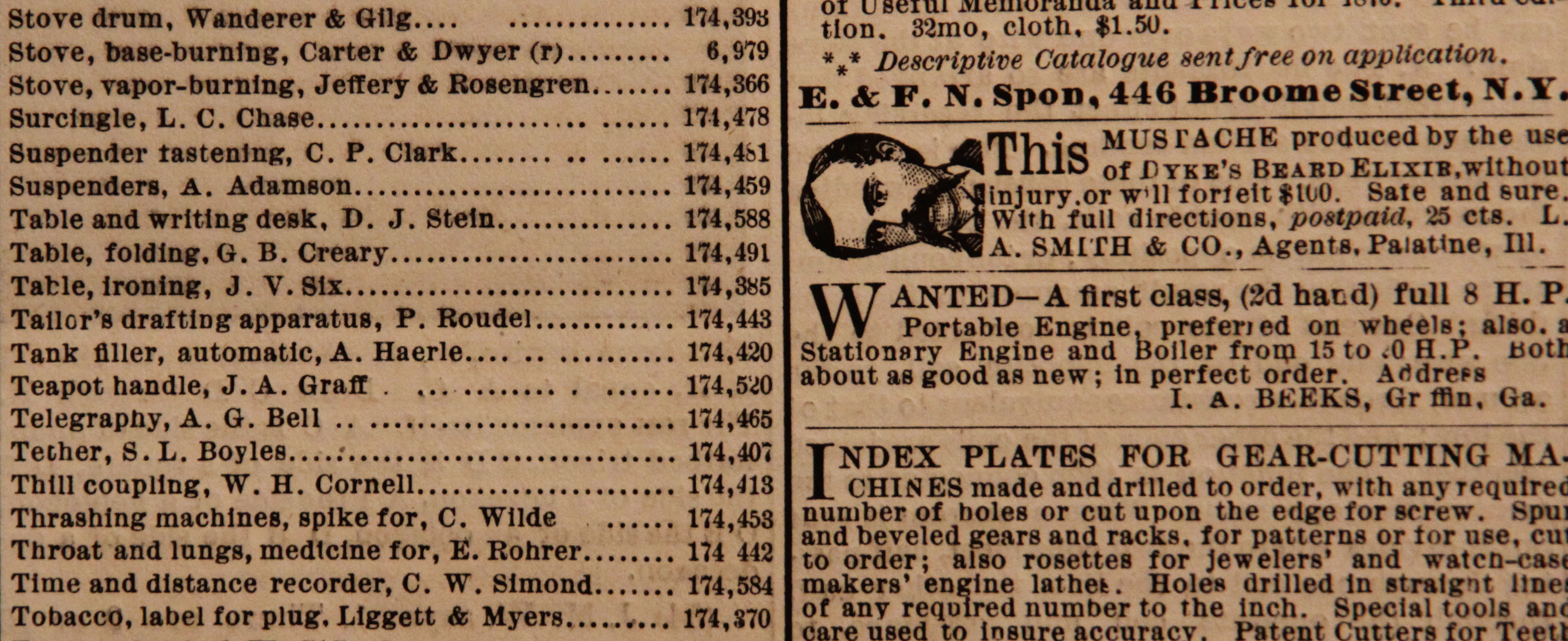
    Besides it being the (U.S.) Centennial year, 1876 saw a number of major gains in the history of human thinking. Sometimes the announcements or earliest public appearances of these breakthroughs didn’t get all that much attention.  As one of the major means of transferring technical and applied science info to the general public, it is interesting to see how Scientific American reacted to such innovations.  For the thick, heavy volume for 1876, amid patent announcements and articles on telegraphic fire alarms, electro-harmonic multiplex telegraphs, recording telegraphs, electro-magnetic telegraph railroad car signals, signal box telegraphs, underground telegraphs, telegraph keys and armature, acoustic telegraphs and the like (though there weren’t that many reported, not really, just on the order of dozens), we find one of the most important of them all, patent # 174,465, by Alexander Graham Bell, appearing 8 April 1876.  It would be a rude resumption of being here in the future of this event to call the coverage short-sighted–this is just the way the patents were reported, with no weighting, just a single line.  

     In an earlier article in the 4 March 1876 issue of SA, there appeared “The Invention of the Telephone”, by P.H. Vander Weyde, in which there is yet any mention of Mr. Bell.  There is an illustration of one of his precursors in the field, the Reuss telephone, with ample description. (This was actually Philipp Reiss, and his telephone really wouldn’t work to transmit the human voice, though did so work for music to some degree.)  Bell’s patent  would be at the Patent Office in March, and would appear as a one-line notice (among a hundred others), the patent stating it was “the method of, and apparatus for, transmitting vocal or other sounds telegraphically … by causing electrical undulations, similar in form to the vibrations of the air accompanying the said vocal or other sound”.  (The first image above is a detail; the second image a longer version, which is really only less than half of what the real-life version looks like in the tall listing.)

    Weeks later, Elisha Gray‘s (on 13 May) telegraphic telephone patent (175071) appears in the Scientific American, and later, on 9 September, on page 163, there is the article “The Human Voice Transmitted by Telegraph”, on the successful transmission by Graham Bell. 

    Admittedly there were a number of developments in the production of the speaking telephone at this time, though in general there seems to have been no great attention paid them in the pages of the Scientific American than pipe cutting machine improvements or improved gravel separators.  Obviously the great impact of the invention was yet to be appreciated, even in any sort of fictional way.

  • “Spirit Writing”: Electric, Script-Writing Telegraph, 1879 (!!)

    JF Ptak Science Books   Post 2295

    Telegraph script

    Telegraph script
    This fine bit of welcome-to-the-future technology appeared in the notice “A Real  Telegraph”, in Nature, 6 February 1879.  It is a quick report on the invention, occupying one scant paragraph of text but was accompanied by a full-page illustration of a sample of the telegraphic writing, which must have seemed in 1879 like a touch of the future–the telegraph was forty years old, but the recording telegraph was relatively new, and the idea that you could read a series of spaces and dots and dashes as though it were handwriting must have seemed like seeing color photographs in 1935.

    The “real” part of the title of the note meant in this case that rather than have a key operator tap out the message in Morse Code, the sender would be writing out the message in long hand, and the receiver would gather up the message so that it appeared in recognizable letters and words rather than dots and dashes.  The inventor’s name was E.A. Cowper, and he brought to the telegraphic art something as “startlingly” as the “marvels” of the telephone, which had been invented just three years earlier.

    The author describes the appearance of the script on the receiving end seeming as though to have been guide by a “spirit hand”, such as the highly unexpected result even to the trained scientific reporter. 

    A somewhat longer article appeared in the New York Times a few weeks later, the full text of which is here.


    According to William Maver jr. American telegraphy and encyclopedia of the telegraph: systems, apparatus … By William Maver (jr.) this was the first successful attempt at producing susch a machine. 


  • Early Robots as Explosive Anthropomorphs

    JF Ptak Science Books   Quick Post

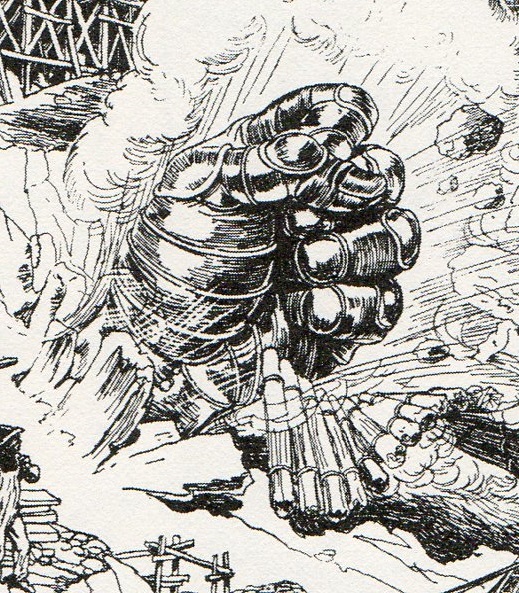
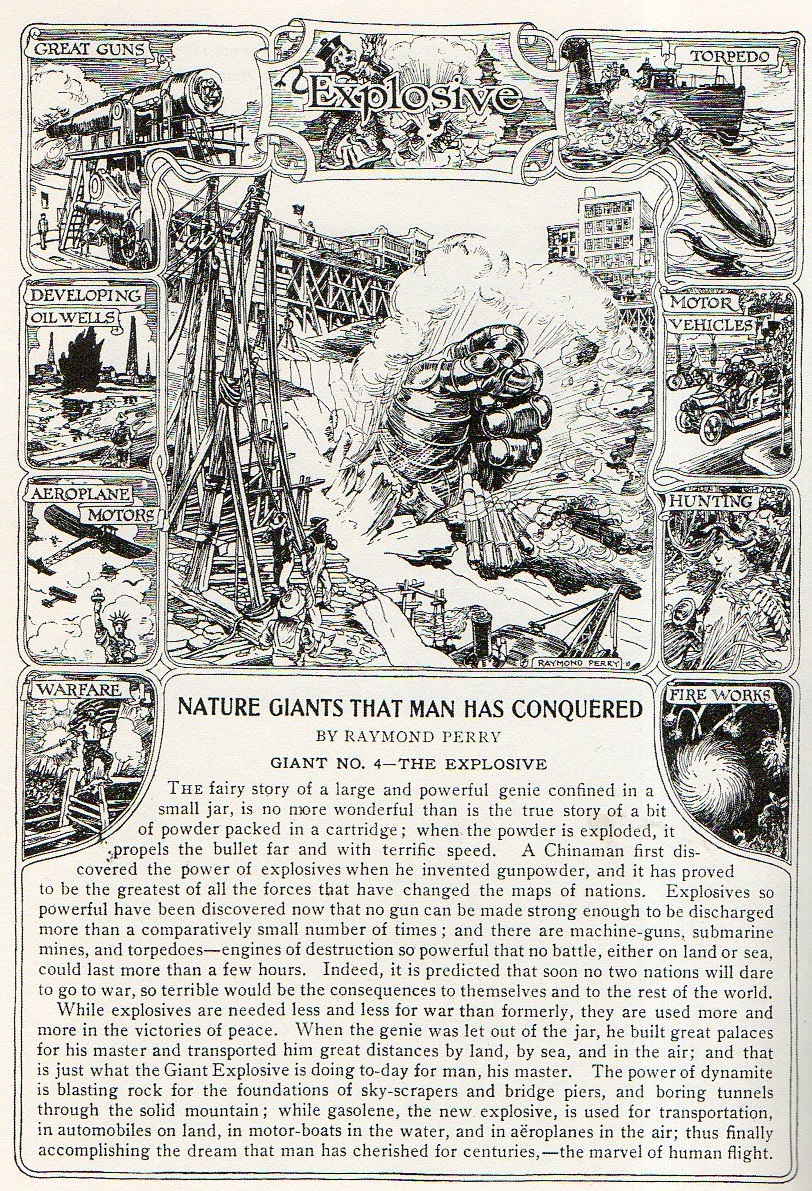
    I have been collecting images of mechanical men/robots pre-singularity antiquarian-quaint displays of advanced technical humans.  This is an unusual one that may or may not fit this, though there is a suggestion of MassiveMan in the gigantic metallic fist, which is supposed to show a successful combat of people over nature via the advancing bliss of explosives.  I’d just like to post this here before I lose it…

    Nature giants262

    Which is a detail from St. Nicholas magazine, 1911:

    Nature giants261

  • The Small Comfort of the Wounded: ElectroPhones, 1917

    JF Ptak Science Books    Post 2296  (WWI Photo #82)

    WWI Electrophone267

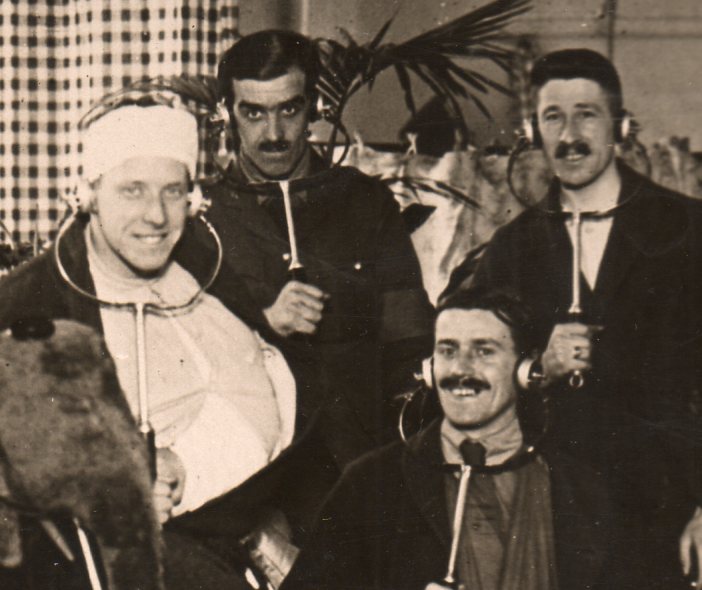
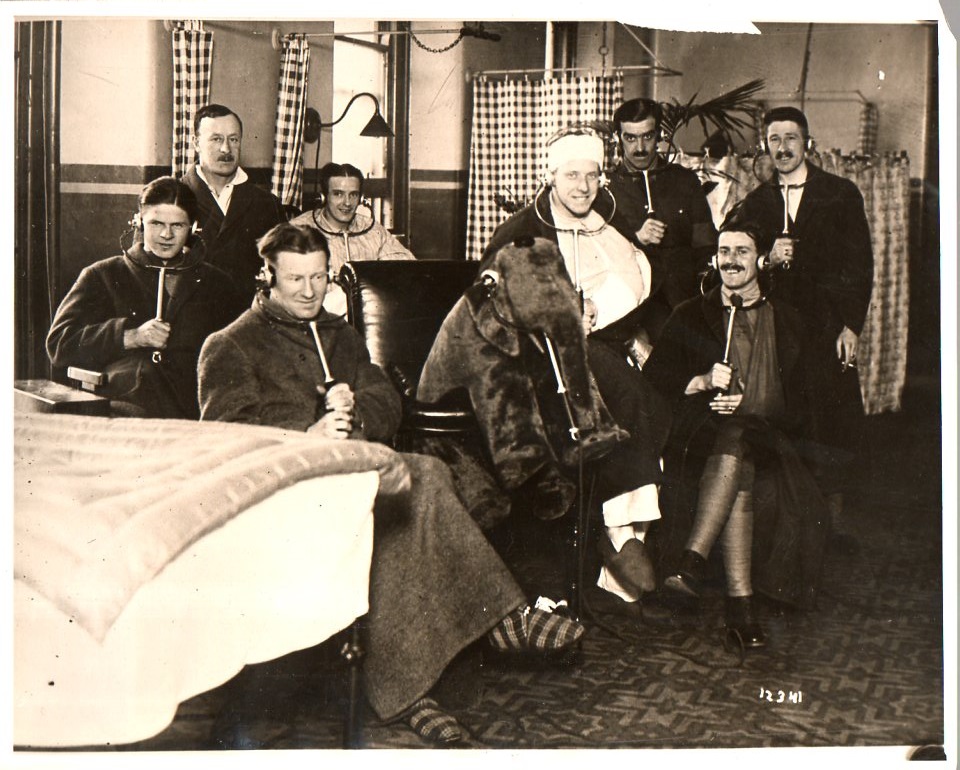
    Overall, these soldiers look to be in pretty good spirits, even if they were told to be so, they still looked fairly genuine. And who wouldn’t be, at least to some degree?  They were a few of the millions of soldiers who were wounded in WWI, which means at least that they were among the millions of the dead. 

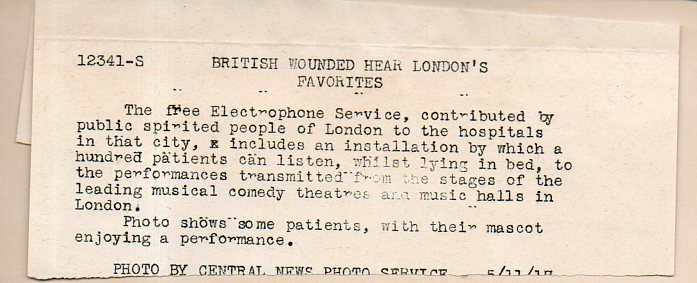
    The caption that accompanies these News Photo Service image (made by the Central News Photo Service and dated May 11, 1917, says that they were enjoying the donated headsets–Electrophones–and represented a few of the hundreds that received them.  This device was basically a telephone receiver, and years after Bell and Edison dreamed of social integration and advancement and wide-ranging culture, of delivery literature and music to people flung near and far, these soldiers were enjoying the benefit of limited concerts and other entertainments via telephone lines.  

    WWI Electrophone266

    Here’s a very good quote on the electrophone from the highly interesting The Cat’s Meat Shop, written by Lee Jackson, author of Dirty Old London, the Victorian Campaign Against Filth. (It is an interesting topic–filth and its control–because you really can’t have an Industrial Revolution without lots of workers living close to their jobs, which means that lots of people live close together, and you can’t have that unless you somehow control for good sanitary conditions, which means you’ve got to take care of filth.)  

    • The original image is available for purchase via the blog’s bookstore, here.

    WWI Electrophone265

    “The most picturesque and entertaining adjunct of Telephone London is the electrophone. There is not a leading theatre, concert-room, or music-hall but has the electrophone transmitters – in shape like cigar-boxes – installed before the footlights, out of sight of the audience. They are at the Royal Opera, Covent Garden; and in many of the principal places of worship a wooden dummy Bible in the pulpit bears the preacher’s words, by means of the N.T.C. telephone lines, to thousands of invalid or crippled listeners in bed or chair in their homes or hospitals. It was thus that Queen Victoria, seated at Windsor Castle, heard 2,000 school children in Her Majesty’s Theatre, in the Haymarket, cheer her and sing “God Save the Queen” on her last birthday. King Edward was likewise relieved from ennui at Buckingham Palace during his illness, for the brightest music, mirth, and song of London were ever on tap at his side. Queen Alexandra is also a devotee of the electrophone, more especially throughout the opera season. On the other hand, the cruel lot of certain hospital patients, of the blind, and even the deaf – for the micro-phonic capacity of the electrophone enables all but the stone-deaf to hear – is thus greatly brightened by science. The sadness of the bedridden, the incurable, or the sufferer from contagious disease is enlivened by sacred or secular song and story, and, as a much-to-be-welcomed addition to the alleviations of London’s strenuous life, the benefits of the electrophone are innumerable. It may be added that in the imposingly decorated salon in Gerrard Street from time to time fashionable parties assemble and “taste” the whole of London’s entertainments in one evening. Thus, over mammoth aerial and subterranean wire-webs does London, annihilating distance, work and play by the aid of Science.–George R. Sims (ed.), Living London, 1902

    ·Posted by :

    ·in:

    —
  • Really Deep Depth: the Universe and SpongeBob SquarePants.

    JF Ptak Science Books   (Expanding an earlier post from 2013, but different enough to get its own Post # 2297)Follow Me on Pinterest 

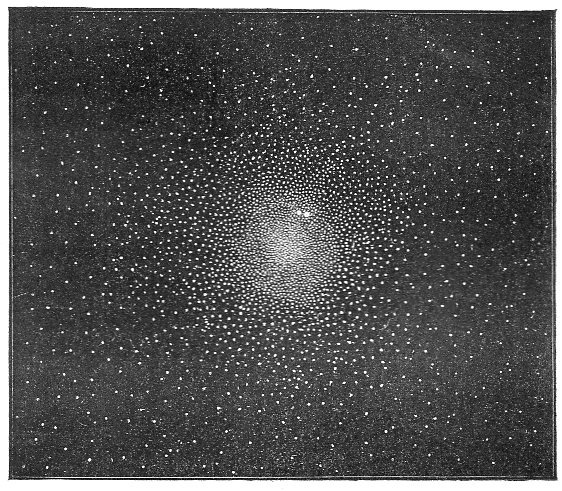
    Astronomy--47 Tuc189

    Thinking about the depth of space and visually explaining it are two different things–vast numbers and the deepest depths, all colliding with the imagination, which really has a hard time keeping up with it all.

    This beautiful engraving appeared in Amedee Guillemin’s  Le Ciel: notions d’astronomie a l’usage des gens du monde et de la jeunesse, which was published by Librairie de L. Hachette and Company, and printed in 1865 (the images from which are available here). Guillemin (1826-1893) was a social/culture writer who became a very respected science journalist/writer, becoming very popular with works in physics, technology, astronomy and general science, many lavishly illustrated. 

    There are many striking images in this book, The Sky/the Heavens…, but I’ve chosen this one because it has a certain deep depth to it, and relays a complexity and distinctness to something that is generally imaged as being less so, being a massive star cluster and all.  Unlike many of his other books, the great illustrations here are the small text images, some only 25% of the page, and in most cases rendered sparingly, and with a real feel of “difference” to them (at least so to me).

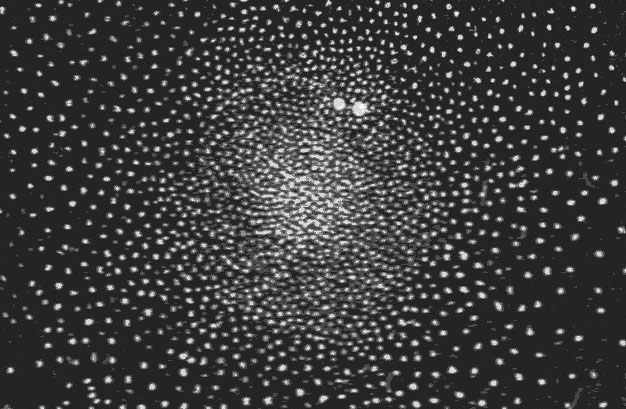
    The “Amas du Toucan”, known now more familiarly as 47 Toucanae or 47 Tuc (NGC 104), is a bright element in the southern sky, a huge cluster 120 light years wide and 16,700 light years from Earth, visible to the naked eye in the constellation Toucan (created by Petrus Plancius in 1598 or so).   And here it is, in a little 9×8 cm engraving with hundreds of white points as stars, made after an engraving of Sir William Herschel (1738-1822, a German-born English astronomer who–with his sister Caroline and brother John–spent decades observing and recording stars, double stars, clusters and nebulae).  

    Astronomy--47 tuc big detail

    47 Tuc was first catalogued as not-a-star by Abbe Nicolas Louis de Lacaille (1713-1762),  a French astronomer who found it too be too fuzzy to be a single star, and who produced a 10,000 (Southern) star catalog, Coelum Australe Stelliferum, which was published in 1762, and which also introduced 14 new constellations.  47 Tuc made another quick appearance in the great Catalogue des Nébuleuses et des Amas d’Étoiles (“Catalogue of Nebulae and Star Clusters”), a superb and meticulous work by Charles Messier, and published in 1771.

    But distances and depths such as we know them now were not-conceivable at this point for Guillemin–and really would be for another 60 years or so.  At this point, and for some time to come, the Milky Way was considered to be the entirety of the universe. The business of galaxies being outside of the Milky Way is a relatively recent development, determined so by Harlow Shapley in 1924, expanding the size of the universe ten-fold to 300,000 light years; this was blown up a quite a bit by Edwin Hubble in ’24 to 900,000 light years, and then five years later in one of his most famous papers Hubble blew the figure up a lot, expanding the universe to 280 million light years.  Walter Baade and others added to the figure in the 1950’s (4 billion light years or so), and during the 1960’s-1990’s the figure expanded to 25-30 billion light years, finding its way to 94 billion light years in 2006.  

    I would imagine that the concept of galaxies outside of our own, and that the universe was vastly larger than we thought, and that the potential for there being new/unforeseen discoveries was great, that in 1924/1929 it may have seemed somewhat like Galileo suddenly seeing an order of magnitude more stars than had ever been seen before by the naked eye…that the sky which had basically been unchanged in appearance to humans for thousands of years really wasn’t what people thought it was.  Perhaps it was like the Two Dimensional beings in Flatland  trying to comprehend the first appearance of a Three Dimensional entity.  Or of course the realization could have been like when Sandy Cheeks came to the shocking epiphany in an episode of the Immortal Sponge Bob Square Pants that the titanic battle she had been waging and ostensibly won with an Alaskan Bull Worm was just her fighting with the tip of the beast’s tongue–oh. Oh my.  Something along those orders.  Deep depth.  

    Sandy cheeks

    The Guillemin work is simply a lovely and elegant thing–one of many accomplishments in a beautiful and relatively simple book. 

  • Single-Line Entries of Revolutionary Ideas: the Transistor, (1949)

    JF Ptak Science Books   Post 2298

    Transistor 066
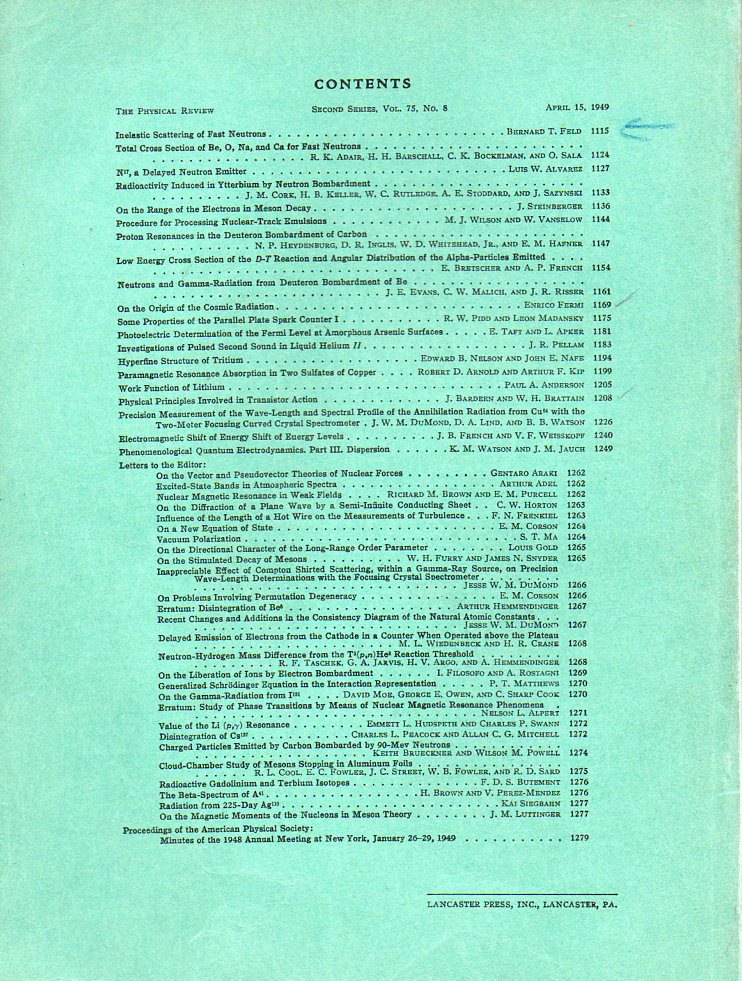
    One of the things I love about working my way through old scientific journals is when I find the issue that I’m looking for and scroll down the list of contributors to find the significant article that I want.  Long list, usually; and then, after making my way through 30 or 40 lines of tight type of the index I find it. [This by the way is one of those experiences that is being replaced by the digital library.]   Even though the paper on pp 1208 through 1226  of the 15 April 1949 issue of The Physical Review looks like any other, it is today seen as revolutionary. The entry for “Physical Principles Involved in Transistor Action” by John Bardeen (two-time Nobel in physics) and Walter Brattain (Nobel ’72) shows up about halfway down the index, sandwiched in some very good company (Enrico Fermi’s “Origins of Cosmic Radiation” and a number of others), and does not show up bolded, or highlighted, or with an asterisk.  Such is the nature of publication in the academic journal world, everything delivered with equal weight–the bolding stuff will happen later, in other venues.  But to see it right there in the flesh, so to speak, fresh and new and revolutionary, and looking like everything else, is really thrilling.  [See this entry for a similar report on the most valuable patent in history.]

    Transistor 064

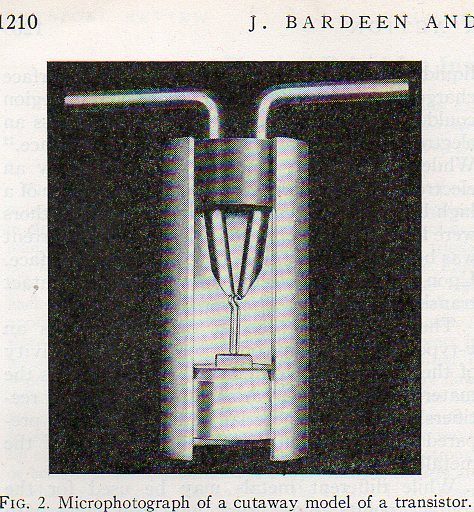
    It makes me wonder though how it would’ve felt to open this journal for the first time back there in mid-April ’49, turning to page 1210 to see the microphotograph of the cutaway of a model of the transistor.  This was the defining technical publication on the transistor1, which was the first massive step towards microminiaturization and the explosive new growth in the computer, allowing far more powerful machines to be designed in far less space, in far less amounts of time, and on and on.  It is one of the first steps in the Information Revolution, moving the computer from massive racks of electronic tubes to more simple, elegant, nimble and by-far faster circuit boards with transistors (and resistors, capacitors, inductors, diodes, etc.) to make an electronic circuit.  This would be the standard for computer construction, only supplemented by Jack Kilby (TI)  and Robert Noyce (Fairchild Camera) in 1958/9 with the integrated circuit, where transistors are made smaller still and produced in groups on circuit boards rather than individually.

    The photo above shows a cutaway of the transistor, and is the first time it was published–the first photo of what was one of the 20th century’s greatest inventions. 

    Transistor 065

    Notes

    1.  The paper was published simultaneously in the Bell System Technical Journal; Bardeen and Brattain were with the Bell Labs.  The Bell journal also contained another revolutionary paper in the same volume, Claude Shannon’s “Communication Theory of Secrecy Systems”, which is one of the most important early papers on electronics and cryptology.

    The full bit: BARDEEN,  John and Walter Brattain:  Physical Principles Involved in Transistor Action;  Lancaster, Pa:  Physical Review,  1949.  1st edition.  The Physical Review, Vol 75, Second Series, No. 8    8vo.

  • Moving Manhattan and Brooklyn Together at the Speed of…Slow (1903)

    JF Ptak Science Books   Post 2299

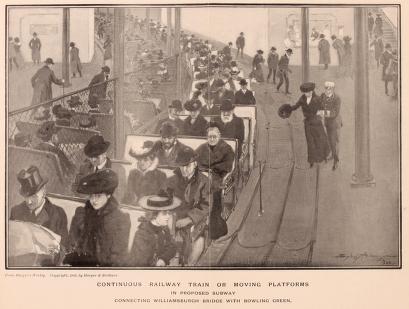
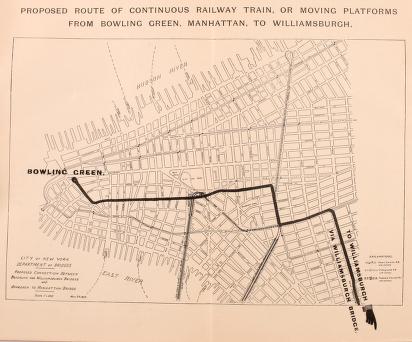
    If New York City was populated by nothing but people wearing hats, carried mink muffs, used gold-handled walking sticks, and really didn’t have to be anywhere at a particular time, then I think this invention might have been useful.  But seeing that off the engineer’s table that Manhattan was not god’s waiting room and far more Darwinian  than a high-Victorian imaginary noblese-chaste class of slow and deliberate people waiting to be waited on, then this idea wouldn’t have worked very well at all.  The seed of it all is found in Transportation of Passengers in Greater New York by Continuous Railway Train, or Moving Platforms.  Argument in favor of equipping the East River Bridges, and connecting subway to Bowling Green, Manhattan, with a continuous railway train or Moving Platforms, which was  prepared by Schmidt & Gallatin of New York in 1903.  It was only 20 pages, but it had  four folding plates, including two maps, and two drawings of the envisioned walkways, and that is the stuff upon which dreams are laid, made, and stayed.

    Sidewalks 3


    “Moving Platforms for the conveyance of passengers were recommended by Mr. Horace Greeley thirty years ago. They were successfully operated, first, at the World’s Columbian Exposition of 1893, where 2,700,000 people were transported. In 1896 they were installed at the Berlin Exposition, and again at the Paris Exposition of 1900, where they carried over eight million passengers. Few persons know what Moving Platforms are. From the face that sometimes they are called ” Moving Side- walks,” it is believed that they must be some sort of a pavement on rollers, on which it is difficult to step with safety and maintain equilibrium. The Moving Platforms are to all intents a railway, operated like other railways, propelled by electricity, with cars, seats, motors, passenger stations, ticket booths, guards, electric lights — in fact, everything belonging to a first-class railway.” 


    Sidewalks map


    “Where it differs from the ordinary railway is that the cars, or trains, are not running at intervals, but are coupled up continuously, so that there is no interruption of traffic at any time, but a large seating capacity at all times. It differs also in the construction of the cars, which are mere flat cars, provided with seats placed crosswise, and so ar- ranged that all rmssengers face in the direction of motion. Each of these seats may be made wide enough to accommodate one, two or more persons. The most approved plan is to provide seats on one side of the cars only and leave the other for passengers to walk, thus giving them an opportunity to further accelerate their speed if they so desire…”

Recent Posts

Archives

Categories