JF Ptak Science Books Post 2290
It isn’t really an onomatopoeia, but the harmonic synthesizer at least feels like itself in the mouth as the two words are spoken. try it: h a r m o n i c s y n t h e s i z e r. The name does feel as though it touches the boundaries of most of the mouth, and that is basically what this analog computer does, analyzes sound, and record it in lovely waves (the plotter on the left in the photo). http://www.phys.cwru.edu/ccpi/Harmonic_synthesizer.html
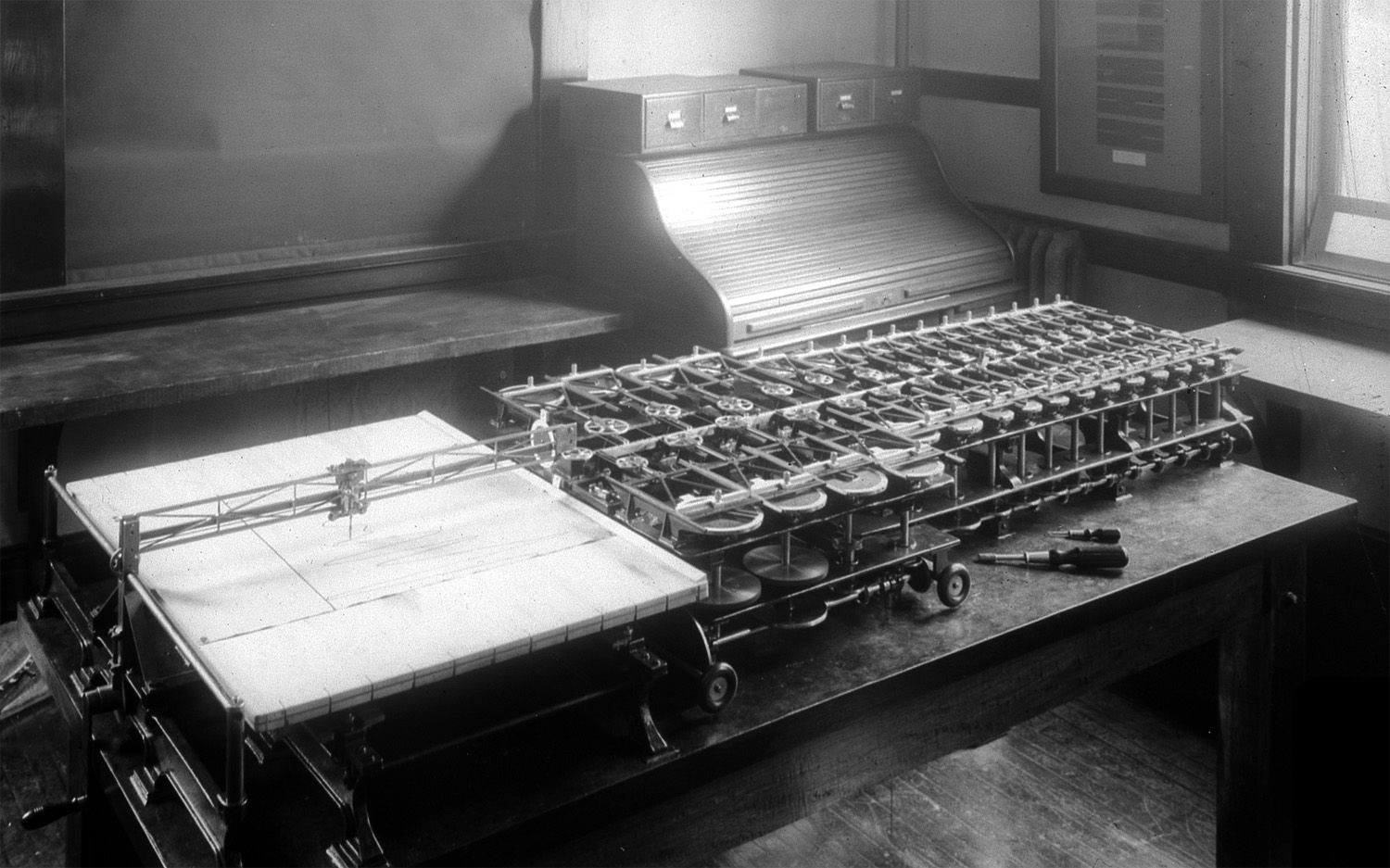
It is also a beautiful machine. The one above is by Dayton Miller of Case Western Reserve, and it is described in a 1916 publication from the Journal of the Franklin Institute.
“As described on the Case Western Reserve University website, “Lord Kelvin’s harmonic synthesizer is basically Henrici’s harmonic analyzer in reverse. Originally designed as a tide predictor in 1873, the system can combine numerous component waves—in some devices, up to 64 separate components—into a single curve. It is based on the earlier pin-and-slot device, which produces simple harmonic motion with the turn of a crank.”
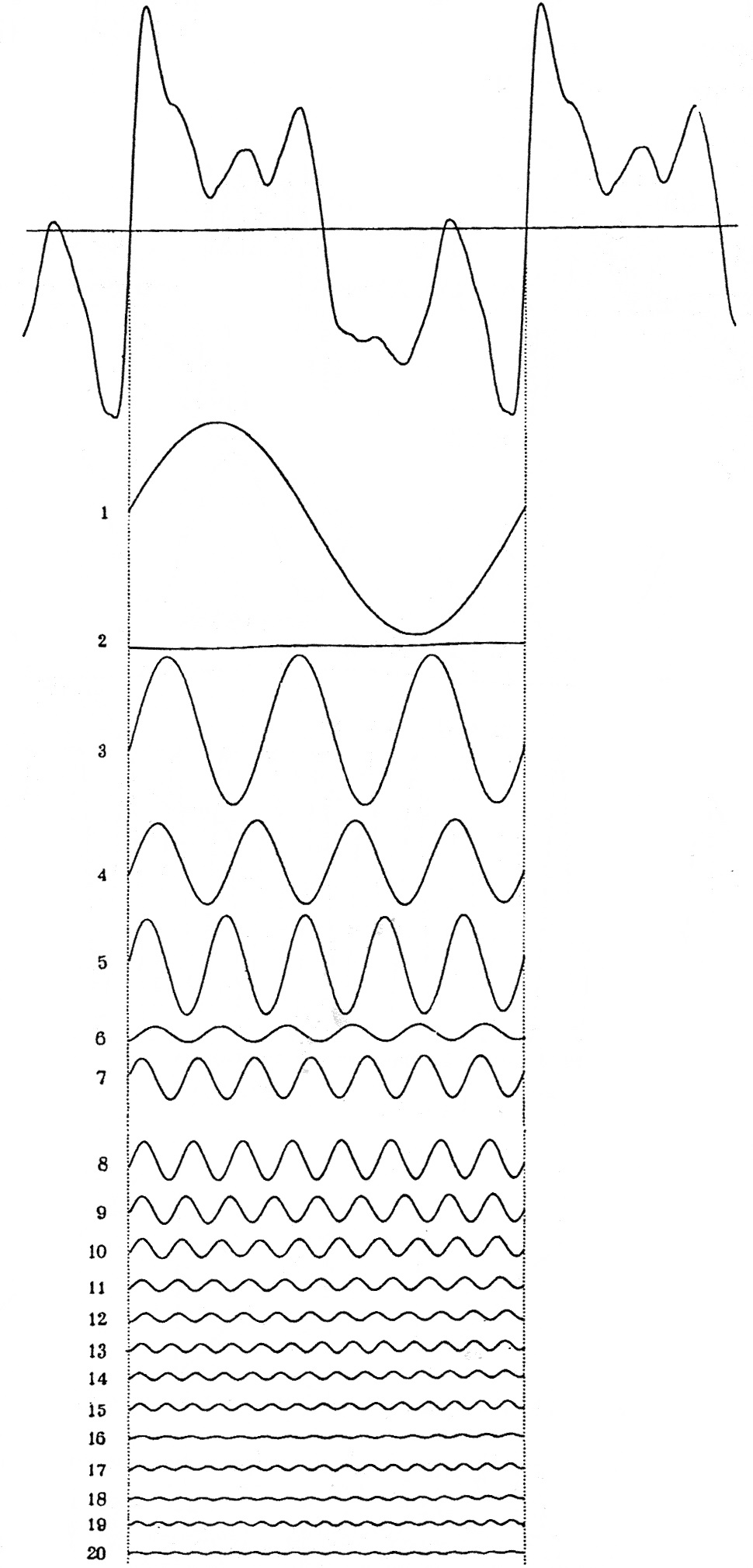
And one of the results as it appeared on page 73 of the Journal of the Franklin Institute, a curve representing the sound wave from a clarinet and twenty of its harmonic components:
“The version used by Dayton Miller was designed and built in the laboratory and instrument shop of the Physics Dept. of the Case School of Applied Sciences. It consisted of 32 rotating pin-and-slot devices (see diagram below), each of which produced simple harmonic motion with a specified amplitude and phase; these 32 elements controlled the motion of a single cable that traced out the combined wave with a stylus and sliding drafting table. It was used by Dayton Miller to check the results produced by the harmonic analyzer against the original phonodeik curve…” http://www.phys.cwru.edu/ccpi/Harmonic_synthesizer.html
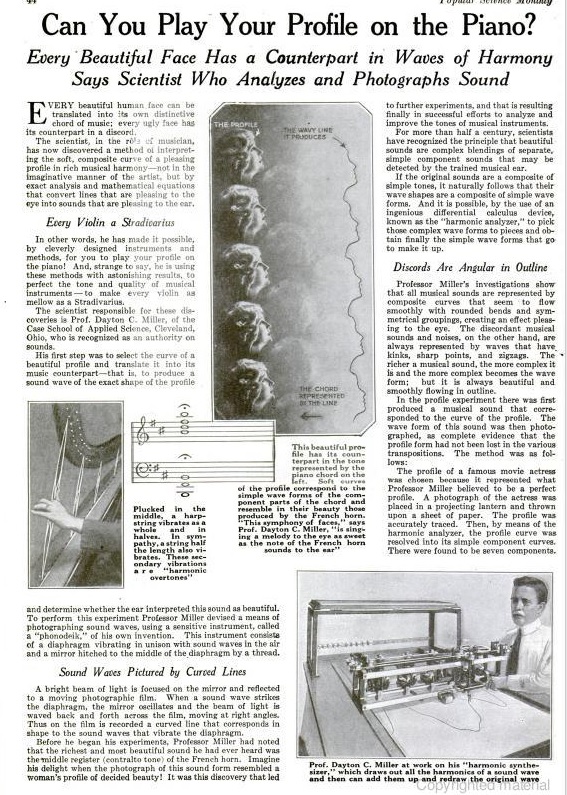
And from the magazine Popular Science for Augusat, 1921, we find the following article:
[Source: Google Books]