A Daily History of Holes, Dots, Lines, Science, History, Math, Physics, Art, the Unintentional Absurd, Architecture, Maps, Data Visualization, Blank and Missing Things, and so on. |1.6 million words, 7500 images, 4.9 million hits| Press & appearances in The Times, Le Figaro, Mensa, The Economist, The Guardian, Discovery News, Slate, Le Monde, Sci American Blogs, Le Pont, and many other places… 5000+ total posts since 2008.

  • When Things ARE Better in Glorious Black & White: Color Detonation and the Invention of *More* Primary Colors, 1942

    JF Ptak Science Books   Post 3286
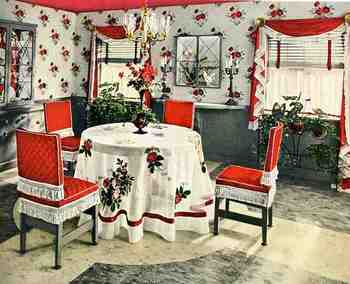
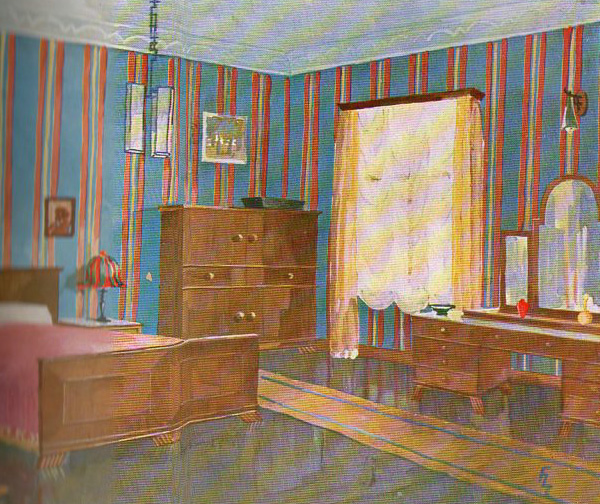
    00blogoct_14color848Well: this is a variation of yesterday’s post on the two opposite edges of color in oddly-applied scientific/technical manners. In unwittingly responding to the question “when is color-use bad?”, the answers were found in these room decorations from 1942, all of which come from a pamphlet entitled Ideas for Old Rooms and New, extracted from the mind of  Hapel (?) Dell Brown.  It is a tidy book with ideas that are anything but tidy;and  as you scroll down you’ll see that the room solutions suggested by Hapel Del are anti-tidy; clutterous (no, not a word but could be).  Everything about these creations speaks to the annihilation of visual resting places; everything seems to be an affront to the concept of causal emptiness.  The weird thing is that there aren’t very many objects in these rooms at all (at least comparing these rooms from where I’m sitting)–the visual complaints seem all rocketing from the abuse of colors found in the fabric of the furniture and walls and floors and window treatments.  The eye gets no rest–and as a matter of fact, the cones of the eyeball are impaled on the rods as a result of the author/decorator  desperate attempts to invent three more primary colors. 

    Believe it or not we don’t really get the full flavor of the color cacophony because the floors in these picture look sort of benign, fading away into themselves–which they are not, according to  the description in the text, because they are all high-gloss linoleum rolls or tiles (“efused [sic] with deep wondrous color”.  And that means not only are these floors adding sheen and color to the rest of the incredibly colorful–an effect fairly lost in these photos–they are also cold.

    One thing that I haven’t pointed out in this peon to syrupy/pastel-y/techno-gelatinous-chromodrama is that they were all done in response to a re-decoration of a perfectly nice-looking house, with all of the former “bland” colonial-style rooms presented in glorious black and white.  I’d rather live in Maison Noir than in this happy nightmare.
  • Lost German Color of 1927

    JF Ptak Science Books    Post 2387

    [Part of the series on Color and its Abuses, as with an example of “When Color is Best in Black-and-White”, here.]

    German color375
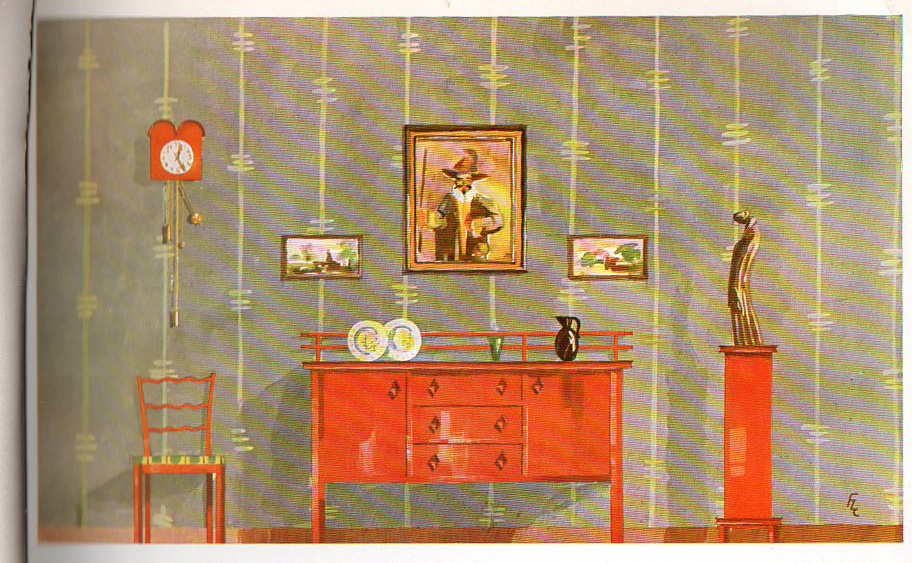
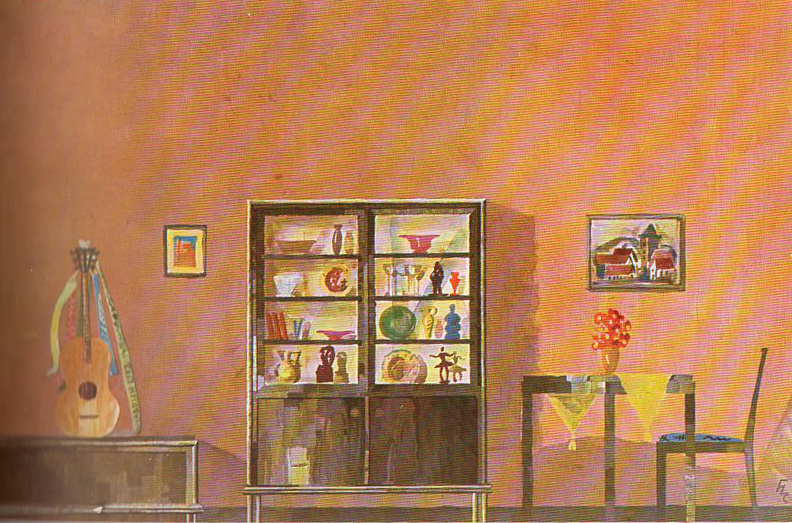
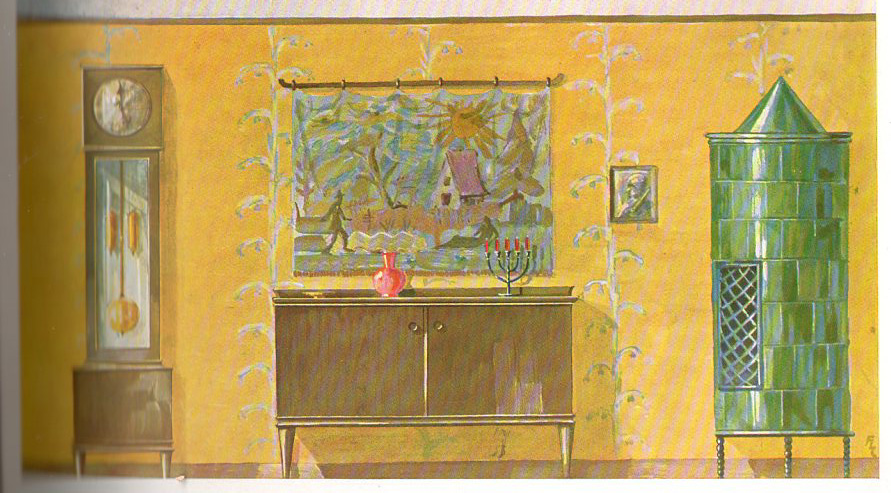
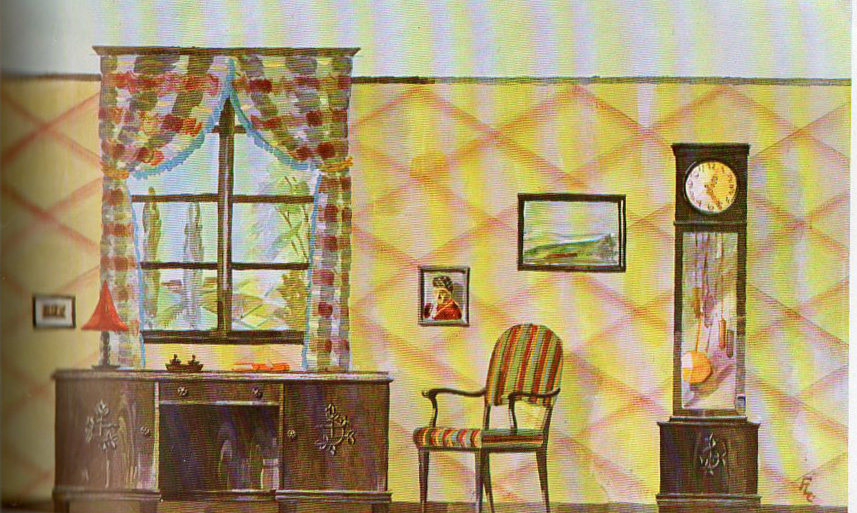
    Nothing quite says no-color as German deep noir of the mid- and late-1920’s.  These movies can be so deep and contrasted, so very black-and-white, with such stark Moon-like shadows, no dawn or dusk just night and day, that it can make you forget that outside of the photographs and movies that people were moving around in great swirls of color.  And nothing quite helps you to remember this than by having a look at a book like one below, a DIY piece printed in Berlin in 1927, the Farbige Wohraume1.

    German color377
    It is of interest here because in addition to blueprints and sections of the furniture to be built, there are associated illustrations showing the completed work placed in a decorated room.  And it just so happens that these rooms are highly, colorfully decorated–not that there’s so much in the room, per se, but there is definitely a lot of color. 

    German color371

    German color372

    Notes:

    1. Farbige Wohnräume, 24 Tafeln farbig dargestellter neuzeitlicher Räume (5 Wohn-, 6 Speise-, 6 Herren-und 7 Schlafzimmer) mit den einzelnen Nöbeln im Masstab 1:20. Dazu weitere 24 Tafeln mit den zur Anfertigung erforderlichen Grund- und Aufrissen und Detailschnitten einschliessich der Sitzmöbel.  Berlin,  Verlagsanstalt Deutschen Holzbeiter Verbanes GMBH. Rebound in library cloth, very nice, workable copy.  37x26cc, 24 color plates of room designs, followed by 24 heavy leaves of associated blueprints printed front and back, these showing a profile of the furniture to be constructed on recto and some cutting instructions on verso.  The color illustrations of the furniture in a room setting is correlated with the blueprints in rear, each of the color plates with a corresponding sheet of blueprints.  Only four copies located in WorldCat: Yale, University of Illinois, Grand Rapids Public Library, and Cornell. 

    German color373

  • The Coming of Broadcast Television (1929)

    JF Ptak Science Books   Post 2388

    I found a news item in the April 6, 1929 issue of Nature that gives a real sense of the coming of the future, of the future-at-hand–and they seemed to have a sense of what was coming, though probably not as big as that future would be. In this case, it was the beginning of the passive visual assumption of the collective culture–the very quick and potentially immediate assimilation of pop culture, this by the invention of television and popular broadcasting.  

    Baird_tv_caption

    The unidentified author was reporting on the recent activities of the Baird Television Development Company, which the author was interested in, and although it was “not presently practicable ” it did “represent(s) a noteworthy scientific achievement”, which I am sure was the writer’s way of downplaying a very significant event.

  • Bicycle Story Without Words, 1869

    JF Ptak Science Books   Quick Post

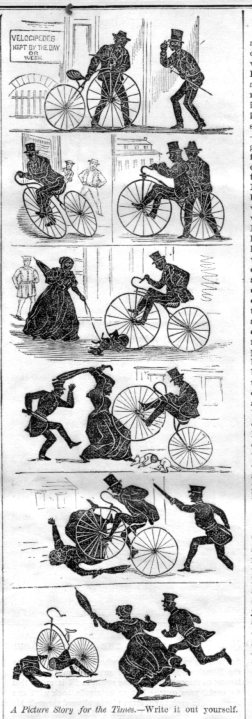
    I found this interesting story-without-words in a column in American Agriculturalist, April, 1869.    The velocipdes were fairly big, and fairly new-ish to be peddle-powered at the front wheel, and apparently not so welcome on urban streets.  (Within fifteen years the bike would take on a decidedly very modern look, easily recognizable as being a close family member to that Schwinn cruiser you owned in 1982.) I don’t have any insight about the editorial content of the segment…  

    Bicycle598

  • A Really Big Idea: the 5,000 Ton Tank (1916)

    JF Ptak Science Books   Post 2389

    These spectacular images of monumental monumentality appeared in the December 1916 issue of Popular Science Monthly.  The author Frank Shuman (1862-1918) had some major inventing chops, not the least of which was some very forward-thinking work (in theory and practice) on solar power (one of which was a solar powered steam engine and another a liquid O2 propulsion system for submarines), so these suggestions for gigantic land battleships came with a fair amount of gravitas. This is some grand thinking, and as Shuman tells us, the beast below would weigh about 5,000 tons (the weight of several hundred Sherman tanks1) and would roll along on 200′ diameter wheels.  Unfortunately, outside of  seeing some sort of (steam) power plant, there is no mention of how those wheels would be turned–I’d’ve liked to read about that.  There is a mention of shock absorbers, but only so, jsut a bare hint.  

    [Image source is Google Books–I have this volume in a 40 year run of this periodical down in the warehouse, but the book was really too thick to lay flat ont he scanner, and so the Google Books scan was used..]

     And for whatever reason there is no heavy artillery on this thing. The damage to the enemy would be done via the three wheels, and also by the enormous chains that hang from the front of the enormity, like a flailing slow-moving monster from a 1950’s B-movie. 

    My guess is that this wouldn’t do so well in the rain.  


  • A Very Early Comparative Display of Lakes and Islands (1851)

    JF Ptak Science Books  Quick Post

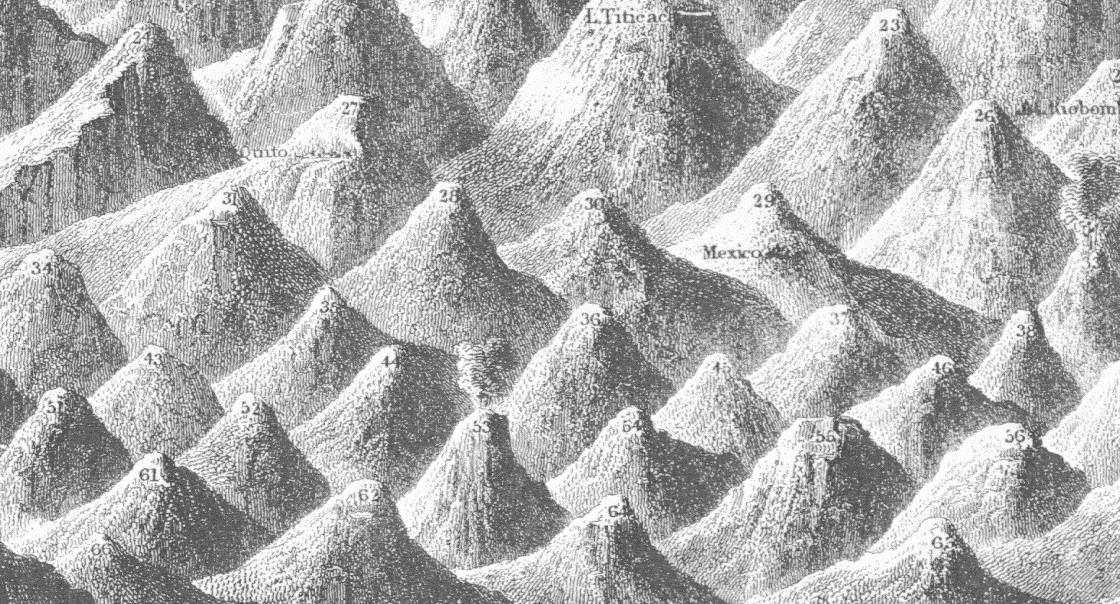
    Mountain comparative detail mtns

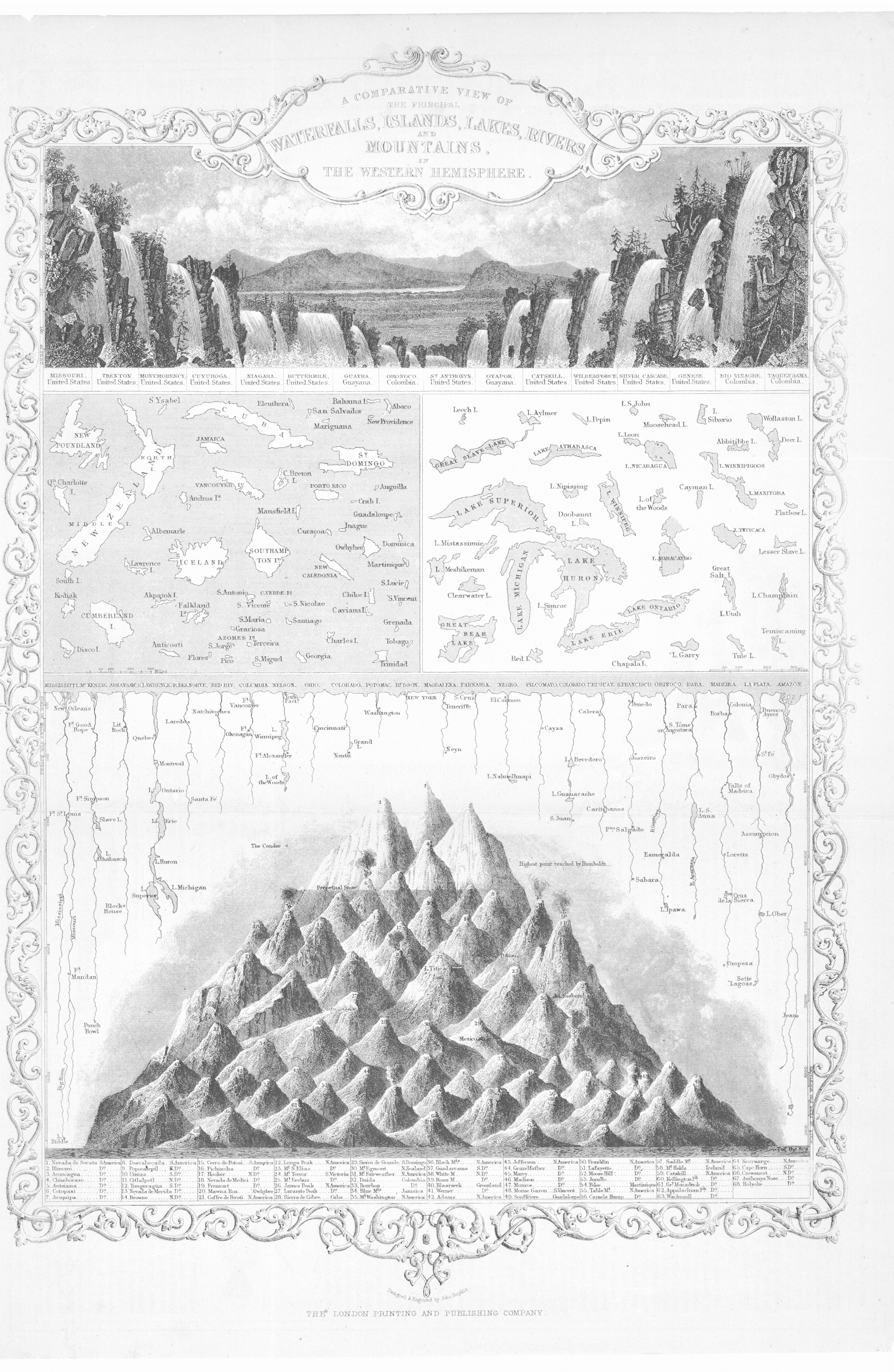
    The 1850’s  may have been the heyday of atlases appearing with illustrations of comparative river lengths/mountain heights;  from 1840-1880 or so was the period in which the majority of descriptive comparatives were published.  This is when you would see images of the lengths of rivers and the heights of mountains and waterfalls beautifully displayed in atlases, everything visually presented in high design and memory-forming fashion.  I don’t know what happened after 1880, but the publication of this sort of data in beautiful and provocative formats really fell off, with the heights of mountains/lengths of rivers stuff relegated to filling the empty areas in the corners of double-hemisphere world maps.  

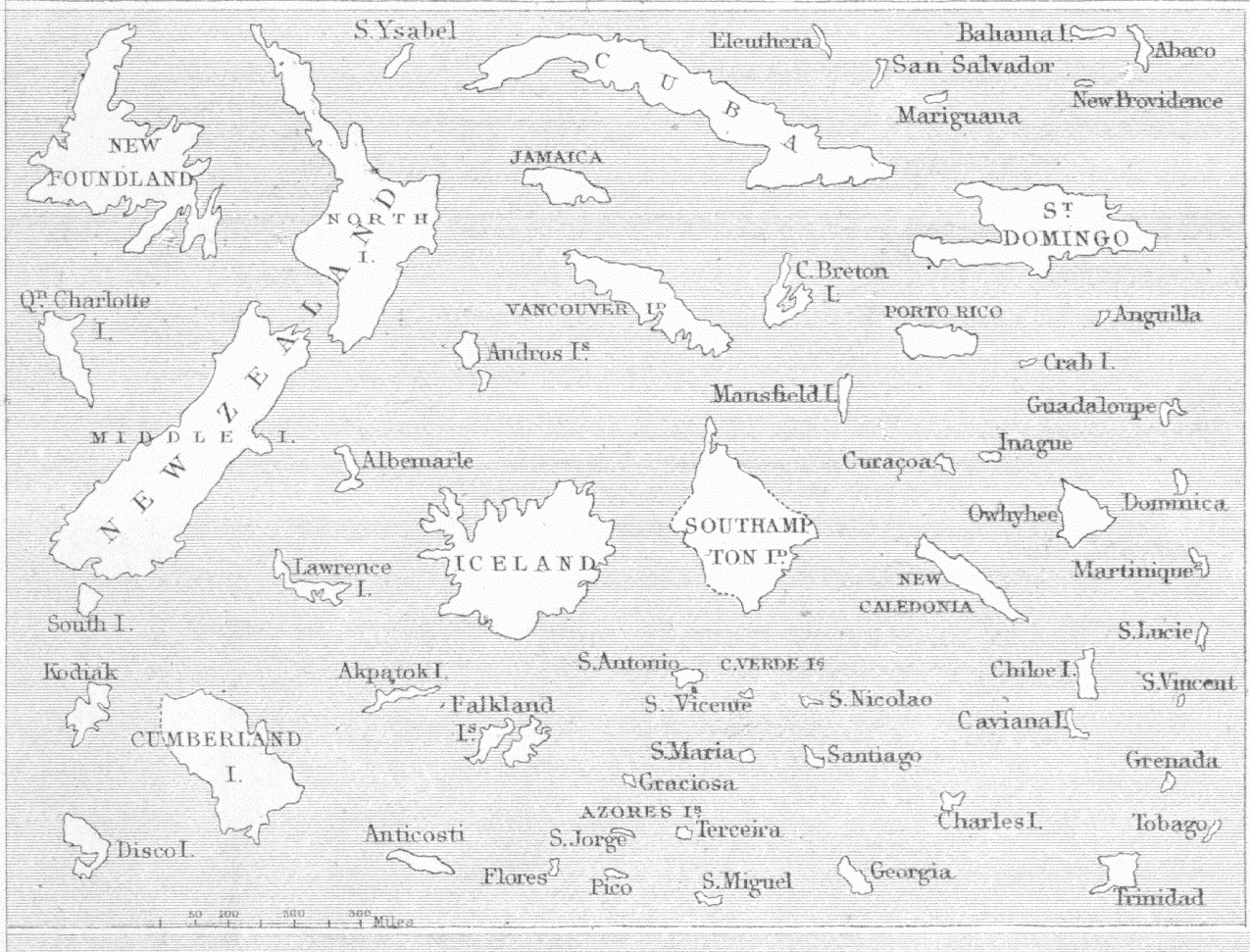
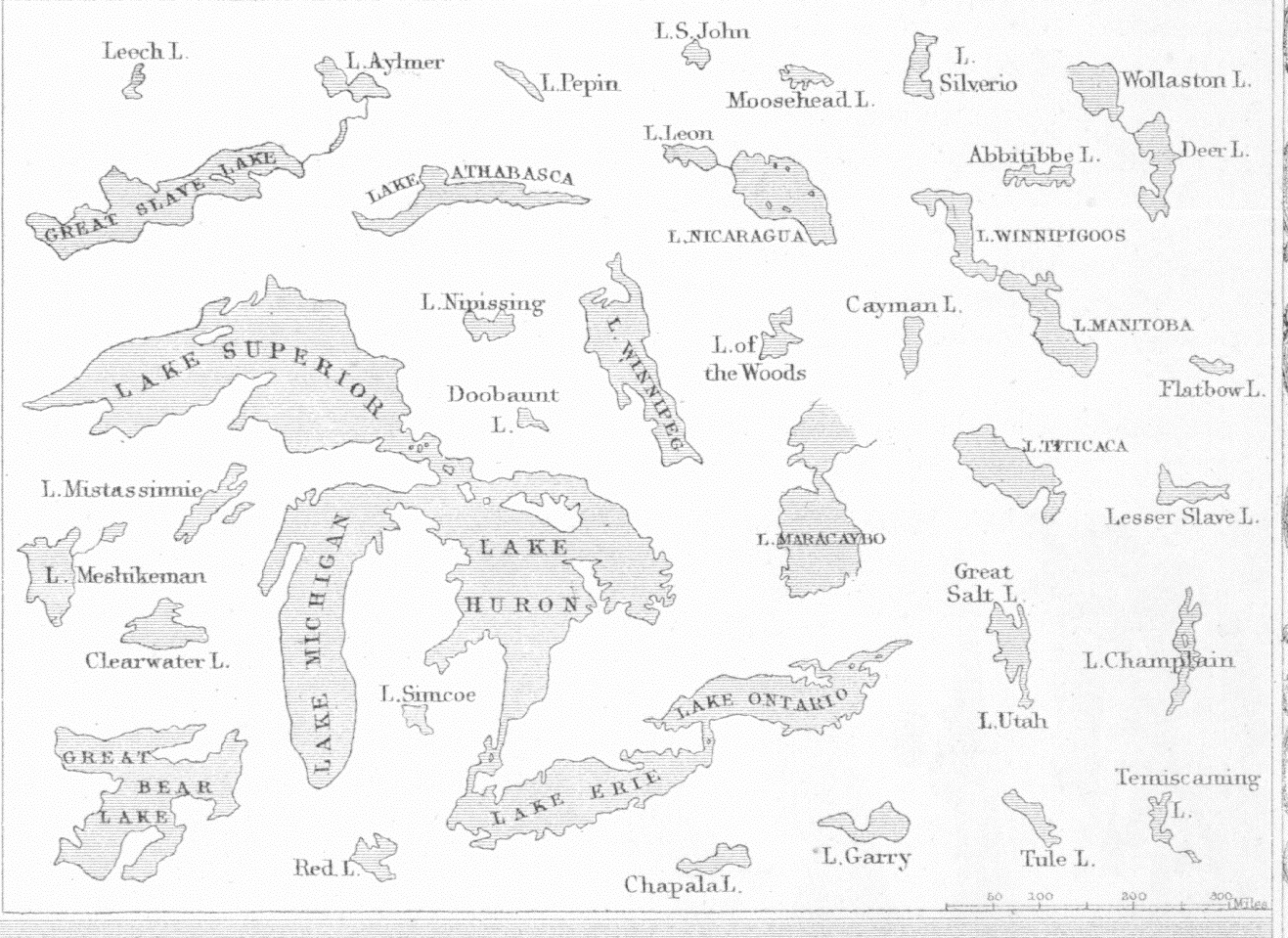
    The example below (from R. Montgomery Martin’s Illustrated Atlas, 1851) is interesting because in addition to the standard mountain/river material, there is also the height of waterfalls; and, in a move that was probably very early as a practice, there are two sets of images that show lakes and island compared to one another on the same scale. Of course maps are composed of data that is necessarily set in the same scale, but here we see just the lakes and just the islands removed from their context and laid into a pool of similar objects.  It is a mystery why this would’ve taken so long to happen, but it is also the case that the first comparative architecture depicting different buildings placed in an illustration that were on the same scale did not occur until the work of J.N.L. Durand in the surprising “late”year of 1800 (in his Recueil et parallèle des édifices de tout genre…), which is a curious thing.A Ver

    Mountain comparative

     And the detail of the lakes and islands:

    Mountain comparative detail islands

    Mountain comparative detail lakes

  • The “Robot” of the Year Zero

    JF Ptak Science Books   Post 2390

    “HIEROGLYPHICS: Language of the ancient Egyptians, invented by the priests to conceal their shameful secrets. To think that there are people who understand them! But perhaps the whole thing is just a hoax?”—Gustave Flaubert, Dictionary of Received Ideas1

    Kircher robot599


    [Reproduced from the Hachette reprint]

    I’ve written a number of posts about pre-robot robots, robots before they were named, mechanical entities of some human qualities that performed tasks or played games, inanimate objects that engaged in articulated motion, with most of the early creations being in the early 19th century.  I never have done the back-fill, the earliest days in which (if you squinted very mightily) robots may have appeared.  

    This came to mind today while writing about the great Athanasius Kircher (1601-1680), a man considered to “know everything” and who if he didn’t know it made the knowledge come out of something else so help him god; he was a man of intense energy, extremely formidable learning, high creativity, and who seemingly possessed the talent to forget nothing.  Today’s episode (with the frequently-appearing Kircher in this blog) is just a small addition to the cosmology thread and the history of dots series. 

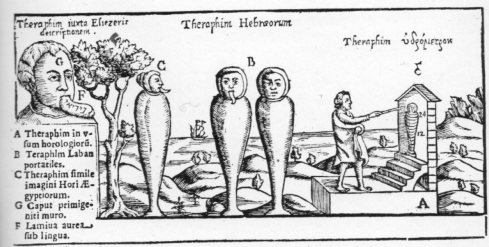
    The image that drew me in is found in Kircher’s magnum opus, his Oedipous Aegyptiacus, printed in three volumes from 1652-1654–it is a half-miracle sort of work–it is astonishing, universal,  fabulous, and in many cases, far-reaching….too far-reaching, especially in the case of his deciphering Egyptian hieroglyphics, where he pretty much gets it all wrong.  In volume one (page 262), however there is  an image of theraphim (“Theraphim Hebraeorum”), which are small-to-largish statuettes/statues which to save sp[ace and time here are seen by many as being something along the order of a household idol. (It is a much more complex story than this, but I think that for at least one aspect in defining these objects that this is basically correct.)
     
    The illustration makes it seem as though the small statues have etched speech on extended tongues–in some versions of the theraphim story the statues do speak in their way. That makes them speaking statues.  And speaking statues are–in a very antiquarian way–robots, or at least they are worthy of that consideration in my book. Or blog. 
     
    And this reminds me of another “speaking” statue:  Memnom, of the the two Colossi at Thebes.This monument was said to be a “miracle” (by Colistatus, in the 3rd century CE) and that the only difference between it and a human was a body. Memnon was said to react to eh morning Sun, emitting  a sound or song or speech; and again, at sunset, a more lamenting sound would issue from the statue, which would sometimes be accompanied by tears.  The songs/cries were said to be returned by Echo, who responded with, well, an echo, which is what all of this might be in regards to the modern sense of the robot, and to the created artificial life of the future.  
     
    Notes:
    1. This fine quote was found in an interesting article  “Egyptian Oedipus: Athanasius Kircher and the Secrets of Antiquity (2013) – Introduction” by Daniel Stolzenber, here.
     
     
  • Draining for Profit, 1869

    JF Ptak Science Books   Quick Post

    This was an honest and very difficult job–it is a tough job in the present day, let alone 146 years ago:

    Draining597


    ·Posted by :

    ·in:

  • The Dots Between the Sun and the Stars (1652)

    JF Ptak Science Books  Quick Post

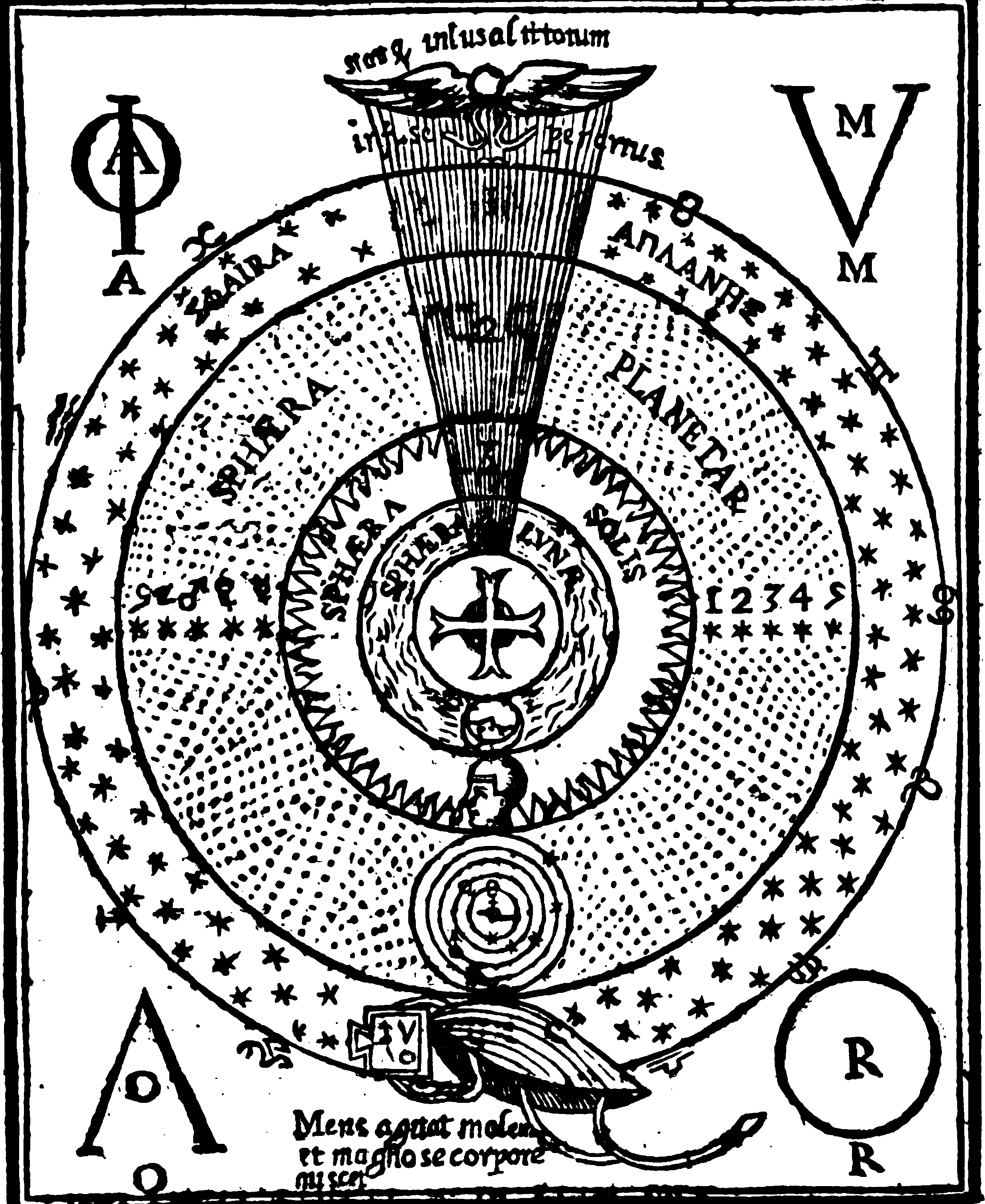
    This is just a quick addition to a continuing series on antiquarian cosmological images (the two major posts, Visual Chronology of Cosmology, Part I and Part II) containing 80 images, mostly before the 19th century) and a long series on the History of Dots.  The engraving below comes from the great intellectual explorer, Fr. Athansius Kircher, in his ultra-fabulous three-volume Oedipus Aegyptiacus (1652-4). And in here–as is the case with some other cosmological images–in between the sphere of the Sun and the sphere of the stars was the realm of the planets, and that is where Fr. Kircher’s artist employed the use of dots, to differentiate the planetary real estate from everything else.  

    Kircher_oedipus_aegyptiacus_1_cosmos det


    And the image in full view (both images reproduced from the Hachette reprint): 

    Kircher_oedipus_aegyptiacus_1_cosmos

    ·Posted by :

    ·in:

    —
  • A Beautifully-Rendered Aeroplane, 1911

    JF Ptak Science Books   Quick Post

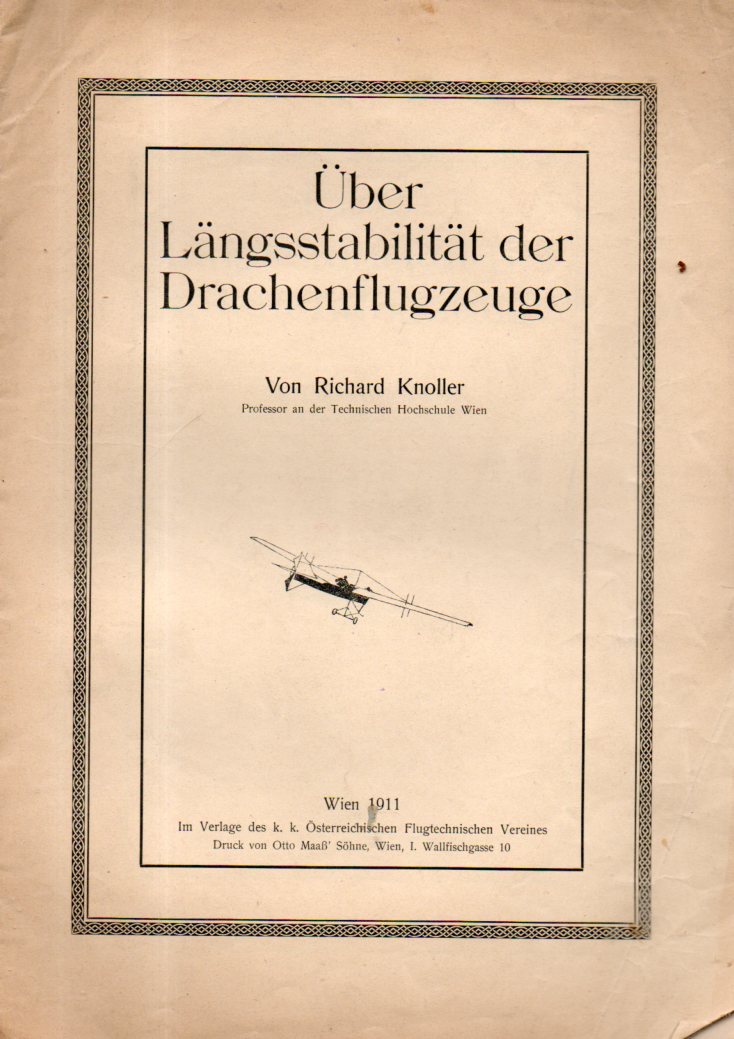
    Aviation 1911 Knoller604

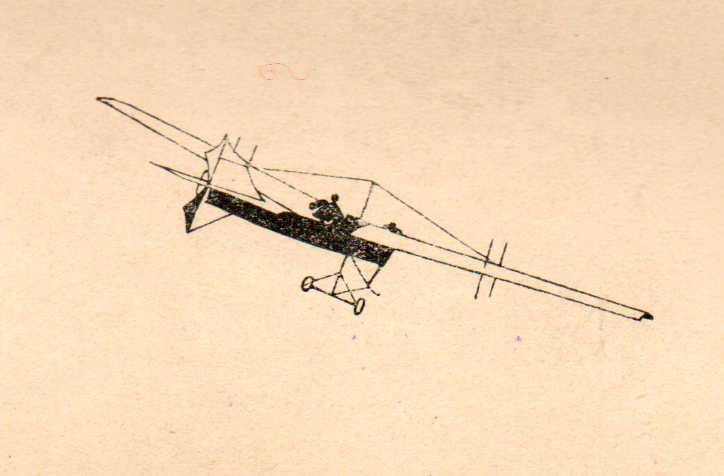
    This is the detail from the cover of  Richard Knoller‘s  (professor at the Technischen Hochschule in Vienna) Ueber Laengsstabilitaet der Drachenflugzeuge, published in 1911. In real the image is only about an two inches wide and spare-but-detailoed, wisely placed  in the center of the oversized pamphlet, and set in a lofty blank space.  Brilliant. 

    Aviation 1911 Knoller605

    ·Posted by :

    ·in:

  • On Not Scooping the OED on the First Use of the Term “Super Computing”

    JF Ptak Science Books  Post 2391

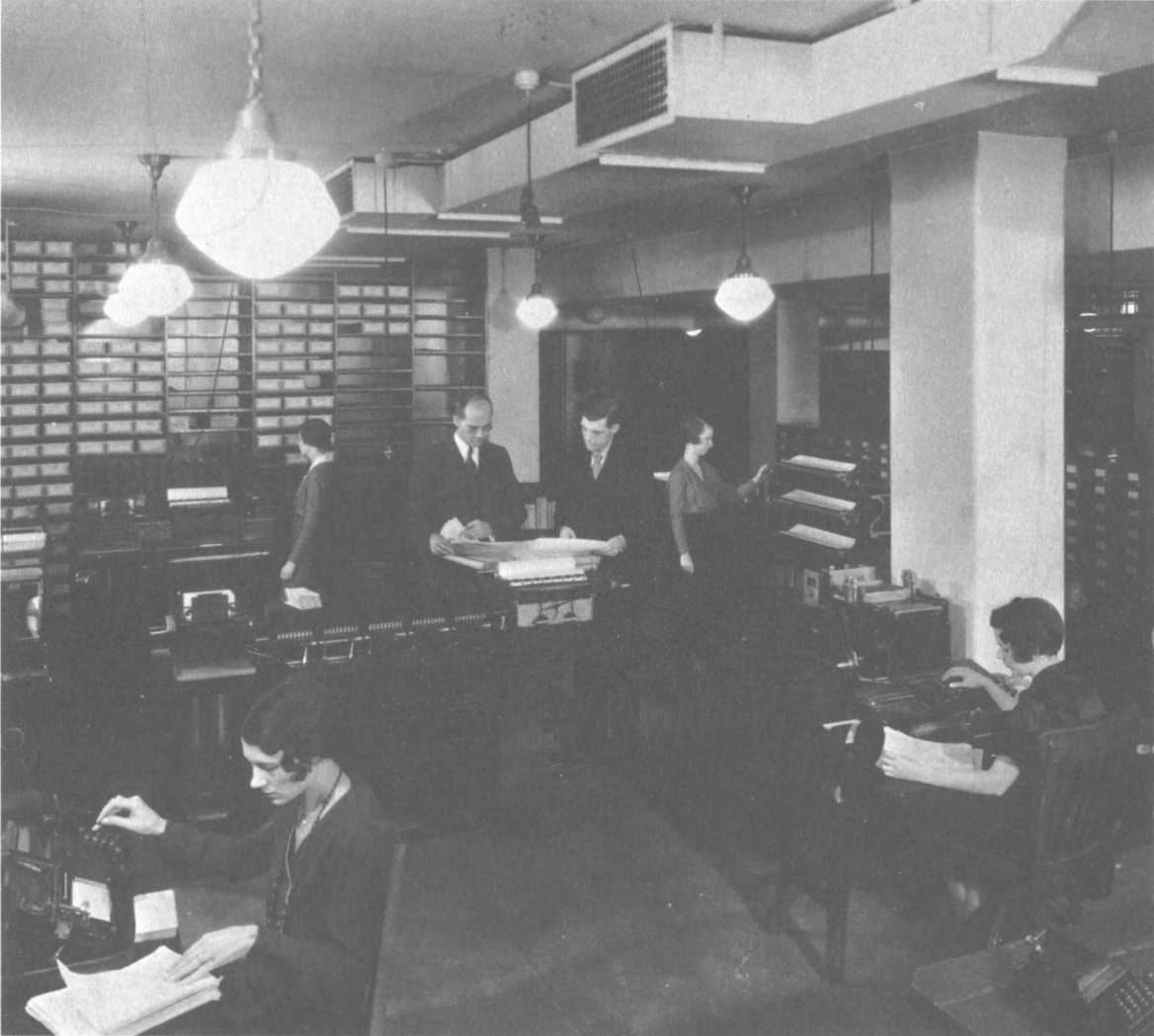
    Computer super eames600I thought for a moment that the Oxford English Dictionary had been scooped in identifying the earliest usage of the term “super computer” when I saw this newspaper article in the wonderful book by Charles and Ray Eames called A Computer Perspective (Harvard University Press, 1973).   The article refers to an unidentified machine at Columbia University in a March 1, 1920 article, which would beat the first use found by the OED in 1927 (see below) by seven years.  So, I checked this out a little, and latched onto a reference to Dr. Ben D. Wood as the director of the Statistical Bureau at Columbia, and found that this event didn’t happen until June 19291.  

    And so the Eameses got this one wrong, or the editor did, or the proof reader, or the typesetter.  So instead of being 1920, this is at the very least second-half 1929, some two years or so past the first use identified by the OED.  It is also possible that this might be 1931/2.  Still, this was very early for using the term, and the article is interesting.  

    More can be found on the machine (which was probably the “Columbia Machine”,  which as also known as the “Statistical Calculator” and the “Difference Tabulator”, and with some affection “the Packard”.  A very good appraisal of this machine can be found at the Columbia University site for computing history at Columbia, http://www.columbia.edu/cu/computinghistory/packard.html

    Computer columbia super computerThe Columbia Statistical Bureau, 1932:   Source: http://www.columbia.edu/cu/computinghistory/statbureau.jpg

     
    OED: the earliest usages of “super computing”:
     
    1927   Army Ordnance Mar. 342/2   The central station instrument, which is a super-computing machine, solves​ the geometrical and ballistic problems.
    1944   Pop. Sci. Monthly Oct. 88/2   Aiken will remain at Harvard after the war as director of a supercomputing laboratory.

    OED: the earliest usages of “supercomputer”:

    1949   Acta Crystallogr. 2 344/2   Modern super-computers will soon provide the ideal method, at least for the more complicated structures.
    1968   N. Walford tr. O. Johannesson Great Computer iv. 108   Linking together about a hundred computers..and combining them..to form a unit known as the supercomputer.
     
    OED: earliest usages of “computer” as a person:
     
    1613   ‘R. B.’ Yong Mans Gleanings 1,   I haue read the truest computer of Times, and the best Arithmetician that euer breathed, and he reduceth thy dayes into a short number.
    1646   Sir T. Browne Pseudodoxia Epidemica vi. vi. 289   The Calenders of these computers.
    1704   Swift Tale of Tub vii. 140   A very skillful Computer, who hath given a full Demonstration of it from Rules of Arithmetick.
    1855   D. Brewster Mem. Life I. Newton (new ed.) II. xviii. 162   To pay the expenses of a computer for reducing his observations.
    1893   Publ. Amer. Econ. Assoc. 8 23   Some curious computer makes out the cost of electing a President for these United States to be four hundred millions of dollars.
     
    OED: earliest usages of the “computer” as a device:
     
    1869   ‘M. Harland’ Phemie’s Temptation i. 12   [Phemie] plunged anew into the column of figures… Her pen was slowly traversing the length of the page, at an elevation of a quarter of an inch above the paper, her eyes following the course of the nib, as if it were the index of a patent computer.
    1897   Engineering 22 Jan. 104/2   This was..a computer made by Mr. W. Cox. He described it as of the nature of a circular slide rule.
    1915   Chambers’s Jrnl. July 478/1   By means of this computer the task is performed mechanically and almost instantaneously.
    1941   Nature 14 June 753/2   The telescope drive is of an elaborate nature; the effects of changing refraction, of differential flexure and of errors in the gears are automatically allowed for by a system of ‘computers’.
     
    Notes:
     
    1. Columbia University computing timeline.  

Recent Posts

Archives

Categories