A Daily History of Holes, Dots, Lines, Science, History, Math, Physics, Art, the Unintentional Absurd, Architecture, Maps, Data Visualization, Blank and Missing Things, and so on. |1.6 million words, 7500 images, 4.9 million hits| Press & appearances in The Times, Le Figaro, Mensa, The Economist, The Guardian, Discovery News, Slate, Le Monde, Sci American Blogs, Le Pont, and many other places… 5000+ total posts since 2008.

  • Color in Black & White (#4): Stained Glass Designs, 1937

    JF Ptak Science Books  Post 2396    

    Part of the series on the History of Blank, Empty, and Missing Things

    Sometimes the suggestion of color is color enough, though I had never really thought about it in terms of stained glass windows before.  They do have an elegance, even in photographs (never having seen anything extensive in person, just bits and pieces). These designs weren’t in black and white in real life–they were just printed so, for unknown reasons, even though the portfolio in which they appeared was half-luxurious. (I have a book depicting the windows at Chartres that is also done in black and white.)  This makes a good and appropriate entry in a long series on this blog called Blank, Empty, and Missing Things, the “missing” part here being color outside of black and white.

    The following images are of modernist stained glass designs collected and curated by Robert Mallet-Stevens (1866-1945)–one of the leading between-the-wars French architects–for the International Exposition of 1937.  

    Stained glass414

    “L’Exposition de 1937, qui nous montre la ‘généralisation’ de l’architecture moderne, nous offre quelques vitraux de tout premier plan… Quand l’architecte voit dans l’espace des volumes bien ordonnés, le peintre verrier trace des lignes et oppose des couleurs heureuses… Je n’oserai dire que l’architecture moderne est en plein progrès, mais je puis affirmer que le vitrail ‘va très bien’!”   From he introduction, by Mallet-Stevens. (Basically, Mallet-Stevens is saying that the Expo is presenting the newest form of modernist architecture, and that the stained glass work in particular was powering ahead (“‘va très bien’!”)). 

  • History of Dots: Dots of Death, 1937

    JF Ptak Science Books,  Quick Post                                                                         Part of the History of Dots series

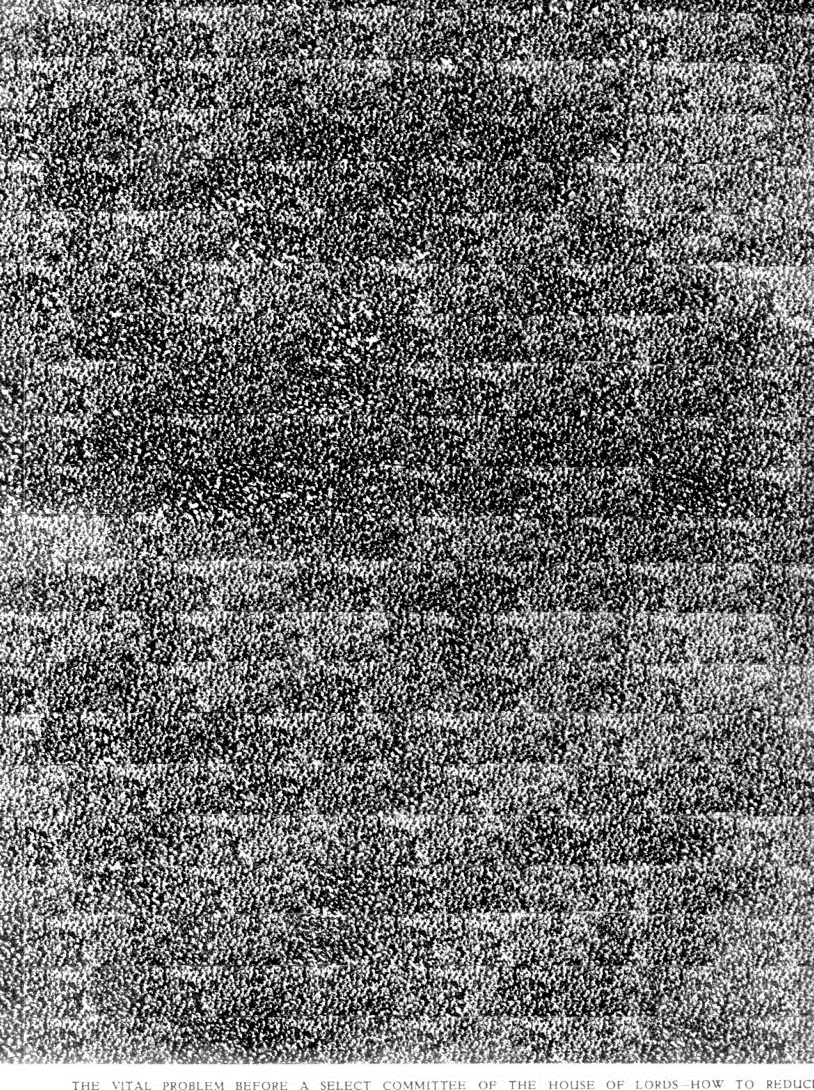
    Data visualization traffic  death658

    This is one half of a very impressive, “what the holy heck” sort of photograph–even more so that it portrays the number of people killed in road accidents in England from 1928-1937.  67,100 people were killed–the number of injured was evidently 30 (!) times higher.  This is particularly impressive given that in all of the U.K. 2175 people were killed in 2012 compared to 36,000 for the U.S., which means 3.5/100,000 in the UK and 11.6/100,000 in the U.S. So things have gotten much better now than they were then, with a third of the fatalities for a much larger population. In any even the photo montage was a very compelling image, and was printed in the Illustrated London News, December 18, 1937, page 1110.  

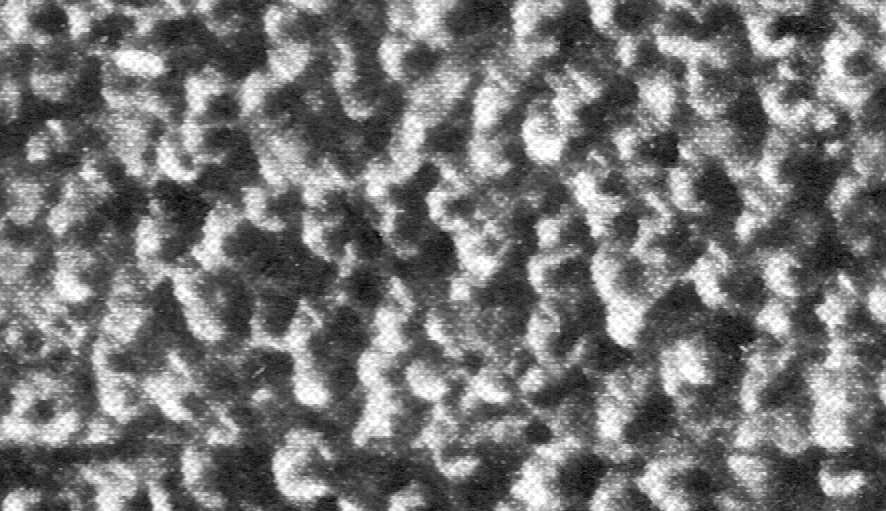
    An extreme detail figuring about 2% of the image: 

    Data visualization traffic  death660

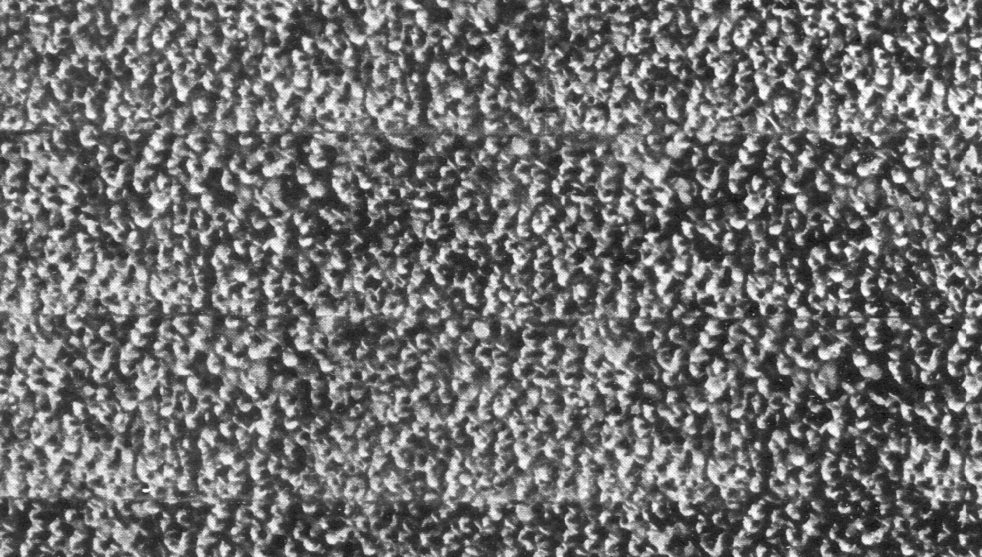
    Another detail, about 1/20th of the image:

    Data visualization traffic  death659

    ·Posted by :

    ·in:

    —
  • Underestimating the Mechanics of the Invasion of England, 1940

    JF Ptak Science Books    Post 2397                                  Part of a long series on the Display of Quantitative Data

    England was last invaded in 1688 by the Dutch republic, following twelve other attempts from 1066, but Adolf Hitler was half-determined to do so (and several of his leading generals who were not-at-all determined, anti-determined to do so) himself, trying to follow in the lost  footsteps of Napoleon with Operation Sea Lion (Unternehmen Seelöwe). Napoleon failed of course, as did his predecessors: three French, two Spanish, and an Austrian attempt since 1707. And so would Hitler, although he would never come close to implementing much outside of his terror attacks on cities in the U.K. and the war waged on the RAF (and particularly Fight Command)–control of the air being integral to any sort of invasion that he might try to mount.

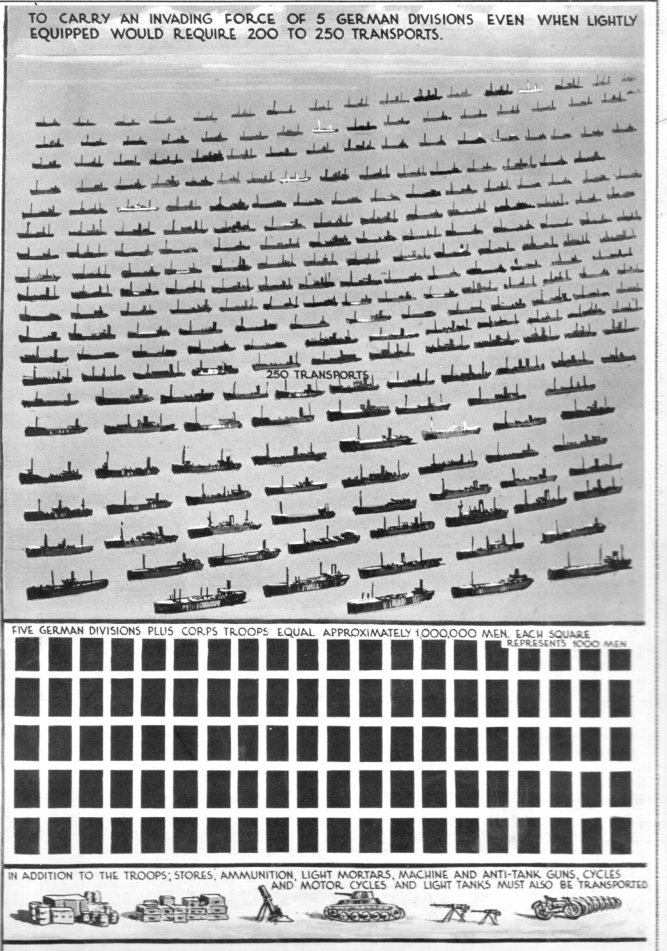
    It was at the beginning of this air attempt–the Battle of Britain–that the following interesting  small graphic appeared in the Illustrated London News  (June 29, 1940), a featurette on what it would require for the Germans to mount a successful invasion of England. Interestingly the Brits had just mobilized their own floatilla for the evacuation of Dunkirk just weeks (26 May-4 June 1940).  

    The German armada pales in comparison….

    Data vis German invasion England662


    Some part of it doesn’t make sense to me, (sitting here quietly in the future, not having Nazis flying overhead trying to kill my country)–like a convoy of troop carrier set at 250 to carry a million soldiers into the U.K.   Plus there were all of the stuff of invasion–food, supplies, support, materiel of all shapes and sizes and description, and on and on.  The D-Day invasion force used 6,939 vessels, 1,213 naval combat ships, 4,126 landing ships, 864 merchant vessels, and 736 other ships, not to mention the 3000+ aircraft and gliders, all in use toland 156k soldiers along a 50 mile front in Normandy. An utterly understated spectacular undertaking–and no doubt the Germans would have had to do something along similar lines, a lot of something that they just didn’t have. But no one knew this yet, not really.

    This small series of graphics probably served two purposes: one was to alert English readers that such an invasion was theoretically possible, and secondly, that, well, it was in some ways impossible, given the enormity of the task. So, beware, but do not fear, is what I think the message was here.  

    And by the way here are two bits of films about a successful Nazi invasion of England: 

    It Happened Here, 1966:

  • Inventory of the Apocalypse (1964)

    JF Ptak Science Books    Post 2398 

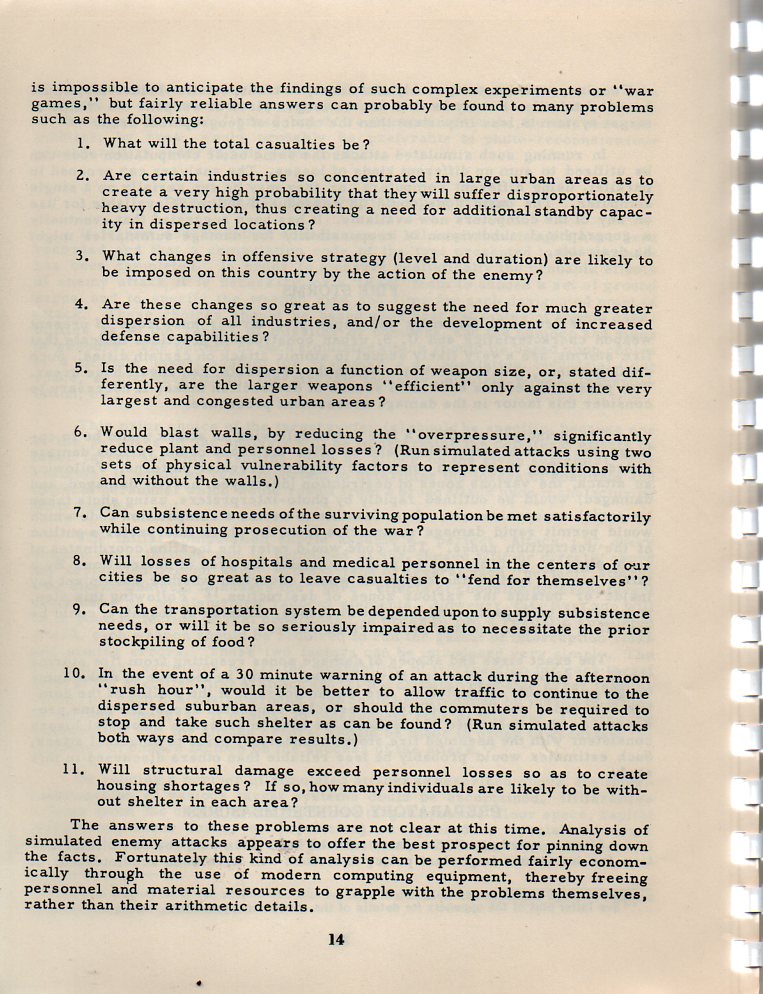
    Describing computer programs “Picnic” for biological/chem weapons damage,  and “Dusty” , for radioactive casualties

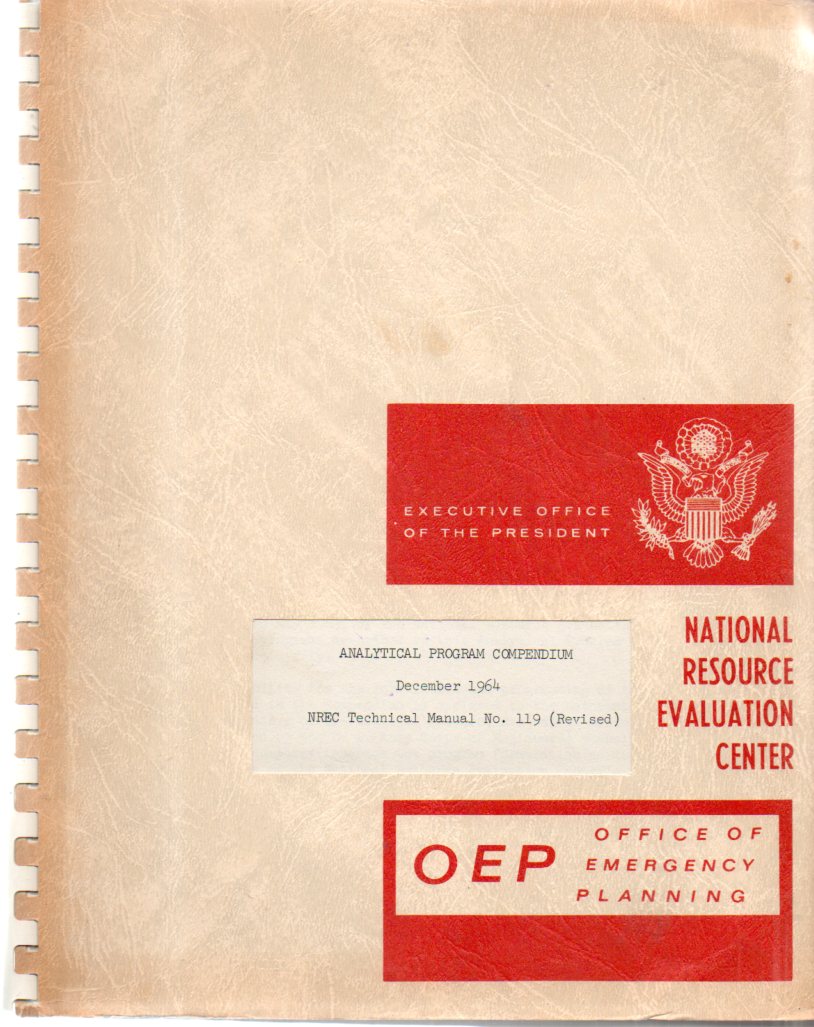
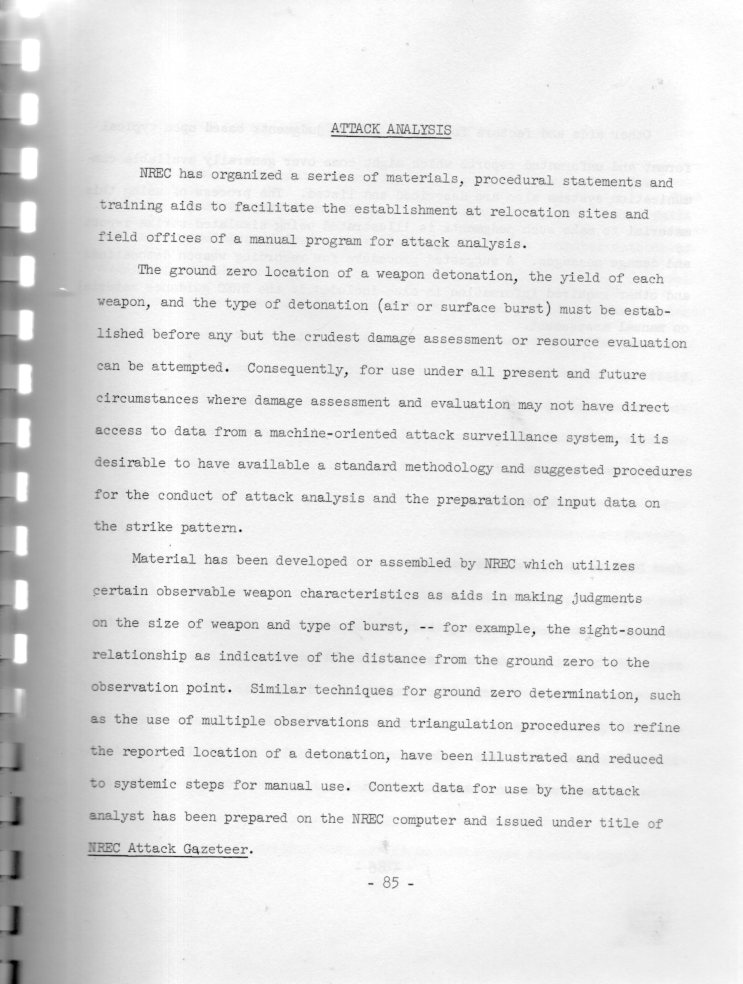
    This was an interesting read, though it took a little while to actually understand what it was I was reading.  Mathematics and Computation Laboratory, National Resource Evaluation Center, Analytical Program Compendium NREC Technical Manual No. 119 (Revised) was pritned on December 1964, housed in the covers of the  Executive Office of the President NREC/Office of Emergency Planning. The prose is mostly congestive, but after a bit you can pick up the rhythm and it becomes more user-friendly.  

    Preface signed by Joseph D. Coker, Chief, National resource Evaluation Center, who writes: “The Analytical Program Compendium gives a brief description of the National Resource Evaluation Center’s current general purpose analytical programs and replaces earlier editions of the NREC Glossary of Damage Assessment Programs. It is intended as a guide for users and potential users of these programs to indicate the various programs that are presently available and those that are being produced. Separate Technical Reports or Technical Manuals are available for the standard operating programs and for a number of those which are in preparation. Reference to these manuals and reports can be obtained in the Bibliography of Publications (Technical Manual No. 121) published by the NREC. The Compendium contains descriptions of the computer programs of a substantive nature.”  

    Nrec 664


    [Can’t live without this Cold War document? See out blog bookstore to purchase the original.]

    The list of the contents of the 92-page work is pretty interesting, the book presented in eight sections (or “casualty classes programs”):  (I) Attack Analysis Programs; (II) Vulnerability Analysis Programs; (III) Damage Assessment Programs (Direct Effects, sections dedicated to nuclear shots Dusty III, Flame I, Jumbo III, Streak IV, Dart II, Dart III, Picnic, Ready I.(IV) Resource Evaluation Programs; (V) Economic Analysis Programs ; (VI) Resource Management Programs; (VII) Mapping and Display; (VIII) Manual Procedures for Damage Assessment and Resource Evaluation.  The last section describes programs of manual damage assessment (“developed by agency representatives for use when computer estimates are not available”).

    Nrec 663


    Under section III are described the various other programs computing availability of surviving resources and damages to the rest, and to assess capability and loss. For example:  Weapons Edit III (working on an 1103 AS or 1105 computer) calculates missile availability; Dusty III (fallout intensity “…at weapon oriented points”; Flame I (“computes an estimate of the extent of the spread of uncontrolled fire”) and can compute fire maps; Jumbo III (a casualty assessment program); Attack Environment III (“determines the blast effect from the dominant weapon and combines the separate effects of fallout and from from all weapons that affect each resource point”); Facility Assessment (Namepoint) III ( for physical damage to facilities); Time-Phased Accessibility  (“listing of accessibility of resources in various conditions of damage after an attack”); Population III (summing up casualties in populations after attack; Manpower III (translating population losses into labor losses and how it would affect x,y, and z); Livestock III (keeping tabs on livestock “and livestock products”); Streak IV (‘high speed estimate of blast and fallout casualties, estimates of damage and denial of facilities…”); Picnic (!, estimating casualties from biological or chemical weapons), and a number of other programs. 

    There are some other interesting programs for end game times: Net Inventory (“(a) routine (that) is a balance sheet between supply (inventory and production) and demands (requirements)” and Amounts of Production (“a routine (showing) the production based in facility damage and labor casualties; and of course Survival II, which computes “the total requirements…for regions”.

    Of course it was necessary to figure all of this stuff out so that in the event of The Big One there is a certain control over what is where and what is left and what is needed and so on.  

    There is no mention made to where these computers are housed. 

    It certainly seems that if there was to be a nuclear holocaust, it would be well-enumerated.  

    ·Posted by :

    ·in:

  • On the Superiority of Salvage

    JF Ptak Science Books     Post 2399

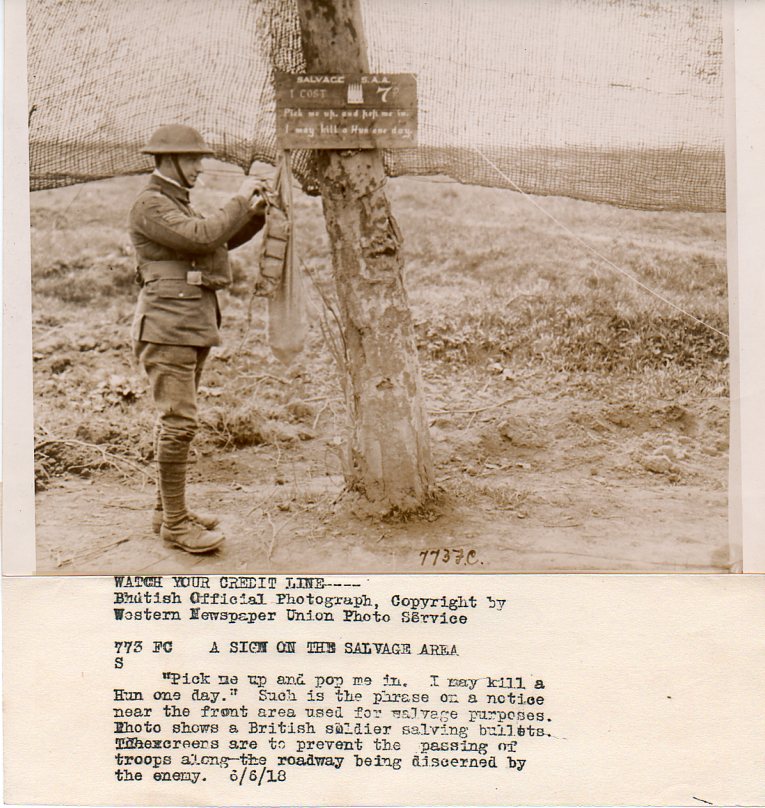
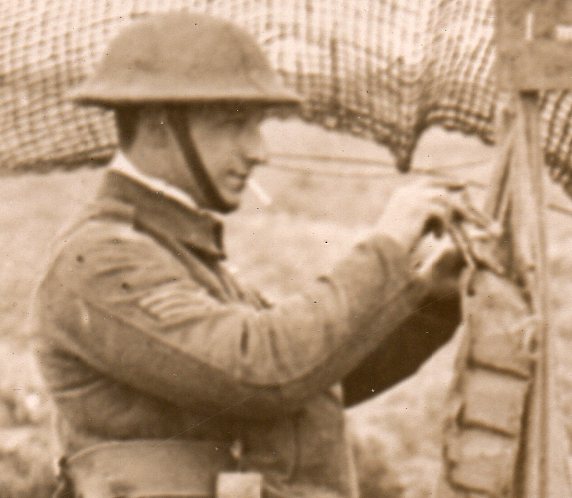
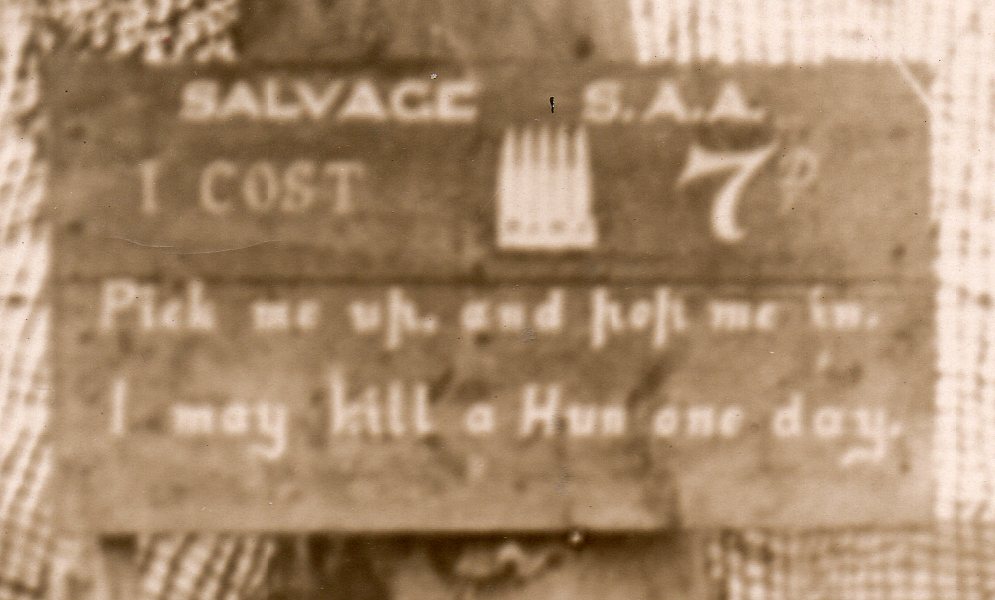
    A little went a long way, sometimes, in collecting the ends and bits of a campaign or a retiring column or from the attics and basements of village houses, or in scrapyards or dustbins or abandoned yards and buildings. Scrap has sometimes contributed greatly to major war efforts; and sometimes it has contributed just a few hundred rounds of ammunition, gathered from the sick or dying or forces on the move, that have told the tale of change in battle.  When you can only carry so much in a campaign where shooting can be an endless process, you can by definition never really carry enough bullets when you’re already carrying enough of everything else.

    WWI--salvage719
    WWI--salvageb720

    WWI--salvagec721

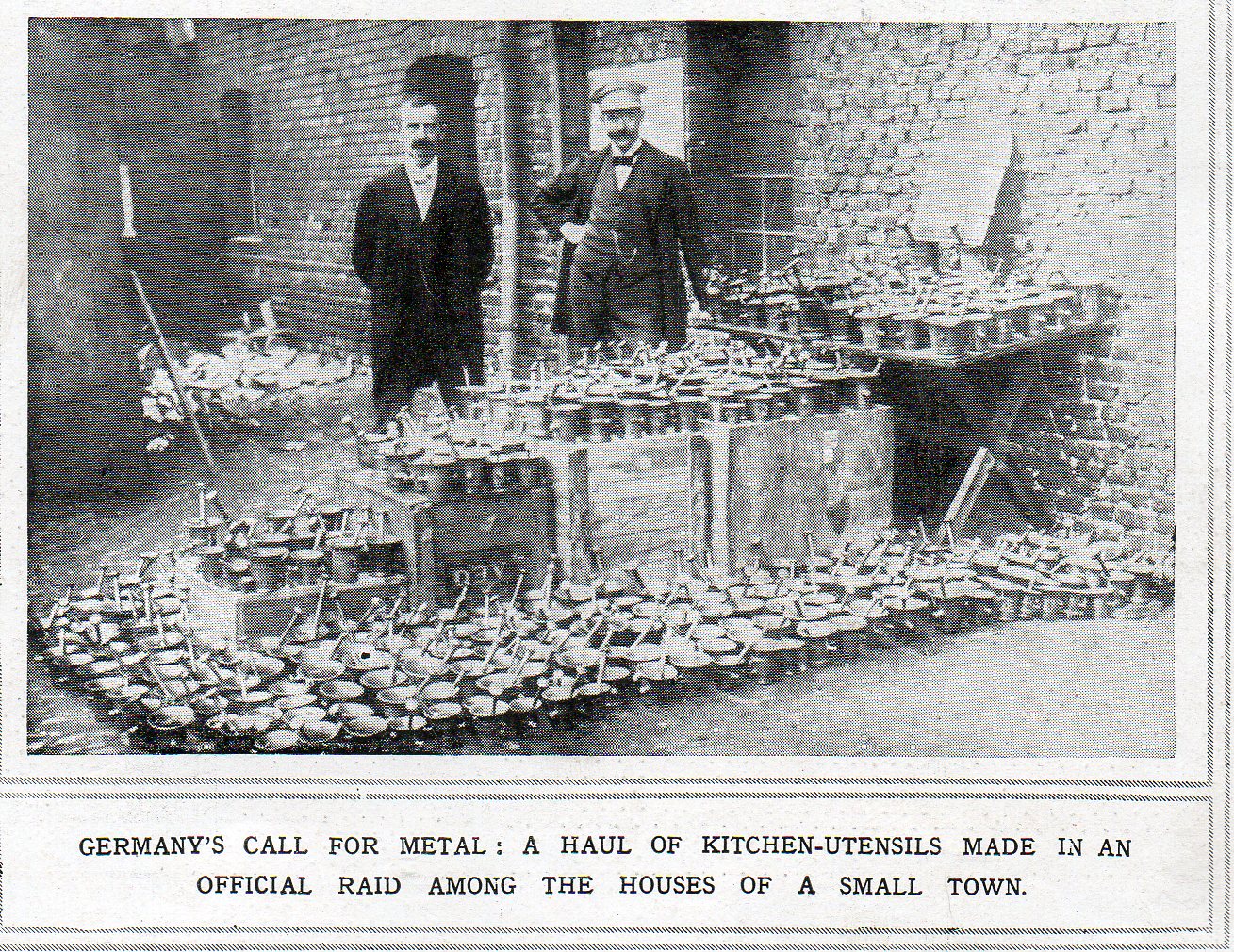
    On the other side of the line, the Germans were trying to utilize every bit possible for the war effort as well–here’s an example of a round-up of metal goods taken from the kitchens of a small town (looking mostly like mortar and pestel sets).  In towns throughout France, on the other hand, church bells were collected and stored away, hidden from possible capture and melting by German troops.

    WWI--raid on pots and pans694


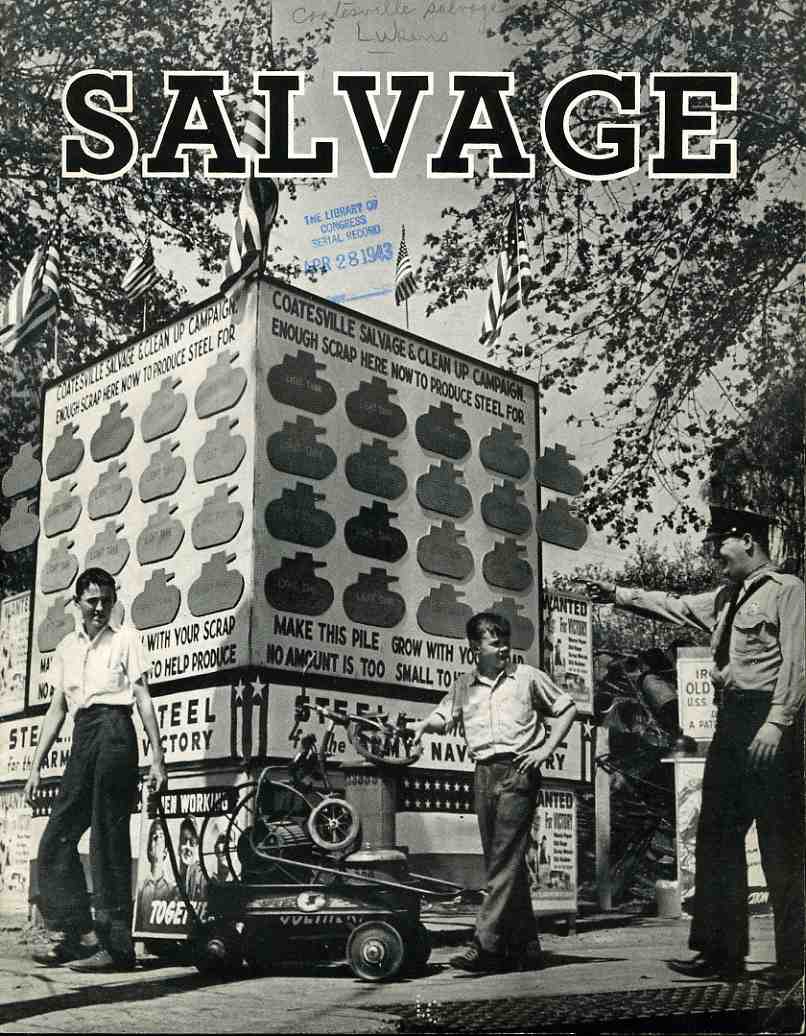
    Now for an example from WWII: Salvage (1943) is just simply brilliant!  It is a superb  design, getting its inelegant point elegantly across to the reader, making the collecting of junk  a bona fide war effort, triumphant, superior; it delivers the message gorgeously.  Who wouldn’t want to rush out and look for some metal scrap and bits and grow a neighborhood junk yard so that the community could build a tank?  Certainly these two boys–under the watchful guidance of a smiling cop in a black tie–couldn’t resist, and from the looks of the progress billboard behind them, nor could anybody else in the neighborhood, as the community collected enough metal junk for 14 tanks.  (Or at least pieces and chunks for fourteen tanks.)

    00-blog-Oct 25 salvage922

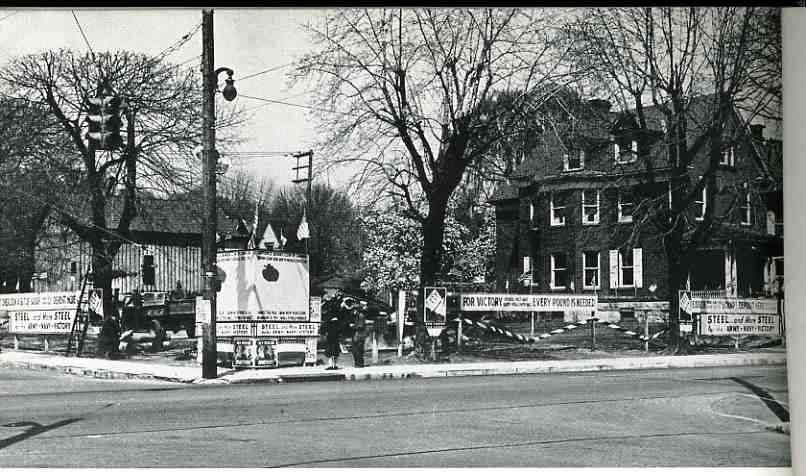
    The community was Coatesville, Pennsylvania, and they certainly did their collecting-best.  The two photos below show (top) the scrap yard after two days of collecting, and (bottom) the end of the campaign two months latter.

    00-blog-Oct 25 salvage before923

    00-blog-Oct 25 salvage after924


    00-blog-Oct 25 salvage before923


    “One pound of fat contained enough glycerin to make a pound of black powder, enough for six 75-mm shells. Twenty three hundred old nylon stockings contained enough nylon to make one parachute. Thirty thousand razor blades contained enough steel to make fifty 30-caliber machine guns.”   (Lingeman, Richard R. Don t You Know There Is a War On? The American Home Front, 1941-1945. New York: G.P. Putnam’s Sons 1970, 254-55).  When you have an entire town doing this, you can build tanks; when you have millions of people throwing together to collect this “junk”, then you get part of a war effort.  It is also part of a giant propaganda hearts/minds machine, especially for the U.S., which was (and I use this word with some hesitation) cushioned from the effects of the war by two oceans–it reminded people who hadn’t contributed a life to the war that there was actually something tangible going on, and that they could do something to help.  It kept peoples’ minds in the game.  Rubber was another big concern, as was silk (the controlling exporter of both coming largely from overseas, and in the case of silk, the exporter was Japan.)  Of course there was the introduction of synthetics for both silk and rubber, but the point in fact was that there was indeed a shortage, and the donated and salvaged stuff was necessary.                                                                                                            

    ·Posted by :

    ·in:

  • On Making Things That Are There Not There: Camouflage, 1917

    JF Ptak Science Books   Post 2400

    Its a little difficult to think of Ellsworth Kelly, Jacques Villon, Grant Wood, Laslo Moholy-Nagy and Thomas Hart Benton as painters-for-war.  But its true, and true for many of hundreds of other artists in the 1915-1918 era. Its not as though they were in the trenches gunning down the enemy or lobbing hand grenades into the swirling gunsmoke. They were camofleurs, camouflage1 experts, artists employed as magicians, Wartime Magi, employed/drafted to make ships and such disappear. 

    Ever since it was (sort of) first noticed in 1915 that designs odd to the environment, stark geometric patterns and such, were capable of fooling the eye, people with  design capacity were pressed into service, rendering offensive and defensive instruments of war optically semi-impervious with variations of the then-five-year-old modern nonrepresentational art. That must’ve been a very odd position to wake up to every morning. 

    Of course the idea of camouflage in the animal world is probably 250 million years old–animals and insects have been blending into their environment for eons, and I’m sure too that early hominids did their fair share of walking behind brush.  But the idea of hiding great amalgamations of very heavy metal with paint is really quite modern.

    World War I photos--Camouflage291 [The original photograph is available for purchase at the blog’s bookstore, here.]

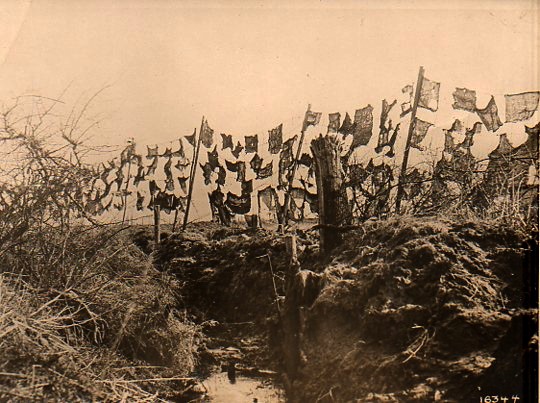
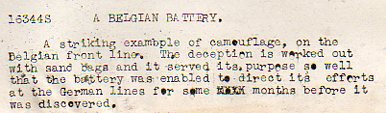
    In this photograph the camouflage is more a more futuristic conception of art than the abstract and cubist approaches that were taken during the war, this looking more like assemblages of found material more than anything else.  And, according to the text that accompanied the photograph (which comes from 1918, from the Underwood & Underwood news photo service agency), the camouflage–empty sandbags thrown on a barbed wire fence) successfully concealed a gunnery emplacement for months on end. 

    World War I photos--Camouflage det292 

    Notes

    1. A fine bibliography on camouflage appears here, at Leonardo Online.

    The definition of “camouflage” from the Oxford English Dictionary shows that it is a young word, in English:
    “(n) The disguising of any objects used in war, such as camps, guns, ships, by means of paint, smoke-screens, shrubbery, etc., in such a way as to conceal it from the enemy; also, the disguise used in this way; freq. attrib.


    1917    Daily Mail 25 May 4/4   The act of hiding anything from your enemy is termed ‘camouflage’.
    1917    Daily Mail 16 July 5/3   The King paid a visit to what is called a camouflage factory.
    1922    C. E. Montague Disenchantment viii. 108   A French aerodrome across which the French camouflage painters had simply painted a great white high-road.

    ·Posted by :

    ·in:

    — —
  • Figuring Out What’s What After a Nuclear Exchange, 1954

    JF Ptak Science Books   Post 2401

    Bomb damage261

    [Original document available from the blog’s bookstore.]

    The spoiler answer to this:  make sure to account for the nukes dropped on you  when figuring out what you’ve got left to work with.

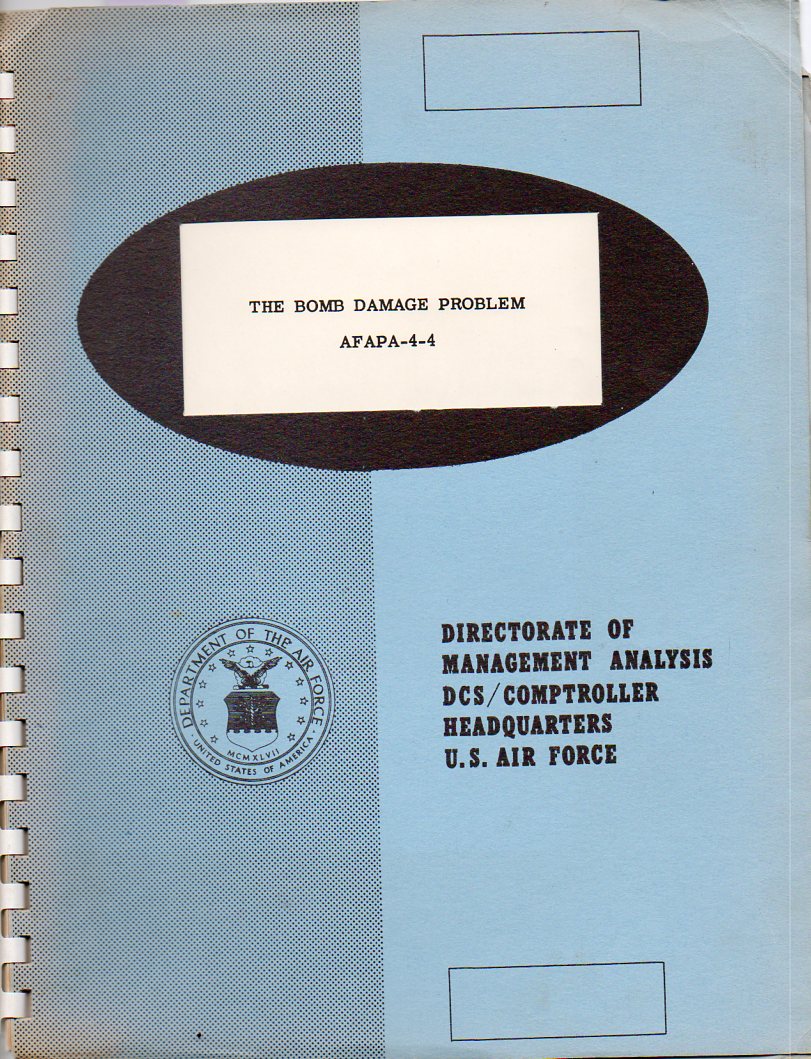
    ITEM:  The Bomb Damage Problem, AFAPA-4-4, published in 1954 by the Directorate of Management Analysis (DCS/Comptroller at the  Headquarters of the U.S. Air Force).  11×8 inches.  GVC binding. 22pp.  Very good condition. RARE.  No copies located in WorldCat.  $175.

    This seems a tautologically  tongue-twisting, not-quite-right title for this post, and indeed it might be.  But that’s the way the pamphlet I’m reporting on read, a sometimes resilient-to- inspection rubberie beastie whose basis for being written was to report on an great oversight that doesn’t really want to be recognized, even if it is the title of the work.

    The Bomb Damage Problem, AFAPA-4-4, published in 1954 by the Directorate of Management Analysis (DCS/Comptroller at the  Headquarters of the U.S. Air Force) is a pamphlet of discovery–or rather, the discovery of the lack of discovery.

    The work is an introduction to some aspects of  nuclear exchange post-attack predictive capacity–particularly with the ability of American industry “to support a war plan”.  

    The anonymous pamphlet gets straight away to the discovery part–that previous predictions of post-attack capacity were “probably completely unrealistic” because “[they] did not take account of the likely bomb damage to the U.S. production facilities”.  

    I would think that even at this relatively early point of planning for possible Soviet nuclear attack that war game scenarios would have taken bomb damage to industry a”and accompanying manpower losses” into account of how the war machine would react after the bombs began to explode.  Though it seems not. I’ve looked to see how I could be misreading this thing because it seems like too monumental an oversight to make. But I can’t find where I’m making my interpretative mistake.  

    Ultimately the authors focuses on saving the corpus of the overall works, saying that this oversight does not damage the “important thinking” that had gone on it spite of this error. 

    The word “error: is not used in the text of course.  This is how it is described: “In connection with this critical new obstacle to intelligent military planning, it is essential that speculation be minimized.” The error is actually redefined as a “critical new obstacle” the effect of which heightens “speculation”.   Which is all true.

    I suppose what is really going on his the formation of some bedrock stuff formulating information gathering for creating a computer program for deeper analytical study of the effects of nuke warfare on post-attack industry.  1954 is about right for the time for this to happen, and the DMA–as the home for the creation of linear programming among countless other things–would’ve been the place for this work to happen.  

    But I keep coming back to what seem to be enormous understatements–even giving plenty of allowance for the time–that keep cropping up in the pamphlet.  Perhaps it is just stating the obvious for te first time that makes all of these seem so potentially underwhelming, like this nugget:   “numerous measures of the importance of each target may eventually be needed….” (Page 7).  

    There’s plenty of more detail though that occurs in the pamphlet, as in figuring out damage to structures by the yield of the explosion and distance from the target and the composition of the target’s structure, and so on. 

    And then we get back to the obvious: “the principal effect of a fire storm following an attack would be to enlarge the area of destruction and to alter the shape of the various damage zones, changing them from concentric rings to irregular patterns. “.  As I said, maybe it is just a case of a “Call me Ishmael”, or stating that lines and points in space exist for the purpose of geometry.  Still, it rubs me the wrong way, all over.

    And just to make this point perfectly clear:  the “bomb damage” problem is to take into account bomb damage to U.S. war-making, bomb-producing capacity, in a sort of BIBO (bomb in, bomb out)  version of a SISO (shit in, shit out).

    Bomb damage b262

    ·Posted by :

    ·in:

  • German Soldier, Worn and Worked, November 18, 1918

    JF Ptak Science Books  Post 2401

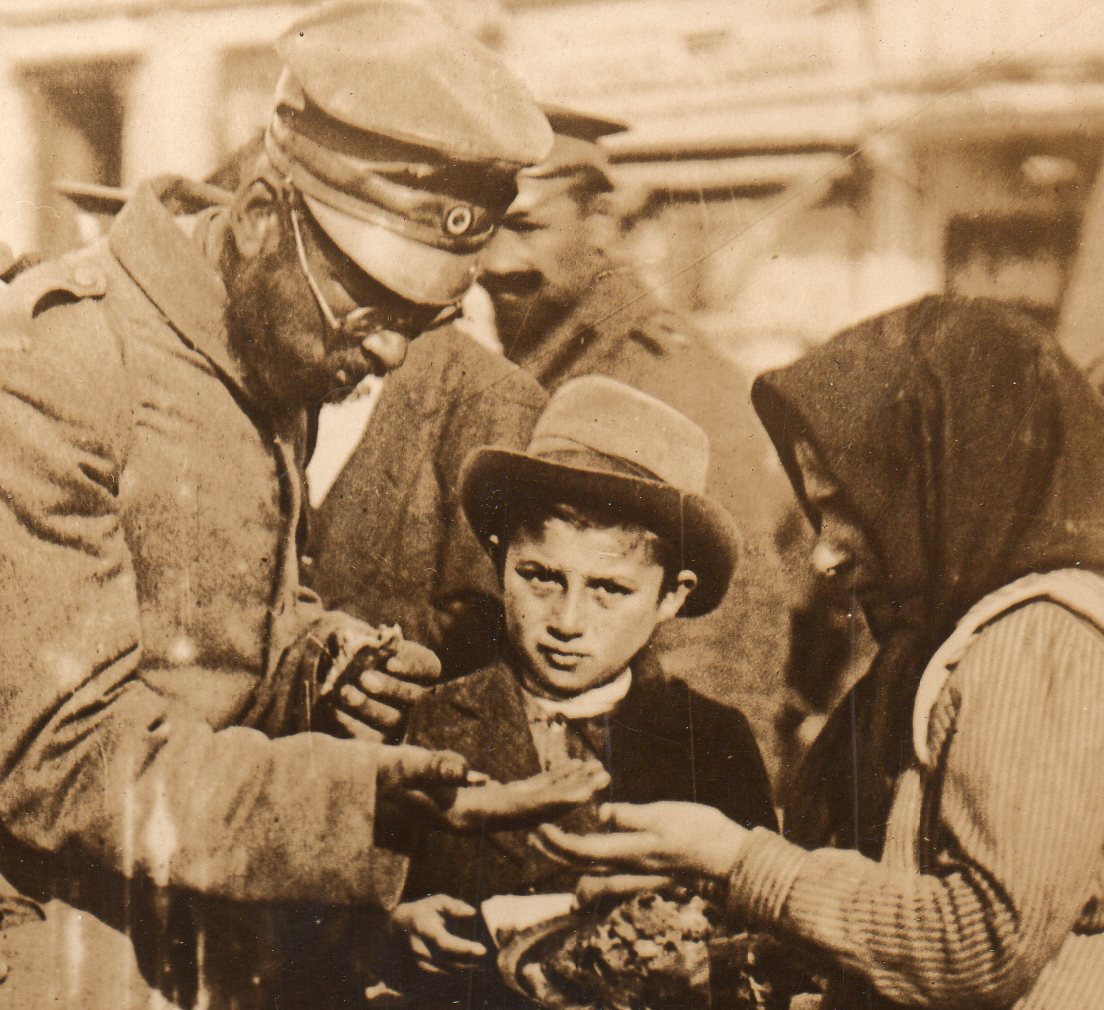
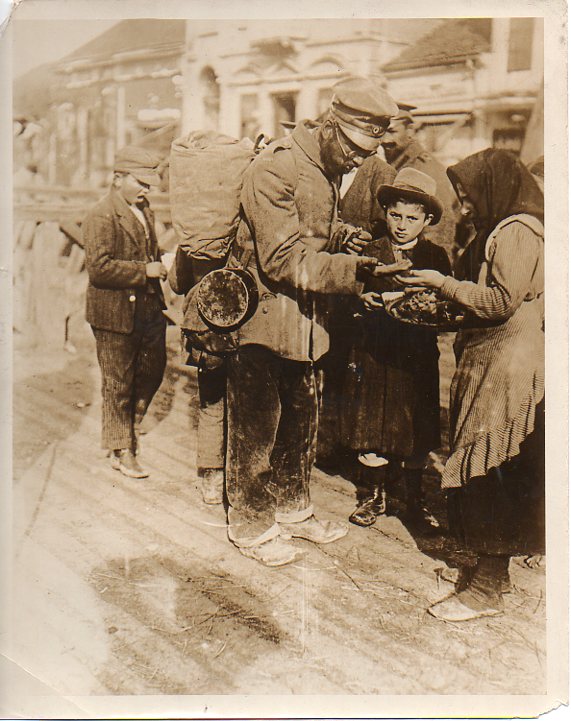
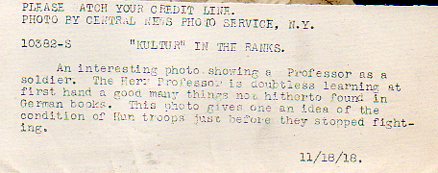
    I’m not sure what this photo depicts specifically but in general it sends an image of exhaustion and wear.  The caption for the image says that it shows “the condition of the Hun troops” and that the subject “Herr Professor” is learning “a good many things not hitheroto found in books”.  Maybe he was a teacher, maybe not.  Machts nichts. His pants looks velour-like and his boots (if that’s what his footware was) look very thin.  He is ragged, his double-fold glasses look like they’re at their limit, his face looks swollen behind his beard, and he just looks “done”, in general. 

    WWI--german--beggar det326
    [Original photograph available for purchase via the blog’s WWI Photography site]

    I’m not sure what he is doing, or where he is.  He may be trying to figure out local currency to purchase whatever it is the vendor-woman has on the tray at her hip–she os holding out her hand, and looking at his.  The soldier definitely has something there, and he looks basically too weary to comprehend it.  the hand language is ambiguous to me.  He may have received something already, some sort of food, and he is staring at it now, thinking perhaps how little of it there was.  He’s eating, and already has taken a bite of whatever bread-like thing is in his left hand.  I’m not sure what attracted the attention  of the boy in the center–perhaps it is simply the camera, and he wanted to be in the shot. 

    WWI--german--beggar325

    There’s a shadow in the foreground-left of what looks like someone making a photograph of teh scene–probably not our photographer, but another, with a brownie or some such smaller camera.

    At the end of years of fighting every general soldier deserves respect and, at least, some free food–I hope this guy got his.

    And the accompanying text to the news photo service image, to be used if published:

    WWI--german--beggar text327

    ·Posted by :

    ·in:

    —
  • WWI Parade in a Deep Big Snow

    JF Ptak Science Books      Post 2402

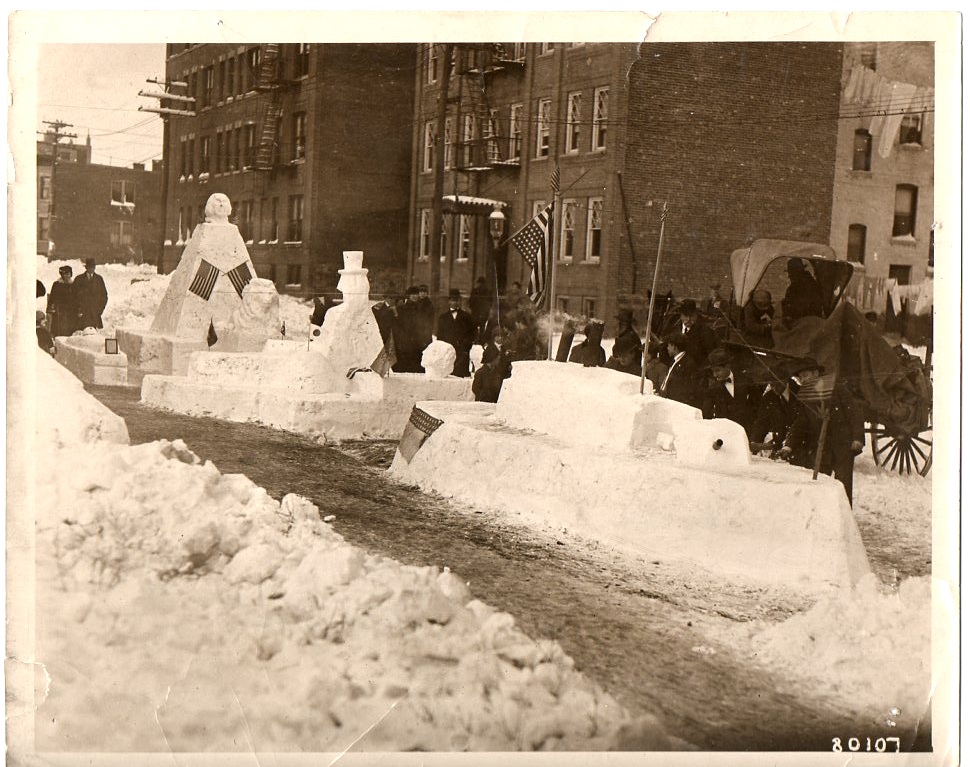
    WWI--great imagessnow parade059

    • The original of this photo is available on the blog’s WWI Photography site; it is also available now as a 13×19 inch reproduction from a 1200 dpi scan.  

    This news photo service image–stamped “Hearst-Pathe News Agency” on the back–is frm the winter of 1917/1918 and shows a patriotic snow parade somewhere in the United States.  The snow looks prodigious, judging from the piles in the foreground and also the accumulated snow on the windowsills, and I imagine that all of the snow floats were sculpted mainly out of exiting snow in the street.  It is a delightful scene, to me, and hosts a variety of smaller, lovely images in vignette. For example:

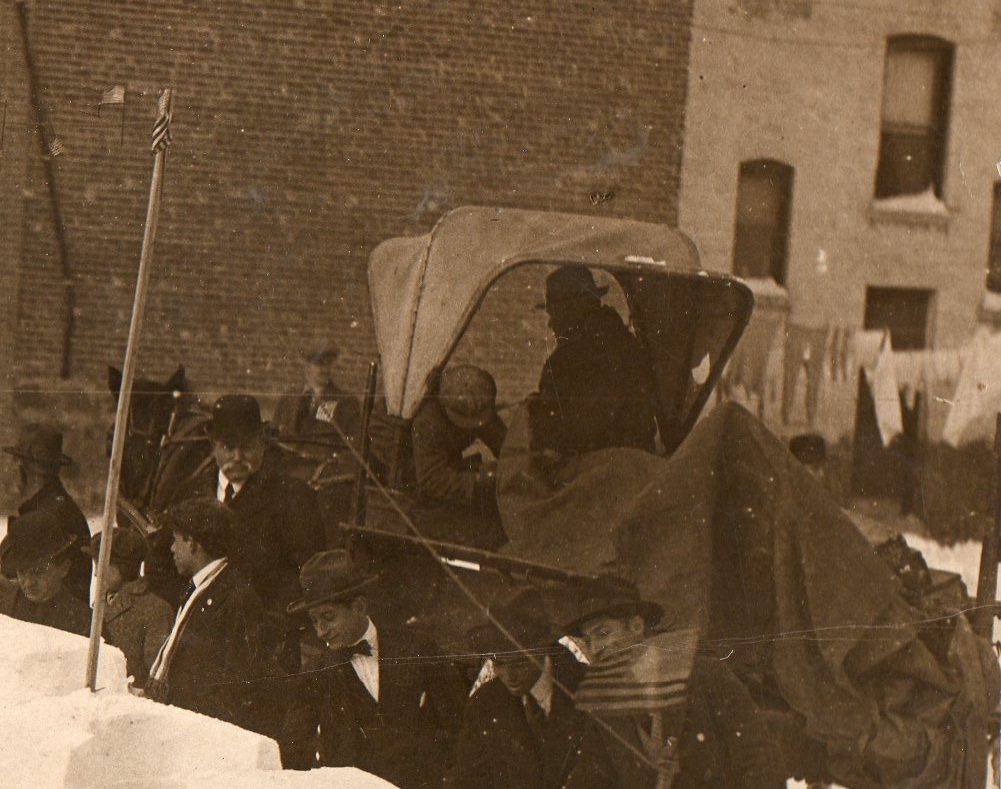
    WWI--great imagessnow parade060

    The man in shadow and sleeping figure (boy) in the buggy complement the white-mustachioed bowler-wearing man to the left; the men looking on in the foreground are interesting, too–plus there’s that laundry in the background.  Given that the laundry is out (and wasn’t just left out during the storm) and that no one seems to be particularly bundled up against cold, I’m going to guess that there was a break in the weather that pushed the temperature higher than normal, with almost everyone taking advantage of the warm snap, as people do everywhere, all the time.  I also like the tiny American flag on the tall pole at left.

    ·Posted by :

    ·in:

  • Doughboys Marching into the Mist of the Past

    JF Ptak Science Books   Post 1328 (from 2011, revised)

    .003%  That’s what I reckon this column of soldiers would represent of the total casualties of WWI.

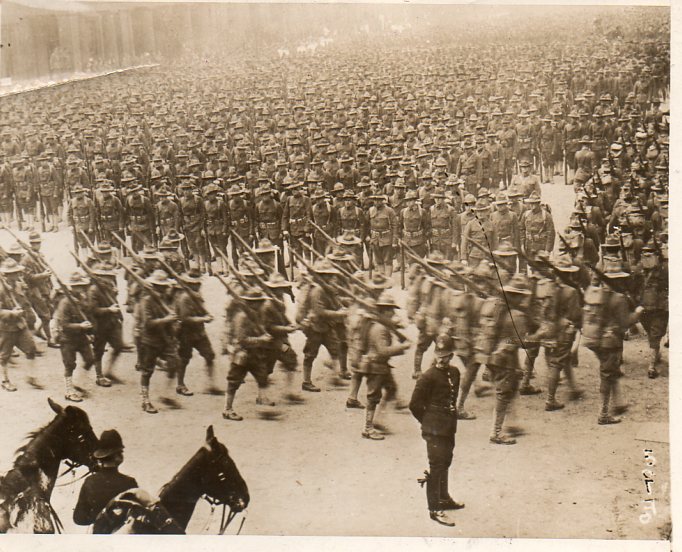
    Generally images like this are a virtual image-host for me, a bucket of ice cold water thrown onto a sizzling summer sidewalk, all sorts of ideas steaming from it.  But for photographs of Doughboys1 marching, especially assembling for parade, this one struck me a little more oddly than most, giving instant pause, making me concentrate on the haze, or dust, that allowed the columns of soldiers to blend into one another and fade, losing their boundaries with their mass receding into a dull blur. 

    Marching london 350

    The Western Newspaper Union was selling this image for insertion in newspaper or journal stories about the war, for a small use fee.  There were a few American organizations like Western Newspaper that were created to photographically cover the war, using pools of photographers who would distribute their work anonymously and which was available for common, general use for a small charge.  The photographs allowed out were certainly restricted and censored, though in my stash of these of objects (numbering about a thousand) I’d say that 10% of them look pretty edgy to my eyes.  Most of the action of war was not covered, but then again this aspect was still fairly technically difficult in 1918.  Images of pain were almost never allowed, and certainly not pain of Allied troops.  Aid stations were almost never covered as well, as were dead bodies, or at least those again of Americans or Brits or French or Canadian.  The imaging of the war was certainly under a fair amount of supervision and control. (The original is available for purchase through our blog bookstore. here.)

    Marching london det352

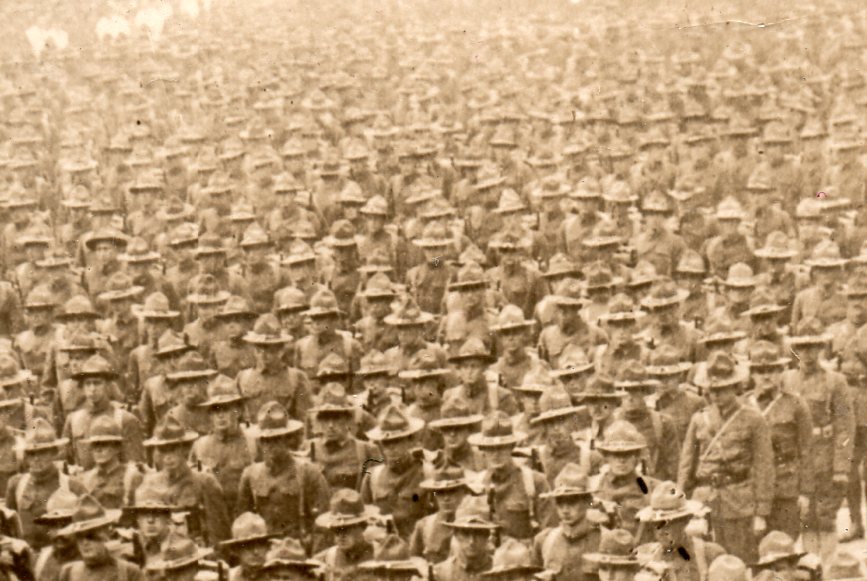
    The image shows American troops assembling for a parade through the streets of London before being deployed.  The mistiness of the composition looks like a statistic to me, these men standing for those who had come before and fallen.

    Marching london det353

     The U.S. lost .13%  of its population to casualties (125,000 killed and 205,000 wounded) during the war–a war which by the time America got here had already been visciously fought for three years, costing dozens of millions of lives.  The figures for everyone else weren’t nearly so “fortunate” as the U.S.:  New Zealand’s 18,000/41,312 killed/wounded amounted to 1.6% of its population.  The U.K. lost 2.19% (964,000/1,663,000), Italy was 3.48% (650,000/953,000 plus 650,000 civilian casualties), while France suffered a 4.29% (1.4 million/4.27 mil) blow of its total population to war.  Things were worse on the other side:  Germany 3.82% (2 mil/2.4 mil plus 426,000 civilian deaths, and the Ottoman Empire 12% (400,000/771,000 plus 2.1 million civilian deaths.   Worst of all was the Ally  Serbia, suffering a catastrophic 16% loss of its population to war, including 275,000/725,000 plus 426,000 civilian casualties.  As gruesome as the numbers were, the Americans felt only a small percentage of the total sting of war–by 11 November, more than 21 million soldiers would have been wounded, with 9.7 million soldiers and 6.8 million civilians killed.  It was an enormous price.

    And that’s what I see in the mist of what may be something like 10,000 soldiers on display n this photograph.  .003%  That’s two of these columns every day, twice a day, for the entire 1550 or so days of the war.   

    Notes

    1.  The origin of the term “Doughboy” is unclear, or varied, or rich, but it is at least pretty oldm beginning around the time of the Mexican American War in 1846-1848–evidently when the soldiers marched through dry, tough terrain they wound up being covered by earth with the color of dough.  Doughboy.

    ·Posted by :

    ·in:

  • G. Washington Hunts His Lost Property: Miss Oney Judge

    JF Ptak Science Books   Post 2401

    George Washington was the first president of the United States, and so the first to own slaves while president–he was the first of 12 presidents who were slave-owners, and the first of eight to own slaves while serving in that office. (All of paper currency  celebrates celebratory people who also owned slaves–the $1, $2, $10, $20, $50, and $100; all but Lincoln.)

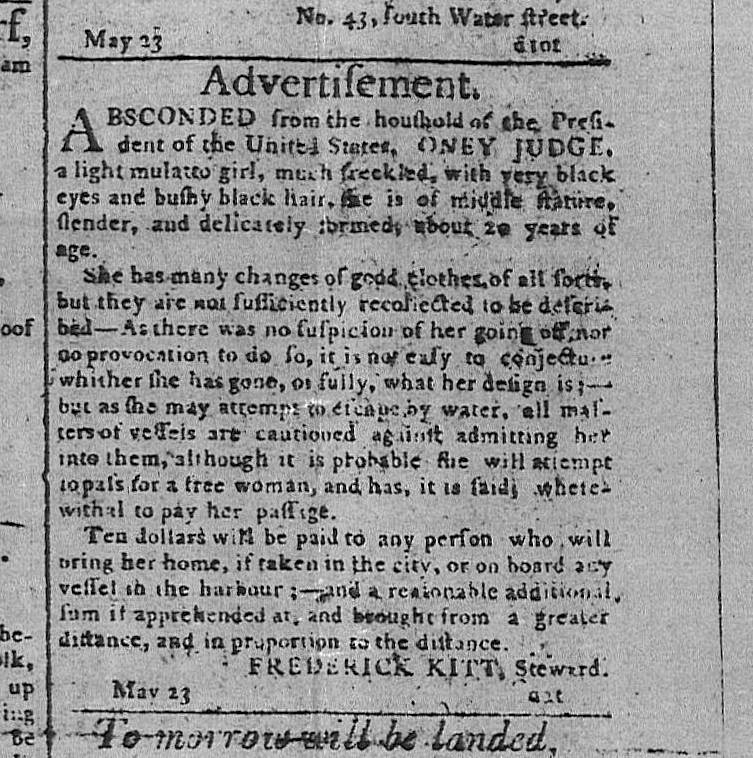
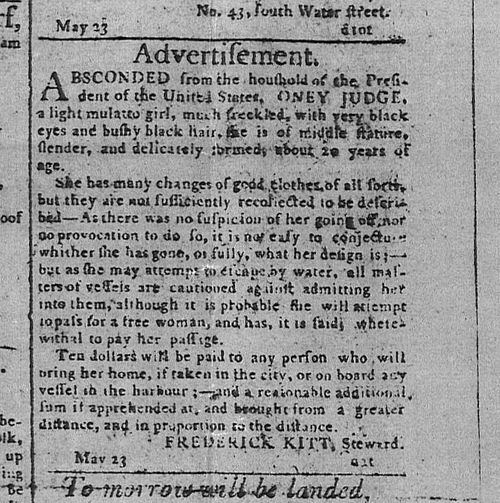
    After he served his terms as president, and two years before his death, Washington suffered a property loss.  Martha Washington’s personal servant fled, escaped, headed north, to freedom. President Washington wanted his property returned:
    Oney_Judge_Runaway_Ad

    [Originally in  The Pennsylvania Gazette, Philadelphia, Pennsylvania, May 24, 1796. Image source: Wikipedia.  The full text1 transcribed in below in Notes.]

    The ad was evidently placed by Frederick Kitt, who was a long-time steward of the Washington household, and it fell to him to look after the return of Ms. Judge.

    The Founding Father found the Founding Fathers law on his side, of course–it was right in there constitution, Article IV, Section 3. (“No Person held to Service or Labour in one State, under the Laws thereof, escaping into another, shall, in Consequence of any Law or Regulation therein, be discharged from such Service or Labour, but shall be delivered up on Claim of the Party to whom such Service or Labour may be due.)  Article IV section 3 was toothless for a while, until the machinery of enforcement was provided in the Fugitive Slave Act of 1793. which made it possible for slave catchers to proceed across all state lines in the hunt for escaped slaves, and made it a federal crime to assist a fugitive slave, among other things, but particularly ensuring that an escaped slave would remain a slave, always.

    Miss Judge was the baby of her enslaved mother [name?] and an indentured servant; even though the indentured servant was a free man, the mother was not, and the law stated that any fruits and/or labors or babies etc. coming from a slave is the property of the slave’s owner.  

    Miss Olney was actually the property of Martha Washington, who inherited 84 “dower” slaves from her first husband–this meant that the slaves were her’s to own but not to sell.  When Martha married George in 1759 they gathered their slaves together but separately, adding significantly to the slave population at the estate (a number that would grow to more than 300 by the time of Washington’s death 40 years later).  Washington freed his slaves after death, in his (1797) will; Martha kept her’s until she died in 1802, at which point her property was distributed to Custis heirs.  

    Oney Judge on the other hand made her way to New Hampshire, where she settled and married Mr. Jack Staines. She spent the rest of her life (she was 26 when she fled and lived to 1848, aged 75) as not-a-slave but unfortunately not-free, either.  

    Washington suffered another major loss–his prized cook, Hercules, took of from Mt. Vernon in 1798 and evidently met happiness in Philadelphia.  Washington wanted that property returned, too2.  

    Notes

    1.  “Advertisement. ABSCONDED from the houshold [sic] of the President of the United States, ONEY JUDGE, a light mulatto girl, much freckled, with very black eyes and bushy black hair. She is of middle stature, slender, and delicately formed, about 20 years of age. She has many changes of good clothes of all sorts, but they are not sufficiently recollected to be described—As there was no suspicion of her going off, nor no provocation to do so, it is not easy to conjecture whither she has gone, or fully, what her design is;—but as she may attempt to escape by water, all matters of vessels are cautioned against admitting her into them, although it is probable she will attempt to pass as a free woman, and has, it is said, wherewithal to pay her passage. Ten dollars will be paid to any person who will bring her home, if taken in the city, or on board any vessel in the harbour;—and a reasonable additional sum if apprehended at, and brought from a greater distance, and in proportion to the distance. FREDERICK KITT, Steward. May 23

    2. Letter from George Washington to Frederick Kitt, January 10, 1798:

    “Mr Kitt

    We have never heard of Herculas our Cook since he left this; but little doubt remains in my mind of his having gone to Philadelphia, and may yet be found there, if proper measures were employed to discover (unsuspectedly, so as not to alarm him) where his haunts are.

    If you could accomplish this for me, it would render me an acceptable service as I neither have, nor can get a good Cook to hire, and am disinclined to hold another slave by purchase.

    If by indirect enquiries of those who know Herculas, you should learn that he is in the City, inform Colo. Clemt Biddle thereof, and he will, I hope, take proper measures to have him apprehended at the moment one of the Packets for Alexandria is about to Sale, and put him therein, to be conveyed hither; and will pay any expence which may be incurred in the execution of this business; which must be managed with address to give it a chance of Success—for if Herculas was to get the least hint of the design he would elude all your vigilance. I wish you well and am Your friend &ca”

    [Source:   http://founders.archives.gov/documents/Washington/06-01-02-0019#GEWN-06-01-02-0019-fn-0002]
     

    ·Posted by :

    ·in:

Recent Posts

Archives

Categories