A Daily History of Holes, Dots, Lines, Science, History, Math, Physics, Art, the Unintentional Absurd, Architecture, Maps, Data Visualization, Blank and Missing Things, and so on. |1.6 million words, 7500 images, 4.9 million hits| Press & appearances in The Times, Le Figaro, Mensa, The Economist, The Guardian, Discovery News, Slate, Le Monde, Sci American Blogs, Le Pont, and many other places… 5000+ total posts since 2008.

  • Striking Anti-Nazi Work on the Subjugation of Women, 1931

    JF Ptak Science Books  Quick Post

    German design frau in reich031

    Wilhelm Hoegner was an early and influential opponent of Adolf Hitler and the NSDAP–a very early opponent, having been involved in the investigation of Hitler’s Beer Hall Putsch in 1923.  He maintained his strong opposition as a member of the Reichstag from 1930-1933; after the elections and after Hitler consolidated his power in 1933, Hoegner’s position became “untenable” in Germany and he left for Austria, and by 1934 he was situated as a journalist in Switzerland.  He played a prominent role in German postwar politics, and died in 1980. 

    Hoegner wrote Die Frau im Dritten Reich  in 1931 as a warning to all about the totalitarian possibilities of the Nazis, and in particular of the tyranny against women–the result is pretty much evident on the very striking cover of his pamphlet.

  • On The Flood, Comets, and a Recantation (1823-1831)

    JF Ptak Science Books   Post 2592

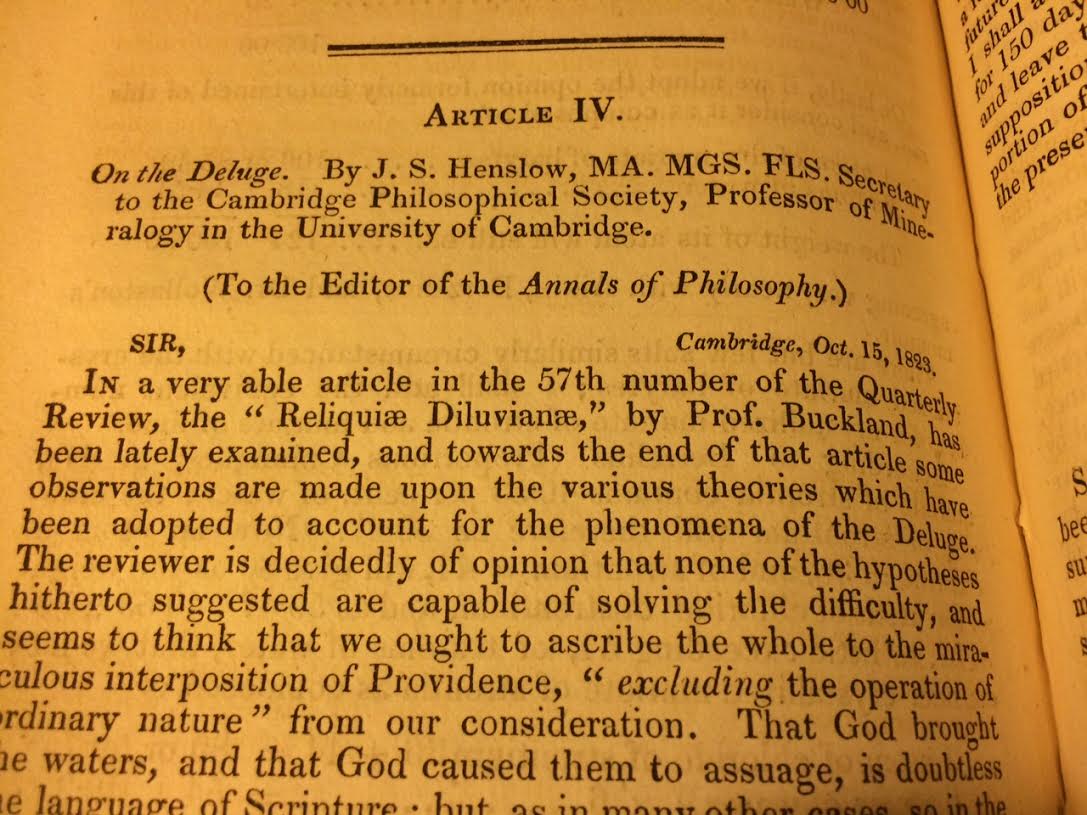
    I pulled a volume at random of the Annals of Philosophy from the shelves–it was volume VI (new series) from 1823. Trying to think of what might be a hot-button issue (in English) for that year, I started flipping through the pages, reading the page headers: Humboldt on volcanoes, Beaufoy’s astronomical observations, Mr. Moyle on the temperature of mines, Prevost on the blood, Pond on some astronomical topic, Ramond on the barometer, book reviews, scientific society announcements, and so on. Nothing really drew me in–until in the back, at page 344, this running header: “Prof. Henslow on the Deluge”. That was a “something” that I was looking-but-not-looking-for.  
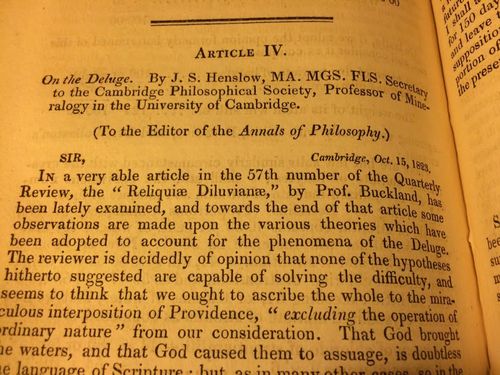
    Flood

    This was a late-ish contribution to the history of the geology of the Great Flood, and in it, John Henslow (a great naturalist and botanist, 1796-1861) postulates that the flood was caused by the near-passing of a comet that disintegrated and contributed its enormous aequeous “nebulae” to the Earth’s atmosphere producing the Noachic flood.  He quickly sites a contemporary (one of many), William Buckland1, in this, who was one of the late leaders in the geological response to the flood, and who theorized a natural history of the flood and a production of an Ice Age.  The belief that there was some scientific basis in the divinely-induced flood was buoyed by the general flavor of the mythology of the flood, which turns up in more than 100 cultures–so part of the Noahic flood argument as being true is the broad cultural base for it. Commonality across cultures like this doesn’t necessarily make something real–there are many many parallels between the Bible and other sacred books besides this, like for example the savior descending into Hell for three days before resurrection, and that in stories that precede the New Testament. So common story bases make them popular, though not necessarily correct.

    So Henslow thinks about the comet in a long tradition of Genesis geology, like Buffon and his comet. But what is more interesting to me in this issue is another contemporary, Reverend Adam Sedgwick, Woodwardian Professor of Geology at Cambridge University, who at the end of several decades in theorizing on catastrophic flood geology decided that he had taken a wrong turn.  What happened then, in 1831, was a remarkable refutation of his earlier work. It was an enormous thing, a statement of real courage and conviction to the scientific process.  

  • Trees and Telephones, 1918

    JF Ptak Science Books  Quick Post

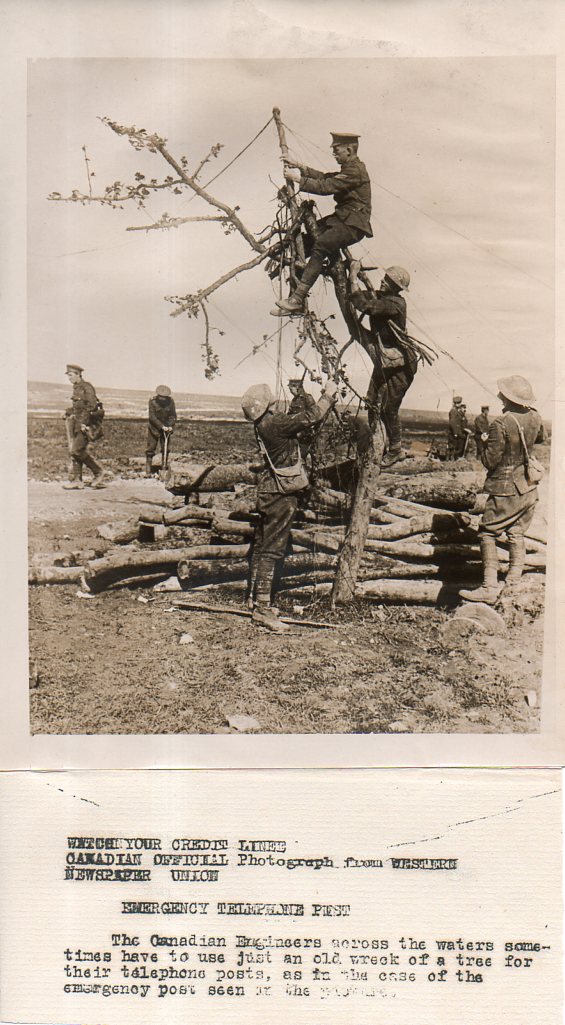
    During World War I battlefields that began as forests ended as plains.  And since telephonic communications depended upon wires, and since the wires needed to go somewhere, anything that survived that was head-and-shoulders above the ground was of particular use, especially to the telephone corps and especially for the use of telephone wires.  This news service photo (provided by the Western Newspaper Union) shows a rather desolate scene, with Canadian engineers working the wreck of a lone tree for all it was worth…as is plainly visible, there is nothing else like it in the near or remote vicinity.  

    WWI Photo Telegraph176

    It was the practice of the agencies providing these images for worldwide distribution to also include typed captions for the photographs.  

    The original of this photograph is available at the blog’s bookstore, here. 

    ·Posted by :

    ·in:

  • Over and Under Stories: an Underwater Lighthouse and a Piggy-Back Bomber (1916)

    JF Ptak Science Books   Post 2593

    Airplane piggyback

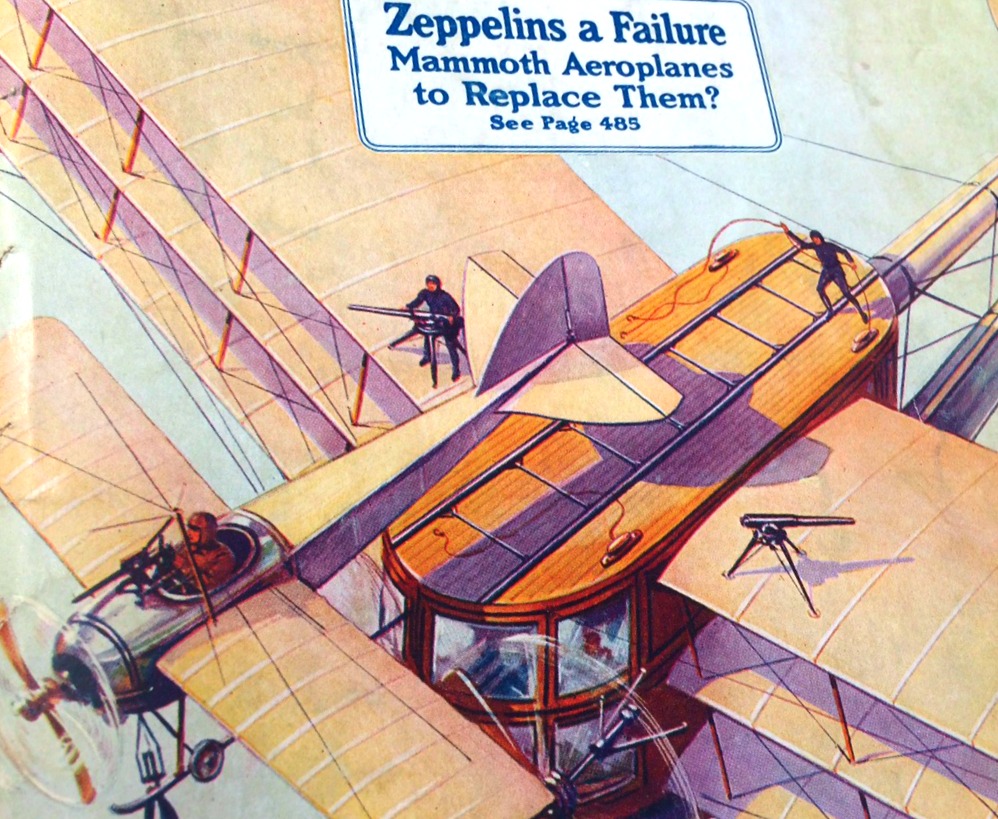
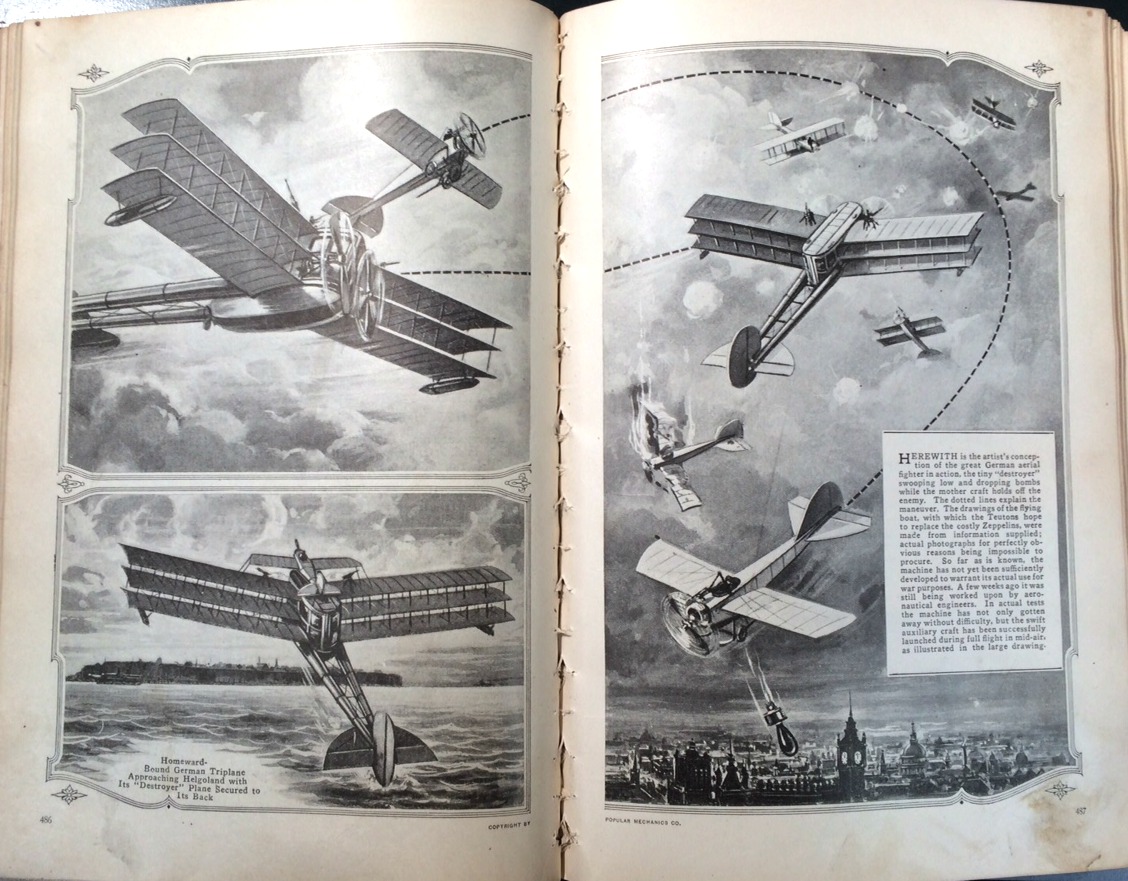
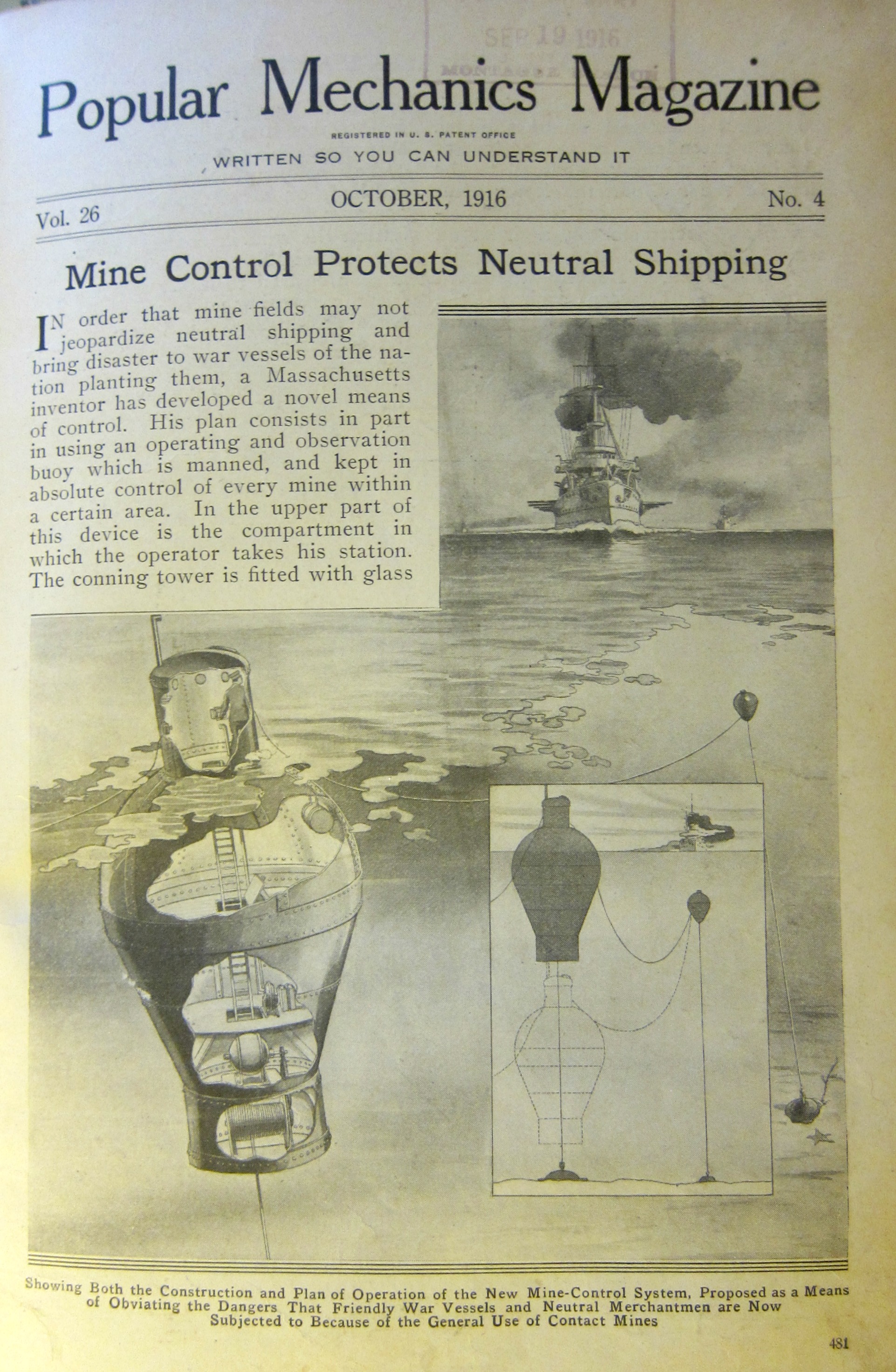
    There are two interesting and remarkable techno-military suggests in this October, 1916 issue of Popular Mechanics.  First is the cover story, a (“destroyer”) aircraft bomber is to be launched from a “battleship” aircraft for a one-two punch of carpet and strategic bombing. The large “mother ship” was to have a 143′ wingspan, making it a monster of a plane for the time. It would enough fuel and oil to keep it aloft for 48 hours, and also have a 1000-pound payload “of bombs”, and a crew of five, two of whom would be wingwalkers firing machine guns. And another plane. The smaller aircraft was “equipped with bomb-dropping devices” and was to be launched for a special raid and/or to ward off enemy attack planes. But the fly in the ointment, says the article, was getting the smaller aircraft back to the larger one–launching was no problem; landing was.  And I can see why.  

    Airplane piggyback 2

    The second article in the issue–the so-called underwater lighthouse (appearing under the far less amusing but much more informative title of “Mine Control Protects Neutral Shipping”)–was a defensive and offensive buoy-structure that would provide a very claustrophobically-unwantable job for someone. The buoy was made to control an undisclosed-number field of mines in/near shipping lanes and differentiate friendly from unfriendly ships.

    Popular MEchanics--buoy mine

    The buoy would have an observation area  from which our unlucky guardian would scan the seas; once a ship was spotted, the buoy would submerge to periscope depth, and after some time the nationality of the ship would be identified; at that point if an enemy ship is recognized the operator could submerge the buoy further (being anchored to the sea floor) via a winch to 50 or 60 feet beneath the surface, and then when the mine made contact (proximity or otherwise?) the buoy operator could detonate the mine. It was thought in this way that you could mine an area of sea and not have to worry about ships being damaged by friendly fire. The whole thing seems highly problematic to me–not the least of which would probably be a very jostling ride to the buoy operator. 

    And so two adventures in speculative military technology in one single war-time issue of Popular Mechanics.

  • In the Golden Age of Bicycles–a 25-cent Bike

    JF Ptak Science Books   Quick Post

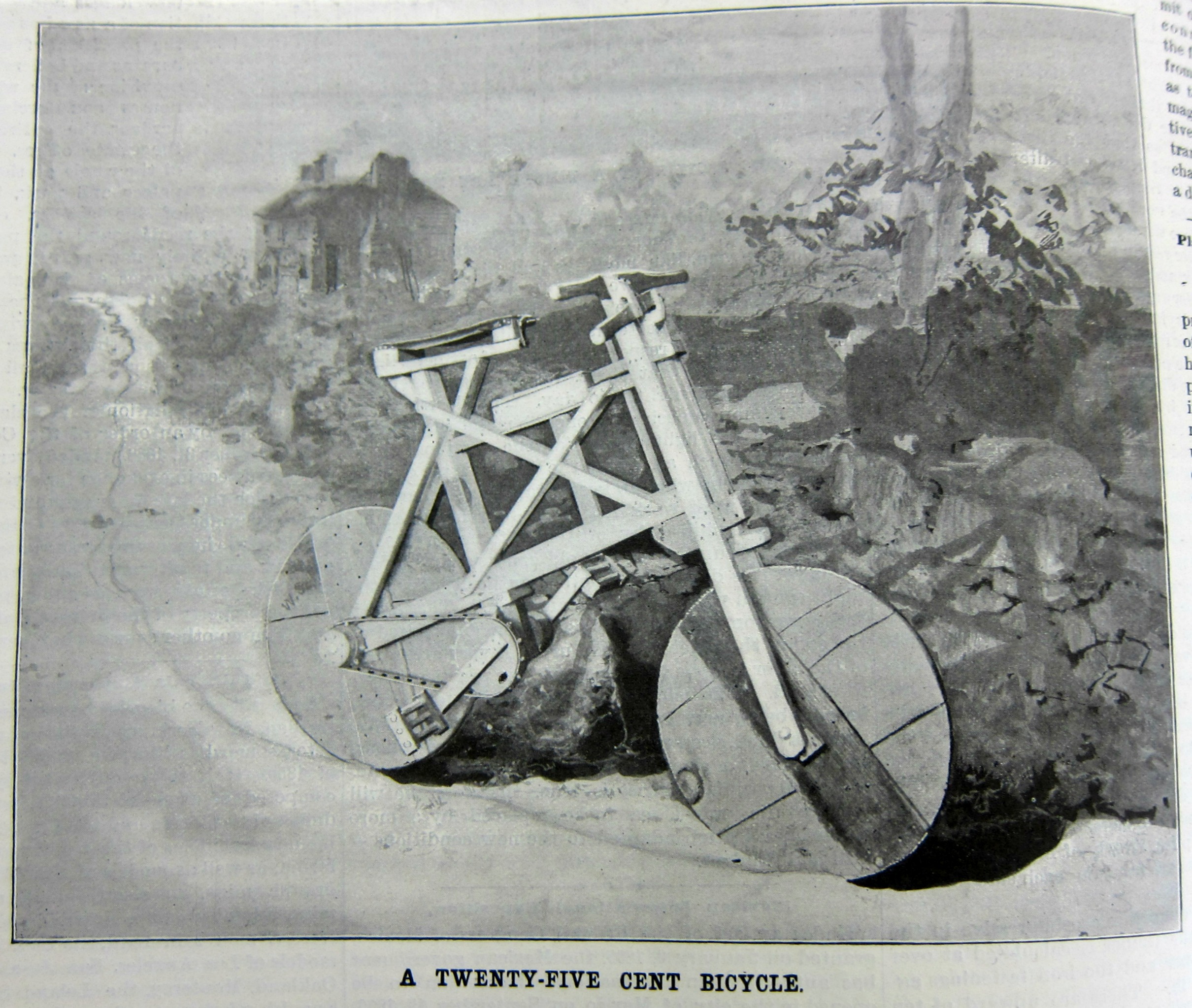
    Today I joked with a neighbor that my car was so old that it has wooden seat belts.  At least it has seat belts, no thanks to the early (pre-1989) efforts of people like Lee Ioccoca to prevent having them automatically installed, and unlike the Flintstones and Jimmy Rockford and others who had no seat belts at all–it is more like Granny’s rope-belt in the Beverly Hillbillies. Be that as it may, this bicycle is a much better creation than my seat belts.  The image appeared in the Scientific American for February 1, 1896, a half tongue-in-check proposal at a time of a great bicycle craze. Even though millions of bicycles were being made, a decent one could cost you $25, which would (according to the Bureau of Labor Statistics inflation calculator) would be about $750-$1000 today–not nothing.  So this Modest Proposal on making a bike from bits, found wood, and a quarter.  

    Bicycle 25 cents

  • An Eight-Person Crew Tricycle, 1896

    JF Ptak Science Books   Quick Post

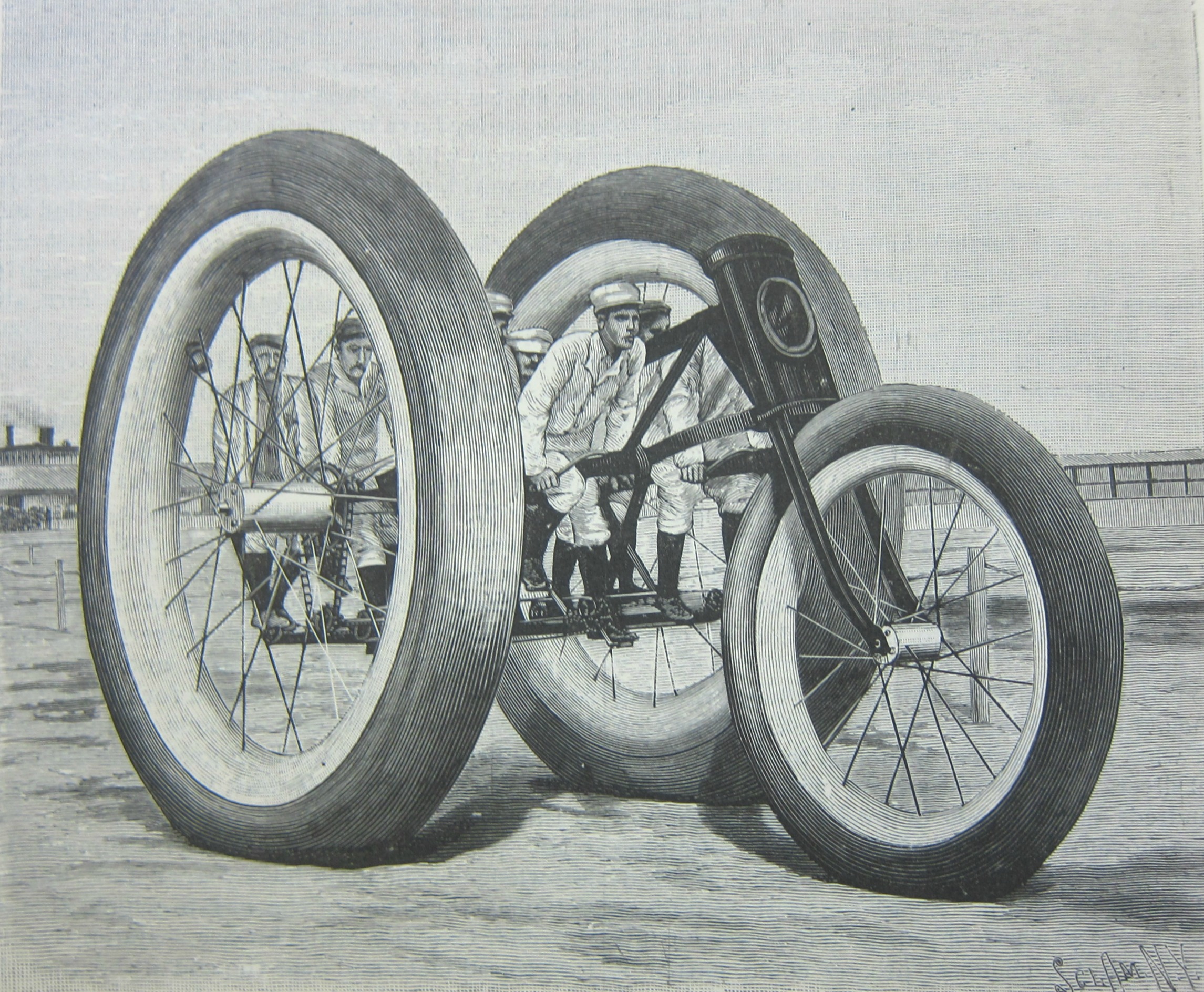
    SO–this is either a very large tricycle with average-sized crew, or an average-sized trike operated by tiny people.  Since it appeared in the November 11, 1896 issue of Scientific American–which had a very very slight leverage on humor–I report here that this was indeed a very large tricycle. As a matter of fact it required a crew of eight to operate, and weighed in at about 1500 pounds.  It was actually constructed, as this crew peddled it around the Boston area for a 125-mile jaunt.  Why this was done–other for the sake of doing it–I do not know.  It seems someone just made a Big Thing, coming (as the short description in the issue says) “in this age of ‘big things’ “.

    Scientific American giant trike 1896

  • Holes for the Living and the Dead: Prisoners & Roman Columbaria

    JF Ptak Science Books   Quick Post   Part of the History of Holes series

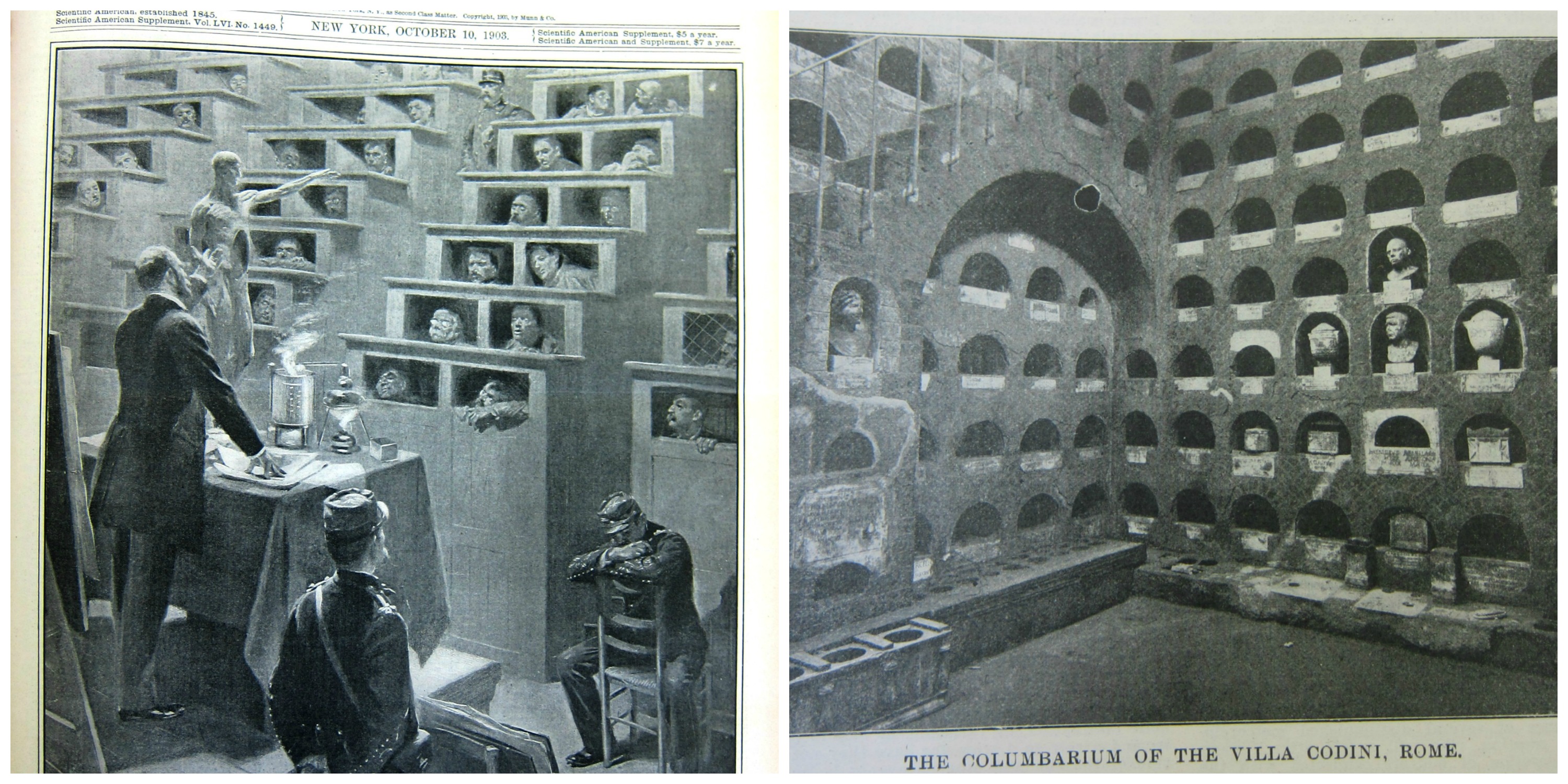
    While browsing a volume of the Scientific American  (Scientific American Supplement #1453, November 7, 1903) I came across a picture of the Columbarium of the Villa Codini, Licinian Gardens, Rome, and then within a minute I came upon a similar scene just dozens of pages away–a striking likeness, though this time the sculpted openings were for the living.  It showed a lecture being delivered to inmates of a criminal sanatorium, hearing about the evils of alcohol, each prisoner stored away in his own little box. “Columbarium” comes from the Latin word (“columba”) for “dove-cote”, and it is easy to see the similarity between the sepulchral images. 

    Columbarium collage


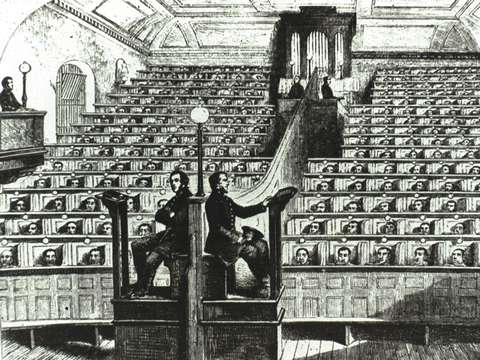
    There is another image that I’ve saved but which has no reference for origin. It depicts prisoners in a European institution attending a Sunday service:

    Hats heads

  • History of the Future of Massiveness: Stadium-Seating Skyscrapers, NYC, 1938 [Part II]

    JF Ptak Science Books  

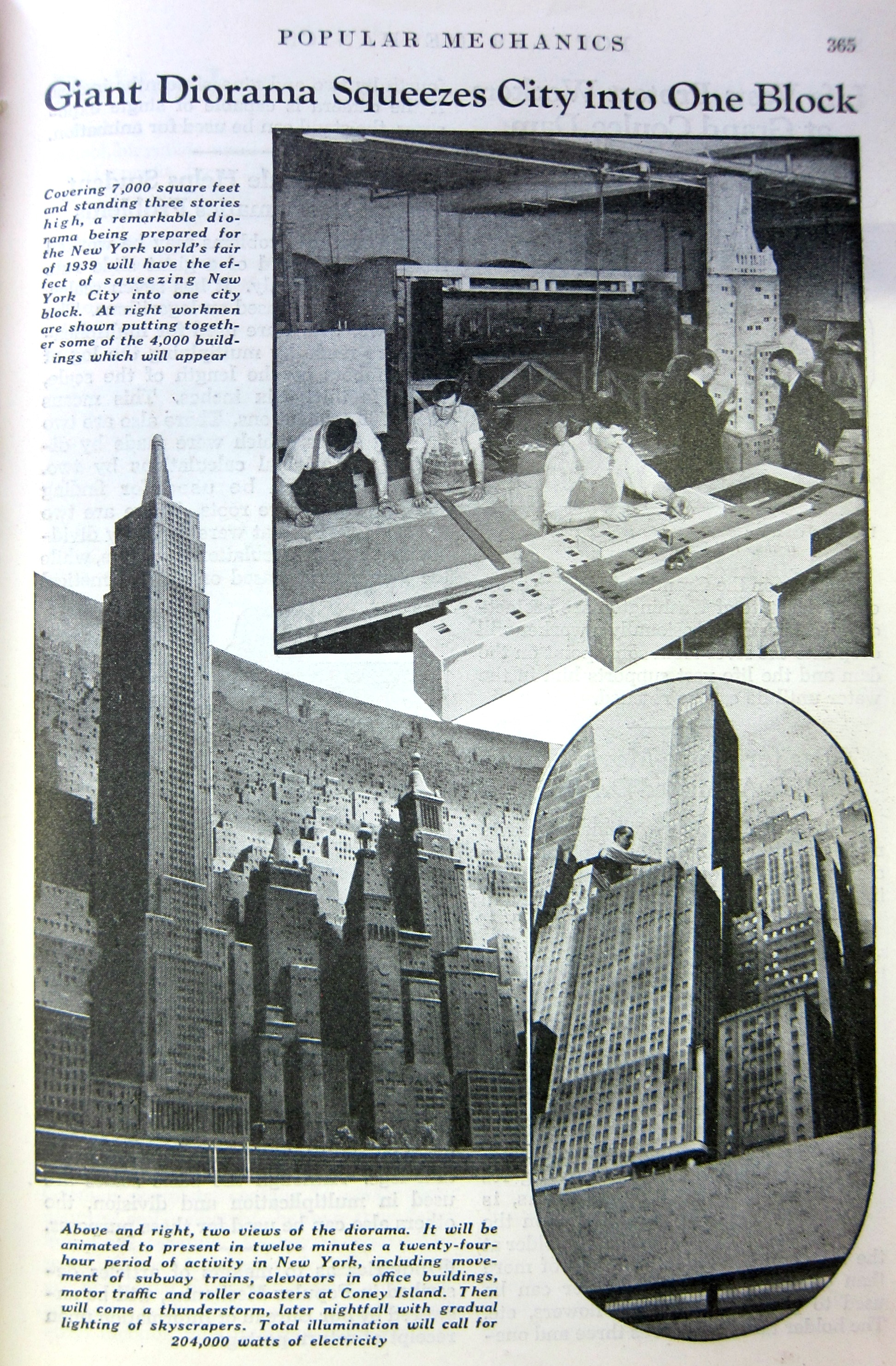
    I wrote earlier in this blog about a wonderful stadium-seating vision of New York City (here https://historyofideasblog.com/thesciencebookstore/2016/02/history-of-the-future-of-massiveness-stadium-seating-skyscrapers-nyc-1938.html)  produced by Con Ed for the 1939 World’s Fair.  What I didn’t realize was that this was a drawing of what was to be a 5,000 square foot model of the buildings of Manhattan, all made to fit on a single block.  The breakthrough for me came in a browse of the September 1938 issue of Popular Mechanics, where I saw a short article with a photo of NYC building models that looked very much like the jam-packed visionary cityscape of ConEd:

    NYC Architecture stadium seating


    Here’s one of the images I posted earlier:

    NYC stadium seating 1938

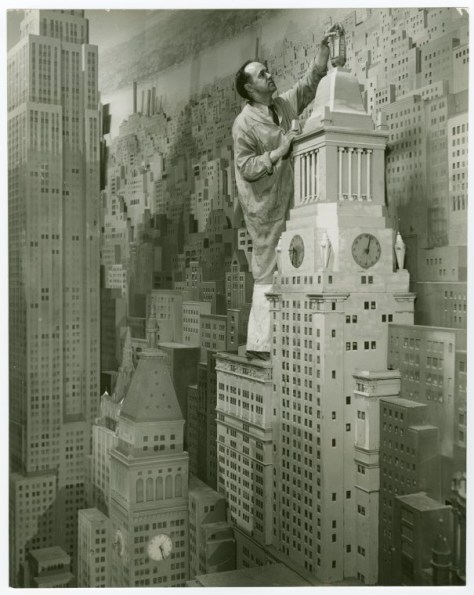
    It turns out that the first images that I posted were drawings for the models that were part of the Consolidated Edison “City of Light” pavilion at the fair, and which constituted the world’s largest diorama.  Here’s an interesting photo showing the scale of the project:


    NYC city of light 1939

    [Source for the image directly above from Architecturalogy which hosts a number of other interesting photos, here:  http://architecturalogy.com/new-york-diorama-the-city-of-light/]

  • The Heavy Stuff–Old School Hardware in Advertisements, 1887

    JF Ptak Science Books  Quick Post

    While looking through a yearly volume of the Scientific American Architects and Builders Supplemental volume for April, 1887, I was very much impressed by the sheer size and heaviness and oddness of some of the good advertised in the back of this one issue.  For example, here’s the distant relation of a convenience that we all take for granted nowadays:

    Scientific American ads old school toilet paper

    ·Posted by :

    ·in:

  • Looking Straight Ahead Series: the Whitley Bomber

    JF Ptak Science Books   Quick Post

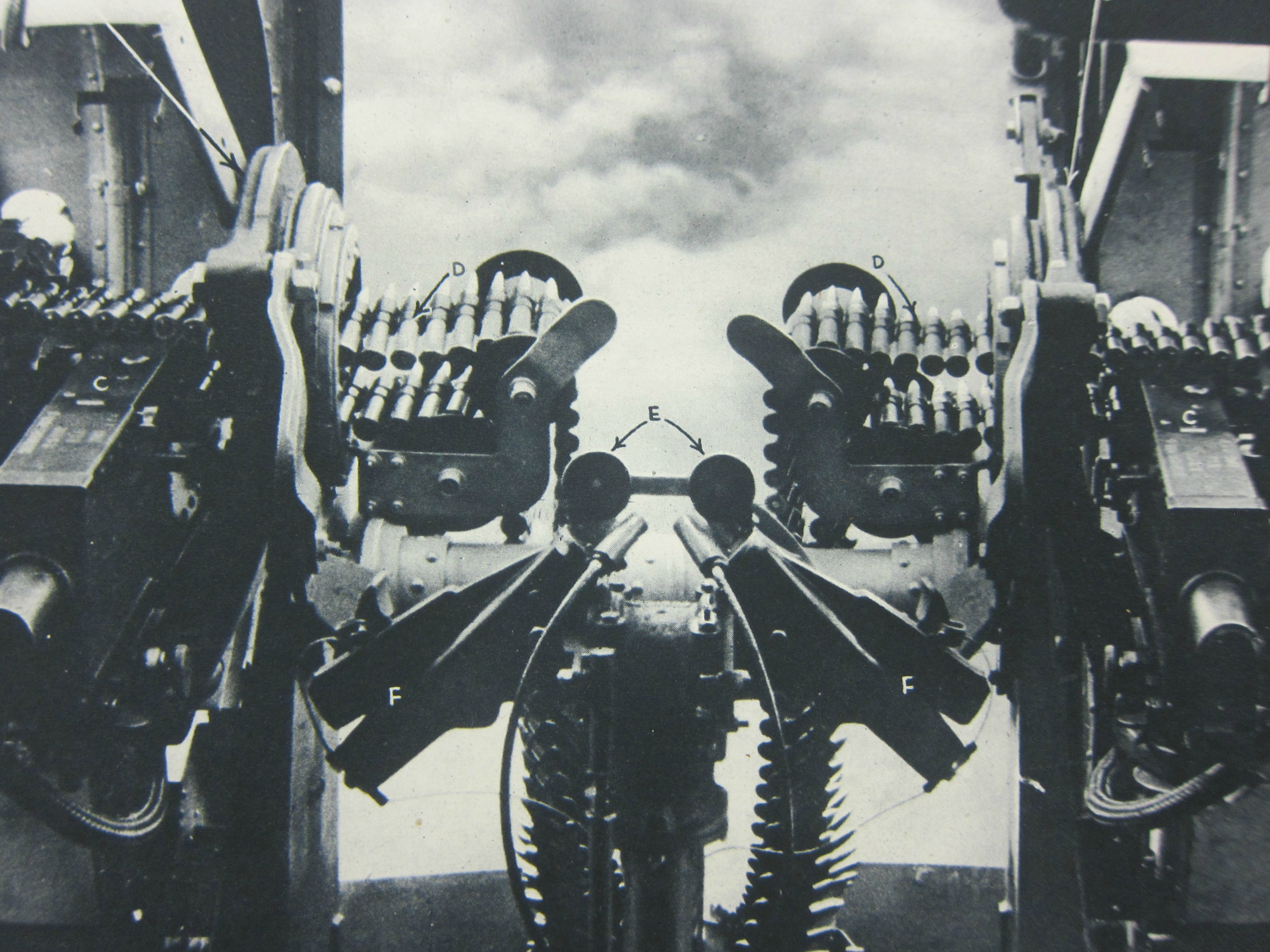
    There are a number of posts on this blog that focus on what turns out to be an unexpectedly unusual perspective–looking at things straight-on. Straight-on as in straight across, and straight up, and straight down, and in images that are not architectural plans or elevations. Today’s entry is similar to an earlier post looking through a Vickers gun sight–this one is looking out from behind the tail gunner’s seat in an Armstrong Whitworth A.W. 38 Whitley.

    Here are a few examples of previous efforts on this subject on this blog:

    • The Straight Series: Looking Straight Through a Vickers Gun Sight, 1916 https://historyofideasblog.com/thesciencebookstore/2015/08/jf-1.html
    • Vision: Looking Straight Up, Down, Across and Through–1525-1905  https://historyofideasblog.com/thesciencebookstore/2009/07/vision-looking-straight-up-down-across-and-through15251905.html
    • Points of View: Inside Looking Out, Outside Looking in, and in-Between  https://historyofideasblog.com/thesciencebookstore/2009/02/points-of-view-inside-looking-out-outside-looking-in-and-inbetween.html
    • Crystallizing a Scarce Perspective: Looking Straight Down & the Art of Photography  https://historyofideasblog.com/thesciencebookstore/2014/03/looking-straight-down-the-art-of-photography.html


    Whitley bomber big

     So, just for perspective’s sake, the two bits labeled “E” are the buttons/triggers located in grips for the four guns which are just barely seen (over-and-under) just to the left and right of the ammunition feeds, and the gunner’s seat would be just a little bit below and back from where the foreground begins. In any event, if you were crowded aft and looked straight out of the back of this workhorse of a medium bomber, this is what you’d see. 

    ·Posted by :

    ·in:

  • Measuring Things With Ships (Again)

    JF Ptak Science Books  Quick Post

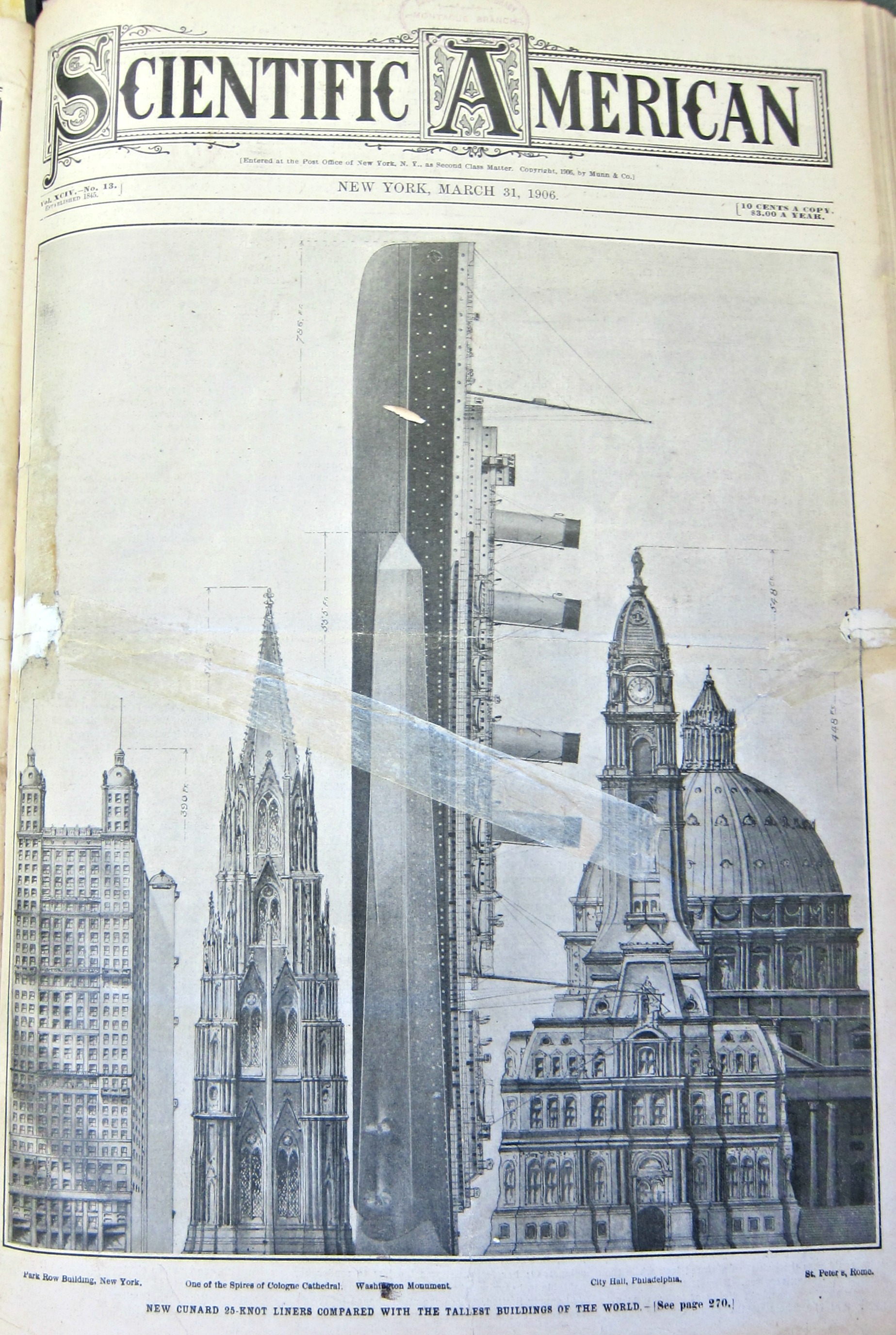
    I didn’t think that there would be many entries for a series on measuring things with ships–they do pop up here and there, as with this issue of the Scientific American for March 31, 1906.  There’s probably room for a History of Measuring Things By Uncommon Non-Standard Means series on this blog–after all, there are examples for ships as a measure, and there are other bits on this blog about measuring things in units of the Eiffel Tower, gargantuanly-oversized bread, enormous nails, collections of beef, Trinity Churches, miles of soldiers, and the like.  Here are a few examples: 

    • Measuring Things in Terms of Trinity Churches https://historyofideasblog.com/thesciencebookstore/2013/12/jf-and-so.html
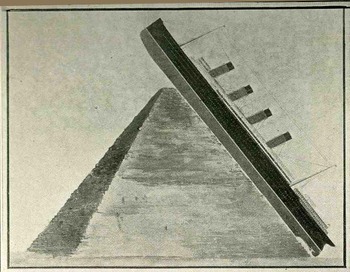
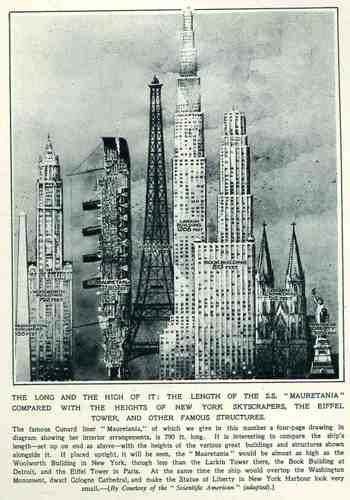
    • Ships in the Skyline    https://historyofideasblog.com/thesciencebookstore/2008/09/comparative-d-1.html
    • Ships on the Pyramid  https://historyofideasblog.com/thesciencebookstore/2008/09/jf-ptak-scien-3.html

    These units of measurement do seem a little odd, but they really have a capacity to humanize inescapably difficult numbers by putting them in context with a known entity, like Trinity Church.  In this new case of ship/measurement, the newest of the Cunard Line’s transatlantic ocean liners (that would be named Lusitania and Mauritania) is presented here on the front page of the Scientific American pressed up against structures that are presumably well known amongst its readers. 

    Scientific American ship standard


    Blog1sept_17_ship_city_btm_det572

    •  [Source:  https://historyofideasblog.com/thesciencebookstore/2008/09/jf-ptak-scien-3.html]

    Blog1sept_16_ship_skyline564

    • [Source: Ships in the Skyline    https://historyofideasblog.com/thesciencebookstore/2008/09/comparative-d-1.html}

Recent Posts

Archives

Categories