A Daily History of Holes, Dots, Lines, Science, History, Math, Physics, Art, the Unintentional Absurd, Architecture, Maps, Data Visualization, Blank and Missing Things, and so on. |1.6 million words, 7500 images, 4.9 million hits| Press & appearances in The Times, Le Figaro, Mensa, The Economist, The Guardian, Discovery News, Slate, Le Monde, Sci American Blogs, Le Pont, and many other places… 5000+ total posts since 2008.

  • Jane Austen and the Evasion of Submarines

    JF Ptak Science Books  Quick Post

     “The little zigzags of embarrassment.”– J. Austen Emma I. xv. 282, 1816

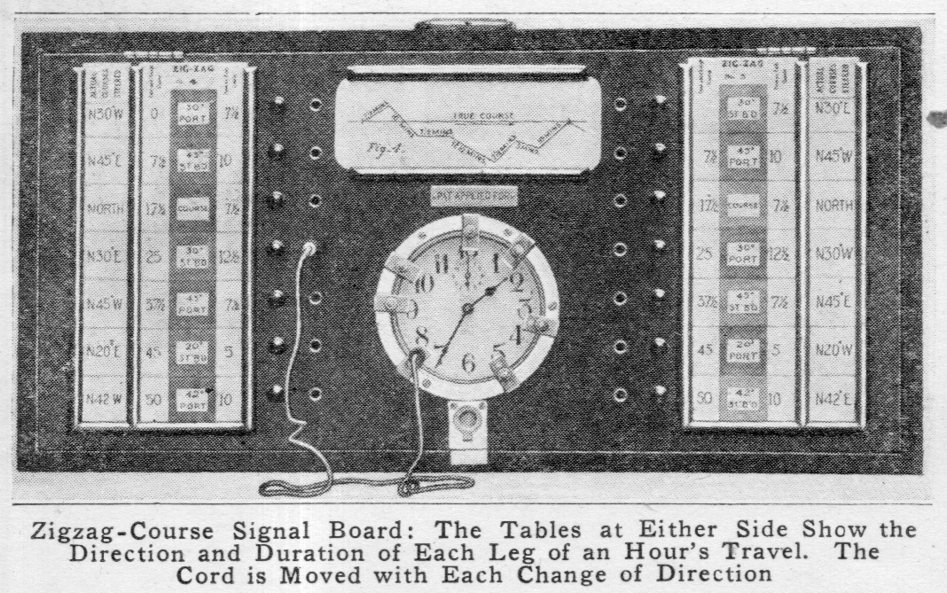
    Zig zag027

    Well, these be not zigzags of embarrassment, but zigzags of necessity, and the means for keeping track of them.  And too there’s nothing in Jane Austen to relate to submarines and their evasion except for an appearance of the word “zigzag”, which is actually a fairly old word in English (coming from the French “sigsak”), reaching down into the very early 18th century.  It is older than the word “submarine” as it is used to describe an underwater vessel, and curiously in light of Ms. Austen it appears in print very close to the date of Emma, in 18281. And so the course of a ship could be documented for those in control of her, keeping track of the true destination in spite of all the zigs and zgas made to confuse and elude a German sub.  This is another example of an empire controlled with string, as we have previously seen here in the use of long collections of string that kept track of the British rail. String isn’t as simple as it seems.  

    • This short article appeared in Popular Mechanics, March, 1918, page 484. 
  • An Interesting Design for an Optics Advertisement, 1918

    JF Ptak Science Books   Quick Post

    Josef Rodenstock (1846-1932) started his company, “G. Rodenstock” in 1879, manufacturing and selling mathematical, physical, and optical instruments–it survives to this day. This advertisement for the optics branch of the company appeared in the July 1, 1918 issue of Illustrirte Zeitung (Leipzig)–it is rather small in the original, but very effective; I couldn’t pass it  by without sharing. 

    German eyeglasses

  • An “Air Garage” Airport Skyscraper, 1927

    JF Ptak Science Books  Quick Post

    Air garage028


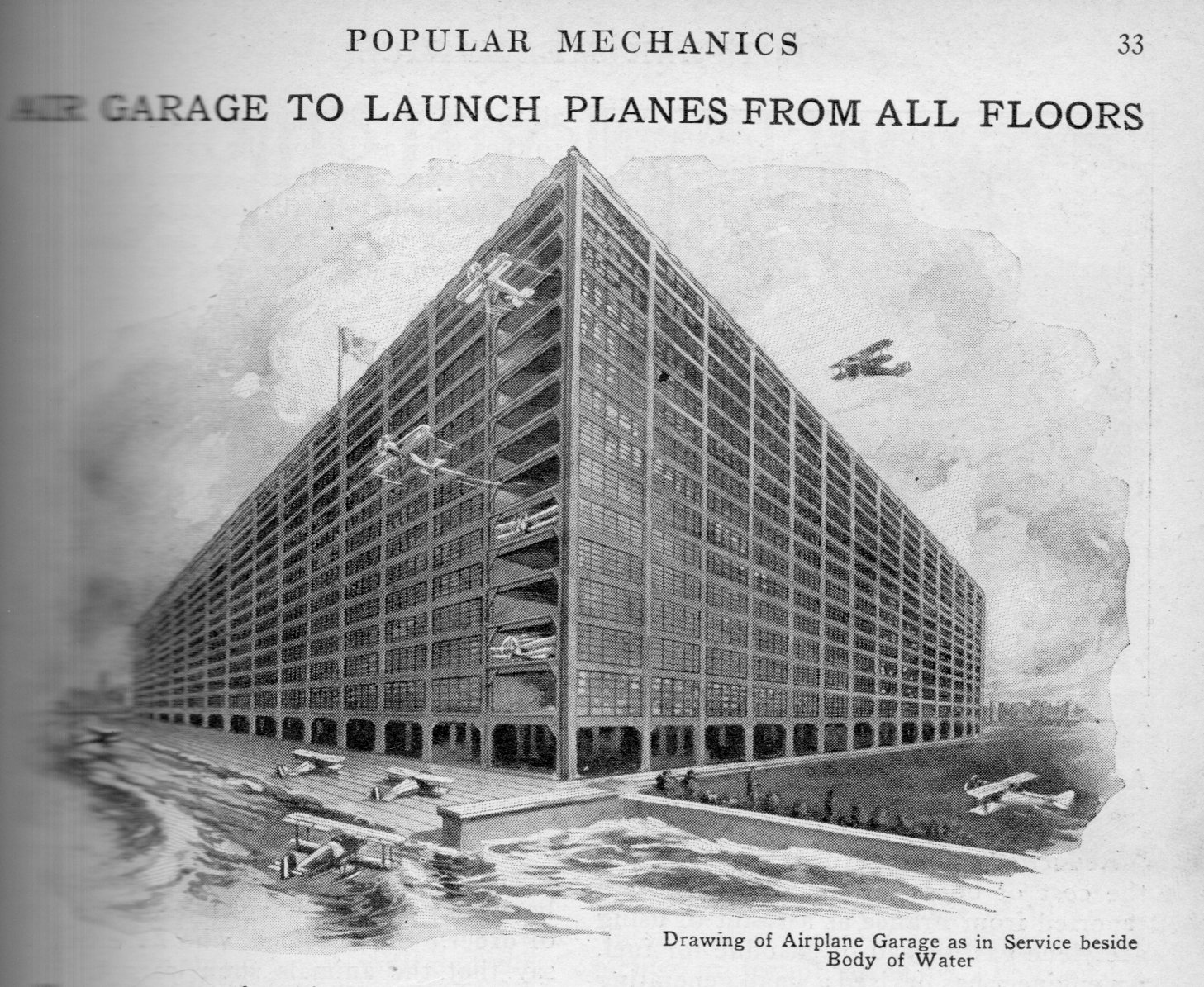
    There were a number of interesting/unusual/bizarro ideas for air travel int he heady aeroplane decade of the 1920’s (search for “airport” in the google search box at right to find some of this blog’s posts on the subject). This one appeared in Popular Mechanics for July, 1927–a 14-story “Air Garage” that would serve to launch 14 planes from its 14 floors, times four, I guess.  I reckon that the interior of each floor would function like a garage/taxi/pre-flight area, and the planes would use the areas closest to the exterior of the structure as a runway. No doubt the writer was envisioning the need for this as the popularity of the airplane was, well, soaring, and the vision may have inched the airplane close to the ubiquity of the Model A.  I commend the writer for thinking Big.  

  • The Pistol in Air-to-Air Combat (1914)

    JF Ptak Science Books  Post 2588

    Air combat 1914The news of the Wright Brothers and their historic powered flight in December 1903 was a monumental deal, though the report of the success was buried in middle of the Scientific American issue that first covered it.  Eleven years later heavier-than-air powered aircraft went from being from non-existent but with potential/possibility to machines used in war.  It took eight years from the Wright plane for an aircraft to be used in combat dropping bombs on people, a role that would of course be exploded beyond all recognition just a few years later. During the first few months of WWI aircraft were used but mostly for surveillance and mapping–aerial combat existed, sort of, though without any firepower. The first air victories were results of aircraft ramming one another (the first seems to have been August 25, 1914), while the first instance of one plane shooting down another didn’t occur until the war was in its second month, a French plane shooting down a German aircraft with a machine gun and a rifle.1

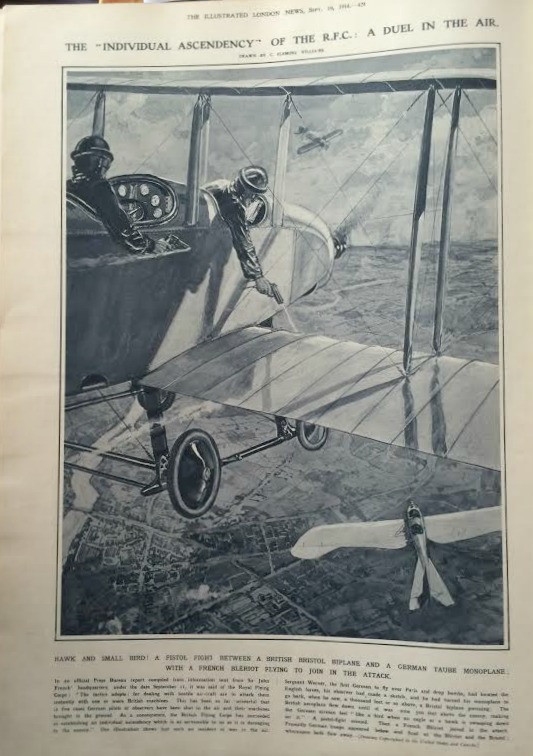
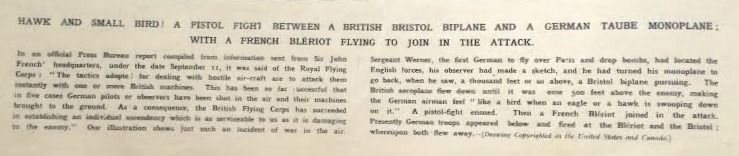
    These notes are simple background for the image that I found in The Illustrated London News (September 19, 1914)  showing aerial combat between a British Bristol and a German Taube.  What is striking of course is that the Royal Flying Corps aircraft was attacking with the co-pilot firing a pistol at the German plane–a little unexpected. The description of the image identifies the pilot of the German aircraft (“Sergeant Werner, the first German to fly over Paris and drop bombs”) and that he had been on a reconnaissance flight mapping allied positions–how that information was known I do not know.  In any event the British aircraft pursued the German and nearly had it within rights–that is until German soldiers on the ground returned fire on the British aircraft, forcing it to retire.  

    Air combat 1914 b

    Luckily I own the war years for the ILN and I do believe that this was the first image in that journal showing air-to-air combat. The ILN does have earlier images showing the first bombing raids from aircraft and also of air-to-ground machine gun attacks, but at this point this may be the first of its kind. It all seems very removed–quaint,even–given how quickly things developed over the next year.  

    Notes

    1. “On October 5, 1914, Sergeant Joseph Frantz and Corporal Louis Quénault of Escadrille VB24 scored the first air-to-air kill (not involving ramming – see Pyotr Nesterov) of the war, shooting down a German Aviatik B.II with machine gun fire. Quénault fired two 48-round magazines at the Germans. The Germans returned fire with rifles. When the Frenchman’s 8 mm Hotchkiss M1909 machine gun jammed, he successfully returned fire with his rifle. Oberleutnant Fritz von Zangen and Sergeant Wilhelm Schlichting of FFA 18 fell to their deaths. This is believed to be the first air-to-air kill in any war.”–a good Wikipedia contribution on the Voisin III, here: https://en.wikipedia.org/wiki/Voisin_III
  • A Grisly Visit With a Contemporary Account of Jack the Ripper, October 1888

    JF Ptak Science Books  Quick Post

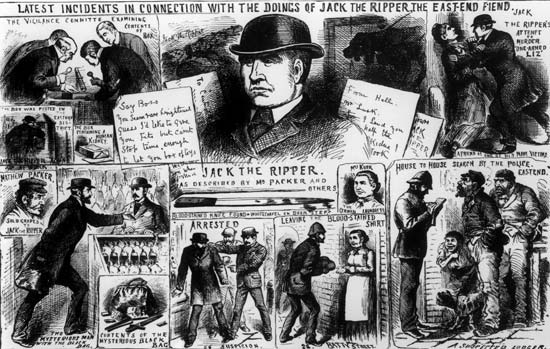
    “LATEST INCIDENTS IN CONNECTION WITH THE DOINGS OF JACK THE RIPPER THE EAST-END FIEND.”

    Ripper online

    [Image source via Victorian Contexts: http://victoriancontexts.pbworks.com/w/page/47425374/The%20Whitechapel%20murders]

    I am pretty certain that I haven’t made a single post (of 4,500 or so) on an odious/horrendous matter for the sake of it odiousness–excepting, I think, this post on Jack the Ripper. I won’t bother with the history of the madman as I am sure everyone is well acquainted with pieces of it.  I bumped into it using a new online find, a paywall site, which is very useful for on-the-spot usage though not so when it comes to reproducing one of its images–so, I needed to find a friendly place to share the image from and found one in Victorian Contexts (see link above). The first magazine to pop up in this new browse was The Illustrated Police News  (London, England), and the first thing I searched for was The Ripper, and so came this issue for Saturday, October 27, 1888; Issue 1289. It just so happens that this issue dealt mainly with the infamous Lusk Kidney, which was a human kidney evidently sent by Jack to the home of  George Akin Lusk, (“a builder who resided at 1 Alderney Road, Mile End. Since his appointment as head of the Whitechapel (or Mile End) Vigilance Committee”1), and which was a cause of enormous excitement. In the fine tradition of other illustrated newspapers/journals, The Police News told much of hte highlights of the story in pictures, right on the front page. Perhaps this was to entice people into buying the paper, and perhaps it was a very elementary entry point for part of the readership that had limited reading ability–I don’t know. But the front page is certainly sensational, whatever the  motivation. 

    The contents of the letter accompanying the mailed box of the human kidney:

    ·Posted by :

    ·in:

  • A Transatlantic Flying Wing/Boat, 1927

    JF Ptak Science Books  Quick Post

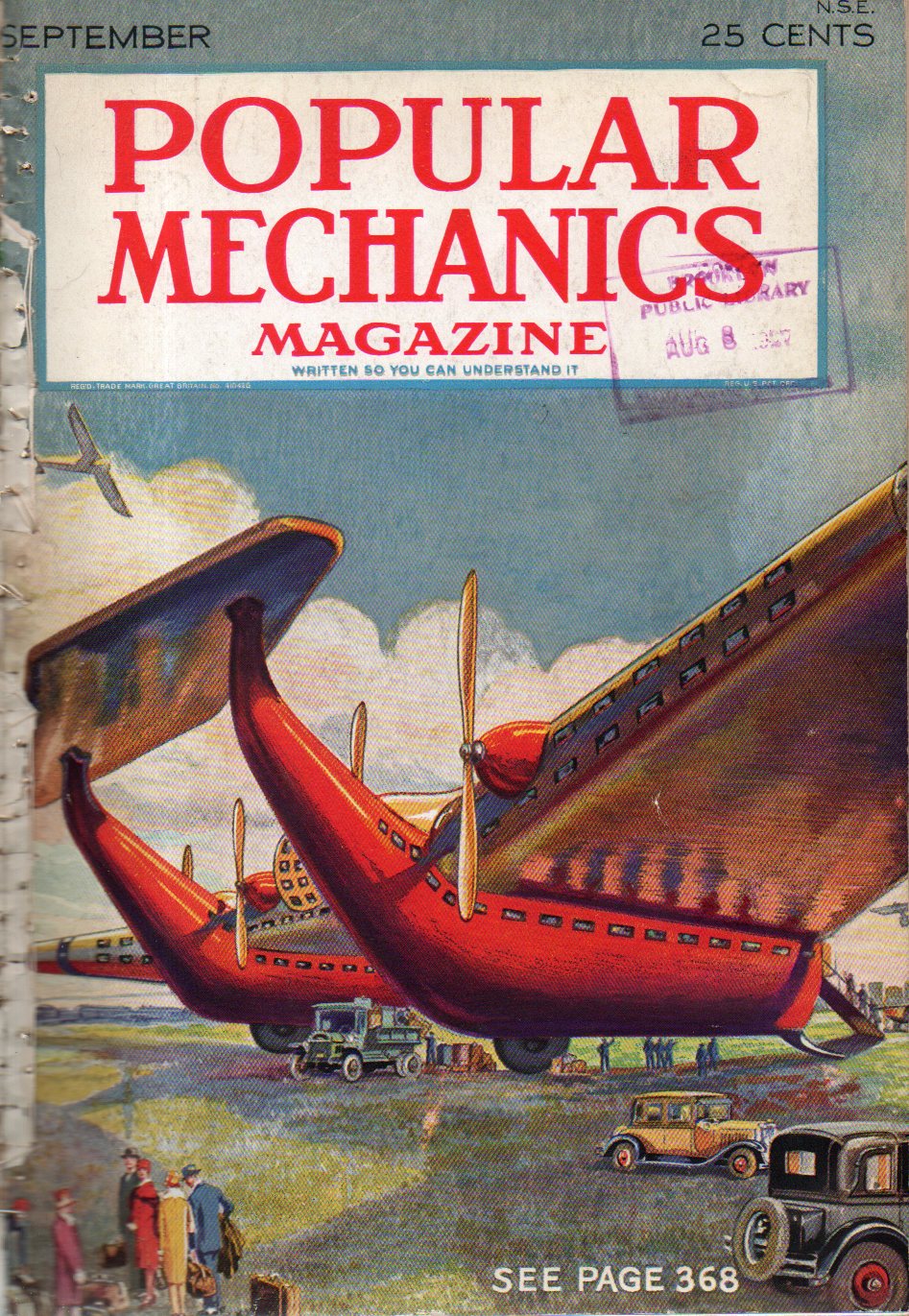
    The beautiful aircraft was being built primarily on high hopes and a sleepless night, but that’s okay. This was a vision for a transatlantic aircraft, and appeared int he September 1927 issue of Popular Mechanics, and was an interesting and in some ways remarkable insight to the coming prospects of long-distance passenger flight. The Wright flight was only 24 years before this, and the Lindbergh solo crossing of the Atlantic occurred just a few months prior to this publication, an event which no doubt added fire to the speculation of future transatlantic flights. The artist imagines a massive aircraft with a 400′ wingspan, the wings offering room enough for sleeping quarters for the passengers.  The Transatlatic flight was technically difficult, and outside of crossings by the Graf Zeppelin and the Hindenburg in the late 1920’s, passenger service really wasn’t instituted on any large scale until after WWII.  There were crossings by aircraft in the early 1930’s, but there (as with the famous flight by Dornier in the DO-X seaplane in 1931) the majority of those flights were over the ocean to South America, and then continued to North America. A notable exception is the Yankee Clipper. which was a luxury flight (carrying 74 and sleeping 36) and which was a massive aircraft, though the real plane’s wingspan was less than half (at 150′) of the visioneered aircraft below.  In any event, recognition is in order to the designer who thought about flight in this manner just 10 weeks1 after Charles Lindbergh made his NYC-Paris flight.

    Airplane flying wing029


    A newsreel of the parade held in Lindbergh’s honor in NYC on June 13, 1927 showing the enormous reception of the new world-wide hero:

    Notes:

    1. The September issue of Popular Mechanics would have been issued in early August (as we can see in the stamp on the cover, this issue being received by the Brooklyn Public Library August 8.

  • “When Will We Have Television?”, 1937

    JF Ptak Science Books   Quick Post

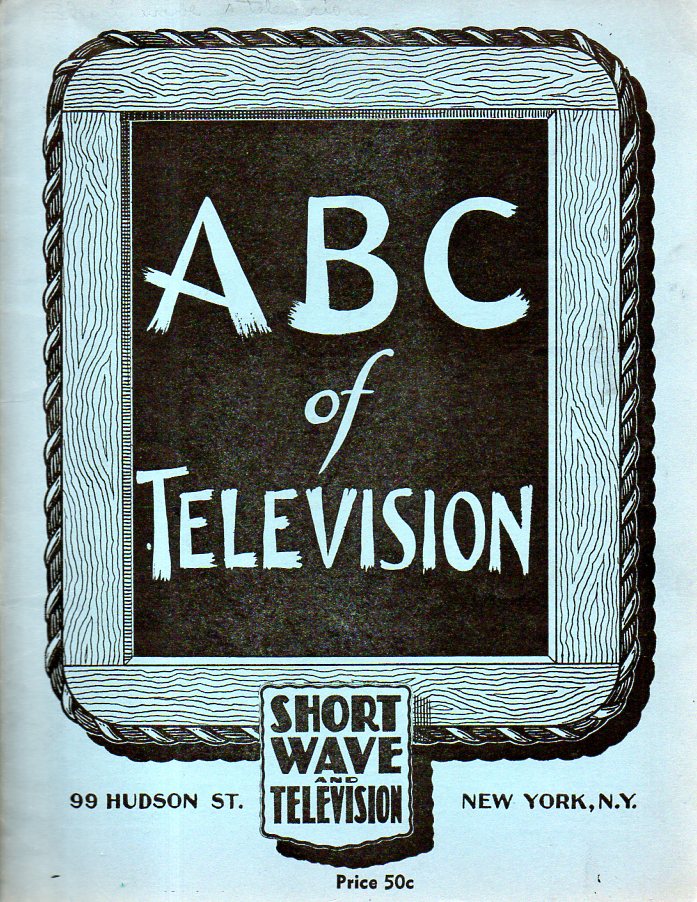
    This is the delightful ABC of Television, published in 1937 by the sci-fi and early modern tech guru and visioneer Hugo Gernsback’s Short Wave & Television magazine–it is a separate publication in it own printed wrappers. The pamphlet includes technical basics (“fundamentals of scanning”, “mechanical systems”, “Cathode ray emission”, transmitter operation”) as well as some popular and necessary information, like “when will we have television” and a list of television stations.  (Just for the record, this publication lists 25 active stations, including low wattage stations like W2XAX, the Atlantic Broadcasting Company, in NYC at 50 Watts–there were 9 broadcasters with 150 Watts or less of the 25 listed. There’s also a list of nine other “discontinued” television stations (“experimental visual licenses and permits discontinued or expired”). The “Experimental Visual License: is a very nice turn-of-phrase.)

    Television abc477

     [If you’d like to own the original, see our books for sale section, here: https://historyofideasblog.com/books/]

    ·Posted by :

    ·in:

  • What They Carried, Part V (1917)

    JF Ptak Science Books  Quick Post

    WWI Havily Laden Soldier268

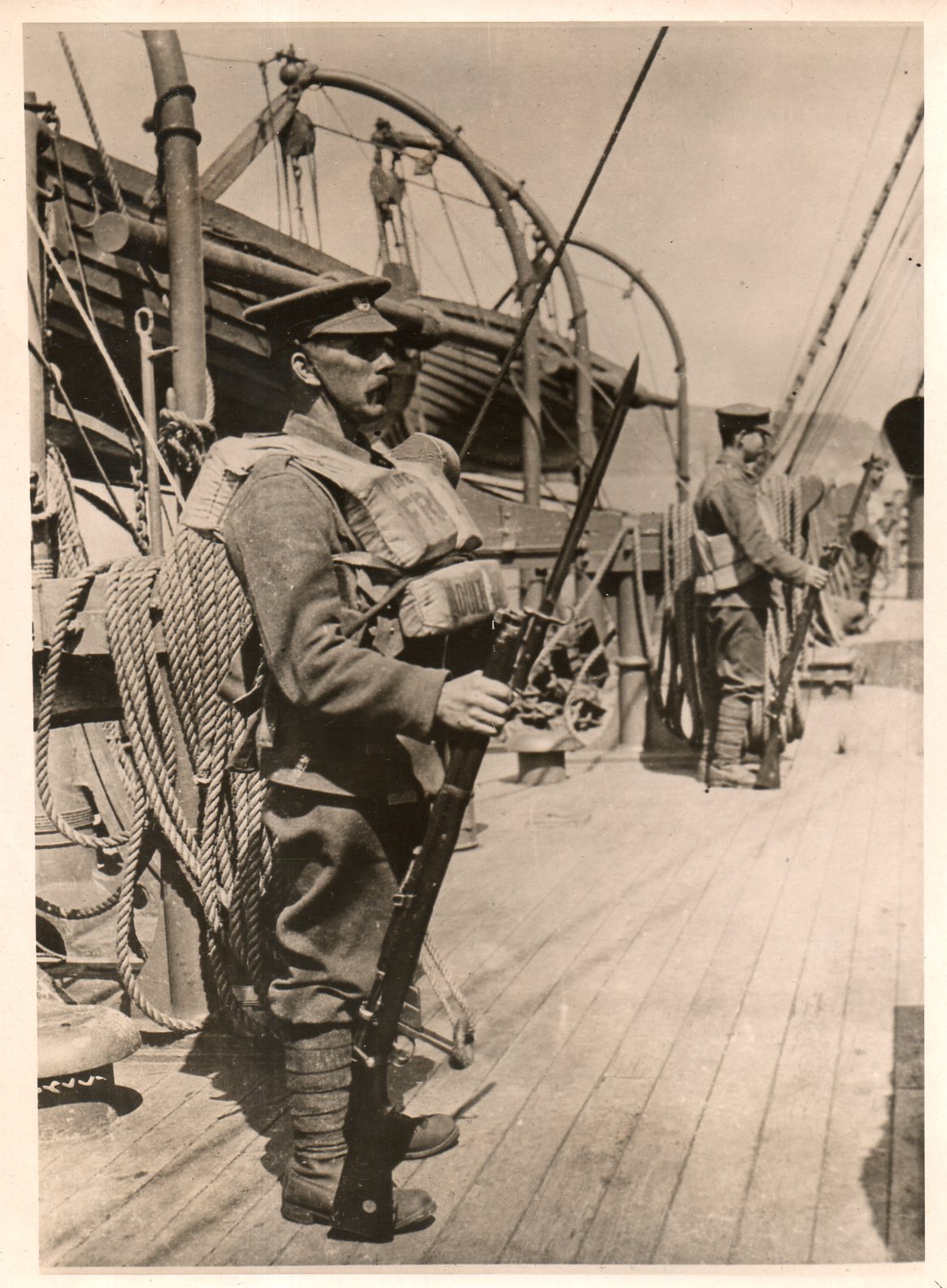
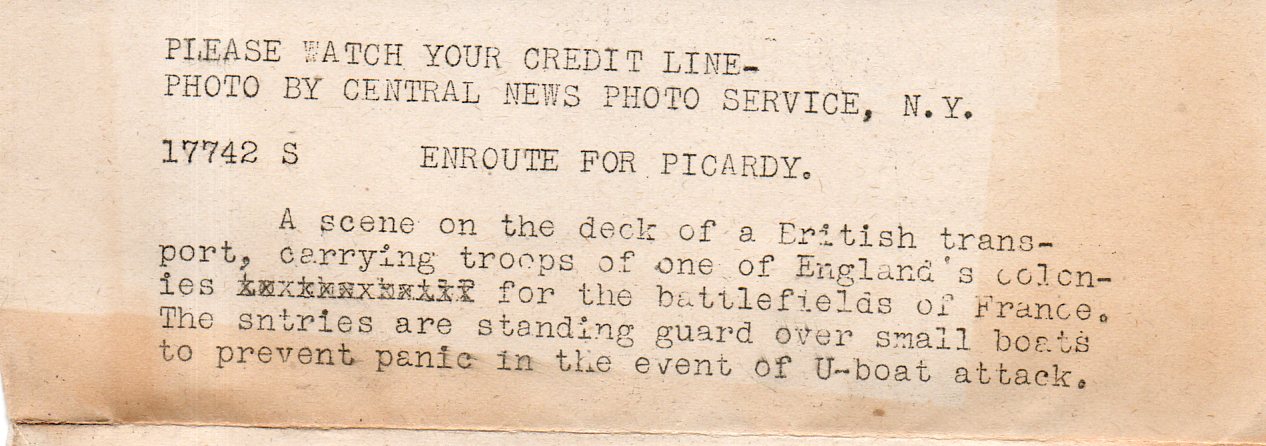
    This is an example from my WWI news photo service collection–this one showing a newly-minted soldier, very heavily laden and off to France, where no doubt he would quickly lose a lot of that clanging, heavy, cumbersome, and probably-useless stuff.  The description (below) accompanied the photo and was the suggested caption to be used with the image when published.  

    See this link https://historyofideasblog.com/thesciencebookstore/2015/10/what-they-carried-part-iv-us-soldier-1917.html for four other posts I made here on this blog on “What They Carried” into battle. 

    WWI Havily Laden Soldier269

    If you’d like the original, see this link in our books for sale section: https://historyofideasblog.com/world_war_i_photography/2014/09/heavily-laden-soldier-ca-1918.html

    For a general explanation of the WWI press photo archive, see https://historyofideasblog.com/world_war_i_photography/


    ·Posted by :

    ·in:

    —
  • A Bit on the History of the Future of Sucking–Vacuum Trains (1945)

     JF Ptak Science Books   Post 2590

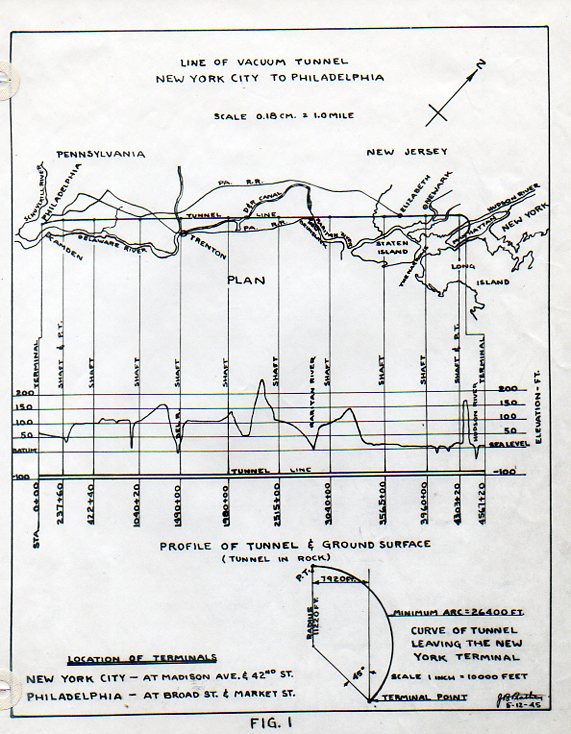
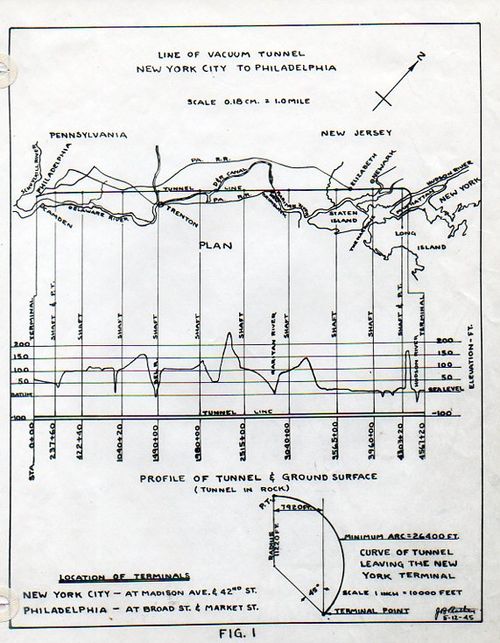
    John B. Prather launched an idea in 1945 for building a high-speed pneumatic passenger/freight train connecting New York City to Philadelphia.  His New York-Philadelphia Vacuum Tunnel, Preliminary Design Features and Economic Analysis was exceptionally hearty. The idea is interesting in a removed, lets-not-do-it-for real-way because, well, it just doesn’t seem to make sense in the long run, at least beyond the building of the thing to show that it could be done.  And I don’t doubt that could be the case–and I just don’t know why it was necessary. 
    Vacuum tunnel318

    [If you’d like to own the original report I’m offering for sale on my blog–there seems to be no others available, with no listings in WorldCat. If you’re interested see the listing follow this link or go to the general catalog and look up [TRAINS]  The Future of Sucking: Vacuum Express Train, NYC to Philly, 1945.]

    Mr. Prather’s approach seems to be the work of an engineer, or at least he had some help.  I doubt though that he had any help from a structural engineer or site geologist–his proposal was to build this tunnel 100′ down through bedrock when it could be found, a level hundred-feet  below the surface, from NYC to Philadelphia.   The tube would accommodate an aluminum-shelled  400′-long train that would be hauling 350 people and 175 tons of freight at speeds of 400-600+ mph, making the run between the two cities in about 20 minutes.  Not bad.  He figures too that all of the freight could be offloaded in 7.5 minutes.  This would make for  a very busy train, though Prather doesn’t tell us how many runs a day it would be making. This was all preliminary.

    The 16.2′-wide  tunnel would be 456,720 feet long, and would cost $173 million to excavate and $41 million to line with cement–according to the author.  The total cost for the ordeal would be about $334 million and would take 6 years, start to finish–that includes all of the tunneling, which would swallow/excavate/face 300′ per day. 

    I don’t see, really, how this could be so narrow a tunnel–I’m not an engineer but it would seem that wear, heat and the abuse and so on that a massive and dense 400′-long missile going 400+mph would require something that was more than 125% of the width of its trains. 

    There is however  precedence for a massive tunnel of something like this size being built in something like this time–the Delaware Aqueduct is 82 miles long and 13 feet wide, and was built during the Second World War (1939-1945) , so, perhaps if enough people and money were thrown at a project like the vacuum tunnel could actually be built (barring geological problems). 

    But it would all be worth it:  Prather suggests that the overall revenue from the operation of the train to be $196 million/year with $32 million in yearly operating expenses.  Which means that the whole thing could be paid for in three years or thereabouts.  So if the things was started in 1946, it would all be finished and paid for by 1956.

    I’ve looked at a number of proposals like this over the course of this blog–like almost filling up the Narrows between Staten Island and Manhattan with an airport and seaport, and making a series of transoceanic airports for flights between the continents, and dropping a gigantic shell filled with people from the top/interior of the Eiffel into a narrow hole filled with water, and covering Midtown Manhattan with a rooftop airport, and covering Midtown Manhattan with a glass-ish dome, and so on–and I know that it is good for at least one thing:  superb classroom discussion fodder of why something like this does or doesn’t make good physical/economic etc. sense.

  • The Swastika as a Rising Sun–Linz, ca. 1935

    JF Ptak Science Books   Quick Post

    Judging from the cover art it is not necessarily clear what is going on with that swastika. But given the question in the title (“Can Austria Still Be Saved?”) and the publisher, the NSDAP’s Volkstimme (Linz) leaves little doubt that the swastika is a rising sun rather than setting.  I can’t find another title in the OCLC/WorldCat–which makes this piece of propaganda rare–and which means that I can’t date it precisely, though I would say it was printed prior to the annexation in 1938 (though the design definitely has an earlier touch to it…)  There is a mention of the Gauleitung der N.S.D.A.P. and the Hitlerbewegung located at Goethestrasse 7 in Linz–and since the Nazis were suppressed under Dollfuss from 1932-1934, which means this document may have been printed in the mid/late 1930’s.  

    German design salvation Austria032

  • A Beautiful Instrument Displaying Sound on Paper

    JF Ptak Science Books   Quick Post

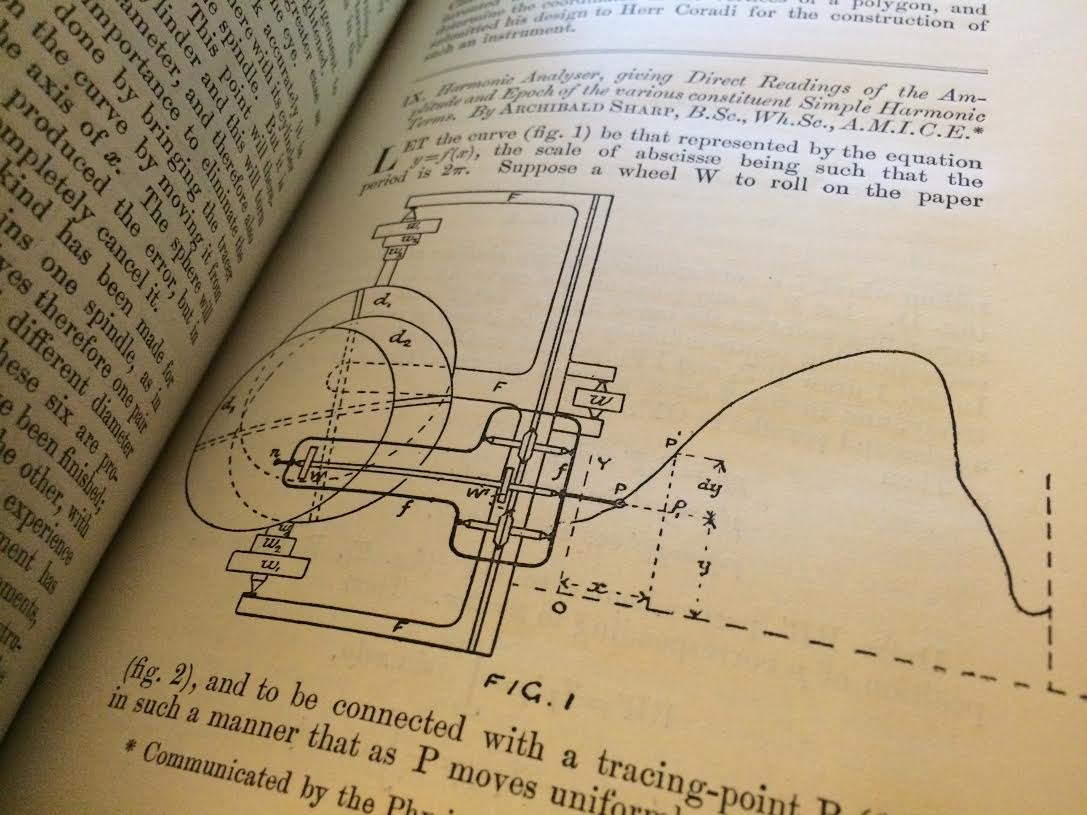
    Olaus Henrici (1840-1918) constructed a beautiful and tidy analog computer to analyze musical sound, publishing his efforts in The Philosophical Magazine in 1894.  It was a mechanical fourier analyzer, in the heritage of the harmonic analyzer/tide predicting computer of James Thomson and his brother Lord Kelvin, analyzing a traced sound waveform.  It was built upon in turn by Dayton Miller and much expanded.  

    Henrici b

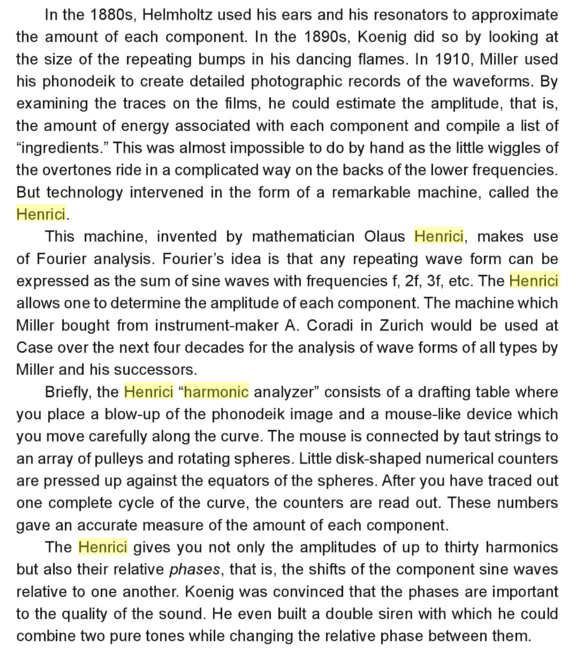
    William Fickinger has this solid description in his book, [Dayton] Miller’s Waves: An Informal Scientific Biography, (2011) found on page 69: 

    Henrici

    A little more background on the harmonic analyzer and Henrici as follows:

    • Robert K. Otnes in The Oughtred Society, “Notes on Mechanical Fourier Analyzers” http://www.oughtred.org/jos/articles/V17.1_OtnesPaper.pdf  
    • Full text of the Henrici paper  from the Biodiversity Heritage Library http://biodiversitylibrary.org/item/122066#page/124/mode/1up
    • On Olaus Henrici https://en.wikipedia.org/wiki/Olaus_Henrici
    • http://www.phys.cwru.edu/ccpi/Harmonic_analyzer.html

    ·Posted by :

    ·in:

Recent Posts

Archives

Categories