JF Ptak Science Books Quick Post
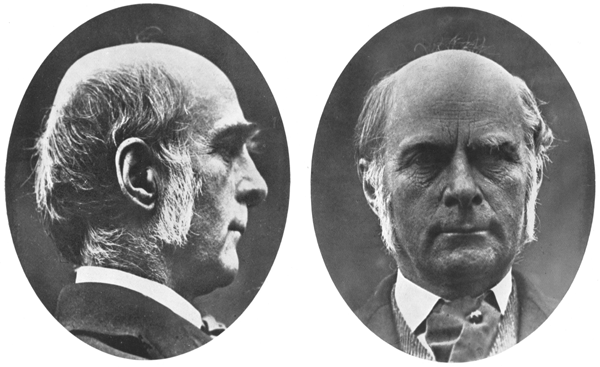
Crusing through some issues of Nature down in the studio–this is the current long-lived Nature, though mine are from 1869-1949, so not-so modern–I was working my way through a few issues before all hell breaks loose with the Roentgen publications in late 1895, and found this very interesting article by Francis Galton. Now Galton was a very interesting man with very advanced interests in many different fields, though he does have some unfortunate bits to his personality and eugenic-based beliefs, so he is an extremely accomplished if not a problematic man. Actually one of my earliest posts on this blog (more than 2,500 posts ago–yes there are only 2147 numbered posts but there are also something like 500 unnumbered “quick posts” as well) was relating another occasion of thumbing my way through another Nature volume, and finding Sir Francis again, though in this one he wrote what may be among the earliest papers on synesthesia (“Visualized Numerals”, 1880, appearing here, with full text).
The present Galton (in 15 November 1894) is his review of work done by Alfred Binet, “Psychology of Mental Arithmeticians and Blindfold Chess-Players”, who looked at the extraordinary abilities of “two groups of remarkable men”, one of which possessed fantastic mental calculating abilities, and the other with the capacity of playing multiple games of chess while blindfolded. A closer look at the first group revealed two men who relied on quite different benefits: one having a great ability to calculate according to “imagined sounds” and another who “relied on…imagined sounds”, both endowed with considerable numerical abilities as well as memories.
Galton reviews a number of calculators and then remarks on experiments he performed on himself, trying to “visualize” a calculating process via olfactory means. The rest of the story of this fascinating article can be found here. (Also see–from Galton.org–a bibliography of his journal articles works in psychology.)
- This is somewhat off the mark, but it may be interesting–given Galton’s olfactory/math experiment–to have a quick look at an earlier post on this blog regarding the first photograph of a smell, here.
I should say that Galton wrote more for Nature than any other journal, some 115 contributions from 1870-1910.
See also this take on the Galton from J.M. Stoddart’s The New Science Review, 1894/5: