It leaves me with such a cozy
feeling to not find what I think is an obvious-but-odd phrase in Google.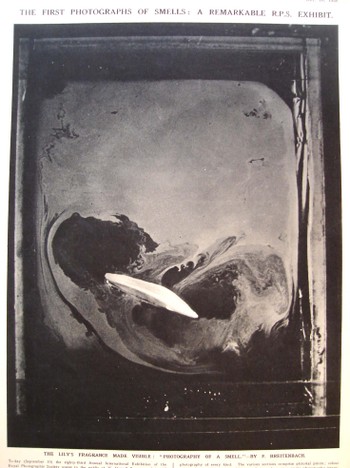
“the first photograph of a smell” (or “photograph of a smell”
or odor, for that matter), as shocking
to the senses as it might be.
of firsts in photography: the first
color photograph (Maxwell, 1867, but impermanent), the first photograph of a
human face, the first photograph of the moon, the first photo of a planet, and
so on, tirelessly, until we see how many derivations of “firsts”
there are. (We can go from first photo
of human to first photo of a human face to first photo of a human in motion to
the first photo showing human hands to the old human recorded by photography
tot eh first photo of a couple to the first photo of a human with a tool and on
and on.) There is a shorter list of “first photographic non-photograph of
a photograph” (?!) that I wrote about in an earlier (illustrated) post,
but we won’t go there today.
that I think hasn’t been dealt with too terribly much: the first photograph of an odor.
These beautiful images appeared in the 10 September 1938 issue of The
Illustrated London News and were exhibited at the 83rd Annual International
Exhibition of the Royal Photographic Society, and were made by H. Devaux (who
evidently, according to the snippet of an obituary that I can see from Science
magazine, was a plant physiologist and “pioneer of surface physics”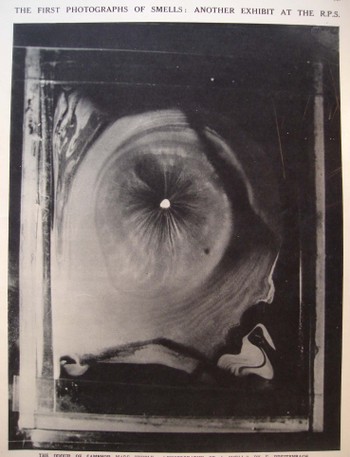
who died in 1956). The note accompanying the photographs read: “The emission of an odor involves
volatillisation of material. If an
odiferous material is enclosed in a cell a few millimeters above a clean
mercury surface, it is possible to collect on the surface of the mercury a
monomolecular layer of the volatillising or odoriferous substance. If the mercury surface initially is covered
with talc powder, the gradual formation of the monomolecules layer may be
observed as the talc is gradually pushed away from the point immediately below
the specimen of material.”
are that of the odors of a lily and of camphor. I don’t know which is which, and a good story could be made up for
either photo belonging to either item. Needless to say, these images are as gorgeous as they are unexpected,
especially considering that they were made in 1938.
FOOTNOTE:
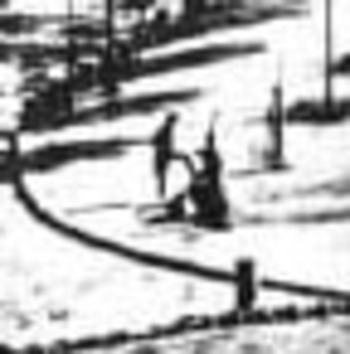
I’d just like to add here the first photograph of a human being–well, actually, it is the first photograph that just happens to capture a human in the emulsion (discussed 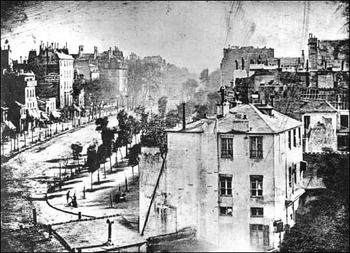
very nicely on the Doug’s Darkworld blogsite. Since the exposure time was so terribly long for this image to be made, the moving people and horses and carriages on the street, all of the city-life bits, were necessarily spectral, invisible, to the photograph. Only the stationary items were captured, and the only people captured here were two figures in the foreground, doing something or other that made them still for at least five minutes–long enough for their anonymous but famous photonic impressions to be captured. Mr. Doug and others seem to think this is a man getting his boots shined–I agree.