JF Ptak Science Books Post 1672
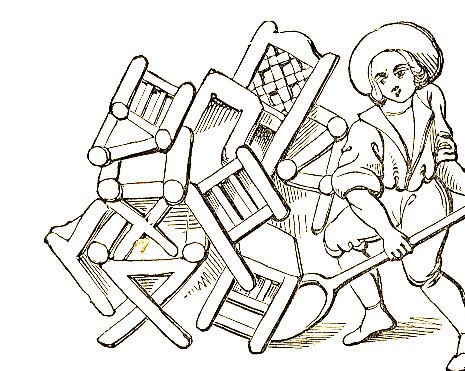
Seeing this extraordinary woodcut of a sculpted feature on the Medieval section of the beautiful town hall of Brussels reminded me of famous shoveling, in general. To begin with, though, I can’t fathom the meaning of this sculpture, shoveling chairs. Perhaps it is a metaphor for the leaders not recognizing relaxation? Or the (presumed) fact that there was no seating inside for the people doing business there? Or that you were expected to seek your business and not loiter at town hall? I really don’t know. But images of other shovelers did pop into my mind.
The most instant shoveling comes from the song Big Rock Candy Mountain (which I’ve written about earlier here) and the very simple plea from a down-but-not-out man for not having to work with “short handled shovels1”.
Next in mind was Frederick Winslow Taylor, who was seen as an iconic leader in establishing human motion studies for efficient factory
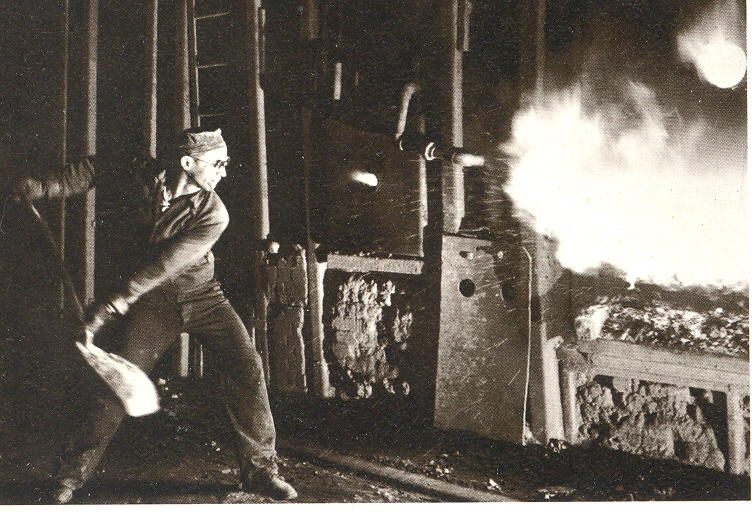
(and etc.) operations in early 20th century America. He did very detailed motion studies of people working—say, in this case of a man shoveling coal into a furnace at Bethlehem Steel in 1907—to determine that best sort of arrangement/placement of tools and supplies. It was very influential work, for sure, and Taylor, who loaned his name to the movement of this sort of effective watchmanship, (“Taylorism” and “Taylorization” and also “scientific management”) and took a huge step forward in establishing efficient factory and business operations and also automatizing the human working cogs in the workplace. According to the wonderful Eames’ brothers book, A Computer Perspectives (1973), “Taylor established the scientific fact that…a first-class shoveler will do his largest day’s work when he had a shovel load of 21 1/2 pounds. Then as a matter of common sense…it was necessary to furnish each worker with a shovel which woul dhold exactly 21 1/2 pounds of the particular material which he was called upont to shovel” (page 52). This, by the way, is also a short handled shovel.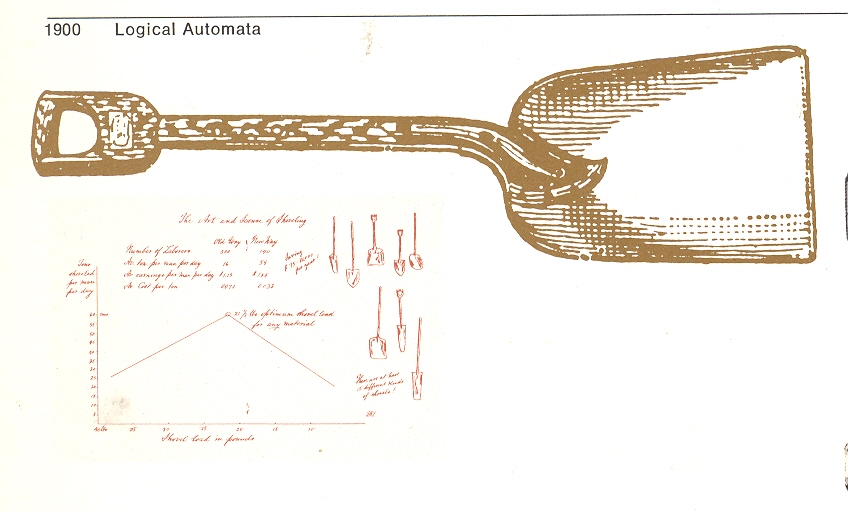
I then thought about the Seven Dwarfs from Snow White (incidentally Tom Waits covers the “Hi Ho, Hi Ho” song like no one ever did or will) but they all carried picks, not a shovel (so far as I can see) among them.
There are undoubtedly many great shovelers—they’re just not people I know about. I can imagine that Casey Jones must’ve had help to feed his locomotive’s fires; the gold rushes around the world produced some very wealthy shovelers whose numbers were titanicly dwarfed by those who shoveled and lost; soldiers have shoveled themselves into the earth for protection for at least 170 years (actually I don’t know when before the U.S. Civil War that soldiers found protection in their own burrows); and so on, but I just don’t know anyone by name. And so my rumination ends—I did say that it was wispy.