JF Ptak Science Books Quick Post

Since there was no controllable source of electricity in the 17th century, there would need to be an alternative to delivering multiple sources of data to a seated recipient or researcher. In these two instances, this issue was solved with wood–big wood. And as we can see, the reader could choose from 12 different data sources–books–while not having to rise from the chair.
[Image source: Agostino Ramelli, Schutzkammer Mechanischer Kunste, Leipzig, Georg Liger, 1620–a tall, thick book with 195 full page illustrations like this for all manner of invention and convenience.]
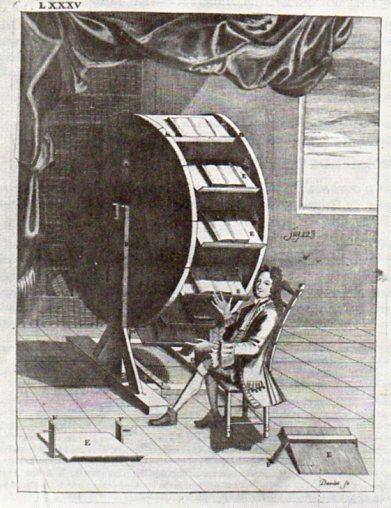
[Image sourceNicolas Grollier de Serviere, Recueil d’Ouvrages Curieux de Mathematique et de Mechanique...printed in Lyon by David Forey in 1719–another good-sized book with 85 full-page (Copperplate) engravings.]
It also seems to me that there could be some doubling up on the placement of the books, allowing 24 of them to be displayed; there might also be something that could be done with a sliding shelf so that those two could be doubled, allowing 48 books to travel ’round at a time. This would be a huge boon to the reader here in 1620 and 1719, if that’s the way you were measuring “boons”. It would be nice to have all of those sources open and available and neat, but one longish table would be good enough for that. and certainly more furniture would be available to people contemplating having one of these monsters built for them because in almost all cases only the wealthy of the religious orders could possibly own 12 or 24 or 48 books at this point in history, so space would not have been a problem, necessarily.
The one thing that this interweb had going for it over the existing version–all of the sources used were vetted.