JF Ptak Science Books Post 1592 [Part of the History of Holes series.]
“Let each man proclaim: there is a great negative work of destruction to be accomplished”–Tristan Tzara

I guess that “up” would be a redundancy in this post’s title, since we can’t really fill a hole going down, filling from the top of the cavity to its base, the reverse of digging a hole. Or perhaps not if the task was given to M. Duchamp.
But in this longish, developing thread on the history of holes it occurred to me that I hadn’t included anything on filling/stopping holes,the realization coming to me while browsing the lovely and very inclusive paper ephemera site of SHeaff-Ephemera.com

[The original site for the above three images: sheaff-ephemera.com; other images in Notes, below.]
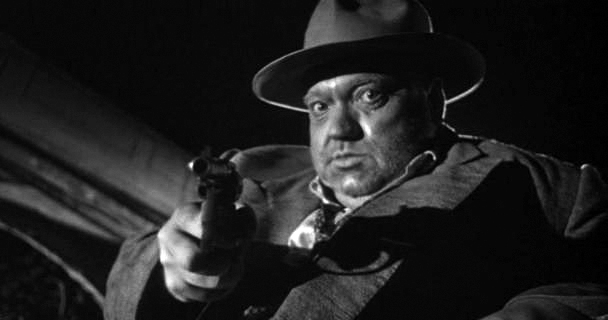 There have been a number of posts here about existing holes, but none thus far about making them (except for a few posts on aerial bombing) or filling them up–so far, the series has been in a hole-stasis. There really should be a section on making high-speed hole-making (with bullets, like our friend Hank Quinlan, with Uncle Orson in the role in the magnificent Touch of Evil), and another on long, longitudinal and laboriously slow hole-making (with say foundation/caisson work in constructing the Brooklyn Bridge).
But for right now I’d like to address the crafty M. Duchamp as a hole-filler, a man who created a two-sided literal and figurative hole-making and hole-filling event, and what may be the first of its kind in the history of art. Figuratively, Duchamp’s approach to art in the nineteen-‘teens was seen by many as a process to “destroy” art itself: finding things like a bicycle wheel and implanting it on a stool and calling it art was seen by his friends as an event and not as art per se, but as a perversion. Even Duchamp’s own group at the epochal 1916 international art show rejected his first “Readymade”2 (not yet then called so) as not art, leading Duchamp to abandon even them. (This had also happened three years earlier with his “Nude Descending”.)
I don’t think that Marcel Duchamp was trying to “destroy” art, though I do believe that he was trying to force a conversation in which he had no interest in participating–a written conversation in which there was no real end or beginning, and so no middle, on top of which the punctuation would be removed and re-applied by chance.
Even the idea of a “hole” could be viewed differently in such circumstances–like the one that appears in his “The Bride Stripped Bare By Her Bachelors, Even” in the top part of the bottom (“Bachelor” panel, the detail of which appears at the head of this post, and the full version below). Perhaps we should be talking about constructing something around a space, the remaining bit once encircled becomes a “hole”: a reverse hole? That would be similar to both constructing and filing the hole, almost at the same time; Duchamp included this hole in this artwork, and then covered it on both sides with glass, the self-described “lazy” Duchamp finishing it after many years of labor, a work he said to be “unanalyzable by logic”. 3
It seems a little like making empty space inside a vacuum.
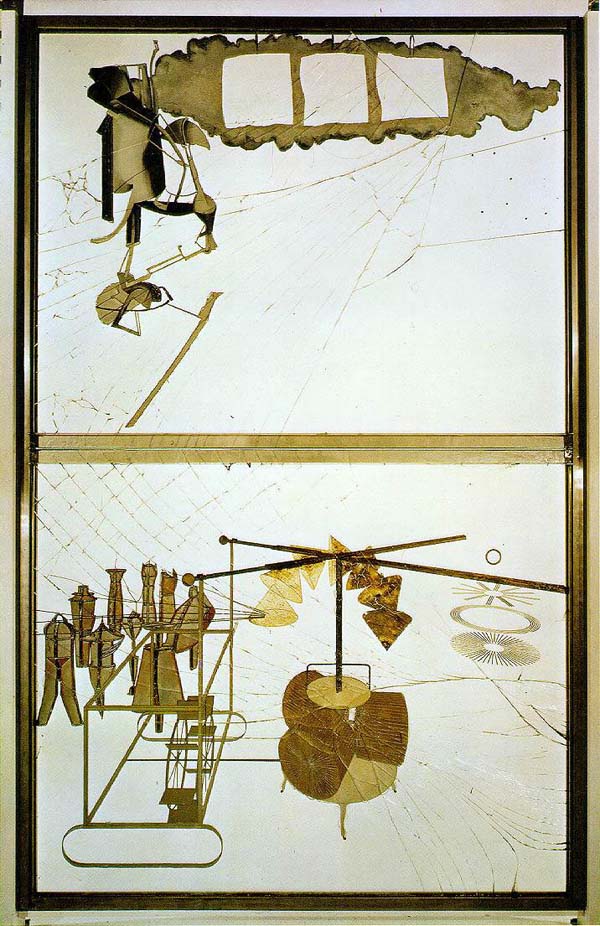
[“The Bride Stripped Bare By Her Bachelors, Even (The Large Glass)” by Marcel Duchamp, is installed at the Philadelphia Museum of Art.]
Notes:

[The original site for the above three images: sheaff-ephemera.com.)