JF Ptak Science Books LLC Post 787 Blog Bookstore
I’m not sure why there was so much included in this engraving that had
nothing to do with its subject matter.
The essential part of the image is the cross section at bottom: the image of landforms, created by the man
most responsible for the establishment of stratigraphy, the German
physician/chemist/mineralogist/geologist Johann Gottlieb Lehmann (1719-1767). What Lehmann accomplished was a sensational,
x-ray-like interpretation of the surface of the earth, a privileged vision
distant from the real birth of the science of geology in the work of James
Hutton more than 50 years later. (Hutton was about the first to treat the entire
corpus of the geology of the earth and which was also completely removed from myth
and fable. His work formed the basis for
that of Charles Lyell who in turn provided some of the intellectual basis for Charles
Darwin.) He seems to be the first to
create such a slice of the earth, illustrating an orderly, historical formation
of the various layers (and not an unrelated jumble), and the first steps
towards establishing the laws of formation of geological sequence.
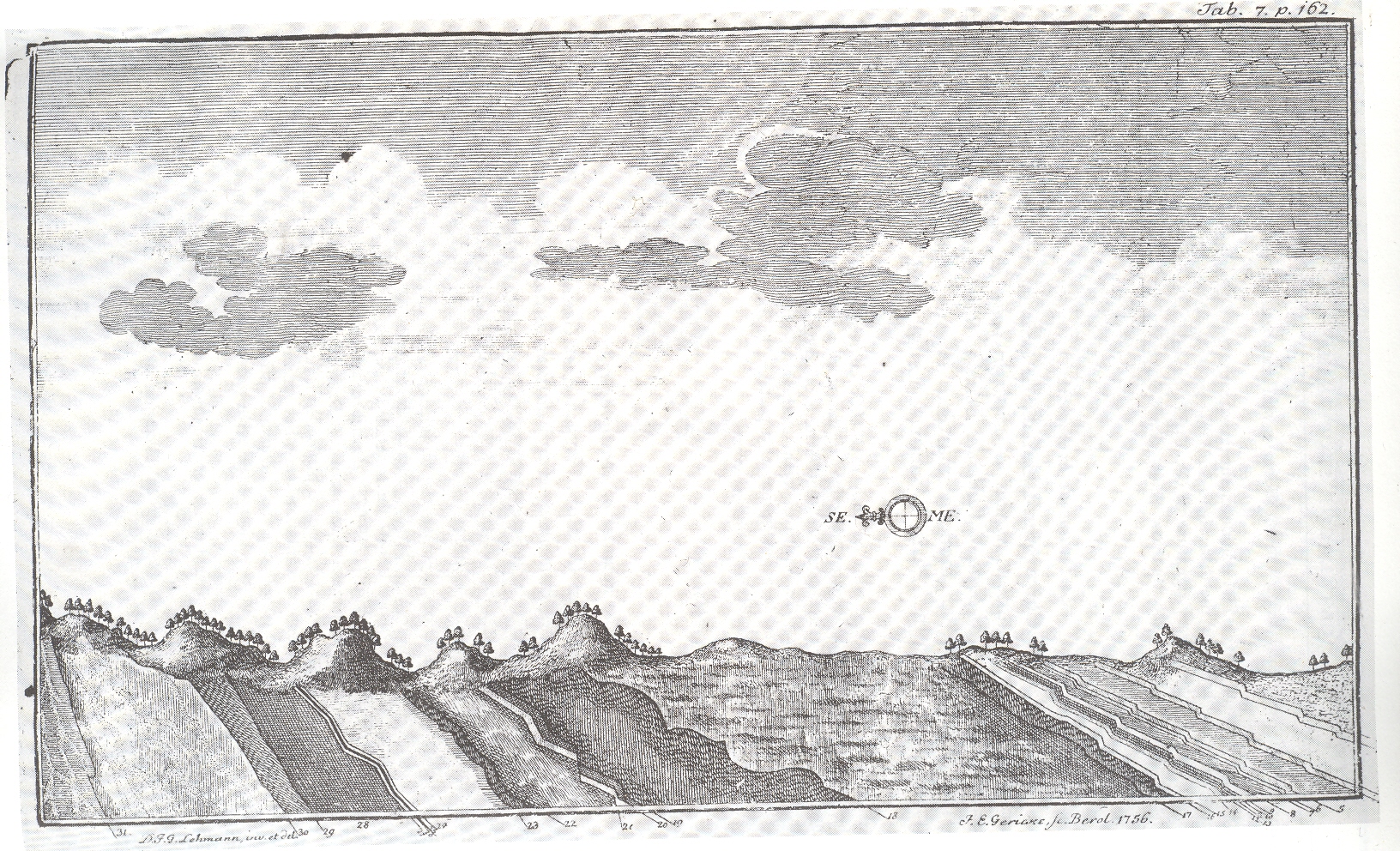
Outside of the spectacular introduction to the workings of earth in this cross
section, I’m taken by the enormous sky, and the very lonely compass, placed,
seemingly haphazardly in a blank field, creating a very considerable blank space above the great discovery.
The scientific greatness of the images aside (can I even say such a
horrible thing?), the engraving looks to me like a modern surreal work.
Book Note: Lehmann, Johann. Versuch einer Geschichte von Flotz-Gebuergen,…1756, printed
in
. “This unpretending treatise must be
ranked as one of the classics of geological literature”—Archibald Geike