JF Ptak Science Books LLC Post 626 Blog Bookstore
Evelyn, a dog, having undergone
Further modification
Pondered the significance of short-person behavior
In pedal-depressed panchromatic resonance
And other highly ambient domains…
“Arf” she said.
—F. Zappa, One Size
Fits All (“Evelyn the Modified Dog”)
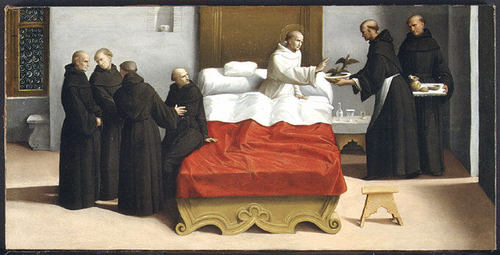
I was going to write something completely different about
these images for this post—but I fell completely into the beds of these
paintings—actually, I missed the beds and made straight for the pillows. I really didn’t have anywhere to go with
this–no point, no cozy tie-ups—and when I told about my wife Patti Digh about
this problem she wisely told me to forget about a point, and “send it out into
the world”. (Patti has no doubt that the
subject of this post sounds like an unending and probably unendurable doctoral
dissertation.) And so when faced with my
own set of sensory inputs that couldn’t come to some sort of comprehension, “arf” sounded pretty good.
by Garofalo (Benvenuto Tisi da Garofalo, Italian, Ferrarese, 1476?–1559) called Saint Nicholas of Tolentino Reviving the Birds and painted around 1530. The
man in the bed is a deathly sick St. Nicholas, an Augustinian monk, who was
attended by no fewer than six of his brethren.
They are shown offering him a plate of roasted birds, but Nicholas, a
vegetarian, rose from his bed and in rejecting the food brought the birds back
to life. We see that long, bed-width
pillow with a small cozy on top of it
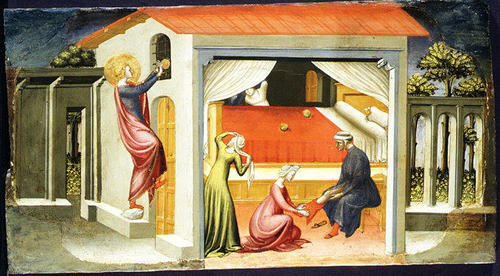
In another painting of another Nicholas, Bicci di Lorenzo’s
(Italian, Florentine, 1373–1452) Nicholas Providing Dowries (date
1433–35), we see the Bishop of Myrna in Asia Minor Nicholas pushing bags of
gold through a transom and into a house. Sounds a little like St. Nick of
Christmas lore, though this St. Nick was providing the dowries to three
daughters of a destitute man unable to provide his offspring with money of his
own. (Not having money for a dowry was a major deal in these times—without the
money the women probably would not have been able to marry, forced to other not
savory means for providing money for their daily needs to survive. Here again we have a big red bed, with a
bed-width pillow, and the smaller pillow on the top of it all.
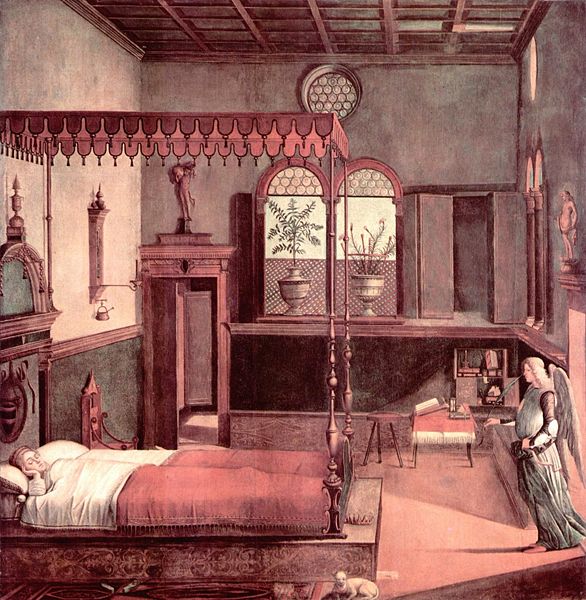
The last example belongs to Vittore Carpaccio (c. 1460 – 1525/1526), in his The Dream of St.
Ursula (painted 1495). Again, the same: red bed, big pillow (though no little fellow
is visible). There is a strange small
ball-like object near her head at the base of the pillow, and her slippers are
where they were when she stepped from them into the bed. It looks like she has six books in her work
area at the back of the room (as well as an hour glass on the desk). There is a problematic burst of light on the
ceiling from the high window to the left of the door—it doesn’t seem likely
that this splash of light could be on the ceiling given the shadows in the
room. Oh well.
And so. There are
more examples of these pillows, but we probably don’t need to look at more
right now—just noticing them is probably enough. Sometimes finding interesting
detail in the detail leads somewhere, and sometimes not. There is a continuing
thread in this blog that looks at the importance of incidental detail in art,
though today’s post chooses the “sometimes
not” option.