JF Ptak Science Books LLC Post 592 Blog Bookstore
A Cosmology Seeded in Salt?
It is, I admit, mere imagination; but how often is imagination the mother of truth?–Sherlock Holmes
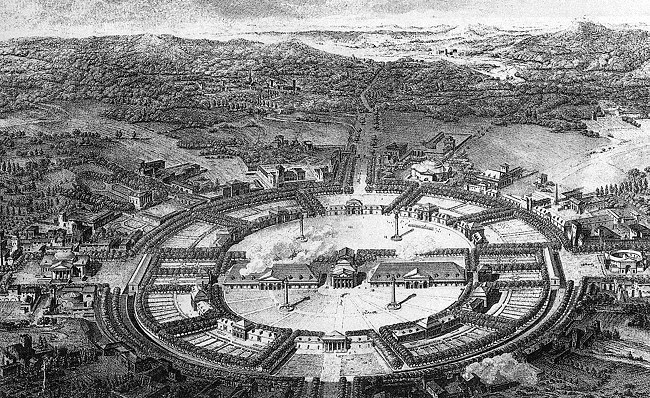
I’ve written a little earlier in this blog about the beautiful Claude-Nicolas-Ledoux (1736 —1806) being the 18th century Marcel Duchamp (or vice versa). I was struck by this image by the master–a depiction of the Earth nestled in clouds amongst other planets in exceptionally close proximity. There was evidently very little explanation to go along with this idea, except that it was inspired by his utopian plan for the saltworks of the factory-village at Chaux. On the face of it there seems to be no physical connection between the two–it must be the philosophical connection that Ledoux was thinking about. From my point of view the idea for the city of Chaux was of course idealistic, perfect, communal, with a vast sense of fairness and correctness, and of great sensibility. It was a “gathering of brothers” as Ledoux wrote, a city of lodges of workers, gathered together for mutual profit.
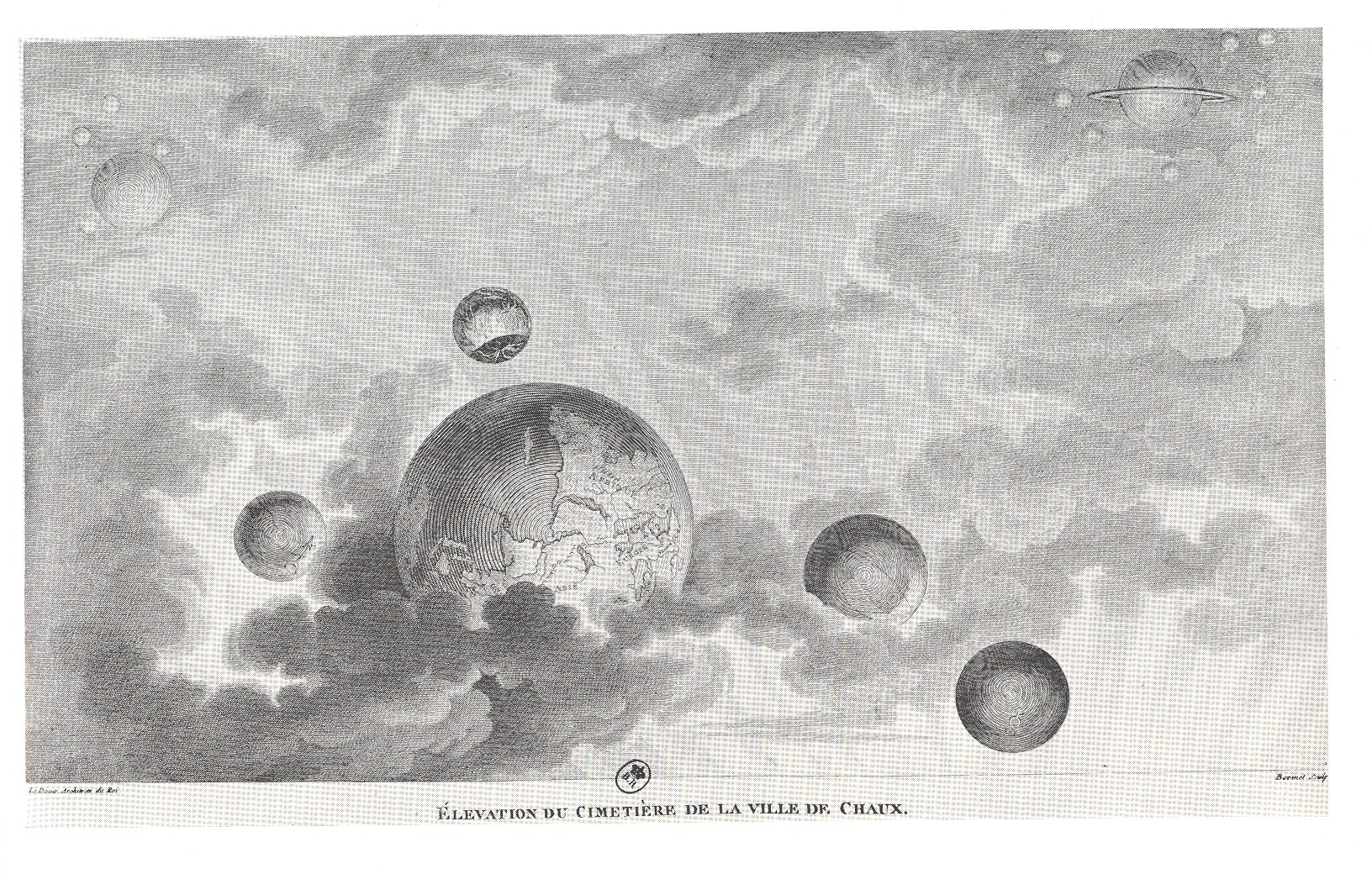
Perhaps this vision of cushioned planets was a larger expression by Ledoux of heavenly gratuity?
Anthony Vidler points out (in his book The Writing of the Walls) that Ledoux described his utopian Chaux as a “galaxy of…utopian forms” (page 101). Since Ledoux also described the architect as the “delegate of the Creator”, perhaps he reverse-engineered a cosmology describing a mutually beneficial community of planets from a community of brotherhood gathered around the (admittedly important in 1780) production of salt.
Or perhaps not–this may just be way to simple and, well, just wrong.
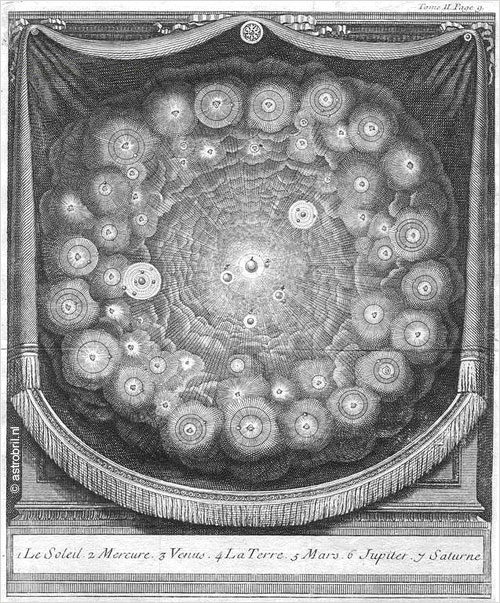 NOTE: I do just want to point out here (and discuss at another
time) that Ledoux was by no means the first to describe multiple-world
systems. One of the prettiest of the earlier attempts, for example,
belongs to Bernard le Bovier de Fontenelle who published this
delightful rendition of an extra solar-systemic galaxy in 1682 in his Entretriens sur la pluralite des mondes. This
sort of thinking was somewhat well-established by the time Ledoux
offered his idea around the time of the turn of the 18th century.
Should we not come to the rescue of a cosmic phenomenon trying to reveal itself in a sea of errors? Peter van de Kamp (1983)
For a beautiful romp, have a look at Ledoux’s L’Architecture considérée sous le rapport de l’art, des mœurs et de la législatio. I’ve included a short list of projects (with links) in the expanded reading section below.