A Daily History of Holes, Dots, Lines, Science, History, Math, Physics, Art, the Unintentional Absurd, Architecture, Maps, Data Visualization, Blank and Missing Things, and so on. |1.6 million words, 7500 images, 4.9 million hits| Press & appearances in The Times, Le Figaro, Mensa, The Economist, The Guardian, Discovery News, Slate, Le Monde, Sci American Blogs, Le Pont, and many other places… 5000+ total posts since 2008.

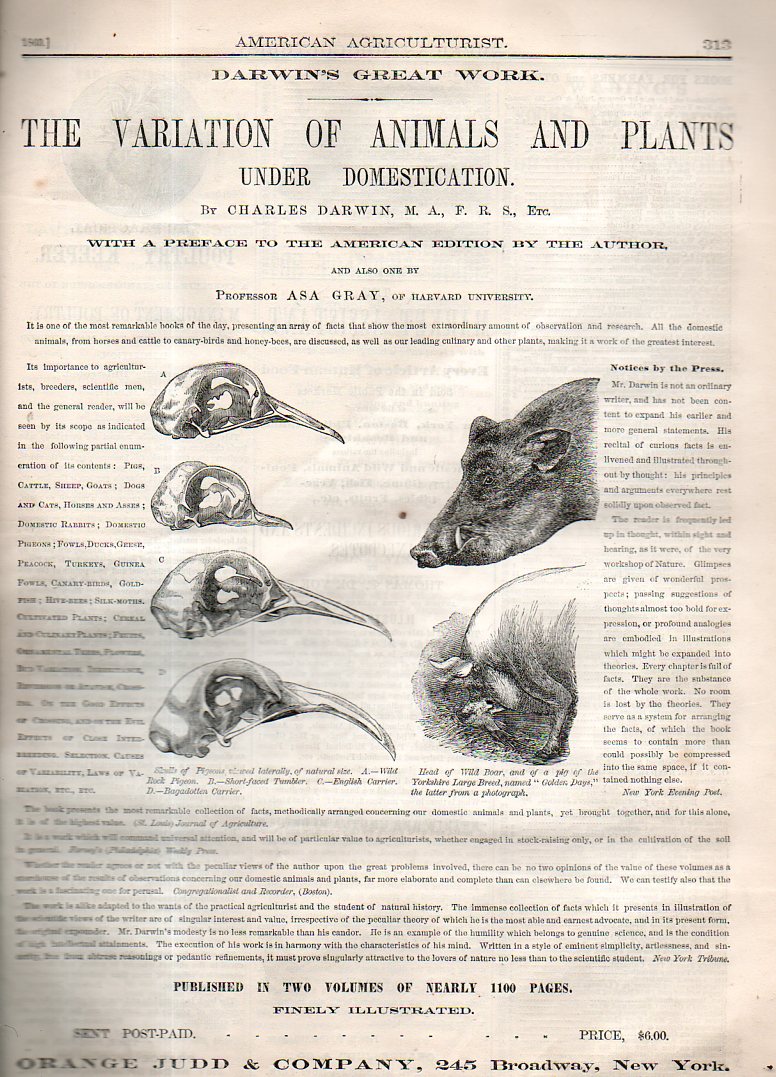
  • Fine Ad for Darwin’s “Variation of Animals…” 1869

    JF Ptak Science Books   Quick Post

    I don’t often see big full page contemporary advertisements for works by Charles Darwin, so I was surprised and happy to see this big boy (12×9″) in the August 1869 issue of American Agriculturalist for the Farm, Garden, and Household..  The first U.S. edition appeared in the previous year–but no matter, there was a lot of practical material in the book that no doubt the farmer/gardener readers of this very practical magazine could have used.  The six dollar price tag was a lot–more than 100 dollars in 2016 terms, and about a week’s wages for a laborer, or a half-week’s wages for a professional.

    Darwin ad460

    ·Posted by :

    ·in:

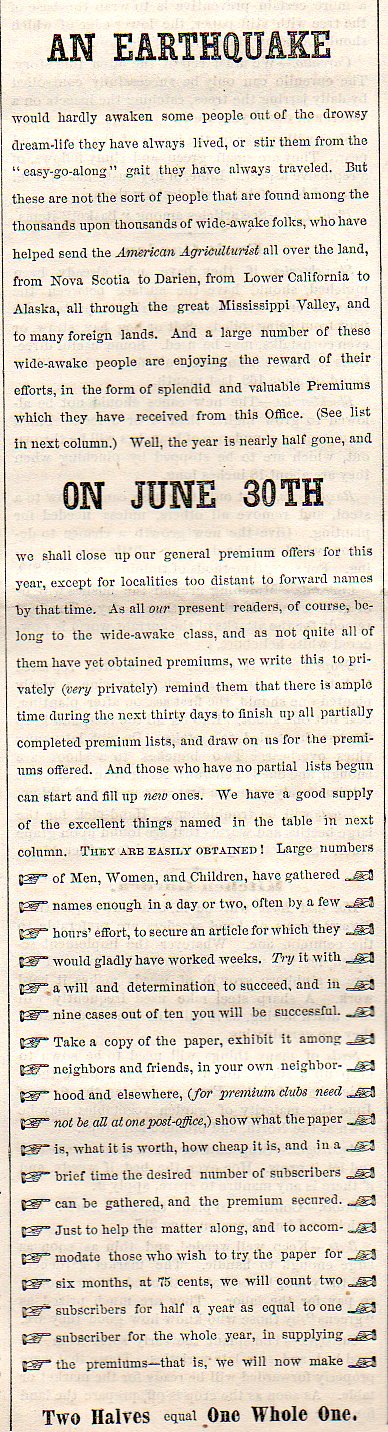
  • An Earthquake–Not! Adventures in Advertising, 1869

    JF Ptak Science Books   Quick Post

    Earthquake ad details 1869464


    Earthquake ad 1869464In 1869 there weren’t yet catchy tunes or jingles to help you remember the name of a product that you didn’t need though purchased because of some subliminal twitch, and there weren’t many images of a well-turned ankle stretched over the bottom rung of a farm-intended three-horse equalizer, and the colorfully pulsating repetitive splash imagery wasn’t close yet to being part of The Daily Life of the Average Person–what certainly did exist was the misleading/phony bait-and-switch lede, which today I guess would be called “click bait”.   Here’s a great example of that, not-so-deeply-nestled in the back pages of the June 1869 issue of American Agriculturalist. The column seems to announce AN EARTHQUAKE perhaps on JUNE 30TH–but all it is is an advertisement for becoming a subscriber, and it turns out to be that the journal is a very useful farmer’s friend.  The ad did however try to grab the attention of the passing reader–and it was still working, 147 years later.  

  • Spheres of Recognition: the Portable Gym and Expulsion from Eden

    JF Ptak Science Books   Quick Post

    Spheres

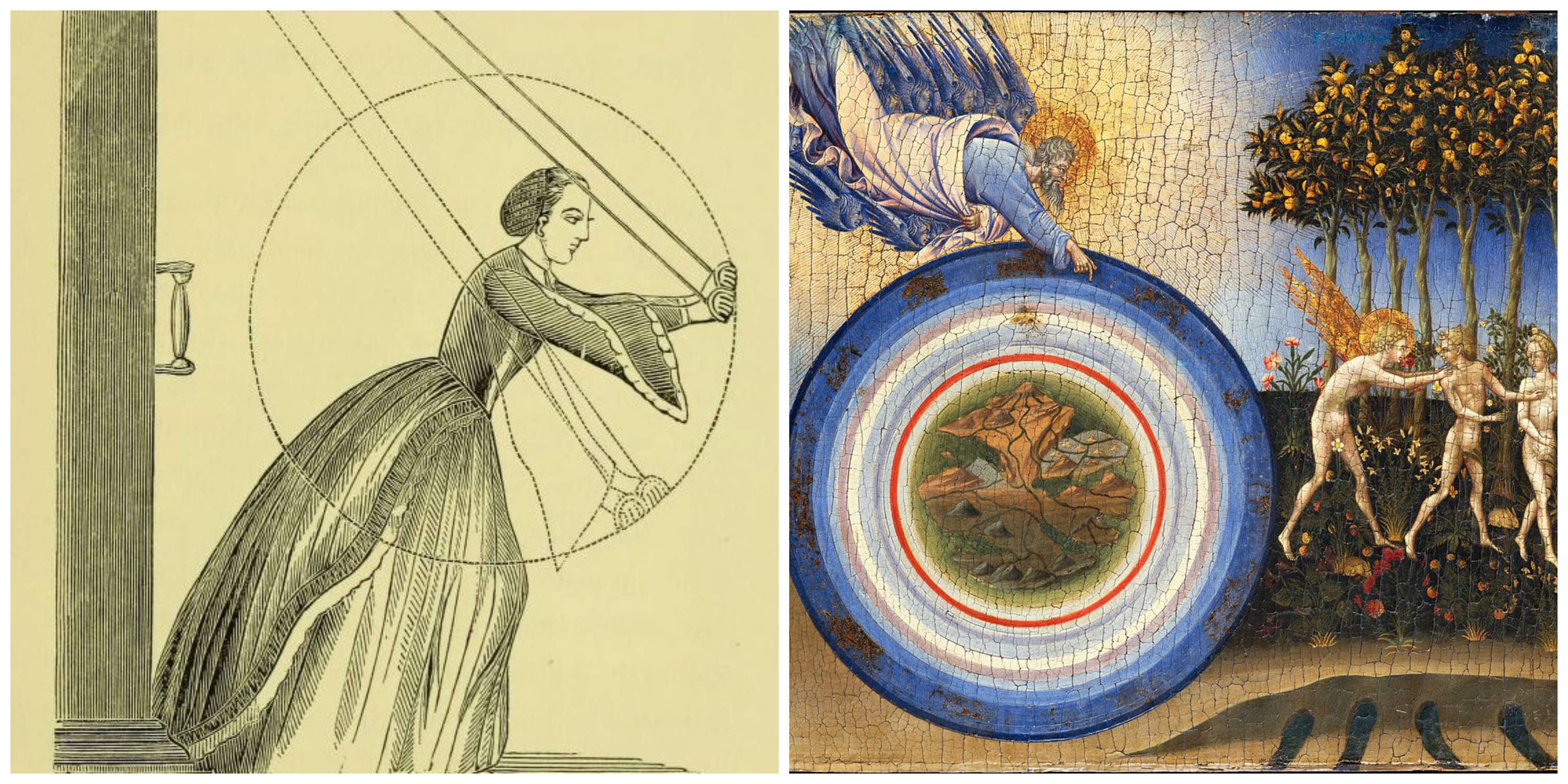
    There was some immediate shock of recognition1 in seeing this image, not for its exact earlier-appearing twin, but in the sense of the spherical delivery of something. In this case, it is a Victorian woman and the depiction of her movements in exercise–but what I remember and associate with this is the Sienese Giovanni di Paolo, and his depiction of the monumentalist giveth-and-taketh cycle of the creation of Eden and the epic fall of humanity and its expulsion from it.  Di Paolo put a lot of history into that one image, the perfection of Paradise and the disposal of Adam and Eve, all via the intercession of the creator of the universe, with is hands of the sphere of being. (Talk about building a wall….).  

    The image of the exercising woman is found in a delightful book used in the banner of  Chloe Roberts (@) a web producer for the Wellcome Library (http://blog.wellcomelibrary.org/) collection and which is available in full in a very nice copy at Internet Archive, here: The portable gymnasium : a manual of exercises, arranged for self instruction in the use of the portable gymnasium, by Gustav Ernst, London 1861: https://archive.org/details/b20399789  Image source for the di Paolo:  https://de.wikipedia.org/wiki/Giovanni_di_Paolo#/media/File:Creation-and-the-expulsion-from-the-paradise-11291.jpg

    Notes

    1. And with that phrase comes other immediate recognitions, mainly in book form: William Gaddis’ The Recognitions, and Edmund Wilson The Shock of Recognition; both are excellent, and the Gaddis may well be a contender for Great American Novel. 

  • Not-Pouillet’s Law, But Pouillet on Population (1842)

    JF Ptak Science Books   Quick Post

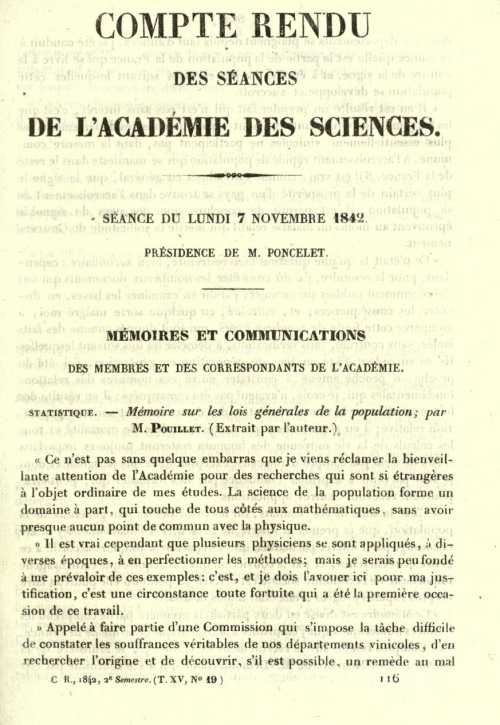
    Pouillet populztionThe other day I retrieved the year 1842 from the mass of the great Comptes Rendus down in the studio, and among the unexpected papers was a truly unexpected one, and it belonged to the physicist Claude-Servais-Mathias-Marie-Roland Pouillet. Pouillet–mostly know as Claude or Mathias–is best remembered today for Pouillet’s Law and his association with Ohm’s Law, though unfortunately this paper was five years past the first appearance of his law (and 15 years past Ohm’s).  What was unexpected here was that this was a long contribution by the physicist Pouillet on the laws of population–now Pouillet had a long and varied career, and published a number of papers in a wide array of physics topics, so the population dynamics paper seemed fairly well outside his scope.  It is also–for the Comptes Rendus–quite long at 16 pages.  

    This is outside of my own area, and although I can’t see any reference to the work of Malthus (1798) or related, I’m afraid the whole thing leaves me behind.  And so I include a link to the full paper found at the Biodiversity Library (http://biodiversitylibrary.org/item/20656#page/875/mode/1up)

    ·Posted by :

    ·in:

  • Very Early Spotter’s Guide for Enemy Aircraft, London, February 1915

    JF Ptak Science Books  Quick Post

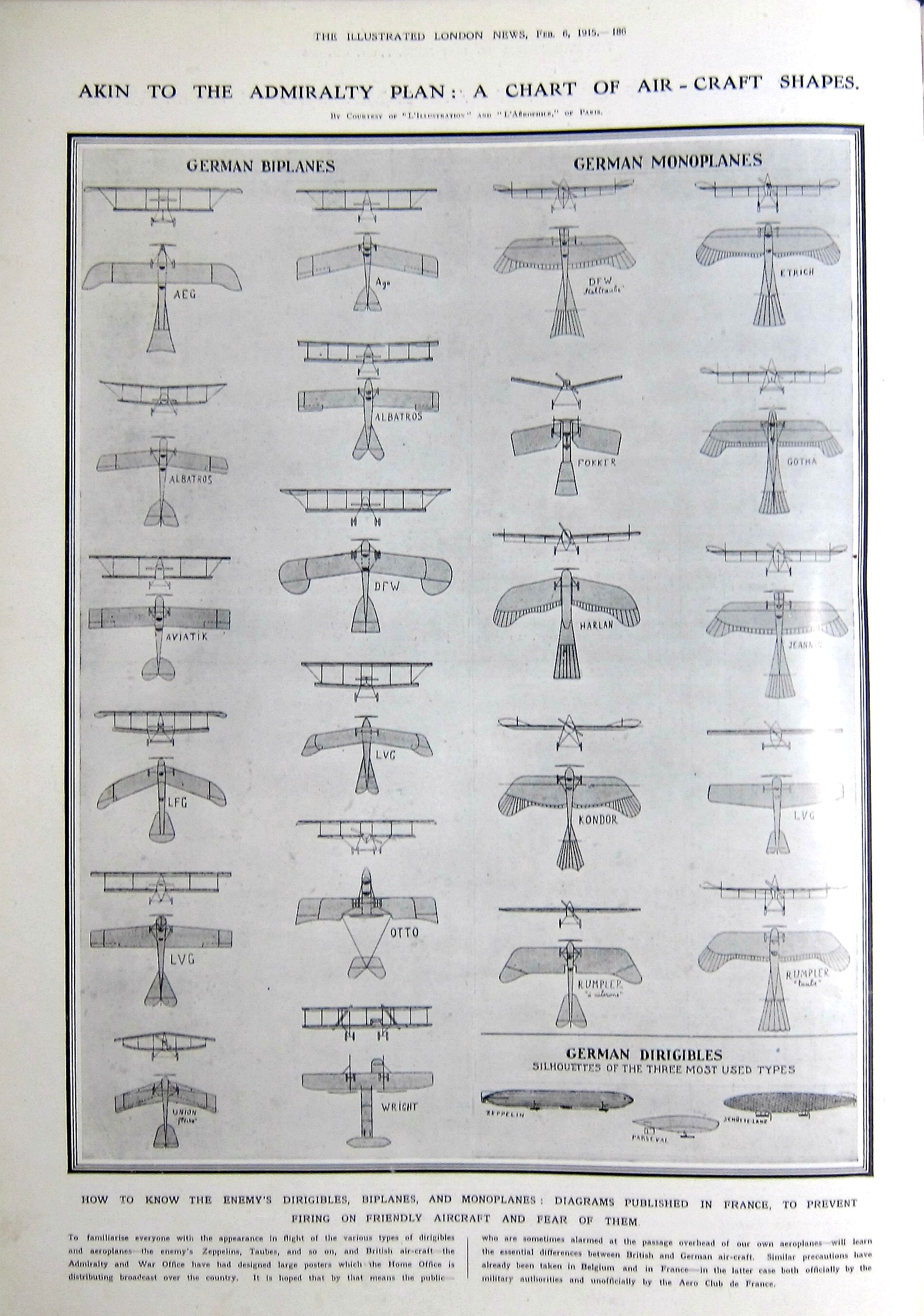
    It seems to me that this is the first time that a spotter’s guide to enemy aircraft appeared in The Illustrated London News for WWI–ditto the Illustrirte Zeitung.  I luckily own both journals covering the war years, and I’ve been through every page of coverage, and I do believe that this is probably a very early display of German aircraft identification for popular use.  Of course it couldn’t really get that much earlier, as the war was on for 150 days or so. And the “air forces” in general were very new–the German army received their first aircraft in 1910 for what would eventually become the  (for France it was 1911), so the concept of a unified fighting force of the air was still very new.  In another 1111 days or so, the aircraft losses for the Entente and the Central Powers would be about 110,000, or about 5,500 of these pages showing destroyed aircraft.  

    WWI Aviation German spotters guide

  • A Fine, Hand-Held Adding Machine, 1869

    JF Ptak Science Books  Quick Post

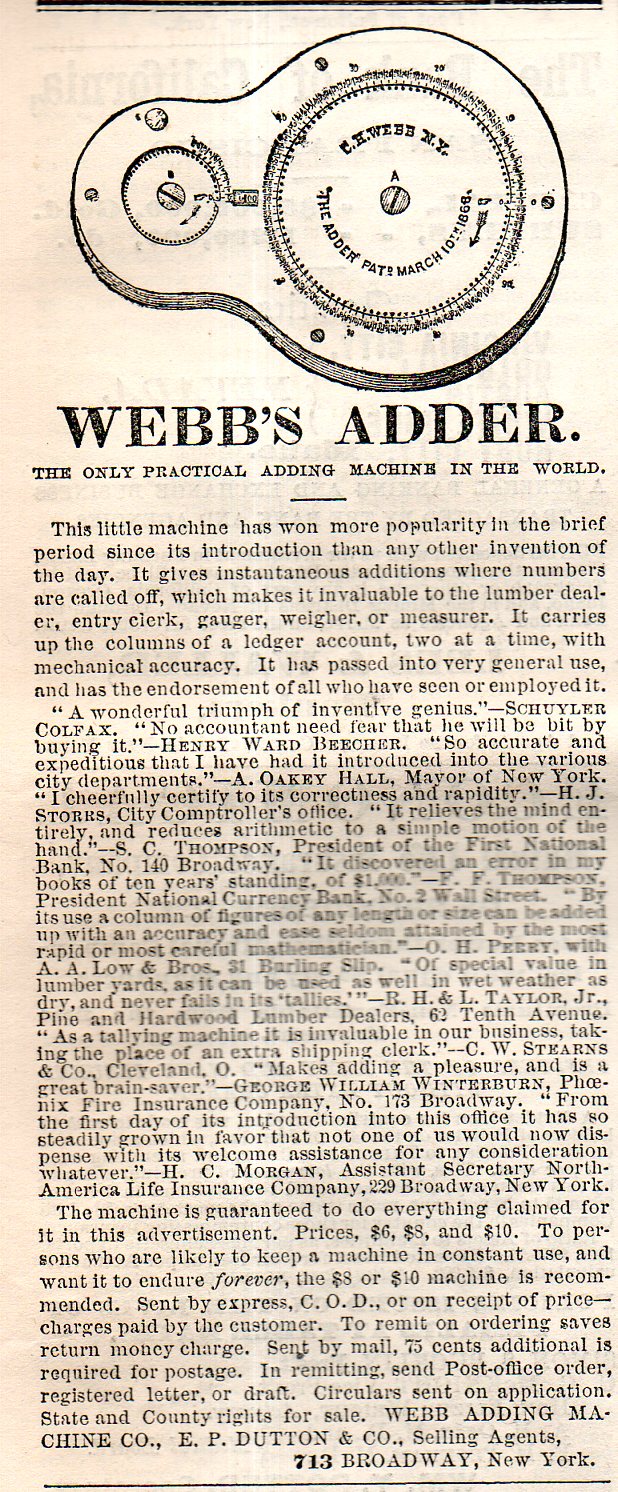
    I found this wonderful ad in the July, 1869 issue of American Agriculturalist--in real life the woodcut is about 1.5″x 4″ and was designed well enough to attract the attention of a practicing farmer needing arithmetical help. It was an intelligent design and speaks well of the readership. The adder–patented just a year earlier by Charles Henry Webb (1834-1905)–would have a long life in various incarnations, a history of which can be found in this excellent article at History-Computer.com (http://history-computer.com/CalculatingTools/Gadgets/Webb.html)

    Webb adder 1869465

  • A Paper Internet, 1917 (and 1932, and 1945)

    JF Ptak Science Books
    Paper internet466

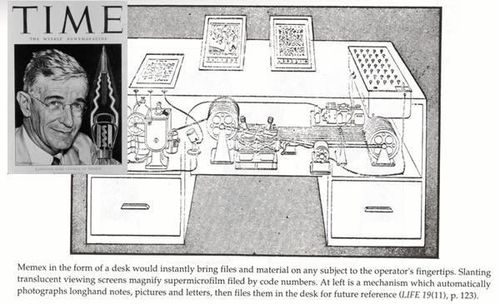
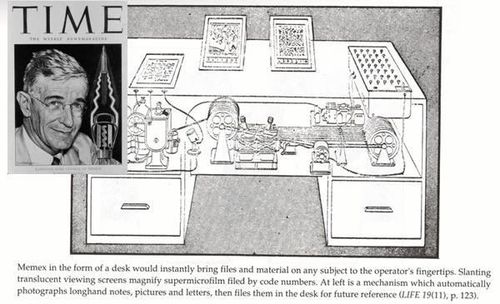
    Before the internet the idea to the idea of the internet existed to some extent in the head of a great unsung hero of the U.S. WWII figure, Vannevar Bush, a person who may well have invented the notion of hypertext.  Vannevar (pronounced “van ee var”) was a flinty no-nonsense New Englander who was an organizational and mechanical genius who as a professor at MIT developed a remarkable analog computer that greatly advance computation capacities for solving differential equations.  This was in the 1930’s, and even after creating an improved electromechanical version of the machine still chose the wrong way to go in the soon-to-materialize digital computer revolution. During WWII Bush was one of the most important Americans in the war effort, overseeing the entire scientific effort of the U.S.—an enormous effort dispatched beautifully (and successfully).  His importance in this regard is difficult to overstate. He also published a short paper on the hypertext idea in an article in The Atlantic in 1945.

     The article, “As We May Think”, outlined his idea for a device he called the MEMEX (“memory” and  “index”), which compressed and organized all that its user could remember and whatever information would be obtained in the future via electromechanical apparatuses, and available with associative tracking between the microtext frames.  So all manner of book and papers and reports and newspapers and images would be microphotographed and stored in a beautifully-indexed mechanical retrieval system where it would live with the information of others.  There was also the possibility of real-time textual additions to whatever it was that was retrieved, the genetic precursor of hypertext.  Bush’s thinking has been deeply recognized (and also by the creators of the internet) as the intellectual grandparent of the modern internet. 
    Bush internet

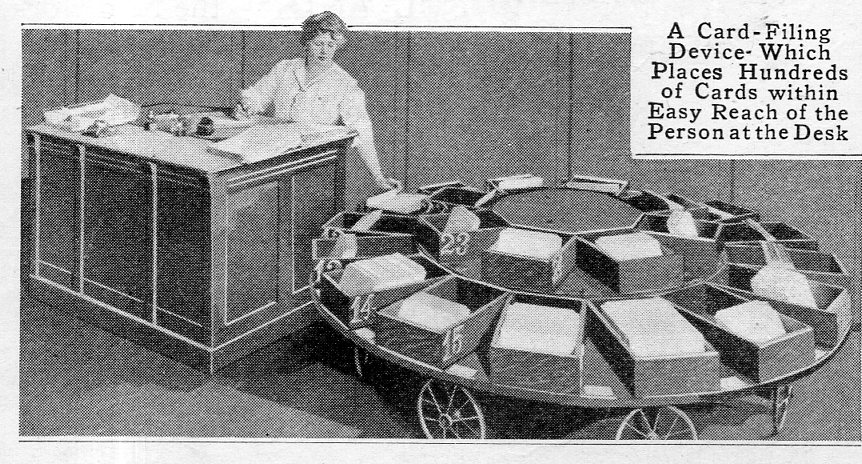
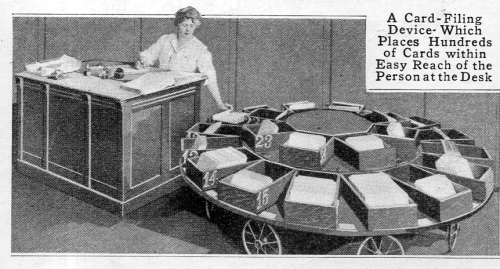
    This brings me to the image leading this note–the index card train. It appears in the pages of Popular Mechanics for January 1917, and was certainly a step forward in organizing finger-tip data–it just wasn’t quite a database, or Google, though the idea was present, after a fashion. 

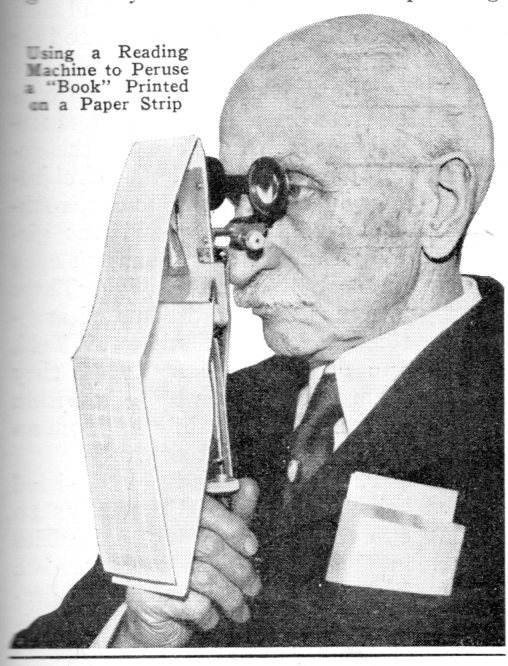
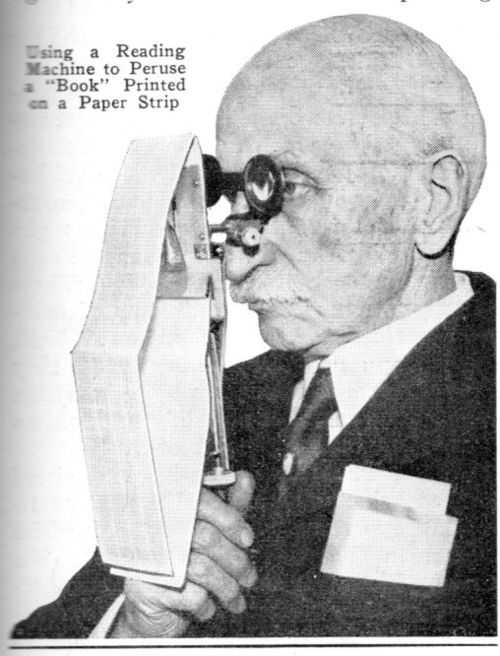
    And then I had a mostly-comical response to the image that I found in the pages of the March 1932 issue of Popular Mechanics–it was actually on the back of the page that I was looking for (on passenger rocket travel across the Atlantic).  With Bush in mind, this image of a man reading a miniaturized book using the system of Rear Admiral Bradley A. Fiske (1854-1942), and the photo shows the reader with the equivalent of a 100,000-word novel.  The article only mentions this one book, and doesn’t venture out into imagining anyone carrying a library with them, nor does it mention searches of organizing systems, but it does bring to bear the possible power of having access to a vast amount of info held on a strip of paper about the size of a newspaper column.  And for 1932, that was a strong idea.
     

    Paper interrnet145

  • Tremendous Montage of Early Airships

    JF Ptak Science Books  Quick Post

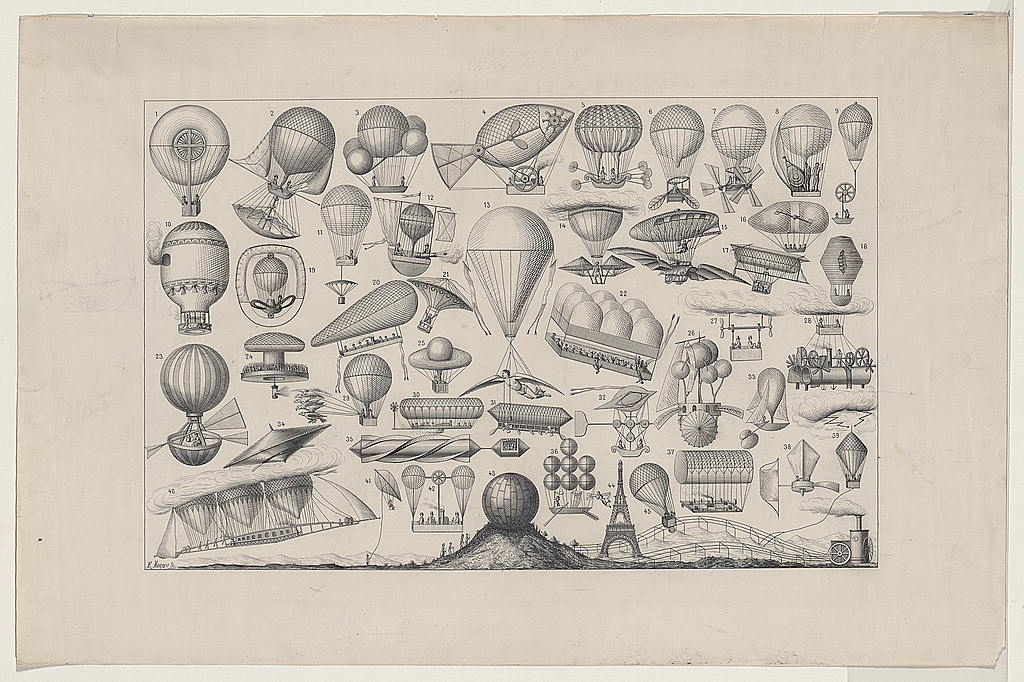
    I stumbled upont his fantastic illustration depicting nearly four dozen early balloons, many of which are a mystery to me. The image comes from the Library of Congress site, though the origin, title, and even the date of the engraving are unknown. It is known as “Balloons, airships, and other flying machines designed with some form of propulsion” though the title was bestowed by the library–one thing for sure is that it was engraved by “E. Morieu, and was printed between 1880-1905.   

    Airships from LC

    Source: Library of Congress [https://catalog.loc.gov/vwebv/search?searchCode=STNO&searchArg=2002722676&searchType=1&recCount=10]

    Somebody at the LC identified some of the airships, as follows: 

    •  “Single sheet with 45 numbered illustrations; lacking identification key.-  no. 18 shows a collapsible Montgolfier balloon from 1784; no. 23 is the design for a glider balloon as described in “Reflections on the aerostatic sphere,” 1783 (September); no. 24 depicts Jean-Charles (l’avocat) Thilorier’s plan for transporting troops across the English Channel to invade England, ca. 1800; and no. 32 shows the dirigible balloon glider used by Charles Guillé for an attempted ascension in Paris, November 13, 1814.”
    • Also, I know for sure that the last figure, #45, at bottom right, is a steam-powered balloon railway…

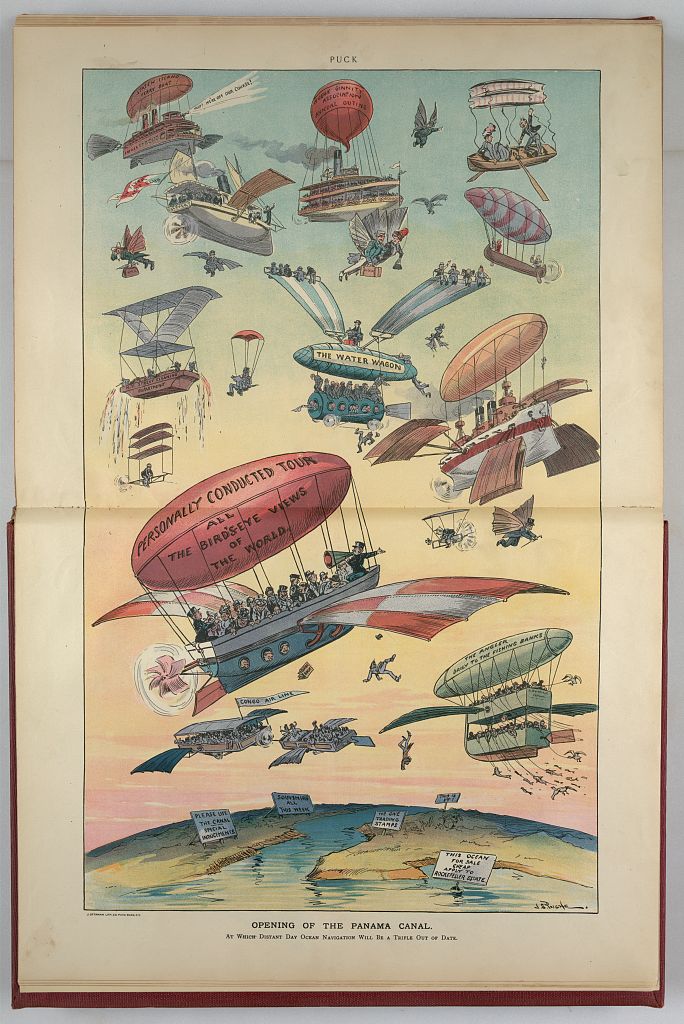
    There’s another fine image of fantastical airships below, also from the LC, and published in Puck, volume 59, no. 1509 (1906 January 31)–this shows the airships of the near future putting the Panama Canal out of business:

    Airship LC Puck

    Source: Library of Congress: https://www.loc.gov/resource/ppmsca.26030/?loclr=pin


  • Odd View of Manhattan, as Seen Under a Flirting Flying Cop, 1898

    JF Ptak Science Books  Quick Post

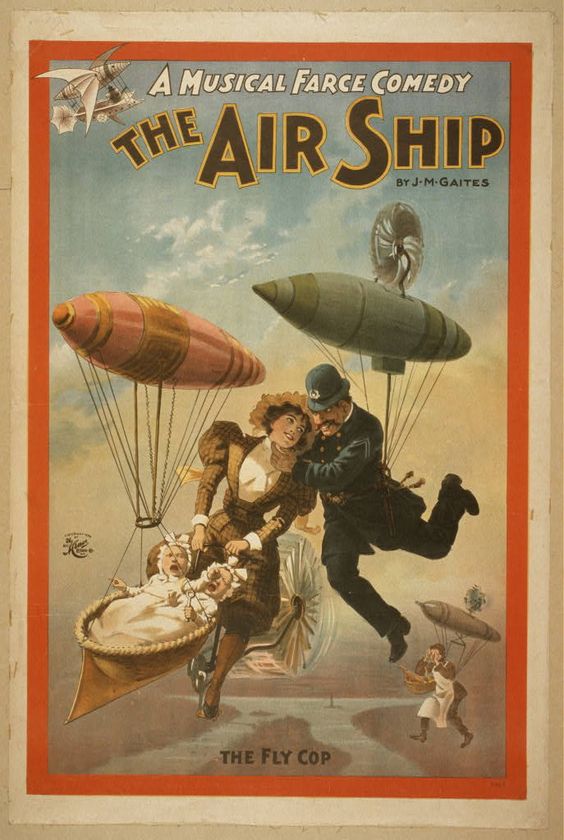
    I’ve been looking at early flying machines–real and imagined–and came upon this at the Library of Congress. There is very little information provided there, and I can’t find anything useful online, so I’m going with this being a poster for J.M. Gaites’ “musical farce comedy” The Air Ship, which was copyrighted in 1898.  The cover shows a “Fly Cop” making a rather forward advance on a young woman with babies in a basket fashioned as a part of the stern of a delicate self-propelled flying machine. The cop is attached to a min-dirigible that has a small fan for its propulsion, as does the remorseful-looking butcher bringing up the rear to the scene. And the whole thing takes place high over Manhattan, looking to be well north of midtown, and probably 3k feet high.  Looking south over the island we see the rivers (and a hint of the Brooklyn Bridge) and then in the harbor a suggestion of the Statue of Liberty.  


    Airships over NYC

    Source: Pinterest account for the Library of Congress  / Flying Machines

  • “The Reich is Split Up/Further Resistance is Senseless” 1945

    JF Ptak Science Books   Quick Post

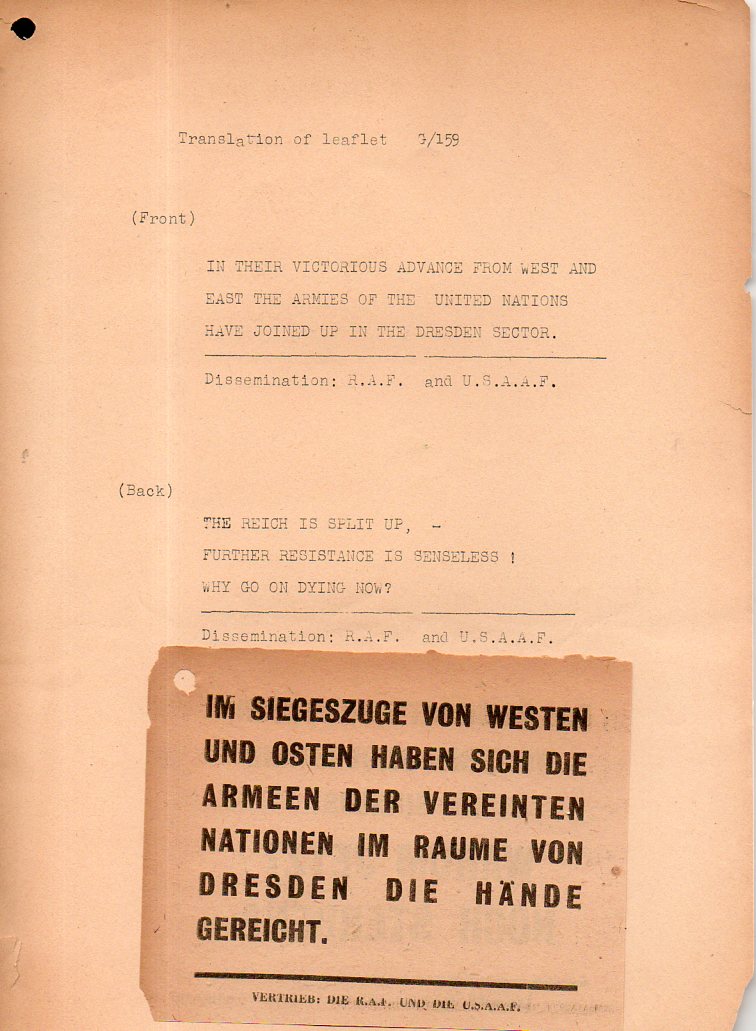
    I’d hate to have been in some Wehrmacht hellhole foxhole in March 1945 and have this fall on me from the sky–I imagine there was little doubt that even the lowest ranking soldier knew that they were in the grip of some enormous vise.  

    Leaflet reich is split up467

  • “Two Disastrous Failures” for the German Army, January 1945

    JF Ptak Science Books   Quick Post

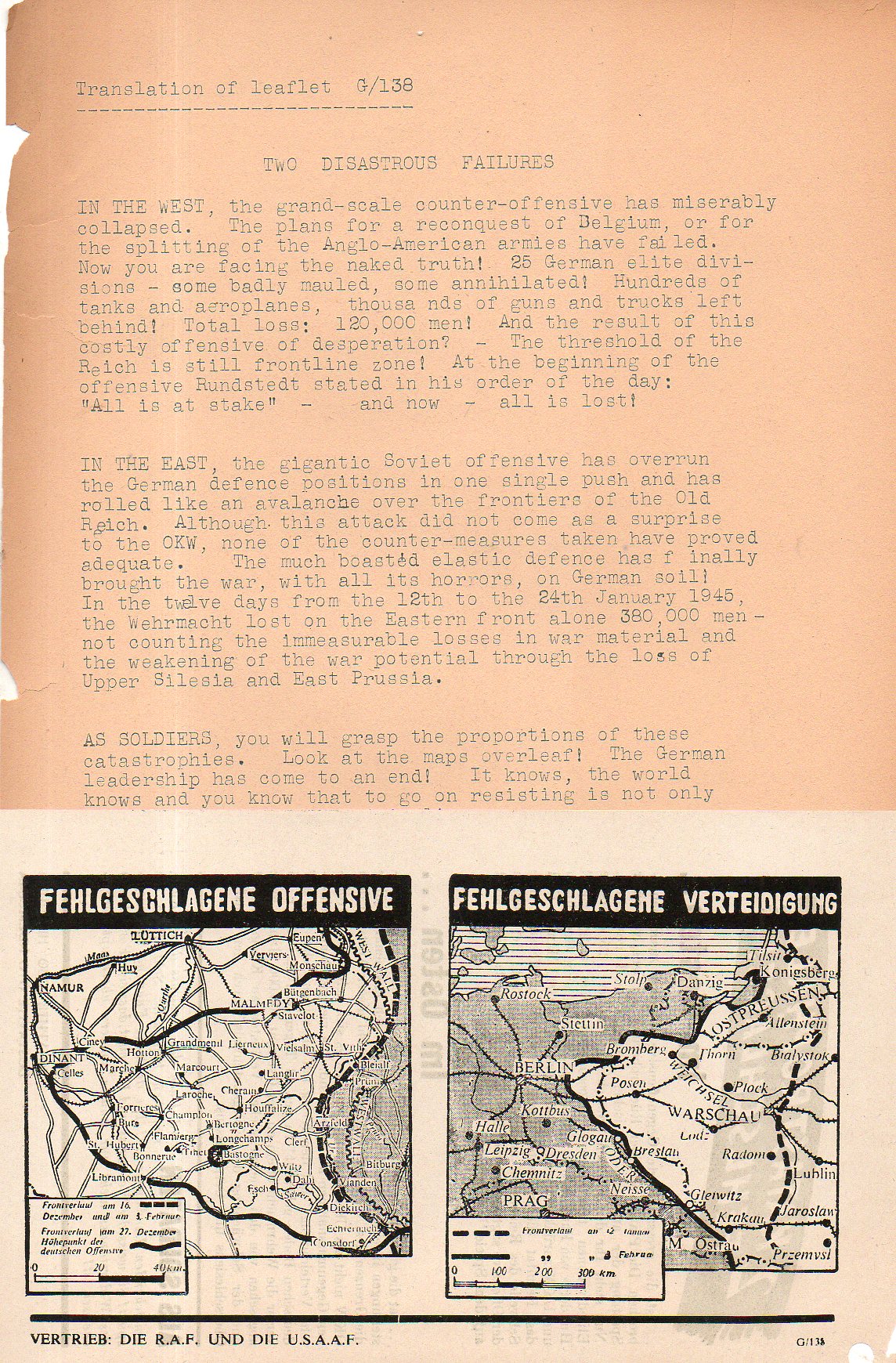
    This leaflet was dropped on German forces by the R.A.F. and the U.S.A.A.F. soon after the breakout of the Battle of the Bulge/Ardennes in the end of January 1945, which is one of the two failures that this propaganda sheet screamed about. It is a little odd though that in the map it would show the German offensive at its worst for the U.S. troops, with the bulge extending far west and Bastogne being surrounded. Yet the leaflet told of the German losses of its failed offensive (“Operation Watch on the Rhine”) though it did not show the progress of the month-long battle on the map, which should have shown the battle line back to its more-or-less original position by 25 January.  In describing the catastrophe of the German position in the east (leading with the loss of “380,000 soldiers”) the date of 24 January is mentioned, which supports the late January estimate for a printing date. This was of course the Vistula-Oder Offensive. which saw the Soviet Army advance more than 300 miles in a month, right to the Oder, only 40-odd miles from Berlin.  In that campaign the German Army Group A was just about killed–of the 450,000 soldiers in retreat along this long and disastrous front during the month of January, the overwhelming majority were casualties, including nearly 300,000 killed. The wounded and other survivors became POWs.  The bottom line of course was that the winter of 1945 for the German soldier was bitter and deadly, and was leading nowhere except defeat–there was no doubt what lay ahead after seeing that map of the Eastern Front. 

    Leaflet two disasterous failures468

Recent Posts

Archives

Categories