A Daily History of Holes, Dots, Lines, Science, History, Math, Physics, Art, the Unintentional Absurd, Architecture, Maps, Data Visualization, Blank and Missing Things, and so on. |1.6 million words, 7500 images, 4.9 million hits| Press & appearances in The Times, Le Figaro, Mensa, The Economist, The Guardian, Discovery News, Slate, Le Monde, Sci American Blogs, Le Pont, and many other places… 5000+ total posts since 2008.

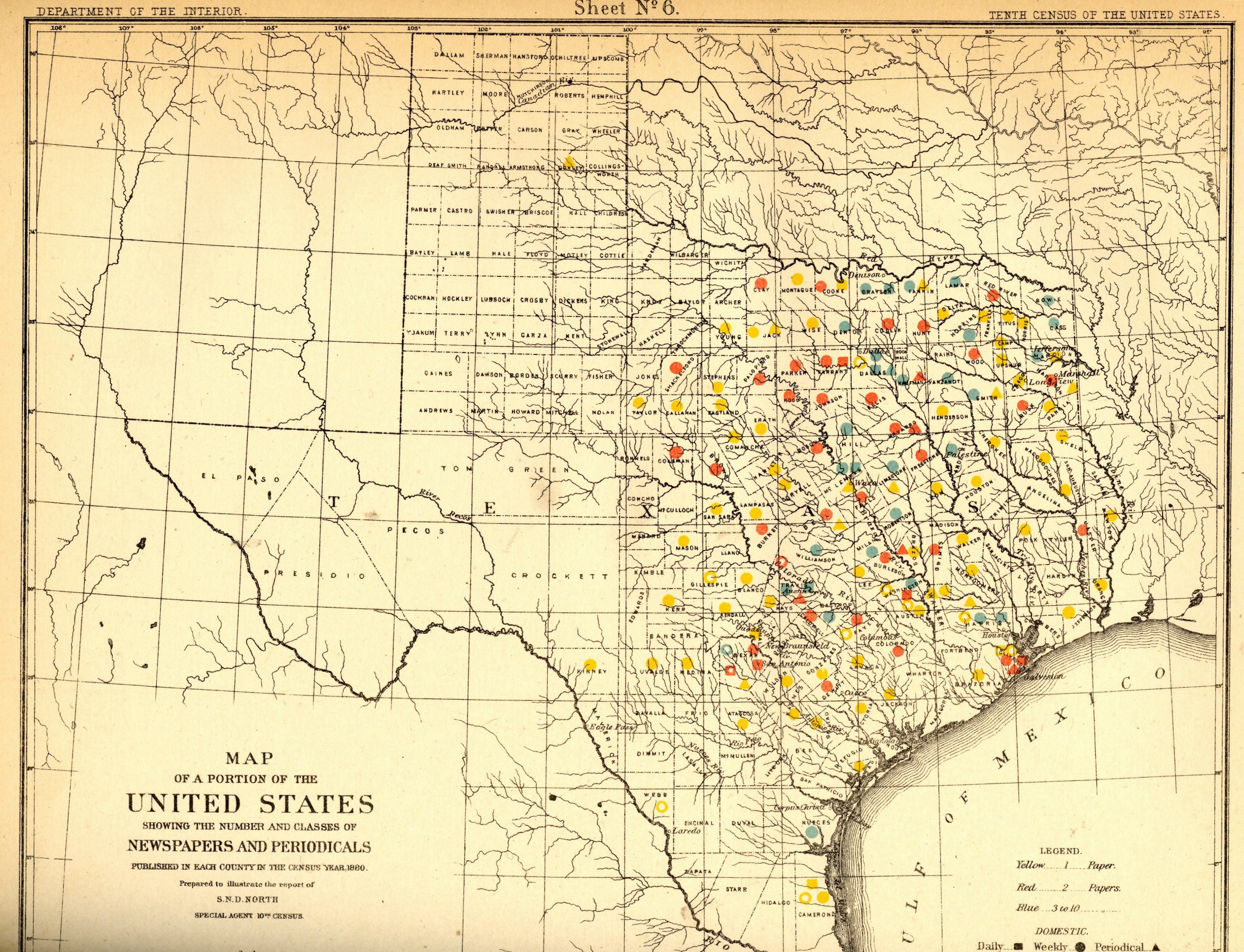
  • Visualizing Data: the Texas Newspaper Frontier in 1880

    JF Ptak Science Books 
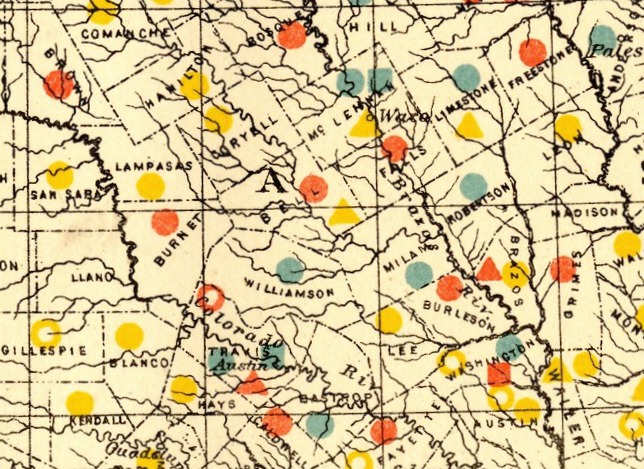
    Dataviz texas newspaper  detail


    Dataviz texas newspaper  tail

    [This expandable image is from the blog’s copy of the publication–full text can be found at the Internet Archive, here: https://archive.org/details/cu31924083814453]

    The idea of the frontier in American history has been around for quite some time, made famous and mostly-invented (and closed) by Frederick Jackson Turner in 1893, and expanded, imagined, enticed, magnified, micro-analyzed, and  generally messed with ever since.  There have been all sorts of frontiers introduced into the study of the birth, expansion and filling-up of this country, from the very earliest colonial periods of Indian frontiers, “far-western” river frontiers of the Connecticut, Delaware, Hudson (!) and Susquehanna, to the Appalachian frontier of the early western reaches of the colonies, to the transportation frontier, the slavery frontier, the gold and mining frontier, the gun frontier, and so on.  

    Here’s another bit to add:  the newspaper frontier.  

    I just happened upon a volume of the US Census of 1880, with a special report by S.N.D. North entitled History and Present Condition of the Newspaper and Periodical Press of the United States…and published in 1882.  What provoked me was the map of Texas newspapers for 1880.  It very clearly, and like no other map of its kind, delineates a fantastic line/frontier between the Texas with newspapers and the Texas without newspapers. We see very clearly that the frontier of the newspaper stops fairly abruptly (and wonderfully) at the 100th meridian, with only two newspapers in all of the rest of Texas found beyond that point (and those just barely beyond the 100th.  And it’s the 100th meridian that mostly marks the vertical middle of the country, running through North and South Dakota, Kansas, Nebraska, the Texas/Oklahoma borders, and so into Texas—if you folded this map vertically in half it folds virtually on the 100th meridian.  An odd bit, it is, half of the country and then approaching half of Texas. 

    I should report that the newspapers west of the 100th meridian were in Kinney County (population 4,440) with the Fort Clark News (established in 1880, at exactly the year of census) and Donley County (population 160, with the monthlyClarendon News and a 50-cent annual subscription rate).  The newspaper development also sort of followed the frontier fort development, almos tall of which (but four) were east of the 100th. 

    Of course the population and easier-natural-resources are located east of this point, I know, but it is still quite a jolt to see the line of newspapers get drawn in the sand so vividly.  There isn’t anything else quite like this so far as the newspapers go, except, a little, for Florida, where the line gets drawn north and south, splitting the peninsula roughly in half, the southern part holding only five counties at this point..  But it is a much more robust image for Texas given the number of newspapers that were being published—280 periodicals and newspapers for Texas versus 45 for Florida, with 11,374 in the entire country*—so that the difference between the have-newspapers and haven’t-newspapers in Texas is that much more vivid. 

    Texas needed more papers:  there were 1.5 million people living in the massive state in 1880, almost twice as many as there were in 1870, and almost half of what there would be there in 1900. That was another story, entirely—even in 1880, which is only 130 years ago, there were only 270,000 people living in the entire state, not even close to half of the county population of Pinelas today.I’m just enjoying the surprise of the straight-edge frontier in Texas. 

    The deal too was that Texas wasn’t at the top of the lisst for average area for each publication per square mile, with each periodical providing coverage for 936 miles. But that again is for Texas east of the 100th meridian–throw in the rest of the state, and that number skyrockets. (There were 13 states with a higher mileage distribution than Texas, topped by Indian Territory,m with basically nothing, with each paper servicing an area of 21,000 square miles.  

    Also, Texas’ 225 counties had 119 counties publishing newspapers and/or peridoicals, compared to the national figures, which were 2,605 counties and 2,073 publishing papers.  

     *Just for the sake of comparison, the number of newspapers and periodicals per state for 1880 was as follows: Illinois, 1017; New York, 1411; Pennsylvania, 973; Ohio,  774; New Jersey 215.  Also, oddly, the average circulation of the Florida and Texaspapers was roughly the same: 1,282 for Texas and 1306 for Florida (with an average for the country at 4137). 

  • Missing the Sounds of War for the Din of Traffic (1917)

    JF Ptak Science Books  Quick Post
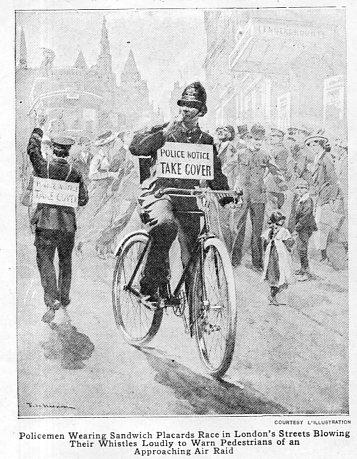
    The idea of bombing people from the sky was less than a decade old at the start of WWI, though the  idea of aerial strategic bombing took off quickly beginning in 1914. When this image was published in Popular Mechanics in October 1917 (page 662), the bombing of London by aircraft and Zeppelin had been well established. In order to effect more efficient evacuation and coverage, and in order to be heard over the considerable amount of traffic noise in London, the warning signals for a possible attack were sounded in addition to three explosives shot into the air in 15-second intervals, after which the police were dispersed into the streets with whistles and placards, trying to warn people above the sounds of the city.  It is an interesting peep into a small piece of time in a moment of possible terror. 

    Bombing london wwi443

    ·Posted by :

    ·in:

  • DIY Tank Model, 1917 (Full Text)

    JF Ptak Science Books   Quick Post

     In the last day or so I’ve been checking through some of my popular journals looking for references of the first usage of a tank in combat in WWI (which occurred in April, 1917). Popular Mechanics had a quick reference in their monthly issue for Map 1917, though now that I am into September 1917 for Scientific American I haven’t found anything on the tank in its pages. (Still to come is the Illustrated London News which I do recall having a large piece on the tank in April, 1917; and also the Illustrirte Zeitung, which I also recall having something on the tank in their place quite quickly following the tank’s appearance, which was an introduction to a new form of warfare that caught Germany very much by surprise.  

    Tank model 1917444

    [Popular Mechanics, August, 1917, pg 307]

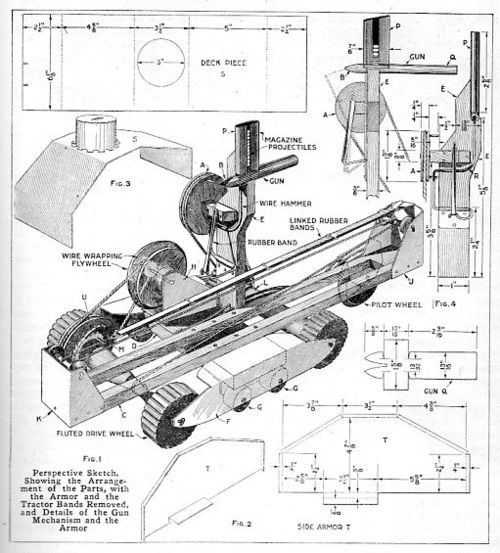
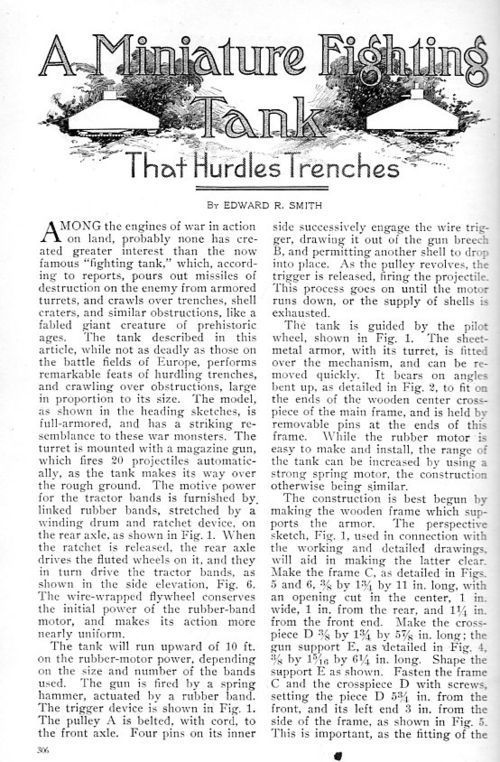
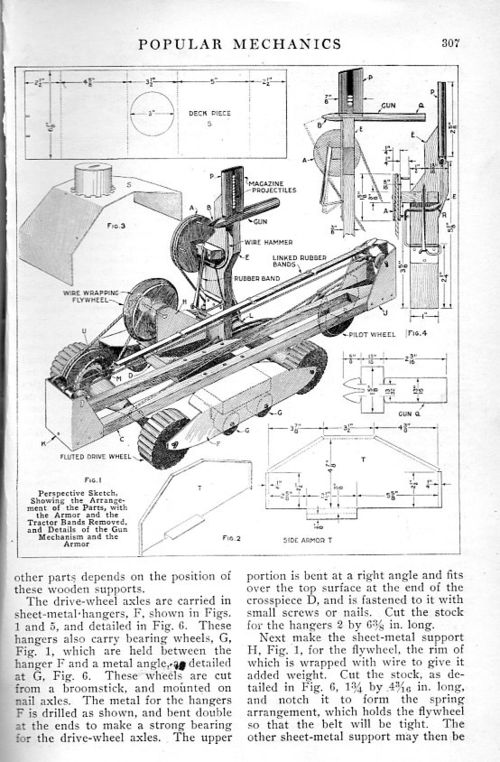
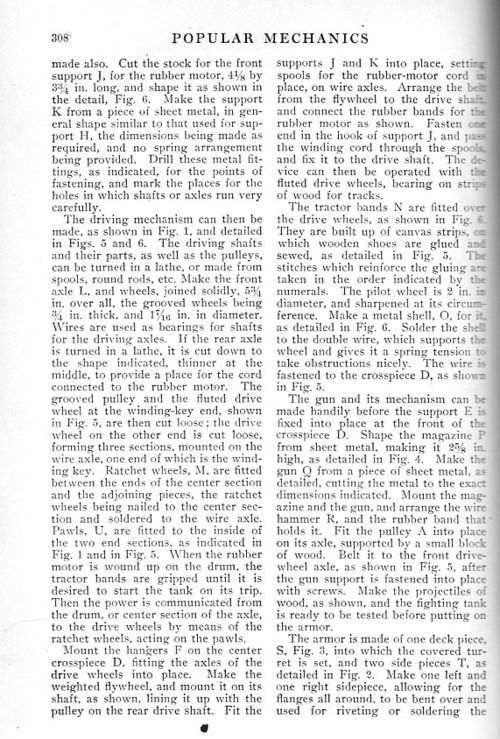
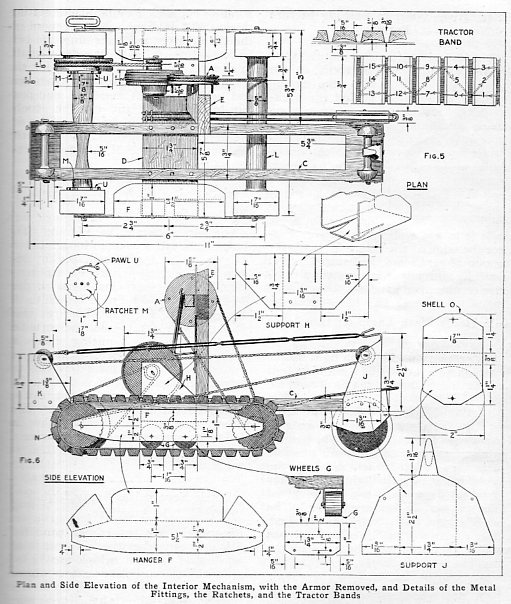
    It will no doubt be of interest to many that in August 1917, just four months after the first use of the tank that Popular Mechanics had a fairly detailed article for children of all ages on constructing a toy tank. Almost as quickly as a monthly magazine can report on an event, Popular Mechanics did so and then very quickly thereafter had a DIY project in its pages of the new innovation. I reprint the four-page article in full:

    “A Miniature Fighting Tank that Hurdles Trenches”

    Tank model 1917447


    Tank model 1917448

    Tank model 1917446

    Tank model 1917445


  • Finding Sameness, 1919

    JF Ptak Science Books   Quick Post

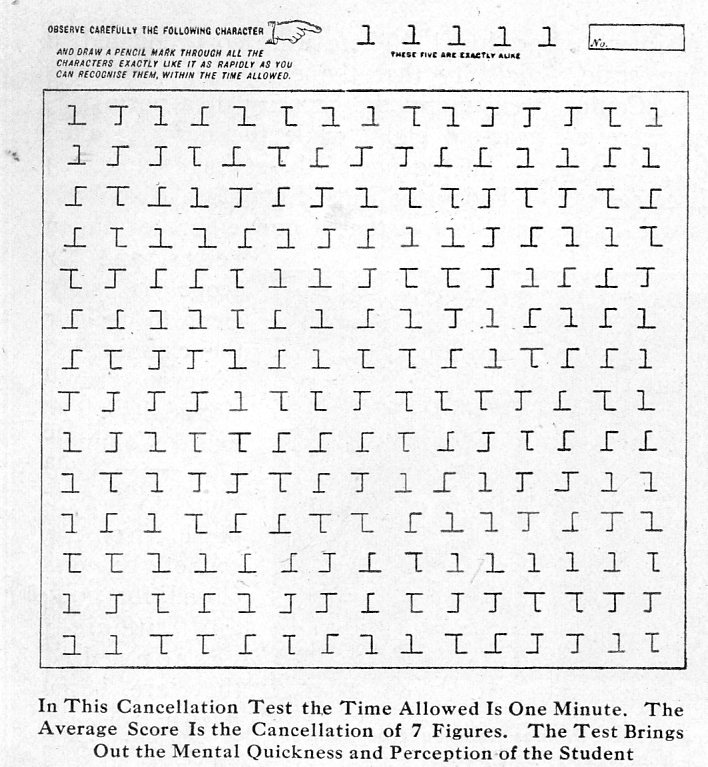
    I just found this unusual image in the page of the scarce journal Illustrated World for June 1919.  At first glance it attracted my attention for the design, and then I thought it was utilizing a Sumerian bill of sale–it turns out to be part of an intelligence test.  The subject is asked to see how many of the figures pointed out in the top line (and repeated five times) are repeated in the diagram. This is a lot easier than what I thought the test was, which was looking for five-times-in-a-row repeating symbols–after finding a few symbols repeated four times in a row and not five, I read the directions, and the test was much simpler, esp since someone had already gone through and marked out a bunch.

    IQ test451

    The cover story for this month was “electrocuting Whales”–and we don’t need to go there. 


    ·Posted by :

    ·in:

    —
  • The Italian “Flying Cucumber”, 1915

    JF Ptak Science Books   Quick Post

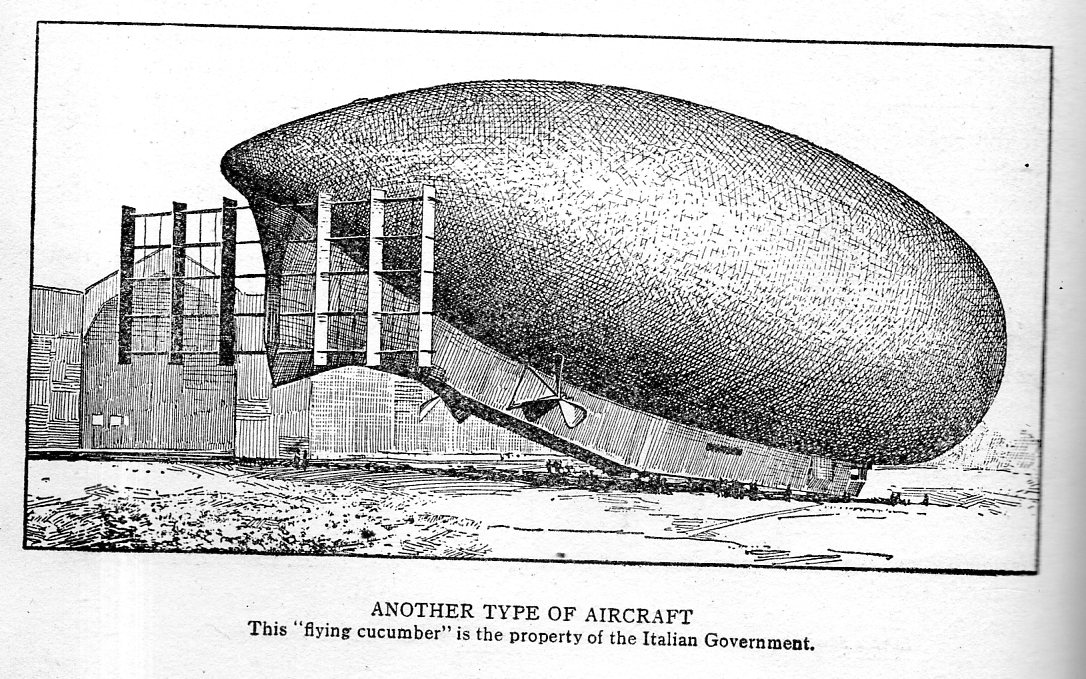
    Here’s an unusual (semi-rigid) airship designed by Enrico Forlanini (13 December 1848 – 9 October 1930, an Italian engineer, inventor and aeronautical pioneer), appearing in Technical World Magazine for May, 1915, and bearing the fetching caption “Another Type of Aircraft”.  It certainly was different, referred to here as the “flying cucumber”, though I doubt the Italians thought that.  In any even the airship went down in 1914 and was not a factor in the war.  

    Wwi aviati cucumber452

  • WWI Aircraft Identification Poster, 1915

    JF Ptak Science Books   Quick Post

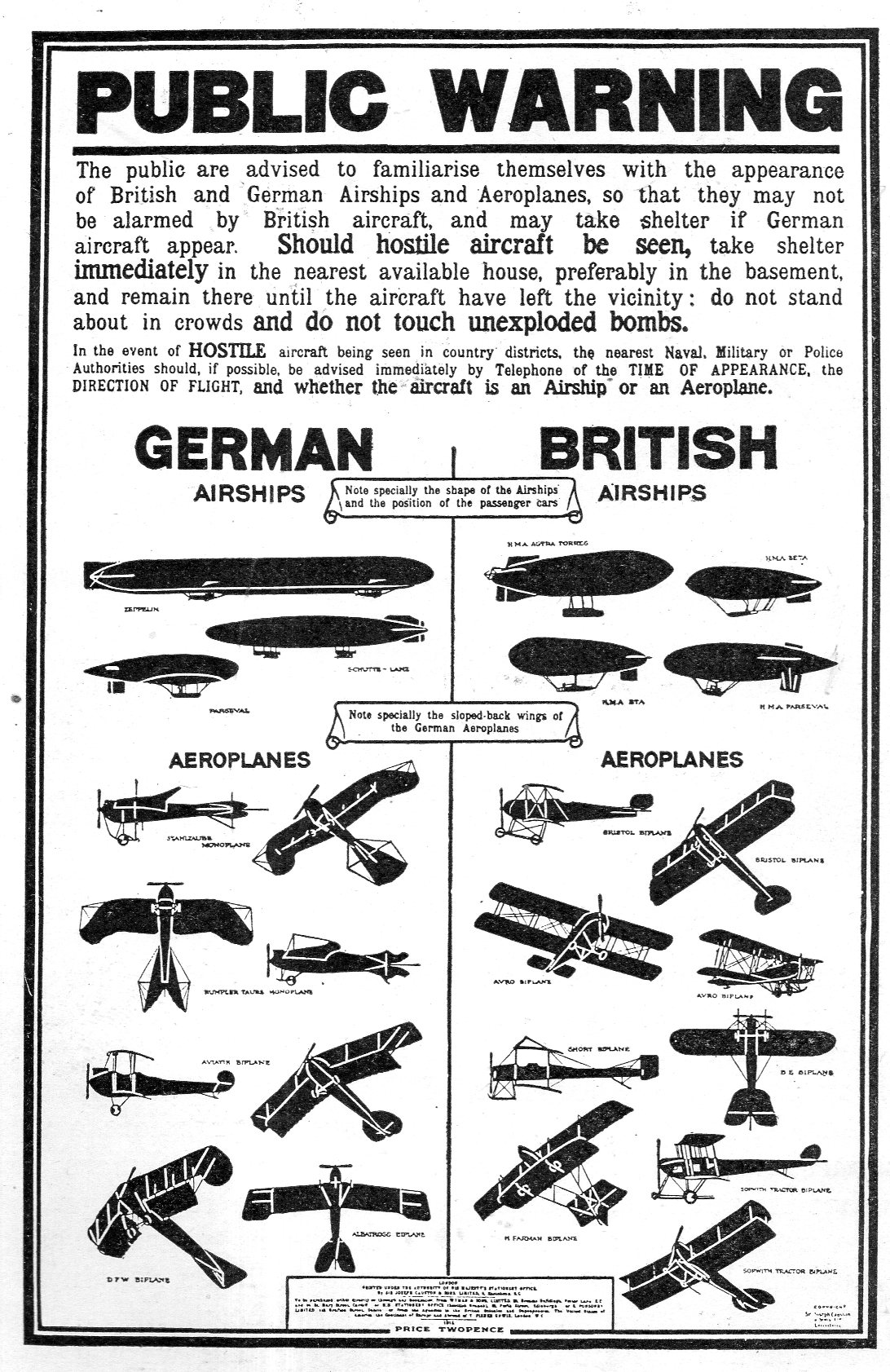
    “Public Warning” was a large, billboard-sized poster that appeared throughout England, posted in the first year of the war, appeared in Technical World Magazine in May 1915. Outside of delivering some good, solid information on behavior and bombing it supplied German/British aircraft silhouettes to help people distinguish between friendly/enemy aircraft, meaning that they could take cover and report the actions of enemy aircraft (valuable information in pre-RADAR days) and also not fret with British aircraft sightings. 

    Wwi poster public warning457

     The National Archives (U.K., http://www.nationalarchives.gov.uk/pathways/firstworldwar/transcripts/spotlights/public_warning.htm) transcribes the poster, identifying the aircraft (just in case you can’t read the text on the poster):

    ·Posted by :

    ·in:

    —
  • Not-Usual WWI Photos: Saved Sailors, Crossbows, Bike Corps, and a Long Line in the Snow

    JF Ptak Science Books   Quick Post

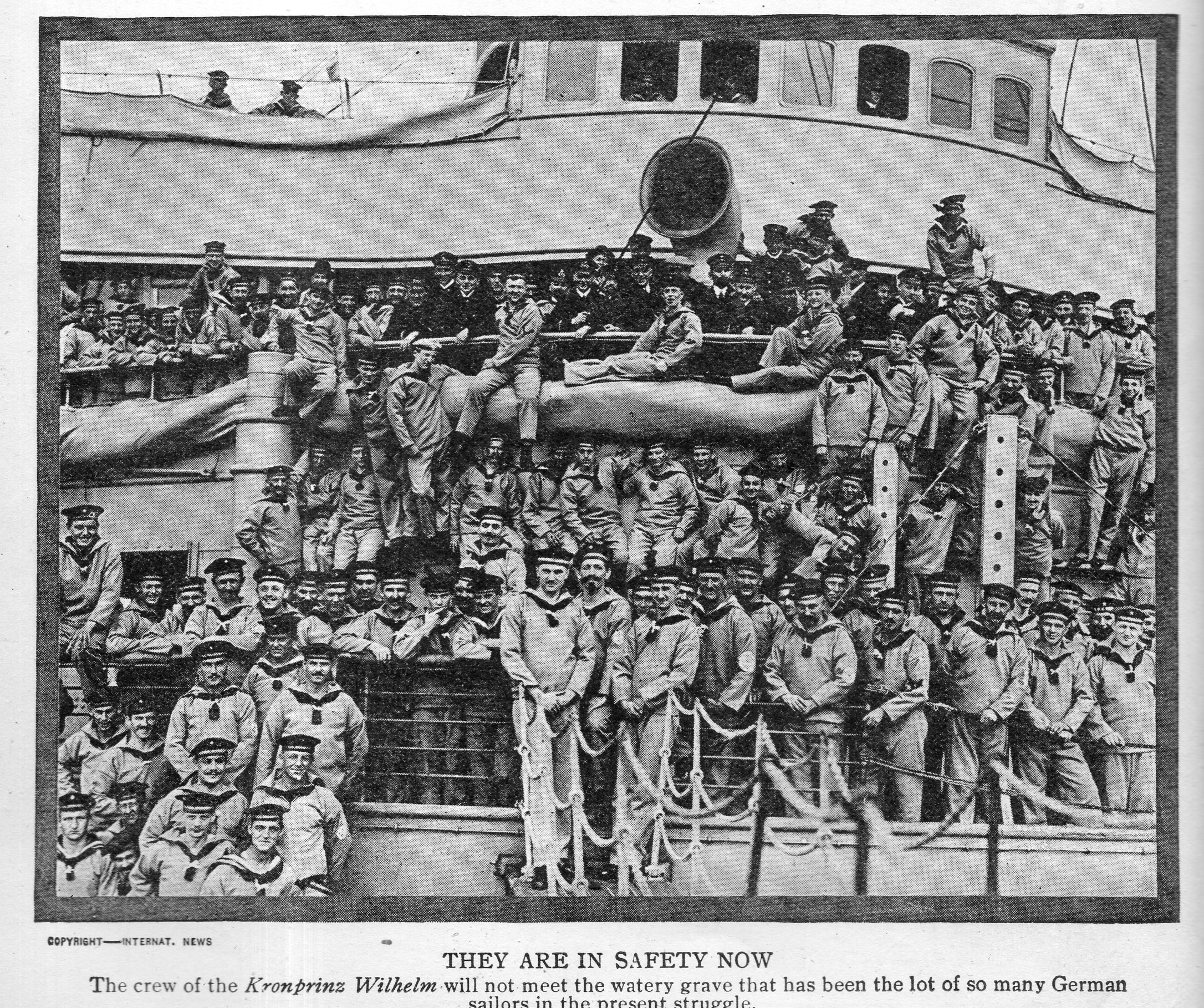
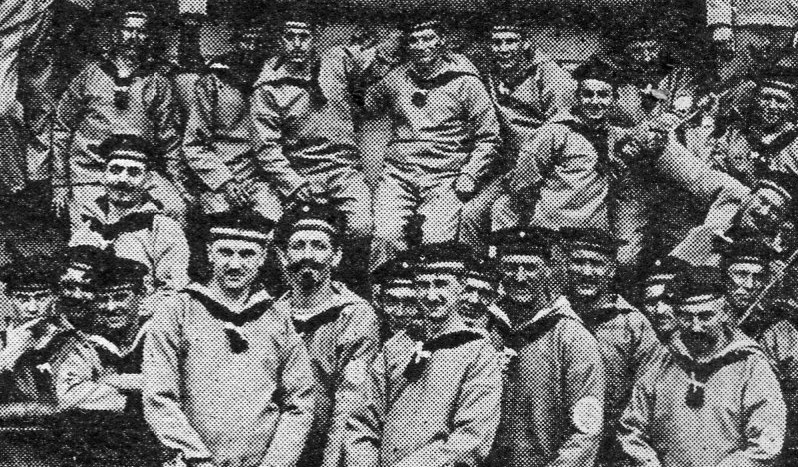
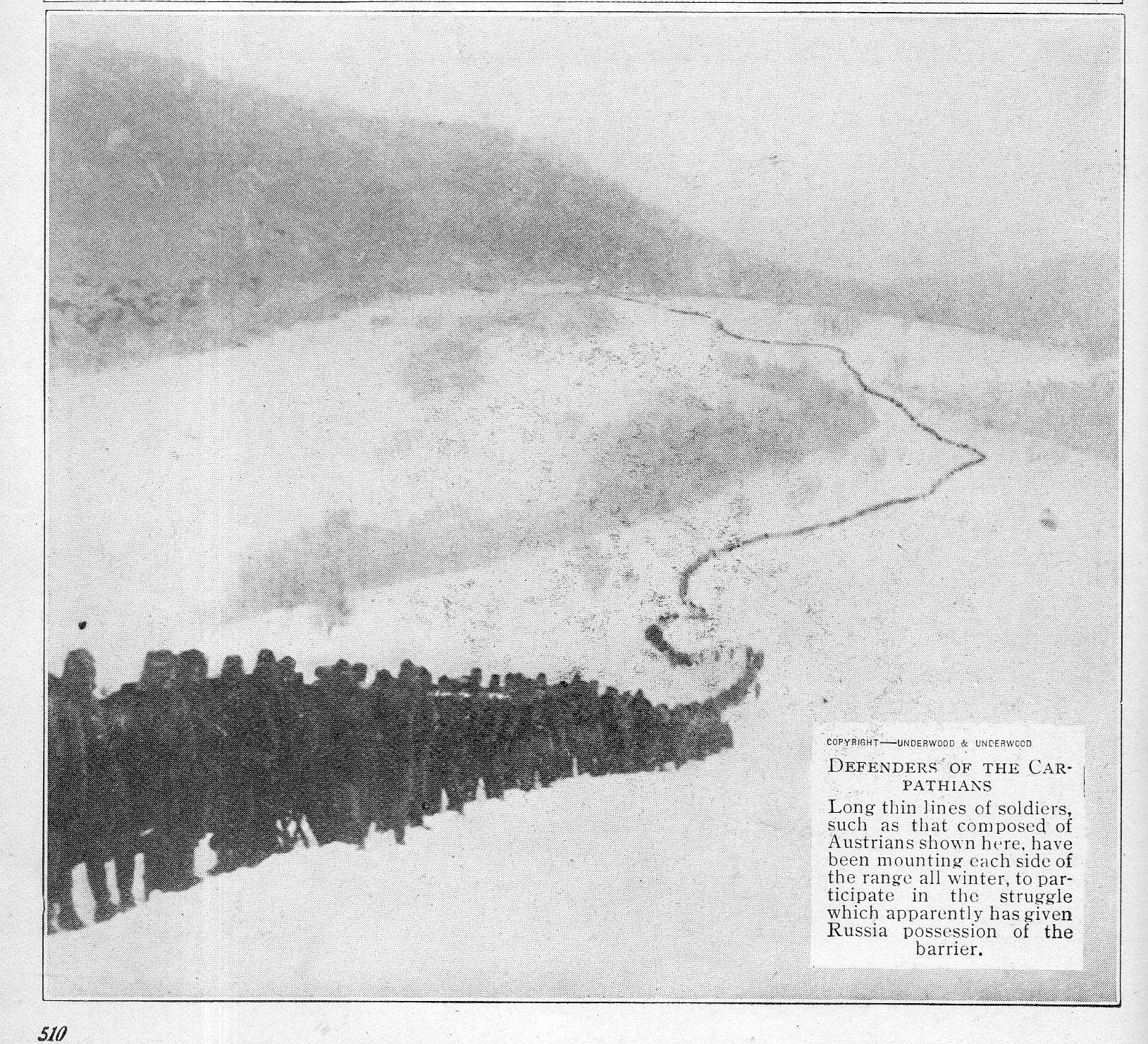
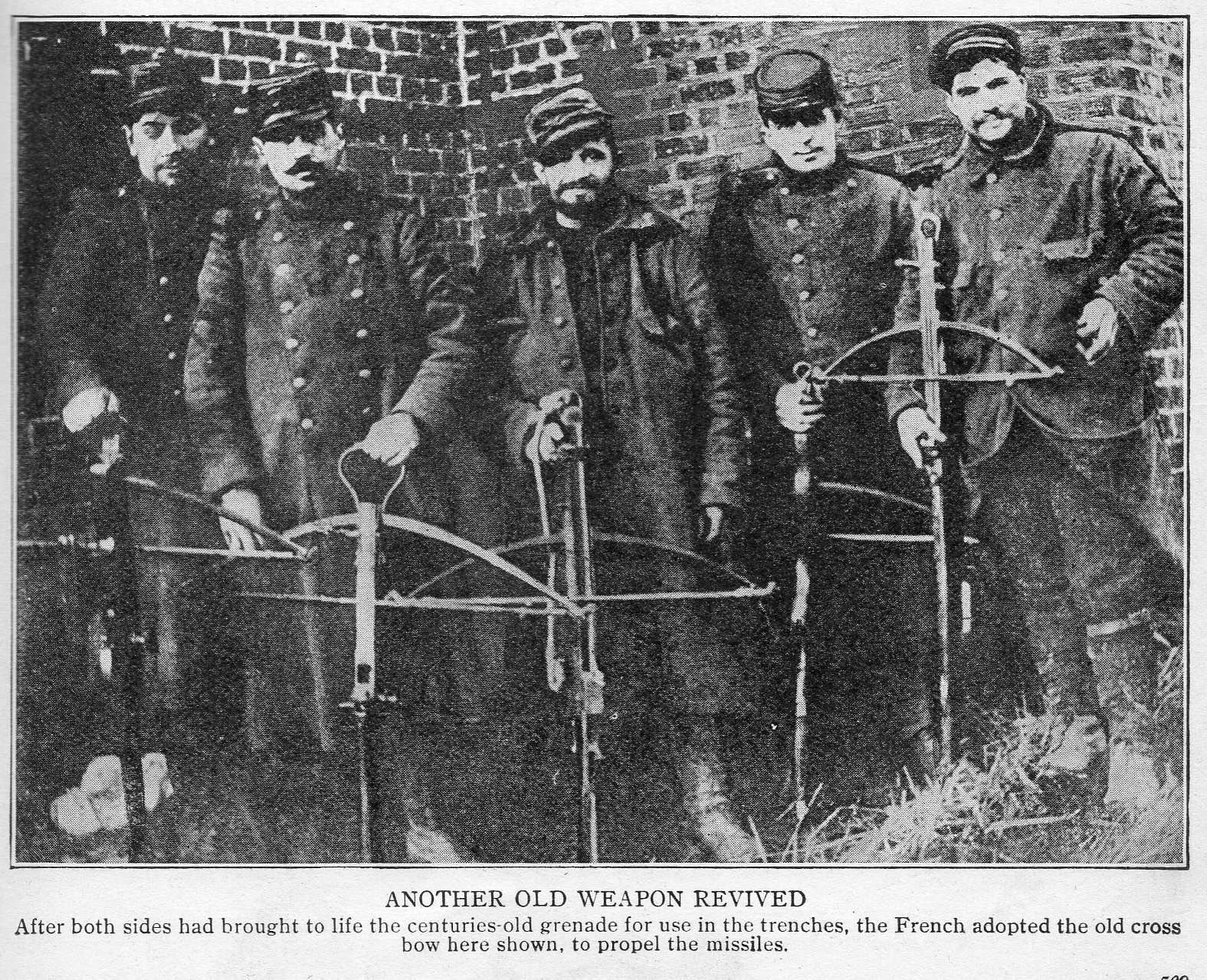
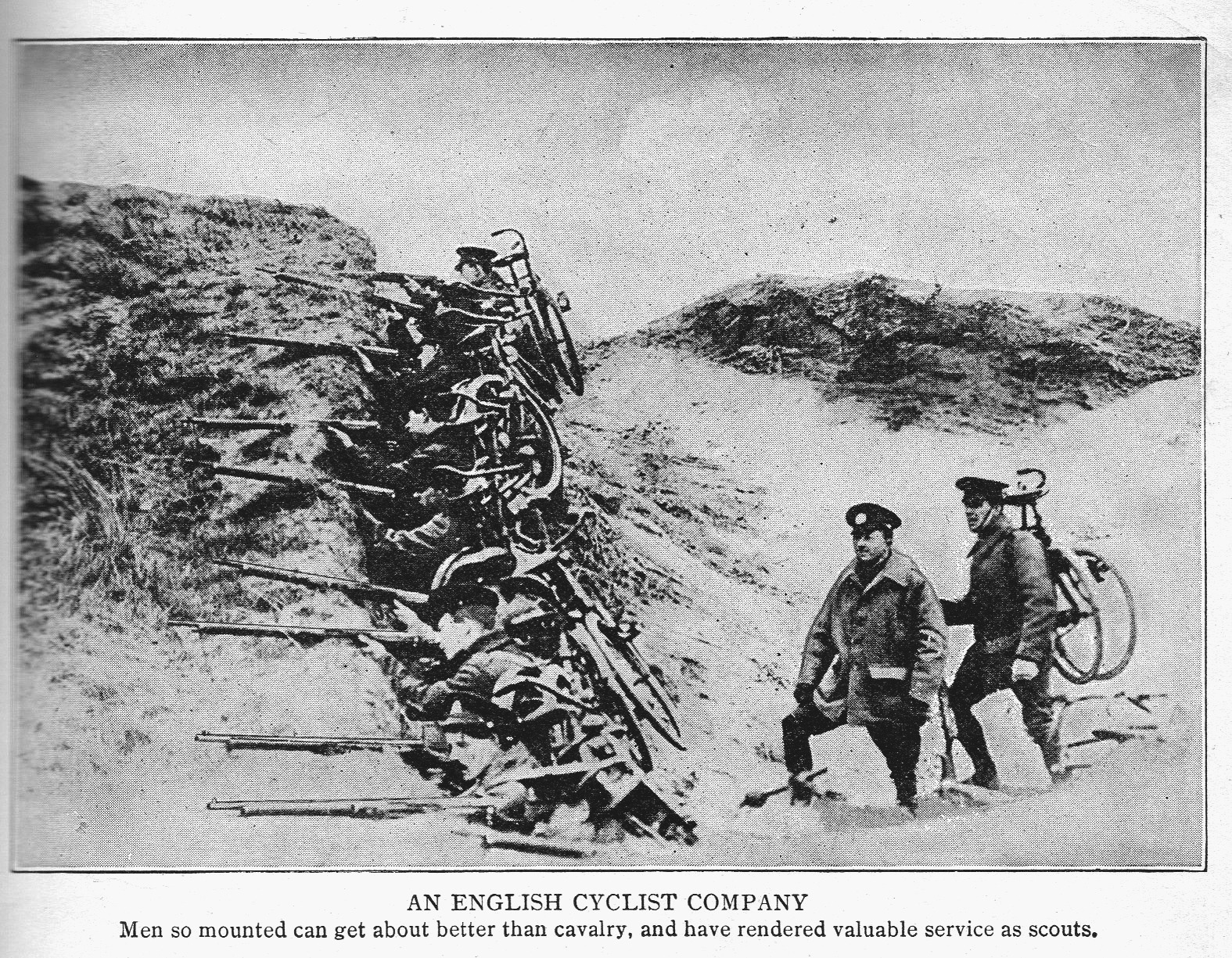
     These four photos originate in one short article in the June, 1915 issue of Technical World Magazine, each a big story in themselves, and in each, in every face, another long subset of big stories.  For example, the photo of the crew of the commerce raider Kronprinz Wilhelm, looking very relieved not to be sick or dead, internees in Virginia (and later POWs in Georgia) after a series of setbacks following a devastating campaign against the Allies at sea. 

    Wwi sailors german rescued453


    And a detail from the image: 

    Wwi sailors german rescued detail 453


    And this one, this one looks like nothing but cold, a long narrow ribbon of black winding its way through a few miles of valley, from one mountain to the next, pushing through the snow to meet some sort of fate.  Fighting in the cold, in the snow, in the wind, in the dark, without proper clothing, and sometimes without food, is unimaginable to me. The campaign in the Carpathians between Austria-Hungary and Russia in the winter of 1915 was the beginning of the idea of Total War in WWI, and the first major campaign in the Far Eastern Front that would eventually lead to massive chaos and some 10 million casualties. And this is what part of that looked like–a long line of soldiers, on the move, not well-equipped, to fight in massively hostile wintry conditions.  


    Wwi long line in snow456


     And these soldiers, with their crossbows, using them evidently to launch grenades (two antiquarian tools of war, both still very effective): 

    Wwi crossbow454


     And of course, the bike corps–I’ve never really understood this idea. Elsewhere on the blog I’ve written two posts relating to soldiers and bikes (one of whom was a bike corps airborne!) and it all just seems too heavy and cumbersome to be worth the effort of struggling with the potentially life-threatening bike.  And let’s face it–these bikes are not specialty light-weight bikes…

    Wwi bike corps455


    ·Posted by :

    ·in:

  • The Modern Rancher: Bombing Sheep from Planes (1917)

    JF Ptak Science Books  Quick Post

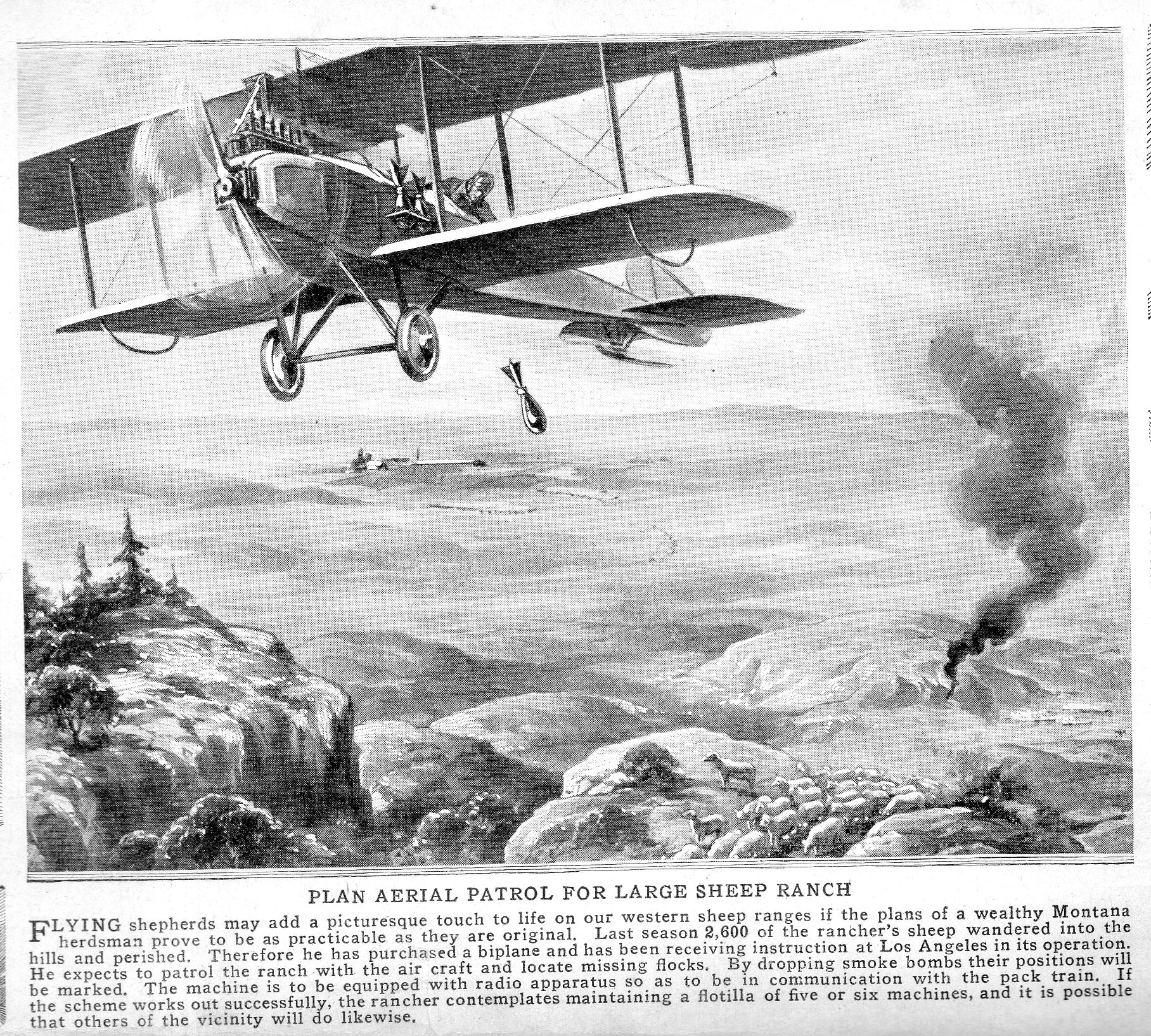
    I’ve made a number of posts to this blog on the history of aerial bombing, and throughout most of the early history of bombing (say up to the end of WWI) the vast majority of the uses of dropping bombs from airships and airplanes has been for killing people and destroying property and infrastructure. There has been an occasional stray article that I’ve found about delivering mail by non-exploding bombs–this to save time and fuel in landing/taking off (there have been other plans to deliver mail by rocket, but that is another story)–but the other uses of dropping b on things from the sky have been, shall we say, “limited”.  And then today I’ve stumbled upon this one–shepherding by dropping bombs near sheep.  This story, found in the pages of the June, 1917 issue of Popular Mechanics, details the plans of a wealthy Montana rancher to patrol his flock using aeroplanes and bombs. It is said in the caption that if the initial tests with the practice are successful that he may use six such planes at his ranch.  I’m looking for metaphors for this story, but the only thing I’m coming up with is adding a lot of exclamation points and underlinings to words like “leads” and “makes” in Psalm 23.

    Bombing sheep458

    ·Posted by :

    ·in:

    —
  • Electrocution in Trench Warfare (?), WWI (Patent for “Electrifying War”, 1917)

    JF Ptak Science Books  Post 2623

    In my limited knowledge of World War I I  have been exposed to various ways in which trench warfare was conducted–there was of course the infantry charge with guns and bayonettes, snipers, artillery bombardment, aerial bombing and strafing, land torpedoes, tank assaults, underground/sapper bombings (in which mines are laid underneath the trenches via tunnels, and of course gas, among other things, but I have not until today encountered electrifying to air in a trench to “incapacitate” soldiers.  And by “incapacitate”, according to my reading of the patent for this mode of warfare, I do think that it talks about electrocuting soldiers. With my limited non-interwebtube sources, I haven’t found any other references to this, so perhaps it was anomalous, or against the sense of decency of warfare that was even beyond the sensibilities of using poison gas.

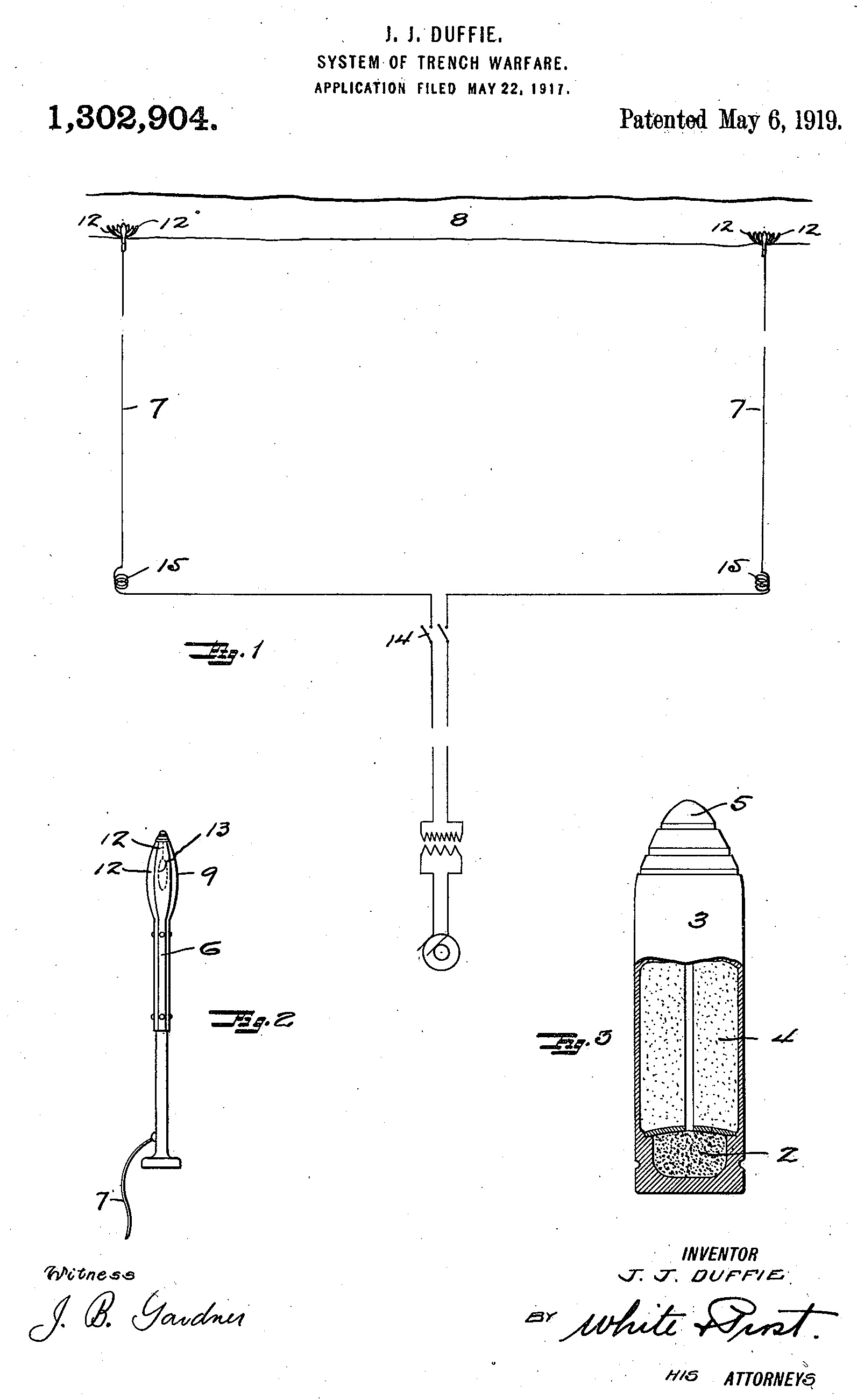
    Patent trench electrocution The work was by J.J. Duffie, US Patent 13029041, which was applied for in 1917 and granted May, 1919 (seven months after the war, though the idea could haven been used “patent pending”), and was called “System of Trench Warfare”, the patent stating  that “An object of the invention is to destroy or incapacitate that portion of the enemy occupying a trench” and “(a)nother object of the-invention is to provide a system for waging warfare by electricity”. 

    And so according to the patent, “The system of warfare of (the) invention consists in filling or charging the air over and in a trench or a section of trench with finely divided particles of an electricity-conducting substance and then causing a high potential electric current to flash through the conducting atmosphere in the trench. The conductive material may be mercury vapor or flake graphite or other substance which will remain in suspension in the air. This material is dispersed in trench from explosive shells provided either with time or impact fuses and by directing a barrage fire of such shells at the trench, the air will become very heavily charged with the conducting templates attached to opposite sides’of a source of high potential are then fired at the ends of the trench and by closing the circuit, the high potential current will are through the conducting material in the air, producing an are extending for the length of the trench section. The arc will have the effect of incapacitating the men in the trench.”

    I don’t understand how you would place the “conducting templates” at the ends of  the trench, but so be it. 

    The following explains the elements of the patent drawings:

    “Fig 1 is a plan view of a trench, with the electrodes forming part of my system disposed at the ends thereof.”

    “Fig.2 is an elevation partly section of charge 2. This charge may be exploded by a fuse or detonator controlled by the cap 5, so that the explosion of the charge may be timed or may be caused by impact. A sufficient number of shells are fired to completely fill the air in the trench with the conductive material, and then an electrode projectile 6 is fired at the trench at each end of the prepared zone or at suitable distances apart, depending upon the potential employed.”

    “The electrode projectile may be fired from a Lyle gun, such as is used in marine life saving work. Attached to the projectile is an electric conductor, preferably in the form of an insulated wire or cable 7, which is carried forward to the trench 8 by the projectile. The head 9 of the projectile is preferably formed of a plurality of. overlapping sheet metal leaves 12 covered on the outside with some insulating material and the cable 7 is connected to these leaves.- A small charge 13 of explosive within the head is exploded preferably by the impact of the projectile, causing the leaves to spread out, to present their clean surfaces to the charged air. A switch in the circuit is then closed, or is previously closed, causing the high potential current to bridge the highly-conductive gap in a flash. The cables and the outer surfaces of the electrode leaves are insulated to prevent grounding and the cables are arranged in coils 15, sot readily carried forward by the projectiles.”

    In closing the patent is described in ten different ways, including

    (7) “An explosive shell containing a charge of material which on the explosion of the divided form in the air in shell forms an electricity-conducting zone in the surrounding air. 8. The method of trench warfare, which consists ‘in making the. atmosphere in a trench electrically conductive and (passing a high potential current through a conductive atmosphere.”

    ·Posted by :

    ·in:

    —
  • The Slim Ubiquity of Smiles in Patent Reports, 1850-1925

    JF Ptak Science Books   Post 2623

    “Better is the last smile, than the first laughter.”–J. Heywood Dialogue Prouerbes Eng. Tongue, 1550. 

    Young communist league detail


    I haven’t written very often on the word “smile” on this blog–less than ten times in 4000 posts, I think. (“Did Teeth Exist in the Renaissance?”, “The Mystery of the Sun’s Missing Smile”, “Is the Mona Lisa’s Smile Nothing?”, that sort of thing, all searchable in the Google search box.)  This came up this morning because I had an idea for morning coffee to check out “smile” in a patent search for 1850-1925 to see what sort of smile-somethings existed in the Patent Office records.  It turns out that even though “smile” appears in two dozen patents for this period, none of them are about the smile of smiling; rather they’re all anthropomorphized for varied and unrelated purposes–except that the thing it is they refer to looks like a “smile”. I thought I’d find something for an artificial smile, or smile-maker (whatever that would be), or something along those lines, but no.

    The differences in the patents in which the word “smile” was used is pretty impressive, and can almost approach a found-poetry status, but not quite–the word appears describing elements of patents for: chuck for bowspirits (1908), production of fertilizer (1918), window cleaner (1909), antifriction cage for roller-bearing rollers (1910), mechanism for a milking apparatus (1919), self-closing funnel (1913), life vest (1912), guide for a molding apparatus (1909), car-coupling for railroad cars (1876); bridle bit (1909); convertible freight car (1914), design for a horse shoe calk (1897), design for a stool (1885)…there are some others, but I think the point is made. Even though the word “smile” is used in many different ways to describe divergent pieces of machinery, they don’t really have anything in common from one patent to the next, save for the anthropormorphized shape of the object, which I find amusing. 

    The slightly odd thing that I have found in this adventure is that “smile” doesn’t seem to makes its way into English until 1550 (?), at least according to the OED, which sources the opening quote above from J. Heywood as the first appearance. Perhaps my post on “Did Teeth Exist in the Renaissance?” which is really about the smile in art shoud have asked that question more directly about the word “smile”…

    ·Posted by :

    ·in:

    — —
  • Acknowledging the Murder of 4 Million Jews, 1944

    JF Ptak Science Books   Quick Post

    Uhl 400k _4_

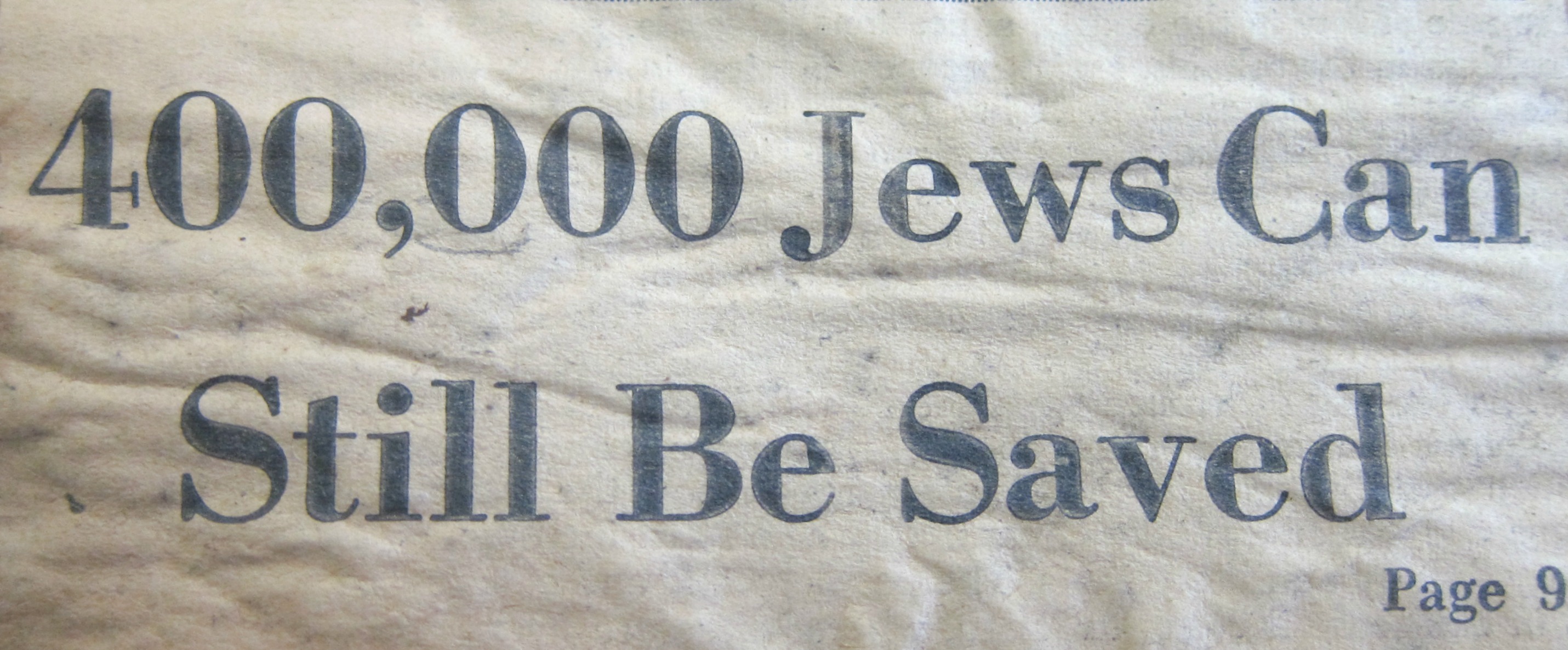
    I have posted on this blog many times on the Holocaust, and in my reading travels in that area I do not often see contemporary reporting using massive numbers to describe what was happening to the Jews. I own a part of the archive of Alexander Uhl, a superior reporter who had seen fighting in the Spanish Civil War while covering the war there for Associated Press, and who had also covered  WWII in Europe, reporting for the great PM newspaper and for which he was awarded the French Legion of Honor medal.  As I was looking through a collection of his snipped articles from PM for 1943 and 1944 I came upon this, on coming to the rescue of 400,000 Jews who could “still be saved”, which for some reason appeared on page nine of the old-line Leftie newspaper.  

    Uhl opens the July 31, 1944 article talking about having covered the Bermuda Conference  (“a most unhappy conference if there ever was one”, in late April, 1943), where U.S. and U.K. representatives (of not particularly high standing) met to discus how to save the remaining Jews of Europe. Uhl reports that affairs were no closer to a solution 14 months later than at Bermuda, where the conduct of the war was of primary importance and the “refugee problem” not. (There are many variations and interpretations of the Allied response at this conference,  though from my reading the majority approach a withering appraisal of the thing.1)

    Uhl then goes on to cite the Jewish Agency for Palestine that two-thirds of the 6.5 million Jews of Europe (in 1939) have disappeared, “either killed by the Nazis or died of suffering and privation”. That is a big number. (I am in no way saying that this is an historic assessment, as there were numerous other reports on the murder/disappearance of millions of Jews, examples of which can be found in contemporary newspaper accounts relating to the Bermuda Conference. I am stopping here today because it still seems to me to be a rare-enough discussion of a large number of murdered Jews to make notice of it.) 

    Uhl gets to the point of his story, which is to say that there were 400,000 Jews in Hungary can still be saved if there were enough ships to transport them and enough places to accept them. “If not, they will be doomed to the same fate as the rest of Europe’s Jewry”.  Uhl makes note of the 1500 entry permits allowed for Jews  into Palestine as dictated by the government of Great Britain, which as Uhl reported showed no inclination to change anything.

    I reprint the article below for the rest of the story.  (I ma told by someone who knows that PM is a rarely-held newspaper in institutions and does not often show up online.) 

    ·Posted by :

    ·in:

Recent Posts

Archives

Categories