A Daily History of Holes, Dots, Lines, Science, History, Math, Physics, Art, the Unintentional Absurd, Architecture, Maps, Data Visualization, Blank and Missing Things, and so on. |1.6 million words, 7500 images, 4.9 million hits| Press & appearances in The Times, Le Figaro, Mensa, The Economist, The Guardian, Discovery News, Slate, Le Monde, Sci American Blogs, Le Pont, and many other places… 5000+ total posts since 2008.

  • Rare Eyewitness Holocaust Account Reproduced in Full (1945)

    JF Ptak Science Books   Post 2618


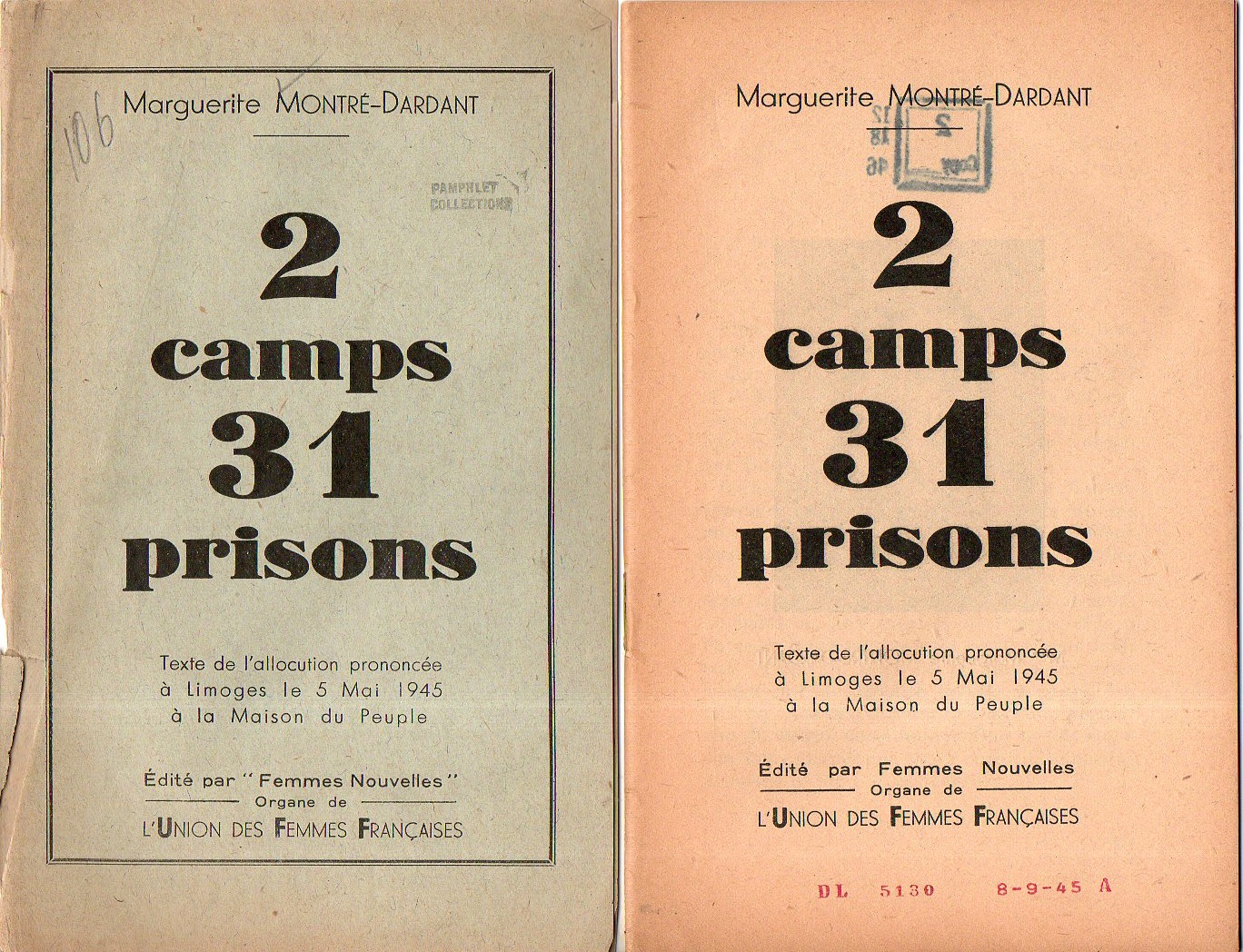
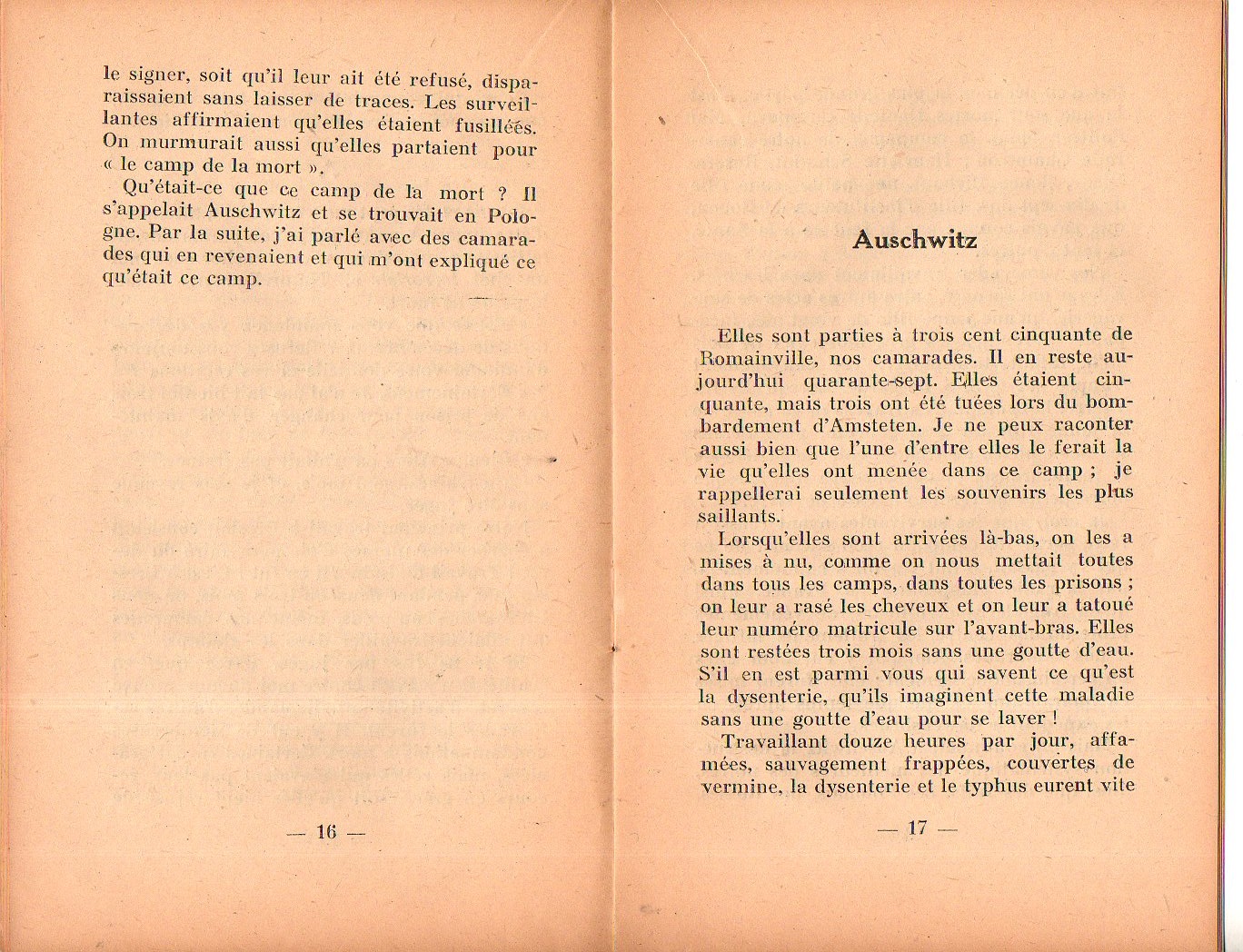
    I recently unearthed this rare eyewitness account of Nazi concentration camps, printed in 1945.  Since there are only two copies of it located by WorldCat/OCLC, and I’m finding no mentions for it online, I’ve decided to reproduce it online.

    2 camps 31 prisons305


    2 camps 31 prisons i313


    The work:   Marguerite Montré-Dardant,  2 camps, 31 prisons,  texte de l’allocution prononcée à Limoges le 5 mai 1945.. préface de Fonvieille-Alquier. 32pp. (with sections on Auschwitz, Ravensbruck, Mauthausen).

    Full text (4 meg file) :  Download Montre-Dardant


    ·Posted by :

    ·in:

  • A Grant Wood Landscape in a Renaissance Painting

    JF Ptak Science Books   Quick Post

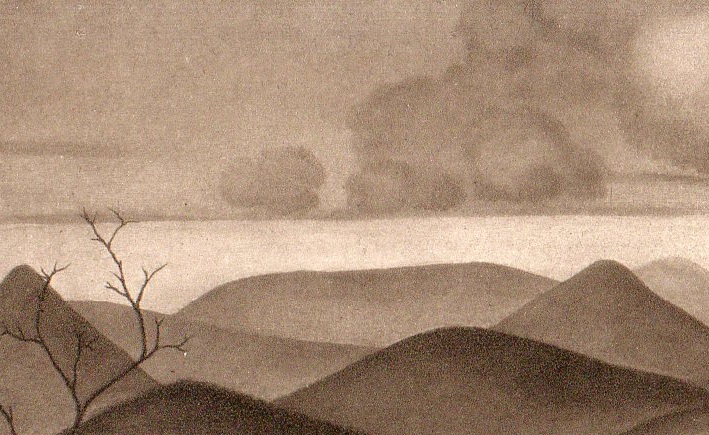
    This landscape brings to mind a certain style if not a particular artist, someone working  a lonely, cool-if-not-cold landscape, and although the terrain is certainly representational nothing on the hills seem to be, save for the tree in the foreground. It seems a little in the school of Grant Wood, or 1930’s, or something along those lines.


    Bellini_3_414


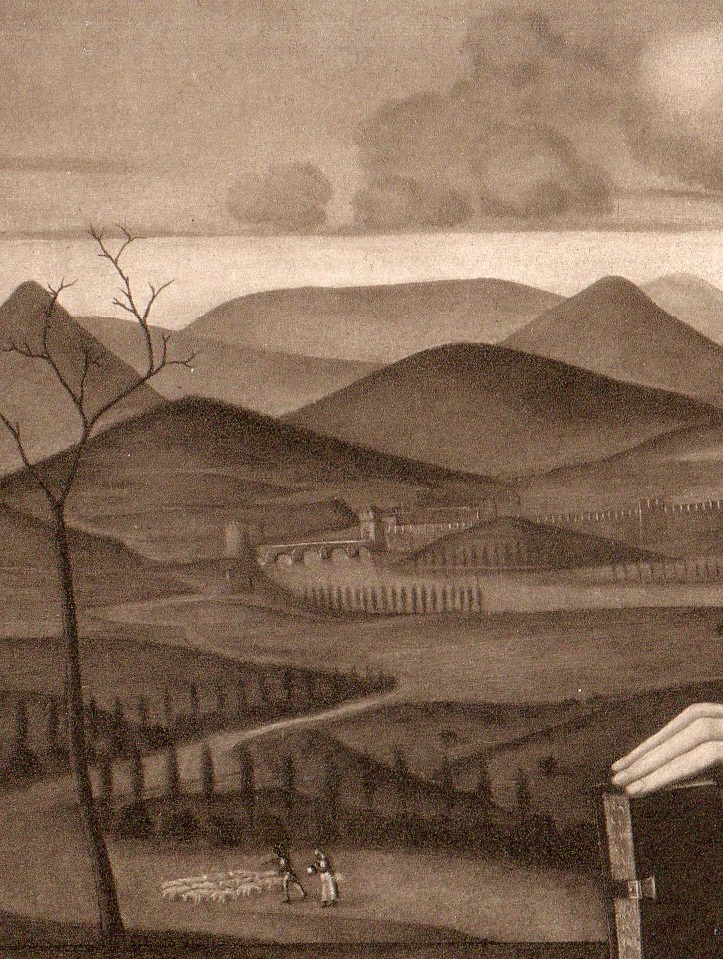
    The image is a detail, and when you pull back a little, there is more a suggestion of time and place:

    Bellini414


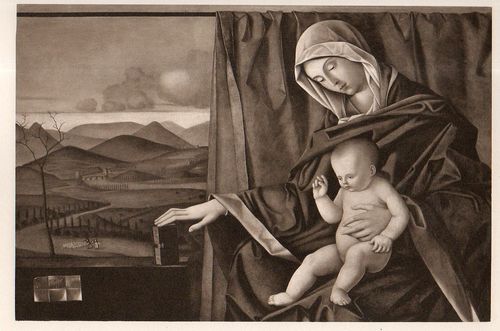
    When I look at the scene in context, it becomes very confusing, because it is sitting in the background of a painting by Giovanni Bellini, which was painted ca. 1500. There is no doubt that this is a Renaissance painting–but for me, seeing this grab of a modernity 400 + years into the future, I wonder what it was that moved Bellini in this way.  


    Bellini413

    [Source:  a catalog for the sale of the paintings collected by the Bourgeois brothers (which is also a good band name), Catalogue des Tableaux Anciens et Modernes composant la Collection Bourgeois Freres .printed in Cologne, 1904, painting number 3. ]


  • Recognizing Nazi Propaganda, ca. 1943

    JF Ptak Science Books   Post 2619

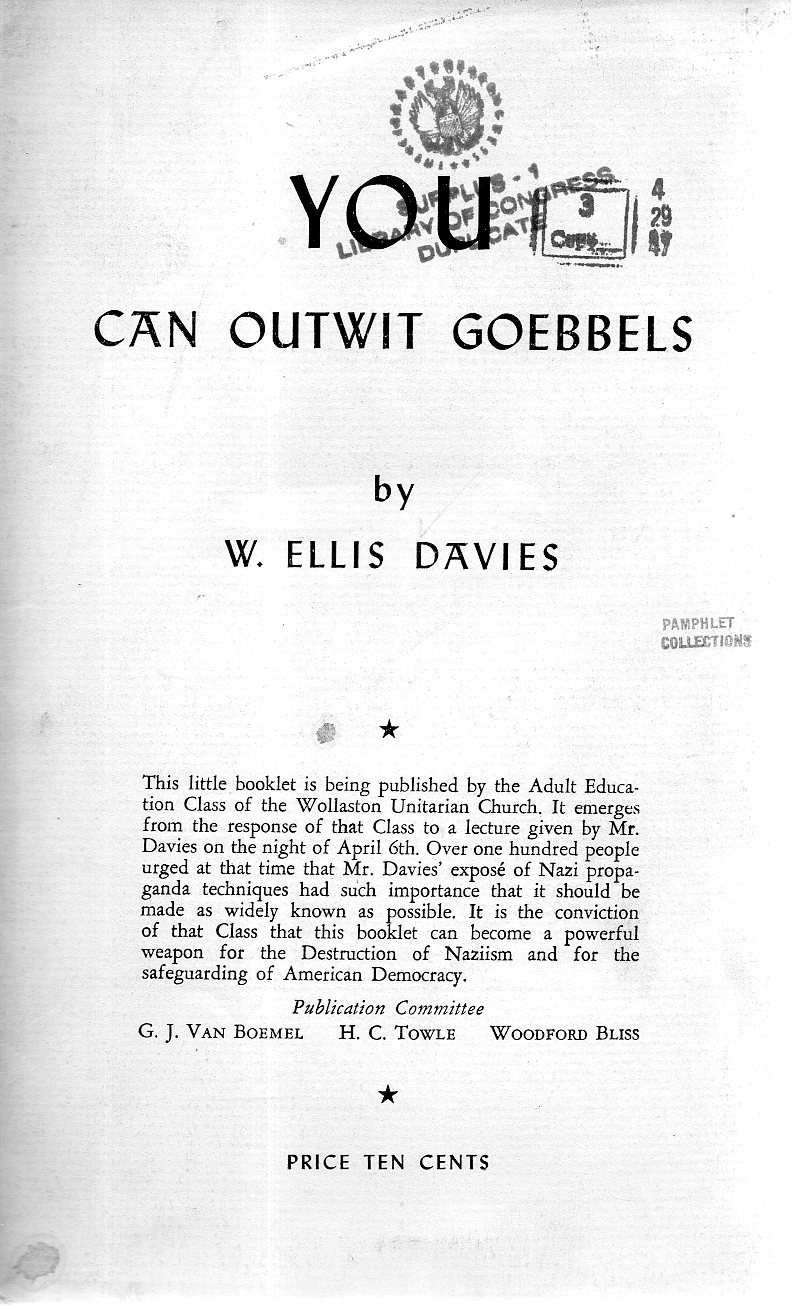
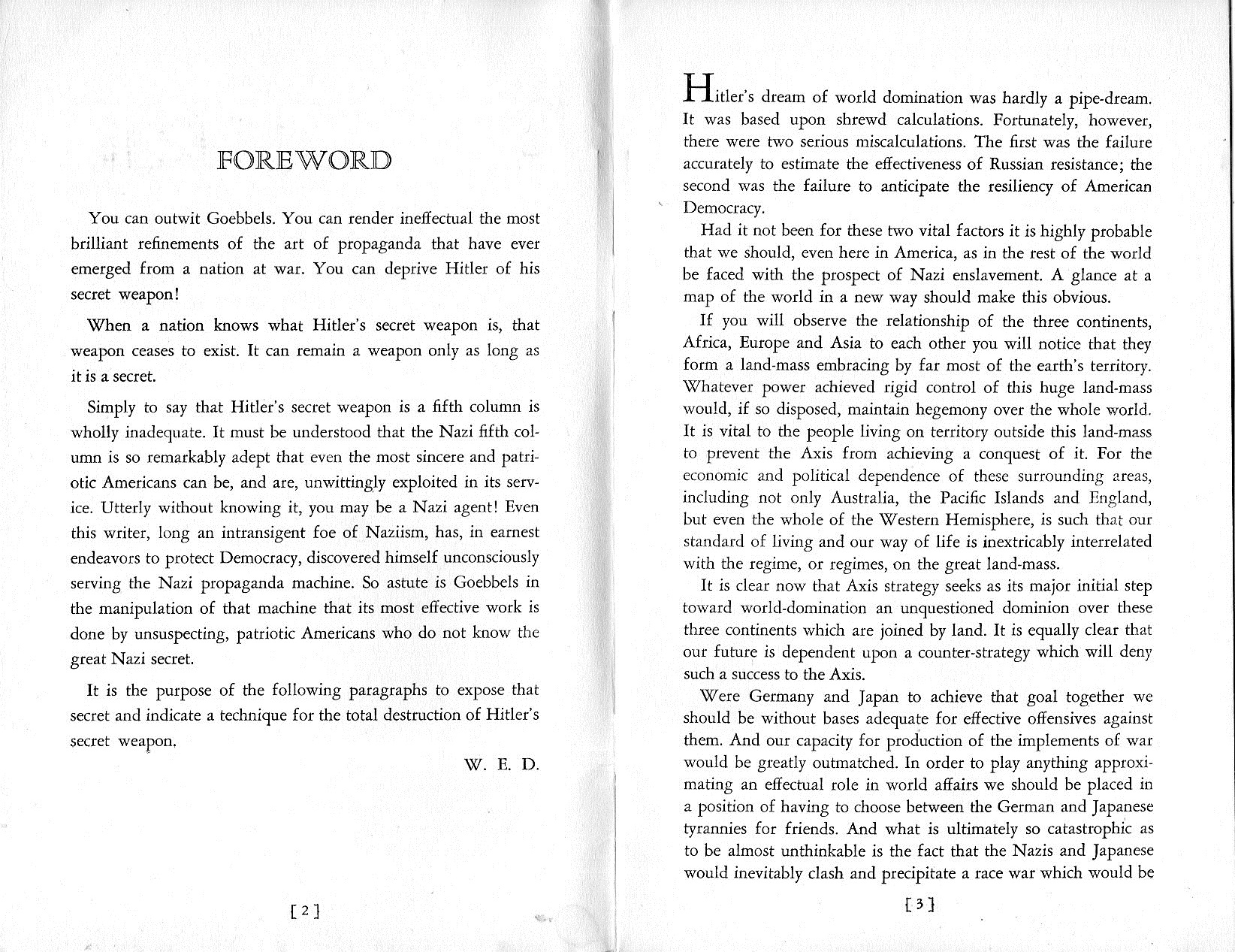
    This is another in this blog’s reprint series of rare and semi-non-existent pamphlets.  Although this pamphlet has a somewhat lazy title it does get the point of its contents across, which was mostly how to recognize and challenge Fifth Column work by the Nazis.  It is only 15 pages long but there’s actually a lot of good common sense on what to do with propaganda–it is really just an invitation to think for yourself.  I couldn’t find any reference to this online, and there are no copies of the work found in WorldCat/OCLC.  Here it is, in full:  Download Reprint series– You Can Outwit Goebbels:

    You can outwit goebbels 415


    You can outwit goebbels 416


    Download Reprint series– You Can Outwit Goebbels:


    ·Posted by :

    ·in:

    —
  • Soviet Investigation of Nazi Atrocities, 1943

    JF Ptak Science Books  Post 2620

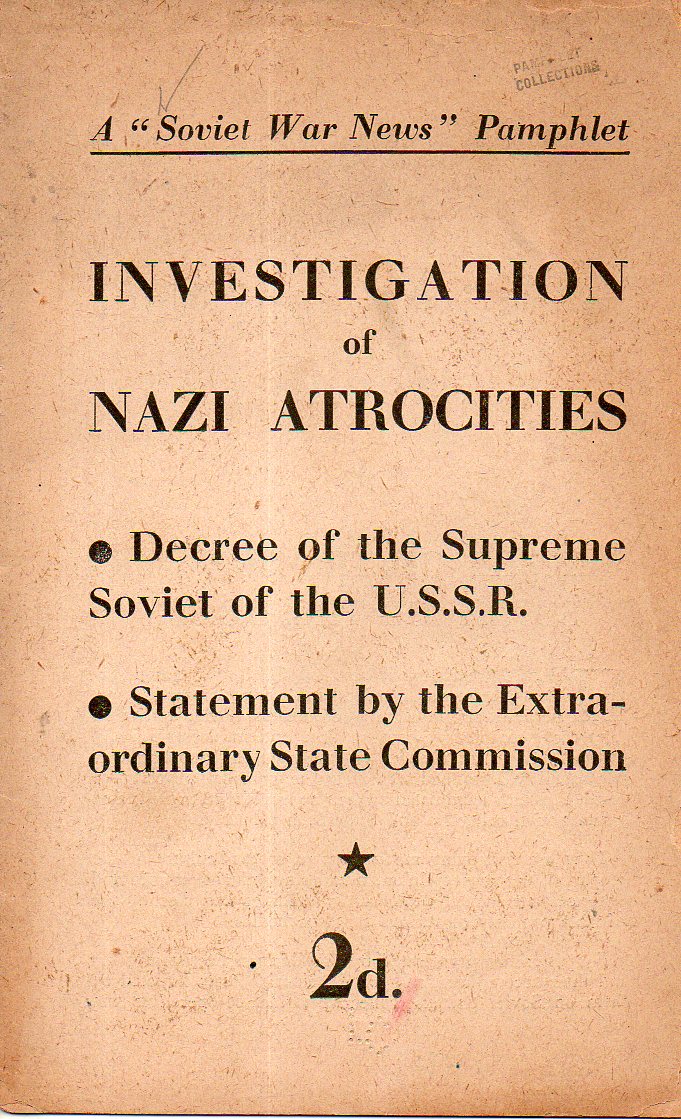
    Nazi atrocities423This rare report asserts and outlines all manner of Nazi war crimes committed against the Soviet Union to April 1943 and issues an official call to keep track of every horror in the form of the  Extraordinary State Commission to Investigate Nazi Atrocities via a decree of the Supreme Soviet. At this point the German attack against the U.S.S.R. was nearly two years old and involved the majority of the German army; in April 1943 nearly 4 million German soldiers were waging war against about 10,000,000 Soviets in the largest military campaign in history, ultimately costing the lives of 10 million Soviets and 5 million Germans, with millions more on each side being MIA and captured–staggering numbers.In the midst of all of this the Germans flayed the Soviet Army, people, and land, and the Russians were very highly decided that now that the turning of the offensive was in sight (now just a few months after the great victory at Stalingrad),that they would absolutely not forget anything that the Germans did there.  This fragile pamphlet was one announcement of this intention.

    I’ve attached the full pamphlet, below, a text-only reproduction from the Internet Archive–I would reproduce my copy with the full flavor of the original except that it might not survive being opened and folded flat over the scanner.  

    Some of the prominent statements in the pamphlet include the murder of the civilian population as well as their enslavement. Lastly, at the end of this grim spectacle, there is a section naming the German officers responsible for the mass of killing and torture. 

    • “the murder of peaceful citizens and the violation of defenceless citizens, women, children and old folk by the
      invaders, and also of facts relating to the exportation of Soviet people into German slavery”
    • “destroying monuments of art and culture of the plundering valuable artistic and historical documents,
      demolishing buildings and stealing the valuable property of various religious bodies.”
    • “losses inflicted by the marauding and plundering activities of the German Fascist invaders on collective farms, co-operatives, trade union and other social organisations by the plunder and destruction of buildings, devices and equipment designed for production and cultural purposes, by the plunder or destruction of stores of raw and other materials, products and goods, agricultural crops, forests, fruit, vegetables, etc., and other collective farm and co-operative property”
    • “…torturing and murdering peaceful citizens. They are plundering wholesale the population of towns and villages and exporting the personal property of Soviet citizens, accumulated by their honest labour, to Germany, together with collective and State farm property.”

    And this incredible statement of truth:

    • “the German-Fascist Army mercilessly destroys Soviet towns and villages, engages in violence, torture and the tormenting and murder of non-combatant citizens as well as of Soviet war prisoners. History has never before witnessed such mass extermination of human beings as that perpetrated by the German-Fascist invaders. ” There is a full section on the “Murder and Torture of Soviet Civilians”.

    There’s much more if you give the work a full reading.  

    [Source: Internet Archive, https://archive.org/stream/investigationofn00unse/investigationofn00unse_djvu.txt]


    ·Posted by :

    ·in:

    —
  • Speaking Photographs, 1892

    JF Ptak Science Books   Quick Post

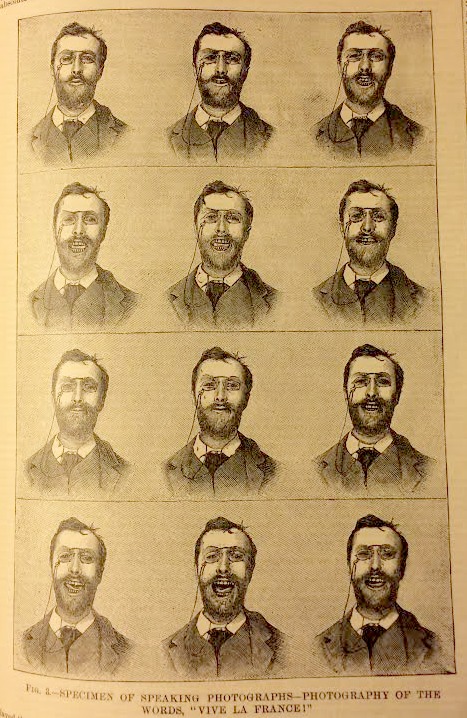
    Georges Demeny (1850-1917) was a pioneer chronophotographer and Victorian cinematographer, a visual experimentalist, an exploratory photographer, who made great contributions to the earliest history of the motion picture. He was an assistant and associate to Etienne Marey–who we have met a number of times on this blog, and who happens to be one of my favorite 19th c sci/tech figures, along with Hermann von Helmholtz, Thomas Young, and w. Stanley Jevons–before moving along on his own following a developing coolness between the two men in around 1894.  This wood engraving, which appeared in the June 18, 1892 edition of Scientific American Supplement, shows Demeny’s chronophoto work (on himself) as he studies what the face looks like when saying “vive la France”.  

    Phonophone 1892[Source: Scientific American Supplement, June 18, 1892, pp 13726-8]

    • A nice appreciation of Demeny’s contribution to the earliest cinema is found here:http://www.victorian-cinema.net/demeny


  • The pre-Google pre-Car ~Google ~Car (1892)

    JF Ptak Science Books  Quick Post 

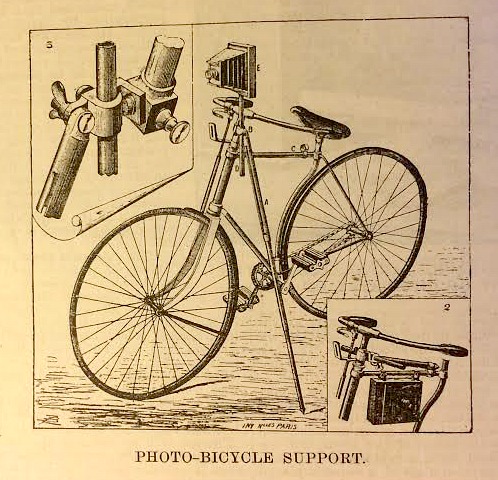
    In the four hundreds years since Columbus’ first voyage we find in the pages of Scientific American Supplement (July 23, 1892) a new mode of transport/exploration/recorder–the bike camera. Or, well, a bike with a camera-holding capacity.  Or a bike with a tripod on which a camera could be placed. I know this is a lot less glamorous than a pre-Google pre-car, but in a sense, it is.  

    Google bike


    Which reminds me of an earlier post:


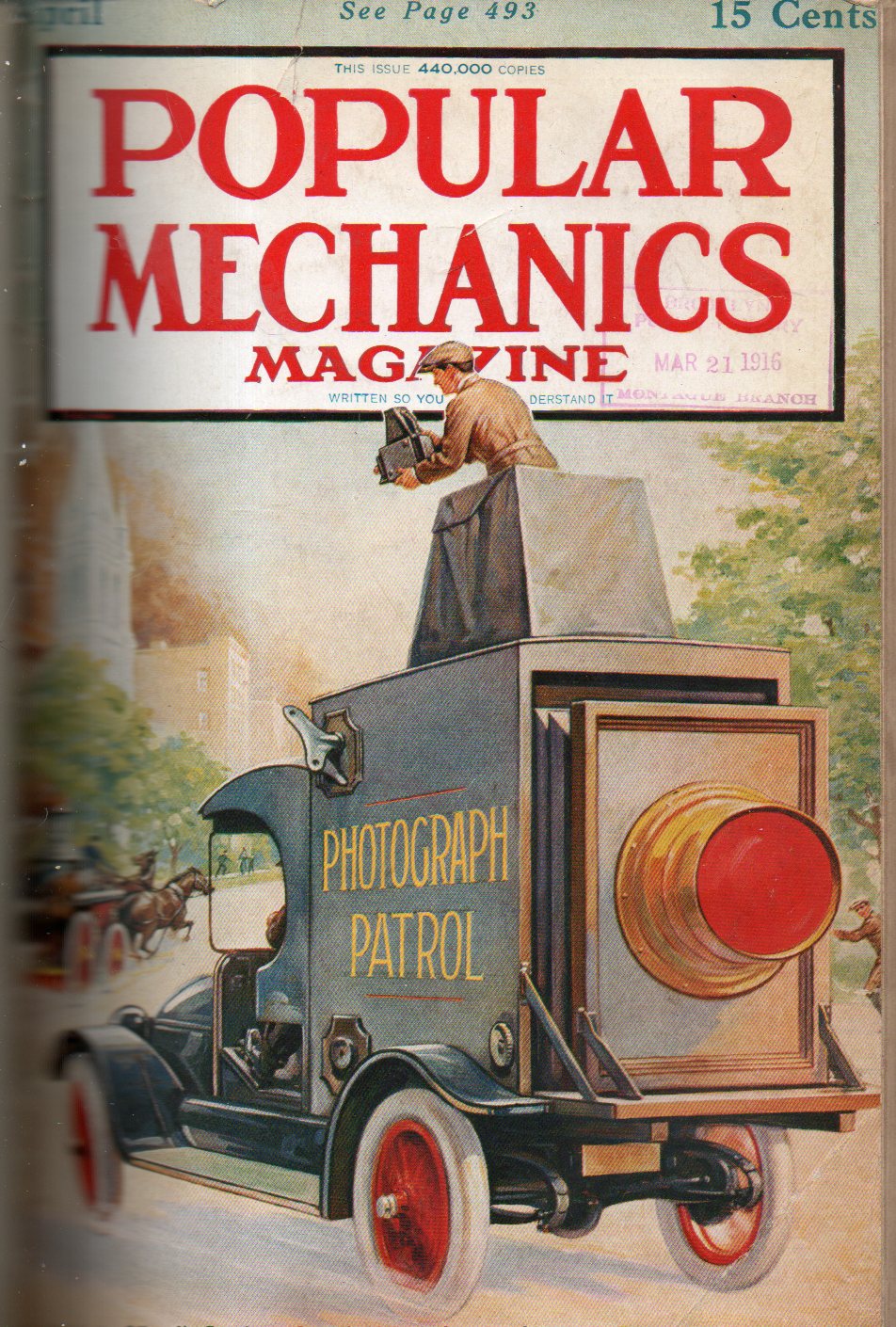
    Google car772

    [Popular Mechanics for April, 1916.]


    And this:

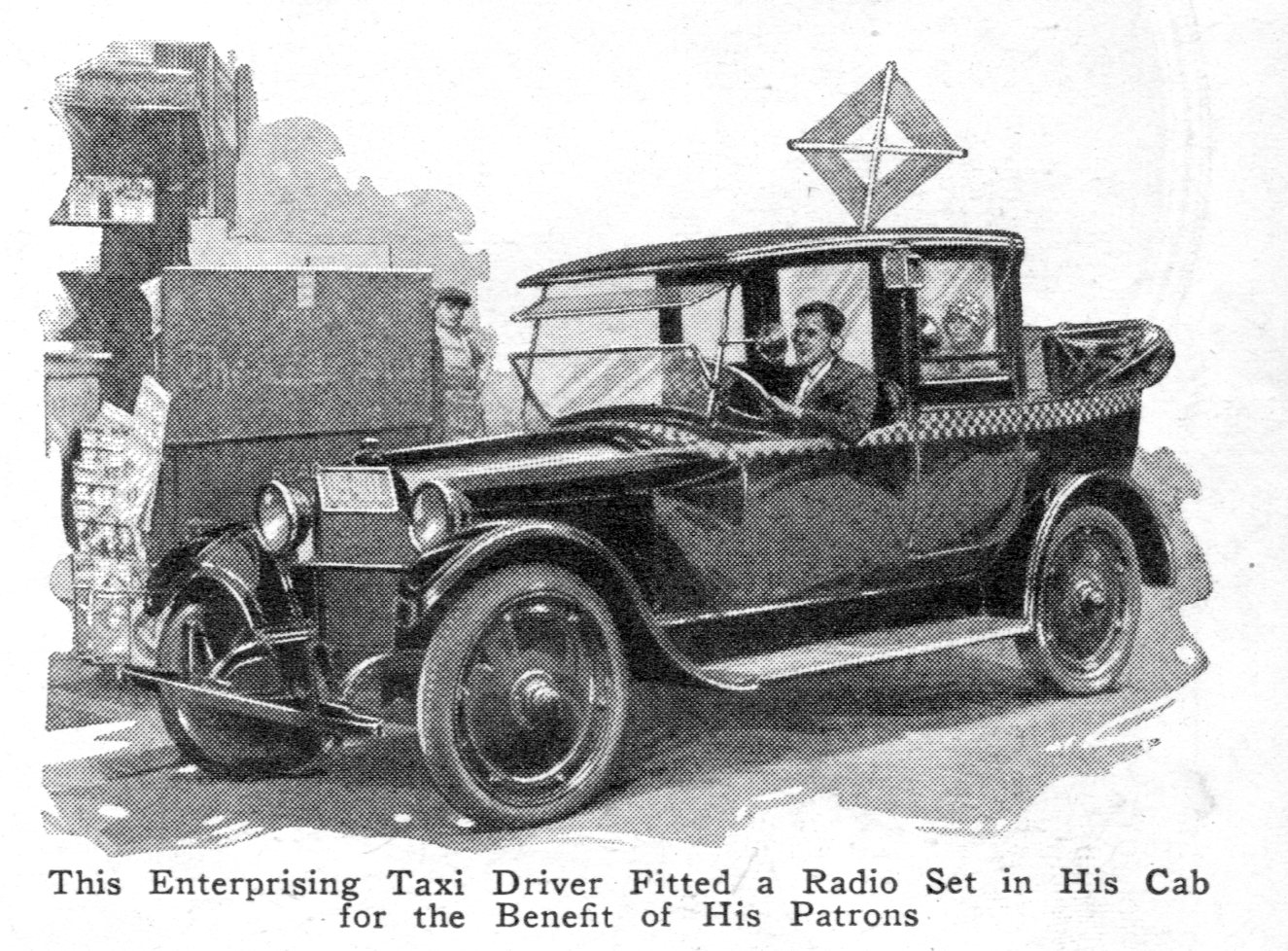
    Google radio781

    [Image source: Popular Mechanics, volume 44, October 1925]

    ·Posted by :

    ·in:

  • Fancy Walking Sticks and their Fancier Interior Lives (1892)

    JF Ptak Science Books   Quick Post

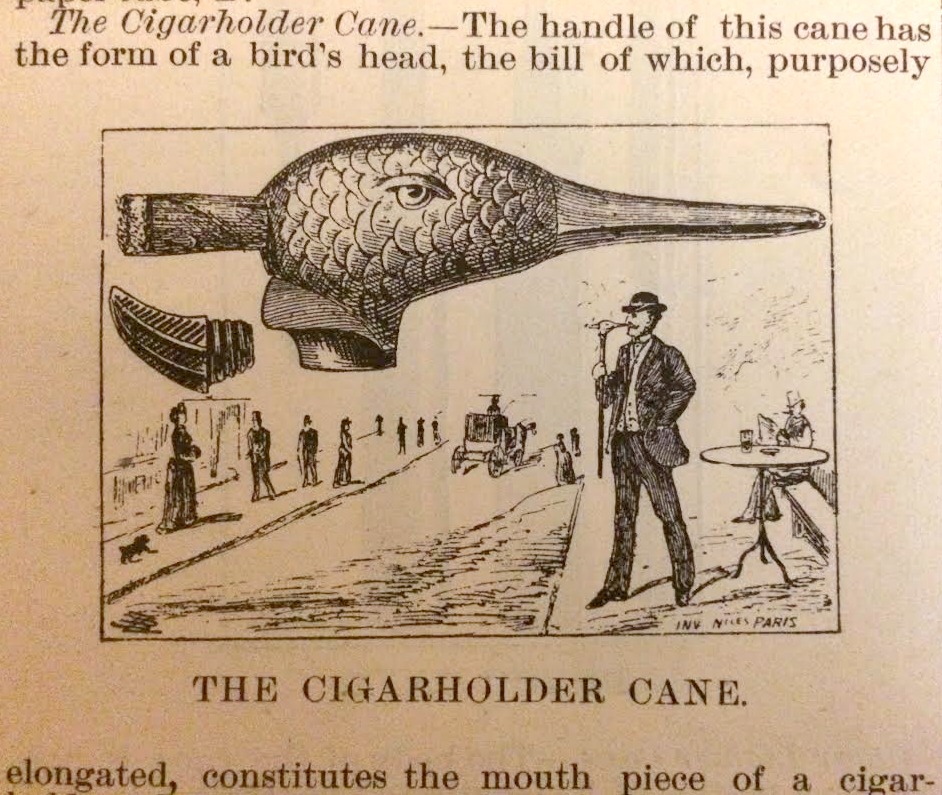
    The walking stick continued to be a “thing”–a gentleman’s pursuit of gentlemanliness, of refinement, or culture, or style, and so on–deep into the 19th century. And as we can see in this sample from the Scientific American Supplement for November 26, 1892, people were interested not only in sticks but also in what other things the cane could do for them while perhaps aiding them in walking.  Some ideas are sort of good, while others, not so.  An example of the later might be the following–using your cane head as a cigar holder allowing you to smoke your stogie through the beak of a duck:

    Cane specialists detail


    Other hidden additions to the cane were not such bad ideas, like the emergency supplies for a physician; and I guess if you going to carrying a cane for show or if you actually needed a cane to help your walk, having the cane serve another purpose was probably a good idea, or at the very least gave a cane-maker something to do beyond making a simple cane.  

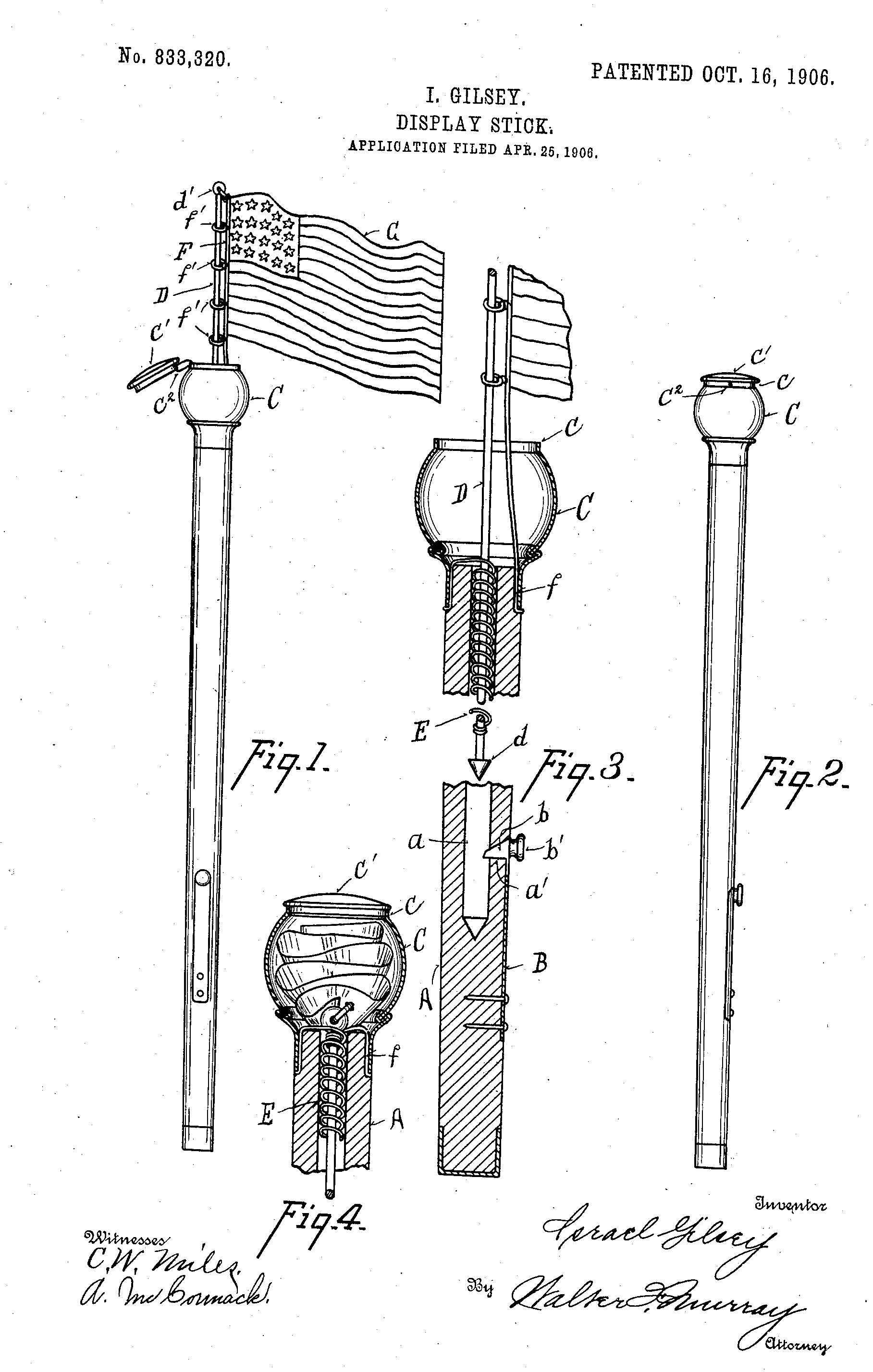
    I did have a quick look at patents for walking sticks for 1875-1925 and found that there were a number of varied patents for walking sticks with umbrellas and stools lodged inside them, which makes sense. There were a number of stick-additions that you’d expect–like that for guns, booze holders, and rulers–and then a number of unexpected contrivances, like music stands, pool cues, fishing rods, soil testers, musical instruments, cameras, lamps, a combo gun-umbrella-fishing rod, and one of my favorites, the flag pole:

    Walking stick flag

    [Source, Google Patents: https://www.google.com/patents/US833320?dq=walking+stick&hl=en&sa=X&ved=0ahUKEwj3xb3BlpvNAhUGTSYKHeJ6ADMQ6wEINDAD]

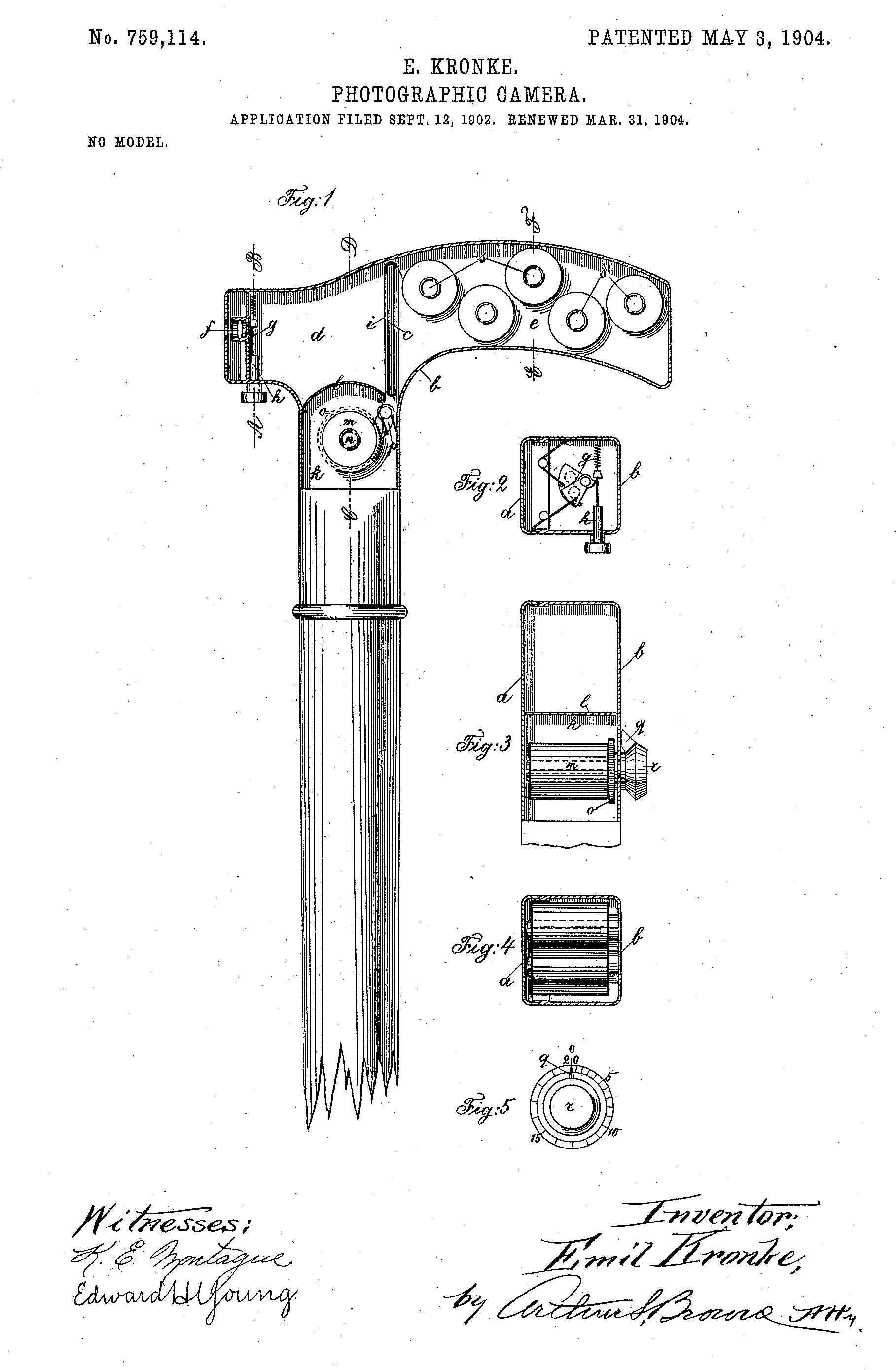
    And the walking stick camera:

    Walking stick camera

    https://www.google.com/patents/US759114?dq=walking+stick&hl=en&sa=X&ved=0ahUKEwiJtunTmJvNAhWEOCYKHT3SBBAQ6wEIUDAH

    ·Posted by :

    ·in:

  • Maps Showing Rates of Travel

    JF Ptak Science Books  Quick Post

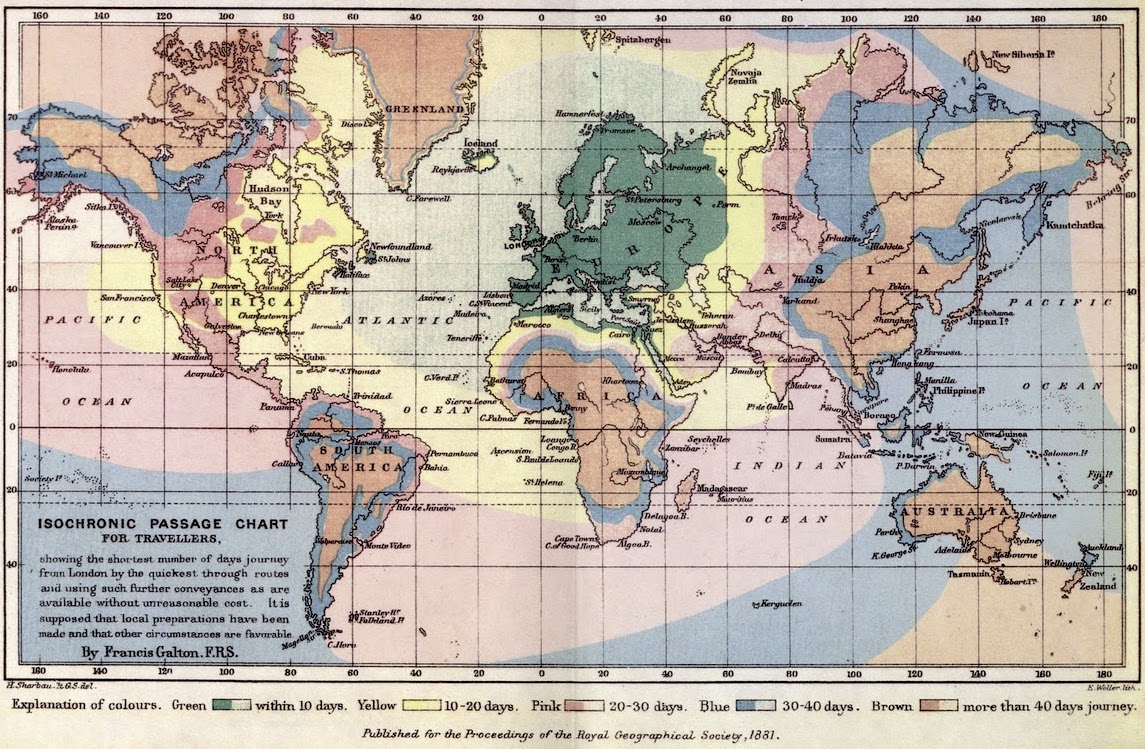
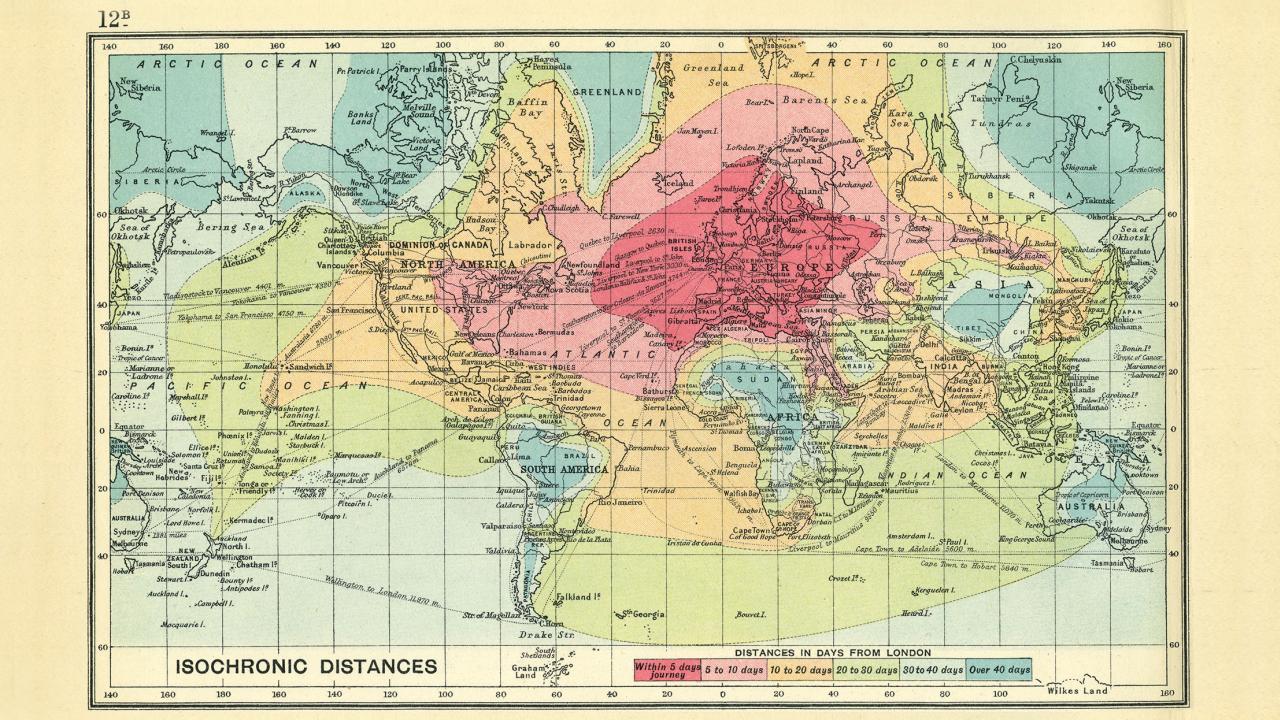
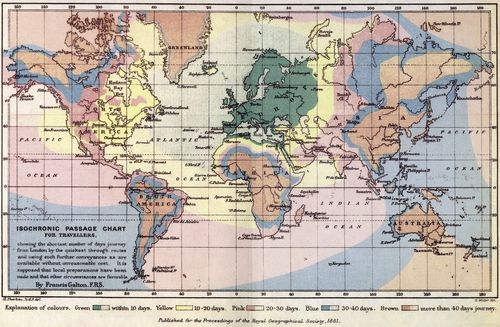
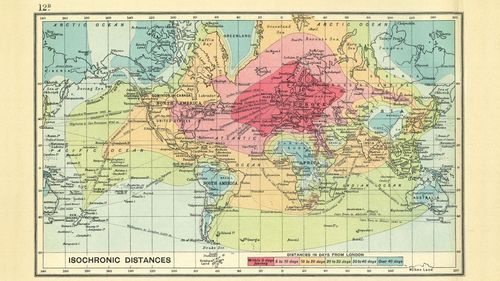
    This morning the writer Clifton Wiens alerted me to his friend’s blog Fevered Mutterings where I found the article “How Fast Do You Want to Get There?” which was illustrated with two fine early isochrone maps. The isochrone/isochronic map is a map of time travel, depicting how long it would take to reach different places from a central point, the variants detailed in colors. (For the record they all seem to assume good or normal or scheduled arrivals and departures, good weather, no impudent problems…so you probably would have to calculate for longer times, given the nature of the beast in the 19th/early 20th century.) In any event, I wanted to reproduce them here along with others that I find. 

    The first of the maps is probably the first of the isochrones, made by the very-multiply-talented Francis Galton. It appeared in 1881(and then again in 1882) in “On the Construction of Isochronic Passage Charts” in the  Proceedings of the Royal Geographical Society (Royal Geographical Society) page 657.
     

    Maps isochronic galton 1881[Source: http://feveredmutterings.com/fast-travel]


    The next example is by John G. Batholomew with his Isochronic Distance Map and Chart which was first published 1889 (and then again in 1914) in his  Atlas of Commercial Geography  or earlier
    Maps isochronic 1914

    [http://feveredmutterings.com/fast-travel]

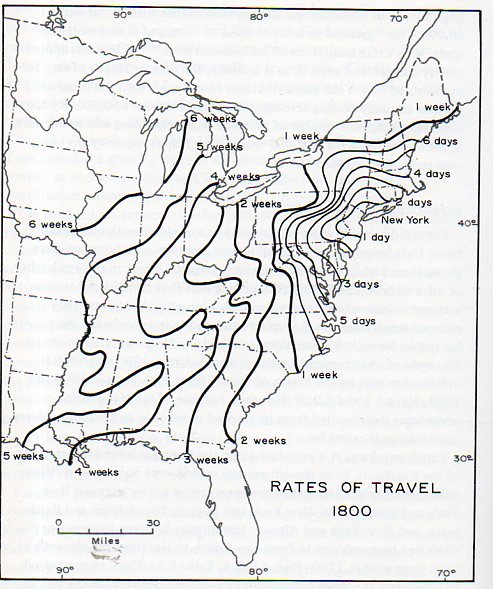
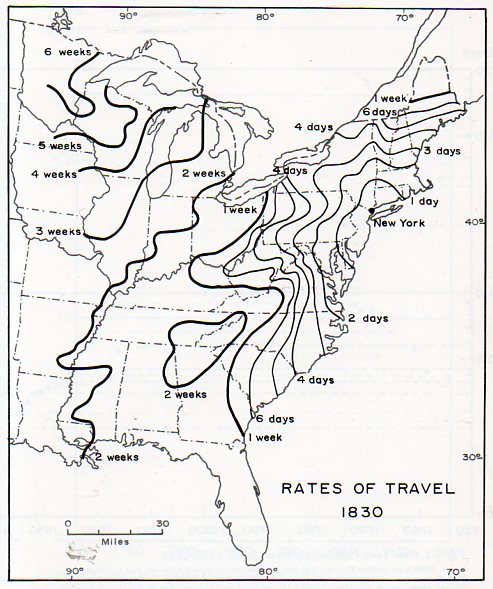
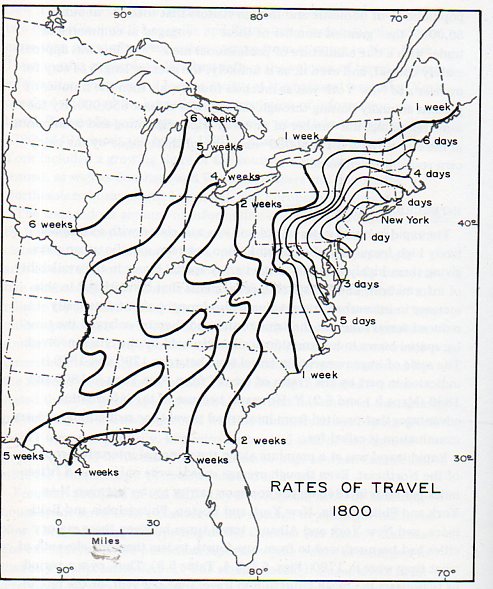
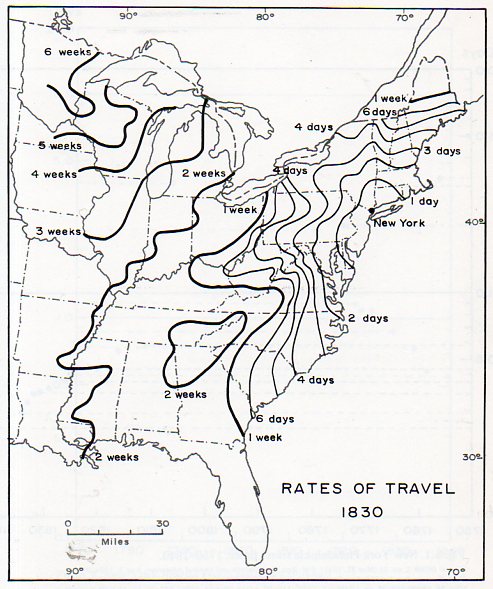
    The following maps are not quite the same, being historical and retroactive, and show rates of travel in the U.S. over certain decades (and seen earlier in this blog in the post “Time Travel in the Early U.S., 1800-1857” https://historyofideasblog.com/thesciencebookstore/2012/02/travel-time-in-the-young-republic-1800-1830.html: 
    Travel time 1317

    [Source: Allan R. Pred Urban Growth and the Circulation of Information, 1790-1840 (Harvard, 1973)]
    Travel time 2316


    [Source: Allan R. Pred Urban Growth and the Circulation of Information, 1790-1840 (Harvard, 1973)]

    Sources and Notes

    Another good collection of modern isochrones can be found here: http://www.citymetric.com/transport/its-christmas-so-here-are-11-beautiful-isochrone-maps-showing-travel-times-different

    Another view of the Allan Pred maps can be found here: Michael Graham Richaard,  “How fast could you travel across the U.S. in the 1800s?” http://www.mnn.com/green-tech/transportation/stories/how-fast-could-you-travel-across-the-us-in-the-1800s

    Also, another older map is by Albrecht Penk’s  “Isochronenkarte” first published 1887  “Isochronenkarte der österreichisch-ungarischen Monarchie”. Deutsche Rundschau für Geographie und Statistik: 337

    https://www.1843magazine.com/places/cartophilia/time-travel   1914 map

    The Galton map is also found here: https://upload.wikimedia.org/wikipedia/commons/8/86/Isochronic_Passage_Chart_Francis_Galton_1881.jpg
     

  • Rare, Secret O.S.S. Report on the Military and Social Conditions of the Netherlands, February 1945 (Full text)

    JF Ptak Science Books  Post 2621

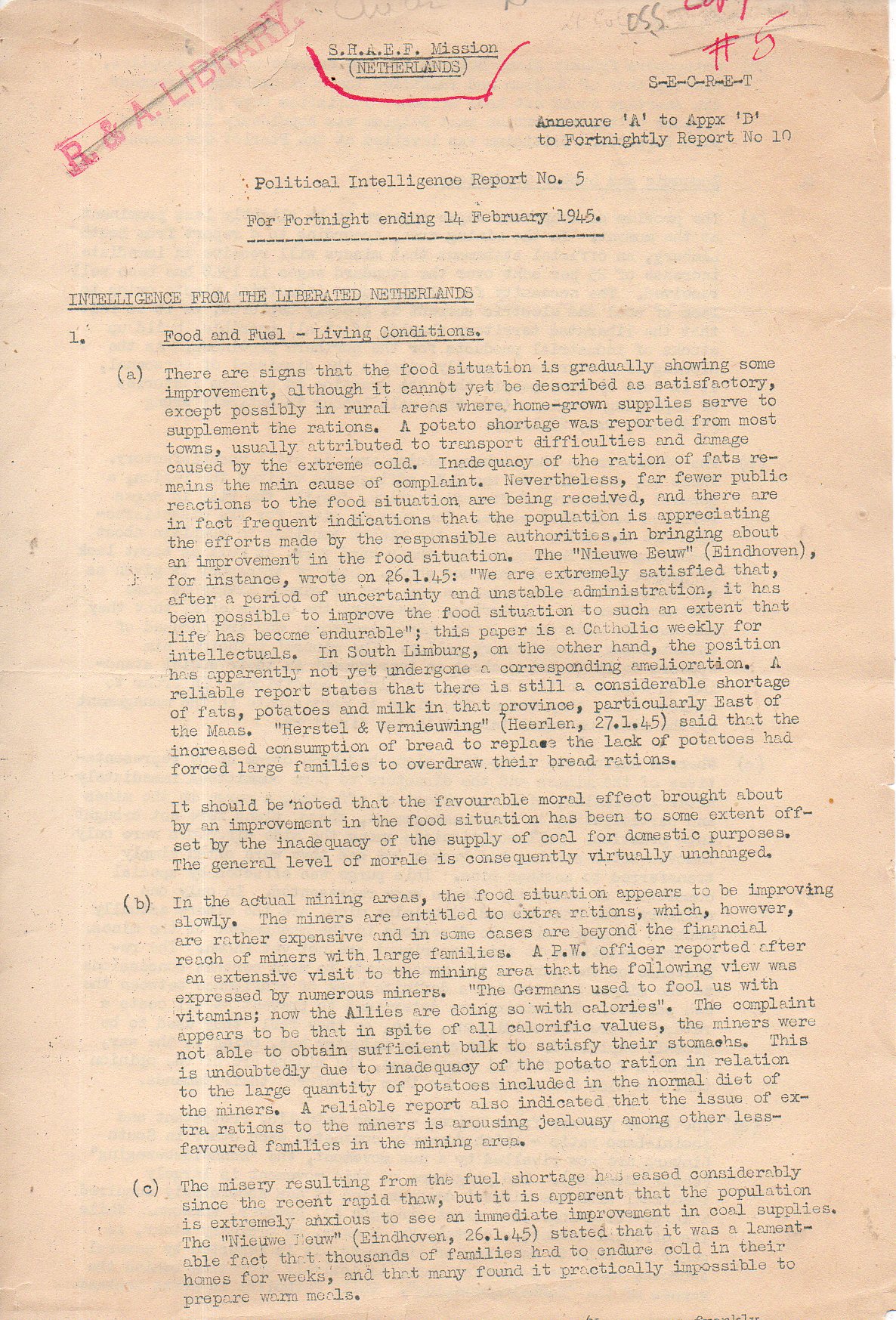
    S.H.A.E.F. Mission (Netherlands) Political Intelligence Report No. 5. For Fortnight ending 14 February 1945.
     
    Intelligence from the Liberated Netherlands.
     
    This is a situation report conducted for the Office of Strategic Services (the O.S.S.) on the social and economic conditions in the Netherlands, including the situations on food, fuel, living conditions, attitudes of the population towards U.S. soldiers, and so on.  This is a fragile, offset production, and not at all found in the WorldCat/OCLC, which means that no copy of this exists in libraries around the world. The work is annotated “OSS”, stamped “R & A Library” and also stamped on the verso of last sheet “received CID 1945 Mar 3 PM”, which means that the paper was received by the Central Information Division of the Office of Strategic Services, the Research and Analysis Branch. The provenace of the paper therefore is the O.S.S. (the precursor to the C.I.A.), and then on to the Library of Congress.  [13×8″, 3 leaves/5pp.]
     
    Given the rarity and its interesting nature, I’ve reproduced the document, below.
     
    Netherlands WWII _3_430

    ·Posted by :

    ·in:

  • “Franco in Power is the death of Spain…”: Rare Anti-Franco Circular, 1943

    JF Ptak Science Books  Post 2621

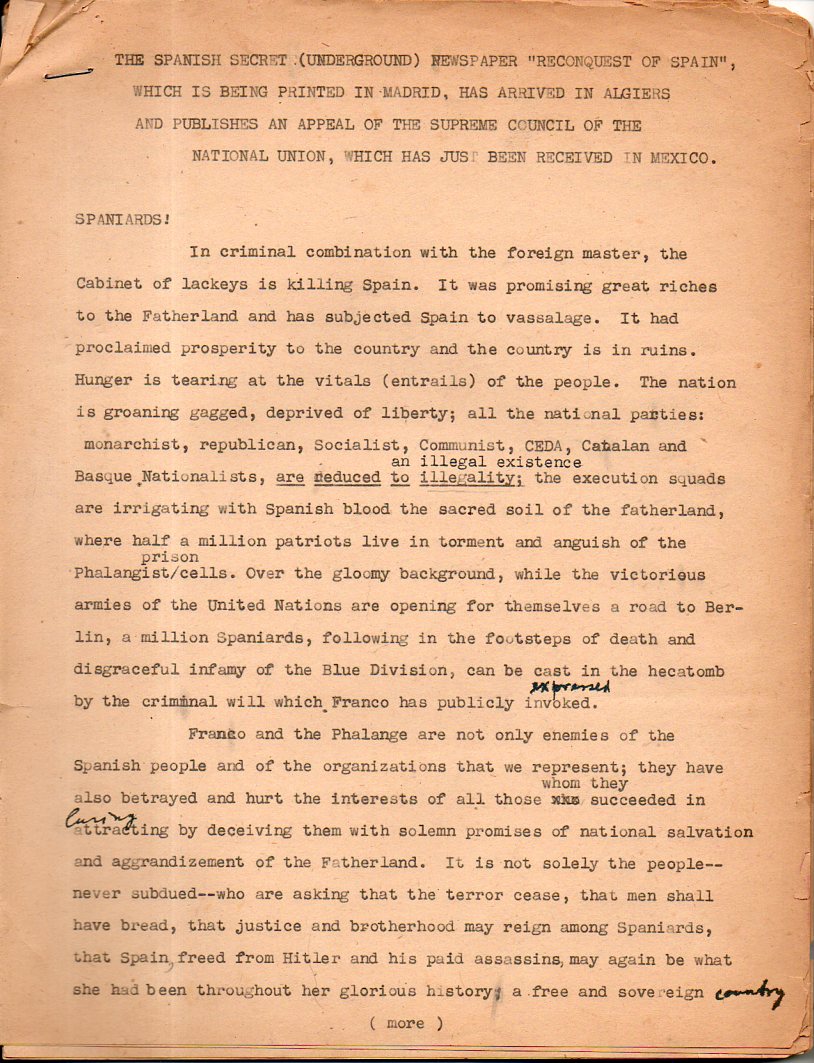
    The Spanish Secret (Underground) Newspaper “Reconquest of Spain”, which is being Printed in Madrid, Has Arrived in Algiers and Publishes an Appeal of the Supreme Council of the National Union, Which Has Just been Received in Mexico, is a rare offset publication–five leaves long and approximately 1500 words–was which published in  December 1943, and which seems to be a general call-to-arms to overthrow the Spanish right-wing leader Francisco Franco (still dead after all of these years). The Spanish Civil war was overwhelmingly over by 1939, though there was still considerable resistance to Franco–much of that at this point (1943) not in Spain. The Spanish government for their part were busy trying to keep their non-neutral neutrality at an optimum price and profit, selling material to the Nazis, and holding out for a more-beneficial payout to themselves from Hitler for joining the Axis outright, which never did happen.    The publication refers to an underground secret newspaper called the “reconquest of Spain”, which I guess would be simply called the Reconquista, which in recently history would have referred to the fight against Franco from 1936 to 1939, and also ()in the deeper past) the 700-year-long fight to establish a Christian kingdom in Spain free of Islamic occupation (ca. 700-1500). Unfortunately my knowledge of Spain during WWII regarding the Republican fight is extremely limited, and so I can’t say anything further about the newspaper–I’m not even sure if this publication below is a reprint of the text of the newspaper (which it seems to be, perhaps) or not.  In any event, here’s some samples from the publication:

    • Spanish civil war

    [Provenance: from the estate of Alexander Uhl,  Associated Press reporter in Spain during the Revolution. WorldCat/OCLC locates 0 copies.]


    “We are uniting to fight, to mobilize the Spanish people in the defense of its very life, to radically extirpate the foreign domination from the soil of Spain…”

    “Franco in Power is the death of Spain…”

    “This is a wartime call to Spaniards to honor their fatherland and overthrow the Nazis and Franco…”

    “Spaniards! In criminal combination with the foreign master, the Cabinet of lackeys is killing Spain. It was promising great riches to the Fatherland and has subjected Spain to vassalage. It had claimed prosperity to the country and the country is in ruins… “

    “The nation is groaning, gagged, deprived of liberty…”

    “…the execution squads are irrigating with Spanish blood the sacred soil of the fatherland…”

    “Over the gloomy background, while the victorious armies of the United Nations are opening for themselves a road to Berlin, a million Spaniards, following the footsteps of death and disgraceful infamy of the Blue Division, can be cast in the hecatomb by the criminal will which Franco has publicly invoked…”

    “We are uniting to fight, to mobilize the Spanish people in the defense of its very life, to radically extirpate the foreign domination from the soil of Spain…”

    “It is not a fight of internal tendencies, but a united attack of the entire nation in order to recover its independence and its sovereignty…”

    “We are inviting publicly, solemnly, the Spaniards who profess other political creeds and most especially the Catholics of the two branches and the army, to participate with us in the Supreme Council of the National Union…to overthrow Franco and the Phalange…”

    “No honorable Spaniard can fail the call of his Fatherland…and can honor themselves by taking part in this genuine crusade of liberation which today demands unanimous national effort. No desertion will make us lower the colors…”

    ·Posted by :

    ·in:

    —
  • Finger-tip Lights for Theater Ushers, 1917

    JF Ptak Science Books  Quick Post

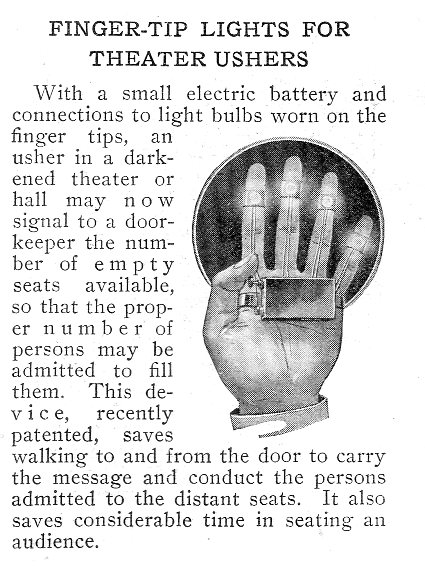
    This invention/innovation looks coy and sweet today, but it actually addressed an issue in 1917.  This was the year that “Hollywood production” in movies really begins, though there was already an explosion of movie houses in the U.S., “Hollywood” or not. Cinemas were plentiful and packed, and from the numbers I’ve seen already in 1917 50% of Americans were going to the movies several times a month–this number would top out in the 30’s when it approach nearly 70%.  So ushers standing at points throughout a movie house finding stray seats for people being held back by the doorman could have signaled the number of available seats with his lighted fingers, and moved the waiting line along more quickly than a lot of whispered back-and-forth strolls around the house. 

    Inventions finger tip431

    Popular Mechanics, April, 1917, p. 525, 

    ·Posted by :

    ·in:

    —

Recent Posts

Archives

Categories