A Daily History of Holes, Dots, Lines, Science, History, Math, Physics, Art, the Unintentional Absurd, Architecture, Maps, Data Visualization, Blank and Missing Things, and so on. |1.6 million words, 7500 images, 4.9 million hits| Press & appearances in The Times, Le Figaro, Mensa, The Economist, The Guardian, Discovery News, Slate, Le Monde, Sci American Blogs, Le Pont, and many other places… 5000+ total posts since 2008.

  • When the New Deal of FDR Was Just Another Capitalist Ploy (1934)

    JF Ptak Science Books  Quick Post

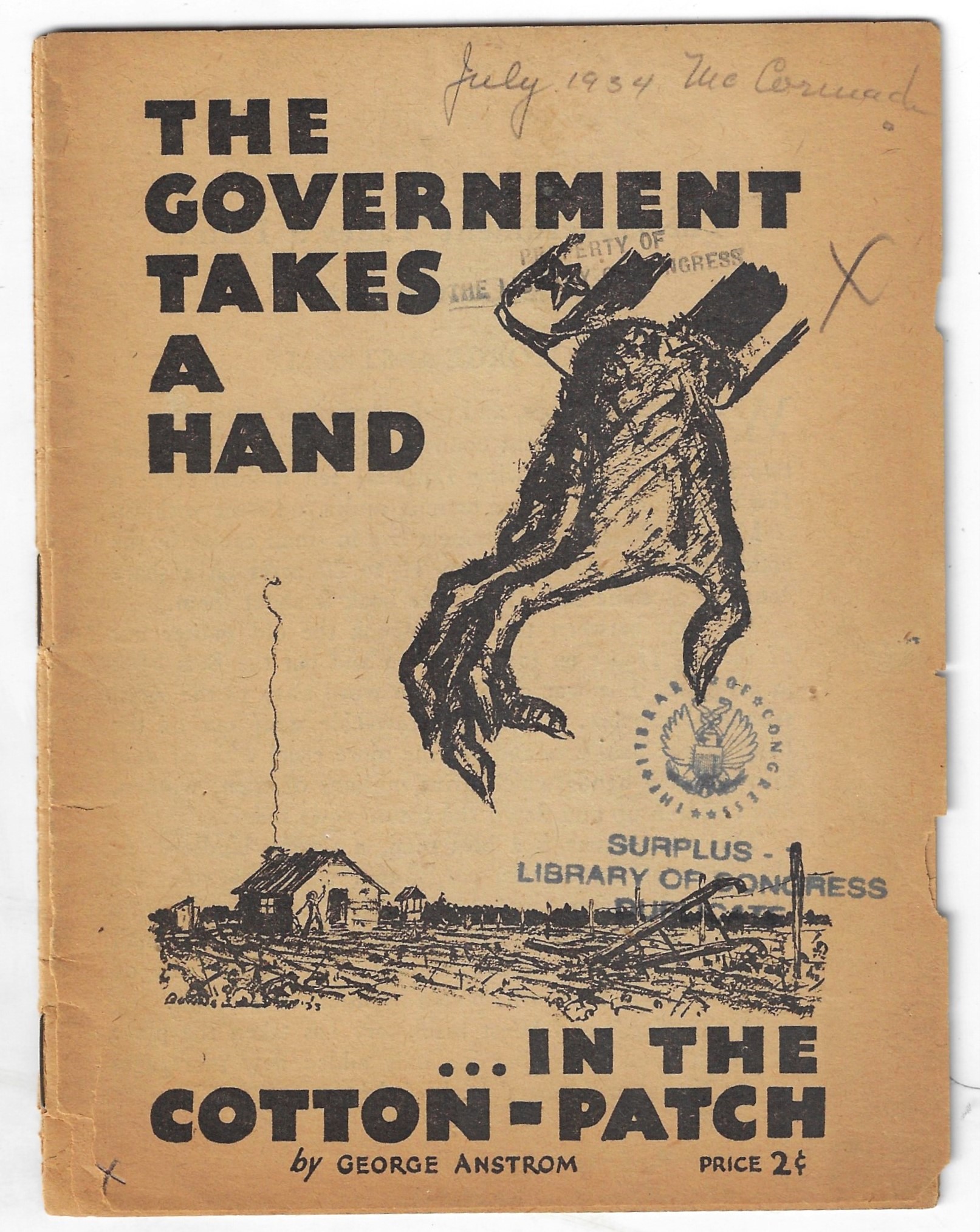
    Harold Ware, 1889-1935, son of activist and Communist Ella Reeve Bloor, early member of what would be the Communist Party of the United States and suspected spy for the USSR, gave Franklin Roosevelt a very grabby and animalistic (in the bad sense of the word) hand for attacking/taking the goods of the poor working class…amidst much else. This occurs on the cover of his 1934 pamphlet–sold for 2 cents and written “George Anstrom”–The Government Takes a Hand, which was an indictment of the enforcement of class and racial conflict in the working classes of the United State. In particular Ware takes aim at the cotton workers and their plight. I’ve included some of what he wrote (below) as there’s a lot of it that makes pretty good sense, and much of it which is correct. He does however take a dim view of the New Deal  and of the agricultural relief action of 1933/4, which Ware maintained was the theft of what little belonged to cotton workers.  In any event, here’s a sampling from Ware’s work:: 
    Cotton-patch“The Wall of Race Prejudice Set Up by the Bosses

    Across narrow country roads white tenants and croppers see Negro neighbors pulling cotton like themselves. But more than that road separates them. Between them rises an invisible wall——the barrier of race prejudice-—deliberately set up by the boss class and its government agencies. That wall is built of fairy tales of white supremacy to keep the white toilers from uniting with the Negro masses against their common exploiters. From the cradle to the grave the poorest white child is taught to look down on, hate and fear his Negro neighbors.”

    “Any sign of protest from Negroes is met with instant terror. Boss inspired Ku Klux Klan raids and lynching parties are the order of the day. The Negro share croppers of Camp Hill, Alabama, organized and fought back against a lynch gang in 1931. They won their demands through organized struggle. But the bosses create a general scare of “Negro rebellion” to justify their chain gangs and other forms of suppression.”
    ·Posted by :

    ·in:

  • The Library of the Future (ca. 1960)

    JF Ptak Science Books  Quick Post

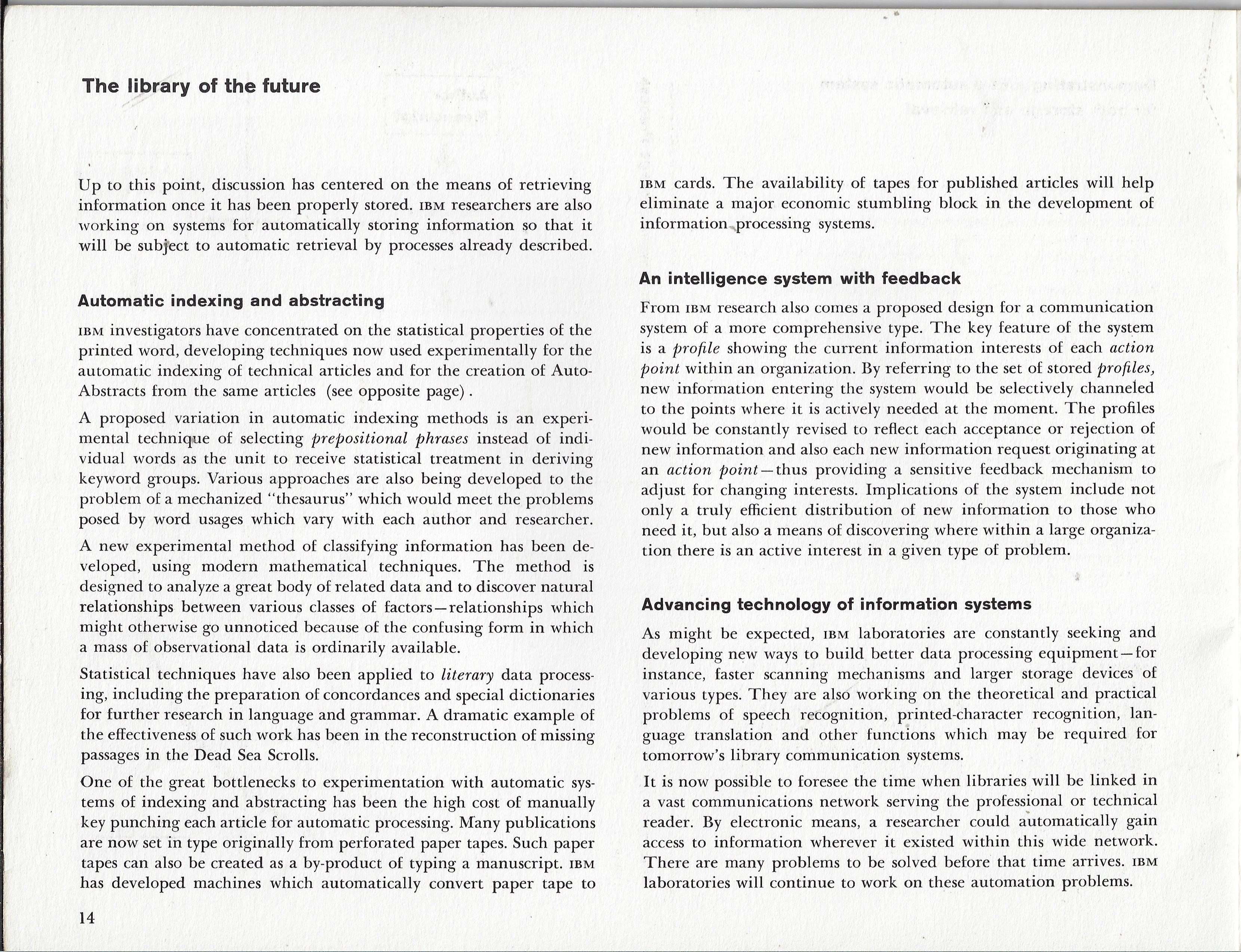
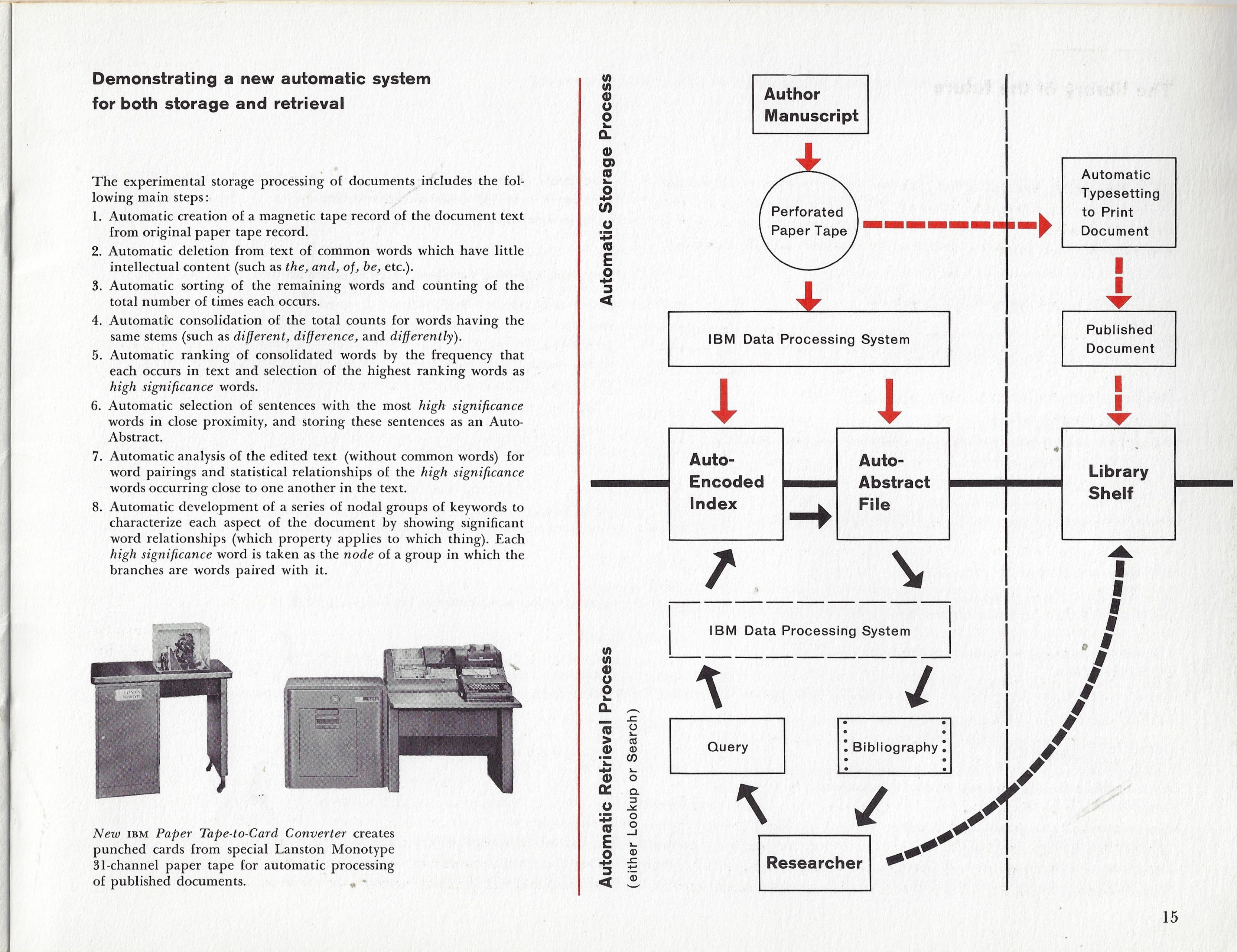
    The oblong pamphlet IBM Information Retrieval was published around 1959/1961 (this is an early evergreen pub with no date but the bibliography cites only 1957 and 1958 “recent” works)  and is a visual/expressive/schematic summation of the current state of affairs in info storage and retrieval delivered in a step-by-step presentation, concentrating on library applications. The main IBM machine at use here is the RAMAC (unnumbered) which made its first appearance in sales in 1956. This is a far more realistic (and existent!) peek at the possibilities of the control of information than the Bush MEMEX (1945, etc.), though of course it wasn’t nearly as far-reaching as Bush envisioned, and didn’t actually deliver the text to the end user, though it did deliver a great deal else, maintaining massive amounts of data in a usable format. It is a fairly scarce document, so I reproduced the small section on “the library of the future” which we are well passed, probably by 1975. 

    • This is another example of something I’m just in the early stages of attention–when the time of effectiveness of what was reckoned to be part of the future and a great innovation turns out to have a very short lifespan and becomes outdated relatively quickly.  

    IBM Info retrieval _2_

    IBM Info retrieval _2_

    ·Posted by :

    ·in:

  • Aether Ennui (1927)

    JF Ptak Science Books  Quick Post

    IMG_1822 (1) (2)IMG_1822 (1) (4)

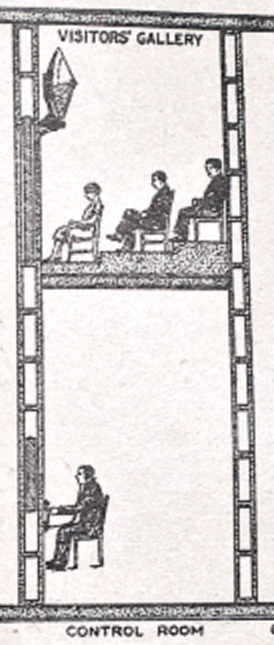
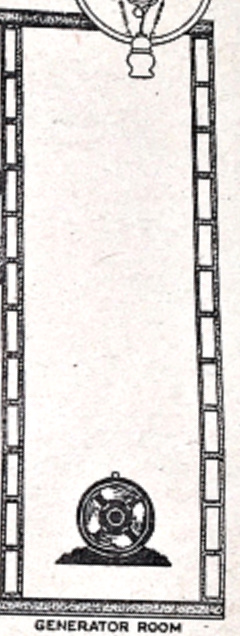
    This story on the new Roxy theater appeared in Radio World in 1927, and it caught my attention with its peculiar empty space and loneliness in elements of the article’s image. 

    Even though we are reading about a new state-of-the-art performance and broadcast facility, a story filled with hope and possibility of another brand new stage opening, the imagery has that certain varnish of vague ennui.

    There is also a lot of space, open space,  over-strong areas of nothing, flat, forbidding, and perhaps even a little cold and frightening. It does fit rather nicely into my collection of images and idea in the History of Blank, Empty and Missing Things series on this blog.   

    I’ve included the full illustration below.  

  • Is This the First Mention of the Word “Cybersex”? Â

    JF Ptak Science Books  Post 2888

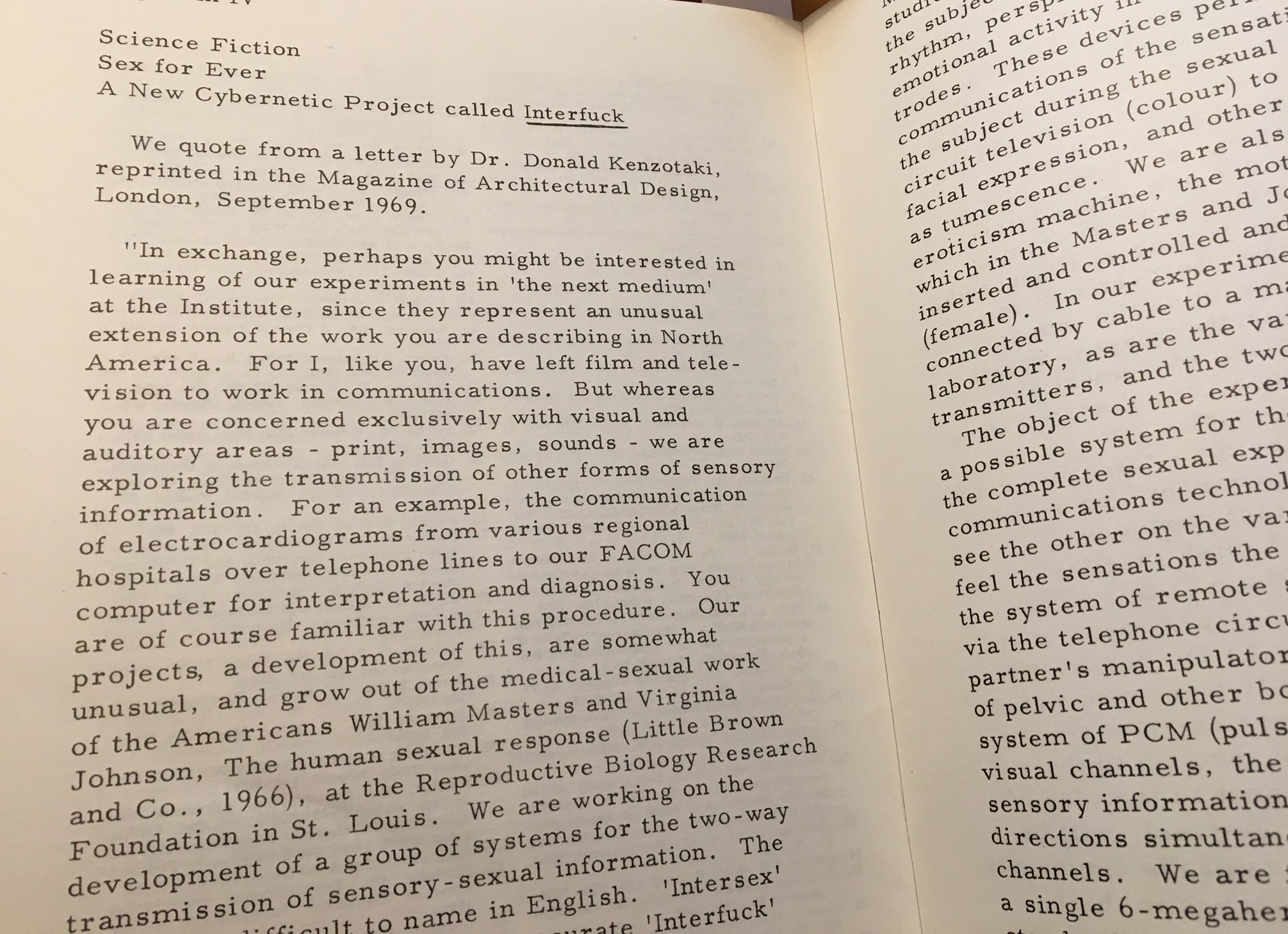
    At first it appeared that this was indeed the first appearance of “cybersex” (in 1970), and that it pre-dated the established conception of its first appearance by twenty years. But, well: no. After much ado, and after some very subdued and annoyed half-bored/boring interest, it turns out that this is a reprint of an article that appeared in 1967, three years previously.

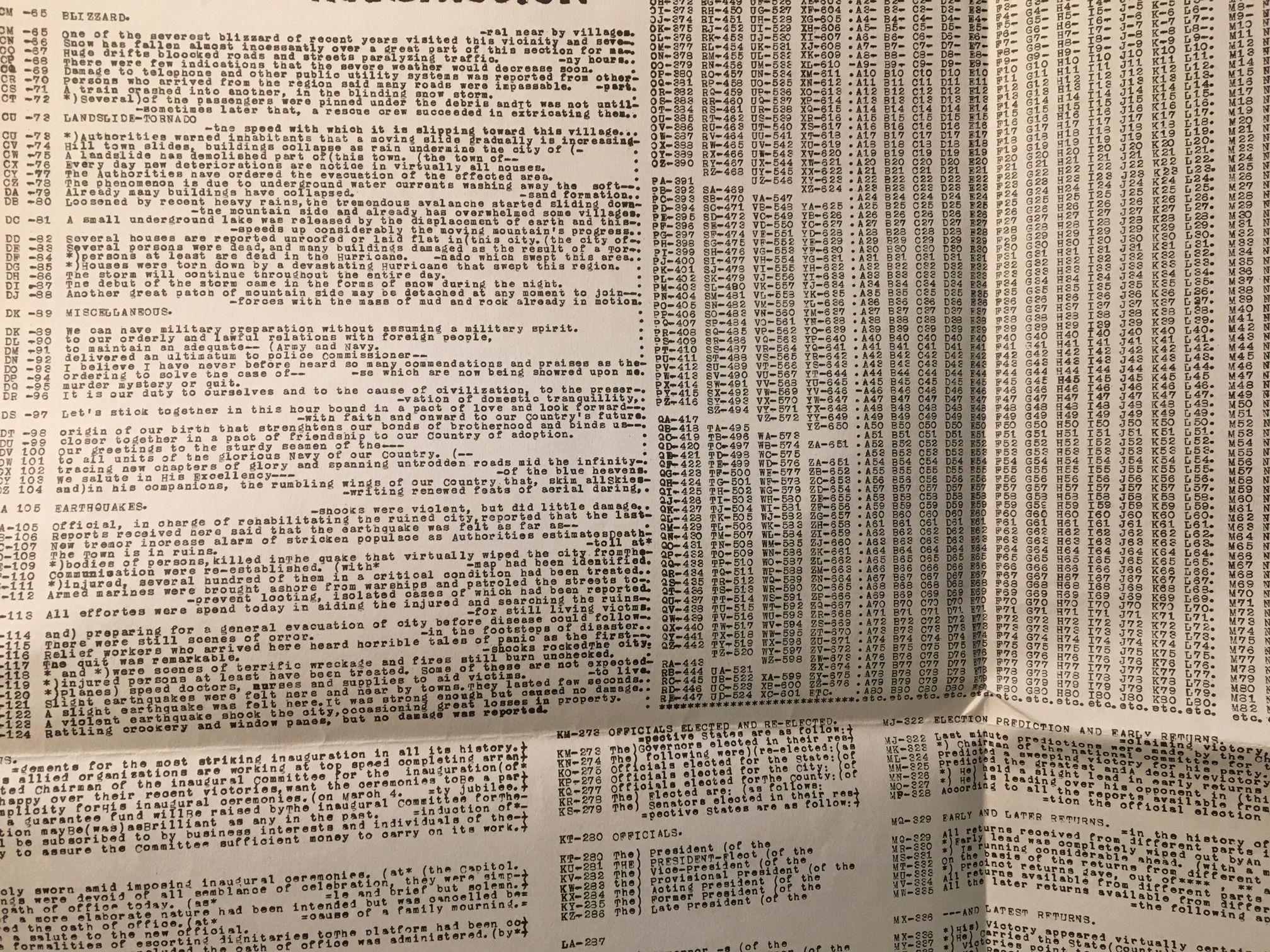
    “Science Fiction—Sex for Ever—a New Cybernetic Project Called Interfuck” is the in-your-face uncertain “title” of the article under consideration here, and it seems to be bouncing its little four-page self around without attribution. Its weirdness caught my eye, and I quickly zeroed-in on the unexpected word, “cybersex”. Now, there’s a LOT of speculation going on in this short article about how all of that person-to-person-to-machine loop happens, and I have no interest in going through it—you can certainly read it for yourself, though, as I’ve scanned the thing and attached it below.

    IMG_1869 (1)

    The article appears in a badly-titled booklet by O.D. Wells, How Could You be So Naive!, published by Artorga and distributed by Modern Books Limited, Berkshire. There are six other papers/articles in this issue in addition to the Wells, including mostly serious stuff: H. Maturan, “Neurophysiology of Cognition”; David Redman “Processing Information with Light”; Roland Fischer, “The Perception-Hallucination Continuum”; J.L. Synge (?!) “A Plea for Chronometry”’ A. Battersby, How to Bury and Idea”; and the our problem, “Science Fiction—Sex for Ever—a New Cybernetic Project Called Interfuck [sic]”…plus a foreword by F.H. George.

    The course of the article wasn’t so obvious because it seemed that this was a bit of a sci-fi story wrapped around a parody and tied up with short anxieties, and the references in the article weren’t accurate, and perhaps not real. Also the publisher, Artorga, is enigmatic, and sometimes to me seems to not take itself seriously even though there are some very serious contributors. There weren’t that many places to turn to check this piece out after the first obvious choices proved to go nowhere.

    It is difficult to find out anything about Artorga (“Artificial Organism”), though the “Paragram” of this work cites heavy hitters Gordon Pask, Ehinz von Foerster, W. Ross Ashby, and Stafford Beer as being “the Committee of Artorga” establishing it in 1958.

    Anyway, “cybersex” as a word hunt was enough for me, and the earliest uses of the word were given as 1991 (Oxford English Dictionary), 1990 (Merriam-Webster), and then a myriad of other minor notes (almost all unreferenced) for the period 1985-1990. This example of course has them all beat, and by a wide margin.

    It also predates just about all of the other “cyber-” created words prefixed to a wide variety of nouns, including a number of words that are slightly more removed than “cybersex”. There’s “cyber-porn” from 1989; -romance, 1992; -smut, 1993; -friend, 1986; and -affair, 1994, for example. The only references I can find for earlier “cyber” prefixes are “cyberkid” which I’ve never encountered (1966); “cyberman”, which evidently has something to do with Dr. Who and also from 1966; and “cybertron”, as a sort of computer hardware reference, from 1961. All of this flows from the first introduction of “cyber” in its creation by Norbert Wiener (a very smart guy who also happened to control greatly to the US war effort in WWII with fire-control in AA weapons derived from his famous “Yellow Peril” book) in his work Cybernetics (1948). Oh yes–”cyberneticist” and “cybernetician” appear in 1948 and 1950.

  • Color, in Living Color! Occasional and Segmented Brutalist Design in Data Visualization. (1944)

    JF Ptak Science Books  Quick Post        

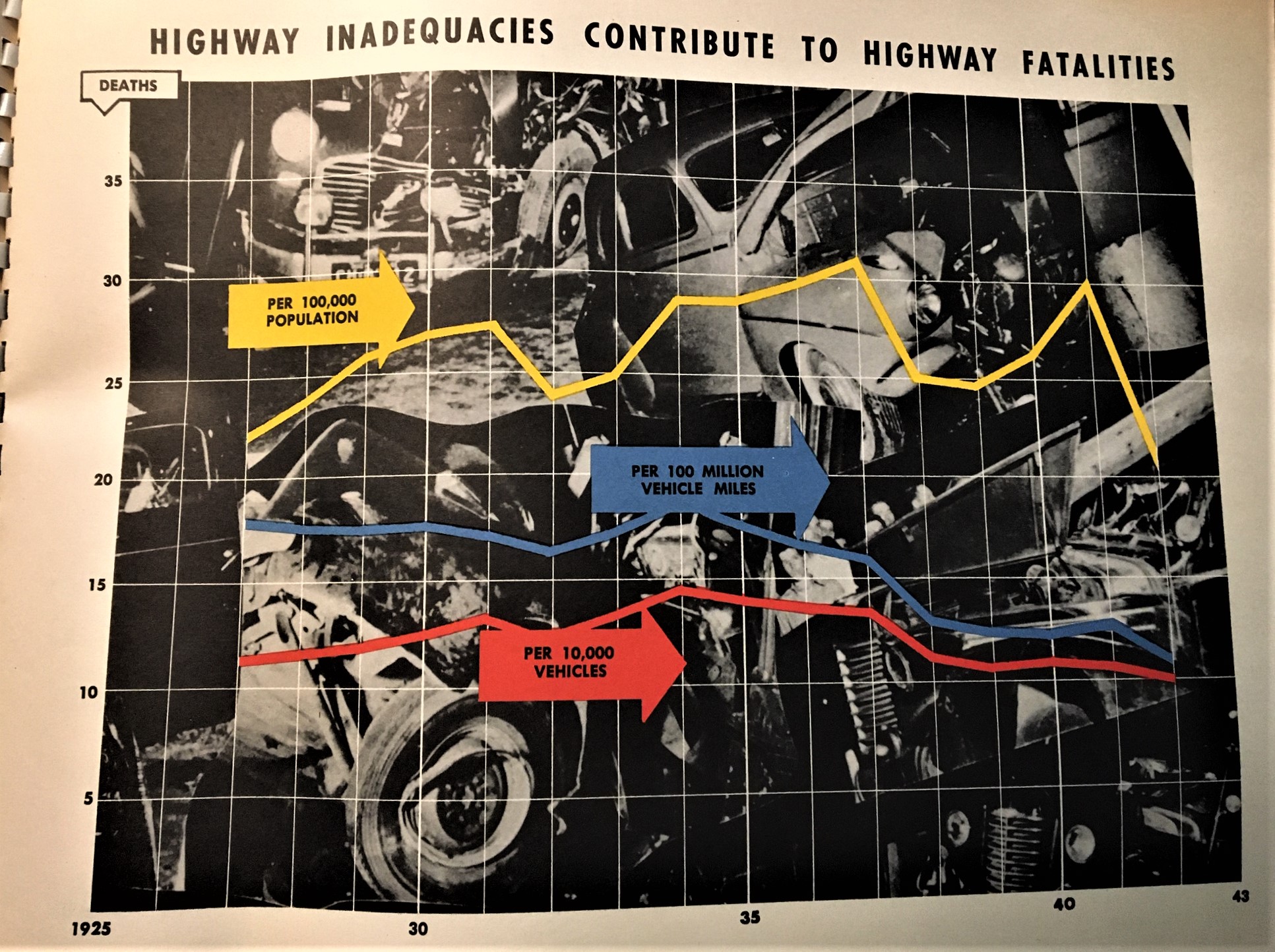
    I’ve made a number of posts to this blog on color and the lack of it (for example, see the series on “Color and its Advanced Abuses”) mostly concentrating on MONUMENTAL color or the lack of it when it could have been there (this, for example, exemplified in a beginner book on color theory with illustrations in glorious black and white). Today’s example comes from a oversize pamphlet called The Story of Highways, which I think was a vehicle used to deliver highway stats to crowds of congressional interest. The 16″-wide pamphlet contains 26 graphs/charts that reproduce 30″x 40″ posters used in a presentation somewhere to justify federal money spent on highways during WWII.  Some of them are unexpectedly colorful, very flat, and as I said in the title of this post, somewhat Brutalist in design. It isn’t quite Soviet Style or Brut Soviet, but there are those elements that I think are pretty noticeable. And if not, they’re interesting to see.

    IMG_1912

  • Magritte, Bruegel, and Mid-western Streetlights (1908)

    JF Ptak Science Books  Quick Post

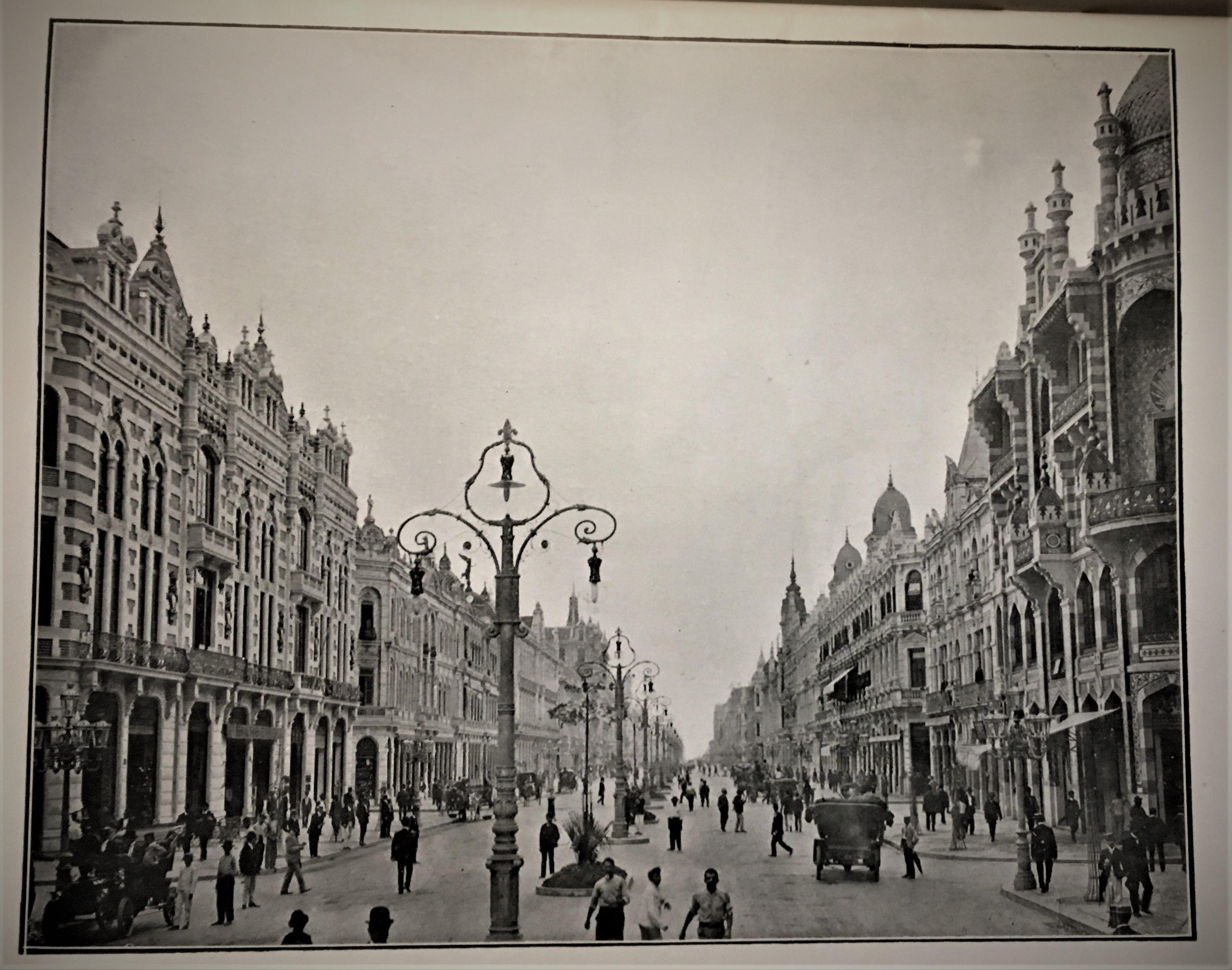
    IMG_1851 (1)I am somewhere between the 16th and 20th centuries with this image–I see a bit of Pieter Bruegel (d. 1569) in this, one of his involved  and diverse human landscapes set into a complex physical environment. In spite of its great and inquisitive artfulness, this photo was made to illustrate the streetlights of Central Avenue in Rio de Janiero for a speculative publication called Public Lighting for St, Louis, which was printed in 1908 and published to solicit opinion on the style of street lighting that was to take place in the city.  Fairly mundane stuff, except that several of the photos used in that slim pamphlet are quiet little sub-masterworks of nothing. I think too that the perspective here of the horizon disappearing down the avenue and the sky being about the same color as the street lend a certain arrogance to the realism of the thing.

    I also see the possibility of Rene Magritte (d. 1967) at work here as well–or a Dada-reconstruction of his Golconda, if you applied a heavier gravity a bit and placed all of those raining bodies from his painting  carefully onto the streets of Rio.   Or it is a combination of the two…in any event it is an evocative photo, buried up to its eyeballs in total obscurity in this 1908 pamphlet, and which probably has not seen the light of day in a hundred years. 

    ·Posted by :

    ·in:

  • Austrian Communist Manifesto for Democracy and Freedom (1944)

    JF Ptak Science Books  Post 2889

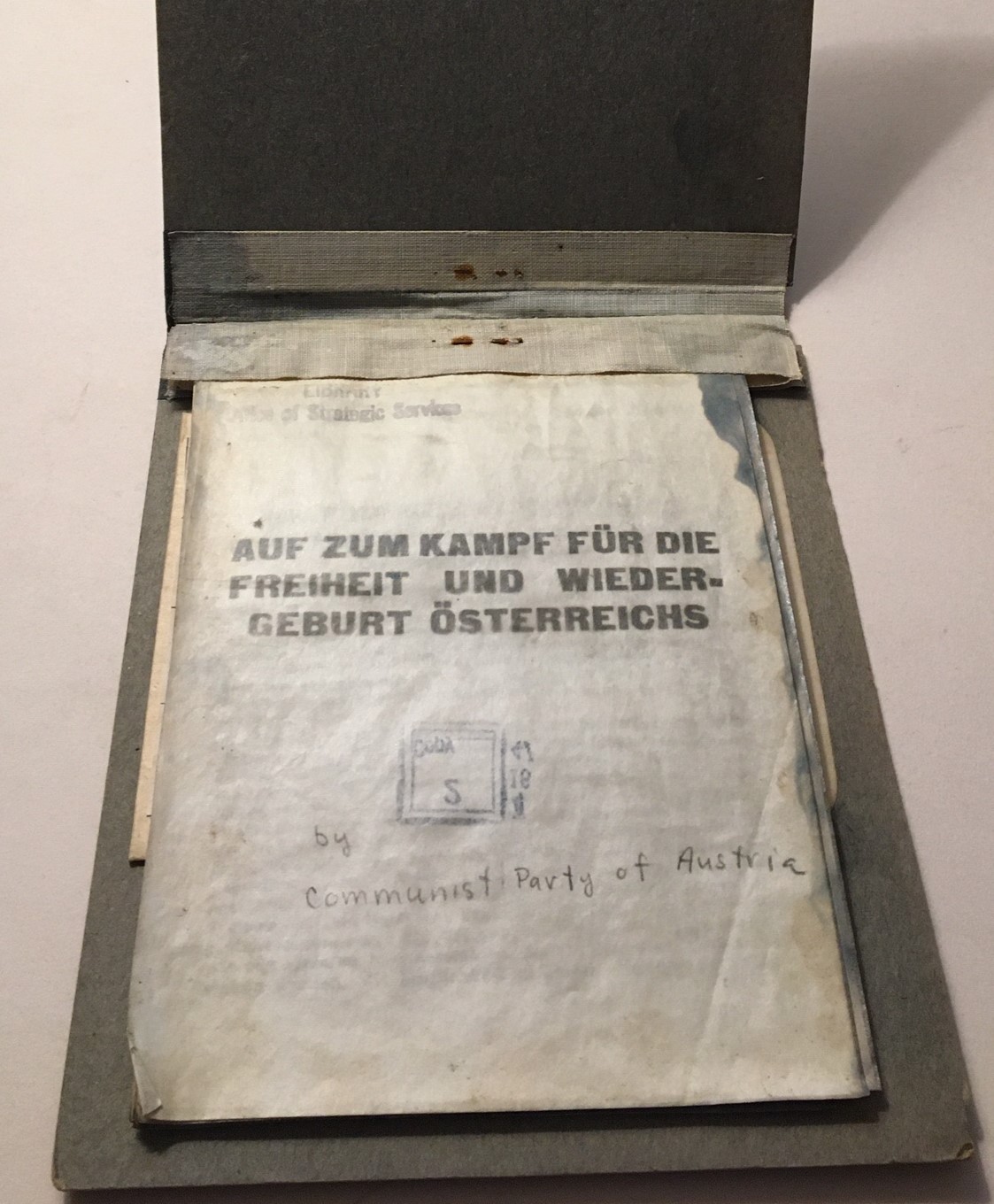
    IMG_1968First of all I mean no disrespect to the author/s of this work in discussing the pamphlet’s appearance, or those who read it with interest, or to those who studied it, or to those who may have lived it and who may have paid the price for doing so.  I thought that this small work was remarkable in content and appearance. and in the way it sounds…the book’s physical appearance seems to me to add to its history and story.

    First of all this effort was written by someone associated with the Communist Party of Austria no later than 1944 and is titled Auf zum Kampf Freiheit und Wiedergeburt Osterreuchs, or The Fight for Freedom and Rebirth in Austria (or Let’s Fight for Austrian Freedom and Rebirth).  This means that this was a highly incendiary work for an Austrian to possess in their Nazi-dominated country. The Nazis absorbed Austria (“annexed” is the word found more often describing the Nazi takeover and obliteration of Austria as a sovereign nation) Austria in March 1938 and were of course massively anti-Communist, except of course for the Communists in the Soviet Union, who Hitler externally tolerated in the public lull of his bitter hatred between the Molotov-Ribbentrop Pact and the beginning of Operation Barbarossa  on 22 June 1941, a period where he was able to use the Soviet Communists to his advantage before attacking and killing millions of Russians.  

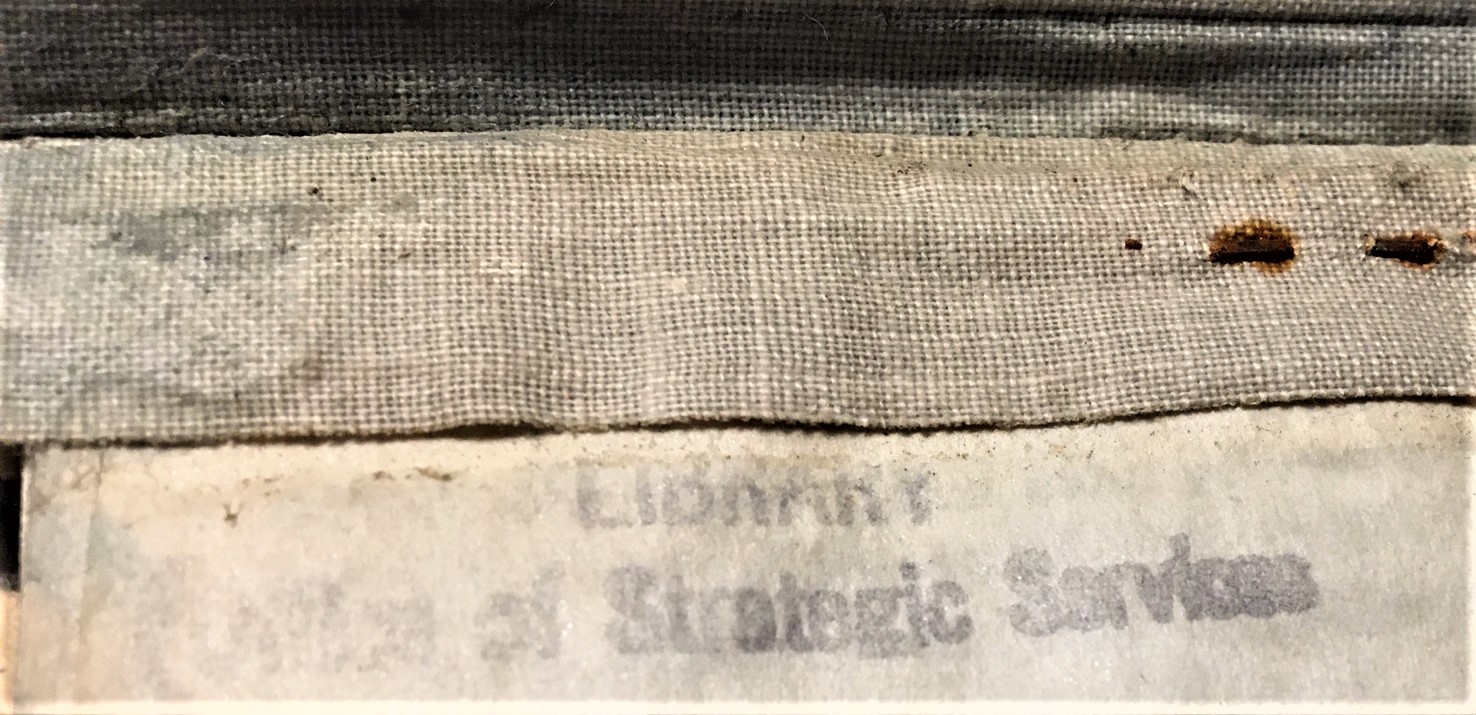
    Auf zum Kampf is a manifesto of the Austrian Communist Party written during a meeting/party congress in 1944. The copy I am working with, the copy with so much presence, is (I expect) a much-reduced photographic copy of the original that was made for the U.S. Office of Strategic Services, the OSS, the organization that morphed into the CIA.  It is 5″x 4″ and 23 pages long. It is staple bound in homemade cardboard for use in the OSS library. (It even has a borrower’s card in the rear pocket with three names, none of whom I could identify.)  The images were printed on a very thin photographic paper, and have a very exaggerated “papery” sound to them, even with the slightest touch…they have the feel of a thin vellum. It really does feel like an unusual document. 

    IMG_1969

    ·Posted by :

    ·in:

  • A Too-Early Vision of the Post-WWII World (November 1939)

    JF Ptak  Science Books  Post 2890 

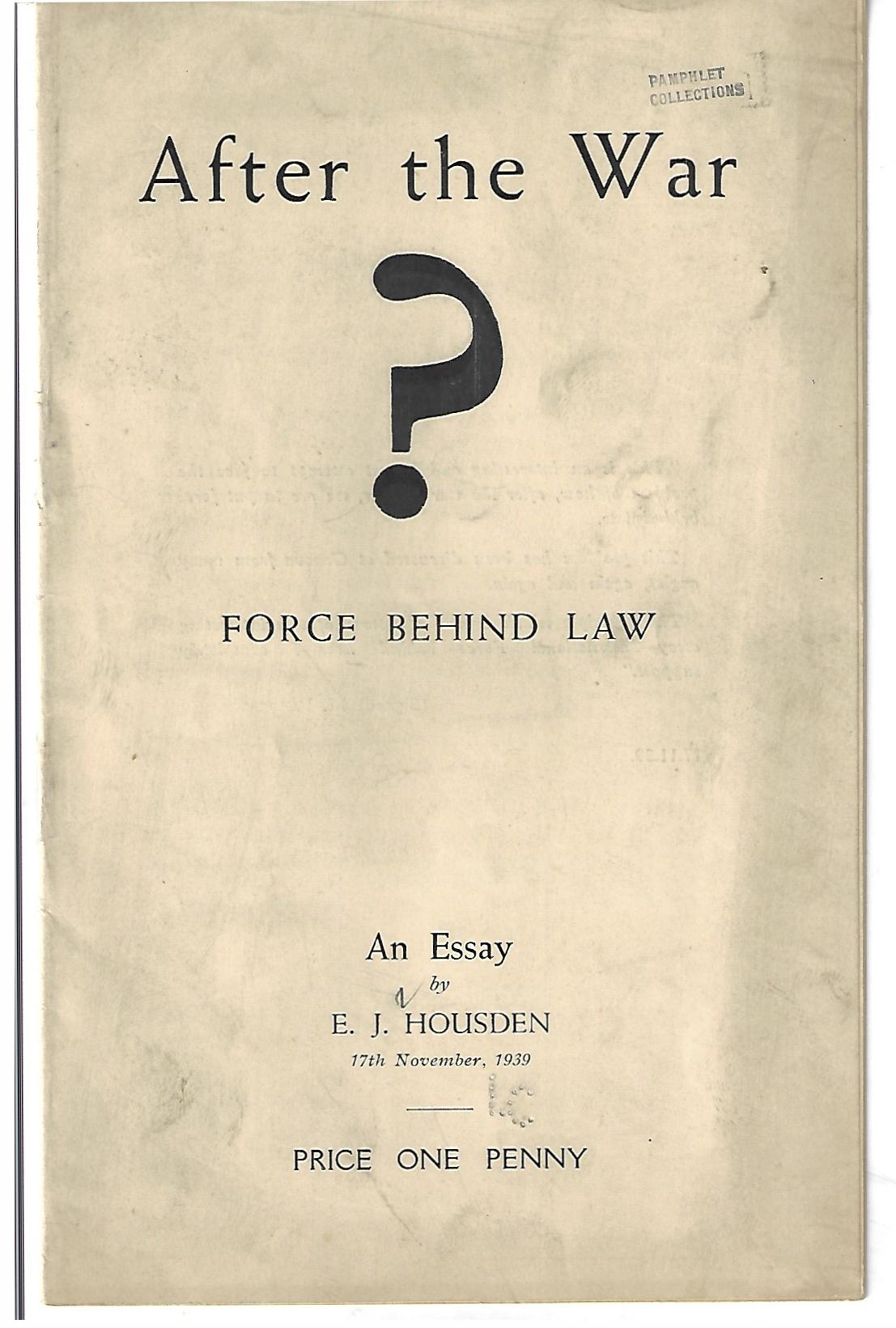
    1939 WarThis is an unusual work to my experience as the author was looking at the post-WWII scenario for the globe at such an early time in the war–November 1939–that the war as written here was known as the “1939 war”, a pre-“World War Two/II/etc designation.  World War I wasn’t really known as such until there was a World War II to differentiate it, and lo! they both came into existence at about the same time, in September, 1939. This publication is dated November 1939, though perhaps it was set into type too late in September to accommodate the new terminology. In any event, I thought it was worth making a note about.

    I don’t know much about E.J. Housden except that he may have published material in the nineteen-aughts, and that one of his pamphlets (Democracy is Fake) turns up in a census of George Orwell’s pamphlet collection. He writes about one world government, a New League of Nations, a universal army, the rollback of sovereignty, one-language, and that sort.  It was a pretty long vision for the end of the war, since there were still about 1,780 days of fighting yet to come, and that the USA, USSR, and Japan were not in it all of the way, yet.  Still. the effort is commendable, and someone needed to do thinking like this at least to establish some sort of dialog about the future.  

    While we’re at it, here’s a bit from the Oxford English Dictionary regarding the first appearances of  “World War” terminology:

    “World War I  n. (also World War One, World War No.1) = First World War n. at first adj., adv., and n.2 Special uses 2b. Abbreviated WWI.

    1939   Time 18 Sept. 10/2   Exports of arms, munitions and related materials in World War I amounted..to only 25% of total exports to the Allies.

    1947   Time & Tide 29 Nov. 1269/2   The despair and cynicism that followed what it has now become fashionable to call World War One.

    First World War  n. the war which began on 28 July 1914 with hostilities between Austria-Hungary and Serbia, and ultimately involved the majority of the nations of the world, suspended by armistice on 11 Nov. 1918.Earlier called the Great War.

    1889   R. B. Anderson tr. V. Rydberg Teutonic Mythol. 399   The giant-maids..took part in the first world-war on the side hostile to Odin.

    1914   E. Haeckel in Indianapolis Star 27 Sept. 37/1   There is no doubt that the course and character of the feared ‘European war’..will become the first world war in the full sense of the word.]

    World War II  n. (also World War Two; occasionally World War No. 2, World War Deuce) = Second World War n.

    1919   Manch. Guardian 18 Feb. 10/1 (heading)    World War No. 2.

    1939   Time 11 Sept. 38/1   Some of the diplomatic juggling which last week ended in World War II was old-fashioned international jockeying for power.

    Second World War  n. the war which began with the German invasion of Poland on 1 Sept. 1939 and ultimately involved the majority of the nations of the world; hostilities ceased in Europe on 7 May 1945 and in the Far East on 12 Sept. 1945. [1930   H. G. Wells Autocracy Mr. Parham 257 (heading)    Book the Fourth: The Second World War.]

    1942   Polit. Sci. Q. Sept. 321   The economic developments associated with the second World War have restored to American railroads a volume of traffic comparable to that which they handled before the great depression.

    World War III  n. (also World War Three, World War No. 3) = Third World War n. at third adj.and n. Special uses 2.

    1945   Duke of Bedford Let. 16 Apr. in B. Russell Autobiogr. (1969) III. i. 44   You will have to postpone your visit until the brief interlude between this war & world-war no 3.”


    ·Posted by :

    ·in:

    —
  • A Lovely, Interesting, and Semi-Outsider Piece of Logi (Radio, Wireless, and TV Ciphers, Codes, Language (1936-1937)

    JF Ptak Science Books  Post 2891

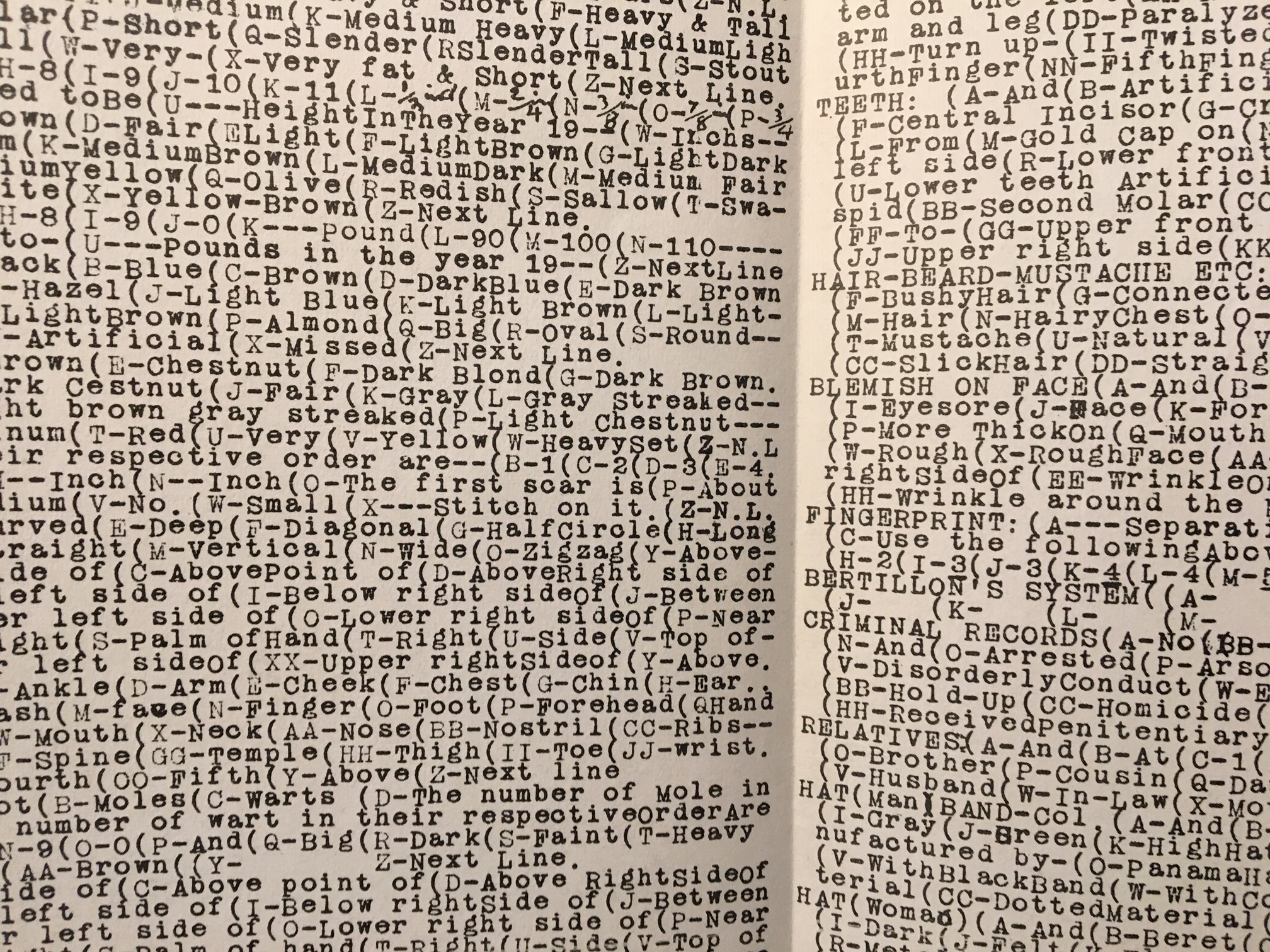
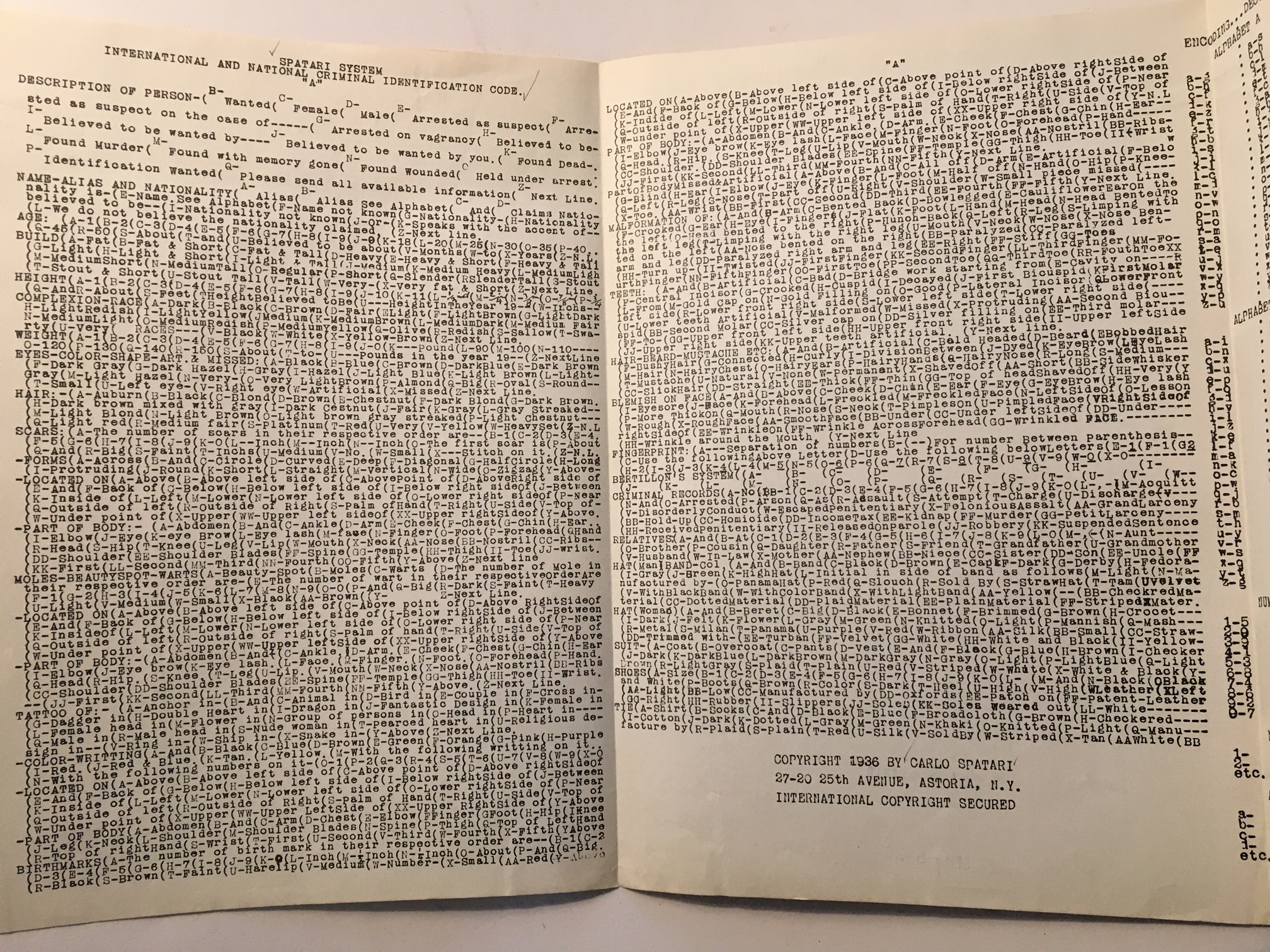
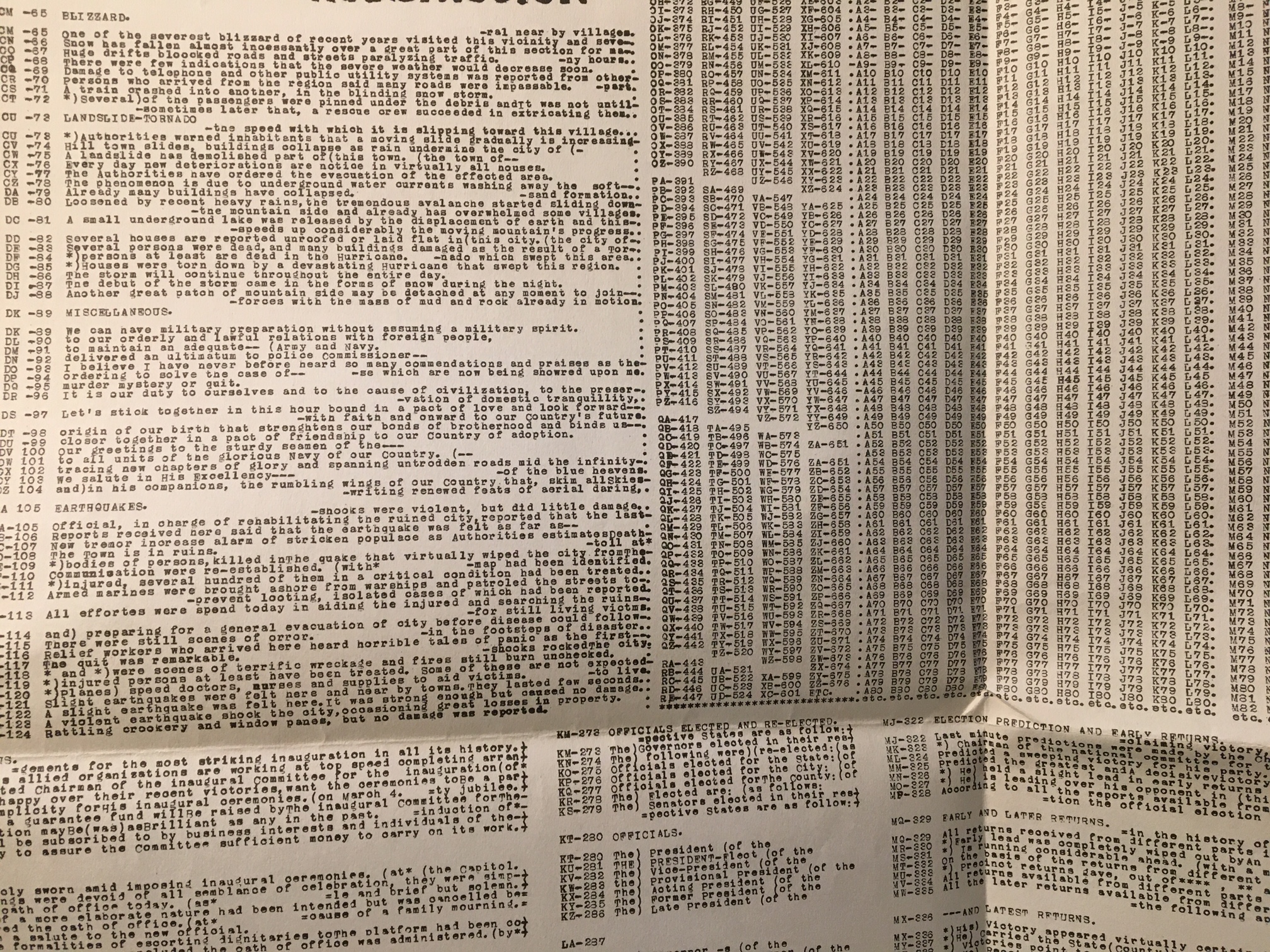
    Carlo Spartari created some interesting if not enigmatic approaches to transmitting thoughts and information via radio back in the mid 1930’s. The first example of his work—nowadays I think mostly forgotten and I imagine pretty obscure—is his book on a new radio language entitled: Spartari Radio Language, Sirela: Spatari Radio Language: A Word-of-mouth Code Easily Understood by Listeners of Many Nationalities Without Need of Memorizing for Use in International Radio Broadcasting, which was evidently self-published in 1937. (“SIRELA” I assume would stand for something like “Spartari International Radio Elementary Language” or something along these lines.

    Taken out of context and working with the text as a visual element, these works seem to me to have more than a heavy touch of an Outsider artistic quality. I find them to be sort of beautiful in their own complex ways:

    IMG_1650

    If nothing else it is easily the tallest book (18”) on radio codes and ciphers that I have seen, Carlo Spartari invented a rather clever and interesting radio language. It was based upon the seven musical notes of the diatonic scale–DO, RE, MI, FA, SO, LA, and SI—which took no translation to understand, and the notes of course are pronounced in about the same way, everywhere,   as la  Italiano. On the one hand it seems to me to be whimsical, and on the other, it seems brilliant. That’s the problem sometimes with challenging new ideas—they can be excellent almost as easily as they can be meshugina.

    This work was accompanied by another, the Spatari International and National Criminal Identification Code, which are basically two very compacted sheets entirely filled with a cipher capable of describing a rather wide variety of appearances of a person with a relatively short number of words. If time was an element in a criminal pursuit, then the Spartari code could perhaps have proved invaluable to law enforcement folks, whereby a lot of data can be transmitted in a short, alpha-abbreviated message via radio or wireless. There are codes to describe the following characteristics of the person of interest: name, alias, nationality, build (“fat/fat and short/fat and tall”), weight, eye color, hair, scars (and their various forms and locations), moles, tattoos, birthmarks, malformations, teeth, hair/beard. Fingerprints, relatives, g\hat style, shoes, tie, and suit, all of which can be described in some detail in the code.

    IMG_1649

    That said, they are using radio here, so, it might be almost as easy to just say what it was needed to be said rather than worry about a time-saving cipher. It really seems like this would be more valuable used in conjunction with the third part of this publication, which is Spatari Television Code for Facsimile Transmission. Certainly in this instance where time and space were critical then the abbreviations and associated ciphers used by Spartari would do well in fax transmission more so than spoken language.

    IMG_1652

    “Back in 1905 a young musician was so impressed by the fact that the language of music is universal, that he decided to develop a language based on music. The result is the Spatari Radio Language, an ingenious system of speech based on the notes of the musical scale, capable of being understood by anyone, regardless of his native language, and requiring no study of grammar, vocabulary or syntax. The entire language consists of only the seven notes DO, RE, MI, FA, SO, LA, and SI, and the symbol BO. Capable of being combined into nearly a million different words or groups, these symbols can be pronounced on sight, and easily written down as soon as heard. The “secret” of the language is that each group of symbols represents an entire thought, or sentence. It is not intended that anyone memorize the symbols, as they can be written down as heard, and found quickly in the Spatari dictionary later.”–World Radio History online, Radex

    Also see Jerome S. Berg, On the Short Waves, 1923-1945: Broadcast Listening in the Pioneer Days of Radio.

  • A Call to Arms to the French Youth of Occupied France by the Communist Party of France (1944)

    JF Ptak Science Books  Post 2891


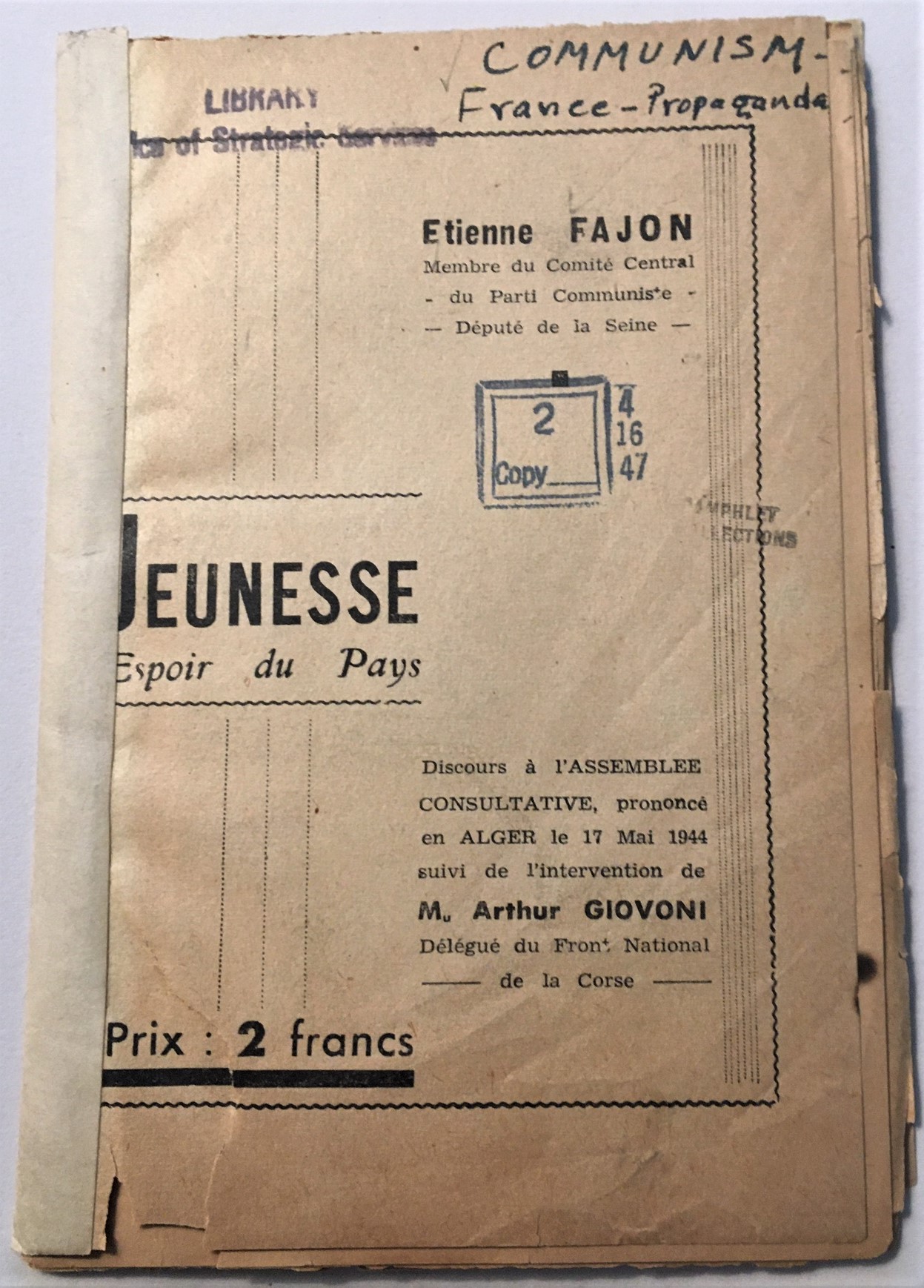
    IMG_2032Someone at the OSS was in a rush to classify this 1944/5 pamphlet as French “propaganda”. Etienne Fajon and Arthur Giovani, and others were responsible for the pamphlet in question, Jeunesse, Espoir du Pays. It was a published meeting of the French Communist “Assemblee Consultative” meeting in Algeria in July 1944. I don’t know exactly when or where it was printed but my guess is that it was before July 1945 in Algeria. It was printed on newsprint and offered out as an important but ephemeral piece, which is why, I think, it is unknown in WorldCat.

    The cataloger at the library of the OSS (the precursor to the CIA) labeled this “COMMUNISM—France-Propaganda”, which it is overall, though what it is first, I think, is a call to arms. And that clarion call is very directly aimed at the youth of France, which the Communist Party saw as being directly under attack by the Nazis.

    The writers here established that “combat over slow death” was the approach to take, there in 1944.  It was their belief that the French children and families were being destroyed by Hitler, and that all needed to combat this. People were supposed to fight for their children, who were being malnourished and starved by the Nazis, indoctrinated by Nazi schools, and having their life will drained from them.  People were supposed to rise up with the support of the Communists and whoever else was available, and by all means necessary. From what I read, this was pretty string stuff.

    Here’s a selection of what they were talking about:

    (Section header: Helping Youth to Fight)

    “We all want to save the French youth that the enemy is trying to destroy. All that, there is only one way: to help young people in France to defend themselves against the enemy, to strike him, to hasten his defeat.”

    “..the rations granted to the French, from January 1943, were equivalent to the death of one in five individuals. No fight could cost our young generation so dear.”

    “Helping French youth to fight that means: Replace certain wait-and-see or stupid broadcasts on our radio with specific advice to young workers to organize the sabotage of enemy production and transport with minimum risk and maximum efficiency

    “…develop the struggle of prisoners and deportees in Germany who are, in their vast majority, young people doomed to death. Our radio must give directives for escapes, for sabotage, for all forms of struggle • in enemy territory. Above all, to urgently send by all means, to young soldiers without uniform, small arms, ammunition, clothing, instructors.

    ·Posted by :

    ·in:

  • Capitalism as the Destroyer of Youth

    JF Ptak Science Books  Quick Post

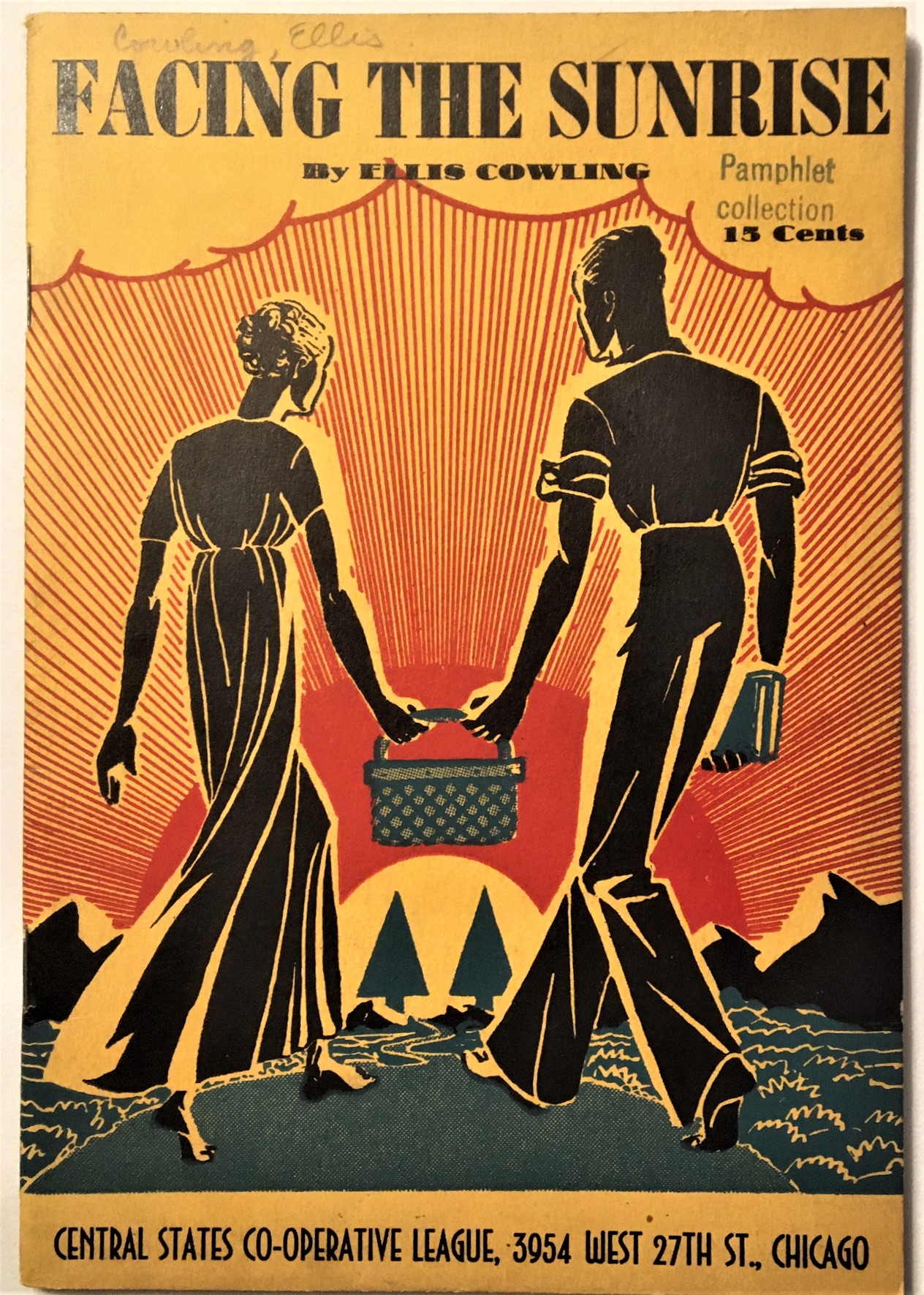
    I just couldn’t resist sharing the cover design for this 1937 pamphlet, as Dick and Jane walk into the purifying light of an atomic sunset.  Well, not quite that, as they were walking the other way into the Purity-of-Essence of a Communist/Cooperative deep red sunrise:

    IMG_2039

    The Cooperative Movement indicts Capitalism for the first half of the pamphlet:

    • Education: “capitalism is robbing youth both of its chances for education…”
    • Romance: “With other things it wrecks, Capitalism is wrecking marriage and home life”. 
    • Good Time: “Modern civilization is not  giving youth what it wants”. 
    • Art: “…increasing insecurity of our times simply means that youth’s chances of being artistically creative are growing less and less”.
    • “Profit system”: “Youth facing life under capitalism does not have a very cheerful outlook”.

    On the other end of the equation, the Cooperative movement promised abundance, increases employment, makes romance and good time possible, encourages creative effort, and advances practical Christianity.  It was 1937, and the Great Depression had its downs and ups but mostly down, deep into 1937/8/9, and people were looking for solutions everywhere. The New Deal may have been part of that, though by 1937 it was mostly being taken off-the-books, and there were plenty of conservative and more-rightist Republicans and Dixiecrats who thought of the FDR acronymic programs as just this side of Socialism–which is all fine and good, though those guys should also remember that FDR did more to save Capitalism than just about anyone in this country, ever. So: yin-yang.

Recent Posts

Archives

Categories