A Daily History of Holes, Dots, Lines, Science, History, Math, Physics, Art, the Unintentional Absurd, Architecture, Maps, Data Visualization, Blank and Missing Things, and so on. |1.6 million words, 7500 images, 4.9 million hits| Press & appearances in The Times, Le Figaro, Mensa, The Economist, The Guardian, Discovery News, Slate, Le Monde, Sci American Blogs, Le Pont, and many other places… 5000+ total posts since 2008.

  • Where Suspended Railroads and Elevated Highways Meet: Los Angeles Traffic, 1939

    JF Ptak Science Books  Quick Post

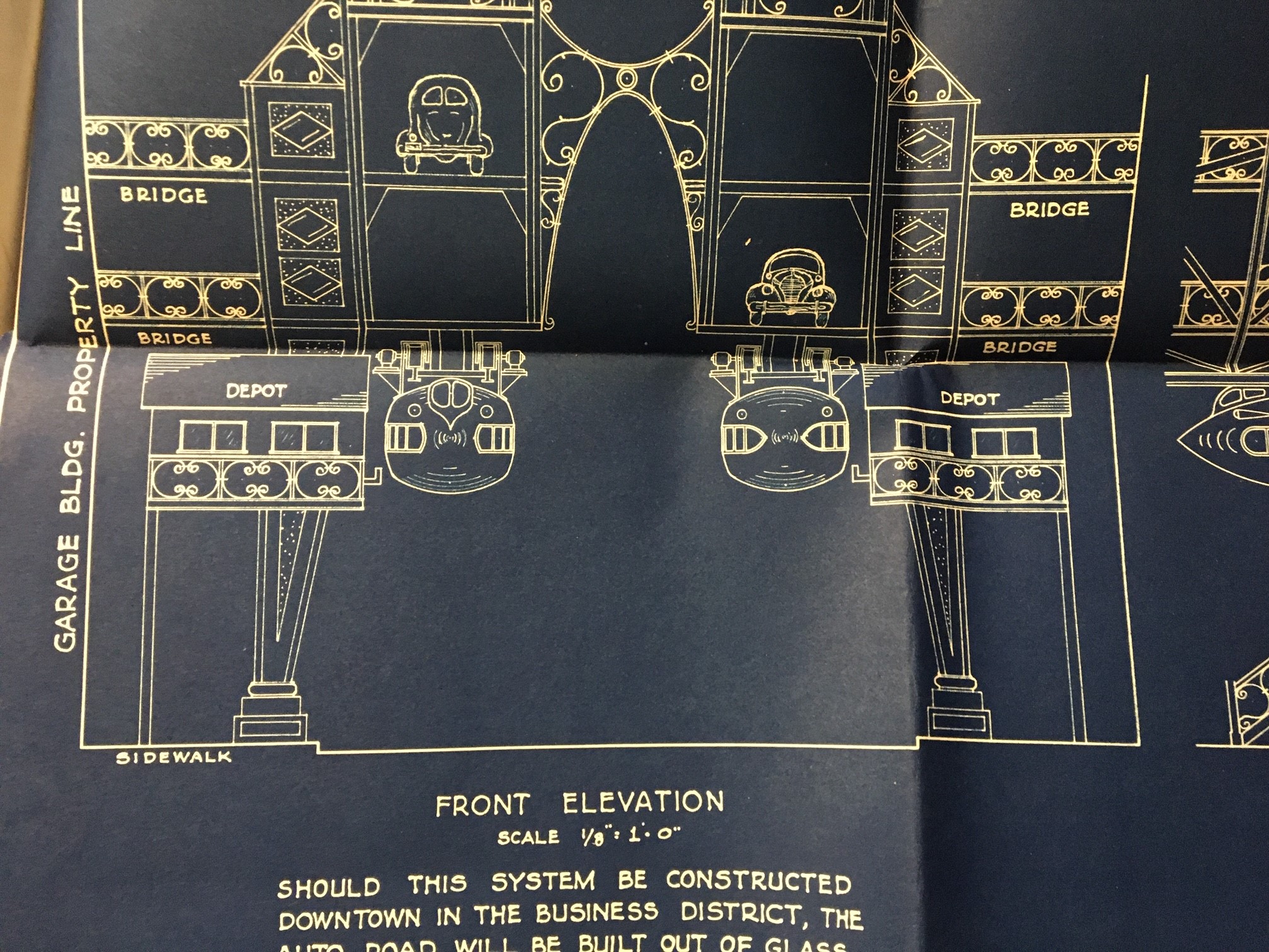
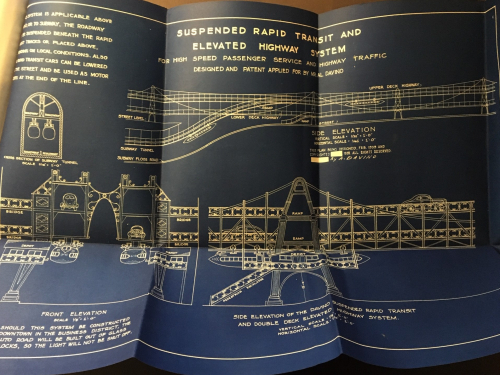
    Here we go: I unearthed a beautiful if not a very good solution to the traffic congestion problems in 1939 Los Angeles. It is a rare, self-published work of what seems to have received almost no attention, suggesting a combination of suspended railways and elevated roads to free up more space on the streets of L.A. It is the work of Alphonso Davino (1888-1965?) who wrote A Brief analysis of the Traffic Congestion Problem and its Economical Solution1 and presented it to city planners in 1939.  Mr. Davino had an entire system of transportation, though he seems to have luck in getting the ideas across a wider population in only occasional and obscure publications. 

    IMG_2251

    I can not find very much at all for Mr. Davino, though he is a patent holder for at least three associated designs/ideas dating from 1926 to 1950. [Semirigid Suspended Railway Structures, 1607875, (1923); Aerial Railway Apparatus patent 2234487 (1943); Suspended Rapid Transit System 2781001A (1950), (suspended vehicles with self-propelled vehicles).] I also found a reference to a suspended transportation system of some sort offered by him through his business “Aerial Apparatus” of Los Angeles (in the Mining Journal, vol 110, 6 November 1920, p 910).

    IMG_2254

  • Lunar Space Suits, 1950

    JF Ptak Science Books  Quick Post

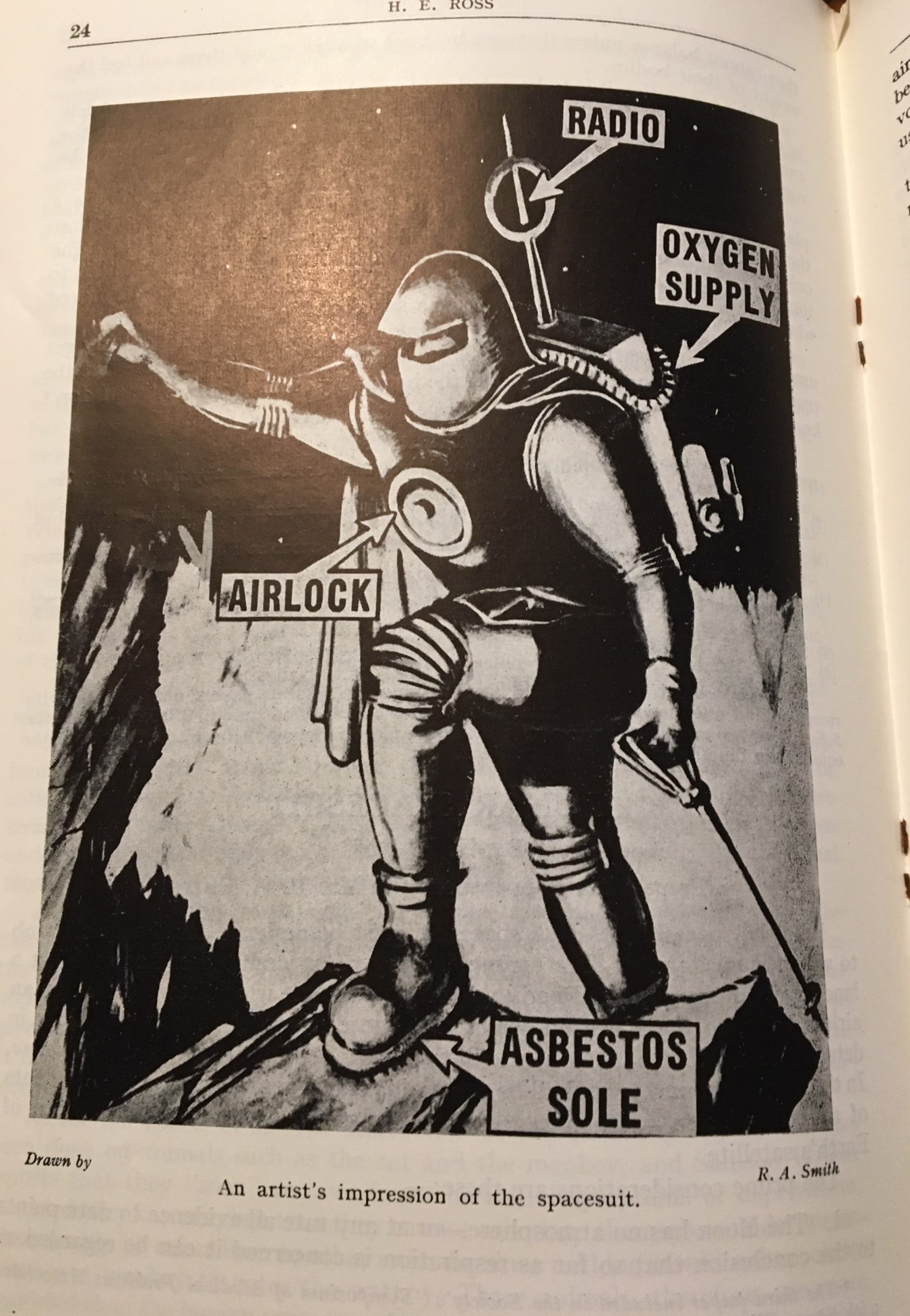
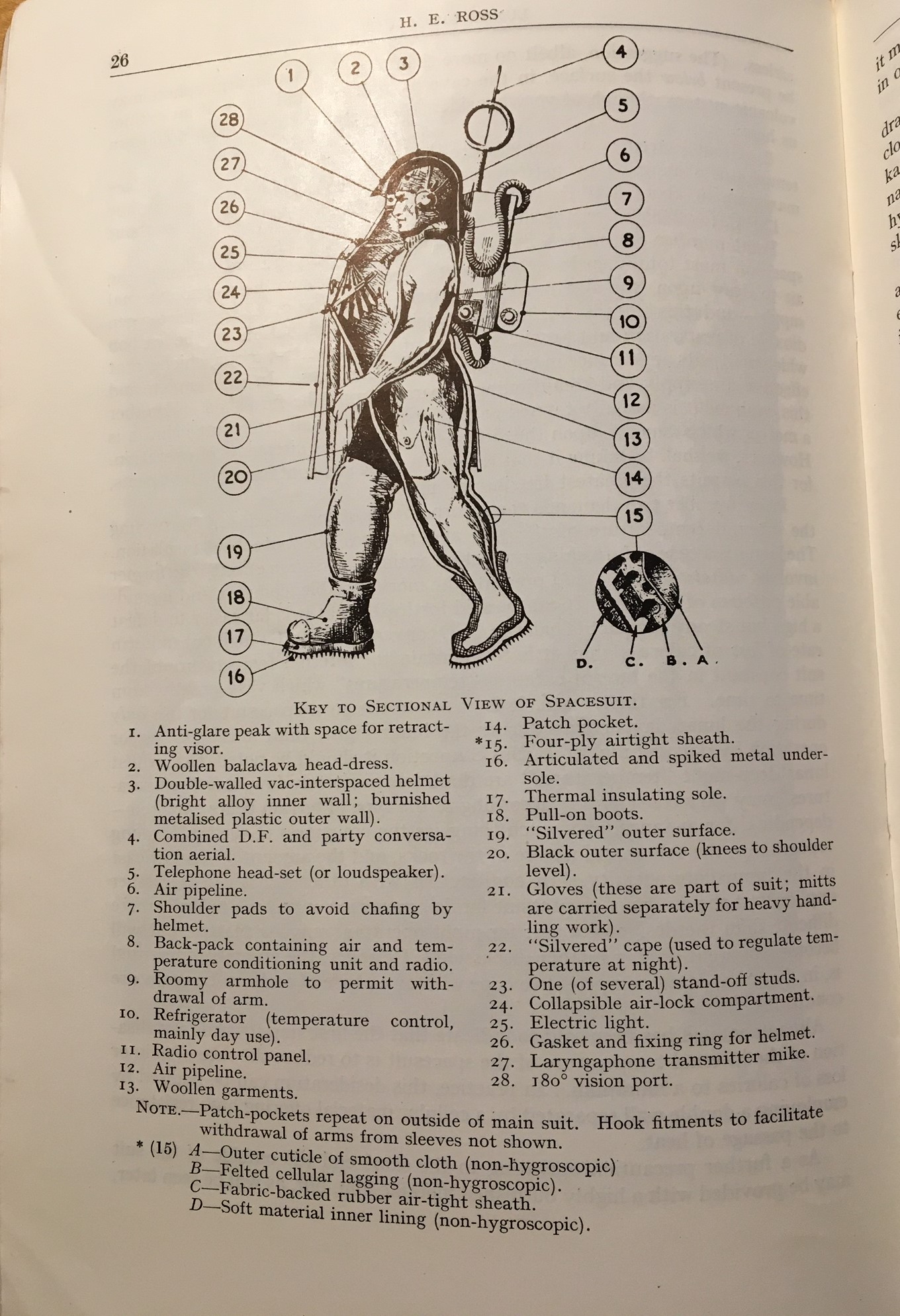
    IMG_2183This is just a very quick post based on a book that I’m trying to sell over on the bookstore end of this blog–the images are arresting and interesting, and I at least wanted to share them here.  These two illustrations are the first serious scientific study of what sort of suit would be needed to survive on the surface of the Moon (according to the Space Centre UK website) and appear in  H.E. (Harry) Ross’ article “Lunar Space Suit” as it appeared in the  Journal of the British Interplanetary Society, (vol 9/1, January 1950) . Enjoy. 

    “In a November 1949 symposium, Harry Ross presented a paper on the “Lunar Space-Suit”. Ross had examined the problem of a 68 kg lunar space suit (equivalent to 11 kg on the Moon) which could be worn for up to 12 hours, within the temperature range of 120 degrees to minus 150 degrees Celsius, representing night and day. The suit design was a 4-ply, made up of a thin exterior skin of closely woven cloth. It had a 1 cm layer of cellular heat-resisting material (Kapok, wool, felt et cetera) and a 1-2 mm main airtight sheath of fabric-backed natural or synthetic rubber. It also had an interior lining of non-hygroscopic material, mainly for comfort and to manage contact between the rubber and skin and absorption of the water-vapour. The exterior of the lunar space suit was to be a highly burnished metallic film, designed to reflect as much heat as possible.”

    IMG_2184“The helmet was to be a light, rigid double-shell structure, with the inner a bright alloy metal and the outer a plastic with burnished metal coating. Lateral vision of 180 degrees was proposed with a minimal vertical extension in order to minimise heat gain or loss. A special glass to prevent heat and actinic Ultra-Violet rays would be employed…”

    “The space suits that were eventually worn by the Project Apollo astronauts are a far cry from this original 1940s design. But the work started out by Harry Ross, led to credible thinking on how humans could survive in a self-contained, mobile habitat. The original paper by Harry Ross is [this paper].” –British Interplanetary Society website

  • The Underground Vaults of Harper & Brothers, 1855

    JF Ptak Science Books  Quick Post

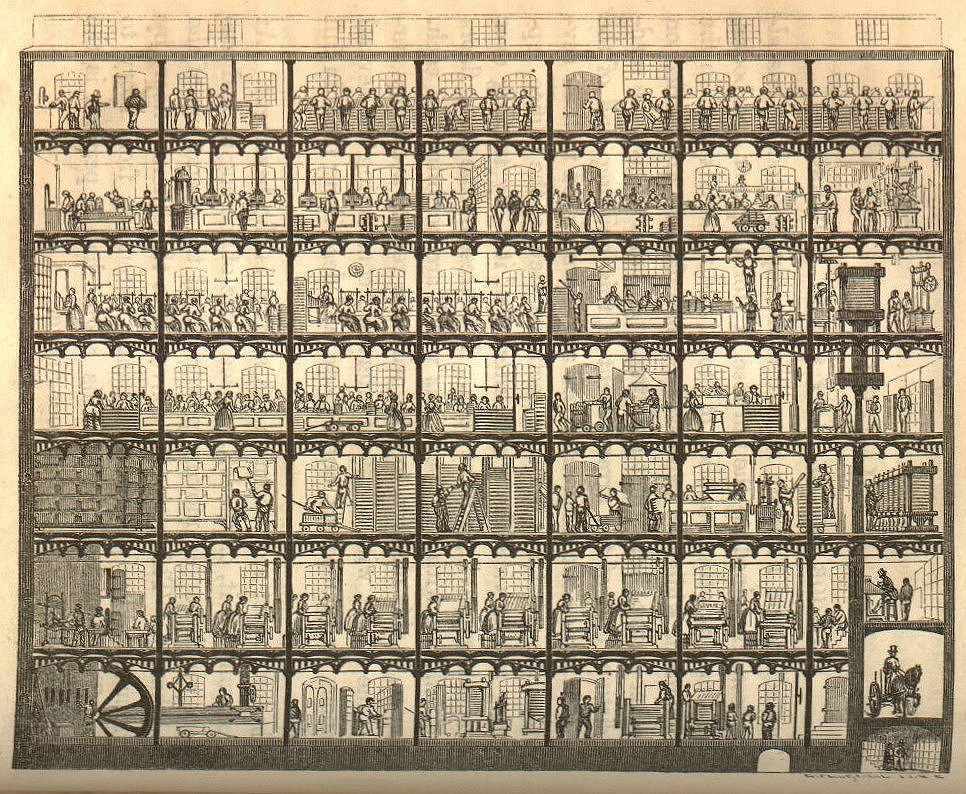
    I found this fantastic cross-section of the Harper & Brothers publishing house in Jacob Abbott’s The Harper Establishment, or, How the Story Books are Made, published of course and thankfully by Harper in 1855, and found in its entirety here.

    Harper & Bros memory vaults

    The whole of the enterprise is explained on pp 43-49.  I’d really like to return to this image at some point, because there are more detailed engravings in the book to match every section of the building, and to me it looks like this image could be turned into a 19th Century Printing and Publishing Board Game.

    What I was interested in right now was the box on the extreme bottom-right, which turns out to be The Vaults–this is the central memory core of this publisher, a 200-foot-long, 8×8′ corridor lined with the original plates for all of the publications of the firm.  The plates for their single-volume version of Herman Melville’s Moby-Dick would’ve been put down there just a few years ago. 

    “The plates are stored in subterranean vaults built under the streets that surround the building. The entrance to these vaults has already been shown in the sectional view of the Cliff Street building, on page 42. (A more enlarged view is shown on the preceding page.) The vaults extend under ground for two hundred feet in length, and in dimensions are eight feet wide by eight feet high. They are shelved on both sides, and the shelves are loaded with plates–stereotype or electrotype–representing all the works published in the establishment. There is one plate for every page of every one of the many hundreds of volumes which the house publishes, making from fifty to seventy tons in all.”

    “When a new edition of any book is required, the plates are brought out from these vaults and put upon the presses. When the work is finished, they are taken back again to the vaults.”

    ·Posted by :

    ·in:

  • Delambre’s History of Greek Mathematics (Almost) in English (1811)

    JF Ptak Science Books   Quick Post

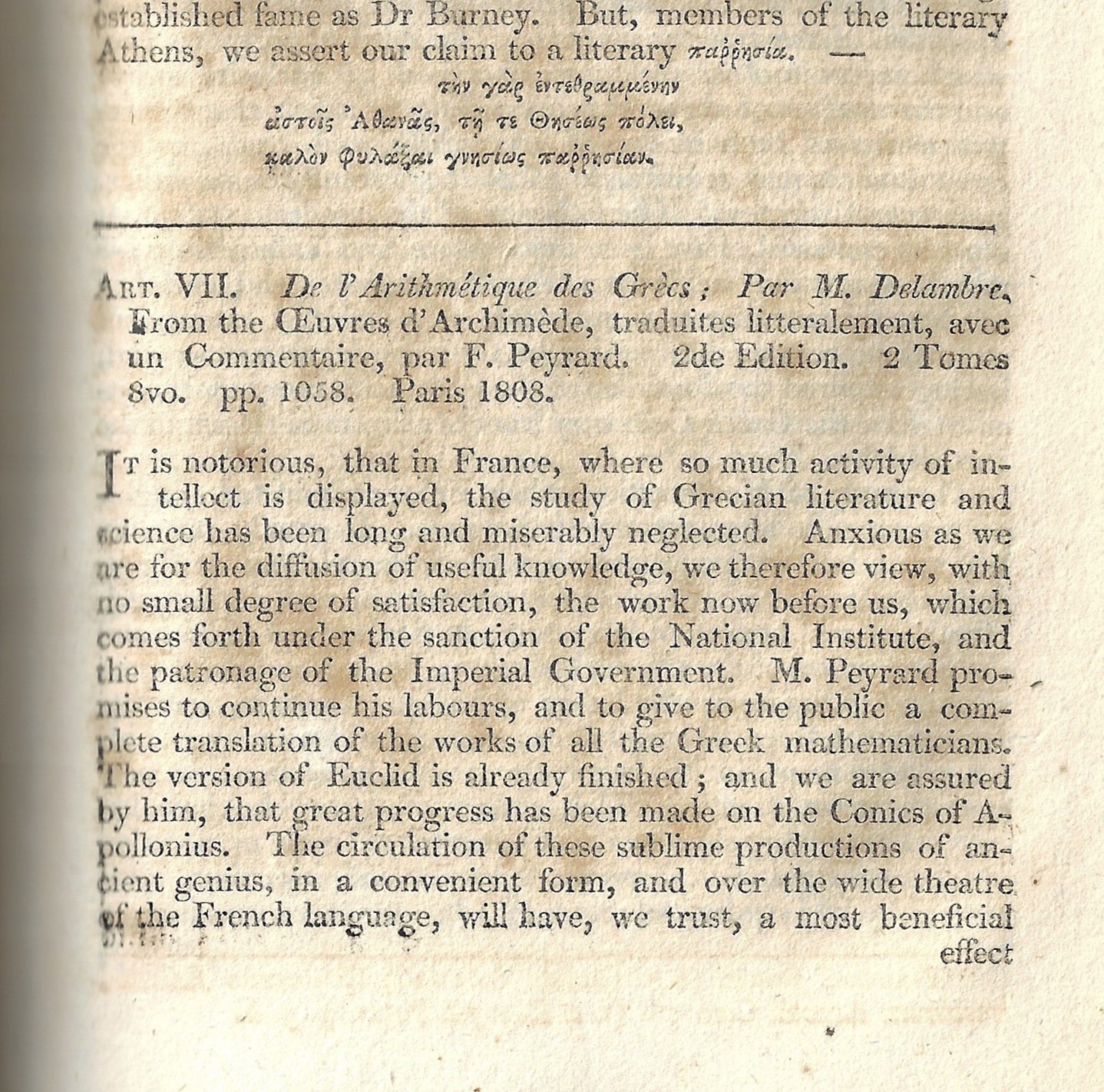
    Edinburgh Review 1811 delambreI found the following while strolling through a volume of teh Edinburgh Review for 1811. The ER was an excellent “magazine, with much in common with the New York Review of Books and The Times literary Supplement–it was meant for a mass audience of careful readers, and performed critical reviews and examinations of newly-published major works. Analysis was done on 40-60 books per year, spread out over about a thousand pages, so there was a lot of space dedicated to each work.  What I’m sharing here is the mathematician Jean-Baptiste Delambre’s (1749-1822) contribution to Francois Peyrard’s (1760-1822) Oeuvres d’Archimède, trad. littéralement, avec un commentaire, par F. Peyrard,…. suivies d’un Mémoire du traducteur sur un nouveau miroir ardent. et d’un autre Mémoire de M. Delambre sur l’arithmétique des grecs... Delambre’s contribution, “De l’Arithmetique des Grecs”,  ran on pp 569-601 in this 1058pp work, and so far as I can find has not been translated. The review occupies pp 185-214 in this volume of the ER, and is in English, so I thought there may be some history/maths folks out there who would like to read it. The image at left is from the copy here; the full text link is provided by Google Books.  

    Full text:  https://babel.hathitrust.org/cgi/pt?id=uc1.b2972985;view=2up;seq=196  (The text clears up with a one-level zoom.)

    ·Posted by :

    ·in:

  • Getting Everything Wrong in 1937 (Gerald L.K. Smith)

    JF Ptak Science Books  Quick Post

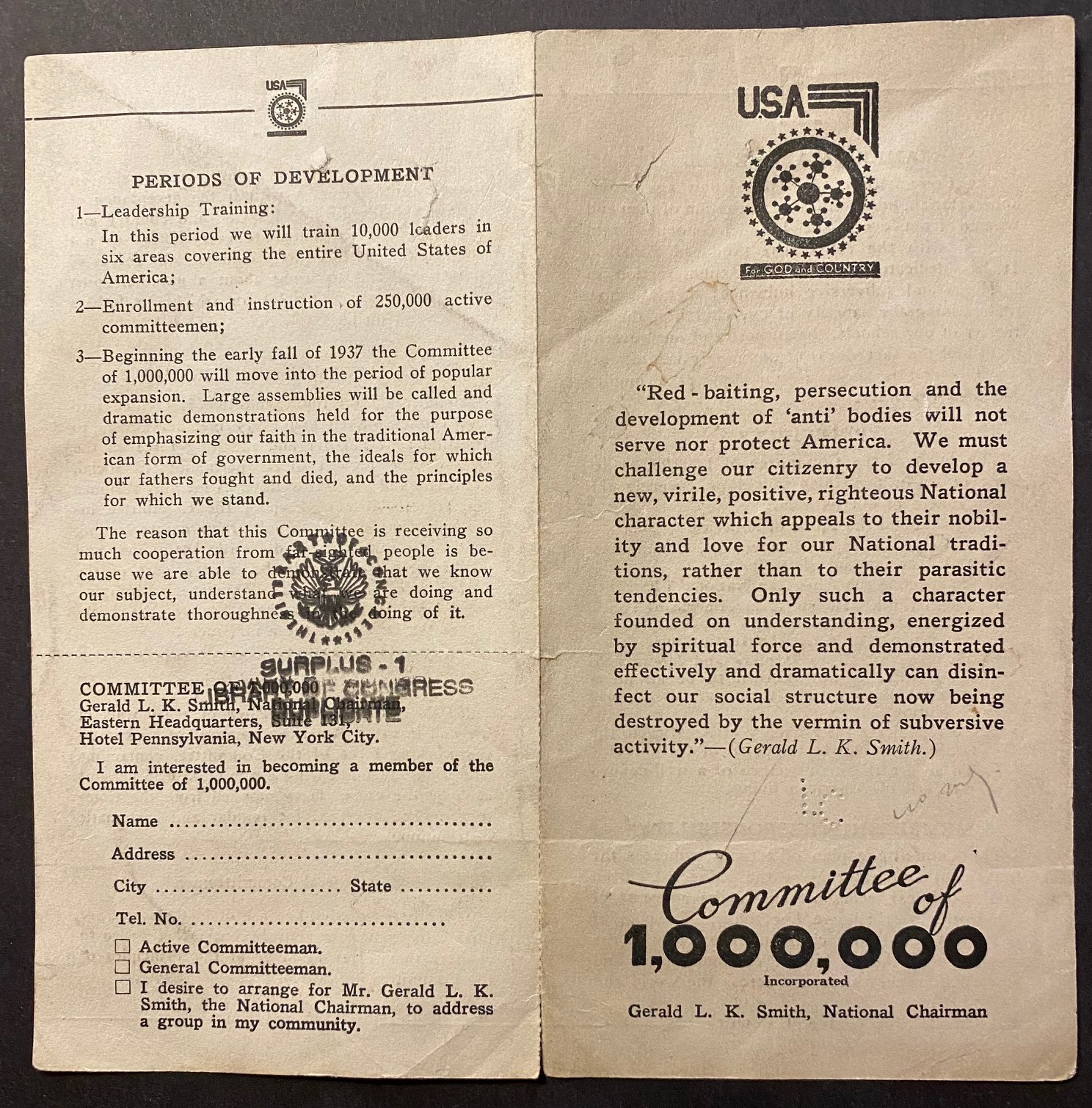
    This little pamphlet packed a lot of bitter bilious hope into its small-framed four pages. The  Committee of 1,000,000 was the work of the past-and-present pastor Gerald L.K.Smith, a rabid far-rightist who seemed to be present at the birth of most of the bad ideas of the 1930s and 1940s. He was a white supremist anti-Semite ultranationalsit pro-Nazi who started his major political life as a national organizer for Huey Long, an ally of Townsend and Coughlin, and the founder of the America First Party. He was a presidential candidate running in   against what he considered to be the Communist Franklin Roosevelt, was a member of William Pelley’s neo-Nazi Silver Shirts in 1942, advocated for the early release of Nazi war criminals at Nuremberg, denied the Holocaust saying that six million Jews weren’t murdered but emigrated to the U.S….and, well, you get the picture. The little leaflet was printed in 1937 and evidently was owned by H.L. Mencken (who kept his fingers on the pulse of such dangerous folks) though he gave it up to the Library of Congress after only a few months. The leaflet is printed on only one sheet of paper, and I reproduce it below. 

    IMG_2414 (1)

    ·Posted by :

    ·in:

  • The Speed of Thought (1850)

    JF Ptak Science Books  Quick Post 

    Here’s another happy and unexpected find, this coming from one of my very-early-on scientific heroes, Hermann von Helmholtz. The two papers1 in question (French translations that appeared in 1850 and 1851 about a year after the results were published in German) form an interesting chapter in the history of infinity—in this case, closing the boundaries of speed of the neural impulses. As with the speed of light (thought to be infinite or thereabouts into the 17th century) the speed of “thought’ or “pre-thought” was thought to be infinite until this paper by the polymathic von Helmholtz. Von H worked in many different fields and made major contributions across numerous disciplines—he was a very very impressive guy, and evidently a good teacher, and also of fine character (as seen in the 2nd law business with Mayer). In this paper he was able to determine the speed of the nerve impulse in a frog, using its sciatic nerve and the calf it was connected to, and elegantly finding a speed of between 24-38 metres/sec., and presented in these two papers for the first time in French. The experiment was fairly simple and just remarkable, and presented the speed of the neural impulse at very much not light speed. And so, the infinity of the speed of thought—thought perhaps so because of religious demands—definitely had a bookend.

    Notes.

    1. Hermann von Helmholtz. “Note sur la vitesse de propagation de l’agent nerveux dans les nerfs rachidiens.” Published in Comptes Rendus vol 30, 25 February 1850, pp. 204-6;  and “Deuxieme Note surla vitesse de propagation de l’agentnerveux”, again in .Comptes Rendus, vol 33, 1851 in pp. 262-5. 

    ·Posted by :

    ·in:

  • Presidential Yard Sale/Give (1913)

    JF Ptak Science Books  Quick Post

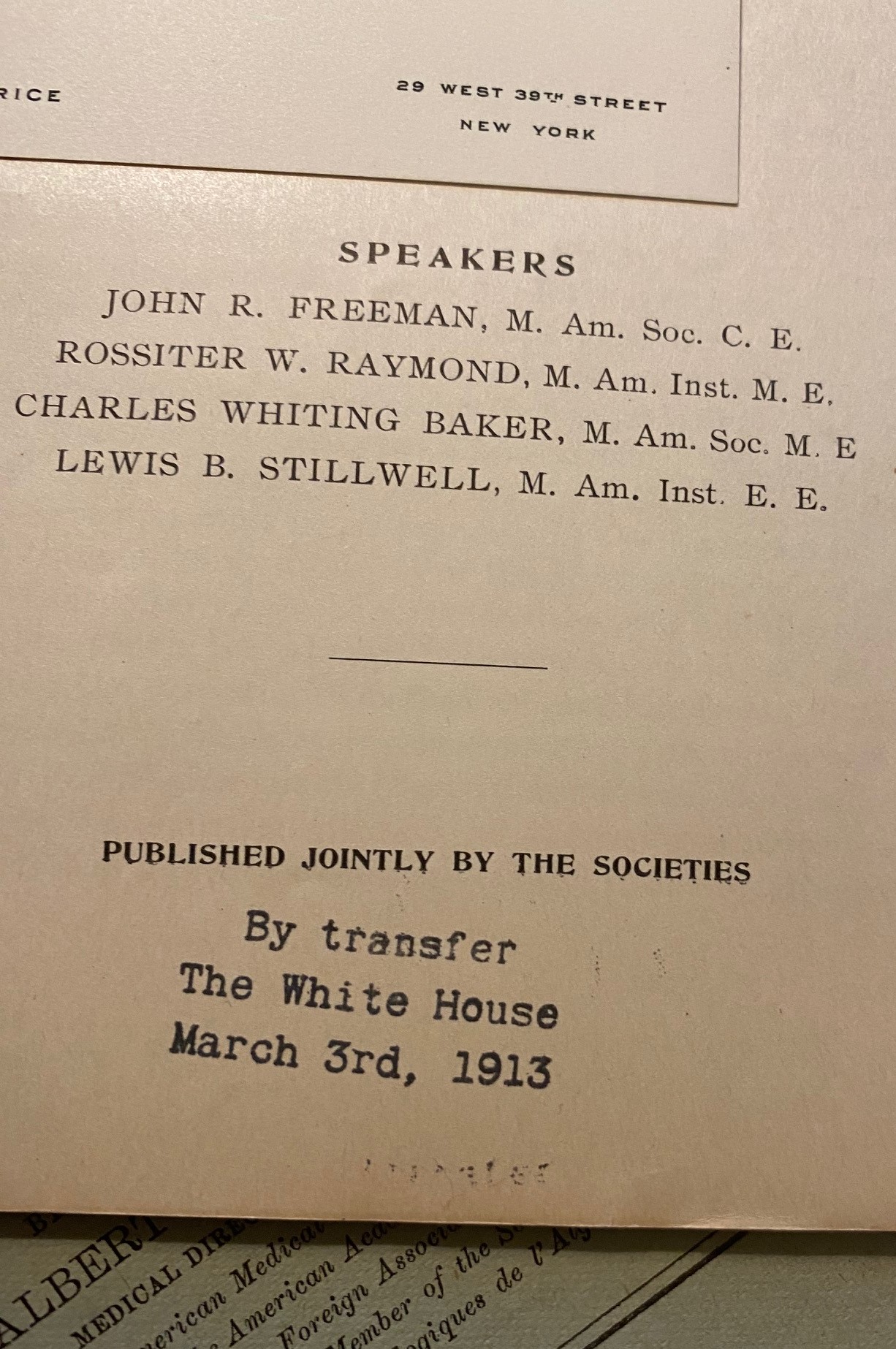
    IMG_2421 (1)This is just a small and short post about an unusual bit/bob from the White House. William Howard Taft to me was Mr. In-Between: he was the president between Roosevelt and Wilson, and he was in there about in between half the bad-ish and half the good-ish presidents, squarely in the middle, I think. He was also Chief Justice of the U.S. Supreme Court, where he was probably a better justice than he was a president, which would put him among the accomplished of his brethren. I remember him mostly for wanting to try to hang on to his chief justice role at least until Herbert Hoover was out of office–he found Hoover to be too liberal for his tastes, memorably referring to the not-Liberal president as “Bolsheviskii”, which has a certain “wow” factor to it. But what I’m drawing your attention to is the pamphlet Conservation of Natural resources–Meeting of Engineers, printed in 1909. The interesting part is that this was transferred out of the White House library on March 3, 1913, Taft’s last full day in office, which makes it sound as though there was a bit of shelf cleaning going on right to the bitter end before Wilson came in, making this a curious tiny bit of ephemera.

    ·Posted by :

    ·in:

    —
  • FuturePunk 1887: What is It?

    JF Ptak Science Books  

    Here’s another in this developing and fun series in the What-is-It? category. At first it reminded me of Renaissance woodcuts of various stages of creation anointed by a coy hand of the creator. This one though is late 19th century and has a definite highly au courant “Oriental” theme which so far as I can tell has nothing to do with the telling of the story of this object.  It looks a little like a multi-horned phonograph (already in existence by about a decade at this point), and it also looks a little like a Chinese earthquake detector. It is surprising for what it actually represents, and it is a lot larger than you’d think, with the figure in the background definitely not to scale. Plus, it comes into the world a few years earlier than its gigantically famous counterpart, as though it had gone back in time…

    What is it?

    Time machine

  • Crazy Cubes, Baseball Cannons, Logic, the 4th Dimension, and Monkey Bars.

    JF Ptak Science Books   (Older post #2248 from July 2014 expanded)
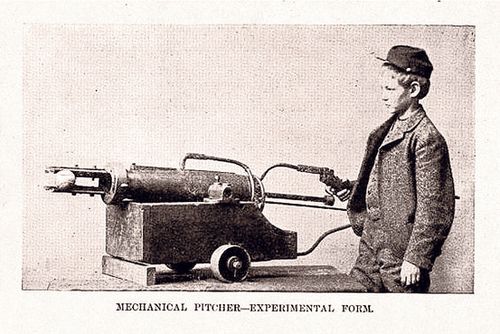
    Hinton cannon[Image source:  Joshua Robinson, “A Machine Before its Time”, Wall Street Journal, June 21, 2010. See below.]

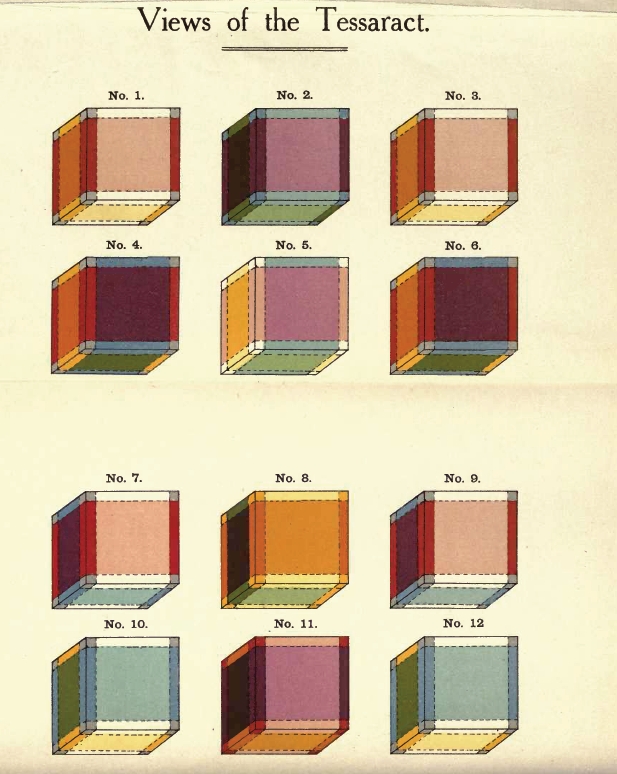
    Somewhat Zelig-like, Charles Howard Hinton (1853-1907) is a sort of shadowy Oxford-educated figure who turns up in the beautiful Jorge Luis Borges’ works, and who married one of  George Boole’s daughters1, and who was a great and very early visualizer of geometries of higher dimensions, and who was the coiner of tesseract, and the inventor of a baseball pitching machine, and a practical joker, and a sci-fi writer, and who deserved an obituary in the New York Sun by the masterful Gellett Burgess2, and who seemed to keep one step ahead of everyone and himself.

    He was also the creator of “crazy cubes”.

    There are many standard-bearers in the history of modern art who probably owe something to Hinton, who published his ideas on the fourth dimension (illustrated!) just at the time when this idea was in it trial runs in the artwork of the modern age.

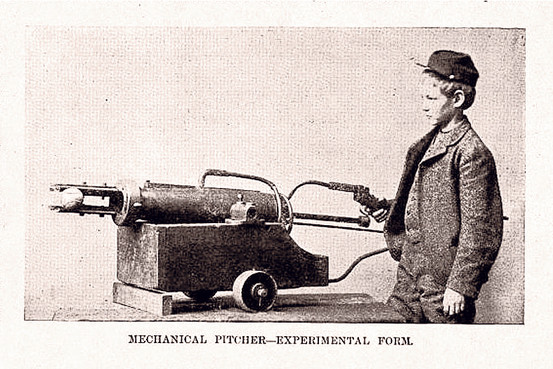
    And so do baseball players—or at least those at Princeton, where he introduced his machine which evidently was used there for several seasons. The pitching gun really was a cannon, the baseball loaded into the thing with an appropriate cartridge to shoot the ball at pitcherly speeds, which he described it in Harper’s Weekly for March 20, 1897. It was capable of varying speeds, had an adjustable breech, and was capable of throwing a curve. (How Hinton got to Princeton is interesting and a mystery, both; he was an instructor of math in England until he was charged and convicted of bigamy in 1886, whereupon he took his first wife and four (?) sons to Japan to teach in Yokohama for a while, then yadda yadda yadda he starts teaching at Princeton in 1893.)

    Hinton was into a lot of things, with a very inquisitive mind, and very smart. And so he bounced here and there in his careers, from position to position. David Toome, in his fine The New Time Travelers: A Journey to the Frontiers of Physics (2010) gently and wonderfully describes Hinton (in his relations to the exterior world of work) as “buoyant” (page 29).

    In any event, Hinton seems not to have patented the thing, so far as I can determine in 10 minutes of patent searches.

    The cannon seems to have excited a bit of baseball scifi3 in itself, adding to Hinton’s other pleasures.

    In a longer and better article than mine, Joshua Robinson writes in the Wall Street Journal about  Hinton’s machine and the near-roboticized future of baseball:

    “…(I)n 1896, the Los Angeles Times called it a “Frankenstein.” One Washington Post columnist worried it would ring in an age of robots ruining the national pastime—this was a long time before anyone was worried about steroids.

    “There would be the base-burning, high-pressure, anti-friction catcher,” he wrote, “and the shortstop made of aluminum and rivets and filled with cogs, cams, valves, shafts, and belting.”

    Hinton’s pitcher was an interesting idea, but ultimately it proved to be too cumbersome and slow to be of any sustained use. Plus, as Robinson points out, after the cartridge was fired there was a puff of smoke, which caused occasional consternation and confusion for those standing in front of the canon. And ducking. 

    And the so-called “crazy cubes”?  That moniker is my own creation. These were simply (really not so) creations by Hinton that he said would help people visualize his four dimensional world, as Rudy Rucker (see below) describes as “points moving around in three dimensions might be imagined as successive cross-sections of a static four-dimensional arrangement of lines passing through a three-dimensional plane…”  Evidently the cubes helped many people experience a more internalized world of fantastic difference, some stating that the cubes drove some people insane. Of course they were just colored cubes, pretty in themselves–though the problem of visualization was fairly knotty.4  
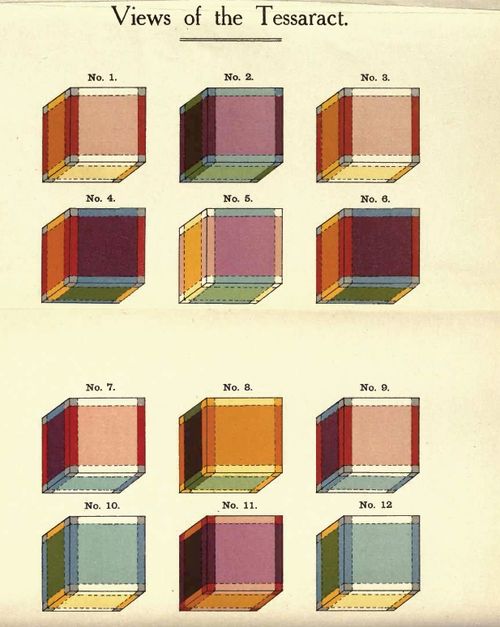
    Hinton tesseract[Source: The Fairyland of Geometry, a Cultural History of Higher Space, 1869-1909, here.]

    It MUST be pointed out that there is a very steely concretized example of the Hinton tesseract that is still around, brought into existence by one of Hinton’s sons. Sebastian Hinton (1887-1923) was a lawyer in Chicago who hit on an idea of bringing his father’s work somewhat into the hands of the public-at-large–specifically, into the hands of children, who would be able to play and climb and swing in Charles’ fourth dimensional idea.  He applied for a patent in 1920 which was granted in 1923:

    Jungle gym


    [Image source: Wiki Commons.]

    The “Junglegym”5. 

    Notes:
  • The Normandie That Failed (1942)

    JF Ptak Science Books  Post 2905

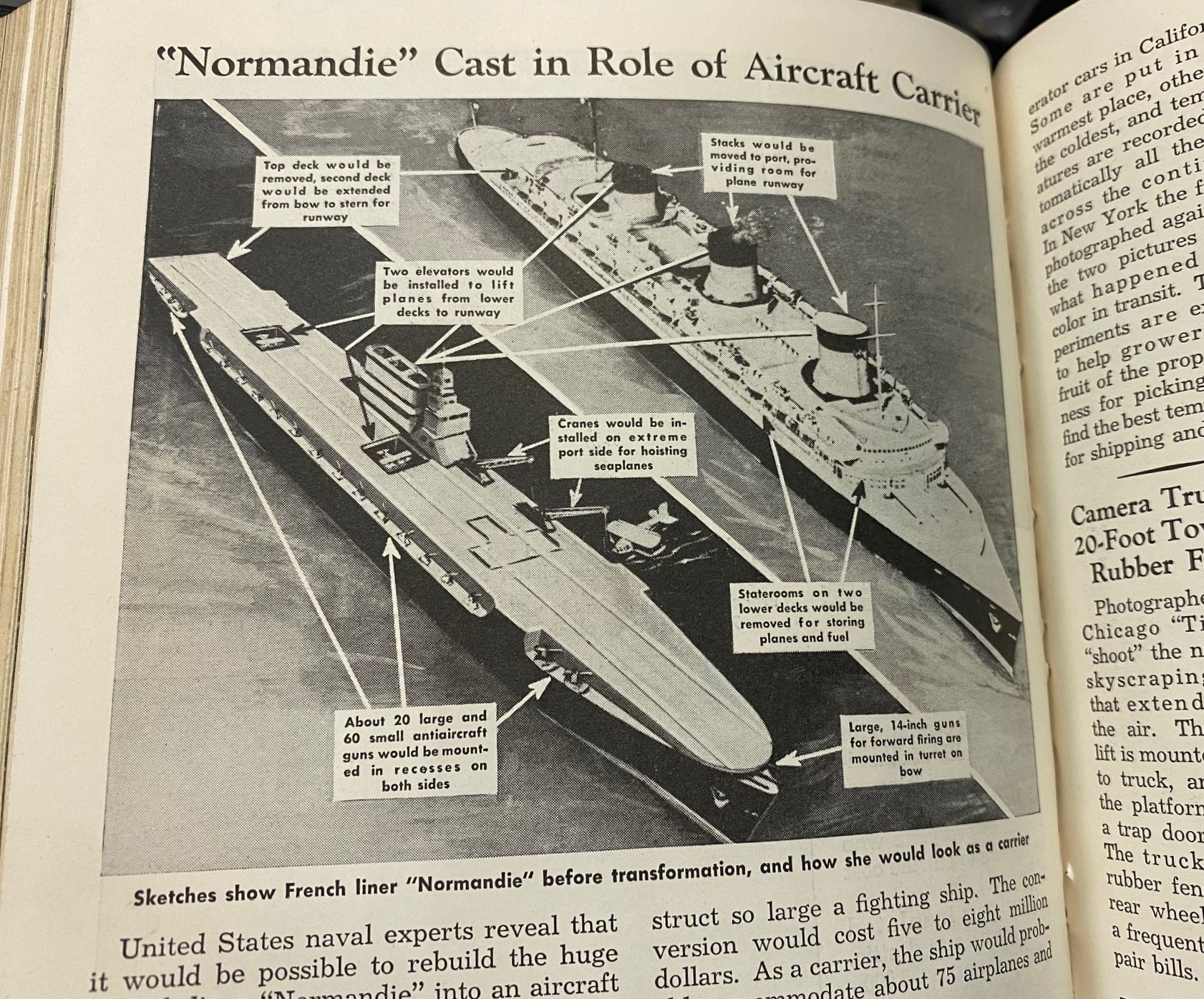
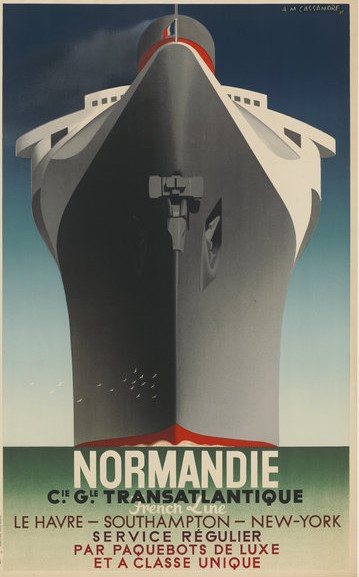
    Breezing through a volume of Popular Mechanic for 1942 I came across an article on refitting the French ocean liner, the Normandie.  The only thing I knew about her was that the ship was the subject of one of the all-time great travel posters (pictured below). The imagery for February 1942 was vastly different. It turns out that when the general war began in Europe the Normandie was in NYC harbor where it was more or less immediately interned. As a matter of fact after just a short while this great ship was tied up next to the RMS Queen Elizabeth and the Queen Mary, which meant the world’s three largest ocean liners were cheek and jowl to one another in NYC.  After Pearl Harbor the ship was put under the command of the U.S. Coast Guard, and after a very brief period the command was transferred to the USN. That’s where these plans come in, to re-purpose the ship into an aircraft carrier:

    IMG_2477

    But that was not to be and construction plans were made to transform the ship into a troop transport

    2017KC2259_jpg_lThen came the Great Misfortune.  In February 1942–the month that this Popular Mechanics was issued–the Normandie (renamed the USS Lafayette) caught fire, flamed out, capsized, and died. There was some amount of rumor and innuendo that the ship was sunk as a result of foreign intrigue, but a board of inquiry found otherwise.1 It seems that in the course of refitting that a blow ironically and tragically set on fire a pile of life preservers that were made of very buoyant by highly flammable fibre from the great kapok tree. The very effective fire suppressor was disengaged after the French sailors were led off, and, well, seemingly a lot of other unfortunate things played into one another to the critical result. It was a fatal fire for the ship. I recall seeing very unsettling pictures of the Normandie in LIFE magazine, capsized in shallow water and winter ice mud.

     There were efforts to revive her, retrieve her, bring the great ship back to life in one way or another, but all attempts failed, and the Normandie was sold for scrap in 1946 and was completely gone by 1948.

    Notes.

    1. “The investigation found evidence of carelessness, rule violations, lack of coordination between the various parties on board, lack of clear command structure during the fire, and a hasty, poorly-planned conversion effort.”–Wikipedia

  • Cutaway View of the Cockpits of the Hawker Hurricaine and Messerschmidt (1942)

    JF Ptak Science Books  Quick Post (Overall post 5101)

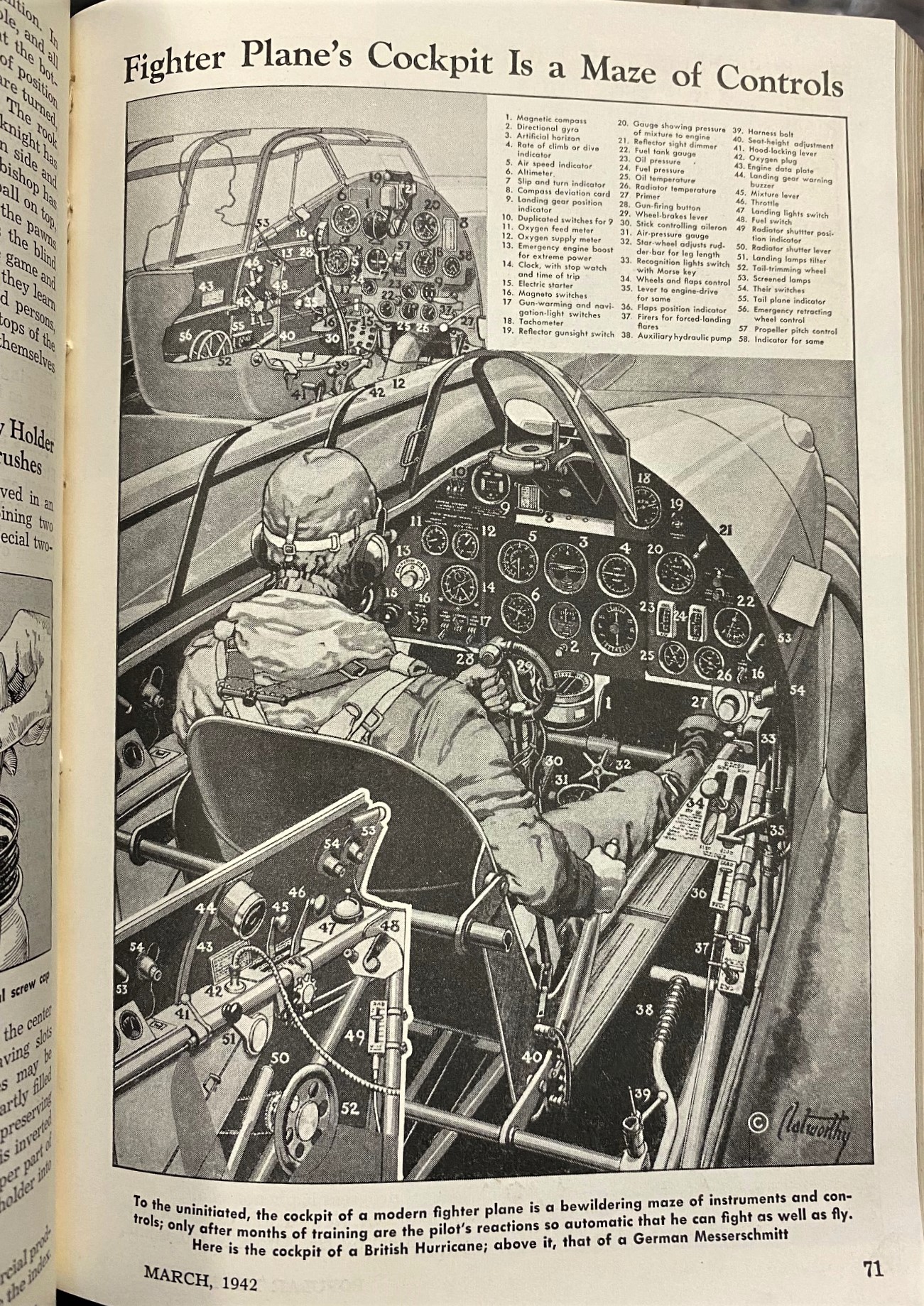
    I think that there are several dozen aircraft cutaway and cross section aviation schematics on this website, and tonight’s main entry is for the British (Hawker) Hurricane (predominantly by Hawker Aircraft Ltd.) followed by a small inset of an (unnamed though I’d guess the 109) Messerschmidt of the Luftwaffe. The image is found in the August 1942 issue of Popular Mechanics, which has hosted a number of these sorts of displays of information.  

     IMG_2472

    ·Posted by :

    ·in:

    —

Recent Posts

Archives

Categories