A Daily History of Holes, Dots, Lines, Science, History, Math, Physics, Art, the Unintentional Absurd, Architecture, Maps, Data Visualization, Blank and Missing Things, and so on. |1.6 million words, 7500 images, 4.9 million hits| Press & appearances in The Times, Le Figaro, Mensa, The Economist, The Guardian, Discovery News, Slate, Le Monde, Sci American Blogs, Le Pont, and many other places… 5000+ total posts since 2008.

  • Worse than “Science Jokes”: Songs of Biology (1945)

    JF Ptak Science Books   Quick Post 

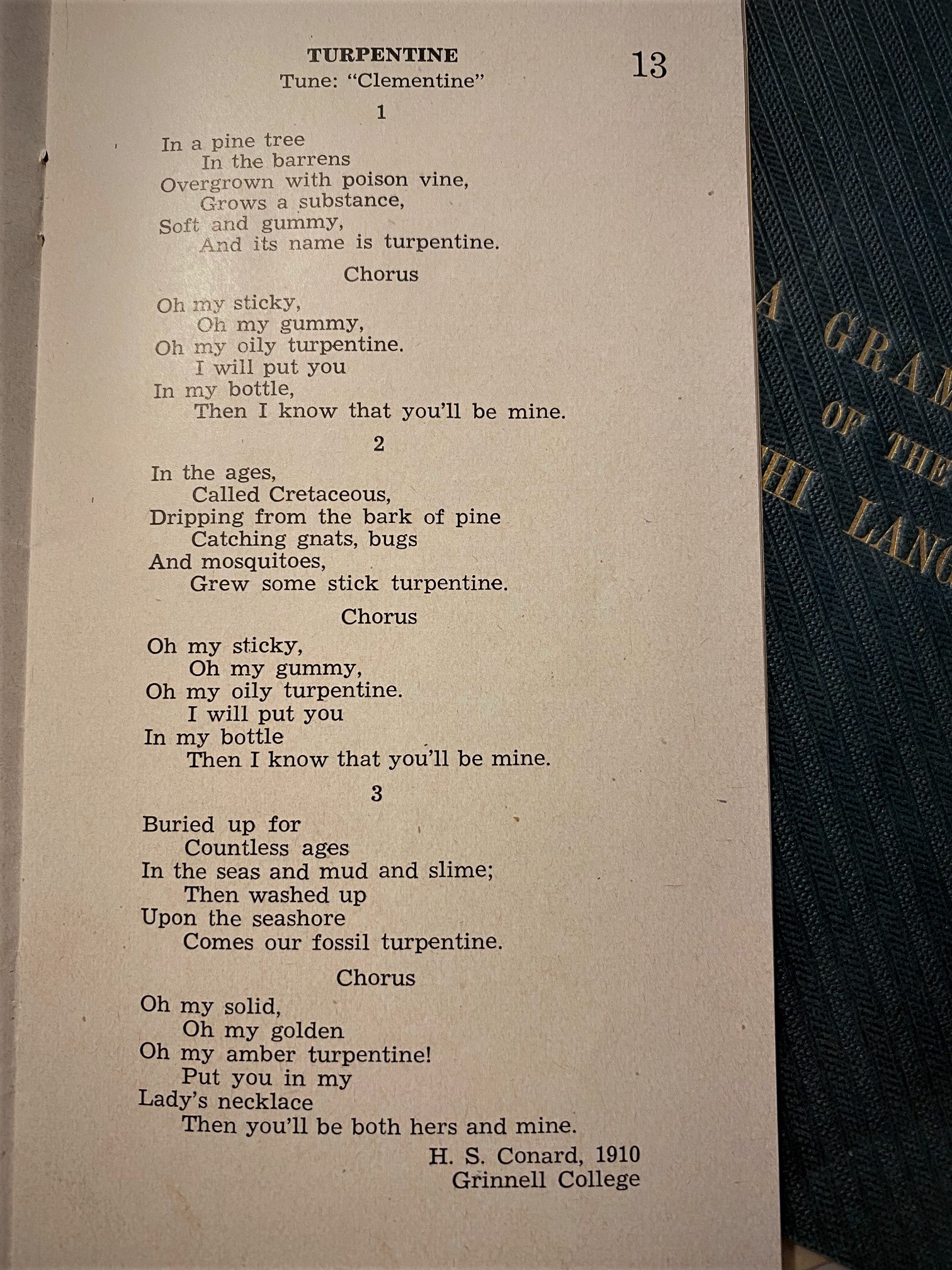
    IMG_2973 (1)Tonight I found a wonderful little biology pamphlet sandwich between two other very thin pamphlets—Free Our Political Prisoners, by the League for the Amnesty of Political Prisoners, ca. 1920, and A Grammar of the Marathi Language, 1868—the three of them together not weighing four ounces. The bio pamphlet is a very non-droll and forced-funny publication out out by the Beta Beta Betans of Mt. Vernon, Iowa, at the end of the War in 1945, and is called Songs of Biology. None of them are any good, though they’re not quite bad enough to land in the safety zone of so-terribly-bad-that-it-is-good. The only simultaneity that occurs here is the level of badness living down to its expectation.

    I do have to commend them on at least some of the song subject and titles, several of which were very unexpected. For example, I doubt that many other songs have been written about turpentine. A few of the others that are more enjoyable to imagine the lyrics than to read them are “The Sad Fate of a Youthful Sponge”, “Objective Tests”, “Parasites on Parade”, “The Germ-Laden Bucket”, “The Simple Arthopod”, and :”ode to Drosophila”. They’d be better with no music and no lyrics.

    Anyway, I present the glory of turpentine…


    ·Posted by :

    ·in:

  • “The Perfect Smoke Column”—the New Miracle of Electronics, 1952

    JF Ptak Science Books  Quick Post

    Electronic cigarettesLiggett & Myers, the producer of Chesterfield cigarettes, sounds the triumphal blast of “the greatest cigarette improvement in thirty years” in this LIFE magazine ad from 1953. It was all made possible by SCIENCE and the sacred mysteries of electronics, which helped create the “perfect-smoke-column-from-end-to-end”, which doesn’t sound all that appetizing though I guess it was if you were a lazy or distracted ciggie consumer. To prove the claim we see a model with perfect un-ciggied teeth with an inset of electronic machinery in the background, which made it look as though the stuff was being produced by the machine.

    The machine doing the great scientific deed was the AccuRay. It was a measure and control system produced by Industrial Nucleonics (beignning their industrial life in 1912 as a steam power supply systems company), which ensured that the cigarettes would be the same, million after million, each being the same length and with the same mount of tobacco. “Scientific miracles never cease”, said the Liggett & Myers people, and I guess the stained proof was in the smokey pudding.

    It may have been all about the burning, as a cigarette that doesn’t need to be drawn on to keep it lit means that it will burn itself out in the allotted time even if you just lighted the thing and kept it in the ashtray. Better burning meant more cigarettes consumed, and so on.

    And by the way Industrial Nucleonics was sold in 1987 to a perhaps more appropriately-named Cumbustion Engineering, at least so far as cigarettes were concerned.

  • 1.8 Million Planes and 2 Million Tanks (1918)

    JF Ptak Science Books  Quick Post

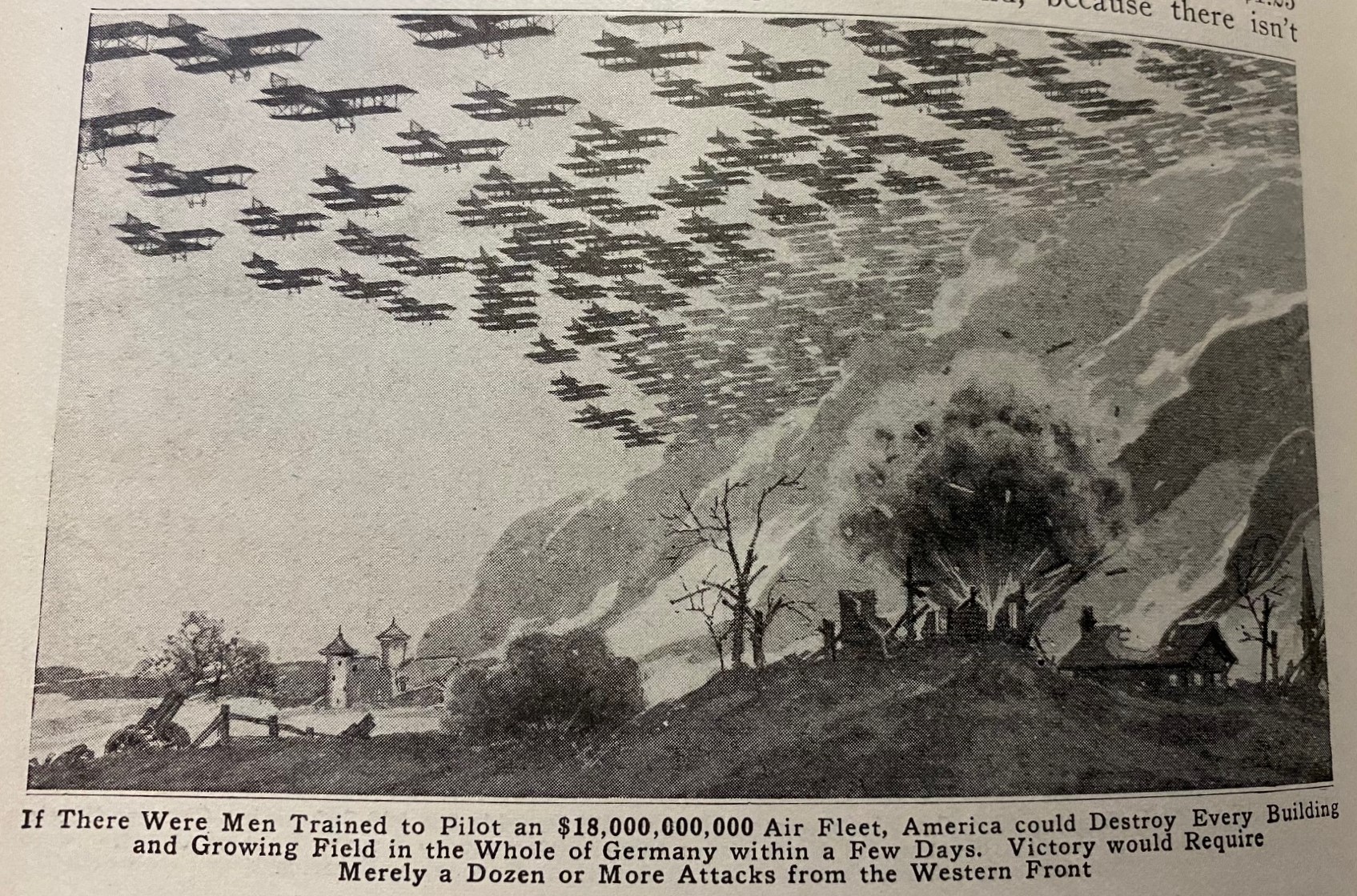
    Here’s a fine and somewhat misleading representation of the U.S. Congressional war allocation of 1918 for what was then the staggering figure of $18,000,000,000 (or about $387 billion in 2020 according to the BLS), found in the pages of Popular Mechanics for May 1918. To visualize the 18-billion, the editors displayed the amount in terms of something somewhat familiar to most readers.  For example, if the appropriation could be laid directly and only into the manufacture of airplanes (and bombs I guess) the editors guessed that the force would lay waste to all of Germany in about two days.  Guessing that each aircraft cost about $10,000 in 1918 that would mean there would be an attack force of 1.8 million planes.  Granting each a capacity of 500 pounds carriage, their entire force could deliver about 20% of the total tonnage dropped on Germany by the US and UK during WWII for each 1.8 million plane sortie.  (I’m guessing at some of the figures but I think that this is about correct.) Given that the “bomber plane” was still in its cradle, this could not have painted a very clear picture of what $18 billion dollars could buy.  Further guessing here is that there were fewer than 50,000 aircraft in existence in 1918, so imaging the 1.8 million figure would have been staggering. 

     IMG_3001

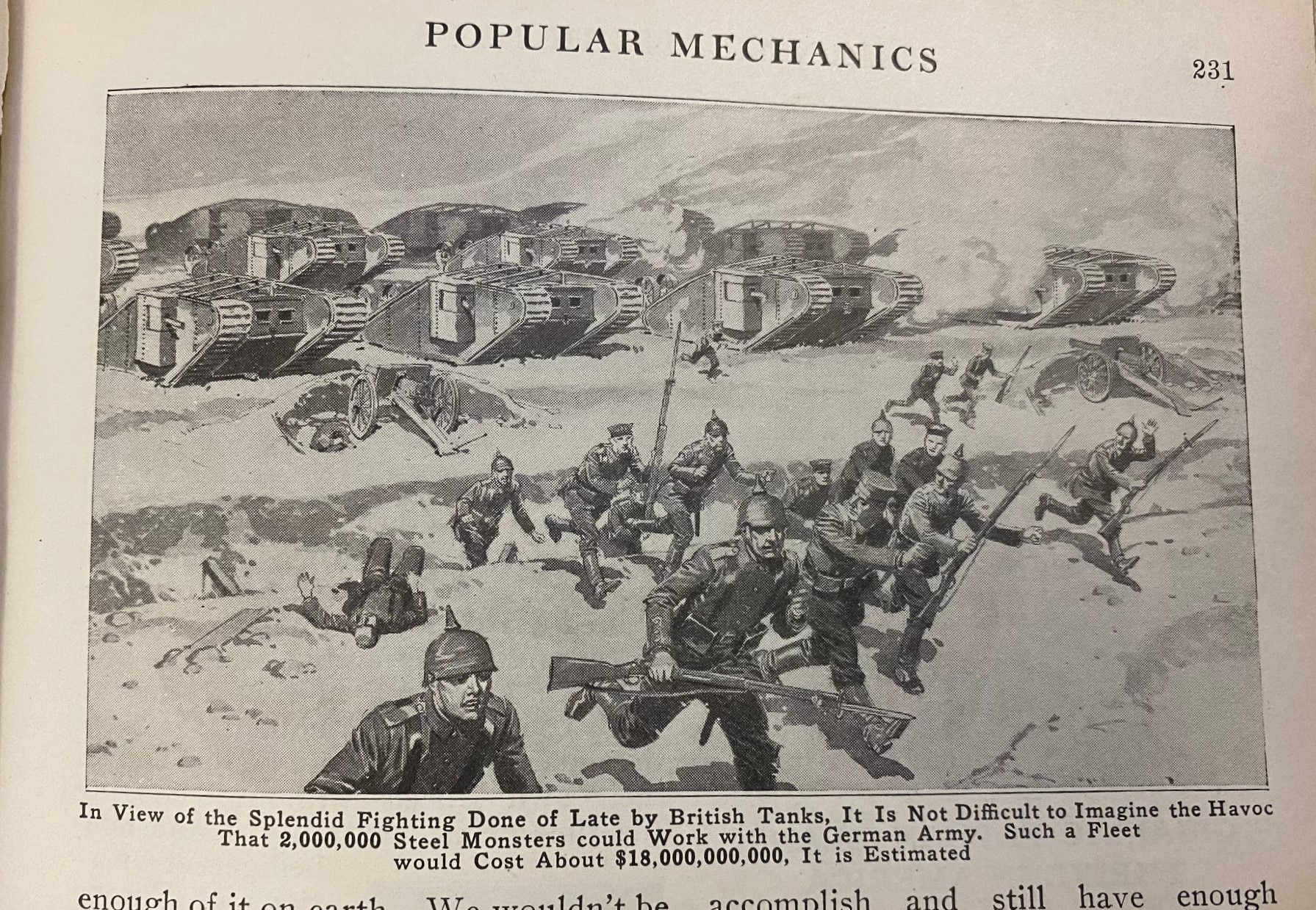
    IMG_3002Another example from the same article involves envisioning $18,000,000,000 worth of tanks, which in 1918 would cover fielding 2,000,000 of them. This of course is an enormous number, particularly having in mind that about 50,000 U.S. Sherman tanks were constructed between 1942 and 1945, which is about 3.5% of the total talked about in the article, and the largest tank battle in history at Kursk in July and August 1943 involved about 6,000 tanks between German and Soviet forces. Given too that the tank is only a few years on the battlefield at this point there was really no way that a person could visualize 2 million tanks–I suppose no commander in 1945 could have envisioned it, either.  

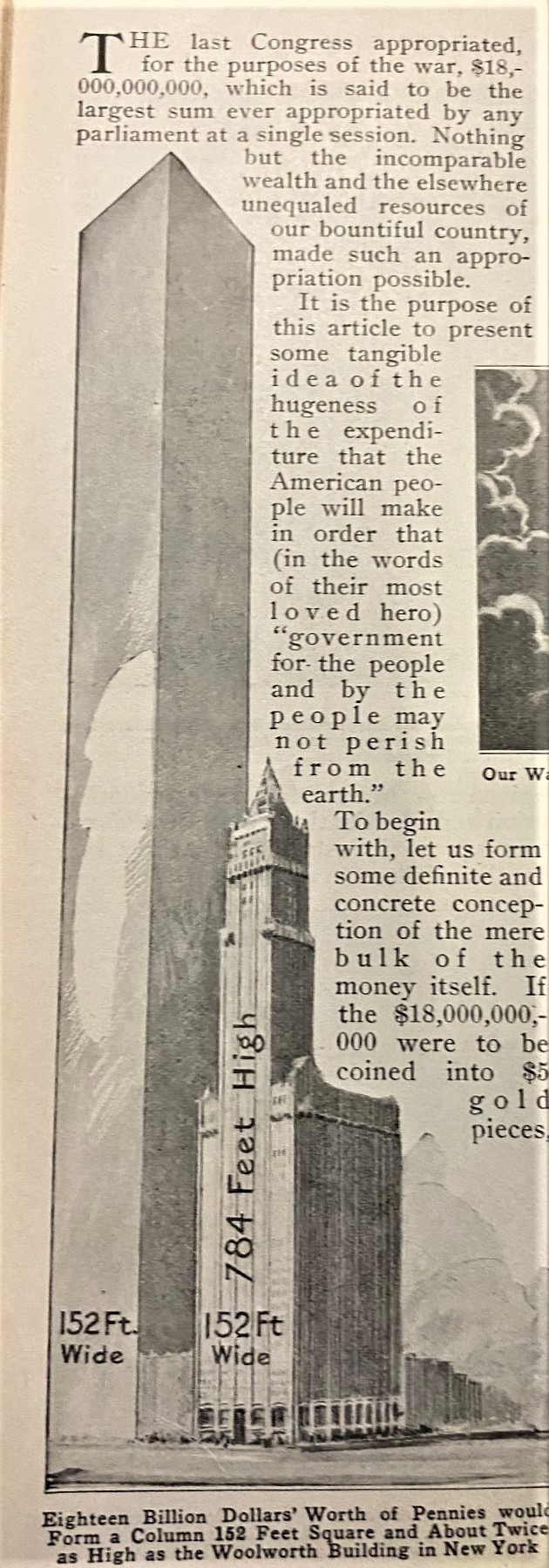
    And another example from the same article: using pennies and the Woolworth Building as comparables.  The Woolworth structure has found itself in a number of similar articles in the ‘teens, though I don’t recall seeing it compared to a 1.8 trillion penny mound, as we see below.  

    I think that the editors were just out and beyond their capacity in trying to visualize war funds in these comparative ways.

    IMG_2999


  • Another Episode in the History of Blank and Empty Things

    JF Ptak Science Books   Quick Post (A small but useful part of the History of Blank and Empty Things series)

    This wide expanse of white and unmodified map space exhibits the more-or-less total absence of daily (or weekly) newspapers in the West and Far West of the U.S. in 1880.  The measure of the gradient colors depict the “newspaper per capita of population, the “absence of color indicate a population of less than two people to a square mile, being practically an absence of settlement”. making up about a third of the country.  

    Source: History and Present Condition of the Newspaper and Periodical of the United States, by S.N.D. North, U.S. Tenth Census Report (1880), printed 1884.  

    IMG_2885

  • A Note on Reverseness–Time

    JF Ptak Science Books  Quick Post

    I was working on a paper by H.C.Corben on time dilation (“Time Dilation Effects in Space Travel” 1959) and the clock paradox and thought about just time moving backwards, in whole or in part, and went poking around the edges of things a little bit to see a few examples in the arts.  

    One story–or a piece of one story–is  in Vonnegut’s Slaughterhouse Five (1969), where we are introduced to backwards WWII narratives of B-17’s getting bullets sucked out of them by Germans while going in to retrieve their bombs to return to base. Martin Amis’ Time’s Arrow (1991) is another good one, though the end result was very troubling, where a doctor brings people back to life through his life though we are disgusted to see how much life he “gives back” as a medical doctor at Auschwitz. There’s Philip K. Dick , Counter-Clock World (1967) , with the charming idea of “old-birthing” in the grave and emerging from wood and dirt (don’t know about cremation); Fitzgerald’s Benjamin Button (1922) in which only one character lives in a reverse chronology; WR Burnett’s Goodbye to the Past (1934), which is a standard story except that it moves continually from 1929 to 1873; and Iain Banks’ Use of Weapons (1991) which tells one story going forwards and the other backwards, together. Remember, this is just a little taste of the literature, a ramble. 

    A few examples from the stage: George S. Kaufman and Moss Hart’s play, Merrily We Roll Along ( 1934 ), which is a narrative told in reverse order. Here’s an interesting theatre example: Harold Pinter’s Betrayal and Seinfeld’s “The Betrayal” episode, in which the later pays homage to the former, maybe, going so far as to name a principal character in the story “Pinter”–no doubt this is toxic to post-structuralists. 

    In cinema, Jean Epstein ‘s The Three Sided Mirror (1927) features a sequence where the events happen in reverse, while more modern examples include Atom Egoyan (The Sweet Hereafter, 1997), Christopher Nolan (Memento, 2000),  Jean-Luc Godard’s short (From the Origin of the 21st Century for Me, 2000), and many others.

    Then there’s the not-quite reverse storytelling line of the nonlinear story, which can go back and forth, or partially this or that, in movies like Citizen Kane (1941), Once Upon a Time in the West (1984), and Gance’s Napolean (1927); and in books like Ulysses (1922), Finnegan’s Wake (1939), and Flann O’Brien At Swim Two Birds, and many many others. It seems this category (and anachronism and parachronism) are much larger than the reverse time story, and seems to be initiated a little earlier as well.

    I’m not going anywhere with this one, just making notes…

    ·Posted by :

    ·in:

  • Albert Robida, Visionary

    JF Ptak Science Books 

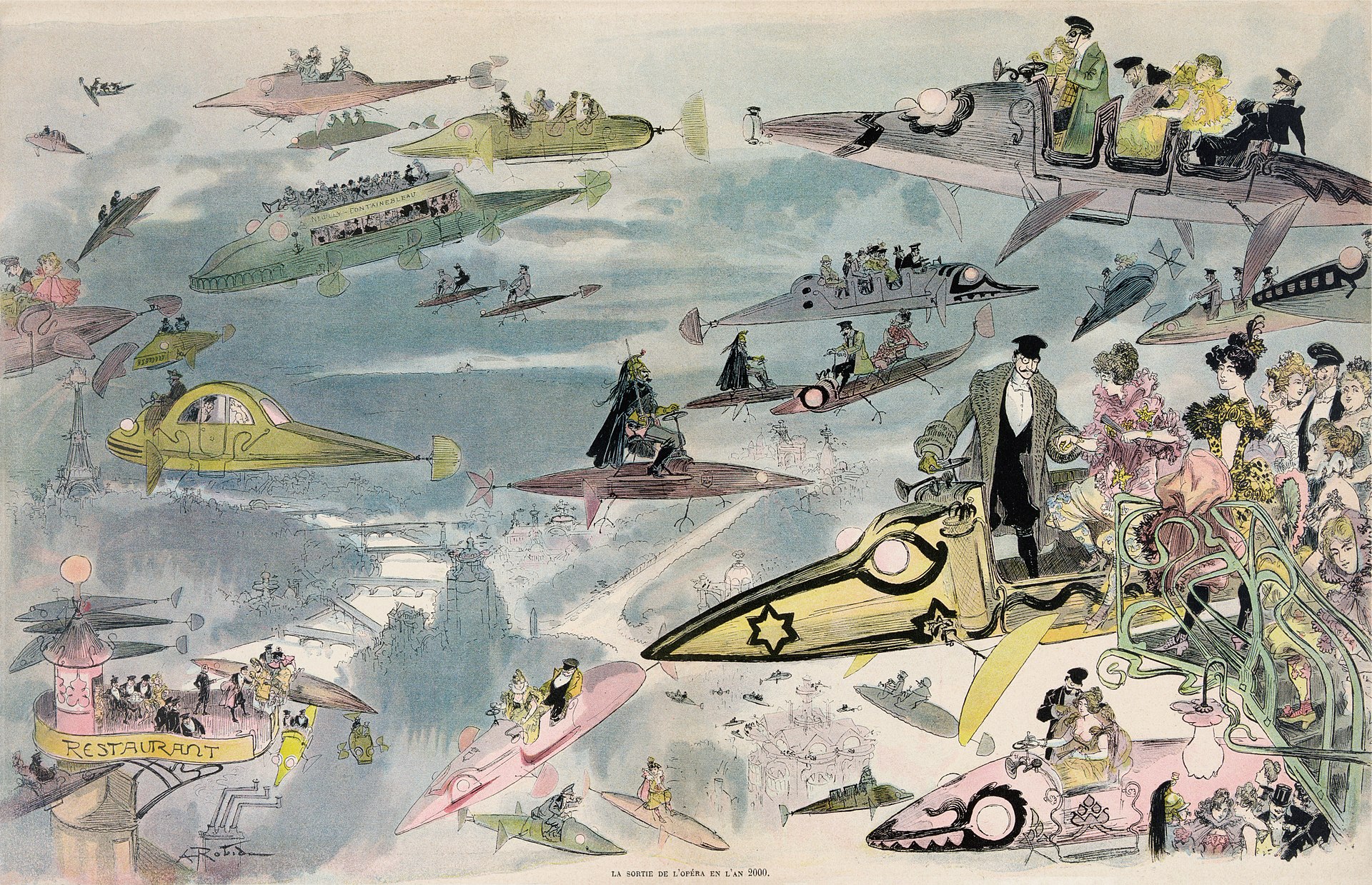
    Albert Robida, a fabulous visionary born in France in 1848 (dying in  1926) was an illustrator, etcher, lithographer, caricaturist, and novelist.  His greatest achievement is his futuristic trilogy, including Le Vingtième Siècle (1883), La Guerre au vingtième siècle (1887) and Le Vingtième siècle. La vie électrique (1890).  In general he has deep, realistic vision, the sort that puts him a similar plain as Jules Verne, but is differentiated from his famous French compatriot in that his creations seem more compatible with possibility, being more common, more fashioned to what the average person might come to expect of their future creature comforts.  In spite of a fantastic and perhaps unparalleled scifi imagination, Verne seems a little beyond the scope of the mortal future, maybe a little too much for their appreciation of whatever common class the future might hold room for.   

    La Sortie de l'opéra en l'an 2000

  • Ancient Books and Manuscripts, Writing, and Writing Instruments

    JF Ptak Science Books   Quick Post

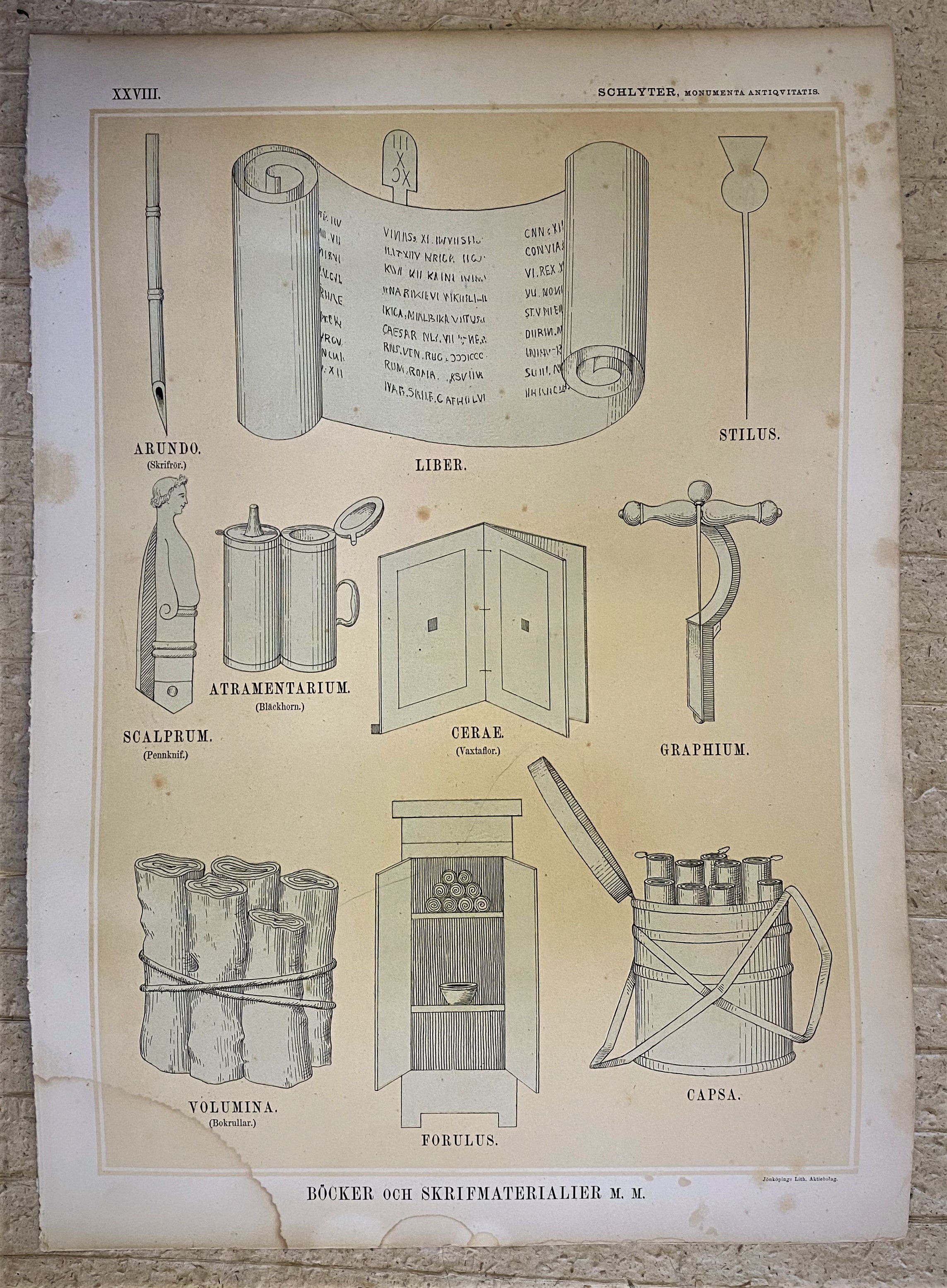
    Just a quick note about this fine and explicative image: it is a lithograph in color from Gustavus Ragn Schlyter’s Monumenta Antiquitatis, printed by Junkopings Lithografica in 1876.  It is rather large (19″x14″) and the work (on Greek and Roman antiquitiies) it is found in is scarce, as only four copies (two in Denmark, and one each in Sweden and Texas) are found in the librarians’ standard cataloguing tool, WorldCat–and the book turns up almost not at all in google and other appropriate searches…its absence is a little curious.

    In any event I found the bits and pieces of recording information to be interesting, so I went ahead and identified them for anyone who is curious about the segments of “book” production from 2000 years ago.  

    Identifying the elements of the lithograph:

    • Liber—literally, “book”, in this case being a Roman scroll written on papyrus.
    • Cerae—(from the word for “wax”), was similar to the Greek tryptich, a kind of primer that was composed of three hard surfaces, the interiors of which were covered in wax so that they could be reused many times.
    • Stilus—“stylus”, was used to incise figures in the wax Cerae, while the opposite (and flat) and was used to basically erase and smooth the wax.
    • Arundo—a filament of a hollow-core plant, used as a quill would be used.
    • Scalprum—a small cutting instrument
    • Graphium—another form of stylus.
    • Atramentarium—an inkwell (the inks being made of a mixture of carbon soot, resin, wine dregs, and cutdefish ink).
    • Volumina—a collection of scrolls or texts, “volumes”.
    • Capsa—a holder for volumina, the attendants of which were called “capsanii”.

    IMG_3145

  • A Warning from the Sky (April 1945)

    JF Ptak Science Books  Quick Post

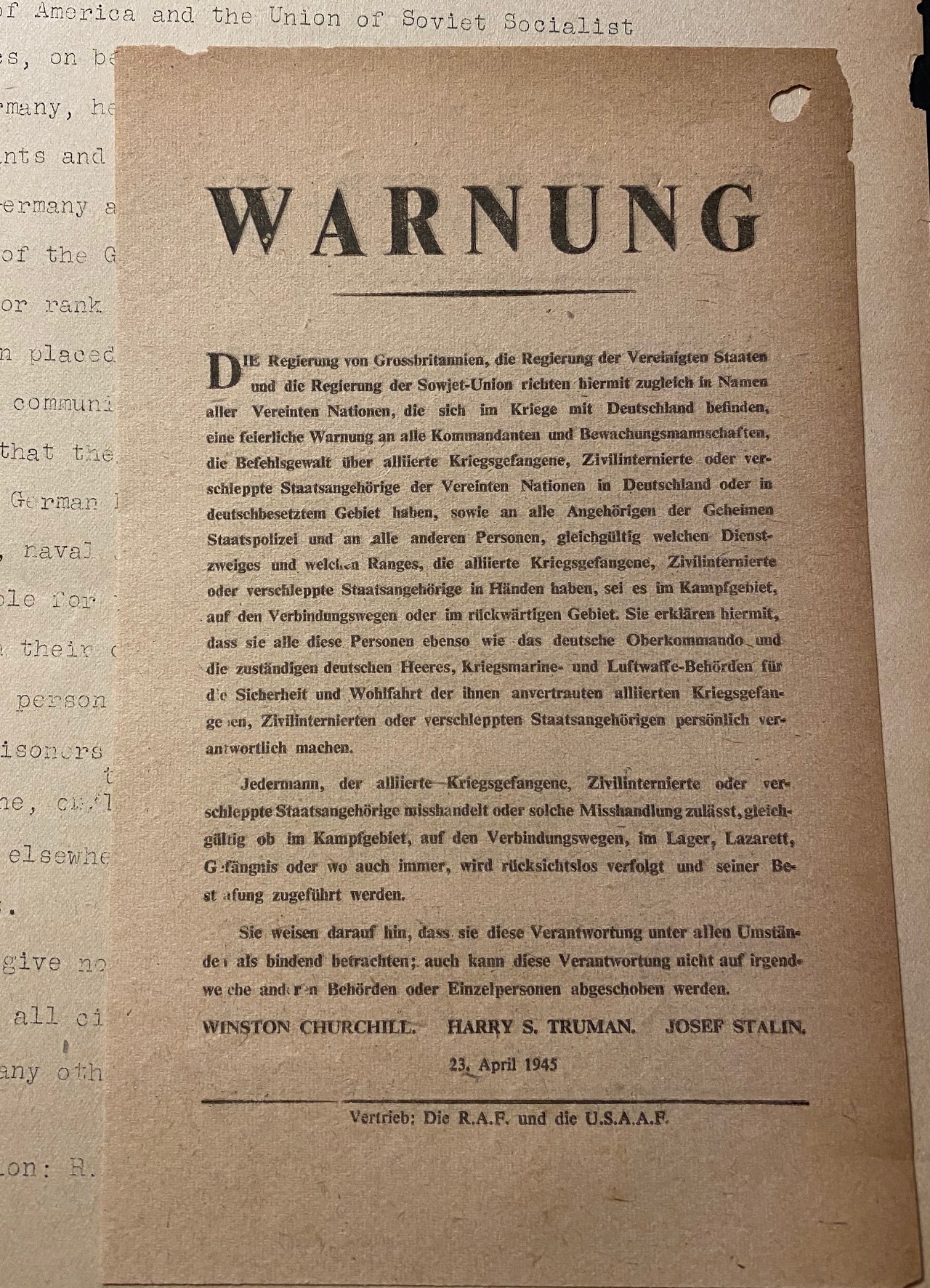
    IMG_3197This is one of the few remnants that I have of a larger collection of surrender and various sorts of propaganda leaflets dropped on the Wehrmacht and Germany in general in the last two years of World War II. (A longer post on this collection can be found elsewhere on this blog.) This leaflet, the “dissemination” of which was orchestrated by the R.A.F. (Royal Air Force) and the U.S.A.A.F. (United States Army Air Force) and were literally dropped in the tens of thousands on the remaining troops in the final weeks of the war, with the document dated 25 April 1945. (Mussolini was killed on this day, the German forces in Italy would surrender on 29 April, Hitler would commit suicide on 30 April, and the Battle for Berlin would be over on 2 May, with the unconditional surrender of the Third Reich coming in the middle of the night at SHAEF HQ at Reims.)

    This leaflet is particularly strong, warning that mistreatment of Allied prisoners in any way or form by Gestapo and its agents would not be tolerated and that if there was mistreatment then those responsible would “be ruthlessly pursued and brought to punishment”.

    This warning comes weeks after the liberations and “discoveries” of various concentration and death camps, the truths found in those places definitely helping to form bloody-minded warnings to anyone in Germany committing crimes against Allied POWs.

    Even though the propaganda bombing no doubt involved millions of pieces of paper, only a tiny fraction seem to have survived.

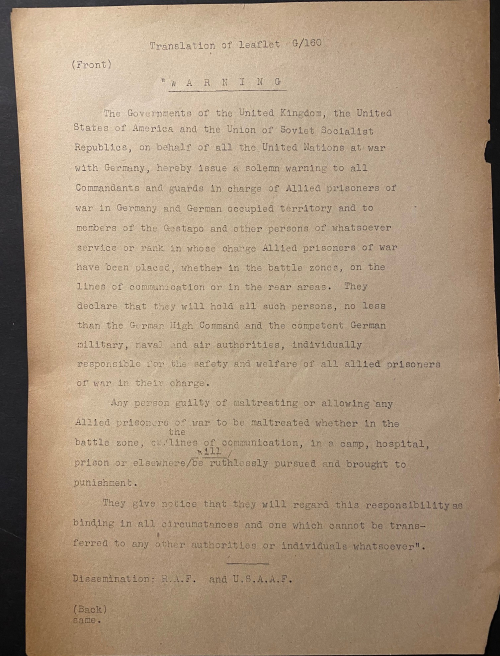
    Here’s the original along (and transcription) with a government-sponsored translation of the leaflet

    “W a r n i n g

    The Governments of the United Kingdom, the United States of America and the Union of Soviet Socialist Republics, on behalf of all. the United Nations at war with Germany, hereby issue a solemn warning to all Commandants and guards in charge of Allied prisoners of war in Germany and German occupied territory and to members of the Gestapo and other persons of whatsoever service or rank in whose charge Allied prisoners of war have been placed, whether in the battle zones, on the lines of communication or in the rear areas. They declare that they will hold all such persons, no less than the German High Command and the competent German military, naval and air authorities, individually responsible for the safety and welfare of all allied prisoners of war in their charge.

    Any person guilty of maltreating or allowing any Allied prisoners of war to be maltreated whether in the the battle zone, lines of communication, in a camp, hospital, prison or elsewhere will be ruthlessly pursued and brought to punishment.

    They give notice that they will regard this responsibility as binding in all circumstances and one which cannot be trans­ferred to any other authorities or individuals whatsoever.

    Dissemination: R.A.F. and U.S.A.A.F. IMG_3198

    ·Posted by :

    ·in:

  • Justifying Chemical Warfare (1925)

    JF Ptak Science Books  Post 2904
    IMG_2324

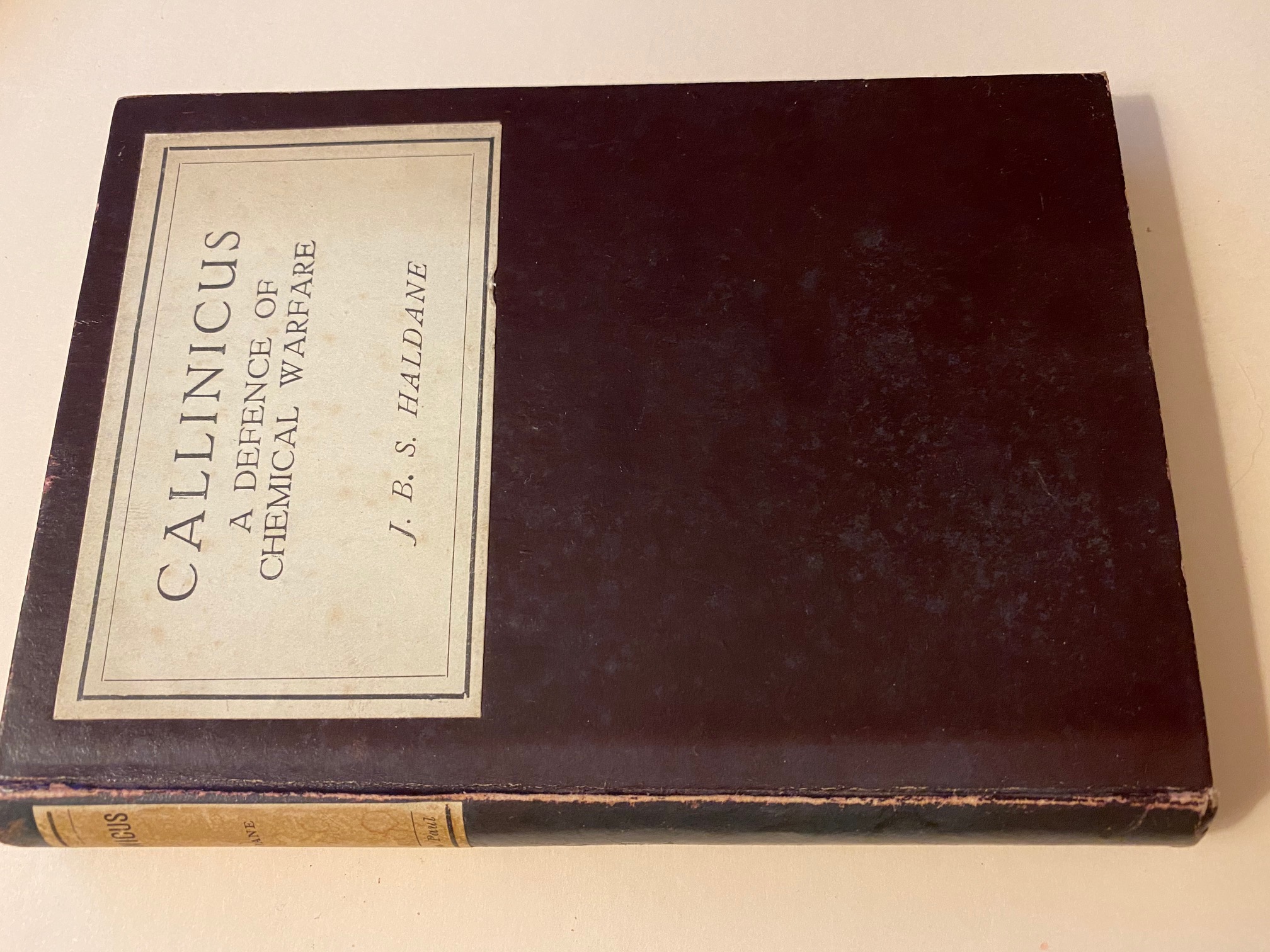
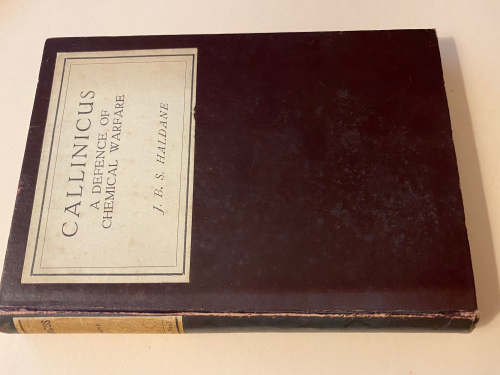
    J.B. S. Haldane (1892-1964, scientist/philosopher/veteran/Communist) contributed a provocative little one-hour read warfare and morality, making a case for the use of chemical weapons during war. I thought that this might be a Modest Proposal exercise, but it isn’t, at least to my reading of it. Callinicus, a Defense of Chemical Warfare (London 1925) is a call for expanding arms if arms is what was needed and if fighting was going to happen. Haldane would’ve been much happier with no fighting whatsoever, but if it were to be the case–again–he didn’t see much of a difference between chemical weapons and other sorts of armaments, as they both killed and wounded and incapacitated. A weapon is a weapon.

    “Why do we accept the invention of Major-General Shrapnel but prohibit the use of chemical weapons in war?” is what Haldane asks, and then proceeds to make his case.  

    The book’s title draws on the Syrian officer Callincus, who created the “Greek Fire” weapon, a flammable liquid, in in the Eastern Roman Empire in the 8th century CE. (“Callinicus1 Of Heliopolis, Callinicus also spelled Kallinikos, (born AD 673), architect who is credited with the invention of Greek fire, a highly incendiary liquid that was projected from “siphons” to enemy ships or troops and was almost impossible to extinguish.” Encyclopedia Britannica)

    An officer in 1914, Haldane was with the Black Watch (Royal Highland Regiment), and served with distinction, and did so at a relatively young age, and so was a witness2 to all manner of weaponry during the Great War. He makes a case for chemical weapons to be less grizzly than many other existing weapons and of those to come–and in the future category he gives a hat-tip to the possible invention of a weapon that sounded a lot like an atomic bomb.  It is an interesting discussion–one that backs you into a very disturbing corner, very quickly3. 

    Haldane ends the work so: “Such are the facts of chemical warfare. They will not be believed because a belief in them would do violence to the sentiments of most people.”

    Notes.

    A reminder that Haldane is the osurce for an often-repeated quote about the nature of the universe: “My own suspicion is that the universe is not only queerer than we suppose, but queerer than we can suppose.”

    1. “Born in Syria, Callinicus was a Jewish refugee who was forced to flee the Arabs to Constantinople. The ingredients of Greek fire were kept a state secret, known only by the Byzantine emperor and Callinicus’ family, which manufactured it. The precise composition is still unknown, but it is generally accepted that it was a mixture of naphtha, pitch, sulfur, possibly saltpetre, and some unknown ingredients. First used in the Battle of Cyzicus (c. AD 673) by the Byzantines against a Saracen fleet off Constantinople, Greek fire proved to be instrumental in that Byzantine victory.”–Encyclopedia Britannica

    2. Haldane also saw service during the war in the British chemical warfare program.

    3. “In Callinicus, Haldane makes the case for chemical weapons as a more humane, eugenic and ultimately more effective and efficient means of prosecuting modern warfare. In this bold advocacy, Haldane was facing an uphill battle, against the British press, who had propagandized against the ‘godless Hun’ and his poison gases, the fearful and scandalized public, and even his colleagues in the eugenics movement, who largely lamented modern warfare as dysgenic.”–Eugenics Archive (Canada) online timeline


    ·Posted by :

    ·in:

    —
  • The Encouragement of Insanity (1877)

    JF Ptak Science Books  Quick Post

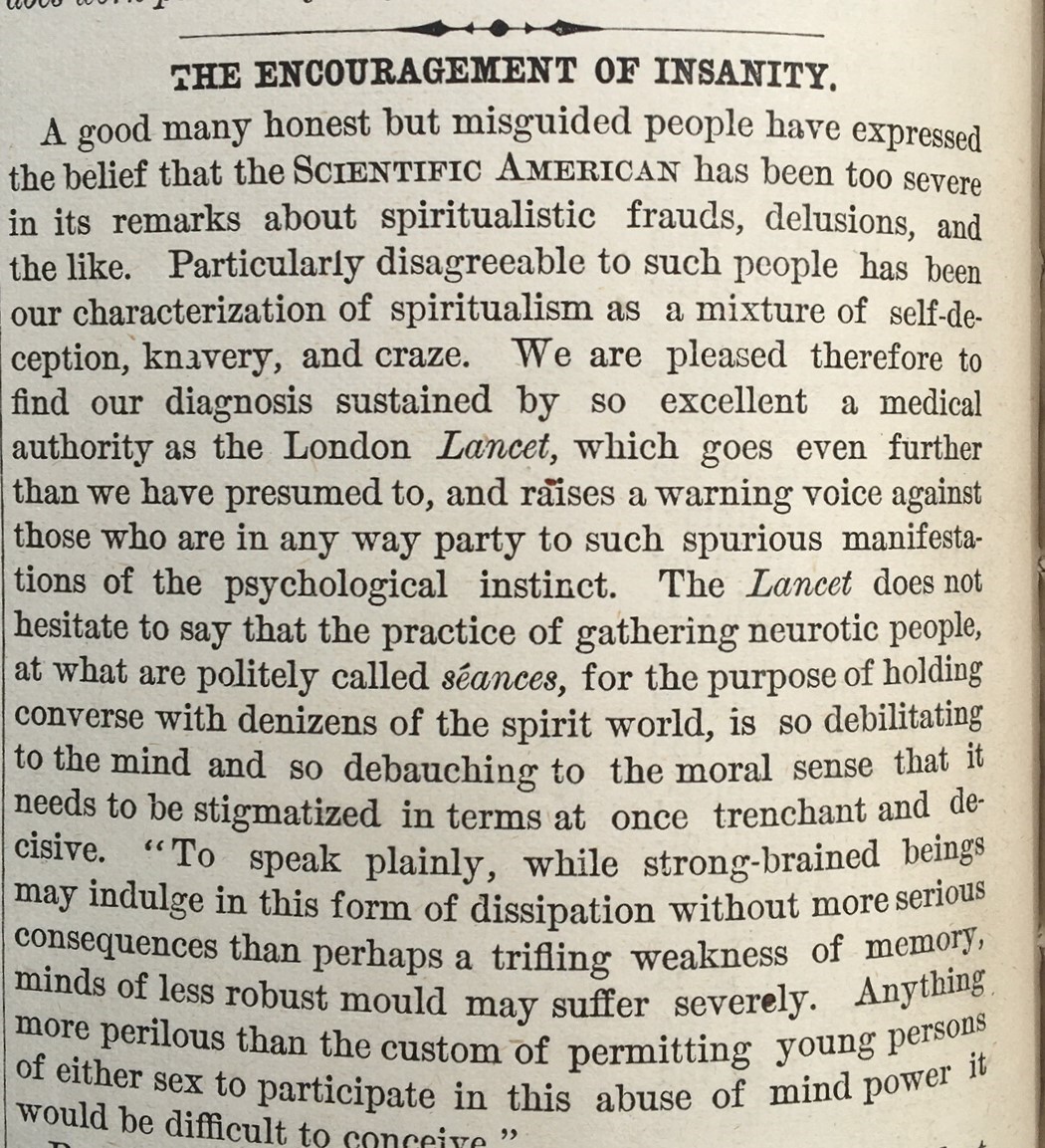
    IMG_2195Well. The Scientific American (1913) delivered quite a blow against the current “craze” of spiritualisms and seances, which they characterize as a mixture of “self-deception and knavery”.  They had no room for it whatsoever, and let their readers know it. These practices were “symptoms of mental degradation that will cast adrift principles…and elect to run riot in vain imaginings and idle conceits”. The editor also brought The Lancet on board in the condemnation of the Spiritualism racket, quoting the great medical journal saying that the talking-to-the-dead racket was “debilitating to the mind and so debauching to moral sense it needs to be stigmatized in terms at once trenchant and decisive”.  An Edgar A. Poe vicious book review this is not, though they do communicate their displeasure with the whole racket in very forceful words.

  • Surfacing Underwater Work–the Ambrose Canal Dredging Measured in Woolworth Buildings (1913)

    JF Ptak Science Books  Quick Post

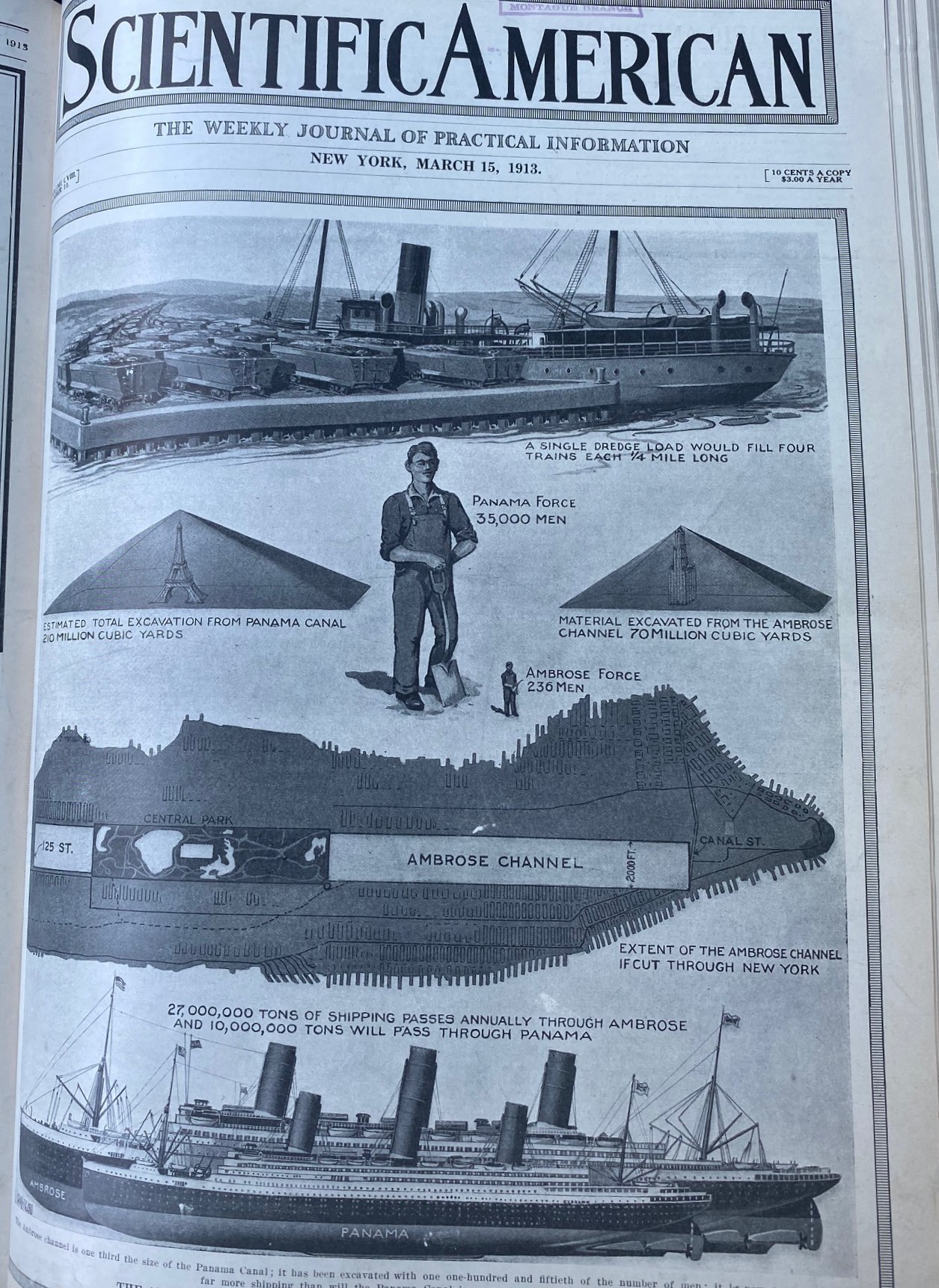
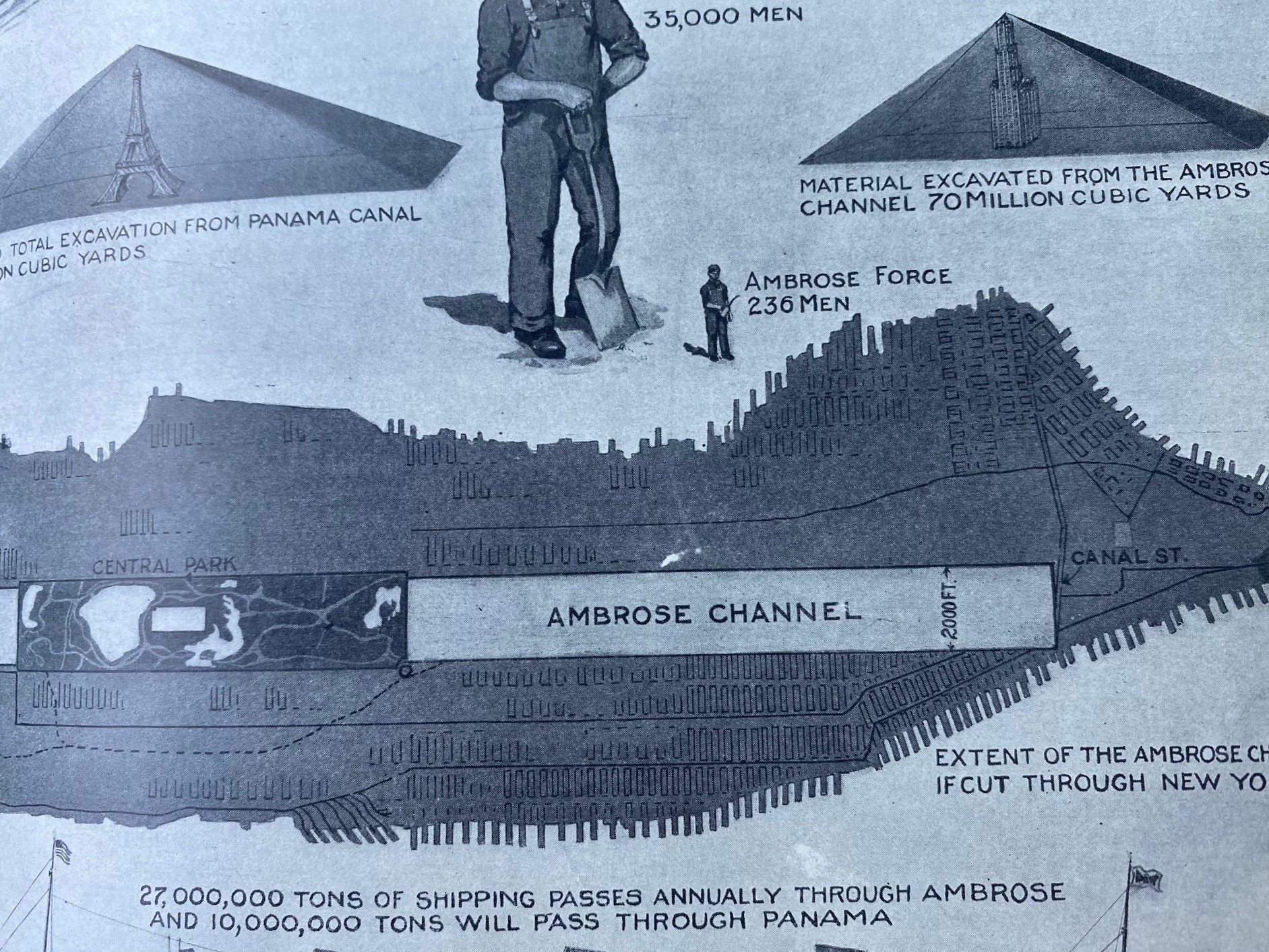
    IMG_2334 (1)Another great example of the artistic display of information using alternative comparison, and this just hours after finding/writing  about another example in this area.  This morning’s find uses several different types of comparisons, the first of which–like last night’s—is using a comparable entity to value the expression of quantity. And again, like last night’s, this short article (from Scientific American for 15 March 1913) uses the newly crowned Woolworth Building to illustrate how much dirt was removed in the dredging of the Ambrose Channel in NYC.  (The Ambrose Channel is in the entrance to NYC harbor, and it seems as though the dredging the author is talking about lies in the lower NYC harbor out past the Narrows.1)

    What was weighing on the mind of the writer was that this project removed  a very considerable amount of soil and was in some high fraction a comparable to the excavation of the Panama Canal, except that you couldn’t see any of the Ambrose project given that it was all taking place underwater. This effort in the SciAm was made to give some surfaceable form to the work going on  under the water in the Narrows. 

    There was a very considerable amount of earth removed, no doubt–difficult work, but not exactly an engineering feat like the Panama Canal that it was being compared to. Nevertheless the interesting minds of SciAm showed what the invisible channel would look like if it was dredging a 40’x15′ by multi-mile section of Manhattan, which is an excavation that would stretch from downtown to north of Central Park.  

    In any event, this reporting job must have been a good bit of fun (and it shows), and was a fairly elegant and memorable means of communicating some big numbers of an invisible project. 

    IMG_2335 (2)

    Notes:

    1. “Ambrose Channel is the only shipping channel in and out of the Port of New York and New Jersey. The channel is considered to be part of Lower New York Bay and is located several miles off the coasts of Sandy Hook, New Jersey, and Breezy Point, New York. Ambrose Channel terminates at Ambrose Anchorage, just south of the Verrazano Narrows Bridge, the gateway to New York Harbor, where it becomes known as the Anchorage Channel.”–Wikipedia

Recent Posts

Archives

Categories