A Daily History of Holes, Dots, Lines, Science, History, Math, Physics, Art, the Unintentional Absurd, Architecture, Maps, Data Visualization, Blank and Missing Things, and so on. |1.6 million words, 7500 images, 4.9 million hits| Press & appearances in The Times, Le Figaro, Mensa, The Economist, The Guardian, Discovery News, Slate, Le Monde, Sci American Blogs, Le Pont, and many other places… 5000+ total posts since 2008.

  • “Telephone” Calls from Tomorrowland–or, Weighing Antique Surprise

    JF Ptak Science Books    (An episode in the series on the History of Anticipation.)

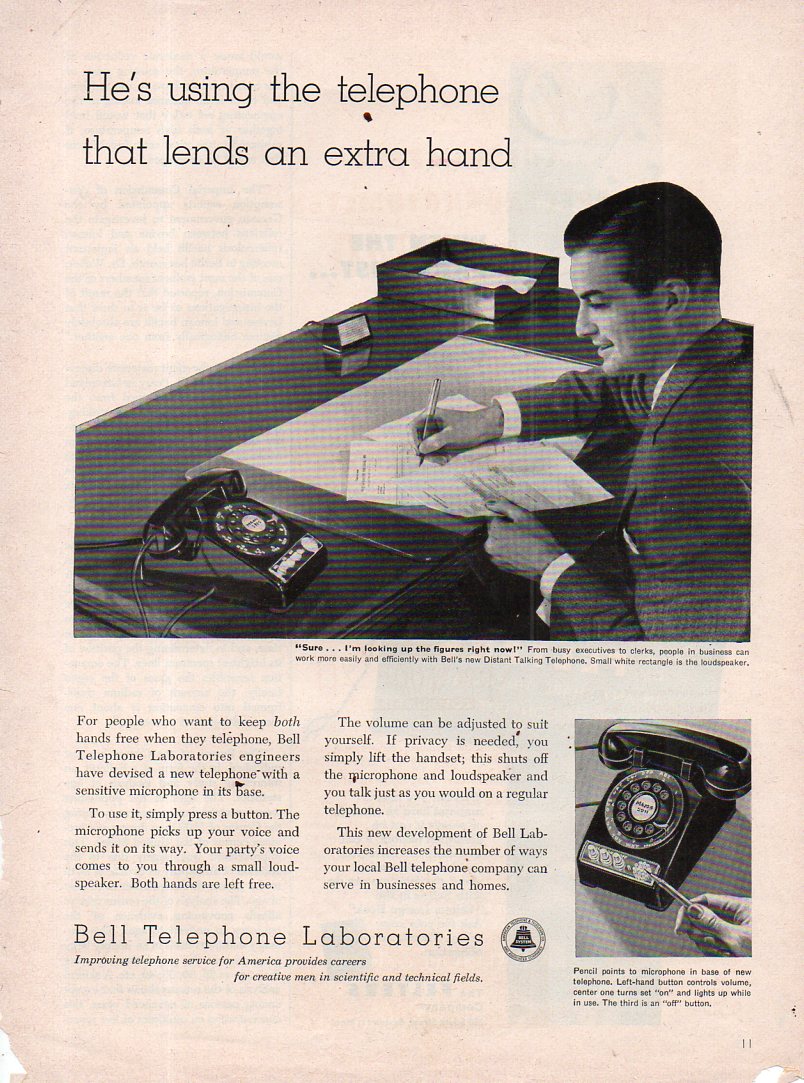
    TelephoneThis ad appeared only 66 years ago in 1954–that’s four generations in dog years, two human generations (or one for the more later-in-life crew, which is appealing as I knew a man whose grandfather was born in the 18th century), and 15 generations in managing data and communications. Perhaps more.  It is difficult to imagine the intense surprise that attended this ad showing a practical and popular adaptation of a communications breakthrough. 

    The electromagnetic telegraph, which is arguably the first electrically-powered iteration of the internet, was in the works from the 1820’s until it was nailed by Samuel Morse in 1837.  It was 40 years to the development of the Bell telephone (another dramatic example of an invention/technological idea/breakthrough that was “in the wind”, a popular undiagnosed monumental meme, some decades in the making in the hands of Bell and Reiss and Meucci and Gray and even Edison). Two more decades (just past the turn of the century) until more-widespread wireless telegraphy, another two decades after that (1920’s) for popular radio, and another two decades after that (post WWII/1950’s) for popular television broadcasting. 120 years between the patented invention of the Morse telegraph to 50 million Americans with televisions in 1955. 

    The “telephone” of 2020 is as removed as the telephone of 1954 as the telephone of 1954 was removed from the electromagnetic telegraph–we’re not meeting half-way in the meeting of improbable impossible worlds, of worlds of the future unimagined in the past.  That is what comes to mind when I see this add for the speaking telephone in 1954–the astounding, astonishing, speaking telephone, the phone that allowed you to not have the receiver to the ear, that allowed you to do free-hand work and communicate at the same time.  It was an ambitious improvement, and as soon as the phone appeared, it became a standard of necessity if that necessity was within budget. 

    It is the weight of surprise that is so abundant looking at pictures like this, giving us the opportunity to imagine the surprise elements of another time. It may well be that the new 1954 user of the speakerphone would have looked at the first telephone systems of 1894 as we look on that 1954 telephone today.  Probably not so, though, probably it was much more imaginable to have foreseen the 1954 possibilities in 1894 than for 1954 to have seen in the same amount of time to 2013:  the technological pieces necessary for part of that imagination had not yet been invented, the science ahead of the sci fi.

    The other part of this surprise element is that 1954 is well within living memory, and that this combination of technology and physics and mathematics has grown so incredibly from the speakerphone to the massive changes in 2013–it is as surprising to imagine this as to imagine the same scenario for what happened a year before in biology:  it is difficult to grasp the  sweeping changes in that field from the identification of DNA in 1953  and how far those fields have come since. 

    I think that if one could quantify this sort of “surprise” that the greatest amount of “Surprise Integers” (or whatever) ever recorded would have taken place within these past 50 or 60 years. Which makes me wonder–will people 66 years hence see the pictures of our fabulous accomplishments in 2020 as quaint reminders of how much things changed between 2020 and 2086?  Will those “Surprise Integers” be as great for that period of time as the (“our”) preceding period with concomitant revolutions in thought?  My guess is “yes”–it’s just hard to imagine. 

    ·Posted by :

    ·in:

  • Thought Machines and the Revenge of the Atoms

    JF Ptak Science Books   Post 2906 (Overall post 5110)

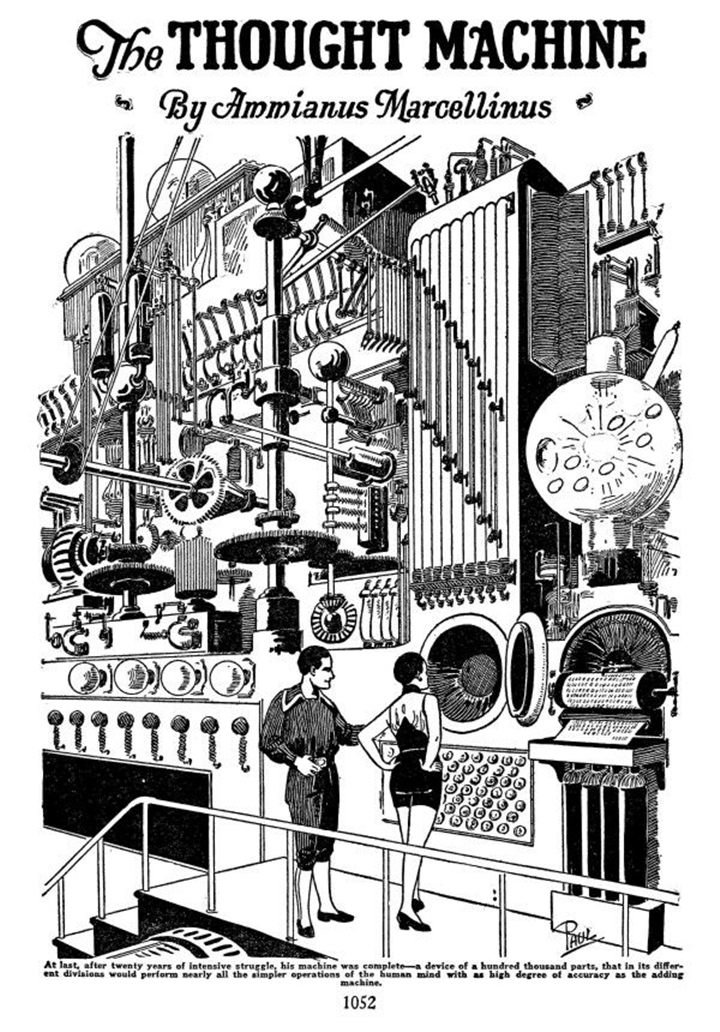
    THought machineIn the past of the past of the Thinking Machine, back when Alan Turing was only 15, the prodigious and fabulous Frank R. Paul was creating this image (left) of such a machine for an almost-adventurous story by “Ammianus Marcellinus” called “The Thought Machine”. The story appeared in Amazing Stories in February 1927, and for me Ammianus (the name of an historian who live in the 4th century CE and who wrote on the later Roman Empire) just did not have the power of persuasion for his tale–perhaps a lot like his 1600-year-old original, who Gibbon found to be boring and tedious). But the legendary work of Mr. Paul was enough for me, and so I’ve reprinted his artwork, which in itself is expansive and techo-lyrical in its many ways. In this one, I was intrigued by some of the thought machine’s components–the most obvious bit being what very much looks like a “Millionaire” calculating machine at bottom right. That, and the Napier’s-Bones-type thing about the bouncing brain of the machine–and then there numerous gears and worms…and what also seems to be like the hints of the power for the whole thing, which are the several belts leading up and away to a larger power conveyer off-picture, which for all I know may have been steam.  

    Atom revolt  of theI looked around in the pulp/sci fi references I have for some other images of “thought machines” from this early <1930 period and came away with very little, though I did find something hopeful called “The Thought Materializer” which was also supposed to be illustrated by Mr. Paul. The story appeared in Science Wonder Quarterly and was published in the spring of 1930–unfortunately the illustration was just a simple and disappointing portrait of the author.  The story was even more disappointing, and the writing was Boy-Wonder-robbed-as-he-knealt-to-pray-about-lonesome-love bad–for example, there is this unpolishable pearl: “Imaginatively, Proctor stepped from the bath”. Ouch.

    That said, looking for that “missing” Paul illustration let me bump into another interesting bit with a title begging question: “The Revolt of the Atoms”.  

    This brings to mind the possibility of “The Revolt of the Adams”, where 17th c Bishop Burnett postulated infinite planets and infinite worlds with infinite people populated by infinite Adams and Eves because as god is perfect each world would be completed with its own A&E.  

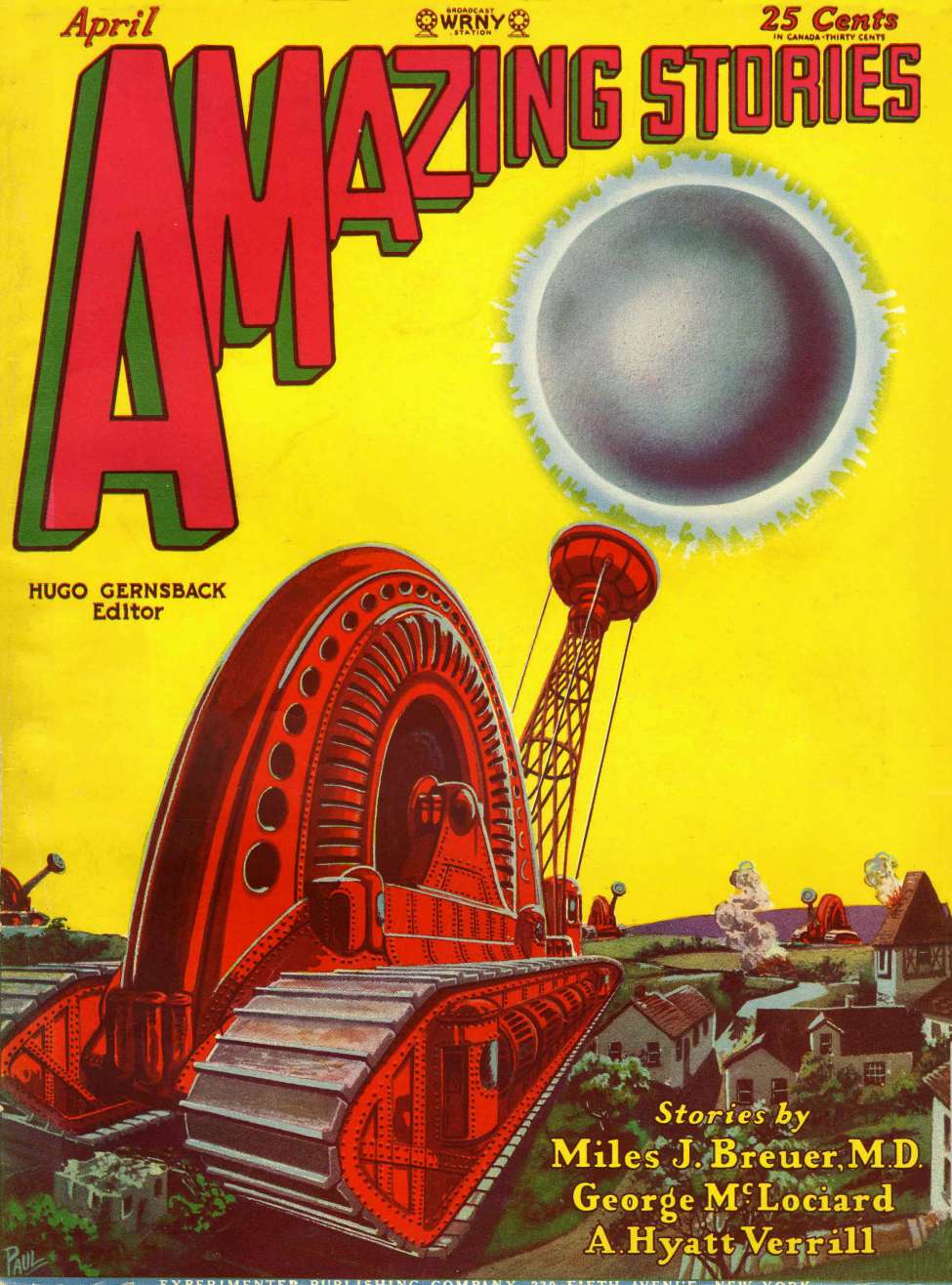
    Getting back to atoms–this story was published in Amazing Stories in their April 1929 issue and was one of the not-many early sci fi bits working around the idea of harnessing the energy of atom. Unlike many, the author, V. Orlovsky, had a go at the dangers of the atoms “rising to power”, the new-found energy becoming an agent in the possible demise of the Earth.  In any event, Something Happens in the story and the atoms run wild, forming a gigantic firey nucleus of a floating monster atom which “swept away everything that was alive”. The giant atom moved across Russia and into Italy, then on to France, destroying everything, threatening the Earth itself with utter destruction. I did not read the whole story, but it does seem as though an eruption of Vesuvius directly beneath the atom and ejected it on an “etherwave” into the Earth’s atmosphere, where it spun itself away and harmlessly so, becoming a small satellite. As I said, it is a disappointing story, though the cover art–again by Frank Paul–saves the day with its drawing of the giant atom being approached by enormous electromagnets to try and do such-and thus to it.  Frankly, I just liked the idea of the killer atom.  


  • The Big Bang Monkey and “Gasoline Alley”

    JF Ptak Science Books  Overall Post 5111   Part of the series A History of Blank, Empty and Missing Things 

    Concevons qu’on ait dressé un million de singes à frapper au hasard sur les touches d’une machine à écrire … [translation: Let us imagine a million monkeys typing haphazardly on typewriters …”1

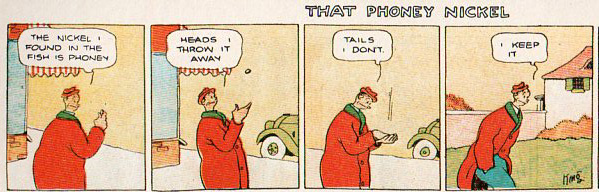
    Gasoline alley723[Gasoline Alley, 1931]

    There are some ideas that leave me with a powerful sense of nothing.

    To me, “nothing” can be very important–especially in writing and speaking and action, doing or saying nothing has been the important and the correct thing to do.  “Nothing” isn’t necessarily an ending, and, just a period or a coma, can just be a placeholder for something that is developing.  There can be long nothings and short one, forever- and micro-nothings, and nothing that is nothing for almost nothing.  Nothing can be implied, insinuated, broadcast and defined, though self-defined extended nothingnesses (like John Cage’s  4’33”) is a tricky thing to make happen with success. 

    The ideas that leave me with a sense of nothing are interesting things.  And there are a lot of them. When I can remember them they are in my nothing file, waiting for nothing–or something–to happen.

    This is the sense I had when (years ago) I was trying to explain randomness to our 10-year-old daughter and her 11-year-old cousin, sitting out in a park, looking at stuff.  Somehow I reached into the past and pulled up the infinite monkey theorem, and tried to make that interesting, but just couldn’t do it. Maybe it was the difficulty of super-large numbers, or the fascinating but incomprehensible thought-threats of Borges and his infinite library, but I was left with nothing.

    It is Borges who writes a lovely piece on the history of producing everything from nothing, appearing in his “The Total Library” in 1939 (and then again in “The Library of Babel” in 19412), reviewing machines and such of spectacular randomization that could produce the whole of what we recognize as what we know. 

    Emile Borel wrote on it in 1913, finding the possibility of one million monkeys pounding away at one million typewriters.  In his wonderful work, The Math Book3, Cliff Pickover looks at 250 big ideas in the history of mathematics and gives each of them one page only for presentation and explanation.  He approaches the infinite monkey theorem by looking at one monkey wailing away at one typewriter, striking the keys, and analyzing how long it might take for the one monkey to produce one line from one book.  The line is “In the beginning…” at the beginning of one great nothingness, from the Old Testament, a 56-object sentence (including punctuation and spaces) and, Pickover reasons, that if there is a 93-character keyboard, then this monkey will have a 1/9356 possibility times 10100 of getting it right, and that if it worked for 24 hours a day striking one key every second then it will have used all of the time in the present universe–the Big Bang Monkey.

    All I got back were big stares, and a big sense of nothing in my gut.  It reminded me of the cartoon featured above, a toss-off sub-cartoon in a panel of the Gasoline Alley series.  Did he actually look at the coin?  Did he just decide to keep it?  And why keep a phony nickel? And who counterfeits nickels, even during the Depression?  What is the outcome of the panels–just some guy walking down the street with a nickel in his pocket.  Something may have happened, but it was a lot of nothing. 

    I know that I should have a bigger sense of what Felix Edouard Justin Emile Borel and Jorge Francisco Isidoro Luis Borges were writing about and in many ways I do, but in the end I know that I am left with nothing.  But I have it in my pocket.  

    Notes

    1. Émile Borel (1913). “Mécanique Statistique et Irréversibilité”) J. Phys. 5e série 3: 189–196.

    2.  Jorge Borges,  “La biblioteca total” (The Total Library), Sur No. 59, August 1939. Translated by Eliot Weinberger, in Selected Non-Fictions (Penguin: 1999)

    3.  Clifford Pickover, The Math Book, (2009), Sterling, page 328.

  • “We Need a Stroke of Genius.” (RPF, 1946)

    JF Ptak Science Books   Quick Post

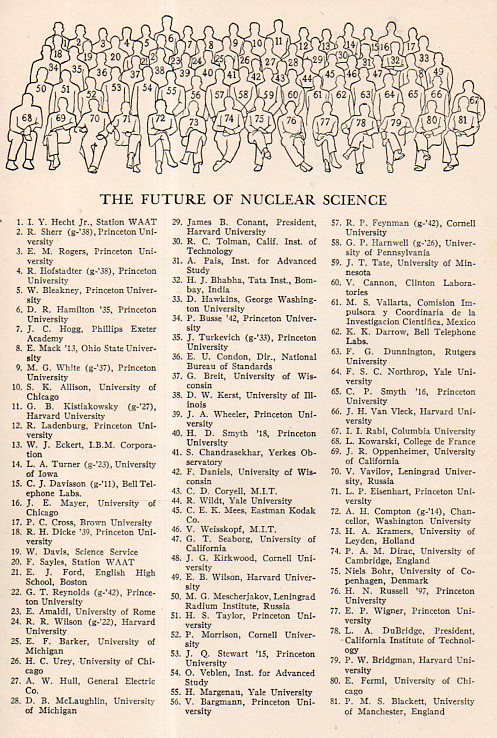
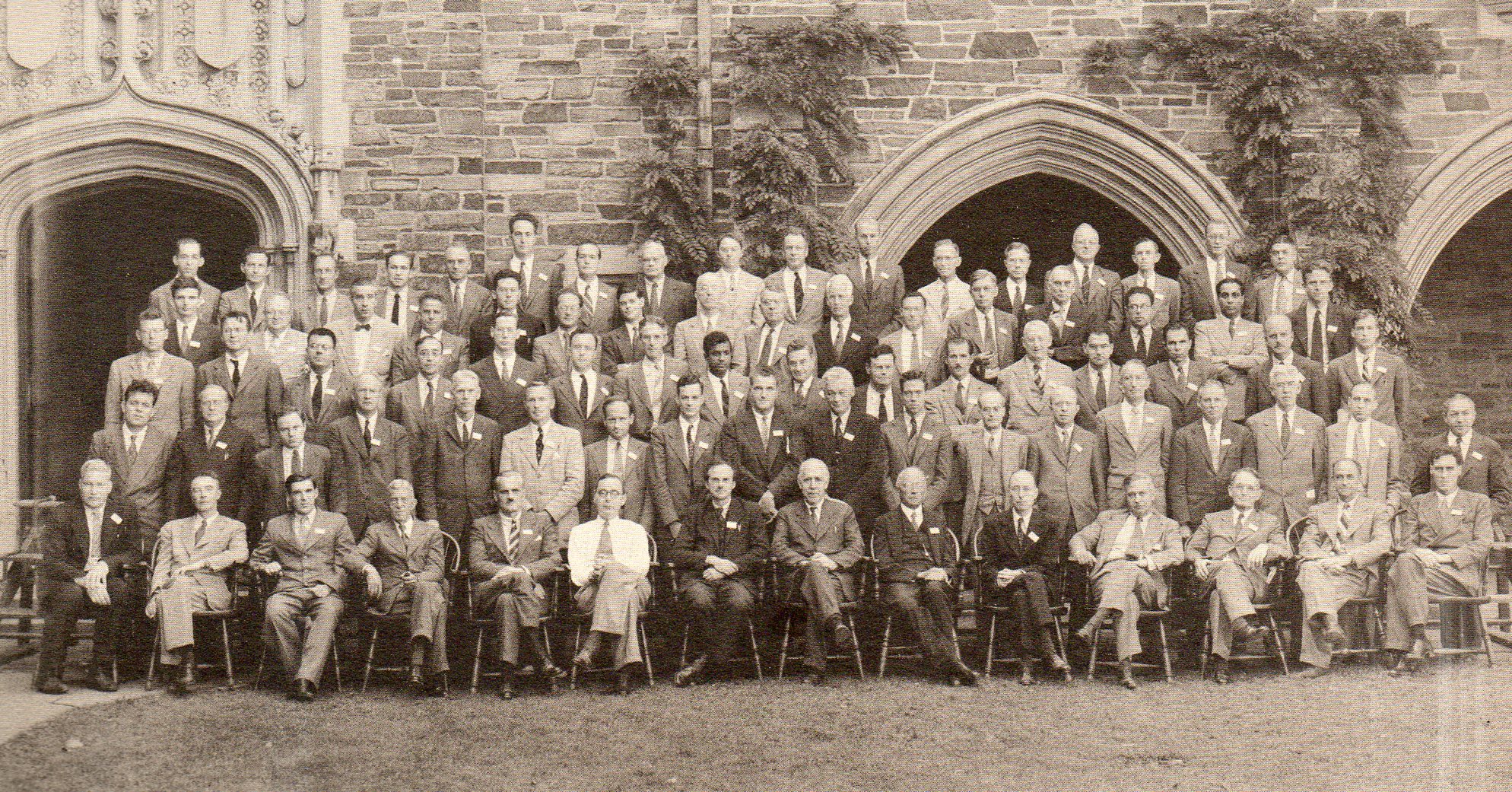
    The Future of Nuclear Science, Princeton University Bicentennial Series, Series I Conference I (1946), with a forward by the director of the conference, E.P Wigner, is mostly just a short (36-page) introduction to the conference, with a few highlights of superstar comments, most notably from Dirac and Feynman (see below). There is a remarkable and seldom scene photo of the conference’s participants–it is a mega-powerhouse of physics people. Perhaps what I enjoy most of the photo part of the publication is the out-of-context artwork in the skeleton/ghost photo that accompanies the image so that you can identify those pictured. It really does take on a life of its own–though I admit I’m partial to these bits.

    Skeleton 716
    It is a considerably heavyweight group of physicists–among them are Hofstadter, S.K. Alison, Kistiakowsky, Ladenburg, W.J. Eckert, L.A. Turner, R.H. Dicke, E. Amaldi, Urey, Conant, Tolman, Pais, Turkevich, Condon, Wheeler, Smyth, Chandrasekhar, Weisskopf, Seaborg, Wilson, Morrison, Veblen, Bargmann, Van Vleck,  Eisenhart, Compton, Kramers, Dirac, DuBridge, Bridgman, Fermi, Blackett, and so on.  Interesting that Feynman stands right behind the seated Dirac, and that Rabi is on the far right, almost out of the picture, leaning away ever so slightly from the group.

    Skeleton det718
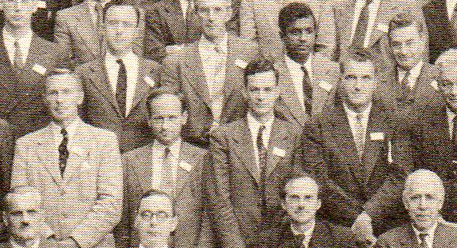
    Here’s a relatively-random detail featuring (bottom left -to-right) Compton, Kramers, Dirac, Bohr, plus (middle left-to-right) Margenau, Bargmann, Feynman, Harnwell, Tate, and (third row) Wheeler, Smyth, and Chandrasekhar.  This was an extraordinary group. 

    Skeleton det a718

    Full text via Hathi Trust via Cornell University.

    Here’s an interesting quote from Feynman:

    “Typical were the comments and queries made by R. P. Feynman of Cornell University and Gregory Breit of the 

    University of Wisconsin: “What will the fundamental particles turn out to be- more particles or less particles?

    Or perhaps all of our so- called ‘different’ particles are not ‘different’ particles but different states of the same

    particle.” The final theory of physics must be complicated, but cannot a logically consistent approximation to it be

    expected—like classical mechanics, which is a logically consistent (but experimentally wrong) approximation

    to quantum mechanics?”

    “Maybe the problem involves a fundamental frequency related to the classical electron radius. . . . Or again, 

    perhaps the meson (note: an elementary particle, found in the cosmic rays, and linked by theory to the

     nuclear force fields) and the electromagnetic field may be two manifestations of the same thing, with the 

    link provided by the fact that they both obey Bose-Einstein statistics.”
    But perhaps all this may best have been summed by the comment of Dr. Feynman, “We need an intuitive 

    leap at the mathematical formalism, such as we had in the Dirac electron theory (note: the theory which predicted 

    the positron discovered in 1932); we need a stroke of genius.”

  • The “Aye Aye”, Newt Rings, and the Chromatic Octave–Compelling Bits from “Nature” (1870).

    JF Ptak Science Books   (Really) Quick Post

    I was writing a bit on the C.G. Foster paper on Fizeau’s experiments on Newton’s Rings, found in an early volume of the great journal Nature (volume 2, June 9, 1870)  In tidying and finishing up, I recorded some of the other interesting-looking (and sounding papers in that weekly issue, and found a minor treasure trove of imaginative and provocative titles for minor papers and notes. They’re delightful, really, and are some good examples for what was the major intellectual foundation of the journal, which was to be scientific of course and just a bit fringe-popular. I imagine to the Victorian mind that much if not all of this slim weekly would’ve been consumed on receipt.  That said, here are some of these beautiful little efforts, spread out over a very tightly packed twenty pages:

    • “The Aye Aye”
    • “Carp and Toads”
    • “Anticipated Destruction of the Cheesewring”
    • “Lefthandedness”
    • “The Chromatic Octave”
    • “The Color of the Moon by Day and Night”
    • “What is a Boulder?”
    • “Scandanavian Skulls”
    • and of course, “The New Australian Mud Fish”.

    Seriously–how could these be refused?


    ·Posted by :

    ·in:

  • Mr. Burns, X-Rays, and the How to Answer a Telephone Call in 1877

    JF Ptak Science Books  Post 2906 (Overall post 5113)

    IMG_3383Mr. Burns, the terminally-alive money monster from The Simpsons, evidently gets it right when he answers his telephone with the phrase “ahoy ahoy”. It seems to me that was the established courtesy in the very earliest stages of telephonic communication. But how did you know the telephone was “ringing” to answer it in 1877 if there was no “ringer”?

    In 1877, Alex Graham Bell’s invention and demonstration of the telephone was only about a year old and was followed immediately by worldwide interest and experimentation. One aspect of the telephone that I hadn’t thought about before but stumbled upon last night1 is something seemingly simple—how did you know to answer a telephone call in 1877? Evidently, you did it with some difficulty, as there seems yet to have been a ringer/notification that a person was receiving a call.

    It seems that the first person to address this issue in a published paper was—unexpectedly–the discoverer of the x-ray, Wilhelm Rontgen.

    Rontgen (1845-1923) was still quite young and a lecturer at Strasbourg in 1877, publishing in the area of thermal conductivity of crystals (1870) and specific heats of gases; and he was still eighteen years away from his own epochal contribution to the history of science  (“Ueber eine neue Art von Strahlen”, “On a New Type of Ray” in 1895) and then for reasons presently unknown to me he was attracted to an issue with the new and magnificent invention of the telephone.
    He states the case pretty clearly in the opening paragraph of his 600-word article:

    “THE speaking of the telephone is admittedly so weak that it can only be caught by keeping the instrument in

    immediate contact with the ear. Hence there is transmitted through the telephone in its present

    form no sound which would be intense enough to announce to any one who was in a large room and who

    did not hold the telephone close to his ear, that a message was about to be sent from the transmitting station. 

    The consequence is that a warning apparatus must be attached to the telephone, so  that there may be no fear

    of missing a projected telephonic conversation.”

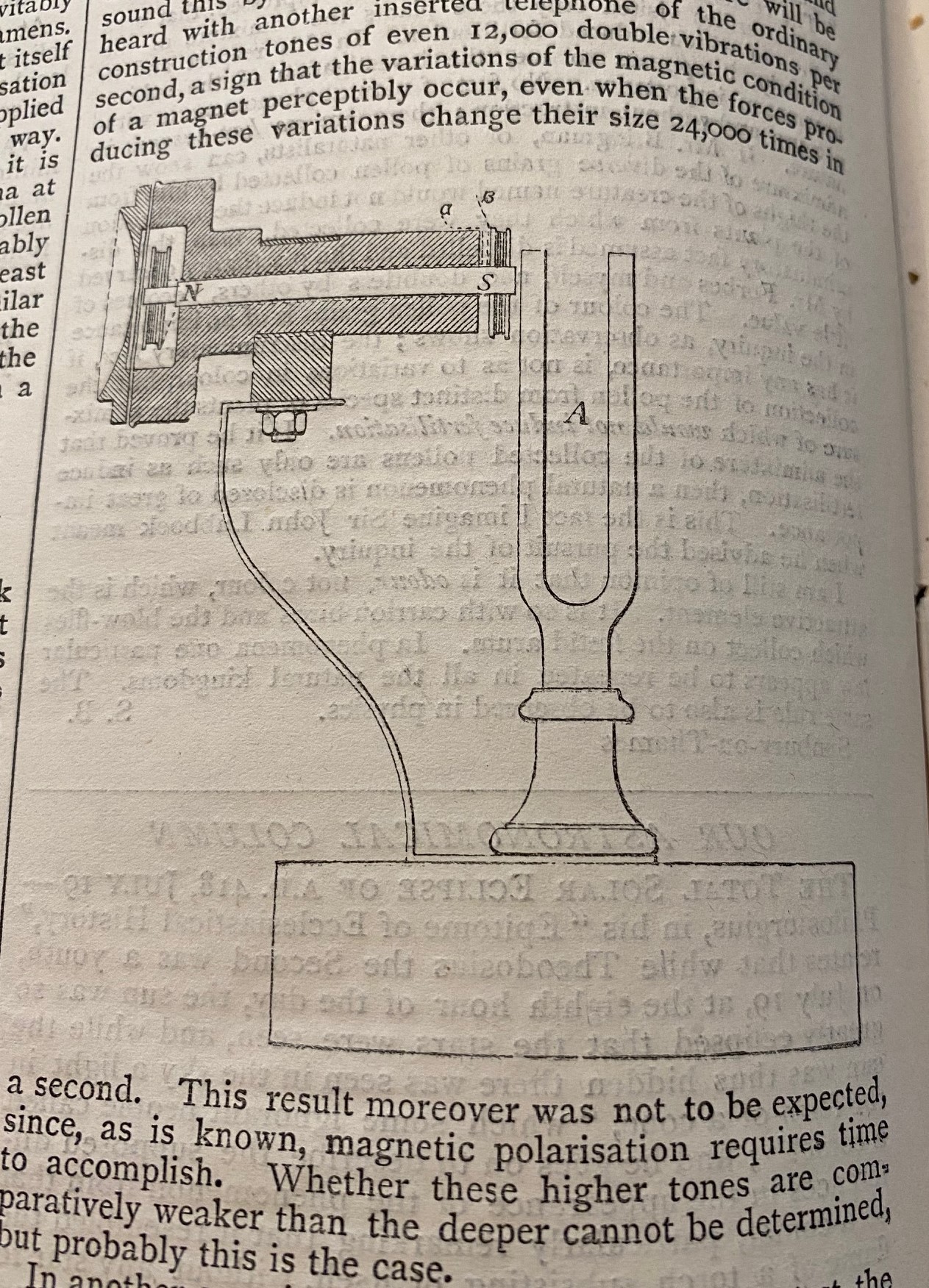
    Rontgen proceeds to experiment with an unused part of the telephone magnet attaching various tuning forks to the device which would become part of the circuit. He writes that:

    “the currents thereby induced in the coil are powerful enough to set the fork of the receiving station in such intense vibration that the sound may be distinctly heard in a large room; warned by this signal a person can in the usual way put the telephone to his ear and listen to the words of from the transmitting station. And so vice versa. “

    I’m not sure when a bell or warning device becomes part of the telephone experience after this, though I assume it comes quickly, once the issue had been identified. 

    Notes:

    Rontgen, W.C. “A Telephonic Alarum”, In NATURE, volume 17, no. 426, December 27, 1877, p165.

  • The Color of Clouds as a New Determinant (1880)

    JF Ptak Science Books   Quick Post   (Overall Post 5114)

    IMG_3388

     “Euery Cloud engenders not a Storme.”–Shakespeare, Henry VI, Pt. 3 (1623) v. iii. 10

     “Vapour, previously unseen, makes its appearance as cloud, or mist, or fog.”–T. H. Huxley Physiogr. (ed. 2) 40 

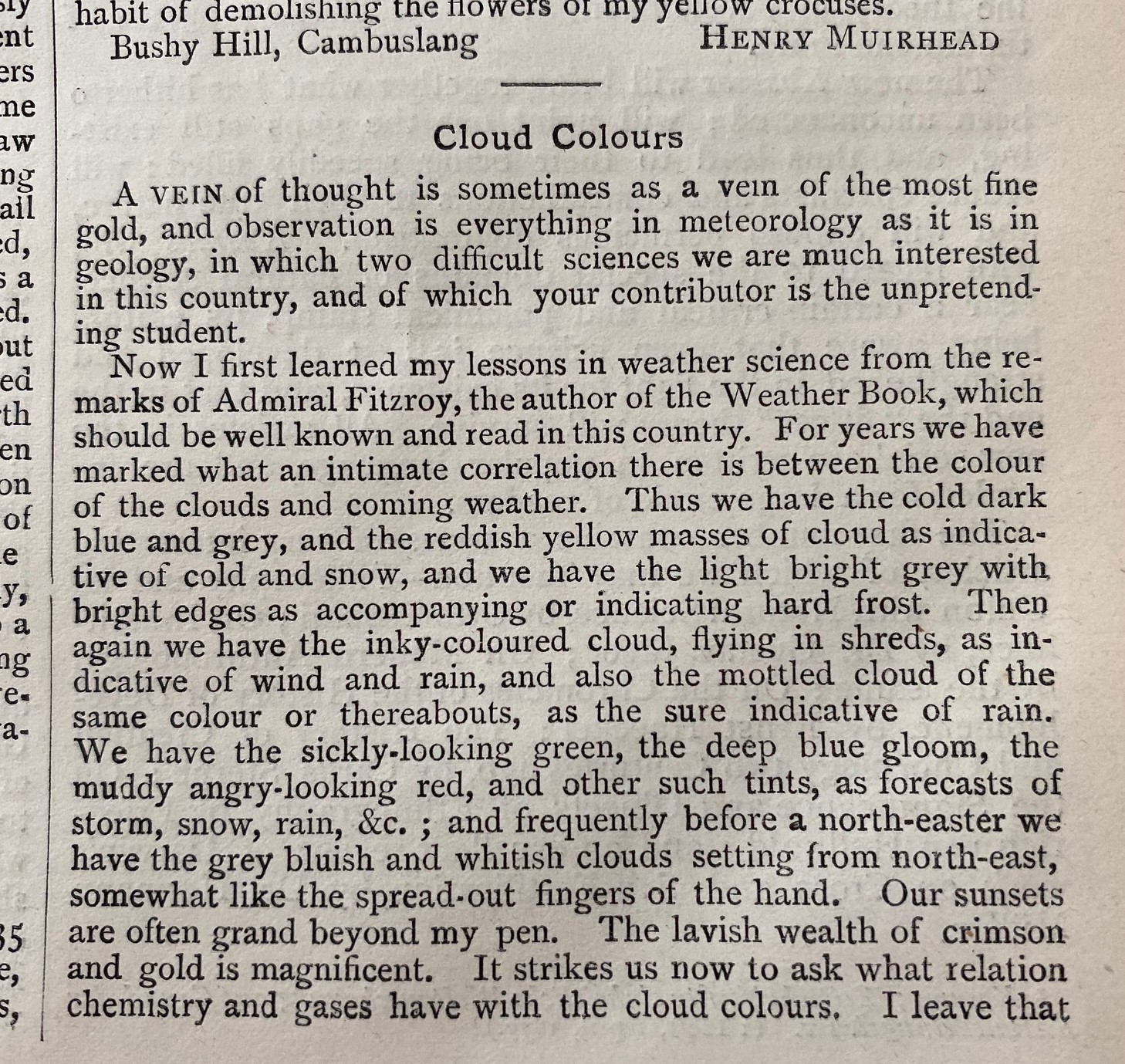
    “H.C” notes in the end that there is “vast importance in noting the colors of clouds. We depend very much in this country ([Canada] on the colour of clouds for weather prediction…”  And he says, H.C. says, that they are not the person for the job of standardizing the description of cloud color.  I imagine that that would be left to the keepers of weather stations (or data collectors), or lighthouse keepers, etc. after some sort of congress or collective determined what colors were what, and then issuing color cards or guidelines matching up clouds color to some standard color list. 

    It is not terribly surprising to see this beginning discussion of cloud color, as cloud shapes hadn’t come to be standardized, somehow, until the early 19th century. The great cloud pioneer Luke Howard (1772-1864) first published on his cloud classifications in his papers “On the Modifications of Clouds and on the Principles of their Production Suspension and Destruction being the Substance of an Essay read before the Askesian1 Society in the Session 1802-3″ in 1803, launching him from general normal obscurity into the ranks of the internationally known. He had done what Aristotle and many others down the years hadn’t–classified (his “Modifications” of the title of his 11k-word effort) the moving mountains in the sky, making him a Linnaeus/Godfather of clouds, his nomenclature quickly adopted worldwide.

    Color, though, was yet another story

    Here’s a bit from none other than Goethe (another great classifier, and color person–I wonder if clouds and color ever came up for him?): 

    “But Howard gives us with his clearer mind
    The gain of lessons new to all mankind;
    That which no hand can reach, no hand can clasp,
    He first has gain’d, first held with mental grasp.
    Defin’d the doubtful, fix’d its limit-line,
    And named it fitly.—Be the honour thine!
    As clouds ascend, are folded, scatter, fall,
    Let the world think of thee who taught it all.”–Goethe, “Howards Ehrengedächtnis”, 1821

    Source: “Cloud Colors”, by H.C., in Nature, volume 16, no. 394, 17 May 1877, pp 43-4.

    ·Posted by :

    ·in:

  • The Poetry of High-Victorian Scientific Article Titles (1884)

    JF Ptak Science Books  Quick Post (Overall Post 5115)

    I found an interesting article by Francis Galton in an 1884 issue of Nature magazine, the polymath addressing a device 
    called "the Identiscope", which sounds a bit like Victorian facial recognition. Well, he was actually discussing an
    advertisement for the instrument and found it wanting, interesting and too-early as it was. What was even more
    interesting were the little articles and notices that surrounded the Galton. Like the post I made here a few days ago,
    the titles and the ideas were just lovely, so I decided to share them here.
    The "Identiscope" itself has a lot to recommend itself, the "-scope" part of it being fairly uncommon at this time
    (save for things like the tele- and micro-).
    Other articles suggesting an immediate read were titled:
    "The Red Light round the Sun—the Blue or Green Light at Setting"; "The Volcanic Dust Phenomena"; "After-glow"; "Curious Phenomena"; "The Algeic Flora of the Arctic Seas"; "Researches on the Origin and Life-Histories of the Least and the Lowest of Living Thing"; "Whirlwinds and Waterspouts"; and of course "A Rainbow after Sunset". The are perfect nightable additions—theoretically, anyway.

    ·Posted by :

    ·in:

  • A Note on Explaining Impressionism as a Result of Astigmatism (1872)

    JF Ptak Science Books  Post 2907  (Overall Post 5116)

    Years ago I wrote short post here on the influence of eyesight and modern art, something along the lines of Impressionism owing itself to artists with poor/uncorrected vision. It was along the lines of alien outer space space aliens determining that for the USA the most revered object in society was what we called “automobiles”–we feed them, wash them, take them out for exercise, work long hours to afford them, get them regular checkups plus occasional doctor visits, etc.–and so in this light Impressionism is born of astigmatism by an artist who thought that their color symphony was what everyone was seeing, and not just a product of their poor eyesight, and lo! a revolution in imagination is created.

    After this bit the subject really never came up…until last night, when I happened on a story by Richard Liebreich in several 18721 articles in the early years of publication of the great science journal, Nature. Between an article on the new Yellowstone Park and another on adaptive coloration of mollusks is “Leibreich on Turner and Mulready”, and on the face of it there’s not much in the title to excite an interest, unless you knew that the first name was that of a celebrated ophthalmology person, suggesting something-or-other in the science/art realm. This appearance is a report on Liebreich’s lecture to the Royal Institution on 8 March 1872 “On the effects of certain faults of vision on painting, with special reference to Turner and Mulready”, the title here getting straightaway to the point, which was basically explaining the creation of Impressionism due to abnormalities in artistic vision.

    Liebreich (1830-1917) was a fine anatomist, an artist and sculptor, an assistant to one of the 19th century’s greatest minds in von Helmholtz, creator of his own ophthalmoscope, and creator of the first atlas of ophthalmology, and so had the chops to look deeply into the possible physiological aspects of vision. He applied this talen to the pre-Impressionist JMW Turner, and evidently found that was people find to be genius in Turner was to Liebreich the possible result of astigmatism. He writes:

    • “It was particularly important to ascertain if the anomaly of the whole picture could be deduced from a regularly recurring fault in its details. This fault is a vertical streakiness, which is caused by every illuminated point having been changed into a vertical line. The elongation is, generally speaking, in exact proportion to the bright- ness of the light; that is to say, the more intense the light which diffuses itself from the illuminated point in nature, the longer becomes the line which represents it on the picture.”

    Giving Liebreich the benefit of the doubt here, it should be noted that when he was working this out in 1871/2 Impressionism was still a very young idea, and Turner (1775-1851) was already dead for 21 years. His access to other examples of Impressionist works was no doubt extremely limited, as the first exhibition of Impressionist painters was still two years away in 1874. (This show displayed works by Degas, Monet, Pissarro, Renoir, Cezanne, Sisley, Morisot and others, and resulted in sales of only 1000 francs for Monet, 200 francs for Renoir and Cezanne, 130 francs for Pissarro, with Degas and Morisot selling nothing. The second exhibition—two years later in 1874—would do a little better.) Anyway my guess is that there wasn’t much for Liebreich to compare Turner to, and so relied on his interpretation of physiological evidence to explain Turner’s revolutionary depiction of light and form. I’ve wondered what people tried to make of Turner in the 1830s—now I know a little of that story, from a little later on. Liebreich writes:

    • “Everything that is abnormal in the shape of objects, in the drawing, and even in the colouring of the pictures of this period, can be explained by this vertical diffusion of light. Till the year 1830 all is normal [re Turner]. In I831 a change in the colouring becomes for the first time perceptible, which gives to the works of Turner a peculiar character not found in any other master. During the last years of Turner’s life this peculiarity became so extreme that his pictures can hardly be understood at all.”

    He does defend Turner from folks who simply see his work as “deranged”–it isn’t, as the “derangement” is just the result of the artist rendering exactly what it was he saw, which was a twisted version of what everyone else was viewing, though it was beyond his control.

    " It is a generally received opinion that Turner adopted
    a peculiar manner, that he exaggerated it more and more,
    and that his last works are the result of a deranged intel-
    lect. I am convinced of the incorrectness, I might almost
    say of the injustice, of this opinion. According to my
    idea, Turner's manner is exclusively the result of a change
    in his eyes, which developed itself during the last twenty
    years of his life. In consequence of it the aspect of nature
    gradually changed for him, while he continued in an un-
    conscious, I might almost say in a naive manner, to re-
    produce what he saw. And he reproduced it so faithfully
    and accurately, that he enables us distinctly to recognise
    the nature of the disease of his eyes, to follow its develop-
    ment step by step, and to prove by an optical contrivance
    the correctness of our diagnosis."

    Liebreich ends another version (appearing in the first volume of Popular Science Monthly, NYC) two months later in June 1872:

    • “It would be more important to correct the abnormal vision of the artist, than to make a normal eye see as the artist saw when his sight had suffered. This, unfortunately, can only be done to a certain extent.”

    This is a complicated story and I’m just making a note of it here. Liebreich overall—I think—makes a defense for understanding and even defending Turner as a fine artist who does not have control over his painting field because of a visual impairment, rather than a revolutionary artist introducing a new way of representing the world.

    A few weeks later a response by W. Mattieu Williams2 appears in Nature in which he conducts some of his own experiments, and finds that some of the Turner imagery were results of deformation in the crystalline lens and of prolonged exposure to the Sun and viewing a scene through excessive tears.

    • “The other phenomena represented by Turner are, I think, simply a faithful copying of the effects of glare and suffusion produced by painful sun-gazing and the looking at a landscape where the shadows are, so to speak, nowhere, or all behind one’s-back.”

    Liebreich lived to 1917, which means that he was able to see the full development of Impressionism and then of non-Representational painting. I wonder how his opinions changed when when seeing Braque and Kandinsky and all he rest…

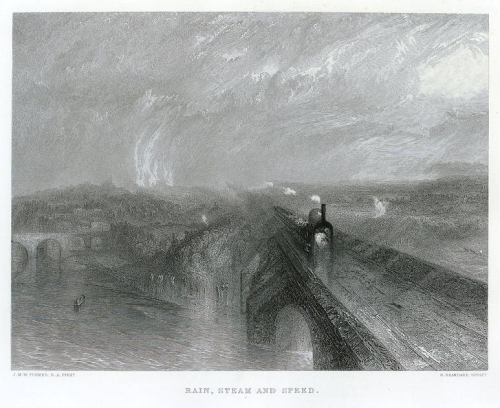
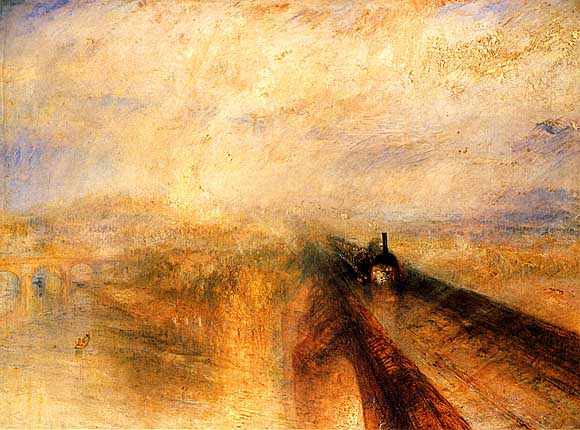
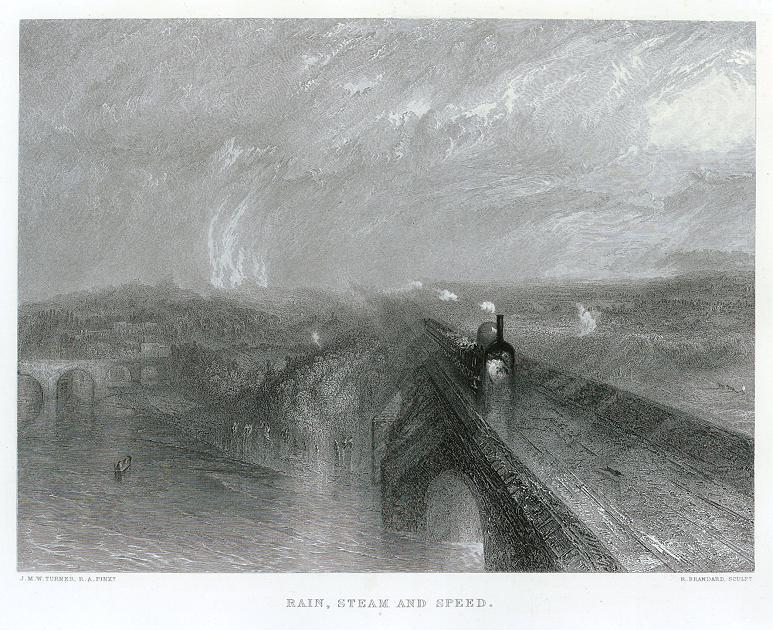
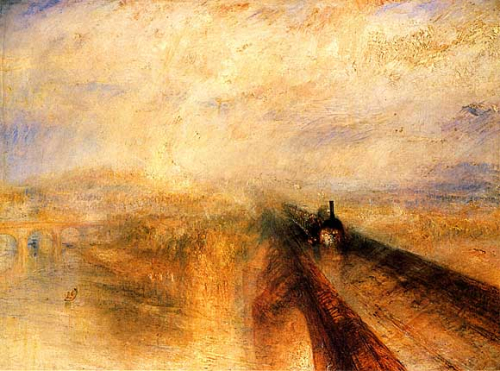
    And as an aside, Turner does get “cleaned up” in a way, when his artwork appears as engravings. There is of course much more definition given the scene as the engraver puts in hard lines on the soft non-edges of the original. For example, here we have “Rain, Steam, and Speed”:

    Before:
    Rain_Steam_and_Speed_The_Great_Western_Railway_1844

    After:

    Rain_Steam_and_Speed_The_Great_Western_Railway_1844

    The “after” version here is actually much more representative of the original than generally found in Turner engravings. 

    Anyway there’s nothing that quite takes the “impression” out of “Impressionism” than cutting a hard line of it in a steel plate.  

    (Again, this is just some outside thinking on the topic, limited to about the timeline of three cups of coffee.  Maybe four.)

    Notes:

    1. “Dr. Liebreich on Turner and Mulready”, Nature, March 21, 1872

    2. Williams, W. Mattieu. “Turner’s Vision”, Nature, 25 April 1872, p 500.
  • Radical and “Socialistic” Ideas of 1939 Mainlined, Mainstreamed, and Main-Streeted

    JF Ptak Science Books  Quick Post

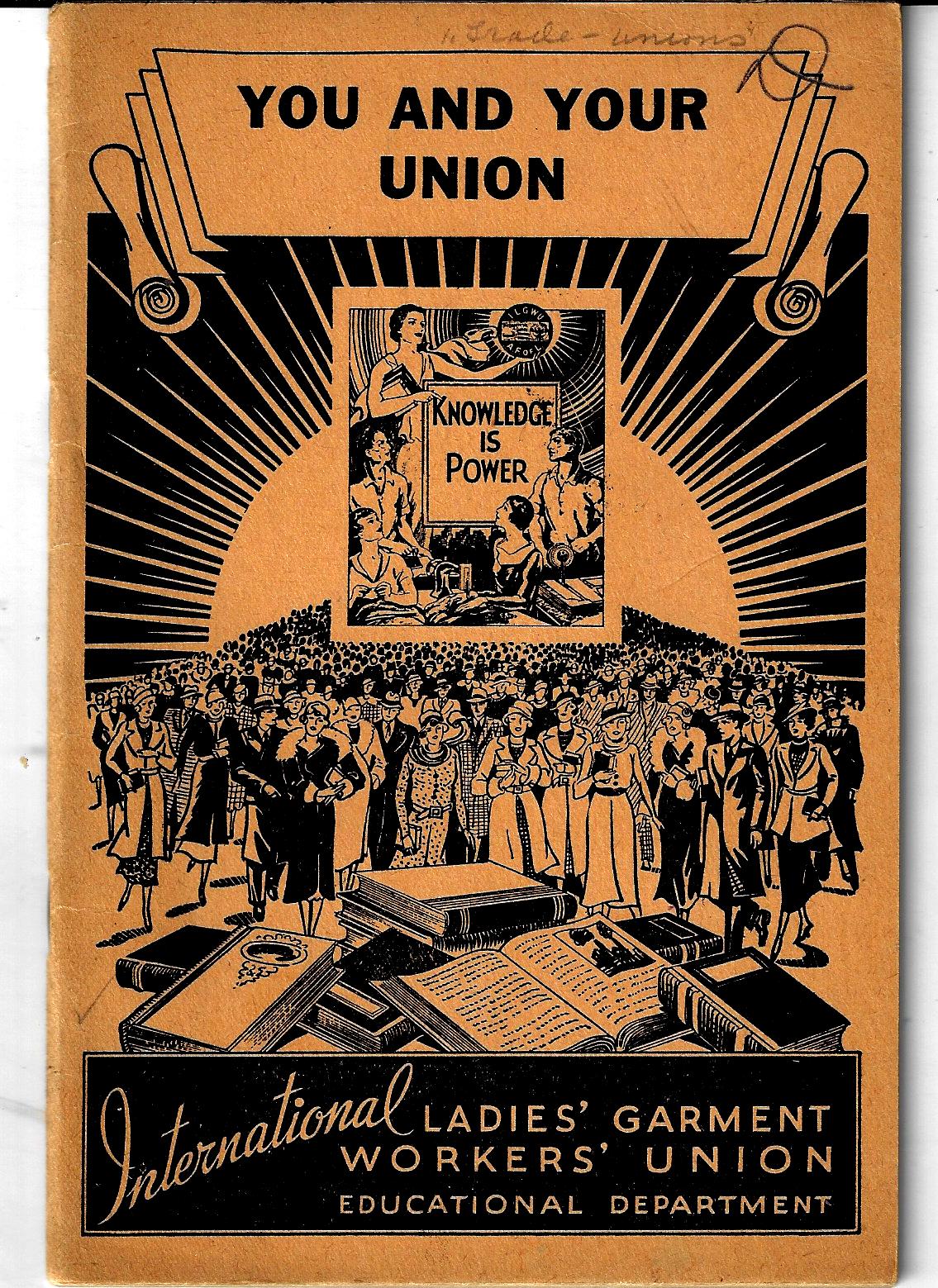
    Books cover ILGWUHere’s another very striking cover for a pamphlet embracing   once-radical semi-socialist pseud-Commie agendas that are today a de rigueur part of our social existence. This is a pro-Union, pro-educational work presented by the International Ladies’ Garment Union (education Department) to its members, getting them up to speed on the major issues of the day. Many of these battles fought by the union were bitterly opposed by industry and (sometimes) the government were for programs and agencies that many take for granted, and something utilized by everyone no matter the political leaning, the bright shining “Socialist” aluminum coating for the future long gone as these programs have become “normalized”.  Some of the issue addressed by the pamphlet were whether or not women could join a union or a labor movement (though 1940 seems a little on the late-ish side for these questions), the necessity of unemployment insurance, social insurance, maternity insurance, old age security, health insurance, and safeguards on the working life of children under 14 years of age.  

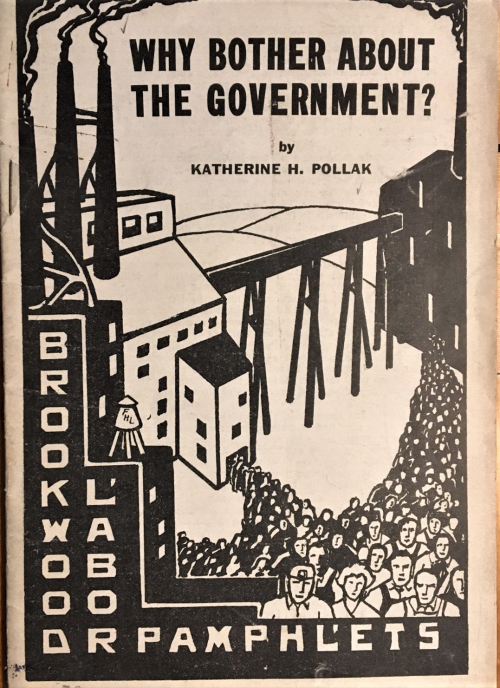
    That, and I also liked the design, the giant parade of women coming from out of the rising Sun.  I’m partial to these mass/crowd images on pamphlet covers–you don’t see them terribly often so when you do the work really stands apart. Here’s another example I wrote about in August 2020, Katherine Pollack’s 1932 Why Bother About the Government, the third installment of the Leftist Brookwood Labor College pamphlet series. It is a bit of a Socratic polemic about the problems and advantages of government, owners of the means of production, workers, and labor organizers…coming down firmly in the square of very-pro forces of organized labor:

    Books covers why bother the government


  • The Beauty of Simple, Tiny Windows (1940)

    JF Ptak Science Books  Quick Post

    Here’s another of my Quiet-Likes in cover design of pamphlets: simple representations of industrial/factory scenes with smoke and windows! This example is the cover of For a Better Tomorrow, published by the State Labor News (East Gay Street, Columbus, Ohio), 1940:

    Books Covers better tomorrow (2)


    ·Posted by :

    ·in:

Recent Posts

Archives

Categories