A Daily History of Holes, Dots, Lines, Science, History, Math, Physics, Art, the Unintentional Absurd, Architecture, Maps, Data Visualization, Blank and Missing Things, and so on. |1.6 million words, 7500 images, 4.9 million hits| Press & appearances in The Times, Le Figaro, Mensa, The Economist, The Guardian, Discovery News, Slate, Le Monde, Sci American Blogs, Le Pont, and many other places… 5000+ total posts since 2008.

  • “Small Target Bombing Probabilities”–Bombing Calculator, 1944

    JF Ptak Science Books  Expansion of an earlier post from  2011 
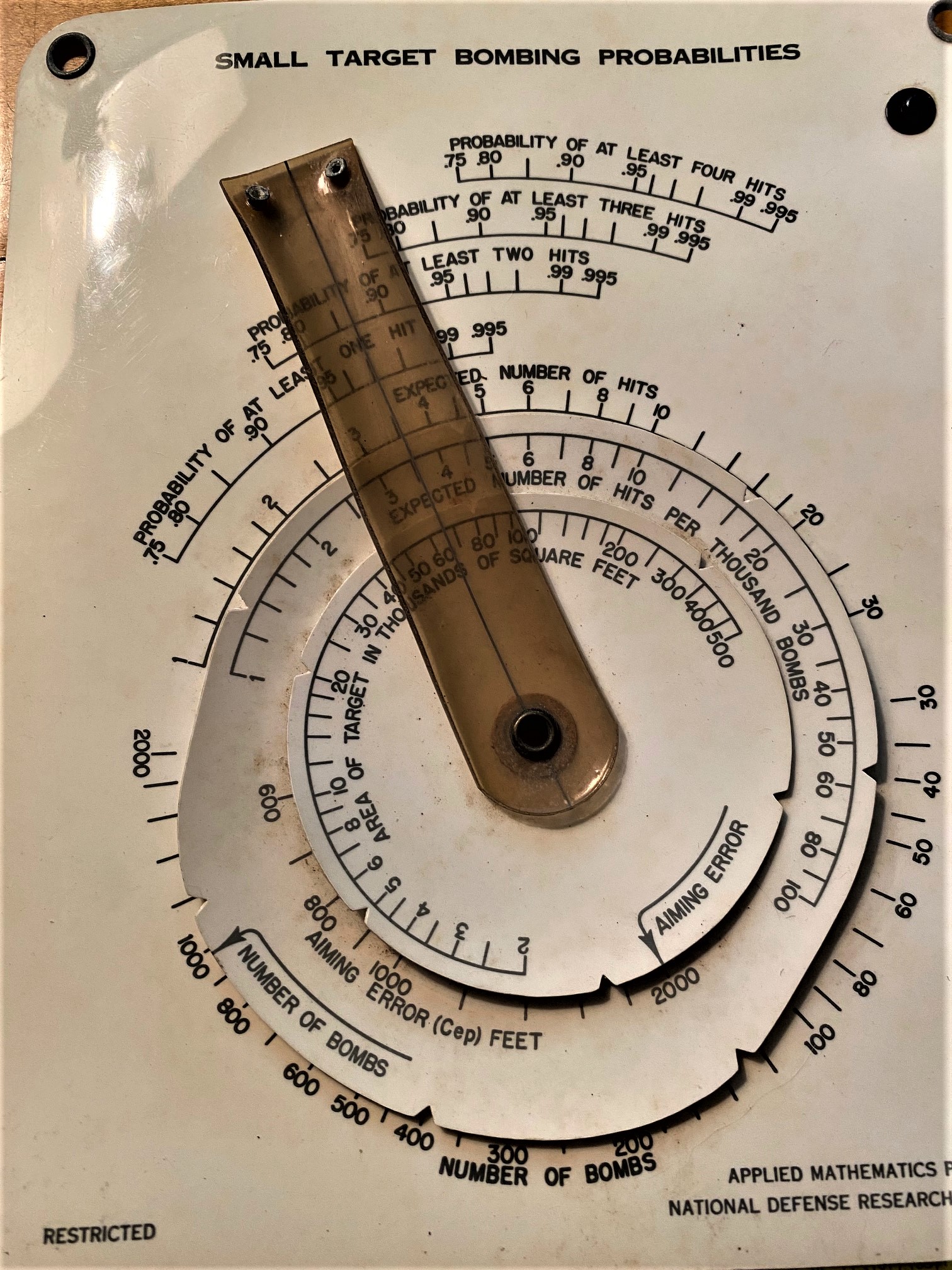
    IMG_5402I found this object in my paper-calculators box (moveable disk calculators made of paper, two going back to  Fr. A. Kircher in the 1680’s)—I’m not sure why it was there as it is not paper, though it is an interesting calculator.

    [Images are greatly expanded in click mode.]

    You can learn or re-learn an interesting lesson from it on bombing accuracy.

    The “Small Target Bombing Probabilities” calculator was issued by the little-known (in the popular sense) Applied Mathematics Panel of the National Defense Research Council (NDRC)1 in the early 1940’s during WWII. 
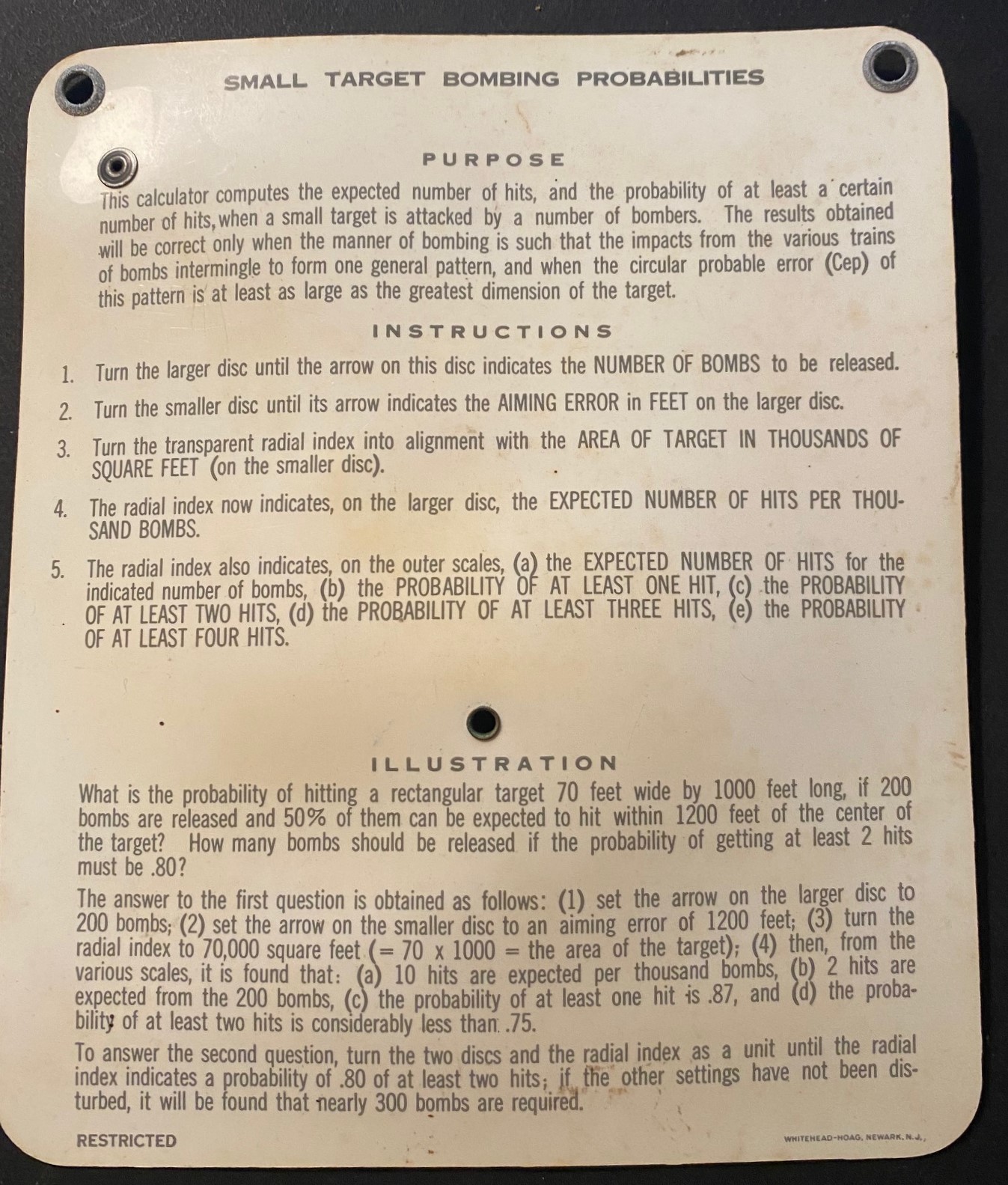
    IMG_5403Marked “Restricted”, it calculated the number of bombs that would successfully be delivered given (1) the number of bombs, (2) the “aiming error”, and (3) target size. It would then generate results for “(a) the expected number of hits for the indicated number of bombs”, (b-e) the probability of at least one hit to four hits.

    What is a little surprising to me was the number of bombs that didn’t find their target. For example, a 65,000 square foot target bombed with 1000 bombs and an aiming error factor of 2000 feet could expect to land 3-4 bombs on the target, with an 88% chance of landing at least two hits, 75% chance of landing three hits, and about 50% of landing at least four hits.  And so the necessity of large numbers of planes dropping a large number of bombs.  

    Notes

    1. The establishment of the NDRC was announced so: “It is announced by Science Service that the following committee has been appointed in the United States to correlate “scientific research on the mechanisms and devices of warfare”: — Nature 146, 191-191 (10 August 1940).

    “Members included: Dr. Vannevar Bush (chairman), president of the Carnegie Institution of Washington, formerly dean of the faculty of engineering at the Massachusetts Institute of Technology; Prof. Richard C. Tolman (vice-chairman), dean of the graduate school and professor of physical chemistry and mathematical physics at the California Institute of Technology; . Dr. Irvin Stewart (secretary), formerly Federal Commissioner for Communications and chairman of the Committee on Scientific Aids to Learning; Rear Admiral Harold G. Bowen, director of the Naval Research Laboratory, Anacostia, D.C.; Conwiy P. Coe, U.S. Commissioner of Patents; Dr. Karl T. Compton, president of the Massachusetts Institute of Technology, formerly professor of physics at Princeton University; Dr. James B. Conant, president, formerly professor of organic chemistry, Harvard University; Dr. Frank B. Jewett, president of the Bell Telephone Laboratories; Brigadier General G. V. Strong, assistant chief of staff, U.S.”
    ·Posted by :

    ·in:

    — —
  • Gliding Flight and The Seventh Seal (1897)

    JF Ptak Science Books  Quick Post (Overall Post 5123)

    Science heavyweight and Nature editor and founder J. Norman Lockyer wrote in 18971 a three-page summary of the recent experimental work of aviation pioneer Percy Pilcher. Mr. Pilcher (1866-1899) was rather more than a “pioneer”–he was an inventor and perhaps Great Britain’s premier experimentalist and visionary in flight at the end of the century—and made significant contributions towards understanding flight dynamics, though he would not live out the century, fatally crashing in a glider flight that was leading towards the launching of a powered glider of his own design.

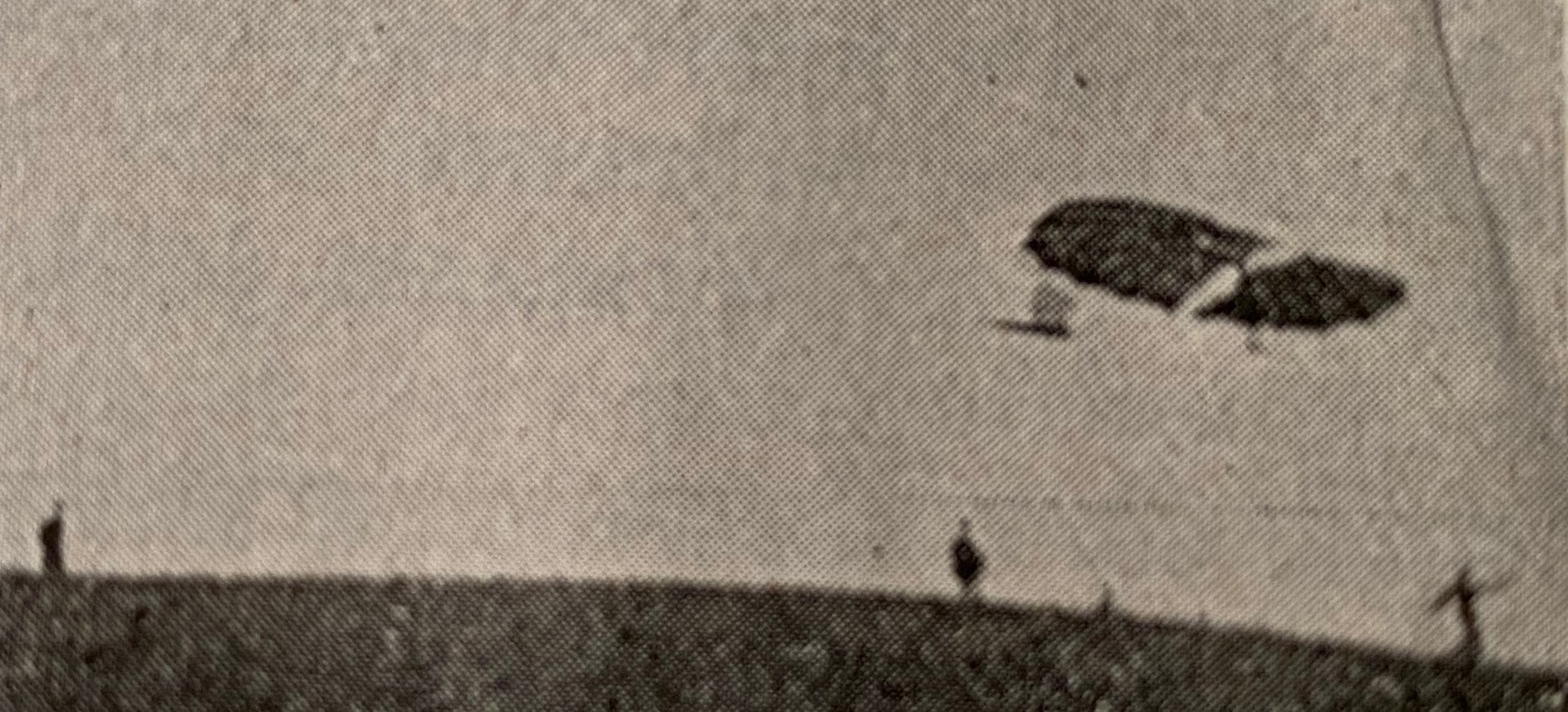
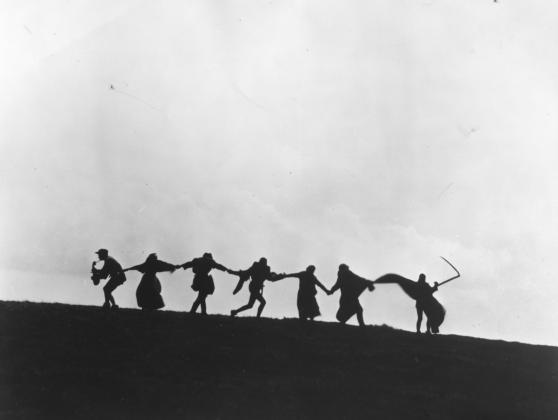
    The article was accompanied by a seven-part rapid-photo series of Pilcher in flight, and what caught my eye in this series were the small figures on the rolling hill under the glider. Enlarging the image quite a bit (the originals in Nature shows figures only 3mm tall) brings proto-post-Swedish-noir to mind, especially the very animated figure on the right and  particularly for a famous scene from Bergman’s Seventh Seal (1957):

    IMG_4836

    Bergman_Seventh-Seal_001_o3


    Notes:

    Sir J. Norman Lockyer (1836-1920), long-time experimentalist/instrumentalist/theoretician who worked in astronomy and spectroscopy and was co-discoverer of helium (found in the atmosphere of the Sun).

    1. (PILCHER, Percy.) Lockyer, William J. “Soaring Flight”, in Nature, a Weekly Illustrated Journal of Science, 12 August 1897, vol 56 no. 1450, pp 344-346 in the issue of pp 337-360.

    And the full series of photos:

  • Charles Babbage Obituary in “Nature”, November 1871.

    JF Ptak Science Books   Quick Post  Overall Post 5124

    This is a fine and understanding obituary of Charles Babbage--it appeared in Nature on 9 November 1871, just two weeks after 
    the death of the Great Man on 20 October, and I include the article in full below. You'll see that a lot of attention is paid to the
    Difference and Analytical Engines, and how much attention they received from Babbage and how much money the
    government spent on it. It was a failure as a working/practical/applicable enterprise, the writer states (which was true) , but the
    thinking that went into the machines were not. That Babbage didn't see the completion of the computer projects wasn't necessarily
    his fault, and to me seems to say that time will out. The obit writer (Lockyer, the founding editor of the journal?) was positively
    convinced of the clarity and precision of Babbage's thinking and writing, and convinced of his genius.

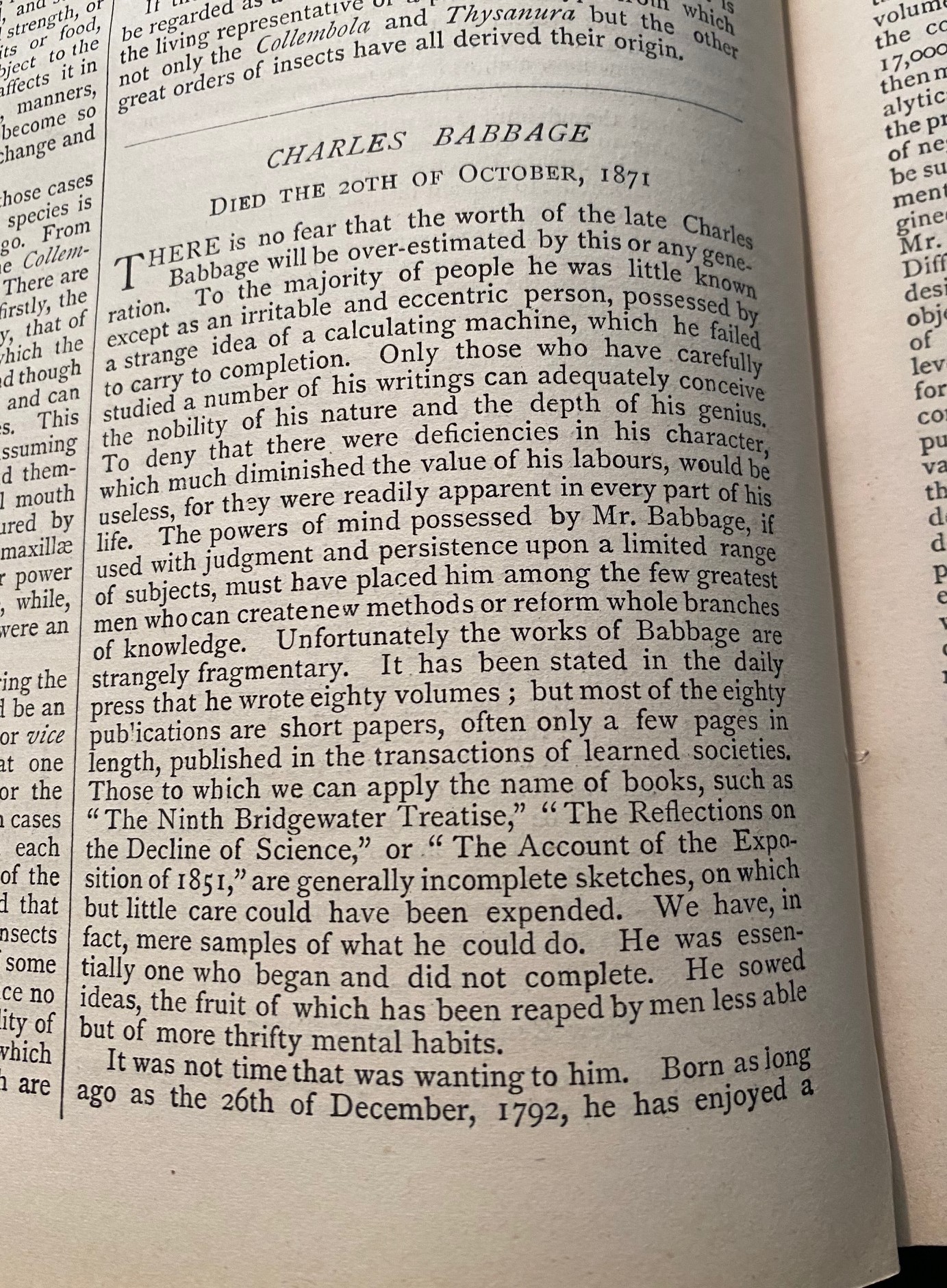
    "THERE is no fear that the worth of the late Charles Babbage will be over-estimated by this or any generation. To the majority of
    people he was little known except as an irritable and eccentric person, possessed by a strange idea of a calculating machine, which
    he failed to carry to completion. Only those who have carefully studied a number of his writings can adequately conceive
    the nobility of his nature and the depth of his genius."IMG_4897
    "Mr. Babbage, relinquishing all notions of completing the Difference machine, bestowed all his energies upon the designs of the
    wonderful Analytical Engine. This great object of his aspirations was to be little less than the mind of a mathematician embodied
    in metallic wheels and levers...Nothing but a careful study of the published accounts can give an adequate notion of the vast
    mechanical ingenuity lavished by Mr. Babbage upon this fascinating design. Although we are often without detailed explanations
    of the means, there can be little doubt that everything which Mr. Babbage asserted to be possible would have been theoretically
    possible."

    IMG_4899
    "The engine was to possess a kind of power of prevision, and was to be so constructed that intentional disturbance of all the loose
    parts would give no error in the final result."
    "Although for many years Mr. Babbage entertained the intention of constructing this machine, and made many preparations, we
    can hardly suppose it capable of practical realisation. Before 1851 he appears to have despaired of Its completion, but his
    workshops were never wholly closed. It was his pleasure to lead any friend or visitor though these rooms and explain their contents.
    No more strange or melancholy sight could well be seen. Around these rooms in Dorset Street were the ruins of a life time of the
    most severe and ingenious mental labours perhaps ever exerted by man. The drawings of the machine were alone a wonderful result
    of skill and industry; cabinets full of tools, pieces of mechanism, and various contrivances for facilitating exact workmanship,
    were on
    every side, now lying useless."

    Read the rest of the obituary:
  • Found Poetry in Lost Plankton (1930)

    JF Ptak Science Books   Quick Post   Overall Post 5125

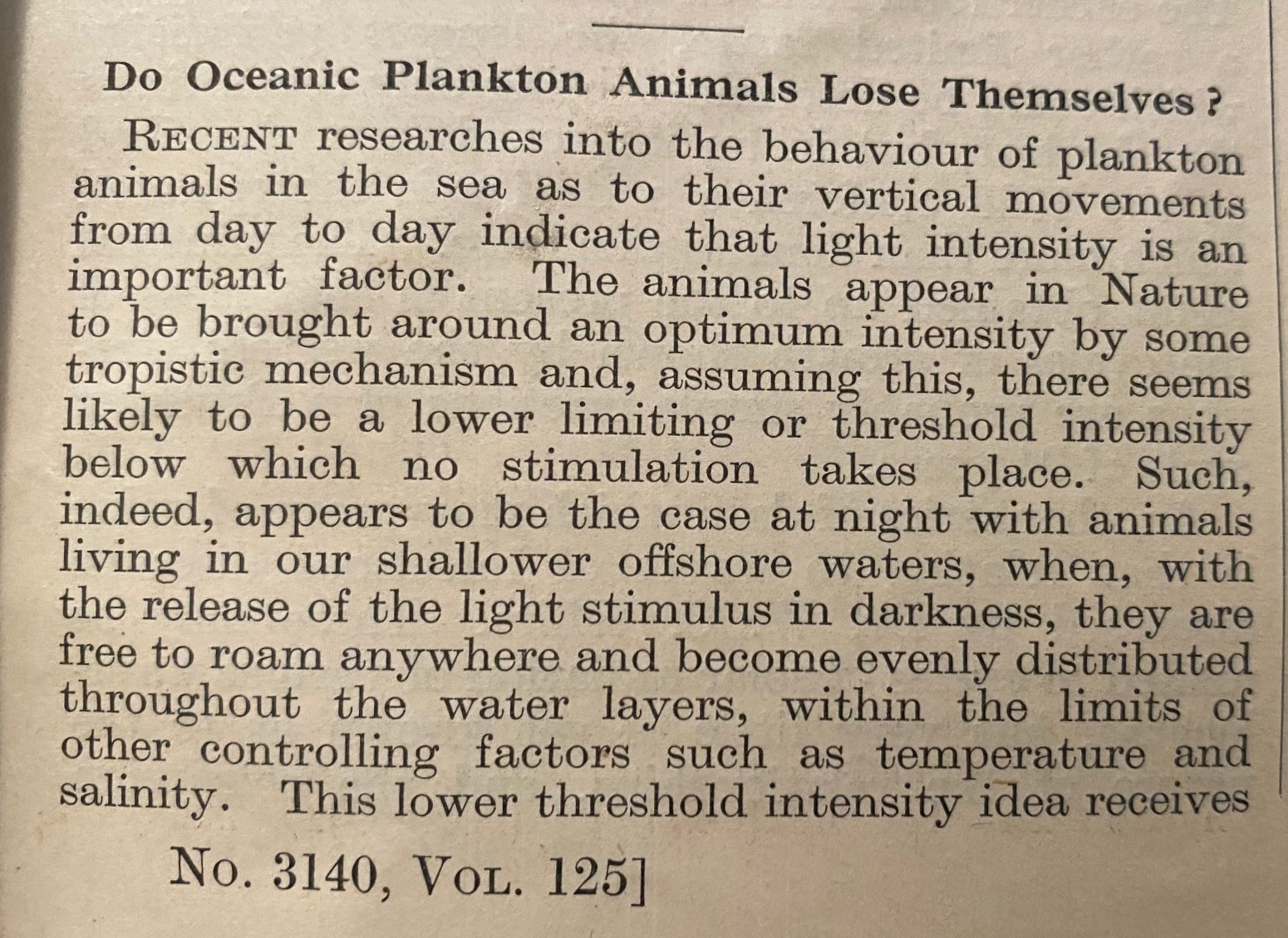
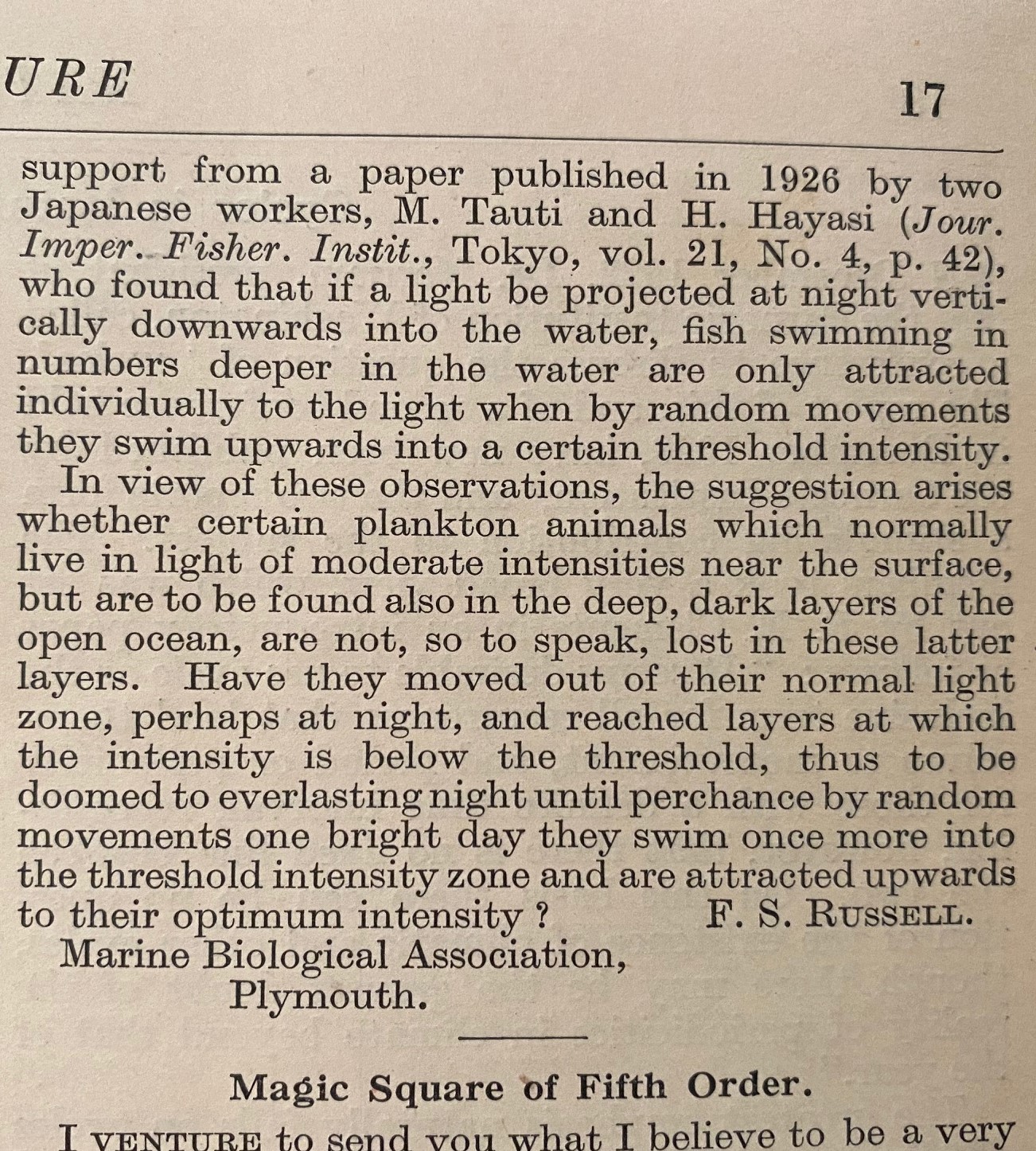
    IMG_5066Over on my blog I’ve made a number of posts on “Found Poetry”–phrases and constructions of interesting structural images that when removed from a narrative form and subjected to a different display find a sort of light art form in themselves. The phrases and sentence are in their original order—spacing and delineation have changed a bit to focus their attractiveness. There have been posts on “Found Poetry” in the (sometimes very extended) titles of Renaissance books, recipes and instructions on cooking dainty sardines, a disintegrating machine from 1877, descriptions of clouds from 1726, and well, you get the picture. “Found art is where you don’t find it”, as M. Duchamp didn’t say—sometimes the found poetry is pretty obvious, sometimes not. Today’s entry has a terrific title, though the text lets us down a little, but then closes up very strong in the last paragraph. And so, from Nature, 4 January 1930, volume 125, no. 3140, the last sentences of the last paragraph:

    “Do Ocean Plankton Animals Lose Themselves?

    Have they moved out of their normal light,

    and reached layers at which the intensity

    is below

    the threshold, thus to be doomed

    to everlasting night until perchance by random movements

    one bright day

    they may swim once more

    into the threshold intensity zone

    and attracted upwards

    to their optimum intensity?”

                –F.S. Russell, Marine Biological Association, Plymouth

    IMG_5067

  • “Euphonium”: Found-Poetry of Recorded Soundwaves (1897)

    JF Ptak Science Books  Quick Post –Overall Post 5122 (Part of the History of Lines series)

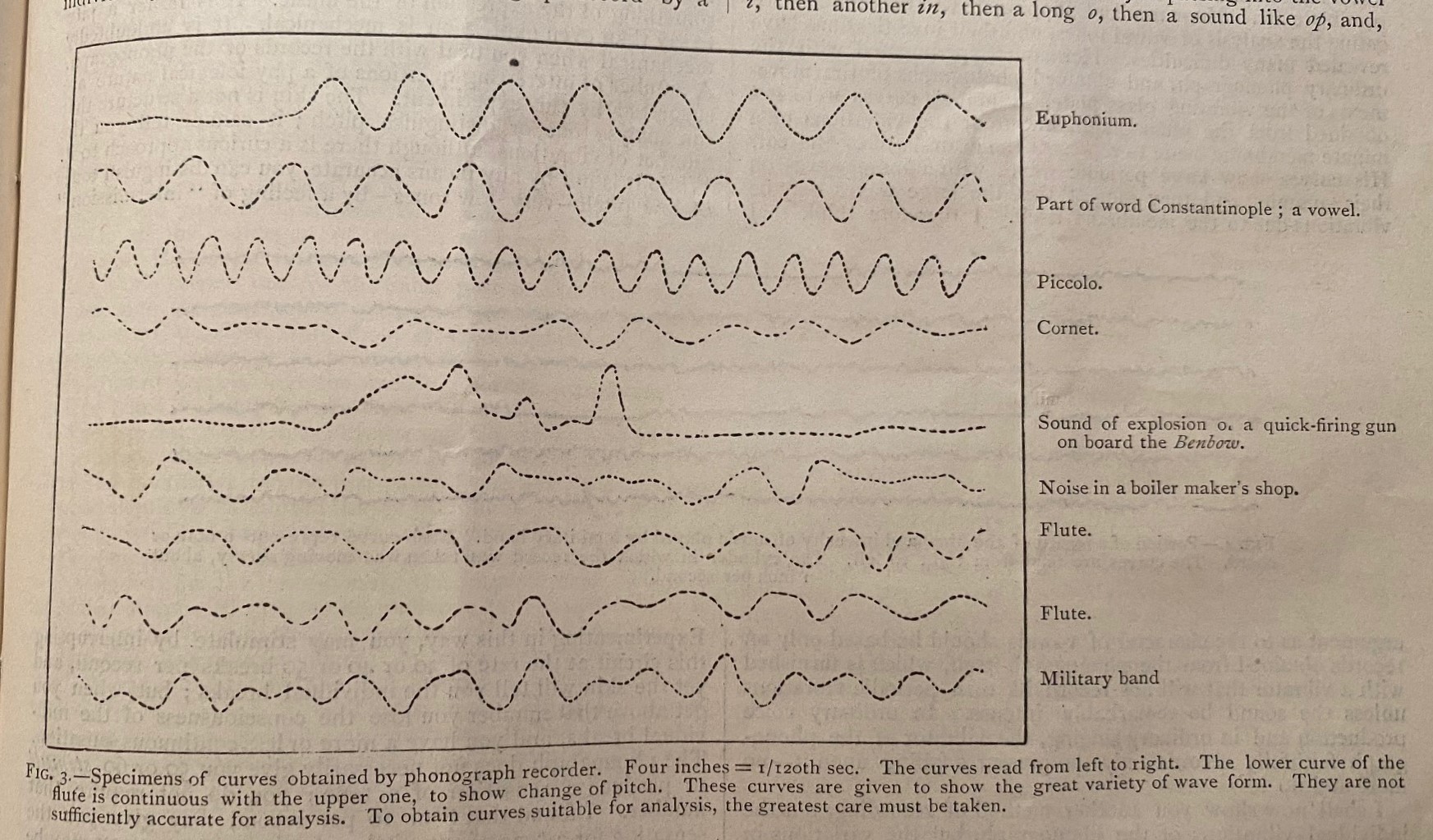
    IMG_4854John McKendrick had a long scientific career, with a  lot of very widely-spaced interests on which he wrote well and often.  What caught my eye on this piece (“The Analysis of Phonograph Records”, in Nature, a Weekly Illustrated Journal of Science, volume 56 no. 1444, 1 July 1897, pp 209-213 in the issue of pp 193-216)–I mean, aside form its wonderful content–was a bit of found poetry in one of the paper’s illustrations.  McKendrick’s—professor of physiology at Glasgow—effort here is one of the early attempt studying graphic records of soundwaves specifically prepared on phonographic cylinders, looking for variations in the graphics of pitch and the meaning they convey. Fascinating results.  

    EUPHONIUM (1897)

    Euphonium,

    Part of a word Constantinople, a vowel,

    Piccolo

    Cornet

    Sound of explosion or a quick-firing onboard the Benbow.

    Noise in a boiler makers group.

    Flute.

    Flute.

    Military band.

  • On Flying Machines–Scientific American, 1848

    JF Ptak Science Books  Quick Post   Overall Post 5120

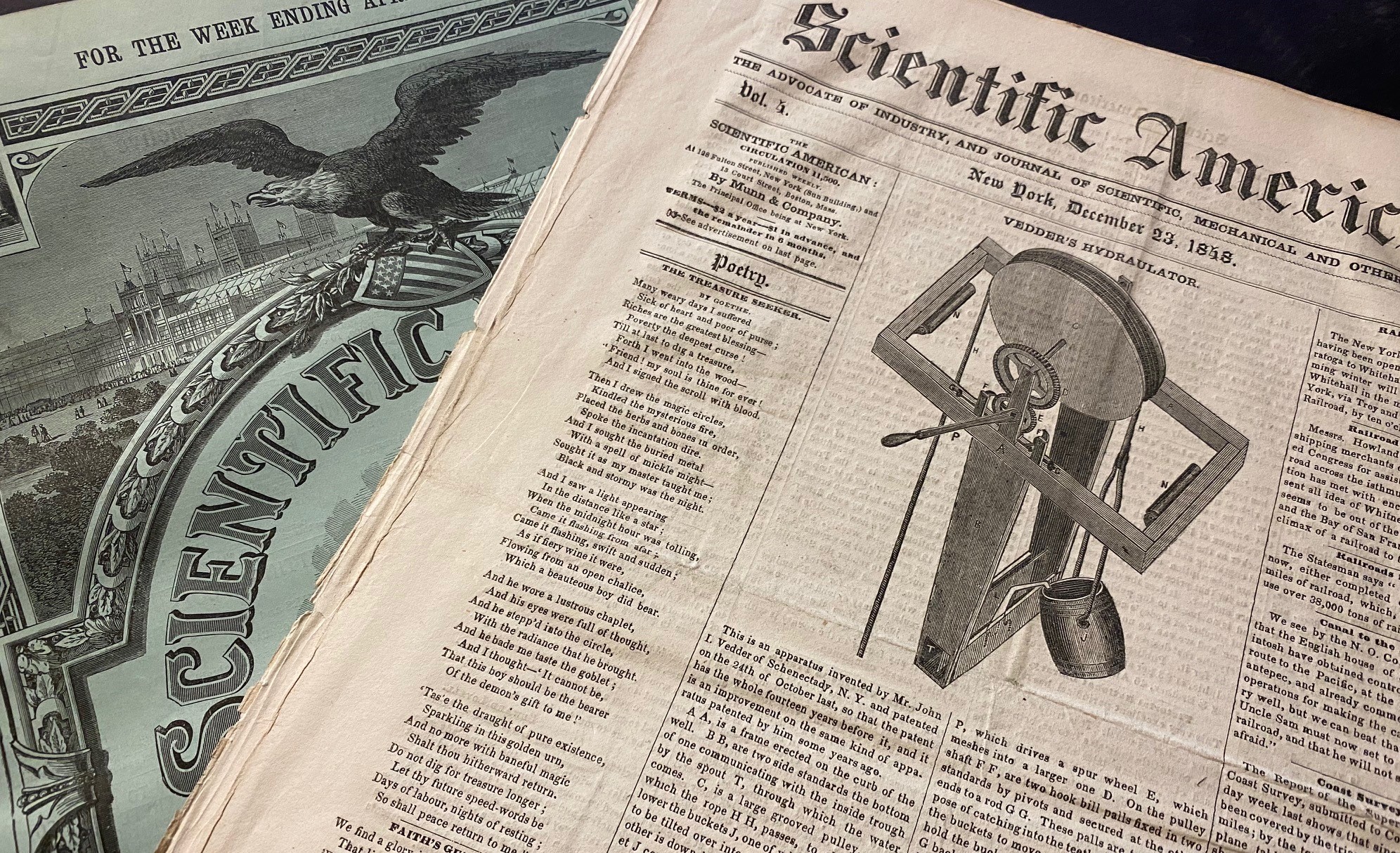
    I found a short article on human flight (“Flying Machines”) in the fourth volume of Scientific American (1848).  It is an interesting and occasionally predictive piece that saw a bit into the future, well past the contemporaneous failures and iron-punk possibilities of sky machines, into a place of “mathematical certainty.  The writer saw the possibility of heavier-than-air flight, only just not in 1848 (or any time soon). “The air furnishes a vast fund of power for the use of mankind, although as yet they have only used it to propel ships and wind-mills. We live in an age of great discoveries and improvements, and among these will certainly be ranked the navigation of the air.” 

    And so some snippets from the article: 

    “Flying Machines and Perpetual Motions are very old and unfortunate acquaintances. No people have invented so many as the Germans, and many a poor fellow has lost his life by his fool hardy confidence in some machines he had invented to ride upon the winds, yet for all the accidents that have taken place to high flyers, from the Dutch Doctor at Ratisbone in 1692 to the unfortunate Englishman who perished a few years ago in London when descending by a parachute, there are still to be found new flying machines coming out every few months. An Austrian made quite a fine display in Cremone Gardens, London last winter, by taking several long jumps with a steam flyer. Since that we have heard no more about it, and presume it has met the fate of its illustrious predecessors…

    IMG_3864 (1)

    “But the end of flying machines is not yet, and here we insert the description of a new and an original one certainly, taken from the Jacksonian published at Pontiac, Michigan… After describing how wings had been tried to beat the lark and eagle, he says:—“As wings then, have failed, and balloons been attended with no better success, men have begun to think that the end is unattainable, and that flying is a victory which man can never achieve.”

  • The New Speed of Information, 1846

    JF Ptak Science Books  Quick Post   Overall Post 5121

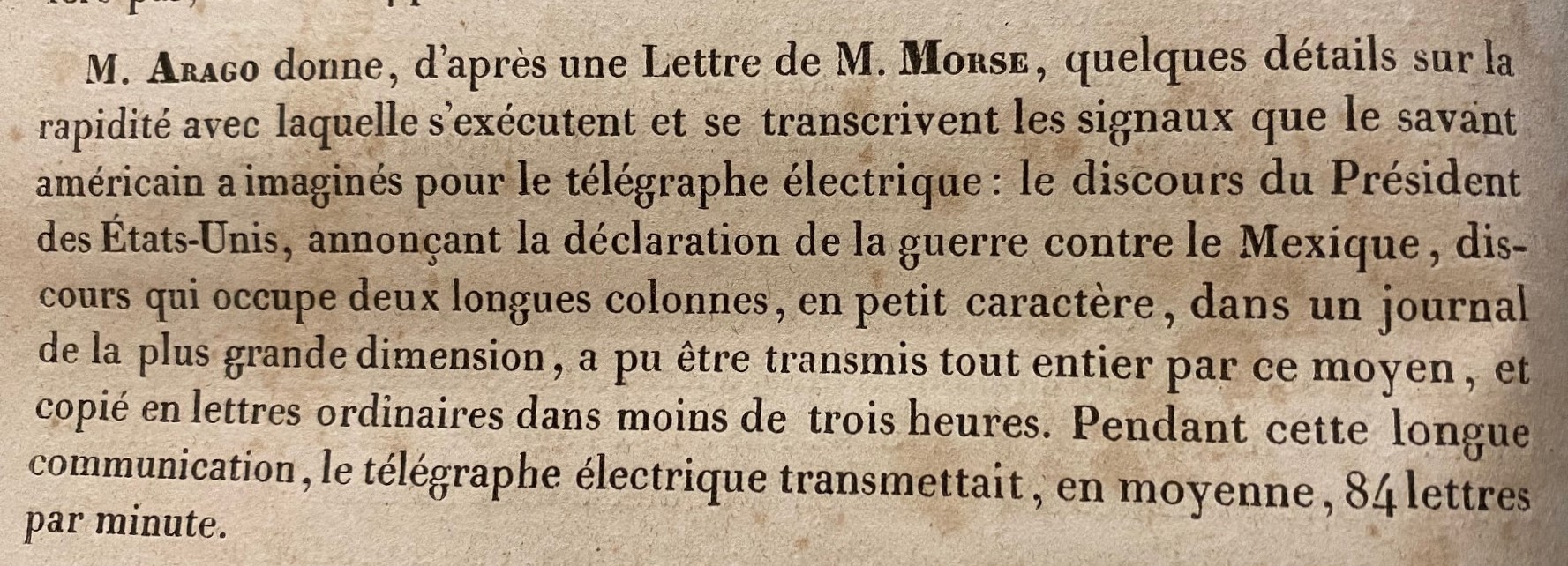
    Here’s probably an obscure bit on the coming of a very large change in journalism and the dispersion of information: a short announcement of the use of the electric telegraph in the rapid reporting of war news. The notice appeared in the Compte Rendu des Seances de l’Academie des Sciences 15 June 1846 (volume 22 no. 24, p 1004), and it is communicated to the Academie by Francois Arago, and runs for only about 100 words. Arago mentions how quick the operation of the electric telegraph was (citing our Mr. Morse), basically drawing attention to this new mode of data dispersal. He uses the example of the speech of the U.S. President (James Polk) on the new Mexican-American War, which was begun 25 April 1846, just weeks earlier than this report was published. Arago doesn’t mention the very dramatic spread of telegraphy lines and far-reaching nodes that blossomed in the U.S. Earlier in 1846…maybe he didn’t know of them, yet. What he does talk about is the astonishing bit of the Polk’s war address being disseminated so quickly—evidently the whole thing was transcribed and telegraphed in three hours. That seems today to be quite glacial, but this was done at a time when news was coming by packet steamer, Pony Express, and the U.S. Post by horse and wagon. To be suddenly able to disseminate news from Washington DC to Richmond and Albany and NYC and Boston all in a matter of hours from Morse to text was really quite astonishing.

    CR graze  15 June 1846 arago morse

  • “The Fine Sport” of Flying, 1893.

    JF Ptak Science Books    Quick Post (Overall Post 5117) 

    Lillienthal

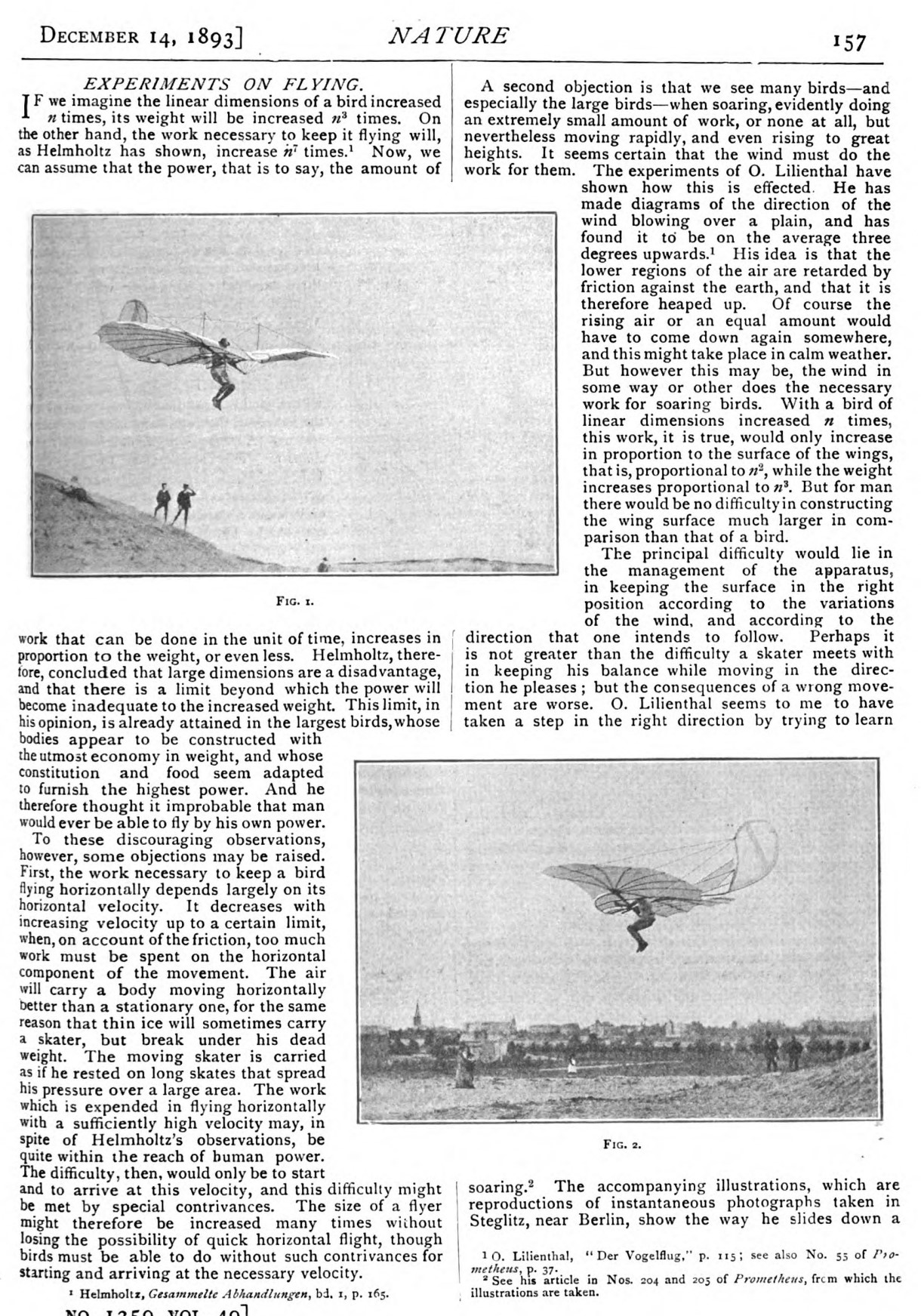
    I found an interesting article in Nature1 just now,  a piece by Carl Runge on 19th century heavier-than-air human flight by the remarkable Otto Lilienthal. 

    Lilienthal was an international authority on human flight, and was known to many as The Flying Man, and The Father of Flight, because, well, he flew. And he flew more often and with more recorded/documented successes in his non-powered flying machines than any other aviation pioneer of the time. In fact, he had a major influence on the Wright brothers (though not necessarily for his experimental data, which they abandoned after a while to create their own in their wind tunnel), with Wilbur Wright saying: “Of all the men who attacked the flying problem in the 19th century, Otto Lilienthal was easily the most important. … It is true that attempts at gliding had been made hundreds of years before him, and that in the nineteenth century, Cayley, Spencer, Wenham, Mouillard, and many others were reported to have made feeble attempts to glide, but their failures were so complete that nothing of value resulted.” (From the Wikipedia article on Lilienthal.)

    Lilienthal was well into making  successful jumps/flights by this time, but would suffer his fatal fall in about two more years, dying August 10, 1896, after a series of 850′ flights. (I’m offering a later paper on Lilienthal, also available on ABE, from Nature for 12 December 1894.)

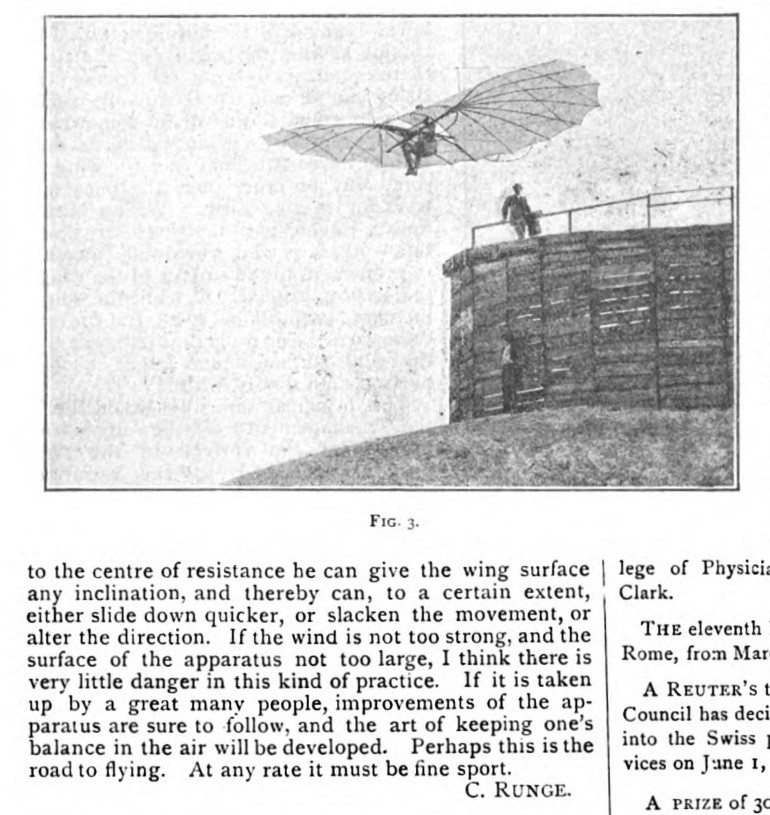
    The last three sentences by Runge are remarkable:

    “If it [flying or attempting to do so]  is taken up by a great many people, improvements of the apparatus are sure to follow, and the art of keeping one’s balance in the air will be developed. Perhaps this is the road to flying. At any rate it must be fine sport.”

    Notes:

    1. (LILIENTHAL, Otto). Runge, C. “Experiments on Flying”, in Nature, a Weekly Illustrated Journal of Science, 14 December 1893, volume 49 no. 1259, pp 145-168, with the Runge article on pp 157-8, with three photo illustrations of Lilienthal in flight.

    Lillienthal _2_

  • Found-Poetry in a Technical Work on Bubbles (1896)

    JF Ptak Science Books  Quick Post   (Overall Post 5118) 

    Bubbles “The water of those wellis sprynge vp with grete bobles.”–W. Caxton tr. Myrrour of Worlde ii. xxi. sig. h4   OED

    Rummaging again through the eminently-rummagable early years of Nature1 I found a lovely little article on the physics of bubbles. The language to me seems delightful, and it comes from the first part of a very long opening paragraph of the paper:

    “He has studied the behaviour of big bubbles and of little ones,

    of bubbles in large and small tubes,

    of bubbles of air in a liquid,

    and of one liquid in another,

    of bubbles in heavy land in light liquids,

    of bubbles in liquids of various degrees of viscosity

    and with various degrees of surface tension at their surfaces.”

    • [IMAGE: “THAUMATROPE for showing the formation and oscillation of drops.” From C.V. Boys’ Soap Bubble and the Forces Which Mold Them, 1896.]

    In spite (or because of) the fact that bubbles are serious things, they are wonderfully named and as C.V. Boys points out in his fantastic Soap Bubble and the Forces Which Mold Them (1896), they are as magnificent as they are simple: “I do not suppose that there is any one in this room who has not occasionally blown a common soap-bubble, and while admiring the perfection of its form, and the marvelous brilliancy of its colours, wondered how it is that such a magnificent object can be so easily produced”.

    Bubbles have a long history in experimental physics2 and continue to work their magic today–when I googled this title I came up with only three pages of hits, including the following, which in their own little way beg to be read:

    • “Film thickness measurements in liquid–liquid slug flow “
    • “Effects of Bubbles on the Hydraulic Conductivity of Porous Materials “
    • “Bubble deformations and segmented flows in corrugated microchannels at large capillary numbers “
    • “Bubble transport through constricted capillary tubes with application to resin transfer molding”
    • “Transport of bubbles in square microchannels”
    • “Step-Wise Velocity of an Air Bubble Rising in a Vertical Tube Filled with a Liquid Dispersion of Nanoparticles”

    From the 1894 article:

    “EVERY student of physics has observed the motion of bubbles in tubes. Which of them has not used a big bubble to show the little ones their duty in clearing out the air when filling a barometer tube? Who has not spent his time and patience in whisking a spirit thermometer to drive a bubble out of the column? Mr. Trouton has recently communicated to the Royal Society the result of some researches on this subject. He has studied the behaviour of big bubbles and of little ones, of bubbles in large and small tubes, of bubbles of air in a liquid, and of one liquid in another, of bubbles in heavy land in light liquids, of bubbles in liquids of various degrees of viscosity and with various degrees of surface tension at their surfaces. From this enumeration it is evident that the number of different magnitudes involved is very great, and at the start it seemed almost hopeless to disentangle the effects due to each. The first matter to observe was that, as in other cases of fluid motion, two cases must be distinguished. These are the cases of slow motion and of quick motion. When the motion is slow the viscosity of the liquid causes the flow to be very simple. It entirely stops all whirling and swirling, such as is seen in the water behind a boat. When the motion is quick, on the other hand, the flow is very complicated. Whirls and swirls are set up, and the resistance is increased, owing to the increased energy that has to be communicated to the whirling and swirling liquid for each centimetre that the bubble moves. The slow kind may be described as viscous flow, and the quick as turbulent flow. The most interesting point observed in connection with the turbulent flow was that it was sometimes possible to increase the rate of flow by increasing the viscosity…”

    Notes:

    1. “On the Motion of Bubbles in Tubes”, in Nature, a Weekly Illustrated Journal of Science, 8 February 1894 (vol 49 no. 1267)/ I should point out that Nature back then was almost entirely readable by almost anyone—nowadays of course it is a vastly different story; I stopped my subscription a while back when I found out that I wasn’t understanding even the titles of some of the papers….

    2. “I have freely made use of the published work of many distinguished men, among whom I may mention Savart, Plateau, Clerk Maxwell, Sir William Thomson, Lord Rayleigh, Mr. Chichester Bell, and Prof. Rücker. The experiments have mostly been described by them, some have been taken from journals, and I have devised or arranged a few. I am also indebted to Prof. Rücker for the use of various pieces of apparatus which had been prepared for his lectures.”–C.V. Boys, Soap Bubble and the Forces Which Mold, 1896.

    Front“Experiment for showing by intermittent light the apparently stationary drops into which a fountain is broken up by the action of a musical sound.”–from the Boys book.  

  • The Not-Unbearable Extra-sub-Heaviness of Light (1876)

    JF Ptak Science Books  Quick Post (Overall post 5119)

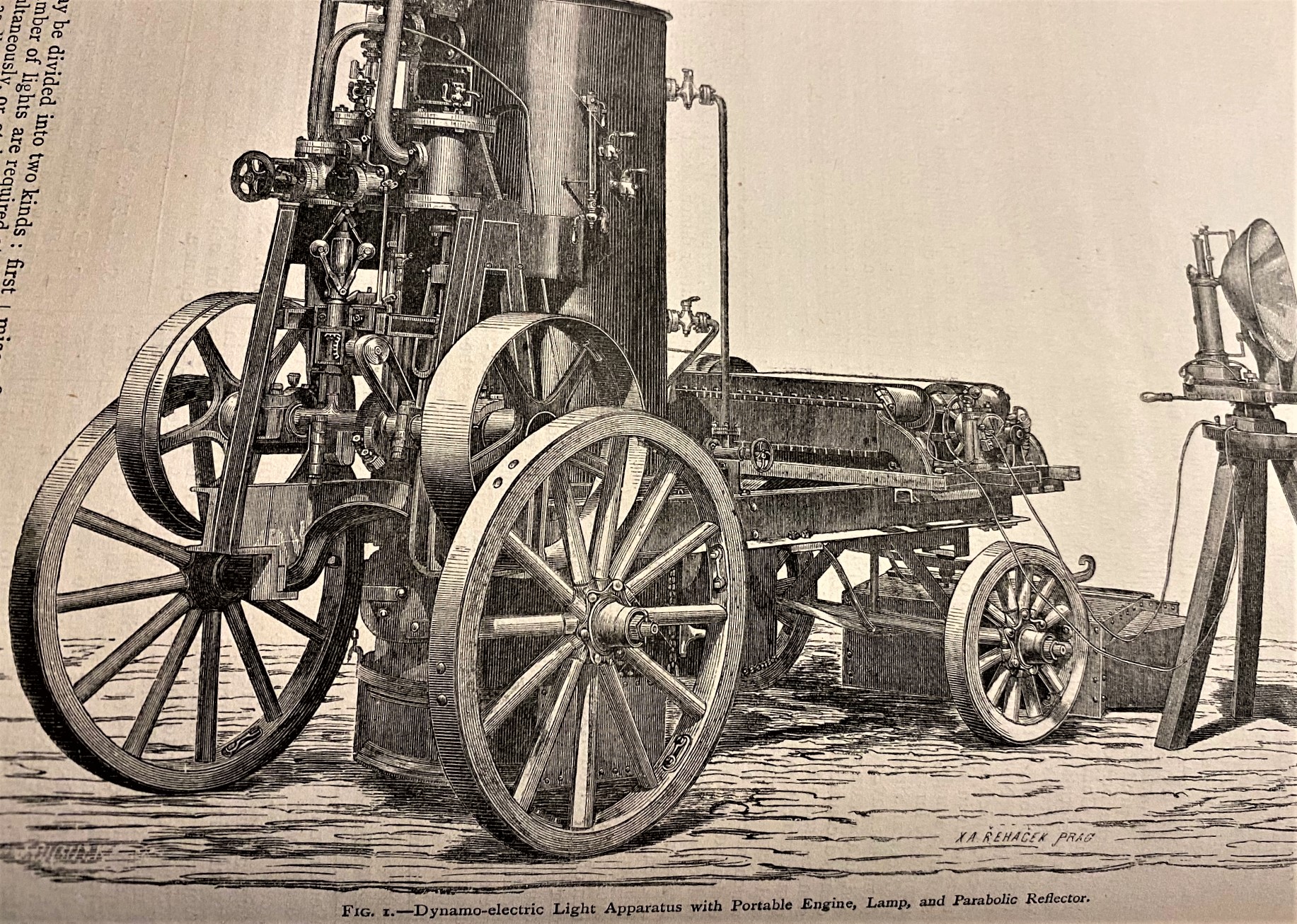
    I thought it would be interesting to share this engraving of a portable electric light apparatus. This does come very early in the modern (post 1850) sense of “electric light”, but, still, even knowing of how early this is in this fiel dit is still a little shocking to see the weight of the engineering and ingenuity in providing mobile electric light.  

    • “THE comparatively infrequent employment of electric light, considering the great success achieved in its production, would at first sight appear to be due to something in the application of the electricity itself. It has been repeatedly and satisfactorily proved that a continuous and powerful light can be produced by electricity, and the question naturally arises, Why is it not more frequently employed for practical purposes?”
    • “For transportation of the Dynamo-electric Light Apparatus is mounted on a wagon, with steam engine, the whole weighing 4,960 lbs. The combination has proved very serviceable on account of its lightness and compactness.”– Siemens’ Electric Light Apparatus. Nature 14, 133–136 (1876).

    IMG_3381


  • Resistance in Czechoslovakia, 1943 (Full Reprint of Scarce Pamphlet)

    JF Ptak Science Books  Quick Post (reprint series) Overall Post #5119

    Youth of Czechoslovakia1 was a Czech-in-exile response to the situation in the country as it stood in 1943. The situation of course was critical, and the compiler of the work, F.L. Lowidt, chronicles the state of the affairs from the end of the First World War to the occupation sometime late in 1943.  About half of the work concentrates on the war period following “the fatal policy of Munich” and the “sacrifice” of Czechoslovakia to impossibly placate Hitler.  It is a very interesting document, and as there are only a half-dozen or so located by WorldCat in libraries worldwide, I’m reproducing it here.  Of special note are the four pages or so dealing with children and the youth being used for “forced labor in Hitler’s war machine”, the “martyrdom of youth”, and the resistance movement.  

    Notes

    1. LOWIDT, F.J. (compiler); artwork by W. Slosser. Youth of Czechoslovakia. Published by the Czechoslovak Youth Committee, London (and printed by Dugdale Printing, Ltd.).[1943] No date stated but WorldCat (which locates only six copies) believes it to be 1943. My copy–a Library of Congress duplicate–has a cataloguer’s pencil notation for being received on 6 March 1943.  


    Czech _11_

    ·Posted by :

    ·in:

Recent Posts

Archives

Categories